# MicroCapClub
> A vetted community of 250+ experienced microcap investors. 350+ multibagger stocks profiled since 2011. Free research, education and newsletter.
Public Ghost content for AI and LLM tooling. This file includes a bounded export of public pages first, then recent public posts.
Append `.md` to any post or page URL to get the content in Markdown (for example, `/example-post.md`).
## Pages
### About MicroCapClub
URL: https://microcapclub.com/about/
Last updated: 2026-09-04T13:45:34.000Z
## MicroCapClub is the best idea generator, collaboration, and networking resource in the microcap space.
MicroCapClub is an exclusive forum for experienced microcap investors to share and discuss microcap companies (sub $1 billion market cap) trading on global markets. Since 2011, our members have profiled 1400+ microcap companies, 350+ have turned into multi-baggers. Investors can join our community by applying to become a member or subscribing to gain instant access. MicroCapClub was founded by full time microcap investor [Ian Cassel](https://microcapclub.com/about/microcap-experts/).
Peter Lynch said: *“The person that turns over the most rocks wins the game”*, and this is what we do on MicroCapClub.
- Since 2011, our members have profiled 1,400+ global microcap companies.
- Since 2011, our members have profiled 300+ microcap companies that have doubled or more since they were profiled through the end of August 2023.
- Since 2011, our members have profiled 196 companies that have gone on to be acquired.
Here is an Introduction to MicroCapClub that will give you a background, overview, and tour of MicroCapClub.
## Why MicroCap?
A Microcap is a public company with a market capitalization less than $500 million. The microcap arena has historically been a breeding ground for undiscovered and misunderstood companies. Warren Buffett, Peter Lynch, and many other notable investors started their careers investing in microcap companies. Wal-Mart, Netflix, Celgene, Amgen, Intuitive Surgical, Monster Energy, even Berkshire Hathaway were once microcap companies. 446 companies managed to make 1000%+ returns between May 2012 to May 2022\. 87% were microcap companies. There are a bunch of small stocks that will 10x over the next 10 years that are waiting to be found. Institutions can't buy them because they are too small and too illiquid. It is the retail investor’s duty to find the great ones early and collect the reward for doing so. Microcap investing is not without risk. You can reduce risk by focusing on the 18% of microcaps that are profitable and have an actual business.
We created the "Beginner's Guide to Researching MicroCap Stocks" as a tool to help you start the journey.
### Terms of Use
URL: https://microcapclub.com/terms/
Last updated: 2023-10-23T12:43:52.000Z
Modified January 12, 2016
**1\. Introduction, User’s Acknowledgment, and Acceptance of Terms**
MicroCapClub LLC (“MicroCapClub,” “We”) provides MicroCapClub.com (the “Site”) as a service to investors, traders, or anyone who accesses the Site (“You,” “Your,” “User,” “Users”). Your use of the Site or any MicroCapClub product or service is expressly conditioned upon your acceptance of these Terms of Use including our Privacy Policy (“Terms”).
YOU AGREE TO BE BOUND BY THESE TERMS BY REGISTERING ON, VIEWING OR USING THIS SITE. IF THESE TERMS ARE NOT ACCEPTABLE TO YOU, PLEASE LEAVE THE SITE IMMEDIATELY. IF FOR ANY REASON YOU ARE DISSATISFIED WITH THE SITE, OR ANY SERVICE, PRODUCT, CONTENT, OR OTHER INFORMATION AVAILABLE ON OR THROUGH THE SITE, YOUR SOLE REMEDY IS TO CEASE USING THE SITE AND/OR PARTICULAR SERVICE OR PRODUCT. YOUR AGREEMENT WITH MICROCAPCLUB REGARDING THESE TERMS BECOMES EFFECTIVE IMMEDIATELY UPON YOUR REGISTRATION, ACCESS TO, OR USE OF THE SITE.
We may modify, add or delete portions of this Terms of Use or Privacy Policy from time to time in our sole discretion. We will post the updated version on the Site. Your use of the Site or continued receipt of Information constitutes acceptance of such modifications, which shall be effective immediately upon posting on the Site.
**2\. Risks of Information and Use of the Site**
This Site provides information (“Information”) regarding, but not limited to, securities, securities markets and general investment strategies. The Information on MicroCapClub is provided by various sources (“Information Provider,” “Information Providers”) including, but not limited to, members, officers, employees, subcontractors, affiliates, or Users of the Site, and third party providers.
The strategies discussed in the Information are strictly for illustrative and educational purposes and should not be construed as a recommendation to purchase or sell, or an offer to sell or a solicitation of an offer to buy any security. There is no guarantee that any strategies discussed will be effective. The Information provided is not intended to be a complete analysis of every material fact respecting any strategy. The examples presented do not take into consideration commissions, tax implications or other transactions costs, which may significantly affect the economic consequences of a given strategy.
MicroCapClub does not verify or monitor the accuracy, truthfulness, or completeness of any Information provided on the Site by such Information Providers and sent to you in the Information. Said Information may contain opinions, forecasts, or projections of the Information Providers and thus may not be fact. You should consider the motives of any Information Provider and independently verify any Information or claims they provide. MicroCapClub does not endorse any opinion or recommendation by any Information Provider. We do not verify the identity of our Information Providers and thus you should not rely that the identity of any Information Provider is who they say they are.
You specifically acknowledge that MicroCapClub will in no way be held liable for any potential or actual violations of United States laws or applicable state laws, including without limitation any federal or state securities laws, based on Information sent to you by MicroCapClub.
The Information on the Site may contain “forward-looking statements” within the meaning of the Private Securities Litigation Reform Act of 1995\. These statements can be identified by the fact that they do not relate strictly to historical or current facts. Forward-looking statements often include words such as “anticipates,” “estimates,” “expects,” “projects,” “intends,” “plans,” “believes” and words and terms of similar substance in connection with discussions of future operating or financial performance. Any forward-looking statements made speak only as of the date on which they are made and MicroCapClub and its Information Providers are under no obligation to, and expressly disclaims any obligation to, update or alter any forward-looking statements, whether as a result of new information, subsequent events or otherwise.
By using this site, you agree that you fully understand that the stock market, other securities markets, and all financial forums contain implicit and explicit risks. That being acknowledged, understood, and agreed, anyone who directly or indirectly uses the Site and/or Information shall hold MicroCapClub and any of its, members, officers, employees, subcontractors, affiliates, and/or third party providers harmless for any loss, injury, or damage resulting from the usage of the Site or any Information. All Users of the Site, agree that they alone bear complete responsibility for their own investment research and investment decisions, and that they will not hold MicroCapClub and any of its, members, officers, employees, subcontractors, affiliates, and/or third party providers liable for any decisions or outcomes from actions made by them or others based directly or indirectly upon the Information or any other material provided by MicroCapClub.
MicroCapClub is not a registered investment advisor or broker-dealer, and is not licensed nor qualified to provide investment advice. In addition, there is no requirement that any of our Information Providers be registered investment advisors or broker-dealers and we do not represent or warrant that such Information Providers are registered investment advisors, broker-dealers or otherwise licensed or registered under applicable law. Nothing published by MicroCapClub should be considered personalized investment advice or investment services by MicroCapClub or the Information Providers.
The Information is NOT a solicitation to BUY, SELL, or HOLD any securities mentioned, directly or indirectly, in the Information. Furthermore the Information should not be used as the basis for making any investment decision and you should consult your own independence financial investment advisor before making any such decision. Your own due diligence is of the utmost importance and highly recommended. Never buy stocks or other financial products based purely on the Information. Neither MicroCapClub nor any Information Provider guarantees any specific outcome or profit, as, among other things, the strategies or investments discussed may fluctuate in price or value and the investments or strategies mentioned on the Site or in the Information may not be suitable for you. This material does not take into account your particular investment objectives, financial situation or needs and is not intended as recommendations appropriate for you.
The material in the Information represents an assessment of the market environment at a specific time and is not intended to be a forecast of future events or a guarantee of future results. You should not rely upon this information as research or investment advice regarding the funds or any security in particular.
You must make an independent decision regarding investments or strategies mentioned on the Site or the Information. You affirm that buying stocks or any other financial instrument is risky and you may lose some or all of your money. Before acting on Information, you should consider whether it is suitable for your particular circumstances and seek advice from your own independent financial or investment advisor. YOU SHOULD VERIFY ALL CLAIMS, DO YOUR OWN DUE DILIGENCE AND/OR SEEK YOUR OWN PROFESSIONAL ADVISOR AND CONSIDER THE INVESTMENT OBJECTIVES AND RISKS BEFORE INVESTING IN ANY SECURITIES MENTIONED ON THE SITE OR IN THE INFORMATION. You specifically acknowledge that MicroCapClub and any of its, members, officers, employees, subcontractors, affiliates, and/or third party providers will in no way be held liable for losses or gains arising out of any Information sent to you by MicroCapClub or subscribed by you from MicroCapClub, and you waive any such claims on your own behalf and on behalf of your successors, heirs and representatives.
This site contains links to third party web sites. We make no warranties, either expressed or implied, regarding the utility, safety, accuracy or completeness of such third party web sites.
We do not guarantee availability of the Site as it may be subject to interruptions due to events within and outside of our control. We assume no liability for availability of the Site.
**3\. Disclosure of Ownership**
From time to time, MicroCapClub, its affiliates, members, officers or employees, Information Providers and/or their affiliates may, or may not, hold positions in one or more of the securities mentioned in the Information and may trade such positions in such securities at any time, without notification to you. Furthermore, MicroCapClub, its affiliates, members, officers, employees, Information Providers and/or their affiliates may have additional information regarding such securities and have no obligation to disclose such information to you at any time. They may also liquidate shares (or other securities) in profiled companies at any time without notice and at will. Such liquidation may have a negative impact on the securities being liquidated. There can be no assurances that (i) Information Providers’ goals, objectives, investment portfolio or strategies are consistent with your own investment objectives and (ii) that the Information Providers are continuing to pursue a strategy or investment decision contained in the Information.
Ian Cassel is a registered investment adviser representative in the state of Pennsylvania. Upon request, when Mr. Cassel recommends the purchase or sale of a security, he will provide (i) the total number of shares or other units of the security held by Mr. Cassel for his own account or for the discretionary account of others, (ii) the price or price range at which such securities were purchased, and (iii) the date or range of dates during which such securities were purchased.
**4\. Disclosure of Compensation**
Sponsors advertising on the Site will directly compensate MicroCapClub for the right to display promotional materials on the Site. Sales by our sponsors which result from advertising on the Site will encourage the sponsors to continue to advertise on the Site. Therefore, MicroCapClub, its affiliates, members, officers or employees, Information Providers and/or their affiliates arguably have a financial incentive to recommend the securities and products of MicroCapClub sponsors. However, the opinions expressed on MicroCapClub are independent of any third party payments and as a general policy, MicroCapClub, its affiliates, members, officers or employees, Information Providers and/or their affiliates may not express opinions on the basis of such compensation.
**5\. User Provided Content**
Users may post, upload, publish, submit or transmit text, information or other materials to be made available through the Site (“User Content”). By making available any User Content through the Site, you hereby grant to MicroCapClub a worldwide, irrevocable, perpetual, non-exclusive, transferable, royalty-free license, with the right to sublicense, to use, copy, adapt, modify, distribute, license, sell, transfer, publicly display, publicly perform, transmit, stream, broadcast and otherwise exploit such User Content. MicroCapClub does not claim any ownership rights in any such User Content and nothing in these Terms of Use will be deemed to restrict any rights that you may have to use and exploit any such User Content.
You acknowledge and agree that you are solely responsible for all User Content that you make available through the Site. You agree that MicroCapClub is not responsible for any legal action, harm, or loss resulting from providing User Content to our Users. You represent and warrant that: (i) you either are the sole and exclusive owner of all User Content that you make available through the Site or you have all rights, licenses, consents and releases that are necessary to grant to MicroCapClub the rights in such User Content, as contemplated under these Terms of Use; and (ii) neither the User Content nor your posting, uploading, publication, submission or transmittal of the User’s Content or MicroCapClub’s use of the User Content (or any portion thereof) on, through or by means of the Site will infringe, misappropriate or violate a third party’s patent, copyright, trademark, trade secret, moral rights or other intellectual property rights, or rights of publicity or privacy, or result in the violation of any applicable law or regulation.
You agree not to post, upload, publish, submit or transmit any text, graphics, information or other material that: (i) infringes, misappropriates or violates a third party’s patent, copyright, trademark, trade secret, moral rights or other intellectual property rights, or rights of publicity or privacy; (ii) violates, or encourages any conduct that would violate, any applicable law or regulation or would give rise to civil liability; (iii) is fraudulent, false, misleading or deceptive; (iv) is defamatory, obscene, pornographic, vulgar or offensive; (v) promotes discrimination, bigotry, racism, hatred, harassment or harm against any individual or group; (vi) is violent or threatening or promotes violence or actions that are threatening to any other person; or (vii) promotes illegal or harmful activities or substances.
You agree not to provide any User Content that contains material, non-public information or knowingly post statements that are not true.
**6\. Credentials and Security**
You agree that your account with us is for your sole use and agree not to share or otherwise make your account available to others. Furthermore, you agree to keep your credentials including your password secure. You agree that you are liable for any use of the site done with your credentials.
Users of the Site agree that they will maintain only one account on the Site.
**7\. User’s Conduct on the Site**
In addition to these Terms, Members and Subscribers of the Site agree to follow such rules that are posted on the site and amended from time to time. Such rules are posted within the forums and are incorporated by reference.
MicroCapClub reserves the right, but has no obligation, to delete any content that violates the Terms of this agreement or is otherwise objectionable to MicroCapClub. We are not responsible for any delay in deleting such content if we chose to delete such content.
MicroCapClub reserves the right, but has no obligation, to terminate the membership, subscription, use, or specific feature of the site of any User who violates the law or these Terms. If your membership, subscription, or use is terminated, your obligations under these Terms, including, but not limited to indemnification and unpaid fees shall survive such termination. It is MicroCapClub’s policy that no refund or proration of any payment made for services shall be provided upon such termination.
**8\. Payment and Refunds**
Payment for subscriptions is done in advance and by default renews automatically for periods subsequent to your initial purchase. If you do not pay your subscription when due we will terminate your service. You agree that your credit card or other payment service will be charged automatically for renewal unless you notify MicroCapClub in advance that you wish to disable automatic renewal. Unless you are otherwise notified, the duration of such renewal will be the same as the length of the initial subscription (e.g. yearly subscriptions renew in yearly increments). Renewals will be at the then current rate applicable for your subscription duration. If your credit card company refuses to pay the billed amount for any reason, you agree that we may terminate your service.
MICROCAPCLUB DOES NOT PROVIDE REFUNDS OR PRORATION OF ANY PAYMENT MADE FOR PRODUCTS OR SERVICES. YOUR SOLE REMEDY FOR ANY DISSATISFACTION IS TO TERMINATE YOUR SERVICES AND STOP USING THE SITE.
**9\. Intellectual Property Rights**
This site is protected by the Copyright Laws of the United States. Except where otherwise indicated, the Site and all text, images, graphics, photographs, drawings, designs, audio, video, data, software, files, trademarks, service marks, trade names, and other information contained on the Site, are the exclusive property of MicroCapClub. You may not reproduce, sell, copy, retransmit, or modify any of the content of the Site without the express written authorization of MicroCapClub.
**10\. Disclaimer of Warranty, Limitation of Liability, and Indemnification**
THE INFORMATION AND MATERIALS ON THIS SITE ARE PROVIDED ON AN “AS IS”, “AS AVAILABLE” BASIS. MICROCAPCLUB DOES NOT GUARANTY THAT THE INFORMATION OR ANY INFORMATION ON THE SITE IS ACCURATE OR CURRENT. MICROCAPCLUB MAKES NO WARRANTY OF ANY KIND, EITHER EXPRESS OR IMPLIED, WITH RESPECT TO THE INFORMATION OR THE SITE. ALL IMPLIED AND STATUTORY WARRANTIES, INCLUDING BUT NOT LIMITED TO, THE WARRANTY OF MERCHANTABILITY, THE WARRANTY OF FITNESS FOR A PARTICULAR PURPOSE, AND THE WARRANTY OF NON-INFRINGEMENT OF PROPRIETARY RIGHTS, ARE EXPRESSLY DISCLAIMED TO THE FULLEST EXTENT PERMITTED BY LAW. MICROCAPCLUB RESERVES THE RIGHT TO CHANGE THE CONTENT OF THE SITE AT ANY TIME WITHOUT NOTICE.
TO THE FULLEST EXTENT PERMITTED BY LAW, MICROCAPCLUB EXPRESSLY DISCLAIMS ALL LIABILITY FOR, AND YOU AGREE TO INDEMNIFY AND HOLD MICROCAPCLUB, ITS MEMBERS, OFFICERS, AND AFFILIATES HARMLESS FOR, ANY DAMAGES OR LOSSES AS A RESULT OF YOUR USE OF OR INABILITY TO USE THE SITE, THE INFORMATION OR MATERIALS YOU PROVIDE TO THE SITE, THE INFORMATION OR YOUR RELIANCE ON THE INFORMATION CONTAINED ON THE SITE, OR YOUR VIOLATION OF THESE TERMS OR APPLICABLE LAW.
**11. General**
You have the sole responsibility to purchase and maintain the equipment and communications services you use to access this Site. We are not responsible for any costs or damages caused to your equipment and communications services that happens because of access to the Site.
You agree that your account is non-transferable and that any rights to your account terminate upon your death.
These Terms as specified in this document constitute the entire agreement between you and MicroCapClub.
Any legal dispute arising out of your use of the Site or these Terms will be governed by the laws of the United States of America and the Commonwealth of Pennsylvania without giving effect to rules governing choice of laws. Those who choose to access the Site from locations outside of the United States do so on their own initiative, and are responsible for compliance with local laws if and to the extent local laws are applicable. The Information provided by MicroCapClub is not intended for distribution to, or use by, any person or entity in any jurisdiction or country where such distribution or use would be contrary to law or regulation or which would subject MicroCapClub to any registration requirement within such jurisdiction or country.
Regardless of any applicable statue or law, you agree that any claim or cause of action related to the use of the Site, our Terms of Use, or Privacy Policy must be filed within one (1) year after such claim or cause of action arose or it shall forever be bared.
If any part of these Terms is found unenforceable or invalid, that part shall be construed as closely as possible in a manner consistent with applicable law to reflect the original intentions and the remaining parts shall remain in full force and effect.
### Privacy Policy
URL: https://microcapclub.com/privacy/
Last updated: 2023-10-24T17:32:30.000Z
The Site allows users to register with MicroCapClub to receive periodic updates with Information. Registrants can register online, and are required to provide MicroCapClub with their e-mail address. By registering with MicroCapClub, you are consenting to have your personal data transferred to and processed in the United States. We will not share your personal information with third-parties. We will email you from time to time with general service-related announcements, but you can opt out of this if desired (please see the privacy features in registration).
Disclosure to Third Parties: We also may disclose your personal information as required by applicable law and may perform disclosures that are necessary or advisable to: (a) protect our rights, safety or property; (b) enforce the Terms of Use; (c) respond to your requests for customer service; (d) to comply with legal process; or (d) to comply with or as permitted by applicable laws and regulations. We reserve the right to transfer any and all information we collect from Site users to an affiliate, as well as to a third party in the event of any reorganization, merger, sale, joint venture, assignment, transfer, or disposition of all or any portion of our business, assets, or stock (including without limitation in connection with bankruptcy or any similar proceedings) with or to such third party.
Links: The Site may include links to websites operated by third-parties. We endeavor to only link to reputable organizations; however, because these other sites are not hosted or controlled by us, we are not responsible for the privacy practices of those sites or the content provided thereon. Therefore, the privacy policies with respect to these areas may differ from those applicable to the Site, and we encourage you to review the privacy policies of those other websites. This Privacy Policy only applies to information we collect through the Site. You acknowledge and agree that these linked-to sites are not under the control of MicroCapClub and that MicroCapClub makes no warranties, endorsements, recommendations, or representations whatsoever concerning the content of these other sites.
Security Measures: MicroCapClub uses reasonable administrative, physical and electronic security measures to protect against the loss, misuse and alteration of your personally identifiable information. We periodically review the effectiveness of these security measures.
If you have any questions about the Site, Terms of Use, or the Privacy Policy, please direct them to the [contact page](https://microcapclub.com/contact/).
### MicroCap Experts
URL: https://microcapclub.com/microcap-experts/
Last updated: 2026-01-01T08:57:24.000Z

#### ****Ian Cassel** Founder
Ian Cassel is the founder and owner of MicroCapClub. Ian is an experienced microcap investor with a 20+ year track record of investing in intelligent fanatic-led businesses that are misunderstood by the marketplace. Since 2018 he has served as CIO of Intelligent Fanatics Capital Management LLC, where he works with private wealth clients to provide them with intelligent exposure to the smallest public companies in the world. Ian sits on the editorial advisory board of the Small Cap Institute, a private community of small cap CEOs, board members, institutional investors and journalists creating educational content to help executives navigate small-cap challenges. Ian has co- authored two books: Intelligent Fanatics Project – How Great Leaders Build Sustainable Businesses and Intelligent Fanatics – Standing on the Shoulders of Giants.
[Twitter](https://twitter.com/iancassel?ref=microcapclub.com)
[Facebook](https://www.facebook.com/Microcapclub)
[LinkedIn](https://www.linkedin.com/in/iancassel?ref=microcapclub.com)
[Ian Cassel](https://microcapclub.com/author/ian-cassel/)

#### ****Sean Iddings** Chief Community Officer
Sean Iddings is the Chief Community Officer at MicroCapClub. Sean has been investing in microcaps for over a decade and owns/operates Immersion Factory LLC, one of the largest real estate photography businesses in Upstate New York. Sean has co-authored two books: Intelligent Fanatics Project - How Great Leaders Build Sustainable Businesses and Intelligent Fanatics - Standing on the Shoulder of Giants.
[Twitter](https://twitter.com/uncapwisdom?ref=microcapclub.com)
[LinkedIn](https://www.linkedin.com/in/sean-iddings-17177047?ref=microcapclub.com)
[Sean Iddings](https://microcapclub.com/author/sean-iddings/)

#### ****Mike Schellinger** Contributor
Mike (aka ****MikeDDKing**) has two decades of investing experience primarily in micro caps. He became a full-time private investor and trader in 2006 after his investing hobby became more profitable than his corporate job managing the development of software for cellular telephones. His specialty is in finding rapidly growing, profitable micro caps that are extremely undervalued and unknown. He spends most of his day turning over every rock he can find to locate those hidden gems.
[Twitter](https://twitter.com/mikeddking?ref=microcapclub.com)
[LinkedIn](https://www.linkedin.com/pub/mike-schellinger/4/535/736?ref=microcapclub.com)
[Mike Schellinger](https://microcapclub.com/author/mike-schellinger/)

#### ****Chip Maloney** Contributor
Chip Maloney is a Canadian-based private investor and has been investing primarily in non-resource Canadian microcaps for 15 years. His investment style could be summed up as GULP (Growth at an Ultra Low Price). When he is not doing investment-related reading, you can find him running, biking, skiing or spending time with his wife and daughter.
[Twitter](https://twitter.com/Microvalue?ref=microcapclub.com)
[Chip Maloney](https://microcapclub.com/author/chip-maloney/)

#### ****Jeff Gramm** Contributor
Jeff Gramm is the author of Dear Chairman, a colorful and insightful history of shareholder activism that has been described as “a grand story” and an “illuminating read” by the Wall Street Journal, “a revelation” by the Financial Times, and “an excellent read” by Andrew Ross Sorkin at the New York Times. Jeff manages a hedge fund and teaches value investing at Columbia Business School. He has served on several public company boards of directors.
[Twitter](https://twitter.com/jeff%5Fgramm?ref=microcapclub.com)
[Jeff Gramm](https://microcapclub.com/author/jeff-gramm/)

#### ****Neil Cataldi** Contributor
Neil Cataldi has 15+ years of Wall Street experience including roles as an Options market-maker/Specialist, Derivatives Strategist, and Portfolio Manager. He launched Blueprint Capital Management in 2012 which is a Microcap equity strategy focused on the Technology and Consumer sectors. If you asked his 6 year old twin boys what he does for a living, they would say, “the stock market game.” Little do they know he takes the “game” very seriously.
[Twitter](https://twitter.com/neilcataldi?ref=microcapclub.com)
[Neil Cataldi](https://microcapclub.com/author/neil-cataldi/)

#### ****Rod MacIver** Contributor
Rod MacIver is an investor and writer living in the Adirondacks, Florida and Vermont. He focuses on companies with a sustainable competitive advantage or “moat” as reflected in extraordinary profitability, little or no debt and minimal capital expenditure requirement. He publishes the Quality Company Analysis report, which offers in-depth research into the highest-quality companies trading on U.S exchanges.
[Rod MacIver](https://microcapclub.com/author/rod-maciver/)

#### ****Sean Marconi** Contributor
Sean started analyzing micro cap companies at the age of 18 and has been hooked ever since. True Religion (TRLG) was his first experience seeing a company go from .75 to 25 dollars over a 4 year period. He enjoys visiting companies and “kicking the tires” as an integral part of his research. Sean enjoys finding the real gems in microcap, doing extensive due diligence, and communicating with other likeminded investors.
[Twitter](https://twitter.com/seanmarconi?ref=microcapclub.com)
[LinkedIn](https://www.linkedin.com/in/seanmarconi?ref=microcapclub.com)
[Sean Marconi](https://microcapclub.com/author/sean-marconi/)

#### ****Jason Revland** Contributor
Jason Revland is a co-founder of Blueprint Capital Management, a registered investment advisor that invests in Small and MicroCap companies. Founded in 2012, Blueprint seeks to deliver outsized investment returns for its individual and institutional clients through fundamental, active security selection and by exploiting market inefficiencies common to smaller companies. Jason is married, lives outside Philadelphia, enjoys fresh food and owns a guitar he has never played.
[Twitter](https://twitter.com/JREVLAND?ref=microcapclub.com)
[Jason Revland](https://microcapclub.com/author/jason-revland/)

#### ****Adam Epstein** Contributor
Adam J. Epstein is the founder of Third Creek Advisors LLC, where he advises the boards of pre-IPO and small-cap companies. He is the author of The Perfect Corporate Board: A Handbook for Mastering the Unique Challenges of Small-Cap Companies (McGraw Hill, 2012), and a contributing author to The Handbook of Board Governance: A Comprehensive Guide for Public, Private, and Not-for-Profit Board Members (Wiley, 2016).
[Adam Epstein](https://microcapclub.com/author/adam-epstein/)

#### ****Mark Vonderwell** Contributor
Mark Vonderwell is a private investor with 18 years experience in the stock market. He now focuses almost exclusively on spinoffs, divestures, strategy changes, and other special situations looking for growth at a value price. His most successful special situation investment went up 100 times in 18 months. Somehow he was both in too soon and out too soon so that he managed to only double his money. Online he goes by his childhood nickname “googie”. He’s married to a beautiful “stock widow” and has four spinoffs hitting their teen years.
[LinkedIn](https://www.linkedin.com/in/mark-vonderwell-43a15812/?ref=microcapclub.com)
[Mark Vonderwell](https://microcapclub.com/author/mark-vonderwell/)

#### ****Rukun Duggal** Contributor
Rukun Duggal is an Investment Partner at Chandern. He has 14 years of experience on Wall Street at Morgan Stanley, Jefferies and Citigroup. Prior to that, he has 12 years of experience in senior operational and managerial roles.
Rukun has an MBA from Columbia Business School and undergraduate degrees in Neuroscience and English Literature from Oberlin College. Rukun is a member of MicroCapClub.
[Twitter](https://twitter.com/RukunDuggal?ref=microcapclub.com)
[Rukun Duggal](https://microcapclub.com/author/rukun/)

#### ****Adam Wilk** Contributor
Adam Wilk is the Founder and Portfolio Manager of Greystone Capital Management, LLC. Greystone is a long-only, equity focused investment strategy centered around identifying mispriced smallcap and microcap businesses.
[Twitter](https://twitter.com/AKWilk?ref=microcapclub.com)
[Adam Wilk](https://microcapclub.com/author/adam)

#### ****Ryan Telford** Contributor
Head of Evidence Based Research at MicroCapClub. I am an individual investor who is obsessed with finding opportunities for alpha. I invest exclusively in quantitative strategies, through the use of current and historical data, and by looking at a group of stocks rather than individual securities.
[Twitter](https://twitter.com/RTelford%5Finvest?ref=microcapclub.com)
[LinkedIn](https://www.linkedin.com/in/ryan-telford-p-eng-pmp-b189a42/?ref=microcapclub.com)
[Ryan Telford](https://microcapclub.com/author/ryan-telford)

#### ****David Barbato** Contributor
David Barbato is a passionate investor and host of the Business Breakdowns and Club Conversations series. He runs Value Hunt, an independent research blog where he shares deep-dive company research and case studies on notable investors and operators. He also helped organize the 5th European Value Investing Conference in Lisbon, bringing together 165+ investors and welcoming speakers such as Mohnish Pabrai, Andrew Brenton, Francisco Paramés, and Ben Watsa.
[Twitter](https://twitter.com/Valuehunte?ref=microcapclub.com)
[LinkedIn](https://www.linkedin.com/in/david-barbato/?ref=microcapclub.com)
[David Barbato](https://microcapclub.com/author/david-barbato)
### Multibaggers
URL: https://microcapclub.com/multibaggers/
Last updated: 2026-02-23T11:03:30.000Z
#### Did you know? 87% of all global equities that went up 1000% or more over the past ten years were microcaps. *(Source: [Global Outperformers](https://www.jengaip.com/global-outperformers/?ref=microcapclub.com))*
The term "multibagger" was first coined by legendary investor Peter Lynch, drawing parallels from baseball's measure of success. For instance, a 10-bagger implies a stock that yields a remarkable 1000% return, multiplying your initial investment tenfold.
#### The Challenge:
Many multibagger stocks start their journey as microcaps. The challenge? Sifting through 1,000s of microcaps, analyzing trends, finances, and quality. Finding and holding that exceptional stock capable of becoming a multibagger demands deep research, keen analysis, and industry understanding.
It’s hard to do alone.
#### Join Our Community:
Become part of our thriving MicroCapClub community, where the best microcap investors have profiled over 200 multibagger stocks since 2011\. Our consistent rate of discovering more than 1 multibagger each month showcases the incredible potential hidden within microcaps.
#### MicroCapGUTS Index (MC-GUTS):
The MicroCapGUTS Index is a quantitative and evidence-based microcap index, based on the GUTS methodology:
- G – Growth,
- U – Undervalued,
- T – Timing, and
- S – Sentiment.
The index includes microcaps from the US, Canada and Europe, and holds the highest ranked 250 GUTS microcap stocks, in equal weight. Since 87% of global equities that went up 1000% or more over the last 10 years were microcaps, and 82% of those were profitable, we feel this index is not only a unique tracking mechanism but also a great idea generation tool for the community.
Here are two presentations you will find useful in your pursuit of multibagger stocks:
**Multibagger First Principles:**
**Could Your Small Business Be the Next Multibagger Stock?:**
New to microcap investing? Delve into A Beginner’s Guide to Researching Microcap Stocks: \[[VIDEO LINK](https://www.youtube.com/watch?v=gDcHGiIixLw&ref=microcapclub.com)\]
#### Ready to unlock the potential of multibagger stocks?
Join our community today and embark on your journey towards exceptional investment returns!
[JOIN NOW](https://microcapclub.com/join-now)
## Top Performers Profiled By Our Members
( \* = Acquired, DWP = Date When Profiled, PWP = Price When Profiled)
### Newsletter
URL: https://microcapclub.com/newsletter/
Last updated: 2026-06-20T05:32:47.000Z
_No content available._
### Stock Picker Book
URL: https://microcapclub.com/stock-picker/
Last updated: 2026-02-23T11:02:05.000Z
---
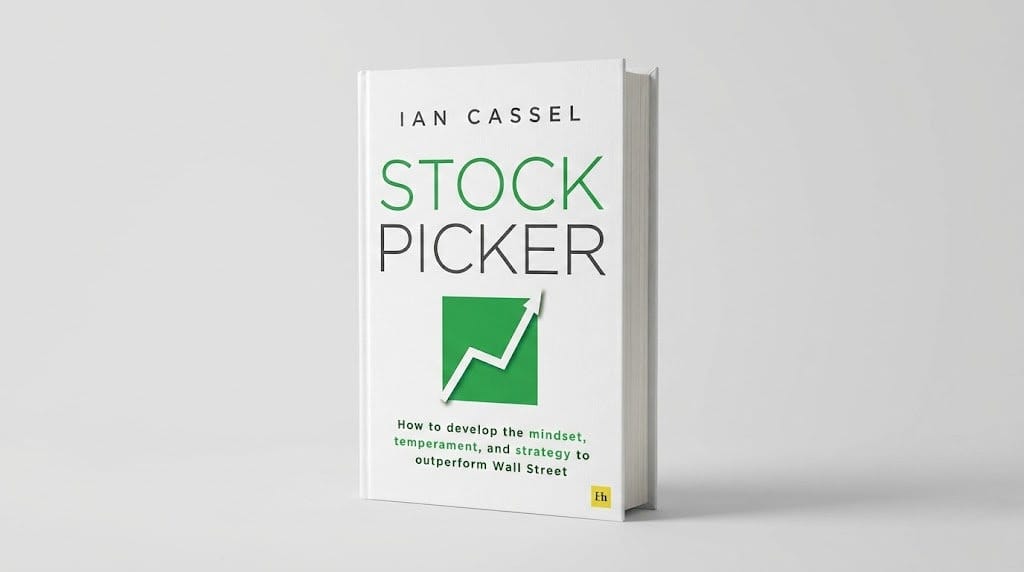
Ian Cassel had never had a normal job, never worked for a big firm, and, sometimes struggles to even screw in a lightbulb. But give him a list of a thousand small stocks, and he can usually pick out the next winners.
Stock Picker is part personal journey, part manifesto for financial independence, and part collection of lessons learned while chasing greatness in stock picking. You'll discover why investing is less about beating others, and more about buying freedom for yourself.
Through luck, failure, discipline, and reinvention, Cassel built a career, first as a full-time private investor, and now as a fund manager. His story proves you don’t need billions or Wall Street prestige, just enough capital, conviction, and patience to live life on your own terms.
---
## Available for Pre-Order Now At

#### Amazon
[Buy now](https://www.amazon.com/Stock-Picker-temperament-strategy-outperform/dp/1804094129?ref=microcapclub.com)

#### Barnes & Noble
[Buy now](https://www.barnesandnoble.com/w/stock-picker-ian-cassel/1148820070?ean=9781804094129&ref=microcapclub.com)

#### Target
[Buy now](https://www.target.com/p/stock-picker-by-ian-cassel-paperback/-/A-1007933324?ref=microcapclub.com#lnk=sametab)

#### Walmart
[Buy now](https://www.walmart.com/ip/Stock-Picker-The-Five-Skills-That-Drive-Market-Beating-Returns-Paperback-9781804094129/18055301827?classType=REGULAR&from=/search&ref=microcapclub.com)

#### Bulk purchases
[Buy now](https://bulkbooks.com/products/stock-picker-how-to-develop-the-mindset-temperament-and-strategy-to-outperform-wall-street?ref=microcapclub.com)
## Posts
### Why Exchanges Beat the Market | James Davolos
URL: https://microcapclub.com/why-exchanges-beat-the-market-james-davolos/
Last updated: 2026-10-19T09:51:38.000Z
James Davolos is a portfolio manager at Horizon Kinetics, where he has spent nearly 21 years studying exchanges and what the firm calls croupier businesses. These are companies that earn fees on trading volume without putting their own capital at risk. One of his first projects at the firm was the New York Stock Exchange’s reverse merger into Archipelago, and his team later bought exchange seats ahead of demutualizations at the CBOE, the Minneapolis Grain Exchange and others.
In this episode, James explains why exchanges have outperformed their local markets over 20 years, why derivatives are the strongest moat in the industry and why inflation and volatility work in exchanges’ favor. He also breaks down MIAX: how it took close to 17% of the multi-listed options market, whether perpetual futures threaten the business and what the Bloomberg futures bet could be worth. The conversation closes with James’s reflections on Horizon Kinetics founder Murray Stahl.
[Join MicroCapClub](https://microcapclub.com/join-now/) and unlock the ability to listen and participate live in these conversations.
You can listen/watch this conversation on [Spotify](https://open.spotify.com/episode/1I7sCITcUa4ryEeOWlZZKv?si=Wb6m1gG0TUCWmJE4LZnH4A&ref=microcapclub.com), [Apple](https://podcasts.apple.com/us/podcast/microcapclub/id1765974269?i=1000797047654&ref=microcapclub.com), and YouTube below:
*Disclaimer: All content in this newsletter is for discussion, education, entertainment, and illustrative purposes only and SHOULD NOT be construed as professional financial advice, solicitation, or recommendation to buy or sell any securities, notwithstanding anything stated on this newsletter and MicroCapClub.com. There are risks associated with investing in securities. Loss of principal is possible. Past performance is not a predictor of future investment performance. Ian Cassel and MicroCapClub.com are not responsible for investment actions taken by viewers. Should you need such advice, consult a licensed financial advisor, legal advisor, or tax advisor. You agree to verify all information yourself before investing. Any past performance discussed on MicroCapClub.com is no guarantee of future results. Investing involves risk and possible loss of principal capital; please seek advice from a licensed professional. All views expressed are personal opinions as of the date of publication and are subject to change without the responsibility to update views. No guarantee is given regarding the accuracy of the information. [FULL DISCLAIMER and TERMS OF USE](https://microcapclub.com/terms/)*
### Keep Evolving
URL: https://microcapclub.com/keep-evolving/
Last updated: 2026-10-15T12:51:03.000Z
By 1969, Miles Davis was already a legendary jazz musician. Kind of Blue (1959) was already considered the greatest album of the entire genre. But by the end of the 1960’s, Davis's albums weren’t selling like they once did. At the age of 43, he felt like a relic of the past playing a previous generations music.
He could have kept his style the same. There was still an audience that loved him and would keep loving him, but they were shrinking.
Instead of staying the same he decided to evolve.
In August 1969, he walked into a recording studio with electric pianos, an electric guitar, two bassists, and multiple drummers. Electric instruments meant rock n roll. Jazz in the 1960’s defined itself partly in opposition to rock and roll. But he told his producer not to interrupt. Just record and let it run. The result was Bitches Brew.
The jazz establishment hated it. Critics called him a sellout. Other jazz musicians called him an artistic traitor.
But promoter Bill Graham heard Bitches Brew and loved it. So much so, that he asked Miles Davis to open for Neil Young, the Steve Miller Band, and even the Grateful Dead.
Miles Davis found a new audience for his music. The album peaked at No. 35 on the all-genre Billboard Chart, the highest of his career. In 1971 it won a grammy, and in 1976 it became his first gold record. It has since gone platinum.
It is fascinating. The audience he risked losing was the same one he was already losing. The move that could have ended Miles Davis’s career as a serious artist was the only move that could keep him a serious artist.
He was either going to be happy playing old hits or evolve and create new ones.
In life, business, art, and investing, sometimes you must risk who you are for what you can be.
The same goes for stock picking.
Buffett started as a short-term cigar butt stock trader. He then started taking control of companies. He then realized it’s better to take control of companies of higher quality, so he doesn’t have to fix or sell them. The point is he kept evolving, pushing out his circle of competence. If he stayed a cigar butt investor, he would have become a relic of the past by age 40 instead of a legend.
The most underrated skill in investing isn't finding great stocks. It's being willing to change how you find them, where to find them, and how you value them and invest in them.
Don’t let how you invest today become your identity. “I’m a resource investor, bitcoin investor, growth investor, deep value investor, etc.” Don’t label yourself because it will slow you down from evolving and growing into a better investor. The investor you were meant to be.
If your last big win was 10 years ago it isn’t "the market’s fault". It’s proof you stopped growing and evolving as an investor. Don’t spend the next 10 years bragging about the returns you had 20 years ago.
The way you started investing should not be the way you finish. If you don’t cringe at some of the investments you made 10 years ago, even some of the winners – YOU AREN’T GROWING.
Inside every stock picker is a better stock picker.
Keep evolving.
#### Stock Picker
Pre-Order my new book, and get the first three chapters!
[Order My New Book!](https://microcapclub.com/stock-picker/)
MicroCapClub is an exclusive forum for experienced microcap investors to share and discuss microcap companies (sub $1 billion market cap) trading on global markets. Since 2011, our members have profiled 1400+ microcap companies, 300+ have turned into multi-baggers. Investors can join our community by applying to become a member or subscribing to gain instant access. For more information, visit
### Lindbergh (LDB.MI): Rolling up Italian HVAC with vendor loans [Update]
URL: https://microcapclub.com/lindbergh-ldb-mi-rolling-up-italian-hvac-with-vendor-loans-update/
Last updated: 2026-10-14T09:58:31.000Z
In this Business Breakdowns, David Barbato sits down with Lindbergh’s (LDB.MI) CEO Michele Corradi and COO Andrea Allegrini. The company was originally profiled by MicroCapClub member "mavix" on October 2nd, 2023, at $2.09 EUR per share. Join MicroCapClub and unlock the ability to listen and participate live in these discussions.
#### Interact and learn with 250+ of the best microcap investors on the planet:
[Join Us](https://microcapclub.com/join-now)
Michele and Andrea explain how they pay about 4 to 4.5 times EBITDA, mostly through vendor loans that the acquired company’s own cash pays off. They also talk about why they now prefer adding companies in regions where they already operate, and how they find each local manager inside the company they buy. Later they cover the end of Italy’s gas boiler incentives, getting acquired companies to collect cash on time, and the shift toward cooling work in the summer months.
You can listen/watch this business breakdowns on [Spotify](https://open.spotify.com/episode/7zmaTd08iTSekccTX2AJEC?si=u6pzy50bTw-MfLkT9c8SzA&ref=microcapclub.com), [Apple](https://podcasts.apple.com/us/podcast/microcapclub/id1765974269?i=1000796279344&ref=microcapclub.com), and YouTube below:
*Disclaimer: All content in this newsletter is for discussion, education, entertainment, and illustrative purposes only and SHOULD NOT be construed as professional financial advice, solicitation, or recommendation to buy or sell any securities, notwithstanding anything stated on this newsletter and MicroCapClub.com. There are risks associated with investing in securities. Loss of principal is possible. Past performance is not a predictor of future investment performance. Ian Cassel and MicroCapClub.com are not responsible for investment actions taken by viewers. Should you need such advice, consult a licensed financial advisor, legal advisor, or tax advisor. You agree to verify all information yourself before investing. Any past performance discussed on MicroCapClub.com is no guarantee of future results. Investing involves risk and possible loss of principal capital; please seek advice from a licensed professional. All views expressed are personal opinions as of the date of publication and are subject to change without the responsibility to update views. No guarantee is given regarding the accuracy of the information. [FULL DISCLAIMER and TERMS OF USE](https://microcapclub.com/terms/)*
### From Speculation to Investment
URL: https://microcapclub.com/from-speculation-to-investment/
Last updated: 2026-10-07T09:43:15.000Z
*You can listen to this article as a podcast on* [*Spotify*](https://open.spotify.com/episode/5kWJECWFjiQAkPQZxB2pTB?si=OJLYIpYqRM6laWj43CFY8Q&ref=microcapclub.com)*,* [*Apple*](https://podcasts.apple.com/us/podcast/microcapclub/id1765974269?i=1000793629386&ref=microcapclub.com)*, and* [*YouTube*](https://youtu.be/7S8U%5F3GOTWU?si=S75RgyVfg7ESAt%5FU&ref=microcapclub.com)*.*
If you planted one hundred Douglas-fir trees with 12-foot spacing in a cleared area, what would happen in 80 years?
Would you get a hundred trees that are the same size?
No.
In 80 years, a couple dozen would be huge (120 ft tall), a third would be dead, and the rest would be half the size of the large ones.
The interesting thing is in the first 15 years all the trees would look relatively the same. There would be plenty of sun to go around because they aren’t growing into each other. But even in the first 15 years, some of the trees would gain a slight advantage for a variety of reasons.
Perhaps some of the trees had a few less rocks in the soil. Perhaps a few trees got infected with a pathogen or fungi that impacted growth. Maybe a rabbit ate the top off a few trees in year 4\. Any number of random events caused a slight 3% advantage/disadvantage which helps shape the entire forest 80 years later.
At around the 15-year mark, the slightly larger trees gain an advantage as the trees start growing into each other. The larger tree’s branches and leaves creep overtop of the smaller tree, taking more light, and it allows the larger trees to grow faster, while suppressing the growth of the smaller trees. This is called size-asymmetric competition.
You compound this advantage over another 65 years, and the dominant trees are twice as tall.
But it’s much more lopsided than it looks. It isn’t just about height.
As trees grow taller, they get thicker. A 120-foot Douglas fir might be 48 inches thick. The smaller 60-foot tree next to it is only 18 inches thick. If you do the math the taller tree is carrying 25x as much wood even though it’s only twice as tall. The amount of growth in the taller tree is exponential in all directions even though a person focuses only on height.
A portfolio can grow the same way.
**Winners Create Concentration**
If you bought 20 stocks and equal weighted them (5% each), the portfolio would concentrate itself into its winners. And it wouldn’t take 80 years like trees.
In 1-2 years:
- 4-6 stocks would dominate the portfolio (50% or more of the portfolio combined)
- 4-6 stocks would be dead (sub 10% combined).
- 8-12 stocks would be medium sized making up the rest of the portfolio.
**Growing Thicker, Not Just Taller**
The dominant stocks are like larger trees. The management teams executed and perhaps with some luck compounded a slight advantage into a more sustainable one. As the stocks rose higher so did their revenue. But it wasn’t just revenue.
Microcap stocks are small businesses, and small businesses are fragile like young trees. Small microcaps are filled with concentration risk. Key person risk, customer concentration, product concentration, geographic concentration, all combined with a constrained balance sheet. The spectrum of outcomes (mainly bad outcomes) is wider in small businesses. This makes small businesses/microcaps on average more fragile and of lower quality than larger businesses.
As a small business grows it expands in all directions. It becomes more diversified across many of the areas where it was once concentrated. More employees, more customers, more products, more processes, more depth. They get thicker, just like a tree.
The balance sheet also expands as the company gets larger which makes the business more attractive to larger customers. This becomes an advantage over smaller competition that allows the slightly larger business to continue to grow quickly.
**Quality Deserves a Higher Multiple**
If you compare two microcap companies in the same industry selling relatively similar products or services with similar growth rates. Let’s say the only real difference is revenue. One business produces $20 million in revenue while the other produces $50 million. Most microcap investors would give them the same valuation multiple.
In fact, a pet peeve of mine is when a company presentation includes a peer comparison table filled with companies that are 10-100-1000x the size of the small microcap company. It is meant to show the small microcap company is undervalued compared to its peers. Guess what? Those larger companies aren't peers. It's like comparing a high school football team to an NFL team.
The larger peers on average are worth more, not just because they produce more revenue but because they are higher quality, less fragile businesses. They are deserving of a valuation multiple 2-3x that of the smaller company. This might not get represented cleanly in public market valuations, but it certainly does in M&A transactions.
**From Speculation to Investment**
The best microcap investments grow like the dominant trees. Not just taller, but thicker. Revenue and earnings increase, but so do the customer base, management depth, and financial strength supporting them. This is what makes holding the right winners so powerful.
As the stock rises and becomes a more concentrated position in your portfolio, the business itself can become less concentrated and less fragile. The company you own may deserve a higher valuation not simply because it is larger, but because it is better. That doesn’t make it worth any price. But it does mean you should evaluate the business it has become, not anchor to the stock price you once paid or the business it once was.
The reward for holding a winner isn’t just a higher share price. It can be continued ownership of a business that is outgrowing the weaknesses that once made it speculative. That is how a speculation turns into an investment.

#### Stock Picker
Pre-Order my new book, and get the first three chapters!
[Order My New Book!](https://microcapclub.com/stock-picker/)
MicroCapClub is an exclusive forum for experienced microcap investors to share and discuss microcap companies (sub $1 billion market cap) trading on global markets. Since 2011, our members have profiled 1500+ microcap companies, 350+ have turned into multi-baggers. Investors can join our community by applying to become a member or subscribing to gain instant access. For more information, visit
### What 10 Years in Oil and Gas Taught Me
URL: https://microcapclub.com/what-10-years-in-oil-and-gas-taught-me/
Last updated: 2026-10-05T09:49:56.000Z
[Join MicroCapClub](https://microcapclub.com/join-now/) and unlock the ability to listen and participate live in these conversations.
Alejandro Yela is the founder of Hermit Ventures and the author of The Hermit, a Substack focused on nano- and microcap companies. He began as a debt investor in Latin American oil and gas bonds, later worked in restructuring, project finance, and M&A, and has averaged returns above 21% since 2018.
In this episode, Alejandro explains how to value an oil producer on its proven (1P) reserves, and why a company's exposure to the oil price depends on whether it extracts, refines, or transports. He walks through his thesis on Computer Modelling Group, the reservoir simulation software company facing pressure from AI while it pursues acquisitions and buybacks. He also explains why he thinks Canadian oil stocks are fully priced after the run in oil, and why he sees more value in oilfield suppliers like OMS Energy.
You can listen/watch this conversation on [Spotify](https://open.spotify.com/episode/0s5ifaQXu3Q48PMO75I2AH?si=Tek%5F2mWVTEikTdM-huqs%5FA&ref=microcapclub.com), [Apple](https://podcasts.apple.com/us/podcast/microcapclub/id1765974269?i=1000793217656&ref=microcapclub.com), and YouTube below:
*Disclaimer: All content in this newsletter is for discussion, education, entertainment, and illustrative purposes only and SHOULD NOT be construed as professional financial advice, solicitation, or recommendation to buy or sell any securities, notwithstanding anything stated on this newsletter and MicroCapClub.com. There are risks associated with investing in securities. Loss of principal is possible. Past performance is not a predictor of future investment performance. Ian Cassel and MicroCapClub.com are not responsible for investment actions taken by viewers. Should you need such advice, consult a licensed financial advisor, legal advisor, or tax advisor. You agree to verify all information yourself before investing. Any past performance discussed on MicroCapClub.com is no guarantee of future results. Investing involves risk and possible loss of principal capital; please seek advice from a licensed professional. All views expressed are personal opinions as of the date of publication and are subject to change without the responsibility to update views. No guarantee is given regarding the accuracy of the information. [FULL DISCLAIMER and TERMS OF USE](https://microcapclub.com/terms/)*
### 700+ 1x1 management meeting requests are in - Here are the top 15
URL: https://microcapclub.com/700-1x1-management-meeting-requests-are-in-here-are-the-top-15/
Last updated: 2026-10-01T10:33:10.000Z
Planet Microcap Toronto will be one of the largest gatherings of microcap investors in Canada. Don't miss this event.
Company schedules are starting to fill up. We already have 700+ 1x1 management meeting requests. Here are the top 15 most requested companies so far:
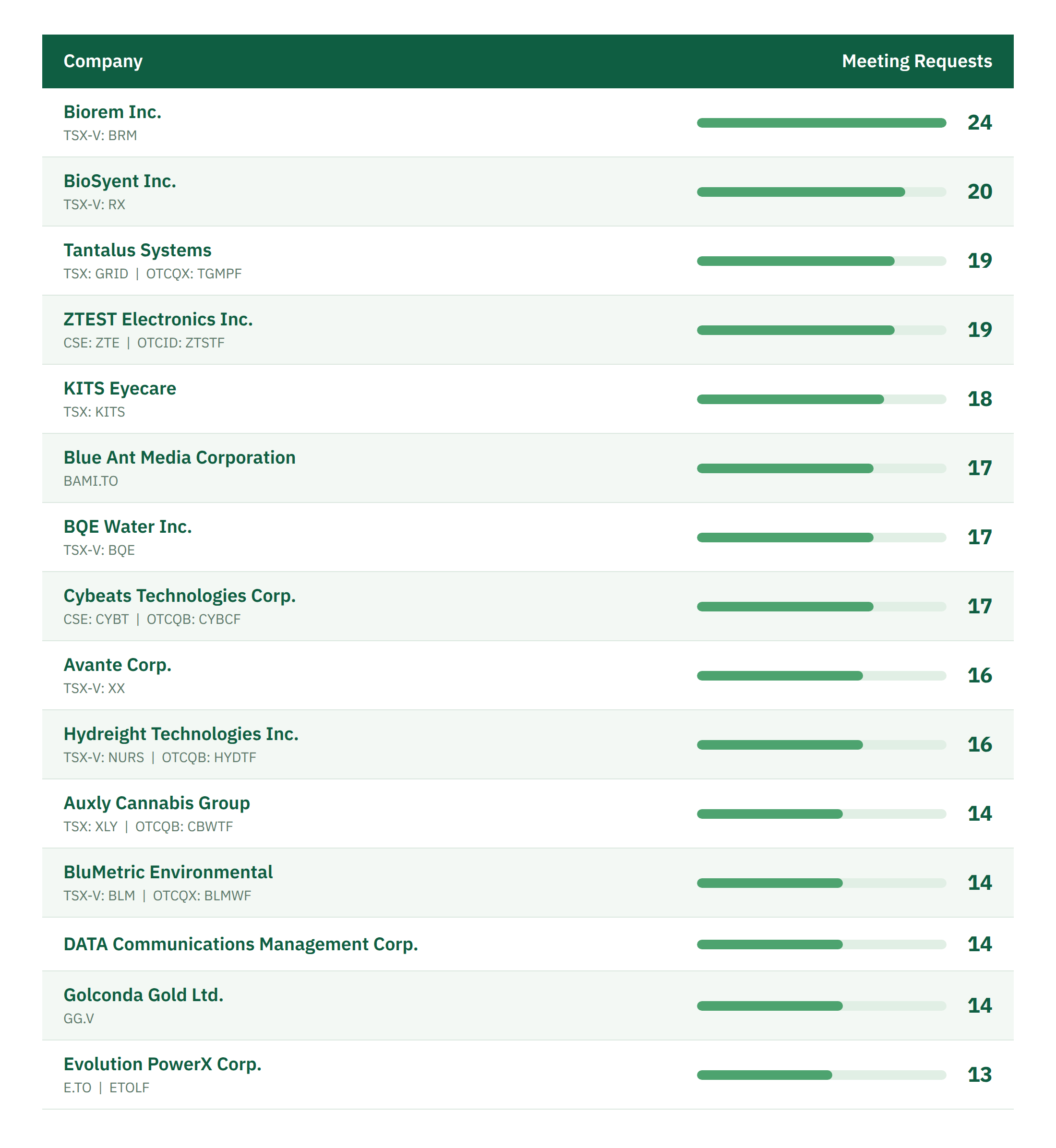
If you're registered, it's time to [log in](https://www.meetmax.com/sched/event%5F136811/conference%5Fhome.html?ref=microcapclub.com) to the portal to get your requests in.
If you're not registered and want to attend, what are you waiting for? Time to register and get your requests in.
Planet MicroCap Toronto is **FREE TO ATTEND** for all verified investors.
[\[INVESTORS – REGISTER NOW\]](https://www.meetmax.com/sched/event%5F136811/conference%5Fregister.html?attendee%5Frole%5Fid=PMC%5FINVESTOR&ref=planetmicrocap.com)
**PRESENTING COMPANIES:** [Full list here](https://www.meetmax.com/sched/event%5F136811/%5F%5Fparticipatingcompanies%5Fcp.html?ref=planetmicrocap.com)

#### Planet MicroCap - Toronto
October 27-29, 2026 - https://planetmicrocap.com
[Learn more](https://planetmicrocap.com/?ref=microcapclub.com)
MicroCapClub is an exclusive forum for experienced microcap investors to share and discuss microcap companies (sub $1 billion market cap) trading on global markets. Since 2011, our members have profiled 1400+ microcap companies, 300+ have turned into multi-baggers. Investors can join our community by applying to become a member or subscribing to gain instant access. For more information, visit
### Strata Critical Medical (SRTA): The Organ Transplant Logistics Roll-Up
URL: https://microcapclub.com/strata-critical-medical-srta-the-organ-transplant-logistics-roll-up/
Last updated: 2026-09-30T11:41:25.000Z
In this Business Breakdown, David Barbato and Adam Wilk sit down with Strata Critical Medical’s (SRTA) co-CEO and CFO Will Heyburn and VP of Finance and Investor Relations and CFO of Clinical Services, Mat Schneider. This discussion took place live on September 29th, 2026, on the MicroCapClub Community. Join MicroCapClub and unlock the ability to listen and participate live in these discussions.
#### Interact and learn with 250+ of the best microcap investors on the planet:
[Join Us](https://microcapclub.com/join-now)
They discuss why Strata stays device-agnostic while companies like TransMedics build their own devices, and how national organ allocation is pushing donors and recipients farther apart. They also cover the growth of normothermic regional perfusion and third-party organ recovery, how OPO retainer contracts cut the cost of dry runs, why owning aircraft is not central to the growth plan, and how Strata buys regional providers at mid-single-digit EBITDA multiples.
You can listen/watch this business breakdowns on [Spotify](https://open.spotify.com/episode/0HGz3c4e9LvCMnpXRbOInS?si=BmOyuLWkSRmaZ6DV2rffsg&ref=microcapclub.com), [Apple](https://podcasts.apple.com/us/podcast/microcapclub/id1765974269?i=1000792355102&ref=microcapclub.com), and YouTube below:
*Disclaimer: All content in this newsletter is for discussion, education, entertainment, and illustrative purposes only and SHOULD NOT be construed as professional financial advice, solicitation, or recommendation to buy or sell any securities, notwithstanding anything stated on this newsletter and MicroCapClub.com. There are risks associated with investing in securities. Loss of principal is possible. Past performance is not a predictor of future investment performance. Ian Cassel and MicroCapClub.com are not responsible for investment actions taken by viewers. Should you need such advice, consult a licensed financial advisor, legal advisor, or tax advisor. You agree to verify all information yourself before investing. Any past performance discussed on MicroCapClub.com is no guarantee of future results. Investing involves risk and possible loss of principal capital; please seek advice from a licensed professional. All views expressed are personal opinions as of the date of publication and are subject to change without the responsibility to update views. No guarantee is given regarding the accuracy of the information. [FULL DISCLAIMER and TERMS OF USE](https://microcapclub.com/terms/)*
### 💡Reminder - Get Your Bonus Chapter
URL: https://microcapclub.com/reminder-get-your-bonus-chapter/
Last updated: 2026-09-24T10:26:11.000Z
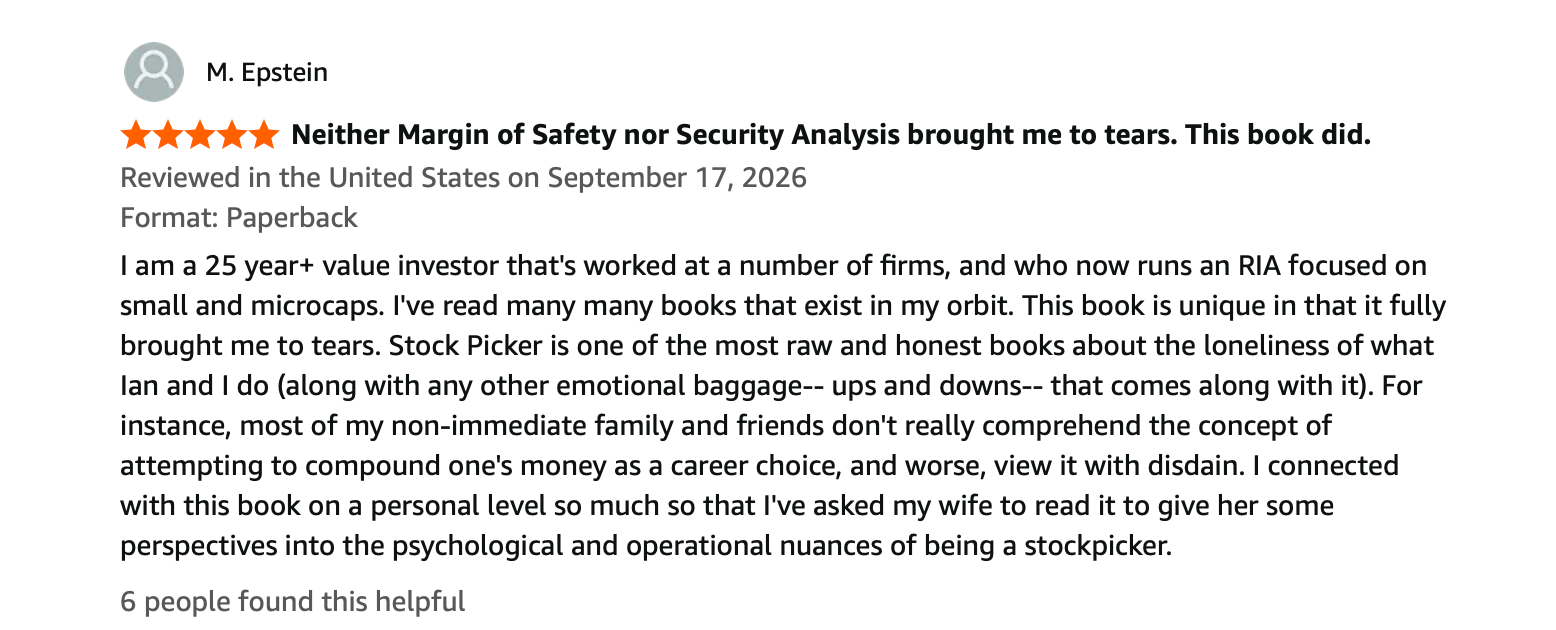
I wanted to send this quick reminder. If you purchased my new book [Stock Picker](https://lnk.to/stockpicker?ref=microcapclub.com), make sure to get this bonus chapter [here](https://www.harriman-house.com/stock-picker-bonus-chapter-offer?ref=microcapclub.com).
I've been blown away from all the kind words about the book. I'm glad it is making an impact on people. If you enjoyed the book, please give it a positive review on Amazon. It will help spread the word and introduce more people to microcap investing. 🙏
MicroCapClub is an exclusive forum for experienced microcap investors to share and discuss microcap companies (sub $1 billion market cap) trading on global markets. Since 2011, our members have profiled 1400+ microcap companies, 300+ have turned into multi-baggers. Investors can join our community by applying to become a member or subscribing to gain instant access. For more information, visit
### Is AI Making Investors Dumber? | Michael Fritzell
URL: https://microcapclub.com/is-ai-making-investors-dumber-michael-fritzell/
Last updated: 2026-09-21T10:24:25.000Z
[Join MicroCapClub](https://microcapclub.com/join-now/) and unlock the ability to listen and participate live in these conversations.
Michael Fritzell writes Asian Century Stocks, a research service covering undercovered equities across Asia. He spent sixteen years on the buy side in Hong Kong, Singapore and Indonesia before leaving in 2021 to publish full time, and now writes deep dives on companies that receive almost no analyst coverage.
In this conversation, Michael explains how he uses generative AI in his research process: the saved prompts he runs on any new ticker, including a bull-versus-bear project and one built to surface red flags in the accounts, and where he refuses to use these tools at all, namely calculations and writing. He also talks about where he finds ideas that AI can't commoditize, mainly insider transaction data and broken IPOs in Asia, and why he shifted from buying low P/E stocks to targeting a prospective IRR and selling once it falls below his cost of capital. He argues that faster research doesn't automatically mean better returns, which leads to the question of why an investor would cover two hundred stocks a year instead of twenty.
You can listen/watch this conversation on [Spotify](https://open.spotify.com/episode/7xakEs1M0pDdL8BtpzEBQh?si=JixjEQceSiWk0kNSPkOGqQ&ref=microcapclub.com), [Apple](https://podcasts.apple.com/us/podcast/microcapclub/id1765974269?i=1000790906797&ref=microcapclub.com), and YouTube below:
*Disclaimer: All content in this newsletter is for discussion, education, entertainment, and illustrative purposes only and SHOULD NOT be construed as professional financial advice, solicitation, or recommendation to buy or sell any securities, notwithstanding anything stated on this newsletter and MicroCapClub.com. There are risks associated with investing in securities. Loss of principal is possible. Past performance is not a predictor of future investment performance. Ian Cassel and MicroCapClub.com are not responsible for investment actions taken by viewers. Should you need such advice, consult a licensed financial advisor, legal advisor, or tax advisor. You agree to verify all information yourself before investing. Any past performance discussed on MicroCapClub.com is no guarantee of future results. Investing involves risk and possible loss of principal capital; please seek advice from a licensed professional. All views expressed are personal opinions as of the date of publication and are subject to change without the responsibility to update views. No guarantee is given regarding the accuracy of the information. [FULL DISCLAIMER and TERMS OF USE](https://microcapclub.com/terms/)*
### 🔑 Unlock an Exclusive Bonus Chapter
URL: https://microcapclub.com/unlock-an-exclusive-bonus-chapter/
Last updated: 2026-09-17T10:10:16.000Z
I appreciate all of you that have purchased my new book, [Stock Picker](https://lnk.to/stockpicker?ref=microcapclub.com). As a Thank You, I'm giving away an exclusive bonus chapter that hasn't been published anywhere.
You can get the chapter [here](https://www.harriman-house.com/stock-picker-bonus-chapter-offer?ref=microcapclub.com), or click the image below.
If you read the book and enjoyed it, please give it a positive review on Amazon or elsewhere. 🙏
#### Unlock an exclusive bonus chapter
When you order your copy of Stock Picker !
[Get Your Free Bonus Chapter!](https://www.harriman-house.com/stock-picker-bonus-chapter-offer?ref=microcapclub.com)
MicroCapClub is an exclusive forum for experienced microcap investors to share and discuss microcap companies (sub $1 billion market cap) trading on global markets. Since 2011, our members have profiled 1400+ microcap companies, 300+ have turned into multi-baggers. Investors can join our community by applying to become a member or subscribing to gain instant access. For more information, visit
### Stock Picker is Now Available! Help spread the word.
URL: https://microcapclub.com/stock-picker-is-now-available-help-spread-the-word/
Last updated: 2026-09-15T09:25:40.000Z
📗 Stock Picker is officially published today! You can [buy it here](https://lnk.to/stockpicker?ref=microcapclub.com).
If you like the book, please Tell a Friend and Write a Positive Review on Amazon or elsewhere. It helps the book be seen by more people. I want to make an impact with this book, and I'll tell you why.
The world didn't need another "invest like me" or instruction manual for successful investing. What time has proven is all great investors and stock pickers invest differently. In fact, that is what makes them great. I wrote this book to inspire and motivate you to invest like you. To do it your own way. That is my story and it can be your story too.
Second, I wrote the book to educate the masses on microcap investing, a space that has been largely forgotten by most of the financial industry. My mission is to pull quality investors, companies, stakeholders into microcap. That is how we make a positive impact on this investment class.
Help me spread the word. Tell a friend. Leave a positive review. Thank you. 🙏
MicroCapClub is an exclusive forum for experienced microcap investors to share and discuss microcap companies (sub $1 billion market cap) trading on global markets. Since 2011, our members have profiled 1400+ microcap companies, 300+ have turned into multi-baggers. Investors can join our community by applying to become a member or subscribing to gain instant access. For more information, visit
### 30 Years of Berkshire Meetings in 60 Minutes
URL: https://microcapclub.com/30-years-of-berkshire-meetings-in-60-minutes/
Last updated: 2026-09-14T09:39:03.000Z
[Join MicroCapClub](https://microcapclub.com/join-now/) and unlock the ability to listen and participate live in these conversations.
Alex Morris is the author of Buffett and Munger Unscripted, a topic-by-topic organization of three decades of Berkshire Hathaway shareholder meetings, and he writes TSOH Investment Research, where he publishes his portfolio and discloses every change before he makes it. He spent roughly twenty years investing, most recently at a firm managing over a billion dollars, before going independent in 2021.
You can listen/watch this conversation on [Spotify](https://open.spotify.com/episode/3lJFB8L7rot3hbZCGhq9qN?si=WlGL%5FkxhRNq1-Aix3XN2eg&ref=microcapclub.com), [Apple](https://podcasts.apple.com/us/podcast/microcapclub/id1765974269?i=1000789532768&ref=microcapclub.com), and YouTube below:
*Disclaimer: All content in this newsletter is for discussion, education, entertainment, and illustrative purposes only and SHOULD NOT be construed as professional financial advice, solicitation, or recommendation to buy or sell any securities, notwithstanding anything stated on this newsletter and MicroCapClub.com. There are risks associated with investing in securities. Loss of principal is possible. Past performance is not a predictor of future investment performance. Ian Cassel and MicroCapClub.com are not responsible for investment actions taken by viewers. Should you need such advice, consult a licensed financial advisor, legal advisor, or tax advisor. You agree to verify all information yourself before investing. Any past performance discussed on MicroCapClub.com is no guarantee of future results. Investing involves risk and possible loss of principal capital; please seek advice from a licensed professional. All views expressed are personal opinions as of the date of publication and are subject to change without the responsibility to update views. No guarantee is given regarding the accuracy of the information. [FULL DISCLAIMER and TERMS OF USE](https://microcapclub.com/terms/)*
### How to Live Off Your Portfolio
URL: https://microcapclub.com/how-to-live-off-your-portfolio/
Last updated: 2026-09-13T10:20:33.000Z
I sat down with Stig Brodersen to talk about my new book, [Stock Picker](https://lnk.to/stockpicker?ref=microcapclub.com). I hope you enjoy it.
You can listen/watch this conversation on [Spotify](https://open.spotify.com/episode/2LoZhz4r7Eo6nYhAt1pcCR?si=LolNkcUmTxCB5FZtwD8GPw&ref=microcapclub.com), [Apple](https://podcasts.apple.com/us/podcast/the-investors-podcast-we-study-billionaires-the/id928933489?i=1000789238617&ref=microcapclub.com), and YouTube below:

#### Stock Picker
Pre-Order my new book, and get the first three chapters!
[Order My New Book!](https://microcapclub.com/stock-picker/)
MicroCapClub is an exclusive forum for experienced microcap investors to share and discuss microcap companies (sub $1 billion market cap) trading on global markets. Since 2011, our members have profiled 1400+ microcap companies, 300+ have turned into multi-baggers. Investors can join our community by applying to become a member or subscribing to gain instant access. For more information, visit
### The New MicroCapClub Platform is Launching Soon
URL: https://microcapclub.com/the-new-microcapclub-platform-is-launching-soon/
Last updated: 2026-09-10T20:48:20.000Z
15 years. 1500+ companies profiled. 350+ multi-baggers profiled. 200+ companies acquired. So many reputations built, and new relationships forged on our community.
This launch has been months in the making. A lot of rethinking, reshaping, pruning back, and then adding additional tools to make the community better.
Launching the end of September.
Here is a sneak peek.
MicroCapClub is an exclusive forum for experienced microcap investors to share and discuss microcap companies (sub $1 billion market cap) trading on global markets. Since 2011, our members have profiled 1400+ microcap companies, 300+ have turned into multi-baggers. Investors can join our community by applying to become a member or subscribing to gain instant access. For more information, visit
### The Benefit of the Doubt
URL: https://microcapclub.com/the-benefit-of-the-doubt/
Last updated: 2026-09-10T09:34:19.000Z
When I first started investing, I fell prey to this pitfall of first order thinking: quarterly results are good, so why is the stock down? This caused me a lot of confusion early on. Sometimes, the answer was positioning, expectations, a weak market or something else that didn't matter very much. Other times, the answer is much simpler.
Most of the time, the market can look past whether any specific quarter was objectively good or bad. Instead, stock prices react to the results relative to what was expected, what is already embedded in the stock price, and what management previously told investors. Calibrating this against any earnings results can help avoid a lot of frustration. Think back to any time you’ve watched a company report a dud, only for the stock to barely move, because management already telegraphed the results. The opposite can occur when results are expected to be good, then surprise to the downside.
However, over time, I've come to believe there is another variable that matters more than investors sometimes appreciate, which is trust.
One of the most common pieces of investing wisdom is that good companies tend to trade at higher multiples because they are good companies. They grow earnings, generate cash, produce attractive returns on capital, and create value over time. But there are also plenty of examples where the market will often give an even higher multiple to a good company where management can be trusted.
This is the type of trust that comes from telling shareholders what you’re going to do, doing it, and then repeating that process for years. Investors know they aren’t going to wake up one day to shocking capital allocation decisions, or strategy pivots, or management being slow to respond to competition. I believe eventually that predictability becomes valuable in and of itself.
The best investment results I’ve experienced involved management teams that communicate a clear operating strategy and explain exactly how they intend to allocate capital. These companies establish transparent criteria for acquiring businesses, repurchasing stock, paying down debt, reinvesting internally, or distributing cash. Then they stick to that plan. Not for a few quarters, but for years, and in the best cases, decades.
Once that happens, something interesting occurs. The company begins receiving the benefit of the doubt.
A lumpy quarter? Benefit of the doubt.
A temporary slowdown? Benefit of the doubt.
Some executive turnover? Benefit of the doubt.
An operating metric moves in the wrong direction for a quarter or two? Benefit of the doubt.
When trust is present, investors feel like they’ve seen this movie before. Management has accumulated enough evidence that shareholders are willing to assume temporary problems are temporary until proven otherwise. That is an extraordinarily valuable position to be in from both the company’s perspective and as a shareholder.
I'm currently struggling with a company in our portfolio that illustrates the opposite problem. Operating performance has been excellent, earnings are growing, and the underlying business continues to execute well, yet the stock remains incredibly cheap.
Part of the problem is that investors don't know what management is going to do next. For a long time, the core capital allocation strategy was M&A. It recently became share repurchases. Then some deleveraging. Then back to M&A. The frustrating part is that each of those decisions were completely rational and represented really strong returns on the capital being invested. In fact, there’s nothing inherently wrong with choosing among those options opportunistically, and it’s what a rational capital allocator should do.
But if investors can't predict how management thinks about capital allocation, they have a harder time underwriting the future. That affects trust, and the multiple investors are willing to assign the business, as there is confusion regarding what the company ultimately wants to become. If those answers constantly change, shareholders are forced to re-underwrite the capital allocation strategy every few quarters, and investors generally place lower multiples on things they have to continuously re-underwrite.
This is where I think investors occasionally underestimate the value of consistency. Consistency reduces uncertainty, which builds trust, which earns the benefit of the doubt. And the benefit of the doubt can eventually translate into a higher valuation.
None of this works without good execution, as a management team that consistently executes a bad strategy will not be rewarded simply for being predictable. Earnings power ultimately has to grow, and I’m still a firm believer that earnings growth trumps almost everything else, because if a business can grow free cash flow for a long enough period of time, the stock usually takes care of itself.
For most of the companies we own, that is the primary mechanism through which I expect a valuation gap to close, but there’s a big difference between a stock working and a stock becoming a multi-bagger.
If the company I'm referring to continues growing earnings at anything close to its current rate, the investment will work out well. What I’m less certain about is whether it will ever receive the kind of valuation afforded to companies whose management teams have spent years telegraphing to shareholders exactly how they will behave.
I’ve learned that the best management teams build a capital allocation system that investors can understand, observe, and eventually trust, and after enough years of doing exactly what they said they would do, the market stops asking for proof every quarter.
It gives them the benefit of the doubt.

#### Planet MicroCap - Toronto
October 27-29, 2026 - https://planetmicrocap.com
[Learn more](https://planetmicrocap.com/?ref=microcapclub.com)
MicroCapClub is an exclusive forum for experienced microcap investors to share and discuss microcap companies (sub $1 billion market cap) trading on global markets. Since 2011, our members have profiled 1400+ microcap companies, 300+ have turned into multi-baggers. Investors can join our community by applying to become a member or subscribing to gain instant access. For more information, visit
### Is AI Coming for Accounting and Law? $KPG.AX $AFL.AX
URL: https://microcapclub.com/is-ai-coming-for-accounting-and-law-kpg-ax-afl-ax/
Last updated: 2026-09-08T10:05:56.000Z
[Join MicroCapClub](https://microcapclub.com/join-now/) and unlock the ability to listen and participate live in these conversations.
Tristan is a tax accountant in Australia and a member of MicroCap Club. He is a long-time shareholder of Kelly Partners Group ($KPG.AX), the accounting firm rolling up small practices in Australia and now overseas, and of AF Legal Group ($AFL.AX), the listed family law firm expanding into criminal law and contested wills. He also spent part of his career working inside a Kelly Partners firm.
You can listen/watch this conversation on [Spotify](https://open.spotify.com/episode/5GHcpT22egGiDL9YkuxTAD?si=IC2rjOv5TrSpW6nUaoSZaQ&ref=microcapclub.com), [Apple](https://podcasts.apple.com/us/podcast/microcapclub/id1765974269?i=1000788437187&ref=microcapclub.com), and YouTube below:
*Disclaimer: All content in this newsletter is for discussion, education, entertainment, and illustrative purposes only and SHOULD NOT be construed as professional financial advice, solicitation, or recommendation to buy or sell any securities, notwithstanding anything stated on this newsletter and MicroCapClub.com. There are risks associated with investing in securities. Loss of principal is possible. Past performance is not a predictor of future investment performance. Ian Cassel and MicroCapClub.com are not responsible for investment actions taken by viewers. Should you need such advice, consult a licensed financial advisor, legal advisor, or tax advisor. You agree to verify all information yourself before investing. Any past performance discussed on MicroCapClub.com is no guarantee of future results. Investing involves risk and possible loss of principal capital; please seek advice from a licensed professional. All views expressed are personal opinions as of the date of publication and are subject to change without the responsibility to update views. No guarantee is given regarding the accuracy of the information. [FULL DISCLAIMER and TERMS OF USE](https://microcapclub.com/terms/)*
### The Stories We Tell Ourselves
URL: https://microcapclub.com/the-stories-we-tell-ourselves/
Last updated: 2026-09-03T09:16:35.000Z
> *“With showbusiness, you receive the greatest flattery and the greatest venom. And they’re both lies.”* \- *Jerry Seinfeld*
Eddie Murphy has one of the greatest filmographies in all of movie history, with a career that spans nearly 45 years (!), with the making of his first movie, 48 Hours, in 1982.
From 1982 – 1995, Eddie Murphy went on a crazy run, starring in Trading Places, Beverly Hills Cop I, II, and III, Harlem Nights, Coming to America, and Boomerang, while also filming his legendary standup special, Raw. Each of those movies grossed tens to hundreds of millions in box office profits, and catapulted Murphy to stardom.
For more than a decade, almost everything worked. The movies made hundreds of millions of dollars. Murphy became one of the biggest stars on the planet, and at various points he was arguably the biggest draw in Hollywood.
Then came *Vampire in Brooklyn*.
The movie was a disappointment. It became Murphy's lowest-grossing film to that point, critics hated it, and the reaction was odd. Suddenly everyone had an explanation for why the failure of the movie and poor performance by Murphy were obvious all along.
Murphy’s career obviously wasn’t finished, but what’s interesting in hindsight is how quickly one bad outcome seemed capable of obscuring thirteen years of extraordinary accomplishment.
And then, almost immediately, he did it all over again.
Following, Vampire in Brooklyn, Murphy went on another legendary run and from 1996 to 2006 starred in Mulan, Life, Bowfinger, Shrek 1 and 2, Dr. Doolittle 1 and 2, and both Nutty Professor movies. He became a major box-office draw for another decade, this time for an entirely new generation. Murphy was back to being praised, and back to being a star.
The lesson here is that we are terrible at keeping the most recent outcome in perspective. Public markets work this way constantly. A single failure becomes a referendum on everything that came before it while a single success does the same thing in reverse.
In our industry, narratives can be created so easily but have very little explanatory power. A company can be an absolute investor darling one day, and a pile of toxic waste the next. The truth lies somewhere in between.
What’s even more fascinating is how stock prices have an extraordinary ability to tell us how we should feel about what we own. Rising stock prices engender praise for the business, praise for the CEO and praise for the investors who were smart enough to make the right call. We tell ourselves that the business is wonderful, the CEO is brilliant, the competitive advantage is stronger than we thought, the industry has years of runway ahead of it. Investors who bought the stock saw something everyone else missed.
Then the stock drops 40%.
Declining stock prices elicit ‘I told you so’s’, vilification of management, and an attitude toward the business that everything is bad and always was. Suddenly the same company is poorly managed. The moat was overstated. The industry is structurally challenged. Management can't allocate capital. The accounting was always suspicious. Very little about the underlying business may have changed enough to justify either extreme.
There is a reason that investors use the phrase ‘price drives narrative’. That couldn’t be more true during certain periods we’ve all lived through.
A stock chart can become a kind of backwards-looking fundamental analysis. When the line goes up, we search for evidence that explains why the company is great. When the line goes down, we search for evidence that explains why it was never great in the first place. And because businesses are complicated enough, there is almost always enough evidence available to construct either story.
This is because markets are fairly good at valuing things that fit neatly into boxes. They are much less comfortable with businesses that don't, or businesses going through periods where the numbers temporarily stop confirming the prevailing story.
Rarely is reality so black and white. Most companies aren't investor darlings or toxic waste. Most CEOs aren't geniuses or idiots. Most investment theses aren't perfectly right or embarrassingly wrong. Reality tends to live somewhere in the uncomfortable middle.
As investors, our job is not to react to the emotional signal being sent by a stock price but rather figure out what has actually changed.
Did the competitive position deteriorate? Did normalized earnings power change? Did management do something that alters our assessment of them? Did the balance sheet become more fragile? Did the thesis depend on something that the latest evidence has now disproven?
Or did the stock just go down?
The same is true when a stock is ripping higher. A rising price doesn’t validate every assumption in the thesis any more than a falling one invalidates them. Even though this sounds obvious when written down, it’s incredibly difficult to live through.
A position that has doubled has a way of making every piece of incoming information look bullish. A position that has been cut in half has a way of making every problem look fatal. The biggest mistakes happen when eventually you stop evaluating the actual business and start defending or attacking a story about yourself. How many of us are guilty of this? Calling ourselves smart or stupid to have owned a specific company. None of that is useful at all.
When faced with these situations, it’s important to remember that we don’t have to become emotionless. I don’t think that’s possible, nor would it be helpful. The emotions of investing consisting of fear, excitement, embarrassment, frustration are all part of taking on risk in uncertain situations. The idea is to stop allowing those emotions to determine what the facts mean.
Unfortunately, you’re never quite as smart as a rising stock makes you feel. And fortunately, you’re never as dumb as a falling stock makes you feel either.
One bad movie doesn't erase *Trading Places*, *Coming to America*, and *Beverly Hills Cop*. And one disappointing quarter or one collapsing stock price doesn't automatically erase everything you previously understood about a business.
Sometimes *Vampire in Brooklyn* is just *Vampire in Brooklyn*.

#### Planet MicroCap - Toronto
October 27-29, 2026 - https://planetmicrocap.com
[Learn more](https://planetmicrocap.com/?ref=microcapclub.com)
MicroCapClub is an exclusive forum for experienced microcap investors to share and discuss microcap companies (sub $1 billion market cap) trading on global markets. Since 2011, our members have profiled 1400+ microcap companies, 300+ have turned into multi-baggers. Investors can join our community by applying to become a member or subscribing to gain instant access. For more information, visit
### WidePoint Corporation (WYY): Securing the Government
URL: https://microcapclub.com/widepoint-corporation-wyy-securing-the-government/
Last updated: 2026-08-31T10:00:49.000Z
In this Business Breakdown, David Barbato, Sergio Heiber, and Lindsay Leeds sit down with WidePoint Corporation’s (WYY) CEO Jin Kang and COO Todd Dzyak. The company was originally profiled by Sergio Heiber on April 13, 2025, at $2.82 USD per share. [Join MicroCapClub](https://microcapclub.com/#join) and unlock the ability to listen and participate live in these discussions.
n this business breakdown, Jin and Todd walk through the company's near-term catalysts: a roughly $50 million five-year SaaS contract with one of the three major U.S. wireless carriers, the 10-year $3.1 billion DHS CWMS 3.0 award currently sitting in a GAO protest, and prime positions on NASA SEWP VI and Navy Spiral 4\. They explain how the protest process works and what happens in each outcome, why FedRAMP authorization on the ITMS platform matters competitively, and how WidePoint's PKI-based credential on a smartphone differs from Okta and standard app-based two-factor authentication. The conversation also covers federal contract pricing and margins, what actually decides a competitive award, the sales cycle for both government and commercial customers, and why the company is holding a net cash position while self-funding growth.
You can listen/watch this business breakdowns on [Spotify](https://open.spotify.com/episode/04Ah98SJse9KxrnCzl5myU?si=93q6bLnnSTyfzdGYxcbc5g&ref=microcapclub.com), [Apple](https://podcasts.apple.com/us/podcast/microcapclub/id1765974269?i=1000786944334&ref=microcapclub.com), and YouTube below:
*Disclaimer: All content in this newsletter is for discussion, education, entertainment, and illustrative purposes only and SHOULD NOT be construed as professional financial advice, solicitation, or recommendation to buy or sell any securities, notwithstanding anything stated on this newsletter and MicroCapClub.com. There are risks associated with investing in securities. Loss of principal is possible. Past performance is not a predictor of future investment performance. Ian Cassel and MicroCapClub.com are not responsible for investment actions taken by viewers. Should you need such advice, consult a licensed financial advisor, legal advisor, or tax advisor. You agree to verify all information yourself before investing. Any past performance discussed on MicroCapClub.com is no guarantee of future results. Investing involves risk and possible loss of principal capital; please seek advice from a licensed professional. All views expressed are personal opinions as of the date of publication and are subject to change without the responsibility to update views. No guarantee is given regarding the accuracy of the information. [FULL DISCLAIMER and TERMS OF USE](https://microcapclub.com/terms/)*
### 83 Companies Confirmed!
URL: https://microcapclub.com/83-companies-confirmed/
Last updated: 2026-08-28T09:22:03.000Z
Planet Microcap Toronto will be one of the largest gatherings of microcap investors in Canada. This event is **OPEN TO ALL MICROCAP INVESTORS and FREE TO ATTEND**.
Day 1: Speakers and Stock Pitches
Day 2: Company Presentations
Day 3: 1x1 Management Meetings
### [Planet MicroCap Toronto 2026 Powered by MicroCapClub](https://www.meetmax.com/sched/event%5F136811/conference%5Fhome.html?ref=microcapclub.com)
When: October 27-29, 2026
Where: Arcadian Court & Loft, Toronto
[**\[FREE TO ATTEND - REGISTER NOW\]**](https://www.meetmax.com/sched/event%5F136811/conference%5Fhome.html?ref=microcapclub.com)
We have 83 presenting companies confirmed:
01 Quantum Inc. (TSX-V: ONE | OTCQB: OONEF)
Auxly Cannabis Group (TSX: XLY | OTCQB: CBWTF)
Avante Corp. (TSX-V: XX)
Baylin Technologies (TSX: BYL | OTCQB: BYLTF)
Biorem Inc. (TSX-V: BRM)
BioSyent (TSX-V: RX)
Blue Ant Media Corporation (TSX: BAMI)
BluMetric (TSX-V: BLM | OTCQX: BLMWF)
Bon Intelligence (Private Company)
BQE Water (TSX-V: BQE)
Branchout Foods (NASDAQ: BOF)
Caldwell Partners International, Inc. (TSX: CWL | OTCQX: CWLPF)
California Nanotechnologies (TSX-V: CNO / OTC: CANOF)
Cannara Biotech Inc. (TSX: LOVE)
Cizzle Brands Corporation (Cboe Canada: CZZL; OTCQB: CZZLF)
Cleantek Industries Inc. (TSX-V: CTEK)
Criterium Energy Ltd. (TSX-V: CEQ)
Cybeats Technologies Corp. (CSE: CYBT)
DATA Communications Management Corp. (TSX: DCM | OTCQX: DCMDF)
Decibel Cannabis Company Inc. (TSX-V: DB | OTCQB: DBCCF)
Dynacor Group Inc. (TSX: DNG)
electroCore, Inc. (NASDAQ: ECOR)
EMERGE Commerce Ltd. (TSX-V: ECOM)
EnWave (TSX-V: ENW)
Evolution PowerX Corp. (TSX: E | OTCQB: ETOLF)
First Canadian Graphite Inc. (TSX-V: FCI)
First Phosphate Corp. (CSE: PHOS) (OTCQX: FRSPF)
Full Circle Lithium Corp. (TSX-V: FCLI | OTCQB: FCLIF)
Golconda Gold (TSX-V: GG)
Greenlane Renewables Inc. (TSX: GRN)
High Tide Inc. (TSX-V / NASDAQ: HITI)
HLS Therapeutics Inc. (TSX: HLS)
Horizon Aircraft (NASDAQ: HOVR)
Hydreight Technologies Inc. (TSX-V: NURS | OTCQB: HYDTF)
Hypercharge Networks Corp. (TSX-V: HC | OTC: HCNWF)
IC Group Holidngs Inc. (TSX-V: ICGH)
Intouch Insight (TSX-V: INX / OTCQX: INXSF)
Jones Soda Co. (CSE | OTCQB: JSDA)
Juno Industries (Private Company)
Kelso Technologies Inc. (TSX: KLS)
Kidoz (TSX-V: KDOZ | OTCQB: KDOZF)
KITS Eyecare (TSX: KITS)
KOIL Energy Solutions, Inc. (OTCQB: KLNG)
LibertyStream Infrastructure Partners Inc. (TSX-V: LIB | OTCQB: VLTL)
LSL Pharma Group Inc. (TSX-V: LSL)
MAX Power Mining Corp. (CSE: MAXX | OTC: MAXXF)
Medexus Pharmaceuticals (TSX: MDP)
Microbix Biosystems Inc. (TSX: MBX, OTCQX: MBXBF)
NEO Battery Materials Ltd. (TSX-V: NBM)
NeuPath Health Inc. (TSX-V: NPTH)
NewLake Capital Partners, Inc. (OTCQX: NLCP)
NewtekOne, Inc. (NASDAQ: NEWT)
NexLiving Communities (TSX-V: NXLV)
NextTrip, Inc. (NASDAQ: NTRP)
Nova Leap Health (TSX-V: NLH)
NowVertical Group Inc. (TSX-V: NOW)
NXT Energy Solutions Inc. (TSX: SFD | OTCQB: NSFDF)
Organigram Global Inc. (NASDAQ | TSX: OGI)
Organto Foods Inc. (TSX-V: OGO | OTCQX: OGOFF)
Paragon Advanced Labs (TSX-V: PALS)
Parvis Invest Inc. (TSX-V: PVIS)
Peraso Inc. (NASDAQ: PRSO)
PesoRama Inc. (TSXV: PESO) (OTC Pink: PSSOF)
PHX Energy Services Corp. (TSX: PHX)
Physitrack PLC (STO: PTRK)
Progressive Planet Solutions (TSX-V: PLAN)
Replenish Nutrients Holding Corp. (CSE: ERTH | OTC: VVIVF)
Rubicon Organics (TSX-V: ROMJ | OTCQX: ROMJF)
Sparq Systems Inc. (TSX-V: SPRQ | OTCQB: SPRQF)
Swiss Water Decaffeinated Water Inc. (TSX: SWP)
Tantalus Systems (TSX: GRID / OTCQX: TGMPF)
Telescope Innovations, Corporation (CSE: TELI / OTCQB: TELIF)
TelyRx Holdings Inc. (TSX: TELY)
TempraMed Technologies Ltd. (CSE: VIVI)
Thermal Energy International (TSX-V: TMG / OTCQB: TMGEF)
Tribe Property Technologies Inc. (TSXV: TRBE) (OTCQB: TRPTF)
Turnium Technology Group Inc. (TSX-V: TTGI)
Usio, Inc. (NASDAQ: USIO)
VersaBank (TSX: VBNK)
Village Farms International (NASDAQ: VFF)
Xtract One Technologies (TSX: XTRA / OTCQX: XTRAF)
Yocale.ai Inc. (CSE: YAI)
ZTEST Electronics Inc. (CSE: ZTE | OTCID: ZTSTF)

#### Planet MicroCap - Toronto
October 27-29, 2026 - https://planetmicrocap.com
[Learn more](https://planetmicrocap.com/?ref=microcapclub.com)
MicroCapClub is an exclusive forum for experienced microcap investors to share and discuss microcap companies (sub $1 billion market cap) trading on global markets. Since 2011, our members have profiled 1400+ microcap companies, 300+ have turned into multi-baggers. Investors can join our community by applying to become a member or subscribing to gain instant access. For more information, visit
### Sitting Tight Doesn't Mean Holding Stocks: What Livermore Actually Meant
URL: https://microcapclub.com/sitting-tight-doesnt-mean-holding-stocks-what-livermore-actually-meant/
Last updated: 2026-08-26T09:27:28.000Z
50% of investing is taking a Warren Buffett, Charlie Munger, or Jesse Livermore quote out of context to justify something you are doing.
Jesse Livermore famously said, "It never was my thinking that made the big money for me. It always was my sitting. Got that? My sitting tight!"
Most investors use this quote to justify holding stocks. This wasn’t what Jesse Livermore was referring to. The excerpt below is from the book, [Jesse Livermore – World’s Greatest Stock Trader](https://www.amazon.com/dp/0471023264?lv=shuf&channelId=500&plpRedirect=mhFallback&ref=microcapclub.com), by Richard Smitten:
Livermore firmly believed in patience and courage. His pivotal point theory allowed him the chance to buy at the exact right time. He never wanted to buy at the lowest price or sell at the top. He wanted to buy at the right time and sell at the right time.
This required patience to wait for the perfect trading moment to form. He did not care if the right formation did not occur on a particular stock he was following, because the pattern would appear on another stock sooner or later. Patience, patience, patience—that was his key to timing success.
Livermore always considered time as a real and essential trading element. He often would say it’s not the thinking that makes the money, it’s the sitting and waiting that makes the money.
This has been incorrectly interpreted by many people to mean that Livermore would buy a stock and then sit and wait for it to move. This is not so. There were many occasions where Livermore sat and waited in cash, holding little or no stock, until the right situation appeared. He was able to sit and wait patiently in cash until the perfect situation presented itself to him. When these conditions came together, when as many of the odds as possible were in his favor, then and only then would he strike.
Buying on the pivotal point assured him the best chance of coming into the situation, just as the action was about to begin. And once he was sure of his play, he was not afraid to make his commitment. He was not called the Boy Plunger for nothing.
His decision was always clear, as he wrote in his own book, published in 1940, How to Trade in Stocks:
> When a speculator can determine the Pivotal Point of a stock and interpret the action at that point, he may make a commitment with the positive assurance of being right from the start.
> But bear in mind when using Pivotal Points in anticipating movements, that if the stock does not perform as it should, after crossing the Pivotal Point, this is an important danger signal which must be heeded.
> I have found the study of Pivotal Points fascinating almost beyond belief. You will find a golden field for personal research. You will derive a singular pleasure and satisfaction from successful trades based on your own judgment. You will discover that profits made in this way are immensely more gratifying than any which could possibly come from tips, or the guidance of someone else. If you make your own discovery, trade your own way, exercise patience, and watch for the danger signals, you will develop a proper trend of thinking.
> Every time I lost patience and failed to await the Pivotal Points and fiddled around for some easy profits, I would lose money.

#### Stock Picker
Pre-Order my new book, and get the first three chapters!
[Order My New Book!](https://microcapclub.com/stock-picker/)
MicroCapClub is an exclusive forum for experienced microcap investors to share and discuss microcap companies (sub $1 billion market cap) trading on global markets. Since 2011, our members have profiled 1400+ microcap companies, 300+ have turned into multi-baggers. Investors can join our community by applying to become a member or subscribing to gain instant access. For more information, visit
### Club Conversation with Joe Kaye, Small Niches, Big Returns
URL: https://microcapclub.com/club-conversation-with-joe-kaye-small-niches-big-returns/
Last updated: 2026-08-24T10:00:14.000Z
[Join MicroCapClub](https://microcapclub.com/join-now/) and unlock the ability to listen and participate live in these conversations.
Joe Kaye is a former actuary who now runs a concentrated separately managed account and is preparing to launch a standalone fund. Since 2023, he's compounded client capital at close to 40% a year, holding ten positions or fewer, filtered for low valuation, low debt, and a strong position in a niche market.
You can listen/watch this conversation on [Spotify](https://open.spotify.com/episode/6XSvMBZKvIuIsMiOPUAti0?si=qMQViFwSRYKhuO8p1Ij3uw&ref=microcapclub.com), [Apple](https://podcasts.apple.com/us/podcast/microcapclub/id1765974269?i=1000785452367&ref=microcapclub.com), and YouTube below:
*Disclaimer: All content in this newsletter is for discussion, education, entertainment, and illustrative purposes only and SHOULD NOT be construed as professional financial advice, solicitation, or recommendation to buy or sell any securities, notwithstanding anything stated on this newsletter and MicroCapClub.com. There are risks associated with investing in securities. Loss of principal is possible. Past performance is not a predictor of future investment performance. Ian Cassel and MicroCapClub.com are not responsible for investment actions taken by viewers. Should you need such advice, consult a licensed financial advisor, legal advisor, or tax advisor. You agree to verify all information yourself before investing. Any past performance discussed on MicroCapClub.com is no guarantee of future results. Investing involves risk and possible loss of principal capital; please seek advice from a licensed professional. All views expressed are personal opinions as of the date of publication and are subject to change without the responsibility to update views. No guarantee is given regarding the accuracy of the information. [FULL DISCLAIMER and TERMS OF USE](https://microcapclub.com/terms/)*
### LibertyStream Infrastructure (LIB.V/VLTLF): Inside the US Lithium Tech Disruption
URL: https://microcapclub.com/libertystream-infrastructure-lib-v-vltlf-inside-the-us-lithium-tech-disruption-2/
Last updated: 2026-08-22T00:48:48.000Z
In this Business Breakdown, David Barbato and Joel Kirkpatrick sit down with LibertyStream Infrastructure’s (LIB.V/VLTLF) CEO Alex Wylie. [Join MicroCapClub](https://microcapclub.com/#join) and unlock the ability to listen and participate live in these discussions.
Alex Wylie is the CEO of LibertyStream Infrastructure (LIB.V/VLTLF), which extracts lithium from oilfield brine in the Permian Basin. He spent 25 years in oil and gas before starting the company in 2021 and has taken it from lab work through six generations of field equipment to a signed offtake agreement with a U.S. industrial customer.
Alex walks through the three steps behind the business, pretreatment, extraction, and refining, and why the Permian's existing water infrastructure, roughly 20 million barrels a day, makes low-grade brine a workable feedstock. He discusses the Freedom One facility being built with Select Water Solutions and the plan to reach commercial production in 2027, why he frames the build-out as multiplication rather than scaling, and the company's S-1 filing and move to a U.S. exchange. He also addresses dilution, how the build-out gets financed, and what shareholders should watch for over the next six to twelve months.
You can listen/watch this business breakdowns on [Spotify](https://open.spotify.com/episode/71tj1i9oqaC2J0QIj5eaZw?si=UeoMZa7HSimpLUnSQhO3mQ&ref=microcapclub.com), [Apple](https://podcasts.apple.com/us/podcast/microcapclub/id1765974269?i=1000784925841&ref=microcapclub.com), and YouTube below:
*Disclaimer: All content in this newsletter is for discussion, education, entertainment, and illustrative purposes only and SHOULD NOT be construed as professional financial advice, solicitation, or recommendation to buy or sell any securities, notwithstanding anything stated on this newsletter and MicroCapClub.com. There are risks associated with investing in securities. Loss of principal is possible. Past performance is not a predictor of future investment performance. Ian Cassel and MicroCapClub.com are not responsible for investment actions taken by viewers. Should you need such advice, consult a licensed financial advisor, legal advisor, or tax advisor. You agree to verify all information yourself before investing. Any past performance discussed on MicroCapClub.com is no guarantee of future results. Investing involves risk and possible loss of principal capital; please seek advice from a licensed professional. All views expressed are personal opinions as of the date of publication and are subject to change without the responsibility to update views. No guarantee is given regarding the accuracy of the information. [FULL DISCLAIMER and TERMS OF USE](https://microcapclub.com/terms/)*
### No One Starts Investing with a Blank Slate
URL: https://microcapclub.com/no-one-starts-investing-with-a-blank-slate/
Last updated: 2026-08-19T09:45:29.000Z
Nobody starts investing with a blank slate. We start with a personality and temperament that's already been wired before you opened your first brokerage account.
Long before you learned what a P/E ratio was, you learned how your father reacted when things fell apart. You learned whether your house felt safe or unpredictable. You learned what happens when you fail, either someone comforted you or laughed at you.
None of that shows up on a resume, but all of it shows up in how we invest.
The investor who panic-sells at the bottom isn't making a market decision. It’s how humans are wired, and lot of times it’s also you replaying an old script from the past. One written in a childhood where uncertainty always meant something bad was coming.
The investor who naturally holds through a 70% drawdown without blinking is either disciplined or delusional. Somewhere along the way, they learned to avoid their emotions when things didn’t work out, or they had past experiences where patience got rewarded.
That lesson probably didn't come from a finance textbook. It came from life. Maybe it was in Church where you learned to fill every void with faith. That stubbornness usually came from somewhere, and in stock picking that faith can lead to 100-baggers and epic disasters.
[These personal experiences that shape us](https://microcapclub.com/the-things-that-shape-you/) are harder to quantify than a discounted cash flow model. But they matter even more.
You can memorize every valuation method and still blow up. You do so not because you didn't understand the business, but because you didn't understand yourself. The best investors aren't the ones with the highest IQ. They're the ones who did the work most people skip. They figured out their own wiring first and created an investment strategy that amplified their strengths and confined their weaknesses.
A few examples:
**You are a naturally trusting individual which makes you susceptible to storytelling CEOs.** Now you know not to buy into a story. You set up a rule to only buy into a story when “the story” shows up in the fundamentals of the business.
**You hold winners too long**. You’re great at the front-end work of finding monster stocks, but you aren’t as good at keeping track of the business after the crowd finds it. You now know to set up guardrails and selling rules to lock in more gains to cut down on the round trips you’ve experienced in positions.
**You sell winners too early.** You grew up in a household where money felt scarce, so booking a 30% gain feels like the responsible thing to do. The problem is you keep clipping what could have been 10-baggers at 1.5x, and you watch from the sidelines as your best ideas compound without you. You now implement a rule that you can only trim a winner when it exceeds a preset portfolio weighting, say 10-15%, or when the fundamentals of the business have measurably deteriorated. Feeling nervous about the size of a gain isn't a valid reason to sell. Only position sizing or a real change in the business is. You also decide you will never completely sell out of a winner. Let some chips on the felt. Take the 3x out of the equity and put it in your bank account but let some ride for the long-term.
**You get too excited when researching new ideas**. It results in you buying new positions too early or oversizing your initial positions. After analyzing your trades, you apply two rules. First, you implement a one-week cooling off period before you purchase a new idea to reset your equilibrium and allow euphoria to dissipate. You also implement a maximum 3% initial position size rule. You can buy more later after you gain more genuine conviction.
**You aren’t good at cutting losing positions**. You hold and hold because losers always look cheap and the company is always saying “just wait another quarter”. So, you implement a mandatory reassessment when a stock is down 30% from your cost basis, or down 30% from your portfolio performance, or down 30% when compared to the industry itself. This forces you to reevaluate the position with fresh eyes, and force you to answer the most important maintenance due diligence question - Would you buy the company at current prices if you didn’t own it?
**You suffer from analysis paralysis**. You keep waiting for one more data point, one more quarter, one more piece of confirmation, and by the time you're finally comfortable, the stock has already tripled. You now give yourself permission to be wrong in small size. Once an idea clears your basic checklist, you take a 1% starter position and let owning it force you to keep working. The position is small enough that being early or wrong doesn't hurt you, but real enough that you stay engaged instead of watching from the sidelines forever.
Before you study another company, study yourself. Your triggers. This isn’t a secondary step to becoming a good investor, it’s the bedrock that everything else is built on.

#### Stock Picker
Pre-Order my new book, and get the first three chapters!
[Order My New Book!](https://microcapclub.com/stock-picker/)
MicroCapClub is an exclusive forum for experienced microcap investors to share and discuss microcap companies (sub $1 billion market cap) trading on global markets. Since 2011, our members have profiled 1400+ microcap companies, 300+ have turned into multi-baggers. Investors can join our community by applying to become a member or subscribing to gain instant access. For more information, visit
### Update with Kelly Partners Group (KPG.AX/KPGHF): The Buy and Build Leaders in Accounting Services
URL: https://microcapclub.com/update-with-kelly-partners-group-kpg-ax-kpghf-the-buy-and-build-leaders-in-accounting-services/
Last updated: 2026-08-17T09:53:50.000Z
In this Business Breakdown, David Barbato sits down with Kelly Partners Group’s (KPG.AX/KPGHF) CEO Brett Kelly. [Join MicroCapClub](https://microcapclub.com/#join) and unlock the ability to listen and participate live in these discussions.
In this episode, Brett explains why he sees AI as an enabler for accounting firms rather than a threat, and why he has stopped publishing the group's playbook. He walks through how a list of everything he and three partners disliked about the firms they had worked in became a 204-point implementation checklist, and why leadership quality decides whether it ever gets used. He also addresses the margin loan he took during a family emergency this year and the 50% share price fall that cost him 14% of his shareholding, along with what comes next: acquiring multi-office firms, a listing outside Australia, and a Constellation-style long-dated debt structure.
You can listen/watch this business breakdowns on [Spotify](https://open.spotify.com/episode/1k2JMJYdhV9rKPbEIls0qB?si=Dt0GxWUmQlqL90bIc4RyLA&ref=microcapclub.com), [Apple](https://podcasts.apple.com/us/podcast/microcapclub/id1765974269?i=1000783780584&ref=microcapclub.com), and YouTube below:
*Disclaimer: All content in this newsletter is for discussion, education, entertainment, and illustrative purposes only and SHOULD NOT be construed as professional financial advice, solicitation, or recommendation to buy or sell any securities, notwithstanding anything stated on this newsletter and MicroCapClub.com. There are risks associated with investing in securities. Loss of principal is possible. Past performance is not a predictor of future investment performance. Ian Cassel and MicroCapClub.com are not responsible for investment actions taken by viewers. Should you need such advice, consult a licensed financial advisor, legal advisor, or tax advisor. You agree to verify all information yourself before investing. Any past performance discussed on MicroCapClub.com is no guarantee of future results. Investing involves risk and possible loss of principal capital; please seek advice from a licensed professional. All views expressed are personal opinions as of the date of publication and are subject to change without the responsibility to update views. No guarantee is given regarding the accuracy of the information. [FULL DISCLAIMER and TERMS OF USE](https://microcapclub.com/terms/)*
### Club Conversation with Leland Roach, Hidden Value in $MAYS, $BUKS, and $EVC
URL: https://microcapclub.com/club-conversation-with-leland-roach-hidden-value-in-mays-buks-and-evc/
Last updated: 2026-08-16T10:14:18.000Z
[Join MicroCapClub](https://microcapclub.com/join-now/) and unlock the ability to listen and participate live in these conversations.
Leland Roach writes The Value Road on Substack, where he covers nano and micro-cap value stocks he finds by screening OTC Markets for hidden asset value and near-term catalysts. He walks through his process for working down a list of OTC filings, a real estate play in J.W. Mays' Brooklyn office building, and the turnaround underway at broadcaster-turned-digital-advertiser Entravision as it grows its Smadex platform. He also covers Butler National's unusual mix of aerospace manufacturing and casino gaming, and lessons learned from past mistakes at [CarParts.com](http://carparts.com/?ref=microcapclub.com) and RCI Hospitality's Rick's Cabaret chain.
You can listen/watch this conversation on [Spotify](https://open.spotify.com/episode/6yc63QaBRXuO5BPXCfCec2?si=gkbTDrIsSZq6WdpQeIHZlA&ref=microcapclub.com), [Apple](https://podcasts.apple.com/us/podcast/microcapclub/id1765974269?i=1000783173314&ref=microcapclub.com), and YouTube below:
*Disclaimer: All content in this newsletter is for discussion, education, entertainment, and illustrative purposes only and SHOULD NOT be construed as professional financial advice, solicitation, or recommendation to buy or sell any securities, notwithstanding anything stated on this newsletter and MicroCapClub.com. There are risks associated with investing in securities. Loss of principal is possible. Past performance is not a predictor of future investment performance. Ian Cassel and MicroCapClub.com are not responsible for investment actions taken by viewers. Should you need such advice, consult a licensed financial advisor, legal advisor, or tax advisor. You agree to verify all information yourself before investing. Any past performance discussed on MicroCapClub.com is no guarantee of future results. Investing involves risk and possible loss of principal capital; please seek advice from a licensed professional. All views expressed are personal opinions as of the date of publication and are subject to change without the responsibility to update views. No guarantee is given regarding the accuracy of the information. [FULL DISCLAIMER and TERMS OF USE](https://microcapclub.com/terms/)*
### My New Book "Stock Picker" is Available in 30 Days!
URL: https://microcapclub.com/my-new-book-stock-picker-is-available-in-30-days/
Last updated: 2026-08-15T10:36:52.000Z
If you've enjoyed my articles over the years you'll enjoy my new book, “Stock Picker”, that debuts on September 15th. If you pre-order the book, my publisher will give you early access to the first three chapters.
Pre-order here: [https://lnk.to/stockpicker](https://t.co/Aiy4t4b83J?ref=microcapclub.com)
Get the first three chapters here: [https://harriman-house.com/stock-picker-pre-order-offer](https://harriman-house.com/stock-picker-pre-order-offer?ref=microcapclub.com)
Here are some early endorsements:
> "Few investment books show you how to find an edge hiding in plain sight, this one does." -**Shane Parrish**, author of the bestseller, Clear Thinking
> “Ian Cassel is an excellent investor and offers us a detailed dive into a lifelong curiosity and obsession with his craft. Stock Picker is lively and highly rewarding.” -**William Thorndike**, author of The Outsiders
> "Ian Cassel’s journey from teenage investor to full-time microcap specialist is a story of conviction, resilience, and independent thinking. In Stock Picker, he blends personal experience with hard-earned lessons on temperament, discipline, and the psychology of concentrated investing. His arguments provide a challenge to both aspiring investors and seasoned market participants, to think differently about risk, opportunity, and what it truly takes to build conviction in an uncertain world." -**Anthony Deden**, Chairman of Edelweiss Holdings plc
> "In Stock Picker, Ian distils the hard-earned lessons of his journey as a microcap investor into a highly readable and deeply thoughtful book. I recommend it warmly to anyone serious about developing the mindset and temperament required to be a successful stock picker." -**Sanjay Bakshi**, Managing Partner at ValueQuest Capital
> “Ian has invested alongside me for 20 years. In Stock Picker, he retells his personal and investing journey from “eat what you kill” trader to value added investor. Investors will gain significant value from reading this book.” -**John Swallow**, CEO of Idaho Strategic Resources

#### Stock Picker
Pre-Order my new book, and get the first three chapters!
[Order My New Book!](https://microcapclub.com/stock-picker/)
MicroCapClub is an exclusive forum for experienced microcap investors to share and discuss microcap companies (sub $1 billion market cap) trading on global markets. Since 2011, our members have profiled 1400+ microcap companies, 300+ have turned into multi-baggers. Investors can join our community by applying to become a member or subscribing to gain instant access. For more information, visit
### Teqnion AB (TEQ.ST): Inside a Nordic Serial Acquirer
URL: https://microcapclub.com/teqnion-ab-teq-st-inside-a-nordic-serial-acquirer/
Last updated: 2026-08-10T12:48:32.000Z
In this Business Breakdown, David Barbato sits down with Teqnion's (TEQ.ST) CXO, Daniel Zhang. [Join MicroCapClub](https://microcapclub.com/#join) and unlock the ability to listen and participate live in these discussions.
In this episode, Daniel explains why Teqnion buys physical product companies rather than service businesses, how it pays around five times EBIT when the market pays closer to eight, and what the China sourcing office he set up has done to costs across the group. He also covers the operational problems that hit roughly ten subsidiaries, where that turnaround stands now, and how Teqnion's bonus structure penalizes managers when earnings fall.
You can listen/watch this business breakdowns on [Spotify](https://open.spotify.com/episode/5AI3Yvt8upnunwNsogLR3P?si=MLsYKpe0RIiTt9Z80eWiUw&ref=microcapclub.com), [Apple](https://podcasts.apple.com/us/podcast/microcapclub/id1765974269?i=1000781920787&ref=microcapclub.com), and YouTube below:
*Disclaimer: All content in this newsletter is for discussion, education, entertainment, and illustrative purposes only and SHOULD NOT be construed as professional financial advice, solicitation, or recommendation to buy or sell any securities, notwithstanding anything stated on this newsletter and MicroCapClub.com. There are risks associated with investing in securities. Loss of principal is possible. Past performance is not a predictor of future investment performance. Ian Cassel and MicroCapClub.com are not responsible for investment actions taken by viewers. Should you need such advice, consult a licensed financial advisor, legal advisor, or tax advisor. You agree to verify all information yourself before investing. Any past performance discussed on MicroCapClub.com is no guarantee of future results. Investing involves risk and possible loss of principal capital; please seek advice from a licensed professional. All views expressed are personal opinions as of the date of publication and are subject to change without the responsibility to update views. No guarantee is given regarding the accuracy of the information. [FULL DISCLAIMER and TERMS OF USE](https://microcapclub.com/terms/)*
### When the Greatest Stock Speculator Met the Greatest Gambler
URL: https://microcapclub.com/when-the-greatest-stock-speculator-met-the-greatest-gambler/
Last updated: 2026-08-05T09:47:34.000Z
Born in 1859, Edward Bradley was a fascinating individual. He had been a steel mill roller at fourteen, then a cowboy, a gold miner, a scout, and even a friend of Wyatt Earp. He also raised racehorses and ultimately won the Kentucky Derby four times. But he was mostly known as the most successful gambler in America.
In 1898, Edward Bradley opened Bradley’s Beach Club. It was a private dining and gambling club in Palm Beach, Florida. It was wildly successful.

Gambling was illegal in Florida, but Bradley structured the operation as a private club, and town authorities looked the other way. The house edge wasn't just mathematical. It was structural. Bradley controlled who walked through his door long before he ever spun a wheel.
This Florida based private Club had a few rules. You had to live outside Florida. Why? He didn’t want locals losing money. It would draw scrutiny. Rich snowbirds only. You had to wear evening dress. No press. No locals. No photographs of the interior, ever.
The turning point came when he decided to let women gamble. The venture went from prosperous to legendary. Historians would later call the Beach Club "America's Monte Carlo." It ran from 1898 to 1945, nearly fifty years of illegal gambling in plain sight.
The richest in America were members of the beach club.
Vanderbilts, Goulds, Belmonts, Astors, Whitneys, Wideners all carried membership cards and sat at the roulette wheel between tea dances and wheelchair rides down Royal Poinciana Way. Joseph P. Kennedy, father of a future president, was a regular after buying his Palm Beach home in 1933\. William K. Vanderbilt II lost $850,000 ($15 million in today’s dollars) in a single sitting at chemin de fer and laughed about it. Automotive magnate John Studebaker dropped $200,000 at roulette in one night.
Jesse Livermore, the greatest speculator ever, was also a notable member. During the 1920’s and 1930’s, Livermore visited the Club every winter and he and Bradley became good friends. Bradley had ticker tapes set up in every major room in the club for Livermore.
In, [Jesse Livermore – World’s Greatest Stock Trader](https://www.amazon.com/dp/0471023264?lv=shuf&channelId=500&plpRedirect=mhFallback&ref=microcapclub.com), author Richard Smitten retells this wonderful exchange between the speculator Jesse Livermore and the gambler Ed Bradley:
One evening at Bradley’s Beach Club in Palm Beach, Jesse Livermore was sitting with Ed Bradley for dinner, just the two of them. After dessert Bradley asked him, “J.L., what makes a good stock speculator?”
“Ed, that’s a funny question. What makes a good gambler? Maybe similar traits?”
“I think maybe they’re a little different, J.L.”
“Well, for a stock speculator it’s an aptitude for the game, a stomach for the ride, and the ability to see what is happening without emotion. The ability to make observations that others don’t and a good memory to remember facts correctly, particularly mathematical facts.
“Finally, Ed, and most important, is experience. To learn from your experiences is paramount. And you need them all. A speculator could have good powers of observation and memory, but not the experience. Or a trader could have experience, but poor memory or poor observational ability, or no mathematical aptitude. A successful trader needs all these characteristics, but the key one, the essential one for sustained success—I believe is experience.”
“And the stomach for it,” Bradley added.
“Yes, it’s not everybody’s calling. Not everybody could or should be a speculator.”
“Or a gambler, like me. But can you be a little more specific J.L.?”
“I’ll make it quick. Only speculate if you can make it a full-time job. Don’t take tips of any kind, no matter where they come from. Don’t worry about catching the tops or bottoms, that’s fool’s play. Keep the number of stocks you own to a controllable number. It’s hard to herd cats, and it’s hard to track a lot of securities. Take your losses quickly and don’t brood about them. Try to learn from them, but mistakes are as inevitable as death. And only make a big move, a real big plunge, when the majority of factors are in your favor.”
“Kinda like holding a royal flush?” Ed Bradley smiled.
“In the market you very rarely get a sure thing. The market always keeps you on the edge.”
“Gambling too, J.L.”
“That’s why every once in a while, you must go into cash, take a break, take a vacation. Don’t try to play the market all the time. It can’t be done, too tough on the emotions. And finally, and I know you’ll like this one Ed, keep some cash in reserve. Like you, Ed, you probably have a hundred grand on you right now.”
“Eighty.” Bradley smiled.
“I have made some of my biggest moves and biggest profits because I had some cash sitting in reserve.” Livermore smiled back. “Now it’s your turn Ed. What makes a good gambler?”
“Pretty much what you just said, J.L.”
“There must be something else.”
“Well, J.L., you know I’m a good Catholic and I never discuss religion, but the fear and love of God was put in me by my mother from when I could talk till I was about twelve or thirteen and I hit the road. So a good gambler always wants God on his side. Second, you live in a nice gentlemanly world up there on Wall Street. At least no one is beating you up or trying to shoot you, which, sad to say, often happens in the life of a gambler. I believe a man must know the manly art of self-defense, not to be a bully but so he doesn’t ever have to have any fear of another person.”
“The men on Wall Street do all their maiming and killing mentally and financially,” Livermore added.
“Yeah and through lying, stealing and cheating, which I will not abide.” Bradley sipped his drink and continued, “Finally, like the market, you gotta do and love the math. So while others are talking, and talking, and talking, like they always do, you can be thinking and thinking and thinking, figuring the percentages and the probabilities. This will ensure a fella of financial success—like you, J.L.”
“Ed, flattery will get you everywhere with me.” Livermore raised his old-fashioned and Bradley raised his glass of soda water. They smiled and clinked glasses, the Great Bear of Wall Street and America’s most successful gambler.

#### Stock Picker
Pre-Order my new book, and get the first three chapters!
[Order My New Book!](https://microcapclub.com/stock-picker/)
MicroCapClub is an exclusive forum for experienced microcap investors to share and discuss microcap companies (sub $1 billion market cap) trading on global markets. Since 2011, our members have profiled 1400+ microcap companies, 300+ have turned into multi-baggers. Investors can join our community by applying to become a member or subscribing to gain instant access. For more information, visit
### Club Conversation with Deiya and Dean Pernas, 30% Net CAGR Since 2017
URL: https://microcapclub.com/club-conversation-with-deiya-and-dean-pernas-30-net-cagr-since-2017/
Last updated: 2026-08-03T10:19:41.000Z
[Join MicroCapClub](https://microcapclub.com/join-now/) and unlock the ability to listen and participate live in these conversations.
Deiya Pernas, CFA, and Dean Pernas are co-founders of Pernas Research, an independent equity research firm whose audited returns have compounded at more than 30% annually since 2017\. Deiya previously served as Deputy CIO at The Bahnsen Group, while Dean left a career in chemical engineering in 2020 to invest full-time.
In this episode, they discuss why they built an audited, buy-side research model instead of following the sell-side approach, how they structure a concentrated portfolio using core, starter, and speculative position sizing, and how they think about holding cash in an expensive market. They also walk through two case studies: a contrarian long in Xometry that returned 764%, and a failed investment in sim-racing company Endor, which went bankrupt despite a pandemic-driven demand surge. The conversation closes with the rule they use to manage the risk of averaging down.
You can listen/watch this conversation on [Spotify](https://open.spotify.com/episode/2ps5zRNpzWtLmrOhJiPj6T?si=gReudDLPR1Ckj60RfeNjxg&ref=microcapclub.com), [Apple](https://podcasts.apple.com/us/podcast/microcapclub/id1765974269?i=1000779659542&ref=microcapclub.com), and YouTube below:
*Disclaimer: All content in this newsletter is for discussion, education, entertainment, and illustrative purposes only and SHOULD NOT be construed as professional financial advice, solicitation, or recommendation to buy or sell any securities, notwithstanding anything stated on this newsletter and MicroCapClub.com. There are risks associated with investing in securities. Loss of principal is possible. Past performance is not a predictor of future investment performance. Ian Cassel and MicroCapClub.com are not responsible for investment actions taken by viewers. Should you need such advice, consult a licensed financial advisor, legal advisor, or tax advisor. You agree to verify all information yourself before investing. Any past performance discussed on MicroCapClub.com is no guarantee of future results. Investing involves risk and possible loss of principal capital; please seek advice from a licensed professional. All views expressed are personal opinions as of the date of publication and are subject to change without the responsibility to update views. No guarantee is given regarding the accuracy of the information. [FULL DISCLAIMER and TERMS OF USE](https://microcapclub.com/terms/)*
### It Checks All the Boxes, Except the One that Matters
URL: https://microcapclub.com/it-checks-all-the-boxes-except-the-one-that-matters/
Last updated: 2026-07-29T09:27:09.000Z
*You can listen to this article as a podcast on* [*Spotify*](https://open.spotify.com/episode/2RTFfJ7Gjl6A2kLuBlChBi?si=PfJKifeQSzOxHPjWqsHzdw&ref=microcapclub.com)*,* [*Apple*](https://podcasts.apple.com/us/podcast/it-checks-all-the-boxes-except-the-one-that-matters/id1765974269?i=1000778869248&ref=microcapclub.com)*, and* [*YouTube*](https://youtu.be/P%5FI-pUSt%5Fko?si=WriG0YSaf5Qd4ZZ%5F&ref=microcapclub.com)*.*
At Mt. Carmel High School in San Diego, Billy Beane, the same Billy Beane portrayed in the movie Moneyball, was a three-sport standout. He excelled in football and basketball, but it was on the diamond where he truly dazzled. He batted .500 his senior year, with a rare combination of elite power, speed, and a cannon for an arm.
By graduation, Beane stood 6'4", 195 pounds, and looked like Mr. Baseball. To scouts, he was the prototype of an MLB Hall of Famer, and he became the most coveted high school player in the nation.
Stanford recruited him for both baseball and football. The New York Mets were so enamored with his potential that they selected him 23rd overall in the 1980 MLB Draft and handed him a $125,000 signing bonus.
Beane chose the pros over college, a decision that would later fuel his skepticism of traditional scouting. Because his skills and tools never translated. Over five seasons in the majors, he appeared in just 148 games and batted .219\. He didn’t live up to the hype.
Beane's story isn't unusual in sports. It’s also a similar pattern we see in stock picking.
We stock pickers all invest differently, which means each one of our “perfect setups” is a bit different. But we all have checklists (literal or mental) we use when evaluating investments based on our past experiences. The hundreds or thousands of reps over 10+ years forms pattern recognition.
Microcaps are the emerging talent of the public markets, and we've all owned the ones that check every box. For me, “checking all the boxes” might look like a pedigreed repeat-winner CEO. A product that's easy to understand and clearly differentiated. A go-to-market strategy McKinsey would endorse. A brand-name institutional anchor on the cap table. On paper, it looks like a future superstar.
All that's left is execution. And it never comes. The production never showed up.
Stock picking will always be a probabilistic game. Nothing is 100% certain. The best stock pickers in the business run 60% hit rates across a portfolio.
Your best ideas will become huge winners, complete disasters, and everything in between. It's your job to limit the disasters.
Lee Freeman-Shor's insight in [The Art of Execution](https://microcapclub.com/winning-and-losing/) is true. In a world where 50% hit rates are normal, stock picking success is determined by what you do after the initial buy decision.
When new information surfaces from your scuttlebutt, from earnings releases, from conversations with other investors, did you react correctly?
Did you buy more when the stock price fell below intrinsic value?
Did you sell when you could sense your thesis was breaking?
Did you hold when the business was performing but the stock price wasn't?
That's the whole game.

#### Stock Picker
Pre-Order my new book, and get the first three chapters!
[Order My New Book!](https://microcapclub.com/stock-picker/)
MicroCapClub is an exclusive forum for experienced microcap investors to share and discuss microcap companies (sub $1 billion market cap) trading on global markets. Since 2011, our members have profiled 1400+ microcap companies, 300+ have turned into multi-baggers. Investors can join our community by applying to become a member or subscribing to gain instant access. For more information, visit
### Club Conversation with Clare Flynn Levy, Helping Fund Managers Outperform
URL: https://microcapclub.com/club-conversation-with-clare-flynn-levy-helping-fund-managers-outperform/
Last updated: 2026-07-27T10:29:18.000Z
[Join MicroCapClub](https://microcapclub.com/join-now/) and unlock the ability to listen and participate live in these conversations.
Clare Flynn Levy is CEO and founder of Essentia Analytics and co-author, with Lee Freeman-Shor, of "Stock Market Maestros." She spent a decade as a fund manager, including running long/short European tech strategies, before founding Essentia to help other managers improve using behavioral data.
In this episode, she explains how Essentia analyzes fund managers' historical trades by building "investment episodes" to measure hit rate and payoff ratio, and how its "nudges" system has been shown to add 160 basis points of alpha per year for clients who use it. She discusses the structural disadvantages professional fund managers face against individual investors, from benchmark mandates to fund inflows and outflows, and breaks down the "repurchase bias," where managers refuse to revisit a stock after losing money on it. She also talks about how AI is changing both her clients' processes and Essentia's own analysis.
You can listen/watch this conversation on [Spotify](https://open.spotify.com/episode/5B7xiStPF9lQQdUGXVPAi8?si=FId8CfO7QqG%5F%5FgUJLp8ggA&ref=microcapclub.com), [Apple](https://podcasts.apple.com/us/podcast/microcapclub/id1765974269?i=1000778517838&ref=microcapclub.com), and YouTube below:
*Disclaimer: All content in this newsletter is for discussion, education, entertainment, and illustrative purposes only and SHOULD NOT be construed as professional financial advice, solicitation, or recommendation to buy or sell any securities, notwithstanding anything stated on this newsletter and MicroCapClub.com. There are risks associated with investing in securities. Loss of principal is possible. Past performance is not a predictor of future investment performance. Ian Cassel and MicroCapClub.com are not responsible for investment actions taken by viewers. Should you need such advice, consult a licensed financial advisor, legal advisor, or tax advisor. You agree to verify all information yourself before investing. Any past performance discussed on MicroCapClub.com is no guarantee of future results. Investing involves risk and possible loss of principal capital; please seek advice from a licensed professional. All views expressed are personal opinions as of the date of publication and are subject to change without the responsibility to update views. No guarantee is given regarding the accuracy of the information. [FULL DISCLAIMER and TERMS OF USE](https://microcapclub.com/terms/)*
### 200+ Investors Registered, 50+ Companies Confirmed, Join Us in Toronto!
URL: https://microcapclub.com/200-investors-registered-50-companies-confirmed-join-us-in-toronto/
Last updated: 2026-07-22T09:59:22.000Z
We are excited to announce the first 50+ confirmed companies for Planet MicroCap Toronto 2026 Powered by MicroCapClub. The initial lineup is below.
We are back at the Arcadian Loft on October 27-29, 2026\. Our goal is 700+ investors and 80-100 high quality companies, as well as Stock Pitches, Keynotes and Fireside Q&A's hosted by the best investors in MicroCap.
Planet MicroCap Toronto is **FREE TO ATTEND** for all verified investors.
[Join MicroCapClub](https://microcapclub.com/#join) to receive a bunch of special perks – MicroCapClub Clubhouse, Early Access to Company 1×1 Meeting Requests, and more.
### [Planet MicroCap Toronto 2026 Powered by MicroCapClub](https://www.meetmax.com/sched/event%5F136811/conference%5Fhome.html?ref=microcapclub.com)
When: October 27-29, 2026 – SAVE THE DATE!
Where: Arcadian Court & Loft, Toronto
[**\[FREE TO ATTEND - REGISTER NOW\]**](https://www.meetmax.com/sched/event%5F136811/conference%5Fhome.html?ref=microcapclub.com)
Confirmed Companies:


#### Planet MicroCap - Toronto
October 27-29, 2026 - https://planetmicrocap.com
[Learn more](https://planetmicrocap.com/?ref=microcapclub.com)
MicroCapClub is an exclusive forum for experienced microcap investors to share and discuss microcap companies (sub $1 billion market cap) trading on global markets. Since 2011, our members have profiled 1400+ microcap companies, 300+ have turned into multi-baggers. Investors can join our community by applying to become a member or subscribing to gain instant access. For more information, visit
### High Expectations
URL: https://microcapclub.com/high-expectations/
Last updated: 2026-07-25T11:32:50.000Z
*You can listen to this article as a podcast on* [*Spotify*](https://open.spotify.com/episode/44wTxGuyHAxxWDEn1hgLdw?si=SXoNIQvoRBC9WzynlOVJ0g&ref=microcapclub.com)*,* [*Apple*](https://podcasts.apple.com/us/podcast/microcapclub/id1765974269?i=1000777692706&ref=microcapclub.com)*, and* [*YouTube*](https://youtu.be/G0RpUvAqPfk?si=kBNybnEUpzA7WxPA&ref=microcapclub.com)*.*
In 2014, Brazil entered the World Cup expecting to win. Brazil’s five World Cup trophies were expected to become six. They were also hosting.
Vegas placed their odds to win it all at 3-1, a 25% implied probability. The only question, in most Brazilian minds, was who they'd beat in the final.
Then Neymar's back broke against Colombia. Thiago Silva picked up a yellow card and was suspended. Two key players gone before the semifinal. Germany was waiting.
What happened next didn't feel like a football match. Germany scored five goals in eighteen minutes. Fans wept in the stands while the game was still being played. The final score was 7-1\.
High expectations ended in disappointment.
The 1999 St. Louis Rams were 4-12 the previous season. Vegas set their preseason Super Bowl odds at +15000 (150-to-1). This would make them the biggest preseason longshot to ever win the Super Bowl since odds tracking began in 1977\.
Their starting quarterback Trent Green tore his knee in the preseason. His replacement, Kurt Warner had been stocking shelves in a grocery store a few years earlier, then bounced through the Arena League. By every reasonable measure, this was a team with no business being good, let alone great.
They won the Super Bowl. Kurt Warner was named NFL MVP and Super Bowl MVP. Running back Marshall Faulk also had the best year of his career.
No one saw them coming. Low expectations.
Stock pickers deal with this all the time. At the start of the year, how often has your largest position (highest conviction = high expectations) performed the worst, and your smallest position (least conviction = lowest expectations) performed the best? Isn’t it crazy how often it occurs.
In fact, you almost sold that small position after reading too many articles on sizing up and concentrated investing. Thank God you didn’t, because it was that small position that went up 500% out of nowhere that saved your year.
We all have our favorite positions, and it’s usually the one that did the best last year. Ironically, the next winner is sometimes the one where most investors (and maybe even you) have the lowest expectations.
In stock picking, you have two sets of expectations.
1. Your expectations for a stock and business.
2. The market’s expectations i.e. the expectations of the majority in the stock.
It’s okay if you have high expectations for a business. The problem is when the market, the majority, has high expectations for a business you own.
Market expectations in microcaps can be gauged by a stock’s multiple (PE, EV/EBITDA, etc) and the amount of bullish chatter on forums, X, Substacks, fund letters, etc.
High multiples + high bullish chatter in microcaps is where future returns go to die.
When a stock moves higher, expectations move higher. When 100 investors are bullishly pounding the table on a microcap stock, the bullish echo chamber pushes expectations to levels business reality can’t meet. When everyone has high expectations, and the business doesn't meet them, stocks get crushed.
The other day a friend of mine asked me about a specific microcap company. I knew the company because it was widely discussed on MicroCapClub, X, everywhere. Everyone was bullish.
I told him, “There might be some small Indigenous tribe in the Yukon that hasn’t heard of this company”. He laughed. I laughed. He understood what I meant.
I’ve always been biased against companies that are already loved by the majority. I simply can’t muster the energy to dig into actively discussed and loved names, regardless of the story or fundamental merits.
All winning stocks go from low expectations to high expectations. I want to buy into low expectations and start selling into high expectations.
In your own portfolio be mindful of what other investors are saying and expecting. Their expectations dictate your future returns as much as yours.

#### Stock Picker
Pre-Order my new book, and get the first three chapters!
[Order My New Book!](https://microcapclub.com/stock-picker/)
MicroCapClub is an exclusive forum for experienced microcap investors to share and discuss microcap companies (sub $1 billion market cap) trading on global markets. Since 2011, our members have profiled 1400+ microcap companies, 300+ have turned into multi-baggers. Investors can join our community by applying to become a member or subscribing to gain instant access. For more information, visit
### Update with Paragon Advanced Labs (PALS.V): High-Speed Mineral Testing Toll Booth
URL: https://microcapclub.com/update-with-paragon-advanced-labs-pals-v-high-speed-mineral-testing-toll-booth/
Last updated: 2026-07-20T09:54:20.000Z
In this Business Breakdown, David Barbato, Sergio Heiber, and Lindsay Leeds sit down with Paragon Advanced Labs (PALS.V) CEO Peter Shippen. This discussion took place live on July 9th, 2026, on the MicroCapClub Community. Join MicroCapClub and unlock the ability to listen and participate live in these discussions.
#### Interact and learn with 250+ of the best microcap investors on the planet:
[Join Us](https://microcapclub.com/join-now)
Peter Shippen is founder and CEO of Paragon Advanced Labs (PALS.V), which operates a hub-and-spoke network of mining assay labs using photon assay, a rapid gold, silver, and copper testing technology from Australia's Chrysos. Co-hosts Sergio Heiber and Lindsay Leeds sit down with Peter for a follow-up conversation covering capacity utilization economics, the McEwen Inc. partnership and shareholder base, pricing versus traditional fire assay, the buildout of sample prep sites in Timmins, Thunder Bay, and Coeur d'Alene, and Paragon's path to cash flow and a U.S. listing.
You can listen/watch this business breakdowns on [Spotify](https://open.spotify.com/episode/0toRTgyBAOE18YQyfs1rBg?si=JA5X9z6LRT6eTLjSu3ZZOQ&ref=microcapclub.com), [Apple](https://podcasts.apple.com/us/podcast/microcapclub/id1765974269?i=1000777529446&ref=microcapclub.com), and YouTube below:
*Disclaimer: All content in this newsletter is for discussion, education, entertainment, and illustrative purposes only and SHOULD NOT be construed as professional financial advice, solicitation, or recommendation to buy or sell any securities, notwithstanding anything stated on this newsletter and MicroCapClub.com. There are risks associated with investing in securities. Loss of principal is possible. Past performance is not a predictor of future investment performance. Ian Cassel and MicroCapClub.com are not responsible for investment actions taken by viewers. Should you need such advice, consult a licensed financial advisor, legal advisor, or tax advisor. You agree to verify all information yourself before investing. Any past performance discussed on MicroCapClub.com is no guarantee of future results. Investing involves risk and possible loss of principal capital; please seek advice from a licensed professional. All views expressed are personal opinions as of the date of publication and are subject to change without the responsibility to update views. No guarantee is given regarding the accuracy of the information. [FULL DISCLAIMER and TERMS OF USE](https://microcapclub.com/terms/)*
### Playboy (PLBY): Cultural Icon, Back to Its Licensing Roots
URL: https://microcapclub.com/playboy-plby-cultural-icon-back-to-its-licensing-roots/
Last updated: 2026-07-16T09:34:14.000Z
In this Business Breakdown, David Barbato and “uzocapital” sit down with Playboy’s (PLBY) CEO Ben Kohn. This discussion took place live on July 8th, 2026, on the MicroCapClub Community. Join MicroCapClub and unlock the ability to listen and participate live in these discussions.
#### Interact and learn with 250+ of the best microcap investors on the planet:
[Join Us](https://microcapclub.com/join-now)
Ben Kohn is CEO of Playboy, Inc. (PLBY), a role he's held since 2018 after two decades in private equity, including as a managing partner at Rizvi Traverse, the firm that took Playboy private in 2011.
In this conversation, Kohn breaks down Playboy's shift to an asset-light licensing model and the economics behind its two largest deals: the partnership with Byborg Enterprises, which turned a $2 million adult-content business into $20 million a year in guaranteed royalties, and the agreement with UTG to sell up to 50% of Playboy's China IP for $122 million over eight years. He details the company's debt paydown from $220 million to $108 million, the new paid-voting Playmate franchise and subscription business, plans for a Playboy Club in Miami Beach, and the future of Honey Birdette within the portfolio. Kohn also discusses lessons from Playboy's SPAC-era overexpansion and how that's shaped the company's current strategy.
You can listen/watch this business breakdowns on [Spotify](https://open.spotify.com/episode/4sksi2K2xktaDdRlYMXd7t?si=xS11TSKsSEq89PcDsxg7ig&ref=microcapclub.com), [Apple](https://podcasts.apple.com/us/podcast/microcapclub/id1765974269?i=1000777039514&ref=microcapclub.com), and YouTube below:
*Disclaimer: All content in this newsletter is for discussion, education, entertainment, and illustrative purposes only and SHOULD NOT be construed as professional financial advice, solicitation, or recommendation to buy or sell any securities, notwithstanding anything stated on this newsletter and MicroCapClub.com. There are risks associated with investing in securities. Loss of principal is possible. Past performance is not a predictor of future investment performance. Ian Cassel and MicroCapClub.com are not responsible for investment actions taken by viewers. Should you need such advice, consult a licensed financial advisor, legal advisor, or tax advisor. You agree to verify all information yourself before investing. Any past performance discussed on MicroCapClub.com is no guarantee of future results. Investing involves risk and possible loss of principal capital; please seek advice from a licensed professional. All views expressed are personal opinions as of the date of publication and are subject to change without the responsibility to update views. No guarantee is given regarding the accuracy of the information. [FULL DISCLAIMER and TERMS OF USE](https://microcapclub.com/terms/)*
### Same Process. Different Outcomes.
URL: https://microcapclub.com/same-process-different-outcomes/
Last updated: 2026-07-15T10:06:09.000Z
*You can listen to this article as a podcast on* [*Spotify*](https://open.spotify.com/episode/2ZHYQxFPEDGDbxXtkUEiXy?si=CA4Vg8NNQGSFWvnp6WW1rg&ref=microcapclub.com)*,* [*Apple*](https://podcasts.apple.com/us/podcast/microcapclub/id1765974269?i=1000776885243&ref=microcapclub.com)*, and* [*YouTube*](https://youtu.be/O0tLe-4FbKg?si=wm%5FvmnJlOXTBQaGb&ref=microcapclub.com)*.*
Berry Gordy had worked on the Ford assembly line before he started Motown Records. He always respected the quality control and consistency of the Ford production line, so he built his record label the same way.
Every act went through the identical process. Songwriting teams cranked out material like it was inventory. Artists got the same choreography lessons, the same etiquette training, the same polish. And every Friday, the whole staff sat down for a "quality control" meeting and voted on which songs were good enough to release.
The bar was simple. A new song had to be able to stand next to the top five selling singles in the country that week. If it couldn't, it went back in the drawer.
One system. One filter. Applied to every artist on the roster, without exception.
In 1964, that system produced a song called "Where Did Our Love Go." They brought it to the Marvelettes first. They were Motown's biggest girl group at the time, the one who'd already given the label its first-ever number one hit. The group turned it down.
Motown then took the song to a group called the Supremes. Internally they were called "the no-hit Supremes." But guess what? It became their first number one single. Then their second. Then their third. By 1966, the Supremes had twelve number one hits, more than any act in history except the Beatles at the time.
For three years the Supremes could do no wrong. The lucky break compounded. Everything went there way. They were the equivalent of a 100-bagger in three years. Everything went right.
For the Marvelletes, they kept producing respectable work, but it wasn’t good enough to keep them on the top of the charts. They simply faded away like an average business does with average returns on capital. They were like a stock that doubles quickly and then slowly drifts lower over the next five years.
The Marvelletes and the Supremes had the same songwriters. Same quality control meetings. Same filter applied the same week. Two groups sitting in the same building. One group heard a hit and passed. The other took the leftovers and built a dozen hits on top of them.
It wasn't a different system that made the Supremes. It was the same system that had already produced a star somewhere else, and then simply didn't do it again in the same way, for the same people, the second time.
Stock picking has the same quiet cruelty to it.
I’ve been a stock picker for over 20 years, and it still amazes me how a basket of asymmetric opportunities that are uncorrelated but filtered through a similar mental model can have completely different outcomes. Some companies in the portfolio make winning look easy, while others make winning look hard.
The winners are exhilarating. You buy a position and it’s like the market gods immediately bless the company. The stock never falls below your cost basis. The management executes. Earnings beat expectations. Everything imaginable and unimaginable catalyzes the business and the story. An embarrassment of riches rains upon your portfolio. Everything goes right.
The losers are confounding. The setup looks identical to the winner, but the market gods curse the company. The business stubs it’s toe the first quarter you own it. Management fumbles the earnings call. Non-cash charges make the bottom line look even worse. External threats emerge. What looked cheap, now looks expensive. Everything goes wrong.
You know what is fascinating and maddening?
Every stock enters the portfolio with similar expectations and exits with dissimilar outcomes.
What happened to the Supremes after their multi-hit run?
Gordy became romantically involved with a young talented artist named Diana Ross. He inserted her into the group, and the act became "Diana Ross & the Supremes". It didn’t go well. Conflict soon erupted.
Three years later Diana Ross left the Supremes and became focused on her solo career. Over the next 15-years she would produce twelve top 10 singles and sell 100 million records worldwide. The Supreme’s followed the same pattern as the Marvellettes. They kept performing and producing respectable work but no one cared anymore. They faded into the history books.
It’s the same for all winning stocks. They all have different shelf lives. Most will win for months or quarters. A few will win for 5 years. Very few will win for decades.
Finding the winners is 10% of stock picking. Holding them the correct duration is the other 90%.

#### Stock Picker
Pre-Order my new book, and get the first three chapters!
[Order My New Book!](https://microcapclub.com/stock-picker/)
MicroCapClub is an exclusive forum for experienced microcap investors to share and discuss microcap companies (sub $1 billion market cap) trading on global markets. Since 2011, our members have profiled 1400+ microcap companies, 300+ have turned into multi-baggers. Investors can join our community by applying to become a member or subscribing to gain instant access. For more information, visit
### Renoworks Software (RW.V / ROWKF): The Visualization Layer for Home Remodeling
URL: https://microcapclub.com/renoworks-software-rw-v-rowkf-the-visualization-layer-for-home-remodeling/
Last updated: 2026-07-13T09:42:38.000Z
In this Business Breakdown, David Barbato and Joshua Cohen sit down with Renoworks Software’s (RW.V / ROWKF) CEO Doug Vickerson. This discussion took place live on July 6th, 2026, on the MicroCapClub Community. Join MicroCapClub and unlock the ability to listen and participate live in these discussions
#### Interact and learn with 250+ of the best microcap investors on the planet:
[Join Us](https://microcapclub.com/join-now)
Doug Vickerson is CEO of Renoworks Software (RW.V / ROWKF), a role he's held for two decades at the company, which builds visualization software for the building products industry, serving manufacturers, distributors, contractors, and homeowners.
In this conversation, Vickerson discusses Renoworks' shift to an AI-powered platform and its push to convert one-time revenue into recurring revenue, which grew 36% year-over-year in the first quarter of 2026 on roughly 80% gross margins. He covers the new platform launching to customers in August, the pricing shift toward licensing and usage-based tokens, and new growth areas opened up by AI, including measurements, estimating, interior design, and decking, categories the company had previously avoided. Vickerson also addresses the company's capital structure and insider ownership, its relationship with Google around Street View data, and why he believes 20 years of manufacturer relationships and product data make the business difficult to replicate.
You can listen/watch this business breakdowns on [Spotify](https://open.spotify.com/episode/4xXRT293lzJfoFIwHATVdn?si=WHG4n8F6SE-CaepKwE%5FEcw&ref=microcapclub.com), [Apple Podcast](https://podcasts.apple.com/us/podcast/microcapclub/id1765974269?i=1000776570200&ref=microcapclub.com), and YouTube below:
*Disclaimer: All content in this newsletter is for discussion, education, entertainment, and illustrative purposes only and SHOULD NOT be construed as professional financial advice, solicitation, or recommendation to buy or sell any securities, notwithstanding anything stated on this newsletter and MicroCapClub.com. There are risks associated with investing in securities. Loss of principal is possible. Past performance is not a predictor of future investment performance. Ian Cassel and MicroCapClub.com are not responsible for investment actions taken by viewers. Should you need such advice, consult a licensed financial advisor, legal advisor, or tax advisor. You agree to verify all information yourself before investing. Any past performance discussed on MicroCapClub.com is no guarantee of future results. Investing involves risk and possible loss of principal capital; please seek advice from a licensed professional. All views expressed are personal opinions as of the date of publication and are subject to change without the responsibility to update views. No guarantee is given regarding the accuracy of the information. [FULL DISCLAIMER and TERMS OF USE](https://microcapclub.com/terms/)*
### REGISTRATION OPEN - Planet MicroCap Toronto 2026
URL: https://microcapclub.com/registration-open-planet-microcap-toronto-2026/
Last updated: 2026-07-09T12:34:11.000Z
We are excited to announce registration is now open for Planet MicroCap Toronto 2026 Powered by MicroCapClub.
We are back at the Arcadian Loft on October 27-29, 2026\. Our goal is 700+ investors and 80-100 high quality companies, as well as Stock Pitches, Keynotes and Fireside Q&A's hosted by the best investors in MicroCap.
Planet MicroCap Toronto is **FREE TO ATTEND** for all verified investors.
Join MicroCapClub to receive a bunch of special perks – MicroCapClub Clubhouse, Early Access to Company 1×1 Meeting Requests, and more.
[Planet MicroCap Toronto 2026 Powered by MicroCapClub](https://www.meetmax.com/sched/event%5F136811/conference%5Fhome.html?ref=microcapclub.com)
When: October 27-29, 2026 – SAVE THE DATE!
Where: Arcadian Court & Loft, Toronto
[\[FREE TO ATTEND - REGISTER NOW\]](https://www.meetmax.com/sched/event%5F136811/conference%5Fhome.html?ref=microcapclub.com)

#### Planet MicroCap - Toronto
October 27-29, 2026 - https://planetmicrocap.com
[Learn more](https://planetmicrocap.com/?ref=microcapclub.com)
MicroCapClub is an exclusive forum for experienced microcap investors to share and discuss microcap companies (sub $1 billion market cap) trading on global markets. Since 2011, our members have profiled 1400+ microcap companies, 300+ have turned into multi-baggers. Investors can join our community by applying to become a member or subscribing to gain instant access. For more information, visit
### Pre-Order My New Book and Get the First Three Chapters Today
URL: https://microcapclub.com/pre-order-my-new-book-and-get-the-first-three-chapters-today/
Last updated: 2026-07-02T12:05:47.000Z
I have a new book coming out September 15th titled, “Stock Picker”. My publisher is providing a cool incentive. If you pre-order the book, they will give you early access to the first three chapters.
Pre-order here: [https://lnk.to/stockpicker](https://t.co/Aiy4t4b83J?ref=microcapclub.com)
Get the first three chapters here: [https://harriman-house.com/stock-picker-pre-order-offer](https://harriman-house.com/stock-picker-pre-order-offer?ref=microcapclub.com)
Here are some early endorsements:
> "Few investment books show you how to find an edge hiding in plain sight, this one does." - **Shane Parrish**, author of the bestseller, Clear Thinking
> “Ian Cassel is an excellent investor and offers us a detailed dive into a lifelong curiosity and obsession with his craft. Stock Picker is lively and highly rewarding.” - **William Thorndike**, author of The Outsiders
> "Ian Cassel’s journey from teenage investor to full-time microcap specialist is a story of conviction, resilience, and independent thinking. In Stock Picker, he blends personal experience with hard-earned lessons on temperament, discipline, and the psychology of concentrated investing. His arguments provide a challenge to both aspiring investors and seasoned market participants, to think differently about risk, opportunity, and what it truly takes to build conviction in an uncertain world." - **Anthony Deden**, Chairman of Edelweiss Holdings plc
> "In Stock Picker, Ian distils the hard-earned lessons of his journey as a microcap investor into a highly readable and deeply thoughtful book. I recommend it warmly to anyone serious about developing the mindset and temperament required to be a successful stock picker." - **Sanjay Bakshi**, Managing Partner at ValueQuest Capital
> “Ian has invested alongside me for 20 years. In Stock Picker, he retells his personal and investing journey from “eat what you kill” trader to value added investor. Investors will gain significant value from reading this book.” - **John Swallow**, CEO of Idaho Strategic Resources
MicroCapClub is an exclusive forum for experienced microcap investors to share and discuss microcap companies (sub $1 billion market cap) trading on global markets. Since 2011, our members have profiled 1400+ microcap companies, 300+ have turned into multi-baggers. Investors can join our community by applying to become a member or subscribing to gain instant access. For more information, visit
### Club Conversation with Sean Westropp, Deep Sail Capital's Microcap Playbook
URL: https://microcapclub.com/club-conversation-with-sean-westropp-deep-sail-capitals-microcap-playbook/
Last updated: 2026-06-29T10:23:02.000Z
[Join MicroCapClub](https://microcapclub.com/join-now/) and unlock the ability to listen and participate live in these conversations.
Sean Westropp is the CIO of Deep Sail Capital, a long/short fund focused on growth, with most of the long book in microcaps and the balance in established mid-cap growth. He launched the fund to outside investors in 2022, after running a predecessor vehicle that began as a value strategy and pivoted to growth in 2017.
In this episode, Sean walks through the four-pillar framework he uses to evaluate microcap management teams, the weekly forward-IRR ranking he runs across his \~500-name investable universe, and why he thinks shorting industry bubbles works better than shorting individual names. He also breaks down three names on his radar, Westell Technologies, AmpliTech Group, and SuperCom, and uses Kraken Robotics as a case study for riding a microcap winner from a $150 million market cap to mid-cap scale.
You can listen/watch this conversation on [Spotify](https://open.spotify.com/episode/6ruKry9FUyUh7XRmZk90co?si=ztayYy2kQ3--6RuGqbl4hQ&ref=microcapclub.com), [Apple Podcast](https://podcasts.apple.com/us/podcast/club-conversation-with-sean-westropp-deep-sail/id1765974269?i=1000774671127&ref=microcapclub.com), and YouTube below:
*Disclaimer: All content in this newsletter is for discussion, education, entertainment, and illustrative purposes only and SHOULD NOT be construed as professional financial advice, solicitation, or recommendation to buy or sell any securities, notwithstanding anything stated on this newsletter and MicroCapClub.com. There are risks associated with investing in securities. Loss of principal is possible. Past performance is not a predictor of future investment performance. Ian Cassel and MicroCapClub.com are not responsible for investment actions taken by viewers. Should you need such advice, consult a licensed financial advisor, legal advisor, or tax advisor. You agree to verify all information yourself before investing. Any past performance discussed on MicroCapClub.com is no guarantee of future results. Investing involves risk and possible loss of principal capital; please seek advice from a licensed professional. All views expressed are personal opinions as of the date of publication and are subject to change without the responsibility to update views. No guarantee is given regarding the accuracy of the information. [FULL DISCLAIMER and TERMS OF USE](https://microcapclub.com/terms/)*
### Planet MicroCap Las Vegas 2026 Pitch Session
URL: https://microcapclub.com/planet-microcap-las-vegas-2026-pitch-session/
Last updated: 2026-06-28T16:32:31.000Z
We had some of the best microcap stock pickers in the world pitch their best ideas at the current price at Planet MicroCap Las Vegas 2026\. We’ve posted the replays below. We look forward to seeing many of you in [Toronto](https://planetmicrocap.com/?ref=microcapclub.com#events).
- [Paul Cerro, founder of Cedar Grove Capital Management, pitches LENSAR (LNSR)](https://youtu.be/1XXnU7naE0A?si=tqClO3B5yhKV7goa&ref=microcapclub.com)
- [Kayser Pravia, founder of El Planeta Financiero, pitches Mama’s Creations (MAMA)](https://youtu.be/RjRPFhQGFp0?si=mVvCVLNBgfjdCbuB&ref=microcapclub.com)
- [Dylan Marrello, founder of Marrello Capital Partners, pitches Rave Restaurant Group (RAVE) ](https://youtu.be/Psk1TynySSk?si=e%5Fy%5FmF7tss28wOjp&ref=microcapclub.com)
- [Maj Soueidan, co-founder of GeoInvesting, pitches SIFCO Industries (SIF)](https://youtu.be/ZONL9TLo8X4?si=V5SKNNDm5aSXhoQS&ref=microcapclub.com)
- [Whit Huguley, founder of River Oaks Capital, pitches Ascent Industries (ACNT](https://youtu.be/x1cumXk20uo?si=PNbpQ4SKxNnMVzRM&ref=microcapclub.com)
- [Howard Punch, founder of Punch & Associates, pitches LSI Industries (LYTS)](https://youtu.be/Qvuc0CPcdr4?si=ettl%5Fw7KeMHnaz3U&ref=microcapclub.com)
- [Sean Westropp, founder of Deep Sail Capital, pitches SuperCom Ltd (SPCB) ](https://youtu.be/W6Q6s8nzWqc?si=rJju2HwnLoiOZGjh&ref=microcapclub.com)
- [Adam Wilk, founder of Greystone Capital Partners, pitches KITS Eyecare (KITS.TO) ](https://youtu.be/IB-9BD4l5lM?si=UvPvyy5jW3furgPo&ref=microcapclub.com)
- [Spencer Hackett, Portfolio Manager at Grandeur Peak Global Advisors, pitches Franchise Brands (FRAN.L)](https://youtu.be/mgecBEQsaz8?si=O9rv5zLsukflB2lg&ref=microcapclub.com)
- [Avi Fisher, founder of Long Cast Advisers, pitches Pro-Dex (PDEX) ](https://youtu.be/TNjp1t2yKjc?si=0q4wHx2flcj7v2VK&ref=microcapclub.com)
- [Artem Fokin, founder of Caro-Kann Capital, pitches Haypp Group (HAYPP.ST)](https://youtu.be/QPKF-sIcf-E?si=sT1Hn2qHs4FhbDMv&ref=microcapclub.com)
- [David Bastian, co-founder of Kingdom Capital Advisors, pitches Beasley Broadcast Group (BBGI)](https://youtu.be/SWVrkYR0Ubg?si=VYpy0dK3X%5FIy2xM4&ref=microcapclub.com)
- [Ryan Irvine, founder of KeyStone Financial, Pitches Dynacor Group (DNG.TO)](https://youtu.be/cCjFLOuF7YQ?si=fXW-PCacOS9fyz1P&ref=microcapclub.com)
We also had two panel discussions:
- [Special Situations Panel with Rich Howe of Stock Spin-off Investing, Asif Suria of Inside Arbitrage, and Colin King of Circle City Capital](https://youtu.be/PKZmiyyiMLs?si=iXKjQnvf8cefm-px&ref=microcapclub.com)
- [Emerging Fund Panel with Katrina Santa Maria of M.S. Howells & Co. and Jessica Greer of Willow Oak Asset Management](https://youtu.be/SZK07PPMXY4?si=RXTjl4jOJXbPA%5FhF&ref=microcapclub.com)

#### Planet MicroCap - Toronto
October 27-29, 2026 - https://planetmicrocap.com
[Learn more](https://planetmicrocap.com/?ref=microcapclub.com)
*Disclaimer: All content in this newsletter is for discussion, education, entertainment, and illustrative purposes only and SHOULD NOT be construed as professional financial advice, solicitation, or recommendation to buy or sell any securities, notwithstanding anything stated on this newsletter and MicroCapClub.com. There are risks associated with investing in securities. Loss of principal is possible. Past performance is not a predictor of future investment performance. Ian Cassel and MicroCapClub.com are not responsible for investment actions taken by viewers. Should you need such advice, consult a licensed financial advisor, legal advisor, or tax advisor. You agree to verify all information yourself before investing. Any past performance discussed on MicroCapClub.com is no guarantee of future results. Investing involves risk and possible loss of principal capital; please seek advice from a licensed professional. All views expressed are personal opinions as of the date of publication and are subject to change without the responsibility to update views. No guarantee is given regarding the accuracy of the information. [FULL DISCLAIMER and TERMS OF USE](https://microcapclub.com/terms/)*
### The Reality of AI
URL: https://microcapclub.com/the-reality-of-ai/
Last updated: 2026-06-27T10:08:16.000Z
Sean Iddings, Chief Community Officer at MicroCapClub, presented at Planet MicroCap Las Vegas 2026 Powered by MicroCapClub. He talks about how technology has changed industries for 75 years, and announced our plans to launch a new AI tool, "MCC Signal", using our proprietary data on MicroCapClub.
You can listen/watch this presentation on [Spotify](https://open.spotify.com/episode/5kIQ1ff5EsTIZ3IfEvDZ2q?si=2427803ec7a64c57&ref=microcapclub.com), [Apple Podcast](https://podcasts.apple.com/us/podcast/planet-microcap-podcast-microcap-investing-strategies/id1024217659?i=1000774457291&ref=microcapclub.com), and YouTube below:

#### Planet MicroCap - Toronto
October 27-29, 2026 - https://planetmicrocap.com
[Learn more](https://planetmicrocap.com/?ref=microcapclub.com)
*Disclaimer: All content in this newsletter is for discussion, education, entertainment, and illustrative purposes only and SHOULD NOT be construed as professional financial advice, solicitation, or recommendation to buy or sell any securities, notwithstanding anything stated on this newsletter and MicroCapClub.com. There are risks associated with investing in securities. Loss of principal is possible. Past performance is not a predictor of future investment performance. Ian Cassel and MicroCapClub.com are not responsible for investment actions taken by viewers. Should you need such advice, consult a licensed financial advisor, legal advisor, or tax advisor. You agree to verify all information yourself before investing. Any past performance discussed on MicroCapClub.com is no guarantee of future results. Investing involves risk and possible loss of principal capital; please seek advice from a licensed professional. All views expressed are personal opinions as of the date of publication and are subject to change without the responsibility to update views. No guarantee is given regarding the accuracy of the information. [FULL DISCLAIMER and TERMS OF USE](https://microcapclub.com/terms/)*
### ADF Group (DRX.TO): The Backbone of America's Biggest Builds
URL: https://microcapclub.com/adf-group-drx-to-the-backbone-of-americas-biggest-builds/
Last updated: 2026-06-25T13:49:23.000Z
In this Business Breakdown, David Barbato and co-host Sébastien Charland, President of Agave Capital, sit down with ADF Group’s (DRX.TO) CFO Jean-François Boursier. The company was originally profiled by "Flipper" on February 16, 2021, at $1.72 CAD per share, representing a gain of 735% since then.
#### Interact and learn with 250+ of the best microcap investors on the planet:
[Join Us](https://microcapclub.com/join-now)
Jean-François Boursier is the CFO of ADF Group, a Quebec-based fabricator of complex steel structures with plants in Terrebonne, Great Falls, Montana, and the Lac-Saint-Jean region. After nearly 16 years at ADF, he's set to retire at the end of 2026, and this Business Breakdown covers where the company stands heading into that transition.
You can listen/watch this business breakdowns on [Spotify](https://open.spotify.com/episode/1rzrigI6GkjN0qaQRLi6wd?si=sNv88mxkQ3G7IpaL%5Fo8yzA&ref=microcapclub.com), [Apple Podcast](https://podcasts.apple.com/us/podcast/adf-group-drx-to-the-backbone-of-americas-biggest-builds/id1765974269?i=1000774166538&ref=microcapclub.com), and YouTube below:
*Disclaimer: All content in this newsletter is for discussion, education, entertainment, and illustrative purposes only and SHOULD NOT be construed as professional financial advice, solicitation, or recommendation to buy or sell any securities, notwithstanding anything stated on this newsletter and MicroCapClub.com. There are risks associated with investing in securities. Loss of principal is possible. Past performance is not a predictor of future investment performance. Ian Cassel and MicroCapClub.com are not responsible for investment actions taken by viewers. Should you need such advice, consult a licensed financial advisor, legal advisor, or tax advisor. You agree to verify all information yourself before investing. Any past performance discussed on MicroCapClub.com is no guarantee of future results. Investing involves risk and possible loss of principal capital; please seek advice from a licensed professional. All views expressed are personal opinions as of the date of publication and are subject to change without the responsibility to update views. No guarantee is given regarding the accuracy of the information. [FULL DISCLAIMER and TERMS OF USE](https://microcapclub.com/terms/)*
### The Ecology of Ergodicity
URL: https://microcapclub.com/the-ecology-of-ergodicity/
Last updated: 2026-06-25T10:09:43.000Z
Don't let the title intimidate you. This is a highly entertaining and instructive presentation. Jason Buck, CIO at [Mutiny Fund](https://mutinyfund.com/?ref=microcapclub.com), presented at Planet MicroCap Las Vegas 2026 Powered by MicroCapClub.
One of my favorite parts is where Jason makes his case why Dennis Rodman was the best NBA player in history.
You can listen/watch this presentation on [Spotify](https://open.spotify.com/episode/0s7h664dpdLXxveduySxPk?si=6b4e3c41002f476a&ref=microcapclub.com), [Apple Podcast](https://podcasts.apple.com/us/podcast/planet-microcap-podcast-microcap-investing-strategies/id1024217659?i=1000774163302&ref=microcapclub.com), and YouTube below:

#### Planet MicroCap - Toronto
October 27-29, 2026 - https://planetmicrocap.com
[Learn more](https://planetmicrocap.com/?ref=microcapclub.com)
*Disclaimer: All content in this newsletter is for discussion, education, entertainment, and illustrative purposes only and SHOULD NOT be construed as professional financial advice, solicitation, or recommendation to buy or sell any securities, notwithstanding anything stated on this newsletter and MicroCapClub.com. There are risks associated with investing in securities. Loss of principal is possible. Past performance is not a predictor of future investment performance. Ian Cassel and MicroCapClub.com are not responsible for investment actions taken by viewers. Should you need such advice, consult a licensed financial advisor, legal advisor, or tax advisor. You agree to verify all information yourself before investing. Any past performance discussed on MicroCapClub.com is no guarantee of future results. Investing involves risk and possible loss of principal capital; please seek advice from a licensed professional. All views expressed are personal opinions as of the date of publication and are subject to change without the responsibility to update views. No guarantee is given regarding the accuracy of the information. [FULL DISCLAIMER and TERMS OF USE](https://microcapclub.com/terms/)*
### Obsession
URL: https://microcapclub.com/obsession/
Last updated: 2026-06-23T13:32:17.000Z
I gave a talk titled "Obsession" at [Planet MicroCap](https://planetmicrocap.com/?ref=microcapclub.com) Las Vegas 2026 Powered by MicroCapClub. I hope you enjoy it.
You can listen/watch this presentation on [Spotify](https://open.spotify.com/episode/5603uaMsMuNdaRnrZGwL6n?si=oMyo9-BuQuOxTOGUwi9MaA&ref=microcapclub.com), [Apple Podcast](https://podcasts.apple.com/sk/podcast/microcapclub/id1765974269?i=1000773888034&ref=microcapclub.com), and YouTube below:

#### Planet MicroCap - Toronto
October 27-29, 2026 - https://planetmicrocap.com
[Learn more](https://planetmicrocap.com/?ref=microcapclub.com)
*Disclaimer: All content in this newsletter is for discussion, education, entertainment, and illustrative purposes only and SHOULD NOT be construed as professional financial advice, solicitation, or recommendation to buy or sell any securities, notwithstanding anything stated on this newsletter and MicroCapClub.com. There are risks associated with investing in securities. Loss of principal is possible. Past performance is not a predictor of future investment performance. Ian Cassel and MicroCapClub.com are not responsible for investment actions taken by viewers. Should you need such advice, consult a licensed financial advisor, legal advisor, or tax advisor. You agree to verify all information yourself before investing. Any past performance discussed on MicroCapClub.com is no guarantee of future results. Investing involves risk and possible loss of principal capital; please seek advice from a licensed professional. All views expressed are personal opinions as of the date of publication and are subject to change without the responsibility to update views. No guarantee is given regarding the accuracy of the information. [FULL DISCLAIMER and TERMS OF USE](https://microcapclub.com/terms/)*
### Club Conversation with Dylan Marrello, Asymmetric Bets in Hated Industries
URL: https://microcapclub.com/club-conversation-with-dylan-marrello-asymmetric-bets-in-hated-industries/
Last updated: 2026-06-22T10:05:24.000Z
[Join MicroCapClub](https://microcapclub.com/join-now/) and unlock the ability to listen and participate live in these conversations.
Dylan Marello is CIO of Marello Capital, a fund he launched after a career as a corporate litigator. He runs a concentrated, long-only portfolio of roughly 12 to 15 names, market-cap agnostic, but skewed toward asymmetric setups in hated or overlooked sectors.
In this episode, Dylan discusses how his legal background shapes the way he writes and structures investment theses, why he sizes his ideas between 5 and 10 percent, and how he thinks about capital cycles in industries like offshore drilling, cinemas, and cannabis. He also walks through two of his largest positions: Entravision Communications, which moved sharply during the recording on a strong print from its Smadex ad-tech segment, and MIAX, the options exchange he frames as a royalty on growing derivatives volumes, including its stake in Robinhood's prediction markets venture.
You can listen/watch this conversation on [Spotify](https://open.spotify.com/episode/4hGwFFAf0Tgw7hXFmYUQvO?si=faba3d8ccfab40d5&ref=microcapclub.com), [Apple Podcast](https://podcasts.apple.com/us/podcast/microcapclub/id1765974269?i=1000773707063&ref=microcapclub.com), and YouTube below:
*Disclaimer: All content in this newsletter is for discussion, education, entertainment, and illustrative purposes only and SHOULD NOT be construed as professional financial advice, solicitation, or recommendation to buy or sell any securities, notwithstanding anything stated on this newsletter and MicroCapClub.com. There are risks associated with investing in securities. Loss of principal is possible. Past performance is not a predictor of future investment performance. Ian Cassel and MicroCapClub.com are not responsible for investment actions taken by viewers. Should you need such advice, consult a licensed financial advisor, legal advisor, or tax advisor. You agree to verify all information yourself before investing. Any past performance discussed on MicroCapClub.com is no guarantee of future results. Investing involves risk and possible loss of principal capital; please seek advice from a licensed professional. All views expressed are personal opinions as of the date of publication and are subject to change without the responsibility to update views. No guarantee is given regarding the accuracy of the information. [FULL DISCLAIMER and TERMS OF USE](https://microcapclub.com/terms/)*
### Club Conversation with Pedro Sousa, Private Equity Meets Microcaps
URL: https://microcapclub.com/club-conversation-with-pedro-sousa-private-equity-meets-microcaps/
Last updated: 2026-06-15T12:43:47.000Z
[Join MicroCapClub](https://microcapclub.com/join-now/) and unlock the ability to listen and participate live in these conversations.
Pedro Sousa is a partner at Oxy Capital, a Portuguese investment firm based in Lisbon, where he leads the public markets strategy. He joined Oxy as an intern during his economics degree at Nova, spent two years at Bain in Spain, and returned to help build out the public book, which has grown from €20M of partner capital in December 2018 to over €100M today, compounding at roughly 20% net annualized.
In this episode, Pedro explains how Oxy applies a private-equity approach to European small caps, five-year underwriting horizons, six-to-ten position concentration, and a sleeve of special situations covering spin-offs, asset-heavy liquidations, and partial M&A RemainCos. He walks through two current positions: The Gym Group, the UK's number two low-cost fitness chain, where he breaks down the local-monopoly unit economics of a single club; and Relais Group, the leading independent aftermarket player for commercial vehicles in the Nordics. He and David also discuss why European management teams get less inbound than US peers, how the team re-underwrites when a company misses expectations, and why Oxy hires undergraduates straight out of Portuguese universities.
You can listen/watch this conversation on [Spotify](https://open.spotify.com/episode/34G1C6WnhEuVpJfDL65miy?si=dq-7dRseSMyOcwzd6x2BjQ&ref=microcapclub.com), [Apple Podcast](https://podcasts.apple.com/us/podcast/microcapclub/id1765974269?i=1000772771217&ref=microcapclub.com), and YouTube below:
*Disclaimer: All content in this newsletter is for discussion, education, entertainment, and illustrative purposes only and SHOULD NOT be construed as professional financial advice, solicitation, or recommendation to buy or sell any securities, notwithstanding anything stated on this newsletter and MicroCapClub.com. There are risks associated with investing in securities. Loss of principal is possible. Past performance is not a predictor of future investment performance. Ian Cassel and MicroCapClub.com are not responsible for investment actions taken by viewers. Should you need such advice, consult a licensed financial advisor, legal advisor, or tax advisor. You agree to verify all information yourself before investing. Any past performance discussed on MicroCapClub.com is no guarantee of future results. Investing involves risk and possible loss of principal capital; please seek advice from a licensed professional. All views expressed are personal opinions as of the date of publication and are subject to change without the responsibility to update views. No guarantee is given regarding the accuracy of the information. [FULL DISCLAIMER and TERMS OF USE](https://microcapclub.com/terms/)*
### Management Meetings: Access without Attachment
URL: https://microcapclub.com/management-meetings-access-without-attachment/
Last updated: 2026-06-11T10:04:08.000Z
Can Selling a Winning Investment Feel As If I Am Letting Someone Down?
A few years ago, I found myself in a strange psychological position. I was selling a successful investment.
This was not a case where the thesis had broken, the business was deteriorating, or management had done something that caused me to lose confidence. Quite the opposite. The company had executed well. The stock had appreciated substantially. Some of the outcome was driven by management doing the right things; some of it was probably helped by favorable industry tailwinds and good luck. That is how investing often works.
But by then, in my view, the thesis had largely played out. The stock was no longer the undiscovered or misunderstood security that we had purchased several years earlier. In fact, when I invested, it was an *orphan stock* – e.g., one of my favorite investment patterns[\[1\]](applewebdata://181292C5-9653-478F-B913-783F20F2B728#%5Fftn1). But at the time when I was facing this psychological discomfort, the company had changed its listing and it was not an orphan security anymore.
The upside was less obvious. The valuation was no longer undemanding.
So, the analytical answer was fairly straightforward: it was time to exit and move on.
Yet the act of selling felt uncomfortable in a way that surprised me. It almost felt as if I were letting someone down.
That was *not* a rational feeling. We own shares for our limited partners and for ourselves, not for management teams. If a stock is no longer attractive, or if the risk/reward has changed materially, the decision should be driven by the facts. I would not describe the CEO as a close personal friend. Still, after owning the company for several years, following it closely, speaking with management many times (both through ups and downs!), and watching the company succeed, I had clearly become close enough that ***selling felt more personal than it should have***.
That feeling was a useful **warning sign**.
It reminded me of a rule I now try to keep front and center when I do initial diligence on the company (e.g., diligence before I invest) and maintenance diligence (e.g., diligence once the company becomes a portfolio position): ***I want to be friendly with management, but I do not want to be friends***.
Why Management Access Matters
This is not an argument against management access. It is actually the opposite. In small-cap and micro-cap investing, management access can be extremely valuable. Many of the companies we study are underfollowed, lightly covered, thinly traded, listed in unusual geographies, or ignored by most institutional investors. Often, there are no sell-side analysts. In other cases, the company does not host elaborate investor days. There are no hour-long podcasts or lengthy interviews with key management team members.
A thoughtful conversation with management can help fill those gaps because ***a good conversation reveals how people think***.
Does management understand the customer? Is the CEO customer-centric and obsessed with customer experience? Does the team understand what customer pain points the company solves? Does management speak in plain English, or in buzzwords? Are the answers specific, or generic? Is the CFO fluent with numbers in 10-Ks and 10-Qs? In general, are the CEO and CFO good at math?[\[2\]](applewebdata://181292C5-9653-478F-B913-783F20F2B728#%5Fftn2) Is the head of sales able to explain the sales motion?
These are not small questions. ***In many small companies, management quality can be the difference between a promising business that compounds for many years and a promising business that never quite fulfills its promise***.
One of my favorite questions when I am speaking with a company I do not know well is simple: *What pain points do you solve for your customers? What is the reason for your existence?*
I like this question because it is both basic and revealing.
On the surface, it helps me understand the business. Every business exists, or at least should exist, because it solves a problem for someone. A customer has a pain point, and the company provides a product or service that makes the customer's life better, easier, cheaper, faster, safer, or more profitable. If the pain point is real, persistent, and valuable to solve, then we may have the beginning of something interesting.
But the question also helps me evaluate management. *A good management team should be able to explain the customer pain point in plain English*. If they cannot, that tells me something. If the answer starts with generic language about platform capabilities, AI-enabled solutions, disruptive innovation, strategic partnerships, and total addressable markets, but never quite arrives at the customer's problem, that also tells me something.
To be clear, a polished answer does not prove that the business is good. *Management teams can be excellent storytellers*. Some CEOs can make a mediocre business sound extraordinary. Others can make a very good business sound boring, which, by the way, may occasionally create an opportunity for us. But if management cannot explain why customers need the product, what exactly could the investment thesis be?
This focus on the customer has influenced how I think about our portfolio companies and potential investments. For example, when I was doing my research on an aesthetics device company with a superb business model, the key question was not simply the science behind the device. The key question was ***why doctors and patients would find the product compelling***. Why would a doctor buy the console? Why would a patient choose the treatment? Why does the product solve a real problem for both sides?
Similarly, when I invested in a rapidly growing vertical e-commerce business the analysis was not just about its product category. It was ***about the customer experience***. Why would consumers prefer buying online? What role do price, assortment, and convenience play? Why do manufacturers value analytics and media offerings? The answer to those questions matters because ***businesses do not compound because we find them intellectually interesting***. ***Businesses compound because customers repeatedly find them useful***.
So, management access matters. Customer understanding matters. But ***the same access that can improve our research can also create a psychological risk***.
That is where the distinction between being friendly and being friends becomes important.
What a Good Conversation Looks Like
I do not want to be hostile toward management. ***Hostility is not objectivity***. ***Cynicism is not wisdom***. Some investors seem to believe that every management team is promotional until proven otherwise. I understand where that instinct comes from, especially in micro-cap land, where investors occasionally encounter bad actors. But if one approaches every management team with contempt, it becomes very hard to learn anything.
The posture I prefer is different. I want to be ***respectful, curious, direct, and friendly***. I want management to view me as a thoughtful long-term shareholder or potential shareholder. I want them to know that I have done the work. I want to ask hard questions, but I do not want to ask them in a way that is designed to embarrass anyone. ***The best management conversations often feel like a serious business discussion, not an interrogation***.
However, I do not want to become friends with management. If I do, I will create **at least two risks**.
Two Risks of Feeling Too Close to Management
**The first risk appears when things go poorly**. If the company misses targets, if execution slips, if the competitive environment changes, or if the thesis starts to break, ***personal closeness can become an obstacle to clear thinking***. I may give management too much benefit of the doubt. I may rationalize weak results. I may avoid asking the question that needs to be asked. I may keep saying, “They are good, smart people; they will figure it out,” when the evidence is pointing in the other direction.
Good people can run bad investments. Good people can make poor capital allocation decisions. Good people can fail to execute. Good people can be too optimistic. ***Investing is not a morality contest***.
**The second risk is more subtle because it appears when things go well.**
When the company is executing, revenue is growing, customers are happy, profits are increasing, and the stock is rising, being close to management feels great. It is fun. It is emotionally rewarding. We all like being associated with success. ***But even in that scenario, a time may come when the stock price fully reflects the opportunity, or more than fully reflects it***. The right decision may be to sell.
***If selling feels like a betrayal, then the relationship has become a problem***.
This is why ***I try to separate two things that can easily become intertwined***: **my respect for management** and **my assessment of the investment**. I can admire a CEO and still sell the stock. I can like a management team and still conclude that the risk/reward is no longer attractive. I can believe a company has done a lot right and still decide that our capital belongs elsewhere.
One test I find useful is to ask myself: if I had never met management, and all I had were the facts, would I still own the stock? A better version of the same question is: ***if management never knew whether we sold or held, would my decision change?***
If the answer is yes, something is wrong.
***As with many things in investing, this is easy to say and hard to practice***.
***The more work we do on a company, the more time we spend with management, and the longer we own the stock, the greater the risk of emotional attachment***. That does not mean we should avoid doing the work. It means we should recognize the risk and manage it.
Management Diligence Should Not Stop with the CEO and CFO
There is another practical implication: ***management diligence should not stop with the CEO and CFO***.
When investors say “management,” they often mean the CEO and CFO. That is understandable. The CEO and CFO are usually the people on earnings calls, investor presentations, and one-on-one meetings. They are the public face of the company. In smaller companies, they may also be the only executives investors ever meet.
But a company is not just a CEO and a CFO.
The CEO may set strategy, but someone has to turn the strategy into reality. A head of sales has to sell. A head of marketing has to understand the customer and the channel. A head of operations has to make sure the product or service is delivered. A head of manufacturing has to keep quality high and costs under control. A head of product has to decide what gets built and what does not. ***In many businesses, these functional leaders determine whether the company executes or disappoints***.
One of the Stanford business school professors used to joke that in business there are **only two problems**: ***number one, not enough sales; number two, everything else***. That may be an oversimplification, but like many good oversimplifications, it contains a lot of truth. If sales execution is critical to a company's future, then understanding the person responsible for sales may be just as important as understanding the CFO's view of depreciation expense.
This also means that ***questions need to be calibrated to the person in the room***.
If I am speaking with the CEO, I probably want to discuss strategy, culture, capital allocation, competitive positioning, customer value proposition, and the long-term direction of the business. I usually do not want to ask why depreciation increased more than I expected last quarter. In fact, if the CEO knows that answer in great detail, I might wonder why the CEO is spending time on that instead of building the business.
If I am speaking with the CFO, I want to understand margins, working capital, capital structure, and accounting choices. The CFO may or may not be the right person to explain whether Instagram or TikTok is the better marketing channel for a specific product. Sometimes the CFO will know; often the CFO will not, and that is perfectly reasonable[\[3\]](applewebdata://181292C5-9653-478F-B913-783F20F2B728#%5Fftn3).
If I am speaking with the head of sales, the conversation should be different again. What is the sales motion? How long is the sales cycle? Where do leads come from? Which customers are easiest to win and which are hardest? What objections do prospects raise? What does the company still need to improve? What is the difference between a good salesperson and a mediocre one in this particular business?
The point is not that every investor needs to meet every functional leader. That is often impossible. The point is that ***management diligence is broader than evaluating whether the CEO sounds smart and the CFO can answer margin questions***.
Understanding the Bench
***I want to understand*** **the bench**.
How deep is the team? How long have key executives been with the company? Were they recruited by the current CEO? Did they stay through difficult periods? Is there constant turnover in important roles? Does the team appear coherent? Do the functional leaders understand their domains? Does the CEO attract talented people, retain them, and allow them to do their jobs?
This is especially important in small companies that are trying to become larger companies. A tiny company can sometimes survive on the brilliance and force of will of one or two people. A larger company cannot. ***As a business scales, the quality of the team below the CEO becomes increasingly important***.
***I pay particular attention to whether talented people stay during hard times***. ***Talented people are not hostages. They have options***. If a company goes through a difficult period, the share price is down, the business faces real challenges, and key executives still stay, I want to understand why. Sometimes the answer is inertia. Sometimes it is compensation. But sometimes it says something meaningful about the CEO, the mission, the culture, and the team’s belief in the opportunity.
Conversely, if important people keep leaving, that also tells me something. It does not automatically mean the company is broken. There are legitimate reasons for turnover. People retire. People relocate. People receive better opportunities. Companies outgrow executives who were right for one stage but not the next. But repeated unexplained turnover in key roles is usually worth studying.
How do we evaluate the bench when a company does not host investor days and does not introduce functional leaders to shareholders?
Sometimes the answer is simple: LinkedIn is your best friend.
This is not complicated investigative journalism. It is basic work. Who are the senior executives? How long have they been there? What did they do before? Do they have relevant experience? Did several of them work together previously? Has the company promoted from within? Are there obvious gaps? Does the head of sales have a sales background? Does the head of marketing have a marketing background? Does the operations leader have experience scaling operations?
None of this is dispositive. LinkedIn will not tell us whether someone is good at their job. But it can help build a mosaic. ***And investing is about building a mosaic from many imperfect pieces of information***.
In-Person Conferences and Meetings Are Still Valuable
This brings me to **in-person conferences and meetings**.
Over the last few years, Zoom has made management access much more efficient. This has been a clear positive. It is now easier to meet management teams across geographies, especially for smaller companies. I can speak with a company in Europe in the morning, one in Canada around lunch, and one in Australia in the evening, all without leaving my desk. That would have been much harder not that long ago.
But ***in-person meetings still matter***.
Interestingly, the formal 25- or 30-minute one-on-one meeting at a conference is not always dramatically different from a Zoom meeting. The agenda may be similar. My questions may be similar. The time is still limited. Management still knows it is speaking with an investor. Everyone is still operating in a semi-formal setting.
The incremental value of an in-person conference often comes *outside the formal meeting*.
It comes during the coffee break, the lunch table, the hallway conversation, or the cocktail reception. It comes when a CEO is speaking with three investors instead of presenting to one. It comes when the CFO answers a question that was not on the prepared list. It comes when you observe how management interacts with junior employees, other investors, or even competitors. It comes when a conversation drifts into leadership style, hiring, culture, mistakes, or how the CEO's view of the business has changed over time.
***Soft information is not the same as unimportant information***.
*A CEO does not run a spreadsheet. A CEO runs an organization made up of people*. Understanding how that person leads, communicates, adapts, and makes decisions can be valuable. Some leaders are highly analytical. Some are charismatic. Some are product-obsessed. Some are sales-driven. Some are operators. Some are capital allocators. Some are good at one stage of a company’s life and not another.
Leadership Is Contextual
Leadership is contextual. I have found that this is a great question to ask: ***would I want to work for this CEO?***
Once on a podcast I used a golf analogy (correctly!) despite not being a golfer, which is dangerous, but I will try again. ***A golfer does not use one club for every shot. Different situations require different clubs. Leadership is similar***. Leading a turnaround is different from leading a high-growth company. Leading in one country or culture may differ from leading in another. Managing engineers may require a different style than managing a sales organization. ***A great leader needs to know which club to use***.
In-person settings can sometimes reveal whether a leader has that flexibility. Not always, of course. We should not overstate what can be learned from a cocktail conversation. But these interactions can provide useful clues.
Back to the Basics: Access Without Attachment
There is an important caveat: the very same in-person interactions that make management diligence richer can also increase the risk of becoming too close.
A charismatic CEO at a cocktail reception can be dangerous. A management team that remembers your name, answers your questions thoughtfully, and treats you well can make you feel good. That is human nature. ***But feeling good is not analysis***. ***Liking someone is not underwriting***. The more I like a management team, the more important it becomes to check my conclusions against the facts.
This is where I try to bring the process back to basics.
ü What customer pain point does the company solve?
ü Is the pain point real and durable?
ü Does the product or service solve it better than alternatives?
ü Do the unit economics make sense?
ü Is the business model attractive?
ü Is the management team aligned with shareholders?
ü Is the team deep enough to execute?
ü Does the company have, or is it developing, a moat?
ü Is the stock undervalued relative to the opportunity and the risks?
And, perhaps most importantly for this discussion: ***am I evaluating the company objectively, or am I letting my relationship with management influence the conclusion?***
None of these questions has a perfect answer. Investing is not math in the clean sense. ***Investing is a probability exercise***. We assemble incomplete information, form a judgment, size the position appropriately, and then continue updating our view as new facts arrive.
Management diligence is one part of that process. It is important, but it is not magic. Meeting management does not guarantee insight. Not meeting management does not guarantee ignorance. Some great investments can be made without ever speaking to management. Some terrible investments can be made after many in-person meetings.
The goal is not to know management personally. The goal is to understand the business, the people running it, the people helping them run it, the customer value proposition, and the execution path - while preserving enough distance to make hard decisions when necessary.
Put simply, ***I want access without attachment***.
I want to be able to ask a CEO hard questions after a bad quarter. I want to be able to say that a management team I like has disappointed us. I want to be able to sell a stock after the thesis has played out, even if the company has done everything right. I want to be able to admit that I was wrong, even if I have had many constructive conversations with management.
That is the standard. I will not always meet it perfectly. ***Human psychology does not disappear because we write down a rule***. ***But recognizing the risk is the first step toward managing it***.
In the end, management diligence is not about finding CEOs I would enjoy having dinner with. It is about backing people who allocate capital, hire teams, set culture, solve customer problems, and navigate uncertainty.
I can admire those people. I can respect them. I can enjoy speaking with them. I can root for their success.
But our job is to protect and grow our capital.
If the facts change, if the thesis breaks, or if the valuation no longer compensates us for the risk, I need to be able to act.
**Friendly, yes. Friends, no.**
---
This essay first appeared in Caro-Kann Capital 1Q 2026 investor letter. To follow Caro-Kann Capital LLC, please visit [www.caro-kann-capital.com](http://www.caro-kann-capital.com/?ref=microcapclub.com)
\*\*\*
**Disclaimer**
This article is provided for informational and discussion purposes only and reflects the author’s opinions as of the date of publication. It does not constitute investment advice, a recommendation to buy, sell, or hold any security, or an offer or solicitation to buy or sell any security or to invest in any fund, investment vehicle, or strategy.
The author and/or affiliated entities may hold positions in securities discussed in this article and may buy, sell, or otherwise change those positions at any time without notice. The information presented is believed to be accurate as of the publication date, but no representation or warranty is made as to its accuracy, completeness, or timeliness. Any forward-looking statements, estimates, or projections are inherently uncertain and may prove to be incorrect.
Readers should conduct their own research and consult their own financial, legal, tax, and other advisers before making any investment decision. Investing involves risk, including the possible loss of principal.
---
[\[1\]](applewebdata://181292C5-9653-478F-B913-783F20F2B728#%5Fftnref1) An orphan stock is a stock that has no natural shareholder base. Usually, this happens due to a mismatch between a country / venue where the stock is listed and a geography where it derives most of its revenue.
[\[2\]](applewebdata://181292C5-9653-478F-B913-783F20F2B728#%5Fftnref2) I know, this may sound bizarre. But I have had some borderline ridiculous encounters that made me question whether highly ranked executives are comfortable with math.
[\[3\]](applewebdata://181292C5-9653-478F-B913-783F20F2B728#%5Fftnref3) In fact, once I asked a CFO of one of our portfolio companies about their launch of WeChat and Red Little Book channels in China. The CFO told me that he is responsible for many things in the company and knows many things about different elements of the business, but this question should clearly go to someone else! I definitely appreciated such directness and honesty.
### Club Conversation with Jeffrey Tory, 40 Years Investing in Canadian Microcaps
URL: https://microcapclub.com/club-conversation-with-jeffrey-tory-40-years-investing-in-canadian-microcaps/
Last updated: 2026-06-08T09:55:12.000Z
[Join MicroCapClub](https://microcapclub.com/join-now/) and unlock the ability to listen and participate live in these conversations.
Jeffrey Tory is the Chair of Pembroke Management, a Montreal-based firm founded in 1968 that specializes in Canadian and U.S. small and mid-cap growth companies. He joined Pembroke in 1987 after starting his career at Burns Fry, and in 2022, he launched the firm's microcap strategy aimed at helping rebuild the Canadian small-cap ecosystem.
In this episode, Jeff discusses the long decline of the Canadian small-cap market and what is beginning to shift, the interview style he uses to disarm management teams and test their understanding of capital allocation, and why dilution and debt are the most common causes of failed investments. He also walks through how he constructs his microcap portfolio, when to trim winners versus let them run, and the "natural speed limit" principle behind the companies that compound from micro to mid-cap.
You can listen/watch this conversation on [Spotify](https://open.spotify.com/episode/6U0bIuuWmRE73GCBCvnqQq?si=o9Ga6G6YR0qoBzskgEyPWA&ref=microcapclub.com), [Apple Podcast](https://podcasts.apple.com/us/podcast/microcapclub/id1765974269?i=1000771660751&ref=microcapclub.com), and YouTube below:
*Disclaimer: All content in this newsletter is for discussion, education, entertainment, and illustrative purposes only and SHOULD NOT be construed as professional financial advice, solicitation, or recommendation to buy or sell any securities, notwithstanding anything stated on this newsletter and MicroCapClub.com. There are risks associated with investing in securities. Loss of principal is possible. Past performance is not a predictor of future investment performance. Ian Cassel and MicroCapClub.com are not responsible for investment actions taken by viewers. Should you need such advice, consult a licensed financial advisor, legal advisor, or tax advisor. You agree to verify all information yourself before investing. Any past performance discussed on MicroCapClub.com is no guarantee of future results. Investing involves risk and possible loss of principal capital; please seek advice from a licensed professional. All views expressed are personal opinions as of the date of publication and are subject to change without the responsibility to update views. No guarantee is given regarding the accuracy of the information. [FULL DISCLAIMER and TERMS OF USE](https://microcapclub.com/terms/)*
### Letting Your Losers Get Smaller
URL: https://microcapclub.com/letting-your-losers-get-smaller/
Last updated: 2026-06-06T10:08:28.000Z
I'm a fan of buying an initial position at 3-7% at cost and then letting management execution determine its future position size. If management executes the stock will go up and naturally become a larger position. If the stock goes down, it will naturally become a smaller position. In this fashion the portfolio concentrates itself into its winners and the losers become insignificant. I’ve found it takes as much discipline to not add to a loser as it does to hold a winner.
In September 1812, Napoleon advanced on Moscow with the largest army Europe had ever assembled. The Russian commander, Mikhail Kutuzov, did something that looked like cowardice and even treason. After a brutal, inconclusive battle at Borodino, he gave up Moscow without a fight.
His own officers were furious. The Tsar was humiliated. Moscow was a symbol, the soul of Russia, and Kutuzov ordered his army to give up the city rather than die defending it. Kutuzov understood something his critics didn't. The position wasn't the city. The position was the army. Lose the army and you lose everything. Lose the city and you've lost some buildings.
Napoleon marched into an empty, burning Moscow and waited for the surrender that never came. There was no one to surrender to. Kutuzov had left without giving Napoleon the one thing he needed, a decisive battle. Kutuzov preserved his army, traded space for time, and let the Russian winter, disease, and burned-out supply lines dismantle Napoleon’s army.
By December, the Grande Armée had been reduced from roughly 600,000 men to tens of thousands. The Russians won by retreating and preserving themselves. Kutuzov’s big decision was not to add good troops to a losing position. His victory came from what he refused to do.
A century later, a different set of generals forgot the lesson.
In 1916, the Germans attacked a French fortress town called Verdun. The Germans didn’t really want the town. They wanted to “bleed France white” and to make the French pour so many men into defending it that the meat grinder of death would break France’s will to continue.
The French took the bait and decided Verdun had to be held at any cost. Not because of any real value but because the place had become a symbol.
Once enough men were buried there, the dead became the argument for sending more. To stop was to confess that everyone already killed had died for nothing. So, they kept sending new troops to vindicate the divisions that had already been ground up and buried. In ten months, something like 700,000 to 800,000 killed and wounded on both sides. The battle lines barely moved.
Why would they do this? For the same reason a stock picker stares at a losing position and buys more. It’s the same flawed logic as Verdun. A stock picker gets anchored to their sunk cost. Your ego gets attached to an underperforming management team or a business that “should” be doing better.
We all have these losers in our portfolios. If you had just let the stock drop and allowed the position allocation to shrink, it wouldn’t have been that big of a deal. But you didn’t let it get smaller. You made it worse by throwing fresh capital into the meat grinder as it drops. The position consumes your mindshare.
The point of no return is when you want to be right more than you want to make money. The stock becomes symbolic like Verdun. Now you have 15% at cost in a 4% position.
Averaging down can be like juggling dynamite, and it has incinerated more capital in microcap than bear markets. If you want to know when to average down, [read this](https://microcapclub.com/when-should-you-average-down/).
Initial position sizing has become more important to me. When I size something right in the beginning it allows me to do the right thing later. It allows me to see reality faster. What do I mean by this?
At the beginning of every investment an investor is normally at peak euphoria and expectations. It’s very easy in this mental state to oversize a position.
In 80% of cases you realize you were earlier to the thesis than you thought. The inflection or acceleration gets pushed out another quarter or two, and you wish you'd sized it smaller from day one. In half of those cases, the inflection never comes at all.
In most cases you would be better off under sizing your initial position. Let management execute and the ascending stock price earn its higher allocation in the portfolio.
When timelines get pushed and you still believe in your thesis, let the stock drift lower and the allocation retreat. Don’t add additional troops to a potentially bad situation.
A big part of winning is letting your losers get smaller and living to fight another day.
#### Interact and learn with 250+ of the best microcap investors on the planet:
[Join Us](https://microcapclub.com/join-now)
MicroCapClub is an exclusive forum for experienced microcap investors to share and discuss microcap companies (sub $1 billion market cap) trading on global markets. Since 2011, our members have profiled 1400+ microcap companies, 300+ have turned into multi-baggers. Investors can join our community by applying to become a member or subscribing to gain instant access. For more information, visit
### Investing Lessons From a Midnight Car Wash
URL: https://microcapclub.com/investing-lessons-from-a-midnight-car-wash/
Last updated: 2026-06-02T09:33:36.000Z
I was enjoying the best nap of my life on the couch when a slap on my leg jolted me awake.
“Someone egged....and cheesed Claire’s car!” the voice sounded familiar. “You need to do something before it freezes!”
I opened my eyes just enough to see my wife, Christine, standing over me in a concerned state. “I’m not kidding!” she added, marching out of the room.
In a dreamlike haze, my first instinct was to fall back asleep and deal with this new problem in the morning. But instead, I decided to pull myself together and head downstairs. There, I found our teenage daughter Claire and her friend Brenda laughing hysterically.
Christine had already gathered some information in between the girls’ laughing fits. The girls said they had left the house in Brenda’s car around 9:30 pm. When they returned an hour later, they spotted an egg and cheese disaster on Claire’s car door. They immediately heard loud music being blasted from a car across the street. In the car were three suspicious-looking males in their late teens. Claire marched over, yanked open the driver’s door, and accused them of the crime. The male driver denied any involvement but offered this sage advice: “You got Big-Mac’ed girl. Personally, I wouldn’t let that sh$t slide on my whip.”
I was now up to speed on the situation so I threw on my parka and toque and stepped outside into the cold night to survey the damage to Claire’s car.
I made my way around to the driver’s side and spotted the egg mess splattered on the door. As I got closer, I noticed a square shaped piece of cheese. It appeared to be a Kraft Single, strategically placed in the middle of the egg splatter. “Egged…and cheesed!” I muttered to myself.
With the winter temperature dropping, I had to figure out a plan to deal with the egg and cheese mess before it bonded permanently with the paint. I had a decision to make: scrub it by hand in our garage or drive the car to the neighbourhood car wash. I decided the easier option would be the car wash. It was only five blocks away, so I hopped in the car and raced over.
As I pulled up to the car wash, I was relieved to see that it was still open. I parked the car and headed inside to purchase a wash. Behind the counter was a sign displaying the different tiers of car wash packages.
My first instinct was to go with the basic tier. But after explaining my predicament to the attendant, he suggested that an upgrade to the ultimate package with the rainbow soap bubbles would be more likely to solve my problem. I thought about it for a few seconds then decided to go with the more expensive rainbow bubble upgrade. He handed me the receipt with the five-digit code and I returned to the car.
When I got back in the car, I noticed the low gas warning light was on so I drove over to the gas pump. I wasn’t familiar with Claire’s car so I pulled on a few levers before I heard the gas tank door pop open. I filled up the tank then drove up to the car wash bay and entered the code.
When the bay door opened, I inched the car forward until the stop sign alerted me to put the car in park. I triple-checked the windows to ensure the car was completely sealed and I settled in for the wash.
After the initial rinse finished, the rainbow soap bubbles started to cover the car. I looked at all the window seals and was relieved to see there were no leaks. But that’s when the red warning light on the dashboard caught my eye: “trunk open.”
In my rush at the gas pump, I must have hit the trunk lever while searching for the gas tank door. I instantly felt a surge of adrenaline.
I had seconds to decide: jump out, attempt to close the trunk door and risk getting clotheslined by the whipping car wash arm, or sit tight and turn the trunk into a rainbow bubble bath. I decided to go for it and attempt to close the trunk.
The windows were now completely covered in rainbow bubbles, leaving me blind and navigating by sound. I was pretty sure the soap bubble unit was near the front of the car so I cracked the driver’s door open and made a mad dash to the back of the car where the trunk was wide open. There, I glanced down to see a thick layer of rainbow bubbles coating the inside of the trunk as I slammed the trunk door shut.
From the back of the car, I surveyed the scene. The high-pressure rinse had started to splatter the hood. Could I make it safely back into the car without getting soaked? I wasn’t sure, but decided to finish what I started. I sprinted back to the driver’s side, pried the door open, and dove inside as water started to pelt the windshield. I yanked the door closed and as I sat there with my heart pounding, I felt relieved that the damage had been contained.
After all the excitement, I was feeling pretty tense. But the rhythmic pelting of the car with water quickly put me back into a relaxed state and my mind began to wander. I replayed the chaotic events of the night and ran through the decisions I had made in the last half hour. Then those thoughts connected to something I’d heard on a recent Lex Fridman podcast episode.
In the episode, Fridman had interviewed founder Jeff Bezos and Bezos described how Amazon management approached decision-making using a door analogy. They divided choices into two types: two-way door decisions and one-way door decisions.
Bezos explained that two-way door decisions are reversible. You can step through the door and if it doesn’t work out, you can simply return back through the door with minimal cost or damage.
On the other hand, one-way door decisions are largely irreversible. Once you pass through the door, there’s no easy way back. Bezos made it clear that for these, you should slow down your decision- making process. He often described himself as the “Chief Slow Down Officer” on these types of decisions, insisting on careful deliberation and thorough analysis. Getting a one-way door decision wrong can be painful and difficult to undo.
As the car wash’s spot free rinse trickled water onto the vehicle, my mind continued to wander. I thought about every decision I faced that night: whether to deal with the egg and cheese mess immediately or wait until morning, scrub by hand or drive to the car wash, basic package or ultimate with rainbow bubbles, and what to do about the open trunk. These were all classic two-way door decisions. The consequences were minor, the options reversible, and the downside limited.
As the wash cycle wrapped up, the green light signaled for me to pull forward to the dryer. I slowly pulled out of the car wash and it was nearing midnight as I headed home in the freshly detailed ride.
Over the next few weeks, I couldn’t stop thinking about Bezos’ decision framework and how it might apply to investing.
Most investing decisions we make are two-way door decisions. For example, public stocks with lots of trading volume allow you to buy shares, realize you were wrong, and sell the next day or even the next minute with little friction. The door swings both ways easily.
But every now and then, investors face more consequential one-way door situations. These are decisions that are difficult or costly to reverse. These are the moments when slowing down, gathering more information and deeper analysis can make a big difference. Bezos’ decision framework is a powerful reminder that when the door only swings one way, don’t rush.
Borrowing heavily from Bezos framework, and incorporating some of my past investment blunders, I developed a mental model for the types of one-way door investment decisions that should be treated with extra caution. They are: illiquidity, behavioural biases, and catastrophic risks. Keeping an eye out for these one-way doors might help you to slow down and perform deeper analysis when making these investment decisions because they can be difficult or costly to reverse.
1. **Illiquidity**
Illiquid assets are those where it’s difficult to sell the asset quickly without a substantial loss in value. Illiquidity is common in private assets without a daily market quote and a small pool of buyers. It’s also common with thinly traded public microcap stocks, where there’s very little trading volume. Illiquidity can even appear in larger public companies with concentrated ownership and a limited free float of shares.
A good rule of thumb is to slow down when your position size grows beyond a week’s worth of average daily trading volume. That may not seem like much but before increasing your position further, you want to be highly confident that this is a business you’re happy to own for the long haul. Because, if things go sideways, you might be locked in for awhile and unable to free up your capital if a more attractive opportunity comes along.
1. **Behavioural Biases**
Certain psychological traps can make it difficult to reverse course even when the facts change. Two common biases that act like one-way doors and can emotionally lock you into a position are:
- Commitment bias. Publicly recommending a stock, defending it on social media, or filing as a major shareholder can commit you to your opinion and lock you into a position. Once you’ve gone on record in support of a company, admitting you were wrong can become far more painful and difficult to reverse course.
- Loss aversion with concentrated positions: When a sizable position moves against you, it can be extremely difficult to admit that you’re wrong and lock in a loss. You’ll likely feel frozen and the bigger the unrealized loss, the harder it is to reverse the buy/hold decision, even when selling is clearly the right move.
1. **Catastrophic Risk**
These situations can occur when there are severe risks that can be anticipated ahead of time but are unlikely to occur. However, if these low probability risks turn into reality, it can lead to a sudden, sharp decline in share price. When this happens, it’s nearly impossible to reverse course without a massive capital impairment.
These large drops rarely come from gradual operating disappointments; they tend to happen when investors suddenly lose faith in a company or with the release of an adverse regulatory decision. When this happens, the rapid loss of value can feel like being on an elevator car that suddenly drops from the 100th floor to the 20th floor with no opportunity to get off in between. These tend to hit hardest in two situations:
- Weak finances. This most often involves companies that are unprofitable or carry a high debt load. If lenders or investors lose confidence in a company’s ability to manage its finances, sentiment can turn on a dime and losses can be swift as everyone rushes for the exits at once. This often forces a company to issue shares or take on more debt at the worst possible time which erodes value even more.
- Regulatory or “stroke of the pen” risk. Companies in heavily regulated industries can see their economics change overnight. A single government policy shift, denial of a drug approval or reimbursement rate cut can trigger a rapid recalculation by investors, sending the stock plunging resulting in an impairment that can’t be reversed.
In each of these one-way door situations, the goal isn’t to avoid investing entirely. It’s to recognize that if things go wrong, you may be stuck in the position for a lot longer, and at worse prices, than you’d like. When you recognize these one-way doors, slow down, dig deeper, and apply more scrutiny before walking through the door.
So the next time you’re tempted to publicly commit to an investment thesis or size up in an illiquid stock, leveraged business or a highly regulated business model, pause and ask yourself: Is this a two-way door, or a one-way door? If it’s the latter, channel your inner Jeff Bezos and become the “Chief Slow Down Officer” for that decision. You’ll make fewer mistakes, and be more prepared when the cheese hits your portfolio.
P.S. The cheese crime remained unsolved at time of publication
#### Interact and learn with 250+ of the best microcap investors on the planet:
[Join Us](https://microcapclub.com/join-now)
MicroCapClub is an exclusive forum for experienced microcap investors to share and discuss microcap companies (sub $1 billion market cap) trading on global markets. Since 2011, our members have profiled 1400+ microcap companies, 300+ have turned into multi-baggers. Investors can join our community by applying to become a member or subscribing to gain instant access. For more information, visit
### CareRx Corporation (CRRX.TO): Care Home Pharmacy
URL: https://microcapclub.com/carerx-corporation-crrx-to-care-home-pharmacy/
Last updated: 2026-06-01T10:17:29.000Z
CareRx delivers prescriptions to long-term care and retirement homes across five provinces in Canada, with provincial governments as the primary payer, and 92,000 residents currently under contract.
In this Business Breakdown, David Barbato and Jason Senensky sit down with CareRx Corporation’s (CRRX.TO) President and CEO, Puneet Khanna, and Suzanne Brand, CFO. Join MicroCapClub and unlock the ability to listen and participate live in these discussions.
#### Interact and learn with 250+ of the best microcap investors on the planet:
[Join Us](https://microcapclub.com/join-now)
Puneet and Suzanne cover the hub-and-spoke automation model CareRx is piloting, centralizing high-volume robotic filling to expand capacity without replicating expensive robotics at every location, the Ontario capitation fee situation and what the removal of step-down language means for the company's revenue floor, why bed count has been flat for four years and when they expect growth to resume, and how they're approaching M&A after doing prior deals at two to six times EBITDA.
You can listen/watch this business breakdowns on [Spotify](https://open.spotify.com/episode/6lI8KG3HoEqOfMQwDs1mJt?si=Wz1k3DXLSfO1QxzOc8P8dA&ref=microcapclub.com), [Apple Podcast](https://podcasts.apple.com/us/podcast/microcapclub/id1765974269?i=1000770549942&ref=microcapclub.com), and YouTube below:
*Disclaimer: All content in this newsletter is for discussion, education, entertainment, and illustrative purposes only and SHOULD NOT be construed as professional financial advice, solicitation, or recommendation to buy or sell any securities, notwithstanding anything stated on this newsletter and MicroCapClub.com. There are risks associated with investing in securities. Loss of principal is possible. Past performance is not a predictor of future investment performance. Ian Cassel and MicroCapClub.com are not responsible for investment actions taken by viewers. Should you need such advice, consult a licensed financial advisor, legal advisor, or tax advisor. You agree to verify all information yourself before investing. Any past performance discussed on MicroCapClub.com is no guarantee of future results. Investing involves risk and possible loss of principal capital; please seek advice from a licensed professional. All views expressed are personal opinions as of the date of publication and are subject to change without the responsibility to update views. No guarantee is given regarding the accuracy of the information. [FULL DISCLAIMER and TERMS OF USE](https://microcapclub.com/terms/)*
### The Coach Who Never Stopped Rebuilding
URL: https://microcapclub.com/the-coach-who-never-stopped-rebuilding/
Last updated: 2026-05-27T11:09:38.000Z
*You can also listen to this article as a podcast on* [*Spotify*](https://open.spotify.com/episode/4E9fJws8CNmlTrywbr9XZr?si=7fc2051ddfd34d14&ref=microcapclub.com)*,* [*Apple*](https://podcasts.apple.com/us/podcast/microcapclub/id1765974269?i=1000769798369&ref=microcapclub.com)*, and* [*YouTube*](https://youtu.be/Ge-Ka23uVGE?si=F3i9zonLmGodW-Lx&ref=microcapclub.com)*.*
My eight-year-old son is getting into basketball. We went to three Philadelphia 76ers games this year and now he’s hooked. We recently watched the Oklahoma City Thunder play the San Antonio Spurs. Hall of famer Tim Duncan was on the sidelines for the game. My son didn’t know who he was, so I told him about him. As I researched the Spurs, Duncan, Popovich and those five NBA championships I found myself reflecting on what they can teach us about investing.
In 1999, the San Antonio Spurs won their first NBA championship. Tim Duncan and David Robinson were dominant in the frontcourt. They also had a defense that suffocated opponents into the low 80s per game and a starting point guard named Avery Johnson.
Just fifteen years later, they won their fifth championship. The point guard was Tony Parker. The shooting guard was Manu Ginóbili. The Finals MVP was a 22-year-old named Kawhi Leonard. Tim Duncan was still there, but he was no longer the centerpiece. He was the wise old anchor on a team built around motion, ball movement, and a roster speckled with international role players no one knew three years earlier.
The one constant was the man in the chair at the end of the bench.
Gregg Popovich coached the Spurs for 29 seasons. He won titles in 1999, 2003, 2005, 2007, and 2014\. If you squint at those years, you'll notice something strange. The 1999 team and the 2014 team have essentially nothing in common except a logo, a city, and a coach. Different stars. Different style of play. Arguably different eras. Everything was different.
That is also what good portfolio management looks like.
Investors love to talk about conviction. Hold your winners. Buy and never sell. These are nice slogans, and they're occasionally true. But this obscures a harder truth that anyone who's run money for a long time will tell you in private. The portfolio that made you money five years ago is probably not the portfolio that will make you money today.
Industries shift. Moats erode. Leaders reach their ceilings. Competitors evolve faster and faster because of AI. In addition, microcaps are inherently fragile with shorter [shelf lives](https://microcapclub.com/shelf-life/). At the start of every year or season, you always think this is the portfolio or team you can win with for years. But reality is half of the team will be gone and traded in 12-months. As a microcap investor you are constantly rebuilding.
The coach who wins a championship and then refuses to change his roster wins exactly one championship. The coach who wins five does something much harder. He keeps the philosophy and rotates the players. Even if you have a superstar player/stock, the roster around him/her changes.
Popovich's philosophy was simple. Defense first. Pass up a good shot for a great one. No stars above the system. Bring in players with character, develop them quietly, and don't overpay for the obvious. His willingness to change personnel was the whole point.
In 1999, the Spurs won with size and grinding half-court defense because that's what the league rewarded and that's what their roster could execute. By 2014, the league had gotten faster. It was more spread out and three-point oriented. Popovich's offense transformed into the most beautiful passing display the sport had ever seen. Same coach. Same culture. Completely different team to play in a different game in a different era.
The investing equivalent is simple to state and brutal to execute. You hold the framework. You hold your [principles](https://microcapclub.com/active-patience/). But you are aware of the trends (style of play), evolve, and play your best players. You don’t complain about the sectors outperforming (AI, data centers, etc). You are openminded enough to evolve and add a player or two that allows you to get the win in this era too. You don’t sit there on your laurels criticizing other coaches and teams that are winning.
Scouting is analogous to microcap investing. Popovich's front office had a near-supernatural ability to find players nobody else valued. Tony Parker was the 28th pick in the 2001 draft. Manu Ginóbili was taken 57th out of 58 picks in 1999\. This is the basketball equivalent of finding a microcap nobody has heard of trading at three times earnings. Kawhi Leonard was acquired in a draft-night trade because the team that drafted him didn't want him. None of these guys were obvious. None of them were on the cover of magazines as teenagers. The Spurs found them because they were looking in places other teams weren't looking and because they valued character as high as ability.
The best stock pickers do the same thing. They're not paying up for known names. They're looking at the back of the draft. They're reading the 10-K nobody reads. They're flying to a town nobody flies to and meeting a management team nobody covers. At [Planet MicroCap Las Vegas](https://planetmicrocap.com/?ref=microcapclub.com) they are the ones looking at the companies at the bottom of the most requested list. Many of the picks won't work. That's fine. The ones that do, you size up over time, the way Popovich let Parker grow from a curiosity into a Finals MVP.
Position sizing is like playing time, and it’s where most investors actually lose the game. Popovich reduced Duncan's minutes year over year, gradually moving him from 38 a night to 25, not because Duncan was washed but because the math of an aging body required it. He didn't fall in love. He didn't owe anyone anything. The player who deserved 30 minutes got 30 minutes, regardless of what he was making or what he'd done two years prior.
Investors often do the opposite of what they should. They fall in love with the position that paid for the kitchen renovation. They hold the winner long past the point where the forward IRR’s make sense. They give starting-lineup weight to a stock whose thesis quietly broke 18 months ago because admitting that means admitting they got something wrong. A good portfolio manager, like a good coach, treats every position as if it must earn its minutes tonight. Every month, every quarter, every season you reassess by being brutally honest and asking - Are these my best players or should we make a trade?
The hardest part is what Popovich made look easiest. The 1999 Spurs are not coming back. The 2014 Spurs aren't either. The team that wins next year will look different from both, and the coach who refuses to acknowledge this will spend the rest of his career talking about their past successes because they didn’t evolve to have future ones.
The portfolio that made you made money five years ago is a historical artifact. The portfolio that keeps you wealthy is the one you have the courage to keep rebuilding.
You are the coach of your portfolio. You are the only constant.
Find super stars. Always play your best players. Win championships. That is successful stock picking.
#### Interact and learn with 250+ of the best microcap investors on the planet:
[Join Us](https://microcapclub.com/join-now)
### 1Stdibs.Com (DIBS): The Curated Luxury Marketplace
URL: https://microcapclub.com/1stdibs-com-dibs-the-curated-luxury-marketplace/
Last updated: 2026-05-25T11:08:02.000Z
In this Business Breakdown, David Barbato and Jamil Tahir sit down with 1Stdibs’ (DIBS) Chairman/CEO, David Rosenblatt. Join MicroCapClub and unlock the ability to listen and participate live in these discussions.
#### Interact and learn with 250+ of the best microcap investors on the planet:
[Join Us](https://microcapclub.com/join-now)
David Rosenblatt is CEO and Chairman of 1stDibs, the curated online marketplace for one-of-a-kind design objects across vintage and antique furniture, jewelry, art, and fashion. He joined the company in 2011 after running DoubleClick, which he sold to Google, and previously served on the boards of Twitter and IAC. He took 1stDibs public on the NASDAQ in 2021.
In this Business Breakdown, David walks through the cost restructuring that delivered two straight quarters of adjusted EBITDA positivity, why he rebalanced spend from paid marketing into product and engineering, and how AI is reshaping the buyer experience across search, pricing, and shipping. He also discusses 1stDibs' roughly $40 million buyback history, M&A discipline, and the live-event sponsorship business he's building in advertising.
You can listen/watch this business breakdowns on [Spotify](https://open.spotify.com/episode/1LeLKAT0xn8l8IN873EGtj?si=2c3395d85ce14faf&ref=microcapclub.com), [Apple Podcast](https://podcasts.apple.com/us/podcast/microcapclub/id1765974269?i=1000769458514&ref=microcapclub.com), and YouTube below:
*Disclaimer: All content in this newsletter is for discussion, education, entertainment, and illustrative purposes only and SHOULD NOT be construed as professional financial advice, solicitation, or recommendation to buy or sell any securities, notwithstanding anything stated on this newsletter and MicroCapClub.com. There are risks associated with investing in securities. Loss of principal is possible. Past performance is not a predictor of future investment performance. Ian Cassel and MicroCapClub.com are not responsible for investment actions taken by viewers. Should you need such advice, consult a licensed financial advisor, legal advisor, or tax advisor. You agree to verify all information yourself before investing. Any past performance discussed on MicroCapClub.com is no guarantee of future results. Investing involves risk and possible loss of principal capital; please seek advice from a licensed professional. All views expressed are personal opinions as of the date of publication and are subject to change without the responsibility to update views. No guarantee is given regarding the accuracy of the information. [FULL DISCLAIMER and TERMS OF USE](https://microcapclub.com/terms/)*
### [LAST CALL] Join 525+ Investors and 135+ Companies in Las Vegas
URL: https://microcapclub.com/last-call-join-525-investors-and-135-companies-in-las-vegas/
Last updated: 2026-05-19T11:19:29.000Z
Planet Microcap Las Vegas will be the largest gathering of microcap investors in the United States. This event is OPEN TO ALL MICROCAP INVESTORS and FREE TO ATTEND.
Day 1: Speakers, Panels, and Stock Pitches
Day 2: Company Presentations
Day 3: 1x1 Management Meetings
525+ investors registered
135 companies confirmed
1800+ 1x1 meetings and counting
You can view the agenda and company lineup [here](https://www.meetmax.com/sched/event%5F130817/conference%5Fhome.html?ref=microcapclub.com).
Don't miss the microcap event of the year. Register Today!
[**Planet MicroCap Las Vegas 2026**](https://www.meetmax.com/sched/event%5F130817/conference%5Fhome.html?ref=microcapclub.com)
**When**: June 16-18th, 2026 – Get Registered!
**Where**: Las Vegas, NV at the Bellagio
[**\[REGISTER NOW! FREE TO ATTEND\]**](https://www.meetmax.com/sched/event%5F130817/conference%5Fhome.html?ref=microcapclub.com)
**Join our MicroCapClub Community receive the following on-site perks:**
- MicroCapClub shown on your name badge
- On-site MCC Clubhouse – Get away from the crowd, network with other investors. Free coffee, sodas, snacks available during the entire event.
- Front of the Room Presentation Seating – First two rows blocked off for MCC
- Post Event Cocktail Reception
#### Interact and learn with 250+ of the best microcap investors on the planet:
[Join Us](https://microcapclub.com/join-now)
MicroCapClub is an exclusive forum for experienced microcap investors to share and discuss microcap companies (sub $1 billion market cap) trading on global markets. Since 2011, our members have profiled 1400+ microcap companies, 300+ have turned into multi-baggers. Investors can join our community by applying to become a member or subscribing to gain instant access. For more information, visit
### Club Conversation with Charlie Youakim, 85x Return in 3 Years
URL: https://microcapclub.com/club-conversation-with-charlie-youakim-85x-return-in-3-years/
Last updated: 2026-05-18T10:25:24.000Z
[Join MicroCapClub](https://microcapclub.com/join-now/) and unlock the ability to listen and participate live in these conversations.
Charlie Youakim is the co-founder and CEO of Sezzle (SEZL), a buy-now-pay-later company now valued at over $3 billion. He previously co-founded Passport, a mobile payments business for parking, and built Sezzle into one of the largest BNPL providers in the U.S. despite raising roughly $120 million in total, a fraction of the capital raised by competitors like Klarna and Afterpay. Sezzle first listed on the ASX in July 2019 and direct-listed on the Nasdaq in August 2023; its market cap bottomed at roughly $35 million during that stretch and has grown to over $3 billion in under three years, roughly an 85x return.
MicroCapClub Member "Adil" profiled Sezzle (SEZL) on MicroCapClub on December 17, 2023, at $2.41 per share. As of the date of this post, the stock is up 3900% in 2.5 years!
#### Interact and learn with 250+ of the best microcap investors on the planet:
[Join Us](https://microcapclub.com/join-now)
You can listen/watch this conversation on [Spotify](https://open.spotify.com/episode/75393JkSGNUbW6zJPyvKe2?si=6e259e6cd980443a&ref=microcapclub.com), [Apple Podcast](https://podcasts.apple.com/us/podcast/microcapclub/id1765974269?i=1000768366382&ref=microcapclub.com), and YouTube below:
*Disclaimer: All content in this newsletter is for discussion, education, entertainment, and illustrative purposes only and SHOULD NOT be construed as professional financial advice, solicitation, or recommendation to buy or sell any securities, notwithstanding anything stated on this newsletter and MicroCapClub.com. There are risks associated with investing in securities. Loss of principal is possible. Past performance is not a predictor of future investment performance. Ian Cassel and MicroCapClub.com are not responsible for investment actions taken by viewers. Should you need such advice, consult a licensed financial advisor, legal advisor, or tax advisor. You agree to verify all information yourself before investing. Any past performance discussed on MicroCapClub.com is no guarantee of future results. Investing involves risk and possible loss of principal capital; please seek advice from a licensed professional. All views expressed are personal opinions as of the date of publication and are subject to change without the responsibility to update views. No guarantee is given regarding the accuracy of the information. [FULL DISCLAIMER and TERMS OF USE](https://microcapclub.com/terms/)*
### We Are Vikings
URL: https://microcapclub.com/we-are-vikings/
Last updated: 2026-05-12T16:37:14.000Z
From 793 to 1066 AD, a small group of people from a cold, fragmented corner of northern Europe stopped minding their own business and decided to attack the rest of the European continent. They took its riches, occupied its territory, and reshaped its bloodlines. The Viking Age is a story about courage, preparation, and opportunity. Ironically, those same three ingredients produce outsized returns in microcap investing.
*I hope you enjoy this presentation. You can listen/view on* [*Spotify*](https://open.spotify.com/episode/6buSS5zkbWsbC0UmpIol2f?ref=microcapclub.com)*,* [*Apple*](https://podcasts.apple.com/us/podcast/microcapclub/id1765974269?i=1000767330202&ref=microcapclub.com)*, and* [*YouTube*](https://youtu.be/rUoW-vhgrAU?si=8m0Ylh3rUafRUfON&ref=microcapclub.com)*.*
#### Interact and learn with 250+ of the best microcap investors on the planet:
[Join Us](https://microcapclub.com/join-now)
MicroCapClub is an exclusive forum for experienced microcap investors to share and discuss microcap companies (sub $1 billion market cap) trading on global markets. Since 2011, our members have profiled 1400+ microcap companies, 300+ have turned into multi-baggers. Investors can join our community by applying to become a member or subscribing to gain instant access. For more information, visit
### BOS Better Online Solutions (BOSC): Defense Supply Chain Integrator
URL: https://microcapclub.com/bos-better-online-solutions-bosc-defense-supply-chain-integrator/
Last updated: 2026-05-11T10:35:11.000Z
In this Business Breakdown, David Barbato and Scott Weis, CIO of Semco Capital, sit down with Better Online Solutions’ (BOSC) CEO Eyal Cohen.
This discussion took place live on May 4th, 2026, on the MicroCapClub Community. Join MicroCapClub and unlock the ability to listen and participate live in these discussions.
#### Interact and learn with 250+ of the best microcap investors on the planet:
[Join Us](https://microcapclub.com/join-now)
Eyal Cohen is the CEO of Better Online Solutions, an Israeli integrator listed on NASDAQ. He joined the company 25 years ago, served in financial roles before being appointed CEO in 2020, and is a certified public accountant in both Israel and the United States.
In this Business Breakdown, Eyal walks through the three divisions behind BOS, supply chain integration of electromechanical connectors and wires, RFID, and robotic cells, and the company's defense customer base, anchored by Israel Aerospace Industries, Elbit Systems, and Rafael. He addresses the flat 2026 guidance that followed a record 2025, the operating leverage that drove EPS growth six times faster than revenue, the India expansion, and an M&A roadmap targeting an acquisition of up to $20 million on the path to $100 million in revenue.
You can listen/watch this business breakdowns on [Spotify](https://creators.spotify.com/pod/show/0k9ZbZIvGmNXB7mLQXwUSC/episode/7ogkqxse6PY4rXpkFM9RsC/wizard?ref=microcapclub.com), [Apple Podcast](https://podcasts.apple.com/us/podcast/microcapclub/id1765974269?i=1000767165274&ref=microcapclub.com), and YouTube below:
*Disclaimer: All content in this newsletter is for discussion, education, entertainment, and illustrative purposes only and SHOULD NOT be construed as professional financial advice, solicitation, or recommendation to buy or sell any securities, notwithstanding anything stated on this newsletter and MicroCapClub.com. There are risks associated with investing in securities. Loss of principal is possible. Past performance is not a predictor of future investment performance. Ian Cassel and MicroCapClub.com are not responsible for investment actions taken by viewers. Should you need such advice, consult a licensed financial advisor, legal advisor, or tax advisor. You agree to verify all information yourself before investing. Any past performance discussed on MicroCapClub.com is no guarantee of future results. Investing involves risk and possible loss of principal capital; please seek advice from a licensed professional. All views expressed are personal opinions as of the date of publication and are subject to change without the responsibility to update views. No guarantee is given regarding the accuracy of the information. [FULL DISCLAIMER and TERMS OF USE](https://microcapclub.com/terms/)*
### Investing is Not a Game of Perfect
URL: https://microcapclub.com/investing-is-not-a-game-of-perfect/
Last updated: 2026-05-06T09:18:43.000Z
*You can also listen to this article as a podcast on* [*Spotify*](https://open.spotify.com/episode/6aS8RBrIEo8jn5ZdBEmyxm?si=046496bbcae14e47&ref=microcapclub.com)*,* [*Apple*](https://podcasts.apple.com/us/podcast/microcapclub/id1765974269?i=1000766415395&ref=microcapclub.com)*, and* [*YouTube*](https://youtu.be/O8eXyZ4pkEI?si=SFpbs5Ijcx5Q5jJR&ref=microcapclub.com)*.*
When I was a freshman in high school, my golf coach was 82 years old. He was also the baseball coach, which tells you something about the size of our school. On the day I made the varsity team, he walked over to me before our practice round and said, "Ian, I'm going to play with you today. And I'm going to play one-handed. I bet I can beat you."
I shot a 92\. About ten strokes worse than my normal round.
He shot an 89\. With one arm.
After we walked off the eighteenth, he looked at me and said something I've thought about for thirty years. "I knew I had you the second I said it. I saw it in your eyes on the first tee. You were thinking, *there's no way I can let an 82-year-old man beat me with one arm.* If I'd kept my mouth shut, you'd have beat me nine times out of ten. But I got in your head. This is a mental game."
A year before that round, in 1995, a sports psychologist named Bob Rotella published a book called [*Golf Is Not a Game of Perfect*](https://www.amazon.com/Golf-Not-Game-Perfect-Rotella/dp/068480364X/ref=sr%5F1%5F1?adgrpid=183377106141&dib=eyJ2IjoiMSJ9.Jg1qloMHpVzlUtX7dKu2uLkfafpdlsAJXxxWmd2GdWvoCQyEKm5u5Nwso-Ga4PU7EA1o9Z7PjpBB1FogBndnhu9deZd5L7a7Al%5FkT0CIgRxsIAC1LZnrgs%5F5WkbGPf9DCXTCHc3Fim0IxdczZ6brkpGvkUrlbnOlJbuG5zmDxDFQjz-P0LIpYksJJoEVglxN6hnoShDI16z59-uqJTqmMWhjAvVrlkxj0qoguOi8b8o.LcSsaqX-TeQj-126faQZPSi8qS5Bj8a0HTQw0EcylWM&dib%5Ftag=se&hvadid=779619770787&hvdev=c&hvexpln=0&hvlocphy=9006782&hvnetw=g&hvocijid=509524806243916760--&hvqmt=e&hvrand=509524806243916760&hvtargid=kwd-98232780&hydadcr=22569%5F13821285%5F9027&keywords=golf+is+not+a+game+of+perfect&mcid=a8049eed44d939d1ae2b9ed5f4faa001&qid=1777888909&sr=8-1&ref=microcapclub.com). I didn't read it until 2020, when another investor sent it to me in the mail. By then I'd been picking microcap stocks full-time for over a decade, and I'd accumulated the kind of scar tissue that only comes from having your own money on the line for that long.
The book is ostensibly about golf. But on almost every page you can cross out the word "golfer" and write in "investor," and the sentence still works. Rotella himself uses the language of risk, reward, and margin for error. Most great books about one thing turn out to be great books about something else.
This book is about golf and investing.
Here's the central idea, and I think it's the most important sentence anyone actively managing a portfolio will ever read:
The professional golfers Rotella worked with, and we're talking about players with hundreds of tournament wins, and dozens of majors combined. Those golfers, the best in the world, could remember only a handful of times when they felt they played their best in two out of four rounds of a tournament they won.
Read that again.
These are the best in the world. They win by playing badly less often than the other guy. They win ugly.
There's a story in the book that captures this. Tom Kite and Rotella were playing a casual round with two University of Texas golfers, ranked third and fourth on their college team. They all shot within a stroke or two of each other. Afterward, one of the kids said, "Tom, we hit it as well as you did today. When you missed a green, we got it up and down too. Why are you the leading money winner in PGA Tour history and we're number three and four on a college team?"
Kite's answer: "When you guys play in a tournament, you'll lose your concentration on four or five shots a round. Over four days, that's sixteen to twenty strokes. That's the difference between being #1 in the world and losing your tour card."
That's it. That's the whole game.
Most investors I know spend their lives looking for the next great winner. They want the home run, the ten-bagger, the trade that changes their life. And those matter. Over a forty year career, you might have ten or twenty companies that produce ninety percent of your gains. But the difference between a great career and a forgettable one isn't the winners. It's how you handle the rest. The hundreds of imperfect ideas. The mistakes you don't compound into worse mistakes. The four or five moments a year when you almost did something stupid and didn't.
I look at my portfolio every day with two questions. Which of these is the next big winner? And just as important, which of these are the losers I haven't yet identified? The hundreds of stocks that quietly drain your time and capital aren't the dramatic blow-ups. They're the slow disappointments you should have cut a year earlier. Those are the bad shots that turn into double bogeys. They take you mentally out of the game, and then you bogey the next hole by playing too aggressive trying to make up for past mistakes.
Rotella spends a lot of time on the pre-shot routine. The pros, he says, don't think about mechanics during the round. They think about target and swing. Target and swing. No overthinking. All the grinding, the technical adjustments, the practice happens on the range, not on the course. By the time they're on the course standing over the ball, the decision is already made.
I think the equivalent in investing is a consistent due diligence process. Not necessarily a rigid checklist that locks you in, but a way of looking at the world that you've sharpened over decades. The ability to benchmark a new idea against everything you've seen before, in roughly the same way, every time. After enough reps, you don't need six months and eighty-five expert calls to know whether something is interesting. You usually know in thirty minutes.
That sounds reckless. It isn't. The thirty minutes are sitting on top of twenty years of looking at companies. The pre-shot routine is short because the practice was long.
What's underneath the routine is even less glamorous. Raymond Floyd said that if you want to be a great golfer, practice six-foot putts. Get really good at six-foot putts. The short game is seventy percent of the score, and almost no amateur practices it, because hitting drivers is more fun than rolling the same short putt two hundred times in a row.
The investing equivalent is reading financial statements. Learning accounting. Understanding how different industries actually make money. It's boring, and most people will find a thousand reasons to skip it. But you cannot fake your way past the six-foot putt. Either you sink it or you don't. Mastering anything requires mastering the basics.
The other thing Rotella teaches is confidence isn't optional.
There's a passage where he talks about hot streaks. Most golfers, when they string together a few great rounds, tell themselves they got lucky. They wait for it to end. Rotella's point is that the hot streak is your true ability. The bad rounds are the noise. What you're doing when everything clicks isn't an accident.
I've had stretches in investing where two or three positions ran at once and I caught myself thinking, *that was lucky.* I don’t think that way anymore.If I did the work. If I formed independent conviction and held through volatility and the thesis played out, that wasn't luck.
A hot streak is the best version of you. It’s God giving you a glimpse of who you actually are when you mentally get out of the way.
Imposter syndrome after a few wins is the same disease as overconfidence after one. Both pull you off-center.
Which brings me to the hardest part. The longer you stay in this game, the more scar tissue you accumulate. You took a brutal loss in 2008 and never quite trust a balance sheet again. You sold a stock that ten-bagged after you walked away. The wins start to look like luck and the losses start to look like character flaws. So you tighten up. You take less risk. You stop swinging.
The way I try to manage it is the way Rotella suggests managing a bad round: don't let the early holes jerk your strings. After a big win, when you're feeling like a genius, go on a vacation. Take time to come back down to Earth before the market does it for you. After a big loss, when I'm second-guessing every decision, same thing. The vacation is cheaper than the dumb trade I'd have made instead. You don't make good decisions at the top of the confidence band or the bottom of it. You want to be in the middle.
And whatever you do, stop looking at other people's scoreboards. Comparing your worst quarter to someone else's best is the most toxic thing you can do to yourself in this business. They're playing a different game. We all win and lose at different times. [Find your own swing](https://microcapclub.com/find-your-swing/). Your swing is your fingerprint, and the long-term compounding is the only thing that decides whether the art form was beautiful or ugly. Jim Furyk's swing looks like a man falling down a staircase. He's won seventeen tournaments on tour.
The last line of Rotella's book is the one that's stayed with me the longest. He writes that even at our best, we will never come close to mastering this game. In the end, you'll realize you love golf because of what it teaches you about yourself.
Same with investing. The market is the most expensive psychiatrist's couch you'll ever sit on, and it will tell you more about who you are than any therapist could. Five years in, you'll start to see it. Twenty years in, you can't unsee it.
Investing is not a game of perfect. None of the companies are perfect. None of the decisions are perfect. None of us are perfect. The freedom is in admitting this on the first tee and swinging anyway.
#### Interact and learn with 250+ of the best microcap investors on the planet:
[Join Us](https://microcapclub.com/join-now)
MicroCapClub is an exclusive forum for experienced microcap investors to share and discuss microcap companies (sub $1 billion market cap) trading on global markets. Since 2011, our members have profiled 1400+ microcap companies, 300+ have turned into multi-baggers. Investors can join our community by applying to become a member or subscribing to gain instant access. For more information, visit
### Chris Mayer and Ian Cassel on the Edge AI Can’t Replicate
URL: https://microcapclub.com/chris-mayer-and-ian-cassel-on-the-edge-ai-cant-replicate/
Last updated: 2026-05-04T14:00:43.000Z
I was recently on the Excess Returns podcast alongside Chris Mayer, author of 100-Baggers. In this episode, Chris and I have a deep discussion on long-term stock picking, microcap investing, business quality, AI disruption, management teams, and the behavioral skills that separate great investors from great analysts. We explore why the edge in investing may increasingly come from judgment, presence, relationships, patience, and the ability to hold the right businesses through uncertainty.
You can listen to it on [Spotify](https://open.spotify.com/episode/1TtGNHip77exzfaavdgXQ9?ref=microcapclub.com), [Apple](https://podcasts.apple.com/us/podcast/the-last-moat-chris-mayer-and-ian-cassel-on-the/id1845466003?i=1000766051822&ref=microcapclub.com), and YouTube below:
*Disclaimer: All content in this newsletter is for discussion, education, entertainment, and illustrative purposes only and SHOULD NOT be construed as professional financial advice, solicitation, or recommendation to buy or sell any securities, notwithstanding anything stated on this newsletter and MicroCapClub.com. There are risks associated with investing in securities. Loss of principal is possible. Past performance is not a predictor of future investment performance. Ian Cassel and MicroCapClub.com are not responsible for investment actions taken by viewers. Should you need such advice, consult a licensed financial advisor, legal advisor, or tax advisor. You agree to verify all information yourself before investing. Any past performance discussed on MicroCapClub.com is no guarantee of future results. Investing involves risk and possible loss of principal capital; please seek advice from a licensed professional. All views expressed are personal opinions as of the date of publication and are subject to change without the responsibility to update views. No guarantee is given regarding the accuracy of the information. [FULL DISCLAIMER and TERMS OF USE](https://microcapclub.com/terms/)*
### Update with Golconda Gold (GG.V/GGGOF): Disciplined Gold Producer
URL: https://microcapclub.com/update-with-golconda-gold-gg-v-gggof-disciplined-gold-producer/
Last updated: 2026-05-03T11:47:12.000Z
In this Business Breakdown, Ian Cassel and David Barbato sit down with Golconda Gold’s (GG.V/GGGOF) Chairman, Founder, and CEO, Ravi Sood. The company was originally profiled by Ian Cassel on August 28, 2025, at $0.95 USD/$1.30 CAD per share.
This discussion took place live on April 29th, 2026, on the MicroCapClub Community. Join MicroCapClub and unlock the ability to listen and participate live in these discussions.
#### Interact and learn with 250+ of the best microcap investors on the planet:
[Join Us](https://microcapclub.com/join-now)
In this follow-up conversation, Ravi covers the 2025 turning point at Golconda's Galaxy gold mine in South Africa, paying down the credit facility and unsecured note, repairing the balance sheet, and opening additional mining faces to push production from roughly 10k gold ounces in 2025, to 18k oz in 2026, and toward 30k oz by 2029\. He walks through the planned June restart of the Summit mine in New Mexico under a capital-light contract mining model, the Banner mill ramp, and the longer-term resource and mill expansion potential across the Steeple Rock district. He also lays out the case for spinning Summit out as a standalone US-listed gold and silver producer beginning in late 2026, TSX Venture first, then OTC, then a full US listing, and shares his thinking on a programmatic VWAP buyback once Summit is de-risked.
You can listen/watch this business breakdowns on [Spotify](https://open.spotify.com/episode/5s2rZRuuZMmElfWwHOkckY?si=9JqxKl38QfKy0F3hboeuwg&ref=microcapclub.com), [Apple Podcast](https://podcasts.apple.com/us/podcast/microcapclub/id1765974269?i=1000765884721&ref=microcapclub.com), and YouTube below:
*Disclaimer: All content in this newsletter is for discussion, education, entertainment, and illustrative purposes only and SHOULD NOT be construed as professional financial advice, solicitation, or recommendation to buy or sell any securities, notwithstanding anything stated on this newsletter and MicroCapClub.com. There are risks associated with investing in securities. Loss of principal is possible. Past performance is not a predictor of future investment performance. Ian Cassel and MicroCapClub.com are not responsible for investment actions taken by viewers. Should you need such advice, consult a licensed financial advisor, legal advisor, or tax advisor. You agree to verify all information yourself before investing. Any past performance discussed on MicroCapClub.com is no guarantee of future results. Investing involves risk and possible loss of principal capital; please seek advice from a licensed professional. All views expressed are personal opinions as of the date of publication and are subject to change without the responsibility to update views. No guarantee is given regarding the accuracy of the information. [FULL DISCLAIMER and TERMS OF USE](https://microcapclub.com/terms/)*
### The Last Moat
URL: https://microcapclub.com/the-last-moat/
Last updated: 2026-04-28T09:33:56.000Z
*You can also listen to this article as a podcast on* [*Spotify*](https://open.spotify.com/episode/4wN17y6Znf2fh4V0cWE8R5?si=nJ-j1vZBQ0edG8pyfU6SOA&ref=microcapclub.com)*,* [*Apple*](https://podcasts.apple.com/us/podcast/microcapclub/id1765974269?i=1000763974374&ref=microcapclub.com)*, and* [*YouTube*](https://youtu.be/-iTjqyp0-mo?si=pDoD5WgKuvp0X-3c&ref=microcapclub.com)*.*
I'm about to travel on three company visits over the next three weeks. I don't like to conduct management meetings with notes in front of me, so I've been writing down talking points. I do this to pound them into my thick skull so I can bring the topics up effortlessly during conversations with management. The goal is to have a conversation, not an interrogation. People tell you more when it feels natural and not like they're a defendant on trial.
As I’m preparing for these trips, I find myself thinking about the art of talking to management, and how there is a strange thing happening in investing right now.
Every serious investor today has access to AI and fintech tools that would have seemed like science fiction fifteen years ago. The information advantage that once separated great analysts from mediocre ones is being erased, and it happened faster than most people expected.
The speed at which you can find and diligence an idea has shortened. It benefits early adopters first, and I’m sure the speed advantage will slowly and then quickly get commoditized away.
But think about this for a minute - the groups building the most sophisticated AI tools for analyzing stocks are, in a weird way, making the least sophisticated investment activities more valuable.
It's funny how the simple things are still incredibly useful. Listening live on earnings calls versus reading the transcript later. Even waiting to listen to the recording later can mean you lost first mover advantage. Talking to management one-on-one. Visiting them in person. The ultimate edge is still simply being present with management in varying ways that most other investors aren’t doing.
These are not sophisticated activities. There is no algorithm involved. And yet they consistently produce insights that no machine can replicate, because the insight comes from interpersonal skills. Often it isn’t even the words. It is in everything surrounding the words.
When you are live on an earnings call and the CEO or CFO pauses for five seconds before answering a question about accounts receivables, you feel something. You cannot explain it cleanly. You just know that pause meant something. Read the transcript two hours later and that pause is gone entirely. The transcript says he answered the question. It does not say he needed five seconds to decide how.
When you visit management in person and the receptionist has been there for twenty-two years, that tells you something. When the parking lot is full at 4pm on a Friday, that tells you something. When the CEO walks you through the factory floor and he has unscripted personal dialogue with the line workers with what looks like genuine respect rather than performed deference, that tells you something significant about how this place operates.
None of that is in the 10-K.
One of the closest parallels to this dynamic is not in finance at all. It is in wine.
The Court of Master Sommeliers administers what many consider the most difficult professional examination in any field. The blind tasting component requires candidates to identify a wine's grape, region, vintage, and producer from a single glass, with no labels, no notes, and no assistance of any kind. Sophisticated spectroscopic tools can analyze a wine's chemical composition with extraordinary precision. AI platforms trained on thousands of tasting profiles can make educated guesses. And yet none of them can pass this exam, because the exam is not really about identification. It is about presence. It is about what happens when a human being with thousands of hours of embodied experience sits with a glass of wine and listens to it.
The Master Sommelier has built something that cannot be downloaded. It lives in their nervous system, their memory, their accumulated feel for the difference between confidence and overripeness, between elegance and dilution. They know things they cannot fully articulate. That inarticulate knowledge is the credential.
The microcap investor who has sat across from a few hundred CEOs in ten different industries over a decade has built the same thing. They have a calibrated internal model of what a great operator looks like under pressure, what a promotional story sounds like versus a real one, what genuine passion for a business feels like in a room versus rehearsed enthusiasm for an investor audience. That model is theirs alone. It cannot be replicated by someone who read the same transcripts and ran the same screens.
Here is the paradox that should make every serious microcap/small-cap investor pay attention.
As AI tools become more widespread and more capable, the informational playing field for for this data flattens. When every fund has access to the same sentiment analysis, the same alternative data, the same automated flags that data stops being an edge. It becomes table stakes. The alpha must go somewhere, and it migrates to wherever commoditization has not arrived yet.
Right now, commoditization has not arrived in the room. It has not arrived in the one-on-one phone call. It has not arrived in the scuttlebutt conversation with a former employee over coffee, or the trade show hallway exchange with a regional competitor who knows exactly why the company your evaluating keeps winning business.
The result is almost ironic. The investor willing to pick up the phone on a Saturday morning, fly coach to a small city in the middle of nowhere to spend two hours with a management team, or spend an afternoon calling every large shareholder they can find. This investor is doing something that looks old-fashioned. It is not old-fashioned. It is increasingly rare, which means it is increasingly valuable.
Phil Fisher understood this sixty years ago when he wrote about scuttlebutt. Charlie Munger understood it when he talked about the importance of reading people. The best microcap investors alive today understand it intuitively because they have lived it. You cannot build a variant perception on a company that every other investor has access to the same information about. But information is not the only input. The human being across the table is an input. The energy in the room is an input. The thing the CEO says at the very end of the call when he thinks the important part is over, that is an input.
These things are not sophisticated. They require no technology. They require only your presence, patience, and the judgment to know what you are seeing when you see it.
This is the last moat in microcap investing. And the more the machines learn, the wider it gets.
25 years ago, when I was 20 years old, I traveled to meet my first CEO. At the time I couldn't believe an idiot like me could sit across the table from a public CEO and gain an edge no one else had. It started my love affair with microcap investing. That motivation and drive to do what average investors aren't willing to do is still the moat.
We'll have 500+ microcap investors at [Planet MicroCap Las Vegas](https://planetmicrocap.com/?ref=microcapclub.com) on June 16-18th. They will likely conduct over 2,000 1x1 management meetings. No AI listening in and commoditizing the knowledge. It's just those select investors willing to travel to form differential insights into companies.
The last moat was always the real moat in microcap.
#### Interact and learn with 250+ of the best microcap investors on the planet:
[Join Us](https://microcapclub.com/join-now)
MicroCapClub is an exclusive forum for experienced microcap investors to share and discuss microcap companies (sub $1 billion market cap) trading on global markets. Since 2011, our members have profiled 1400+ microcap companies, 300+ have turned into multi-baggers. Investors can join our community by applying to become a member or subscribing to gain instant access. For more information, visit
### Precipio (PRPO): Advanced Blood Diagnostics
URL: https://microcapclub.com/precipio-prpo-advanced-blood-diagnostics/
Last updated: 2026-04-27T09:29:03.000Z
In this Business Breakdown, David Barbato and Sean Westropp from Deep Sail Capital sit down with Precipio’s (PRPO) CEO Ilan Danieli. The company was originally profiled by Sean Westropp, aka "Deepsailcapital" on June 26, 2025, at $11.20 USD per share.
This discussion took place live on April 22nd, 2026, on the MicroCapClub Community. Join MicroCapClub and unlock the ability to participate live in these discussions, and also join in on the discussion on Precipio on our community.
#### Interact and learn with 250+ of the best microcap investors on the planet:
[Join Us](https://microcapclub.com/join-now)
In this Business Breakdown, Ilan walks through Precipio's dual model, how the clinical lab funds and accelerates product R&D (the recent BCR-ABL assay was developed for under $100,000, versus a $5–10M industry norm), and the company's 2025 inflection to profitability on 30% revenue growth. Sean Westropp, CIO of Deep Sail Capital, joins David for the Q&A, pressing Ilan on execution risk after the recent buildout of the product's sales team, unit economics, and capacity on both sides of the business, distributor go-to-market through McKesson, Fisher, Cardinal, and Medline, and the path to a 50/50 revenue mix and 80% product gross margins.
You can listen/watch this business breakdowns on [Spotify](https://open.spotify.com/episode/2AoodSnriPVVicV6MHuc1N?si=6dAgo1mdSzyiY-6LkJE-XA&ref=microcapclub.com), [Apple Podcast](https://podcasts.apple.com/us/podcast/microcapclub/id1765974269?i=1000763779905&ref=microcapclub.com), and YouTube below:
*Disclaimer: All content in this newsletter is for discussion, education, entertainment, and illustrative purposes only and SHOULD NOT be construed as professional financial advice, solicitation, or recommendation to buy or sell any securities, notwithstanding anything stated on this newsletter and MicroCapClub.com. There are risks associated with investing in securities. Loss of principal is possible. Past performance is not a predictor of future investment performance. Ian Cassel and MicroCapClub.com are not responsible for investment actions taken by viewers. Should you need such advice, consult a licensed financial advisor, legal advisor, or tax advisor. You agree to verify all information yourself before investing. Any past performance discussed on MicroCapClub.com is no guarantee of future results. Investing involves risk and possible loss of principal capital; please seek advice from a licensed professional. All views expressed are personal opinions as of the date of publication and are subject to change without the responsibility to update views. No guarantee is given regarding the accuracy of the information. [FULL DISCLAIMER and TERMS OF USE](https://microcapclub.com/terms/)*
### Club Conversation with Paul Andreola, Buying & Riding 100 Baggers
URL: https://microcapclub.com/club-conversation-with-paul-andreola-buying-riding-100-baggers/
Last updated: 2026-04-20T09:22:15.000Z
[Join MicroCapClub](https://microcapclub.com/join-now/) and unlock the ability to listen and participate live in these conversations.
In this in-depth interview, the founder of Small Cap Discoveries and CEO of NameSilo, Paul Andreola, shares his evolving investing philosophy, focusing on microcaps, growth stocks, and strategic decision-making. Discover his approach to due diligence, managing biases, and leveraging relationships to identify high-potential opportunities in the Canadian market and beyond.
You can listen/watch this conversation on [Spotify](https://open.spotify.com/episode/0s3Rw4LNedpT9QWAoyEH6O?si=04386cb06be64334&ref=microcapclub.com), [Apple Podcast](https://podcasts.apple.com/us/podcast/microcapclub/id1765974269?i=1000762367846&ref=microcapclub.com), and YouTube below:
*Disclaimer: All content in this newsletter is for discussion, education, entertainment, and illustrative purposes only and SHOULD NOT be construed as professional financial advice, solicitation, or recommendation to buy or sell any securities, notwithstanding anything stated on this newsletter and MicroCapClub.com. There are risks associated with investing in securities. Loss of principal is possible. Past performance is not a predictor of future investment performance. Ian Cassel and MicroCapClub.com are not responsible for investment actions taken by viewers. Should you need such advice, consult a licensed financial advisor, legal advisor, or tax advisor. You agree to verify all information yourself before investing. Any past performance discussed on MicroCapClub.com is no guarantee of future results. Investing involves risk and possible loss of principal capital; please seek advice from a licensed professional. All views expressed are personal opinions as of the date of publication and are subject to change without the responsibility to update views. No guarantee is given regarding the accuracy of the information. [FULL DISCLAIMER and TERMS OF USE](https://microcapclub.com/terms/)*
### Defending Your Convictions
URL: https://microcapclub.com/defending-your-convictions/
Last updated: 2026-04-15T09:39:04.000Z
In 1979, inflation was running hot at 13% and President Jimmy Carter appointed Paul Volcker as chairman of the Federal Reserve. Volcker immediately increased interest rates from 11.2% to 20% over the next 12-months. The S&P 500 dropped 25%.
Throughout the 1970s, developing nations such as Mexico, Brazil, and Argentina borrowed heavily to fund industrialization. These loans were denominated in U.S. dollars and carried floating interest rates. These countries were now at risk of default due to the higher debt service.
By the fall of 1981, a 32-year-old Ray Dalio became convinced that the world economy was headed for a "Great Depression" style collapse.
He didn't just hold this view privately. He shouted it from the rooftops. He appeared on television and wrote articles to spread the word. On June 29, 1982, he even testified before the Senate, confidently asserting that a massive debt crisis would trigger a deflationary spiral and a stock market crash.
He was so certain of his analysis that he put his own money and clients' money behind a massive bet on a market downturn.
While the debt crisis was real, Dalio had completely miscalculated how Volcker and the stock market would respond. Volcker pivoted in July 1982 and cut the fed funds rate to 11%, and then again in August to 9.5%.
It didn't matter that Mexico announced they couldn't service their $80 billion in debt. Liquidity had loosened. The stock market ripped higher and went on one of the greatest bull runs in history. By the end of 1982 the S&P 500 closed at 140, up 40% from the August low.
The financial fallout was devastating. Dalio lost almost all his clients’ money and his own wealth. He was forced to let go of every employee at Bridgewater until it was just him, working out of his home. He had to borrow money from his father just to pay his family's bills.
The 1982 blunder was a pivot point. It taught Dalio that no matter how much evidence he thought he had, he could still be painfully wrong. This led to the development of his famous Principles, specifically:
**Stress-Testing**: He began seeking out the smartest people he could find who disagreed with him to understand their reasoning.
**Diversification**: He realized he needed to balance his bets so that no single "certainty" could ever wipe him out again.
**Systematization**: He moved away from purely emotional or intuitive betting toward building algorithms that could account for various economic scenarios.
Dalio often says that while the experience was humiliating, it was the best thing that ever happened to him. It shifted his mindset from thinking "I'm right" to one of radical open mindedness. This shift in perspective allowed Bridgewater to eventually become the largest hedge fund in the world and Dalio to be one of the richest men in the world.
If you’ve been a stock picker for more than five years, you’ve likely had a Ray Dalio moment. You found an investment opportunity. You built extreme conviction. You told the world about it and maybe got family and friends to buy in. Then you were dead wrong.
We often have such extreme conviction in the beginning of every investment when our expectations are at their peak. We haven’t given the management team, business, external forces enough time to disappoint us. The more reps we accumulate the more we know this and yet we defend our stock positions and convictions like they are our children. We defend them like our conviction will never waiver, even though it almost always does.
When I was getting started and building my reputation I felt like a street fighter. I was defending my ideas on all fronts. From longs, from shorts, from even myself. It was a full-time job to try to prove how smart I thought I was.
As you mature as a stock picker and accumulate more reps, you start to understand your own base rates (hit rate, payoff ratio, etc). You begin to respect how quickly conviction changes, especially in microcap. You start to understand that businesses don’t operate in a vacuum. Businesses are dynamic and conviction must also be dynamic.
I may love a company today, but there is only a 10% chance I will love it in 24-months. This is further proof you shouldn’t talk openly about your positions unless you are strong enough to change your mind in front of the crowd. The more defending you do, the more you anchor yourself to yesterday’s conviction.
It's funny when you think about it. We all sort of like the same companies. We just differ on valuation and time horizon.
We would all own Google at 1x earnings. Few would own Google at 100x earnings.
We would all own an opportunity if the upside was easily captured within 3-months (the next quarter). If the catalyst, acceleration, inflection gets pushed out to 12-months, most microcap investors go away.
Most of our differences are on valuation and time horizon, not even the company itself.
As you grow and mature and develop self-confidence in your abilities you don't feel the urge to defend your convictions as much.
Why? We all invest differently and there is a 99% chance you too will change your mind in the future.
Ray Dalio learned to develop radical open-mindedness, and this is a mindset all microcap investors must develop. Any practice, action, or habit that slows you down from seeing reality must be eliminated. I have high conviction in all my positions today, but I'm open to changing my mind tomorrow.
#### Interact and learn with 250+ of the best microcap investors on the planet:
[Join Us](https://microcapclub.com/join-now)

#### Planet MicroCap - Las Vegas
June 16-18, 2026 - https://planetmicrocap.com
[Learn more](https://planetmicrocap.com/?ref=microcapclub.com)
MicroCapClub is an exclusive forum for experienced microcap investors to share and discuss microcap companies (sub $1 billion market cap) trading on global markets. Since 2011, our members have profiled 1400+ microcap companies, 300+ have turned into multi-baggers. Investors can join our community by applying to become a member or subscribing to gain instant access. For more information, visit
### A Club Conversation with Rich Beaven, Cyclicals with a Catalyst
URL: https://microcapclub.com/a-club-conversation-with-rich-beaven-cyclicals-with-a-catalyst/
Last updated: 2026-04-13T09:49:52.000Z
[Join MicroCapClub](https://microcapclub.com/join-now/) and unlock the ability to listen and participate live in these conversations.
In this in-depth interview, Rich Beaven, principal and co-owner of Signia Capital, shares his journey into value investing, his approach to catalysts, industry focus, and how AI is transforming investment research. Gain insights into his investment philosophy, portfolio management, and the evolving landscape of small-cap investing. Signia Capital ranks in the top 1% of all US equity strategies in eVestment database trailing 5.25 years as of 12/31/2025\.
You can listen/watch this conversation on [Spotify](https://open.spotify.com/episode/4JDcTbW0uVo7HPrJS3ny0t?si=99f40b5f7e834341&ref=microcapclub.com), [Apple Podcast](https://podcasts.apple.com/us/podcast/microcapclub/id1765974269?i=1000761065476&ref=microcapclub.com), and YouTube below:
*Disclaimer: All content in this newsletter is for discussion, education, entertainment, and illustrative purposes only and SHOULD NOT be construed as professional financial advice, solicitation, or recommendation to buy or sell any securities, notwithstanding anything stated on this newsletter and MicroCapClub.com. There are risks associated with investing in securities. Loss of principal is possible. Past performance is not a predictor of future investment performance. Ian Cassel and MicroCapClub.com are not responsible for investment actions taken by viewers. Should you need such advice, consult a licensed financial advisor, legal advisor, or tax advisor. You agree to verify all information yourself before investing. Any past performance discussed on MicroCapClub.com is no guarantee of future results. Investing involves risk and possible loss of principal capital; please seek advice from a licensed professional. All views expressed are personal opinions as of the date of publication and are subject to change without the responsibility to update views. No guarantee is given regarding the accuracy of the information. [FULL DISCLAIMER and TERMS OF USE](https://microcapclub.com/terms/)*
### 400+ Investors Registered, 115+ Companies Confirmed, Join Us!
URL: https://microcapclub.com/400-investors-registered-115-companies-confirmed-join-us/
Last updated: 2026-04-10T00:44:25.000Z
Whether you're an individual investor, fund manager, family office, or institution, our events are completely free for all verified investors. Don't miss the microcap event of the year.
[**Planet MicroCap Las Vegas 2026**](https://planetmicrocap.com/?ref=microcapclub.com)
**When**: June 16-18th, 2026 – Get Registered!
**Where**: Las Vegas, NV at the Bellagio
[**\[REGISTER NOW! FREE TO ATTEND\]**](https://www.meetmax.com/sched/event%5F130817/conference%5Fhome.html?ref=microcapclub.com)
**On June 16th, we have an incredible lineup of speakers and investors pitching their favorite microcap stock at the current price:**

**Join our MicroCapClub Community receive the following on-site perks:**
- MicroCapClub shown on your name badge
- Early Access to Company 1x1 Registration – get the meetings you want before they fill up
- On-site MCC Clubhouse – Get away from the crowd, network with other investors. Free coffee, sodas, snacks available during the entire event.
- Front of the Room Presentation Seating – First two rows blocked off for MCC
- Post Event Cocktail Reception
**On June 17-18th, we have 115+ companies (and counting) presenting and conducting 1x1 meetings:**

MicroCapClub is an exclusive forum for experienced microcap investors to share and discuss microcap companies (sub $1 billion market cap) trading on global markets. Since 2011, our members have profiled 1400+ microcap companies, 300+ have turned into multi-baggers. Investors can join our community by applying to become a member or subscribing to gain instant access. For more information, visit
### Are You an Analyst or an Investor?
URL: https://microcapclub.com/are-you-an-analyst-or-an-investor/
Last updated: 2026-04-08T09:30:11.000Z
In the early 2000’s, when I was in college and starting my journey into microcaps, I traveled to meet a gentleman that would become a mentor to me. I wrote about him [here](https://microcapclub.com/mentors/).
In the 1970’s and 1980’s he trained stockbrokers, and his personality reflected that era and profession on Wall Street. He was loud, opinionated, and arrogant. He was also the first conviction investor I ever met. I became his student and he trained me.
When I lacked conviction, he would scream at me, “Are you an analyst or an investor?!”
This was his way of forcing me upsize my conviction or get out and move on. He believed a position should be big enough to move the entire portfolio and big enough to hurt when you're wrong.
In the book, *More Money Than God*, Sebastian Mallaby, chronicles the rise of the hedge fund industry. He retells some entertaining stories of the pioneers: A.W. Jones, Michael Steinhardt, George Soros, Julian Robertson and others.
I love this story from the book about Michael Steinhardt because it reminds me of my training.
> John LeFrere, an analyst hired by Michael Steinhardt in the 1970s, recalls his first weeks on the job; he visited IBM and returned convinced that its profits were headed upward. At the partnership's Monday-morning meeting, LeFrere recommended buying IBM stock ahead of that Friday's quarterly results, but Steinhardt pushed back. The boss had been watching IBM splutter about aimlessly on the stock ticker, and he had a black feeling in his gut that the stock was going nowhere.
> “Mike, I think you're wrong,” LeFrere said. It took courage to contradict Steinhardt, but LeFrere had a strong build and figured he could bench him.
> “I hate the pig,” said Steinhardt.
> “Mike, I don't care how it looks on the tape. The results are going to be good and the stock's going up.”
> Steinhardt's contrarian radar flickered. “How much you want to buy then?”
> “How about ten thousand?” LeFrere ventured, calculating that, with IBM trading at $365, owning three and a half million dollars' worth of one stock was about the maximum conceivable.
> Steinhardt hit a button and ordered his trader to buy 25,000 IBM immediately.
> “Mike, I said ten thousand,” LeFrere said anxiously.
> “How convinced are you of your fuckin' opinion?” Steinhardt barked.
> “I'm very convinced.”
> “You better be right,” Steinhardt said grimly. He hit the button again and bought another 25,000.
> That exchange left Steinhardt with some $18 million worth of IBM, representing perhaps a quarter of his capital. It was a hefty concentration of risk in one stock, five times the size that LeFrere had recommended. But when IBM's results came out at the end of the week, the stock shot up 20 points, yielding an instant profit of $1 million. LeFrere had survived his rite of passage.
Julian Robertson at Tiger Global, often simplified the entire hedge fund business into one sentence:
> "Our mandate is to find the 200 best companies in the world and invest in them, and find the 200 worst companies in the world and go short on them. If the 200 best don't do better than the 200 worst, you should probably be in another business."
One of Robertson’s pet peeves was when an analyst would express high conviction in something but recommend a small position (1%). He believed that a small position in a great idea was a sign of intellectual cowardice.
He would stress test the analyst by forcing them to make it a 5% or nothing bet. He wanted to see if the analyst would flinch. He used size as a stress test to see if the analyst had the balls (a term Robertson used frequently) to live with the swings of a concentrated bet.
Robertson also enforced a strict “four sentence rule” at his infamous Friday analyst lunch meetings. Analysts were often expected to sum up an investment thesis in four sentences.
Robertson believed that if you couldn't explain the "why" simply, you didn't truly understand the value. He would then use that simple thesis to challenge the analyst: "If it’s that simple and that good, why aren't we bigger?"
Finding great ideas is one thing. Making all the necessary decisions (valuation, sizing, etc) around great ideas is another thing. It’s the difference between being an analyst and being an investor. Many analysts can’t make the leap.
In Robertson’s biography he said, "There are not a whole lot of people equipped to pull the trigger. I’m usually the one who pulls the trigger."
Not all ideas are great ones, so most of these hedge fund titans had it drilled into their analysts’ heads to only bring the great ideas.
In the book, *Black Edge*, author Sheelah Kolhatkar chronicles the rise of billionaire fund manager Steve Cohen and his firm SAC Capital. It describes the culture and tactics he used to influence analysts to get a “black edge” which is another word for inside information.
The book is an expose of sorts chronicling the FBI and SEC investigation that eventually led to SAC Capital paying $1.8 billion in fines and forfeitures to settle criminal insider trading charges.
According to the book Cohen implemented a "conviction scale". This was a formal internal ranking system used by analysts and traders to rate their confidence in a buy or sell recommendation, ranging from 1 (lowest) to 10 (highest).
The scale functioned as a way for traders to communicate the value of their information directly to Cohen, helping him decide whether to buy for his own account.
A score of 9 or 10 indicated near absolute certainty in a stock's performance. These high ratings were assumed to have been gathered through a black edge.
Ironically, the rating system was initiated by the firm's compliance department, which aimed to create a buffer to protect Cohen from explicitly receiving material nonpublic information, and instead acting on the high-conviction ratings.
I’m not advocating the pursuit of insider knowledge, but I do like the idea of a conviction scale.
Framing new ideas in this manner is a good way to limit yourself from being lured into mediocre ideas. Only investing in 9’s and 10’s would likely save us all pain and discomfort.
Given my style of investing, I find great ideas fall into two buckets.
First, the “no brainers” that are meant for you. These show up when opportunity, luck, diligence, and serendipity create a perfect storm and serve you up something on a silver platter. The type of great opportunities that look so obvious they leave you scratching your head as to how everyone else has missed it. I get 1-3 per year. These are the 9’s and 10’s minus the insider information of course.
Second, opportunities that fit holistically but not perfectly into your investment strike zone, and the low valuation is incentive enough to add it to your farm team to see how the situation matures. I find I get ten or so of these per year. But it’s hard to conviction rank them because they are formed from intuition on how situations can develop. The hit rate is lower, but the slugging % if you get 3 out of 10 right makes them worth the effort. You express the uncertainty with a smaller position size.
In a similar way George Soros believed in taking small positions while investigating a trade and to feel out the market before committing a large amount.
The titans of trading and investing did not like losses. They had very short leashes on positions that were going against them.
Legendary trader Paul Tudor Jones enforced brutal discipline on his sub-managers/traders. Jones would walk over to a trader who was bleeding money and ask where his stop was. If he didn’t like the answer, Jones would lean in and say:
> “If it hits that price, I'm not just closing the trade. I’m closing your entire book for the week. You're done. Go home.”
Tony Gannon worked for Jones and gave an interview describing how Jones would tap an analyst on the shoulder and tell them their position was being liquidated because they had lost their edge or conviction.
To Jones a trader who couldn't pull the trigger on a loss was a liability to the entire firm. The threat of closing their book wasn't just about that one trade, it was about protecting the firm's capital from a trader who had lost their objectivity.
Jones believed that once a trader's conviction turned into stubbornness, they were no longer capable of seeing the market clearly. By benching the trader and forcing them to go home, he was mandating a psychological reset.
I’ve always loved how Stanley Druckenmiller views losses, "If you're extremely confident in yourself, taking a loss doesn't bother you."
This is true not just in trading but with investing. The lies we tell ourselves to help fuel our “hopium”. Those “just another quarter stocks” that keep stringing us along or holding onto losers because we are anchored to our cost basis. We have an inborn human desire to sell winners too soon and hold losers too long.
If you are a great stock picker, half of your picks will be winners and half will be losers. This means you must make more money from your winners than you lose on your losers. Enough so that you can still beat the market.
The term for this is *Payoff Ratio*.
Payoff ratio is what separates the best investors from the rest. It measures how much a manager gains when they’re right compared to how much they lose when they’re wrong. A payoff ratio over 100% means your winning ideas more than make up for your losers and is typically the result of a disciplined approach to running winners and cutting losers.
For example, a payoff ratio of 170% means a manager is 1.7x as right as they are wrong.
Many investors look at payoff ratio and focus on the first part, finding big winners. But cutting losers is an equally important part of the equation.
Lee Freeman-Shor and Clare Flynn Levy analyzed the trade data of many of the best fund managers in the world. They showcase their findings in *Stock Market Maestros*, and David and I interviewed them [here](https://microcapclub.com/club-conversation-with-lee-freeman-shor-clare-flynn-levy-stock-market-maestros/).
I asked them which decision type do successful managers have the most trouble with?
Their answer: Cutting losers
Here are some strategies highlighted in the book that great stock pickers use to help keep their losers small.
- **Use the “Blank Piece of Paper” Test**. I also call this the honesty test. This acts as a mental reset. We all invest differently with different time horizons. Some will do this daily. Others might do this monthly, quarterly or annually, but an investor should look at their portfolio and ask: "If I had a blank piece of paper today, would I buy this stock at its current price?". Don’t BS yourself. Be honest.
- **Write pre-mortems**. Write out the things that could disrupt your thesis. Keep those things top of mind. The only way to do this effectively is to study a business’s entire ecosystem. It isn’t a 5-minute thought experiment, but the result of a deep analysis.
- **Create pre-determined reassessment points for losers**. In microcap this is difficult because drawdowns are rather normal, so the % needs to match what would be deemed “concerning”. For some, it might mean when a position drops 30% compared to the benchmark, portfolio, and/or peer group. The point is to have a trigger that forces you to do a full reassessment like you were looking at the company for the first time.
- **Speak with investors that disagree with you**. This is difficult because we all desire to find confirming evidence, not disconfirming. But the best investors don’t become anchored to what they want to be true, they are always anchored to finding the truth. High conviction that is subject to change is the sweet spot in microcap.
- **Be very cautious adding to losers**. Outside of macro declines that pull down everything, when a stock is constantly on a downtrend it’s fascinating how often the stock is telling you something. Very few good decisions come from throwing good money after bad adding to losers in a steep decline. Many great investors simply let the position get smaller or sell them out completely.
Whether it is Steinhardt doubling down because of a visceral certainty or Paul Tudor Jones forcing a psychological reset to prevent stubbornness from draining capital, the common thread is a mastery over one's own conviction. It’s a demanding internal tug-of-war where you must have the ability to size up a no-brainer and yet possess the humility to cut a losing position before it clouds your objectivity. As the data from the world's best fund managers suggests, your success won't be defined by a perfect track record, but by a superior payoff ratio where your winners far outsize your losers.
Ultimately, the transition from analyst to investor is found by developing your skillset beyond finding great ideas to executing on great ideas. I talk about these skills in my upcoming book, [*Stock Picker*](https://microcapclub.com/stock-picker/).
#### Interact and learn with 250+ of the best microcap investors on the planet:
[Join Us](https://microcapclub.com/join-now)

#### Planet MicroCap - Las Vegas
June 16-18, 2026 - https://planetmicrocap.com
[Learn more](https://planetmicrocap.com/?ref=microcapclub.com)
MicroCapClub is an exclusive forum for experienced microcap investors to share and discuss microcap companies (sub $1 billion market cap) trading on global markets. Since 2011, our members have profiled 1400+ microcap companies, 300+ have turned into multi-baggers. Investors can join our community by applying to become a member or subscribing to gain instant access. For more information, visit
### Club Conversation with Lee Freeman-Shor & Clare Flynn Levy, Stock Market Maestros
URL: https://microcapclub.com/club-conversation-with-lee-freeman-shor-clare-flynn-levy-stock-market-maestros/
Last updated: 2026-04-06T09:34:47.000Z
[Join MicroCapClub](https://microcapclub.com/join-now/) and unlock the ability to listen and participate live in these conversations.
In this insightful interview, co-authors Lee Freeman-Shor and Clare Flynn Levy talk about their new book, [Stock Market Maestros](https://www.amazon.com/Stock-Market-Maestros-strategies-investors/dp/1804091464/ref=sr%5F1%5F1?adgrpid=193184777944&dib=eyJ2IjoiMSJ9.v6ggDjl1LZ5WPmw6lmxk50j9742O47pWq-x-CGEMQCUZDfOUgFAS%5FoRSelQn0TQ5m%5FheKb1sPdo%5F3cKs6oPvkgiHy-N%5FBd809FYkIB8dJdNGvo4850lTzb-1CQh8jDNbrEJH08ojIX0Yl%5Ffob-mGX3BZjLIHxgnY6exOqeYd1axspN2oX7uvEYax9RtBdw2BwI%5FGueElVQZnAEpTnnpWJH%5FigmC1FJcmt6Hk3oIxN-s.wmUe7rkb-WOXcux9SpEVMmxdb13BXGvswKL73hY3tmc&dib%5Ftag=se&hvadid=792738029168&hvdev=c&hvexpln=0&hvlocphy=9006782&hvnetw=g&hvocijid=3377502165461545278--&hvqmt=e&hvrand=3377502165461545278&hvtargid=kwd-2505883436797&hydadcr=18463%5F13827995%5F2332632&keywords=stock+market+maestros&mcid=e34361947d4532c59395dacbc761ade7&qid=1775468000&sr=8-1&ref=microcapclub.com) and the winning habits, strategies, and mindsets of the world's best investors. They explore how data analytics, behavioral metrics, and disciplined processes can distinguish skill from luck among top fund managers, offering practical tools and frameworks to improve investment performance.
You can listen/watch this conversation on [Spotify](https://open.spotify.com/episode/2lXiGWETCwO0JHnSvGWhst?si=96936a0cb1eb4f46&ref=microcapclub.com), [Apple Podcast](https://podcasts.apple.com/us/podcast/microcapclub/id1765974269?i=1000759506980&ref=microcapclub.com), and YouTube below:
*Disclaimer: All content in this newsletter is for discussion, education, entertainment, and illustrative purposes only and SHOULD NOT be construed as professional financial advice, solicitation, or recommendation to buy or sell any securities, notwithstanding anything stated on this newsletter and MicroCapClub.com. There are risks associated with investing in securities. Loss of principal is possible. Past performance is not a predictor of future investment performance. Ian Cassel and MicroCapClub.com are not responsible for investment actions taken by viewers. Should you need such advice, consult a licensed financial advisor, legal advisor, or tax advisor. You agree to verify all information yourself before investing. Any past performance discussed on MicroCapClub.com is no guarantee of future results. Investing involves risk and possible loss of principal capital; please seek advice from a licensed professional. All views expressed are personal opinions as of the date of publication and are subject to change without the responsibility to update views. No guarantee is given regarding the accuracy of the information. [FULL DISCLAIMER and TERMS OF USE](https://microcapclub.com/terms/)*
### MicroCapGUTS Index Update: Q1 2026
URL: https://microcapclub.com/microcapguts-index-update-q1-2026/
Last updated: 2026-04-03T16:11:58.000Z
The [MicroCapGUTS Index (MC-GUTS)](https://microcapclub.com/the-launch-of-the-microcapguts-index/) is intended to find quality microcap stocks across the US, Canada and Europe that exhibit the evidence-based GUTS factors, and track their performance as a group over time. The index includes 240 stocks across all three regions. You can view the top 15 stocks (ranked by a series of proprietary factors) on our community [here](https://community.microcapclub.com/forums/topic/5079-the-microcapguts-index-mc-guts/?ref=microcapclub.com#findComment-105455).
#### Interact and learn with 250+ of the best microcap investors on the planet:
[Join Us](https://microcapclub.com/join-now)
MC-GUTS was down -0.2% in Q1 2026, underperforming the iShares Microcap ETF +2.0%, but outperforming the S&P 500 -4.4%, and Nasdaq -5.9% respectively.

Source: Portfolio123 data, Author Table
Below is our updated performance of the MC-GUTS, simulated since 2015\.

Source: [Portfolio123](https://www.portfolio123.com/index.jsp?apc=RYANT&ref=microcapclub.com) output, Author strategy. Past performance is no guarantee of future results. Simulated performance going back to 2015 vs monthly MC-GUTS which is tracked live.

#### Planet MicroCap - Las Vegas
June 16-18, 2026 - https://planetmicrocap.com
[Learn more](https://planetmicrocap.com/?ref=microcapclub.com)
*Disclaimer: All content in this newsletter is for discussion, education, entertainment, and illustrative purposes only and SHOULD NOT be construed as professional financial advice, solicitation, or recommendation to buy or sell any securities, notwithstanding anything stated on this newsletter and MicroCapClub.com. There are risks associated with investing in securities. Loss of principal is possible. Past performance is not a predictor of future investment performance. Ian Cassel and MicroCapClub.com are not responsible for investment actions taken by viewers. Should you need such advice, consult a licensed financial advisor, legal advisor, or tax advisor. You agree to verify all information yourself before investing. Any past performance discussed on MicroCapClub.com is no guarantee of future results. Investing involves risk and possible loss of principal capital; please seek advice from a licensed professional. All views expressed are personal opinions as of the date of publication and are subject to change without the responsibility to update views. No guarantee is given regarding the accuracy of the information. [FULL DISCLAIMER and TERMS OF USE](https://microcapclub.com/terms/)*
### Find Your Swing
URL: https://microcapclub.com/find-your-swing/
Last updated: 2026-03-31T09:37:43.000Z
In January 2005, in the prime of his career prior to DUI charges, Tiger Woods said, "There are only two golfers who have truly owned their swings: Ben Hogan and Moe Norman." Ben Hogan made sense. But Moe Norman? A man who rarely played on the world’s biggest stages and lived most of his life in relative obscurity. Such a statement sent many to find out who this man was.
Known as "Pipeline Moe" for his ability to hit the ball perfectly straight, Norman was a golfing savant whose life was as complex as his swing was simple.
Born in 1929 in Kitchener, Ontario, Moe Norman’s journey began with childhood trauma. A sledding accident where he struck his head on a car bumper. Many believe this event, combined with what was likely undiagnosed autism, shaped his unique personality. He was socially awkward, had repetitive speech, but had intense focus. He could also remember any number. He had over 400 courses memorized. All holes and all yardages. He was the “Rain Man” of golf.
Moe was entirely self-taught. He never took a lesson. Instead, he developed his unique swing through sheer repetition. He would spend eight to ten hours a day on the range, hitting hundreds of balls. He didn't just practice. He relentlessly experimented. He learned how the clubface interacted with the ball by feel, eventually reaching a level of mastery where the club became an extension of his own anatomy.
Moe’s swing was a radical departure from convention. Instructors today call it the "Single Plane Swing." While most golfers lift the club on one plane and return it on another, Moe’s swing stayed on a single path from address through impact.

- **The Address:** Moe stood with his feet exceptionally wide apart for stability. He held the club several inches behind the ball, aligning the club shaft directly with his lead arm.
- **The Grip:** He used a palm grip rather than the traditional finger grip, which minimized hand action and wrist hinge.
- **The "Move":** Moe’s swing had the fewest moving parts of any in history. He didn't believe in the "shallowing" or "dropping" moves taught in modern golf. Instead, his body remained remarkably still, his legs braced, and his lead knee flexed.
- **The Finish:** He finished with his arms extended skyward, pointing the club toward the target.
The result of this was a ball flight that was unnervingly straight. During one exhibition, Moe hit 1,540 drives in seven hours. Every single one landed within a 30-yard wide landing zone.
Here is a Moe Norman interview and demonstration for the 1994 PGA coaching and teaching summit.
In the late 1950s, Moe attempted to take his talent to the PGA Tour. On paper, he was unstoppable. He won back-to-back Canadian Amateurs (1955-56) and dominated the Canadian Tour. However, the culture of the American PGA was a poor fit for a man who marched to the beat of his own drum.
Moe was different. He talked to himself. He played at a lightning-fast pace without taking practice swings. He would often crack jokes with the gallery while his playing partners were trying to focus. He would even take bets from the gallery, claiming he could bounce a ball off his driver face 100 times or hit a ball into a spectator's shirt pocket and then proceed to do it. Once, during a round with Sam Snead, Moe was told he couldn't carry a creek with his driver. Moe deliberately hit his ball across the bridge that spanned the creek, just to prove he could.
In a 1959 tournament in New Orleans, PGA officials gave him a "dressing down" for his antics. Afterword Moe retreated to Canada. He spent much of his career playing in Ontario, setting 33 course records and winning 55 professional tournaments.
Despite his brilliance, Moe lived in near poverty for much of his life. He didn't care for money. All he cared for was the feeling of greatness that came from a perfectly struck ball. He lived out of his car, carrying his clubs, a stash of Coca-Cola, and McDonald’s bags, choosing to play for the home crowd in Canada over the riches of the tour.
Photo: Courtesy Canadian Golf Hall of Fame and Museum
In 1995, Moe mentioned to a reporter that despite playing Titleist balls his entire career, "Titleist never did nothing for me."
Wally Uihlein, the CEO of Titleist heard the comment. Rather than being offended, Uihlein recognized that Moe was a living treasure who had been overlooked. He flew to meet Moe and signed him to a "lifetime contract" of $5,000 per month with no strings attached. It was a humanitarian gesture that provided Moe with financial security for the first time in his 60s. Uihlein later served as a pallbearer at Moe’s funeral, a testament to the respect the industry eventually found for the man they once shunned.

Today, Moe’s "Single Plane" philosophy is the foundation for thousands of golfers through organizations like Graves Golf. Players like Bryson DeChambeau have brought elements of Moe’s "scientific" approach, single-length clubs and palm-heavy grips back to the forefront of the professional game.
Moe Norman, Bobby Jones, Arnold Palmer, Tiger Woods, Jack Nicklaus, Lee Trevino all took great pride in how their golf swings were not conventional. You could tell it was Lee Trevino or Moe Norman 100 yards away from how they swung the golf club. Their swings were a highly personal expression of their art. They had the confidence to learn from the greats but to swing in their own unique way.
Jim Furyk is from my hometown. He holds the record for the lowest score in PGA Tour history, shooting a 58 in the final round of the 2016 Travelers Championship. He is a 17-time PGA Tour winner, including the 2003 US Open. Furyk's swing is unconventional. He brings the club straight up and drops it back down at impact. His swing is the opposite of Moe Norman’s single plane swing. He swung the club his own way.

Jim Furyk swing path
Warren Buffett invests his way while Walter Schloss did it another way. Carl Ichan does it his way while Peter Lynch did it another way. David Tepper does it his way while Marc Andreessen does it another. Some are long term. Some are short term. Some are value investors. Some are growth investors. Some are concentrated. Some are diversified. Some are activists. Some are passivists. Some bet on change. Some bet on things that won’t change. The greatest investors ever have opposing strategies. Even within the world of “value investing” alone, there are hundreds of successful iterations.
With every successful stock picker, you can find someone on the exact opposite side of the spectrum doing it at a GOAT level of competence and performance. Successful stock picking isn’t about cloning other investors; it’s about finding where your temperament meets execution. Where YOU can hit the center of the club face consistently over the long-term. Your swing will be different from every other investor. Go practice. Go find your swing.
#### Interact and learn with 250+ of the best microcap investors on the planet:
[Join Us](https://microcapclub.com/join-now)
MicroCapClub is an exclusive forum for experienced microcap investors to share and discuss microcap companies (sub $1 billion market cap) trading on global markets. Since 2011, our members have profiled 1400+ microcap companies, 300+ have turned into multi-baggers. Investors can join our community by applying to become a member or subscribing to gain instant access. For more information, visit
### Enterprise Group (E.TO/ETOLF): Infrastructure Services Specialist
URL: https://microcapclub.com/enterprise-group-e-to-etolf-infrastructure-services-specialist/
Last updated: 2026-03-30T09:47:40.000Z
In this Business Breakdown, David Barbato and Erik Voss sit down with Enterprise Group’s (E.TO/ETOLF) CEO Desmond O'Kell. The company was originally profiled on MicroCapClub by member James Emanuel.
This discussion took place live on March 23rd, 2026, on the MicroCapClub Community. Join MicroCapClub and unlock the ability to listen and participate live in these discussions.
#### Interact and learn with 250+ of the best microcap investors on the planet:
[Join Us](https://microcapclub.com/join-now)
In this detailed interview, Desmond O'Kell, CEO of Enterprise Group, shares insights into the company's operations, growth strategies, and the future of natural gas and site power solutions in Canada. Discover how Enterprise is leveraging innovative turbine technology, market opportunities, and strategic initiatives to drive sustainable growth in the resource and construction industries.
You can listen/watch this business breakdowns on [Spotify](https://open.spotify.com/episode/0RFJ4bibywcS4VH7ctON8p?si=915e1bac61ad4bb9&ref=microcapclub.com), [Apple Podcast](https://podcasts.apple.com/us/podcast/microcapclub/id1765974269?i=1000758182186&ref=microcapclub.com), and YouTube below:
*Disclaimer: All content in this newsletter is for discussion, education, entertainment, and illustrative purposes only and SHOULD NOT be construed as professional financial advice, solicitation, or recommendation to buy or sell any securities, notwithstanding anything stated on this newsletter and MicroCapClub.com. There are risks associated with investing in securities. Loss of principal is possible. Past performance is not a predictor of future investment performance. Ian Cassel and MicroCapClub.com are not responsible for investment actions taken by viewers. Should you need such advice, consult a licensed financial advisor, legal advisor, or tax advisor. You agree to verify all information yourself before investing. Any past performance discussed on MicroCapClub.com is no guarantee of future results. Investing involves risk and possible loss of principal capital; please seek advice from a licensed professional. All views expressed are personal opinions as of the date of publication and are subject to change without the responsibility to update views. No guarantee is given regarding the accuracy of the information. [FULL DISCLAIMER and TERMS OF USE](https://microcapclub.com/terms/)*
### Should I Buy the Dip After a 60% Drawdown?
URL: https://microcapclub.com/should-i-buy-the-dip-after-a-60-drawdown/
Last updated: 2026-03-26T09:46:07.000Z
Most microcap investors are aware of the volatility that comes with the asset class - market beating returns on the upside, and deep drawdowns on the downside.
Downside volatility can be difficult, but at times can provide buying opportunities (aka “buy the dip”). But not all drawdowns are created equal - some are temporary, and others are longer term, or even permanent.
In an article I wrote last week,[“Average Up, or Average Down?"](https://community.microcapclub.com/forums/topic/5832-average-up-or-average-down%C2%A0-what-the-data-says/?ref=microcapclub.com) (exclusive to MCC Members/Subscribers), we saw that microcaps tend to outperform near their highs, or on mild pullbacks (10-30% drawdown from their highs). Deeper drawdowns, on the other hand, resulted in weaker future 1 year returns.
Some readers asked the natural follow-up: what happens over longer time horizons?
Do microcaps that experience deep drawdowns eventually recover? And if so, what about those stocks that have strong fundamentals after the drawdown - are these potential buying opportunities?
Let’s look at the data.
**Deep Drawdown Data**
In the previous piece, we looked at various depths of drawdown. For this piece, we’ll focus on the deepest drawdown group, those with 1 year drawdowns of 60% or more, or a “collapse”.
We’ll look at future returns of 1, 3, 5 and 10 years after the collapse, both broadly at all microcaps, and also importantly at those with fundamental strength the year of the drawdown, specifically those stocks that are profitable, and that are growing sales.
**Important to note:** this is a very small sample. From 2012 to 2025, the median number of collapse stocks with fundamental strength is just 12 per year — and fewer in some years. Results can be influenced by outliers, so interpretation should be done with appropriate caution. For this reason, median values are used throughout.
See the basis of the test below.
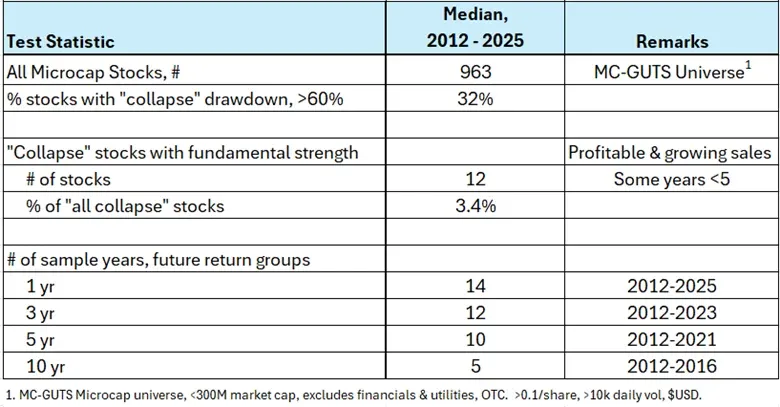
Notable here that nearly 1/3 of microcaps experience a collapse drawdown of 60% per year. And of those, only 3.4% still have fundamental strength, being both profitable and growing sales.
**Most “Collapse” Microcaps Do not Recover**
The chart below shows median future returns of our deep drawdown microcaps (“collapse”, -60% 1 year drawdown or more), in the future 1, 3, 5 and 10 years after collapse.
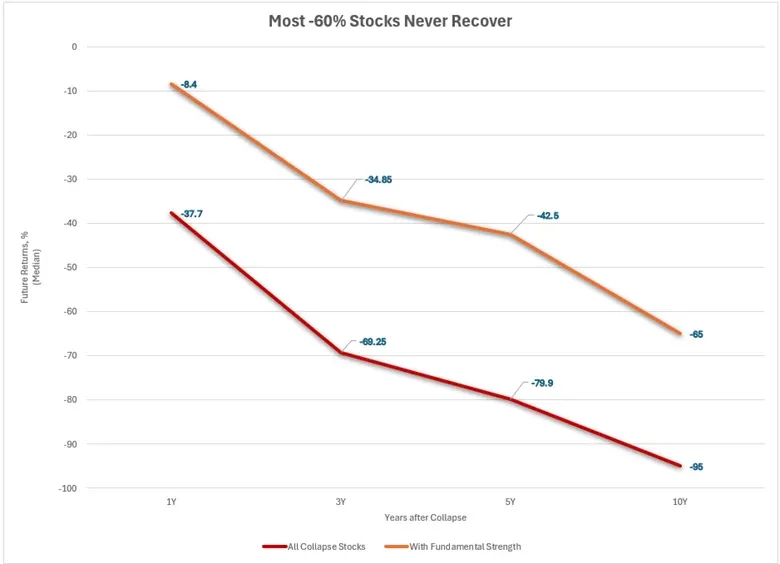
Source: Author chart, Portfolio123 data. US Microcaps, median values 2012 thru 2025\. See study basis for details.
As the chart illustrates, future returns continue to deteriorate for our group of “collapse” microcaps (red line), from -38% in the next near, to -95% in 10 years.
Even those stocks with fundamental strength at time of collapse (profitable and growing sales, orange line), future returns improve compared to all collapse microcaps, but are still negative and quite deep.
**Survival Rates**
Of those collapse microcaps with fundamental strength, a meaningful percentage do not survive long term. This is due to several factors, mostly due to delistings, bankruptcies, mergers, and in a minority of cases the stock exiting the microcap universe.
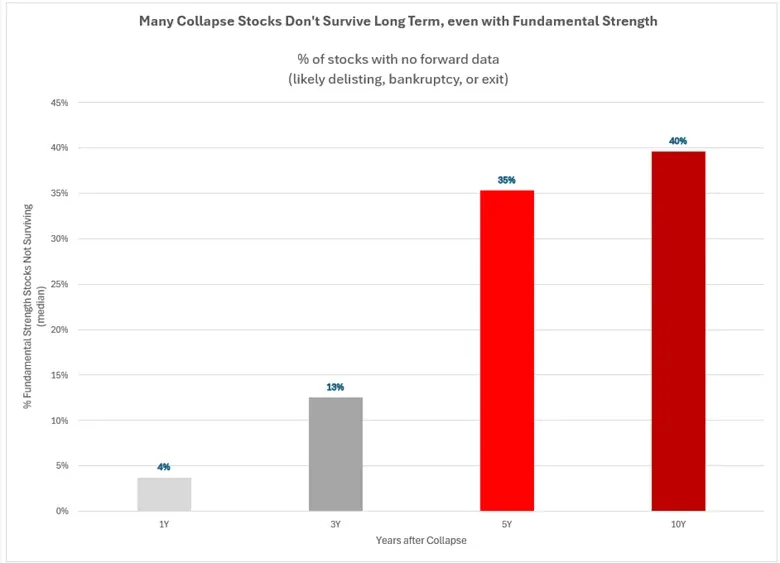
Source: Author chart, Portfolio123 data. US Microcaps, median values 2012 thru 2025\. See study basis for details.
Survival rates decline meaningfully over longer time horizons, with roughly 40% of collapse stocks no longer in the universe after 10 years.
**Winners Win**
Median values describe the overall group, but they obscure an important subset: the winners.
Below we see overall median returns of those stocks with fundamental strength, that managed to post positive future returns.
As an example, 5 years after the collapse, winning stocks posted a return of nearly 2X (99%), and 2.5X after 10 years.
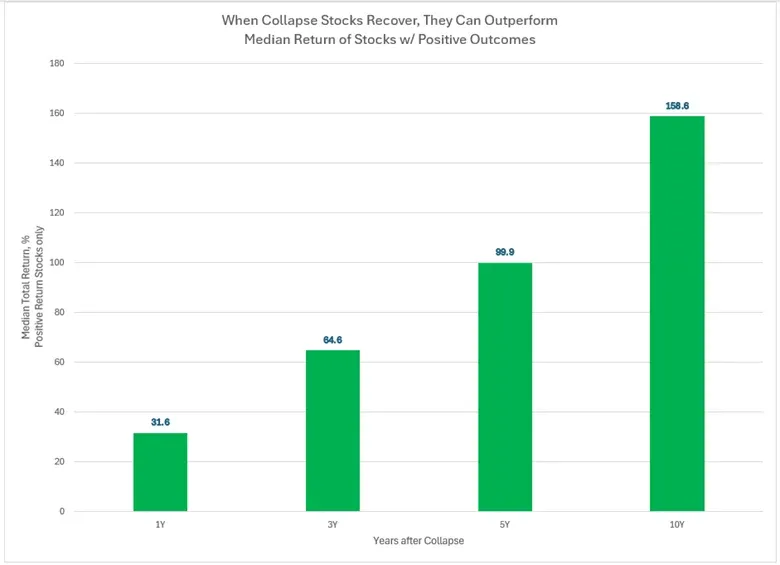
Source: Author chart, Portfolio123 data. US Microcaps, median values 2012 thru 2025\. See study basis for details. Past performance is no guarantee of future results.
We are talking a small subset of stocks that posted positive returns. In the chart below, we see median % of stocks with fundamental strength, also with positive returns (blue line).
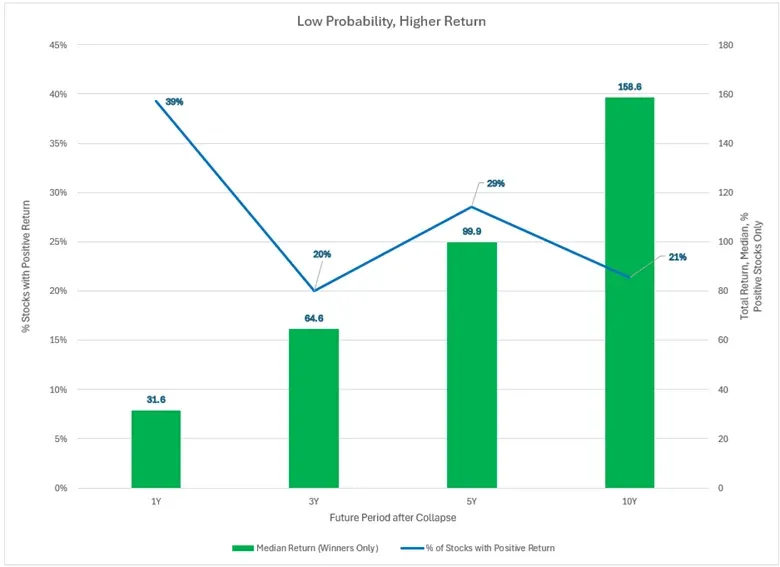
Source: Author chart, Portfolio123 data. US Microcaps, median values 2012 thru 2025\. See study basis for details. Past performance is no guarantee of future results.
As can be expected, the proportion of winners trends downwards over time, with 39% of collapse stocks being winners after 1 year, but trending down to 21% over 10 years.
It should be emphasized that overall we are looking at very few stocks that fit this category. Recall from the first table that the median number of “collapse” stocks with fundamental strength is only 12 stocks. This is a tiny number, but these stocks do exist, and pose potential returns for those investors willing to find them.
**Deep Drawdown Microcaps - Dead Money, or Long Term Opportunity?**
Deep drawdowns in microcaps are rarely a signal of opportunity on their own.
On average, the data shows that most “collapse” stocks continue to underperform, and a meaningful percentage don’t survive at all.
But the story doesn’t end there.
A small subset of companies, particularly those that maintain fundamental strength, do recover. And when they do, the returns can be significant over multi-year periods.
The challenge, of course, is that these winners are few and difficult to identify in real time.
For investors, this reinforces an important point:
“Buy the dip” should not be a strategy in microcaps, but rather a starting point. Not all drawdowns are created equal.
In microcaps, a 60% decline is often a warning sign — but in select cases, it can also mark the beginning of the next cycle.
**\*\*\* If you found this research helpful, please share it and also join our community to view 30+ other articles I've written**.
#### Interact and learn with 250+ of the best microcap investors on the planet:
[Join Us](https://microcapclub.com/join-now)
**Portfolio123** – All data and quantitative tools used for this piece, and all pieces in the Evidence Based Forum, provided by Portfolio123\. If you’d like to try Portfolio123 with an extended free trial (35 days vs the typical 20 days), check out [this link](https://www.portfolio123.com/index.jsp?apc=RYANT&ref=microcapclub.com), or use Invitation Code “RYANT” (full disclosure, affiliate link). I’m available for any questions you may have.
**Note:** Past performance is not an indicator of future results. Please visit our Terms of Use for a more complete disclaimer and discussion of the risks of investing.
### Club Conversation with Thomas Bachrach, The Frontier Investor
URL: https://microcapclub.com/club-conversation-with-thomas-bachrach-the-frontier-investor/
Last updated: 2026-03-23T10:23:42.000Z
[Join MicroCapClub](https://microcapclub.com/join-now/) and unlock the ability to listen and participate live in these conversations.
In this insightful interview, Tom Bachrach of PFH Capital shares his investment philosophy, risk management strategies, and experiences in frontier markets like Kazakhstan. Discover how deep value investing, humility, and global opportunities shape his approach to building a resilient portfolio.
You can listen/watch this conversation on [Spotify](https://open.spotify.com/episode/1fG9YkRF8f4WTdrA0e2dfq?si=NGWnsFBWTbm-wdZh1DbfHQ&ref=microcapclub.com), [Apple Podcast](https://podcasts.apple.com/us/podcast/microcapclub/id1765974269?i=1000756740139&ref=microcapclub.com), and YouTube below:
*Disclaimer: All content in this newsletter is for discussion, education, entertainment, and illustrative purposes only and SHOULD NOT be construed as professional financial advice, solicitation, or recommendation to buy or sell any securities, notwithstanding anything stated on this newsletter and MicroCapClub.com. There are risks associated with investing in securities. Loss of principal is possible. Past performance is not a predictor of future investment performance. Ian Cassel and MicroCapClub.com are not responsible for investment actions taken by viewers. Should you need such advice, consult a licensed financial advisor, legal advisor, or tax advisor. You agree to verify all information yourself before investing. Any past performance discussed on MicroCapClub.com is no guarantee of future results. Investing involves risk and possible loss of principal capital; please seek advice from a licensed professional. All views expressed are personal opinions as of the date of publication and are subject to change without the responsibility to update views. No guarantee is given regarding the accuracy of the information. [FULL DISCLAIMER and TERMS OF USE](https://microcapclub.com/terms/)*
### Finding Monsters in the Desert
URL: https://microcapclub.com/finding-monsters-in-the-desert/
Last updated: 2026-03-22T11:02:54.000Z
During the winter of 1902, H.J.L. Beadnell was a geologist working for the Geological Survey of Egypt. He was doing the unglamorous work of surveying the topography of the Sahara Desert.
One day he was far from civilization. He was two hundred miles southwest of Cairo, in a valley of the Sahara Desert.
The valley itself was located behind a mountain known as Garet Gohannam "the Mountain of Hell". When the sun sets, the mountain glows with an eerie red light.
While trekking through the valley he noticed weathered bones protruding through the yellow sandstone. He then saw many more. When he analyzed the fossil remains he realized they were giant marine fossils. They looked like whales, but these were different.
They looked like monsters.

The one skeleton reached 70 feet long. It had a long serpentine body with a head that looked like an alligator. But there wasn’t just one of these beasts. There were hundreds of them.
How lonely it must have felt. Beadnell all alone in the middle of nowhere with the remains of hundreds of gigantic sea monsters around him. He was likely filled with excitement, horror, and “WTF is this?!”.
Beadnell passed his findings onto Charles Andrews of the Natural History Museum in London, who, in 1905, officially named the species *Basilosaurus*.

What were the remains of prehistoric sea monsters doing in the middle of the desert?
A long time ago this valley was the Tethys Sea. It was shallow, tropical, and teeming with life. Today, the seabed is now the dessert floor. Thousands of years of winds have peeled back layer after layer, and it now reveals a graveyard of mythical sea creatures. The *Basilosaurus* is now known as the T-Rex of the sea*.*
The valley was like finding a specific zip code where all these giants lived. This wasn’t a place where they came to die. The shallow bay was where they feasted.
The area would go forgotten for sixty years due to it being so hard to get to without the help of 4x4 vehicles. In the late 1980’s it was eventually called Wadi al-Hitan (Arabic for "Valley of the Whales") by the Egyptian government. In 2005, Wadi al-Hitan became a protected area under international treaty by UNESCO.
Even today, only 1000 people visit the secluded site each year.
The Sahara desert is roughly the size of the United States. The microcap ecosystem can feel like the Sahara dessert. It is massive by surface area, roughly 60% of all public companies globally. Few are willing to survey this investment topography. But that in itself is the opportunity.
You could search for days, weeks, months and find nothing unique. But if you had the help of 100 or 1000 highly skilled microcap investors you would likely find something faster.
On MicroCapClub we have many of the world’s best microcap stock pickers searching the vast microcap ecosystem for the next multibagger. Our global community produces 10-20 ideas per month.
We summarize each new investment thesis down to a paragraph so you can quickly digest the ideas and drill down on those you connect with to start your research. You can view over 1,500 discussions, interact with members, and be proactive with the community on due diligence.
Since 2011, our members have profiled 1,500 microcaps, 300+ multi-baggers, 256 have been acquired.
#### Interact and learn with 250+ of the best microcap investors on the planet:
[Join Us](https://microcapclub.com/join-now)
Several hundred of us are meeting up in Las Vegas for the Berkshire of microcap. You don’t have to be part of MicroCapClub to attend. Registration is **FREE FOR ALL INVESTORS**.

#### Planet MicroCap - Las Vegas
June 16-18, 2026 - https://planetmicrocap.com
[Learn more](https://planetmicrocap.com/?ref=microcapclub.com)
MicroCapClub is an exclusive forum for experienced microcap investors to share and discuss microcap companies (sub $1 billion market cap) trading on global markets. Since 2011, our members have profiled 1400+ microcap companies, 300+ have turned into multi-baggers. Investors can join our community by applying to become a member or subscribing to gain instant access. For more information, visit
### Strengths as Weaknesses
URL: https://microcapclub.com/strengths-as-weaknesses/
Last updated: 2026-03-17T09:51:01.000Z
> *Every form of strength covers one weakness and creates another, and therefore every form of strength is also a form of weakness, and every weakness is a strength.* \- *Michael Lewis*
Sometimes an investors’ strengths can also be their greatest weaknesses. In fact, often times, your greatest strength is *right next to* your greatest weakness.
In Morgan Housel’s excellent book, *Same as Ever*, he talks about Cope’s Rule, an evolutionary hypothesis stating that animal lineages tend to evolve toward larger body sizes over geological time. The tendency of evolution to create larger species is counterbalanced by the tendency of extinction to kill off larger species. In other words, body size accentuates the gains but amplifies the losses. Big animals require lots of land per capita. They need more food per unit of body mass than small animals. They can’t hide easily. They move slowly. They reproduce slowly. They don’t need to adapt since they are at the top of the food chain. Therefore, they become more susceptible to death.
There are so many parallels to investing here, whether it’s thinking about leverage (which amplifies gains and magnifies losses), lack of adaptation, or competitive advantages (harder to gain, even harder not to lose). But I’m most interested in weaknesses sitting right next to strengths.
I attempted an exercise recently that involved writing down the most closely held beliefs I’ve developed as an investor, and then immediately examine how they could actually be some of my biggest weaknesses. The results were shocking. In just a short period of time, I realized that I’m guilty of being inflexible, stubborn, biased, and condescending toward other investment styles or ways of making money.
A few examples include my determination to find and own ‘cheap’ stocks, something I labeled as a strength. Well, the best businesses are rarely, if ever, optically cheap, and cheap stocks are cheap for a reason. Both of those truths, following my belief, have led to mistakes throughout my career.
I’ll never stop searching for and investing in quality microcaps, an area of the market that can be rife with inefficiencies. However, there is data behind the fact that large company stock prices move around significantly during any given year. There can be massive inefficiencies among even large cap companies (thinking of you, Constellation Software), while small companies often have difficulty achieving the appropriate cost of capital. There have been many times when I should have owned a larger business that I dismissed as ‘too big’, while instead owning a lower quality small company operating in the same industry.
The final example includes using long-termism as a crutch. Thinking that I will be bailed out from a weakening thesis or competitive position by being ‘long-term’ or more patient has at times detracted from returns. I’ve learned that the short term actually matters a lot. Investment returns are in fact a longer series of short term returns, and good companies that are executing do not stay cheap for years. It doesn’t make you short term by selling a losing position, or taking profits once a company has reached your estimate of intrinsic value.
These are just a few examples where strengths I’ve long valued sit uncomfortably close to potential weaknesses.
In his essay [What’s Going On Here, With this Human](https://grahamduncan.blog/whats-going-on-here/?ref=microcapclub.com), allocator Graham Duncan writes: “One marker that I’m seeing someone clearly is when I understand how their strengths are also their weaknesses, how their genius lives right next to their dysfunction.”
That idea has stuck with me because it applies just as much to investors as it does to anyone else. I’m not encouraging less conviction or less discipline. The goal is to understand the hidden costs of these qualities when taken too far, as a rigid framework or process can turn develop into shackles.
I’d recommend every investor try this exercise. Write down the traits and beliefs you are most proud of, then force yourself to ask how each one could be hurting you. Not in theory, but in practice. Where has your temperament improved your results? Where has it blinded you? What do you think is your edge, and how could it be a liability?
A person’s greatest strength often carries the blueprint for their greatest weakness. Pay attention to the traits that give you an advantage, then recognize the distortions and blind spots that can come with it. In investing, as in life, strengths don’t exist in a vacuum. They arrive attached to their own failure modes. The investor who can see both clearly is usually the one who keeps improving.
#### Interact and learn with 250+ of the best microcap investors on the planet:
[Join Us](https://microcapclub.com/join-now)
MicroCapClub is an exclusive forum for experienced microcap investors to share and discuss microcap companies (sub $1 billion market cap) trading on global markets. Since 2011, our members have profiled 1400+ microcap companies, 300+ have turned into multi-baggers. Investors can join our community by applying to become a member or subscribing to gain instant access. For more information, visit
### EVS Broadcast Equipment SA (EVS.BR): The Backbone of Live Broadcasting
URL: https://microcapclub.com/evs-broadcast-equipment-sa-evs-br-the-backbone-of-live-broadcasting/
Last updated: 2026-03-16T09:33:47.000Z
In this Business Breakdown, David Barbato and Geert Campaert sit down with EVS Broadcast Equipment’s (EVS.BR) CEO Serge Van Herck. The company was originally profiled on MicroCapClub by Geert Campaert on April 28, 2025.
This discussion took place live on March 9th, 2026, on the MicroCapClub Community. Not part of the community? [Join us](https://microcapclub.com/join-now/).
#### Interact and learn with 250+ of the best microcap investors on the planet:
[Join Us](https://microcapclub.com/join-now)
In this in-depth interview, Serge Van Herck, CEO of EVS Broadcast Equipment, shares insights into the company's strategic growth, technological innovations, and market positioning in live video technology for broadcast and media productions. Discover how EVS is shaping the future of live content creation, their acquisition strategy, and how they navigate industry challenges.
You can listen/watch this business breakdowns on [Spotify](https://open.spotify.com/episode/5u6pID9hCuiwFzotoVxifM?si=defdMStZRYiVize6NgxGaA&ref=microcapclub.com), [Apple Podcast](https://podcasts.apple.com/sk/podcast/microcapclub/id1765974269?i=1000754035063&ref=microcapclub.com), and YouTube below:
*Disclaimer: All content in this newsletter is for discussion, education, entertainment, and illustrative purposes only and SHOULD NOT be construed as professional financial advice, solicitation, or recommendation to buy or sell any securities, notwithstanding anything stated on this newsletter and MicroCapClub.com. There are risks associated with investing in securities. Loss of principal is possible. Past performance is not a predictor of future investment performance. Ian Cassel and MicroCapClub.com are not responsible for investment actions taken by viewers. Should you need such advice, consult a licensed financial advisor, legal advisor, or tax advisor. You agree to verify all information yourself before investing. Any past performance discussed on MicroCapClub.com is no guarantee of future results. Investing involves risk and possible loss of principal capital; please seek advice from a licensed professional. All views expressed are personal opinions as of the date of publication and are subject to change without the responsibility to update views. No guarantee is given regarding the accuracy of the information. [FULL DISCLAIMER and TERMS OF USE](https://microcapclub.com/terms/)*
### Analyzing the Decision Making of the World’s Best Investors
URL: https://microcapclub.com/analyzing-the-decision-making-of-the-worlds-best-investors/
Last updated: 2026-03-11T10:37:19.000Z
The chance of a top investor’s idea making money is 49%. Let me rephrase that so the message hits home: when a top investor picks a stock to invest in, 51% of the time they will lose money.
Lee Freeman-Shor arrived at this finding by analyzing the top ideas of the world’s best investors, including legendary billionaire hedge fund managers. That discovery shocked, but fascinated him because despite being wrong most of the time, most of them made a lot of money.
When you realize it’s a toss of a coin whether you make money on a stock, and that’s the average of the best investors in the world. Then it hits you what matters most is how you react when you are winning and losing.
He wrote about his findings in his first book, *The Art of Execution*. I wrote about the book [here](https://microcapclub.com/winning-and-losing/).
Shor said the response to the book was overwhelming, but readers wanted to know how to put the lessons learned into practice. He thought a book featuring quantifiably verified Stock Market Maestros would do the trick.
In a new book, *Stock Market Maestros*, co-authors Lee Freeman-Shor and Clare Flynn Levy analyze the decision making of the world’s best investors.
The 12 Stock Market Maestros interviewed in the book weren’t picked randomly. Shor and Levy started with a universe of tens of thousands of public equity mutual funds and active ETFs, and narrowed it down to a shortlist comprised of:
- Morningstar, Lipper, FE Fund Info and Morningstar award winners
- Equity mutual funds listed on Morningstar with high three-year Sharpe, Sortino and Upside/Downside Capture Ratios
- Funds already in the Essentia Analytics database exhibiting strong decision stats.
73 funds made the shortlist. Then they narrowed the list down to 12 stock market maestros based on three long-term and short-term measures.
**Behavioral Alpha Score (BA)** – proprietary patent pending measure of investor decision-making skill developed by Essentia Analytics. It looks at the last three years of trading history and measures whether the investor has been making skilled decisions RECENTLY. That’s important as just because someone was making good (or bad) decisions 10 years ago, doesn’t mean they are still doing so now. BA analyzes 7 critical decision types – Picking, Sizing, Entry timing, Scaling in, Size Adjusting, Scaling out, Exit Timing. A BA score >50 is 1.5x as likely to outperform in the next year as an investor with a BA Score <50.
**Hit Rate** \- The percentage of all positions in the portfolio that generated a positive return during the portion of the period they were held.
**Payoff Ratio** – taking the P&L generated by the average good idea or decision and dividing it by the P&L generated by the average bad idea or decision - How much more are you making from your winners than losing from your losers?
Neither the Maestros nor the shortlist had a median hit rate >50%, but the Maestros scored significantly higher than the rest of the shortlist on all three measures, most notably on Behavioral Alpha Score and payoff ratio.
Each chapter of the book features a conversation with a real Stock Market Maestro from the United States, Europe, or Asia. Each Maestro explains their strategy, decision making, and real examples of what they do when they are winning and losing.
Below is a sample chapter.
[Buy the book!](https://www.amazon.com/Stock-Market-Maestros-strategies-investors/dp/1804091464?ref=microcapclub.com)
[Josh\_GoldbergJosh\_Goldberg.pdf597 KBdownload-circle](https://microcapclub.com/content/files/2026/03/Josh%5FGoldberg.pdf "Download")
#### Interact and learn with 250+ of the best microcap investors on the planet:
[Join Us](https://microcapclub.com/join-now)
MicroCapClub is an exclusive forum for experienced microcap investors to share and discuss microcap companies (sub $1 billion market cap) trading on global markets. Since 2011, our members have profiled 1400+ microcap companies, 300+ have turned into multi-baggers. Investors can join our community by applying to become a member or subscribing to gain instant access. For more information, visit
### Iridex Corp (IRIX): Transforming Eye Care
URL: https://microcapclub.com/iridex-corp-irix-transforming-eye-care/
Last updated: 2026-03-09T15:38:01.000Z
In this Business Breakdown, David Barbato and Christian Schmidt sit down with Iridex (IRIX) CEO Patrick Mercer and CFO Romeo Dizon. This discussion took place live on February 27th, 2026, on the MicroCapClub Community. Not part of the community? [Join us](https://microcapclub.com/join-now/).
#### Interact and learn with 250+ of the best microcap investors on the planet:
[Join Us](https://microcapclub.com/join-now)
This comprehensive interview with Patrick Mercer and Romeo Dizon of Iridex covers the company's strategic focus, financial turnaround, product portfolio, market opportunities, and future plans. Gain insights into how Iridex is positioning itself for growth in ophthalmic laser technology and the healthcare industry.
You can listen/watch this business breakdowns on [Spotify](https://open.spotify.com/episode/1MyjdJ6uDkaSHJQ8TR8piE?si=W%5FUr1MIkQYaRTHx-N-QmIA&ref=microcapclub.com), [Apple Podcast](https://podcasts.apple.com/sk/podcast/microcapclub/id1765974269?i=1000754035063&ref=microcapclub.com), and YouTube below:
*Disclaimer: All content in this newsletter is for discussion, education, entertainment, and illustrative purposes only and SHOULD NOT be construed as professional financial advice, solicitation, or recommendation to buy or sell any securities, notwithstanding anything stated on this newsletter and MicroCapClub.com. There are risks associated with investing in securities. Loss of principal is possible. Past performance is not a predictor of future investment performance. Ian Cassel and MicroCapClub.com are not responsible for investment actions taken by viewers. Should you need such advice, consult a licensed financial advisor, legal advisor, or tax advisor. You agree to verify all information yourself before investing. Any past performance discussed on MicroCapClub.com is no guarantee of future results. Investing involves risk and possible loss of principal capital; please seek advice from a licensed professional. All views expressed are personal opinions as of the date of publication and are subject to change without the responsibility to update views. No guarantee is given regarding the accuracy of the information. [FULL DISCLAIMER and TERMS OF USE](https://microcapclub.com/terms/)*
### High Conviction
URL: https://microcapclub.com/high-conviction/
Last updated: 2026-03-22T10:23:07.000Z
There is a massive difference between taking a large initial position and allowing a position to become large. Few investors understand this distinction.
Taking a large initial "at-cost" position is the investment equivalent of getting married after one date. In contrast, building conviction in a management team and business is like building trust in a relationship. It can’t be rushed. Trust is built at the beat of its own drum. Every position is unique, just like every relationship is unique, and conviction scales differently with each investment.
One of the most rewarding aspects of stock picking over 20+ years is looking back to see how I've evolved. The thousands of buy, sell and hold decisions. Some ultimately impact you far greater than others. Every investment decision shapes the next version of you like a sculptor shapes a piece of art, and knowing which specific experiences changed your perspective is invaluable.
**Growing Means Evolving**
I have always been a conviction investor, but I have evolved in how I define "high conviction" and how it is expressed within my portfolio. When most investors hear high conviction, they think of high concentration. To them, concentration means making massive bets. Specifically, initial position sizes of 10% or more.
Most investors operate under this logic:
> High Conviction = High Concentration = Large Initial Position Sizes
I used to believe this too, but I now realize this thinking is flawed. [Conviction investing](https://microcapclub.com/conviction-investing/) is a deeply personal pursuit where subjectivity blends with objectivity. To an outsider, true conviction often looks like stubbornness or even arrogance.
**What is Conviction?**
Conviction is when you KNOWa business or a stock better than most other investors in that name.
Notice that my definition does not include hoping or believing more than others. Those are emotions, and they are rarely grounded in facts. You don’t build conviction by waiting for management to tell you how the business is doing, nor do you build it by doing what the average investor does while hoping for an above-average outcome.
True conviction means understanding the Key Performance Indicators (KPIs) that drive the business and finding ways to track them independently of management’s commentary. This requires "scuttlebutt," channel checks, and expert calls. It often means digging for exclusive public information that isn’t readily available to those who aren’t looking for it.
**High Conviction ≠ No Risk**
High conviction does not mean all risk has been eliminated. The higher the valuation, the higher the risk. In addition, variables outside of a company’s control which may impact your ability to "know" a business better than others also increases risk.
Every business in a portfolio is susceptible to different risks and magnitudes of risk. The fund I manage invests in various microcap business types, ranging from "story stocks" with no revenue, to growth stocks with no profit, to GARP stocks with growing revenue and profit. We are industry agnostic, owning healthcare, exploration and mining, oil & gas, cybersecurity, building material retailers, cannabis, infrastructure, and aerospace and defense. The common thread across all these positions is my perception of quality management.
Because each industry and business type has its own risk profile, high conviction isn't "cookie-cutter". It doesn't mean every situation warrants a 5%, 10%, or 15% at-cost position. High conviction might justify a 3% position in one instance and 8% in another. Initial sizing should be based on the adjusted risk profile and the upside/downside ratio.
**Upside, Downside, and Liquidity**
The upside of a company is the gap between today’s valuation and what you believe it will be worth in 2-3 years. This is often difficult to assess, as it is a combination of fundamental execution, the "story," and whether macro conditions are acting as a headwind or tailwind to valuation multiples. It is always best to remain conservative with future expectations.
Here is the funny thing about microcaps and downside. No matter how cheap or undiscovered you think a microcap is, EVERY microcap has 50% downside. When you are calculating upside to downside ratios across your portfolio and watchlist, the starting point is down 50%.
If you manage large sums, initial sizing may also be a function of liquidity. It might take me a week or three months to build a 3% position. I don't avoid a stock just because it might "get away" from me before I reach my target size. IRR is IRR whether it's a 1% or 3% position, and with patience, I can usually acquire the desired stake.
**A Stock Picker is a Chef**
Envision you are a Chef hosting a dinner. *Mise en place* is the French term for having all ingredients measured, chopped, and arranged before cooking. Your guests haven't been told what you are making. They only see the raw ingredients on the counter. A few guests become concerned because they see an ingredient they personally dislike.
However, you have made this dish a hundred times. It’s a favorite of yours. You’ve also put your personal mark on it with a pinch of this or a drizzle of that. The guests watch you incorporate the ingredients in specific ways and precise quantities. They may remain skeptical until they finally taste the dish and realize it is delicious.
In the same way, outside investors might be skeptical of your portfolio’s ingredients and weightings. They have preconceived notions based on their own experiences, or lack thereof, with a specific industry. They see a standalone ingredient rather than a piece of a larger flavor profile.
I’ve jokingly referred to my portfolio like a stew. To outsiders the ingredients don’t make sense, and the dish looks like a pile of slop, but it sure tastes good.
**Using Unloved Ingredients**
The investment world is full of contradictions. For example, many investors avoid "price takers", businesses like oil & gas, or resources or even cannabis where the market decides the price of the commodity.
However, if you invert this negative attribute, you find a positive. Some of these companies often don't need sales or marketing departments. They simply need to produce at a cost lower than the market price. You are trading pricing power for the insatiable demand that is always present at a certain price point.
More importantly, it is easier to spot great leadership in these "awful" industries. When a sector is contracting, the outliers that remain profitable and continue to grow become obvious. Identifying these companies at cyclical lows can create generational wealth.
The risk here is unknowable duration risk. You might have to wait 2-3-5-10 years to make 2,000% in 18-months. The equities in these industries can remain dormant for years due to capital outflows. You express this unknown through smaller position sizing. I can have high conviction and still hold a small position. A position size that allows me to stay the course financially and emotionally until the destination is reached.
I also hold a couple story stocks. The main risk is dilution. I might love the story, and the management. Perhaps the management team even had previous success, but past success doesn’t guarantee future success.
Story stocks have heightened macro and stock market sensitivity. In a bull market a story stock might trade at a $200 million valuation. In a bear market that same story stock might trade at a $10 million valuation. Same story. Different valuation. I may have high conviction in a story stock, but these risks get reflected in smaller initial position sizing.
**High Conviction ≠ High Concentration ≠ Big Initial Positions**
I hold a concentrated 15-stock portfolio where my top four positions are each 10% or more. All of them began as 2-4% at-cost positions.
High concentration doesn't mean sizing big in the beginning. It means letting winning positions get big in the end.
A position earns the right to be large by going up 3x, 4x, 5x+. It is much easier to sleep at night during volatility when you’ve already been proven right and the position has earned its larger weighting.
Many mistakes stem from oversizing and overstepping your conviction at the exact moment you are most excited about a company – at the beginning of the relationship when euphoria is at its peak.
Gavin Baker, Managing Partner/CIO of Atreidas Management said it best, “Take your time getting to know the people and only make a very large bet once you have a history with the management and the company.”
Building a big position in the portfolio is the same as building trust in a relationship. It can't be rushed. You must experience firsthand how the management and business will react in good and bad times and how they treat you. Let the position earn its scale.
#### Interact and learn with 250+ of the best microcap investors on the planet:
[Join Us](https://microcapclub.com/join-now)
MicroCapClub is an exclusive forum for experienced microcap investors to share and discuss microcap companies (sub $1 billion market cap) trading on global markets. Since 2011, our members have profiled 1400+ microcap companies, 300+ have turned into multi-baggers. Investors can join our community by applying to become a member or subscribing to gain instant access. For more information, visit
### 300+ Investors Registered, 80+ Companies Confirmed, Join Us!
URL: https://microcapclub.com/300-investors-registered-80-companies-confirmed-join-us/
Last updated: 2026-03-03T10:44:28.000Z
The Microcap event of the year is only 104 days away. We already have 300+ investors confirmed.
Whether you're an individual investor, fund manager, family office, or institution, our events are completely free for all verified investors.
- **Completely Free** — No registration fees, no hidden costs, no upsells
- **Structured 1×1 Meetings** — Pre-scheduled face time with management teams
- **Company Presentations** — 25-minute deep dives, not 5-minute pitches
- **Elite Networking** — The highest concentration of serious microcap capital anywhere
- **MicroCapClub Perks** — Members/Subscribers receive exclusive on-site benefits.
Don't miss the microcap event of the year.
[**Planet MicroCap Las Vegas 2026**](https://planetmicrocap.com/?ref=microcapclub.com)
**When**: June 16-18th, 2026 – Get Registered!
**Where**: Las Vegas, NV at the Bellagio
[**\[REGISTER NOW! FREE TO ATTEND\]**](https://www.meetmax.com/sched/event%5F130817/conference%5Fhome.html?ref=microcapclub.com)
We have 80+ microcap companies already confirmed. Our goal is to host 130 high quality microcap companies. If you are a shareholder of such a company, tell your management teams they should attend.
Review the early lineup below. Get ready to schedule 1x1 management meetings. Come prepared. Gain valuable insights you can only get by meeting in person.
[Presenting Companies — Planet MicroCap Showcase 2026Presenting Companies — Planet MicroCap Showcase 2026.pdf401 KBdownload-circle](https://microcapclub.com/content/files/2026/03/Presenting-Companies-----Planet-MicroCap-Showcase-2026.pdf "Download")

Interested in presenting or sponsoring? [\[MORE INFO\]](https://planetmicrocap.com/?ref=microcapclub.com)
See you in Vegas!
MicroCapClub is an exclusive forum for experienced microcap investors to share and discuss microcap companies (sub $1 billion market cap) trading on global markets. Since 2011, our members have profiled 1400+ microcap companies, 300+ have turned into multi-baggers. Investors can join our community by applying to become a member or subscribing to gain instant access. For more information, visit
### NeurAxis (NRXS): Growth-Stage Medtech
URL: https://microcapclub.com/neuraxis-nrxs-growth-stage-medtech/
Last updated: 2026-03-02T11:05:14.000Z
In this Business Breakdown, David Barbato and Sergio Heiber sit down with NeurAxis’s (NRXS) CEO Brian Carrico. The company was originally profiled by Sergio Heiber on August 18, 2024, at $3.14 USD per share. This discussion took place live on February 18th, 2026, on the MicroCapClub Community. Not part of the community? [Join us](https://microcapclub.com/join-now/).

In this conversation, Brian Carrico, CEO of Neuroaxis, discusses the company's growth, the significance of the Category One CPT code, and the current market position. He highlights the importance of strong data for insurance coverage and reimbursement, the focus on pediatric healthcare, and the expansion into the VA market. The discussion also covers the company's treatment mechanisms, ongoing clinical trials, and strategies for scaling operations. Audience questions provide further insights into insurance negotiations and market opportunities.
You can listen/watch this business breakdowns on [Spotify](https://open.spotify.com/episode/4xojwyv7FogiLzWv7Co9w6?si=E60SjmzhTKuGaUjIgFhWuQ&ref=microcapclub.com), [Apple Podcast](https://podcasts.apple.com/us/podcast/microcapclub/id1765974269?i=1000752475706&ref=microcapclub.com)D, and YouTube below:
*Disclaimer: All content in this newsletter is for discussion, education, entertainment, and illustrative purposes only and SHOULD NOT be construed as professional financial advice, solicitation, or recommendation to buy or sell any securities, notwithstanding anything stated on this newsletter and MicroCapClub.com. There are risks associated with investing in securities. Loss of principal is possible. Past performance is not a predictor of future investment performance. Ian Cassel and MicroCapClub.com are not responsible for investment actions taken by viewers. Should you need such advice, consult a licensed financial advisor, legal advisor, or tax advisor. You agree to verify all information yourself before investing. Any past performance discussed on MicroCapClub.com is no guarantee of future results. Investing involves risk and possible loss of principal capital; please seek advice from a licensed professional. All views expressed are personal opinions as of the date of publication and are subject to change without the responsibility to update views. No guarantee is given regarding the accuracy of the information. [FULL DISCLAIMER and TERMS OF USE](https://microcapclub.com/terms/)*
### The Quicker the Rise, The Harder the fall
URL: https://microcapclub.com/the-quicker-the-rise-the-harder-the-fall/
Last updated: 2026-02-25T11:25:24.000Z
One of the attractions of microcap investing is finding multibaggers, stocks that have increased in value of 2X or more.
Your odds of finding them in microcaps, compared to large caps, are generally higher. In 2024, 15 microcaps returned 4X or more. No stocks in the S&P 500 achieved that level of return.

While there is a higher chance of finding multibaggers as microcaps, there is also a cost, higher volatility.
One of the more painful forms of volatility is max drawdown — the peak-to-trough decline during a stock’s ascent. On their path to multibagger status, microcaps have historically experienced larger drawdowns than their large-cap counterparts (noting the smaller sample size for large caps).
Trailing drawdown is one thing. But if the saying “the quicker the rise, the harder they fall” holds true, then high performers may also face elevated future drawdown risk.
In our sample, that is exactly what has occurred.

Essentially, the higher or quicker the bagger, the larger the subsequent 1-year drawdown — exceeding 50% in this case. These declines can be gut-wrenching. Some stocks recover and continue their ascent, others do not.
So what is driving these drawdowns?
Which category of bagger (1 year 2x, 3x, 4x, 5x baggers) produces the best long-term (10-year) returns?
I answer these questions in the [full report](https://community.microcapclub.com/forums/topic/5789-multibagger-misbehavior-deep-drawdowns-capital-cycles-and-how-to-protect-your-gains/?ref=microcapclub.com) which is on our community. Not part of MicroCapClub?
#### Interact and learn with 250+ of the best microcap investors on the planet:
[Join Us](https://microcapclub.com/join-now)
MicroCapClub is an exclusive forum for experienced microcap investors to share and discuss microcap companies (sub $1 billion market cap) trading on global markets. Since 2011, our members have profiled 1400+ microcap companies, 300+ have turned into multi-baggers. Investors can join our community by applying to become a member or subscribing to gain instant access. For more information, visit
### High Tide Inc (HITI): Inside the Costco of Cannabis
URL: https://microcapclub.com/high-tide-inc-hiti-inside-the-costco-of-cannabis/
Last updated: 2026-02-23T10:42:30.000Z
In this Business Breakdown, David Barbato and Ian Cassel sit down with High Tide Inc’s (HITI) CEO Raj Grover and Capital Market Advisor Vahan Ajamian. The company was originally profiled by Ian Cassel on November 10, 2025, at $3.00 USD per share. This discussion took place live on February 17th, 2026, on the MicroCapClub Community. Not part of the community? [Join us](https://microcapclub.com/join-now/).
In this conversation, Raj Grover, CEO of High Tide, discusses the company's journey from a single tobacco shop to the largest cannabis retailer in Canada. He shares insights into their innovative business model, including a unique loyalty program that has significantly boosted customer engagement and sales. The discussion also covers Hightide's expansion strategy, both domestically and internationally, as well as the challenges and opportunities within the cannabis market. Grover emphasizes the importance of location, store economics, and the company's commitment to becoming a global leader in cannabis retail.
You can listen/watch this business breakdowns on [Spotify](https://open.spotify.com/episode/78uJsN9gi4KxULkQ4aoUZq?si=LKc-mT6rRXitvKkC8jdTLQ&ref=microcapclub.com), [Apple Podcast](https://podcasts.apple.com/us/podcast/microcapclub/id1765974269?i=1000750991282&ref=microcapclub.com), and YouTube below:
*Disclaimer: All content in this newsletter is for discussion, education, entertainment, and illustrative purposes only and SHOULD NOT be construed as professional financial advice, solicitation, or recommendation to buy or sell any securities, notwithstanding anything stated on this newsletter and MicroCapClub.com. There are risks associated with investing in securities. Loss of principal is possible. Past performance is not a predictor of future investment performance. Ian Cassel and MicroCapClub.com are not responsible for investment actions taken by viewers. Should you need such advice, consult a licensed financial advisor, legal advisor, or tax advisor. You agree to verify all information yourself before investing. Any past performance discussed on MicroCapClub.com is no guarantee of future results. Investing involves risk and possible loss of principal capital; please seek advice from a licensed professional. All views expressed are personal opinions as of the date of publication and are subject to change without the responsibility to update views. No guarantee is given regarding the accuracy of the information. [FULL DISCLAIMER and TERMS OF USE](https://microcapclub.com/terms/)*
### D-BOX Technologies (DBO.TO / DBOXF): Inside the Haptics Powering Modern Cinema
URL: https://microcapclub.com/d-box-technologies-dbo-to-dboxf-inside-the-haptics-powering-modern-cinema/
Last updated: 2026-02-19T10:52:16.000Z
In this Business Breakdown, Sean Marconi and Mathieu Martin sit down with D-BOX Technologies (DBO.TO / DBOXF) CEO Naveen Prasad. The company was originally profiled by "Akin Akinnawo" on December 29, 2015, at $0.36 CAD per share. This discussion took place live on February 13th, 2026, on the MicroCapClub Community. Not part of the community? [Join us](https://microcapclub.com/join-now/).

In this conversation, Naveen Prasad, CEO of D-BOX Technologies, discusses the evolution and strategic focus of the company, emphasizing the role of haptic technology in enhancing the theatrical experience. He outlines the company's revenue model, market opportunities, and financial performance, while also addressing the contributions of sim racing and training. The discussion includes insights into future technology developments, the sales process evolution, and global market expansion. Audience questions provide further clarity on D-BOX's positioning and growth strategy.
You can listen/watch this business breakdowns on [Spotify](https://open.spotify.com/episode/40jZUxymAuXNgDm9l8PMX1?si=Csz7hUMIQDW6Yi8X93onDw&ref=microcapclub.com), [Apple Podcast](https://podcasts.apple.com/us/podcast/microcapclub/id1765974269?i=1000750466412&ref=microcapclub.com), and YouTube below:
*Disclaimer: All content in this newsletter is for discussion, education, entertainment, and illustrative purposes only and SHOULD NOT be construed as professional financial advice, solicitation, or recommendation to buy or sell any securities, notwithstanding anything stated on this newsletter and MicroCapClub.com. There are risks associated with investing in securities. Loss of principal is possible. Past performance is not a predictor of future investment performance. David Barbato and MicroCapClub.com are not responsible for investment actions taken by viewers. Should you need such advice, consult a licensed financial advisor, legal advisor, or tax advisor. You agree to verify all information yourself before investing. Any past performance discussed on MicroCapClub.com is no guarantee of future results. Investing involves risk and possible loss of principal capital; please seek advice from a licensed professional. All views expressed are personal opinions as of the date of publication and are subject to change without the responsibility to update views. No guarantee is given regarding the accuracy of the information. [FULL DISCLAIMER and TERMS OF USE](https://microcapclub.com/terms/)*
### New Book - Stock Picker by Ian Cassel
URL: https://microcapclub.com/new-book-stock-picker-by-ian-cassel/
Last updated: 2026-02-17T11:24:10.000Z
I'm excited to announce a new book I've been working on that will be available in September. I'll be talking about it more this summer and think you will enjoy it. You can [Pre-order here](https://microcapclub.com/stock-picker/).
[](https://microcapclub.com/stock-picker/)
### A Club Conversation with Michael Liu, Biotech Trading
URL: https://microcapclub.com/a-club-conversation-with-michael-liu-biotech-trading/
Last updated: 2026-02-16T11:04:43.000Z
[Join MicroCapClub](https://microcapclub.com/join-now/) and unlock the ability to listen and participate live in these conversations.
In this conversation, Michael Liu, founder of Capuchin Capital, shares his journey from early experiences in investing to establishing his own firm focused on microcap and biotech investments. He discusses his unique investment strategies, the importance of understanding shareholder dynamics, and the challenges of managing investor expectations. Michael also emphasizes the significance of mental clarity in trading, shares resources for researching small companies, and challenges conventional investing wisdom. Throughout the discussion, he provides insights into the volatility and opportunities present in the biotech sector, as well as practical advice for aspiring investors.
You can listen/watch this conversation on [Spotify](https://open.spotify.com/episode/2Q7lctqm8YyaoMpS7Gx2QQ?si=uKM7JIX8Ttq5dknI-LdQbg&ref=microcapclub.com), [Apple Podcast](https://podcasts.apple.com/us/podcast/microcapclub/id1765974269?i=1000749952514&ref=microcapclub.com), and YouTube below:
✉️ Share your feedback - david@microcapclub.com
✉️ David’s X (Twitter) - [https://x.com/Valuehunte](https://www.youtube.com/redirect?event=video%5Fdescription&redir%5Ftoken=QUFFLUhqbEFiUjJ4R0VxNFJYNld3LVNxVlc2UGk2UVotZ3xBQ3Jtc0trZnhDQUhOWk1JOWx6TlBlWWNqX1pVRHZrSXh4MHU1SkFyUTZWaVhORE0ydlA1M0ZYZmRuaXpCcWlndzdFR0NJSmdUdnJFSnV3YnNWdmpmd05OU3B4QXpPb3lHQ2dkcE96OE9qRnBDZlI3N1l2eWdwYw&q=https%3A%2F%2Fx.com%2FValuehunte&v=v%5FMcF4jVOyI&ref=microcapclub.com)

#### Planet MicroCap - Las Vegas
June 16-18, 2026 - https://planetmicrocap.com
[Learn more](https://planetmicrocap.com/?ref=microcapclub.com)
*Disclaimer: All content in this newsletter is for discussion, education, entertainment, and illustrative purposes only and SHOULD NOT be construed as professional financial advice, solicitation, or recommendation to buy or sell any securities, notwithstanding anything stated on this newsletter and MicroCapClub.com. There are risks associated with investing in securities. Loss of principal is possible. Past performance is not a predictor of future investment performance. David Barbato and MicroCapClub.com are not responsible for investment actions taken by viewers. Should you need such advice, consult a licensed financial advisor, legal advisor, or tax advisor. You agree to verify all information yourself before investing. Any past performance discussed on MicroCapClub.com is no guarantee of future results. Investing involves risk and possible loss of principal capital; please seek advice from a licensed professional. All views expressed are personal opinions as of the date of publication and are subject to change without the responsibility to update views. No guarantee is given regarding the accuracy of the information. [FULL DISCLAIMER and TERMS OF USE](https://microcapclub.com/terms/)*
### Cybeats Technologies (CYBT/CYBT.CN): SBOM Management Platform
URL: https://microcapclub.com/cybeats-technologies-cybt-cybt-cn-sbom-management-platform/
Last updated: 2026-02-12T11:07:23.000Z
In this Business Breakdown, David Barbato and Jeff Kowal sit down with Cybeats Technologies’s (CYBT/CYBT.CN) CEO Justin Leger. The company was originally profiled by Jeff Kowal aka "Valueseeker123" on September 15, 2025, at $0.13 CAD per share. This discussion took place live on February 9th, 2026, on the MicroCapClub Community. Not part of the community? [Join us](https://microcapclub.com/join-now/).

In this conversation, Justin Lagier, CEO of Cybeats Technologies, discusses the importance of Software Bill of Materials (SBOM) management in cybersecurity. He explains the regulatory landscape driving the need for SBOMs, the company's business model, customer retention strategies, and the competitive landscape. Justin also shares insights on the sales cycle, implementation process, and the expertise of the team behind SciBits. The conversation highlights the company's growth potential and the challenges it faces in the evolving cybersecurity market.
You can listen/watch this business breakdowns on [Spotify](https://open.spotify.com/episode/3e8yD7tZMdQVegEEuVgdud?si=EA6fYPVgT12dDojvIG9ETQ&ref=microcapclub.com), [Apple Podcast](https://podcasts.apple.com/us/podcast/microcapclub/id1765974269?i=1000748349630&ref=microcapclub.com), and YouTube below:
*Disclaimer: All content in this newsletter is for discussion, education, entertainment, and illustrative purposes only and SHOULD NOT be construed as professional financial advice, solicitation, or recommendation to buy or sell any securities, notwithstanding anything stated on this newsletter and MicroCapClub.com. There are risks associated with investing in securities. Loss of principal is possible. Past performance is not a predictor of future investment performance. Ian Cassel and MicroCapClub.com are not responsible for investment actions taken by viewers. Should you need such advice, consult a licensed financial advisor, legal advisor, or tax advisor. You agree to verify all information yourself before investing. Any past performance discussed on MicroCapClub.com is no guarantee of future results. Investing involves risk and possible loss of principal capital; please seek advice from a licensed professional. All views expressed are personal opinions as of the date of publication and are subject to change without the responsibility to update views. No guarantee is given regarding the accuracy of the information. [FULL DISCLAIMER and TERMS OF USE](https://microcapclub.com/terms/)*
### From Disaster to Triumph
URL: https://microcapclub.com/from-disaster-to-triumph/
Last updated: 2026-02-14T11:34:30.000Z
In the 1660’s, London was the third-largest city in the Western world, behind only Paris and Constantinople. God was angry at London, so he sent plague and fire to destroy the city.
First, the Great Plague of London hit in 1665\. It killed 100,000 people over 18 months, one quarter of London’s population. The very next year, in 1666, the Great Fire of London destroyed 80% of the city, leaving 100,000 residents homeless.
The fire began in the early hours of September 2nd in a bakery on Pudding Lane. It quickly spread due to the dry summer conditions. Fanned by strong easterly winds, the fire raged uncontrollably for four days. In the end it destroyed more than 13,000 homes, 87 churches, St. Paul's Cathedral, and numerous civic buildings. Remarkably, the death toll was minimal, but the devastation left 1/3 of the population homeless and the city in ruins.
In the aftermath, London faced the daunting challenge of reconstruction. Two men at the forefront of the city's rebirth were Christopher Wren, an architect, and Robert Hooke, a scientist and engineer. Their collaboration and vision helped lay the foundation for the modern city we see today.
Wren, already an esteemed academic and professor of astronomy, had developed a passion for architecture. He saw the fire as an opportunity to redesign London into a grand, modern metropolis with wide boulevards, public squares, and monumental buildings inspired by the Renaissance cities of Europe.
He quickly submitted plans for a rebuilt London, emphasizing a grid layout to replace the medieval street pattern. However, due to the complexity of land ownership and the urgency to rebuild, Wren's ambitious plan never happened. Instead, the city was reconstructed largely along its existing street lines.
Despite these setbacks, Wren left a profound architectural legacy. Most notably, he undertook the redesign of St. Paul's Cathedral, which had been destroyed in the fire. The new cathedral, completed in 1711 (45 years later), became a masterpiece of English Baroque architecture and remains one of London's most iconic landmarks. Wren was also responsible for designing or rebuilding 51 parish churches, each reflecting his skill in blending classical and innovative designs.
Meanwhile, Robert Hooke, a polymath and Wren's contemporary, played an equally crucial role in the rebuilding effort. As the City of London's Surveyor, Hooke was responsible for laying out the new streets and ensuring the safe reconstruction of buildings. He devised practical solutions for the rebuilding process, including setting standardized building regulations to reduce the risk of future fires. Hooke's work extended beyond logistics; he also collaborated with Wren on several architectural projects, blending his engineering expertise with Wren's artistic vision.
The two complemented each other: Wren with his visionary designs and Hooke with his scientific precision and practical problem-solving skills. They both had high standards which reshaped London from disaster to triumph.
The destruction and rebuilding of London is like a new management team stepping into a mismanaged business and turning it around. A turnaround management team must cut expenses, sell off unprofitable, vanity, and non-core assets until its left with a foundation in which it can grow from.
Some of the biggest returns can come from turnarounds at the time of management change. These times are normally at peak disappointment and despair. If the new management team is successful, and that's a big IF, an investor can fully benefit from multiple expansion as a distressed deep value stock transitions to value, then to GARP, then potentially to Growth multiples.
#### Interact and learn with 250+ of the best microcap investors on the planet:
[Join Us](https://microcapclub.com/join-now)
Here are a few examples of companies profiled on MicroCapClub that were profiled in the early innings of a turnaround:
**D-BOX Technologies Inc. (DBO.TO)** \- Profiled by member Iqbal\_WHYUNO on May 6, 2025, at $0.15 per share, now $0.84 per share. View the original profile and ongoing discussion [here](https://community.microcapclub.com/forums/topic/1337-d-box-technologies-dboto-dboxf/page/2/?ref=microcapclub.com#findComment-98328).

The initial catalyst for the turnaround occurred in June of 2023, when Daniel Marks of Stonehouse Capital pressured management to reshuffle the board. They conceded and Daniel Marks and Naveen Prasad were added to the board.
Then in June 2025, D-BOX underwent a significant leadership shakeup. Naveen Prasad, a seasoned media and restructuring executive (formerly of VICE Media Canada and Elevation Pictures), was appointed interim CEO. Prasad replaced long-time CEO Sébastien Mailhot with a mandate for "disciplined execution."
Since taking over, Prasad has overhauled the executive suite, appointing a new CFO (David Reid) and a new Chief Commercial Officer (Scott Sherr) to focus on aggressive market expansion rather than just managing existing accounts. The transformation is already visible in the numbers. In the most recent quarter, revenues soared 33% and profits almost doubled year over year. While the stock was a "penny stock" for years, it has seen a dramatic re-rating in 2025 and early 2026\.
**Aluula Composites (AUUA.V)** \- Profiled by member lockstockbarrel on August 6th, 2025, at $1.11, now $3.60 per share. View the original profile and ongoing discussion [here](https://community.microcapclub.com/forums/topic/5310-aluula-composites-inc-auuav/?ref=microcapclub.com).

The turnaround was sparked by the appointment of Sage Berryman as CEO in February 2024\. Berryman, a specialist in corporate transitions, recognized that the company's real value wasn't in making end-products, but in its patented, glue-free composite material.
Berryman executed a "burn the boats" strategy. She divested the company’s retail brand, Ocean Rodeo, to eliminate a conflict of interest with other gear manufacturers. This allowed Aluula to position itself as a neutral ingredient brand becoming the "Intel Inside" or "Gore-Tex" of high-performance composites. The market's re-rating of Aluula has been aggressive over the last year as they moved from "research project" to "commercial scale."
**SANUWAVE Health (SNWV)** – Profiled by Ian Cassel on October 23, 2024, at $14.25 per share, now $25\. View the original profile and ongoing discussion [here](https://community.microcapclub.com/forums/topic/4659-sanuwave-health-snwv/?ref=microcapclub.com).

Sanuwave acquired UltraMIST in 2020 and since then it’s quickly become 95% of the company’s revenue and profit. Ultramist uses ultrasound waves to treat wounds making the process pain free since it makes no physical contact with the wound. But by 2023 Sanuwave $30 million EV dumpster fire of a share structure. 1 billion shares outstanding, another 2 billion worth of dilution from convertibles/warrants, and a pile of debt in forbearance.
The catalyst was when Morgan Frank stepped in as CEO in May of 2023 to protect his investment when the company was on the verge bankruptcy. He negotiated extensions on the debt and replaced much of the workforce, all of the C-Suite, and almost all of the sales force. In late 2024, he recapitalized the company converting warrants and convertible notes into common stock, executed a 1-375 reverse split, while also raising $10 million in new capital while backstopping it with his own money.
The stock has tripled since the recapitalization, and with past skeletons now buried, Morgan and the board are focused on profitable growth.
**TSS Inc, (TSSI)** \- Profiled member Maj on August 20th, 2018, at $0.60, now $9 per share. View the original profile and ongoing discussion [here](https://community.microcapclub.com/forums/topic/2136-tss-inc-tssi/?ref=microcapclub.com).

The turnaround was ignited by Darryll Dewan, who took over as CEO in November 2022\. A former executive at Dell and IBM, Dewan brought "big tech" operational discipline to a company that had previously been a sleepy, low-margin reseller.
TSSI was historically a low-margin hardware reseller with stagnant growth and a tiny balance sheet that couldn't handle large contracts. Dewan pivoted the company away from simple hardware resale toward Systems Integration (AI Rack Integration). He bet the company's future on a new, massive 213,000-square-foot facility in Georgetown, Texas, specifically designed to build and test the complex, liquid-cooled server racks required for AI.
**Zedcor (ZDC.V)** \- Profiled by member Philippsgui on December 10th, 2023, at $0.65, now $6 per share. View the original profile and ongoing discussion [here](https://community.microcapclub.com/forums/topic/4144-zedcor-zdcv/?ref=microcapclub.com).

The transformation was architected by Todd Ziniuk (CEO), who took the helm in 2018\. He recognized that renting "mats and pipes" to oil rigs was a race to the bottom. The company was entirely dependent on the volatile oil and gas cycle. When oil prices dropped, Zedcor’s equipment sat idle, and its debt became unsustainable.
Ziniuk pivoted the company toward Mobile Security. He took their existing light towers, stripped them down, and retrofitted them with high-definition cameras, AI-at-the-edge sensors, and 24/7 live monitoring capabilities (branded as MobileyeZ™).
Since 2022, Zedcor (ZDC.V) has transitioned from a Canadian-centric firm to a North American leader in AI-driven security. Revenue exploded from $22.1 million in 2022 to an estimated $51 million+ in 2025 while Adjusted EBITDA nearly doubled, growing from $7.6 million to over $14.8 million (9-month 2025).
**Ascent Industries (ACNT)** \- Profiled by member ODC on March 6th, 2023, at $9.80 per share, now $17 per share. View original profile and ongoing discussion [here](https://community.microcapclub.com/forums/topic/3699-ascent-industries-acnt/?ref=microcapclub.com).

Ascent Industries is a classic "sum-of-the-parts" turnaround that has recently completed its most critical stage: shedding underperforming businesses to focus on a high-margin winner.
The turnaround began in earnest when Bryan Kitchen was appointed CEO February 2024, after becoming President of the chemicals division in September of 2023\. Kitchen is a veteran of the specialty chemicals industry, and his strategy was radical: stop trying to fix the broken parts and sell them instead. For years, Ascent was a "di-worsified" mess. It had a volatile, capital-intensive steel pipe (tubular) business that dragged down a much better specialty chemicals business.
In 2025, Kitchen successfully divested all tubular assets, including the sale of Bristol Metals. This turned Ascent into a "pure-play" specialty chemicals company. The company is moving away from low-margin commodities to a "CaaS" model. In December 2025, they secured a new $10M+ contract that alone represents 15% growth over their trailing revenue, with margins higher than the company average.
After the 2025 divestitures, Ascent eliminated its debt. As of late 2025, they held roughly $58 million in cash, a massive war chest for a company with a $160M market cap.
**BluMetric (BLM.V)** \- Profiled by member Tom Fedichin on July 21, 2024, at $0.47, now $1.30 per share. View the original profile and ongoing discussion [here](https://community.microcapclub.com/forums/topic/4482-blumetric-environmental-inc-blmv/?ref=microcapclub.com).

BluMetric Environmental is a "transformation-in-progress" story. Historically known as a steady but slow-moving environmental consultancy, the company has recently pivoted into a high-growth WaterTech provider while becoming a vertically integrated water solutions company.
The turnaround has been led by CEO Scott MacFabe. He first shut down unprofitable divisions, then rebuilt the company balance sheet, and now is expanding the business. In 2024 and 2025, MacFabe executed a "growth-by-acquisition" strategy to help diversify away from lumpy Canadian government contracts.
A key catalyst was the 2024 acquisition of Gemini Water (U.S.-based) for 4x EV/EBITDA, which gave BluMetric a manufacturing foothold in the United States and the Caribbean. In December 2025, BluMetric closed a massive acquisition of DS Consultants at 5x EV/EBITDA, a leading Ontario-based engineering firm. This move is designed to double their "Professional Services" footprint while providing a cross-selling platform for their water technologies.
The market began to re-rate BluMetric as its revenue profile shifted from Canadian focused "linear consulting" to a vertically integrated water solutions and technology company providing consulting, engineering, infrastructure, water technology, as well as operation and maintenance anywhere in North America.
**Koil Energy (KLNG)** \- Profiled by member otcdig on November 8th, 2024, at $1.39, now at $2.25 per share. View the original profile and ongoing discussion [here](https://community.microcapclub.com/forums/topic/4681-koil-energy-solutions-inc-klng/?ref=microcapclub.com).

Koil Energy an "under-the-radar" subsea services company that has undergone a complete identity shift over the last three years. Formerly known as Deep Down, Inc., the company rebranded to Koil Energy in 2022 to signal its transition from a traditional oil and gas hardware supplier to a broader subsea technology and renewable energy partner. The turnaround occurred when Erik Wiik was appointed as President and CEO in early 2024\. Wiik, a subsea industry veteran, previously served as Regional President for North America at Aker Solutions.
The company was historically seen as a niche fabrication shop with inconsistent revenue and a heavy reliance on a few major Gulf of America oil projects. Wiik shifted Koil from a simple equipment maker to a strategic services partner. He set out on a 3-year strategic plan to increase sales within its current set of customers while also expanding their products and services into new basins. KLNG is growing its business while the rest of the industry is contracting which proves they are taking market share.
---
The story of London’s 17th-century devastation and subsequent rebirth serves as a powerful reminder that the greatest opportunities are often forged in the wake of total disaster. These dark moments provide the opportunity for great leadership and visionaries like Christopher Wren, Robert Hooke to step into the abyss and help shape a better future.
In the same way, the most compelling investment opportunities frequently emerge when the sky is darkest (or in flames). When a business has been mismanaged and valuation hits rock bottom it is sometimes a catalyst for new leadership to emerge. At MicroCapClub, our members do a phenomenal job of "turning over rocks" to uncover these transformational moments. The ultimate trigger for value creation is often the arrival of new management or an activist investor stepping into a disaster to engineer a triumph.

#### Planet MicroCap - Las Vegas
June 16-18, 2026 - https://planetmicrocap.com
[Learn more](https://planetmicrocap.com/?ref=microcapclub.com)
MicroCapClub is an exclusive forum for experienced microcap investors to share and discuss microcap companies (sub $1 billion market cap) trading on global markets. Since 2011, our members have profiled 1400+ microcap companies, 300+ have turned into multi-baggers. Investors can join our community by applying to become a member or subscribing to gain instant access. For more information, visit
*Disclaimer: All content in this newsletter is for discussion, education, entertainment, and illustrative purposes only and SHOULD NOT be construed as professional financial advice, solicitation, or recommendation to buy or sell any securities, notwithstanding anything stated on this newsletter and MicroCapClub.com. There are risks associated with investing in securities. Loss of principal is possible. Past performance is not a predictor of future investment performance. Ian Cassel and MicroCapClub.com are not responsible for investment actions taken by viewers. Should you need such advice, consult a licensed financial advisor, legal advisor, or tax advisor. You agree to verify all information yourself before investing. Any past performance discussed on MicroCapClub.com is no guarantee of future results. Investing involves risk and possible loss of principal capital; please seek advice from a licensed professional. All views expressed are personal opinions as of the date of publication and are subject to change without the responsibility to update views. No guarantee is given regarding the accuracy of the information. [FULL DISCLAIMER and TERMS OF USE](https://microcapclub.com/terms/)*
### Club Conversation with Dave Waters, Dark Stock Investing
URL: https://microcapclub.com/club-conversation-with-dave-waters-dark-stock-investing/
Last updated: 2026-02-09T10:32:48.000Z
[Join MicroCapClub](https://microcapclub.com/join-now/) and unlock the ability to listen and participate live in these conversations.
In this Club Conversation, Dave Waters from Alluvial Capital, shares his unique journey into the world of investment management, highlighting his non-traditional background and the evolution of his investment philosophy. He discusses the concept of 'arbitrage of inconvenience' in micro-cap investing, the challenges of illiquidity, and the intricacies of expert markets. Waters emphasizes the importance of understanding why companies are public and how to value non-reporting companies. He also explores the role of catalysts in investment decisions, shares insights on international investment opportunities, and reflects on case studies of both successful and unsuccessful investments. Throughout the discussion, he provides valuable lessons on avoiding common investment mistakes and introduces his Tactile Fund strategy, which focuses on unique physical assets. Finally, Waters expresses his passion for investing and the importance of continuous learning, while also considering the future of investing education for his children.
You can listen/watch this conversation on [Spotify](https://open.spotify.com/episode/70WidsGDf5z3GzdKdQuCL1?si=oCnMGj3hSdezq%5FlJmLfCVA&ref=microcapclub.com), [Apple Podcast](https://podcasts.apple.com/us/podcast/microcapclub/id1765974269?i=1000748887278&ref=microcapclub.com), and YouTube below:
✉️ Share your feedback - david@microcapclub.com
✉️ David’s X (Twitter) - [https://x.com/Valuehunte](https://www.youtube.com/redirect?event=video%5Fdescription&redir%5Ftoken=QUFFLUhqbEFiUjJ4R0VxNFJYNld3LVNxVlc2UGk2UVotZ3xBQ3Jtc0trZnhDQUhOWk1JOWx6TlBlWWNqX1pVRHZrSXh4MHU1SkFyUTZWaVhORE0ydlA1M0ZYZmRuaXpCcWlndzdFR0NJSmdUdnJFSnV3YnNWdmpmd05OU3B4QXpPb3lHQ2dkcE96OE9qRnBDZlI3N1l2eWdwYw&q=https%3A%2F%2Fx.com%2FValuehunte&v=v%5FMcF4jVOyI&ref=microcapclub.com)

#### Planet MicroCap - Las Vegas
June 16-18, 2026 - https://planetmicrocap.com
[Learn more](https://planetmicrocap.com/?ref=microcapclub.com)
*Disclaimer: All content in this newsletter is for discussion, education, entertainment, and illustrative purposes only and SHOULD NOT be construed as professional financial advice, solicitation, or recommendation to buy or sell any securities, notwithstanding anything stated on this newsletter and MicroCapClub.com. There are risks associated with investing in securities. Loss of principal is possible. Past performance is not a predictor of future investment performance. David Barbato and MicroCapClub.com are not responsible for investment actions taken by viewers. Should you need such advice, consult a licensed financial advisor, legal advisor, or tax advisor. You agree to verify all information yourself before investing. Any past performance discussed on MicroCapClub.com is no guarantee of future results. Investing involves risk and possible loss of principal capital; please seek advice from a licensed professional. All views expressed are personal opinions as of the date of publication and are subject to change without the responsibility to update views. No guarantee is given regarding the accuracy of the information. [FULL DISCLAIMER and TERMS OF USE](https://microcapclub.com/terms/)*
### Intelligent Monitoring Group Ltd (IMB.AX): Security Monitoring at Scale
URL: https://microcapclub.com/intelligent-monitoring-group-ltd-imb-ax-security-monitoring-at-scale/
Last updated: 2026-02-05T11:21:13.000Z
In this Business Breakdown, David Barbato and Christian Schmidt sit down with Intelligent Monitoring Group Ltd (IMB.AX) MD Dennison Hambling, and HBI Shenin Singh. The company was originally profiled by MicroCapClub member "Schmidt" on May 31, 2024, at $0.34 AUD per share. This discussion took place live on January 30th, 2026, on the MicroCapClub Community. Not part of the community? [Join us](https://microcapclub.com/join-now/).

In this conversation, Denison Hambling and Shenin Singh from Intelligent Monitoring Group discuss their professional backgrounds, the evolution of their business model, and the strategic vision for the future. They delve into the impact of AI technology on security solutions, the importance of delivery and growth, and their approach to mergers and acquisitions. The discussion highlights the unique position of IMG in the security market and its focus on innovative video guarding technology, which aims to replace traditional security measures with more effective solutions. The conversation concludes with insights into capital allocation and the company's optimistic outlook for the future.
You can listen/watch this business breakdowns on [Spotify](https://open.spotify.com/episode/3e8yD7tZMdQVegEEuVgdud?si=EA6fYPVgT12dDojvIG9ETQ&ref=microcapclub.com), [Apple Podcast](https://podcasts.apple.com/us/podcast/microcapclub/id1765974269?i=1000748349630&ref=microcapclub.com), and YouTube below:
*Disclaimer: All content in this newsletter is for discussion, education, entertainment, and illustrative purposes only and SHOULD NOT be construed as professional financial advice, solicitation, or recommendation to buy or sell any securities, notwithstanding anything stated on this newsletter and MicroCapClub.com. There are risks associated with investing in securities. Loss of principal is possible. Past performance is not a predictor of future investment performance. Ian Cassel and MicroCapClub.com are not responsible for investment actions taken by viewers. Should you need such advice, consult a licensed financial advisor, legal advisor, or tax advisor. You agree to verify all information yourself before investing. Any past performance discussed on MicroCapClub.com is no guarantee of future results. Investing involves risk and possible loss of principal capital; please seek advice from a licensed professional. All views expressed are personal opinions as of the date of publication and are subject to change without the responsibility to update views. No guarantee is given regarding the accuracy of the information. [FULL DISCLAIMER and TERMS OF USE](https://microcapclub.com/terms/)*
### Paragon Advanced Labs (PALS.V): High-Speed Mineral Testing Toll Booth
URL: https://microcapclub.com/paragon-advanced-labs-pals-v-high-speed-mineral-testing-toll-booth/
Last updated: 2026-02-02T10:53:58.000Z
In this business breakdowns, Ian Cassel and Jeff Kowal sit down with Peter Shippen, CEO of Paragon Advanced Labs (PALS.V). The company was originally profiled by Ian Cassel on December 18th, 2025 at $1.90 CAD per share. This Business Breakdowns discussion took place live on January 21st, 2026, on the MicroCapClub Community. Not part of the community? [Join us](https://microcapclub.com/join-now/).
[](https://microcapclub.com/join-now/)
In this conversation, Peter Shippen, CEO of Paragon Advanced Labs, discusses the innovative approach of his company in the mining industry, particularly focusing on their unique assay services using Photon Assay technology. He elaborates on the challenges faced by traditional assay methods, the strategic partnerships that bolster their market position, and the operational model that allows for rapid growth and customer engagement. The discussion also touches on future growth prospects, capital allocation strategies, and the importance of non-destructive testing in the mining sector.
You can listen/watch this business breakdowns on [Spotify](https://open.spotify.com/episode/7uzNpsEKF0pLeCP7f8sSgw?si=dnUBOGr0Q%5Fes0-%5FvfJtBOQ&ref=microcapclub.com), [Apple Podcast](https://podcasts.apple.com/us/podcast/microcapclub/id1765974269?i=1000747682427&ref=microcapclub.com), and YouTube below:
*Disclaimer: All content in this newsletter is for discussion, education, entertainment, and illustrative purposes only and SHOULD NOT be construed as professional financial advice, solicitation, or recommendation to buy or sell any securities, notwithstanding anything stated on this newsletter and MicroCapClub.com. There are risks associated with investing in securities. Loss of principal is possible. Past performance is not a predictor of future investment performance. Ian Cassel and MicroCapClub.com are not responsible for investment actions taken by viewers. Should you need such advice, consult a licensed financial advisor, legal advisor, or tax advisor. You agree to verify all information yourself before investing. Any past performance discussed on MicroCapClub.com is no guarantee of future results. Investing involves risk and possible loss of principal capital; please seek advice from a licensed professional. All views expressed are personal opinions as of the date of publication and are subject to change without the responsibility to update views. No guarantee is given regarding the accuracy of the information. [FULL DISCLAIMER and TERMS OF USE](https://microcapclub.com/terms/)*
### LibertyStream Infrastructure (LIB.V / VLTLF): Inside the US Lithium Tech Disruption
URL: https://microcapclub.com/libertystream-infrastructure-lib-v-vltlf-inside-the-us-lithium-tech-disruption/
Last updated: 2026-02-01T11:06:40.000Z
In this Business Breakdown, David Barbato and John LaGourgue sit down with LibertyStream Infrastructure’s (LIB.V; VLTLF) CEO Alex Wylie. The company was originally profiled by MicroCapClub member John LaGourgue on October 14, 2025, at $0.40 CAD per share. This discussion took place live on January 30th, 2026, on the MicroCapClub Community. Not part of the community? [Join us](https://microcapclub.com/join-now/).

In this conversation, Alex Wylie, CEO of Liberty Stream Infrastructure, discusses the company's innovative approach to lithium extraction from oilfield brines. He outlines the operational strategies, including the importance of field experience, proprietary technology, and refining processes. The conversation also covers market demand, partnerships, funding strategies, and the long-term vision for the company in the rapidly evolving lithium market.
You can listen/watch this business breakdowns on [Spotify](https://open.spotify.com/episode/3A4gVKgtDthtyS1fDEsj8V?si=nbBv0q-cSVOlmVaBB4eZpg&ref=microcapclub.com), [Apple Podcast](https://podcasts.apple.com/us/podcast/microcapclub/id1765974269?i=1000747553783&ref=microcapclub.com), and YouTube below:
*Disclaimer: All content in this newsletter is for discussion, education, entertainment, and illustrative purposes only and SHOULD NOT be construed as professional financial advice, solicitation, or recommendation to buy or sell any securities, notwithstanding anything stated on this newsletter and MicroCapClub.com. There are risks associated with investing in securities. Loss of principal is possible. Past performance is not a predictor of future investment performance. Ian Cassel and MicroCapClub.com are not responsible for investment actions taken by viewers. Should you need such advice, consult a licensed financial advisor, legal advisor, or tax advisor. You agree to verify all information yourself before investing. Any past performance discussed on MicroCapClub.com is no guarantee of future results. Investing involves risk and possible loss of principal capital; please seek advice from a licensed professional. All views expressed are personal opinions as of the date of publication and are subject to change without the responsibility to update views. No guarantee is given regarding the accuracy of the information. [FULL DISCLAIMER and TERMS OF USE](https://microcapclub.com/terms/)*
### 210+ Investors Registered / 50+ Companies Confirmed / Join Us!
URL: https://microcapclub.com/210-investors-registered-50-companies-confirmed-join-us/
Last updated: 2026-01-30T10:31:21.000Z
On June 16-18th, 2026 several hundred microcap investors are congregating in Las Vegas.
This event is **OPEN TO ALL MICROCAP INVESTORS** and **FREE TO ATTEND**. We already have 210+ investors registered, and 50+ companies confirmed.
MicroCapClub community attendees will receive a bunch of special perks like access to the onsite MicroCapClub Clubhouse, Early Access to Company 1x1 Meeting Requests, and more. [Join our community](https://microcapclub.com/join-now/).
Don't miss this event!

#### Planet MicroCap - Las Vegas
June 16-18, 2026 - https://planetmicrocap.com
[Learn more](https://planetmicrocap.com/?ref=microcapclub.com)
Our goal is to host 130 high quality microcap companies. If you are a shareholder of such a company, tell your management teams they should attend.
The current company lineup is below:
- 1stdibs.com, Inc. (DIBS)
- 5E Advanced Materials, Inc. (FEAM)
- a.k.a. Brands Holding Corp. (AKA)
- Altigen Communications (ATGN)
- Amtech Systems, Inc. (ASYS)
- Armanino Foods of Distinction, Inc. (AMNF)
- Ascent Industries (ACNT)
- Atlas Salt Inc. (SALT)
- Baylin Technologies (TSX: BYL | BYLTF)
- BluMetric (TSX-V: BLM | BLMWF)
- Borealis Mining (TSX-V: BOGO)
- Branchout Foods (BOF)
- Buda Juice (BUDA)
- BuildDirect (TSX-V: BILD / BDCTF)
- Cannara Biotech Inc. (TSXV: LOVE)
- CitroTech (CITR)
- Comstock Inc. (LODE)
- Creative Realities (CREX)
- Crexendo (CXDO)
- Cybeats Technologies Corp. (CSE: CYBT)
- Data I/O (DAIO)
- DHI Group, Inc. (DHX)
- DIRTT Environmental Solutions (TSX: DRT | DRTTF)
- DocGo Inc. (DCGO)
- electroCore, Inc. (ECOR)
- EnWave (ENW)
- Forum Energy Technologies, Inc. (FET)
- FST Corp. (KBSX)
- Gelteq (GELS)
- GiG Software (NASDAQ Stockholm: GIG-SDB)
- High Tide Inc. (HITI)
- Idaho Strategic Resources (IDR)
- Intellicheck (IDN)
- Jerash Holdings (JRSH)
- Kidoz (TSX-V: KDOZ | KDOZF)
- LibertyStream Infrastructure Partners Inc. (TSX-V: LIB | VLTLF)
- Mama's Creations, Inc. (MAMA)
- McCoy Global Inc. (TSX: MCB)
- NCS Multistage Holdings, Inc. (NCSM)
- NexLiving Communities (TSX-V: NXLV)
- Perfect Corp. (PERF)
- Pioneer Power Solutions (PPSI)
- Precipio (PRPO)
- QHSLab, Inc. (USAQ)
- Qualstar (QBAK)
- Rubicon Organics (TSX-V: ROMJ | ROMJF)
- Tantalus Systems (TSX: GRID / TGMPF)
- Zedcor Inc. (TSX-V: ZDC)
- Zedge (ZDGE)
- Zoomd Technologies Ltd. (TSX-V: ZOMD)
MicroCapClub is an exclusive forum for experienced microcap investors to share and discuss microcap companies (sub $1 billion market cap) trading on global markets. Since 2011, our members have profiled 1400+ microcap companies, 300+ have turned into multi-baggers. Investors can join our community by applying to become a member or subscribing to gain instant access. For more information, visit
### Lindbergh SPA (LDB.MI): The HVAC Serial Acquirer Paying 2x EBITDA
URL: https://microcapclub.com/lindbergh-spa-ldb-mi-the-hvac-serial-acquirer-paying-2x-ebitda/
Last updated: 2026-01-29T10:41:15.000Z
In this business breakdowns, I sit down with Lindbergh SPA (LDB.MI) CEO Michele Corradi and COO Andrea Allegrini. The company was originally profiled by MicroCapClub member "mavix" on October 2nd, 2023 at $2.09 EUR per share. This Business Breakdowns discussion took place live on January 21st, 2026, on the MicroCapClub Community. Not part of the community? [Join us](https://microcapclub.com/join-now/).
[](https://microcapclub.com/join-now/)
This conversation provides an in-depth look at Lindbergh, a company founded by Michele Corradi and Marco Pomé, focusing on their journey in logistics, waste management, and HVAC services. The discussion covers the evolution of the company, key milestones, and the growth of different business units, particularly HVAC. The founders share insights on their acquisition strategy, cash management, and operational synergies, as well as the challenges they face in integrating various companies. They emphasize the importance of maintaining a lean structure while fostering a culture of best practices and continuous improvement. The conversation concludes with reflections on lessons learned and strategies for managing risks in a rapidly changing market.
You can listen/watch this business breakdowns on [Spotify](https://open.spotify.com/episode/6IiPj2HJRrSK5ivq6splE3?si=KiXXvjDlRpCwex3Wn0L5FQ&ref=microcapclub.com), [Apple Podcast](https://podcasts.apple.com/us/podcast/microcapclub/id1765974269?i=1000747159466&ref=microcapclub.com), and YouTube below:
*Disclaimer: All content in this newsletter is for discussion, education, entertainment, and illustrative purposes only and SHOULD NOT be construed as professional financial advice, solicitation, or recommendation to buy or sell any securities, notwithstanding anything stated on this newsletter and MicroCapClub.com. There are risks associated with investing in securities. Loss of principal is possible. Past performance is not a predictor of future investment performance. Ian Cassel and MicroCapClub.com are not responsible for investment actions taken by viewers. Should you need such advice, consult a licensed financial advisor, legal advisor, or tax advisor. You agree to verify all information yourself before investing. Any past performance discussed on MicroCapClub.com is no guarantee of future results. Investing involves risk and possible loss of principal capital; please seek advice from a licensed professional. All views expressed are personal opinions as of the date of publication and are subject to change without the responsibility to update views. No guarantee is given regarding the accuracy of the information. [FULL DISCLAIMER and TERMS OF USE](https://microcapclub.com/terms/)*
### Winning and Losing
URL: https://microcapclub.com/winning-and-losing/
Last updated: 2026-02-11T10:16:47.000Z
In the book, [The Art of Execution](https://www.amazon.com/Art-Execution-worlds-investors-millions/dp/085719495X?ref=microcapclub.com), portfolio manager Lee Freeman-Shor invests $25-$150 million ($1+ billion total) in 45 of the world’s top investors. His instructions to them were simple as there was just one rule. They could only invest in their ten best ideas. Over several years he tracked their positions, trades, performance and was amazed at what he saw.
The average hit rate (% of winning stocks) for the best stock pickers in the world was only 49%. Analyzing 1,866 investments from top fund managers, he found that most ideas actually lost money. In fact, the investor that made the most money for Shor only made money on 30% of his stocks.
Lee Freeman-Shor was recently interviewed on [“The Art of Investing”](https://youtu.be/O9hdEuHM7Wg?si=ywG2c4SYw9A4KMoa&ref=microcapclub.com) podcast. One of the co-hosts is Chris Fellingham who ran George Soros’s London Office.
Fellingham said:
> “I would hear Soros ranting in the background about how useless he was, how he got things wrong all the time, how terrible it was. How he lost it. And then he would suddenly come in with the most amazing numbers. I chatted with him once about this and he reckoned he got three out of ten right. But on those three he ran them and he ran them and he ran them. And the seven he got wrong, he got out quickly. So just reiterating, it's all about execution.”
When stock pickers are asked about their hit rate no one ever says 40%. It sounds like you’re a moron. At the same time 80% sounds like you're too confident. So most say 60%. When in reality, your hit rate doesn’t matter. What matters is how much money you made on the winners and how much money you lost on your losers.
When you realize it’s a toss of a coin whether you make money on a stock, and that’s the average of the best investors in the world. Then it hits you what matters most is how you react when you are winning and losing.
**The Three Tribes of losers**
When an investment goes south, as it will at least half the time, Shor says stock pickers tend to fall into one of three psychological "tribes". Identifying which tribe you belong to is the first step toward survival.
**The Rabbit:** The Rabbit is the most dangerous category. When a stock drops, the Rabbit freezes like a creature in headlights. They do nothing, hoping the market will eventually prove them right. This leads to the "math of despair": if a stock drops 90%, it requires a 900% gain just to break even. Rabbits often find themselves stuck in "holes" so deep they can never climb out.
**The Assassin**: Most successful professionals strive to be Assassins. These traders have no emotional attachment to their positions. If a stock drops 30% to 40%, they simply kill the position and move on. By limiting the damage and preserving capital, they ensure they live to fight another day. The Assassin understands that hope is not an investment strategy.
**The Hunter**: The Hunter is the rarest breed, requiring a strong constitution and immense psychological discipline. When a high-conviction idea goes against them, the Hunter doesn't just hold. They add more capital. However, this is not mindless averaging down. It is a calculated move based on the belief that the original thesis is still valid. For many this is torture because of the mental toll of doubling down on a losing position.
Chris Fellingham, added about the Hunters,
> “You've got to be really well psychologically set up for that because if you think about that, I've got my position, it goes down 25%, I double that position, now it goes down another 25 or 30%. My loss is really starting to stack up. I'm probably not sleeping at night, I'm having trouble seeing straight and I can't see this company as anything other than if it fails, I've ruined my career. But if it hasn't failed, it's still going to be a problem sitting and languishing where it is. So what you are saying is it's really difficult to find anybody who can be a really successful hunter.”
**The Two Tribes of Winners**
Success is not just about keeping losses small; it is about how you handle the rare "home run".
**The Raider**: Shor says you don’t want to be a Raider. Raiders are tempted by the dopamine kick of a quick win. They sell the entire position and take profits at 10% or 20%. While this feels good, it mathematically doesn't work over the long term because small wins cannot offset the inevitable big losses.
**The Connoisseur**: The Connoisseur is the "boring" investor who embraces low turnover. They hunt for big winners and have the discipline to sit on their hands while the stock climbs 1,000% or more. They don't use arbitrary price targets that force them out of a winning position too early.
> “All my research showed basically it's a handful of big winners which determine your success or failure and you need to have a process of which embraces winning big.”- Lee Freeman-shor
Microcap stock pickers can take some valuable lessons from Shor's research.
Due to the illiquidity and fragile nature of microcap businesses, when a position is losing a successful microcap investor must be a blend of assassin and hunter. The key is knowing the businesses you own so intimately that you can spot the signs of your investment thesis cracking before others so you can kill a position and take a small loss before it becomes a large loss. If a stock is dropping and the business is performing, you potentially become a hunter and add to the position. I talk about this [here](https://microcapclub.com/when-should-you-average-down/).
When a microcap stock is rising over months, quarters, years you must be nimble and be a mixture of Raider and Connoisseur. Most microcap stocks only win for a season. They have [shorter shelf lives](https://microcapclub.com/shelf-life/) than midcaps and largecaps. A microcap stock picker must live in this reality and take profits as they rise. If a winning stock is pulling forward 3-4-5 years of valuation to the present, you sell more aggressively, but I think the key is to never completely sell out of a winning position. We never know how long a winning stock will win.
Shor says the most powerful tool is the “Blank Piece of Paper” Test which acts as a daily reset. Every morning, an investor should look at their portfolio and ask: "If I had a blank piece of paper today, would I buy this stock at its current price?". If the answer is no, the only rational move is to sell, regardless of how much was originally paid. This helps to combat endowment bias (valuing something more just because you own it) and sunk cost bias (the reluctance to walk away after investing time and money).
In bull markets 8 out of 10 stocks work. In bear markets 1 out of 10 stocks work. I think it’s important to remember your hit rate probably has more to do with the macro situation than you think. Most long only managers benefit by being "beta jockeys" riding the market's natural uptrend. When you average your hit rate over a full economic cycle, a hit rate of four or five out of ten is likely accurate.Where I differ slightly from Shor is I do think hit rate matters and we should all strive to have "higher" hit rates.
Ultimately, successful stock picking is finding stocks in your flavor of investing where the odds are stacked in your favor. A big part of this is buying at a low valuation and understanding the upside to downside ratio of every position in your portfolio. Next, initial position sizing is crucial, so the weight of the position doesn’t lean too hard on your emotions. Most microcap investors size positions too large in the beginning. Appropriate initial position sizing frees you up mentally to do the right thing when you are winning and losing.
#### Interact and learn with 250+ of the best microcap investors on the planet:
[Join Us](https://microcapclub.com/join-now)

#### Planet MicroCap - Las Vegas
June 16-18, 2026 - https://planetmicrocap.com
[Learn more](https://planetmicrocap.com/?ref=microcapclub.com)
MicroCapClub is an exclusive forum for experienced microcap investors to share and discuss microcap companies (sub $1 billion market cap) trading on global markets. Since 2011, our members have profiled 1400+ microcap companies, 300+ have turned into multi-baggers. Investors can join our community by applying to become a member or subscribing to gain instant access. For more information, visit
### Club Conversation with Tim Hanson, Making Millions in Boring Businesses
URL: https://microcapclub.com/club-conversation-with-tim-hanson-making-millions-in-boring-businesses/
Last updated: 2026-01-26T11:12:59.000Z
In this conversation, Tim shares his unique journey to Permanent Equity, detailing how a chance phone call led him to a career in private equity. He explains the innovative approach of Permanent Equity, which focuses on acquiring small businesses without leveraging debt, allowing for long-term growth and stability. Tim discusses the transition from public to private markets, highlighting the challenges and opportunities in each. He emphasizes the importance of assessing quality of earnings through cash flow analysis and shares insights into investment strategies, team culture, and the role of storytelling in building a successful business. Throughout the conversation, Tim's philosophy of optimizing for fun and meaningful work shines through, making for an engaging and insightful discussion.
[Join MicroCapClub](https://microcapclub.com/join-now/) and unlock the ability to listen and participate live in these conversations. You can listen/watch this conversation on [Spotify](https://open.spotify.com/episode/6q7pZyRjDHE1Mlm2MhrHpI?si=NlzZkGrVTrKEiH8K0L3GBA&ref=microcapclub.com), [Apple Podcast](https://podcasts.apple.com/us/podcast/microcapclub/id1765974269?i=1000746675292&ref=microcapclub.com), and YouTube below:
✉️ Share your feedback - david@microcapclub.com
✉️ David’s X (Twitter) - [https://x.com/Valuehunte](https://www.youtube.com/redirect?event=video%5Fdescription&redir%5Ftoken=QUFFLUhqbEFiUjJ4R0VxNFJYNld3LVNxVlc2UGk2UVotZ3xBQ3Jtc0trZnhDQUhOWk1JOWx6TlBlWWNqX1pVRHZrSXh4MHU1SkFyUTZWaVhORE0ydlA1M0ZYZmRuaXpCcWlndzdFR0NJSmdUdnJFSnV3YnNWdmpmd05OU3B4QXpPb3lHQ2dkcE96OE9qRnBDZlI3N1l2eWdwYw&q=https%3A%2F%2Fx.com%2FValuehunte&v=v%5FMcF4jVOyI&ref=microcapclub.com)

#### Planet MicroCap - Las Vegas
June 16-18, 2026 - https://planetmicrocap.com
[Learn more](https://planetmicrocap.com/?ref=microcapclub.com)
*Disclaimer: All content in this newsletter is for discussion, education, entertainment, and illustrative purposes only and SHOULD NOT be construed as professional financial advice, solicitation, or recommendation to buy or sell any securities, notwithstanding anything stated on this newsletter and MicroCapClub.com. There are risks associated with investing in securities. Loss of principal is possible. Past performance is not a predictor of future investment performance. Ian Cassel and MicroCapClub.com are not responsible for investment actions taken by viewers. Should you need such advice, consult a licensed financial advisor, legal advisor, or tax advisor. You agree to verify all information yourself before investing. Any past performance discussed on MicroCapClub.com is no guarantee of future results. Investing involves risk and possible loss of principal capital; please seek advice from a licensed professional. All views expressed are personal opinions as of the date of publication and are subject to change without the responsibility to update views. No guarantee is given regarding the accuracy of the information. [FULL DISCLAIMER and TERMS OF USE](https://microcapclub.com/terms/)*
### Armanino Foods (AMNF): The Leading Producer of Italian and Specialty Foods
URL: https://microcapclub.com/armanino-foods-amnf-the-leading-producer-of-italian-and-specialty-foods/
Last updated: 2026-01-21T10:28:08.000Z
In this business breakdowns, Adam Wilk sits down with Armanino Foods of Distinction, Inc. (AMNF) CEO Deanna Jurgens. This Business Breakdowns discussion took place live on January 20th, 2026, on the MicroCapClub Community. The company was originally profiled by a MicroCapClub member on May 13th, 2014 at $1.75 per share.
#### Interact and learn with 250+ of the best microcap investors on the planet:
[Join Us](https://microcapclub.com/join-now)
Armanino Foods of Distinction, Inc. (AMNF) is an international food company that manufactures and markets frozen Italian specialty food. The company's product line includes pesto sauces, stuffed pastas, pasta sheets, focaccia, and cooked meat products to the foodservice, retail, and industrial markets. Its organic line includes classic basil pesto. It also offers other pesto flavors, such as Cilantro, dried tomato and garlic, roasted red bell pepper, southwest chipotle, artichoke, roasted garlic and light basil. Armanino Foods of Distinction was founded in October 1986 and is headquartered in Hayward, CA. Armanino's growth strategy includes strengthening the U.S. foodservice business, growing with Tier-1 Quick Service Restaurants, and international growth where the focus will be in Asia. [https://armaninofoods.com](https://www.youtube.com/redirect?event=video%5Fdescription&redir%5Ftoken=QUFFLUhqbEh5QTZIZklueDFYSHRhdFlRYWRxTllPaGdBUXxBQ3Jtc0tseGhoMHJROC1uckt4bE1MaFR3YkJ5c3VLZUp0ckRWeDBqT0dQVGpncWcwcXA3TndDNFNNd0FLZnVmNmdzZ3hGOHNzNU1aRkU1dXp1VkRBT1ZNeTV5REtfSG5HaDhCODAzMjNNLUpVYWhxenB1a00xMA&q=https%3A%2F%2Farmaninofoods.com%2F&v=nCv1niORQDo&ref=microcapclub.com)
You can listen/watch this business breakdowns on [Spotify](https://open.spotify.com/episode/1YOfwpco5HQpui8C6iPzy0?si=%5FeVf8F2oQ9Sgpy%5FkyTkPuw&ref=microcapclub.com), [Apple Podcast](https://podcasts.apple.com/us/podcast/microcapclub/id1765974269?i=1000746012052&ref=microcapclub.com), and YouTube below:
*Disclaimer: All content in this newsletter is for discussion, education, entertainment, and illustrative purposes only and SHOULD NOT be construed as professional financial advice, solicitation, or recommendation to buy or sell any securities, notwithstanding anything stated on this newsletter and MicroCapClub.com. There are risks associated with investing in securities. Loss of principal is possible. Past performance is not a predictor of future investment performance. Ian Cassel and MicroCapClub.com are not responsible for investment actions taken by viewers. Should you need such advice, consult a licensed financial advisor, legal advisor, or tax advisor. You agree to verify all information yourself before investing. Any past performance discussed on MicroCapClub.com is no guarantee of future results. Investing involves risk and possible loss of principal capital; please seek advice from a licensed professional. All views expressed are personal opinions as of the date of publication and are subject to change without the responsibility to update views. No guarantee is given regarding the accuracy of the information. [FULL DISCLAIMER and TERMS OF USE](https://microcapclub.com/terms/)*
### How to Avoid Dilution in Microcaps - A Dilution Risk Scorecard
URL: https://microcapclub.com/how-to-avoid-dilution-in-microcaps-a-dilution-risk-scorecard/
Last updated: 2026-01-20T11:48:14.000Z
Companies need capital to operate and grow.
Capital can come from various sources, from internal resources (i.e. a company generating enough cash to operate), new debt, or new equity, among others.
Many microcaps rely on equity as their capital source for many reasons. As we’ve seen in previous pieces, only a fraction of microcaps are profitable or cash flow positive to be self-funded, and in many cases microcaps do not have a sufficiently strong balance sheets to acquire new debt.
For this reason, equity is a common form of capital for many microcaps.
All sources of capital have their unique pros and cons. When it comes to equity, one of the most negative cons is dilution. As a microcap acquires new equity, the total share count must increase (as the company are essentially selling more shares to the market), which “dilutes” any current shareholders.
As a simple example, assume a microcap with $1000 in earnings, distributed across 1,000 shares, or $1.00 of earnings per share. The company sells 200 shares to the market, and now that $1,000 of earnings is spread across 1,200 shares, or $0.83 earnings per share. Current shareholders have been “diluted”, and a corresponding drop in share price usually follows.
Dilution is a common occurrence in microcaps, and can be a frustrating experience to see one of your microcaps drop 10-30% as it acquires new shares.
But not all is lost – there are usually signals that a company may be at risk of requiring new equity, which can be predicted months in advance.
We’ll look at some specific factors to help us, in what I call the “Dilution Risk Scorecard”.
**Microcap Capital Structure**
Before getting into dilution, understanding capital structure can provide some good context. Microcaps are fundamentally different than their large cap cousins, and even within microcaps properties can vary significantly across different geographic regions.
Equity is essentially a component of a company’s capital structure, which is typically combined with some level of debt (but not always). Below is a chart of the ratio of equity to debt (the inverse of the more common debt-to equity ratio) for our MC-GUTS Microcap universes, along with the S&P500 for large caps.
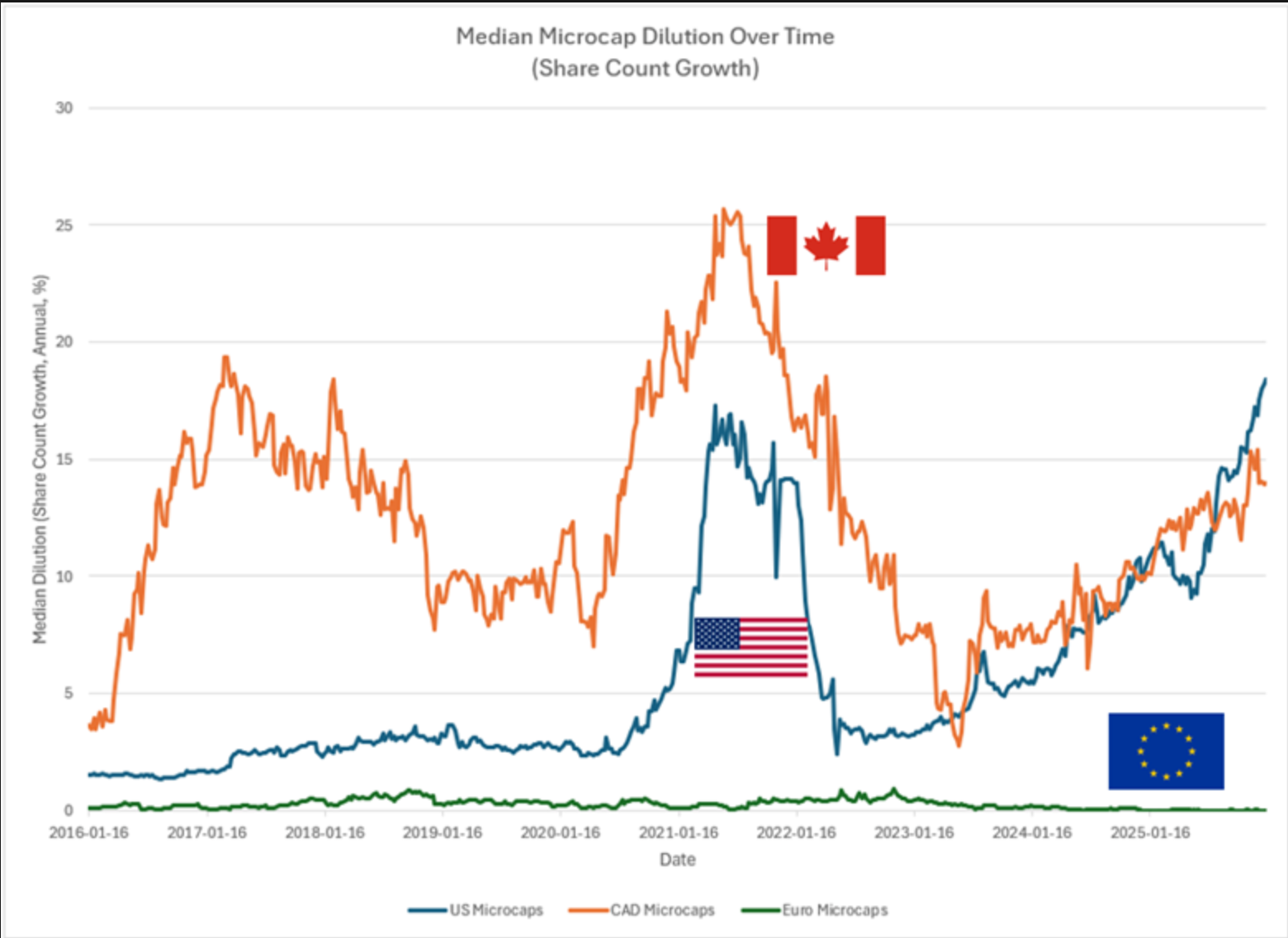
Source: Portfolio123 data, Author graph. MC-GUTS Microcap universes, <300M market cap, excludes financials & utilities, >0.1/share, >10k daily vol, in native currencies, non-Euro listed stocks not currency hedged
Canadian Microcaps stand out as the most equity financed microcaps consistently over time, ramping up to about 10:1 equity-to-debt in 2022, and settling down to about 6 to 7 today. Perhaps this is not surprising, with a majority of Canadian microcaps being in capital intensive industries such as mining and energy production. US Microcaps show a similar trend peak in 2022, but at a much lower level and at 4 today. European microcaps have even less equity in their capital structure, with a 10 year median of around 2-3\. This will be key to remember for later.
And for comparison – US large caps (as measured thru the S&P500) have historically had a ratio of equity to debt of just over 1.
And these are median values over time – as we will see, these values can vary widely between individual microcaps.
**Microcap Dilution Over Time**
Now with a view on how microcaps are structured, we can look more closely at dilution over time with some context. Below is a plot of dilution, as measured by increase in share count growth, for the same microcap groups above.
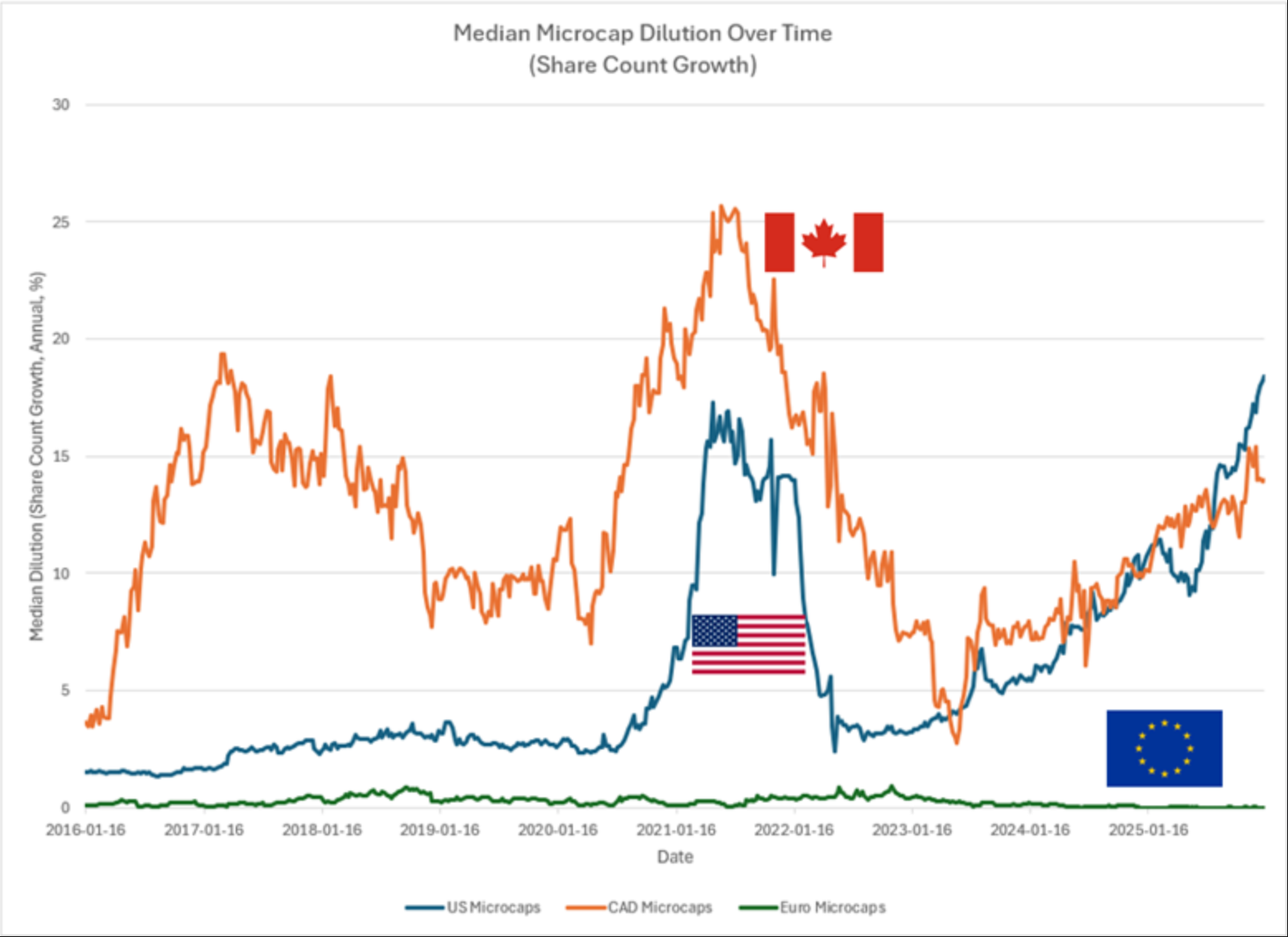
Source: Portfolio123 data, Author graph. MC-GUTS Microcap universes, <300M market cap, excludes financials & utilities, >0.1/share, >10k daily vol, in native currencies, non-Euro listed stocks not currency hedged.
We see similar trends across our regions between dilution and capital structure. Canadian microcaps are financed more by equity, and similarly have the highest amount of dilution over time, peaking at 25% in 2022, dropping to a single digit low in 2023, and ramping up again to today. US Microcaps have had more of a stable dilution rate, other than a peak in 2021/22, but since the dilution bottom in 2022 has steadily been increasing from a low of about 3 to a peak today of 18.
And European microcaps – their dilution rates barely register on this scale, compared to Canadian and US Microcaps. There can be different reasons for this, mostly due to their capital structure with lower equity, but also in some quick research European companies tend to view dilution very differently than their North American counterparts. Keep this in mind for the later sections.
**The Dilution Risk Scorecard**
Dilution is arguably one of the most destructive forces in investing, but can investors avoid it in advance?
With some understanding on how microcaps are financed, we can look at some key criteria to help assess a microcap’s risk of future dilution.
I’ve looked at various factors, and combined the following into what I call the **Dilution Risk Scorecard**.
1. Self-funding – is the stock able to fund its operations internally? Positive operating cash flow will be our positive signal.
2. Cash runway – the faster a company is burning thru its cash, the sooner it is likely to need additional capital. A cash base of more than 1 year is preferred.
3. Past dilution history – has the stock diluted before? This can be a strong signal on its own. Little to no previous dilution is preferred.
4. Hidden dilution risk – When the fully diluted share count is rising faster than basic shares, it can indicate growing convertible or warrant overhang — a strong early warning that dilution is likely before it shows up in reported share counts.
5. Balance Sheet strength – Access to debt is limited by the strength of a stock’s balance sheet. A weak balance sheet often means that capital must be sourced from equity.
Below is our Dilution Risk Scorecard.
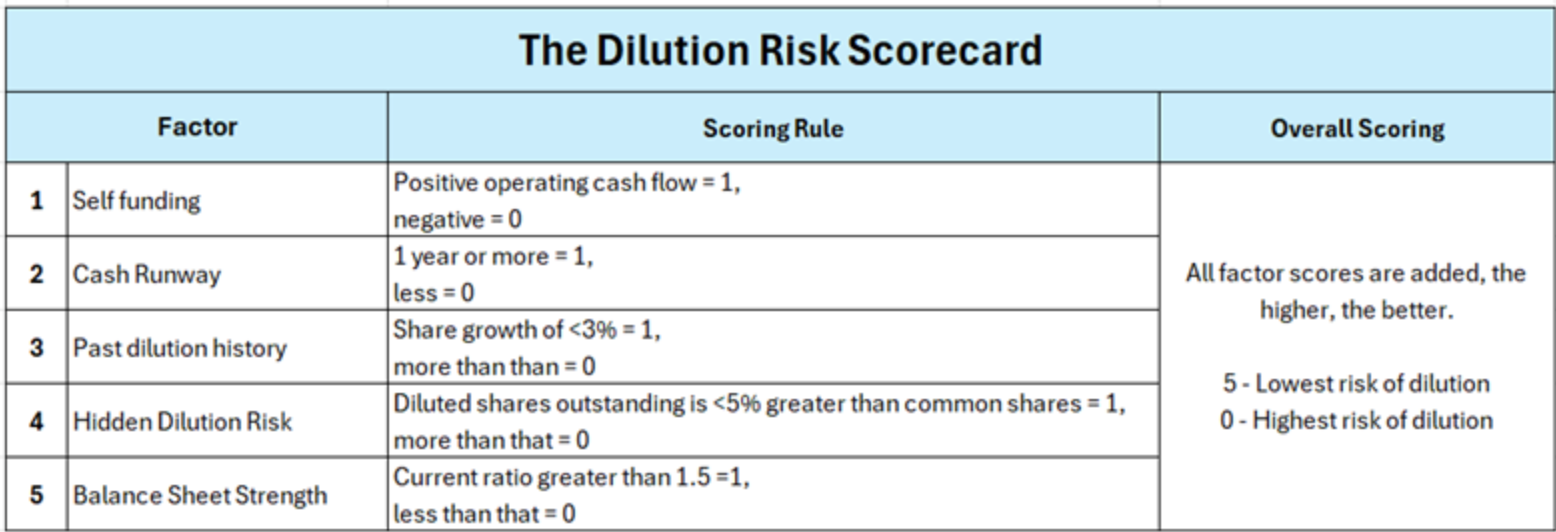
Author Table
All scores are added up for each stock, the higher the score, the better.
**Using the Dilution Risk Scorecard to Predict Dilution**
Now let’s see how effective our Dilution Risk Scorecard has been at predicting dilution.
The table below shows the breakdown of all US microcaps today, based on the Dilution Risk Score. Future dilution is also shown at various cut-off dates to see how well each score has predicted dilution.
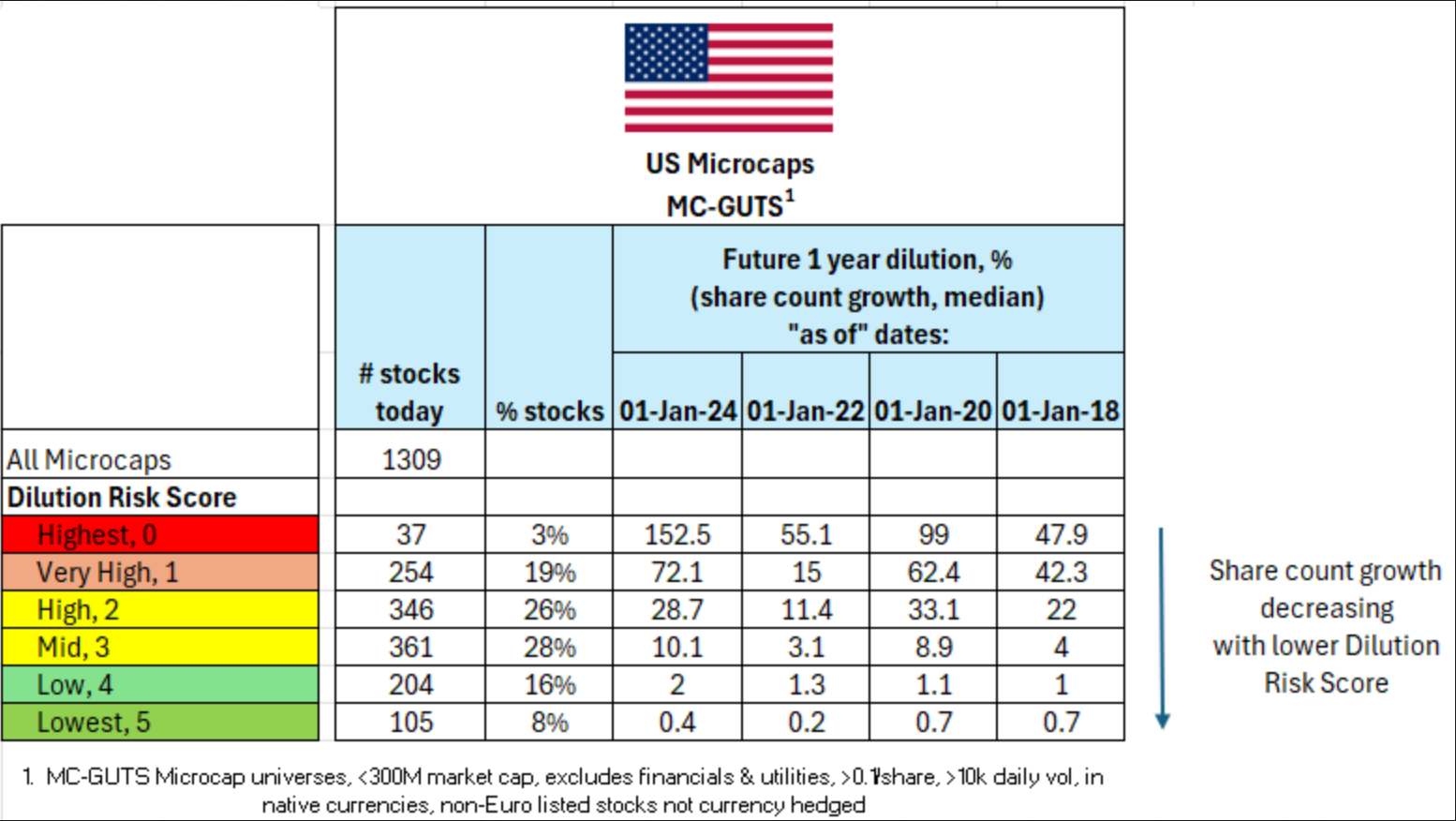
Source: Portfolio123 data, Author Table.
As of today, more than 50% of US microcaps have middling dilution risk scores, with higher and lower risk stocks at the fringes.
Most importantly from this table, we see **how the score has predicted future 1 year dilution** – the higher the risk (lower score), the higher the future dilution has been, when tested over the 4 years 2024, 2022, 2020 and 2018\. This is exactly what we want to see.
And for Canada, we see the same trend – the higher the dilution risk, the higher the future dilution.
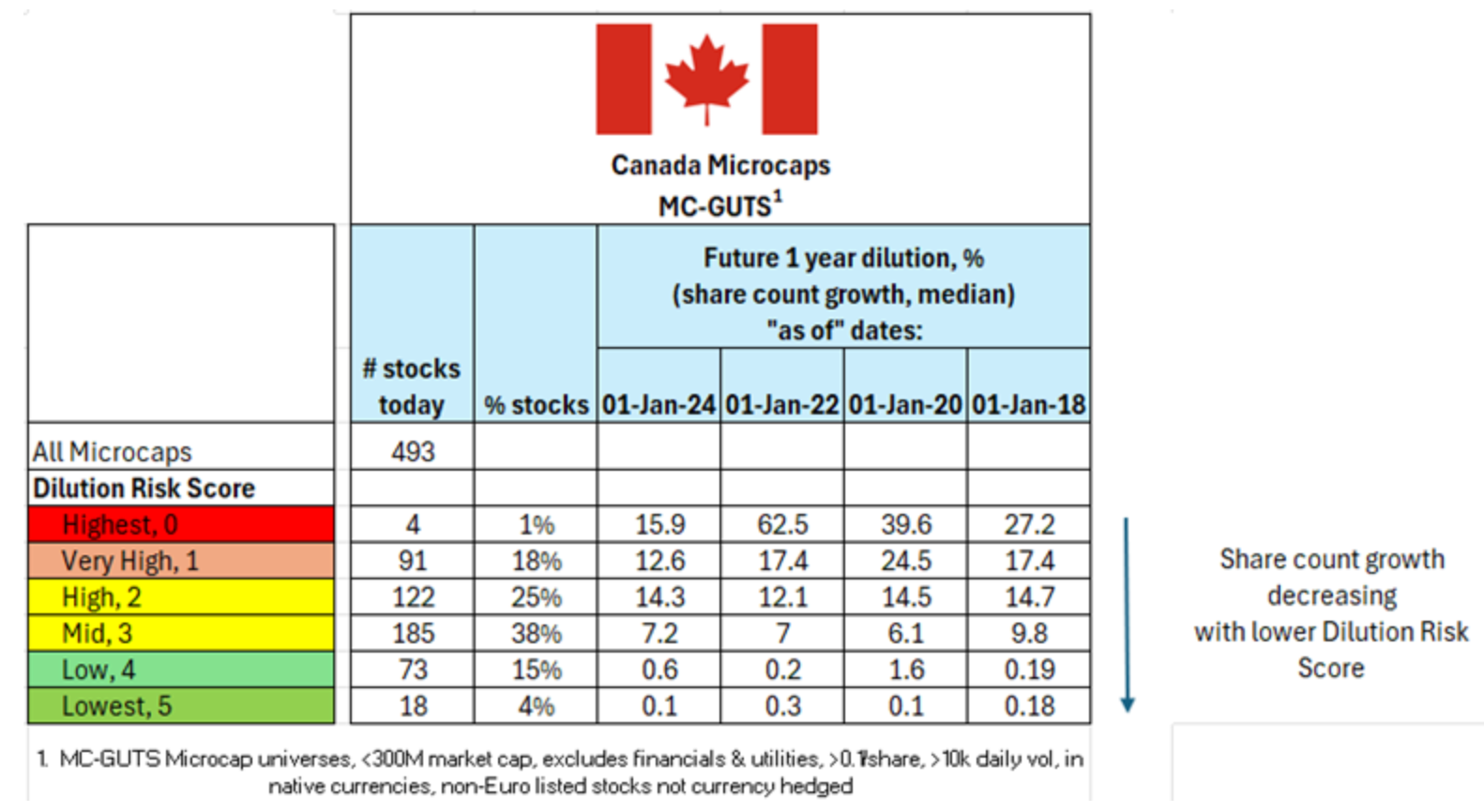
Source: Portfolio123 data, Author Table.
Recall from the charts earlier that European microcaps have very different equity and dilution characteristics compared to US and Canadian microcaps. Below is the same table with scoring and future dilution rates for European microcaps, but not surprisingly based on the earlier charts, we see zero future dilution at the higher scoring stocks. This suggests that the dilution score may not be as effective with European microcaps (as dilution is not as much of an issue in the first place).
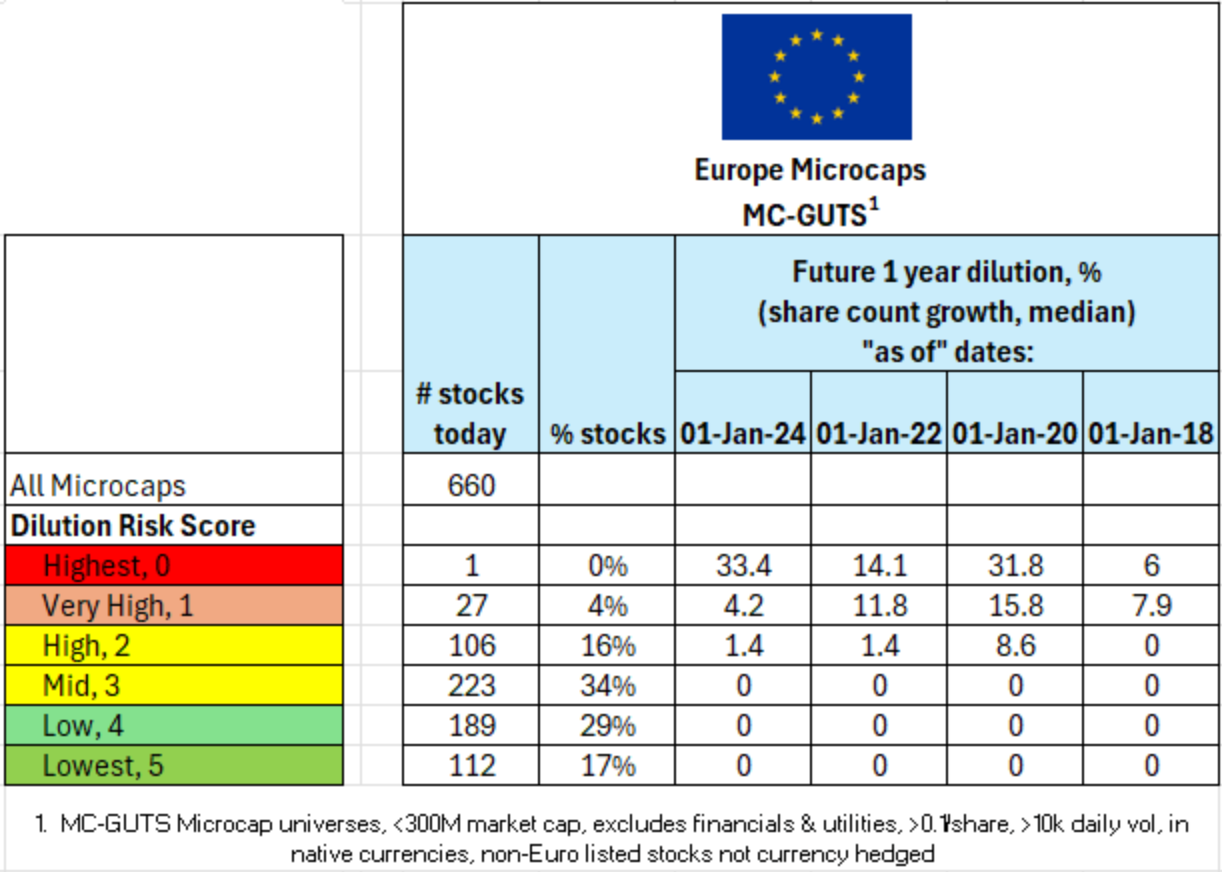
Source: Portfolio123 data, Author Table.
**Using the Dilution Risk Scorecard to Predict Future Returns**
So if the Dilution Risk Score has been able to predict future dilution, can it predict future returns? Below is a summary of 10 year annualized returns of our various Dilution Risk score groups for US and Canadian microcaps.
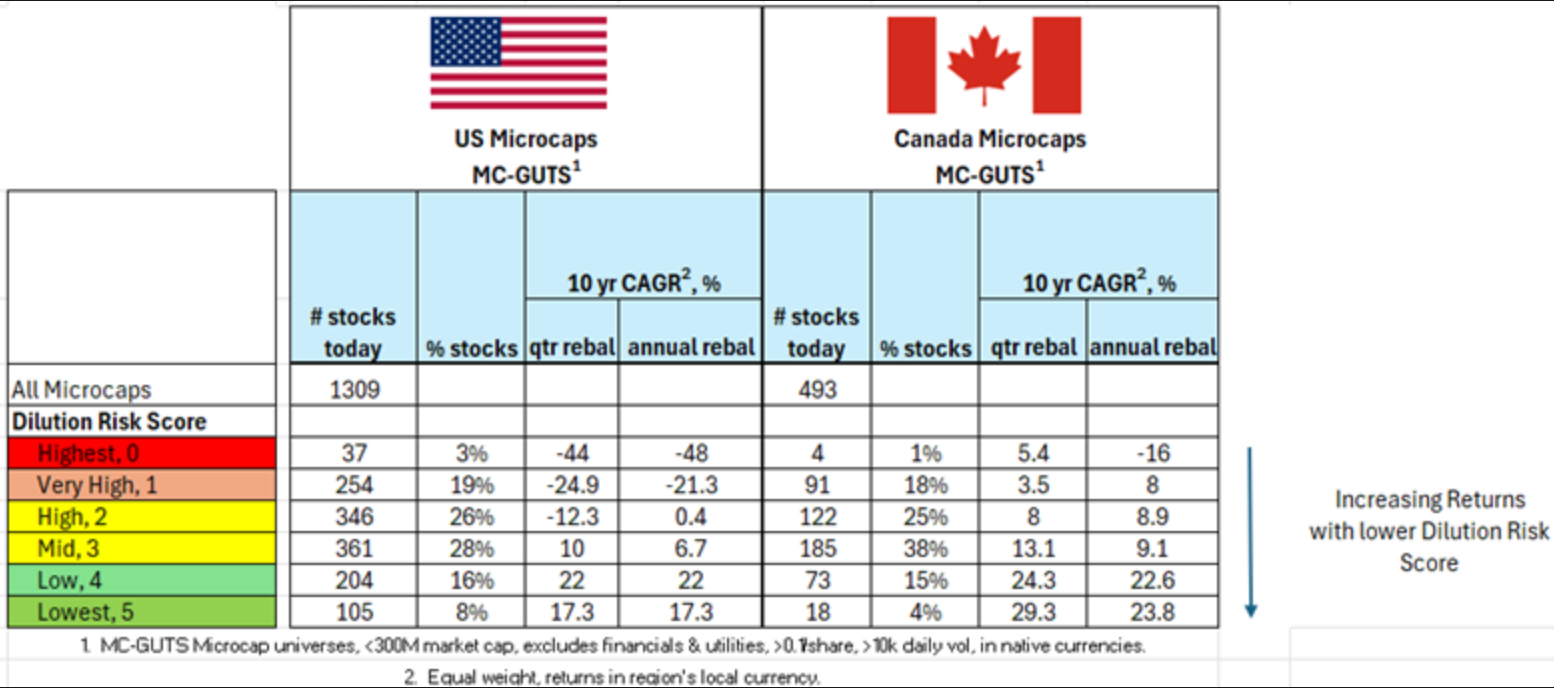
Source: Portfolio123 data, Author Table. Past performance is no guarantee of future performance.
As we saw with future dilution, the Scorecard groups have been able to predict future returns as well – the lower the dilution risk score, the higher the returns. The only exception is with lowest dilution risk US microcaps (score 5), which has slightly lower returns than the low (Score 4) stocks.
These are positive results – dilution is value destroying for existing shareholders, and being able to predict it before it happens can help avoid some potential blowups.
**Dilution is Predictable**
Dilution in microcaps is often viewed as unavoidable, but the evidence suggests it follows a pattern. The need to issue equity is typically driven by cash burn, limited balance-sheet flexibility, prior dilution behavior, and growing hidden dilution pressure — all of which can be observed well before new shares appear.
The Dilution Risk Scorecard brings these signals together using only standard financial statement line items and widely available Portfolio123 functions. It requires no forecasts or discretionary judgment, making it transparent, testable, and repeatable. Across U.S. and Canadian microcaps, the score shows a clear relationship with both future dilution and long-term returns: companies with higher dilution risk go on to dilute more, and those that dilute more tend to deliver weaker shareholder outcomes.
Avoiding dilution does not guarantee success, but repeatedly owning equity-dependent microcaps almost guarantees disappointment. In markets where equity is the primary source of capital, managing dilution risk is not a secondary consideration — it is often the difference between compounding returns and permanent capital loss.
If you enjoyed this article, I've written 30+ microcap evidence based papers on the MicroCapClub Community [here](https://community.microcapclub.com/forums/forum/90-microcap-evidence-based-research/?ref=microcapclub.com).
#### Interact and learn with 250+ of the best microcap investors on the planet:
[Join Us](https://microcapclub.com/join-now)
**Portfolio123** – All data and quantitative tools used for this piece, and all pieces in the Evidence Based Forum, provided by Portfolio123\. If you’d like to try Portfolio123 with an extended free trial (35 days vs the typical 20 days), check out [this link](https://www.portfolio123.com/index.jsp?apc=RYANT&ref=microcapclub.com), or use Invitation Code “RYANT” (full disclosure, affiliate link). I’m available for any questions you may have.
*Disclaimer: All content in this newsletter is for discussion, education, entertainment, and illustrative purposes only and SHOULD NOT be construed as professional financial advice, solicitation, or recommendation to buy or sell any securities, notwithstanding anything stated on this newsletter and MicroCapClub.com. There are risks associated with investing in securities. Loss of principal is possible. Past performance is not a predictor of future investment performance. Ian Cassel and MicroCapClub.com are not responsible for investment actions taken by viewers. Should you need such advice, consult a licensed financial advisor, legal advisor, or tax advisor. You agree to verify all information yourself before investing. Any past performance discussed on MicroCapClub.com is no guarantee of future results. Investing involves risk and possible loss of principal capital; please seek advice from a licensed professional. All views expressed are personal opinions as of the date of publication and are subject to change without the responsibility to update views. No guarantee is given regarding the accuracy of the information. [FULL DISCLAIMER and TERMS OF USE](https://microcapclub.com/terms/)*
### Club Conversation with David Gardner, the Rule Breaker
URL: https://microcapclub.com/club-conversation-with-david-gardner-the-rule-breaker/
Last updated: 2026-01-19T11:20:46.000Z
In this engaging conversation, David Gardner shares insights from his journey as an entrepreneur and investor, discussing the founding of The Motley Fool, his investment philosophy, and the importance of trust and character in business. He reflects on the emotional resilience required in investing, the lessons learned from both successful and failed investments, and the legacy he hopes to leave behind. Gardner emphasizes the significance of optimizing for trust and the impact of one's financial decisions on the world.
You can listen/watch this conversation on [Spotify](https://open.spotify.com/episode/7MtVE9bHLhuKiPXGzKodWh?si=224aa41a834f4329&ref=microcapclub.com), [Apple Podcast](https://podcasts.apple.com/us/podcast/microcapclub/id1765974269?i=1000745724363&ref=microcapclub.com), and YouTube below:
✉️ Share your feedback - david@microcapclub.com
✉️ David’s X (Twitter) - [https://x.com/Valuehunte](https://www.youtube.com/redirect?event=video%5Fdescription&redir%5Ftoken=QUFFLUhqbEFiUjJ4R0VxNFJYNld3LVNxVlc2UGk2UVotZ3xBQ3Jtc0trZnhDQUhOWk1JOWx6TlBlWWNqX1pVRHZrSXh4MHU1SkFyUTZWaVhORE0ydlA1M0ZYZmRuaXpCcWlndzdFR0NJSmdUdnJFSnV3YnNWdmpmd05OU3B4QXpPb3lHQ2dkcE96OE9qRnBDZlI3N1l2eWdwYw&q=https%3A%2F%2Fx.com%2FValuehunte&v=v%5FMcF4jVOyI&ref=microcapclub.com)
Join MicroCapClub and unlock the ability to listen and participate live in these conversations.
#### Interact and learn with 250+ of the best microcap investors on the planet:
[Join Us](https://microcapclub.com/join-now)
MicroCapClub is an exclusive forum for experienced microcap investors to share and discuss microcap companies (sub $1 billion market cap) trading on global markets. Since 2011, our members have profiled 1400+ microcap companies, 300+ have turned into multi-baggers. Investors can join our community by applying to become a member or subscribing to gain instant access. For more information, visit
### Proven Survivors
URL: https://microcapclub.com/proven-survivors/
Last updated: 2026-01-27T12:36:24.000Z
John McCain (1936-2018) was a naval aviator and pilot in the U.S. Navy during the Vietnam War prior to becoming a US House Representative and then US Senator. McCain came from a prominent military family; his father and grandfather were four-star admirals in the U.S. Navy.
McCain graduated from the U.S. Naval Academy in 1958, becoming a fighter pilot. In 1967, he was assigned to the aircraft carrier USS Forrestal, stationed in the Gulf of Tonkin.
While he was aboard the Forrestal, a catastrophic fire broke out on the flight deck after a rocket accidentally launched, causing a series of explosions and fires.
He narrowly escaped death while trying to help other pilots and crew. The fire claimed the lives of 134 sailors, and injuring 161 more, making it one of the deadliest accidents in U.S. naval history.
After the Forrestal fire, John volunteered for combat duty on the USS Oriskany, another aircraft carrier in the Gulf of Tonkin. He flew A-4 Skyhawk attack aircraft, engaging in dangerous bombing missions over North Vietnam.
On October 26, 1967, during a mission over Hanoi, McCain’s plane was hit by a surface-to-air missile. He ejected from the aircraft, breaking both arms and one leg during the fall. He landed in Trúc Bạch Lake and was captured by North Vietnamese forces. When they found him, they stabbed his only working leg and foot with a bayonet.
John was held as a prisoner of war (POW) at the notorious Hỏa Lò Prison, dubbed the “Hanoi Hilton” by American POWs. He endured extreme torture, starvation and isolation.
> "Every man has his breaking point. I had reached mine. I was at the end of my rope, and yet, at that moment, I knew I had a choice. I could break or I could endure. I chose to endure."
His status as the son of a prominent admiral made him a valuable propaganda asset, and the North Vietnamese offered him an early release. McCain refused early release, adhering to the U.S. military’s Code of Conduct, which stipulated that prisoners should be released in the order of capture. This decision led him to receive even more torture and extended imprisonment.
> "I felt I was honor-bound to refuse. It wasn’t just about me; it was about the other men who were there longer. If I left early, it would have demoralized them, and that was something I couldn’t do."
Over five and a half years of captivity, McCain faced a harsh regimen designed to break his will, including countless rope bindings (hanging by your hands until your shoulders dislocate) which would leave him unable to lift his arms above his shoulders the rest of his life.
> "The thing that sustained me most during my captivity was the sense of brotherhood we had among us. We were each other's lifeline. We knew we weren’t alone."
Soon after the signing of the Paris Peace Accords in January 1973, the North Vietnamese released McCain along with 590 other American POWs.
> "The most important lesson I learned in captivity was that our character, and our principles, are all that we have in the end. They are what define us, and what sustain us."
John McCain would be awarded the Silver Star, Legion of Merit with Combat “V”, Distinguished Flying Cross, (2) Bronze Star Medals with Combat “V”, (2) Purple Hearts, Navy and Marine Corps Commendation with Combat “V”, Prisoner of War Medal, National Defense Service Medal, and numerous other medals.
He would become a US Representative (1983-1987) and then a US Senator (1987-2018).
We all go through challenges in life. Some are tested in extreme and unique ways like McCain. Most of us are tested in life’s more common but still difficult ways - the death of a loved one, illness, job loss, addiction, poverty, divorce, betrayal, etc.
The worst thing you have ever experienced is the worst thing you have ever experienced. When you experience anything less than your worst experience it doesn’t seem that bad.
After McCain’s POW imprisonment, I’m sure if you would have put him in most high stress life or death situations he would be as cool as cucumber. Me, not so much.
What does this have to do about stock picking?
I’ve always been attracted to leaders who have faced life and business challenges and prevailed. There is no greater challenge than being a microcap CEO.
To be honest, I’ve always felt being a microcap CEO is one of the worst jobs on the planet. Most of them have stepped into less than desired situations and had to turn a business, turn a culture, turn a cruise ship, all while being undercapitalized.
Almost all microcap success stories started from [challenging circumstances](https://microcapclub.com/most-big-winners-were-ugly-ducklings/). 95%+ of microcaps are [turnarounds](https://microcapclub.com/turnarounds/) and underdog stories in some shape or form. They were all laughed at and mocked by most investors. Layer on top of this the stress and torture of every action being on public record and being second guessed and questioned by thousands of common shareholders - many of whom have never run a business before.
When a management team has dealt with all these financial and public headwinds while also fighting off hundreds of competitors clawing for their customers …
When a management team prevailed against all odds lifting a microcap company from the outhouse to the penthouse …
When a management team handles themselves with honor and distinction in the worst of times, it allows you to trust them with the best of times.
It's what makes investing in [repeat winners](https://microcapclub.com/finding-great-leaders-early/) (CEO's with a track record of winning) so alluring. They've already been through the wringer a few times. They already made the rookie mistakes and dealt with scaling problems and learned from them.
When they face future challenges they won't be unnerved. They know what to do or who to go to for answers. In their next venture an investor can buy today's wisdom without paying for yesterday's mistakes.
Wby? Because they are proven survivors.
#### Interact and learn with 250+ of the best microcap investors on the planet:
[Join Us](https://microcapclub.com/join-now)
MicroCapClub is an exclusive forum for experienced microcap investors to share and discuss microcap companies (sub $1 billion market cap) trading on global markets. Since 2011, our members have profiled 1500+ microcap companies, 300+ have turned into multi-baggers. Investors can join our community by applying to become a member or subscribing to gain instant access. For more information, visit
### Club Conversation with Aswath Damodaran, the Dean of Valuation
URL: https://microcapclub.com/club-conversation-with-aswath-damodoran-the-dean-of-valuation/
Last updated: 2026-01-12T16:31:36.000Z
In this conversation, Aswath Damodaran shares insights into his early life in India, his passion for teaching, and his pragmatic approach to valuation. He discusses the importance of learning from mistakes through case studies, the impact of AI on investing, and the balance between qualitative and quantitative analysis in valuation. The conversation also touches on the differences between passive and active investing, the future of work in an AI-driven world, and the significance of personal philosophy in investment decisions.
You can listen/watch this conversation on [Spotify](https://open.spotify.com/episode/0EzWYO3WbuFROKYsGRoskD?si=04c2baa9bd8d4ed8&ref=microcapclub.com), [Apple Podcast](https://podcasts.apple.com/us/podcast/microcapclub/id1765974269?i=1000744758321&ref=microcapclub.com), and YouTube below:
✉️ Share your feedback - david@microcapclub.com
✉️ David’s X (Twitter) - [https://x.com/Valuehunte](https://www.youtube.com/redirect?event=video%5Fdescription&redir%5Ftoken=QUFFLUhqbEFiUjJ4R0VxNFJYNld3LVNxVlc2UGk2UVotZ3xBQ3Jtc0trZnhDQUhOWk1JOWx6TlBlWWNqX1pVRHZrSXh4MHU1SkFyUTZWaVhORE0ydlA1M0ZYZmRuaXpCcWlndzdFR0NJSmdUdnJFSnV3YnNWdmpmd05OU3B4QXpPb3lHQ2dkcE96OE9qRnBDZlI3N1l2eWdwYw&q=https%3A%2F%2Fx.com%2FValuehunte&v=v%5FMcF4jVOyI&ref=microcapclub.com)
Join MicroCapClub and unlock the ability to listen and participate live in these conversations.
#### Interact and learn with 250+ of the best microcap investors on the planet:
[Join Us](https://microcapclub.com/join-now)
MicroCapClub is an exclusive forum for experienced microcap investors to share and discuss microcap companies (sub $1 billion market cap) trading on global markets. Since 2011, our members have profiled 1500+ microcap companies, 300+ have turned into multi-baggers. Investors can join our community by applying to become a member or subscribing to gain instant access. For more information, visit
### Mama's Creations (MAMA) - The National Deli Solutions Company
URL: https://microcapclub.com/mamas-creations-mama-the-national-deli-solutions-company/
Last updated: 2026-01-08T12:16:15.000Z
In this business breakdowns, I sit down with Mama's Creations (MAMA) CEO Adam Michaels and Chief Commercial Officer Chris Darling. This is a follow up discussion from our initial interview with the company that aired June 24th, 2024 [here](https://www.youtube.com/watch?v=QU174KOAnyA&ref=microcapclub.com).
MAMA was profiled on MicroCapClub in 2017 at $1.50 per share (Now $12.50 per share). You can follow the ongoing discussion on MAMA on our community [here](https://community.microcapclub.com/forums/topic/1871-mamamancinis-mama/?ref=microcapclub.com).
#### Interact and learn with 250+ of the best microcap investors on the planet:
[Join Us](https://microcapclub.com/join-now)
Mama’s Creations (MAMA) is a food business that seeks to be a “one-stop-shop” deli supplier. The company originally started selling a single product, Italian meatballs, but have since grown their product portfolio into other Italian cuisine along with salads, sandwiches, olives, soups, pizza and even some initial items in Asian cuisine. Their primary distribution channel is grocery and club. They have a nascent online presence and are very early in making in-roads in the convenience store channel.
The business was an operational turnaround with the arrival of CEO Adam Michaels CFO Anthony Gruber in September of 2022\. During the past three years, management has improved operations, profitability, and added resources in operations, sales and marketing. The company has a vision of becoming $1 billion business that “owns” the fresh deli space, through a combination of organic growth and acquisitions. They have room to grow within the deli space, as they continue to build out their product portfolio. In addition, while they have a nice customer list including Costco, Sam's Club, Publix, Aldi, Albertsons, BJ’s and others, there remains room to penetrate even larger customers such as Walmart, Target, and Kroger, with an opportunity in convenience as well. [https://mamascreations.com](https://www.youtube.com/redirect?event=video%5Fdescription&redir%5Ftoken=QUFFLUhqbVhKN0ZTb19GNU15cERGczdCZVZnZFlKY0wxUXxBQ3Jtc0tuVlIyR0FoQ2JrbU5jNk5hRUZUc1ZDWThWdFFOdmZWbk9OeUU1U0FpaS1tWnNZZ1doT0VoOThSeVZ1c2lRSTJNT0J0MU95TF95R0tCaDFldzBGY1hRdmY3Nmc5ODVubGtid29sZnlGRmEtbEtFTnNuQQ&q=https%3A%2F%2Fmamascreations.com%2F&v=Xw3yLKbSsK4&ref=microcapclub.com)
You can listen/watch this business breakdowns on [Spotify](https://open.spotify.com/episode/7GN03G0F4ko98Vrz1chucS?si=ZEP-tu7jRwKDGfOvUKrBNw&ref=microcapclub.com), [Apple Podcast](https://podcasts.apple.com/us/podcast/microcapclub/id1765974269?i=1000744257168&ref=microcapclub.com), and YouTube below:
*Disclaimer: All content in this newsletter is for discussion, education, entertainment, and illustrative purposes only and SHOULD NOT be construed as professional financial advice, solicitation, or recommendation to buy or sell any securities, notwithstanding anything stated on this newsletter and MicroCapClub.com. There are risks associated with investing in securities. Loss of principal is possible. Past performance is not a predictor of future investment performance. Ian Cassel and MicroCapClub.com are not responsible for investment actions taken by viewers. Should you need such advice, consult a licensed financial advisor, legal advisor, or tax advisor. You agree to verify all information yourself before investing. Any past performance discussed on MicroCapClub.com is no guarantee of future results. Investing involves risk and possible loss of principal capital; please seek advice from a licensed professional. All views expressed are personal opinions as of the date of publication and are subject to change without the responsibility to update views. No guarantee is given regarding the accuracy of the information. [FULL DISCLAIMER and TERMS OF USE](https://microcapclub.com/terms/)*
### MicroCapGUTS Index Update: Q4 2025
URL: https://microcapclub.com/microcapguts-index-update-q3-2025-2/
Last updated: 2026-01-07T14:01:01.000Z
The [MicroCapGUTS Index (MC-GUTS)](https://microcapclub.com/the-launch-of-the-microcapguts-index/) is intended to find quality microcap stocks across the US, Canada and Europe that exhibit the evidence-based GUTS factors, and track their performance as a group over time. The index includes 240 stocks across all three regions. You can view the top 15 stocks (ranked by a series of proprietary factors) on our community [here](https://community.microcapclub.com/forums/topic/5079-the-microcapguts-index-mc-guts/?ref=microcapclub.com#findComment-105455).
MC-GUTS was up +37.6% in 2025, outperforming the iShares Microcap ETF +22.5%, S&P 500 +17.7%, and Nasdaq +20.8% respectively.

Source: Portfolio123 data, Author Table
All regions ended with double digits, with Canada and Europe leading the US. Canadian microcaps posted nearly 65%, much of which credited from the boom in commodities and miners.

Source: Portfolio123 data, Author table. Past performance is no guarantee of future results
Below is our updated performance of MC-GUTS, simulated since 2015\. Over this time, the strategy has 7X’d, vs the IWC benchmark which has more than 2X’d.

Source: [Portfolio123](https://www.portfolio123.com/index.jsp?apc=RYANT&ref=microcapclub.com) output, Author strategy. Past performance is no guarantee of future results
For more information on the index, and to view the top 15 constituents join our Community.
#### Interact and learn with 250+ of the best microcap investors on the planet:
[Join Us](https://microcapclub.com/join-now)
*Disclaimer: All content in this newsletter is for discussion, education, entertainment, and illustrative purposes only and SHOULD NOT be construed as professional financial advice, solicitation, or recommendation to buy or sell any securities, notwithstanding anything stated on this newsletter and MicroCapClub.com. There are risks associated with investing in securities. Loss of principal is possible. Past performance is not a predictor of future investment performance. Ian Cassel and MicroCapClub.com are not responsible for investment actions taken by viewers. Should you need such advice, consult a licensed financial advisor, legal advisor, or tax advisor. You agree to verify all information yourself before investing. Any past performance discussed on MicroCapClub.com is no guarantee of future results. Investing involves risk and possible loss of principal capital; please seek advice from a licensed professional. All views expressed are personal opinions as of the date of publication and are subject to change without the responsibility to update views. No guarantee is given regarding the accuracy of the information. [FULL DISCLAIMER and TERMS OF USE](https://microcapclub.com/terms/)*
### Planet MicroCap Holdings LLC, owned by Ian Cassel, Acquires Planet MicroCap LLC to Expand into In-Person Events
URL: https://microcapclub.com/planet-microcap-holdings-llc-owned-by-ian-cassel-acquires-planet-microcap-llc-to-expand-into-in-person-events/
Last updated: 2026-01-27T12:36:32.000Z
I’m excited to announce the acquisition of Planet MicroCap LLC from the Kraft family. The combination of MicroCapClub's online community and Planet MicroCap's in-person events is a powerful flywheel that we look to leverage to positively impact the microcap space globally. I hope you can attend [Planet MicroCap Las Vegas](https://microcapclub.com/register-today-planet-microcap-las-vegas-2026/) on June 16-18th, 2026\.
View Press Release [HERE](https://www.accessnewswire.com/newsroom/en/publishing-and-media/planet-microcap-holdings-llc-owned-by-ian-cassel-acquires-planet-microcap-llc-1123001?ref=microcapclub.com) and also posted below:
## Planet MicroCap Holdings LLC, owned by Ian Cassel, Acquires Planet MicroCap LLC to Expand into In-Person Events
### Acquisition Unlocks Robust Synergies Across Online Community and In-Person Events
Planet Microcap Holdings LLC announced it has acquired Planet Microcap LLC. Planet Microcap Holdings LLC is owned by Ian Cassel, founder of MicroCapClub.com. Planet Microcap LLC, owned by the Kraft Family, is an independent event organizer and media company that has been operating in-person microcap events since 2014.
The business will continue to operate under the Planet MicroCap brand. Shelly and Lulu Kraft will support the business over a transition period, and Bobby Kraft will continue to lead the Planet MicroCap events business post-acquisition, as well as continue to host the Planet MicroCap Podcast.
Ian Cassel commented, “Over the last several years I’ve been watching Shelly, Lulu, and Bobby Kraft build the best large scale, fully independent, microcap in-person event organization in North America. In 2025, MicroCapClub.com formed a strategic collaboration with Planet MicroCap with two events in Las Vegas and Toronto. The feedback from investors, companies, and partners was overwhelmingly positive. It became obvious the two brands should be brought together under an aligned vision and mission to achieve the greatest impact.”
Shelly and Lulu Kraft commented, “We both look forward to the continuing success of our legacy family business and wish the best of luck to both Ian and Bobby in their future endeavors.”
Bobby Kraft commented, “MicroCapClub is universally viewed as the thought leader in the microcap space. The ability for microcap investors to meet online on MicroCapClub.com and then meet in-person at our events is a powerful synergy. I look forward to working alongside Ian and the team at MicroCapClub to continue to raise the standard with our events by bringing the best investors and companies together online, and in person.”
**Upcoming Events:**
- [June 16-18, 2026 - Planet MicroCap Las Vegas](https://www.meetmax.com/sched/event%5F130817/conference%5Fhome.html?ref=microcapclub.com)
- October 27-29, 2026 – Planet MicroCap Toronto
**About Planet MicroCap**
Planet Microcap hosts the highest quality microcap in-person events in North America. The mission is to bring the best microcap investors, companies, and allocators together to gather, connect, and grow.
**About MicroCapClub**
MicroCapClub is an exclusive forum for experienced microcap investors to share and discuss microcap companies (sub $1 billion market cap) trading on global markets. Since 2011, our members have profiled 1500+ microcap companies, 300+ have turned into multi-baggers. Investors can join our community by applying to become a member or subscribing to gain instant access. For more information, visit
### Club Conversation with Howard Marks, Oaktree’s Quiet Legend
URL: https://microcapclub.com/club-conversation-with-howard-marks-oaktrees-quiet-legend/
Last updated: 2026-01-05T11:03:29.000Z
In this conversation, Howard Marks shares his insights on investment strategies, the nature of risk, and the impact of market cycles. He discusses the origin of his company, Oak Tree, and elaborates on the concept of risk, emphasizing that it is subjective and tied to the possibility of undesirable outcomes. Marks also explores the upside of bubbles in technology, the implications of Brexit on the UK economy, and the current state of private credit. He provides advice on portfolio structuring, the importance of incentives in organizations, and personal reflections on success and happiness.
You can listen/watch this conversation on [Spotify](https://open.spotify.com/episode/12evOFaXGvIeRsYqj24Aug?si=PKWGvn8CSO2NMvTU1%5F-ONw&ref=microcapclub.com), [Apple Podcast](https://podcasts.apple.com/us/podcast/microcapclub/id1765974269?i=1000743767366&ref=microcapclub.com), and YouTube below:
✉️ Share your feedback - david@microcapclub.com
✉️ David’s X (Twitter) - [https://x.com/Valuehunte](https://www.youtube.com/redirect?event=video%5Fdescription&redir%5Ftoken=QUFFLUhqbEFiUjJ4R0VxNFJYNld3LVNxVlc2UGk2UVotZ3xBQ3Jtc0trZnhDQUhOWk1JOWx6TlBlWWNqX1pVRHZrSXh4MHU1SkFyUTZWaVhORE0ydlA1M0ZYZmRuaXpCcWlndzdFR0NJSmdUdnJFSnV3YnNWdmpmd05OU3B4QXpPb3lHQ2dkcE96OE9qRnBDZlI3N1l2eWdwYw&q=https%3A%2F%2Fx.com%2FValuehunte&v=v%5FMcF4jVOyI&ref=microcapclub.com)
Join MicroCapClub and unlock the ability to listen and participate live in these conversations.
#### Interact and learn with 250+ of the best microcap investors on the planet:
[Join Us](https://microcapclub.com/join-now)
MicroCapClub is an exclusive forum for experienced microcap investors to share and discuss microcap companies (sub $1 billion market cap) trading on global markets. Since 2011, our members have profiled 1400+ microcap companies, 300+ have turned into multi-baggers. Investors can join our community by applying to become a member or subscribing to gain instant access. For more information, visit
### BeWhere Holdings (BEW.V / BEWFF) - A Software Business Focused on The Internet of Things
URL: https://microcapclub.com/bewhere-holdings-bew-v-bewff-a-software-business-focused-on-the-internet-of-things/
Last updated: 2025-12-23T11:02:05.000Z
BeWhere presents a compelling high-growth opportunity within the $26B IoT asset-tracking market. The company has sold over 475,000 MIOT units globally. The Q3 2025 results demonstrate significant operational "torque," featuring record quarterly revenue of $6.1M and record Adjusted EBITDA.
The company’s "Hardware Enabled SaaS" (HSaaS) model is a key differentiator, driving high-margin scalability with Annual Recurring Revenue (ARR) reaching $8.6M (up 21% YoY). Recent milestones, including an 8,000-unit FirstNet order and successful direct-to-satellite connectivity tests, validate BeWhere’s technological leadership and its ability to disrupt legacy pricing models. Currently trading at a significant discount (3.1x LTM revenue) compared to the 8.2x industry peer average, BeWhere offers a rare combination of profitability, innovative tech, and an insider-aligned team poised to capitalize on a massive, fragmented global market.
In this discussion, Trevor Treweeke and I have a conversation with CEO Owen Moore. BeWhere was profiled on MicroCapClub in 2016\. You can follow the ongoing discussion on BeWhere on our community [here](https://community.microcapclub.com/forums/topic/1518-bewhere-holdings-bewv/?ref=microcapclub.com#comment-33955).
#### Interact and learn with 250+ of the best microcap investors on the planet:
[Join Us](https://microcapclub.com/join-now)
You can listen/watch this business breakdowns on [Spotify](https://open.spotify.com/episode/3RS0F4RvsX5PXs5pTeU3Fp?si=m-0vYMoOR0qb%5F%5Fi0CDNCzg&ref=microcapclub.com), [Apple Podcast](https://podcasts.apple.com/us/podcast/microcapclub/id1765974269?i=1000742431744&ref=microcapclub.com), and YouTube below:
*Disclaimer: All content in this newsletter is for discussion, education, entertainment, and illustrative purposes only and SHOULD NOT be construed as professional financial advice, solicitation, or recommendation to buy or sell any securities, notwithstanding anything stated on this newsletter and MicroCapClub.com. There are risks associated with investing in securities. Loss of principal is possible. Past performance is not a predictor of future investment performance. Ian Cassel and MicroCapClub.com are not responsible for investment actions taken by viewers. Should you need such advice, consult a licensed financial advisor, legal advisor, or tax advisor. You agree to verify all information yourself before investing. Any past performance discussed on MicroCapClub.com is no guarantee of future results. Investing involves risk and possible loss of principal capital; please seek advice from a licensed professional. All views expressed are personal opinions as of the date of publication and are subject to change without the responsibility to update views. No guarantee is given regarding the accuracy of the information. [FULL DISCLAIMER and TERMS OF USE](https://microcapclub.com/terms/)*
### Quality - The Most Overused Term in Investing
URL: https://microcapclub.com/quality-the-most-overused-term-in-investing/
Last updated: 2026-03-05T12:06:00.000Z
The Bayeux Tapestry is nearly 70 meters long (half a meter tall), embroidered with wool thread on linen, and it’s been around since the 11th century. The tapestry is one of those things that shouldn’t exist. Not because it’s controversial, but because it’s fragile.
A thousand years of different kings, fires, floods, wars, careless hands, and bored soldiers should have turned it into dust. And yet it’s still here, telling its story in pictures like a medieval movie strip.

Its origins date back to the year 1066\. England’s King Edward dies, and the crown becomes a prize. Harold Godwinson takes it. William, Duke of Normandy, says Harold promised it to him. Armies move. Ships are built. Oaths are sworn. And on a windy October day at the Battle of Hastings, Harold dies and William wins, eventually becoming known as William the Conqueror. The tapestry is basically the victory speech, stitched.
Most historians think it was commissioned by Bishop Odo of Bayeux, William’s half-brother and likely made in England in the 1070s. It was likely made to decorate Odo’s newly built Bayeux Cathedral around its consecration in 1077\. It’s funny because the conquerors may have owned the story, but the conquered likely did much of the work of the Tapestry. History is full of ironies like that.
For centuries it was preserved in Normandy, later associated with Bayeux Cathedral. Over time it became less of a local treasure and more of a European artifact. As it became more famous, it became more at risk because famous things attract people who want to use them.
In World War II, the tapestry was treated like a strategic object. Even before the war began, officials moved it for protection. It survived not because it was tough, but because people decided it was worth protecting when it was most inconvenient to do so.
There’s a compounding effect to cultural objects. The longer something lasts, the more meaning it accumulates. Not because it changed, but because we did.
That’s the quality in art: craftsmanship strong enough to carry a story 1000 years, and every few decades needing to find a new group of people who value it enough to preserve it.
I’ve always been interested in survival and quality. A gave a presentation during the depths of covid on the topic [here](https://youtu.be/urkBe%5FkUSyI?si=yzxzpw1TRuk47eAH&ref=microcapclub.com).
The Merriam-Webster definition of quality - degree of excellence : how good, bad, useful, etc. something is
My definition: Quality is an idea, a piece of artwork, a business, a relationship, or even a book that keeps working (providing value) even after conditions change over time.
Quality is an interesting topic because it's one of the most overused terms in investing. Investor’s throw its use around so liberally that it dilutes its core meaning.
Most investors definition of a quality business or quality management has nothing to do with quality - it’s simply the stock they own that is up the most in the last 12-months.
Quality is a label that can only be earned over 10+ years because any business and management can do well for 1-2-3 years because of luck, fad, investor sentiment, few big orders that result in a few big quarters. A stock can 2-10x and it has nothing to do with quality.
Here are some characteristics of quality that come to mind:
- **Scarcity** \- a business with a strong competitive advantage that is difficult to duplicate.
- **Independence** – a company that is not overly dependent on a single supplier, customer, or government regulation. They are also not dependent on capital markets.
- **Permanence** \- an antifragile company designed for multi-generational endurance. Management focused on a company’s balance sheet but also value growth as a key indicator they are increasing market share. Endurance means playing offense and defense.
- **Owner Management** –management that prioritizes the company's well-being, a happy workforce, satisfied customers, and balancing innovation with frugality.
When you think of these characteristics, quality becomes extremely difficult to find in small public companies. Most microcaps are young, fragile with relatively weak balance sheets. Especially microcaps sub-$100 million market cap.
Most microcaps are dependent on the stock market. They must raise money every 1-2 years to fund operations which means they must produce a narrative that will excite the crowd. They live or die by the ability to access capital markets. In many ways they are children who are growing up and figuring out who they are while still dependent on their parents.
It is ironic that the best performing microcaps are normally independent. The ones that don’t NEED to access capital markets. They can stand on their own two feet. They earn their own money and can pay their own bills.
There are quality businesses that don’t make great stocks. These companies normally dominate niche markets that aren’t growing. They are like value traps, but they should be called quality traps. Value traps snare investors by using cheapness as bait. Quality traps snare investors by using a couple quality characteristics as bait. They are the market leader in VHS tapes or some other obscure niche. They might be good businesses, but they aren’t great stocks.
I believe growth is a crucial component of quality, but growth doesn’t always align with quality. For a small company to grow quickly there is usually some form of overreaching or aggressive tactics that sacrifice quality and durability in the short-term such as disrupting the corporate culture, leveraging the balance sheet or equity dilution.
Patrick O’Shaughnessy recently interviewed Henry Ellenbogen who has one of the best track records in smallcap growth investing. He invested in Amazon, Netflix, and many others early on in their public lifecycle. He gave this wonderful statistic.
> "4000 average public stocks. How many are great? 1%.
> Every rolling 10-year period we have 40 stocks that can compound at 20%, and 80% of those start their journey as small caps. That's why we love small caps."
In a financial world that loves private equity and keeping private companies private, Ellenbogen is a bit of an outlier. He preaches the advantages of being public. The main advantage is if you want to be one of those 1% outliers the public markets won’t allow you to be lazy. You can’t just focus on innovation, or growth, or profitability. You must do all three.
> “I believe to build a great \[public\] company, you have to balance growth, profitability, and innovation. You have to be in the "and" business, not the "or" business."
My report card as a fund manager is my 10-year performance versus the S&P 500\. The report card for any public CEO is the same thing. It’s their company's rolling 10-year stock chart versus the S&P 500\. Quality shines through over time and mediocrity reverts to the mean. Find a CEO + Business that has outperformed the S&P for 10 years or more and those are the outliers that deserve recognition and the label of “quality”.
#### Interact and learn with 250+ of the best microcap investors on the planet:
[Join Us](https://microcapclub.com/join-now)
MicroCapClub is an exclusive forum for experienced microcap investors to share and discuss microcap companies (sub $1 billion market cap) trading on global markets. Since 2011, our members have profiled 1400+ microcap companies, 300+ have turned into multi-baggers. Investors can join our community by applying to become a member or subscribing to gain instant access. For more information, visit
### The “Illiquidity” Premium – Fact or Fiction?
URL: https://microcapclub.com/the-illiquidity-premium-fact-or-fiction/
Last updated: 2025-12-17T10:23:01.000Z
Microcaps are often described as “illiquid” – they are too small to actually buy and sell.
This can be an issue for large funds with billions under management, but for the retail investor, with much less capital to manage, “illiquidity” is not so much of a barrier.
In academic circles, the “illiquidity premium” is often credited as one of the drivers in microcap outperformance (over those periods where they do outperform), being less efficient than their large cap cousins.
But what does “illiquid” actually mean? It can be measured or defined in different ways, but one tangible way to measure how much volume a stock trades.
For perspective – US large caps trade about $150M per day. When you compare this to microcaps, daily volume is a percent of a percent of large caps, not even registering on the same scale.
I shared the graph below in my recent presentation [“**Uncovering the Edge in Canadian Microcaps”**](https://community.microcapclub.com/forums/topic/5540-uncovering-the-edge-in-canadian-microcaps/?ref=microcapclub.com)to illustrate the difference.
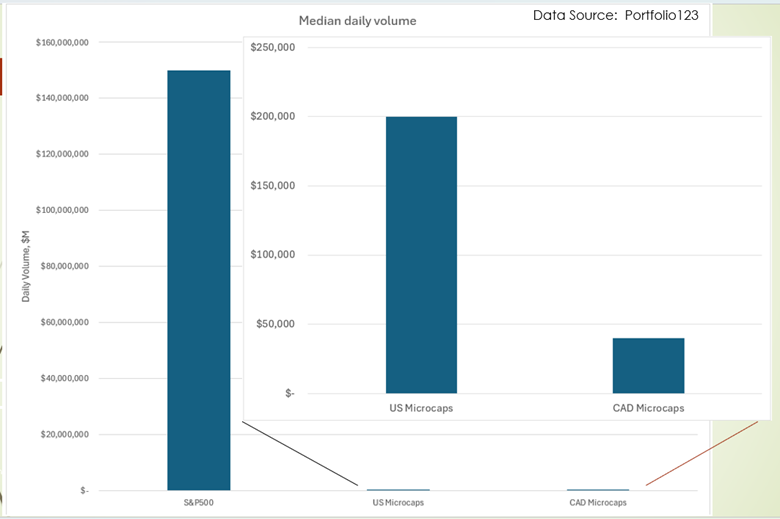
Source: Portfolio123 data, Author Graph
Where US microcaps trade at 0.1% the volume of S&P500 stocks, and Canadian microcaps even less.
We will analyze the MC-Guts Universe defined as all microcaps >$10k vol, >$0.1 share price, excluding financials and utilities. This is also the universe of companies we screen quantitatively for our [MicroCapGUTS Index](https://microcapclub.com/microcapguts-index-update-q3-2025/).
Liquidity varies over time, sometimes significantly. The plot below shows median daily volume ($) of US MC-GUTS microcaps. Historically these stocks have traded around $200k per day, but note the significant spike during COVID, peaking at over $1.4M, only to fall back to historical levels.
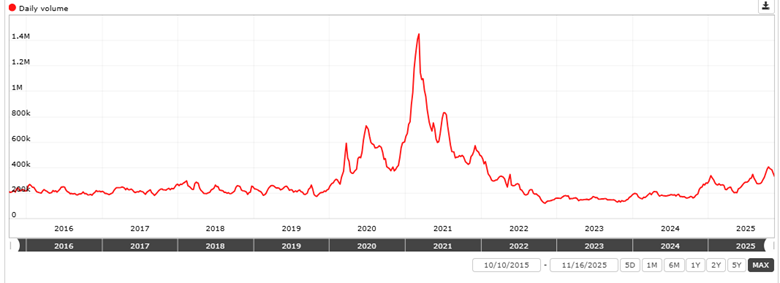
Source: Portfolio123 data and graph. US MC-GUTS microcaps, >$10k vol, >$0.1 share price, excluding financials and utilities.
Liquidity is an important aspect in testing factors and strategies as well. If lower limits are too low (i.e. too illiquid), then results can end up being artificially high. For all research and simulations on the Evidence Based Forum at MicroCapClub, I use a minimum of $10k volume per day. For some investors this may be liquid enough, but eventually as capital increases, then higher liquidity is required to buy and sell stocks, even microcaps.
So let’s dig into microcaps, and look more closely at liquidity.
The table below takes our MC-GUTS US universe, and breaks down the number of stocks into liquidity groups, as measured by median daily volume.
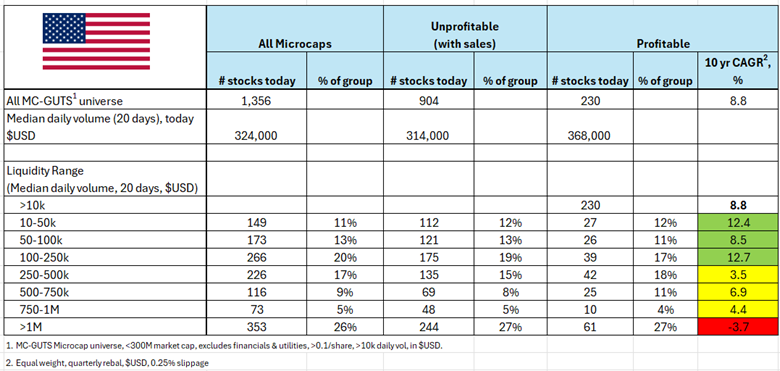
Source: Portfolio123 data, Author table. Past performance is no guarantee of future results.
As of today, the median trading volume of US microcaps (over 20 days, or 1 month) is $324k (first column). About 75% of all microcaps trade less than $1M per day, but still 25% over $1M is meaningful.
Microcaps are unique to large caps in that they may be pre-revenue, or even not yet profitable. For further insight, the next two columns look at microcaps that are unprofitable (with sales), and those that are profitable. The proportions in both groups are more or less than same as the “all microcaps” group.
The right-most column shows performance (10 year annualized) of each liquidity group for profitable microcaps. Notably – the least liquid stocks, or $250k or less, have outperformed. Stocks with more than $250k in volume have still come out positive, but underperforming the less liquid stocks. And the most liquid microcaps, with trading volume of $1M or more – have provided negative returns.
Recall from the bar graph above that Canadian microcaps have even less daily volume than US microcaps. The plot below shows median volume over the last 10 years for MC-GUTS Canadian microcaps. The historical median is roughly $40-50k, with a spike during COVID (although not as extreme compared to the US), and has been trending upwards in 2025.
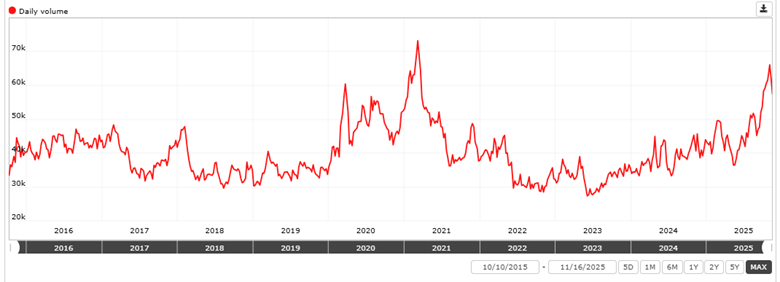
Source: Portfolio123 data and graph. Canada MC-GUTS microcaps, >$10k vol, >$0.1 share price, excluding financials and utilities, $CAD.
And Canadian MC-GUTS microcaps broken down today into different liquidity groups:
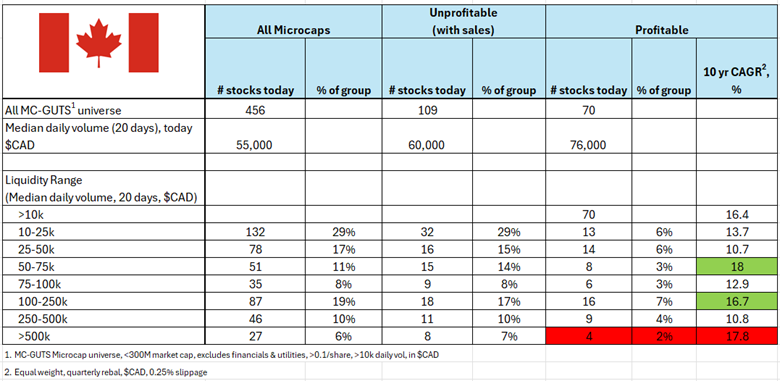
Source: Portfolio123 data, Author table. Past performance is no guarantee of future results.
We see the flipside in terms of liquidity distribution in Canadian microcaps, with nearly 30% of stocks in the smallest group ($10k-$25k).
Also notable here with Canadian vs US microcaps is the consistency in returns of the profitable group – where the full universe of profitable stocks have had a return of 16.4%, all other liquidity groups have still returned in the double digits.
(Note: The number of liquid Canadian microcaps with more than $10K in daily volume is substantially less than for US microcaps, so our samples size are smaller and may not be a direct comparison to US microcaps in this case. The $500k+ group in particular is very small, and results are very volatile (highlighted red)).
And when it comes to European microcaps, the historical median volume has been around 50k Euro, with a slight peak 2019 thru 2021.
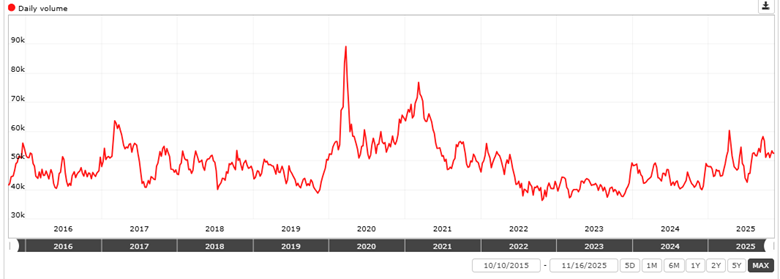
Source: Portfolio123 data and graph. Europe MC-GUTS universe, >10k € vol, >0.1 € share price, excluding financials and utilities. No currency hedging for non-Euro listed stocks.
And European MC-GUTS microcap broken down:
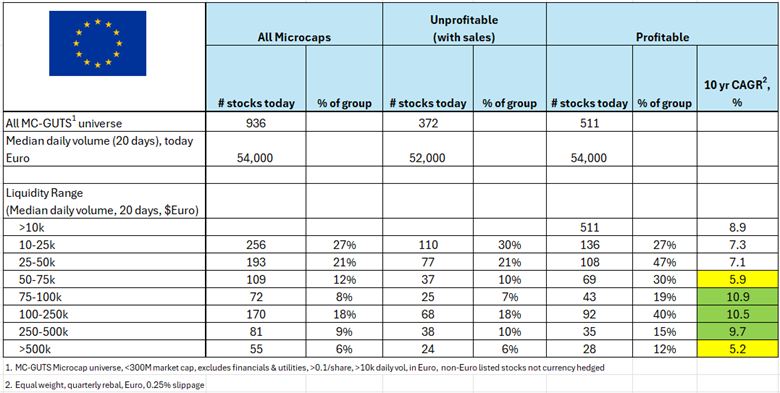
Source: Portfolio123 data, Author table. Past performance is no guarantee of future results.
Profitable European microcap returns have been fairly consistent across liquidity groups, the highest performing from 75k to 500k range, and all in positive territory.
**The Illiquidity Premium – Fact or Fiction?**
Like many things – it depends – on how you measure liquidity, and then further how you define what is illiquid and what isn’t.
Liquidity varies by region for microcaps, and can impact some regions more than others (i.e. the more illiquid the better for US profitable microcaps, but less so for Canadian and European), and it can vary over time, at times significantly.
We have looked generally at profitable microcaps, but performance can vary by liquidity by different types of microcaps and their different factors.
Another related aspect of microcaps is market impact – for an investor making sizeable investments of a microcap, the buy or sell alone can move the stock, which we have not taken into account here. There are ways to estimate market impact, which may be the subject of a future piece.
If you enjoyed this article, I've written 30+ microcap evidence based papers on the MicroCapClub Community [here](https://community.microcapclub.com/forums/forum/90-microcap-evidence-based-research/?ref=microcapclub.com).
#### Interact and learn with 250+ of the best microcap investors on the planet:
[Join Us](https://microcapclub.com/join-now)
**Portfolio123** – All data and quantitative tools used for this piece, and all pieces in the Evidence Based Forum, provided by Portfolio123\. If you’d like to try Portfolio123 with an extended free trial (35 days vs the typical 20 days), check out [this link](https://www.portfolio123.com/index.jsp?apc=RYANT&ref=microcapclub.com), or use Invitation Code “RYANT” (full disclosure, affiliate link). I’m available for any questions you may have.
**Note:** Past performance is not an indicator of future results. Please visit our Terms of Use for a more complete disclaimer and discussion of the risks of investing.
MicroCapClub is an exclusive forum for experienced microcap investors to share and discuss microcap companies (sub $1 billion market cap) trading on global markets. Since 2011, our members have profiled 1400+ microcap companies, 300+ have turned into multi-baggers. Investors can join our community by applying to become a member or subscribing to gain instant access. For more information, visit
*Disclaimer: All content in this newsletter is for discussion, education, entertainment, and illustrative purposes only and SHOULD NOT be construed as professional financial advice, solicitation, or recommendation to buy or sell any securities, notwithstanding anything stated on this newsletter and MicroCapClub.com. There are risks associated with investing in securities. Loss of principal is possible. Past performance is not a predictor of future investment performance. Ian Cassel and MicroCapClub.com are not responsible for investment actions taken by viewers. Should you need such advice, consult a licensed financial advisor, legal advisor, or tax advisor. You agree to verify all information yourself before investing. Any past performance discussed on MicroCapClub.com is no guarantee of future results. Investing involves risk and possible loss of principal capital; please seek advice from a licensed professional. All views expressed are personal opinions as of the date of publication and are subject to change without the responsibility to update views. No guarantee is given regarding the accuracy of the information. [FULL DISCLAIMER and TERMS OF USE](https://microcapclub.com/terms/)*
### Sanara MedTech (SMTI) – A Profitable 90%+ Gross Margin Surgical Products Business
URL: https://microcapclub.com/sanara-medtech-smti-a-profitable-90-gross-margin-surgical-products-business/
Last updated: 2025-12-12T11:08:40.000Z
Sanara is a profitable, growing, 90%+ gross margin small-cap med-tech company trading at 1/2 of peer group multiple. The surgical business is on a path toward 20% growth or roughly $125 million in revenue and around $25 million in EBITDA in 2026, representing a multiple today of 1.75x EV/Sales and 8.8x EV/EBITDA. Peer med-tech companies with similar growth and margin characteristics typically trade at 3- 6x sales and in the low-teens to high-teens on EBITDA. The shutdown of THP (discontinued operations) in late 2025, will make the financials much cleaner and easier for investors to see and model through 2026 and beyond. The setup is in place for a meaningful re-rating along with operational progress as the story becomes purely surgical and operating leverage continues to show through. [https://sanaramedtech.com](https://www.youtube.com/redirect?event=video%5Fdescription&redir%5Ftoken=QUFFLUhqa1ZTdTlLNjB0RmpYdk1rWjlyUGNIQ0Q3MHZkUXxBQ3Jtc0trdHFnVl9vQzFMSXVlUV9hc3Y3Z2VDeWVoSFhBZW9iNFVVcENVY09GMmdmYVc3YW1oMzNMd1ZJX2lJQXo0YnIyaVBvcXFQaDJudDk1enBXQjd0QVpTMndISlZrNFVyalc4ZGpHVjhDM0tRR2xUSE5CMA&q=https%3A%2F%2Fsanaramedtech.com%2F&v=7mIOtV9n3JM&ref=microcapclub.com)
In this discussion, Chris Plahm and I have a conversation with CEO Seth Yon and CFO Elizabeth Taylor. You can follow the ongoing discussion on Sanara MedTech on our community [here](https://community.microcapclub.com/forums/topic/2692-sanara-medtech-smti/page/21/?ref=microcapclub.com#comment-104913).
#### Interact and learn with 250+ of the best microcap investors on the planet:
[Join Us](https://microcapclub.com/join-now)
You can listen/watch this business breakdowns on [Spotify](https://open.spotify.com/episode/5udruSrRADh4avZYyV0H46?si=Yqzg-s%5FbRIWVGeHwQ9Ssew&ref=microcapclub.com), [Apple Podcast](https://podcasts.apple.com/us/podcast/microcapclub/id1765974269?i=1000740986257&ref=microcapclub.com), and YouTube below:
*Disclaimer: All content in this newsletter is for discussion, education, entertainment, and illustrative purposes only and SHOULD NOT be construed as professional financial advice, solicitation, or recommendation to buy or sell any securities, notwithstanding anything stated on this newsletter and MicroCapClub.com. There are risks associated with investing in securities. Loss of principal is possible. Past performance is not a predictor of future investment performance. Ian Cassel and MicroCapClub.com are not responsible for investment actions taken by viewers. Should you need such advice, consult a licensed financial advisor, legal advisor, or tax advisor. You agree to verify all information yourself before investing. Any past performance discussed on MicroCapClub.com is no guarantee of future results. Investing involves risk and possible loss of principal capital; please seek advice from a licensed professional. All views expressed are personal opinions as of the date of publication and are subject to change without the responsibility to update views. No guarantee is given regarding the accuracy of the information. [FULL DISCLAIMER and TERMS OF USE](https://microcapclub.com/terms/)*
### The Psychological Burden of Concentration
URL: https://microcapclub.com/the-psychological-burden-of-concentration/
Last updated: 2025-12-09T10:51:42.000Z
> "Anything that does not destroy you, leaves you with the responsibility of understanding it." – John Steinbeck
Modern Portfolio Theory and institutional norms tell us that risk must be managed through continual diversification. Unfortunately, the industry definition of risk, is not the possibility of losing money. It’s relative price volatility.
That means:
- A portfolio down -1% when the S&P is up 5%, is risky
- A portfolio up 10% when the market’s up 15%, is poorly managed
- A portfolio up 30% when the market’s up 10%, is risky again
- A portfolio down -10% when the market’s down -12%, is now safe
I don’t come from this industry. I have a very unconventional background. So when I first learned how the industry views investment risk, I remember thinking, ‘that is absolutely batshit crazy.’ Yet, this is how the game is scored in most institutional settings. It’s also why so many portfolios end up looking the same and why concentration is discouraged even when it’s the most rational choice.
However, running a concentrated portfolio is not strictly an analytical challenge. It’s a psychological one. Most investors severely underestimate how emotionally demanding real concentration is. I’m not talking about 30–50 names pretending to be differentiated, but 8-10 positions that will actually drive outcomes. I can speak from experience when I say that concentration amplifies everything, and forces you to sit with uncertainty in a way diversified managers never have to.
Owning a 1% position is easy. Owning a 15% position is not. A 1% drawdown is invisible. A -20% drawdown is a direct punch in the gut. When a large position goes against you, every instinct in your body screams to do something. This is where many investors trip up. They reduce, explain, justify, hedge, manage etc. Concentration exposes you by stripping away the comforting illusion of diversification, leaving you alone with your decisions.
This is why so many managers (and allocators) say they believe in concentration but construct portfolios that look nothing like the words coming out of their mouths. The psychological cost of being wrong in size is higher than most people can tolerate. And the industry is built to encourage the opposite behavior, consisting of smooth returns, low tracking error, and minimal volatility.
A concentrated strategy demands a completely different temperament:
- **You must endure deep drawdowns without losing conviction**
- And conviction is earned through research, evidence and repeated validation of the thesis.
- **You must be willing to look wrong before you are proven right**
- Every single successful long-term investment goes through periods where price and value diverge.
- **You must ignore the noise of relative performance**
- Concentration guarantees there will be times where your results diverge meaningfully from benchmarks. As mentioned, that is the price of admission for excellent long-term returns.
- **You must accept that your best ideas will feel uncomfortable**
- If a position doesn’t occasionally make you nervous, it’s not large enough to matter.
- **You must maintain radical intellectual honesty**
- Not every drawdown or negative reaction is noise. Some are early signs of impairment. The skill is in telling the difference, and it takes a massive amount of humility to do so.
I believe the psychological hurdle is the real reason concentration works. If concentration were purely an analytical edge, [everyone would do it](https://www.goodreads.com/quotes/722648-if-past-history-was-all-that-is-needed-to-play?ref=microcapclub.com). But very few investors can sit with discomfort long enough to let real compounding work. They interrupt it or diversify it away, and self-sabotage their winners. I’m certainly guilty of this.
This is also why investor / LP alignment matters so deeply. A concentrated manager needs partners who understand that volatility is the path to outperformance, not the cost. Without that alignment, most investors are forced into defensive behavior that degrades the very edge we are trying to cultivate.
The irony here is that concentration is both the easiest and hardest strategy. It requires fewer decisions, but each decision carries enormous weight. It requires less activity, but more discipline. It requires less diversification, but more emotional resilience. Anyone can build a diversified portfolio, but very few can build a concentrated one and hold it through the parts that will make it meaningful.
#### Interact and learn with 250+ of the best microcap investors on the planet:
[Join Us](https://microcapclub.com/join-now)
MicroCapClub is an exclusive forum for experienced microcap investors to share and discuss microcap companies (sub $1 billion market cap) trading on global markets. Since 2011, our members have profiled 1400+ microcap companies, 300+ have turned into multi-baggers. Investors can join our community by applying to become a member or subscribing to gain instant access. For more information, visit
### Stock Prices
URL: https://microcapclub.com/stock-prices/
Last updated: 2025-11-26T11:53:55.000Z
When a stock you own drops 25% it's an "opportunity". When it drops 10% more you call the CEO to verify the thesis and buy more. When it drops 10% more you get annoyed insiders aren't buying. When it drops 10% more you sell your stock to the investors that are going to make money on the stock.
Think about all the stocks you said you would buy if they ever dropped to a certain price.
When the stock price finally drops, you quickly pivot, "ehh.. maybe I’ll buy it 10% lower". You do this three more times.
Watchlist companies = a list of stocks you tell yourself you would buy if they drop, but when they do drop you never buy them. You just watch them.
Then the stock bottoms and starts to rise. In an instant you mentally shift from “fear of loss” to “fear of missing out” and you take offers in the stock chasing it 30% higher to get a position.
Stock prices pull on our emotions like a dog on a leash. We all suffer from stock prices driving the narrative in our mind.
The truth is when a stock is down, many times nothing fundamental has changed. It’s simply the market sentiment flipping or a large holder selling.
When a stock moves up, many times the business really hasn’t changed. Investors just got more excited about the story.
When stocks go up everyone is willing to look the other way on almost any issue. When a stock is rising investors pull out a telescope from the closet, climb onto the roof, and look way out into the future to justify paying a higher valuation today.
When stocks go down the telescopes turn into microscopes. Everyone focuses on next quarter and all the little cracks in a thesis that were always there are now obsessed over by everyone. A high share price forgives all ills, and a low share price magnifies them.
Stocks that were loved 100% higher are hated 50% lower. Many times, nothing has materially changed with the business. The stock simply went down and that changed the narrative.
Think about the stock in your portfolio that is up the most YTD. You immediately think – “Quality business! The best management team I own.”
Most investors definition of a quality business or quality management has nothing to do with quality - it’s simply the stock you own that is up the most in the last 12-months.
Successful investing has always been a game of separation. You must separate the business from the stock price and the short-term stock price direction. You can’t let a rising stock price make you believe the business is better than it is. You can’t let a descending stock price make you believe a business is worse than it is. You must stay grounded in reality.
#### Interact and learn with 250+ of the best microcap investors on the planet:
[Join Us](https://microcapclub.com/join-now)
MicroCapClub is an exclusive forum for experienced microcap investors focused on microcap companies (sub $500m market cap) trading on United States, Canadian, European, and Australian markets. MicroCapClub was created to be a platform for experienced microcap investors to share and discuss stock ideas. Since 2011, our members have profiled 1400+ microcap companies. Investors can join our community by applying to become a member or subscribing to gain instant view only access. MicroCapClub’s mission is to foster the highest quality microcap investor Community, produce Educational content for investors, and promote better Leadership in the microcap arena. For more information, visit and
### NameSilo (URL.CN / URLOF): The Low Price Domain Registrar
URL: https://microcapclub.com/namesilo-url-cn-urlof-the-low-price-domain-registrar/
Last updated: 2025-11-19T11:09:09.000Z
NameSilo (URL.CN / URLOF) is a low-cost provider of domain name registration and management services. As an accredited ICANN registrar, NameSilo is one of the fastest growing domain registrars in the world with approximately 4.67 million active domains under management from approximately 160 countries. [https://www.namesilo.com](https://www.namesilo.com/?ref=microcapclub.com)
NameSilo invests its capital in companies and opportunities which management believes are undervalued and have potential for significant appreciation. The company makes investments in both public and private markets and focuses on opportunities in a wide variety of industries excluding the resource and resource service sectors.
In this discussion, John LaGourgue and I have a conversation with CEO Paul Andreola. You can follow the ongoing discussion on NameSilo on our community [here](https://community.microcapclub.com/forums/topic/1215-namesilo-technologies-urlcn-urlof/?ref=microcapclub.com#comment-27785).
#### Interact and learn with 250+ of the best microcap investors on the planet:
[Join Us](https://microcapclub.com/join-now)
You can listen/watch this business breakdowns on [Spotify](https://open.spotify.com/episode/147YRnTx1AgA4KOFunWor7?si=1EKUr3WiSnOPxVv4UW9AOw&ref=microcapclub.com), [Apple Podcast](https://podcasts.apple.com/us/podcast/microcapclub/id1765974269?i=1000737387585&ref=microcapclub.com), and YouTube below:
*Disclaimer: All content in this newsletter is for discussion, education, entertainment, and illustrative purposes only and SHOULD NOT be construed as professional financial advice, solicitation, or recommendation to buy or sell any securities, notwithstanding anything stated on this newsletter and MicroCapClub.com. There are risks associated with investing in securities. Loss of principal is possible. Past performance is not a predictor of future investment performance. Ian Cassel and MicroCapClub.com are not responsible for investment actions taken by viewers. Should you need such advice, consult a licensed financial advisor, legal advisor, or tax advisor. You agree to verify all information yourself before investing. Any past performance discussed on MicroCapClub.com is no guarantee of future results. Investing involves risk and possible loss of principal capital; please seek advice from a licensed professional. All views expressed are personal opinions as of the date of publication and are subject to change without the responsibility to update views. No guarantee is given regarding the accuracy of the information. [FULL DISCLAIMER and TERMS OF USE](https://microcapclub.com/terms/)*
### Uncovering the Edge in Canadian Microcaps
URL: https://microcapclub.com/uncovering-the-edge-in-canadian-microcaps/
Last updated: 2025-11-15T11:39:14.000Z
In this presentation, I outline the historical data comparing US microcaps and Canadian microcaps and provide the evidence on why Canadian microcaps have outperformed.
You can watch on YouTube below, [Apple Podcast](https://podcasts.apple.com/us/podcast/art-and-investing-by-ian-cassel/id1765974269?i=1000733774839&ref=microcapclub.com) and [Spotify](https://open.spotify.com/episode/46VHYp3nqXvKXLgStoDEBN?si=HK5aACW%5FRg6Q%5Fw5Whjbjfg&ref=microcapclub.com). I hope you enjoy it.
If you enjoyed this presentation you will like our Evidence Based Forum on our community. I've written over 30+ articles.

#### Interact and learn with 250+ of the best microcap investors on the planet:
[Join Us](https://microcapclub.com/join-now)
*Disclaimer: All content in this newsletter is for discussion, education, entertainment, and illustrative purposes only and SHOULD NOT be construed as professional financial advice, solicitation, or recommendation to buy or sell any securities, notwithstanding anything stated on this newsletter and MicroCapClub.com. There are risks associated with investing in securities. Loss of principal is possible. Past performance is not a predictor of future investment performance. Ian Cassel and MicroCapClub.com are not responsible for investment actions taken by viewers. Should you need such advice, consult a licensed financial advisor, legal advisor, or tax advisor. You agree to verify all information yourself before investing. Any past performance discussed on MicroCapClub.com is no guarantee of future results. Investing involves risk and possible loss of principal capital; please seek advice from a licensed professional. All views expressed are personal opinions as of the date of publication and are subject to change without the responsibility to update views. No guarantee is given regarding the accuracy of the information. [FULL DISCLAIMER and TERMS OF USE](https://microcapclub.com/terms/)*
### REGISTER TODAY - Planet MicroCap Las Vegas 2026
URL: https://microcapclub.com/register-today-planet-microcap-las-vegas-2026/
Last updated: 2025-11-12T12:39:06.000Z
We are excited to announce the venue and dates for Planet MicroCap Las Vegas 2026\.
We are raising the bar and having this event at the Bellagio Hotel & Casino. We have a discounted room block available.
This event is **OPEN TO ALL MICROCAP INVESTORS** and **FREE TO ATTEND**.
The MicroCapClub community will also receive a bunch of special perks - MicroCapClub Clubhouse, Early Access to Company 1x1 Meeting Requests, and more.
#### Interact and learn with 250+ of the best microcap investors on the planet:
[Join Us](https://microcapclub.com/join-now)
Our goal is to have 120 high quality companies from across the world. If you are a shareholder of a company you would like to attend, tell your management teams they should attend. They can email rkraft@snnwire.com
[**Planet MicroCap Las Vegas 2026 Powered by MicroCapClub**](https://www.meetmax.com/sched/event%5F130817/conference%5Fhome.html?ref=microcapclub.com)
When: June 16-18, 2026 – SAVE THE DATE!
Where: Bellagio Hotel & Casino in Las Vegas, NV.
[**\[FREE TO ATTEND - REGISTER NOW\]**](https://www.meetmax.com/sched/event%5F130817/conference%5Fregister.html?ref=microcapclub.com)
MicroCapClub is an exclusive forum for experienced microcap investors focused on microcap companies (sub $500m market cap) trading on United States, Canadian, European, and Australian markets. MicroCapClub was created to be a platform for experienced microcap investors to share and discuss stock ideas. Since 2011, our members have profiled 1000+ microcap companies. Investors can join our community by applying to become a member or subscribing to gain instant view only access. MicroCapClub’s mission is to foster the highest quality microcap investor Community, produce Educational content for investors, and promote better Leadership in the microcap arena. For more information, visit and
### Hydreight Technologies (NURS.V/HYDTF): The Mobile Healthcare and Telemedicine Innovator
URL: https://microcapclub.com/hydreight-technologies-nurs-v-hydtf-the-mobile-healthcare-and-telemedicine-innovator/
Last updated: 2025-11-06T12:55:10.000Z
Hydreight Technologies (NURS.V/HYDTF) is a 50-state mobile healthcare and telemedicine company and one of the fastest-growing in North America. Hydreight has grown rapidly from \~C$1mm in adj. revenue in 2020 to over C$22mm during 2024, exclusively through its nurse network and white-label solutions verticals. It has already onboarded 3,000+ nurses, with significant improvement in new business partner sign-ups expected going forward.
Beyond its legacy verticals, NURS’s newly launched D2C VSDHOne platform is expected to geometrically scale recurring-type revenues beginning in 3Q25\. Already ahead of schedule, the platform has sold 400+ licenses, targeting 1,000 by year-end. Existing partners are already generating more than 100k monthly orders, with the pipeline being enough to hit the 1.3mm+ full-year order target, even before factoring in its expanding catalog of recurring medications and new partnerships not yet included in guidance. Hydreight now holds its strongest cash position in its history and is fully funded to pursue bold strategic moves if needed. [https://hydreight.com](https://www.youtube.com/redirect?event=video%5Fdescription&redir%5Ftoken=QUFFLUhqbXVLeXRjaHRLLVpOVHVpbHVhT2RJdFd4cnR1UXxBQ3Jtc0tueUJ4dmJWQ0lzaFNINXM4ZGlFMU5lSWk3Q0xzdXVQenRmMDhBdElPOVJIWmFjOUMxcklSRkl4RDlmRmhaTjNVNDFnbVpROV9RVzA2bWJTYWxkTWZmbDd0VjVBTlBZWDkwQzFqWHkzQXVZVDM5NVFUTQ&q=https%3A%2F%2Fhydreight.com%2F&v=mgkgtFOidlM&ref=microcapclub.com)
In this discussion, Charles Hutchison and I have a conversation with CEO Shane Madden and Board Chair Shafin Diamond of Hydreight Technologies (NURS.V/HYDTF). You can follow the ongoing discussion on Hydreight Technologies on our community [here](https://community.microcapclub.com/forums/topic/5098-hydreight-technologies-inc-nursv/?ref=microcapclub.com).
#### Interact and learn with 250+ of the best microcap investors on the planet:
[Join Us](https://microcapclub.com/join-now)
You can listen/watch this business breakdowns on [Spotify](https://open.spotify.com/episode/7HmdjZ0IlCuMhPm1eG1TFL?si=NMnzl0O0SkCGY-%5FQzT38mA&ref=microcapclub.com), [Apple Podcast](https://podcasts.apple.com/us/podcast/hydreight-technologies-nurs-v-hydtf-the-mobile/id1765974269?i=1000735550757&ref=microcapclub.com), and YouTube below:
*Disclaimer: All content in this newsletter is for discussion, education, entertainment, and illustrative purposes only and SHOULD NOT be construed as professional financial advice, solicitation, or recommendation to buy or sell any securities, notwithstanding anything stated on this newsletter and MicroCapClub.com. There are risks associated with investing in securities. Loss of principal is possible. Past performance is not a predictor of future investment performance. Ian Cassel and MicroCapClub.com are not responsible for investment actions taken by viewers. Should you need such advice, consult a licensed financial advisor, legal advisor, or tax advisor. You agree to verify all information yourself before investing. Any past performance discussed on MicroCapClub.com is no guarantee of future results. Investing involves risk and possible loss of principal capital; please seek advice from a licensed professional. All views expressed are personal opinions as of the date of publication and are subject to change without the responsibility to update views. No guarantee is given regarding the accuracy of the information. [FULL DISCLAIMER and TERMS OF USE](https://microcapclub.com/terms/)*
### Master and Apprentice
URL: https://microcapclub.com/master-and-apprentice/
Last updated: 2025-11-04T10:50:03.000Z
In 1989, Jack Schwager profiled Ed Seykota in the original “Market Wizards”. Seykota is widely regarded as one of the best traders ever. He quietly built one of the first computerized trading systems, then let math and discipline do the work. The results were astonishing: one account grew more than 250,000% in sixteen years.
But what struck Schwager most wasn’t the money, it was Seykota’s mind. He treated markets like a mirror, reflecting human behavior back at us. His real edge wasn’t prediction. It was understanding people, including himself.
Ed Seykota wrote a book that was never published called, “The Traders Window”. He would let visitors read it and even printed a few copies for some close friends.
In the book there is a short story called The Jade Master, and Seykota allowed Jack Schwager to reprint it for the prologue of his next book, “The New Market Wizards” (1992). Here is the story:
> One cold winter morning a young man walks five miles through the snow. He knocks on the Jade master's door. The Jade master answers with a broom in his hand.
>
> "Yes?"
>
> "I want to learn about Jade."
>
> "Very well then, come in out of the cold."
>
> They sit by the fire sipping hot green tea. The Jade master presses a green stone deeply into the young man's hand and begins to talk about tree frogs. After a few minutes, the young man interrupts.
>
> "Excuse me, I am here to learn about Jade, not tree frogs."
>
> The Jade master takes the stone and tells the young man to go home and return in a week.
> The following week the young man returns. The Jade master presses another green stone into the young man's hand and continues the story.
> Again, the young man interrupts. Again, the Jade master sends him home.
> Weeks pass. The young man interrupts less and less. The young man also learns to brew the hot green tea, clean up the kitchen and sweep the floors. Spring comes.
>
> One day, the young man observes, "The stone I hold is not genuine Jade."
> \* \* \*
> I lean back in my chair, savoring the story. My student interrupts.
>
> "OK. OK. That's a great story. I don't see what it has to do with making money. I come to you to find out about the markets. I want to learn about the bulls and the bears, commodities, stocks, bonds, calls and options. I want to make big money. You tell me a fable about Jade. What is this? You ..."
>
> "That's all for now. Leave those price charts on the table. Come back next week."
>
> Months pass. My student interrupts less and less as I continue the story of The Trader's Window.
---

Dr. David Druz (2008)
In 1991, Dr. David Druz became Ed Seykota’s first apprentice, but Druz was already an accomplished trader.
Dr. David Druz’s journey into the futures markets began with one electrifying moment: as a medical student, he watched a peer turn a $2,000 wager into $500,000 in the “great bean move” of 1970\.
Rather than follow the usual path, Druz chose a dual-career route. For two decades he split his time between rigorous studies in medicine and working summers in the research department of a brokerage firm at the Chicago Board of Trade, testing trading systems and sharpening his quantitative edge.
In 1981, while still practicing emergency medicine in Fairbanks, Alaska, he launched his first futures fund under his own banner, Tactical Investment Management Corporation (TIM).
Fast-forward to 1991: having retired from medicine, Druz relocated to Hawaii, devoting his life fully to his twin passions, windsurfing by day and trading systematic futures by night.
It was at this time that Druz first read about Ed Seykota in Jack Schwager’s book.
Druz deduced from the book that Seykota lived in Lake Tahoe. He traveled to the area and went to a pay phone and searched the phone book for “Ed Seykota”. Sure enough, he finds and calls the number. Seykota picks up the phone and after some dialogue Sykota asks for Druz last 12-months worth of trades. It eventually leads to an apprenticeship.
In a [rare interview](https://www.toptradersunplugged.com/podcast/living-with-ed-seykota-ft-david-druz/?ref=microcapclub.com), Druz talks about his experience learning under the master Ed Seykota. But he didn’t just learn from Seykota, he lived with him for six months.
> ..Right off the bat, when I'm starting out to be his apprentice, he gives me this little teeny book that he wrote, The Trader's Window. And this book has nothing to do with trading.
> It's one of these Zen kinds of teaching things. In the Jade Master story, the guy that's been coming and sitting with the jade master, he eventually knows everything about jade. And the master has basically told him nothing. They just sat together.
> Little did I realize this is Ed's teaching style. You know, you just hang out with the guy and you see what he does and see if you can do it. So anyway…
> Most of the time it was just whatever Ed was doing that day. It was like, “Hey, Dave, let's go down the hill to Reno and go to the grocery store.” Okay, so, we'd go down to the grocery store. And we’d come back, and then Ed would play banjo. You know, he's a great banjo player. And then, at the end of the day, when markets closed, we’d look at charts. It would take about, maybe, 10 minutes. That was my favorite part.
> And then I said, “Well, Ed, what do you think about this?”
> “Well, I think I might buy that.” And I said, “Well, where are you going to buy that?”
> “Well, you know, somewhere around here.” And he'd draw a little. He’d never tell me exactly.
> “Well, but where are you going to put your stop?”
> “Somewhere around here.”
> And that's it. That's what we’d do.
> And I’d just watch him do this. And he is very big on psychology. And his idea was everybody gets what they want from the markets. And markets are a vehicle for people to work out their psychology. And if they have any hidden psychological kinks, they're all going to come out in the markets. This is his idea. And if you've got anything that's screwing you up, inside, you’re going to bring it out of the markets and you're going to screw yourself up.
> Well, after I apprenticed with him for that time, I thought, well, all right, I'll try it with my own money from my own account. And he always said, you have to trade with money that's meaningful in order for you to learn and understand yourself. Like, if you're a millionaire, you don't put $10,000 in an account and trade, or you're never going to learn anything because it doesn't mean anything to you. So, you have to put something meaningful into the account.
> This is very scary because if you're wrong, you're going to lose a meaningful amount of your equity, of your assets. But this is his idea. This is what you have to do.
> So, after I apprenticed with him, I said, okay, I'm going to try this for myself. And so, I took, for me, what was a significant amount of money and set up my own account. And I let my investors know that I do have a proprietary account, and it has nothing to do with what we're trading, and I'm not trading ahead, and blah, blah, blah, just to disclose.
> So, what I did is I continued to run my systems for my investors, but I traded this account for a little over a year. And every day I would say, pretend you're Ed. Okay, all right, you're Ed. You're sitting with Ed. Okay, look at the charts. Okay, what would I do? Well, I'd probably buy it around here. I'd probably put a stop about here.
> Okay, so, I did this for about 15 months, made 300% return, and absolutely went crazy because it was not my trading style. At the same time, my systems made 20% for my investors.
> I closed the account, and I saw a psychiatrist for a year because I was so messed up by pretending I'm somebody I'm not. I pretended I was Ed, every day. You know, I did it for like 15 months. But it was just so not me. I can't tell you. It's like, I don't want to do that ever again.
> Ed has this idea that we limit ourselves in our success in the markets because we don't believe that we are deserving of great success or we feel that we're not worthy or that we're not adequate or not good enough. We hold ourselves back. That's one of his psychological ideas.
> So, you're always trying to clear our psychology and help us feel that we do have the ability to succeed. And if we have that mindset, we will attract the success. Without that mindset, it works very much against us. So, I got this. I understood this.
#### Interact and learn with 250+ of the best microcap investors on the planet:
[Join Us](https://microcapclub.com/join-now)
MicroCapClub is an exclusive forum for experienced microcap investors focused on microcap companies (sub $500m market cap) trading on United States, Canadian, European, and Australian markets. MicroCapClub was created to be a platform for experienced microcap investors to share and discuss stock ideas. Since 2011, our members have profiled 1300+ microcap companies. Investors can join our community by applying to become a member or subscribing to gain instant view only access. MicroCapClub’s mission is to foster the highest quality microcap investor Community, produce Educational content for investors, and promote better Leadership in the microcap arena. For more information, visit and
### Art and Investing
URL: https://microcapclub.com/art-and-investing/
Last updated: 2025-10-28T09:22:15.000Z
I gave this presentation at Planet Microcap Toronto 2025 in collaboration with MicroCapClub. You can also listen on [Apple Podcast](https://podcasts.apple.com/us/podcast/art-and-investing-by-ian-cassel/id1765974269?i=1000733774839&ref=microcapclub.com) and [Spotify](https://open.spotify.com/episode/46VHYp3nqXvKXLgStoDEBN?si=HK5aACW%5FRg6Q%5Fw5Whjbjfg&ref=microcapclub.com). I hope you enjoy it.
#### Interact and learn with 250+ of the best microcap investors on the planet:
[Join Us](https://microcapclub.com/join-now)
MicroCapClub is an exclusive forum for experienced microcap investors focused on microcap companies (sub $500m market cap) trading on United States, Canadian, European, and Australian markets. MicroCapClub was created to be a platform for experienced microcap investors to share and discuss stock ideas. Since 2011, our members have profiled 1300+ microcap companies. Investors can join our community by applying to become a member or subscribing to gain instant view only access. MicroCapClub’s mission is to foster the highest quality microcap investor Community, produce Educational content for investors, and promote better Leadership in the microcap arena. For more information, visit and
### The Spotlight
URL: https://microcapclub.com/the-spotlight/
Last updated: 2025-10-08T09:55:43.000Z
Frank Lucas was a drug dealer, and a very good one at that. By the 1970’s his heroin empire in New York City was bringing in $1 million per day. Day after day, and year after year.
Part of the reason he got away with his crimes for so long was that he kept a low profile, living a mostly unremarkable material life, which helped him avoid unwanted attention. He wasn’t on the police’s radar.
But hubris caught up, as it has a way of doing.
Other low-level drug dealers lived flashy lives, and eventually Lucas had had enough. He wrote in his memoir: “I could not have people who made less money than me walking around thinking they ruled the world. I screamed it out to all who would listen: ‘Ya’ll think you gone outshine me?’”
At the March 8, 1971, “Fight of the Century” between Muhammad Ali and Joe Frazier at Madison Square Garden, Lucas wore a floor-length $100,000 chinchilla coat with matching hat – clothes worth roughly $1 million in today’s dollars. He sat in the best seat, in front of Frank Sinatra and Vice President Spiro Agnew.
“For the first time ever, I actually felt like showing off,” he wrote.

It worked. Strangers lined up to take picture with him and his fancy coat. The press went wild. Everybody that night paid attention to Frank Lucas.
Including the New York Police Department.
“I came to the fight an unknown man,” Lucas wrote. “I left the fight a marked man.”
Stunned at how an unknown man could be living like a king, law enforcement began investigating Lucas, and that was that. He was caught, arrested, and sentenced to seventy years in prison.
Lucas was a criminal. But let me introduce you to a concept that applies to all of us ordinary people. I call it social debt.
Social debt is what happens when how you spend your money influences what people think of you in unwanted ways. It’s often a hidden form of debt, which makes it especially dangerous.
Sometimes it’s people being envious of you.
Sometimes it’s you suddenly feeling superior to people whose company you used to enjoy.
It can even be your own higher expectations that come from inflating your lifestyle.
There are some purchases for which every dollar you spend changes how the rest of the world thinks of you, and what you think of yourself, in ways you might come to regret.
This story above is an excerpt from Morgan Housel's new book “[The Art of Spending Money](https://www.amazon.com/Art-Spending-Money-Simple-Choices/dp/0593716620?ref=microcapclub.com)”
---
In 2001, I made it a goal to become a full-time private investor. It was my BHAG. “$10k and two 10-baggers = millionaire.” Every day and every night it’s all I thought about. No one else understood this goal. They thought I was being stupid, reckless, lazy or some combination of all three. What people thought of me just added fuel to my fire.
From 2001 to 2007 I went from undergraduate, to graduate school, to consulting – everything I did was to give me additional time and autonomy so I could focus on reaching my goal. During these years I moved to Philadelphia, then to New Jersey, then to the Poconos (Northeastern PA), and then back to Lancaster, PA in 2007\.
When I moved back to Lancaster, I was single. I had no debt. I rented an old red barn that had been renovated into an apartment at the end of the long lane. My neighbors were Amish. Nothing around me but cow pastures. My family and friends didn’t understand what I was doing or pursuing. I liked it that way. There was something energizing about being misunderstood and pursuing something on your own terms.
In 2008, Mike Tyson punched the financial markets in the form of the GFC. My portfolio was hit too but would recover. I owned three stocks. Two stocks were down 60% peak to trough and one stock went up 280%. By mid-2009 the one stock that was down 60% was making new all-time highs.
My portfolio eclipsed the $2 million mark. I felt I survived a calamity and earned the badge of full-time private investor.
But something changed in me once I reached my goal.
I don’t know if it was the years of being intensely focused and disciplined.
I don’t know if it was the years of feeling invisible, misunderstood and even disrespected.
I don’t know what it was, but I had that Frank Lucas moment. I wanted the spotlight.
So I woke up one morning and bought a new Porsche 911\. I then went to a jeweler and ordered a solid white gold Rolex. I then joined a country club. Then I dropped off a $100,000 check at the Church to try to make myself feel better about the reckless purchases I just made.

I still miss this car
A 20-something driving around in a new Porsche attracts attention in a small town. It wasn’t because many others couldn’t afford one. It’s more so because few would ever want to buy one.
Lancaster, PA is one of the most robust blue collar rich areas in the country. Lancaster is the type of place where someone might be worth $10 or $20 million but they still drive a Ford F-150\. It’s one of the things I now appreciate about this area – there aren’t many “look at me” rich people around here.
Most assumed I was a drug dealer. For a moment I turned into that guy that most of you can’t stand – a prick with a Porsche. Strangers certainly looked at me differently, but so did family and friends. I didn’t like the attention.
Ironically, the week I picked up my new car also marked a multi-year top in my portfolio. God looked down on me and rightfully said, “you foolish young man.”
Being a stock picker, I suffer no sunk costs. I sold the Porsche and canceled the country club membership. I kept the Rolex.
When you start having some success you realize there are two types of people in this world:
People that desperately want you to know they are doing well, and people that desperately don’t want you to know they are doing well.
The older you get the more you respect the latter.
It’s the same with your portfolio. Most problems occur because you can’t keep your mouth shut when you’re doing well. The market hates hubris so it puts a target on your back to teach you a lesson.
This isn’t a condemnation of buying nice things. Coco Chanel said it best,
“The best things in life are free. The second-best things are very, very expensive.”
I am not ruling out buying another Porsche after I spend money on a laundry list of things my wife reminds me of every day. But I do think intentions matter. When you buy things to draw attention to yourself, all you attract is the wrong people.
#### Interact and learn with 250+ of the best microcap investors on the planet:
[Join Us](https://microcapclub.com/join-now)
MicroCapClub is an exclusive forum for experienced microcap investors focused on microcap companies (sub $500m market cap) trading on United States, Canadian, European, and Australian markets. MicroCapClub was created to be a platform for experienced microcap investors to share and discuss stock ideas. Since 2011, our members have profiled 1300+ microcap companies. Investors can join our community by applying to become a member or subscribing to gain instant view only access. MicroCapClub’s mission is to foster the highest quality microcap investor Community, produce Educational content for investors, and promote better Leadership in the microcap arena. For more information, visit and
### MicroCapGUTS Index Update: Q3 2025
URL: https://microcapclub.com/microcapguts-index-update-q3-2025/
Last updated: 2025-10-03T09:54:58.000Z
The [MicroCapGUTS Index (MC-GUTS)](https://microcapclub.com/the-launch-of-the-microcapguts-index/) is intended to find quality microcap stocks across the US, Canada and Europe that exhibit the evidence-based GUTS factors, and track their performance as a group over time. The index includes 240 stocks across all three regions. You can view the top 5 stocks (ranked by a series of proprietary factors) per region on our community [here](https://community.microcapclub.com/forums/topic/5079-the-microcapguts-index-mc-guts/?ref=microcapclub.com#findComment-102546).
MC-GUTS was up +32.4% YTD, outperforming the iShares Microcap ETF +15.2%, S&P 500 +14.7%, and Nasdaq +17.9% respectively.

Source: Portfolio123 data, Author Table
The underlying regional MC-GUTS strategies were led by Canada in September, trailing close behind the US (and matching performance of the S&P500), and Europe is still matching the major US benchmarks.

Source: Portfolio123 data, Author table. Past performance is no guarantee of future results.
Below is our updated performance of MC-GUTS, simulated since 2015\. Over this time, the strategy has 7X’d, vs the IWC benchmark which has more than 2X’d.

*Disclaimer: All content in this newsletter is for discussion, education, entertainment, and illustrative purposes only and SHOULD NOT be construed as professional financial advice, solicitation, or recommendation to buy or sell any securities, notwithstanding anything stated on this newsletter and MicroCapClub.com. There are risks associated with investing in securities. Loss of principal is possible. Past performance is not a predictor of future investment performance. Ian Cassel and MicroCapClub.com are not responsible for investment actions taken by viewers. Should you need such advice, consult a licensed financial advisor, legal advisor, or tax advisor. You agree to verify all information yourself before investing. Any past performance discussed on MicroCapClub.com is no guarantee of future results. Investing involves risk and possible loss of principal capital; please seek advice from a licensed professional. All views expressed are personal opinions as of the date of publication and are subject to change without the responsibility to update views. No guarantee is given regarding the accuracy of the information. [FULL DISCLAIMER and TERMS OF USE](https://microcapclub.com/terms/)*
### Warren Buffett, Sun Tzu and the Ancient Art of Risk-Taking
URL: https://microcapclub.com/warren-buffett-sun-tzu-and-the-ancient-art-of-risk-taking/
Last updated: 2025-10-02T10:14:38.000Z
Tobias Carlisle has published a fantastic new book: [Soldier of Fortune – Warren Buffett, Sun Tzu and the Ancient Art of Risk-Taking](https://www.youtube.com/redirect?event=video%5Fdescription&redir%5Ftoken=QUFFLUhqbXpZaFFsQU1RdGJRMzd4NlpFNXRzRUUtSl9tQXxBQ3Jtc0tsZTZrVkpxT3Y5bmh6VmNIMEVialdtQ3FDWWJPdmZkcktsSmt5Vk42Sko2b1VwMVJEdWNVdFo3NkZMeXpNUjdldU9nMl9HTHdETTRHMlQ0VHlLc3NORzhZM1c4VnZHQTNGU1NhaFpGVmpHNWplWHNEUQ&q=https%3A%2F%2Famzn.to%2F4nWQf3W&v=FIM%5FXN2wzbM&ref=microcapclub.com)
Here is an interview with Tobias talking about the book and below the interview is an excerpt from the book. You will enjoy it.
---
## The Skillful Leader Subdues the Enemy Without Fighting
> The skillful leader subdues the enemy’s troops without any fighting; he captures their cities without laying siege to them; he overthrows their kingdom without lengthy operations in the field.
> With his forces intact he will dispute the mastery of the Empire, and thus, without losing a man, his triumph will be complete.
> —SUN TZU, The Art of War, c. 430 BC
> (Giles, III. §6-7, 1910)
In 2013, investors David Einhorn and Carl Icahn mounted separate activist campaigns targeting Apple, Inc. under Tim Cook’s new leadership. They shared a common goal: unlocking the value trapped in Apple’s enormous cash holdings, which stood at $150 billion.
Einhorn, through Greenlight Capital, held about $600 million in Apple shares. He pushed Apple to pay out some of the huge pile of cash. Einhorn said Apple’s $150 billion in cash was too much for a stock with only $60 billion in fixed assets. It earned next to no interest. It was better in the hands of shareholders. Einhorn said Apple’s stock price was discounted to the value of the cash. It could “unlock significant shareholder value” by paying out the cash on its “bloated balance sheet.”
Einhorn focused his attack on his “iPref” proposal. Apple should create a special dividend-paying preferred stock. This would allow Apple to return capital while preserving flexibility and overseas cash reserves. Despite winning a lawsuit against Apple over shareholder voting, Apple didn’t adopt Einhorn’s iPref proposal. His offensive did contribute to Apple expanding its capital return program to $100 billion.
Icahn entered more aggressively in August 2013, starting with a $1.5 billion stake that grew to $3.6 billion. Unlike Einhorn’s more technical approach, Icahn used his trademark aggression and public pressure tactics. In an open letter to Cook, Icahn called Apple “extremely undervalued.”
When we met, you agreed with us that the shares are undervalued. In our view, irrational undervaluation as dramatic as this is often a short-term anomaly. The timing for a larger buyback is still ripe, but the opportunity will not last forever.
A share buyback or stock repurchase happens when a company buys its own shares on the stock market. This reduces the number of shares available to the public. It is a return of excess cash like a dividend payment, but it is directed only to selling shareholders. With fewer shares outstanding, it increases earnings per share and improves operational efficiency ratios like return on equity.
Icahn used media appearances, open letters to Cook, and proxy fight threats to demand Apple increase its buyback to $150 billion. He dropped his proposal in February 2014 after Apple bought back $14 billion of shares following a price decline.
Both activist campaigns reflected different styles but similar insights: Apple held too much cash given its strong cash flows. Both recognized that much of Apple’s cash was trapped overseas due to U.S. tax laws. Their impact was substantial—by April 2014, Apple had increased its share buyback program to $90 billion, raised its dividend by 8 percent, and announced a 7-for-1 stock split.
About two years later and in stark contrast to the public activist approaches, Warren Buffett quietly began buying Apple stock. Buffett’s investment was one of the most significant in his career, marking a notable shift in his approach. Berkshire Hathaway, Buffett’s holding company, began buying Apple shares in early 2016\. The initial stake was 9.8 million shares valued at about $1 billion.
It marked a significant departure from Buffett’s prior aversion to technology companies. Throughout his career, he had avoided technology stocks, preferring businesses whose prospects he thoroughly understood. His recent disappointing experience with IBM made the Apple investment even more surprising to Buffett watchers.
Rather than pushing for quick financial changes like the activists, Buffett saw Apple as a core, long-term holding. He viewed it as a consumer products business with extraordinary brand loyalty and pricing power, not a technology company.
Apple’s worldwide brand recognition attracted him, along with the durable “moat” of its products. Buffett saw that Apple’s product ecosystem encouraged recurring revenue with minimal capital requirements. Under Cook’s exceptional management, the company would likely continue throwing off cash as it grew.
Buffett dramatically increased Berkshire’s Apple holdings from 2016 to 2018\. By early 2022, Berkshire’s stake had grown to almost 900 million shares (accounting for Apple’s 4-for-1 stock split in 2020), making it Berkshire’s largest equity position by far.
The fundamental difference in strategies was striking. While activists Einhorn and Icahn sought to quickly unlock value through capital-structure changes, Buffett focused on long term business fundamentals and competitive advantages.
The activists applied public pressure for specific corporate actions within months, while Buffett patiently built his position over years, trusting management’s abilities. Where the activists found a new manager with a bloated balance sheet needing fixing, Buffett found the opportunity perfected—it was still an exceptional business, efficiently managed, but now it had a streamlined balance sheet too. The activists had succeeded in breaking Apple’s resistance to a buyback.
The timing was also telling—the activists targeted Apple during market uncertainty after Steve Jobs passed away. Buffett invested after Cook had proven his leadership abilities and streamlined the capital structure. This contrast highlights the fundamental difference between activist investors seeking catalysts for short-term value realization versus Buffett’s approach of identifying exceptional businesses for long-term ownership.
The scale and success of Buffett’s investment was remarkable. By the second quarter of 2023, Berkshire’s Apple stake was worth $160 billion. It was over 40 percent of Berkshire’s stock portfolio. Unrealized gains exceeded $100 billion. The investment dominated Berkshire’s assets and financial results. Apple’s share price movements became the single largest determinant of Berkshire’s reported quarterly earnings. Icahn and Einhorn had made gains primarily through capital structure changes they pressed on Apple. Buffett’s passive, long-term approach yielded extraordinary returns through Apple’s business growth and stock appreciation.
By late 2024 Buffett had slashed the position by two-thirds to 300 million shares worth $70 billion. Even so, Apple remained Berkshire’s largest equity holding. Berkshire’s cash reserves had risen to a record $334 billion, up from $128 billion in 2022—most of it from the sale of Apple. It was a singular investment by a singular investor. No other investor in the world could have deployed so much capital at one time in one position. It was the most profitable investment of all time—a huge return on an enormous sum of money—and arguably the greatest trade ever.
The greatest trade of all time is like modern art—it’s in the eye of the beholder. There have been bigger proportionate gains from smaller investments. But it was those investments that brought those other investors fame, making them indistinguishable from lucky lottery tickets. They were unknown before the investment succeeded. Nothing rivals the scale of Berkshire’s position in Apple, the absolute size of the profit, its impact on Berkshire’s portfolio, and the proportionate return. It is a striking glimpse into the strategy of the greatest investor who has lived at the absolute peak of his powers.
Buffett’s success with Apple is largely unheralded because we are so familiar with both Buffett and Apple. Buffett was famous when he made the investment, already an avatar for investors for decades. Apple was hiding in plain sight. It was one of the largest companies in the world, and its products were everywhere—it is perhaps the most successful consumer products company ever. Buffett had no special information or access. The victory brought him “neither reputation for wisdom nor credit for courage.”
Contrast Buffett’s approach to the one taken by activist investors Icahn and Einhorn. Without publicly condemning Apple or Cook, Buffett enjoyed the fruits of the ongoing buyback and encouraged it. Buffett had an iron-fisted message for the managers of his public companies, but he delivered it in a velvet glove:
Loss of focus is what most worries Charlie and me when we contemplate investing in businesses that in general look outstanding. All too often, we’ve seen value stagnate in the presence of hubris or of boredom that caused the attention of managers to wander. That’s not going to happen again at Coke and Gillette, however—not given their current and prospective managements.
He applied as much pressure with a policy of praising management as others did attacking them and with none of the harsh words or bad feelings. He achieved the same ends without quarrel. It was yet another example of Buffett succeeding without conflict and doing it effortlessly. He wins with ease because he seeks battle only after victory is won.
Buffett observes the ancient laws of strategy first described by Sun Tzu. This is a book about those ancient laws and how Buffett applies them in industry and investment.
> \[T\]o fight and conquer in all your battles is not supreme excellence; supreme excellence consists in breaking the enemy’s resistance without fighting.
> —SUN TZU, The Art of War, c. 430 BC
> (Giles, III. §2, 1910)
#### Interact and learn with 250+ of the best microcap investors on the planet:
[Join Us](https://microcapclub.com/join-now)
MicroCapClub is an exclusive forum for experienced microcap investors focused on microcap companies (sub $500m market cap) trading on United States, Canadian, European, and Australian markets. MicroCapClub was created to be a platform for experienced microcap investors to share and discuss stock ideas. Since 2011, our members have profiled 1300+ microcap companies. Investors can join our community by applying to become a member or subscribing to gain instant view only access. MicroCapClub’s mission is to foster the highest quality microcap investor Community, produce Educational content for investors, and promote better Leadership in the microcap arena. For more information, visit and
### The Myth and Math of 10-Baggers: What Investors Overlook
URL: https://microcapclub.com/the-myth-and-math-of-10-baggers-what-investors-overlook/
Last updated: 2025-09-30T09:31:00.000Z
Finding a 10-bagger, or a stock that has returned 10X, is the goal of many investors. These types of stocks are rare indeed, but finding one can certainly boost your net worth, not to mention providing a lot of “street cred”.
In my recent article, [10X Microcaps and Multibaggers – What Really Drives High Returns?](https://microcapclub.com/10x-microcaps-and-multibaggers-what-really-drives-high-returns/%C2%A0), I shared some of the factors that have historically driven 10X returns in stocks.
But there are many other important aspects of 10X stocks that get overshadowed by the headlining high returns. We’ll look at some of them:
- 10X Stocks are rare
- Position sizing
- Time and opportunity cost
- Drawdowns and Round trippers
- 10X stocks vs. the 10X portfolio
**10-Baggers – A Rare Breed**
What are the chances of finding 10X stocks?
Let’s look at the 5 year returns of stocks today and see how many have made multi-bagger status.
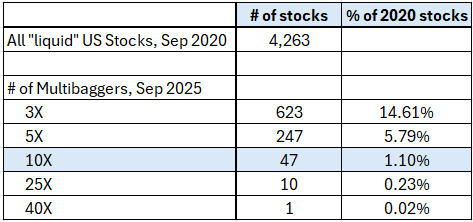
Source: Portfolio123 data, Author Table. Stocks are US primary listed only, with a minimum share price of $0.10 (5 years ago). May not include all multibaggers over shorter periods within the 5 years.
So about 1% of stocks have 10X’d in 5 years.
While there are particular factors that really drive 10X stocks (we saw the importance of earnings growth in the last piece), 1% is still a tiny, difficult to find fraction.
I often advocate finding “smaller-baggers” – while still difficult to find, the chances are often much higher than the elusive 10X+ stocks, and returns of multiple multi-baggers can compound quickly.
On the flipside, 25X and 40X stocks become increasingly rare – there was a 1 in 4,263 chance in finding a 40-bagger, or 0.02%.
**10X Position Sizing**
Needless to say, finding a stock that has returned 10X its initial value is outstanding, not only because of how rare they are, but the monetary gain. Turning $1 into $10 can certainly help to increase one’s overall wealth by a wide margin.
But the actual monetary gain of a 10X stock can vary widely, as it depends on two factors
a) return, and
b) position sizing
For illustration, if an investor went all in on a stock that eventually returned 10X, then his/her portfolio would also 10X. But I think we can all agree that the chances of this happening are extremely rare, and a concentration like this is extremely risky (based on how many stocks actually 10X) – regardless of how much fundamental analysis has been done, there are so many factors out of our control.
Now assume an investor who has 10 positions in his/her portfolio (equal weight initially), and manages to find a 10X stock. To keep it simple, assume that the other 9 positions are more or less even in terms of performance and have a net return of 0 (more on this below). In this case, the 10X stock would have only moved the portfolio 1.9X, significantly less than the 10X of the individual stock. Don’t get me wrong, nearly doubling a portfolio is fantastic, but the point is that a single 10X rarely translates into a 10X of the portfolio.
The higher the number of positions, the smaller the impact a 10X stock will have on the overall portfolio. This scenario, and others, are shown in the table below.
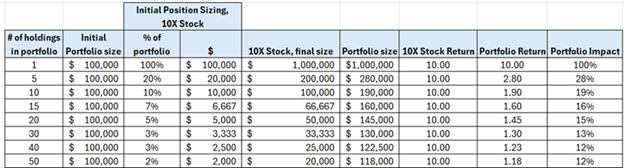
Source: Author Table
These are hypothetical scenarios of course, and the returns of the non-10X stocks can vary widely. If the investor “got lucky” in finding the 10X stock, then the assumption that the balance of the portfolio returned 0 may be realistic. If the investor is more systematic and has a strategy with a sustainable edge, then more stocks in the portfolio may have outperformed.
And position sizing can vary as well – investors may add more capital to the 10X stocks as they see it rising in price, or on the flipside may even sell some if the position size becomes too large, or in a panic during a drawdown to reduce exposure.
Either way – while the % return of a 10X stock is impressive, the actual monetary gain of an investor’s portfolio depends on position sizing, and is often some fraction of 10X.
**Time & Opportunity Cost**
A stock returning 10X is wonderful, but over what time frame?
Stock A returns 8% per year, and becomes a 10-bagger in roughly 30 years.
Stock B returns 50% per year, and becomes a 10-bagger in less than 6 years.
These are both 10X stocks, but the time to get there is vastly different.
**Which is the better stock?**
This answer may vary between investors, but I’d hazard a guess that most would pick Stock B.
These are annualized returns, and quite likely Stock B experienced some swings along the way, which would test most investors’ “conviction” (more on this below).
On the other hand, Stock A has been much more stable, but waiting 30 years for a 10-bagger isn’t really that impressive. For perspective, the 25 year CAGR of the S&P500 is 8%.
Waiting that long introduces opportunity costs, especially if better opportunities like Stock B exist. Investors who found Stock B could either choose to keep holding, or sell and try and find other multi-baggers, to further compound their overall portfolio.
**Drawdowns**
Conventional wisdom often states that high performing stocks can experience deep drawdowns during their ascent. How true is this?
Of all the 10X stocks from the last 5 years, the median max drawdown has been a whopping 56%. In fact, 6 of these stocks had drawdowns of 80% or higher.
See table below of all US 10X stocks from the last 5 years and their drawdowns.
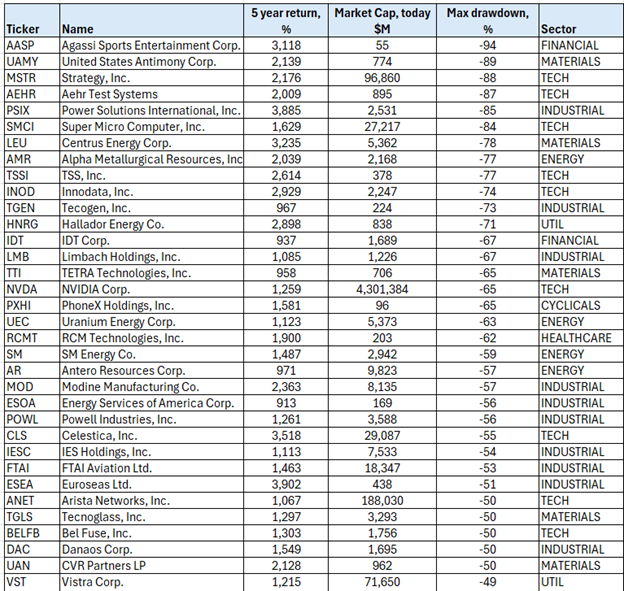
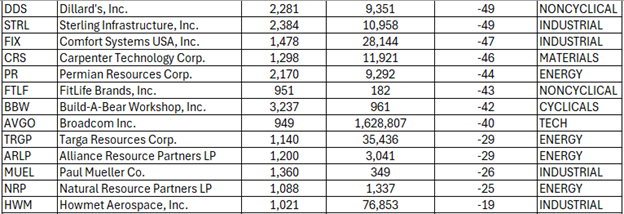
Source: Portfolio123 data, Author Table. Past returns are no guarantee of future results. May not include all multibaggers over shorter periods within the 5 years.
Drawdowns are a real risk in 10X stocks. Being able to hold thru these drawdowns is a key requirement in being able to reap the rewards later. But of course, easier said than done - whether there is a recovery after a drawdown is very difficult to know in the moment.
**Reaching 10X is one thing, Keeping 10X is another**
The 10X stocks we’ve been looking at from the last 5 years are those that are **still 10X**.
There are many stocks that may have reached 10X over this time, but have receded from those highs (and not surprising with the drawdown stats above).
Only 23% of all stocks reaching 10X+ in the last 5 years are still 10X. At the extreme, we have the dreaded "round-trippers" – former 10X stocks that have given back all of their returns, resulting in a negative 5 year return.
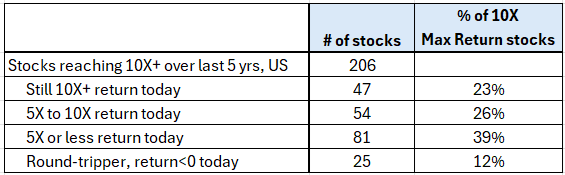
Source: Portfolio123 data, Author Table. Past returns are no guarantee of future performance. May not include all multibaggers over shorter periods within the 5 years.
Drawdowns are common and deep in 10X stocks as we’ve seen – but the most challenging part is knowing what drawdowns will be followed by a recovery, and which drawdowns are permanent.
**The 10X Portfolio vs. 10X Stocks**
10X stocks are wonderful - if you can find them **and** hold them thru volatility. And depending on your portfolio allocation, a 10X stock is usually only a fraction of a 10X gain in one’s portfolio.
While we have focused on individual 10X stocks, another approach is to strive for the **10X Portfolio**.
This is essentially targeting multi-baggers, but not necessarily at the extreme of 10X stocks. Over time, the portfolio may reach the equivalent return of a single 10X stock, but with the added feature (and safety) of diversification. A diversified portfolio can reduce the overall impact of the deep drawdowns experienced by individual 10X stocks, and position sizing in single positions is less of a concern.
There are many paths to 10X. The table below shows different variations of achieving 10X, based on annual return and the number of years.
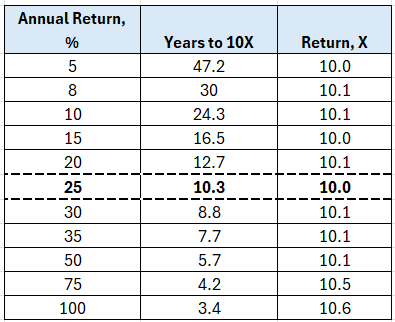
Source: Author Table
Even at a 5% annual return, you could reach 10X – the only caveat is that it would take half a lifetime (47 years) – not to mention the reduction in value thru inflation over such a long period.
At the opposite end of the spectrum, if you are a superinvestor and can achieve 100% per year, it would take you about 3.5 years to 10X.
In the middle, we have the “25% for 10 years” rule. While 25% is certainly a high return over time (the historical return for the S&P500 is 8%), it can be possible when finding the right stocks continuously over time.
Take the [MC-GUTS Microcap Index](https://microcapclub.com/the-launch-of-the-microcapguts-index/) for Canada. The index includes US, Canada and Europe, with the Canadian component of the strategy holding 40 stocks.
It just so happens that this strategy has compounded at 25% since May of 2015 (just over 10 years), in simulation.
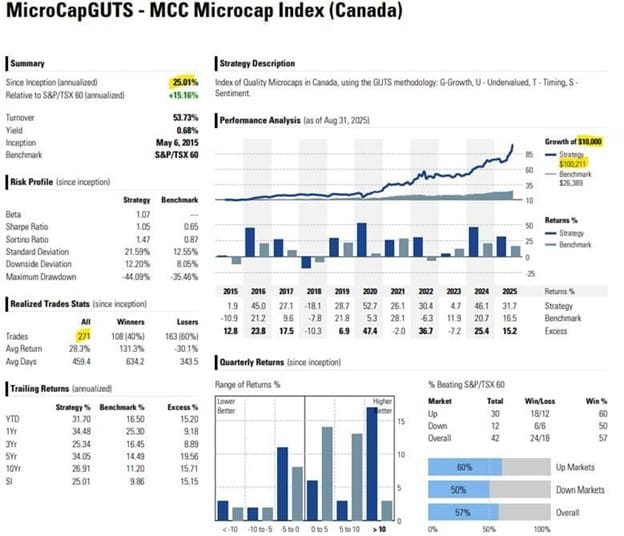
Source: Portfolio123, Author strategy. Past performance is no guarantee of future results.
The Canadian component of the MC-GUTS Index has managed to 10X in 10 years at 25% CAGR, with 271 trades over that time. Overall win rate is only 40% - however the average return of winners is significantly higher than the average return of the 60% of losers.
And how many 10X stocks were in this portfolio? Only 2, or 0.7% of all trades.
The table below outlines the distribution of multi-baggers in the MC-GUTS Canada strategy.
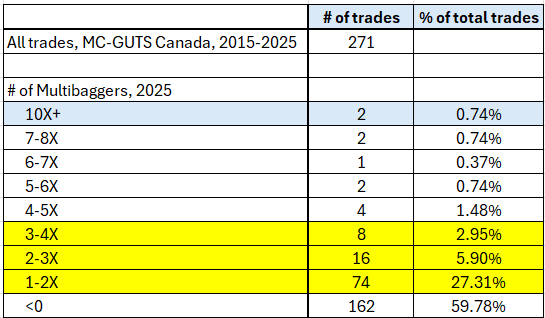
Source: Portfolio123, Author Table. Past performance is no guarantee of future results.
Of the winners, more than 1/3 were 4-baggers or lower. But when collected over time, returns compound towards overall strategy performance.
Also note the drawdown – single 10X stocks have historically drawn down on a median basis in the high 50%’s (and higher) – where this strategy max drawdown was at 44%. Still significant, but not as deep as single 10X stocks historically.
**The Reality of 10X Stocks**
No doubt, being able to find 10X stocks is great, but there are many other practical aspects and risks to consider: opportunity cost in just how rare they are, position sizing, drawdowns and volatility to name a few.
An alternative: the 10X portfolio – a diversified approach to target smaller multi-baggers, with less risk, and the potential to compound the portfolio to a 10X equivalent over time.
**Portfolio123** – All data and quantitative tools used for this piece, and all pieces in the Evidence Based Forum, provided by Portfolio123\. If you’d like to try Portfolio123 with an extended free trial (35 days vs. the typical 20 days), check out [this link](https://www.portfolio123.com/index.jsp?apc=RYANT&ref=microcapclub.com), or use Invitation Code “RYANT” (full disclosure, affiliate link). I’m available for any questions you may have.
**Note:** Past performance is not an indicator of future results. Please visit our Terms of Use for a more complete disclaimer and discussion of the risks of investing.
#### Interact and learn with 250+ of the best microcap investors on the planet:
[Join Us](https://microcapclub.com/join-now)
MicroCapClub is an exclusive forum for experienced microcap investors focused on microcap companies (sub $500m market cap) trading on United States, Canadian, European, and Australian markets. MicroCapClub was created to be a platform for experienced microcap investors to share and discuss stock ideas. Since 2011, our members have profiled 1300+ microcap companies. Investors can join our community by applying to become a member or subscribing to gain instant view only access. MicroCapClub’s mission is to foster the highest quality microcap investor Community, produce Educational content for investors, and promote better Leadership in the microcap arena. For more information, visit and
### Looking Beyond the Numbers
URL: https://microcapclub.com/looking-beyond-the-numbers/
Last updated: 2025-11-03T17:53:49.000Z
Jakob Fugger was born in 1459 in Augsburg, Germany into a wealthy merchant family. He is widely regarded as one of the richest people who ever lived, estimated at $500 billion USD inflation adjusted today.
At 14, he was sent to Venice, the Wall Street of the 15th century. That’s where he learned the secret: money doesn’t just move goods. It moves people. And people run the world.
When he returned home, he took the family cloth business and turned it into something unrecognizable. He didn’t just sell. He invested. In silver mines. In copper. In trade routes. In popes and princes. Fugger understood early that the real return doesn’t come from goods, it comes from leverage i.e. when important people owe you money.
In the early 1500s, he was financing emperors, buying popes, and reshaping Europe’s power map from a desk in Augsburg. But there was one thing he hated more than losing money: not knowing where it went.
So he did something radical for the time. He adopted and perfected double-entry bookkeeping. A system where every transaction has two entries, one credit and one debit. Today, it’s just accounting. Back then, it was revolutionary.
Fugger didn’t invent it. Merchants in Venice had been experimenting with the method, but Fugger took it from dusty ledgers and turned it into a financial weapon. He used it to track mining investments in the Alps, shipping ventures in the Mediterranean, and bribes to the seven electors of the Holy Roman Empire. His ledgers weren’t just books; they were the key instrument for controlling his empire.
What made Fugger different wasn’t just his wealth. It was how he used information. Most people saw money as gold coins and land deeds. Fugger saw it as data. And in a world with no Excel, no internet, and no Bloomberg terminals, he built a system that let him know in real time what was owned, owed, and how much profit he was making.
His greatest bet came in 1519\. He loaned today’s equivalent of tens of billions to Charles V to help him win the throne of the Holy Roman Empire. It worked. Charles won. And Fugger didn’t just get his money back. He got access, monopolies, mining rights, political sway.
The total payoff? He became the richest man in the known world. Richer than kings.
He was the only person to have a direct business relationship with the Roman Curia. He loaned money to the Vatican to build the St. Peter's Basilica, the Sistine Chapel, as well as other buildings within the Vatican. He held the power to force the Church to raise taxes until his debt was repaid.
Fugger’s legacy isn’t just in cathedrals or royal debts. It’s in every balance sheet, every income statement, every accountant’s notebook. The lesson is timeless: The more clearly you see your money, the more power you have over it. Fugger didn’t get rich by guessing. He got rich by counting twice.
Accounting is the language of business. Investors must understand the language to gauge the health of a business.
Financials tell us about the past and present but aren’t very good at telling us the future.
We investors love to project the future with linear up and to the right financial projections. The future loves to mock our financial models and estimates.
The difference between your financial model and the outcome you get is management.
A business always rises and falls to the quality level of management’s decision making.
Talking to management to understand their strategy is the only way to see the future. The [art of talking to management](https://microcapclub.com/the-art-of-interviewing-management/) is imperative when investing in small public companies.
Legendary investor Phil Fisher would make it a point to become an expert in the business he was evaluating prior to talking to management. He is known for saying an investor won’t know the right questions to ask until they do all the upfront scuttlebutt research. I believe this is true for small-mid-large caps, but not nano-microcaps.
When investing in small public companies you can’t afford to wait until the end of your due diligence to talk to management. Why? Oftentimes one management conversation unearths differential insights that make the company completely un-investable or 3x more interesting than you orginally thought. I normally talk to management earlier in the due diligence process after I have a broad understanding of the business.
In general, I’m trying to get these core questions answered:
- Can the stock double in three years based on conservative fundamental assumptions and no multiple expansion?
- What could go wrong (customer concentration, reimbursement changes, new legislation, churn, etc)?
- Do they need to raise money (dilution)?
I find in person meetings are by far superior to phone or zoom. I’ve conducted hundreds of management interviews and on many occasions one statement, shift in body language, made an investment investable or not investable at all. With in person meetings there is no where to hide.
[Gary Channon](https://microcapclub.com/how-do-you-get-management-to-talk-about-things-they-dont-want-to-talk-about/), founder and CIO of Phoenix Asset Management, takes it a step further and only does management meetings in pairs or threes.
“We always have management meetings in pairs or threes. We never go on your own - writing things down, trying to do the questions and then trying to remember afterwards. My memory is not what it was, but I used to have a complete recall. But with multiple people you notice how management looked at each other when you said X. A single person could miss that.”
Ironically some of my biggest errors were when I made assumptions after only looking at the financials of a business – when I didn’t go the extra mile and talk with management.
When looking at the financials I might assume that a profitable business won’t need to raise capital. In the moment, I feel silly even asking management, but I do. Management admits they are looking to raise capital for M&A. Do they have the experience and proper board to make/integrate a successful acquisition? Will they overpay? How are they going to raise the capital? Are they going to hire a lower tier investment bank? I may pass on the opportunity.
When looking at the financials I might assume that the current growth rate is sustainable. I probe deeper and find it’s because of one large contract that is set to run off. They may not have offered this information if I asked them directly, but it came up indirectly while talking about customer concentration. I may pass on the opportunity.
We investors love to default to laziness. Often our spidey sense goes off, but we don’t follow up with management:
- Perhaps a boring money losing company subtly mentions “acceleration” or “breakeven” in an earnings call or earnings release, but you don’t follow up.
- Perhaps a CEO makes a significant open market purchase, but you don’t follow up.
- Perhaps it’s your past experience with a company under a different management team, “this business has always been a dog with fleas”. You don’t meet the new management team.
It’s always these situations where we are distracted, lazy or biased. Then someone else does the work you were supposed to do and captures the 100-400% discovery gain. All you can do is sit back, grit your teeth, and criticize the stock move to help justify your laziness.
All your best professional moments in life came/will come when you’ve overprepared – when you’ve done the work and the person or group you are trying to impress can tell you’ve done the work. It's the same for management meetings.
The work you do prior to management meetings allows you to keep the conversation friendly and conversational, not an interrogation. Your preparation also allows you to adapt with the flow of the conversation.
I don’t even like to use a notepad or write down anything during a management meeting. Management won’t be as free with words when they see you writing down every word they say. When you are writing you aren’t listening. When you are writing you aren’t watching them. In fact, writing during a meeting takes away much of the benefit of in person meetings.
You can’t expect your first 5-10 management meetings to go perfectly. It takes time and reps. Roger Federer’s backswing looked so effortless because of the tens of thousands of hours in practice and preparation over a lifetime. It takes time and effort to make anything look effortless and productive.
In a world where almost every investment professional is using AI tools to gain an edge, ironically today's real edge is your willingness to go the extra mile and gain new insights from management teams.
Well-formed management conversations can unlock differential insights that you would never be able to gain by looking at financial statements. In the end you must do both to understand the past, the present and the future.
#### Interact and learn with 250+ of the best microcap investors on the planet:
[Join Us](https://microcapclub.com/join-now)
MicroCapClub is an exclusive forum for experienced microcap investors focused on microcap companies (sub $500m market cap) trading on United States, Canadian, European, and Australian markets. MicroCapClub was created to be a platform for experienced microcap investors to share and discuss stock ideas. Since 2011, our members have profiled 1300+ microcap companies. Investors can join our community by applying to become a member or subscribing to gain instant view only access. MicroCapClub’s mission is to foster the highest quality microcap investor Community, produce Educational content for investors, and promote better Leadership in the microcap arena. For more information, visit and
### Ascent Industries (ACNT): The Specialty Chemicals Business Executing a Transformation
URL: https://microcapclub.com/ascent-industries-acnt-the-specialty-chemicals-business-executing-a-transformation/
Last updated: 2025-09-19T12:09:15.000Z
Ascent Industries (ACNT) a Specialty Chemicals company that has emerged from a multi-year turnaround following a proxy contest and the sale of their Stainless Tubing business in June of this year. Today, the Chemicals business produces specialty chemicals for the carpet, chemical, paper, metals, mining agricultural, fiber, paint, textile automotive, petroleum, cosmetics, mattress, furniture, janitorial and other industries. Ascent operates three manufacturing sites in the Southeastern US all near Tennessee and North Carolina. Ascent can be viewed as the company that cleans up the breadcrumbs of the larger chemical companies. They have a high degree of recurring revenue from blue-chip customers as the chemical processes are too niche and not-scalable. From here, the cash from steel asset sales will be redeployed into the higher-margin specialty chemical segment, and strategic acquisitions with increased emphasis on branded products are central to the company's go-forward strategy. [https://ascentco.com](https://www.youtube.com/redirect?event=video%5Fdescription&redir%5Ftoken=QUFFLUhqbG5HT0pNbTByM3lTUldPeTFzTy00NnFFdktPQXxBQ3Jtc0tsMWJVM2JlT3RZMjZGQ1RHbHV2ZGhXalRPdDBLVnNySEl3M2NYU01aempvZ2p2bWtBd1p6VjQ5bkwzMlVZN044cWVqZDdicVk5bVJTYjNrVlNXZDVWQ2MzWE1XTGRfTlg0d1EzMzVSbWtkQXpWTE4xVQ&q=https%3A%2F%2Fascentco.com%2F&v=WG-6zTdOdxs&ref=microcapclub.com)
Sebastian Krog and I have a conversation with CEO Bryan Kitchen of Ascent Industries (ACNT). You can follow the ongoing discussion on Ascent Industries on our community [here](https://community.microcapclub.com/forums/topic/3699-ascent-industries-acnt/?ref=microcapclub.com#comment-80807).
#### Interact and learn with 250+ of the best microcap investors on the planet:
[Join Us](https://microcapclub.com/join-now)
You can listen/watch this business breakdowns on [Spotify](https://creators.spotify.com/pod/profile/microcapclub/episodes/Ascent-Industries-ACNT-The-Specialty-Chemicals-Business-Executing-a-Transformation-e38ehh3?ref=microcapclub.com), [Apple Podcast](https://podcasts.apple.com/us/podcast/ascent-industries-acnt-the-specialty-chemicals/id1765974269?i=1000727499480&ref=microcapclub.com), and YouTube below:
*Disclaimer: All content in this newsletter is for discussion, education, entertainment, and illustrative purposes only and SHOULD NOT be construed as professional financial advice, solicitation, or recommendation to buy or sell any securities, notwithstanding anything stated on this newsletter and MicroCapClub.com. There are risks associated with investing in securities. Loss of principal is possible. Past performance is not a predictor of future investment performance. Ian Cassel and MicroCapClub.com are not responsible for investment actions taken by viewers. Should you need such advice, consult a licensed financial advisor, legal advisor, or tax advisor. You agree to verify all information yourself before investing. Any past performance discussed on MicroCapClub.com is no guarantee of future results. Investing involves risk and possible loss of principal capital; please seek advice from a licensed professional. All views expressed are personal opinions as of the date of publication and are subject to change without the responsibility to update views. No guarantee is given regarding the accuracy of the information. [FULL DISCLAIMER and TERMS OF USE](https://microcapclub.com/terms/)*
### LAST CHANCE – 360+ Investors Registered / 67 Companies Confirmed / Join Us!
URL: https://microcapclub.com/last-chance-360-investors-registered-67-companies-confirmed-join-us/
Last updated: 2025-09-18T14:22:04.000Z
On October 21-23, 2025 several hundred investors are congregating in Toronto for our inaugural event. You still have time to register.
This event is **OPEN TO ALL MICROCAP INVESTORS** and **FREE TO ATTEND**. We already have 360+ investors registered, and 67+ companies confirmed.
MicroCapClub community attendees will receive a bunch of special perks like access to the onsite MicroCapClub Clubhouse, Early Access to Company 1x1 Meeting Requests (just opened up), and more.
#### Interact and learn with 250+ of the best microcap investors on the planet:
[Join Us](https://microcapclub.com/join-now)
On Day 1, we have a phenomenal speaker lineup of private investors, analysts, and fund managers who will be sharing more about their strategies and their top pick at the current price.
On Day 2, we have 67 companies presenting throughout the day.
On Day 2 and Day 3, we have 1x1 management meetings.
Don't miss this event.
[**Planet MicroCap Toronto in Partnership with MicroCapClub**](https://www.meetmax.com/sched/event%5F123229/conference%5Fhome.html?bank%5Faccess=0&event%5Fid=123229&ref=microcapclub.com)
When: October 21-23, 2025
Where: Toronto Canada at the Arcadian Court and Loft
[**\[FREE TO ATTEND – REGISTER NOW\]**](https://www.meetmax.com/sched/event%5F123229/conference%5Fhome.html?bank%5Faccess=0&event%5Fid=123229&ref=microcapclub.com)
*Disclaimer: All content in this newsletter is for discussion, education, entertainment, and illustrative purposes only and SHOULD NOT be construed as professional financial advice, solicitation, or recommendation to buy or sell any securities, notwithstanding anything stated on this newsletter and MicroCapClub.com. There are risks associated with investing in securities. Loss of principal is possible. Past performance is not a predictor of future investment performance. Ian Cassel and MicroCapClub.com are not responsible for investment actions taken by viewers. Should you need such advice, consult a licensed financial advisor, legal advisor, or tax advisor. You agree to verify all information yourself before investing. Any past performance discussed on MicroCapClub.com is no guarantee of future results. Investing involves risk and possible loss of principal capital; please seek advice from a licensed professional. All views expressed are personal opinions as of the date of publication and are subject to change without the responsibility to update views. No guarantee is given regarding the accuracy of the information. [FULL DISCLAIMER and TERMS OF USE](https://microcapclub.com/terms/)*
### The Perils of Thesis Drift
URL: https://microcapclub.com/the-perils-of-thesis-drift/
Last updated: 2025-09-12T10:38:15.000Z
When you’re confronted with mounting evidence that you’re wrong, what do you do?
Investing is incredibly humbling. Those of us who decide to pursue actively managing an investment portfolio are often driven by the fun pursuits of this job. We tie ourselves to the intellectual pursuit of information, the stimulating rewards of finding new ideas, the making money, maybe even appearing smart to our non-investor friends. But much of the time in this business, you are confronted with the irrationality of people, the difficulty of managing a losing or winning position, the ego hit of being wrong, and the constant discovery that you don’t know as much as you think you do.
I love learning about businesses and industries and putting the pieces of the puzzle together that this job requires. But there is a reason many people will claim that ‘investing is hard’. Spending significant amounts of time studying a business, building a model of the world, making a prediction about the future and putting real money at risk, only to find that reality is nowhere near what you thought – aka your thesis is invalidated – is a difficult and emotionally taxing part of being an investor.
But there are ways to manage the difficulty, by letting go of mistakes and bad investments as quickly as possible, by avoiding what’s known as ‘thesis drift’.
Thesis drift is a term we all know and love, and happens when an investor refuses to admit they made a mistake, instead justifying the reasons for poor business performance and a declining stock price. When your model of the world predicts one thing, and something entirely different happens, refusing to acknowledge you were wrong and investing *new*reasons for continuing to own a stock can be portfolio management death.
I’ve been there many times. The problem with thesis drift is that it’s incredibly easy to fall prey. Your company just lost their largest customer? That’s ok, they were low margin anyway. Pricing power never materialized? That’s ok, they’ll make up for it on volume. Margin expansion isn’t happening? That’s ok, we’re just a few quarters away from that.
Not falling prey to thesis drift is a cognitive battle against yourself, which mirrors much of what investing really is. The hardest part is catching yourself in the act of bad behavior and correcting it before it damages the portfolio. We all know we carry biases, but the real game is preventing them from steering our decisions. When you confront what looks like thesis drift, resist the temptation to “re-underwrite the business,” call management again, or tinker endlessly with your model. Instead, cut your losses and move on. This is a gift you can give yourself: the willingness to admit a mistake. Far from a weakness, it’s a mark of emotional maturity and one of the most valuable qualities an investor can cultivate.
Despite the typical negative public reaction, I always enjoy seeing a well known investor or 13F filer blow out of a position, especially a newly purchased one, without any consideration for what might happen. An unexpectedly bad earnings report or structural shift in the industry could trigger a decision like that, which again, is a sign of strength.
I posed the question at the beginning of this article because it applies to much more than investing. Many of us have stayed in relationships that weren’t working and jobs we didn’t like. We see politicians cling to policies that aren’t effective and watch TV shows that are clearly in decline but won’t be cancelled. It is an investing – and general – superpower to avoid rationalizing, and act when evidence is mounting that you are wrong.
With investing, the goal is to make money, full stop. That is a straightforward goal. But in life, it’s not that cut and dry. Although much harder said than done, my solution to avoiding thesis drift has been to try and remove my ego. No decision should be framed as being ‘right or wrong’ but rather avoiding any potential failure that begets more failure. Paul Tudor Jones is famous for having the phrase ‘Losers Average Losers’ framed above his desk. Exiting bad positions is the way to avoid this death spiral. Again, this is a source of strength and maturity, not something that should destroy your identity.
Investing is hard. Life can be hard. But both are made easier when we allow ourselves to change course when necessary. From here on out, try to recognize thesis drift when it appears, and cut it off early. The discipline to admit you’re wrong is what keeps you in the game long enough to eventually be right.
#### Interact and learn with 250+ of the best microcap investors on the planet:
[Join Us](https://microcapclub.com/join-now)
MicroCapClub is an exclusive forum for experienced microcap investors focused on microcap companies (sub $500m market cap) trading on United States, Canadian, European, and Australian markets. MicroCapClub was created to be a platform for experienced microcap investors to share and discuss stock ideas. Since 2011, our members have profiled 1300+ microcap companies. Investors can join our community by applying to become a member or subscribing to gain instant view only access. MicroCapClub’s mission is to foster the highest quality microcap investor Community, produce Educational content for investors, and promote better Leadership in the microcap arena. For more information, visit and
### Golconda Gold (GG.V / GGGOF): A Profitable Gold Producer Focused on Increasing Production and Not Diluting
URL: https://microcapclub.com/golconda-gold-gg-v-gggof-a-profitable-gold-producer-focused-on-increasing-production-and-not-diluting/
Last updated: 2025-09-09T17:53:08.000Z
Golconda Gold is an $80 million market cap profitable unhedged gold producer with assets in South Africa (Galaxy Mine) and New Mexico USA (Summit Mine) that expects to triple gold production over the next three years. Insiders own 40%+ and expect no further dilution. Gold producers currently trade between 8-12x EV/EBITDA, with growing gold producers trading at the top of the range.
At $3000 per ounce gold, management expects $10 million USD in EBITDA in 2025, ramping to 25 million USD EBITDA in 2026\. By 2028 the company estimates they will be generating close to $50 million USD in EBITDA with strategic plans for capital allocation in dividends and buybacks.
I recently sat down with CEO/30% owner Ravi Sood of Golconda Gold (GG.V / GGGOF) to talk about the company backstory and future growth expectations. You can follow the ongoing discussion on Goldconda Gold on our community [here](https://community.microcapclub.com/forums/topic/5357-golconda-gold-ggv-gggof/?ref=microcapclub.com). Not part of our community? Join Us.
You can listen/watch this business breakdowns on [Spotify](https://creators.spotify.com/pod/profile/microcapclub/episodes/Golconda-Gold-GG-VGGGOF-A-Profitable-Gold-Producer-Focused-on-Increasing-Prod---Not-Diluting-e380knb?ref=microcapclub.com), [Apple Podcast](https://podcasts.apple.com/us/podcast/golconda-gold-gg-v-gggof-a-profitable-gold-producer/id1765974269?i=1000725756382&ref=microcapclub.com), and YouTube below:
*Disclaimer: All content in this newsletter is for discussion, education, entertainment, and illustrative purposes only and SHOULD NOT be construed as professional financial advice, solicitation, or recommendation to buy or sell any securities, notwithstanding anything stated on this newsletter and MicroCapClub.com. There are risks associated with investing in securities. Loss of principal is possible. Past performance is not a predictor of future investment performance. Ian Cassel and MicroCapClub.com are not responsible for investment actions taken by viewers. Should you need such advice, consult a licensed financial advisor, legal advisor, or tax advisor. You agree to verify all information yourself before investing. Any past performance discussed on MicroCapClub.com is no guarantee of future results. Investing involves risk and possible loss of principal capital; please seek advice from a licensed professional. All views expressed are personal opinions as of the date of publication and are subject to change without the responsibility to update views. No guarantee is given regarding the accuracy of the information. [FULL DISCLAIMER and TERMS OF USE](https://microcapclub.com/terms/)*
### How do you get management to talk about things they don't want to talk about?
URL: https://microcapclub.com/how-do-you-get-management-to-talk-about-things-they-dont-want-to-talk-about/
Last updated: 2025-09-08T10:20:44.000Z
Gary Channon is the founder and CIO of UK based Phoenix Asset Management. The firm oversees £1.8 billion across a series of closed end funds.
The flagship fund has produced an 8.4% CAGR since 1998 which may not impress people, but there are always things we can learn from someone that has invested for almost three decades.
I recently listened to this [interview](https://behindthebalancesheet.com/podcasts-singles/47-the-relentless-improver/?ref=microcapclub.com) with Gary Channon. You will enjoy it too. Gary is a great conversationalist.
Channon’s passion for investing began in childhood at a naval boarding school where he discovered the Financial Times. At 12, he made his first stock purchase, Johnson and Firth Brown, with a letter to his bank. His second investment, Poly Peck, turned a £50 stake into £2,000 before the company was revealed to be a fraud. By age 15, he had turned that initial capital into £50,000 through UK privatizations, becoming what he calls "his most confident self". However, personal hardships, including expulsion from school and family struggles cut his education short.
Channon began his career in in 1987, hired as a Japanese bond trader despite having no qualifications. He taught himself derivatives, later joining Goldman Sachs. But the pivotal moment came in 1995 when he read Roger Lowenstein’s biography of Warren Buffett. The book sparked an epiphany: Channon realized his calling was long-term value investing. He used his employer’s resources to teach himself the craft and in 1997, launched Phoenix with his savings and help from colleagues.
Channon’s goal was to create a concentrated, long-term value fund. He aimed to run no more than 15 stocks, invest only when a company traded at less than half of his estimate of intrinsic value, and hold positions for many years.
Today Phoenix uses a proprietary evaluation system called DREAM (Dynamic Relative Evaluation and Assessment Model), developed to objectively score businesses, management, and price. Each component is rated by depth of research, confidence, and intrinsic quality. DREAM requires two analysts to complete a company evaluation, and scoring is documented and revisited regularly. This structured feedback loop helps reduce bias and improves learning from past mistakes.
This is the most interesting part, at least to me - they only invest in businesses where there is enough transparency to allow them to see the business separate from whatever management is telling them. In other words, Phoenix only invests in companies where they can use primary research to get a pulse on the business. The team avoids sell-side research and uses mystery shopping, site visits, and competitor interviews. For example, when evaluating Travis Perkins, feedback from builders helped the team delay investing until evidence supported the company’s pricing power.
The team maintains detailed “snap DREAM” reports for watchlist companies and conducts full DREAM evaluations only when an investment is made. They also document reasons for discarding ideas, which helps when analyzing missed opportunities.
What also makes Phoenix unique is they have fully embraced AI. They are heavily investing in AI to augment the research process. Each team member is building AI “agents” named after Venetian figures to automate tasks such as idea generation, monitoring, and competitive mapping. Tools scrape websites to analyze homebuilder sales, funeral trends, and other sector-specific metrics. Channon believes AI will massively reduce sell-side roles within two years and already finds AI-generated reports more useful than most analyst work. He uses multiple AI tools to cross-check hallucinations and increase accuracy.
Their strategy is a barbel in that they have fully embraced AI but also rigorously prepare for management meetings. I think stock pickers will enjoy these two questions and answers:
**How do you get a management to talk about the things they don't want to talk about?**
> We don't have a meeting with management until the end. So be an expert when you arrive. Don't rely on management to educate you.
> We would rather see a competitor first. If you really want to learn about management's weaknesses, hear it from their competitors. They are very happy to share. We also try to have something useful to share with management and be value added. We always have management meetings in pairs or threes. We never go on your own - writing things down, trying to do the questions and then trying to remember afterwards. My memory is not what it was, but I used to have a complete recall. But with multiple people you notice how management looked at each other when you said X. A single person could miss that. So having multiple people in the room helps.
> We plan for a one-hour meeting, and we might spend four to six hours preparing for it. What are we trying to learn? Let’s hypothesize XYZ is the case, how do we get that out of them? How do we get them to share something not price sensitive but commercially sensitive?
> There are many techniques you can use – You can put numbers or words in people’s mouths and let them correct you or if they don’t their face will tell you something. If I’m gauging integrity, I might take them down a path where they might agree, and later on I’ll produce a piece of information to see if they contradict something they agreed to earlier. Do they care about being correct and truthful or is their appearance more important and are they willing to be slightly untruthful. Are they open with telling me all the negatives? Those people are very rare
> We also have a charisma red flag. It’s almost better to not meet with them at all. If a CEO is charismatic, we have a cooling off period. I won’t go to those meetings so I can remain objective.
**How do you stay detached when you are friendly with management and own a stock for a long-time?**
> The goal is to have a relationship with management where your ownership position is never a baggage between you. Our best relationships with management are actually the ones we’ve owned the stocks several times over a couple decades. Management knows they are doing well if we are reducing our position. And to be honest if the stock is trading well and your taking some off the table management is happy – they don’t hold it against you. Management is getting rewarded as well with a higher stock price.
> We do watch out for endowment bias, but we’ve made several corrections that limit it as part of our process. We are more than willing to sell down a position and buy back later.
> What I have learned through time is the probability of being correct – so a stock that you’ve owned for a long-period of time and had a lot of access with management, the value of that is very high in terms of how likely we are to be right or wrong about the future versus a new position.
If you enjoyed this article you will like [The Art of Interviewing Management](https://microcapclub.com/the-art-of-interviewing-management/) by Chip Maloney.
#### Interact and learn with 250+ of the best microcap investors on the planet:
[Join Us](https://microcapclub.com/join-now)
MicroCapClub is an exclusive forum for experienced microcap investors focused on microcap companies (sub $500m market cap) trading on United States, Canadian, European, and Australian markets. MicroCapClub was created to be a platform for experienced microcap investors to share and discuss stock ideas. Since 2011, our members have profiled 1000+ microcap companies. Investors can join our community by applying to become a member or subscribing to gain instant view only access. MicroCapClub’s mission is to foster the highest quality microcap investor Community, produce Educational content for investors, and promote better Leadership in the microcap arena. For more information, visit and
### BluMetric Environmental (BLM.V / BLMWF): A Growing Environmental Solutions and Water Technology Company
URL: https://microcapclub.com/blumetric-environmental-blm-v-blmwf-a-growing-environmental-solutions-and-water-technology-company/
Last updated: 2025-09-04T19:34:11.000Z
Sebastian Krog and I have a conversation with CEO Scott MacFabe and CFO Dan Hilton of BluMetric Environmental (BLM.V / BLMWF). This MicroCap Business Breakdowns discussion took place live on September 4, 2025, on the MicroCapClub Community.
#### Interact and learn with 250+ of the best microcap investors on the planet:
[Join Us](https://microcapclub.com/join-now)
BluMetric is only a $30 million USD market cap, but it’s a management team and business punch well above their weight. The business is currently generating over $50 million in annual sales and growing rapidly. The medium-term goal is $100 million in sales and $10 million in EBITDA.
BluMetric is a Canadian clean-tech and environmental consulting firm that provides turnkey environmental solutions and Mission Ready Water treatment systems for clients in the commercial, industrial, mining, government and military sectors.The company manufactures its equipment in Ontario, Canada and following its acquisition of Gemini Water in 2024, also at a second plant in Gainesville, Florida. This gives BluMetric direct access to the Canadian, US and Caribbean markets. A steady stream of recurring service revenue ensures the business’s resilience, and growing demand for its WaterTech Systems provides ample opportunity for expansion on both sides of the border.
You can listen/watch this business breakdowns on [Spotify](https://creators.spotify.com/pod/profile/microcapclub/episodes/BluMetric-Environmental-BLM-VBLMWF-A-Growing-Environmental-Solutions--Water-Technology-Company-e37pgkp?ref=microcapclub.com), [Apple Podcast](https://podcasts.apple.com/us/podcast/blumetric-environmental-blm-v-blmwf-a-growing/id1765974269?i=1000725035006&ref=microcapclub.com), and YouTube below:
*Disclaimer: All content in this newsletter is for discussion, education, entertainment, and illustrative purposes only and SHOULD NOT be construed as professional financial advice, solicitation, or recommendation to buy or sell any securities, notwithstanding anything stated on this newsletter and MicroCapClub.com. There are risks associated with investing in securities. Loss of principal is possible. Past performance is not a predictor of future investment performance. Ian Cassel and MicroCapClub.com are not responsible for investment actions taken by viewers. Should you need such advice, consult a licensed financial advisor, legal advisor, or tax advisor. You agree to verify all information yourself before investing. Any past performance discussed on MicroCapClub.com is no guarantee of future results. Investing involves risk and possible loss of principal capital; please seek advice from a licensed professional. All views expressed are personal opinions as of the date of publication and are subject to change without the responsibility to update views. No guarantee is given regarding the accuracy of the information. [FULL DISCLAIMER and TERMS OF USE](https://microcapclub.com/terms/)*
### Bull Markets
URL: https://microcapclub.com/bull-markets/
Last updated: 2025-08-31T10:36:01.000Z
Bull and bear markets are polar opposites and often compel us to do the wrong thing.
In bull markets you forget about valuation.
In bear markets all you think about is valuation.
In bull markets it takes a few days to be right.
In bear markets it takes a few years to be right.
In bull markets all you see is more upside.
In bear markets all you see is more downside.
In bull markets stocks go up on positive news.
In bear markets stocks go down on positive news.
In bull markets everyone posts their YTD returns.
In bear markets no one can find their YTD returns.
In bull markets everything you sell immediately feels like a mistake.
In bear markets everything you buy immediately feels like a mistake.
In bull markets the only thing that matters is growth.
In bear markets the only thing that matters is the balance sheet.
In bull markets everyone justifies paying higher.
In bear markets everyone justifies selling lower.
In bull markets you get tomorrow's gains today.
In bear markets you get tomorrow’s losses today.
In bull markets you hate weekends and market holidays.
In bear markets you can’t wait for weekends and market holidays.
In bull markets everyone wants to be a full-time investor.
In bear markets everyone wants a job.
The worst part of bull markets is the rise of inexperienced people educating other inexperienced people.
The worst part of bear markets is perma-bears feeling vindicated after being wrong for a decade or two.
Last week I sat down with [Antonio](https://x.com/antonioresource?ref=microcapclub.com) from [ResourceTalks.com](https://resourcetalks.com/?ref=microcapclub.com) to talk about navigating bull markets. Hope you enjoy it.
#### Interact and learn with 250+ of the best microcap investors on the planet:
[Join Us](https://microcapclub.com/join-now)
MicroCapClub is an exclusive forum for experienced microcap investors focused on microcap companies (sub $500m market cap) trading on United States, Canadian, European, and Australian markets. MicroCapClub was created to be a platform for experienced microcap investors to share and discuss stock ideas. Since 2011, our members have profiled 1300+ microcap companies. Investors can join our community by applying to become a member or subscribing to gain instant view only access. MicroCapClub’s mission is to foster the highest quality microcap investor Community, produce Educational content for investors, and promote better Leadership in the microcap arena. For more information, visit and
### Talent Distribution
URL: https://microcapclub.com/talent-distribution/
Last updated: 2025-08-29T09:45:14.000Z
In 2013, Brian Scalabrine, a recently retired 11-year NBA player, had enough.
Scalabrine was sick and tired of hearing average Joes say they could beat him one-on-one on the court. The armchair professionals insisted that Scalabrine, who averaged 3.1 points per game over his career, a poor player by NBA standards, would be an easy challenge.
Scalabrine wanted to shut them up. Scalabrine took on four of Boston’s best amateur ballers, dubbed it the “Scallenge” and recorded it for all to see. Some had Division - 1 college experience. All had supreme confidence they would win.

Here is how it went.
The Vanilla Godzilla lambasted every single one. The D-1 guy who played at Syracuse lost to Scalabrine 11-3\. The next two average Joes didn’t even score a point on Scalabrine. And the last competitor couldn’t score more than 3 points, too. Once the former NBA player figured out the competition, they didn’t have a chance. In total, Scalabrine scored 44 points to their 6\.
For safe measure, Scalabrine finished by facing off against the three radio hosts who were running the “Scallenge”. Despite being outnumbered 3-to-1, Scalabrine scorched them 11-1\.
Why is this story important?
At the end, Brian Scalabrine said something prophetic, “I’m way closer to LeBron James than you are to me.”
Let that sink in for a moment.
We all are trying to succeed at investing. We enjoy the process. We enjoy the challenge, but we all want above average returns. Otherwise, what’s the point? Just invest in index funds.
All of us, I believe, deep down in the lowest depths of our ego, hope that we can reach the peak, the apex of our field. That desire is to rub shoulders with the best, compete at the highest level AND be considered the best, too.
Let’s face it though. We can’t all be a freak of nature. That just isn’t statistically possible.
There’s a much greater chance, however, we are the average Joes thinking, ignorantly, that we can keep up with the bottom of the barrel of the top 1%, the Brian Scalabrine’s of investing.
The “White Mamba”, as Scalabrine has been nicknamed, was far from the best NBA player. But to play in the NBA for any length of time, one is in an elite group of the best basketball players in the world. The focus of the viewer’s attention fixates on the elite of the elites. Don’t forget: they’re all phenomenal vs the rest of us.
Here is the reality. Investors form themselves into the bell curve we see in all areas of human talent, like above. At the left are the bad ones. This group makes up 50% of the human population. This group lacks the skill, genetics, knowledge and “fitness” to do the most basic of task at a manageable, let alone great level over a long period.

Next to them, is a group which is slightly smaller but still large, roughly 40%. These are the mildly able investors. They might survive for a short time, or might be lucky enough to look good during boom times, but when the tide turns, they’re history. These are no more than one-hit wonders.

The next level is much smaller. These are the good investors, operators, artists, basketball players and so on. When I say good, they consistently smoke weaker competition and attain above average results. They usually operate in small niches. Generally, these are the people who’ve reached the top of their field with mountains and mountains of work, intelligence and fanaticism. Brian Scalabrine would be at the top of this pack.

Above them and us all, are the Disney’s, the Walton’s, the Buffett’s, the Malone’s, the Mozart’s, the Jordan’s, the Jackson’s, the Jon Jones’s and the Rockefeller’s. These are the freaks of nature. Divine accidents, gifted at birth and through nurture with talents beyond us mere mortals. Everything comes at least 4 times quicker to them so each stroke of effort multiplies exponentially allowing them to dance circles around everyone while we all bash our heads into the wall wondering enviously, “How on earth do they do that?”

So be honest with yourself first. Where do you personally fall on the bell curve?
It’s a bull market and heady part of a cycle, so more people think they can tussle with the Brian Scalabrine’s of investing by themselves and win. But that’s silly. Those individuals are much, much closer to the freaks of nature than most of us are to them.
Our estimation of our own abilities is probably higher than it actually is. It’s like asking a group of random people who are great drivers. Every hand goes up. Build a margin of safety in. Deduct plenty of points from your initial knee jerk estimation.
As an investor, I would put myself in the middle of the mildly able. I have worked years to go from barely able to average. But I am honest about it.
The path from barely able to phenomenal is close to lottery odds. And moving from barely able to the level of the freak of nature on your own is impossible. It will not happen, full stop.
Thankfully, for those of us who are mortal, being part of a group with high standards accelerates development and gives you something you couldn’t ever get alone. It is what has helped me.
Think of young boys in Edo-period Japan. They grew up surrounded by sword mastery. A samurai’s speed and precision were not seen as miraculous because they saw it daily. It was simply normal.
Investors of Graham-and-Doddsville succeeded for the same reason. They were immersed in Graham’s relentless standards. Above average results became routine in that environment. Ian talks about the difference between good, great, and GOAT stock pickers [here](https://microcapclub.com/what-is-the-difference-between-good-great-and-g-o-a-t-stock-pickers/).
Inside MicroCapClub, we have witnessed 299 multi-baggers. Many of us not only found them early but also held them through gut-wrenching volatility. That is the harder part. The difference between selling early and compounding wealth often comes down to conviction, and conviction grows when you see how others, especially those with more experience and skill than you, work through the same challenges.
In our forums you can follow the entire record of discussions as ideas unfolded. XPEL was first pitched in 2013 at $0.36\. Members debated it through the 3M lawsuit, the business setbacks, the recovery, and the run to a hundred times higher. Kraken Robotics was profiled ten years ago at $0.23 and became a 10-bagger and has a treasury trove of discussion. Kneat.com was profiled at $0.50 cents in 2017 and also became a 10-bagger with plenty of discussion through its journey. Idaho Strategic Resources was profiled in 2013 at $1.26 (split-adjusted) and has become a 20+-bagger with pages of discussion. There are many of these case studies waiting for you to study and learn from.
On top of that, there is a constant flow of new ideas. Some are fresh companies never discussed before. Others are older names with new developments. The community itself becomes a filter as the best investors share work, challenge assumptions, and continue the dialogue. Our conferences provide another layer of connection, helping you build a network in person that strengthens the ties formed online.
The more effort you put into the Club, the more you gain.
The next decade’s multibaggers are being dissected here today. The only question is whether you will be inside the room.
#### Interact and learn with 250+ of the best microcap investors on the planet:
[Join Us](https://microcapclub.com/join-now)
MicroCapClub is an exclusive forum for experienced microcap investors focused on microcap companies (sub $500m market cap) trading on United States, Canadian, European, and Australian markets. MicroCapClub was created to be a platform for experienced microcap investors to share and discuss stock ideas. Since 2011, our members have profiled 1300+ microcap companies. Investors can join our community by applying to become a member or subscribing to gain instant view only access. MicroCapClub’s mission is to foster the highest quality microcap investor Community, produce Educational content for investors, and promote better Leadership in the microcap arena. For more information, visit and
### 280+ Investors Registered / 55+ Companies Confirmed / Preliminary Speaker Lineup / Join Us!
URL: https://microcapclub.com/280-investors-registered-55-companies-confirmed-preliminary-speaker-lineup-join-us/
Last updated: 2025-08-26T10:31:07.000Z
On October 21-23, 2025 several hundred investors are congregating in Toronto.
This event is **OPEN TO ALL MICROCAP INVESTORS** and **FREE TO ATTEND**. We already have 280+ investors registered, and 55+ companies confirmed.
MicroCapClub community attendees will receive a bunch of special perks like access to the onsite MicroCapClub Clubhouse, Early Access to Company 1x1 Meeting Requests, and more.
#### Interact and learn with 250+ of the best microcap investors on the planet:
[Join Us](https://microcapclub.com/join-now)
On Day 1, we have a phenomenal speaker lineup of private investors, analysts, and fund managers who will be sharing more about their strategies and their top pick at the current price.
**Preliminary Speaker Lineup:**
- Ian Cassel, Founder of MicroCapClub & CIO IFCM MicroCap Fund LP
- Ryan Telford, Head of Quantitative Research at MicroCapClub
- Meredith Brill, @Lockstockbarrl on Twitter/X and MicroCapClub
- Howard Punch, Founder & CEO of Punch & Associates
- @MaxwellHouse on Twitter/X and MicroCapClub
- Mathieu Martin, Portfolio Manager at Rivemont MicroCap Fund
- Jordan Zinberg, President and CEO at Bedford Park Capital
- Dean Trottier, @Petty\_Cash on Twitter/X/Substack and MicroCapClub
- Julian Goto, LLC Private Wealth - Canaccord Genuity
- Gerry Wimmer, Founder of InvestorFile @IFGerryWimmer
- Jesse Gamble, Senior Vice President & Portfolio Manager at Donville Kent Asset Management
- Donangelo Volpe, Equity Research Analyst at Beacon Securities Limited
- Canadian Value Investors, @CDNValueInvestr on Twitter/X and MicroCapClub
- Russell Stanley, Managing Director, Equity Research at Beacon Securities Limited
- Sharon Wang, Senior Investment Analyst at PenderFund Capital Management
- Ryan Irvine, President & CEO at Keystone Financial - Keystocks.com
Our goal is to have 70 high quality Canadian microcap companies. If you are a shareholder of such a company, tell your management teams they should attend. You can view the current company lineup [here](https://www.meetmax.com/sched/event%5F123229/%5F%5Fparticipatingcompanies%5Fcp.html?ref=microcapclub.com).
Don't miss this event.
[**Planet MicroCap Toronto in Partnership with MicroCapClub**](https://www.meetmax.com/sched/event%5F123229/conference%5Fhome.html?bank%5Faccess=0&event%5Fid=123229&ref=microcapclub.com)
When: October 21-23, 2025
Where: Toronto Canada at the Arcadian Court and Loft
[**\[FREE TO ATTEND – REGISTER NOW\]**](https://www.meetmax.com/sched/event%5F123229/conference%5Fhome.html?bank%5Faccess=0&event%5Fid=123229&ref=microcapclub.com)
*Disclaimer: All content in this newsletter is for discussion, education, entertainment, and illustrative purposes only and SHOULD NOT be construed as professional financial advice, solicitation, or recommendation to buy or sell any securities, notwithstanding anything stated on this newsletter and MicroCapClub.com. There are risks associated with investing in securities. Loss of principal is possible. Past performance is not a predictor of future investment performance. Ian Cassel and MicroCapClub.com are not responsible for investment actions taken by viewers. Should you need such advice, consult a licensed financial advisor, legal advisor, or tax advisor. You agree to verify all information yourself before investing. Any past performance discussed on MicroCapClub.com is no guarantee of future results. Investing involves risk and possible loss of principal capital; please seek advice from a licensed professional. All views expressed are personal opinions as of the date of publication and are subject to change without the responsibility to update views. No guarantee is given regarding the accuracy of the information. [FULL DISCLAIMER and TERMS OF USE](https://microcapclub.com/terms/)*
### Fear Of Missing Out (FOMO)
URL: https://microcapclub.com/fear-of-missing-out-fomo/
Last updated: 2025-10-03T10:19:22.000Z
The stock market is a diabolical doctor that injects us with despair, hubris, or FOMO - sometimes all three at the same time.
When we are injected with despair, it feels like you can do no right. Every decision you make is the wrong one. The stocks you buy go down. The stocks you sell go up. The stocks you hold go nowhere.
When we are injected with hubris, it feels like you can do no wrong. The Lord blesses you for 6-12 months with a crystal ball as a brain. You can see the future. Every decision you make is the right one.
At all times we are injected with FOMO. We watch stocks we don't own outperform what we own. It makes us do stupid things.
No one is spared from the diabolical doctor, not even the GOATs (Greatest of all Time).
In February 1999, Stanley Druckenmiller went short technology stocks. The bubble was obvious to him. One month later his loss was $600 million. He threw up his hands in anguish, closed his short position and ate the loss.
Just one year later, technology stocks were still ripping. He couldn’t take it anymore and went long.
> “I bought the top of the tech market in March of 2000 … in an emotional fit I had because I couldn’t stand the fact that it was going up so much … I put billions of dollars in within hours of the top. And, boy, did I get killed the next couple months.”
It is maddening watching other people make money in stocks you passed on. The worst is when those "other people" are your friends.
You research a new idea and mention it to a couple of your investment friends. You did your diligence and determined the management and/or business doesn't meet your standards. Your buddies decide to buy it. You keep the stock on your watchlist.
When the stock moves up 25% in a week it doesn’t bother you. "Lucky timing for my friends. Good for them!"
But when it’s up 50% you start to feel the tug of resentment.
Then it’s up 100% in a month. “Well, that’s annoying.”
Then every Substack/blogger/X Guru add the stock as a "Top Pick".
Now the stock is up 200% in two months, and then 300% in three months.
You thrust your clenched fists towards the heavens in despair. Why has God brought this anguish upon you? You’ve been a good and faithful servant of value investing.
You watch your friends hand slapping and grab assing about their win all over social media and group texts, “like a bunch of amateurs”.
When YOU make money on stocks it's called skill.
When OTHER PEOPLE make money on stocks you don't own it's called luck.
Thankfully, you have enough discipline not to buy this stock up 300% in 3-months.
But you wonder if you should loosen your standards to let the next one into your portfolio.
You do.
You buy the next one that doesn’t exactly fit your standards, but it fits the theme or fad that is working.
Then just like Druckenmiller you top tick the market. Like a light switch the market, theme, or fad goes out of favor. The stock you just bought drops 30% in a week. You realize you are just like everyone else.
The diabolical doctor's job is to turn you into an average investor.
Over an investment lifetime you will pass on more winning stocks than you will let into your portfolio. Most of them are stocks that didn't fit your standards or principles.
You can't beat yourself up watching stocks go up that you wouldn't have been able to hold onto/build conviction in the first place.
Not every winner is meant for you. You can learn from them, but don't get distracted by them.
Successful stock picking means finding the select few winners that are meant for you so you can hold onto them.
#### Interact and learn with 250+ of the best microcap investors on the planet:
[Join Us](https://microcapclub.com/join-now)
MicroCapClub is an exclusive forum for experienced microcap investors focused on microcap companies (sub $500m market cap) trading on United States, Canadian, European, and Australian markets. MicroCapClub was created to be a platform for experienced microcap investors to share and discuss stock ideas. Since 2011, our members have profiled 1300+ microcap companies. Investors can join our community by applying to become a member or subscribing to gain instant view only access. MicroCapClub’s mission is to foster the highest quality microcap investor Community, produce Educational content for investors, and promote better Leadership in the microcap arena. For more information, visit and
### How long will it Last?
URL: https://microcapclub.com/how-long-will-it-last/
Last updated: 2025-08-19T10:20:05.000Z
In 1896, gold was discovered in the Klondike region of northwestern Canada. That small moment sparked one of the wildest gold rushes in history. Within a year, nearly 100,000 people from all over the world packed up their lives and headed north, hoping to strike it rich.
Most didn’t find gold. But one man didn’t just get rich, he became a legend.

His name was Alexander McDonald. People called him “Big Alex.” He wasn’t famous when he arrived in the Yukon. He was a strong, quiet man who had worked in mines most of his life. Born in Nova Scotia in 1859, McDonald had spent years digging in the ground for silver and gold, first in Canada, then in Colorado and Alaska. He never found much. But he learned something more valuable than gold, he learned how the mining business worked.
When McDonald arrived in the Klondike around 1895, he wasn’t looking to dig. He was looking to deal.
One day, he made a trade with a Russian prospector. For just a sack of flour and some bacon, McDonald got Claim 30 on Eldorado Creek. That patch of land turned out to be one of the richest gold spots in the whole region, producing up to $5,000 worth of gold a day.
But McDonald didn’t dig it himself.
Instead, he came up with a clever idea. He let other miners dig on his land, and in return, they gave him half of whatever gold they found. This system, called a “lay”, made him rich fast. He didn’t have to swing a pickaxe. He just collected gold from miners working on his land.
Soon, others copied his method. But McDonald had a head start. He used the gold from Claim 30 to buy more and more land, sometimes using borrowed money, even with high interest.
By 1898, he had stakes in over 70 mining claims and was known as the biggest landowner in the Klondike. Some said he was worth $30 million. Others said not even McDonald knew how rich he really was.
If Big Alex walked by a piece of land and paused to look at it, other people rushed in to buy it. His opinion was worth more than gold.
But Big Alex wasn’t just about money. He gave a lot away. After a fire burned down the Catholic church in Dawson City, he donated $30,000 to help rebuild it. He gave to hospitals. He let guests take gold nuggets from a bowl in his house like candy. And he once said gold was just “trash”, he only cared about buying land.
In 1898, McDonald traveled to Europe. He met the Pope in Rome and was given the title of Knight. In London, he got married. When he returned to Dawson, he was still rich, still famous, and still buying land.
But the gold rush was slowing down.
By 1899, most of the gold had already been found, and prospectors were heading to a new discovery in Nome, Alaska. But McDonald stayed. He kept buying land, even when it was no longer valuable. He couldn’t stop.
Slowly, his fortune disappeared.
He spent more than he earned. His land stopped producing gold. He had taken on too much debt. By the time he was 50, he was living alone in a small cabin, still searching for gold, hoping for one last lucky strike.
He died of a heart attack while chopping wood in 1909\. He had just $30,000 left, far less than his debts. He died poor.
When I heard this story of Big Alex I couldn’t help but think of the parallels with stock picking and crowd behavior.
Being early matters, but Big Alex’s problem was the Klondike gold rush only lasted for three years. Big Alex never sold, in fact he tripled down on his levered bet right at the top, and then the gold ran out.
In a [recent interview](https://podcasts.apple.com/us/podcast/rwh060-what-buffett-munger-bill-miller-taught-me-w/id928933489?i=1000722239697&ref=microcapclub.com), investor and author Robert Hagstrom said the most important question to ask is, **“How long will it last?”**.
Hagstrom cited work done by Michael Mauboussin and was referring to the competitive advantage period or moat of a business.
This question is especially relevant for microcaps since they have much shorter [shelf lives](https://microcapclub.com/shelf-life/). We are often drawn to a microcap situation after a breakout quarter or a couple great quarters in a row.
Every microcap multi-bagger is the result of a management team that strung together two or more great quarters in a row. Small stocks need momentum to reach escape velocity. The more quarters they string together the higher the stock goes.
It's like dominos. Two great quarters in a row and the stock is probably a double. Three great quarters a triple. If a management can string together four to six great quarters and investors believe the momentum will continue - this is a 10-bagger.
The hard truth is the momentum usually runs out before we think. Microcap companies reach a ceiling in leadership, opportunity or both. Only a select few can backfill appropriately with talent, processes, and execution to continue the momentum and reach new highs. These management teams are uniquely skilled in scaling a business. I write about this [here](https://microcapclub.com/from-hustle-to-scale/).
Most winning stocks won’t win forever. In microcap, the most important question you must answer is, “How long will it last?”.
#### Interact and learn with 250+ of the best microcap investors on the planet:
[Join Us](https://microcapclub.com/join-now)
MicroCapClub is an exclusive forum for experienced microcap investors focused on microcap companies (sub $500m market cap) trading on United States, Canadian, European, and Australian markets. MicroCapClub was created to be a platform for experienced microcap investors to share and discuss stock ideas. Since 2011, our members have profiled 1300+ microcap companies. Investors can join our community by applying to become a member or subscribing to gain instant view only access. MicroCapClub’s mission is to foster the highest quality microcap investor Community, produce Educational content for investors, and promote better Leadership in the microcap arena. For more information, visit and
### Investing Against the Tide by Anthony Bolton
URL: https://microcapclub.com/investing-against-the-tide-by-anthony-bolton/
Last updated: 2025-08-13T10:24:53.000Z
Anthony Bolton was called “Britain’s Warren Buffett” while managing the Fidelity Special Situations Fund from 1979 to 2007\. His 28-year track record of 19.5% annualized returns remains one of the most impressive in modern fund management history.
In 2009, Anthony Bolton wrote, [*Investing Against the Tide: Lessons Learned from a Life Running Money*](https://www.amazon.com/Investing-Against-Tide-Lessons-Running/dp/129212928X?ref=microcapclub.com)*.* In the book he distills his investment philosophy, and lessons learned from managing one of the most successful and largest funds in Europe.
> "When you have a fish on the line you have to know when to pull them in and when to give them more line. In the same way, knowing when to be aggressive in buying or selling and when to stand back and let the market come to you is part of the skill."
> “Always remember that bull markets paper over the “cracks” while bear markets expose them – however the point is that the “cracks” are always there.”
> “The stock market is an excellent discounter of the future – never underestimate this. It moves on what investors in aggregate expect to happen in the real world in six to twelve months’ time.”
I enjoyed Bolton’s writing on the emotional and behavioral patterns he’s observed, and thought this concise list was worth sharing. This is word for word from his book, not an AI summarized compilation.
- We need to keep an open mind. Once we buy shares, we become less open to the idea that our decision to buy was wrong. We close our mind to evidence that doesn’t confirm our initial thesis.
- We need to think independently of others. You are neither right nor wrong because the crowd disagrees with you.
- Many supposed experts are not. Many experts never change their view. They remain with a permanently positive or negative view of the world or companies knowing they will be right part of the time. A number of stock market newsletters, surprisingly, get a high number of readers despite taking this approach.
- We all think we are better at investment than we are. We are overconfident and, in particular, you mustn’t let a good run go to your head.
- We are often most influenced by the recent past and by recent prices. Often the first plausible answer is the one that influences us.
- We are too conservative when we take gains and too relaxed in running losses.
- We should ask ourselves if we own it, would we buy it again at this price?
- Investors underestimate the likelihood of rare events happening when they haven’t happened recently, while they overestimate them when they have. A classic example of this is the effect hurricanes have on the insurance business. After a bad season investors often think the next season will be bad again. This point about investors being particularly influenced by their recent experiences is a very important one.
I couldn’t help but nod my head in affirmation at many of these. I think many of these behavioral and emotional tendencies from investing dissipate when we become self-aware of them. It’s only after we become self-aware and decide to control these behaviors, that we may then take advantage of them in others.
You can also hear some recent interviews with Anthony Bolton [here](https://podcasts.apple.com/us/podcast/41-the-composer/id1581153925?i=1000677927022&ref=microcapclub.com) and [here](https://podcasts.apple.com/us/podcast/the-mindset-of-a-contrarian-investor-anthony-bolton/id1614211565?i=1000715373598&ref=microcapclub.com).
> This interview with Anthony Bolton was good.
> Bolton did 19.5% net CAGR for 28 years. [https://t.co/Clomk01Ol6](https://t.co/Clomk01Ol6?ref=microcapclub.com) [pic.twitter.com/OXlbYYZDTx](https://t.co/OXlbYYZDTx?ref=microcapclub.com)
>
> — Ian Cassel (@iancassel) [June 21, 2025](https://twitter.com/iancassel/status/1936400987738018025?ref%5Fsrc=twsrc%5Etfw&ref=microcapclub.com)
#### Interact and learn with 250+ of the best microcap investors on the planet:
[Join Us](https://microcapclub.com/join-now)
MicroCapClub is an exclusive forum for experienced microcap investors focused on microcap companies (sub $500m market cap) trading on United States, Canadian, European, and Australian markets. MicroCapClub was created to be a platform for experienced microcap investors to share and discuss stock ideas. Since 2011, our members have profiled 1300+ microcap companies. Investors can join our community by applying to become a member or subscribing to gain instant view only access. MicroCapClub’s mission is to foster the highest quality microcap investor Community, produce Educational content for investors, and promote better Leadership in the microcap arena. For more information, visit and
### A Conversation with Jacob Ma-Weaver of Cable Car Capital LP
URL: https://microcapclub.com/a-conversation-with-jacob-ma-weaver-of-cable-car-capital-lp/
Last updated: 2025-07-31T22:14:28.000Z
Jacob Ma-Weaver manages Cable Car Capital, LP, a San Francisco-based investment adviser and the general partner of Funicular Funds, LP.
Funicular Funds has produced 17.1% net annualized returns since November 2013\. The fund is currently closed to new investors. Join MicroCapClub and unlock the ability to listen and participate live in these discussions.
#### Interact and learn with 250+ of the best microcap investors on the planet:
[Join Us](https://microcapclub.com/join-now)
We talk about Jacob’s journey from being a literature major in college to becoming a multi-strategy fund manager. We dive into several of his investment approaches, including shorting, litigation funding, India IPOs, structured financings, activism, negative EV biotechs, crypto treasury stocks, and more.
We also discuss his and his wife's $1 million personal commitment to fund the International Rescue Committee—one of many programs directly affected by the cancellation of USAID grants. [https://proimpact.tools](https://proimpact.tools/?ref=microcapclub.com)
You can listen/watch this business breakdowns on [Spotify](https://creators.spotify.com/pod/profile/microcapclub/episodes/A-Conversation-with-Jacob-Ma-Weaver-of-Cable-Car-Capital-LP-e369ptc?ref=microcapclub.com), [Apple Podcast](https://podcasts.apple.com/us/podcast/a-conversation-with-jacob-ma-weaver-of-cable-car-capital-lp/id1765974269?i=1000720129466&ref=microcapclub.com), and YouTube below:
*Disclaimer: All content in this newsletter is for discussion, education, entertainment, and illustrative purposes only and SHOULD NOT be construed as professional financial advice, solicitation, or recommendation to buy or sell any securities, notwithstanding anything stated on this newsletter and MicroCapClub.com. There are risks associated with investing in securities. Loss of principal is possible. Past performance is not a predictor of future investment performance. Ian Cassel and MicroCapClub.com are not responsible for investment actions taken by viewers. Should you need such advice, consult a licensed financial advisor, legal advisor, or tax advisor. You agree to verify all information yourself before investing. Any past performance discussed on MicroCapClub.com is no guarantee of future results. Investing involves risk and possible loss of principal capital; please seek advice from a licensed professional. All views expressed are personal opinions as of the date of publication and are subject to change without the responsibility to update views. No guarantee is given regarding the accuracy of the information. [FULL DISCLAIMER and TERMS OF USE](https://microcapclub.com/terms/)*
### Cannara Biotech (LOVE.V): Premium Cannabis at Affordable Prices
URL: https://microcapclub.com/cannara-biotech-love-v-premium-cannabis-at-affordable-prices/
Last updated: 2025-07-31T10:08:02.000Z
Mathieu Martin and I have a conversation with Nicholas Sosiak, CFO of Cannara Biotech (LOVE.V/LOVFF). This MicroCap Business Breakdowns discussion took place live on July 30th, 2025, on the MicroCapClub Community.
#### Interact and learn with 250+ of the best microcap investors on the planet:
[Join Us](https://microcapclub.com/join-now)
Cannara Biotech is a Canadian cannabis company specializing in premium-quality cannabis production at affordable prices. Due to its premium, high quality products, Cannara has emerged as one of Quebec’s fast-growing licensed producers. Cannara grows their product in state-of-the-art facilities, employing methods used in the most sophisticated markets in the world; cultivated from rare genetics, hang dried, slow cured, and hand trimmed. Today, Cannara is recognized for its craft quality at disruptive pricing, and has rapidly carved out market share in Quebec.
Cannara owns and operates two mega Quebec‐based facilities spanning over 1,650,000 sq. ft., providing up to 100,000kg of annualized cultivation output. Cannara’s facilities deliver premium‐quality cannabis from seed to final packaging at affordable retail prices. Cannara is strategically positioned to capitalize on the growing Canadian cannabis market. [https://www.cannara.ca](https://www.cannara.ca/?ref=microcapclub.com)
You can listen/watch this business breakdowns on [Spotify](https://creators.spotify.com/pod/profile/microcapclub/episodes/Cannara-Biotech-LOVE-V-Premium-Cannabis-at-Affordable-Prices-e368v0n?ref=microcapclub.com), [Apple Podcast](https://podcasts.apple.com/us/podcast/cannara-biotech-love-v-premium-cannabis-at-affordable/id1765974269?i=1000719958998&ref=microcapclub.com), and YouTube below:
*Disclaimer: All content in this newsletter is for discussion, education, entertainment, and illustrative purposes only and SHOULD NOT be construed as professional financial advice, solicitation, or recommendation to buy or sell any securities, notwithstanding anything stated on this newsletter and MicroCapClub.com. There are risks associated with investing in securities. Loss of principal is possible. Past performance is not a predictor of future investment performance. Ian Cassel and MicroCapClub.com are not responsible for investment actions taken by viewers. Should you need such advice, consult a licensed financial advisor, legal advisor, or tax advisor. You agree to verify all information yourself before investing. Any past performance discussed on MicroCapClub.com is no guarantee of future results. Investing involves risk and possible loss of principal capital; please seek advice from a licensed professional. All views expressed are personal opinions as of the date of publication and are subject to change without the responsibility to update views. No guarantee is given regarding the accuracy of the information. [FULL DISCLAIMER and TERMS OF USE](https://microcapclub.com/terms/)*
### 10X Microcaps and Multibaggers – What Really Drives High Returns?
URL: https://microcapclub.com/10x-microcaps-and-multibaggers-what-really-drives-high-returns/
Last updated: 2025-07-30T09:52:58.000Z
The factors that drive short term and long term microcap outperformance are quite different.
When it comes to those factors that really drive stock returns, there are many opinions – earnings growth, multiple expansion, buybacks/dividends, sentiment, and many more.
In reality, nailing down exactly how much of a stock’s return is driven by a given factor can be difficult.
That said, using some algebra, it is possible to determine how a few broad factors have driven returns of any stock over time, and in what proportion.
I touched on this subject in my Keynote speech at the April MCC/Planet Microcap conference [\[VIEW HERE\]](https://community.microcapclub.com/forums/topic/5058-2025-las-vegas-conference-keynote-investing-with-guts-an-evidence-based-approach-to-microcaps/ ?ref=microcapclub.com). In this post I would like to expand on some of those key ideas and principles.
Of particular interest is Appendix B in the aforementioned piece, [“The Mathematics of Return Decomposition”](https://osam.com/Commentary/factors-from-scratch-appendix-b?ref=microcapclub.com), where the OSAM team show the algebra behind a stock return, and how it can be broken down into its individual drivers – earnings growth, multiple expansion, and dividends.
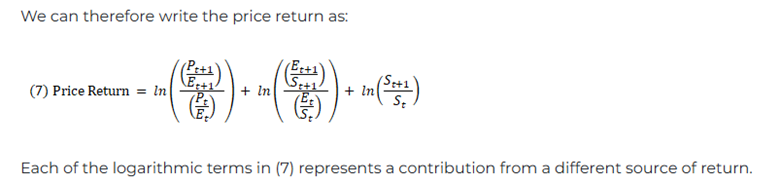
Source: OSAM paper (link above). P/E term = multiple expansion; E/S term = margin growth; S term = sales growth (earnings growth = E/S \* S)
Or perhaps more intuitively:
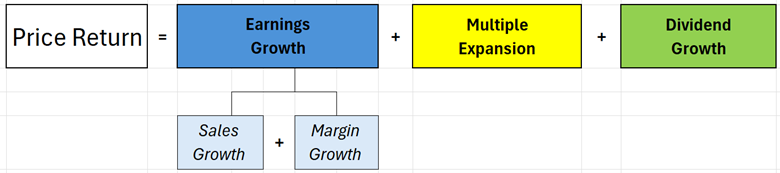
Source: Author graphic
It is important to note that price return can be broken down into different drivers, provided that the algebra works out (i.e. numerators and denominators balance properly, see the OSAM Appendix B for more details). Perhaps I will look at other variations in the future.
The table below shows a few examples of large cap US stocks that have returned more than 5X in the last 10 years, and the main return driver can vary across different stocks.
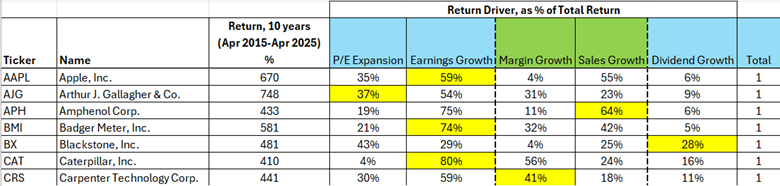
Source: Portfolio123 data, Author calculations & table. Past returns are no guarantee of future results.
In the case of AAPL, AIG, BMI and CAT, the main drivers over the last 10 years have been earnings growth. We can break earnings growth down further, and see how margin growth and sales growth have contributed – notable in APH’s case, the earnings growth was driven mostly by sales growth.
Of these select stocks, P/E expansion and dividend growth have been the minor contributors, with the exception being BX, with 43% and 28% respectively.
These are some large cap multibaggers, now let’s look at microcaps.
**Microcap Multibaggers**
With our return driver framework, we can look at some microcap multibaggers, and see how our returns drivers have contributed to their returns.
For different perspectives, we will look at both short term and long term multibaggers:
- Short term multibagger: >3X over 3 years
- Long term multibagger: >10X over 10 years
We are only looking at multibaggers that have retained their returns; any “roundtrippers” that may have 3X’d within 1 or 2 years, but then returned to their starting point are excluded. We are also looking at profitable stocks only, so we can compare starting and ending P/E ratios (as noted above, only profitable stocks can have P/E ratios)
The table below provides some stats on multibaggers, and the proportion of those starting out as microcaps.
From our sample, a higher proportion of microcaps have made “short term multibagger” status (about 33% of all stocks), however fewer long term multibaggers started out as microcaps (20-25%).
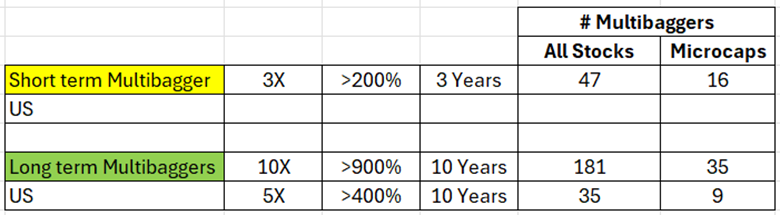
Source: Portfolio123 data, Author Table. Past returns are no guarantee of future results.
**Multiple Expansion**
Multiple Expansion is essentially a value driver – a stock bought at a P/E of 10, and then rising to a P/E of 20, is a 2X return on its own.
Multiples can vary over time (particularly for microcaps), from swinging wildly to either the positive or negative, or even staying flat for several years.
The graph below plots the median P/E ratio for all profitable microcaps (as only profitable stocks can have a P/E ratio) in our US MC-GUTS universe, over the last 10 years.
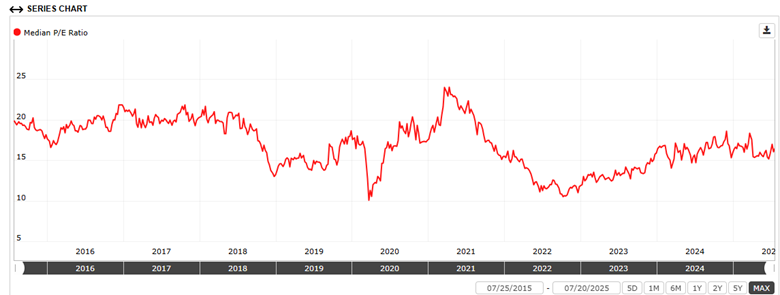
Source: Portfolio123 output, Author custom aggregate series. MC-GUTS microcap universe mkt cap<$300M, >$0.1/share, >$10k daily vol, excl. utilities, financials, OTC.
Over the last 10 years, US profitable microcaps have had a median P/E ratio of around 15\. But notable here is that any change in P/E is highly dependent on buy and sell points. For example, there was little to no multiple expansion for the group from 2015 to 2018, with the P/E ratio more or less flat at 20.
But if one bought near the bottom of COVID (P/E of 10), and sold within a year at the peak in 2021, multiples expanded nearly 250% (10 to 25). Or if taking a very long term position – the group bought in 2015 at P/E of 20, and held until today, would have seen P/E contraction from 20 to 15\. Timing these entry points, based on P/E or valuation, can be very difficult.
For comparison, here is the same median P/E graph for the S&P500 over the last 10 years:
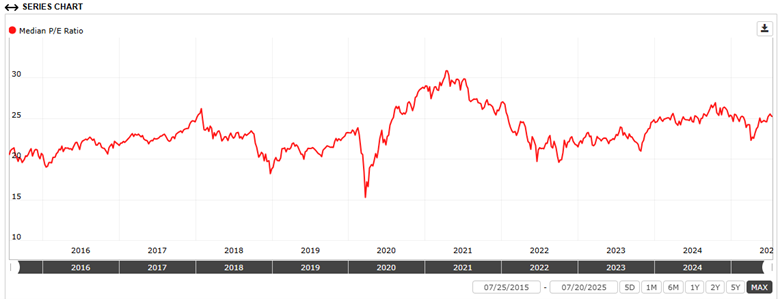
Source: Portfolio123 output, Author custom aggregate series.
While we still see some P/E extremes from the COVID bottom to the peak, the P/E has remained more stable, around 20-25\.
These graphs provide perspective of groups of stocks, but a single stock can show similar trends in P/E over time, and the buy and sell point can make a significant impact on how much (or little) multiple expansion can drive returns.
**Short Term Multibaggers**
The graphic below takes our short-term multibaggers (>3X in 3 years), and compares the broad group (top) with those starting out as microcaps (bottom).
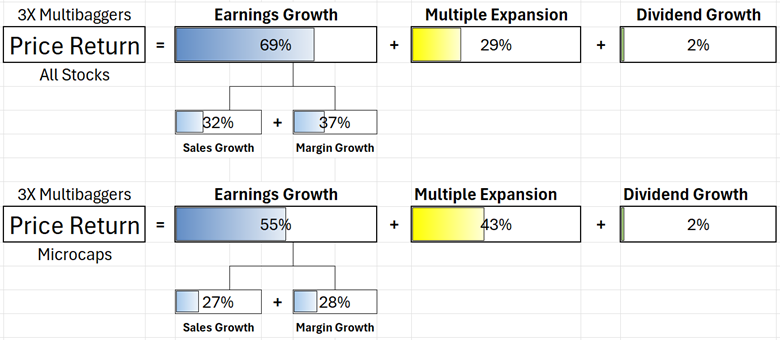
Source: Portfolio123 data, Author calculations and graphic. US stocks and microcaps, 2022-2025, Return drivers are aggregated from all stocks in the group to show overall drivers. Past returns are no guarantee of future results.
For our “all stocks” 3X multibaggers, the lion’s share of return has been driven by earnings growth (69%), split more or less evenly between sales growth and margin growth.
The microcaps of the group show similar strength from earnings growth, however the return from multiple expansion is notably higher than all stocks (43% vs 29%). When we look at our trend of P/E ratios in microcaps vs the S&P500 above, there has generally been a wider spread in the last 3 years with microcaps. Perhaps if we completed this study in the 3 years 2015-2018 when P/E was mostly flat, it would have been a different story.
**Long Term Multibaggers**
Below we have return drivers for our 10X stocks in 10 years. For both all stocks (ex. Microcaps) and our microcaps only group, earnings growth has accounted for 90%+ of the returns. Multiple expansion has been a minor contributor only, and in fact for microcaps, has even been outpaced by dividend growth (for more on dividend paying microcaps, see [here](https://community.microcapclub.com/forums/topic/5218-microcaps-that-pay-dividends-finding-the-outperformers/%29.?ref=microcapclub.com).
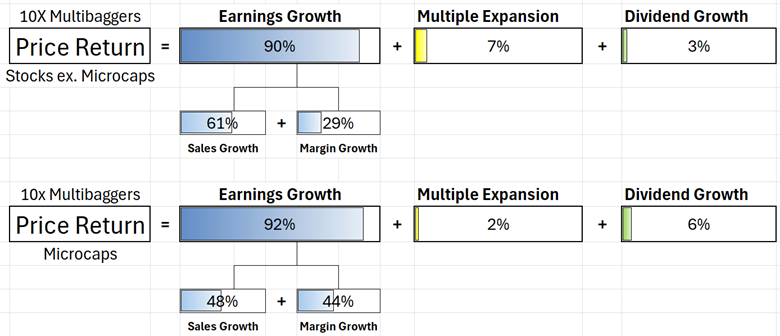
Source: Portfolio123 data, Author calculations and graphic. US stocks and microcaps, 2015-2025, Return drivers are aggregated from all stocks in the group to show overall drivers. Past returns are no guarantee of future results.
Within our All Stocks (ex microcaps), sales growth was the main driver of earnings growth vs margin growth (61% vs 29% respectively), but it has been more balanced for microcaps (48% vs 44% respectively). Either way, in my travels and speaking to investors, top line sales and growth tends to be underappreciated, with much more focus on bottom line values. But as we see, sales growth has been responsible for \~50% or more of returns in our long term multibaggers.
At least from our sample, with multiple expansion providing such a small proportion of the return, it suggests just how little the value factor has played, over the long term with high performing stocks.
**The “Voting Machine” vs The “Weighing Machine”**
One of Ben Graham’s most famous quotes describes how the market behaves in the short run vs the long run:
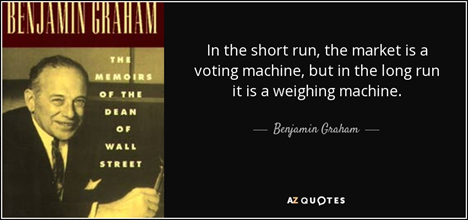
We can extend this idea to our return drivers. “Weighing” can be considered the fundamental growth or performance of a business, i.e. earnings growth. “Voting” on the other hand, could be considered the P/E ratio - what the market is willing to pay for given earnings. And as we have seen, particularly for microcaps, the “voting” can be very volatile in the short run.
If we consider our 3 year multibaggers as “short run”, and 10 year multibaggers as “long run”, then our data is not too far off from Graham’s insight. While we saw earnings growth making up much of the return in our short term stocks, multiple expansion (aka “voting”) played a meaningful role, especially for microcaps.
And for the longer term stocks, 90%+ of the returns were driven by the “weighing machine”, or our earnings growth.
As with all tests, results can vary with differing time periods and stocks, but the takeaway here is that what really drives stock returns (especially for our coveted microcap multibaggers), can also vary. Earnings growth is a key driver, but multiple expansion can have a more meaningful impact over the short run, but can also vary considerably.
#### Interact and learn with 250+ of the best microcap investors on the planet:
[Join Us](https://microcapclub.com/join-now)
***Portfolio123*** – All data and quantitative tools used for this piece, and all pieces in the Evidence Based Forum, provided by Portfolio123\. If you’d like to try Portfolio123 with an extended free trial (35 days vs the typical 20 days), check out this [link](https://www.portfolio123.com/index.jsp?apc=RYANT&ref=microcapclub.com) or use Invitation Code “RYANT” (full disclosure, affiliate link). I’m available for any questions you may have.
*Disclaimer: All content in this newsletter is for discussion, education, entertainment, and illustrative purposes only and SHOULD NOT be construed as professional financial advice, solicitation, or recommendation to buy or sell any securities, notwithstanding anything stated on this newsletter and MicroCapClub.com. There are risks associated with investing in securities. Loss of principal is possible. Past performance is not a predictor of future investment performance. Ian Cassel and MicroCapClub.com are not responsible for investment actions taken by viewers. Should you need such advice, consult a licensed financial advisor, legal advisor, or tax advisor. You agree to verify all information yourself before investing. Any past performance discussed on MicroCapClub.com is no guarantee of future results. Investing involves risk and possible loss of principal capital; please seek advice from a licensed professional. All views expressed are personal opinions as of the date of publication and are subject to change without the responsibility to update views. No guarantee is given regarding the accuracy of the information. [FULL DISCLAIMER and TERMS OF USE](https://microcapclub.com/terms/)*
### How Do You Achieve a 30% CAGR over 27 years in the Oil and Gas Industry?
URL: https://microcapclub.com/how-do-you-achieve-a-30-cagr-over-27-years-in-the-oil-and-gas-industry/
Last updated: 2025-07-23T10:12:14.000Z
In 1988, Ken Hersh co-founded [NGP Energy Capital Management](https://ngpenergy.com/?ref=microcapclub.com), one of the nation’s largest natural resources private equity firms which pioneered private capital investing in the sector. Until 2016, he served as CEO, investing over $12 billion, earning a 27-year 30% annualized rate of return.
Ken got his start working for legendary investor Richard Rainwater.
Richard Rainwater (1944 – 2015) was trained in math at the University of Texas and an MBA at Stanford. He did a short stint at Goldman Sachs before classmate Sid Bass recruited him in 1970 to steward the Bass family fortune. Rainwater studied Buffett and Graham, built sophisticated valuation models, and helped parlay roughly $50 million of Bass oil wealth into a $5 billion-dollar empire. He did it through shrewd stakes in energy, real estate, and buying a 25% stake in a struggling Walt Disney in 1984 for $478 million and bringing in Michael Eisner to turn it around.
Then in 1986, at the age of 42 with $100 million of accumulated personal wealth, Rainwater left the Bass family and went out on his own.
One of Rainwater’s earliest personal investments post-Bass was in a struggling offshore drilling company called Energy Ventures, which he later renamed Ensco. Offshore drilling was deeply out of favor at the time due to falling oil prices, but Rainwater sensed a bottom and bought in when rigs were selling for less than scrap value. That contrarian bet would eventually pay off massively, positioning him as a smart energy investor in his own right. Ensco would turn into Valaris (VAL).
Soon after in 1987, Rainwater partnered with a young lawyer-turned-operator named Rick Scott (yes the two term Florida Governor, now Senator) to launch Columbia Hospital Corporation, a two-man outfit that acquired two Texas hospitals. Rainwater put in the seed money, and the duo set out to consolidate what they saw as an inefficient, fragmented healthcare industry. The chain would later grow explosively into Columbia/HCA, the largest for-profit hospital operator in the country.
It was around this time in 1988, that Rainwater ran into Ken Hersch.
Ken’s early experience with Richard Rainwater was a masterclass in initiative, serendipity, and being ready when luck meets preparation. It began in 1988 while Hersh was a business student at Stanford. Seeking a unique summer internship outside the typical corporate recruiting channels, he reached out cold to Rainwater.
Hersh had no inside track, no connection beyond having heard Rainwater’s name. He simply called 411 information, got Rainwater’s Fort Worth office address, and sent a handwritten letter and résumé. Four days later, Hersh got a call. A voice on the other end said, “Hold for Mr. Rainwater.” He assumed it was a prank—until Rainwater got on and opened with, “Do you want the quote?” Rainwater had called Hersh’s former boss at Morgan Stanley, who had replied: “Ken Hersh is the best analyst we’ve ever had.”
That phone call led to an in-person meeting in Fort Worth. Rainwater had no formal team or structured business plan. His office looked more like a lab than a corporate suite—whiteboards filled with numbers and big ideas, and a desk with only a phone, a family photo, and a legal pad. He told Hersh he wasn’t hiring, but handed him a McKinsey report on natural gas markets and casually asked what he thought.
Hersh, having worked in Morgan Stanley’s energy group, offered a bold proposal on the spot: he would design a study on who would win or lose if McKinsey’s forecast for a natural gas price spike came true. He offered to do the work while also interning at McKinsey. Rainwater told him to put it in writing.
Hersh mailed the proposal with a request for a $5,000 stipend. The next day, a FedEx envelope arrived—no note, just a check for $5,000\. “I guess I have my first client,” Hersh thought.
That study—researching which energy companies would thrive under rising gas prices—became the foundation for what would become Natural Gas Partners (NGP). Hersh presented it to a group that included future Texas power players like Rick Scott and John Goff. Eventually, Rainwater introduced him to David Albin, a former Rainwater associate. That partnership—formed when Hersh was just 25—would last 30 years.
By November 1988, The Equitable Life Insurance Society committed $97.5 million, and NGP was born.
In the early days of Natural Gas Partners (NGP), the investment thesis was clear: commodity prices—especially natural gas—were poised to rise. Armed with a bold McKinsey forecast and \~$100 million in backing from The Equitable, Ken Hersh and his partner David Albin set out to bet on the assets that would benefit most if that prediction came true.
There was just one problem. The prediction was dead wrong.
Instead of rising, natural gas prices fell for seven straight years. NGP, still in its infancy, was staring down a brutal reality: the very foundation of their thesis had cracked. But instead of folding, Hersh and Albin did something that would redefine energy private equity—they pivoted. They looked at their early portfolio. Four deals. One flopped. One did okay. Two were thriving. Why?
The answer wasn’t the assets—it was the people.
The winners weren’t sitting on better fields. They had better managers—people who could adapt, cut costs, find new opportunities, and make something out of nothing. As Hersh put it, they could “make lemonade if the world gave them lemons.” That realization sparked a quiet revolution at NGP: stop trying to predict the commodity cycle, and start backing the best operators, regardless of market conditions.
This wasn’t the norm in the late ’80s and early ’90s. Most private equity firms insisted on deals with existing assets in place. But NGP went the other way. They stopped requiring hard assets. They looked for engineers and operators with grit, passion, and a track record of turning underperforming wells into cash-generating machines. They called them “owner-managers”—people who were willing to invest their own capital and act like true partners.
Backing people instead of assets was radical at the time. But it worked. And not just financially—it helped unlock the unconventional shale revolution. The big oil majors had written off tired fields and old shale formations. But NGP-backed entrepreneurs, armed with horizontal drilling, trial-and-error, and equity capital, brought them back to life.
That pivot—from assets to people—defined NGP’s culture. It turned a nearly doomed thesis into one of the most successful franchises in energy private equity. And it offered a timeless lesson: in a commodity business, people aren’t just part of the equation. They are the equation.
How do you achieve a 30% CAGR investment track record over 27 years in the Oil and Gas industry? Locating great assets? Finding the next big oil field?
No. You do it by finding and backing great people.
Listen to this [great interview](https://podcasts.apple.com/us/podcast/the-fort/id1410549811?i=1000710982178&ref=microcapclub.com) with Ken Hersh on the Fort Podcast.
If you enjoyed this article, you’ll also enjoy – [The Little Things that Result in the Big Things](https://microcapclub.com/the-little-things-that-result-in-the-big-things/).
#### Interact and learn with 250+ of the best microcap investors on the planet:
[Join Us](https://microcapclub.com/join-now)
MicroCapClub is an exclusive forum for experienced microcap investors focused on microcap companies (sub $500m market cap) trading on United States, Canadian, European, and Australian markets. MicroCapClub was created to be a platform for experienced microcap investors to share and discuss stock ideas. Since 2011, our members have profiled 1300+ microcap companies. Investors can join our community by applying to become a member or subscribing to gain instant view only access. MicroCapClub’s mission is to foster the highest quality microcap investor Community, produce Educational content for investors, and promote better Leadership in the microcap arena. For more information, visit and
### Tantalus Systems (GRID.TO): Helping Utilities Modernize Distribution Grids
URL: https://microcapclub.com/tantalus-systems-grid-to-helping-utilities-modernize-distribution-grids/
Last updated: 2025-07-19T13:57:59.000Z
Jeff Kowal and I have a conversation with President and CEO Peter Londa of Tantalus Systems (GRID.TO). This MicroCap Business Breakdowns discussion took place live on July 17th, 2025, on the MicroCapClub Community.
#### Interact and learn with 250+ of the best microcap investors on the planet:
[Join Us](https://microcapclub.com/join-now)
Tantalus Systems (GRID.TO) is a technology company dedicated to helping utilities modernize their distribution grids by harnessing the power of data across all their devices and systems deployed throughout the entire distribution grid – from the substation to the EV charger located behind the meter. The company offers smart grid solutions across multiple levels: intelligent connected devices, communications networks, data management, enterprise applications and analytics.
The Tantalus Grid Modernization Platform (TGMP™) delivers unprecedented levels of visibility, command and control across a utility’s operations and provides a secure, flexible and affordable path to grid modernization. TGMP is a technology architecture designed to deliver true data interoperability across new and existing devices, systems and vendors.
Tantalus has achieved a customer retention rate of 99% over multiple decades, while serving as a true partner to the utilities they support and to the communities they serve. [https://tantalus.com](https://tantalus.com/?ref=microcapclub.com)
You can listen/watch this business breakdowns on [Spotify](https://creators.spotify.com/pod/profile/microcapclub/episodes/Tantalus-Systems-GRID-TO-Helping-Utilities-Modernize-Distribution-Grids-e35ohqv?ref=microcapclub.com), [Apple Podcast](https://podcasts.apple.com/us/podcast/tantalus-systems-grid-to-helping-utilities-modernize/id1765974269?i=1000718066678&ref=microcapclub.com), and YouTube below:
*Disclaimer: All content in this newsletter is for discussion, education, entertainment, and illustrative purposes only and SHOULD NOT be construed as professional financial advice, solicitation, or recommendation to buy or sell any securities, notwithstanding anything stated on this newsletter and MicroCapClub.com. There are risks associated with investing in securities. Loss of principal is possible. Past performance is not a predictor of future investment performance. Ian Cassel and MicroCapClub.com are not responsible for investment actions taken by viewers. Should you need such advice, consult a licensed financial advisor, legal advisor, or tax advisor. You agree to verify all information yourself before investing. Any past performance discussed on MicroCapClub.com is no guarantee of future results. Investing involves risk and possible loss of principal capital; please seek advice from a licensed professional. All views expressed are personal opinions as of the date of publication and are subject to change without the responsibility to update views. No guarantee is given regarding the accuracy of the information. [FULL DISCLAIMER and TERMS OF USE](https://microcapclub.com/terms/)*
### Join Us in Toronto - 180+ Investors Already Registered!
URL: https://microcapclub.com/register-today-planet-microcap-toronto-in-partnership-with-microcapclub-2/
Last updated: 2025-07-18T11:48:04.000Z
On October 21-23, 2025 several hundred investors are congregating in Toronto.
This event is **OPEN TO ALL MICROCAP INVESTORS** and **FREE TO ATTEND**. We already have 180+ investors registered.
MicroCapClub community attendees will receive a bunch of special perks like access to the onsite MicroCapClub Clubhouse, Early Access to Company 1x1 Meeting Requests, and more.
#### Interact and learn with 250+ of the best microcap investors on the planet:
[Join Us](https://microcapclub.com/join-now)
Our goal is to have 80 high quality Canadian microcap companies. If you are a shareholder of such a company, tell your management teams they should attend.
Don't miss this event.
[**Planet MicroCap Toronto in Partnership with MicroCapClub**](https://www.meetmax.com/sched/event%5F123229/conference%5Fhome.html?bank%5Faccess=0&event%5Fid=123229&ref=microcapclub.com)
When: October 21-23, 2025
Where: Toronto Canada at the Arcadian Court and Loft
[**\[FREE TO ATTEND – REGISTER NOW\]**](https://www.meetmax.com/sched/event%5F123229/conference%5Fhome.html?bank%5Faccess=0&event%5Fid=123229&ref=microcapclub.com)
*Disclaimer: All content in this newsletter is for discussion, education, entertainment, and illustrative purposes only and SHOULD NOT be construed as professional financial advice, solicitation, or recommendation to buy or sell any securities, notwithstanding anything stated on this newsletter and MicroCapClub.com. There are risks associated with investing in securities. Loss of principal is possible. Past performance is not a predictor of future investment performance. Ian Cassel and MicroCapClub.com are not responsible for investment actions taken by viewers. Should you need such advice, consult a licensed financial advisor, legal advisor, or tax advisor. You agree to verify all information yourself before investing. Any past performance discussed on MicroCapClub.com is no guarantee of future results. Investing involves risk and possible loss of principal capital; please seek advice from a licensed professional. All views expressed are personal opinions as of the date of publication and are subject to change without the responsibility to update views. No guarantee is given regarding the accuracy of the information. [FULL DISCLAIMER and TERMS OF USE](https://microcapclub.com/terms/)*
### No Paralysis Through Analysis
URL: https://microcapclub.com/no-paralysis-through-analysis/
Last updated: 2025-07-09T10:16:16.000Z
Before The Fresh Prince of Bel-Air, Will Smith’s career seemed finished. His run with DJ Jazzy Jeff had cooled, and the IRS was seizing his possessions and his income was shrinking.

Everything changed after he appeared on The Arsenio Hall Show. I'll let Will tell the rest.
**Will Smith:**
> I meet Benny (VP of A&R at Warner Bros.) and he pitches me the idea for this show, and I'm not an actor. I'm like, "Cool." And he said, "Hey, I want you to meet Quincy Jones, Quincy Jones is producing with me."
> So I find myself at Quincy's and there's actors and artists and celebrities and politicians, everybody's at Quincy's house. It's like the Whiz without the costumes.
> Benny walks me in and introduced me to Quincy. Like, "Hey Q, what's up man? He said, "Hey man, I saw your music videos. I love what you're doing. I love what you're doing. Tell me your rap name again."
> "They call me The Fresh Prince."
> "All right, good. That's what we're going to call the show." And he handed me a screenplay for a failed Morris Day pilot.
> "So I need you to do this. I need you to go ahead and take a few minutes, take 10 minutes, study the script, and I'm going to clear all the stuff out (of) the living room, and we're going to have everybody sit down in the living room. We're going to do an audition." He had movers that could reset his furniture. I was like, "This dude is real."
> He goes outside and everybody, "Come on. Come on. Come on." I was like, "Hey, Q, hold up man. Hold up. I'm not ready to do no audition." He said, "Oh, all right. All right. What you need? Tell me what you need. Just set the meeting for a week and I could do it."
> He said, "Yeah. Brandon Tartikoff, the head of NBC is out there. I'll get him to schedule for next week. And then what's going to happen? Something going to come up and then he's going to have to reschedule."
> Oh, yeah.
> “Three weeks from now, we can do it three weeks from now,” I said. "Yeah, yeah, yeah. Three weeks from now be good. Or you can take 10 minutes right now and you can change your life forever."
> I was like, "F\*ck it then. Yes, give me 10 minutes."
> I said yes, and I let it rip and I got to the end and everybody's clapping. Quincy looks at Brandon Tartikoff, the head of NBC, "Did you like it?" And Brandon said, "Yeah, I liked it." Quincy says, "No, did you like it?" And he's like, "Yeah, I liked it." He's like (speaking to the guy next to Tartikoff), "Good, you are his lawyer. Draw me up something right now."
> Damn, Quincy ordering other people lawyers around. That's his lawyer. Quincy, leave that man alone. Quincy turned to me and he was like, "Hey, Will, you got a lawyer?" "Quincy, I'm broke. If I had a lawyer taking 5%, he'd owe me money right now." He was like, "All right." He turns to his assistant. He was like, "Get Will a lawyer."
> ….The lawyers go out in the limo and they're drawing up the first deal for the Fresh Prince of Bel Air. Quincy is pop up at the window, "No paralysis, through analysis. No paralysis, through analysis." I'm like, "How did he make Thriller like this?"
> We got the lawyers to draw up something. Ken Hertz looked it over for me, Brandon Tartikoff, and we took the picture and we signed the basic deal for the Fresh Prince. Three months later we were shooting the pilot. And that's the story of how I became the prince of Bel-Air.
Some investment opportunities are thrown our way like *The Fresh Prince of Bel-Air* audition was sprung on Will Smith. They catch you by surprise while the clock is ticking. Facts are thin. You must swing or watch the pitch sail past.
Other investment opportunities drift across the plate in slow motion: You have time to study competitors, talk to management, check every channel, chart every number, and decide whether the pitch is worth your hard-earned cash.
As investors we never know how fast the next fat pitch will come across the plate. All we can do is prepare and be ready. You must continue to develop the skill of active patience. [Active Patience](https://microcapclub.com/active-patience/) means knowing what you are looking for and doing nothing until you find it.
#### Interact and learn with 250+ of the best microcap investors on the planet:
[Join Us](https://microcapclub.com/join-now)
MicroCapClub is an exclusive forum for experienced microcap investors focused on microcap companies (sub $500m market cap) trading on United States, Canadian, European, and Australian markets. MicroCapClub was created to be a platform for experienced microcap investors to share and discuss stock ideas. Since 2011, our members have profiled 1300+ microcap companies. Investors can join our community by applying to become a member or subscribing to gain instant view only access. MicroCapClub’s mission is to foster the highest quality microcap investor Community, produce Educational content for investors, and promote better Leadership in the microcap arena. For more information, visit and
### Choose Your Own Way
URL: https://microcapclub.com/choose-your-own-way/
Last updated: 2026-01-27T12:36:44.000Z
Prince is considered one of the greatest musicians to ever live, with a discography that includes 7 Grammys, 5 number one albums, and decades of hits.
Prince was 18 years old when he made his first album, [For You](https://en.wikipedia.org/wiki/For%5FYou%5F%28Prince%5Falbum%29?ref=microcapclub.com). He turned down several major studios before signing a deal with Warner Brothers, after Prince’s manager, Owen Husney, convinced the company to sign Prince to a three album deal, the largest record contract ever given to such a young artist.
According to Prince, Husney also played an important role in the production of For You. In an interview with *Musician* magazine in 1983, Prince shared Husney’s philosophy:
> *“Owen believed in me, he really did, he shared. “The main thing he said to me was that *no one should produce a record of mine—I should do it.”**
And produce is what he did. The album credits on For You say it all:
> ***“Produced, arranged, composed, and performed by Prince.”***
Despite the conciseness of those credits, the actual process of making the album was anything but easy. The studio attempted to take shortcuts, but were met with the defiance of one of the most unique artists of his generation, who wanted no shortcuts. It took seven painstaking months to finish For You, What transpired was an exercise in trusting one’s own judgment, and demonstrating a singularity of purpose.
First, Prince was given a budget of $180,000 to produce three studio albums. However, given his desire for his first album to be absolutely perfect, he spent nearly the entire budget ($170,000) on the making of For You.
As a result, with money on the line, and as large record companies like Warner Brothers often do, they stepped in and attempted to commandeer the process by asking veteran artists and producers to guide Prince through the making of the album.
Warner Brothers wanted [Maurice White](https://en.wikipedia.org/wiki/Maurice%5FWhite?ref=microcapclub.com) of Earth, Wind, and Fire fame to produce the album, Prince said no. Warner Brothers then brought in Grammy award winning producer [Tommy Vicari](https://en.wikipedia.org/wiki/Tommy%5FVicari?ref=microcapclub.com) to produce and engineer the album, and deliver a hit as he had done in the past. Vicari suggested they record the album in Los Angeles, because that’s where everyone was making records. Prince said no. The album ends up being recorded at [The Record Plant](https://en.wikipedia.org/wiki/Record%5FPlant?ref=microcapclub.com) in the Bay Area.
At the studio, Vicari suggested they bring in other musicians. Prince said no. Instead, Prince sang every vocal, played every instrument, and recorded every note on the entire album. Vicari continued to make suggestions about what to play, and Prince again said no. When they start mixing the album, both Vicari and the studio told Prince not to play any additional instruments over the recorded songs. Prince said no. After overdubbing a ton of layered guitar, the album ends up with [the signature Prince sound](https://beltmag.com/minnesota-sound-prince-music/?ref=microcapclub.com) that he would become known for throughout his entire career.
Once the album is finished, the studio hires a photographer to do the cover art for the album. They make a bunch of suggestions, and Prince said….you guessed it…no. He instead hired his own photographer, and together, they made this iconic album cover.

*For You* achieved a sound only Prince could create, as he played a whopping 27 different instruments and perfected the execution of each one. Because he recorded every aspect of the album himself, Prince tapped into a new approach and sound that would lay the groundwork for the so-called “Minneapolis Sound” — a style of music that Prince would catapult to global fame in the early 1980s.
Prince was the ultimate auteur, who demonstrated a strong singularity of purpose throughout his life and career. Trusting his judgement is what shaped his work.
---
The life of a stock picker should be long. There will be iterations of your process, strategy and framework. Early on, you may find yourself placating to others, or making decisions based on borrowed conviction. Over time, you eventually realize, like Prince, that the only person worth impressing is your future self, years from now, looking back at the decisions you made and evaluating whether you had the courage to follow your instincts, stay committed to your process, and stay the course when it mattered most.
Trusting your own judgment doesn’t mean you’re always right. It means you’re willing to be wrong *on your own terms*. It means you’re willing to carry the weight of your decisions and stand behind the work. It means that if you fail, you fail because of *you*, not because you deferred to someone else’s framework or preference.
That’s the game. Not beating the benchmark. Not outperforming in this or that quarter. The real game is finding something *you* believe in—and then refusing to let go. It’s what separates the hobbyist from the professional. The technician from the artist. The analyst from the investor.
I’ve repeatedly asked myself a few useful questions to get to the heart of how strongly I trust my own judgement.
- Do you trust yourself enough to hold the thing you like, even when no one else does?
- Do you trust yourself enough to let your biggest winner keep compounding, even when every model and talking head says it’s overvalued?
- Do you trust yourself enough to build a track record that reflects *you*, not the investment equivalent of a corporate committee?
Just as Prince ignored the "correct" way to make an album, there is **no single "correct way" to invest.** Investment decisions, at their core, are *creative pursuits* that rely on trained intuition and experienced judgement. They are an expression of how you, the investor, view the world and what you believe will create value. The ways to execute a creative pursuit are as follows: ***the correct way, and the way you like***.
Contrary to popular belief, most musical artists don’t make music for their fans. They make music they like, and then decide to share it with the world. Whether other people like it is irrelevant. It’s great if they do, but it’s not why the music was made. The artist is expressing something, a belief, a sound, a vision, and executing on it. It doesn’t matter whether anyone else likes it.
The delineation between the correct way to do something and whether you like it or not has roots in investing. There is no ‘correct way’ to invest. I’m often amazed at the ways I see some of my peers sustainably make money.
Yet, every step of the way, throughout your investing life, there seems to be this constant tension from others regarding what investors *should* do. The types of companies, liquidity, securities, position sizing, valuation, simple versus complex, short term versus long term, and more.
I remember pitching my first idea to a more experienced PM many years ago, and when the idea was met with questions, I folded like a chair. I was trying to get him to *like* my idea. That was the wrong approach. I already liked it, and was just sharing it with him due to its attractiveness. Whether he - or anyone - agreed with me was irrelevant. In fact, unless you are pitching a low quality business that is likely to destroy capital, most investment discussions or debates come down to preference and time horizon.
The best place to arrive as an investor is the moment when you stop defending your ideas altogether because you’ve done the work and have confidence in yourself and your thesis. This is what trusting your judgement looks like.
The Prince story is one of my favorite stories about creative pursuits. There is no map to follow. There is no right answer. With Greystone, I’ve adopted the one-man shop approach. All investment decisions run through me as the lead analyst and PM. It works for me, as I have a vision that I am trying to execute on. My view on investing is that investment decisions are to be made independently, not by committee. Group discussions, lengthy meetings, bureaucracy and long decision loops all detract from solid, long-term investment decisions.
That doesn’t mean I don’t collaborate with people. I’m constantly exchanging ideas, pitching interesting stocks, red-teaming a thesis, and looking for disconfirming evidence from other smart people. I’m not suggesting operating in a vacuum. But how could Tommy Vicari or Maurice White or Warner Brothers possibly hear what Prince heard? How could they bring to life his way of seeing the world?
When I meet with potential investors, I'm very careful to explain that Greystone is the vehicle I use to execute my vision. They don't have to like it or agree with it, and many don't, but it's my vision. Building an investment business and an investment portfolio is about taking pieces of yourself - your background, experience, interests - and bringing them to life. Again, there is no right answer. All investors are tasked with developing a connection between their ideas / portfolio and the way they see the world. That connection has to last through everything, and there are ways to develop and improve it.
- **Make Mistakes and Refine:** The path to good judgment is paved with lessons learned from both successes and failures. Embrace your mistakes as opportunities for refinement.
- **Develop a Clear Vision and Purpose:** Understand *why* you invest and *what* kind of investor you aspire to be. This clarity provides a compass when navigating uncertain markets.
- **Gain Experience:** There's no substitute for hands-on experience. Putting risk on the table, making buy/sell decisions, and living with the consequences is the only way to truly learn. Being an analyst, while valuable, doesn't inherently prepare you to be an effective portfolio manager.
- **Do the Upfront Work:** Conviction isn't born out of thin air. It's the result of diligent research, deep understanding, and a well-thought-out thesis. The more work you put in at the inception of an idea, the stronger your conviction will be.
Maybe there is a universe where Prince’s first album, done his way, flops. I bet he could have lived with that. Success someone else’s way isn’t rewarding. Failing doing something someone else told you to do is even worse. Prince went to great lengths to protect his vision, likely before he earned it. He’s not the only one. This is the hard way to do it, but the best way. The thing you make, build, construct, whatever it is, needs to be something you like. What you like comes from your judgement. Exercise it often, and learn to trust it.
#### Interact and learn with 250+ of the best microcap investors on the planet:
[Join Us](https://microcapclub.com/join-now)
MicroCapClub is an exclusive forum for experienced microcap investors focused on microcap companies (sub $500m market cap) trading on United States, Canadian, European, and Australian markets. MicroCapClub was created to be a platform for experienced microcap investors to share and discuss stock ideas. Since 2011, our members have profiled 1300+ microcap companies. Investors can join our community by applying to become a member or subscribing to gain instant view only access. MicroCapClub’s mission is to foster the highest quality microcap investor Community, produce Educational content for investors, and promote better Leadership in the microcap arena. For more information, visit and
### MicroCapGUTS Index Update: Q2 2025
URL: https://microcapclub.com/microcapguts-index-update-q2-2025/
Last updated: 2025-07-01T16:09:03.000Z
The MicroCapGUTS Index (MC-GUTS) is intended to find quality microcap stocks across the US, Canada and Europe that exhibit the evidence-based GUTS factors, and track their performance as a group over time.
You can learn more about the index [here](https://microcapclub.com/the-launch-of-the-microcapguts-index/).
We also share the top five ranked holdings per region on our community [here.](https://community.microcapclub.com/forums/topic/5079-the-microcapguts-index-mc-guts/?ref=microcapclub.com#findComment-99777)

Source: Portfolio123 data, Author Table
MC-GUTS was up +16.5% YTD, outperforming the iShares Microcap ETF -1.6%, S&P 500 +5.4%, and Nasdaq +7.9% respectively.
European-MC-GUTS constituents have been leading the charge +18.6% YTD.
To get an idea of overall simulated performance, below is the updated performance summary from May 2015 to June 30 2025\.

#### Interact and learn with 250+ of the best microcap investors on the planet:
[Join Us](https://microcapclub.com/join-now)
*Disclaimer: All content in this newsletter is for discussion, education, entertainment, and illustrative purposes only and SHOULD NOT be construed as professional financial advice, solicitation, or recommendation to buy or sell any securities, notwithstanding anything stated on this newsletter and MicroCapClub.com. There are risks associated with investing in securities. Loss of principal is possible. Past performance is not a predictor of future investment performance. Ian Cassel and MicroCapClub.com are not responsible for investment actions taken by viewers. Should you need such advice, consult a licensed financial advisor, legal advisor, or tax advisor. You agree to verify all information yourself before investing. Any past performance discussed on MicroCapClub.com is no guarantee of future results. Investing involves risk and possible loss of principal capital; please seek advice from a licensed professional. All views expressed are personal opinions as of the date of publication and are subject to change without the responsibility to update views. No guarantee is given regarding the accuracy of the information. [FULL DISCLAIMER and TERMS OF USE](https://microcapclub.com/terms/)*
### What is the difference between Good, Great, and G.O.A.T stock pickers?
URL: https://microcapclub.com/what-is-the-difference-between-good-great-and-g-o-a-t-stock-pickers/
Last updated: 2025-06-27T10:03:05.000Z
I was recently interviewed by Kyle Grieve on The Investor's Podcast. We talk about the skills of stock picking and how I define good, great, and G.O.A.T (Greatest Of All Time) stock pickers.
- How should stock pickers be judged?
- What is the correct benchmark?
- How do I define Good, Great and G.O.A.T?
- What are each category doing to separate themselves from the pack and what can we learn from them?
Hope you enjoy it.
You can listen on [\[Apple Podcast\]](https://podcasts.apple.com/us/podcast/tip732-the-mindset-and-skills-that-build/id928933489?i=1000714729703&ref=microcapclub.com) [\[Spotify\]](https://open.spotify.com/episode/6cQwSVzczkPmF8fKPti906?si=1hIGbqovQbWUs2f3z9D74g&ref=microcapclub.com) and YouTube below:
#### Interact and learn with 250+ of the best microcap investors on the planet:
[Join Us](https://microcapclub.com/join-now)
MicroCapClub is an exclusive forum for experienced microcap investors focused on microcap companies (sub $500m market cap) trading on United States, Canadian, European, and Australian markets. MicroCapClub was created to be a platform for experienced microcap investors to share and discuss stock ideas. Since 2011, our members have profiled 1300+ microcap companies. Investors can join our community by applying to become a member or subscribing to gain instant view only access. MicroCapClub’s mission is to foster the highest quality microcap investor Community, produce Educational content for investors, and promote better Leadership in the microcap arena. For more information, visit and
### Lucky Breaks
URL: https://microcapclub.com/lucky-breaks/
Last updated: 2025-06-26T15:18:49.000Z
In a [previous article](https://microcapclub.com/small-stocks-are-roller-coasters/), I wrote about the importance of discovery. You either buy before discovery or after the discovery bubble bursts. The first discovery move in a small stock is normally the result of a breakout quarter or event. Often, it’s a lucky break which creates short-term excitement (days to quarters) but longer-term questions.
- A large new contract catalyzes growth for the next 12-months, but can management get another big contract?
- An FDA ruling goes in a company’s favor, but how will they fund the next trial or commercial launch?
- The 80th drill hole hits 30 meters of 45 g/ton gold but can this management team turn a drill hole into a mine?
- The loosening or tightening of a law provides a tailwind, but can management capitalize before new competition follows?
One of the hardest parts of microcap investing is figuring out if management is skilled enough to take advantage of a lucky break.
I often think about this story in the Bible.
The Parable of the Talents (Matthew 25:14–30) is a story Jesus tells to illustrate the importance of faithful stewardship and using what God gives us wisely. In the story, a master goes on a journey and entrusts his property to three servants. He gives five talents (a large sum of money) to the first servant. He gives two talents to the second servant, and one talent to the third – each according to their ability.
While the master is away the servant with five talents trades and earns five more. The servant with two talents earns two more. The servant with one talent hides it in the ground and earns nothing.
When the master returns, he praises the first two servants for being faithful and trustworthy rewarding them with greater responsibility and inviting them to “share in your master’s happiness.” But he rebukes the third servant for being lazy and fearful.
There are many lessons in this short story but one of them is God expects us to grow what he entrusts to us - our gifts, abilities, and even luck.
In 1980, Microsoft (MSFT) was an $8 million revenue company with 40 employees. IBM was largest public company in the world and controlled 70% of the global computer market which was primarily mainframe computers.
At the time, IBM was developing its first personal computer, the IBM PC, and needed an operating system. IBM initially approached Digital Research, creators of the CP/M operating system, but negotiations fell through. IBM then turned to a relatively small software company—Microsoft—primarily known for its programming languages.
Microsoft didn’t have an operating system ready, but it seized the opportunity. Bill Gates and his team quickly acquired an existing OS called QDOS (Quick and Dirty Operating System) from Seattle Computer Products for a modest fee—reportedly around $50,000\. Microsoft then modified it and rebranded it as MS-DOS (Microsoft Disk Operating System). Crucially, in the deal with IBM, Microsoft negotiated to retain the licensing rights to MS-DOS, allowing it to license the software to other hardware manufacturers.
By retaining the rights to license MS-DOS to other manufacturers, Microsoft not only supplied the software for the IBM PC but also positioned itself as the operating system provider for the entire PC industry. MSFT didn’t coerce or manipulate IBM into the deal. IBM wanted this deal, and that was the lucky part.
In 1986, five years later, Microsoft had its IPO. Goldman Sachs took them public and raised $61 million at a $777 million valuation. The company was extremely profitable even in these early years.
In 1986, Microsoft produced $197 million in revenues (40% growth YoY) and $32 million in net income (60% growth YoY). They had 1,100 employees.
The agreement with IBM enabled Microsoft to establish dominance in the software market and laid the groundwork for decades of growth that was pivotal in creating modern Microsoft and a $3 trillion company.
In a [recent interview](https://youtu.be/CYC49%5Faeop0?si=TkdVvm9dUM%5Fr3xiN&ref=microcapclub.com), former Microsoft CEO Steve Balmer, said, “Luck is important in the creation of all great companies.”
In 2024, Ryan Pape, CEO of XPEL spoke at our annual Summit. You can watch the interview [here](https://youtu.be/kzFtQLCXKRc?si=GMKm8p3FyoPtjD0m&t=1476&ref=microcapclub.com). He stepped into the CEO seat when the stock was less than $0.10 per share. Today it’s $35.00 per share. In the interview, Ryan Pape was asked how much luck played a role in XPEL’s success.
> “I think luck is a huge part of all success. It’s at least half of the reason we are here today. You have the decisions you make which are both good and bad and then those are compounded by what happens to you. Part of our success was we were the right company with the right brand with the right product at the right time. It’s at least 50% luck.”
Luck plays a role in every great business and every great stock. Luck initially gives a company an early advantage - a head start (time) and/or windfall (resources) they weren’t expecting.
Skilled management can take the limited resources and luck they’ve been given and multiply it. Mediocre management can’t.
#### Interact and learn with 250+ of the best microcap investors on the planet:
[Join Us](https://microcapclub.com/join-now)
MicroCapClub is an exclusive forum for experienced microcap investors focused on microcap companies (sub $500m market cap) trading on United States, Canadian, European, and Australian markets. MicroCapClub was created to be a platform for experienced microcap investors to share and discuss stock ideas. Since 2011, our members have profiled 1300+ microcap companies. Investors can join our community by applying to become a member or subscribing to gain instant view only access. MicroCapClub’s mission is to foster the highest quality microcap investor Community, produce Educational content for investors, and promote better Leadership in the microcap arena. For more information, visit and
### A Conversation with Christian Schmidt
URL: https://microcapclub.com/a-conversation-with-christian-schmidt/
Last updated: 2025-06-25T10:07:17.000Z
Christian Schmidt is a full-time private investor based in Germany. His focus is on overlooked and underfollowed micro- and small-cap stocks, primarily in the U.S., Canada, U.K., and Australia. Christian’s strategy has produced a 32.8% CAGR since 2017\. Christian is also the co-founder of [Tracktacle.com](https://app.tracktacle.com/?ref=microcapclub.com), a real-time news, filing, and document search platform for the United States and Canadian market.
You can listen/watch this business breakdowns on [Spotify](https://creators.spotify.com/pod/show/microcapclub/episodes/A-Conversation-with-Christian-Schmidt-e34n37h?ref=microcapclub.com), [Apple Podcast](https://podcasts.apple.com/us/podcast/a-conversation-with-christian-schmidt/id1765974269?i=1000714484653&ref=microcapclub.com), and YouTube below:
#### Interact and learn with 250+ of the best microcap investors on the planet:
[Join Us](https://microcapclub.com/join-now)
*Disclaimer: All content in this newsletter is for discussion, education, entertainment, and illustrative purposes only and SHOULD NOT be construed as professional financial advice, solicitation, or recommendation to buy or sell any securities, notwithstanding anything stated on this newsletter and MicroCapClub.com. There are risks associated with investing in securities. Loss of principal is possible. Past performance is not a predictor of future investment performance. Ian Cassel and MicroCapClub.com are not responsible for investment actions taken by viewers. Should you need such advice, consult a licensed financial advisor, legal advisor, or tax advisor. You agree to verify all information yourself before investing. Any past performance discussed on MicroCapClub.com is no guarantee of future results. Investing involves risk and possible loss of principal capital; please seek advice from a licensed professional. All views expressed are personal opinions as of the date of publication and are subject to change without the responsibility to update views. No guarantee is given regarding the accuracy of the information. [FULL DISCLAIMER and TERMS OF USE](https://microcapclub.com/terms/)*
### New MicroCapClub Screening Tool
URL: https://microcapclub.com/new-microcapclub-screening-tool/
Last updated: 2025-06-23T10:51:17.000Z
Since 2011, our members have profiled 1,300 global microcap stocks on MicroCapClub. In the process, we’ve uncovered 250+ multi-bagger stocks and 200+ have been acquired. Our community is filled with discussion, valuable insights, due diligence, and analysis on these companies.
The next multi-bagger is likely on our forum, hidden in plain sight. The challenge has been sifting through the library of companies. It is like walking into a massive library for the first time. Where do you start? Which book do you pick up? What is worth your limited time? Several months ago we set out to solve this issue.
We’ve developed a screener-like tool that will make navigating profiled companies much easier. Our community can access the tool [here](https://community.microcapclub.com/forums/topic/5202-microcapclub-screening-tool/?ref=microcapclub.com).
Think of it like a directory. You can now view, sort, screen all 1300 profiled companies by country, sector, with a full set of real-time fundamentals and valuation metrics relevant to the industry. We provide a popularity gauge and direct link to the discussion on the company. Some of our best performing companies were the least popular.
Here is an overview of the tool:
All great companies started as small companies. Let's find them.
#### Interact and learn with 250+ of the best microcap investors on the planet:
[Join Us](https://microcapclub.com/join-now)
MicroCapClub is an exclusive forum for experienced microcap investors focused on microcap companies (sub $500m market cap) trading on United States, Canadian, European, and Australian markets. MicroCapClub was created to be a platform for experienced microcap investors to share and discuss stock ideas. Since 2011, our members have profiled 1300+ microcap companies. Investors can join our community by applying to become a member or subscribing to gain instant view only access. MicroCapClub’s mission is to foster the highest quality microcap investor Community, produce Educational content for investors, and promote better Leadership in the microcap arena. For more information, visit and
### 5 Ways to Look at Return on Invested Capital (ROIC) for Microcaps
URL: https://microcapclub.com/5-ways-to-look-at-return-on-invested-capital-roic-for-microcaps/
Last updated: 2025-06-20T12:09:47.000Z
Return on Invested Capital (ROIC) is one of more popular investing factors. Michael Mauboussin and others have written extensively about this metric, so I won’t repeat it here, but rather we’ll look at ROIC as it applies to microcaps, and some other unique quantitative factors that potentially complement this factor.
The basic theory is if ROIC is in excess of a firm’s cost of capital, then value is being created. If the cost of capital exceeds the ROIC, then value is being destroyed.
Cost of capital can be a hotly debated topic, as it is so subjective, particularly cost of equity.
In our approach, we’re not so interested in cost of capital, but we’ll look at ROIC from four angles:
1. High ROIC
2. Two capital allocation factors potentially contributing to future high ROIC
3. Return on Incremental Invested Capital (ROIIC)
4. ROIC inflections
There are many variations of ROIC, but its basic equation is:
- Net Operating Profit After Taxes / Invested Capital
or simply NOPAT / IC
With different variations for both the numerator and denominator I typically resort to the Mauboussin versions. Intangibles have generally been accepted as another source of “capital” in recent years, however this can be difficult to quantify. There are quantitative factors that can be used to help approximate these values, but they are still quite broad. I use an approach similar to the one covered in [this paper](https://www.sciencedirect.com/science/article/abs/pii/S0304405X16301969?ref=microcapclub.com).
**ROIC & Microcaps**
Only \~24% of our [MC-GUTS](https://microcapclub.com/the-launch-of-the-microcapguts-index/) US microcap universe is NOPAT positive, compared to 93% of the S&P500\.

Source: Portfolio123 data, Author Table
Canada has roughly the same proportion of NOPAT/ROIC positive stocks, but much higher in Europe with more than half.
**High ROIC**
Do high ROIC microcaps outperform low ROIC microcaps?
Many critics of ROIC (and other factors) argue that the factor is backward looking, and doesn’t tell you anything about the future, and therefore shouldn’t provide any outperformance.
What does the data say?
If we simply rank all microcaps by trailing ROIC (higher, the better), the top ranked 10% of stocks (right decile) have returned 11.3% annualized (equal weight, quarterly rebalance, last 10 years), outperforming:
- both the IWC \[“Bench” dashed line\] and
- all MC-GUTS universe \[“Univ” dashed line\]

Source: Portfolio123, Author Ranking system. Past performance is not an indicator of future results.
The rank chart also features a slowly descending performance of deciles (or monotonic), which is what we want to see.
See here for another post on rank charts on the MicroCapClub Community.
Here is the performance if ranking on high ROIC, including intangibles, for the same US Microcaps universe:

Source: Portfolio123, Author Ranking system. Past performance is not an indicator of future results
Nice monotonic lineup, but here the top ranked ROIC firms (including intangibles) has underperformed (3.1% annualized) the 2nd highest ranking decile.
Either way, the data shows that for microcaps, high ROIC firms have outperformed low ROIC firms, with some variation depending on which version of IC is used.
**Capital Allocation Factors - Investment and Capital Management Factors**
But to those critics’ point, we can look at factors that may contribute to higher ROIC in the future, and therefore may not already be incorporated into the share price.
As “invested capital” is a key part of ROIC in being the denominator, we can look at how a microcap stacks up in its capital allocation decisions, and if it has added to performance.
We’ll look at a factor group I call the **“Investment”** factor, that ranks stocks on the following sub-factors:
- Higher CAPEX investment (growth CAPEX only)
- Higher R&D investment (excluding “maintenance” R&D)
- Other intangible investment – branding, etc (using 30% of SG&A as a proxy)
All as a proportion of the firms’ invested capital (including intangibles).
And a **“capital management”** factor:
- The higher the change in debt reduction, the better (i.e. deleveraging)
- The higher the reduction in equity, the better (i.e. buybacks)
Also scaled by IC (w/ intangibles).
Let’s assume each of these factors equally, and build a ranking system, i.e.
- 33% ROIC (ttm)
- 33% investment factor
- 33% capital management factor
All to be ranked “higher the better”. And we will rank our US Microcap universe:

Source: Portfolio123, Author Ranking system. Past performance is not an indicator of future results.
Adding the investment and capital management factors have improved performance with just ROIC alone (particularly when including intangibles).
These are a few ways to look at ROIC as it applies to microcaps. In the full post at MicroCapClub [here,](https://community.microcapclub.com/forums/topic/5144-5-ways-to-look-at-roic-return-on-invested-capital-for-microcaps/?ref=microcapclub.com) we also look at how ROIC can be changing thru **Return on Incremental Invested Capital** (ROIIC), and potential **ROIC inflection points**.
#### Interact and learn with 250+ of the best microcap investors on the planet:
[Join Us](https://microcapclub.com/join-now)
*Ryan Telford is Head of Evidence Based Research at MicroCapClub. He uses quantitative strategies to invest in Microcaps, using his GUTS methodology, and shares his insights with the MCC community and on X. Reach out to him at MicroCapClub, or on Twitter/X,* [*@rtelford\_invest*](https://x.com/RTelford%5Finvest?ref=microcapclub.com)*.*
*Disclaimer: All content in this newsletter is for discussion, education, entertainment, and illustrative purposes only and SHOULD NOT be construed as professional financial advice, solicitation, or recommendation to buy or sell any securities, notwithstanding anything stated on this newsletter and MicroCapClub.com. There are risks associated with investing in securities. Loss of principal is possible. Past performance is not a predictor of future investment performance. Ian Cassel and MicroCapClub.com are not responsible for investment actions taken by viewers. Should you need such advice, consult a licensed financial advisor, legal advisor, or tax advisor. You agree to verify all information yourself before investing. Any past performance discussed on MicroCapClub.com is no guarantee of future results. Investing involves risk and possible loss of principal capital; please seek advice from a licensed professional. All views expressed are personal opinions as of the date of publication and are subject to change without the responsibility to update views. No guarantee is given regarding the accuracy of the information. [FULL DISCLAIMER and TERMS OF USE](https://microcapclub.com/terms/)*
MicroCapClub is an exclusive forum for experienced microcap investors focused on microcap companies (sub $500m market cap) trading on United States, Canadian, European, and Australian markets. MicroCapClub was created to be a platform for experienced microcap investors to share and discuss stock ideas. Since 2011, our members have profiled 1200+ microcap companies. Investors can join our community by applying to become a member or subscribing to gain instant view only access. MicroCapClub’s mission is to foster the highest quality microcap investor Community, produce Educational content for investors, and promote better Leadership in the microcap arena. For more information, visit and
### BranchOut Food (BOF): An Emerging Player in the Natural Foods Space
URL: https://microcapclub.com/branchout-food-bof-an-emerging-player-in-the-natural-foods-space/
Last updated: 2025-06-18T18:09:15.000Z
Erik Voss and I have a conversation with Founder and CEO Eric Healy and CFO John Dalfonsi of BranchOut Food (BOF). This MicroCap Business Breakdowns discussion took place live on June 18th, 2025, on the MicroCapClub Community. You can listen and participate live by joining our community.
#### Interact and learn with 250+ of the best microcap investors on the planet:
[Join Us](https://microcapclub.com/join-now)
BranchOut Food Inc. (Nasdaq: BOF) is an emerging player in the natural foods space that is reaching a key inflection point in its growth story. Using an innovative food dehydration technology, BranchOut is aiming to disrupt the snack food industry with its growing portfolio of healthy fruit and vegetable based snacks and ingredients.
BranchOut is starting to show signs of explosive growth potential, similar to the trajectories of recent natural food high-flyers like Sow Good Inc. (SOWG) and Celsius Holdings (CELH) in their early stages.
In addition, a major catalyst is about to kick growth into an even higher gear - the imminent opening of BranchOut's new production facility in Peru. Equipped with the company's proprietary GentleDry dehydration technology, this facility will expand production capacity to $40 million annually. [https://branchoutfood.com](https://www.youtube.com/redirect?event=video%5Fdescription&redir%5Ftoken=QUFFLUhqbWpMMUJ6Z2RIaEplVnhQSWdFMDNTalVURzZIQXxBQ3Jtc0ttTGtfeW1xSXJrRmRidXdWdnZ5czlCVEFGLUFnenc5S2tFM1o0VXYwclhYU0FnMEppYlFrYmpoX05iTkphNVk0bzBRdWV6VTh4ZXdzdmtmdUtnYXF0TGFlUS1icXcyTDFyckFFQ0psZ0lUVE5hR3VwWQ&q=https%3A%2F%2Fbranchoutfood.com%2F&v=rqCQGSS-eSg&ref=microcapclub.com)
You can listen/watch this business breakdowns on [Spotify](https://creators.spotify.com/pod/show/microcapclub/episodes/BranchOut-Food-BOF-An-Emerging-Player-in-the-Natural-Foods-Space-e34e4qk?ref=microcapclub.com), [Apple Podcast](https://podcasts.apple.com/us/podcast/branchout-food-bof-an-emerging-player-in-the/id1765974269?i=1000713465707&ref=microcapclub.com), and YouTube below:
*Disclaimer: All content in this newsletter is for discussion, education, entertainment, and illustrative purposes only and SHOULD NOT be construed as professional financial advice, solicitation, or recommendation to buy or sell any securities, notwithstanding anything stated on this newsletter and MicroCapClub.com. There are risks associated with investing in securities. Loss of principal is possible. Past performance is not a predictor of future investment performance. Ian Cassel and MicroCapClub.com are not responsible for investment actions taken by viewers. Should you need such advice, consult a licensed financial advisor, legal advisor, or tax advisor. You agree to verify all information yourself before investing. Any past performance discussed on MicroCapClub.com is no guarantee of future results. Investing involves risk and possible loss of principal capital; please seek advice from a licensed professional. All views expressed are personal opinions as of the date of publication and are subject to change without the responsibility to update views. No guarantee is given regarding the accuracy of the information. [FULL DISCLAIMER and TERMS OF USE](https://microcapclub.com/terms/)*
### Small Stocks are Roller Coasters
URL: https://microcapclub.com/small-stocks-are-roller-coasters/
Last updated: 2025-06-17T10:49:32.000Z
The roller coaster has a long and surprising history that stretches back several centuries. Its origins trace to 17th-century Russia, where “Russian Mountains” were popular winter attractions. These early rides were massive wooden slides covered in ice, reaching heights of 70 feet and speeds up to 50 miles per hour. Riders would climb stairs and descend on sleds made of wood or ice. Catherine the Great was reportedly a fan, and even had one built on her estate.
In the early 1800s, the concept spread to France, where it evolved into wheeled carts on tracks. One of the first was the "Les Montagnes Russes à Belleville" in Paris. These rides used guided rails to keep the carts on track—setting the stage for modern roller coaster design.
The roller coaster took a major leap forward in the United States. In 1884, LaMarcus Thompson opened the first successful gravity-powered coaster in Coney Island, New York. Called the “Switchback Railway,” it ran on a wooden track and carried riders at 6 miles per hour. It was a major success and helped spark a golden age of coaster building across America.
I was recently at Hershey Park, and I went on the [Comet](https://www.hersheypark.com/things-to-do/rides-and-attractions/comet?ref=microcapclub.com) which is the oldest roller coaster in the park. It was built in 1946 and made of wood. It’s a rather tame roller coaster by today’s standards.
The Comet starts in a slow ascend up the 96-foot main camelback hill. Anticipation builds as the rollercoaster slowly climbs the hill. At the top, the rollercoaster feels like it almost stops. Then momentum shifts forward, and you plunge into the descent hitting 55 mph at the bottom and that momentum takes you through the remainder of the 3,300-foot ride.
Small stocks aren’t smooth train rides through the countryside. The path isn’t carved through the landscape and tunneled through mountains.
Small stocks are old roller coasters. They are fast and violent. They go up and down, and sometimes upside down. You must hold on to your lap bar and anchor yourself to the business, so you don’t get tossed out.
**The best time to buy great microcaps is before discovery.**
Get on the ride before the first big hill. When you buy before the initial discovery move it’s just you and few others that are still living in their parent’s basement. The others probably don’t even understand what they own.
The first big discovery move in a microcap is always the easiest. Why? No one owns it to sell it. There is the least amount of friction. Just a few people with low expectations.
The catalyst could be a large contract win or series of small wins, legislation change, competitor leaving the market, or any number of reasons that create a quick 20-100% growth spurt in the business over 2-6 quarters.
The first breakout quarter is like a siren going off to the thousands of retail and small institutions looking for such things.
The revenue growth flows through the income statement with relative ease producing operating leverage on the bottom line.
The crowd gets excited. The stock moves up 100-500% in 12 months. The issue with discovery moves is expectations become too high.
Everyone projects out 50% annual revenue growth and 200% net income growth for the next 10 years. Smart retail buys first, small institutions second, and finally dumb retail pay the highest price at the top.
The stock trades for perfection. You've reached the height of the discovery move.
What most investors don’t realize is the company is over earning. Management is learning as they go and is late in making the necessary investments to support a larger enterprise.
Then management realizes they are behind the curve. They need more infrastructure and redundancies. C players must be replaced with B or A players. They must spend $3 million on a new Sales Force CRM implementation.
At the same time growth gets harder.
Last year’s 50% growth turns into this year’s 30%.
200% earnings growth turns into flat earnings YoY due to the increased investment in labor, technology and infrastructure.
Investors are shocked because they’ve never run a business before.
Expectations fall.
The stock/rollercoaster made an elegant and graceful rise over a few quarters and now it plunges 50%+ in a few days.
This is why selling is necessary and perhaps the most important skill in microcap investing. Those that sell the first wave of discovery are correct for doing so. The base rates are low for management teams proving they are more than a one hit wonder.
The valuation compresses. 50x forward earnings turns into 15x trailing earnings. Growth investors leave, and value investors start circling the company again.
**The second-best time to buy great microcaps is after the discovery bubble bursts.**
Investor sentiment flips like a light switch from extreme optimism to extreme pessimism. From nothing can go wrong to nothing can go right. From penthouse to outhouse. From high expectations to low expectations.
The opportunity is doing the independent work and buying when nothing good is priced in. If the business is growing, profitable, and not diluting chances are investors will come back to it.
But now the stock is a known company. It might even have an analyst or two that picked up coverage.
When a stock goes from $1.00 to $5.00 and back to $2.00, it will take a lot more time, volume, and fundamental progress to surpass $5.00\. Unlike the initial discovery move, now you have a bunch of investors with higher cost basis waiting to sell when they get back to breakeven.
The hardest part of buying the rebound is most stocks never surpass their discovery peak. The discovery move was driven by high expectations. It’s a tall task for management because it will likely take 2-3x the earnings to surpass the old highs.
Short-term stock prices are driven by emotion, sentiment, and expectations.
Long-term stock prices are driven by fundamentals.
Then of course Morgan Housel brings it together brilliantly,
“The valuation of every company is simply a number from today multiplied by a story about tomorrow.”
Small stocks are roller coasters. Learn how to ride them.
#### Interact and learn with 250+ of the best microcap investors on the planet:
[Join Us](https://microcapclub.com/join-now)
MicroCapClub is an exclusive forum for experienced microcap investors focused on microcap companies (sub $500m market cap) trading on United States, Canadian, European, and Australian markets. MicroCapClub was created to be a platform for experienced microcap investors to share and discuss stock ideas. Since 2011, our members have profiled 1200+ microcap companies. Investors can join our community by applying to become a member or subscribing to gain instant view only access. MicroCapClub’s mission is to foster the highest quality microcap investor Community, produce Educational content for investors, and promote better Leadership in the microcap arena. For more information, visit and
### Supreme PLC (SUP.L): A Leading Distributor in Fast Moving Consumer Goods
URL: https://microcapclub.com/supreme-plc-sup-l-a-leading-distributor-in-fast-moving-consumer-goods/
Last updated: 2025-06-05T20:21:47.000Z
Sven Klass and I have a conversation with CEO Sandy Chadha of Supreme PLC (SUP.L). This MicroCap Business Breakdowns discussion took place live on June 5th, 2025, on the MicroCapClub Community. You can listen and participate live by joining our community.
#### Interact and learn with 250+ of the best microcap investors on the planet:
[Join Us](https://microcapclub.com/join-now)
Supreme PLC (SUP.L) is an AIM-quoted UK company that has become a leading distributor in the fast-moving consumer goods (FMCG) sector. With a strong presence in the UK, Supreme PLC has earned a reputation for its expertise in supplying a wide range of FMCG products to retailers, wholesalers and consumers.
Supreme PLC has successfully navigated the dynamic FMCG landscape for several decades, since the company was founded in 1975 by the father of the current CEO. The company's extensive experience and deep understanding of consumer trends and market dynamics have made it a trusted partner for global brands.
Supreme PLC's portfolio covers a wide range of FMCG products, including batteries, nutritional supplements, lighting products and vaping products. By working with renowned brands and suppliers, but more importantly by continuously adding and improving their own brands, the company ensures that its customers have access to a comprehensive range of high-quality products that meet the changing needs of consumers. [https://www.supreme.co.uk](https://www.youtube.com/redirect?event=video%5Fdescription&redir%5Ftoken=QUFFLUhqbDc1cGM1dndudmdFZ2YtTEtUVXE4LTd4M1E5UXxBQ3Jtc0tscDUzN2NxZm5VWW0xYlc3VWtyMlNWUjBmVEw2OFVCVUJVQjBXWHNYVWlEdlUzUUdscEdjbU5yeFRTZEVWazlTc29nSlpRSmRPcnJmNk10NWVSQXEzUnJobU9TVjFzc0c2MG9zODdFcTZmTEJBaFNETQ&q=https%3A%2F%2Fwww.supreme.co.uk%2F&v=xVng7HtYg9I&ref=microcapclub.com)
You can listen/watch this business breakdowns on [Spotify](https://creators.spotify.com/pod/show/microcapclub/episodes/Supreme-PLC-SUP-L-A-Leading-Distributor-in-Fast-Moving-Consumer-Goods-e33rot3?ref=microcapclub.com), [Apple Podcast](https://podcasts.apple.com/us/podcast/supreme-plc-sup-l-a-leading-distributor-in/id1765974269?i=1000711724173&ref=microcapclub.com), and YouTube below:
*Disclaimer: All content in this newsletter is for discussion, education, entertainment, and illustrative purposes only and SHOULD NOT be construed as professional financial advice, solicitation, or recommendation to buy or sell any securities, notwithstanding anything stated on this newsletter and MicroCapClub.com. There are risks associated with investing in securities. Loss of principal is possible. Past performance is not a predictor of future investment performance. Ian Cassel and MicroCapClub.com are not responsible for investment actions taken by viewers. Should you need such advice, consult a licensed financial advisor, legal advisor, or tax advisor. You agree to verify all information yourself before investing. Any past performance discussed on MicroCapClub.com is no guarantee of future results. Investing involves risk and possible loss of principal capital; please seek advice from a licensed professional. All views expressed are personal opinions as of the date of publication and are subject to change without the responsibility to update views. No guarantee is given regarding the accuracy of the information. [FULL DISCLAIMER and TERMS OF USE](https://microcapclub.com/terms/)*
### The Launch of the MicroCapGUTS Index!
URL: https://microcapclub.com/the-launch-of-the-microcapguts-index/
Last updated: 2025-05-20T09:59:55.000Z
In my own investing strategies, I have devised an approach I refer to as GUTS, which focuses on 4 major areas:

Author Table
To sum up – GUTS microcaps are those that are
- growing,
- trading at low valuations,
- bought and sold at the right time, with
- positive or improving sentiment in the market.
I have found that over time, these factor groups have performed well for microcaps, both historically through backtests, and in actual live “out of sample” performance.
We will use a version of GUTS to form the basis of our MicroCapGUTS index.
**The Objective**
The MicroCapGUTS Index is intended to find quality microcap stocks across the US, Canada and Europe that exhibit the evidence-based GUTS factors, and track their performance as a group over time.
The objective is to create an index of stocks across different regions which has a return higher than the common benchmarks, with reasonable turnover.
**The Approach**
The index will be composed of three strategies, combined into one, based on our 3 major regions: US, Canada and Europe.
While all regions will use the GUTS approach, the specific factors may differ slightly to suit the specific market’s nuances or data available.
The strategy will also look at all “liquid” microcaps in each universe, and select the 5-10% highest ranking stocks.
Our full starting universe will be comprised of approximately 2,500 stocks, of which nearly 10% will be our target to select for the index.

Author Table
Next, all stocks are ranked based on our GUTS criteria.
Each stock is assigned a score on each of the GUTS factors (equally weighted), from 0-100 (100 being the best).
Stocks are then assigned an overall GUTS score (from 0-100). The top ranked stocks from each universe are then purchased, in equal weights.
Each month, the index is rebalanced, and all stocks are re-ranked. Those stocks still within the top number of positions are kept, and those that fall below the minimum rank are sold, with the new higher ranked stocks purchased in their place.
We can now combine the 3 strategies into a single book, to create our full MicroCapGUTS index of approximately 240 stocks.
Weights of each region are based on the selected microcap proportion of each region, roughly US/Canada/Europe: 40/20/40\.

Source: Portfolio123 output, Author Strategy. Comprised of US, Canada and Europe strategies, each in their own currency ($USD, $CAD, €Euro). No currency hedging. Past performance is not an indicator of future results.
The overall strategy has returned 18%+ annualized over the last 10 years in simulation, with underperforming years in 2016 and 2018 compared to the [iShares MicroCap ETF (IWC)](https://microcapclub.com/ishares-microcap-etf-iwc-a-benchmark-that-is-not-very-microcap/) benchmark. Also notable here is that the strategy has done quite well in the “down” markets, outperforming the benchmark in 93% of “down” quarters.
The strategy has also printed favorable risk characteristics, with favorable Sharpe and Sortino ratios and standard deviations of returns.
**Please note:** Past performance is no guarantee of future results. This is still a simulation that is backward looking, and there will likely be unseen factors that can impact performance going forward, but this is a good start.
For a full breakdown of the MicroCapGUTS Index and strategy, be sure to check it out [here](https://community.microcapclub.com/forums/topic/5079-the-microcapguts-index-strategy-description-and-simulation/?ref=microcapclub.com).
**Going Forward**
We will track the MicroCapGUTS Index on a monthly basis and post the results publicly. We will showcase the performance in its entirety and also looking at each region separately.
On the MicroCapClub community we will also disclose the highest ranked companies per region which could help drive idea generation. [Join](https://microcapclub.com/join-now/) the community to view.
Like any strategy, some of the details and/or factors may be modified or updated over time. This is usually kept to a minimum to avoid excess turnover.
Feel free to use the index to track against your own performance or holdings.
*Disclaimer:*
*Note that all MicroCapClub indices should not be construed as investment advice or recommendations to buy or sell securities. All indices are meant for tracking and idea generation purposes. Community members and subscribers may hold companies in the index and may buy and sell at any time. Past performance is not an indicator of future results. Please visit our Terms of Use for a more complete disclaimer and discussion of the risks of investing.*
MicroCapClub is an exclusive forum for experienced microcap investors focused on microcap companies (sub $500m market cap) trading on United States, Canadian, European, and Australian markets. MicroCapClub was created to be a platform for experienced microcap investors to share and discuss stock ideas. Since 2011, our members have profiled 1200+ microcap companies. Investors can join our community by applying to become a member or subscribing to gain instant view only access. MicroCapClub’s mission is to foster the highest quality microcap investor Community, produce Educational content for investors, and promote better Leadership in the microcap arena. For more information, visit and
### REGISTER TODAY - Planet MicroCap Toronto in Partnership with MicroCapClub
URL: https://microcapclub.com/register-today-planet-microcap-toronto-in-partnership-with-microcapclub/
Last updated: 2025-05-15T11:37:17.000Z
After our success in Las Vegas where we had 550 investors attend who engaged in 1800 company 1x1 meetings, we are excited to announce our next event collaboration with Planet MicroCap in Toronto!
This event is **OPEN TO ALL MICROCAP INVESTORS** and **FREE TO ATTEND**. We already have 60+ investors registered.
MicroCapClub community attendees will receive a bunch of special perks like access to the onsite MicroCapClub Clubhouse, Early Access to Company 1x1 Meeting Requests, and more.
#### Interact and learn with 250+ of the best microcap investors on the planet:
[Join Us](https://microcapclub.com/join-now)
Real investors focus on real businesses. One of the missions is to primarily focus on profitable or soon to be profitable businesses.
Our goal is to have 80 high quality Canadian microcap companies. If you are a shareholder of such a company, tell your management teams they should attend.
Don't miss this event.
[**Planet MicroCap Toronto in Partnership with MicroCapClub**](https://www.meetmax.com/sched/event%5F123229/conference%5Fhome.html?bank%5Faccess=0&event%5Fid=123229&ref=microcapclub.com)
When: October 21-23, 2025
Where: Toronto Canada at the Arcadian Court and Loft
[**\[FREE TO ATTEND – REGISTER NOW\]**](https://www.meetmax.com/sched/event%5F123229/conference%5Fhome.html?bank%5Faccess=0&event%5Fid=123229&ref=microcapclub.com)
MicroCapClub is an exclusive forum for experienced microcap investors focused on microcap companies (sub $500m market cap) trading on United States, Canadian, European, and Australian markets. MicroCapClub was created to be a platform for experienced microcap investors to share and discuss stock ideas. Since 2011, our members have profiled 1000+ microcap companies. Investors can join our community by applying to become a member or subscribing to gain instant view only access. MicroCapClub’s mission is to foster the highest quality microcap investor Community, produce Educational content for investors, and promote better Leadership in the microcap arena. For more information, visit and
### Investing with GUTS: An Evidence Based Approach to MicroCaps
URL: https://microcapclub.com/investing-with-guts-an-evidence-based-approach-to-microcaps/
Last updated: 2025-05-09T10:26:33.000Z
In this presentation I give a thorough overview of how I size up the microcap ecosystem across the United States, Canada, and Europe. I also talk about my GUTS strategy (Growth, Undervalued, Timing, Sentiment) that uses a series of quantifiable factors applied to microcaps to outperform the markets. I will be discussing this and other topics on the MicroCapClub Community. [Join Us](https://microcapclub.com/join-now/)
#### Interact and learn with 250+ of the best microcap investors on the planet:
[Join Us](https://microcapclub.com/join-now)
MicroCapClub is an exclusive forum for experienced microcap investors focused on microcap companies (sub $500m market cap) trading on United States, Canadian, European, and Australian markets. MicroCapClub was created to be a platform for experienced microcap investors to share and discuss stock ideas. Since 2011, our members have profiled 1200+ microcap companies. Investors can join our community by applying to become a member or subscribing to gain instant view only access. MicroCapClub’s mission is to foster the highest quality microcap investor Community, produce Educational content for investors, and promote better Leadership in the microcap arena. For more information, visit and
### Simply Better Brands (SBBC.V): The Team Behind the Growth of TRUBAR
URL: https://microcapclub.com/simply-better-brands-sbbc-v-the-team-behind-the-growth-of-trubar/
Last updated: 2025-05-06T21:04:27.000Z
Adam Wilk has a conversation with CEO Erica Groussman and Chairman Kingsley Ward of Simply Better Brands (SBBC.V / SBBCF). This MicroCap Business Breakdowns discussion took place live on May 6th, 2025, on the MicroCapClub Community. You can listen and participate live by joining our community.
#### Interact and learn with 250+ of the best microcap investors on the planet:
[Join Us](https://microcapclub.com/join-now)
Simply Better Brands (soon to be renamed TRUBAR Inc.) is a CPG company that incubates various brands in the global protein-based nutrition and wellness categories, with most of their products prioritizing clean ingredients. This is a fast-growing and massive segment of the market including supplements, bars and other nutrition foods.
Simply owns the brand TRUBAR, the fast-growing, plant-based protein bar that customers seem to love. Trubar is growing like a weed, has found product/market fit and a customer base, and is growing both their wholesale and DTC businesses. Simply is at an interesting spot today because they can now be self-funding along with their small credit line, allowing us to avoid dilution, and the company’s largest shareholder is also the Chairman.
Simply has targeted 1,500 distribution points by year end (when they report Q4 results), meaning customer ordering patterns could become more consistent. They are in grocery stores, convenience stores, club chains (both US and Canadian Costco), and growing distribution points each month. If distribution grows, revenue growth rates will likely maintain 100% or more. TRUBAR is growing fast on Amazon, going from a standing start of $50k monthly sales to over $1.0mm, while watching its product ranking skyrocket.
You can listen/watch this business breakdowns on [Spotify](https://open.spotify.com/episode/4ivjCQbJZHKt2MBAe1PYCG?si=7fe4db3e67904c82&ref=microcapclub.com), [Apple Podcast](https://podcasts.apple.com/us/podcast/simply-better-brands-sbbc-v-the-team-behind-the/id1765974269?i=1000706571189&ref=microcapclub.com), and YouTube below:
MicroCap Business Breakdowns (MCBB) is a monthly program where we invite leaders of unique microcap businesses to have in depth conversations with the MicroCapClub member/investor that knows the business best. In each conversation we look to drill down into the history, business, strategy, vision, and bull/bear case. The MicroCapClub community can tune in live and ask questions. We publicize each episode two weeks after the live discussion. Not part of the MicroCapClub community? [Join Us](https://microcapclub.com/join-now/).
*Disclaimer: All content in this newsletter is for discussion, education, entertainment, and illustrative purposes only and SHOULD NOT be construed as professional financial advice, solicitation, or recommendation to buy or sell any securities, notwithstanding anything stated on this newsletter and MicroCapClub.com. There are risks associated with investing in securities. Loss of principal is possible. Past performance is not a predictor of future investment performance. Ian Cassel and MicroCapClub.com are not responsible for investment actions taken by viewers. Should you need such advice, consult a licensed financial advisor, legal advisor, or tax advisor. You agree to verify all information yourself before investing. Any past performance discussed on MicroCapClub.com is no guarantee of future results. Investing involves risk and possible loss of principal capital; please seek advice from a licensed professional. All views expressed are personal opinions as of the date of publication and are subject to change without the responsibility to update views. No guarantee is given regarding the accuracy of the information. [FULL DISCLAIMER and TERMS OF USE](https://microcapclub.com/terms/)*
### A Candid Buy-Side Perspective on Transformative Microcap Storytelling by Adam Epstein
URL: https://microcapclub.com/a-candid-buy-side-perspective-on-transformative-microcap-storytelling-by-adam-epstein/
Last updated: 2025-05-06T16:31:20.000Z
Premium microcap valuations are products of fundamentals and storytelling; both are mandatory. Former institutional investor, Adam J. Epstein, is going to share what great microcap storytelling looks like… and what it definitely does not look like. Whether it’s via the WSJ, Nasdaq, Small-Cap Institute, testimony in Washington, his blog, or his books ([The Perfect Corporate Board](https://www.amazon.com/Perfect-Corporate-Board-Mastering-Challenges/dp/0071799540?ref=microcapclub.com) was #1 on Amazon in its vertical), Adam is renowned for directness and practicality.
For more information about Adam J. Epstein and to read his insights, please visit: [https://adamjepstein.com/blog/](https://www.youtube.com/redirect?event=video%5Fdescription&redir%5Ftoken=QUFFLUhqazlQTGpzUlI5X0ROdXcyNEpvNnBfdWl6cFdqUXxBQ3Jtc0tsNUFja3VUaVRrUnpwNks3ZXRQb2JEbnJadmw2NTJLNjRVUy1ld0ZyVmhzMk04WHFNNnFON0Y5SVp4WnFDa0NnVEZ1U21jeTZnUnliQlI5cmhFS1h3bkhWMEV2MlFyREdMb01lc0R2bEw3aV83aUw3SQ&q=https%3A%2F%2Fadamjepstein.com%2Fblog%2F&v=Fm0EkDq0ePs&ref=microcapclub.com)
#### Interact and learn with 250+ of the best microcap investors on the planet:
[Join Us](https://microcapclub.com/join-now)
MicroCapClub is an exclusive forum for experienced microcap investors focused on microcap companies (sub $500m market cap) trading on United States, Canadian, European, and Australian markets. MicroCapClub was created to be a platform for experienced microcap investors to share and discuss stock ideas. Since 2011, our members have profiled 1200+ microcap companies. Investors can join our community by applying to become a member or subscribing to gain instant view only access. MicroCapClub’s mission is to foster the highest quality microcap investor Community, produce Educational content for investors, and promote better Leadership in the microcap arena. For more information, visit and
### My Presentation from Planet MicroCap Las Vegas 2025
URL: https://microcapclub.com/my-presentation-from-planet-microcap-las-vegas-2025/
Last updated: 2025-05-02T09:55:17.000Z
We had 550 investors attend from 34 countries. We set a new standard for physical events in the microcap space. This is just the beginning. Bobby Kraft lead with some opening remarks and I followed with a presentation that ends with a cool story from the 1700's. I hope you enjoy it.
#### Interact and learn with 250+ of the best microcap investors on the planet:
[Join Us](https://microcapclub.com/join-now)
MicroCapClub is an exclusive forum for experienced microcap investors focused on microcap companies (sub $500m market cap) trading on United States, Canadian, European, and Australian markets. MicroCapClub was created to be a platform for experienced microcap investors to share and discuss stock ideas. Since 2011, our members have profiled 1200+ microcap companies. Investors can join our community by applying to become a member or subscribing to gain instant view only access. MicroCapClub’s mission is to foster the highest quality microcap investor Community, produce Educational content for investors, and promote better Leadership in the microcap arena. For more information, visit and
### The Secret to Compounding
URL: https://microcapclub.com/the-secret-to-compounding/
Last updated: 2025-07-03T09:42:02.000Z
Intelligent Fanatics was a term Charlie Munger used to describe a great entrepreneur and business builder. An individual that founded a company and built it into one that dominated their niche, geography, or industry. The cherry on top is that intelligent fanatics don’t just dominate for a year or two, but for decades.
These are the best of the best that create dominant and enduring businesses. Sean Iddings and I co-authored two books on intelligent fanatics.
We studied 100+ of them.
Do you know what the most common element was among all of them?
It was high standards. They executed on high standards every single day.
You don’t start with a single store in Arkansas and in 25 years become the largest retailer in the world without high standards.
You don’t launch a rocket ship into space and have it land back down to Earth again without high standards.
You don’t create the most dominant quick service restaurant chain in the United States that is also closed on Sundays without high standards.
Whether it’s Jeff Bezos’s customer obsession or Steve Job’s relentless pursuit of design and function. High Standards were the key.
High standards create dominant companies. High standards create great stock pickers. High standards create great families. High standards create great relationships. High standards change the world.
If you want to be like everyone else, lower your standards.
High standards transcend business into stock picking and even our personal lives.
I remember someone saying on a podcast, “Anyone that says time heals has never lost a child.” This statement struck me since I have two young children. A few years ago, a friend of a friend lost a child in a tragic accident.
My kids were three and six at the time. I decided right then and there I needed to hug my kids more. I felt I needed to step up and raise the standard.
Every morning, I started giving them hugs. BIG HUGS. I wouldn’t let go of them until they squirmed to get away. I did it consistently, every morning.
A few weeks ago I hugged my daughter when she came downstairs. She giggled and squirmed to get away like she always does.
When I finally let her go she said, “Are you ever going to stop hugging me?” and I replied, “Never” and she looked at me and said, “I know Daddy.”
Her response triggered something. I melted. I had to walk into the bathroom to get gain my composure. I couldn’t help but think to myself, “Ok she knows I love her. It doesn’t matter what happens tomorrow.”
I’ve noticed the older my children get the less they do what I say and the more they do what I do.
I’ve tried to become more self-aware of what I’m saying, doing, and how I’m reacting. My kids are always watching. It is slowly changing my behavior.
When I started viewing myself through their eyes there were things I didn’t like. I needed to be a better example. To set a high standard.
The easy times are easy. The hard times are hard.
What about when they see me having an argument with their mother? Do they see me treat her with respect? Do they see me listen to her? Do they hear me say “I love you” at the end? When it’s the last thing I want to say?
When my kids see me step up in hard situations like this it shows them what a real relationship looks like. It shows them it doesn’t matter what we are arguing about today, we still love each other.
More importantly it shows them how they should treat people and how they should expect to be treated. It shows my son and daughter what a man looks like.
It creates a high standard for their future relationships. I fail a lot but I’m slowly getting better at it. I must be the example.
My seven-year-old son is going through a phase where he’s thinking about what he wants to be when he grows up. I want to be a teacher. I want to be a baseball player. I want to be an astronaut. I want to work at a zoo. I want to be an uber driver. It’s hilarious because every week it is something different.
Every time he asks me, “Do you think I can do it?”
I reply, “Of course buddy. You can do anything you want.”
He wouldn’t ask me unless he needed that positive affirmation. All kids need it. But the older he gets he’ll stop asking me and start watching me.
He needs to see me chasing my dreams and making him a part of it. That is how he’ll know he can accomplish anything he wants in life. I need to be the example for him.
I don’t want you to think I’m perfect. I make tons of mistakes and say dumb things. Just ask my wife. This isn’t about perfection, it’s about intention.
I do have a few life hacks that I’m implementing that are very simple and extremely powerful. The key is doing them today, not tomorrow..
- When you think something good say it. Whether you are alone or around people. Say it out loud. Positivity attracts people. Negativity reverts you to the mean.
- When you think something good about someone else, tell them immediately. Most people don’t know their gifts or talents. Even accomplished people don't get a lot of positive feedback. One word of encouragement can change the trajectory of someone’s life.
- When you think you wronged someone, even in the slightest way, apologize to them immediately. Don’t wait another day. Quick apologies make relationships 3x stronger. Slow apologies make relationships weaker. Time becomes a wedge that is hard to bring back together again.
- When you’ve been wronged, reach out to the person and have a hard conversation today. Try to forgive them as soon as possible. Don’t let hate build up and distract you.
Stock pickers think in long-term CAGRs. We all want to compound our capital at high rates because it’s how we are ultimately judged.
We are always looking forward 1-2-3 years and estimating what a business will look like in the future. When you know a business intimately and build conviction those future returns feel so real. We can smell, taste, even envision spending those returns. We can feel our ego swelling from the accolades we would receive from achieving those returns.
The worst part of investing is wishing time goes faster so you can get to your returns quicker. We all make this mistake. Ironically, doing so distracts us from the work that is necessary today to achieve those high returns. We live in the future, instead of the present.
Here is the secret.
When you do the work today…
When you read the earnings transcripts today…
When you do those key word searches today…
When you read the press releases and filings today…
When you set up the expert calls today…
When you have that hard conversation with a CEO today...
When you do the financial modeling today…
When you set a high standard for your business today…
When you hug your children today…
When you tell your spouse you love them especially when you don’t want to… today
When your kids see you chasing your dream today…
When you call your parents today…
When you apologize today…
When you forgive today…
When you get on your knees and pray to your God today…
When you do these things today, you don’t have to worry about tomorrow.
The secret to compounding your family, your relationships, your faith, your dreams, your business and your portfolio – it all starts and ends with taking care of today. This is how you live an abundant life. Being present and living today to a high standard.
Don’t get distracted by the millions of things that are trying to make you mediocre.
When you take care of today, tomorrow takes care of itself.
#### Interact and learn with 250+ of the best microcap investors on the planet:
[Join Us](https://microcapclub.com/join-now)
MicroCapClub is an exclusive forum for experienced microcap investors focused on microcap companies (sub $500m market cap) trading on United States, Canadian, European, and Australian markets. MicroCapClub was created to be a platform for experienced microcap investors to share and discuss stock ideas. Since 2011, our members have profiled 1200+ microcap companies. Investors can join our community by applying to become a member or subscribing to gain instant view only access. MicroCapClub’s mission is to foster the highest quality microcap investor Community, produce Educational content for investors, and promote better Leadership in the microcap arena. For more information, visit and
### SANUWAVE Health (SNWV): A Disruptive Razor-Blade Medical Device Company Growing 50%
URL: https://microcapclub.com/sanuwave-health-snwv-a-disruptive-razor-blade-medical-device-company-growing-50/
Last updated: 2025-04-17T09:39:12.000Z
Sebastian Krog joins me to have a conversation with Morgan Frank, CEO of SANUWAVE Health (SNWV). This MicroCap Business Breakdowns discussion took place live on April 16th, 2025, on the MicroCapClub Community. You can listen and participate live by joining our community.
#### Interact and learn with 250+ of the best microcap investors on the planet:
[Join Us](https://microcapclub.com/join-now)
Sanuwave is a medical device company that markets UltraMIST, a low frequency, non-contact, non thermal deep ultrasound system used in the treatment of complex and non-healing wounds. UltraMIST is an FDA cleared product that has schedule 1 CMS reimbursement under CPT code 97610 (one of only two companies entitled to use this code). The company has a classic “razor/razorblade” model of selling a system (list price $35,000) and then a disposable applicator (list price $100) for each procedure and its products are sold into hospitals, physician’s offices, wound care centers, mobile wound care providers, and nursing homes and skilled nursing facilities.
Although system sales can be lumpy, the growing installed base has driven a steady increase in consumables sales which generally represent 55-65% of revenue. Full year 2024 revenues were $32.6 million, up 60% from full year 2023 revenues. The company initiated full year 2025 revenue guidance of $48-50 million for full year 2025 (an increase of 47-53% versus 2024).
The company underwent a significant capital restructuring in October 2024 consummating a note and warrant exchange, a $10.3 million PIPE transaction, debt paydown, and 375:1 reverse stock split. As a result, the cap table is now clean and the company has 8.5 million common shares outstanding. The balance sheet is relatively healthy, with about $11 million in net debt. The company has been profitable and cash generative and aims to continue paying down debt from operating cash flow going forward.
You can listen/watch this business breakdowns on [Spotify](https://creators.spotify.com/pod/show/microcapclub/episodes/Laird-Superfood-LSF-A-Better-For-You-CPG-Pioneer-e311r2c?ref=microcapclub.com), [Apple Podcast](https://podcasts.apple.com/us/podcast/sanuwave-health-snwv-a-disruptive-razor-blade/id1765974269?i=1000703840539&ref=microcapclub.com), and YouTube below:
MicroCap Business Breakdowns (MCBB) is a monthly program where we invite leaders of unique microcap businesses to have in depth conversations with the MicroCapClub member/investor that knows the business best. In each conversation we look to drill down into the history, business, strategy, vision, and bull/bear case. The MicroCapClub community can tune in live and ask questions. We publicize each episode two weeks after the live discussion. Not part of the MicroCapClub community? [Join Us](https://microcapclub.com/join-now/).
*Disclaimer: All content in this newsletter is for discussion, education, entertainment, and illustrative purposes only and SHOULD NOT be construed as professional financial advice, solicitation, or recommendation to buy or sell any securities, notwithstanding anything stated on this newsletter and MicroCapClub.com. There are risks associated with investing in securities. Loss of principal is possible. Past performance is not a predictor of future investment performance. Ian Cassel and MicroCapClub.com are not responsible for investment actions taken by viewers. Should you need such advice, consult a licensed financial advisor, legal advisor, or tax advisor. You agree to verify all information yourself before investing. Any past performance discussed on MicroCapClub.com is no guarantee of future results. Investing involves risk and possible loss of principal capital; please seek advice from a licensed professional. All views expressed are personal opinions as of the date of publication and are subject to change without the responsibility to update views. No guarantee is given regarding the accuracy of the information. [FULL DISCLAIMER and TERMS OF USE](https://microcapclub.com/terms/)*
### Michael Steinhardt - In His Own Words
URL: https://microcapclub.com/michael-steinhardt-in-his-own-words/
Last updated: 2025-04-15T09:59:06.000Z
In 1967, at the age of 26, Michael Steinhardt co-founded his hedge fund. Initially named Steinhardt, Fine, Berkowitz & Co., the firm was established with prominent co-investors William Salomon, then-managing partner of Salomon Brothers, and Jack Nash, who later founded Odyssey Partners.
Launching with a modest $7.7 million in capital under management, the firm was one of perhaps only a dozen such hedge funds at the time with a “1 and 20” fee class. Around 1979, following the departure of partners Howard Fine and Jerrold Berkowitz, the firm's name changed to Steinhardt Partners.
From 1967 and 1995, Steinhardt Partners compounded capital at 24.5% CAGR (Net) compared to 10.96% for the S&P 500 Total Return Index. To put in further context, Warren Buffett took over Berkshire in 1965\. Berkshire’s performance from 1965 to 1995 was a 23.6% CAGR.
Steinhardt was a fundamental stock picker, but he was short-term. He was also a top-down macro trader. He also shorted. He was so different. He didn’t fit in a box. He was a savage.
The older I get the more I appreciate those that invest differently that have crushed the market in their own unique way. Investors that don’t simply bow down to the popularized and evangelized “buy and hold forever” is the only way to get to heaven.
Michael Steinhardt started trading at the age of 13\. By the time he was 20 years old, he would go to great lengths to try to predict quarterly earnings on a few companies by the penny and "I did it very well. I was really good at predicting earnings."
Is it a surprise that Steinhardt would put up one of the best investment track records in the business? Of course not. This is what I love about stock picking and markets. You can play this game and win in so many ways. There is no right or wrong way. Just your way.
I recently reread Michael Steinhardt’s autobiography, “[No Bull](https://www.amazon.com/No-Bull-Life-Out-Markets/dp/0471660469?ref=microcapclub.com)”. I highlighted 2000 words and pieced them together below in an order that makes it feel like he’s simply talking about his strategy, evolution, wins, losses, mental game, variant perception, how to pitch him an idea, his ruthlessness, and more.
Enjoy Michael Steinhardt in his own words. As you read it, reflect on your own approach.
---
Our track record over the years was achieved through an intense devotion to the principles of long-term investing that was tempered by my compulsive need to have monthly, weekly, and even daily profits.
In some years, we did well on the strength of concentrated positions in a few well-chosen stocks. In later years, our equity performance was sometimes dwarfed by directional macro bets. Unlike most money managers, we were almost comfortable being short stocks as being long, and we usually played both sides aggressively.
We started off with a long and impressive track record in the stock market, both domestic and foreign. We irregularly speculated in currencies, and we employed modern derivative products (options, futures, swaps, and so on) usually as quickly as they were created. Above all, we were flexible, opportunistic, and unconstrained in where we could and could invest.
Ultimately, though, a great deal of our success came from getting the markets’ overall direction right**.** When we started off, we did virtually no trading, and almost all serious long positions were held for long-term appreciation.
That view did not last too long; I began to realize that adverse market movements could periodically dwarf the impact of even the best stock picking. We remained fundamental stock pickers, but the emphasis changed. More often than not, the net exposure of our capital (gross longs minus gross shorts) began to determine our success.
Generally, I tried to look first at the big picture of where the market was going. Then I would find stocks or other instruments to construct a portfolio that reflected my worldview. The great thrust of our effort was to obtain long-term understanding of what was happening in both a micro and macro sense. Sometimes this translated into longer-term holdings and concentration in various stocks an industry groups.
Often, however, the results of this work were used in making shorter-term transactions. For example, when a long-term development had an exaggerated short-term impact, or when, for market timing considerations, we adjusted the portfolio to reflect a changed view on market direction. Thus, there was continuous tension between short-term perceptions and long-term holdings.
Warren Buffett has said, “If you are not willing to own a stock for 10 years, do not even think about owning it for 10 minutes.” The truth of the matter is, I have never owned a stock for 10 years, but I have had the unique and profitable experience of owning some very good companies for 10 minutes.
I liked to think of myself as a fundamental value investor, but more often than not, I ended up selling too soon. Sometimes I think I sell early because I get far more pleasure out of taking on the intellectual challenge and being right than I do out of making the maximum return. Once I am proved right in the market, the bottom line is of less interest to me. I am ready for the next idea.
A summer intern reminded me of some advice I had given him on his first day at work. I told him that ideally he should be able to tell me, in two minutes, four things:
(1) the idea;
(2) the consensus view;
(3) his variant perception; and
(4) a trigger event.
No mean feat.
In those instances where there was no variant perception – that is, solid growth recommendations within consensus – I generally had no interest and would discourage investing.
Moreover, I would purposefully ask provocative, action-oriented questions. If an analyst bought a stock at 10 and it went up to 12, I would grill him or her: “Do you still want to own this stock? Are you willing to pay 12 for it?” If there was willingness to buy it at 12, then the stock should stay in the portfolio. If there was unwillingness to buy it at 12, then the stock might be sold.
We tried to coordinate our research and trading activities to take advantage of interim price movement. I liked to say that if we bought a stock at 20 having an objective of 30 through trading, we would hope to make profits equivalent to the stock going to 40.
I tried to view the portfolio fresh every day. Indeed, investing toward long-term capital gains treatment was of secondary consideration for me. One of my favorite expressions was “the quick and the dead,” meaning that if you did not respond fast enough to the newest change, even nuance, you might lose.
Several times I would make a decision to “start all over again.” I would decide I did not like the portfolio. I did not think we were in sync with the market, and while there were various degrees of conviction on individual securities, I concluded we would be better off with a clean slate.
I would call either Bob Mnuchin and Goldman Sachs or Stanley Shopkorn at Salomon Brothers and ask to have us take out of the entire portfolio. In one swift trade, one of these firms would buy our longs and cover our shorts, often after extensive negotiation.
In an instant, I would have a clean position sheet. Sometimes it felt refreshing to start over, all in cash, and to build a portfolio of names that represented our strongest convictions and cut us free from wishy-washy holdings.
In 1973, The Dow was flat and we were up about 15 percent. By fiscal 1974, when the market was down 38 percent, we were up 34%. Nothing gives a better feeling to a money manager when making money for his or her investors when almost everyone else is losing. That was, for me, the height of professional satisfaction.
By the time the Dow hit bottom in December 1974, it had lost almost 50 percent since January 1973\. Yet, even the Dow averages did not reflect the carnage that was taking place within the overall market.
By then, bearishness was rampant and people were afraid to own stocks. However, because we had been so successful during this debacle, we had great confidence in our view that the market was sufficiently pessimistic to create a bottom.
Just as outright euphoria is often a sign of a market top, fear is, for sure, a sign of a market bottom. Time and time again, in every market cycle I have witnessed, the extremes of emotion always appear, even among experienced investors. When the world wants to buy only Treasury bills, you can almost close your eyes and get long stocks.
Over the course of one month, we switched our net exposure from minus 55% to plus 35% - a huge reversal from short to long. We bought stocks right and we sold them early. That year (1975), we were up about 66%.
During this period, I began to consciously articulate the virtue of using variant perception as an analytic tool.
I defined variant perception as holding a well-founded view that was meaningfully different from market consensus. This included knowing more and perceiving the situation better than others did. It was also critical to have a keen understanding of what the market expectations truly were. Understanding market expectation was at least as important as, and often different from, fundamental knowledge. As a firm, we soon found that we excelled at this.
Having a variant perception can be seen benignly as simply being contrarian. The quintessential difference, that which separates disciplined, intensive analysis, from “bottom fishing,” is the degree of conviction one can develop in one’s views. Reaching a level of understanding that allows one to feel competitively informed well ahead of changes in the “street” views, even anticipating minor stock price changes, may justify at times making unpopular investments. They will, however, if proved right, result in return both from perception change as well as valuation adjustment. Nirvana.
I was tough and driven; sometimes, I said things that were too harsh and unfair. Each year was, in many ways, a war. I was the leader who led my troops past danger and on to victory. I kept going back to the fact that our investors were paying us “1 and 20” to perform for them. It was not my job to be nice, and I was never concerned about equanimity. It was not good enough to be a little better than the market because it was not our job to achieve a relatively good return. Our goal was to achieve THE BEST performance.
I ruled unconstrained and sometimes ruthlessly. A highlight of each day was the Profit and Loss (P&L) Statement, the scoreboard. Even if we were having a good day-say, up 2 percent while the market was up 1 percent, instead of being pleased about our gain, I would focus on the stocks in our portfolio that were losing money.
Every day, sometimes every hour, when I sensed a problem in the action of a stock, I brought that scrutiny and intensity to each position we held. I had an overriding need to win every day. If I was not winning, I suffered as though a major tragedy had occurred.
In 1986 I had hired a portfolio manager who specialized in convertibles. In the P&L statement in the days immediately following the crash of 1987, I was relieved to see that our convertible portfolio was up 10% for the month of October. Then I asked one of my traders to reconfirm that all the “marks” used by the portfolio manager on these mostly over-the-counter convertibles to see if they were in fact correct. The bonds had been mismarked.
My rage was uncontrollable. The shouting emanating from my office reached a new decibel level. When the portfolio manager finally had the courage to mutter a few words back to me, he said, “All I want to do is kill myself.” I replied coolly, “Can I watch?”.
Following one my “screaming tirades,” I got back to business in short order. Some of the analysts, however, could not set the episode aside as readily as I could. They might shake, cry, or occasionally get physically sick from the experience. Needless to say, this intense, combative environment was not for everyone.
Over the years, I have tried to forget the actual dollar amount I lost on Black Monday and the days afterword. But I do know that, in September 1987, Steinhard Partners was up by about 45%, and by the end of the calendar year, we were up only 4%. We lost nearly the entire year’s profit on the day of the crash and days that followed. I was so depressed that fall that I did not want to go on. I took the crash personally. Maybe I was losing my judgement. Maybe I just was not as good as I used to be. My confidence was shaken. I felt alone.
The world went to great lengths to create a rationale for the crash. Would a recession follow? A depression? Political turmoil? In retrospect the Crash of 1987 predicted nothing. A bear market did not follow.
During the early 1990’s, our capital base grew enormously. Everything that we invested in worked spectacularly. Our performance was superb, three consecutive 60 percent years, and with that came newfound recognition.
We were now running just under $5 billion, an enormous amount back then. We began to reach for larger, now global, markets to employ the capital. Having been successful in the markets that I had ventured into over time, I had confidence that the quality of my investment judgement was applicable worldwide. Perhaps rapid success had bred complacency.
Many of the new opportunities in international markets allowed the firm to employ significantly greater amounts of leverage. Moreover, Wall Street was flush with bull market success, and credit, at attractive terms was readily available.
We purchased and then repurchased (financed) our enormous bond portfolio for as little as a 1 percent “haircut” (collateral). This meant that for every $100 million of bonds, we sometimes had to utilize only $1 million of capital. By 1993 our bond portfolio totaled $30 billion.
With each basis point move in bond yields, we made or lost $10 million. In 1993 we were up 60%, primarily because of our significantly levered bet on European bonds, mostly, German bunds and French betans. Then, in the fourth quarter, US economic growth surged, prompting the Federal Reserve to begin raising short-term interest rates for the first time in five years.
I had misjudged the liquidity of the positions we held. Now, faced with a massive sell off, there was no painless way to get out. We finally finished liquidating the entire portfolio at the end of March, only three months into the year. At that point, we were down 30 percent. At year end we were down 31%.
I felt more depressed than I had ever been. This was worse than 1987\. This was by far the only substantial loss the funds had ever suffered. Our only other loss years were 1969 and 1972, when we were down by 1.5% each year. I had failed in the most fundamental tenet of money management: capital preservation.
As any major league baseball player knows, there inevitably comes a time when even the best in the game must retire. Everybody tops out sometime. Even though I was only 54 years old, I now felt, more strongly than ever, that it was time for me quit the business. I had certainly had my run. I had to make the money back for my investors. I would not go out after the only bad year of my career. We had to make it back. We did.
By September 1995, our funds were up 22%. The performance was sufficiently good to create the window I was looking for. We had recouped most of the 1994 loss. My investors were happy. I could feel good about returning their money. I decided to pull the trigger.
Year after year, I posted some of the highest returns on Wall Street. Proud of what I had achieved, I was thrilled to have had a career that was being called “legendary.” But it was time to move on.
After we closed down, Judy and I took a two-week vacation. Upon my return, I had to deal with the reality that I had, in fact, retired.
In retirement, I would keep my office but with a much smaller staff. I had no traders working for me, but on the first day back, creature of habit that I was, I did what I always did. I sat at my desk, looked at my Bloomberg screen flashing stock quotes, and decided I wanted to trade. The problem was, I did not have a trader to place orders with the brokerage firms. I picked up our years-long direct line into the Goldman Sachs trading room.
“Hi, this is Mike Steinhardt,” I said to the broker who answered. “I want to buy a few S&P futures.” Then I dictated the orders to him. It was just like the old days, when I entered orders myself without going through the trading desk. I listened carefully as he read them back to me before I hung up.
Later, my chief administrator, Lisa Addeo, one of the firm’s stalwarts, told me I no longer had an account open with Goldman Sachs. All of the accounts the firm maintained were closed. The broker called back and talked to Lisa, “What do I do? He gave me all these orders but you do not have an account. They’ve all be closed.”
“Then open one up!” she said. “This is Michael Steinhardt, for God’s sake. He’s trading. That’s what he does. Anway, whatever orders he put in, you know he’s good for the money.”.
#### Interact and learn with 250+ of the best microcap investors on the planet:
[Join Us](https://microcapclub.com/join-now)
MicroCapClub is an exclusive forum for experienced microcap investors focused on microcap companies (sub $500m market cap) trading on United States, Canadian, European, and Australian markets. MicroCapClub was created to be a platform for experienced microcap investors to share and discuss stock ideas. Since 2011, our members have profiled 1200+ microcap companies. Investors can join our community by applying to become a member or subscribing to gain instant view only access. MicroCapClub’s mission is to foster the highest quality microcap investor Community, produce Educational content for investors, and promote better Leadership in the microcap arena. For more information, visit and
### The ROI of Your Mother
URL: https://microcapclub.com/the-roi-of-your-mother/
Last updated: 2025-04-10T10:23:29.000Z
Most business is probabilistic, but investors and sometimes companies do everything they can to pretend that it’s deterministic. Every spreadsheet contains mostly information from the past, which we pretend has some wonderful predictive value. But it really doesn’t.
Gary Vaynerchuk, the Founder of Vayner Media, is an entrepreneur, motivational speaker, business coach and investor. He’s also known for being brash, profane and has been accused of being a charlatan. His videos and podcasts are entertaining to say the least.
Years ago, Gary was in a meeting with a conservative CMO of a large company, who kept grilling him on the ROI of social media. This was around 2012 when we didn’t yet know the impact of capturing attention nor was the widespread use of social media ubiquitous in terms of companies directing their marketing dollars to various platforms. However, there was plenty of anecdotal and even some data driven metrics to point out regarding its usefulness. Yet, big companies, slow to change and adapt, kept funneling marketing dollars to print and linear TV.
The CMO kept grilling Gary.
*What’s the ROI of social media?... What’s the ROI of social media?...*
Finally, Gary turned to her and bluntly asked: [what’s the ROI of your mother](https://www.youtube.com/watch?v=QwZT4qg0d-A&t=190s&ref=microcapclub.com)?
Once the CMO moved past her confusion, Gary explained.
> *"…the ROI of my mother is everything everything. The reason I'm going to buy a multi-billion dollar sports franchise is because of my mother. My mother the way she parented me which, oh by the way is perfectly, is the reason I have the ability the confidence and absolute wherewithal to execute the businesses that I'm building. However my friends at Inc. 500, I cannot come to you with slides and put them on those screens and say over here, click, in sixth grade when I got a mullet you know and my mom said I was gorgeous and beautiful and I could do anything, well that was building self-esteem, and so what I did with that on the next slide is you'll see here I sold a couple more cases of wine in 1994 because of that self-esteem which led to this and now…I can't show you. I can't show you in data the ROI of my mother. But I promise you it's all of it. The whole kit and kaboodle."*
The context of that quote was referring to social media, but it can also refer to giving businesses permission to spend money on low ROI, high customer satisfaction endeavors that have enormous non-monetary value.
Say what you want about Gary, but I thought his story was both funny and informative.
Businesses do things all the time that can’t be measured but are incredibly valuable. Especially consumer facing businesses that often have the mission of delighting customers. These things often cost money, with no corresponding line for them in a spreadsheet. This makes them difficult to measure, and likely understates their importance to a business. Remember, probabilistic versus deterministic.
If a business spends money on acquiring customers, they can see whether it’s working very quickly. They can say ‘*we spent X and the value of customers we acquired was Y*’.
Now let’s say a business wanted to make a corresponding investment in customer service or customer loyalty, ensuring customers were delighted, resulting in a great experience and incentivizing them to purchase their product or service again. Money spent here is likely *more* cost effectivethan acquiring customers directly. However, it will likely take years before you can prove the effectiveness of that loyalty spend, if at all. Making decisions through this lens, despite any short-term negative effects, is more often than not the right way to approach things. Get a customer’s attention in a positive way, *then* worry about ROI.
This is not just a theoretical discussion.
I recently traveled to Houston and stayed at the Hyatt Regency downtown. Each day around lunch time, Hyatt put out a table of [individually wrapped, freshly baked cookies](https://www.hyattplaceelsegundolax.com/blog/sweet-treats-hyatt-places-signature-freshly-baked-cookies/?ref=microcapclub.com). Sugar, chocolate chip, oatmeal raisin. There was a hotel employee standing near the table smiling and encouraging guests to take some. I saw that small gesture brighten people’s day. The cookies were delicious, and I even heard a guest thank the hotel for doing that upon checkout. What’s the ROI on those cookies? Does Hyatt monitor some ‘cookie related spend’ KPI? Does a guest who takes a chocolate chip cookie spend more per night at the hotel? Are there repeat visit metrics based on cookie consumption? Of course not. It’s impossible to measure. But it get’s people’s attention and makes their day a little better.
AO.com, a UK-based appliances retailer, has a system where during each appliance delivery, if there is a child present or the family has children, the technician will hand out [a teddy bear with the AO logo](https://ao.com/bear?ref=microcapclub.com) on it. What’s the cost/benefit analysis on that teddy bear? Do customers tip delivery drivers more often after receiving the bear? Do teddy bears drive pricing power? It’s impossible to measure. But it gets people’s attention and makes their day a little better.
Chewy.com sends customers on auto-ship subscriptions for pet food, flowers and a card when their pet passes away. There is a real cost to that spend. Yet, given most pet owners will have multiple pets during their lives, I’d imagine they never order pet food from another company after that. Massive brand loyalty is created with that single gesture, while at the same time generating a negative short-term ROI.
Rolls Royce puts a [custom-made umbrella](https://www.rolls-roycemotorcars.com/en%5FUS/boutique/all-accessories/rolls-royce-umbrellas.html?ref=microcapclub.com) in every car they manufacture, hidden in the rear passenger door. I’ve seen estimates for the cost of this umbrella and compartment to be around $10,000 per car. Rolls Royce manufactured over 6,200 cars in 2024, meaning it’s possible that umbrellas alone are costing them over $60mm dollars per year. This extra cost could be eliminated by the time you’re done reading this post. What’s the ROI on umbrellas? Yet, Rolls Royce owners (and non-owners!) are delighted by this feature, and it helps build brand value.
Attention first, ROI later.
Companies (and investors) have to make judgement calls using unknowable information. The cost of the AO teddy bear, Hyatt cookies, or Chewy flowers may not be trivial, but the long-term effect is likely to be very good. I know where I’ll be staying the next time I’m in Houston.
As a result, an overreliance on financial metrics runs the risk of ruining these customer enhancing initiatives. Just because something is not quantifiable, or there appears to be negative value up front, doesn’t mean it’s a mistake.
Finance tries to reduce everything to a number. What’s the ROI? How will this affect margins? What does this mean for next quarter’s earnings? The shareholder value movement along with quarterly reporting has put short-term measures way ahead of long-term brand building. Not because the short-term results are more valuable. They aren’t. It’s because they deliver measurable results faster.
Most businesses should be making decisions in accordance with long-term brand building. From an investment perspective, analyzing companies involves both primary work along with faith that the right decision is being made by the company. Yet, there are signs that investors can pay attention to surrounding long-term brand building.
Amazon is an excellent, and perhaps the best example. Bezos letters to shareholders read like an exercise in long-term thinking. In the prologue of [The Everything Store](https://www.amazon.com/Everything-Store-Jeff-Bezos-Amazon/dp/0316219266?ref=microcapclub.com), Bezos explains how Amazon is different.
> “We are genuinely customer centric, we are genuinely long-term oriented and we genuinely like to invent. Most companies are not those things. They are focused on the competitor, rather than the customer. They want to work on things that pay dividends in two or three years, and if they don’t work in two or three years they will move on to something else. And they prefer to be close-followers rather than inventors, because it’s safer. So if you want to capture the truth about Amazon, that is why we are different. Very few companies have all of those three elements.”
In fact, page one of Bezos’ 1997 letter to shareholders contains the following:
**It’s All About the Long Term**
*We believe that a fundamental measure of our success will be the shareholder value we create over the long term. This value will be a direct result of our ability to extend and solidify our current market leadership position. The stronger our market leadership, the more powerful our economic model. Market leadership can translate directly to higher revenue, higher profitability, greater capital velocity, and correspondingly stronger returns on invested capital.*
*Our decisions have consistently reflected this focus. We first measure ourselves in terms of the metrics most indicative of our market leadership: customer and revenue growth, the degree to which our customers continue to purchase from us on a repeat basis, *and the strength of our brand. We have invested and will continue to invest aggressively to expand and leverage our customer base, brand, and infrastructure as we move to establish an enduring franchise.**
The second page is just as important:
**We will continue to focus relentlessly on our customers.**
*We will continue *to make investment decisions in light of long-term market leadership considerations rather than short-term profitability considerations* or short-term Wall Street reactions.*
*We will continue to measure our programs and the effectiveness of our investments analytically, to jettison those that do not provide acceptable returns, and to step up our investment in those that work best. *We will continue to learn from both our successes and our failures.**
Fast forward 28 years later and you can see that he wasn’t messing around. This philosophy is still in place today.
[](https://substackcdn.com/image/fetch/f%5Fauto,q%5Fauto:good,fl%5Fprogressive:steep/https%3A%2F%2Fsubstack-post-media.s3.amazonaws.com%2Fpublic%2Fimages%2Fc596ef10-a3c7-4096-be23-5bc468cba73d%5F1000x475.jpeg?ref=microcapclub.com)

Last Christmas I was gifted an Amazon gift card which came in the package above. A gift card holder shaped as a small Amazon delivery van, with wheels that work, and the gift card inside. I love small, insignificant details maybe more than the average person, but this should blow anybody away. This is one of the coolest and most thoughtful designs I’ve ever seen, especially to hold something so insignificant. Another way that Amazon goes out of their way to delight their customers. My son plays with the truck. Like the examples above, Amazon could save a few bucks by eliminating the gift card holders, but instead use this as an opportunity to showcase their creativity and again, delight customers.
That’s not all. Nearly every important initiative that customers love about Amazon was a non-obvious, non-quantifiable investment in long-term brand building. Many employees hated the ideas of Amazon Prime and Prime Video. Amazon Web Services probably wasn’t an easy sell to Amazonians. The Kindle was thought to destroy the core book shipping business. Engineers, or people who work in finance need to measure everything precisely. How do you measure customer satisfaction?
In the early days of Amazon, employees, even Jeff Bezos himself, wrote thank you notes to all customers that purchased a book from the site. How do you measure the return on that time spent? Yet, it kept customers coming back. Imagine if Bezos had listened to his team, or analysts, or run Amazon in a way that tried to smooth or cater to short term quarterly results? He would be much less wealthy than he is today, and we would be worse off as customers.
The lesson should be obvious by now. Customer delight cannot be measured, but is just as important as the things that *are* measured.
So for both companies and investors, with all of this judgement involved, how can we ensure that we don’t invest behind a company claiming to make investments in customer loyalty, when they are actually destroying tons of value?
Look for companies that are trying things. Experimentation in the name of the game. You want companies that are trying what I’d call low ROI, but high probability tactics.
Giving away product for free. Loyalty programs. Membership discounts. Free teddy bears. My favorite t-shirt company offers discounts in the checkout area of the website, right before clicking ‘Submit Order’, you’ll be given the option to add on a T-shirt for -25% off and free shipping. That’s creative.
Importantly, if these initiatives don’t seem to be adding any value or improving customer satisfaction, they can be halted or eliminated without damaging the brand or the business. Recalling the Amazon example, like the [two-way door framework](https://www.inc.com/jeff-haden/amazon-founder-jeff-bezos-this-is-how-successful-people-make-such-smart-decisions.html?ref=microcapclub.com) pioneered by Bezos.
A one-way door decision would be deciding to build a huge factory or distribution center to be closer to the customer or lower costs. That decision is difficult to walk back and requires a certain degree of rigor, decision making, analysis etc.
A two-way door decision is an initiative you can try and then stop if it’s not working. And the trial part will likely cost less than the company would have spent trying other things.
[KITS Eyecare](https://microcapclub.com/kits-eyecare-kits-to-the-fastest-growing-optical-company-to-achieve-150-million-in-sales/) is an example of a business that tries things. They’ve built a better mousetrap for manufacturing eyeglasses. To build brand awareness and attract customers early in their lifecycle, they offered free glasses. Your first pair of glasses was free, up to $25.
They also just rolled out a subscription / loyalty program, KITS+, whereby a $50 annual subscription gives customers access to upfront product discounts along with discounts on repeat purchases and lens replacements. Based on KITS current unit economics and gross margins on eyewear, along with the monthly cost of the subscription, I’d imagine they are losing money on the first, if not first few purchases a customer makes as a KITS+ member. Yet, they are driving long-term brand value, repeat customers and a better customer experience. This is a two-way door decision. If it doesn’t work, they can just stop.
Today, it’s as easy as it’s ever been to get people’s attention, and as difficult as it’s ever been at the same time. That strange paradox means that companies need to get creative with marketing in non-traditional ways, and ways that don’t require massive marketing spend. Small gestures of kindness and conscientiousness have unknown short-term ROIs, but enormous long term ones. Similar to the ROI of your mother.
#### Interact and learn with 250+ of the best microcap investors on the planet:
[Join Us](https://microcapclub.com/join-now)
MicroCapClub is an exclusive forum for experienced microcap investors focused on microcap companies (sub $500m market cap) trading on United States, Canadian, European, and Australian markets. MicroCapClub was created to be a platform for experienced microcap investors to share and discuss stock ideas. Since 2011, our members have profiled 1200+ microcap companies. Investors can join our community by applying to become a member or subscribing to gain instant view only access. MicroCapClub’s mission is to foster the highest quality microcap investor Community, produce Educational content for investors, and promote better Leadership in the microcap arena. For more information, visit and
### Be Superman
URL: https://microcapclub.com/be-superman/
Last updated: 2025-05-01T17:05:08.000Z
Stock picking is a serious game with serious consequences. When I was a full-time private investor supporting my family, I couldn’t ever be broken. Now that I run a [fund](https://if.capital/?ref=microcapclub.com) with seventy partners it is even more important.
Since 1950, the average drawdown in the S&P 500 has been 14% in a calendar year, and drawdowns of at least 10% have occurred in 37 of the past 75 years.
20%+ corrections have occurred in 11 out of the past 75 years.
30%+ corrections have occurred in 4 of the past 75 years.
You get one or two big opportunities per decade. You never know when the big corrections are coming because it's the surprise factor that breaks the market. This is when the big money is made. The greatest opportunity is always at the depths of uncertainty.
I’m old enough to have invested through three 30%+ drawdowns – the DOT COM Crash, Global Financial Crisis, and Covid Pandemic. I’m lucky in that I’m still young enough to take advantage of the lessons learned.
Whenever you experience a drawdown, it feels like an outlier event when in reality the outlier is not having one every couple of years. When you haven’t had a correction in a few years investors forget what they feel like and overreact when the next one occurs.
In early 2020, the markets were collapsing due to the spread of the Covid pandemic. In hindsight we realize it wasn’t that bad. But in the moment - Investors, governments, and markets were losing their minds.
From February 19th to March 23rd the S&P 500 fell 34%.
On March 18th, Bill Ackman came on CNBC to say, “hell was coming” and the US needed to seal off the border to protect the population.
No one was talking positively about stock prices. When you see the best investors in the world throw in the towel you know the bottom is close. There were so many investors sitting on 50—75% cash waiting and hoping for the world to get even worse. Warren Buffett sat on his huge cash position waiting to see how things would turn out.
On March 20th, two days after Ackman’s famous “hell is coming” tirade, I felt we were close to a bottom and posted:
> What you do over the next few months will likely decide the next 5-10 years of returns. Everyone looks back and wants a shot at buying in 2008-09\. You might get it now. Do you have the stomach for it?
>
> — Ian Cassel (@iancassel) [March 20, 2020](https://twitter.com/iancassel/status/1241116080875192323?ref%5Fsrc=twsrc%5Etfw&ref=microcapclub.com)
The post was shared hundreds of times. 90% of the replies were negative. It’s interesting to go back and read the comments. Investors screamed at me that I didn’t understand how bad things were going to get.
March 23rd was the low in the market.
Everyone says they are ready for a correction. Some even say they want a correction. Very few will have the stomach or the cash to follow through on their intentions and buy when others are selling.
It can happen over weeks, months, quarters, even years. The longer a drawdown lasts the more painful they become. Market drawdowns are a cascade because investors sell stocks that are down 5% to buy more of the stocks down 10%. They do this again and again until everything is down and there is nothing left to sell.
I can’t help but laugh during drawdowns when investors constantly post, write, scream about the great buys they are seeing - obviously all of these ideas are positions they are down in.
It reminds me of a time I messaged my mentor Skip during the panic of 2008-2009 and he responded, *"Stop showing me stuff to buy. I have plenty of stuff to buy. I need something to sell."*
When the market moves higher it makes you want to buy. When it moves lower it makes you want to sell. The market never screams at you to do the right thing, only the wrong thing.
In significant corrections the market turns even great investors into average ones. What saves great investors is they can find cash quicker than you.
What is the worst-case scenario?
We hit a market environment like 2008\. The stock market drops 50% and your stocks are probably down 60%. This was the scenario for 90% of professional investors.
In the moment, what can you control? You can’t control stock prices. The answer is cash. Drawdowns are a reminder that cash is a position.
If your portfolio was down significantly but you had cash to deploy how bad would it be? Half as bad. A quarter as bad. It wouldn’t be that bad right? Drawdowns are only bad if you can’t take advantage of them.
When you have cash during a drawdown you hope it drops. When you don’t have cash, you pray it stops. But you must find the right balance.
I don't believe in holding a large cash position.
In up markets everyone tries to become long-term investors. In down markets everyone turns into macro strategists, geopolitical experts, and market timers.
The larger your cash position becomes the more you become a market timer instead of a stock picker. You are trying to time a drawdown.
Peter Lynch famously stated, "Far more money has been lost by investors in preparing for corrections, or anticipating corrections, than has been lost in the corrections themselves".
When you are sitting on a large cash position it's easy to become too bearish. I witnessed this during the Covid drawdown of 2020\.
Too large a cash position clouds your judgement. You wake up hoping the markets crash, and your negativity paralyzes your common sense. Instead of timing a bottom you should be slowly adding to the businesses you love.
Especially if you invest in small stocks that aren’t broadly owned by institutions and ETFs. Your portfolio can zig when the markets zag. During the one-month Covid drawdown one of my positions went up 300% and our strategy was only down single digits when many were down 20-50%. Small stocks surprise you in good and bad ways.
The amount of cash you hold is a function of your temperament and strategy. I like to only hold enough cash to buy half of a new position and then be forced to sell an existing position to buy the other half. It forces me to sell my weakest convictions to add new convictions.
The ability to deploy even a small amount of capital during a market drawdown can be a life saver. The ability to at least feel like you took advantage of lower prices even in a small way can’t be overstated. I hold enough cash to safeguard my emotions.
When you have a little cash, you have confidence. When you don’t have cash, you are just like everybody else.
Every so often the market throws us a gut punch we didn't see coming. It hits us so hard it could almost bring Superman to his knees.
Don't panic. Don’t lay down in the fetal position. Stand up and step into the fear and lead your portfolio. It takes strength. It takes courage. You must be a rock. You must be unbreakable. Be Superman (or Superwoman).
Be Superman for your portfolio
Be Superman for your family.
Be Superman for your investors.
#### Interact and learn with 250+ of the best microcap investors on the planet:
[Join Us](https://microcapclub.com/join-now)
MicroCapClub is an exclusive forum for experienced microcap investors focused on microcap companies (sub $500m market cap) trading on United States, Canadian, European, and Australian markets. MicroCapClub was created to be a platform for experienced microcap investors to share and discuss stock ideas. Since 2011, our members have profiled 1200+ microcap companies. Investors can join our community by applying to become a member or subscribing to gain instant view only access. MicroCapClub’s mission is to foster the highest quality microcap investor Community, produce Educational content for investors, and promote better Leadership in the microcap arena. For more information, visit and
### Laird Superfood (LSF): A Better-For-You CPG Pioneer
URL: https://microcapclub.com/laird-superfood-lsf-a-better-for-you-cpg-pioneer/
Last updated: 2025-04-03T09:23:10.000Z
Olivier Colombo joins me to have a conversation with CEO Jason Vieth and CFO Anya Hamill of Laird Superfood (LSF). This MicroCap Business Breakdowns discussion took place live on April 2nd, 2025, on the MicroCapClub Community. You can listen and participate live by joining our community.
#### Interact and learn with 250+ of the best microcap investors on the planet:
[Join Us](https://microcapclub.com/join-now)
Laird Superfood is an emerging consumer products platform focused on manufacturing and marketing highly differentiated plant-based and functional foods. The Laird Superfood brand is increasingly recognized and trusted by a growing number of consumers. The core pillars of the Laird Superfood platform are currently Superfood Creamer coffee creamers, Hydrate hydration products and beverage enhancing supplements, and roasted and instant coffees, teas and hot chocolate. All products are plant-based, clean, with functional ingredients that are on trend with consumers.
LSF IPO'd on the Nasdaq in late 2020 at $22 per share, and quickly ascended to $60 per share. It was a prime example of the “growth at all costs” boom at that time. In 2022, LSF produced $35 million in sales and lost $24 million. The stock fell from $60 per share to $2 per share.
In 2022, CEO Jason Vieth and CFO Anya Hamill stepped in to turn the company around. Both executives came from WhiteWave which was acquired by Danone in 2017\. Ironically Danone also invested $10 million in the LSF IPO. The duo has produced a remarkable turnaround. In two years, the company has gone from losing $24 million on $35 million in sales, to producing positive cash flow on $43 million in sales.
A category leading, authentic consumer products company that makes money is rare to find in a sub-$100 million public company. The peer group trades at 1-3x sales, with the higher multiples going to companies that are growing double digits and profitable. Management gave guidance for 20-25% growth in 2025\.
You can listen/watch this business breakdowns on [Spotify](https://creators.spotify.com/pod/show/microcapclub/episodes/Laird-Superfood-LSF-A-Better-For-You-CPG-Pioneer-e311r2c?ref=microcapclub.com), [Apple Podcast](https://podcasts.apple.com/us/podcast/laird-superfood-lsf-a-better-for-you-cpg-pioneer/id1765974269?i=1000702019572&ref=microcapclub.com), and YouTube below:
MicroCap Business Breakdowns (MCBB) is a monthly program where we invite leaders of unique microcap businesses to have in depth conversations with the MicroCapClub member/investor that knows the business best. In each conversation we look to drill down into the history, business, strategy, vision, and bull/bear case. The MicroCapClub community can tune in live and ask questions. We publicize each episode two weeks after the live discussion. Not part of the MicroCapClub community? [Join Us](https://microcapclub.com/join-now/).
*Disclaimer: All content in this newsletter is for discussion, education, entertainment, and illustrative purposes only and SHOULD NOT be construed as professional financial advice, solicitation, or recommendation to buy or sell any securities, notwithstanding anything stated on this newsletter and MicroCapClub.com. There are risks associated with investing in securities. Loss of principal is possible. Past performance is not a predictor of future investment performance. Ian Cassel and MicroCapClub.com are not responsible for investment actions taken by viewers. Should you need such advice, consult a licensed financial advisor, legal advisor, or tax advisor. You agree to verify all information yourself before investing. Any past performance discussed on MicroCapClub.com is no guarantee of future results. Investing involves risk and possible loss of principal capital; please seek advice from a licensed professional. All views expressed are personal opinions as of the date of publication and are subject to change without the responsibility to update views. No guarantee is given regarding the accuracy of the information. [FULL DISCLAIMER and TERMS OF USE](https://microcapclub.com/terms/)*
### Keep Throwing Spears
URL: https://microcapclub.com/keep-throwing-spears/
Last updated: 2025-04-02T10:10:31.000Z
Every investor has a moment where they have to decide: trust the consensus, or throw the spear.
Giordano Bruno, a 16th-century Italian friar with a sharp mind and a big imagination, gives us a model to follow.
One day, he picked up an old Roman poem—Lucretius’ *De Rerum Natura*—and his life changed.
In it, Lucretius asks a simple question:*“Imagine standing at the edge of the universe. You pick up a spear and throw it. What happens?”*
Either the spear keeps going (which means the universe continues), or it hits a wall. But if it hits a wall, you could climb that wall and throw again. Over and over.
Which leads to a simple conclusion: the universe doesn’t end where we think it ends. It just keeps going.
Now, let’s rewind to the 1500s for a second.
At that time, the dominant view upheld by the Roman Catholic Church was that the Earth sat motionless at the center of the universe.
The heavens were believed to be perfect, crystalline spheres. The stars were fixed. The sun, the moon, and the planets orbited us. It was sacred and not exactly open to debate.
So imagine how well it went over when Bruno said:*“Actually… the sun is just one star among many, the stars go on forever, and the universe is infinite. And the earth revolves around the sun, not vise-versa.”*
Yeah. Not great.
Bruno was excommunicated. He was chased out of multiple cities. Eventually, he was arrested by the Inquisition.
When ten years in prison and torture didn’t make him change his mind, they burned him at the stake.
Now, let’s shift gears and talk about investing.
No one’s getting literally tortured for buying or selling a stock these days, but the figurative penalty for acting differently than the herd is still real.
It’s uncomfortable to challenge the consensus. It’s hard to buy when no one else is—when the company’s too small, too boring, or getting sold off.
It’s hard to hold when things get ugly. And it’s even harder to believe you’re seeing something real when everyone else thinks you’re not.
But that’s where the edge is.
Most investors stop at the accepted narrative:“This stock is broken.”“That business is too small.”“Everyone already knows that.”
But some investors—like Bruno with his spear—say: *“What if that’s not the end? What if there’s more beyond?”*
That’s where the alpha lives.
Like Bruno, you might not have a telescope. You might not have confirmation, yet.But if the logic holds—if the business is real, the grassroots reality tells a different story, the numbers make sense, and the story checks out—you’ve got something.
Bruno knew he was right not because he had evidence, but because he couldn’t break the idea. It held up to questioning. It held up to pressure.
And that gave him conviction—quiet, lonely, unshakable conviction.
The same goes for investors. You don’t need the crowd. You don’t need the confirmation. You need preparation, a well-tested thesis, a cool head, and a willingness to wait.And yes, you might look crazy for a while. Bruno certainly did.
But ten years later, Galileo pointed a telescope at the sky and proved him right.Galileo is that guy who buys the stock three years later—after it’s dropped 70%—and makes more than you in half the time.And it pisses you off, because *you deserved that gain*.
But timing matters. Of course, being Bruno means you carry the risk of being too early—and sometimes, being too early *is* the same as being wrong.
You have to be okay with looking like a fool. You have to be okay with being misunderstood. But you also have to be ready.
**How to Know If You're Bruno—Or Just Wrong**
Conviction and delusion wear the same clothes. The difference lies in the work underneath.
Here’s how to tell them apart:
1. **Pressure-Test Your Idea Relentlessly**
Ask: “Have I modeled this business under multiple assumptions?”
“What do the numbers *absolutely require* to be true in order for this to work?”
“Would I still believe in this if I had never read the bull case from someone else?”
If the idea holds up under intense questioning, you might be Bruno. If it only works when you cherry-pick or hand-wave, you might be wrong.
1. **Seek Disconfirming Evidence**
Bruno’s spear didn’t prove he was right—it helped him rule out the dominant theory.Try to disprove your thesis. If you can’t, and you’ve honestly tried, that’s where conviction is born.
Charles Darwin had a golden rule: whenever he encountered a new fact, observation, or thought that went against his theory, he made a note of it immediately—*without fail*. He knew from experience that the mind is far more likely to remember evidence that confirms our beliefs than that which contradicts them. And because he made it a habit to record and wrestle with dissenting ideas, he later found that very few objections came up that he hadn’t already considered. He even welcomed delays in publishing, because time gave him the distance to view his own work “almost as though it was of another person.”
1. **Touch the Medium as a Compass**
Before the telescope, Bruno had poetry and logic. You have something better: on-the-ground information.
What do employees, customers, competitors, or niche users know that the market has missed?Most of the best ideas start with someone noticing reality doesn’t match the stock price.
1. **Apply a Few Mental Models**
Inversion: What would it take for this business to fail? Is that already priced in?
Second-Order and Third-Order Thinking: If X happens, what happens next? If this works, what chain reaction does it set off?
Survivorship Bias: Is the market judging this company against winners that had very different starting points or tailwinds?
1. **Recognize the Galileo Window or the Catalyst**
This is key. You don’t need to be first—you need to be *early enough*.Look for signs the telescope is coming: early adopters validating the product, cash flow beginning to stabilize, insiders buying or management signaling long-term confidence, disconnected valuation vs. actual user behavior or product traction.
If you can identify when the public lens is about to shift, you can position before the crowd arrives—without needing to be crucified like Bruno.
So, do the work. Question the assumptions. Trust your process. And when you’ve built something solid?
Keep throwing spears.When you hit a wall, adapt. If you don’t, hold on.
Because when the telescope finally points your way, you won’t just be right, you’ll be rewarded.
#### Interact and learn with 250+ of the best microcap investors on the planet:
[Join Us](https://microcapclub.com/join-now)
MicroCapClub is an exclusive forum for experienced microcap investors focused on microcap companies (sub $500m market cap) trading on United States, Canadian, European, and Australian markets. MicroCapClub was created to be a platform for experienced microcap investors to share and discuss stock ideas. Since 2011, our members have profiled 1200+ microcap companies. Investors can join our community by applying to become a member or subscribing to gain instant view only access. MicroCapClub’s mission is to foster the highest quality microcap investor Community, produce Educational content for investors, and promote better Leadership in the microcap arena. For more information, visit and
### [LAST CALL] Join 470+ Investors and 100+ Companies in Las Vegas
URL: https://microcapclub.com/last-call-join-470-investors-and-100-companies-in-las-vegas-2/
Last updated: 2025-03-19T11:24:42.000Z
Planet Microcap Las Vegas will be the largest gathering of microcap investors in the United States. This event is OPEN TO ALL MICROCAP INVESTORS and FREE TO ATTEND.
If you are part of the MicroCapClub community (members and subscribers), we have carved out some [exclusive perks](https://community.microcapclub.com/forums/topic/4594-planet-microcap-las-vegas-in-partnership-with-microcapclub/?ref=microcapclub.com).
You still have time to [register](https://www.meetmax.com/sched/event%5F113149/conference%5Fhome.html?bank%5Faccess=0&event%5Fid=113149&ref=microcapclub.com).
Real investors focus on real businesses. One of our goals is to primarily focus on profitable or soon to be profitable microcap companies.
We are now at 100+ companies confirmed, many of which are profitable businesses. Here is the [agenda](https://www.meetmax.com/sched/event%5F113149/conference%5Fpresentations.html?bank%5Faccess=0&event%5Fid=113149&ref=microcapclub.com) and [company lineup](https://www.meetmax.com/sched/event%5F113149/%5F%5Fparticipatingcompanies%5Fcp.html?ref=microcapclub.com).
Don't miss this event.
[Planet MicroCap Las Vegas in Partnership with MicroCapClub](https://www.meetmax.com/sched/event%5F113149/conference%5Fhome.html?bank%5Faccess=0&event%5Fid=113149&ref=microcapclub.com)
When: April 22-24, 2025 – Get Registered!
Where: Las Vegas, NV at the Paris Las Vegas Casino and Hotel
[\[FREE TO ATTEND - REGISTER NOW\]](https://www.meetmax.com/sched/event%5F113149/conference%5Fhome.html?bank%5Faccess=0&event%5Fid=113149&ref=microcapclub.com)
#### Interact and learn with 250+ of the best microcap investors on the planet:
[Join Us](https://microcapclub.com/join-now)
MicroCapClub is an exclusive forum for experienced microcap investors focused on microcap companies (sub $500m market cap) trading on United States, Canadian, European, and Australian markets. MicroCapClub was created to be a platform for experienced microcap investors to share and discuss stock ideas. Since 2011, our members have profiled 1200+ microcap companies. Investors can join our community by applying to become a member or subscribing to gain instant view only access. MicroCapClub’s mission is to foster the highest quality microcap investor Community, produce Educational content for investors, and promote better Leadership in the microcap arena. For more information, visit and
### iShares Microcap ETF (IWC) – A Benchmark that is Not Very Microcap
URL: https://microcapclub.com/ishares-microcap-etf-iwc-a-benchmark-that-is-not-very-microcap/
Last updated: 2025-03-18T10:14:50.000Z
My name is Ryan Telford and I'm the new Head of Evidence Based Research at MicroCapClub.
What is Evidence Based Research? Instead of guessing and letting biases influence my investing, I look at evidence, and facts. I use a historical databases of accurate data that can be measured consistently over time. This includes, but is not limited to, financial statement data, price and volume data, analyst data specific to stocks, and to a lesser extent even macro data sets.
I've been highlighting my findings on the community. To view, [join us](https://microcapclub.com/join-now/):
Image for MicroCapClub Community
The [iShares Microcap ETF (IWC)](https://finance.yahoo.com/quote/IWC/?ref=microcapclub.com), is generally accepted as a benchmark for microcaps, and is available for investors to get some microcap exposure, should they prefer not to pick their own.
But as we will see, there are several features of this ETF that may suggest it is not an ideal microcap benchmark.
First off, performance of this ETF has underperformed large cap indices, and even other microcap performance metrics, by a wide margin. While larger cap indices, and the [MCC Profitable Index (MCCPI)](https://microcapclub.com/mcc-profitable-index-q4-2024-update/) have enjoyed double digit CAGR over the last 10 years, IWC has managed less than 5% CAGR.
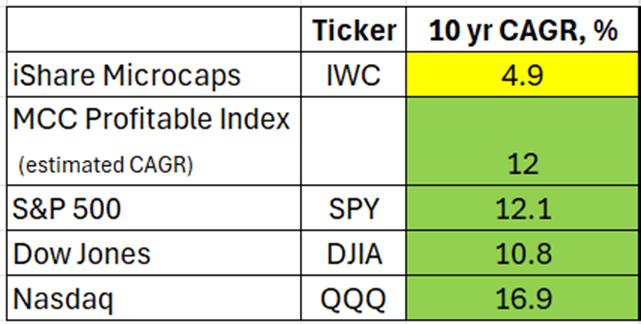
Source: Portfolio123 data, Author Table
Let’s dig in.
First off, while the iShares Microcap ETF is "microcap" in name, the actual make-up is different.
Roughly 2/3 of the index is made up of microcap stocks (<$300M market cap), while the remaining 1/3 of stocks are mostly large smallcaps.
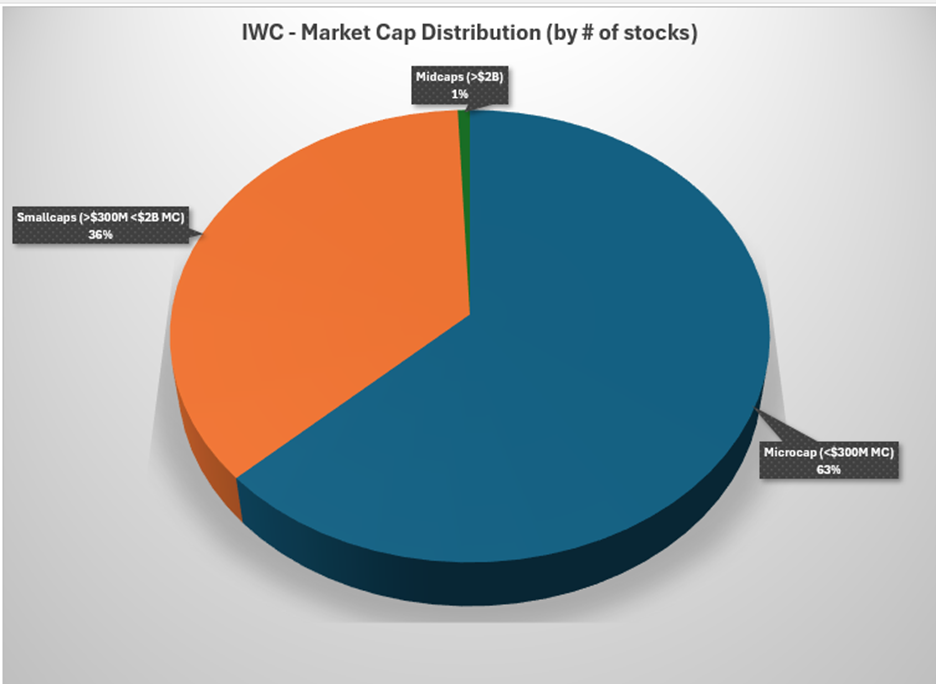
Source: Portfolio123 data, Author Graph
At first glance, the difference between microcap and smallcap may not seem that significant. But put in perspective, in some cases the difference can be more than an order of magnitude.
Here are the 10 largest holdings currently in IWC:
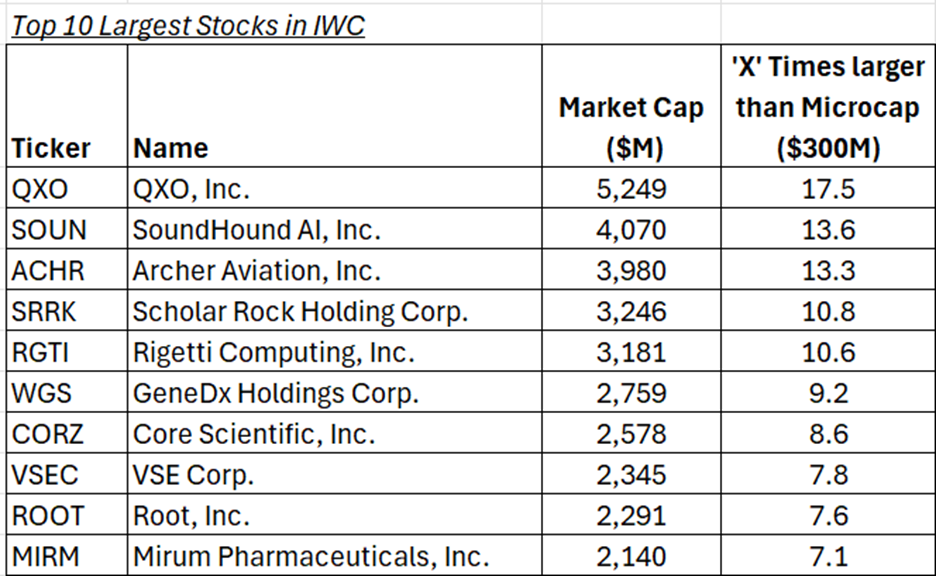
Source: Portfolio123 data, Author Table
The top 5 holdings are >10X the maximum microcap size.
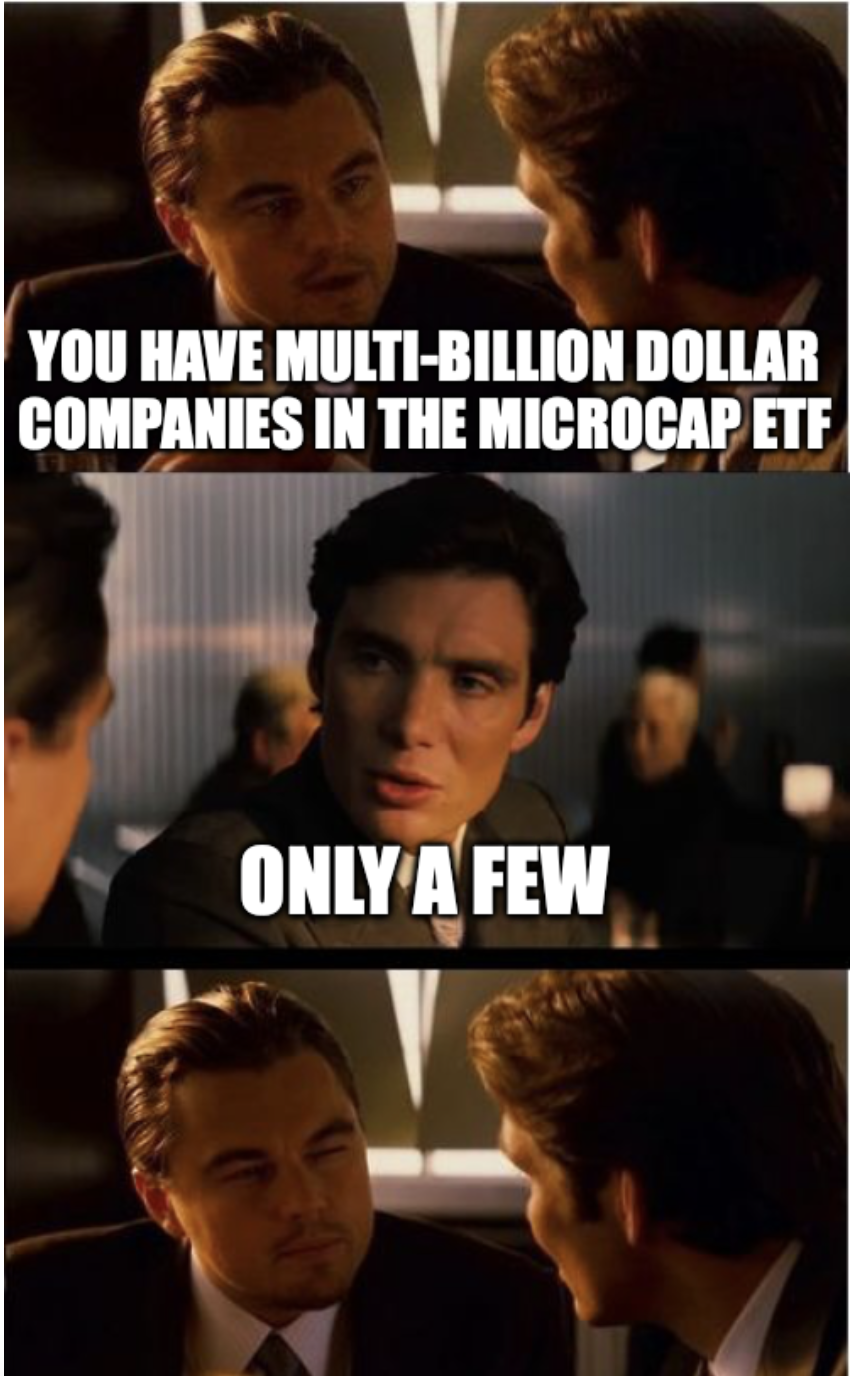
As IWC is market cap weighted, those larger stocks will receive a larger weight in the index.
If we take total aggregate market cap by size group (a proxy for cap weighting), in microcap, smallcap and midcap, we see a significant difference in weighting, with smallcaps making up about 2/3 of the index.
(Note that this may not reflect the actual weighting of IWC, as this is a simple proportion of total market cap by size group.)
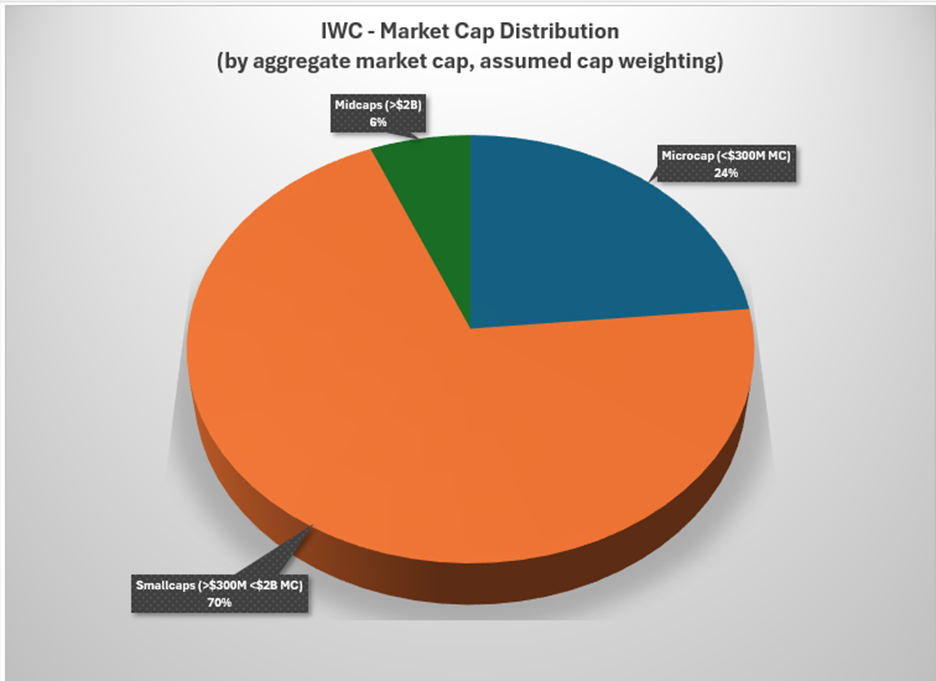
Source: Portfolio123 data, Author Table
Even with different approaches, this microcap benchmark index does not appear to be all that microcap.
Next up, what is the sector distribution in IWC? More than 50% of stocks are in healthcare or financials.
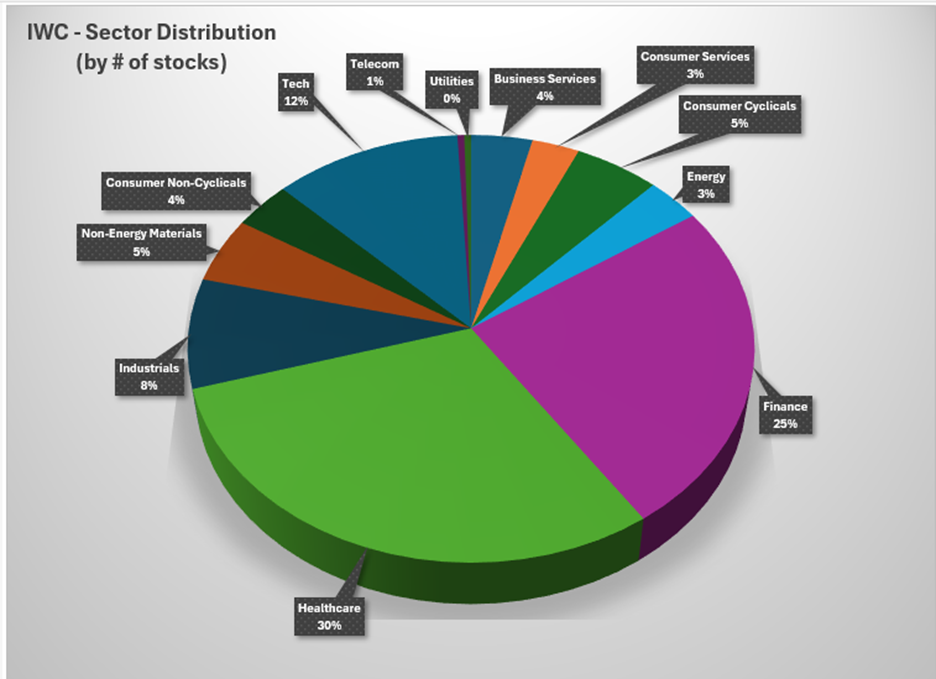
Source: Portfolio123 data, Author Graph
Using the same market cap weighting approach, the sector distribution does not vary significantly from just the number of stocks.
At first glance, the sector weighting appears to overweight recent underperformers (healthcare/biotech), but underweight outperforming sectors (technology stocks).
Let’s break it down further. Recall from our [Microcaps Roadmap](https://community.microcapclub.com/forums/topic/4896-the-microcaps-landscape-is-vast-the-microcaps-roadmap/?ref=microcapclub.com) on our community, we looked at various categories of microcaps:
- With/without sales
- Growing/shrinking sales
- Profitable/unprofitable
- Profitable + growing earnings v/s unprofitable + shrinking earnings
For all US microcaps, performance of each group has been as follows:
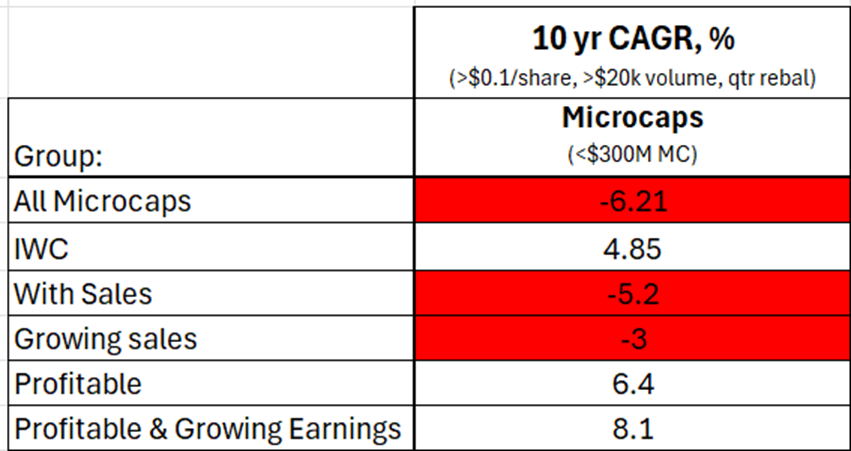
Source: Portfolio123 data, Author Table
On the one hand, IWC has outperformed microcaps broadly, however has underperformed the higher quality microcap groups of profitable and profitable + growing earnings.
When we breakdown IWC by these groups, we see that it is underweight the most high performing group, “profitable & growing earnings”:
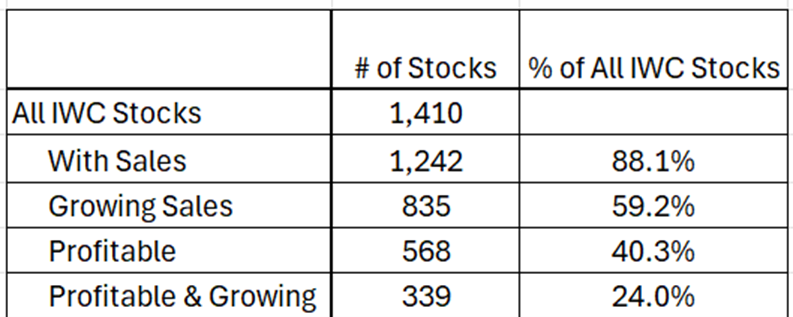
Source: Portfolio123 data, Author Table
It is also notable that only 40% of the holdings are profitable.
And by sector:
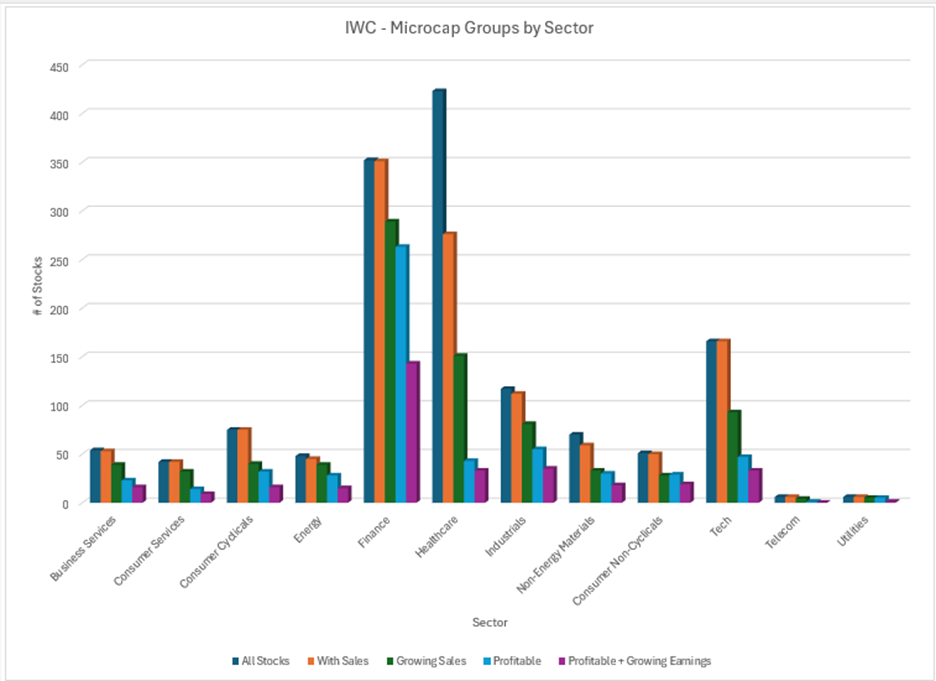
Source: Portfolio123 data, Author Graph
Finance and Healthcare represent more than 50% of all IWC holdings, with finance holding its own in terms of most profitable and profitable+growing, however healthcare includes the least proportion of these higher performing groups.
Comparing one’s own performance to a benchmark is important – to gauge whether he additional effort in stock picking or using another custom strategy is able to generate alpha. However it is key to understand what the benchmark represents, to ensure an apples-to-apples comparison.
From the data above, IWC has several characteristics that may not be similar to how many microcap investors actually invest.
If using IWC as a benchmark, at least we know how performance may be different than our own strategies.
#### Interact and learn with 250+ of the best microcap investors on the planet:
[Join Us](https://microcapclub.com/join-now)
*Disclaimer: All content in this newsletter is for discussion, education, entertainment, and illustrative purposes only and SHOULD NOT be construed as professional financial advice, solicitation, or recommendation to buy or sell any securities, notwithstanding anything stated on this newsletter and MicroCapClub.com. There are risks associated with investing in securities. Loss of principal is possible. Past performance is not a predictor of future investment performance. Ian Cassel, Ryan Telford and MicroCapClub.com are not responsible for investment actions taken by viewers. Should you need such advice, consult a licensed financial advisor, legal advisor, or tax advisor. You agree to verify all information yourself before investing. Any past performance discussed on MicroCapClub.com is no guarantee of future results. Investing involves risk and possible loss of principal capital; please seek advice from a licensed professional. All views expressed are personal opinions as of the date of publication and are subject to change without the responsibility to update views. No guarantee is given regarding the accuracy of the information. [FULL DISCLAIMER and TERMS OF USE](https://microcapclub.com/terms/)*
MicroCapClub is an exclusive forum for experienced microcap investors focused on microcap companies (sub $500m market cap) trading on United States, Canadian, European, and Australian markets. MicroCapClub was created to be a platform for experienced microcap investors to share and discuss stock ideas. Since 2011, our members have profiled 1200+ microcap companies. Investors can join our community by applying to become a member or subscribing to gain instant view only access. MicroCapClub’s mission is to foster the highest quality microcap investor Community, produce Educational content for investors, and promote better Leadership in the microcap arena. For more information, visit and
### KITS Eyecare (KITS.TO): The Fastest-Growing Optical Company to Achieve $150 million in Sales
URL: https://microcapclub.com/kits-eyecare-kits-to-the-fastest-growing-optical-company-to-achieve-150-million-in-sales/
Last updated: 2025-03-13T10:33:08.000Z
I join MicroCapClub member Stephen De Beir to have a conversation with Joseph Thompson, COO of KITS Eyecare (TSX: KITS / OTC:KTYCF). This MicroCap Business Breakdowns discussion took place live on March 12th, 2025, on the MicroCapClub Community. You can listen and participate live by joining our community.
#### Interact and learn with 250+ of the best microcap investors on the planet:
[Join Us](https://microcapclub.com/join-now)
KITS Eyecare is a fast-growing e-commerce retailer of glasses, contacts and accessories. KITS offers customers access to a vast selection of contact lenses and eyeglasses, including their own exclusive KITS designed products, as well as a robust suite of online vision tools. KITS technology stack along with their industry leading manufacturing process removes the middle-man from eyecare retail and allows them to offer wide selection and low prices.
Founder and CEO Roger Hardy founded Coastal Contacts in 2000 grew the company into the world’s largest online eyewear retailer which he then sold to Essilor in 2014 for CAD $430 million. KITS was founded in 2019 and applies all the learnings from Coastal along with Roger’s post-Coastal ventures toward becoming the premier destination for low-cost online eyewear. Management (Roger and his co-founders) own 73% of shares outstanding.
KITS has become the fastest-growing optical company to achieve a $150 million revenue run rate, from a standing start. Kits has grown at an average of 26% for the past 8 quarters, boasts over 1 million customers, and currently represents less than 1% of the optical industry total addressable market. Management is aiming for $250mm in revenues within 2-3 years, and $500mm in sales within five years after that.
You can listen/watch this business breakdowns on [Spotify](https://open.spotify.com/episode/6HhIPggODAvmTMhlgmlro5?si=YQlgM276RgiwDJ8wxdq%5FOg&ref=microcapclub.com), [Apple Podcast](https://podcasts.apple.com/us/podcast/kits-eyecare-kits-to-the-fastest-growing-optical/id1765974269?i=1000699001341&ref=microcapclub.com), and YouTube below:
MicroCap Business Breakdowns (MCBB) is a monthly program where we invite leaders of unique microcap businesses to have in depth conversations with the MicroCapClub member/investor that knows the business best. In each conversation we look to drill down into the history, business, strategy, vision, and bull/bear case. The MicroCapClub community can tune in live and ask questions. We publicize each episode two weeks after the live discussion. Not part of the MicroCapClub community? [Join Us](https://microcapclub.com/join-now/).
*Disclaimer: All content in this newsletter is for discussion, education, entertainment, and illustrative purposes only and SHOULD NOT be construed as professional financial advice, solicitation, or recommendation to buy or sell any securities, notwithstanding anything stated on this newsletter and MicroCapClub.com. There are risks associated with investing in securities. Loss of principal is possible. Past performance is not a predictor of future investment performance. Ian Cassel and MicroCapClub.com are not responsible for investment actions taken by viewers. Should you need such advice, consult a licensed financial advisor, legal advisor, or tax advisor. You agree to verify all information yourself before investing. Any past performance discussed on MicroCapClub.com is no guarantee of future results. Investing involves risk and possible loss of principal capital; please seek advice from a licensed professional. All views expressed are personal opinions as of the date of publication and are subject to change without the responsibility to update views. No guarantee is given regarding the accuracy of the information. [FULL DISCLAIMER and TERMS OF USE](https://microcapclub.com/terms/)*
### Great Stocks Evolve But Most Investors Don’t
URL: https://microcapclub.com/great-stocks-evolve-but-most-investors-dont/
Last updated: 2025-03-18T10:14:20.000Z
Almost every winning stock was once a deep value stock, value stock, GARP stock, and growth stock. It was once cheap, expensive, loved, and hated multiple times during the journey. Businesses are constantly changing which means sentiment is constantly changing. Great stocks evolve but most investors don’t.

In 1999, Microsoft was trading at an 80 PE (Price to Earnings ratio). High PE means high expectations. Growth and hypergrowth investors were piling in.
In 2009, Microsoft was trading at a 9 PE. Low PE means low expectations. Growth investors were selling and deep value and value investors were buying.
In 2016, Microsoft was back to a 40 PE. Value investors were selling and growth investors were buying again.
Few outside of Bill Gates can hold for the entire duration.

Over the last 40 years WalMart has traded in a 10 to 60 PE range. It attracted deep value investors and growth investors. A majority of multi-decade multi-baggers were valuation roller coaster rides.
In a perfect world monster winners would look like [AutoZone](https://microcapclub.com/good-business-great-stock/) that stay in a narrow 13-20 PE valuation band for most of its epic run. It's easier to hold on when the business never gets too expensive.
#### 87% of all global equities that went up 1000% or more over the past ten years were microcaps.
[Find Multibaggers](https://microcapclub.com/multibaggers)
Valuation is a hard topic because we all value different things and we all value things differently.
Stock pickers tend to silo themselves into one or two valuation camps:

Valuation Spectrum
Stock picking means finding businesses today that other investors will value more than you later. When you sell a winner, you sell it to someone that sees more upside than you.
Each valuation camp sells a winning stock to a person on the right, and they sell a losing stock to a person on the left.
Deep value investors will sell a winning stock to value investors.
Value investors will sell a winning stock to GARP investors.
GARP investors will sell a winning stock to Growth investors.
The group to the right sees more upside than you.
It's the same in reverse.
When you sell a loser, it’s to someone that sees more value than you.
Growth investors will sell a losing stock to GARP investors.
GARP investors will sell a losing stock to Value investor.
Value investors will sell a losing stock to Deep Value investors.
This leads to an interesting question. Is it wrong to stay locked into a valuation camp?
[Michael Melby](https://microcapclub.com/a-conversation-with-michael-melby-of-gate-city-capital-management/) at Gate City Capital has put up a 22% net CAGR for 14 years in a deep value strategy. He buys businesses at half of intrinsic value and he’s right more than he's wrong. He’s done very well staying rigid and sticking to his valuation camp.
[Turtle Creek](https://microcapclub.com/how-are-you-different-2/) has put up 19% CAGR for 25 years. They build precise models around valuation and intrinsic value. They actively trade around positions because market prices change quicker than intrinsic value. They buy more as the gap between intrinsic value and market value increases and sell as the gap closes. They are value investors and stay in their lane.
Warren Buffett’s best returns were when he was the most rigid - when he was a high turnover deep value cigar butt investor. [Buffett had 100% turnover](https://microcapclub.com/portfolio-turnover-is-the-price-of-progress/) per year in his peak return years.
You know what is interesting?
The more rigid, narrow and valuation focused you are the shorter-term you should be. If a stock must trade 50% below your assessment of intrinsic value, you are saying there is 100% upside today. To get a 25% CAGR you must capture that return within three years. Preferably sooner.
The best deep value investors have higher turnover because they are proven right quicker. As long as you are really good determining intrinsic value and can replace what you sold with other higher IRR opportunities you can do really well sticking to a narrow focused deep value/value valuation camp.
Warren Buffett and many others started on the left side of the valuation spectrum and moved to the right. His success forced him to lengthen his duration which meant focusing more on quality.
Even Ben Graham became more of a growth investor at the end. It’s just easier to invest with a tailwind. Graham said, [“It sort of speeds things up a bit.”](https://microcapclub.com/a-tribute-to-chuck-allmon/)
Buffett evolved toward growth but he still wants to buy cheap. He is just willing to hold on a little longer to capture the right tail of returns. But he certainly doesn't hold forever.
Buffett only holds 8 stocks in the public portfolio for more than 10 years. 8 out of the \~250 stocks he's owned over the decades. Even for the best "long-term" stock picker in the world, only 4% of stocks he's purchased deserve to be held long-term. The rest deserve to be sold.
Every stock picker is unique. There is no right or wrong way to play this game. Some do very well sticking to their valuation camp. They stay narrow and rigid which means higher turnover.
Others successful investors learn to widen their valuation spectrum and hold a little longer. Some do this out of necessity because higher turnover is harder to do with higher AUM. Some learn to hold a little longer because they can't find new high IRR opportunities fast enough to replace the old ones. Some learn to hold a little longer because they don't want to burnout like Peter Lynch did. They want to [go the distance](https://microcapclub.com/going-the-distance/).
It’s extremely difficult to capture the right tail of monster winners because the underlying businesses are constantly changing and evolving.
Great stocks evolve. Most investors don’t. And that's okay.
#### Interact and learn with 250+ of the best microcap investors on the planet:
[Join Us](https://microcapclub.com/join-now)
MicroCapClub is an exclusive forum for experienced microcap investors focused on microcap companies (sub $500m market cap) trading on United States, Canadian, European, and Australian markets. MicroCapClub was created to be a platform for experienced microcap investors to share and discuss stock ideas. Since 2011, our members have profiled 1200+ microcap companies. Investors can join our community by applying to become a member or subscribing to gain instant view only access. MicroCapClub’s mission is to foster the highest quality microcap investor Community, produce Educational content for investors, and promote better Leadership in the microcap arena. For more information, visit and
### BuildDirect (BILD.V): Omnichannel Flooring Disruptor with Pro-Driven Growth
URL: https://microcapclub.com/builddirect-bild-v-omnichannel-flooring-disruptor-with-pro-driven-growth/
Last updated: 2025-03-07T11:57:27.000Z
I join Mark Zaret from [Teraz Fund](https://spartanfunds.ca/spartan-fund/teraz/?ref=microcapclub.com) to have a conversation with CEO Shawn Wilson of BuildDirect (TSX-V: BILD, OTC: BDCTF). This MicroCap Business Breakdowns discussion took place live on March 6th, 2025, on the MicroCapClub Community. You can listen and participate live by joining our community.
#### Interact and learn with 250+ of the best microcap investors on the planet:
[Join Us](https://microcapclub.com/join-now)
BuildDirect is focused on growing its presence in the North American flooring market through the organic development and acquisition of profitable brick-and-mortar locations known as ‘Pro Centers’.
BILD is well-positioned to consolidate the highly fragmented flooring industry, which is dominated by small independent operators. Management’s goal is to expand from 9 locations to 50+ locations using a capital efficient, high IRR growth strategy. In most cases acquisitions can be made at 1-3x EBITDA, which means a 2-year payback or 40% IRRs.
BILD has strong momentum under its new leadership, with CEO Shawn Wilson. He has spent his entire career in the flooring industry. Over the last two years he has reduced BILD’s cost of capital by renegotiating loans, streamlined their software systems, and focused on repeat pro customers (contractors) while expanding with new locations. These changes were made without harming BILD’s capital structure and with strong backing from major shareholders—three multi-billion-dollar entities that control \~80% of the shares.
At a $45m market cap with $70M run rate sales and positive EBITDA, the current market cap is uncommanding. After two years of turning the business around, 2025 will be the start of "growth" mode. Strong leadership, a tight share structure, and improving business fundamentals could set the stage for institutional discovery over the next few years.
You can listen/watch this business breakdowns on [Spotify](https://open.spotify.com/episode/6HhIPggODAvmTMhlgmlro5?si=YQlgM276RgiwDJ8wxdq%5FOg&ref=microcapclub.com), [Apple Podcast](https://podcasts.apple.com/us/podcast/builddirect-bild-v-omnichannel-flooring-disruptor-with/id1765974269?i=1000698241570&ref=microcapclub.com), and YouTube below:
MicroCap Business Breakdowns (MCBB) is a monthly program where we invite leaders of unique microcap businesses to have in depth conversations with the MicroCapClub member/investor that knows the business best. In each conversation we look to drill down into the history, business, strategy, vision, and bull/bear case. The MicroCapClub community can tune in live and ask questions. We publicize each episode two weeks after the live discussion. Not part of the MicroCapClub community? [Join Us](https://microcapclub.com/join-now/).
*Disclaimer: All content in this newsletter is for discussion, education, entertainment, and illustrative purposes only and SHOULD NOT be construed as professional financial advice, solicitation, or recommendation to buy or sell any securities, notwithstanding anything stated on this newsletter and MicroCapClub.com. There are risks associated with investing in securities. Loss of principal is possible. Past performance is not a predictor of future investment performance. Ian Cassel and MicroCapClub.com are not responsible for investment actions taken by viewers. Should you need such advice, consult a licensed financial advisor, legal advisor, or tax advisor. You agree to verify all information yourself before investing. Any past performance discussed on MicroCapClub.com is no guarantee of future results. Investing involves risk and possible loss of principal capital; please seek advice from a licensed professional. All views expressed are personal opinions as of the date of publication and are subject to change without the responsibility to update views. No guarantee is given regarding the accuracy of the information. [FULL DISCLAIMER and TERMS OF USE](https://microcapclub.com/terms/)*
### Investing Without A Parachute
URL: https://microcapclub.com/investing-without-a-parachute/
Last updated: 2025-03-13T12:52:46.000Z
April 2, 1988\. The sky over Franklin County Sports Parachute Center in North Carolina was a crisp 75 degrees, scattered clouds drifting overhead. Ivan Lester McGuire, a 35-year-old veteran skydiver with over 800 jumps, was prepping for his third jump of the day. A perfectionist behind the lens, he was working overtime to capture educational footage of a first-time student and their instructor.
As the twin-engine Beech D18 climbed past 10,500 feet, McGuire got set. The bulky camera rig was a familiar weight on his back. The door opened, and one by one, McGuire then the other divers exited. McGuire, focused on his camera and captured the student and instructor in freefall.
For 30 seconds, everything was routine. He tracked the divers, staying close, capturing their descent, waiting for them to deploy their parachutes so he could pull his own and continue filming. As their parachutes deployed and they drifted out of frame, horror set in.
McGuire reached for his own ripcord. It wasn’t there.
No parachute.

His last words captured on camera, "Oh my God, no!"
In a moment of sheer panic, the camera still rolling, McGuire grasped at nothing. He had jumped from the plane wearing only his camera pack—similar in size and weight to a parachute. He had done this hundreds of times. He knew the routine. Yet, in his fixation on filming, exhausted and overconfident, he forgot the one thing that would save his life.
Ivan Lester McGuire fell to his death.
McGuire was an expert. He had done this hundreds of times. But a lapse in memory or judgement at the wrong time can be fatal. Investors often make a similar mistake.
A stock market crash doesn’t come with a warning. The floor simply drops. Investors, much like skydivers, suddenly find themselves in freefall. But here’s the terrifying truth: most investors aren’t wearing their parachutes either.
They think they are prepared. They’ve studied Buffett, Munger, Lynch. They’ve read the books, followed the market. They’ve consumed every investing podcast, every investor letter and gone through every company's annual reports A-Z. They might even have a checklist scribbled somewhere in a notebook or on their computer.
But when the market turns south—when stocks nosedive and portfolios shrink—they reach for their ripcord and realize it’s not there.
Because knowledge that isn’t *internalized* is as useless as a parachute sitting in your basement.
You can’t pull out a checklist mid-freefall. Your subconscious won’t allow you to Google the right answer when your portfolio is evaporating. It will fight you. Hard.
Loss aversion will paralyze you—you’ll hold onto losers, convinced they’ll rebound. The endowment effect will whisper, *'This one’s different.'* Confirmation bias will blind you, making you hunt for anything that validates your hope while ignoring the flashing red warnings. Denial will keep you frozen until it’s too late. And those same biases will work against you in holding a great business too—fear will push you out right before the upside.
Your emotions will hijack your judgment. You will rationalize. You will delay. You will hesitate.
That’s why *preparation is everything.*
To truly understand is to *already* know what to do. You have to train yourself—before the panic sets in—to react correctly, instinctively, without hesitation. Because when the moment comes, when the market is in freefall, there won’t be time to think.
Only time to act.
I know this because I’ve lived it.
I’ve watched one of my holdings plummet more than 80% from highs. I questioned everything—my thesis, my judgment, my competence. The only thing that kept me from bailing was something I had internalized prior: the story of another great company, in its early days, facing a nearly identical crisis. A lawsuit from a dominant competitor, a seemingly insurmountable challenge. But I had internalized that company’s leader. I had seen how he fought back—with integrity, relentless effort, and creativity. And as I watched my own company’s CEO navigate his storm, I recognized very similar traits.
Had I not *truly* internalized that story—had I just skimmed it, nodded along, and moved on—I would have panicked. Had I not surrounded myself with sharp, disciplined investors in MicroCapClub who challenged my thinking and reinforced my conviction, I would have cracked. I would have sold at the worst possible moment, locking in regret. I wouldn’t have held. I wouldn’t have kept adding. And I would have watched, from the sidelines, as one of the greatest opportunities of my investing life slipped through my fingers.
In bull markets and flat markets, there’s no need for a parachute—you’re still on the plane, climbing higher, cruising effortlessly. But sooner or later, Mr. Market kicks you out. And that’s when reality hits.
Market forces are like gravity—easy to ignore when everything’s smooth, but the moment you’re in freefall, it’s ruthless. Stocks *will* drop. Sometimes slowly, sometimes in a gut-wrenching plunge. And when they do, you won’t have time to wish you had a parachute. You’ll either have one strapped on, ready to deploy—or you’ll find out exactly what it feels like when your hard-earned cash hits the ground.
Prepare.
Thomas Edison put it bluntly: *“I regard it as a criminal waste of time to go through the slow and painful ordeal of ascertaining things for one’s self if these things have already been ascertained and made available by others.”*
Every lesson has already been learned by the greats who came before us—Buffett, Munger, and others. Their wisdom is there, waiting to be fully absorbed. But if you only *skim* it—if you don’t internalize it, commit it to memory, and train yourself to act on it instinctively—you’ll be no better off than the investor who never learned it at all. You’ll be worse, since you spent all that time for nothing!
Because when the market kicks you out of the plane, you won’t have time to look for answers. You’ll either *already know what to do*—or you’ll be another investor in freefall, grasping at air.
That’s why surrounding yourself with experienced, disciplined investors isn’t just helpful—it’s necessary. You need people who’ve been through the crashes, the gut-wrenching drawdowns, and come out stronger. People who challenge your thinking, help you separate emotion from reality, and reinforce conviction when it matters most.
That’s what MicroCapClub has been for me—a place where I’m constantly learning, refining my process, and seeing the market through the lens of those who’ve navigated it successfully. When my stock dropped 80%, I wasn’t alone. I had a network of smart, battle-tested investors helping me stay grounded, pushing me to do the right thing, not the easy thing.
In investing, like in skydiving, the worst time to realize you need a parachute… is in freefall.
#### Interact and learn with 250+ of the best microcap investors on the planet:
[Join Us](https://microcapclub.com/join-now)
MicroCapClub is an exclusive forum for experienced microcap investors focused on microcap companies (sub $500m market cap) trading on United States, Canadian, European, and Australian markets. MicroCapClub was created to be a platform for experienced microcap investors to share and discuss stock ideas. Since 2011, our members have profiled 1200+ microcap companies. Investors can join our community by applying to become a member or subscribing to gain instant view only access. MicroCapClub’s mission is to foster the highest quality microcap investor Community, produce Educational content for investors, and promote better Leadership in the microcap arena. For more information, visit and
### A Solid Foundation is Buying at a Low Valuation
URL: https://microcapclub.com/a-solid-foundation-is-buying-at-a-low-valuation/
Last updated: 2025-03-05T20:10:02.000Z
All successful investors have two things in common. They are extremely disciplined, and they understand the downside of their investments even more than the upside.
They look down before they look up.
“*Look down before you look up”* is a phrase articulated by Steven Scruggs, portfolio manager at [FPA Queens Road Smallcap Value Fund](https://fpa.com/funds/overview/fpa-queens-road-small-cap-value-fund?ref=microcapclub.com). The phrase is so brilliantly simple, and I wish I would have said it first. I hate Steven Scruggs for saying it first. H/T to [John Rotonti](https://x.com/JRogrow?ref=microcapclub.com) and this [interview](https://podcasts.apple.com/us/podcast/interview-with-steve-scruggs-portfolio-manager-of/id1709504113?i=1000659496378&ref=microcapclub.com).
Of course, other famous investors have said similar things in different ways. Warren Buffett said, *“Investing is all about protecting your downside. The upside will take care of itself”* and *“Price is my due diligence.”*
Most investors forget about valuation in bull markets. All they see is more upside to justify paying up.
I can feel the Graham style value investors nodding your heads in unison. Perhaps even shaking your fists towards the heavens as you’ve watched Mag7, AI stocks, bitcoin, and sh!tcos outperform the last few years.

Nothing is more toxic than watching other investors outperform you in things you don’t like or believe in.
But valuation is like a great balance sheet – eventually it matters.
Speaking of the Mag7\. We all remember the famous example of Microsoft (MSFT).
In 1999, MSFT hit a high of $58 per share. It took 17 years to surpass that high even while revenues grew from $19 billion to $90 billion, and EPS grew from $0.71 to $2.56\.
But it’s actually much worse than this.
If you bought MSFT at $58 in 1999, it would have taken you 21 years to get back to even with the S&P 500 return. 21 years!

Here is another example.
Over the past 25 years Costco (COST) has grown revenues from $32 billion to $254 billion, and net income from $630 million to $7.4 billion. Costco's stock is up 2100% (13.2% CAGR) over this period compared to 609% for the S&P 500\.
Costco’s Price/Earnings ratio was 20-25 in the 2000’s, 25-35 in the 2010’s, 35-45 in the early 2020’s. Today, Costco is trading at 61x earnings.

I think Charlie Munger would even agree the valuation is a little rich. The crowd loves Costco. It’s a crowded trade.
If Costco’s PE ratio rerated back to 40x earnings, a reasonable valuation, it would take five years for Costco’s stock to get back to the current stock price. Five years.
In extreme cases a great business can’t even save you from a bad entry price.
Multiple expansion is a beautiful thing when you buy before the multiple expands.
No one wants to wait 5-17-21 years to be right. You don’t want this. Your investors don’t want this. Your spouse doesn’t want this.
It’s better to buy companies before the multiple expands. Before they are discovered by institutions. Before they are priced for perfection.
By the time everyone calls it a great business the exceptional returns are usually in the rearview. The time to buy is when a company is misunderstood, undiscovered and under-appreciated.
You want to find uncrowded trades.
Your entry price matters. Valuation Matters. It why valuation is one of the [six core skills of stock picking](https://microcapclub.com/the-skills-of-stock-picking/).
When you buy at a low valuation it provides a better base to grow from. You don’t need as much to go right to make money.
If you want to find good businesses trading at low multiples you will be focused on unknown or unloved stocks. The intersection of unknown and unloved is microcap.
The next big winner is a company that is quietly executing under the radar that most investors don’t know about or believe in.
Many misinterpret investing in microcaps as risky. It can be if you don’t care about valuation and profitability. 87% of 10-baggers in global equity markets started as microcaps and were profitable.
Multi-bagger investing would be best described as getting a good entry price (valuation) on a small business that can consistently grow revenues and earnings with limited dilution.
Depending on the industry, companies are valued on Enterprise Value/Sales, Price/Earnings, Enterprise Value/EBITDA, Price/Book or some variant of each.
To find a 10-bagger first find a stock that can double in three years with conservative fundamental assumptions and no multiple expansion.
What is the key to this?
For a stock to double in three years you need 25% annual organic growth in the denominator of the valuation metric used with little dilution.
Let me give you a couple examples.
**Example 1:**
Company X is a consumer products company. They make industry leading food products in a small but growing product category. In this area companies trade between 1-4 EV/Sales. The higher the organic growth rate the higher multiple. If the company is EBITDA breakeven or better, it is additive to the multiple.
- Company X is organically growing sales 25%.
- Company X is cash flow positive.
- Company X is confident the current growth rate will continue.
- Company X doesn’t need to raise money.
- Company X is trading at 1x EV/Sales. At the low end of valuation.
Company X is a wise purchase. The equity return should at least match the organic growth rate over a 3-year period. 100% in three years. If the multiple expands it supercharges the IRR. If the multiple expands to 2x EV/Sales by the end of year three, it’s a 300% return in three years.
Heads you win. Tails you win even more.
**Example 2:**
Company Y is a debt free profitable growing company in an unloved industry (Cannabis, Mining, Oil & Gas, Tobacco, etc). All your peers say you’re an idiot for investing in this industry. It’s an uncrowded trade.
- Company Y is organically growing sales and earnings 25%.
- Company Y is confident the current growth rate will continue.
- Company Y doesn’t need to raise money.
- Company Y is at an 8 PE.
Company Y is a great setup. You can double your money in three years without any multiple expansion or operating leverage.
If the company does grow 25% for three years in a row, chances are they will show significant operating leverage i.e. 25% revenue growth produces 50% earnings growth. It’s also likely by year two or three the multiple will expand from 8 to 15\.
Then all your peers will pile in after it triples and call it a wonderful business.
In both examples, heads you win (no multiple expansion) and tails you win even more (w/multiple expansion).
A solid foundation is buying at a low valuation.
Your purchase price matters. Valuation matters. When you combine low valuation with double digit organic growth and a company that doesn’t need to raise money, you get market beating returns.
Peter Lynch in *One Up on Wall Street* said,
> "These are among my favorite investments: small, aggressive new enterprises that grow 20-25% a year. If you choose wisely, this is the land of the 10 to 40 baggers, and even 200-baggers. With a small portfolio, one or two of these can make a career."
Go find them.
#### Interact and learn with 250+ of the best microcap investors on the planet:
[Join Us](https://microcapclub.com/join-now)
MicroCapClub is an exclusive forum for experienced microcap investors focused on microcap companies (sub $500m market cap) trading on United States, Canadian, European, and Australian markets. MicroCapClub was created to be a platform for experienced microcap investors to share and discuss stock ideas. Since 2011, our members have profiled 1200+ microcap companies. Investors can join our community by applying to become a member or subscribing to gain instant view only access. MicroCapClub’s mission is to foster the highest quality microcap investor Community, produce Educational content for investors, and promote better Leadership in the microcap arena. For more information, visit and
### Enterprise Group (E.TO): A Specialized Equipment and Power Provider with 40% EBITDA Margins
URL: https://microcapclub.com/enterprise-group-e-to-a-specialized-equipment-and-power-provider-with-40-ebitda-margins/
Last updated: 2025-02-21T12:18:21.000Z
I join Jesse Gamble from Donville Kent Asset Management to have a conversation with co-founder and President Desmond O’Kell of Enterprise Group (E.TO). This MicroCap Business Breakdowns discussion took place live on February 20th, 2025, on the MicroCapClub Community. You can listen and participate live by joining our community.
#### Interact and learn with 250+ of the best microcap investors on the planet:
[Join Us](https://microcapclub.com/join-now)
Enterprise Group is a leading provider of specialized equipment and services to the energy, pipeline, and infrastructure industries, is positioned for significant growth. Based in Alberta, Canada, Enterprise operates through four divisions: Evolution Power Projects, Westar Oilfield Rentals, Arctic Therm International and Hart Oil Field Rentals. With a strategic focus on natural gas-related services, the company benefits from its competitive positioning and growth opportunities in the Canadian energy sector.
Enterprise Group's services are closely tied to the natural gas industry, specifically in western Canada, where the company operates. Western Canada is a key natural gas-producing region, and its industry is poised for further expansion due to the ongoing development of liquefied natural gas (LNG) facilities. With the anticipated increase in LNG exports, Canada is set to become a top-10 LNG exporter by 2028, creating a strong tailwind for Enterprise Group’s growth.
Enterprise Group presents an interesting investment opportunity, underpinned by its leadership position in a growing market, a strong competitive moat through its natural gas-powered solutions, and a proven ability to execute both organic and acquisition-driven growth strategies. The anticipated forthcoming LNG boom in Canada provides a significant tailwind for the company, and its financial performance indicates that it is well-positioned to capitalize on this opportunity.
You can listen/watch this business breakdowns on [Spotify](https://creators.spotify.com/pod/show/microcapclub/episodes/Kingsway-Financial-Services-Revolutionizing-the-Search-Fund-Model-e2tbhnd?ref=microcapclub.com), [Apple Podcast](https://podcasts.apple.com/us/podcast/enterprise-group-e-to-a-specialized-equipment-and/id1765974269?i=1000694700818&ref=microcapclub.com), and YouTube below:
MicroCap Business Breakdowns (MCBB) is a monthly program where we invite leaders of unique microcap businesses to have in depth conversations with the MicroCapClub member/investor that knows the business best. In each conversation we look to drill down into the history, business, strategy, vision, and bull/bear case. The MicroCapClub community can tune in live and ask questions. We publicize each episode two weeks after the live discussion. Not part of the MicroCapClub community? [Join Us](https://microcapclub.com/join-now/).
*Disclaimer: All content in this newsletter is for discussion, education, entertainment, and illustrative purposes only and SHOULD NOT be construed as professional financial advice, solicitation, or recommendation to buy or sell any securities, notwithstanding anything stated on this newsletter and MicroCapClub.com. There are risks associated with investing in securities. Loss of principal is possible. Past performance is not a predictor of future investment performance. Ian Cassel and MicroCapClub.com are not responsible for investment actions taken by viewers. Should you need such advice, consult a licensed financial advisor, legal advisor, or tax advisor. You agree to verify all information yourself before investing. Any past performance discussed on MicroCapClub.com is no guarantee of future results. Investing involves risk and possible loss of principal capital; please seek advice from a licensed professional. All views expressed are personal opinions as of the date of publication and are subject to change without the responsibility to update views. No guarantee is given regarding the accuracy of the information. [FULL DISCLAIMER and TERMS OF USE](https://microcapclub.com/terms/)*
### JOIN 400+ INVESTORS - Planet MicroCap Las Vegas 2025
URL: https://microcapclub.com/join-400-investors-planet-microcap-las-vegas-2025/
Last updated: 2025-02-17T11:28:46.000Z
Back in November we announced an event collaboration with Planet Microcap in Las Vegas, on April 22-24, 2025\.
We already have 400+ investors attending and 80+ companies presenting.
This will be the largest gathering of microcap investors in the United States. This event is OPEN TO ALL MICROCAP INVESTORS and FREE TO ATTEND.
If you are part of the MicroCapClub community (members and subscribers), we have carved out some [exclusive perks](https://community.microcapclub.com/forums/topic/4594-planet-microcap-las-vegas-in-partnership-with-microcapclub/?ref=microcapclub.com).
You still have time to [register](https://www.meetmax.com/sched/event%5F113149/conference%5Fhome.html?bank%5Faccess=0&event%5Fid=113149&ref=microcapclub.com).
Real investors focus on real businesses. One of our goals is to primarily focus on profitable or soon to be profitable microcap companies.
We are now at 80+ companies confirmed, many of which are profitable businesses. Here is the [company lineup](https://www.meetmax.com/sched/event%5F113149/%5F%5Fparticipatingcompanies%5Fcp.html?ref=microcapclub.com).
Don't miss this event.
[Planet MicroCap Las Vegas in Partnership with MicroCapClub](https://www.meetmax.com/sched/event%5F113149/conference%5Fhome.html?bank%5Faccess=0&event%5Fid=113149&ref=microcapclub.com)
When: April 22-24, 2025 – Get Registered!
Where: Las Vegas, NV at the Paris Las Vegas Casino and Hotel
[\[FREE TO ATTEND - REGISTER NOW\]](https://www.meetmax.com/sched/event%5F113149/conference%5Fhome.html?bank%5Faccess=0&event%5Fid=113149&ref=microcapclub.com)
#### Interact and learn with 250+ of the best microcap investors on the planet:
[Join Us](https://microcapclub.com/join-now)
MicroCapClub is an exclusive forum for experienced microcap investors focused on microcap companies (sub $500m market cap) trading on United States, Canadian, European, and Australian markets. MicroCapClub was created to be a platform for experienced microcap investors to share and discuss stock ideas. Since 2011, our members have profiled 1200+ microcap companies. Investors can join our community by applying to become a member or subscribing to gain instant view only access. MicroCapClub’s mission is to foster the highest quality microcap investor Community, produce Educational content for investors, and promote better Leadership in the microcap arena. For more information, visit and
### The Conviction that Inspires Us
URL: https://microcapclub.com/the-conviction-that-inspires-us/
Last updated: 2025-03-05T20:10:08.000Z
Marie Curie was born Maria Skłodowska in 1867 in Warsaw, Poland. Her family valued education but struggled financially. Women faced barriers to higher education, so she joined the underground Flying University, an underground institution that provided education to women.

In 1891, she moved to Paris to study at the Sorbonne. Life was difficult, but she earned degrees in physics (1893) and mathematics (1894). In 1895, she married physicist Pierre Curie. They formed a strong scientific partnership. Despite hardships, she persisted. Her early struggles shaped her path. She overcame obstacles and prepared for groundbreaking discoveries in radioactivity.
We find common elements in scientific discovery and stock discovery that provides a good framework for doubling down on our conviction, diligence and positions.
**Discovery of New Elements**: In 1898, Curie discovered two new elements, polonium and radium. The scientific establishment was initially doubtful about her findings, as radioactivity was poorly understood, and the tools available for verification were limited.
Similarly, if you are a microcap investor your job is to find small stocks that have big potential. You want to find it first so you can reap the financial reward and attach your name to the idea and be a catalyst for discovery.
The longer I invest the more I realize only a fraction of stocks (a fraction of winning stocks) are meant for you. The select few where your experience, diligence, temperament, timing, and luck all collide into creating a situation where you can build real conviction before the world finds it.
**Ignoring Skepticism**: Despite skepticism and significant physical challenges (e.g., manually processing tons of pitchblende ore to isolate tiny amounts of radium), Curie doubled down on her research because she recognized the unmistakable evidence of radioactivity and its potential.
The best stock ideas are hated or unknown in the beginning and loved in the end. Our ability to pursue undiscovered ideas that are non-traditional but led by extraordinary people is where multi-baggers emerge. Like Curie, it isn’t our hope that should drive our conviction, but the evidence we unearth.
**Validation of Her Findings**: Over time, Curie’s results were confirmed as other scientists replicated her experiments. She persisted in her work, publishing groundbreaking papers and solidifying the science of radioactivity.
In winning stocks other stock pickers will follow. They will replicate your diligence and come to similar conclusions. Others will find new supporting evidence that is additive to the thesis. As more people validate it adds credibility to the thesis and drives widespread discovery.
**Revolutionary Discoveries**: Curie's insistence on the validity of her findings earned her the Nobel Prize in Physics in 1903, shared with Pierre Curie and Henri Becquerel. She later won a second Nobel Prize in Chemistry in 1911 for her work on radium and polonium, making her the first person to win Nobel Prizes in two different sciences.
Finding a multi-bagger stock before others and going ten miles deeper in research than others to discover the truth is what creates generational returns.
A mentor of mine grew his six-figure 401k portfolio into a nine-figure portfolio in microcaps. He emailed me the other day and wrote,
“I do a minimum of 2+ hours of research every day on \[His Largest Position\].”
His maintenance due diligence is what keeps him in the stock. Your initial due diligence might get you into a position, but it is your maintenance due diligence that makes you the big money or saves you from the big losses.
**Big Ideas Lead to Big Ideas**: Curie’s work laid the foundation for future research in nuclear physics and medicine, leading to innovations such as cancer treatments and nuclear energy.
When you find multi-bagger stocks it often leads to finding others. The company and industry research lead you to other unique companies in the same or adjacent industries.
The new investors you meet and share due diligence with become life-long friends and part of your tribe. The bonds forged by going to war and winning against the naysayers turns you into comrades in arms and you find more winners and fight more battles together.
The relationships you build with winning CEOs aka intelligent fanatics, leads them to trusting you and opening their rolodex to you. They start to introduce you to other high-quality individuals doing interesting things. Winners attract winners and big ideas start to find you.
**Inspiration**: By trusting the signs she saw in her research, Marie Curie pushed forward against resistance, Curie became a role model for scientists worldwide, particularly women in a field dominated by men at the time.
When we see stock pickers finding, buying and holding great companies early it is inspires us to do the same.
When you see a private investor like [Jason Hirschman](https://microcapclub.com/a-conversation-with-jason-hirschman/) make nine figures on a single microcap stock it inspires us.
In hindsight most big discoveries look obvious because we are judging the beginning by the end. In reality they were not obvious in the beginning. Most big stocks started as [ugly ducklings](https://microcapclub.com/most-big-winners-were-ugly-ducklings/). They were imperfect and unloved. They had hair, warts, and walked with a limp. Most investors were running away, not running to invest.
Jason doubled down on his independent research right when most other investors were fleeing for the exits. Another investor, a female microcap investor, who wishes to remain nameless, teamed up on the due diligence. Their independent research validated their conviction.
They did the work others weren’t willing to do to form conviction others weren’t willing to build. They tripled down their positions when everyone else was selling.
Then their independent research was proven right. Sentiment shifted, management executed, an ugly duckling turns into a beautiful swan, and the result was generational wealth.
Innovation isn’t easy. Conviction isn’t easy. Nothing that inspires us is easy.
#### Interact and learn with 250+ of the best microcap investors on the planet:
[Join Us](https://microcapclub.com/join-now)
MicroCapClub is an exclusive forum for experienced microcap investors focused on microcap companies (sub $500m market cap) trading on United States, Canadian, European, and Australian markets. MicroCapClub was created to be a platform for experienced microcap investors to share and discuss stock ideas. Since 2011, our members have profiled 1200+ microcap companies. Investors can join our community by applying to become a member or subscribing to gain instant view only access. MicroCapClub’s mission is to foster the highest quality microcap investor Community, produce Educational content for investors, and promote better Leadership in the microcap arena. For more information, visit and
### Join the MicroCap Revolution!
URL: https://microcapclub.com/join-the-microcap-revolution/
Last updated: 2025-02-13T11:49:06.000Z
In 1600, Dutch spectacle maker Zacharias Janssen put two lenses together and formed the first compound microscope. It could magnify objects 20-30x their normal size.
A few decades later Antonie van Leeuwenhoek started experimenting with microcopes by grinding his own lenses. His microscope looked more like a magnifying glass. He could magnify an object up to 200x.
At the same time Robert Hooke was experimenting with microscopes. Unlike Leeuwenhoek, Hooke’s microcscope were true compound microscopes. They were less powerful, but offered greater ease of use and broader perspective, allowing him to capture larger structures in his drawings.

Microscope 1927-437\. A full-size reconstruction of Robert Hooke’s compound microscope. © Science Museum/SSPL
Since photography wasn’t invented yet, Hooke would spend countless hours observing magnified objects and then drawing what he saw by hand. He used a graticule (a grid) to help him get a sense for relative size of what he was observing.
When Robert Hooke published “Micrographia” in 1665 it immediately became a best seller.

Image from National Library of Wales
The book included stunning drawings of Hooke's microscopic observations, showing intricate details of plant and insect structures, among other objects.
One of Hooke's most famous illustrations is of a flea, which he showed in almost monstrous detail. It captivated adults and children and was as much an artistic marvel as a scientific one.

Another famous observation was that of cork under the microscope. He noticed that cork was made up of many tiny, hollow compartments, which he thought looked like the cells (rooms) in a monastery. This led him to name these compartments “cells,” a term still used in biology today.

No matter a person’s age or socioeconomic status, Hooke’s magnified images of blue mold, hair, skin, snowflakes, a fly’s eye, feathers, fish scales, and a nettle sting captivated everyone. “Micrographia” encouraged the public and scientists alike to question what other mysteries might be hidden just out of sight.
This simple picture book became the catalyst for widespread curiosity, single handedly propelling the **scientific revolution** in physics, biology, and engineering.
All this simply by letting people clearly see a microscopic world that was always there.
This is also a goal of MicroCapClub through our community and public content (articles, presentations, interviews). We too will be the catalyst that brings a microcap world into view.
I want to thank all of you, from our readers to our members, for being a part of this movement.
When I founded MicroCapClub in 2011, the microcap ecosystem was in dire straits. The average age of a microcap investor was “one foot in the grave”. There was no energy or pulse. Fast forward to today and the ecosystem is on much better footing, but we still have a long way to go.
Here are some self-evident truths, at least to microcap investors.
- Most of the best performing stocks of the last 10 years were
microcaps. [87% to be exact](https://microcapclub.com/multibaggers/).
- Most of the greatest companies of all time were microcaps (even Berkshire Hathaway).
- Most of the best performing stocks of all time were microcaps.
- Most of the greatest investors ever started their careers right here in microcap. Name a famous value investor and they likely started by sifting through thousands of microcap stocks.
- Most of the great investors that will emerge over the next 10 years are already here investing. Read: [The Superinvestors of MicroCap](https://microcapclub.com/the-superinvestors-of-microcap/)
There are a bunch of small stocks that will 10x over the next five years that are waiting to be found. The opportunity in small stocks (microcaps) exists because institutions can’t buy them when they are small. Only you can. Institutional money must wait until these stocks go up and become more liquid. It is the small astute investor’s duty to find them first and collect the reward for doing so.
MicroCapClub is a community of 280+ stock pickers who share and discuss their ideas and collaborate on due diligence. We have some of the best stock pickers on the planet right here on our community. But we aren't a guru service. We don't make stock recommendations. Some microcaps discussed by members will be monster winners and others won't. We all learn and grow together through our successes and mistakes. [No one to blame](https://microcapclub.com/no-one-to-blame/).
Our members have profiled 1,200+ microcaps since inception. 165 companies in 2024 alone. 33 new [multi-baggers](https://microcapclub.com/multibaggers/) discovered in 2023 and 2024 (profiled price through YE 2024) which is more than one multi-bagger found per month. There are many more out there, waiting to be found.
Just as Robert Hooke’s “Micrographia” opened a hidden world for all to see, MicroCapClub’s mission is to uncover the extraordinary opportunities hidden in the microcap ecosystem.
If you're ready to start your journey, begin with [this primer](https://youtu.be/gDcHGiIixLw?feature=shared&ref=microcapclub.com) on researching microcaps.
For those ready to take their microcap investing to the next level, we have two ways to [join the revolution](https://microcapclub.com/join-now/).
If you are an experienced microcap investor, Apply to be a Member. We are an incredible idea generation, due diligence and networking tool for your continued advancement as a stock picker.
If you don't have the time or ability to become a member, become a Subscriber and follow the content, learn and engage with discussion.
Many of us are meeting up in Las Vegas on April 22-24th. 300+ investors are already registered. [You should come](https://microcapclub.com/register-today-planet-microcap-las-vegas-in-partnership-with-microcapclub-2/).
All great companies started as small companies.
#### Interact and learn with 250+ of the best microcap investors on the planet:
[Join Us](https://microcapclub.com/join-now)
MicroCapClub is an exclusive forum for experienced microcap investors focused on microcap companies (sub $500m market cap) trading on United States, Canadian, European, and Australian markets. MicroCapClub was created to be a platform for experienced microcap investors to share and discuss stock ideas. Since 2011, our members have profiled 1200+ microcap companies. Investors can join our community by applying to become a member or subscribing to gain instant view only access. MicroCapClub’s mission is to foster the highest quality microcap investor Community, produce Educational content for investors, and promote better Leadership in the microcap arena. For more information, visit and
### Kingsway Financial Services: Revolutionizing the Search Fund Model
URL: https://microcapclub.com/kingsway-financial-services-revolutionizing-the-search-fund-model/
Last updated: 2025-01-11T11:06:37.000Z
I join full-time private investor Mark Vonderwell, to have a conversation with CEO J. T. Fitzgerald and CFO Kent Hansen of Kingsway Financial Services (KFS). This MicroCap Business Breakdowns discussion took place live on January 9th, 2024\. You can listen and participate live by joining the community.
Kingsway Financial Service’s base business offering warranties for automobiles and HVAC systems generates the cash for their fledgling search funds business. Under Kingsway’s Search Xcelerator program, new business school graduates, using Kingsway’s capital leveraged with bank loans, purchase very small private companies from retiring founders and become the chief executive officers. While Kingsway owns the businesses, the “operators in residence” are compensated based highly on the acquired business performance. To date, Kingsway has had five operators-in-residence acquire six companies. Currently four more business school graduates are searching for an acquisition, with a goal to add two or three companies each year.
J.T. Fitzgerald became Kingsway’s CEO in September 2018 after joining the company when the private firm that he founded to invest in search funds, Argo Investment Management, was acquired by Kingsway in 2016\. According to a Stanford Business School study, search funds have historically produced a 30%+ average return, albeit mostly middling returns aided by a small percentage of extraordinary winners. Fitzgerald hopes to improve on the historical success rate by aiding young operators in residence both in acquiring and operating companies with the counsel of experienced businessmen. An advisory board formed in 2022 includes Will Thorndike, an experienced search fund investor and author of the 2012 book titled “The Outsiders: Eight Unconventional CEOs and Their Radically Rational Blueprint for Success” and retired, phenomenally successful Danaher ceo Thomas Joyce. Further boosting returns, Kingsway’s search acquisitions are shielded from taxation by over $700 million in tax net-operating loss carryforwards created by their shut down casualty insurance operations. Kingsway attracts potential operators in residence by providing capital and credibility, helping with legal contracts, and sharing a successful operating framework derived from Fitzgerald’s prior experience with the Danaher Business System.
You can listen/watch this business breakdowns on [Spotify](https://creators.spotify.com/pod/show/microcapclub/episodes/Kingsway-Financial-Services-Revolutionizing-the-Search-Fund-Model-e2tbhnd?ref=microcapclub.com), [Apple Podcast](https://podcasts.apple.com/us/podcast/kingsway-financial-services-revolutionizing-the/id1765974269?i=1000683567318&ref=microcapclub.com), and YouTube below:
MicroCap Business Breakdowns (MCBB) is a monthly program where we invite leaders of unique microcap businesses to have in depth conversations with the MicroCapClub member/investor that knows the business best. In each conversation we look to drill down into the history, business, strategy, vision, and bull/bear case. The MicroCapClub community can tune in live and ask questions. We publicize each episode two weeks after the live discussion. Not part of the MicroCapClub community? [Join Us](https://microcapclub.com/join-now/).
*Disclaimer: All content in this newsletter is for discussion, education, entertainment, and illustrative purposes only and SHOULD NOT be construed as professional financial advice, solicitation, or recommendation to buy or sell any securities, notwithstanding anything stated on this newsletter and MicroCapClub.com. There are risks associated with investing in securities. Loss of principal is possible. Past performance is not a predictor of future investment performance. Ian Cassel and MicroCapClub.com are not responsible for investment actions taken by viewers. Should you need such advice, consult a licensed financial advisor, legal advisor, or tax advisor. You agree to verify all information yourself before investing. Any past performance discussed on MicroCapClub.com is no guarantee of future results. Investing involves risk and possible loss of principal capital; please seek advice from a licensed professional. All views expressed are personal opinions as of the date of publication and are subject to change without the responsibility to update views. No guarantee is given regarding the accuracy of the information. [FULL DISCLAIMER and TERMS OF USE](https://microcapclub.com/terms/)*
### A Conversation with Michael Melby of Gate City Capital Management
URL: https://microcapclub.com/a-conversation-with-michael-melby-of-gate-city-capital-management/
Last updated: 2025-01-10T10:41:44.000Z
In this conversation I sit down with Michael Melby, the founder and portfolio manager at Gate City Capital Management. Gate City has produced a 22.4% net annualized return since inception (September 2011), compared to 14.8% for the S&P 500\. During this discussion we talk about Michael’s beginnings growing up in a small Montana town, education and early experience, launching his fund, his strategy and process, and the decision to close the fund to new investors.
Enjoy this conversation with Michael Melby on [Spotify](https://creators.spotify.com/pod/show/microcapclub/episodes/A-Conversation-with-Michael-Melby-of-Gate-City-Capital-Management-e2t9a17?ref=microcapclub.com), [Apple Podcast](https://podcasts.apple.com/us/podcast/a-conversation-with-michael-melby-of-gate/id1765974269?i=1000683441698&ref=microcapclub.com), and YouTube below:
#### Interact and learn with 250+ of the best microcap investors on the planet:
[Join Us](https://microcapclub.com/join-now)
MicroCapClub is an exclusive forum for experienced microcap investors focused on microcap companies (sub $500m market cap) trading on United States, Canadian, European, and Australian markets. MicroCapClub was created to be a platform for experienced microcap investors to share and discuss stock ideas. Since 2011, our members have profiled 1000+ microcap companies. Investors can join our community by applying to become a member or subscribing to gain instant view only access. MicroCapClub’s mission is to foster the highest quality microcap investor Community, produce Educational content for investors, and promote better Leadership in the microcap arena. For more information, visit and
### MCC Profitable Index Q4 2024 Update
URL: https://microcapclub.com/mcc-profitable-index-q4-2024-update/
Last updated: 2025-01-07T11:26:05.000Z
The MCC Profitable Index (MCCPI) is an equal weight index of all global profitable companies (trailing twelve months aka TTM) profiled on MicroCapClub.
Since 87% of all global equities that went up 1000% or more over the last 10 years were microcaps, and 82% of those were profitable, we feel this index is not only a unique tracking mechanism but also a great idea generation tool for the community.
Several multi-baggers are likely hiding in plain sight in the index. As part of our community, you gain access to this incredible tool and will be able to view its constituents.
Every quarter we rebalance the index. New companies enter that are new TTM profitable, and companies get dropped that are no longer profitable TTM. In addition, we drop companies that move over $500 million market cap. The index is not optimized for "performance", but for idea generation.
**MCCPI Q4 2024 Rebalance Update:**
276 total companies/ 35 companies added / 54 companies dropped

MCCPI Q4 2024 Factsheet

Q4 2024 Top Gainers/Losers
To view all the companies in the index and the list of companies added/dropped each quarter, [Join Us](https://microcapclub.com/join-now/).
#### Interact and learn with 250+ of the best microcap investors on the planet:
[Join Us](https://microcapclub.com/join-now)
*Disclaimer: All content in this newsletter is for discussion, education, entertainment, and illustrative purposes only and SHOULD NOT be construed as professional financial advice, solicitation, or recommendation to buy or sell any securities, notwithstanding anything stated on this newsletter and MicroCapClub.com. There are risks associated with investing in securities. Loss of principal is possible. Past performance is not a predictor of future investment performance. Ian Cassel and MicroCapClub.com are not responsible for investment actions taken by viewers. Should you need such advice, consult a licensed financial advisor, legal advisor, or tax advisor. You agree to verify all information yourself before investing. Any past performance discussed on MicroCapClub.com is no guarantee of future results. Investing involves risk and possible loss of principal capital; please seek advice from a licensed professional. All views expressed are personal opinions as of the date of publication and are subject to change without the responsibility to update views. No guarantee is given regarding the accuracy of the information. [FULL DISCLAIMER and TERMS OF USE](https://microcapclub.com/terms/)*
MicroCapClub is an exclusive forum for experienced microcap investors focused on microcap companies (sub $500m market cap) trading on United States, Canadian, European, and Australian markets. MicroCapClub was created to be a platform for experienced microcap investors to share and discuss stock ideas. Since 2011, our members have profiled 1200+ microcap companies. Investors can join our community by applying to become a member or subscribing to gain instant view only access. MicroCapClub’s mission is to foster the highest quality microcap investor Community, produce Educational content for investors, and promote better Leadership in the microcap arena. For more information, visit and
### MicroCapClub Top 10 Articles of 2024
URL: https://microcapclub.com/microcapclub-top-10-articles-of-2024/
Last updated: 2024-12-29T11:21:52.000Z
We hope you’ve enjoyed reading our blog throughout the year. In case you missed a few articles, here are the Top-10 articles of 2024 by views.
[Active Patience](https://microcapclub.com/active-patience/) \- Active Patience means knowing what you are looking for and doing nothing until you find it.
[Shelf Life](https://microcapclub.com/shelf-life/) \- My intention is to hold stocks forever, but the harsh reality is every stock has different shelf life.
[No One To Blame](https://microcapclub.com/no-one-to-blame/) \- Stock picking is an individual sport so the winning streaks are intoxicating and the losing streaks excruciating. It's how we deal with both extremes that sets us up for long-term success.
[The Superinvestors of MicroCap](https://microcapclub.com/the-superinvestors-of-microcap/) \- Microcap gets little attention despite being the small island of investing that produces superinvestors.
[But We Are Long-Term Investors](https://microcapclub.com/but-youre-a-long-term-investor/) \- It's often how you react (or don't) to the same situations that shows you how much you’ve grown.
[Finding Ideas Before Others](https://microcapclub.com/finding-ideas-before-others/) \- Over time you realize finding ideas before others often means finding ideas with others. Stock picking isn’t a zero-sum game.
[Turnarounds](https://microcapclub.com/turnarounds/) \- You make the most money by having a 1–3-year variant view on a business and buying the stock before the business turns up, inflects, or accelerates.
[The Run](https://microcapclub.com/the-run/) \- If you consider yourself a stock picker – at some point in your life you must do the work others aren’t willing to do and form extreme conviction in something you believe in.
[Grow Yourself](https://microcapclub.com/grow-yourself/) \- You must always be growing yourself ahead of your portfolio.
[](https://microcapclub.com/we-are-all-fighting-the-same-battles/)
[We Are All Fighting The Same Battles](https://microcapclub.com/we-are-all-fighting-the-same-battles/) \- A good rule of thumb is to be quieter than you want to be. Don't give people a reason to root against you. It's an asset when people can't tell whether you are winning or losing.
#### Interact and learn with 250+ of the best microcap investors on the planet:
[Join Us](https://microcapclub.com/join-now)
MicroCapClub is an exclusive forum for experienced microcap investors focused on microcap companies (sub $500m market cap) trading on United States, Canadian, European, and Australian markets. MicroCapClub was created to be a platform for experienced microcap investors to share and discuss stock ideas. Since 2011, our members have profiled 1200+ microcap companies. Investors can join our community by applying to become a member or subscribing to gain instant view only access. MicroCapClub’s mission is to foster the highest quality microcap investor Community, produce Educational content for investors, and promote better Leadership in the microcap arena. For more information, visit and
### No One To Blame
URL: https://microcapclub.com/no-one-to-blame/
Last updated: 2025-03-05T20:10:17.000Z
You will sell winners too soon. You will hold losers too long. You will buy stocks you shouldn’t. Just don’t blame others. When you blame others, it proves you didn't do the work you were supposed to do. Fully own your investment mistakes so you learn, grow, and move forward.
Whether you watch American football, European football (soccer), cricket, baseball, or basketball – these are team sports. Th team may have important players, but the credit and blame get cast over the entire team. Yes you can blame the kicker that missed the game winning field goal or the player that missed the penalty kick or the goalie that allowed it but even in these situations everyone knows it was the team that put the individual in that position in the first place. The team is to blame.
Individual sports like tennis or boxing or golf are different. In individual sports the best players might have coaches, trainers, agents, and others supporting them, but in matches or tournaments it’s one player versus another, or one player versus the world. The player gets the credit for the win, and the player gets the blame for the loss. It's why individual sports are agonizing even for the best in the world. Eight-time major tennis champion Andre Agassi said,
> “It's no wonder that tennis causes more divorces among players than any other sport. It's so solitary, so cutthroat, it's Darwinism in a pair of shorts. You’re always at the edge. There’s no middle ground in tennis, like life itself. You’re either winning or losing. You’re never safe. Tennis is a psychological and physical war, one that never ends. It’s gladiatorial. You’re out there all alone, with no one to help, no place to hide.”
Stock picking is an individual sport. It doesn’t matter if you’re a small retail investor managing your $1,000 Schwab account or you’re a CIO/PM of a $10 billion fund. As a CIO/PM it doesn’t matter if you have a team around you. Your investors don’t care. You get the credit and the blame. You have no place to hide. The outcome is focused on you.
It makes the wins intoxicating. You can’t wait to journal, write your annual letter, self-reflect, replay your achievements and humblebrag to the world. Bull markets are fun. Stock’s go up 4 out of 5 days, and your last buy decision takes 4.3 seconds to be positively reinforced. Everyone sees the upside in everything. You’re a great stock picker.

Losing is excruciating. The bull stops running, and the bear starts biting. Market drawdowns are a cascade because investors sell stocks that are down 5% to buy more of the things down 10%. They do this over and over again until everything is down.
When stocks stop going up, our self-confidence evaporates. Stocks go down 4 out of 5 days. Small stocks stop positively reacting to news because everything becomes a reason to sell. The “catalyst” you’ve been waiting for hits, and the stock still doesn’t go up. The same stocks you loved 100% higher you now hesitate to buy lower. In bear markets everyone looks at the downside of everything.
The market reverts back to longer feedback loops (aka reality) when it takes a year or more to be proven right on a thesis.
When stocks go down we stop looking in the mirror and start blaming everything and everyone else.
**We blame others**
When you are an amateur investor, you like to blame others. You blame other investors, talking heads on CNBC, analysts, recommendation services, your friend’s boss who gave you the hot stock tip. Amateur investors consciously or sub-consciously self-sabotage themselves. They weren’t serious when they made the investment, so they aren’t serious with the outcome. They must justify not doing any work into the investment so they blame others. Are you an amateur investor?
**We blame the stock market, market conditions, or anything macro**
> "Investors who buy 'undervalued' small stocks have been punished for their prudence. People are wondering. How can the S&P 500 be up 20% and my stocks are down? The answer is that a few stocks in the S&P 500 are propping up the averages."
This quote is from Peter Lynch in 2000\. You likely thought it was from 2024\.
Investors have been complaining and blaming the same things for decades.
When you are a sea captain you don’t blame the tides and the weather. When you are a stock picker you don’t blame market conditions or macro forces. Bull markets, bear markets, recessions, interest rates, inflation, presidential elections, wars – they are all part of the journey. It’s your job to pick stocks and navigate through any environment.
Never blame market conditions for underperformance. We are all dealing with the same circumstances. Losers take the credit in the good times and then blame the market in the bad times. Winners take responsibility regardless of the outcome.
**We blame management teams**
Many management teams over promise and under deliver. But we investors are not completely innocent. We like to push management teams for higher growth numbers to help justify not caring about valuation. We let the bullish echo chamber in our minds build up an unrealistic view of a business we like. When our unrealistic expectations aren’t met we sell and blame management for not hitting numbers they never agreed with.
When we lose money, we like to nit-pick. “Management wasn’t aligned!”. They didn’t own enough of the company. Whether a CEO owns 1% or 40% of the business, no one wants to fail. We forget that running a business is hard. It’s a daily knife fight with 100 other competitors vying for the same market and customers. When things don’t work out, we like to tell ourselves management was negligent, incompetent buffoons. It lets us sleep better at night with our investing mistake to point the finger of blame. Sometimes management is to blame, but often they tried their best and it didn't work out. Sh!t happens.
**We blame the lack of ideas**
“I just can’t find ideas.”
“Everything is too expensive.”
There are 60,000 public companies in the world. If you can’t find a handful of great investment opportunities that fit your flavor of investing, you aren’t trying or you aren't growing (or both). Every time I have complained about the lack of investment opportunities it was because I wasn't working hard enough to find them.
**We blame the lack of resources**
If I just had \[insert anything\] I would be successful.
You don’t need another computer screen, another newsfeed, another opinion, another self-proclaimed guru, another crutch to replace "thinking". You have what you need between your ears. Develop it.
The issue with blame is it keeps us from growing and becoming the stock picker we were meant to be. There are two people in all of us. The person you are today and the person you aspire to be. It’s your job to make sure they meet as soon as possible.
**Blame is a sin that transcends investing and business and flows into our personal lives.**
Tomorrow, December 23rd, is always an emotional day for me. 11 years ago, my mom was killed in a freak accident. She was walking across the street to get the mail at dusk and was struck by a car and killed instantly.
As you can imagine this was an emotional time for our family.
The police did a full investigation. They wanted to see if the driver was impaired, distracted or speeding. Was the driver negligent?
The driver was a young woman.
If I’m being completely honest, deep down in that moment I wanted the driver to have been speeding. I wanted her to have been drunk. I wanted another excuse to hate her so I could justify the pain I was feeling.
During the investigation we learned the driver was in counseling for depression. Looking back I can’t imagine the pain she was feeling.
A week after the funeral the police finished the investigation. They found that the driver wasn’t under the influence of drugs or alcohol. She wasn’t speeding. She wasn’t on her phone. She didn’t even have it on her. The police found nothing.
To this day I still don't know what happened. I don't know if it was the sun at dusk that clouded the driver's vision. I'm not sure if my mother just didn't see the car coming for some reason. I imagine it was just a bunch of random things leading to a tragic outcome.
24 hours after the accident I hated the driver. Two weeks after the accident our family had time to reflect. We found the driver's address and sent her a card. We wrote a few sentences with *“We Forgive You”* at the end.
We needed to move on and I hope it helped her move on.
Whether it’s in life, or business, or your portfolio we often get punched in the gut by events we don’t see coming. We look around for something or someone to blame, but oftentimes there isn’t anyone to blame even when there is someone to blame. Sometimes sh!t just happens.
The worst thing you can do is let these events change who you are, changing you from a happy person into a bitter person. Changing you from a person of values and principles into a person that doesn’t care anymore. Changing you from a person of action into someone that gives up on their dreams and sits back and criticizes people that win.
The lesson is to keep moving forward. Blame and hate keeps us in the past.
A few years ago I wrote this mantra.
> *Rise Early.*
> *Work hard.*
> *Slow to anger.*
> *Quick to forgive.*
> *No one to blame.*
#### Interact and learn with 250+ of the best microcap investors on the planet:
[Join Us](https://microcapclub.com/join-now)
MicroCapClub is an exclusive forum for experienced microcap investors focused on microcap companies (sub $500m market cap) trading on United States, Canadian, European, and Australian markets. MicroCapClub was created to be a platform for experienced microcap investors to share and discuss stock ideas. Since 2011, our members have profiled 1200+ microcap companies. Investors can join our community by applying to become a member or subscribing to gain instant view only access. MicroCapClub’s mission is to foster the highest quality microcap investor Community, produce Educational content for investors, and promote better Leadership in the microcap arena. For more information, visit and
### Grifting and Gullibility in Market Manias
URL: https://microcapclub.com/grifting-and-gullibility-in-market-manias/
Last updated: 2024-12-16T12:03:59.000Z
In the late 1980s, Australia faced a problem with grifters. The country had become a popular destination for channelers—individuals who claimed to receive messages from the dead. Preying on the vulnerable, these channelers took the unwitting public’s money with ease.
That didn’t sit well with Richard Carlton, a journalist at *60 Minutes*. He came up with the idea to bring a fake channeler to Australia to see how much free publicity they could get from the other less-than-skeptical news media outlets. His goal was to expose the grifting culture of channelers and demonstrate how easily the public could be manipulated by both charlatans and the media.
With the help of magician and skeptic James Randi, they created a "famous" channeler from the U.S. who claimed to channel the spirit of a 2,000-year-old mystic named Carlos. Randi selected a random young artist named José Alvarez, gave him a few hours of training, and produced a professional PR kit along with a short book as marketing material. The *60 Minutes* Australia team flew to the U.S. to capture promotional footage of José receiving a standing ovation from a crowd after a Penn and Teller show. It was all staged.
Randi devised a simple gimmick to convince audiences that José Alvarez was legitimate: at the moment Carlos supposedly entered Alvarez’s body, José’s pulse would appear to stop. An unsuspecting nurse or doctor would confirm that his pulse had stopped. It was an age-old trick—using a ball concealed under the arm and squeezed to temporarily block the pulse.
A week later, Alvarez, Randi, and another random person they chose to act as Alvarez’s manager left for Australia. Randi remained incognito to avoid drawing attention. The media was eagerly anticipating the arrival of the great Carlos. José and his manager embarked on a publicity tour, appearing on multiple media outlets. They were interviewed eight times on primetime Australian TV. Randi, concealed in a nearby room, fed Alvarez lines through a small radio earpiece, guiding him on what to say.
Everything in the PR packet was fabricated. The video footage from the U.S. was fake. A simple call to confirm an event could have immediately exposed the hoax—none of the phone numbers, places, or events were real. Yet, no media outlet bothered to investigate.
Carlos became front-page news. The Australian media, over-eager for a new sensation, embraced Carlos wholeheartedly. They hyped up a free performance at the Sydney Performance Center, where hundreds of gullible attendees gathered. Carlos wowed the crowd, and the crew even set up a shop in the foyer selling items like the "Tears and Sweat of Carlos" and an "Atlantis Crystal" (which was actually a chunk of tar found in the parking lot before the show). While they didn’t actually sell anything, they easily could have made a small fortune, as audience members were eager to buy.
Shortly after the performance, Richard Carlton revealed the hoax in an episode of *60 Minutes*. However, many media outlets dismissed it as unimportant. If it had truly mattered, they argued, they would have fact-checked Carlos’s supposed success in the U.S. Meanwhile, audience members who believed in Carlos struggled to accept the truth of the hoax, refusing to let go of their beliefs despite the revelation.
> *"One of the saddest lessons of history is this: If we’ve been bamboozled long enough, we tend to reject any evidence of the bamboozle. We’re no longer interested in finding out the truth. The bamboozle has captured us. It’s simply too painful to acknowledge, even to ourselves, that we’ve been taken. Once you give a charlatan power over you, you almost never get it back. So the old bamboozles tend to persist as the new ones rise"* \- **Carl Sagan**
In today’s social media and AI-driven age, we are once again confronted with a dilemma: how do we maintain skepticism in a world where the media is perpetually chasing sensationalism and virality, rather than truth? How are the next generation of grifters preying on the gullible in this new paradigm?
Well, it’s a bull market, and it seems like everyone is making big gains. The gullible come out in droves, hoping to strike it rich quickly. Who can blame them? Younger generations are in a tough spot. They’ve been burdened by crushing student loan debt, struggling with rising costs of everyday goods, exorbitant insurance premiums, and a housing market that feels utterly out of reach. They’ve been left behind. For many, it seems the only way to achieve any semblance of the financial stability enjoyed by previous generations is to YOLO their savings on the riskiest assets. After all, prices keep climbing every day—how could they possibly go wrong?
Unfortunately, it’s when people are at their weakest and most desperate that grifters emerge in full force. Bull markets bring out the worst in human greed and vulnerability. Schemers, charlatans, and scoundrels can sense desperation the way a lion smells sickness in a mule deer. Like clockwork, they devise new sleight-of-hand tricks to exploit the gullible herd.
Valuing a company based on discounted cash flows? That’s for investors from the Paleolithic era. Today, valuations are built on… well, who knows? For instance, you might see a zombie business buying Bitcoin by diluting shareholders and taking on enormous convertible debt. Their new metric of choice? Bitcoin yield. What does it tell us? Absolutely nothing. It’s all smoke and mirrors. A 60% BTC yield sounds impressive, but it’s a charade that obscures the economic reality. I don’t have any issues with Bitcoin itself, but when companies come up with fanciful new terms to justify taking on huge leverage and dilution, I get skeptical. It’s like judging a marathon runner’s performance by how many pairs of shoes they own instead of how fast they can run, or judging a band by how many tour buses they have instead of how they actually sound.
The bamboozling, as Carl Sagan aptly put it, continues unimpeded. The longer a bull market lasts, the more complacent we all become. When prices keep climbing indefinitely, we tend to reject any evidence that reveals the true reality of the situation. And as the frothy market persists, more and more people begin to embrace the belief that “this time is different.”
But as Carl Sagan also predicted, “So the old bamboozles tend to persist as the new ones rise.” Like hot air, Fartcoin has seen its price multiply tenfold since October. It would take $440 million to buy all the Fartcoin in existence. Who in their right mind would want to do that? Then there’s PEPE coin, valued at $10 billion after a 100-fold increase since January. Even PooCoin is worth $1.95 million, though its price has been in the toilet—down 96% since 2021\. Go figure.
On one hand, I genuinely hope some people manage to make money and improve their financial situations. On the other hand, I’m disgusted by the rampant grifting and tomfoolery perpetrated by predators. Because once the tide recedes, the grifters will become obvious to everyone, but by then, it’s too late. The desperate, gullible masses will be left holding the bag. When the market inevitably sobers up, the pendulum of emotion swings violently from euphoric highs to crushing despair. Those who are already struggling will end up in even worse situations, while the grifters ride off into the sunset.
> *“We are thinking creatures, but often we forget that we have this power to think rationally, to come to our own conclusions. We find it easier to accept something that's already predigested, so we turn to the media and we accept whatever seems to be attractive at the moment. That's the easy way. If you go through your whole life that way, you're going to find that you are a sucker and you're going to be taken advantage of. Look around, and your skin's gone.”* \- **James Randi**
When will the euphoria stop? Next week? Next year? I have no idea.
To some, I might sound like a cranky old man yelling at a cloud—but I’m still an optimist. I still believe there are great, undiscovered microcap companies out there trading on fundamentals. We’re finding them every day right here on MicroCapClub. But I’ll be honest—the signs out there still startle me.
#### Interact and learn with 250+ of the best microcap investors on the planet:
[Join Us](https://microcapclub.com/join-now)
MicroCapClub is an exclusive forum for experienced microcap investors focused on microcap companies (sub $500m market cap) trading on United States, Canadian, European, and Australian markets. MicroCapClub was created to be a platform for experienced microcap investors to share and discuss stock ideas. Since 2011, our members have profiled 1000+ microcap companies. Investors can join our community by applying to become a member or subscribing to gain instant view only access. MicroCapClub’s mission is to foster the highest quality microcap investor Community, produce Educational content for investors, and promote better Leadership in the microcap arena. For more information, visit and
### Learning from Mistakes
URL: https://microcapclub.com/learning-from-mistakes/
Last updated: 2024-12-12T12:13:16.000Z
Mistakes are disguised as things we don’t want. In reality, they are essential for moving yourself forward in your life or your craft.
If you are lucky enough to manage money on behalf of others, ‘personal growth’ is likely not why they hired you to do so. But investment mistakes are unavoidable, so when you make them, it’s best to learn from them and improve your process as a result. Especially if you are trying something new. Which is never a mistake.
Some of my biggest investment mistakes have been backing first-time public market CEOs, and unproven business models. Both done in the spirit of trying something new. Lucky for me, management due diligence blunders and business operational issues were compounded by portfolio and risk management mistakes, allowing me to make the investment mistake equivalent to 'hitting the cycle'. Valuable lessons were derived from those investments, leading to important process improvements that may not have been implemented were it not for the mistakes made.
Investing is not the only field where this idea of mistakes as beneficial can be found.
Singer John Mayer, actor Matt Damon, producer Rick Rubin and designer Paula Scher, all use failure and mistakes to elevate themselves and their crafts. Grammy winners, Oscar winners and award winning designers have recognized the power of mistakes.
Matt Damon shared his experience making a movie that was considered a flop:
> *"I always tell people, you don't see the movie before you make it."*
>
> *"You get the ingredients for whatever you're cooking and you get to see what the ingredients are and you go, 'All right, with all these people around we should be able to do something pretty good, or hopefully great.'*
>
> *"Some of them *just don't work*."*
John Mayer has often said that sometimes you have to write bad songs to get to the good ones. Mistakes can lead to interesting and unexpected music.
> *“Sometimes *you have to write bad songs to get to the good ones*. Give the worst ideas a chance because you never know. I’ve become a better guitar player but I make more mistakes, because I’m free.”*
In a podcast interview a few years ago, Paula Scher beautifully describes how she is still living this process:
> **“I still do things that are pretty awful. It’s part of the process.* You have periods of tremendous productivity and other periods where you’re fallow. The fallow periods are really important because that’s where you’re refiguring it out. *You have to sort of work through this rough period of not quite understanding what you’re doing in order to discover something new.* When you’ve had a successful run of things, that starts to become your modus operandi, and that’s very dangerous because you’ll only repeat and you’ll never be quite as insightful as you were the first three times you did it.So you want to kind of move yourself along to the next level. That’s painful. *It seems scary but it’s really part of personal growth. The parts of yourself you think are failing are actually the things helping you grow.”**
This sounds incredibly counterintuitive. How can sub-par work, or mistakes be an essential part of any creative process?
Because it provides the chance to remove one’s ego.
In fact, one of the central functions of any art form is that the majority of the work you do **teaches you how to do the work that is truly great.**
If you’ve ever made an investment mistake, you likely felt terrible shortly after the realization of that mistake. Losing money sucks. It pokes and prods at your ego, which is damaged from the experience. The ‘what-ifs’ start rolling in. What if I just added to my best idea instead? What if I sold after that one bad quarter? What if I had just not invested in the first place?
One of the most important attributes an investor can have is objectivity surrounding mistakes. Can you zoom out enough to honestly assess what went wrong? Good or bad outcome, there should be a clear documented path from the beginning of a decision to the result, which lets you objectively evaluate ***why you did what you did, and how you were feeling at the time.*** This was a lesson I had to learn many times.
Early in my investment career, I took every single mistake personally. Even when it was made with just my own capital. Much of my self-worth and identity was tied into my early results. So from that perspective, when I lost money or made a mistake, **I was the mistake**. This mentality can be incredibly damaging over time if you don’t rid yourself of this way of thinking. You are removing the one feedback mechanism that exists to evaluate a decision, which is the ‘this isn’t personal’ way of assessing your mistake. The best outcome after losing money is that you walk away from the post-mortem with the knowledge that you made the best possible decision given the work that was done and the information available at the time, but the result wasn’t favorable.
In a podcast interview with Rick Rubin, Scher elaborates on the concept above:
> *You move things forward and you make discoveries usually through mistakes. You’re doing something and you’ve made a terrible mistake and you stop. And then you realize there is a possibility. Then you can play with it, and move it forward, and stretch a form.*
Rubin chimes in:
> *Some people’s egos wouldn’t allow a mistake to be a good thing. We have to be open minded enough to accept the mistake *as better than what we were trying to do*.*
Instead of letting your ego get in the way, you have to be open minded enough to recognize the mistake as better than what you were trying to do. You make discoveries through mistakes.
As a result, there are a certain amount of mistakes you have to make in investing. There are a certain amount of really stupid decisions where you have to feel the pain of those failures. It’s good for your development as a portfolio manager, even if when dealing with other people’s money this can be construed as careless or insensitive.
You’ll often hear some of the best investment managers, such as Bill Miller, sounding a bit sociopathic, by advising to be unemotional about your decisions. Creating some disassociation isn’t a lack of care, but rather, if there is a part of your investment strategy or process that isn’t working or is leading to mistakes, you have to be able to step back and identify the mistake. As I had to learn, this is incredibly difficult to do when you feel as though ***you’re the mistake***.
When you can’t separate yourself from your errors, that’s when emotions start to creep into portfolio decisions. The key, as Bill Miller says, is to have enough detachment to actively suppress the emotional ups and downs which cause bad decisions to be compounded by more bad decisions.
With my early mistakes, instead of making myself feel terrible, often for months, a better approach would have been to objectively step back, assess what isn’t working, and iterate from there. My process is much better equipped to handle mistakes today without them being crippling, and in that sense, mistakes can be very useful as an investor. They serve as an amazing check and balance tool, while allowing you to make new discoveries along the way. You shouldn’t seek them out, but they are also not meant to be avoided by allowing a mistake to destroy your ability to take calculated risks in the future.
In addition, when you rinse and repeat this process, your ego slowly withers away, and you can begin to codify in your mind the process of making a mistake and how to move forward.
The process looks something like this:
Mistake —> ego —> crippling —> no improvement
Mistake —> expected and necessary —> no ego —> iterate and improve
It’s not until you experience an investment mistake do you really gain context and allow the lessons to really stick. As you move through this process, and as your experience grows, so does your pattern recognition and ability to do great work.
Given that mistakes are inevitable, and they happen because you have yet to experience the consequences of that exact mistake, the key is to not repeat the same ones.
It’s here we can learn from the experience of others.
> *“He (Affleck) said to me really one of the most profound things, 30 years ago,’’ said Damon. “So he was 20 years old and I was 22 and we were starting to write ‘Good Will Hunting’ and he said, ‘Judge me for how good my good ideas are, not how bad my bad ideas are.’*
>
> *“What it unlocks is your ability to throw the window as wide open as you can and just throw out every idea that you have without any ego at all,” Damon continued. *Sometimes you have to get through a lot of bad ideas to get to the good ideas*. It was a really incredible thing for a 20-year-old kid to say, and I’ve carried that with me through everything that I’ve done, and everything that we have done together, and I always will.”*
Bringing back something I wrote earlier in the post:
One of the central functions of any art form is that the majority of the work one does as an artist **teaches us how to do the work that is truly great. But you don’t see the movie before you make it.**
Investing is about managing emotions when making decisions, dealing with uncertainty and risk, and being okay knowing that there will be both mistakes (bad decisions) and bad outcomes (being unlucky). Thankfully in public markets, we don’t have to stick around to finish making a bad movie. But we can always learn from our mistakes, without letting them cripple us. That’s the path to improvement over time.
#### Interact and learn with 250+ of the best microcap investors on the planet:
[Join Us](https://microcapclub.com/join-now)
MicroCapClub is an exclusive forum for experienced microcap investors focused on microcap companies (sub $500m market cap) trading on United States, Canadian, European, and Australian markets. MicroCapClub was created to be a platform for experienced microcap investors to share and discuss stock ideas. Since 2011, our members have profiled 1200+ microcap companies. Investors can join our community by applying to become a member or subscribing to gain instant view only access. MicroCapClub’s mission is to foster the highest quality microcap investor Community, produce Educational content for investors, and promote better Leadership in the microcap arena. For more information, visit and
### A Conversation with Harris Perlman
URL: https://microcapclub.com/a-conversation-with-harris-perlman/
Last updated: 2024-12-16T11:19:33.000Z
In this conversation I sit down with Harris Perlman. Harris is a private full-time investor focused mainly on microcap stocks. During this conversation we talk about his journey, strategy, and being a full-time private investor.
Enjoy this conversation with Harris Perlman on [Spotify](https://creators.spotify.com/pod/show/microcapclub/episodes/A-Conversation-with-Harris-Perlman-e2s325d/a-abm1v8q?ref=microcapclub.com), [Apple Podcast](https://podcasts.apple.com/us/podcast/a-conversation-with-harris-perlman/id1765974269?i=1000679857374&ref=microcapclub.com), and YouTube below:
MicroCapClub is an exclusive forum for experienced microcap investors focused on microcap companies (sub $500m market cap) trading on United States, Canadian, European, and Australian markets. MicroCapClub was created to be a platform for experienced microcap investors to share and discuss stock ideas. Since 2011, our members have profiled 1200+ microcap companies. Investors can join our community by applying to become a member or subscribing to gain instant view only access. MicroCapClub’s mission is to foster the highest quality microcap investor Community, produce Educational content for investors, and promote better Leadership in the microcap arena. For more information, visit and
### Research Solutions: The Bloomberg of Scientific Research
URL: https://microcapclub.com/research-solutions-the-bloomberg-of-scientific-research/
Last updated: 2024-12-05T11:13:39.000Z
I join Avi Fisher, PM at [Long Cast Advisers](http://www.longcastadvisers.com/?ref=microcapclub.com), to have a conversation with CEO Roy Olivier of Research Solutions Inc. (RSSS). This MicroCap Business Breakdowns discussion took place live on December 4th, 2024\. You can listen and participate live by joining the community.
Research Solutions is a SaaS subscription platform business that specializes in document distribution and management for the scientific, technical and medical community as well as academic institutions and corporations. The company operates in two segments: Transactions, which represents the purchase of research documents in single document delivery format for a fee, and Platform, which is the company’s fast-growing cloud subscription service providing a unique solution in terms of an efficient research tool to corporations, academic institutions and small businesses.
Research Solutions’ service offerings are packaged as a single solution that enable life science and other research-intensive organizations to speed up R&D activities with faster, single-source access and management of content and data used throughout the intellectual property development lifecycle. The company provides a single-source, one-stop-shop for businesses, researchers and academics to access research documents in a fast, secure (copyright compliant) and efficient way.
The past few years involved some moving parts including a management change, the removal of the Founder/former CEO from the business, organic and inorganic growth, and increases in revenues, gross profits and cash flow. RSSS is now well positioned to continue growing organically and trades at a cheap valuation on today's metrics.
You can listen/watch this business breakdowns on [Spotify](https://creators.spotify.com/pod/show/microcapclub/episodes/Research-Solutions-The-Bloomberg-of-Scientific-Research-e2rtnd6?ref=microcapclub.com), [Apple Podcast](https://podcasts.apple.com/us/podcast/research-solutions-the-bloomberg-of-scientific-research/id1765974269?i=1000679315154&ref=microcapclub.com), and YouTube below:
MicroCap Business Breakdowns (MCBB) is a monthly program where we invite leaders of unique microcap businesses to have in depth conversations with the MicroCapClub member/investor that knows the business best. In each conversation we look to drill down into the history, business, strategy, vision, and bull/bear case. The MicroCapClub community can tune in live and ask questions. We publicize each episode two weeks after the live discussion. Not part of the MicroCapClub community? [Join Us](https://microcapclub.com/join-now/).
MicroCapClub is an exclusive forum for experienced microcap investors focused on microcap companies (sub $500m market cap) trading on United States, Canadian, European, and Australian markets. MicroCapClub was created to be a platform for experienced microcap investors to share and discuss stock ideas. Since 2011, our members have profiled 1200+ microcap companies. Investors can join our community by applying to become a member or subscribing to gain instant view only access. MicroCapClub’s mission is to foster the highest quality microcap investor Community, produce Educational content for investors, and promote better Leadership in the microcap arena. For more information, visit and
*Disclaimer: All content in this newsletter is for discussion, education, entertainment, and illustrative purposes only and SHOULD NOT be construed as professional financial advice, solicitation, or recommendation to buy or sell any securities, notwithstanding anything stated on this newsletter and MicroCapClub.com. There are risks associated with investing in securities. Loss of principal is possible. Past performance is not a predictor of future investment performance. Ian Cassel and MicroCapClub.com are not responsible for investment actions taken by viewers. Should you need such advice, consult a licensed financial advisor, legal advisor, or tax advisor. You agree to verify all information yourself before investing. Any past performance discussed on MicroCapClub.com is no guarantee of future results. Investing involves risk and possible loss of principal capital; please seek advice from a licensed professional. All views expressed are personal opinions as of the date of publication and are subject to change without the responsibility to update views. No guarantee is given regarding the accuracy of the information. [FULL DISCLAIMER and TERMS OF USE](https://microcapclub.com/terms/)*
### Haypp Group: The Market Leader in Nicotine Pouches
URL: https://microcapclub.com/haypp-group-haypp-st-the-market-leader-in-nicotine-pouches/
Last updated: 2024-11-21T11:39:43.000Z
I join Ebin Hirschman of [Hudson 215 Capital](https://hudson215capital.com/?ref=microcapclub.com) to have a conversation with CEO Gavin O'Dowd of Haypp Group AB (HAYPP.ST). This MicroCap Business Breakdowns discussion took place live on November 20th, 2024\. You can listen and participate live by joining the community.
Haypp is the largest online retailer of nicotine pouches in the world, operating multiple e-commerce stores in the US and in Europe. Due to restrictions on paid advertising for nicotine and tobacco products online, customers find Haypp through their sites’ strong organic search engine rankings and continue to purchase from the sites because of their quick and cheap shipping, assortment of different brands and discount pricing. Maintaining share depends on these factors, not on marketing spend. The company also partners directly with brand owners and manufacturers for on-site promotions and data and insights, consumer panels and product trials.
The primary risks to Haypp are competition and regulations. Consumer interest in nicotine pouches has both moved faster than and been limited by the pace of pertinent government policies, but future regulations in the US and Europe will determine how large the nicotine pouch market and its e-commerce share can become.
You can listen/watch this business breakdowns on [Spotify](https://creators.spotify.com/pod/show/microcapclub/episodes/Haypp-Group---The-Market-Leader-in-Nicotine-Pouches-e2r9sls?ref=microcapclub.com), [Apple Podcast](https://podcasts.apple.com/us/podcast/haypp-group-the-market-leader-in-nicotine-pouches/id1765974269?i=1000677746039&ref=microcapclub.com), and YouTube below:
MicroCap Business Breakdowns (MCBB) is a monthly program where we invite leaders of unique microcap businesses to have in depth conversations with the MicroCapClub member/investor that knows the business best. In each conversation we look to drill down into the history, business, strategy, vision, and bull/bear case. The MicroCapClub community can tune in live and ask questions. We publicize each episode two weeks after the live discussion. Not part of the MicroCapClub community? [Join Us](https://microcapclub.com/join-now/).
MicroCapClub is an exclusive forum for experienced microcap investors focused on microcap companies (sub $500m market cap) trading on United States, Canadian, European, and Australian markets. MicroCapClub was created to be a platform for experienced microcap investors to share and discuss stock ideas. Since 2011, our members have profiled 1000+ microcap companies. Investors can join our community by applying to become a member or subscribing to gain instant view only access. MicroCapClub’s mission is to foster the highest quality microcap investor Community, produce Educational content for investors, and promote better Leadership in the microcap arena. For more information, visit and
*Disclaimer: All content in this newsletter is for discussion, education, entertainment, and illustrative purposes only and SHOULD NOT be construed as professional financial advice, solicitation, or recommendation to buy or sell any securities, notwithstanding anything stated on this newsletter and MicroCapClub.com. There are risks associated with investing in securities. Loss of principal is possible. Past performance is not a predictor of future investment performance. Ian Cassel and MicroCapClub.com are not responsible for investment actions taken by viewers. Should you need such advice, consult a licensed financial advisor, legal advisor, or tax advisor. You agree to verify all information yourself before investing. Any past performance discussed on MicroCapClub.com is no guarantee of future results. Investing involves risk and possible loss of principal capital; please seek advice from a licensed professional. All views expressed are personal opinions as of the date of publication and are subject to change without the responsibility to update views. No guarantee is given regarding the accuracy of the information. [FULL DISCLAIMER and TERMS OF USE](https://microcapclub.com/terms/)*
### Good Business Great Stock
URL: https://microcapclub.com/good-business-great-stock/
Last updated: 2024-12-16T11:19:44.000Z
In 1988, Eddie Lampert launched his fund, ESL Investments. Legendary investor Richard Rainwater invested $28 million in seed capital. The first ten years was mostly traditional stock picking and he built up a good track record. Lampert's investors were prominent individuals like Michael Dell, David Geffen, Ziff family, and the Tisch family.

EDDIE LAMPERT - PHOTOGRAPH BY NIGEL PARRY
By the late 1990’s he became more activist in his approach pushing management to make changes. By 2007, his fund ballooned to $20 billion in assets after racking up 18 years averaging \~30% annual returns.
A few years prior he placed big bets on AutoNation and AutoZone which were 25%+ positions in his fund. In 2003, Lampert invested $700 million buying Kmart debt at 20c on the dollar and provided the bankruptcy re-org financing. The debt was converted into equity. Lampert owned 54% of Kmart equity. He was in control.
Lampert had the Midas touch.
Kmart lost $3.2 billion in 2002\. Post bankruptcy/Lampert financing Kmart was able to produce $400m in operating profit in 2003, and $900 million in 2004\. Also in 2004, Lampert sold 70 Kmart stores (5% of the base) for $900 million to Sears and Home Depot, and Kmart’s stock soared 300%.
The sale gave him the idea that Sears was also an opportunity, and over several months he negotiated Kmart’s purchase of Sears for $12 billion.
Eddie was at his peak. [He was on one heck of a run](https://microcapclub.com/the-run/). He looked like he could do no wrong.
In a 2018 [Vanity Fair](https://www.vanityfair.com/news/2018/03/the-strange-odyssey-of-hedge-fund-king-eddie-lampert-sears-kmart?srsltid=AfmBOop%5FYxSGLDhtFu4Z0w9nMmqKUVutD7GW2rirpTcX4AfC7MACTOC0&ref=microcapclub.com) article, Richard Rainwater said of Lampert,
> “He’s so obsessed with moving in the direction he wants to move that sometimes people get burned, trampled on, bumped into, I think he has gone about alienating himself from almost everyone who he’s come into contact with.”
Another former colleague said,
> “He’s really an extreme guy. There’s something odd about him, I think, his lack of emotional connection to people. . . . It’s so important, but some people just don’t have that. They’re off in their own little world.”
When you are on a winning streak, you want to bet heavier on your next bet because you feel you’ve earned the right.
Sears would become 70% of Lampert’s portfolio in 2007\. The position totaled $16.5 billion. 10 years later its value declined by 95%. Sears filed for bankruptcy in 2018, and Eddie Lampert still owns the nine remaining Sears stores scattered around the country.
Most investors remember Eddie Lampert for his one major stumble, and forget about some of the amazing successes.
Let’s dive into AutoZone.
AutoZone (AZO), O’Reilly Automotive (ORLY), and Advanced Auto Parts (AAP) make up 40% of the retail automotive replacement parts market in the United States. These are boring businesses in mature industries, but the compounding lies below the surface. In the United States, the average age of a car continues to rise. As a car ages the maintenance costs go up. It costs $2,000 per year to maintain a car with 50,000 miles, and it costs $4,000 per year to maintain a car with 100,000 miles.
AutoZone, O’Reilly, and Advanced Auto Parts are similar, but the differences are in the nuances. Historically, Advanced Auto Parts caters to the “we’ll do it for you” consumer, while AutoZone and O’Reilly cater to the “do it yourself” consumer. Advanced Auto has been struggling lately and the stock chart tells the tale, but in general all three are very good retail businesses with great margins (55%) and high returns on capital.
In fact, the title of this article isn’t completely accurate – AutoZone isn’t a good business. It’s a low growth great business.
AutoZone’s intense focus on the customer was born in the 1980’s and 1990’s. AutoZone stores were deliberately designed to be light and inviting, instead of dusty, dark, and gloomy. In the 1980’s they were the first retailer to private label parts and give a lifetime warranty, even when the manufacturer themselves wouldn’t provide one. They were the first to offer an electronic catalog in all stores that would allow employees to look up parts, warranties, and check inventories at nearby stores. In the 1990’s, they were the first ones to use satellite technology to connect their stores to their warehouses to increase efficiency. Most importantly, AutoZone employees grew a reputation for always going the extra mile for the customer.
40% of the market outside these major chains is mom and pop mechanics and small auto parts retailers, so the industry has always been ripe for consolidation. In the early - mid 1990's AutoZone acquired a 500-store chain and a 200-store chain and was spending considerable money on refitting the stores. This caught the attention of Eddie Lampert.
In 1998, Eddie Lampert started acquiring shares of AutoZone. He ultimately acquired 29% of the company and joined the board in 1999\. Lampert helped refocus AutoZone away from big acquisitions toward big buybacks and focusing on capital efficiency. Each AutoZone store costs $2.5 million to build out, produces $2 million in annual revenue at 20% operating profit. If you include debt and capitalized leases, it’s close to a 40% ROIC.
To Lampert, what made sense was slow methodical growth (200 stores each year) and plowing all excess cash flow into share buybacks. This deliberate approach didn’t just enhance shareholder value; it reshaped AutoZone’s identity as a company that prioritized creating value over chasing scale.
Eddie Lampert stayed on the board until 2006 and sold out of his position in 2012 making 20x on his investment. He would have made 100x if he held on for another 12 years. Investing is hard, even when it’s easy.
Even though AutoZone has been a 25 year 100-bagger success story, the stock has never been expensive, historically trading between 13-20 PE. With a low revenue growth of a 6% CAGR, the company amplified its EPS growth to over 20% annually. If you do some simple math the buybacks turned a 10% IRR into a 20% IRR. It turned a good outcome into a great one.
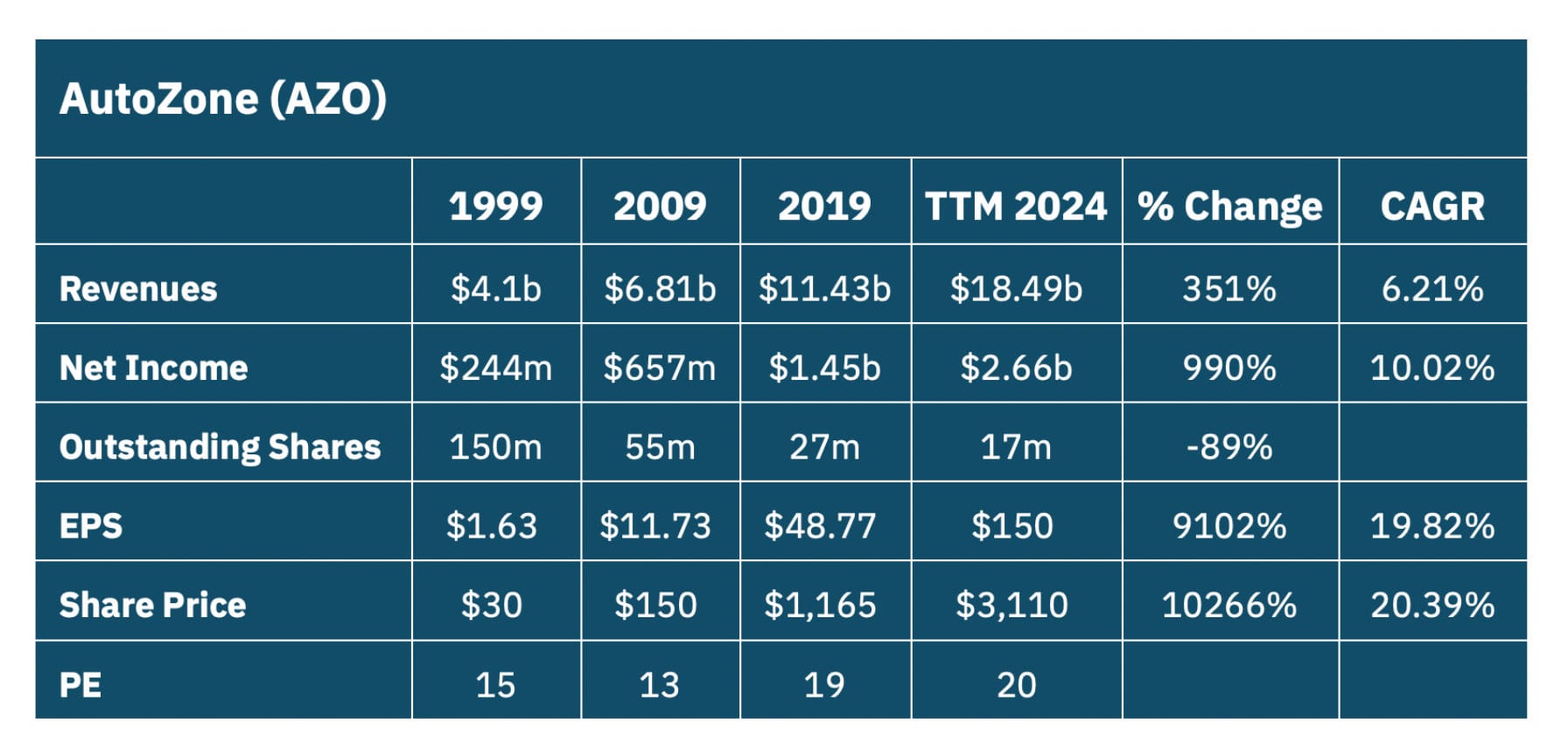
O’Reilly growth rate is double that of AutoZone which has historically given the equity a higher valuation between 20-30 PE. What is interesting is the EPS growth rate is quite similar between the two companies. Both stocks have performed extraordinarily well.
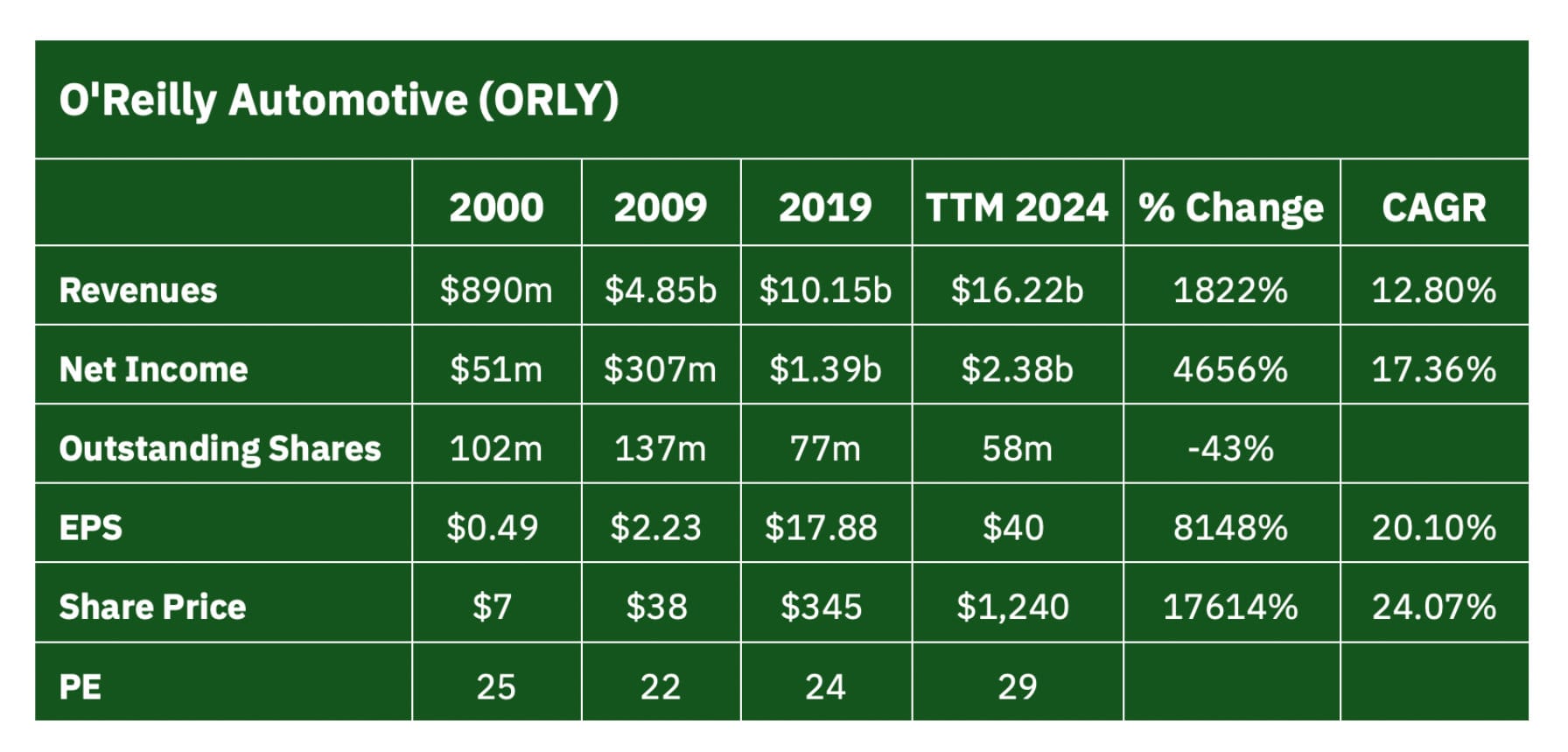
For cash-generative microcap companies, the message is clear: success isn’t about becoming the biggest or growing the fastest—it’s about finding the right size for your business model, industry, and management team. This principle applies not only to the size of the business but also to its shares outstanding. Disciplined share buybacks can provide an invaluable mechanism for creating value when orchestrated in a thoughtful disciplined manner.
Microcaps should adopt AutoZone’s mindset:
- Focus on operational efficiency.
- Use buybacks strategically to compound EPS growth when reinvestment opportunities are limited.
- Avoid the temptation to chase growth for growth’s sake, especially through acquisitions that strain resources or exceed integration capacity.
We live in a revenue growth at all costs type of world. Investors, investment bankers, analysts – they all scream at management teams to grow faster. It takes incredible discipline to turn your back on the crowd and instead focus on EPS growth at all costs.
If you find a well-run cash generative microcap, share this article with the management team. Subject: Just Do This!
You can prove to them there is another way. A slower growth business can still be a great stock.
#### Interact and learn with 250+ of the best microcap investors on the planet:
[Join Us](https://microcapclub.com/join-now)
MicroCapClub is an exclusive forum for experienced microcap investors focused on microcap companies (sub $500m market cap) trading on United States, Canadian, European, and Australian markets. MicroCapClub was created to be a platform for experienced microcap investors to share and discuss stock ideas. Since 2011, our members have profiled 1200+ microcap companies. Investors can join our community by applying to become a member or subscribing to gain instant view only access. MicroCapClub’s mission is to foster the highest quality microcap investor Community, produce Educational content for investors, and promote better Leadership in the microcap arena. For more information, visit and
### REGISTER TODAY - Planet MicroCap Las Vegas in Partnership with MicroCapClub
URL: https://microcapclub.com/register-today-planet-microcap-las-vegas-in-partnership-with-microcapclub-2/
Last updated: 2024-11-16T11:46:49.000Z
I’m excited to announce an event collaboration between MicroCapClub and Planet MicroCap in Las Vegas, on April 22-24, 2025\.
We are teaming up to make Planet MicroCap Las Vegas the best large format microcap event in North America.
This event is **OPEN TO ALL MICROCAP INVESTORS** and **FREE TO ATTEND**. We already have 100+ investors registered.
If you are part of the MicroCapClub community (members and subscribers), we have carved out some [exclusive perks](https://community.microcapclub.com/forums/topic/4594-planet-microcap-las-vegas-in-partnership-with-microcapclub/?ref=microcapclub.com).
Real investors focus on real businesses. One of the goals of our collaboration is to primarily focus on profitable or soon to be profitable businesses. We expect 150+ companies to attend, and we already have 20+ companies signed up to present.
Don't miss this event.
[**Planet MicroCap Las Vegas in Partnership with MicroCapClub**](https://www.meetmax.com/sched/event%5F113149/conference%5Fhome.html?bank%5Faccess=0&event%5Fid=113149&ref=microcapclub.com)
When: April 22-24, 2025 – Get Registered!
Where: Las Vegas, NV at the Paris Las Vegas Casino and Hotel
[**\[FREE TO ATTEND - REGISTER NOW\]**](https://www.meetmax.com/sched/event%5F113149/conference%5Fhome.html?bank%5Faccess=0&event%5Fid=113149&ref=microcapclub.com)
#### Interact and learn with 250+ of the best microcap investors on the planet:
[Join Us](https://microcapclub.com/join-now)
MicroCapClub is an exclusive forum for experienced microcap investors focused on microcap companies (sub $500m market cap) trading on United States, Canadian, European, and Australian markets. MicroCapClub was created to be a platform for experienced microcap investors to share and discuss stock ideas. Since 2011, our members have profiled 1000+ microcap companies. Investors can join our community by applying to become a member or subscribing to gain instant view only access. MicroCapClub’s mission is to foster the highest quality microcap investor Community, produce Educational content for investors, and promote better Leadership in the microcap arena. For more information, visit and
### Stock Picking is a Game of Self-Confidence
URL: https://microcapclub.com/stock-picking-is-a-game-of-self-confidence/
Last updated: 2025-08-16T10:39:06.000Z
In 1831, William Kirkpatrick agreed to compensate Abraham Lincoln (22 years old) to move some saw logs.
Kirkpatrick refused to give Lincoln the equipment he needed but Lincoln still completed the job. Kirkpatrick then paid Lincoln $2 less than the agreed upon rate ($75 less in today’s dollars). Kirkpatrick stiffed him.
A few months later Governor Reynolds of Illinois called for volunteers to join a militia against a Native American named Black Hawk.
Black Hawk was a Sauk leader who led raiding and war parties. The Sauk and Fox tribes ceded their lands in 1828 and were relocated west of the Mississippi river to the newly formed Iowa Indian Territory.
In 1832, Black Hawk became frustrated and moved 1500 of his people back to Illinois which sparked local militia groups to band together to force Black Hawk back to the Iowa territory.
Among the companies that responded was one from Menard County, Illinois.
Abraham Lincoln was still seeking work and doing odd jobs, so he was the first to enlist, and it didn’t take long for the quota of men to be met.
An election was held among the company for whom was to be the captain. A few men wanted Lincoln.
Lincoln didn’t want the position, but finally consented to be a candidate.
The only other candidate was William Kirkpatrick, the man who previously mistreated Lincoln, and who was one of the most influential men in the area.
The election process was simple. Lincoln stood on one side of the room and Kirkpatrick stood on the other side. Each man of the company was to choose their leader by standing beside either Lincoln or Kirkpatrick.
Immediately, 75% of the men stood beside Lincoln. When it was obvious Lincoln was going to win, the few standing next to Kirkpatrick left him, and stood next to Lincoln.
Kirkpatrick was left all alone. Lincoln the wronged laborer was now his ex-employer’s captain.
Later in life, Abraham Lincoln said no other success during his entire lifetime had given him half the satisfaction he felt that day.
The early self-confidence he gained would power him through the next round of struggles. In fact, later in 1832 Lincoln would lose his first political race for Illinois State Legislature.
Many people say early success is a horrible thing because it gives you misguided confidence in your abilities. I disagree.
I often think about how lucky I was that my first experience in the stock market was a big win. It didn’t matter that it was 100% luck. It didn’t matter that I mistook a bull market for brains. The experience gave me self-confidence.
The early win proved to me “I could do this and it could be done”, and that’s all that mattered.
If my first investing experience would have been losing most of my money instead of achieving a big win, I would have likely moved on to some other money-making endeavor (started a business, a career, etc).
A couple years later when the technology/dot-com bubble popped I lost 90% of my money. But it didn’t destroy me because I still had self-confidence. Why? Because I made money before – I knew it could be done. It didn't occur to me that it couldn't be done again. I made the money back.
Abraham Lincoln was 7-5 in elections during his career. 7 wins and 5 losses. His last two elections were wins in 1860 and 1864 for the President of the United States.
An election is basically a popularity contest. How crushing it must be to lose. Your entire State or even Country chooses the other person over you. Everyone knows you were the loser. An election loss has to crush your self-confidence.
In 1858, Lincoln lost in a Senate race against Stephen Douglas. This was only two years before his historical Presidential win.
In a letter to a friend after the loss, Lincoln expressed determination rather than discouragement:
> "The fight must go on. The cause of civil liberty must not be surrendered at the end of one, or even one hundred defeats."
The longer you pick stocks, the more wins and losses you accumulate. Most people say you learn the most from your losers. I disagree.
Many of the losers I've had, there was nothing to learn. In fact, the real lesson was to forget and move on. To not let the losers change who I am, change my strategy, change my principles. To not let the losers slow me down and steal my courage to act on the next opportunity.
A handful of massive winners will likely make up a bulk of your lifetime returns. If you’ve been a stock picker for 10+ years a small part of you always wonders if the last big win you had was your last. You can’t ever let it sink in and believe it or you’re done.
In the final year of Roger Federer’s playing career, he said,
> “It is always in my mind that I can still crush anybody. That’s not an issue. If you don’t believe you can win tournaments anymore, then you can’t do it.”
Stock picking is a game of self-confidence.
Whether you win or lose today you must always know (not believe) that another big win is right around the corner.
A win that could make history.
---
This week I was interviewed by the Excess Returns Podcast. I hope you enjoy it:
#### Interact and learn with 250+ of the best microcap investors on the planet:
[Join Us](https://microcapclub.com/join-now)
MicroCapClub is an exclusive forum for experienced microcap investors focused on microcap companies (sub $500m market cap) trading on United States, Canadian, European, and Australian markets. MicroCapClub was created to be a platform for experienced microcap investors to share and discuss stock ideas. Since 2011, our members have profiled 1000+ microcap companies. Investors can join our community by applying to become a member or subscribing to gain instant view only access. MicroCapClub’s mission is to foster the highest quality microcap investor Community, produce Educational content for investors, and promote better Leadership in the microcap arena. For more information, visit and
### A Conversation with Grant Williams
URL: https://microcapclub.com/a-conversation-with-grant-williams/
Last updated: 2024-10-29T10:31:49.000Z
In this conversation I sit down with Grant Williams. Grant is an accomplished writer, interviewer, speaker, and has this wonderful ability to dissect the financial landscape in a thought provoking way. You can find his content on [www.grant-williams.com](http://www.grant-williams.com/?ref=microcapclub.com).
During this conversation we talk about Grant's twenty years' experience on a trading desk, lessons from great traders, differentiation between luck and skill, writing habits, how he prepares for interviews, and what is top of mind for him currently.
Enjoy this conversation with Grant Williams on [Spotify](https://podcasters.spotify.com/pod/show/microcapclub/episodes/A-Conversation-with-Grant-Williams-e2q7vbd?ref=microcapclub.com), [Apple Podcast](https://podcasts.apple.com/us/podcast/a-conversation-with-grant-williams/id1765974269?i=1000674847369&ref=microcapclub.com), and YouTube below:
#### Interact and learn with 250+ of the best microcap investors on the planet:
[Join Us](https://microcapclub.com/join-now)
MicroCapClub is an exclusive forum for experienced microcap investors focused on microcap companies (sub $500m market cap) trading on United States, Canadian, European, and Australian markets. MicroCapClub was created to be a platform for experienced microcap investors to share and discuss stock ideas. Since 2011, our members have profiled 1200+ microcap companies. Investors can join our community by applying to become a member or subscribing to gain instant view only access. MicroCapClub’s mission is to foster the highest quality microcap investor Community, produce Educational content for investors, and promote better Leadership in the microcap arena. For more information, visit and
### The Inner Animal
URL: https://microcapclub.com/the-inner-animal/
Last updated: 2024-10-24T11:21:19.000Z
It’s April 23, 1991, and the grand Royal Albert Hall in London is packed with Britain’s elite business leaders. Gerald Ratner, confident and sharply dressed, takes the stage at the Institute of Directors Annual Convention to talk about his business. Eight minutes into his speech, leaning into the microphone, he delivers the now-infamous joke:
> “We even sell a pair of earrings for under a pound. Gold earrings as well. And some people say that’s cheaper than a prawn sandwich from Marks and Spencer’s, but I’d say the sandwich will probably last longer than the earrings.”
The room erupts in laughter.
At the time, Ratner was at the helm of the UK’s largest jewelry empire, The Ratners Group, generating over £1.6 billion in revenue and £120 million in profits. He enjoyed the spoils of success—luxury living, and private jets on the company’s dime, along with a substantial salary. But outside that room, his joke fell flat. Britain was in a recession, and the public—many struggling financially—saw his comment as elitist and out of touch. The media pounced, casting him as disconnected from his customers.
In a matter of weeks, The Ratners Group’s stock plummeted from £4.20 to 2p, wiping out £500 million in market value. Customers fled, and Ratner’s empire crumbled. Reflecting on his downfall, Ratner described the experience as “like daggers going into my stomach.” What began as a careless joke destroyed his career, a stark reminder of how unchecked ego and poor judgment can unravel even the most successful leaders.
Ratner’s story is a cautionary tale in business and investing. I’ve noticed that after a big investment win, my Inner Animal similarly starts to surface. Overconfidence creeps in, clouding my judgment, leading to hasty decisions, skipped due diligence, or clinging and to failing positions. Greed, FOMO, and loss aversion are primal instincts that, if left unchecked, sabotage long-term success.
The choice is clear: do we succumb to these impulses, or do we take the long-term approach that prioritizes integrity and collective well-being? Lasting success isn’t built on chasing quick wins and saiting every animal urge. It requires mastering the Inner Animal and recognizing that by serving the greater good, we achieve sustainable, high-return outcomes with the lowest risk.
This is where the analogy of myopia comes into play. As someone with literal myopia—unable to see clearly more than a foot ahead without glasses—I know how short-sightedness distorts our view. In finance, focusing only on immediate gains obscures the bigger picture. To succeed, we need metaphorical glasses of integrity and morality, seeing beyond ourselves and focusing on what benefits everyone around us. In today’s world, what’s good for the whole is greater than the sum of its parts.
Tolstoy’s line from Anna Karenina—*“All happy families are alike; each unhappy family is unhappy in its own way”*—rings true here. There are countless ways to fail by succumbing to our Inner Animal, as Ratner did. But those who achieve the *highest returns, longest duration, and lowest risk* in business and investing follow the same principles: integrity, discipline, and long-term thinking focused on the collective good. They [Take the High Road](https://microcapclub.com/take-the-high-road/), not as an act of altruism, but because it’s simply smart business.
Warren Buffett and Charlie Munger exemplified this. They’ve emphasized that integrity and restraint are far more important for long-term success than intellect alone. As Buffett once said, “If you don’t have integrity, the other two (intelligence and energy) will kill you.” Ratner, in contrast, had intelligence and energy but lacked integrity and humility, leading to his downfall.
In contrast, Buffett and Munger have built Berkshire Hathaway by prioritizing the long-term interests of shareholders, employees, and the companies they acquire. Their annual shareholder letters, filled with wisdom and insights, freely share knowledge with their investors, empowering them to think long-term. During times of market distress, such as the Global Financial Crisis, Berkshire Hathaway provided liquidity when others couldn't, stepping in as a stable, reliable player in turbulent times.
Their reputation as the "acquirer of choice" is rooted in their win-win philosophy: they allow operating companies to maintain their autonomy while benefiting from the resources and stability Berkshire provides. This additive, long-term mindset ensures that each company under the Berkshire umbrella thrives, creating a collective success that far exceeds the sum of individual parts.
By consistently wearing the glasses of integrity and focusing on the well-being of others, Buffett and Munger achieved extraordinary success—*high returns, long duration, and low risk*—by mastering their Inner Animal and cultivating an ecosystem where everyone wins.
Similarly, Bono and U2’s manager, Paul McGuinness, embraced long-term collaboration and ethical principles. Bono’s moral compass—reflected in his “[10 Commandments](https://docs.google.com/document/d/1%5FP-K27NkrExmmW5ZewcPLC%5FpQVZY1vOxvFGqmvcoZnc/edit?usp=sharing&ref=microcapclub.com)”—and McGuinness’s philosophy, embodied by his company Principle Management, ensured U2 retained creative control of their music and a fair share of their earnings. They avoided the traps that ensnared other artists, like Prince, who famously fought his record label for control. While Prince’s rebellion was marked by the word “Slave” written on his face, Bono and McGuinness chose a different path—guided by integrity and additive sum relationships with partners. Over the last 45 years, they’ve become one of the most successful bands in history, amassing hundreds of millions for each band member and relatively few internal squabbles or mistakes.
What Buffett, Munger, and Bono have mastered isn’t just controlling their Inner Animal but applying the lessons of civilization’s moral, intellectual, and cultural progress. The difference between early humans and us today isn’t in our instincts—they remain largely the same—but in the moral and intellectual heritage we’ve inherited. Left unchecked, human nature is raw and often at odds with today’s world. Discipline and guidance—whether from wise mentors or lessons from history—are essential for refining us.
Becoming civilized isn’t about table manners or appearances or becoming a prick—it’s about giving freely, whether it’s knowledge, a laugh, a story, or a helping hand, without expecting anything in return. It’s about adding value to the collective. It’s about treating others as you’d want to be treated and learning from the past to better yourself and those around you.
At MicroCapClub, we live by this philosophy. While the stock market can sometimes feel like a zero-sum game—where one person wins while another loses—that's only true in the short term. Long-term investing isn’t about gambling on quick gains; it's about cultivating a disciplined approach that creates lasting value. At MicroCapClub, we foster a mindset of collective growth, where shared knowledge and collaboration raise everyone up. Our community is greater than the sum of its parts, and together, we help each other navigate the challenges of investing while minimizing the cognitive biases of our Inner Animal.
In the end, both business and investing are about mastering our instincts and focusing on the bigger picture. What once helped us survive now often leads to short-sighted decisions that can sabotage lasting success. But by embracing a disciplined, moral approach that benefits not only ourselves but the collective, we unlock the potential for sustainable, long-term success. At MicroCapClub, we believe that only by working together can we achieve the highest returns with the lowest risk over the longest time. Join us, and let’s rise together.
#### Interact and learn with 250+ of the best microcap investors on the planet:
[Join Us](https://microcapclub.com/join-now)
MicroCapClub is an exclusive forum for experienced microcap investors focused on microcap companies (sub $500m market cap) trading on United States, Canadian, European, and Australian markets. MicroCapClub was created to be a platform for experienced microcap investors to share and discuss stock ideas. Since 2011, our members have profiled 1200+ microcap companies. Investors can join our community by applying to become a member or subscribing to gain instant view only access. MicroCapClub’s mission is to foster the highest quality microcap investor Community, produce Educational content for investors, and promote better Leadership in the microcap arena. For more information, visit and
### The Run
URL: https://microcapclub.com/the-run/
Last updated: 2024-12-04T20:34:22.000Z
Archie Karas was born on the island of Cephalonia, Greece. His father was a poor construction worker. Archie remembers shooting marbles when he was a kid and betting on each game. He made decent money doing it. He worked construction as a teenager. He then worked on a ship for two years being a waiter. Finally, opportunity knocked. The ship set sail for the United States.
At the age of 17 he ended up in Los Angeles. He didn't speak English, so he got a job in the kitchen of a restaurant. In the restaurant was a bowling alley and pool hall. He started playing pool on breaks and soon became an expert pool player. Archie started making more money playing pool than working. He would play $1,000 games, then $5,000 games, then $40,000 games. He amassed $1.2 million from playing pool.
Soon no one wanted to play him anymore, so he started playing poker. He fell in love with poker and poker fell in love with him. He would amass around $2 million in winnings. His nick name was "The Greek". He grew a reputation for having no limit. He played for big stakes and had no fear.
Finally, his luck turned and lost everything. He was down to his last $50 and decided to go to Las Vegas to start over. Archie found someone to lend him $10,000 at 50% interest. At the first table, he tripled the capital in three hours. He paid the person back and kept playing.

This was the start of a legendary 3-year winning streak that would later be called "The Run." He turned $50 into $40,000,000\.
"The Run" received a lot of public attention, and scrutiny from casinos. They put the screws to him. The casinos started accusing him of framing, and he was arrested five times for casino scams. He spent 73 days in jail. His name was put in the infamous "Black Book" - essentially banned for life from Las Vegas. Today He's broke and still lives in Vegas. Archie still claims his innocence.
When I was in college, I wrote down, “$10k and two 10-baggers equal millionaire.” My goal was to be a full-time private investor. It was a motivating force for me. Did I do this exactly? No. Directionally? Yes. In fact, I think 99% of active stock pickers got to the first million this way. You need a few big wins in a row. You must go on a run.
I shared “$10k and two 10-baggers equal millionaire” on social media a year ago and it was met with 10% positive reactions and 90% negative reactions. The 10% were stock pickers that have done it or those that felt motivated by it. The 90% were people that will never achieve it because they don’t believe it can be done.
Many people took the statement the wrong way – that a person must take big risks. No, it simply means finding a few great companies when they are small and holding them. Many of the best investors ever started in microcaps. Many of the best performing stocks ever started as microcaps.
Finding great companies early has never gone out of style and never will. Yes, it’s easy to say and hard to do. It’s hard to find them, and even harder to hold them. What makes it harder still is that a small percentage of the winners will become sustainable monster winners. Most of the winners will eventually fall right back down. [They have a short shelf life](https://microcapclub.com/shelf-life/). Very few deserve to be held for 5+ years.
Many people try at least once to bet on a small stock hoping it becomes the next monster winner. Unfortunately, they get the recommendation/tip from a friend or paid advertisement or some [Judas Goat](https://microcapclub.com/judas-goats/). They lose most of their money and never want to hear about microcaps ever again.
This is why microcap has such a bad reputation. Most investor's first experience with a microcap is a bad one. First impressions matter. They should have focused on [profitable companies](https://microcapclub.com/mcc-profitable-index-q3-2024-update/) instead of story stocks. They should have done actual research instead of viewing the investment like a once per year trip to Las Vegas.
One of my early mentors grew his portfolio from a few thousand dollars to over $150 million in microcaps and then smallcaps. No one knows of him or his accomplishment but his family, close friends (and me). He still lives in the same modest house where he and his wife of 45 years raised their children.
In another [article](https://microcapclub.com/i-hope-this-inspires-you/), I wrote:
> “You don’t hear much about full-time private investors because publicity doesn’t benefit them. In fact, publicity hurts them. Full-time private investors like the fact that even family and friends don’t quite know what they do for a living. They like the fact that they’ve built up an extensive knowledge level in a niche of the market where it doesn’t benefit them to arm-wave their successes. The advantage of the private investor is you can go places bigger money can’t, and build up investment knowledge in an area where few others bother. You can live a comfortable life fishing the same small pond because you know where the fish are. The ability to fit into society, live below your means, and do so under the radar is a big advantage.”
[Jason Hirschman](https://microcapclub.com/a-conversation-with-jason-hirschman/) is another full-time private investor that grew a portfolio from thousands to nine figures. If you intend to buy and hold winning stocks you must also embrace drawdowns. Every big winner has soul crushing drawdowns as they ascend to heaven.
> “Drawdowns are a privilege. It only comes to those who earn it, and I really believe that.” - Jason Hirschman ([source](https://microcapclub.com/a-conversation-with-jason-hirschman/))
If you consider yourself a stock picker – at some point in your life you must do the work others aren’t willing to do and form extreme conviction in something you believe in. But it takes work. YOU must do the work. YOU must form the conviction. The peanut gallery and your emotions will be screaming at you to sell. Holding winners is extremely lonely.
If you can't handle being criticized for your convictions/positions, then you aren’t ready to make real money. Successful investing means doing independent research to form independent conviction so you can achieve uncommon outlier returns.
You will make mistakes. You aren’t perfect. You will buy stocks you shouldn’t. You will sell winners too soon. You will hold losers too long. You can’t learn this game without loss, pain, and discomfort. Whether it’s taking a variant or contrarian view on a business or absorbing the gut shots of being wrong along the way - stock picking takes courage.
Brene Brown said, *“If you choose courage, you will absolutely know failure, disappointment, setback, even heartbreak. That's why we call it courage. That's why it's so rare.*
Every individual stock has its own mini bull/bear market going on within its equity independent of the stock market. Every great stock will have quarters and years where they go nowhere or drawdown against the tide of a bull market and make you look/feel foolish for holding. You will look/feel like an idiot and a hero several times, sometimes in the same year.
Here are the stages of winning stocks:
- Stage 1: \[Stock Goes Up\] - More buyers than sellers.
- Stage 2: \[Stock Peaks\] - Multiple expands until there are more sellers than buyers.
- **Stage 3: \[Stock Down\] - Fundamentals backfill.**
- Stage 4: \[Stock Resumes Going Up\] – Multiple contracts until more buyers than sellers.
Stage 3 can last for quarters or years and this is when a tough decision must be made – Do you hold through Stage 3 or trade around it? The more money you manage the harder it is to be nimble, so it’s natural the more money you accumulate the longer-term you become if you invest in illiquid things. It’s also why overall returns come down as your portfolio grows from $10,000 to $1 million to $10 million to $100 million. It’s why Buffett was confident he could make 50% returns on $1 million and less confident with $50 billion. He can’t be as nimble.
The hardest part of achieving a great long-term investment track record is over half the time your returns will look average. Especially if you are concentrated - you can go years where it feels like you are working hard for mediocre returns waiting for the fundamentals to backfill/multiples compress to springboard the portfolio to new highs. But then it finally happens and the previous year’s efforts, perhaps helped by a better macro environment create circumstances where you don't have to work as hard for your returns. The world works for you and pulls forward 5-10 years’ worth of returns and riches in a single year. “Whew” you feel smart again.
Over the years I’ve realized a portfolio has a certain rhythm to it and the longer you invest the more you can tell whether the portfolio is in tune or out of tune. The “in tune” moments are amazing. The whole portfolio is in sync, not necessarily from a performance perspective, but just holistically you can feel it’s in perfect tune. Every instrument (stock) is doing what it’s supposed to be doing in perfect harmony. If you added a position or took one away it would hurt the portfolio and the rhythm.
Then in a moment everything feels out of tune. The out of tune moments make you feel like you lost control. It might be from a surprise negative announcement from your largest position or just market forces pulling the portfolio lower for no reason. Or maybe it’s from just being wrong on your last few investments. You start to lose confidence. You become unsettled.
Losing streaks compel you to do dumb things at the wrong time. You invest in new things you shouldn’t or double down on the wrong things (losers) trying to make back what you lost. You throw Hail Mary’s like there is 5 seconds left in a tie game when you don’t have to. It’s sort of what happened to Archie. He got more aggressive instead of less aggressive and then his luck ran out. Stock picking is like golf in that it takes discipline, self-confidence, and not letting one or two bad shots get to you. You must get good at forgetting and moving on so you stay in the rhythm. In those moments it’s okay to play a little smaller, not bigger.
I've always loved this quote from Stanely Druckenmiller on position sizing and confidence,
> “People ask me what I learned from George Soros. I thought, when I went there, I was going learn what made the Yen and the Deutsche Mark go up and down, and that kind of thing. No, what I learned was position sizing is probably 70 or 80% of the equation. It's not whether you're right or wrong, it's how much you make when you're right, and how much you lose when you're wrong. I've also found, as an investor, I believe in streaks. You see it in baseball, you see and everything else. I see it in investing. Sometimes you're seeing the ball, sometimes you're not. One of my number one jobs, is to know whether I'm hot or cold. And when I'm hot, I'm supposed to turn the dial way up. Not say, okay, I'm up 40% this year, let's go, this will look good at the end a year ago, take a break. No, you got to make hay while you're hot. And then when you're cold, the last thing you should do is try and make big bets to get back to even. You should tone yourself down.”
Stock picking is about discipline, patience, self-awareness and self-confidence. The first two are knowing what you are looking for and only acting on the great opportunities. The second two are knowing yourself and believing in yourself and knowing another run is just around the corner.
#### Interact and learn with 250+ of the best microcap investors on the planet:
[Join Us](https://microcapclub.com/join-now)
MicroCapClub is an exclusive forum for experienced microcap investors focused on microcap companies (sub $500m market cap) trading on United States, Canadian, European, and Australian markets. MicroCapClub was created to be a platform for experienced microcap investors to share and discuss stock ideas. Since 2011, our members have profiled 1000+ microcap companies. Investors can join our community by applying to become a member or subscribing to gain instant view only access. MicroCapClub’s mission is to foster the highest quality microcap investor Community, produce Educational content for investors, and promote better Leadership in the microcap arena. For more information, visit and
### DIRTT Environmental Solutions: The Global Leader in Industrialized Construction
URL: https://microcapclub.com/dirtt-environmental-solutions-the-global-leader-in-industrialized-construction/
Last updated: 2024-10-10T10:58:56.000Z
I join full-time private investor Jeff Kowal to have a conversation with CEO Benjamin Urban of DIRTT Environmental Solutions Ltd. (DRT.TO / DRTTF). This MicroCap Business Breakdowns discussion took place live on October 8th, 2024, on the MicroCapClub Community. You can listen and participate live by joining the community.
DIRTT Environmental Solutions Ltd. (DRT, TSX-listed) is a global leader in industrialized construction for interior spaces. By utilizing their first-of-its-kind software called ICE, the company custom manufactures client's unique visions into compelling high-performance spaces. This ICE software allows configuration and pricing with direct connection to manufacturing equipment. DIRTT has built sustainable workspaces for 30% of the Fortune 500 companies. The company’s motto is “Not just built for today. Building for tomorrow."Over the past few years, led by two US-based hedge funds, a complete restructuring took place, including the management team, the board and the balance sheet. Now these efforts are starting to show in record delivery times and profitability.
You can listen/watch this business breakdowns on [Spotify](https://podcasters.spotify.com/pod/show/microcapclub/episodes/DIRTT-Environmental-Solutions-The-Global-Leader-in-Industrialized-Construction-e2pfb51?ref=microcapclub.com), [Apple Podcast](https://podcasts.apple.com/us/podcast/dirtt-environmental-solutions-the-global-leader-in/id1765974269?i=1000672472742&ref=microcapclub.com), and YouTube below:
MicroCap Business Breakdowns (MCBB) is a monthly program where we invite leaders of unique microcap businesses to have in depth conversations with the MicroCapClub member/investor that knows the business best. In each conversation we look to drill down into the history, business, strategy, vision, and bull/bear case. The MicroCapClub community can tune in live and ask questions. We publicize each episode two weeks after the live discussion. Not part of the MicroCapClub community? [Join Us](https://microcapclub.com/join-now/).
MicroCapClub is an exclusive forum for experienced microcap investors focused on microcap companies (sub $500m market cap) trading on United States, Canadian, European, and Australian markets. MicroCapClub was created to be a platform for experienced microcap investors to share and discuss stock ideas. Since 2011, our members have profiled 1000+ microcap companies. Investors can join our community by applying to become a member or subscribing to gain instant view only access. MicroCapClub’s mission is to foster the highest quality microcap investor Community, produce Educational content for investors, and promote better Leadership in the microcap arena. For more information, visit and
*Disclaimer: All content in this newsletter is for discussion, education, entertainment, and illustrative purposes only and SHOULD NOT be construed as professional financial advice, solicitation, or recommendation to buy or sell any securities, notwithstanding anything stated on this newsletter and MicroCapClub.com. There are risks associated with investing in securities. Loss of principal is possible. Past performance is not a predictor of future investment performance. Ian Cassel and MicroCapClub.com are not responsible for investment actions taken by viewers. Should you need such advice, consult a licensed financial advisor, legal advisor, or tax advisor. You agree to verify all information yourself before investing. Any past performance discussed on MicroCapClub.com is no guarantee of future results. Investing involves risk and possible loss of principal capital; please seek advice from a licensed professional. All views expressed are personal opinions as of the date of publication and are subject to change without the responsibility to update views. No guarantee is given regarding the accuracy of the information. [FULL DISCLAIMER and TERMS OF USE](https://microcapclub.com/terms/)*
### MCC Profitable Index Q3 2024 Update
URL: https://microcapclub.com/mcc-profitable-index-q3-2024-update/
Last updated: 2024-10-07T14:59:57.000Z
The MCC Profitable Index (MCCPI) is an equal weight index of all global profitable companies (trailing twelve months aka TTM) profiled on MicroCapClub.
Since 87% of all global equities that went up 1000% or more over the last 10 years were microcaps, and 82% of those were profitable, we feel this index is not only a unique tracking mechanism but also a great idea generation tool for the community.
Several multi-baggers are likely hiding in plain sight in the index. As part of our community, you gain access to this incredible tool and will be able to view its constituents.
Every quarter we rebalance the index. New companies enter that are new TTM profitable, and companies get dropped that are no longer profitable TTM. In addition, we drop companies that move over $500 million market cap. The index is not optimized for "performance", but for idea generation.
**MCCPI Q3 2024 Rebalance Update:**
295 total companies/ 45 companies added / 35 companies dropped

MCCPI Q3 2024 Factsheet

Best/Worst Performing Constituents
To view all the companies in the index and the list of companies added/dropped each quarter, [Join Us](https://microcapclub.com/join-now/).
#### Interact and learn with 250+ of the best microcap investors on the planet:
[Join Us](https://microcapclub.com/join-now)
*Disclaimer: All content in this newsletter is for discussion, education, entertainment, and illustrative purposes only and SHOULD NOT be construed as professional financial advice, solicitation, or recommendation to buy or sell any securities, notwithstanding anything stated on this newsletter and MicroCapClub.com. There are risks associated with investing in securities. Loss of principal is possible. Past performance is not a predictor of future investment performance. Ian Cassel and MicroCapClub.com are not responsible for investment actions taken by viewers. Should you need such advice, consult a licensed financial advisor, legal advisor, or tax advisor. You agree to verify all information yourself before investing. Any past performance discussed on MicroCapClub.com is no guarantee of future results. Investing involves risk and possible loss of principal capital; please seek advice from a licensed professional. All views expressed are personal opinions as of the date of publication and are subject to change without the responsibility to update views. No guarantee is given regarding the accuracy of the information. [FULL DISCLAIMER and TERMS OF USE](https://microcapclub.com/terms/)*
MicroCapClub is an exclusive forum for experienced microcap investors focused on microcap companies (sub $500m market cap) trading on United States, Canadian, European, and Australian markets. MicroCapClub was created to be a platform for experienced microcap investors to share and discuss stock ideas. Since 2011, our members have profiled 1000+ microcap companies. Investors can join our community by applying to become a member or subscribing to gain instant view only access. MicroCapClub’s mission is to foster the highest quality microcap investor Community, produce Educational content for investors, and promote better Leadership in the microcap arena. For more information, visit and
### Avoiding the ‘Uh-Oh’ Moments
URL: https://microcapclub.com/avoiding-the-uh-oh-moments/
Last updated: 2024-10-28T10:40:53.000Z
> *"The cost of this kind of myopic learning system is that it will sometimes ignore the obvious." -* Marc Hauser, evolutionary psychologist at Harvard
Marc Hauser gained notoriety in the ‘90s for his psychological studies and experiments on animals to try to uncover patterns in thinking and connections to human behavior. In one study, Hauser trained a rat to navigate a maze to reach food. He gave the rat a script for where the food would be. When he changed the location of the food, moving it to the beginning of the maze, the rat ran right past it to get to where its script told it the food previously was. The script that the rat was given caused it to ignore or discount new information, even when it would have been helpful.
Human beings and investors have some of the same scripts. They can be beneficial, as we use them to override manual thinking to preserve energy, and ‘turn our brain off’ with mundane tasks. An easy example might be if you’ve driven the same road 100 times, you may ignore a new route that’s built, even if it becomes obviously faster. Unfortunately, the efficiency of our scripts comes at the expense of paying attention to real information coming from our environment. For investors, this can be harmful.
Our models and scripts form the basis of how we act and what we believe. We tend to not notice things that are inconsistent with the scripts we’ve been given (or told ourselves) and tend not to notice what is bad about those scripts. I posit that we should never ignore the obvious, even if it means having to override our impulses.
At one point during my NBA days, I was evaluating the next move in my career which involved interviewing with a few different teams and then weighing any offers before accepting one of the positions. I thought I was headed to Charlotte to work for the Hornets until Michael Jordan (the owner at the time) implemented a hiring freeze on the entire organization. Thanks MJ.
As a result, my final decision was between the Rockets and the Bucks. The Bucks flew me to Milwaukee for the day, I met with the entire staff, they took me out to lunch and drove me back to the airport. In a coincidence that will likely never happen again in my lifetime, a disgruntled FAA employee, in a bizarre suicide attempt, set fire to one of the air traffic control towers, causing all flights for the day to be cancelled. The Bucks sent a staff member back to the airport to pick me up, he took me out to dinner, they rescheduled my flight, paid for a hotel for the night, and treated me to a complimentary breakfast the next morning. They even drove me to CVS so I could grab some contact solution. I remember thinking on the flight home, I’m moving to Milwaukee.
When interviewing for the Houston job, they only went as far as talking to me over the phone. I spoke with two executives on the basketball operations team, and they offered me the job. The interviews were ok, and the people seemed ok, but I remember thinking how strange it was that they didn’t want to meet me in person. However, the Rockets were much more competitive than the Bucks at the time, the compensation was a bit better, and I remember having some reservations about living in Milwaukee. I chose Houston, with the rationale being that if I can say I worked for these guys, I will be set for my next opportunity. I couldn’t have been more wrong.
Fast forward a bit, and I drove to Houston with a packed car, with no place to live and only a vague idea of where I should look for apartments. I had no direction from the team, nobody checking in on me, and no help. I again had that strange feeling. Since this was my first time ever stepping foot in Houston, I realized it was going to take me a lot longer to find a place to live than I thought, I called the team the night I got there and asked them if they could put me up in a hotel for a day or two while I secured an apartment. They said: ‘we don’t really do that sort of thing, but good luck finding a place and let us know when you’re coming in’.
It was right then where I thought ‘uh-oh’.
It didn’t take long for me to really miss the Milwaukee Bucks staff, and for the next almost two years, I suffered through some of the worst and most frustrating moments of my career working for a group that was not aligned with who I am as a person or professional. I still think about that decision to this day, especially because it seemed so *painfully obvious* at the time. I knew the right thing to do, and I went in another direction.
As stock pickers, we want to do our very best to avoid having similar ‘uh-oh’ moments with our investments, but unfortunately, it will happen. When it does, it’s important not to ignore them. Uh-oh moments usually reveal themselves during due diligence, or as you get to know a business, and they will be painfully obvious, like my decision to choose between the people in Milwaukee vs. Houston. One group showed me they were great people with a great culture, the others did not. But like our rat mentioned above, the script I was following (work for and contribute to a *good* team, and you can get hired anywhere) caused me to run right past the obvious choice.
I’ve had countless ‘uh-oh’ moments in my investing career, and at times I failed to act appropriately. Sometimes, uh-oh moments need to result in selling a stock. Sometimes they result in incremental due diligence to mitigate a risk, and sometimes, they are just short-term blips, like when a holding drops -20% after a less than stellar quarter. An uh-oh moment can also be thinking you ‘missed’ investing in a good business by not purchasing that stock that you passed on, because it’s up 20-40-60% from when you first passed (only to increase another 400% over time).
It’s our job not to ignore the obvious when these situations arise. When I realized moving to Houston was a mistake, I spent plenty of time justifying my error. Well, the staff here is more accomplished. It will look better on my resume. The weather is nicer in Houston. Justifications like this get you killed in investing. So what you wrote a 40 page research report that took 60 hours of work? So what it’s your largest position? So what the stock is up +30% in two weeks? When that uh-oh moment comes, act accordingly. I couldn’t just pack my things and move out of Houston. But you can sell a stock in seconds. You can make a few due diligence phone calls. You can heavily add to a position when short term issues are clouding the picture.
Years ago, I remember taking a due diligence trip to a remote town deep in the southeastern part of the US, to visit the operations of a $25mm microcap that I thought was my next big winner. In situations like this, when the company is trying to make it, manage costs and grow profitability, I expect everyone to be on the same page. Hungry, focused, and frugal. Let’s not act like we’ve accomplished anything yet. So when the CEO pulled up to the headquarters in a brand new Mercedes S500, I went, uh-oh. A few months later, the company lost their largest customer, kissing 60% of their revenues goodbye. Uh-oh.
I’ll let you guess how the investment turned out. I found a way to justify my feelings along with the bad news and lost a lot of money. I failed to act when the opportunity presented itself, in two very obvious ways.
Another instance involved me taking a trip to see the warehouse and distribution center of a sub-$200mm business. The investment was not going well. The industry hit a rough patch due to macroeconomics factors. There was a first-time CEO. The company was under investigation for unknown claims made by former employees. All uh-oh moments. I distinctly remember arriving at the facility that was supposed to be responsible for $500mm in sales. A small building with plenty of deferred maintenance that looked like it would struggle to do *$5mm* in sales. Uh-oh.
I’ll let you guess how *that* investment turned out. I have plenty more examples. There are patterns here. Something is patently obvious. An uh-oh moment (or two) arrives. Either take action or suffer the consequences.
Today, there is zero tolerance built into my process for *unexpected* uh-oh moments. Deceitful or lying management, a bad capital raise that wasn’t telegraphed in advance, or poor treatment of customers and employees are all signs that I need to move on.
When I launched my firm, the day one portfolio contained a company I was very excited about. Excellent business, good management, cheap valuation. As I got to know management better and as additional channel checks came back, my opinion changed. My spidey sense was tingling and the position was starting to keep me up at night in that I started to believe the CEO was the reason for the cheap valuation and that he would continue to hold the business (and their public market reputation) back. Shortly after, during a live earnings call, when asked to explain a revenue miss, the CEO proceeded to bash his entire salesforce for their youth and inexperience. All blame, zero accountability. This was a software business, so part of the thesis revolved around the company being able to hire talented and hungry salespeople to sign larger and larger deals. And the CEO just publicly torpedoed any chance of doing that successfully over time. Would you want to work for that guy? I sold out of our entire position the next day.
There is a difference between good and bad uh-oh moments. The example above was a ‘shoot first, ask questions later’ situation that necessitated blowing out of our entire position. Earlier this year, however, one of my largest positions hit a quarterly snag and found itself down -30% within a span of two days following the issuance of softer than expected forward guidance. As a global electronics component manufacturer, this was during a period where the market was particularly sensitive to macro weakness, which affected the company given their end market exposure. However, this temporary slowdown was well telegraphed, and management did a great job of explaining that they may see some industry softness given the length of inventory destocking periods that are very common throughout the industry. I also had this as a key item in my pre-mortem for this business. ‘*Expect some industry softness at some point, which will likely result in a tough quarter or two, and a buying opportunity.’* Despite the price action, the quarter itself was excellent, with ample cash generation, debt paydown, a share buyback program implemented for 5% of share outstanding, and a solid longer term picture. In other words, it was very clear that I needed to add to our holding. Following that uh-oh moment, I made it my second largest position. The stock is up +60% in the past six months.
Today, thinking through and identifying potential uh-oh moments has become a big part of my investment process, and I highly recommend it for any investor. Also known as a pre-mortem, I like to write out or visualize waking up to significant negative news for one of my investments. Would I be excited? Would I want to immediately sell the stock? My answer to those questions can be very telling. In addition, it prepares me for that potential shock. With my electronic component manufacturer, I was ready. With my software business, I was watching management closely, and their actions triggered the immediate sell decision.
With every investment, there are things you can’t control, so you need a plan for reacting to the unexpected. This is why research is important. This is why gaining conviction matters. Don’t fall prey to thesis creep, which uh-oh moments can introduce. Write down things that would make you change your mind about a specific investment. Then don’t ignore the obvious. That way, when you’re staring down the barrel of an uh-oh, you won’t just gulp. You’ll do something.
#### Interact and learn with 250+ of the best microcap investors on the planet:
[Join Us](https://microcapclub.com/join-now)
MicroCapClub is an exclusive forum for experienced microcap investors focused on microcap companies (sub $500m market cap) trading on United States, Canadian, European, and Australian markets. MicroCapClub was created to be a platform for experienced microcap investors to share and discuss stock ideas. Since 2011, our members have profiled 1000+ microcap companies. Investors can join our community by applying to become a member or subscribing to gain instant view only access. MicroCapClub’s mission is to foster the highest quality microcap investor Community, produce Educational content for investors, and promote better Leadership in the microcap arena. For more information, visit and
### Kelly Partners Group - The Buy and Build Leaders in Accounting Services
URL: https://microcapclub.com/kelly-partners-group-the-buy-and-build-leaders-in-accounting-services/
Last updated: 2024-09-29T14:18:17.000Z
I join Aakash Vanchi Nath of P&R Investment Management Limited to have a conversation with CEO Brett Kelly and CFO Kenneth Ko of Kelly Partners Group (KPG.AX / KPGHF).
Kelly Partners Group provides accounting services for small and medium businesses. KPG has a buy and build strategy of acquiring accounting firms in Australia and the US and are planning to expand their playbook to new geographies. The have compounded revenues above 20% for over 15 years. Founder and CEO, Brett Kelly is key to the business and owns 49%. Brett will continue to apply the KPG acquisition and business improvement playbook to a fragmented accounting market. This should enable KPG to continue to compound capital at high rates of return for a long period of time.
This MicroCap Business Breakdowns discussion aired on September 26th on the MicroCapClub Community. You can see further discussion on KPG on our community.
You can listen/watch this business breakdowns on [Spotify](https://podcasters.spotify.com/pod/show/microcapclub/episodes/Kelly-Partners-Group---The-Buy-and-Build-Leaders-in-Accounting-Services-e2p0k93?ref=microcapclub.com), [Apple Podcast](https://podcasts.apple.com/us/podcast/microcapclub/id1765974269?ref=microcapclub.com), and YouTube below:
MicroCap Business Breakdowns (MCBB) is a monthly program where we invite leaders of unique microcap businesses to have in depth conversations with the MicroCapClub member/investor that knows the business best. In each conversation we look to drill down into the history, business, strategy, vision, and bull/bear case. The MicroCapClub community can tune in live and ask questions. We publicize each episode two weeks after the live discussion. Not part of the MicroCapClub community? [Join Us](https://microcapclub.com/join-now/).
Disclaimer: The purpose of this presentation is for informational and educational purposes only and should not be construed as a recommendation to purchase or sell any security. MicroCapClub is not a registered investment advisor. MicroCapClub, its partners, members, subscribers, and affiliates may or may not hold positions in one or more of the securities mentioned on this program and may trade in such securities at any time. Do your own due diligence and seek counsel from a registered investment advisor before trading in any security.
MicroCapClub is an exclusive forum for experienced microcap investors focused on microcap companies (sub $500m market cap) trading on United States, Canadian, European, and Australian markets. MicroCapClub was created to be a platform for experienced microcap investors to share and discuss stock ideas. Since 2011, our members have profiled 1000+ microcap companies. Investors can join our community by applying to become a member or subscribing to gain instant view only access. MicroCapClub’s mission is to foster the highest quality microcap investor Community, produce Educational content for investors, and promote better Leadership in the microcap arena. For more information, visit and
### A Conversation with Jason Hirschman
URL: https://microcapclub.com/a-conversation-with-jason-hirschman/
Last updated: 2024-10-07T13:23:29.000Z
Jason Hirschman is on my Mount Rushmore of private investors. Why? He is one of the few private investors that has turned a small personal portfolio into a large nine figure portfolio from stock picking. He was a small business owner that parlayed that and some investing success into becoming a full-time private investor, and now manages capital for his family office at [Hudson 215 Capital](https://hudson215capital.com/?ref=microcapclub.com). Jason's investments typically feature high return on invested capital, superior management, and secular growth tailwinds. He focuses on non-resource microcap equities domiciled in the U.S., Canada, and Europe.
Enjoy this conversation with Jason Hirschman on [Spotify](https://open.spotify.com/episode/5zwzqBZTH6UWqRjhSdFPd5?si=8dd059cc98264f9b&ref=microcapclub.com), [Apple Podcast](https://podcasts.apple.com/us/podcast/a-conversation-with-jason-hirschman/id1765974269?i=1000670510795&ref=microcapclub.com), and YouTube below:
#### Interact and learn with 250+ of the best microcap investors on the planet:
[Join Us](https://microcapclub.com/join-now)
MicroCapClub is an exclusive forum for experienced microcap investors focused on microcap companies (sub $500m market cap) trading on United States, Canadian, European, and Australian markets. MicroCapClub was created to be a platform for experienced microcap investors to share and discuss stock ideas. Since 2011, our members have profiled 1000+ microcap companies. Investors can join our community by applying to become a member or subscribing to gain instant view only access. MicroCapClub’s mission is to foster the highest quality microcap investor Community, produce Educational content for investors, and promote better Leadership in the microcap arena. For more information, visit and
### A Conversation with Anthony Deden
URL: https://microcapclub.com/a-conversation-with-anthony-deden/
Last updated: 2024-09-20T10:06:09.000Z
One of the unique benefits of joining our community is the ability to participate in live discussions with renowned investors, like this one with Anthony Deden, Chairman of Edelweiss Holdings plc. While the public only receives the recording or transcript, our members and subscribers can engage in real-time, asking questions, and contributing to the conversation.
Future conversation recordings will be distributed on [Spotify](https://open.spotify.com/show/0k9ZbZIvGmNXB7mLQXwUSC?si=0cae37f3aaac4ce0&ref=microcapclub.com), [Apple Podcast](https://podcasts.apple.com/us/podcast/microcapclub/id1765974269?ref=microcapclub.com) and [YouTube](https://www.youtube.com/@MicroCapClub?ref=microcapclub.com).
We hope you enjoy this conversation transcript with Anthony Deden.
[Anthony Deden TranscriptAnthony Deden Transcript.pdf9 MBdownload-circle](https://microcapclub.com/content/files/2024/09/Anthony-Deden-Transcript.pdf "Download")
MicroCapClub is an exclusive forum for experienced microcap investors focused on microcap companies (sub $500m market cap) trading on United States, Canadian, European, and Australian markets. MicroCapClub was created to be a platform for experienced microcap investors to share and discuss stock ideas. Since 2011, our members have profiled 1000+ microcap companies. Investors can join our community by applying to become a member or subscribing to gain instant view only access. MicroCapClub’s mission is to foster the highest quality microcap investor Community, produce Educational content for investors, and promote better Leadership in the microcap arena. For more information, visit and
### The Hidden Lessons from Monster Beverage Corporation
URL: https://microcapclub.com/the-hidden-lessons-from-monster-beverage-corporation/
Last updated: 2024-09-25T08:57:23.000Z
Monster Beverage (MNST) has risen 180,000% over the last 32 years, but the stock went nowhere for the first 11 years. Everyone talks about the last 21 years after the breakthrough moment of launching the Monster Energy Drink. No one talks about the first 11 years when the management and business looked mediocre at best. As stock pickers, it’s the first 11 years when Monster Beverage was still a microcap, that are the most instructive.
In 1992, two South Africans, Rodney Sacks (age 42) and Hilton Schlosberg (age 40), acquired Hansen Natural Corporation for $14.5 million. Rodney became the CEO and Hilton became the President. Rodney and Hilton each owned 40% (80% total) of the company. That same year they took the company public on the Nasdaq.
In 1992, Hansen Natural produced $20 million in sales, lost money, and was a $20 million market cap. The company continued to struggle. The losses continued in 1993, 1994, and 1995.
Hansen Natural fell to a $6 million market cap. It was an [ugly duckling](https://microcapclub.com/most-big-winners-were-ugly-ducklings/).
However, the launch of its Smoothie drinks in late 1995 brought renewed optimism. The Smoothie line turned out to be a crucial success, generating one-third of the company's revenue within the first nine months and accounting for one in every five cases sold. This turnaround allowed Hansen Natural to report a profit of $357,000 in 1996.
The company rose back to a $25 million market cap, but it was still an ugly duckling.
At first Sacks was content to chase whatever beverage trend was in vogue, but he knew Hansen's me-too products had little chance of standing out. "We needed to create something different," he recalls.
Hansen's "functionals" came out in early 1997\. A functional beverage provides health and wellness benefits from a variety of functional ingredients, ranging from probiotics to caffeine to bioactive proteins. The trend in functional beverages had already been established in Europe, where they first caught the attention of Sacks.
Hansen's functional drinks were lightly carbonated. They were packaged in skinny 8.2-ounce cans, offering a more manageable serving for an energy drink. Each can retailed for about $2, whereas sodas cost 60 cents. They offered "an immediate boost whenever you need it the most."
Another advantage attributed to Hansen was the superior taste of its drinks. The company also benefited from an established distribution network. Hansen aggressively promoted its functional drinks by giving out free samples and setting up literature centers in grocery stores. Initially, convenience stores and liquor stores were the primary retailers of the new beverage, but it quickly gained traction with a variety of other retailers.
By 1997, three-quarters of the company's sales were from California. The success of the functional drinks line helped Hansen increase out-of-state sales of its other products. In 1997 sales grew to $43 million and earnings were $1.3 million.
By 1998, functional drinks accounted for a quarter of Hansen's $54 million in sales, and the company's earnings grew to $3.6 million. The company was a $40 million market cap.
From 1998 to 2002, sales would grow from $54 million to $92 million, but earnings would stagnate around $3-4 million. The stock would go nowhere for five years, stuck at a $40 million market cap.
From 1992 to 2003, Hansen’s stock went up 50%. A 3.75% CAGR. It was still an ugly duckling.
I often think about the first 11-years of Hansen’s under Randy and Hilton’s leadership. A mediocre looking business with a mediocre looking management team running a $40 million market cap. The business grew from $21 million in sales to $93 million but the business wasn’t showing any operating leverage. I’m sure many of us would have looked at the company and said, “This is a loser”.
The funny thing is we all have at least one of these companies in the portfolio. A company you’ve held onto far too long - hoping that a new product or strategy will completely change the trajectory of the company.
A Price/Earnings (PE) ratio is a good sentiment indicator. When a PE is high, expectations are high. When a PE is low, expectations are low. From 2000-2002, Hansen Natural was trading at a 10 PE. No one was expecting anything.
But then lightning struck.
In late 2002 the company launched the Monster Energy Drink with the tagline “Unleash the Beast”. The edgy packaging was the opposite of the company’s natural product offerings. They snagged some key sports sponsorships. In just two years they were able to acquire 18% market share in the $2 billion energy drink market (Red Bull held 50%).
By the end of 2004, the business grew to $180 million in sales with $20.4 million in earnings and the stock unleashed the beast. Hansen Natural was now a $350 million market cap.
In 2004 and 2005 the energy drink market soared 63%. Coca Cola and Pepsi launched several products into the category to take advantage of the market growth while their core soft drink market declined. Hansen’s Monster brand exploded.
In 2005, Hansen’s sales almost doubled to $350 million, and earnings tripled to $60 million. By the end of 2005, Hansen’s market cap grew to $2 billion. Hansen’s stock rose 3,000% in three years.
Some of you are now thinking of some loser in your portfolio thinking it could be the next Monster Beverage:
This is the interesting part – both Rodney Sacks and Hilton Schlosberg sold 40% of their holdings between 2003-2005\. Could you blame them? They sat on dead money for 11-years and then the stock rips 30x. At the same time industry behemoths Coke and Pepsi were launching numerous products playing catchup. You would have sold too.
Sacks and Schlosberg didn’t know the stock would go up another 14,000% over the next 20 years. What you find is even the people closest to the business don’t even know the future.
#### 87% of all global equities that went up 1000% or more over the past ten years were microcaps.
[Find Multibaggers](https://microcapclub.com/multibaggers)
In 2012, Hansen Natural would change their name to Monster Beverage. In 2015, Monster Energy and Coca-Cola executed a strategic asset swap, with Coca-Cola acquiring Hansen’s juice brands while Monster gained Coke’s energy drink line. Monster consolidated its position in the energy drink market, and Coca-Cola expanded its fruit juice empire.
Today Rodney Sacks (74) and Hilton Schlosberg (72) are still the co-CEOs of Monster Beverage. The two co-founders would continue to sell stock rather consistently. Today they each own \~7% of the company and are both billionaires.
Here is a chart showing Rodney Sacks and Hilton Schlosberg ownership % overlayed over the stock price:
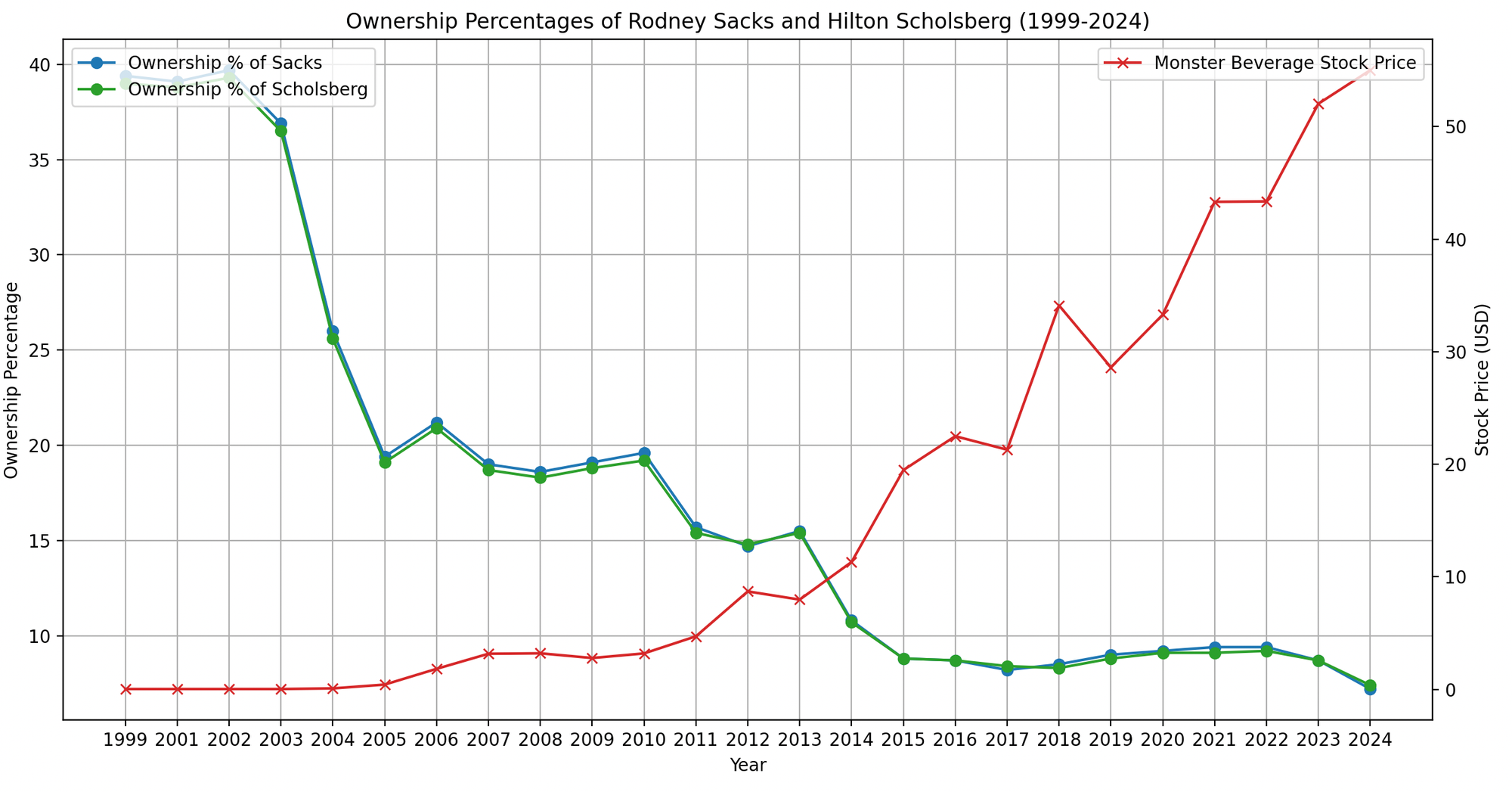
Peter Lynch famously said, "insiders might sell their shares for any number of reasons, but they buy them for only one: they think the price will rise."
Investors love insider buying. It’s the purest signal. What most investors get wrong is believing insider selling is always negative. 95% of insider selling is a non-event and offers little to no signal. Especially in microcap where most operators aren’t filthy rich. They still have bills to pay, tuition to pay, memories they need to pay for at a future Lakehouse with their kids/grandkids. Selling a little along the way doesn’t make them any less motivated.
As yourself – if you were a public CEO, would owning 10%, 30%, even 50% less stock make you any less motivated? I don’t think so. Wouldn’t the shame of a poor public track record be motivation enough? The entire executive management team, employee stock option plan, everyone’s livelihood depends on your decision making. Like all things it all comes down to character and finding and investing in good people.
Here is a great post on X that didn’t get enough attention:
> Investors want managers to have "skin in the game."
>
> As a manager, I want the same. I want the opportunity to bet on myself.
>
> But the evaluation of "skin in the game" isn't as simple as what % of a manager's net worth is tied up in the company, cash comp, or how much of the… [pic.twitter.com/ifJ15cpHP7](https://t.co/ifJ15cpHP7?ref=microcapclub.com)
>
> — PEoperator (@PEoperator) [August 23, 2024](https://twitter.com/PEoperator/status/1827010118141063196?ref%5Fsrc=twsrc%5Etfw&ref=microcapclub.com)
Every monster winner had a breakthrough moment - a new product, FDA approval, a big contract/customer, a super accretive acquisition, a new CEO/management team, or simply being in the right place at the right time with the right product (a little bit of luck). 80% of successful microcap investing is figuring out if a breakthrough moment is the tip of the iceberg or the whole iceberg. Can they parlay this one big win that will last for quarters into many more wins that can last for years/decades?
Every monster winner doesn’t fit perfectly into any framework. We try to cut through the noise by talking about a long-term CAGR, “Monster Beverage has produced a 26.5% CAGR over the last 32 years.” The issue with CAGR’s is it smooths over all the breakthrough moments, missed expectations, volatility, and mediocre moments. It smooths over and hides all the important lessons that need to be learned.
If you liked this article, you would also enjoy the presentation:
#### Interact and learn with 250+ of the best microcap investors on the planet:
[Join Us](https://microcapclub.com/join-now)
MicroCapClub is an exclusive forum for experienced microcap investors focused on microcap companies (sub $500m market cap) trading on United States, Canadian, European, and Australian markets. MicroCapClub was created to be a platform for experienced microcap investors to share and discuss stock ideas. Since 2011, our members have profiled 1000+ microcap companies. Investors can join our community by applying to become a member or subscribing to gain instant view only access. MicroCapClub’s mission is to foster the highest quality microcap investor Community, produce Educational content for investors, and promote better Leadership in the microcap arena. For more information, visit and
### Judas Goat
URL: https://microcapclub.com/judas-goats/
Last updated: 2024-10-14T23:46:24.000Z
In one of the most bizarre spectacles in agriculture history, nicotine-addicted Judas goats once led sheep to slaughter down livestock’s version of the green mile. The aptly named Judas goats, rewarded with a single cigarette for every herd of sheep deceitfully escorted to the killing floor, were once key players in meatpacking plants.
The slaughterhouses of yesteryear were multi-level structures, sometimes five or six stories in height, with each floor housing a specific function related to animal processing. The killing floor occupied the top level and served as a conduit to further processing on the floors below.
Getting large quantities of livestock to the top floor, a space bathed in the smell of death, required systematic efficiency. Cows could be cajoled; pigs could be coaxed; but sheep were a breed apart—an entirely different proposition.
Enter the Judas goat.

It strains credulity to envision the surreal parade of a lone goat leading sheep across a meatpacking facility, coaxing the flock up concrete ramps, delivering the herd beyond the point of no return, and then seeing the goat hustling toward a nicotine fix and a repeat performance. However, Judas goats were part-and-parcel of livestock slaughter, and their history sheds a fascinating light on a bygone era. Betrayal by bleat \[the yell of a goat\] and tobacco.
“The only way to calmly get them \[sheep\] on the killing floor was a goat. We’d take the goat and put him in front of the sheep. Up the ramp they’d go, following Judas. If the sheep hesitated, Billy would bleat to keep them moving. If they didn’t come, he’d stop, turn around, bleat more, and wait for them to catch up.”
At the pinnacle, on the sixth floor, a single doorway led to the final point of debarkation. After the last sheep went by, the goat came back down the ramp to get his reward.
The goat was trained on unfiltered cigarettes, particularly one Camel or Lucky Strike per trip, specifies Dunn. “He ate it whole. He loved it because he was addicted to nicotine.”
The story above is an excerpt from an article by Chris Bennett called, [**Judas Goats: Agriculture’s Bizarre, Drug-Addicted Masters of Deceit Once Ruled the Killing Floor**](https://www.agweb.com/news/livestock/beef/judas-goats-agricultures-bizarre-drug-addicted-masters-deceit-once-ruled?ref=microcapclub.com)**.**
In every industry there are people that knowingly and unknowingly lead sheep to slaughter. The financial industry is filled with them. Judas goats seem to multiply during bull markets. The worst part of bull markets is the rise of inexperienced people educating other inexperienced people. The thing that exacerbates the problem is the human desire for stock recommendations and to buy into them blindly. Most people are wired to be sheep.
**Don’t be a sheep.**
One of the most painful lessons is following people, even high-profile investors, into stocks you don't understand and losing money. Don’t worry, everyone has done this at least once. If you don’t do your own work, you will get slaughtered, especially in microcap.
**!WARNING!** – controversial statement coming that is 100% true.
> Most microcaps you buy must be sold within 36 months. Even the winners. Only a small fraction of the winners will have management teams and businesses that can evolve and grow into something truly sustaining. This is a bitter pill for the buy and hold forever crowd to swallow, but it is microcap reality.
When the crowd buys into an illiquid situation it is fun watching it go up. When the crowd decides to sell an illiquid situation, sheep get slaughtered. If you don’t do your own work, you don’t know when to sell. If you are waiting for someone else to tell you when to sell, it is already too late.
In the rare occasion a sheep buys a monster stock they will never reap the full reward. Every monster stock that ascends 1000%+ over a 3-5-10 year timeframe goes through seasons where the stock is loved, hated, cheap, and expensive.
If you can’t form your own conviction, you will get run over by your emotions. You must put in the work to earn the right to 10-100x stocks.
Sheep (followers) get slaughtered either way. Don’t be a sheep.
**Don’t be a Judas Goat.**
If you're a young stock picker and looking to build a reputation - find a great company early, before institutions. Do the work. Be public about it. Be the axe in the name. Be right. People, employers, investors will find you. Then do it again and again. It's the only resume that matters. This is how I built my early reputation on public stock message boards.
But it’s easy to take things too far. I know I did. When I was young and naïve I would pound on a specific company, and post on the message boards with the consistent drum beat of bullishness. Oftentimes as the stock would rise, my ego would swell, and I would pound that drum even harder.
My early mentor once told me, “Ian, you can get them up \[the stock price\], but the business needs to keep them up.”
Building your reputation in illiquid stocks with short shelf lives can be problematic as your reputation grows on social media, Substack, or paid recommendation service. When “the crowd” piles into an illiquid thing, not everyone will be able to get out. Some portion of your followers will be left “holding the bag” and feeling used. Especially if they saw you bleating and luring the sheep higher into the slaughterhouse as the stock rose.
The hardest part of influence is knowing when to stop.
If you are building your reputation publicly - be thoughtful and disciplined with how you communicate to your audience.
- Give your audience unique situations with supporting evidence. Give them the facts, then let them decide. Educate people so they can make decisions themselves, so when the next material event happens, they can think for themselves. Communicate to them that they own their buy and sell decisions.
- Don’t talk in absolutes like “X stock is going to Y price”. You can’t predict the future with certainty. Talk in if/then statements. “If the business does X, I think the stock can do Y.” Tie the stock price to the business performance, so you never look dumb.
- As stocks rise, expectations rise but keep yours grounded. A good rule of thumb is to be quieter than you want to be when you are right. Stop reaching for reasons the stock can go even higher. Don’t pound the drum at the top. Your audience already knows you found it early. Control your ego.
- Don’t talk bullishly about a stock unless you own it and would buy it at the current price.
- Don’t ever talk bullishly about a stock you are selling.
If you want to gain followers, talk about your winners. If you want to gain the respect of your peers and keep your followers, talk about your losers. Postmortems are where the real learning happens.
Talking about your losers in a once per year, longer form post, shows your audience what you and they can learn from the losers. It also reinforces the right lesson – you aren’t going to be right all the time. Microcap success is batting average + slugging percentage. You can make a lot of money being right half the time.
When you are building your reputation, the way you communicate matters. Be thoughtful. Don’t be an amateur. Future investors, employers, business partners are watching you.
The world doesn’t need more sheep. The world doesn’t need another Judas goat.
#### Interact and learn with 250+ of the best microcap investors on the planet:
[Join Us](https://microcapclub.com/join-now)
MicroCapClub is an exclusive forum for experienced microcap investors focused on microcap companies (sub $500m market cap) trading on United States, Canadian, European, and Australian markets. MicroCapClub was created to be a platform for experienced microcap investors to share and discuss stock ideas. Since 2011, our members have profiled 1000+ microcap companies. Investors can join our community by applying to become a member or subscribing to gain instant view only access. MicroCapClub’s mission is to foster the highest quality microcap investor Community, produce Educational content for investors, and promote better Leadership in the microcap arena. For more information, visit and
### The Price of Greatness
URL: https://microcapclub.com/the-price-of-greatness/
Last updated: 2024-09-02T10:36:18.000Z
Look for a moment at the breathtaking ceiling of the Sistine Chapel. What comes to mind? Michelangelo. Masterpiece. Beauty. The pinnacle of the Renaissance.
But have you ever stopped to think about what truly went into creating one of the most iconic works of art in history? What was the price for such greatness?
Was it an effortless exercise, a mere stroll through the park for Michaelangelo to create?
Well, it was far from being all sunshine and rainbows for Michelangelo. In fact, in 1509, he penned a poem detailing his experience one year into the project, and it is nothing short of eye-opening. It reveals the price of greatness:

Michelangelo described precisely what Bob Dylan sang, “Behind every beautiful thing, there is some kind of pain.”
Similarly, behind every impressive investment or business track record, there is often some kind of pain. Take Stanley Druckenmiller, for example. Over nearly three decades, he consistently achieved phenomenal success, reportedly never having a losing year and delivering an average annual return of around 30%. However, in 2010, when he decided to close his Duquesne Fund, Druckenmiller revealed the price of greatness. He stated:
> "For me the disappointment of each interim drawdown over the years has taken a cumulative toll that I cannot continue to sustain…I continue to care deeply about performing for our clients, and the stress of performing in a way that I consider to be disappointing - even if you do not share that view - persists in exacting a high emotional toll.”
Even the great investors feel pain. It has been a while since the market has faced a significant downturn, so now might be a good time to discuss the cost of greatness–pain.
Seeing your stocks drop 20% feels like a punch in the mouth. Watching a stock freefall 50% is like a kick to the gut. When your whole portfolio drops by a third, it induces panic. While most pain in life has an expected duration - a cold lasts a week, a deep cut heals in about a month - the pain from losing money (whether it’s realized or just on paper) has no set time limit. It can last a day or feel like a lifetime with no end in sight. Not to mention you might be wrong or right.
Behind every microcap that grows into a large-cap, investors must endure significant pain to reap the most beautiful rewards. Take, for instance, Wal-Mart’s stock price from 1972 to 1998\.
Over this 26-year period, Wal-Mart’s stock grew 871 times, resulting in a compound annual growth rate (CAGR) of 29%. However, to achieve these remarkable returns, akin to a Sistine Chapel masterpiece, investors had to endure years of hardships and painful mental beatings. For instance, Wal-Mart’s share price fell by 72.5% in 1972 and stayed at that level for 8 trading days. It then took until October 3, 1977–1,218 trading days, nearly 5 full calendar years– for the stock to recover to its 1972 high.
Wal-Mart shareholders would then have to endure the following drawdowns in the share price:
- \[>20%\] 33.2% of the time = 2,152 days
- \[>30%\] 14% of the time = 907 days
- \[>40%\] 6.4% of the time = 419 days
- \[>50%\] 4% of the time = 259 days
- \[>60%\] 1.4% of the time = 91 days
- \[>70%\] 0.45% of the time = 29 days

How then does an investor build the tolerance for pain and discern which pain is worth enduring and which should be avoided?
The great Japanese novelist Haruki Murakami once wrote, “I can bear any pain as long as it has meaning.” When I go to the gym, I look forward to each grueling workout and the accompanying pain because it signals that my muscles are growing, I’m pushing my limits, and I’m maintaining healthy habits that benefit my short- and long-term health. The low throb and ache in my muscles after reaching failure in a workout has positive meaning to me.
The same applies to investing. The hours spent gathering quality information, writing, thinking, organizing, and synthesizing ideas from business and various fields can be tedious and, at times, painful, much like working out at the gym. Yet, this effort is meaningful and, therefore, bearable. This preparation helps me grow my understanding, sharpen my skills, improve my pattern recognition, and increase my ability to endure volatility. So, when I invest in companies that align with my framework and their share price falls due to superficial reasons, it’s painful—but that pain is temporary. Great businesses and achievements are enduring. However, quitting a promising investment too soon or at the worst possible time can lead to a much deeper suffering—lasting regret, one of the most profound and enduring pains a person can experience.
However, just as there is good pain and bad pain in the gym, the same is true in the stock market. If I overwork myself, push too far or lift with poor form and injure a muscle, the pain is sharp and intense. There’s no benefit to feeling more of this pain; it signals that I need to STOP and heal immediately. To continue on could lead to irreversible damage. The same principle applies to investing. When you overextend yourself into a situation that you don’t understand, the pain can be severe. These situations often involve poor form by not doing the work or following someone blindly, as well as getting into lesser-quality companies and opportunities where the risk of capital loss is high. In these cases, the pain is everlasting, and you need to STOP, sell and heal immediately.
If you’re not experiencing some form of good pain on a daily basis, you’re not pushing yourself hard enough, and you’re not paying the price for greatness. To achieve something truly remarkable, you have to give up something—in this case, comfort—for everything you gain.
All greatness comes with an edge of pain, so pay the price and don’t complain.
#### Interact and learn with 250+ of the best microcap investors on the planet:
[Join Us](https://microcapclub.com/join-now)
MicroCapClub is an exclusive forum for experienced microcap investors focused on microcap companies (sub $500m market cap) trading on United States, Canadian, European, and Australian markets. MicroCapClub was created to be a platform for experienced microcap investors to share and discuss stock ideas. Since 2011, our members have profiled 1000+ microcap companies. Investors can join our community by applying to become a member or subscribing to gain instant view only access. MicroCapClub’s mission is to foster the highest quality microcap investor Community, produce Educational content for investors, and promote better Leadership in the microcap arena. For more information, visit and
### Large Positions
URL: https://microcapclub.com/large-positions/
Last updated: 2024-09-11T12:50:56.000Z
Herschel Walker was a formidable running back in the late 1980s and early 1990s. He was drafted and played the first part of his career at the Dallas Cowboys. He amassed 8,225 rushing yards and scored 61 rushing touchdowns throughout his career. At a time when few running backs were also receivers, he recorded 4,859 receiving yards which contributed to his reputation as a potentially game changing player.
In 1989, the Minnesota Vikings decided they had to have him. They believed he would be the final piece they needed to win a Super Bowl leading them to give up a total of eight draft picks, including three first-round picks and three second-round picks, along with five players.
However, Walker was never able to live up to those expectations in Minnesota and was gone from the team within three seasons.
The Cowboys used the wealth of draft picks they received to build a dynasty in the 1990s. They drafted future Hall of Famers Emmitt Smith and Darren Woodson, as well as several other key contributors to their championship teams. The Cowboys won three Super Bowls with those players in 1992, 1993, and 1995.
Minnesota was thinking about one amazing player. Dallas was thinking about the whole team. The trade became known as “The Great Train Robbery” because of how one-sided the outcome was in Dallas’s favor. It’s used as a prime example of how focusing on a single player rather than the whole team can be a colossal mistake.
At our [Summit](https://microcapclub.com/summit/), [Jason Buck](https://x.com/jasoncbuck?ref=microcapclub.com) told me the [story](https://mutinyfund.com/herschel-walker-syndrome/?ref=microcapclub.com) above about Herschel Walker. It got me thinking about position sizing.
When I was a private investor, I was super concentrated in 2-3 stocks. All it took was one or two big winners in any given year to have a phenomenal year which I would define as a portfolio return of 75%+.
When you own a 2-3-stock portfolio, you have the time to go a mile deep into your positions. This can also become the biggest downside. The downside of super concentration is overthinking your positions. You have too much time to think about a few things.
As your capital grows it’s important to [grow yourself](https://microcapclub.com/grow-yourself/) with your capital. It’s a natural progression to add a few more positions. Why? You get better at knowing what you are looking for and waiting until you find it. You also get better at evaluating and tracking more positions than when you were younger. I feel today I can get similar performance out of 4-8 core positions (core = 10%+ positions) with less volatility and risk as I did with 2-3 core positions.
I started managing outside capital in late 2018\. We normally hold 4-8 core positions (85% of portfolio) and another 4-5 smaller/tracking positions. I view our large core positions similar to veteran players on a sports team. Core positions have earned their right to their position size/salary. You've spent considerable time to get to know them. You've witnessed how the management and the business react under pressure. They've proven themselves and have earned your conviction and trust. The stock has rewarded you with good returns and you have rewarded the management/business with a bigger weighting in the portfolio.
For long only quality focused stock pickers, your largest positions should be the businesses you’ve held the longest that have gone up the most. It doesn’t always work out this way but directionally I think the statement is correct.
Our 4-5 smaller/tracking positions I view as our farm team/minor league team. These businesses have a majority of the elements we seek to make an investment, but they are still somewhat young, immature, and unproven. We buy a little to put them on our team, to follow and get to know the management, and give them a little playing time. The minor league is where a bulk of our turnover occurs. If the management team and business perform, we will buy more and make them a core position. If they don’t perform, we kick them off the team and replace them with other talented prospects.
Building conviction in a position is the same as building trust in a relationship. It just takes time to develop. It can’t be forced. The best relationships are built over time. The best positions are built over time.
If you are a concentrated investor that lets positions run, the larger a position becomes the more it will lead the entire portfolio up and down. Every stock has its own little bull and bear market cycle going on within its equity independent of the macro cycle. They can last for months, quarters, years, triggered by a really good or bad quarter. Hated to loved, loved to hated. Large positions can make you look like a hero in bad times (outperform during bear markets), and an idiot in good times (underperform during bull markets).
Earlier this year I had a 30% position that was down 30% YTD, and I had two 5% positions go up 100%, and I remember thinking how hard I had to work to breakeven, but that is the price you pay for concentration. It cuts both ways. I'm used to this, but you must be sure your investors understand.
An imperfect analogy might be the more you pay your superstar player the less you can pay/allocate to the other players. You also must be sure your superstar doesn’t get hurt. If you don’t get production out of your superstar, the rest of the team really needs to step up.
A few years ago, I had a phenomenal year in the market. I owned 10 stocks and 7 of them returned 100%+ in the same year. I look forward to that happening again – in my lifetime. When I looked at the attribution, I remembered thinking that it now takes a team effort to produce a phenomenal return in the portfolio in a single year. I used to go all in on one superstar, and now I build winning teams.
#### Interact and learn with 250+ of the best microcap investors on the planet:
[Join Us](https://microcapclub.com/join-now)
MicroCapClub is an exclusive forum for experienced microcap investors focused on microcap companies (sub $500m market cap) trading on United States, Canadian, European, and Australian markets. MicroCapClub was created to be a platform for experienced microcap investors to share and discuss stock ideas. Since 2011, our members have profiled 1000+ microcap companies. Investors can join our community by applying to become a member or subscribing to gain instant view only access. MicroCapClub’s mission is to foster the highest quality microcap investor Community, produce Educational content for investors, and promote better Leadership in the microcap arena. For more information, visit and
### Quest Resource Holdings Corp (QRHC) - An Asset-Light Waste and Recycling Services Provider
URL: https://microcapclub.com/quest-resource-holdings-corp-qrhc-an-asset-light-waste-and-recycling-services-provider-2/
Last updated: 2024-08-24T13:37:48.000Z
I join Greg Kitt and Jordan Salim from the Pinnacle Family Office to have a conversation with CEO Ray Hatch of Quest Resource Holding Corporation (QRHC).
Quest Resource Holding Corp (QRHC) is an asset-light waste and recycling services provider benefitting from increased interest to divert waste away from the landfill because of external regulatory drivers and internal ESG mandates. Quest boasts long standing relationships with a diversified base of blue chip customers, and provides data and reporting to customers to meet internal ESG and regulatory requirements. QRHC diverts 80% of waste away from the landfill by recovering the salvage value for these commodities, meaning customers benefit from increased landfill diversion, reduced operational complexity, and modest cost savings. Quest’s waste hauler partners gain access to large volume waste generator customers that they could not otherwise win. These waste haulers benefit from high margin incremental volume and offer Quest attractive pricing in exchange for these large, dependable customers.
Quest’s business has true flywheel effects. Quest’s unit economics improve with scale because Quest can effectively reduce service costs to its customers, which drives incremental business, creating the flywheel. Scale drives network effects that improve QRHC’s value proposition to customers and haulers.
This MicroCap Business Breakdowns discussion aired on August 22nd on the MicroCapClub Community. You can see further discussion on QRHC on our community.
MicroCap Business Breakdowns (MCBB) is a monthly program where we invite leaders of unique microcap businesses to have in depth conversations with the MicroCapClub member/investor that knows the business best. In each conversation we look to drill down into the history, business, strategy, vision, and bull/bear case. The MicroCapClub community can tune in live and ask questions. We publicize each episode two weeks after the live discussion. Not part of the MicroCapClub community? [Join Us](https://microcapclub.com/join-now/).
Disclaimer: The purpose of this presentation is for informational and educational purposes only and should not be construed as a recommendation to purchase or sell any security. MicroCapClub is not a registered investment advisor. MicroCapClub, its partners, members, subscribers, and affiliates may or may not hold positions in one or more of the securities mentioned on this program and may trade in such securities at any time. Do your own due diligence and seek counsel from a registered investment advisor before trading in any security.
MicroCapClub is an exclusive forum for experienced microcap investors focused on microcap companies (sub $500m market cap) trading on United States, Canadian, European, and Australian markets. MicroCapClub was created to be a platform for experienced microcap investors to share and discuss stock ideas. Since 2011, our members have profiled 1000+ microcap companies. Investors can join our community by applying to become a member or subscribing to gain instant view only access. MicroCapClub’s mission is to foster the highest quality microcap investor Community, produce Educational content for investors, and promote better Leadership in the microcap arena. For more information, visit and
### The Skills of Stock Picking
URL: https://microcapclub.com/the-skills-of-stock-picking/
Last updated: 2024-08-20T10:14:02.000Z
I gave this presentation at the MicroCap Leadership Summit on August 1, 2024.
#### Interact and learn with 250+ of the best microcap investors on the planet:
[Join Us](https://microcapclub.com/join-now)
The MicroCap Leadership Summit is an annual event hosted by MicroCapClub. MicroCapClub is an exclusive forum for experienced microcap investors focused on microcap companies (sub $500m market cap) trading on global markets. MicroCapClub was created to be a platform for experienced microcap investors to share and discuss stock ideas. Investors can join our community by applying to become a member or subscribing to gain access. MicroCapClub’s mission is to foster the highest quality microcap investor Community, produce Educational content for investors, and promote better Leadership in the microcap arena. For more information, visit [http://microcapclub.com](https://www.youtube.com/redirect?event=video%5Fdescription&redir%5Ftoken=QUFFLUhqbG92MXJYQjE4cVdTaXpfbzhDVEwzS0FTNHdlQXxBQ3Jtc0tsQjBRM2h2VGx1X1BxX01aWC1Nc2FhNEF2bi1FWmUyNXBvOUhyTkRGQ3NsU3d2REFpczNsVllhQy01MW5xYmpDT0I1azlTVXU0NUd2dHJzS1Q5Rl9xU2VzR3R3WGIwLVhVVGNSTVFndmRpYzE2Q1hyUQ&q=http%3A%2F%2Fmicrocapclub.com%2F&v=daf22jRsXdI&ref=microcapclub.com) and [https://microcapclub.com/summit/](https://www.youtube.com/redirect?event=video%5Fdescription&redir%5Ftoken=QUFFLUhqbDhBVGNpMUFxeVdQY2pscFRfZTQ4NUxHS0N1UXxBQ3Jtc0trZDY4cGQyY3dNMzQ5TTlBNnF0TVZsX0c0OGUycGVWMDlEVTdLSWgwbnU0eEVDTmlrdG8zZ3c0QUZYRk9yNWIxLUhwZ3VmMFpoRl9YWGhER01VUkpUS1ZJRUMzSm9UNks4cUVqSWVoS2JJRUlWbXRJRQ&q=https%3A%2F%2Fmicrocapclub.com%2Fsummit%2F&v=daf22jRsXdI&ref=microcapclub.com)
Disclaimer: The purpose of this presentation is for informational and educational purposes only and should not be construed as a recommendation to purchase or sell any security. MicroCapClub is not a registered investment advisor. MicroCapClub, its partners, members, subscribers, and affiliates may or may not hold positions in one or more of the securities mentioned on this program and may trade in such securities at any time. Do your own due diligence and seek counsel from a registered investment advisor before trading in any security.
### Building Platform Companies by Ron Nixon
URL: https://microcapclub.com/presentation-building-platform-companies-by-ron-nixon/
Last updated: 2024-08-14T10:03:06.000Z
Ron Nixon, founder of The Catalyst Group and CEO of Sanara MedTech (SMTI), presented at MicroCap Leadership Summit 2024 at the Coeur d’Alene Resort in Coeur d’Alene, Idaho. The MicroCap Leadership Summit can only be attended by members and subscribers of the MicroCapClub community.
Ron Nixon founded The Catalyst Group in 1990 for one primary reason: to assist good companies achieve their long-term potential. Over his career, he has participated in over 200 separate transactions while managing TCG’s eight previous limited partnerships. Ron is also CEO of Sanara MedTech (Nasdaq:SMTI), one of the platform companies he is building to disrupt the surgical and wound care industries.
Ron Nixon was the first investor who backed Keith Myers from LHC Group in 1995, which sold to UnitedHealth for $5.4 billion in 2023\. Keith presented right before Ron at the Summit, and you can hear that presentation [here](https://microcapclub.com/presentation-the-story-of-lhc-group-by-co-founder-keith-myers/).
The MicroCap Leadership Summit is an annual event hosted by MicroCapClub. MicroCapClub is an exclusive forum for experienced microcap investors focused on microcap companies (sub $500m market cap) trading on global markets. MicroCapClub was created to be a platform for experienced microcap investors to share and discuss stock ideas. Investors can join our community by applying to become a member or subscribing to gain access. MicroCapClub’s mission is to foster the highest quality microcap investor Community, produce Educational content for investors, and promote better Leadership in the microcap arena. For more information, visit [http://microcapclub.com](https://www.youtube.com/redirect?event=video%5Fdescription&redir%5Ftoken=QUFFLUhqbG92MXJYQjE4cVdTaXpfbzhDVEwzS0FTNHdlQXxBQ3Jtc0tsQjBRM2h2VGx1X1BxX01aWC1Nc2FhNEF2bi1FWmUyNXBvOUhyTkRGQ3NsU3d2REFpczNsVllhQy01MW5xYmpDT0I1azlTVXU0NUd2dHJzS1Q5Rl9xU2VzR3R3WGIwLVhVVGNSTVFndmRpYzE2Q1hyUQ&q=http%3A%2F%2Fmicrocapclub.com%2F&v=daf22jRsXdI&ref=microcapclub.com) and [https://microcapclub.com/summit/](https://www.youtube.com/redirect?event=video%5Fdescription&redir%5Ftoken=QUFFLUhqbDhBVGNpMUFxeVdQY2pscFRfZTQ4NUxHS0N1UXxBQ3Jtc0trZDY4cGQyY3dNMzQ5TTlBNnF0TVZsX0c0OGUycGVWMDlEVTdLSWgwbnU0eEVDTmlrdG8zZ3c0QUZYRk9yNWIxLUhwZ3VmMFpoRl9YWGhER01VUkpUS1ZJRUMzSm9UNks4cUVqSWVoS2JJRUlWbXRJRQ&q=https%3A%2F%2Fmicrocapclub.com%2Fsummit%2F&v=daf22jRsXdI&ref=microcapclub.com)
Disclaimer: The purpose of this presentation is for informational and educational purposes only and should not be construed as a recommendation to purchase or sell any security. MicroCapClub is not a registered investment advisor. MicroCapClub, its partners, members, subscribers, and affiliates may or may not hold positions in one or more of the securities mentioned on this program and may trade in such securities at any time. Do your own due diligence and seek counsel from a registered investment advisor before trading in any security.
### The Story of LHC Group by co-founder Keith Myers
URL: https://microcapclub.com/presentation-the-story-of-lhc-group-by-co-founder-keith-myers/
Last updated: 2024-08-14T10:29:30.000Z
Keith Myers presented at MicroCap Leadership Summit 2024 at the Coeur d’Alene Resort in Coeur d’Alene, Idaho. The MicroCap Leadership Summit can only be attended by members and subscribers of the MicroCapClub community.
Keith G. Myers is co-founder of LHC Group and served as chairman and CEO from 1994 until the company was acquired by UnitedHealth for $5.4 billion in 2023\. Mr. Myers helped establish LHC Group as a single freestanding home health agency in rural St. Landry Parish, La. From this foundation, he and his wife Ginger, a nurse at the time, built what would become one of the largest and highest quality in-home healthcare providers in the U.S. with 29,000 employees supporting more than 900 agency locations serving 38 states and the District of Columbia.
The MicroCap Leadership Summit is an annual event hosted by MicroCapClub. MicroCapClub is an exclusive forum for experienced microcap investors focused on microcap companies (sub $500m market cap) trading on global markets. MicroCapClub was created to be a platform for experienced microcap investors to share and discuss stock ideas. Investors can join our community by applying to become a member or subscribing to gain access. MicroCapClub’s mission is to foster the highest quality microcap investor Community, produce Educational content for investors, and promote better Leadership in the microcap arena. For more information, visit [http://microcapclub.com](https://www.youtube.com/redirect?event=video%5Fdescription&redir%5Ftoken=QUFFLUhqbG92MXJYQjE4cVdTaXpfbzhDVEwzS0FTNHdlQXxBQ3Jtc0tsQjBRM2h2VGx1X1BxX01aWC1Nc2FhNEF2bi1FWmUyNXBvOUhyTkRGQ3NsU3d2REFpczNsVllhQy01MW5xYmpDT0I1azlTVXU0NUd2dHJzS1Q5Rl9xU2VzR3R3WGIwLVhVVGNSTVFndmRpYzE2Q1hyUQ&q=http%3A%2F%2Fmicrocapclub.com%2F&v=daf22jRsXdI&ref=microcapclub.com) and [https://microcapclub.com/summit/](https://www.youtube.com/redirect?event=video%5Fdescription&redir%5Ftoken=QUFFLUhqbDhBVGNpMUFxeVdQY2pscFRfZTQ4NUxHS0N1UXxBQ3Jtc0trZDY4cGQyY3dNMzQ5TTlBNnF0TVZsX0c0OGUycGVWMDlEVTdLSWgwbnU0eEVDTmlrdG8zZ3c0QUZYRk9yNWIxLUhwZ3VmMFpoRl9YWGhER01VUkpUS1ZJRUMzSm9UNks4cUVqSWVoS2JJRUlWbXRJRQ&q=https%3A%2F%2Fmicrocapclub.com%2Fsummit%2F&v=daf22jRsXdI&ref=microcapclub.com)
Disclaimer: The purpose of this presentation is for informational and educational purposes only and should not be construed as a recommendation to purchase or sell any security. MicroCapClub is not a registered investment advisor. MicroCapClub, its partners, members, subscribers, and affiliates may or may not hold positions in one or more of the securities mentioned on this program and may trade in such securities at any time. Do your own due diligence and seek counsel from a registered investment advisor before trading in any security.
### We Will Find You
URL: https://microcapclub.com/we-will-find-you/
Last updated: 2024-08-12T10:44:57.000Z
> “I know there’s joy at the other end, at the finish line. But I also know I’ve got to earn that happiness.”
The quote above is from Sha’Carri Richardson, the fastest woman in the world -or possibly your favorite microcap.
Microcap investing can at times feel like both a sprint and a marathon. Whichever one it is, there are two things in common. There is a finish line at the end, and both companies and shareholders must *earn the right* to cross it.
When I was working in the NBA, I once heard a reporter ask my boss, the General Manager of the team, how it was possible for scouts to find obscure players in obscure places around the globe? His response was, it doesn’t matter where someone is from. If they’re good enough, we’ll find them.

Giannis Antetokounmpo
Back then, I was also privy to the first scouting tape ever released for NBA All-Star Giannis Antetokounmpo. It was a grainy film recorded in a most likely non-air conditioned high-school gym in Athens, Greece, and to make a long story short, there were plenty of questions raised about Giannis’ prospects. However, *none* of those questions included wondering how he would get noticed by the NBA.
In meetings with prospective investors, after highlighting a business we own with the tagline of quality, cheap and insufficiently researched, a question I’m often asked is, “Why won’t this just stay cheap forever?” I have come to like this question less and less over time. The idea is that if a company is small, doesn’t benefit from indexation, and is too small for larger funds to own, how will the stock price appreciate? I think of Giannis whenever this question comes up.
The answer I’ve historically given is that company size doesn’t matter. The market mechanism that reprices revenue and earnings growth is not broken, no matter how small the business. One of the reasons I love microcaps is that I regularly come across examples (sometimes in my own portfolio) of sub-$20mm or sub-$10mm market cap businesses that experienced significant price appreciation on the back of positive changes in fundamentals. These have included food distribution companies, Mexican mining businesses, manufacturers of gas storage equipment, and even companies that forego investor communication altogether. Although investors may not see huge step changes all at once, over time, good results can’t be ignored. If earnings power grows, size is not an impeding factor.
This idea is just as important when viewed through the lens of companies themselves. Microcap management teams have to realize (and often don’t) that the best shareholders, and significant share price appreciation, is earned. One of the things I like to do prior to and during the ownership of our businesses is develop relationships with our management teams. As a result, I’m occasionally asked a version of the question I’m posed above, especially by the businesses that are executing well, and not yet seeing the fruit of their labor. When will the market notice? What more could we be doing?
My response to them is along the same lines. If you’re good enough, investors will find you. That’s my answer from now on. Companies that grow earnings power and don’t dilute give themselves a great chance of getting noticed, no matter how small. That’s because we, as stock pickers, are looking, and we will find them.
- If you grow organically, investors will find you.
- If you don’t dilute, investors will find you.
- If you allocate capital responsibly and for the benefit of shareholders, shareholders will find you.
- If earnings power grows, investors will find you.
A great example of this is Warren Buffett’s purchase of Grief Bros. Cooperage in 1951\. Buffett purchased Grief at a single digit multiple of earnings, when the entire company had a market cap of $6mm ($70mm today, adjusted for inflation). As a manufacturer of bulk packaging equipment, Grief was a simple business with a clean balance sheet and a long history of profitability. With an average purchase price of around $18, Buffett likely experienced a strong return as the stock traded into the $60s in the ensuing years. I was surprised to learn that not only does Grief still exist, but is still public, and sports a market cap of $3 BILLION today. How does a business grow from being a $70mm market cap to a $3 billion dollar company? There are many ways, but mostly because they earned it.
Referring to my NBA scouting story, it seems funny to imagine today’s version of Giannis, with all of size and skill, stuck in Greece, never having garnered the interest of any NBA team, simply because he started his career in a small country not known for producing NBA stars. It would also be funny to imagine a non-cyclical business that consistently grew its revenues and earnings power without dilution, and made smart capital allocation decisions, but the stock never appreciated simply due to a small market cap.
Buffett has said companies ultimately end up with the shareholders they deserve. I couldn’t agree more, and taking that a step further, shareholders end up with the results they deserve. In other words, when investing alongside great management, with a willingness to go along for the ride, through ups and downs, you get the results you deserve. When investing alongside bad actors making poor decisions for short term gain, you get the results you deserve. It doesn’t matter if you run a $10mm dollar business or a $10B dollar one. Companies and shareholders will end up deserving each other, and our job is to find the ones that deserve to be found.
#### Interact and learn with 250+ of the best microcap investors on the planet:
[Join Us](https://microcapclub.com/join-now)
MicroCapClub is an exclusive forum for experienced microcap investors focused on microcap companies (sub $500m market cap) trading on United States, Canadian, European, and Australian markets. MicroCapClub was created to be a platform for experienced microcap investors to share and discuss stock ideas. Since 2011, our members have profiled 1000+ microcap companies. Investors can join our community by applying to become a member or subscribing to gain instant view only access. MicroCapClub’s mission is to foster the highest quality microcap investor Community, produce Educational content for investors, and promote better Leadership in the microcap arena. For more information, visit and
### Ian Cassel Talks Full-Time Private Investing and The Skills of Stock Picking
URL: https://microcapclub.com/ian-cassel-talks-full-time-private-investing-and-the-skills-of-stock-picking/
Last updated: 2024-07-28T11:18:55.000Z
I was recently interviewed by Kyle Grieve on The Investor's Podcast. In this interview I talk about becoming a full-time private investor and the transition to managing a fund. I also talk about the six universal skills of stock picking. I hope you enjoy it.
You can listen on [\[Apple Podcast\]](https://podcasts.apple.com/us/podcast/tip648-essential-skills-for-successful-investing-w/id928933489?i=1000663543563&ref=microcapclub.com) [\[Spotify\]](https://open.spotify.com/episode/75ZHizRmDa0hxd1MH6KrHT?si=tsMGG20HS26J5km1vLMBJw&ref=microcapclub.com) and YouTube below:
#### Interact and learn with 250+ of the best microcap investors on the planet:
[Join Us](https://microcapclub.com/join-now)
MicroCapClub is an exclusive forum for experienced microcap investors focused on microcap companies (sub $500m market cap) trading on United States, Canadian, European, and Australian markets. MicroCapClub was created to be a platform for experienced microcap investors to share and discuss stock ideas. Since 2011, our members have profiled 1000+ microcap companies. Investors can join our community by applying to become a member or subscribing to gain instant view only access. MicroCapClub’s mission is to foster the highest quality microcap investor Community, produce Educational content for investors, and promote better Leadership in the microcap arena. For more information, visit and
### Mama's Creations (MAMA) - A Diversified Food Supplier with Strong Growth Ambitions
URL: https://microcapclub.com/mamas-creations-mama-a-diversified-food-supplier-with-strong-growth-ambitions/
Last updated: 2024-07-28T10:46:35.000Z
In this business breadowns I team up with MicroCapClub member Andrew Rem of Odinson Partners to break down the business of Mama's Creations (MAMA). We sit down with Chairman and CEO Adam Michaels, and Chief Marketing Officer Lauren Sella.
Mama’s Creations, Inc. is a food business that seeks to be a “one-stop-shop” deli supplier. The company originally started selling a single product, Italian meatballs, but have since grown their product portfolio into other Italian cuisine along with salads, sandwiches, olives, soups, pizza and even some initial items in Asian cuisine. Their primary distribution channel is grocery and club. They have a nascent online presence and are very early in making in-roads in the convenience store channel.
The business was an operational turnaround with the arrival of CEO Adam Michaels CFO Anthony Gruber in September of 2022\. Over the next 12 months they improved operations, profitability, and added resources in operations, sales and marketing. As operational improvements were sustained, investments in sales and marketing are beginning to show progress as sales have accelerated nicely over the last twelve months. The company has a vision of becoming $1 billion business that “owns” the fresh deli space, through a combination of organic growth and acquisitions. They have room to grow within the deli space, as they continue to build out their product portfolio. In addition, while they have a nice customer list including Costco, Sam's Club, Publix, Aldi, Albertsons, BJ’s and others, there remains room to penetrate even larger customers such as Walmart, Target, and Kroger. Finally, outside grocery channel there’s C-store which provides optionality for further growth.
#### Interact and learn with 250+ of the best microcap investors on the planet:
[Join Us](https://microcapclub.com/join-now)
This MicroCap Business Breakdowns discussion aired on June 25th on the MicroCapClub Community. You can see further discussion on Mama's Creations on our community.
MicroCap Business Breakdowns (MCBB) is a monthly program where we invite leaders of unique microcap businesses to have in depth conversations with the MicroCapClub member/investor that knows the business best. In each conversation we look to drill down into the history, business, strategy, vision, and bull/bear case. The MicroCapClub community can tune in live and ask questions. We publicize each episode two weeks after the live discussion. Not part of the MicroCapClub community? [Join Us](https://microcapclub.com/join-now/).
Disclaimer: The purpose of this presentation is for informational and educational purposes only and should not be construed as a recommendation to purchase or sell any security. MicroCapClub is not a registered investment advisor. MicroCapClub, its partners, members, subscribers, and affiliates may or may not hold positions in one or more of the securities mentioned on this program and may trade in such securities at any time. Do your own due diligence and seek counsel from a registered investment advisor before trading in any security.
MicroCapClub is an exclusive forum for experienced microcap investors focused on microcap companies (sub $500m market cap) trading on United States, Canadian, European, and Australian markets. MicroCapClub was created to be a platform for experienced microcap investors to share and discuss stock ideas. Since 2011, our members have profiled 1000+ microcap companies. Investors can join our community by applying to become a member or subscribing to gain instant view only access. MicroCapClub’s mission is to foster the highest quality microcap investor Community, produce Educational content for investors, and promote better Leadership in the microcap arena. For more information, visit and
### Most Big Winners were Ugly Ducklings
URL: https://microcapclub.com/most-big-winners-were-ugly-ducklings/
Last updated: 2024-07-22T10:03:17.000Z
Once upon a time, in a peaceful meadow, a mother duck sat on her nest, waiting for her eggs to hatch. One by one, the eggs cracked open, revealing fluffy yellow ducklings.
However, one egg, larger than the rest, was the last to hatch. When it finally did, out came a duckling unlike the others. He was big, gray, and awkward, quite different from his siblings.
The other ducklings laughed at him, calling him ugly. The poor duckling felt lonely and sad. Even the animals around the farmyard taunted him. Seeking solace, he wandered far from the farm, finding refuge in the wild.
Autumn came, and the ugly duckling observed a flock of majestic swans flying south. He longed to join them but felt unworthy. Winter was harsh, and he struggled to survive the cold. However, kind-hearted farmers found him and took him in, nurturing him back to health.
As spring arrived, the duckling had grown stronger. One day, he saw his reflection in a clear pond and was astonished. He had transformed into a beautiful swan. Suddenly, a group of swans flew by and landed near him. To his delight, they welcomed him, recognizing him as one of their own.
The swans took the ugly duckling, now a magnificent swan, with them. He had finally found a place where he belonged. As he glided gracefully across the pond with his new friends, he felt a deep sense of joy and acceptance.
The ugly duckling had discovered that what he had perceived as flaws were simply the traits that made him special, and the swan lived happily ever after.
The tale of the ugly duckling is something we microcap investors encounter every day. As microcap investors we are drawn to businesses and situations that are small, obscure, unloved, and under-estimated because of inherent flaws.
When I reflect on all my big winners and most of the top performing companies profiled on MicroCapClub - EVERY SINGLE ONE was an ugly duckling at one point.
They all had flaws and imperfections. They all would have been laughed at by 99% of investors. If you go back far enough they all were ugly.
+8,868% [profiled by Paul Andreola](https://community.microcapclub.com/forums/topic/536-xpel-technologies-xpel/?ref=microcapclub.com) \- XPEL, Inc. (XPEL) was an ugly duckling. Niche provider of paint protection film transforms under the leadership of an unproven new CEO. The stock traded under a weird symbol on the Canadian Venture Exchange even though operations are based in the United States.
+4,898% [profiled by Ian Cassel](https://community.microcapclub.com/forums/topic/207-napco-security-technologies-nssc/?ref=microcapclub.com) \- Napco Security Technologies, Inc. (NSSC) was an ugly duckling. A physical door lock company which accumulated a lot of debt from an acquisition started paying down that debt and executing on a recurring revenue alarm business.
+3,391 [profiled by CleverLongboat](https://community.microcapclub.com/forums/topic/2361-celsius-holdings-celh/?ref=microcapclub.com) \- Celsius Holdings (CELH) was an ugly duckling. In 2017, the company prevailed in a court case challenging the validity of their claims that Celsius drinks increase the body’s metabolism and burn calories for up to three hours after consumption. The CFO of the company steps into the CEO seat in 2018 and transforms the company.
+2,585% [profiled by Ptec](https://community.microcapclub.com/forums/topic/362-willdan-group-wldn/?ref=microcapclub.com) \- Willdan Group, Inc. (WLDN) was an ugly duckling. A money losing consulting company right sizes their expense structure right when industry tailwinds kicked in.
+2,440% [profiled by dsmoak](https://community.microcapclub.com/forums/topic/1785-hemacare-hema/?ref=microcapclub.com) \- HemaCare (HEMA) was an ugly duckling. An unprofitable but growing company that didn’t post financials with the SEC or OTC Markets suddenly transforms into a very profitable niche player in the healthcare industry.
+2,271% [profiled by smarshall](https://community.microcapclub.com/forums/topic/193-us-concrete-uscr/?ref=microcapclub.com) \- US Concrete (USCR) was an ugly duckling. A producer of ready-mix concrete exiting bankruptcy with a new CEO turns the corner at the right time.
+1,990% [profiled by NeilCataldi](https://community.microcapclub.com/forums/topic/621-heska-corp-hska/?ref=microcapclub.com) \- Heska Corp (HSKA) was an ugly duckling. A sleepy tertiary player in the veterinary market transforms under the vision of a new CEO Kevin Wilson.
+1,587% [profiled by littlefish](https://community.microcapclub.com/forums/topic/456-smith-midland-smid/?ref=microcapclub.com) \- Smith Midland (SMID) was an ugly duckling. A slow growth pre-cast concrete maker starts growing faster, earning more money and not diluting.
+1,575% [profiled by MikeDDKing](https://community.microcapclub.com/forums/topic/234-biosyent-inc-rxv-bioyf/?ref=microcapclub.com) \- BioSyent Inc. (RX.V / BIOYF) was an ugly duckling. A quirky insecticide business suddenly pivots and in-licenses an iron supplement into the Canadian market.
+1,445% [profiled by MikeDDKing](https://community.microcapclub.com/forums/topic/663-fitlife-brands-inc-ftlf/?ref=microcapclub.com) \- FitLife Brands, Inc. (FTLF) was an ugly duckling. A mismanaged fitness/nutriceutical products company selling into GNC stores and franchises transforms under the leadership of a new CEO.
+1,400% [profiled by kgrae](https://community.microcapclub.com/forums/topic/1533-ufp-technologies-ufpt/?ref=microcapclub.com) \- UFP Technologies (UFPT) was an ugly duckling. A company that produces custom molded foam and plastic undergoes a 3 – year facility consolidation plan masking short-term earnings power.
I could go on and on with examples.
90% of microcaps are [turnarounds](https://microcapclub.com/turnarounds/) in some shape or form.
Everyone hates turnarounds because Buffett said - “Turnarounds seldom turn.”
I got news for you. They do turn. You cannot be a microcap investor and not invest in turnarounds. If you don’t like the term turnaround (negative connotation), then reframe them as transformations (positive connotation).
Most big winners were ugly ducklings that transformed themselves into beautiful swans.
I was recently interviewed on [The Meb Faber Show](https://www.themebfabershow.com/episodes/G02vw2rtiLt?ref=microcapclub.com). Give it a listen if you would like to learn more about my journey and the investing merits of microcap investing. [\[Apple Podcast\]](https://podcasts.apple.com/us/podcast/ian-cassel-on-the-art-of-microcap-investing/id1128955736?i=1000662724404&ref=microcapclub.com) [\[Spotify\]](https://open.spotify.com/episode/4oVKbsrSGz008fiQ7RqIS2?si=VSjD6WHQSxWiehykC3BlHw&ref=microcapclub.com) [\[YouTube\]](https://youtu.be/ppDCClXZaNY?si=1uQSTD88jwZFGsMe&ref=microcapclub.com)
#### Interact and learn with 250+ of the best microcap investors on the planet:
[Join Us](https://microcapclub.com/join-now)
MicroCapClub is an exclusive forum for experienced microcap investors focused on microcap companies (sub $500m market cap) trading on United States, Canadian, European, and Australian markets. MicroCapClub was created to be a platform for experienced microcap investors to share and discuss stock ideas. Since 2011, our members have profiled 1000+ microcap companies. Investors can join our community by applying to become a member or subscribing to gain instant view only access. MicroCapClub’s mission is to foster the highest quality microcap investor Community, produce Educational content for investors, and promote better Leadership in the microcap arena. For more information, visit and
### Finding Ideas Before Others
URL: https://microcapclub.com/finding-ideas-before-others/
Last updated: 2024-08-07T13:51:55.000Z
When Robert Ballard found the Titanic in 1985, he was officially on a classified military project to find the wrecks of two sunken nuclear submarines, the USS Thresher, and the USS Scorpion.

Ballard had long been fascinated by the Titanic and its mysterious fate since it sank in the North Atlantic Ocean in 1912\. He even led an expedition in 1977 to find the ship but came up empty handed.
Apart from his interest in the ship, Ballard was also heavily involved in underwater robotics and deep-sea exploration technology. The military agreed to fund one of his projects. Ballard designed the Argo, a 16-foot (5-metre) submersible sled that could be towed by the ship at depths of 20,000 feet. The sled was equipped with a remote-controlled camera that could transmit live images back to the ship.
Ballard made an agreement with the Navy that if he successfully completed his primary mission early of locating the two submarines, he could use the remaining time and resources to search for the Titanic. After completing the submarine surveys, Ballard had 12-days to find the Titanic. It took 8-days.

Boiler Image
On September 1, 1985, after a week of searching the seafloor, the team’s persistence paid off. The Argo camera captured the first images of the Titanic’s boiler, a key piece of debris from the wreck, lying on the ocean floor about 12,500 feet (3,800 meters) below the surface. At these depths the water is 1–2 °C (34–36 °F) with low light, and low oxygen. The water acts as a time capsule. This initial finding was quickly followed by more discoveries, including large sections of the ship and a vast debris field.
We can picture Ballard and the crew on the ship in celebration watching the live video feed. First the boiler. A few minutes later they see China plates and cutlery. A few minutes later a child’s leather shoe. In that moment the excitement starts to fade.
Ballard described the emotional impact of the find: "When I first saw the Titanic through the porthole, the impact was overwhelming. It took my breath away. Then, in the next moment, I realized that what I was seeing was also a grave site. It was a very sobering moment."
Just a few years earlier Texas oilman Jack Grimm backstopped the expense of three expeditions to find the Titanic with no success. Later it was found the sonar used in his 1980 expedition passed right over the Titanic but didn’t detect it. He was so close.
When we are kids, we are amazed by everything, and as we age, we are amazed by nothing. Today we read this story and think, “What took so long?”. We forget that only 5% of the world's oceans have been explored and how difficult it is to find something 2 miles underwater in the pitch black.
It took 72 years of studying, searching, talking to past search parties, the invention of new technologies, to find the Titanic. It also took the funding of another exhibition to lead to the discovery of the Titanic. The search for one thing led to finding another.
I often think about this story and the parallels with stock picking.
After 23 years in the game, it's still exhilarating stumbling upon a new opportunity that makes you stop everything you are doing - those "clear the calendar" moments that happen a couple times per year. The thrill of discovery. There is no greater high in the world.
A talent is a gift or strength you were born with. A skill is a strength that can be developed. Identifying aka "finding ideas before others" is one of the six core skills of a stock picker.
The common element in every great stock picker is relentless curiosity and persistence. A stock picker must use all the tools at your disposal to find actionable ideas before others. In the end sometimes it’s serendipity or luck or fate that led you to find something great, but even then it’s the result of a consistently applied search plan.
How do you find actionable stock ideas?
60,000 public companies worldwide and about half are microcaps.
20,000 public companies in North America and half are microcaps.
Microcaps are small companies with little to no analyst coverage. They aren’t being spoon fed and sold to you by Wall Street (US), Bay Street (Canada), Dalal Street (India) financial machines. You must leave the comfort of the crowd and go find them.
Where do you start? It can be overwhelming unless you know what you are looking for.
What flavor of investor are you? Are you a deep value investor, GARP, inflection, special situation, hypergrowth, momentum, short-term, macro, technical analysis, a combination of a bunch of things?
Depending on what type of investor you are and what exactly you are looking for will determine how you find them.
For me – I find ideas like a spider builds a web. The spider can’t catch a fly by singling out one fly. It makes a web and waits. It’s the same for finding ideas. You must build out your web through brute force, screening, researching, networking, and relationships. You must be diligent in maintaining your web and keeping it free of debris so you can feel the tremor. It might be once every two years or ten times per year but eventually something will hit your web and you will feel it. Then you go see what you caught.
I’ve found there are three main ways you find ideas and two-ways ideas find you.
## Here are the ways you find ideas:
**Brute Force**: *the only way you know you aren’t missing something is to look at everything*
Your advantage can be the fact that you are willing to sift through a mountain of sand to find a small diamond. Your willingness to look at hundreds of un-investable ideas to find one. This will put you in the top 5% in finding ideas. Many say they do it, but most don’t.
Michael Liu and I did this last year on the London AIM exchange, literally going through the list of 1,100 stocks A to Z. You can't just do it once. You need to do it every year. We also try to do this once per year on the OTC markets here in the United States. It takes a lot of work but the more you do it the better you get at deselection. If you know what you are looking for, it only takes a few seconds per company. You might be left with 20 out of 1,100 that are worthy of additional time.
How many times have you looked at a stock that went up 100-500-1000% and went back to see when the first clues were visible that it was something special? The clues are usually found in a press release (headline or commentary), transcript, hidden in a filing, or insider transaction.
An additional brute force approach is to look at every press release, transcript, filing and/or insider transaction of every company under a certain market cap. Every great opportunity leaves these clues or crumb pieces. Perhaps it’s a PR headline “record results” or “accretive acquisition” or “record backlog” or any number of things that alert us to a transformation.
**Screens:** *Narrowing down the investment universe based on what you value*
Screening is a tradeoff between being specific and being comprehensive. Specific screens are screening for 4-5-6 fundamental criteria. For example, I want to screen all stocks on US/Canadian exchanges, sub $100 million market cap, TTM revenues >$10 million, Growing >20%, Insider ownership >20%, and ROE > 20%.
Initial Universe 23,698 stocks, output after this screen = 3 stocks
Is this useful? Not really. Every other microcap investor is doing this exact same screen. I also don’t find screening for qualitative attributes like ROE to be helpful. Often times with specific screens you’re screening for the perfect company but remember, often times an opportunity is an opportunity because the business isn’t perfect yet.
I’m more interested in comprehensive screens and event driven screens.
Comprehensive screens would be screening by market cap (sub $100 million) and TTM Net Income > 0\.
Initial Universe 23,698 stocks, output after this screen = 1,294 stocks
Is this useful? Yes, you aren’t screening for perfection. It’s going to give you a lot more companies to sift through, but you will potentially find some interesting situations that others would have screened out.
Examples of event driven screens would be screening for rights offerings, management changes, or insider buys over $100,000\. In this screen you are looking for substantial skin in the game and transformations.
**Researching:** *company and industry research leads to finding ideas*
Robert Ballard discovered the Titanic because he was searching for something else. When you consistently “do the work” great things happen in life, business, and stocks. The seeds you plant today analyzing companies and industries is what bears fruit today, tomorrow, and in the years and decades ahead. Your ongoing initial diligence and maintenance due diligence in one company can compound into discovering other things that are even better. Don’t stop.
## Here are the ways ideas find you:
**Networking:** *proactively engaging with others*
Microcap investors, at least the good ones, are very independent thinkers. I’ve found this independent mindset skews a stock picker’s views on networking one of two ways. The first way is to isolate themselves. Perhaps in their parents basement (I’m joking..well ..not really). They don’t communicate with others. They believe they can't find new ideas if they get ideas from others. This is a huge tactical error.
Most of the best stock pickers I know share ideas frequently and reciprocate with investors they trust. We all invest differently. Someone might mention a stock, and they don’t even realize what they have. Someone might mention a stock, but they are too distracted to dig into it. Someone might mention a stock, but it isn’t in their circle of competence, but it might be in yours. The benefits of networking far outweigh the cons.
When I was getting started in the early 2000’s, most microcap discussion and networking occurred on public forums/message boards like RagingBull, SiliconInvestor, Yahoo Finance, and Investorshub. Since most microcap companies are largely owned by retail investors this is where these investors congregated. This is where investors built their reputation for finding and analyzing ideas. This is where I built my reputation. Over time many of these public forums died off and the conversations shifted to private forums like MicroCapClub or blogs, reddit, X, Substacks and other places.
You supercharge the power of serendipity by sharing your ideas. Start a blog, get on a podcast, post your ideas to MicroCapClub. Do them all. Put yourself in situations to show off your potential. Reciprocate and show value to other people. Build your network. As you build out your network you start to form relationships and those relationships will become your biggest asset as a stock picker.
**Relationships:** *the greatest asset of a stock picker*
Build relationships with other stock pickers you trust. I mentioned this in a [previous article](https://microcapclub.com/the-ultimate-edge-in-investing/). As you mature as a stock picker/business picker, relationships become your greatest assets – those relationships with investors, CEO’s, industry experts you’ve built over years and decades through reciprocity. It’s the gold plating on your reputation.
Opportunities find you. Investors and operators bring you opportunities. They want you involved because they see the value in your involvement. The absolute pinnacle of this is “You’re the first call”.
Over time you realize finding ideas before others often means finding ideas with others. Stock picking isn’t a zero-sum game.
Your flavor of investing will determine how you find ideas, but I do think the core ways in which we find ideas are quite similar.
As you develop into a stock picker, you will fine tune your idea generation and identification process. The key is applying it consistently. If you take care of today, tomorrow will take care of itself.
#### Interact and learn with 250+ of the best microcap investors on the planet:
[Join Us](https://microcapclub.com/join-now)
MicroCapClub is an exclusive forum for experienced microcap investors focused on microcap companies (sub $500m market cap) trading on United States, Canadian, European, and Australian markets. MicroCapClub was created to be a platform for experienced microcap investors to share and discuss stock ideas. Since 2011, our members have profiled 1000+ microcap companies. Investors can join our community by applying to become a member or subscribing to gain instant view only access. MicroCapClub’s mission is to foster the highest quality microcap investor Community, produce Educational content for investors, and promote better Leadership in the microcap arena. For more information, visit and
### MCC Profitable Index Q2 2024 Update
URL: https://microcapclub.com/mcc-profitable-index-q2-2024-update/
Last updated: 2024-07-05T11:14:38.000Z
The MCC Profitable Index (MCCPI) is an equal weight index of all global profitable companies (trailing twelve months aka TTM) profiled on MicroCapClub.
Since 87% of all global equities that went up 1000% or more over the last 10 years were microcaps, and 82% of those were profitable, we feel this index is not only a unique tracking mechanism but also a great idea generation tool for the community.
Several multi-baggers are likely hiding in plain sight in the index. As part of our community, you gain access to this incredible tool and will be able to view its constituents.
Every quarter we rebalance the index. New companies enter that are new TTM profitable, and companies get dropped that are no longer profitable TTM. In addition, we drop companies that move over $500 million market cap. The index is not optimized for "performance", but for idea generation.
**MCCPI Q2 2024 Rebalance Update:**
285 total companies/ 41 companies added / 30 companies dropped

MCCPI Q2 2024 Factsheet

Top and Bottom Performing Constituents
#### Interact and learn with 250+ of the best microcap investors on the planet:
[Join Us](https://microcapclub.com/join-now)
MicroCapClub is an exclusive forum for experienced microcap investors focused on microcap companies (sub $500m market cap) trading on United States, Canadian, European, and Australian markets. MicroCapClub was created to be a platform for experienced microcap investors to share and discuss stock ideas. Since 2011, our members have profiled 1000+ microcap companies. Investors can join our community by applying to become a member or subscribing to gain instant view only access. MicroCapClub’s mission is to foster the highest quality microcap investor Community, produce Educational content for investors, and promote better Leadership in the microcap arena. For more information, visit and
*Disclaimer: All content in this newsletter is for discussion, education, entertainment, and illustrative purposes only and SHOULD NOT be construed as professional financial advice, solicitation, or recommendation to buy or sell any securities, notwithstanding anything stated on this newsletter and MicroCapClub.com. There are risks associated with investing in securities. Loss of principal is possible. Past performance is not a predictor of future investment performance. Ian Cassel and MicroCapClub.com are not responsible for investment actions taken by viewers. Should you need such advice, consult a licensed financial advisor, legal advisor, or tax advisor. You agree to verify all information yourself before investing. Any past performance discussed on MicroCapClub.com is no guarantee of future results. Investing involves risk and possible loss of principal capital; please seek advice from a licensed professional. All views expressed are personal opinions as of the date of publication and are subject to change without the responsibility to update views. No guarantee is given regarding the accuracy of the information. [FULL DISCLAIMER and TERMS OF USE](https://microcapclub.com/terms/)*
### BQE Water (BQE.V / BTQNF) - Transforming Water Management in the Mining Industry
URL: https://microcapclub.com/bqe-water-bqe-v-btqnf-transforming-water-management-in-the-mining-industry/
Last updated: 2024-07-01T12:15:22.000Z
BQE Water is a niche service provider specializing in water treatment and management for metals mining. The company helps to transform the way the industry thinks about water in the context of natural resource projects by offering services and expertise that enable more sustainable water management practices. The company has two main revenue streams: technical services and operation contracts. BQE gets involved with mining projects at the development and permitting stages to design the water treatment system. Once BQE technologies get spec’d in, the mining client will typically be required to use BQE to run the water treatment system (operation contracts) for the life of the mine, creating a long-term (15+ years) recurring revenue stream.BQE has developed unique intellectual property and holds patents for niche water treatment needs, and is a sole source provider on more than half of its projects.
#### Interact and learn with 250+ of the best microcap investors on the planet:
[Join Us](https://microcapclub.com/join-now)
In this business breakdowns, Adam Wilk and Mathieu Martin have a conversation with David Kratochvil (CEO), and Peter Gleeson (Executive Chairman) of BQE Water. This MicroCap Business Breakdowns discussion aired on June 26th on the MicroCapClub Community.
MicroCap Business Breakdowns (MCBB) is a monthly program where we invite leaders of unique microcap businesses to have in depth conversations with the MicroCapClub member/investor that knows the business best. In each conversation we look to drill down into the history, business, strategy, vision, and bull/bear case. The MicroCapClub community can tune in live and ask questions. We publicize each episode two weeks after the live discussion. Not part of the MicroCapClub community? [Join Us](https://microcapclub.com/join-now/).
Disclaimer: The purpose of this presentation is for informational and educational purposes only and should not be construed as a recommendation to purchase or sell any security. MicroCapClub is not a registered investment advisor. MicroCapClub, its partners, members, subscribers, and affiliates may or may not hold positions in one or more of the securities mentioned on this program and may trade in such securities at any time. Do your own due diligence and seek counsel from a registered investment advisor before trading in any security.
MicroCapClub is an exclusive forum for experienced microcap investors focused on microcap companies (sub $500m market cap) trading on United States, Canadian, European, and Australian markets. MicroCapClub was created to be a platform for experienced microcap investors to share and discuss stock ideas. Since 2011, our members have profiled 1000+ microcap companies. Investors can join our community by applying to become a member or subscribing to gain instant view only access. MicroCapClub’s mission is to foster the highest quality microcap investor Community, produce Educational content for investors, and promote better Leadership in the microcap arena. For more information, visit and
### Finding Great Leaders Early
URL: https://microcapclub.com/finding-great-leaders-early/
Last updated: 2024-06-26T10:06:35.000Z
My love affair with microcaps started 23 years ago when I traveled to meet the first microcap CEO I ever met face to face. The ability for a moron like me to sit across the table and ask questions was exhilarating. I felt like I had an edge.
I don’t even remember what I asked him. I don’t even remember what he said. I just remember buying the stock and having it go up 15x in 14 months. This experience gave me the (false) confidence I needed to commit to microcaps.
Instant success is a curse and a gift. The curse is you think luck is skill. The gift is you know it can be done. Then it’s a race to turn luck into skill before you lose it all.
Since then, I’ve had hundreds of reps evaluating and investing in CEO’s and leaders. Yes, it takes time to put in the reps via interviews and conversations. But it takes the most time to build relationships with leaders who have produced outsized returns over the long-term (5+ years). I started to develop pattern recognition.
Microcaps are small businesses. Small businesses have [shorter shelf lives](https://microcapclub.com/shelf-life/) than larger businesses. In microcap you see a lot of flash in the pan successes that do well for a season (1-2 years) and then fade back to mediocrity.
All public CEO’s have a report card and it’s called a long-term stock chart. If you study the attributes and characteristics of leaders that outperformed the market over a 5-10+ year timeframe you start noticing certain behaviors. The behaviors can be distinctive even from those leaders that had success for only a season.
The name of my fund is IFCM MicroCap Fund. The IFCM stands for Intelligent Fanatics Capital Management. The term Intelligent fanatic was first used by the late Charlie Munger to describe a great business builder. I even [co-authored](https://www.amazon.com/Intelligent-Fanatics-Project-Sustainable-Businesses/dp/0997576502?ref=microcapclub.com) two books on the subject with my good friend Sean Iddings. Here is presentation I gave in 2019 – [What Does An Intelligent Fanatic Look Like?](https://microcapclub.com/presentation-what-does-an-intelligent-fanatic-look-like/) . It’s always the people that attract us to a situation. Why? The moat of any small business is management.
I recently hosted a webinar with my investors. I had the leaders of our top five holdings give presentations followed by Q&A with me, and then my investors had a chance to ask questions. It showcases our knowledge of the business but also our relationship with management. Our relationship with management is our edge.
The market caps ranged from a $25 million market cap to $300 million market cap. $9 million in revenues to $70 million. Each one from a different industry, solving different problems for different customers. From the outside looking in they look like they have nothing in common. But if you zoom in closer we feel there is one thing they all have in common. They are run by exceptional people. Time will prove if I’m right. I know I will be wrong on some.
Most long only quality focused stock pickers are looking for a founder/CEO with 10%+ ownership, a low salary, frugal, can operate a robust organization out of an 500 square foot office in a strip mall (sarcasm), that also has the resources to buy stock every quarter (also sarcasm). But it isn’t this simple. They can come in all shapes and sizes.
I’ve found over the years that potential intelligent fanatics can be put into four categories. Each category isn’t mutually exclusive, so there can be overlap across these four categories, but I’ve found them to be distinctive.
1. **Repeat Winners** – These leaders are the easiest to find because their track record is in their resume. They have experience building small businesses into larger businesses. Their track record, reputation and experience allow them to move faster and better the next time they build something.
2. **Overlooked Superstar** – These leaders often emerge during a turnaround. Perhaps the individual was the second in command of the business and now has the chance to step into the CEO seat. Perhaps the individual is someone that worked for a larger company that wants to make an impact on a smaller company. Perhaps the person has always been underestimated and has something to prove. They have something to prove to the world, prove to themselves, prove to the naysayers. Sometimes they don’t have a big ownership stake because they weren’t the founder, they aren’t rich, they didn’t get a chance at a founder’s cost basis position. They might only own 1-5% of the business but the fire within them is just as hot.
3. **Batman and Robin Combination** – Whether it’s Warren Buffett and Charlie Munger, or Bill Gates and Paul Allen, or Larry Page and Sergey Brin – you see a lot of batman and robin success stories in business. They are rarely Co-CEO’s but different management roles, or management and board roles. You can find successful Batman and Robin combinations in microcap. They normally bring a ying and yang type of thought process (vision + detail oriented or aggressive + conservative) to the business and that are complimentary to decision making.
4. **First Time Founders/CEO’s** – They might not have a long-term track record like repeat winners, but their track record of execution is happening in real time. You can see how they talk about the business, write about the business – you can see how thoughtful they were in crafting their team and board. It’s a mix of things combined with execution that are clues this individual could be an intelligent fanatic.
One of our smaller positions is a Batman and Robin combination where Batman is the largest shareholder who financially backstopped the turnaround. Robin was the leader on the ground leading the turnaround. Robin only owns 1-2% of the company. Neither Batman nor Robin are the highest paid person in the company. They have the complete respect of the organization and you’ll see why.
In a private email exchange I asked the "Robin" about his role in the turnaround and his response struck me..
> “I have thought about this question myself. Here is what I have come up with to explain what happened at our company:
> An Olympic athlete becomes weak. After visiting the doctor, he is diagnosed with cancer. He goes to a surgeon who removes the cancer. The athlete heals fully. Then, after all that is over, the athlete trains very hard and wins a gold medal. Was the surgeon responsible for the gold medal? Of course not. I am just a surgeon who removed a cancer, but the success this company has enjoyed is due to the hard work and dedication of the people here. While I have had very little to do with that, I am still proud of my contributions, the most important of which is a focus on profit and not revenue. Old management and most people who are not educated in business focus on revenue and run into problems trying to achieve it.
> The direction the business took in terms of product development, sales and marketing strategy, and product fulfillment came from the people running these departments, not me. I could be replaced by a decent financial person and this company would not miss a beat.”
You don't know the business, industry, or even the valuation, but you read the passage above and you want to buy the stock. Why? Because this is the type of leader you want to invest in. This is the type of leader you wish you had early in your career. This is the type of leader you want to become. Great leadership isn’t invisible. You just need to find them.
#### Interact and learn with 250+ of the best microcap investors on the planet:
[Join Us](https://microcapclub.com/join-now)
MicroCapClub is an exclusive forum for experienced microcap investors focused on microcap companies (sub $500m market cap) trading on United States, Canadian, European, and Australian markets. MicroCapClub was created to be a platform for experienced microcap investors to share and discuss stock ideas. Since 2011, our members have profiled 1000+ microcap companies. Investors can join our community by applying to become a member or subscribing to gain instant view only access. MicroCapClub’s mission is to foster the highest quality microcap investor Community, produce Educational content for investors, and promote better Leadership in the microcap arena. For more information, visit and
### We Are All Fighting The Same Battles
URL: https://microcapclub.com/we-are-all-fighting-the-same-battles/
Last updated: 2024-06-12T10:52:11.000Z
We are all fighting the same battles: Riding a winner deciding if you should hold it. Holding a loser deciding if you should sell it. Sticking with a stock that has gone nowhere for quarters or years questioning your thesis. You aren’t alone.
The main reason stock picking can feel so isolating is your short-term and long-term report card is staring at you in the face.
Stock picking is an individual sport. It’s you against the market and your emotions. You can’t blame your results on anyone else. Even when you have a team around you, there is no one else to blame for results but you. It's also why it's the greatest game in the world.
We log-in here or X or anywhere and you see other investors crushing it and taking victory laps on stocks you don’t own. You then start comparing the worst of who you are against the best of everyone else and second guessing yourself. We are all running a marathon even though we love to compare ourselves to whomever won the last lap. I’ve always loved Terry Smith’s comparison of investing to the [Tour De France](https://microcapclub.com/winning-your-race/).
The mind games are real. Investing is 5% intellect and 95% temperament. It's a test of how well you can sit quietly when your emotions and comparisons are screaming at you to do the wrong thing.
When stocks go up all you see is the upside. When stocks go down all you see is the downside.
Winning blinds you to risk. Losing blinds you to opportunity because you are focused on surviving today.
Holding losers is easier than holding winners. Why? Because losers always look cheap.
Holding winners is hard in small stocks. Why? The moves can be fleeting. The [shelf-lives](https://microcapclub.com/shelf-life/) shorter.
Every stock picker wins and loses at different times at different seasons for different reasons. And only in a sport like stock picking can the wins feel as lonely as the losses. It’s also what makes MicroCapClub a special place and why community, relationships, and networking is so important. We like to help others celebrate victories.
It’s in the highs and lows of investing where most mistakes are made. Over-confidence and under-confidence cause every investor to over-reach for returns.
At your highs you double down on what was working last year at peak valuation or gunsling into a new area where you lack competence. At your lows you keep averaging down into losers or sell things at lows to buy into a new things at highs only to get cut in half again.
This past week I saw a well-known investor speak poorly about another. The older I get the more annoyed I get at investors that love to sound smart by teeing off on investors that are struggling that operate a strategy they don't agree with. Focus on your own game or the stock market will take aim at you next. It loves to destroy egos. There is a reason the best investors are the quietest.
A good rule of thumb is to be quieter than you want to be. Don't give people a reason to root against you. It's an asset when people can't tell whether you are winning or losing.
You see it most vividly in how we treat those closest to us.
How often do you let your portfolio direction dictate your mood? I know I’ve been guilty of this.
“Family, we are going out for steak tonight!”
or
“Family, here is pack of saltine crackers to split amongst yourselves.”
How much precious time has been stolen from you even after the markets closed for the day or week? You are thinking about the markets instead of living in the present with your family. I know I’m guilty of this. We all are.
A big part of successful investing is not letting the short-term direction of your portfolio dictate your attitude, effort, or how you treat people. You can't let the market become your life or you will have a very shallow life.
We are all fighting the same battles.
#### Interact and learn with 250+ of the best microcap investors on the planet:
[Join Us](https://microcapclub.com/join-now)
MicroCapClub is an exclusive forum for experienced microcap investors focused on microcap companies (sub $500m market cap) trading on United States, Canadian, European, and Australian markets. MicroCapClub was created to be a platform for experienced microcap investors to share and discuss stock ideas. Since 2011, our members have profiled 1000+ microcap companies. Investors can join our community by applying to become a member or subscribing to gain instant view only access. MicroCapClub’s mission is to foster the highest quality microcap investor Community, produce Educational content for investors, and promote better Leadership in the microcap arena. For more information, visit and
### Currency Exchange International (CXI.TO / CURN)
URL: https://microcapclub.com/currency-exchange-international-cxi-to-curn/
Last updated: 2024-06-05T10:01:22.000Z
Currency Exchange International is a provider of foreign currency exchange services throughout the US, Canada and in select countries across the world. CXI is one of only three major suppliers of foreign banknotes in the United States (such as € or £) and of US dollar banknotes internationally. The company intends to tactfully use this advantage to gain market share and produce increased cash flow with scale. The company is led by its founder Randolph Pinna who owns 21% of the company.
#### Interact and learn with 250+ of the best microcap investors on the planet:
[Join Us](https://microcapclub.com/join-now)
In this business breakdowns, Ian Cassel and Adam Wilk sit down with CEO, founder, and largest shareholder Randolph Pinna. This MicroCap Business Breakdowns discussion aired live on May 30th on the MicroCapClub Community.
MicroCap Business Breakdowns (MCBB) is a monthly program where we invite leaders of unique microcap businesses to have in depth conversations with the MicroCapClub member/investor that knows the business best. In each conversation we look to drill down into the history, business, strategy, vision, and bull/bear case. The MicroCapClub community can tune in live and ask questions. We publicize each episode 2-4 weeks after the live discussion. Not part of the MicroCapClub community? [Join Us](https://microcapclub.com/join-now/).
Disclaimer: The purpose of this presentation is for informational and educational purposes only and should not be construed as a recommendation to purchase or sell any security. MicroCapClub is not a registered investment advisor. MicroCapClub, its partners, members, subscribers, and affiliates may or may not hold positions in one or more of the securities mentioned on this program and may trade in such securities at any time. Do your own due diligence and seek counsel from a registered investment advisor before trading in any security.
MicroCapClub is an exclusive forum for experienced microcap investors focused on microcap companies (sub $500m market cap) trading on United States, Canadian, European, and Australian markets. MicroCapClub was created to be a platform for experienced microcap investors to share and discuss stock ideas. Since 2011, our members have profiled 1000+ microcap companies. Investors can join our community by applying to become a member or subscribing to gain instant view only access. MicroCapClub’s mission is to foster the highest quality microcap investor Community, produce Educational content for investors, and promote better Leadership in the microcap arena. For more information, visit and
### The Superinvestors of MicroCap
URL: https://microcapclub.com/the-superinvestors-of-microcap/
Last updated: 2024-09-25T08:57:48.000Z
In investing, the skeptic says results don’t persist; the past offers little guidance for the future. Conventional wisdom preaches regression to the mean. But occasionally, a big idea comes along potent enough to trump these forces. The idea forges a tribe of believers who congregate in a figurative place sharing ideas and mental models. Their results may seem uncorrelated but zoom out and you find a common North Star and set of principles.
An example is the value investing philosophy of Benjamin Graham and David Dodd, whose ideas bred success for disciples even as academia declared them dead. Graham, a man shaped by memories of the Great Depression, sought a margin of safety in cheap, ignored, out-of-favor stocks. “Treat investing like a business, not a casino,” he said. Have the intelligence to think independently combined with the temperament to act on conviction.
Ben Graham and David Dodd wrote *Security Analysis* in 1934\. The book is widely regarded as the fundamental text for learning about value investing and is considered the "Bible" for value investors. Warren Buffett got an A+ in Ben Graham's class and graduated from Columbia Business School in 1951\. He went to work with Graham Newman & Company in 1954 until it closed in 1956\. Buffett then launched his partnership.
On March 17th, 1984, Buffett gave a speech at Columbia Business School on the 50th anniversary of *Security Analysis*. The speech was titled, "[The Superinvestors of Graham-and-Doddsville](https://www8.gsb.columbia.edu/sites/valueinvesting/files/files/Buffett1984.pdf?ref=microcapclub.com)". Buffett profiled several value investors trained by Graham and Dodd who posted incredible long-term track records. These included Walter Schloss, Tom Knapp, Ed Anderson, Bill Ruane, Rick Guerin, Stan Perlmeter, Charlie Munger, and Buffett himself. Though adopting varying investment strategies, they all shared the foundational approach of Graham and Dodd by buying securities trading far below estimated intrinsic value to allow a margin of safety.
Walter Schloss never went to college; he attended high school and night school while working as a clerk. However, he studied under Graham at Columbia Business School and became a star pupil. When Graham closed his investment partnership in 1956, Schloss started his own. Walter’s son Edwin then joined the firm in 1973\. During the height of the dotcom bubble, when they could only find three stocks cheap enough to buy, they called it quits. From 1956 to 2001, Schloss's partnership generated a compounded annual return of 15.3% compared to just 10.5% for the S&P 500 over the same period. More about [Walter Schloss](http://www.fordhamgabellicenter.org/wp-content/uploads/2021/12/Walter-Schloss.pdf?ref=microcapclub.com).
Ben Graham, through his firm Graham-Newman Corp, used Tweedy & Co. as a brokerage. Tom Knapp took a night course taught by David Dodd. When Graham-Newman shut-down, Tom Knapp joined Tweedy and transitioned it from a brokerage to an investment firm. In 1968, Tom Knapp and [Ed Anderson](https://www.legacy.com/us/obituaries/nytimes/name/edward-anderson-obituary?id=25837825&ref=microcapclub.com) teamed up with two others to form Tweedy, Browne. They took the firm from $10 million in capital to several billion.
[Stan Perlmeter](https://www.legacy.com/us/obituaries/herald/name/stanley-perlmeter-obituary?id=10077844&ref=microcapclub.com) was one of the lesser-known but highly successful value investors. He launched Perlmeter Investments, Ltd in 1965 and ran it until his death in 2018\. Perlmeter managed a modestly sized investment partnership, rarely topping $20 million in assets. However, he generated exceptional returns by sticking to the bargain-hunting methods outlined by Graham. From 1965 to 1984, Perlmeter's partnership returned over 19% per year on average.
Charlie Munger said of Rick Guerin, “We met on the opposite side of a deal in January of 1962, and Rick quickly realized he was on the wrong side. From there we did a lot of deals as co-venturers.” Rick Guerin started his partnership in 1965 and partnered with Buffett and Munger on Blue Chip Stamps and See's Candy. He became overleveraged during the 1973-74 downturn and was forced to sell his Berkshire stock to Munger at $40 per share. Everyone loves to tell the worst part of Rick’s story, but he lived a great life and did quite well. From 1965 through 1983, Guerin's partnership,Pacific Partners generated an outstanding average annual return of 23.6%. Here is a great tribute to [Rick Guerin](https://www.jpguerin.com/obituary?ref=microcapclub.com).
Bill Ruane met Warren Buffett when they were both enrolled in Graham’s security analysis course at Columbia. They became good friends and spoke every day. When Buffett shut down his partnership, he advised his clients to move over to Ruane. Ruane launched the Sequoia Fund in 1970 and managed it for over 25 years. From 1970 to 1992, Ruane compounded Sequoia's net asset value at an average annual rate of 14.5% compared to just 10.6% for the S&P 500 over the same period. More about [Bill Ruane](https://www.fordhamgabellicenter.org/wp-content/uploads/2023/02/Bill-Ruane-Financial-History-Winter-2023-edition.pdf?ref=microcapclub.com).
Ben Graham and David Dodd helped pioneer a movement, some would say a religion, that has lasted for decades. Thousands if not millions of investors have been born into this tribe, with many of the greatest investors ever coming out of this camp.
One lesser-talked-about yet lucrative tribe is microcap investing.
Most of the greatest investors ever, including Warren Buffett, Peter Lynch, and Joel Greenblatt, started their careers as microcap investors. It's the only area in the public market where retail investors and small institutions have the advantage over larger institutions.
Microcap gets little attention despite being the small island of investing that produces superinvestors. And yet the proof is all around us, as evidenced by the next generation of superinvestors emerging from our MicroCapClub community.
Both Connor Haley (32.9% Net CAGR since 2018 at [Alta Fox Capital](https://www.altafoxcapital.com/?ref=microcapclub.com)) and Daniel Smoak (43.9% Net CAGR since 2018 at [Smoak Capital](https://www.smoakcapital.com/?ref=microcapclub.com)) started posting on our community long before they launched their funds. Michael Melby actively posted soon after starting [Gate City Capital Management](https://www.gatecitycap.com/?ref=microcapclub.com) and has since generated a 22% Net CAGR since 2011\. We have dozens of other emerging managers and private investors who are quietly building impressive track records across the globe.
When I started investing in microcaps in the early 2000s, most research and conversations occurred on public stock message boards. Why? Microcaps are mainly owned by retail investors, and this is where retail investors congregated. These forums were where reputations were made. The ability to follow investors, privately message, form relationships, and view historical discussion on a company was powerful. Idea generation, collaboration, discussion, networking are critical components to building community. Call me “old school,” but I still think stock picking communities can be big assets for any stock picker if used effectively. This is why I founded MicroCapClub in 2011\.
Today, we have 280 of the smartest microcap investors on the planet on our community. We track every company each member profiles and rank each member based on a simple formula. Our Member Ranking System is the aggregate percentage gain (or loss) of every company a member has profiled. If a member has +876 points, it means they've profiled a cumulative 876% of gains across all companies they've profiled. We don't allow members to sell to lock in gains, so it's a coffee-canned ranking calculation. This used to bother me, but over time I’ve come to realize it forces investors to think about long-term returns. The ranking is a simple and elegant way to rank members who have profiled the biggest winners over the long-term. When you join our community, you can follow and interact with members and be alerted every time they post on an idea.
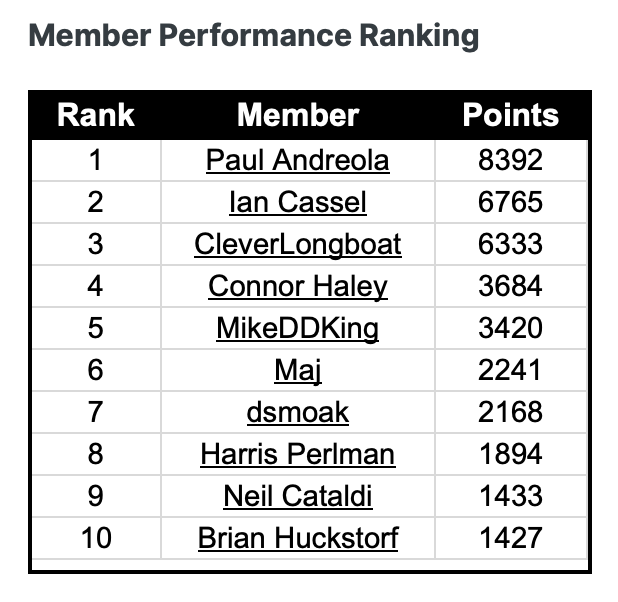
In Hendrik Bessembinder's research, [Do Stocks Outperform Treasury Bills?](http://csinvesting.org/wp-content/uploads/2017/05/Bessembinder-Do-Stocks-Outperform-Treasury-Bills.pdf?ref=microcapclub.com), he studied 26,000 stocks from 1926 to 2015\. He was analyzing long-term stock returns, he examined 20 variables. Three of these variables were statistically significant. The most significant variable was net income growth – a similar takeaway to what Jenga Investment Partners concluded in their study of [Global Outperformers](https://www.jengaip.com/global-outperformers/?ref=microcapclub.com).
87% of all global equities that went up 1000% or more over the past ten years were microcaps. 82% of those were profitable at the start of their ascent, and 91% had some history of profitability. The key is small, growing, profitable, and undiscovered. This is also why we launched our [MCC Profitable Index (MCCPI)](https://microcapclub.com/mcc-profitable-index-q1-2024/) earlier this year.
Bessembinder also found that from 1926 to 2015, only 86 stocks (out of 26,000) accounted for over half of the wealth creation.
I’m always reminded of this wonderful quote [\[Art of Holding\]](https://microcapclub.com/the-art-of-holding/).
> “The most successful investors I worked with, those who made the most money, all had one thing in common: the presence of a couple of big winners in their portfolios. Any approach that does not embrace the possibility of winning big is doomed.” – Lee Freeman-Shor
The key is finding, buying, and holding the winners, and it’s not surprising our rankings are driven by finding the few big winners.
- Member Paul Andreola, founder of [SmallCap Discoveries](https://smallcapdiscoveries.com/?ref=microcapclub.com), profiled [XPEL (XPEL)](https://community.microcapclub.com/topic/536-xpel-technologies-xpel/?ref=microcapclub.com) at $0.36 per share on June 10th, 2013, adding over 8,000 points to his ranking. An 80-bagger.
- Member CleverLongboat profiled [Celsius Holdings (CELH)](https://community.microcapclub.com/topic/2361-celsius-holdings-celh/?ref=microcapclub.com) at $4.25 per share on July 10th, 2019, adding over 6,000 points to his ranking. A 60-bagger.
- I profiled [Napco Security (NSSC)](https://community.microcapclub.com/topic/207-napco-security-technologies-nssc/?ref=microcapclub.com) at $2.15 per share on December 18th, 2011, adding over 4,000 points to my ranking. A 40-bagger.
- Member Connor Haley profiled Straight Path Communications (STRP) at $5.58 per share on October 2nd, 2013, adding over 3,000 points to his ranking. The company was acquired. A 30-bagger.
- Member MikeDDKing profiled [Biosyent (RX.V)](https://community.microcapclub.com/topic/234-biosyent-inc-rxv-bioyf/?ref=microcapclub.com) at $0.55 per share on February 17th, 2012, adding over 1,400 points to his ranking. A 14-bagger.
- Member Daniel Smoak profiled [HemaCare (HEMA)](https://community.microcapclub.com/topic/1785-hemacare-hema/?ref=microcapclub.com) at $1.00 per share on February 23rd, 2017, adding 2,500 points to his ranking. The company was acquired. A 25-bagger.
- Member Maj Soueidan, founder of [Geoinvesting,](https://geoinvesting.com/?ref=microcapclub.com) profiled [BlueLinx Holdings (BXC),](https://community.microcapclub.com/topic/1622-bluelinx-holdings-bxc/?ref=microcapclub.com) a 10-bagger, and Koru Medical Systems (KRMD), an 8-bagger.
In fact, our members have profiled [235 multi-bagger stocks](https://microcapclub.com/multibaggers/) since inception. This equates to 1.5 per month since the community was started in July of 2011\.
Buffett, Lynch, and Greenblatt all started in microcap for a reason: it’s the only place in the public markets where an astute investor managing small sums has a structural advantage over institutions. Microcap investing has a long history of producing the greatest stock pickers in the world. Microcap is where greatness begins. The next Buffett is likely sifting through the thousands of obscure microcaps that trade around the world. There’s a good chance that person is on MicroCapClub. That person could be you.
#### Interact and learn with 250+ of the best microcap investors on the planet:
[Join Us](https://microcapclub.com/join-now)
MicroCapClub is an exclusive forum for experienced microcap investors focused on microcap companies (sub $500m market cap) trading on United States, Canadian, European, and Australian markets. MicroCapClub was created to be a platform for experienced microcap investors to share and discuss stock ideas. Since 2011, our members have profiled 1000+ microcap companies. Investors can join our community by applying to become a member or subscribing to gain instant view only access. MicroCapClub’s mission is to foster the highest quality microcap investor Community, produce Educational content for investors, and promote better Leadership in the microcap arena. For more information, visit and
### Survival
URL: https://microcapclub.com/survival/
Last updated: 2024-06-01T09:51:44.000Z
In 1858, a nineteen-year-old named Arthur B. Farquhar traveled fourteen hours by train and ferry to New York City. His goal was to ask prominent millionaire businessmen such as A. T. Stewart, William B. Astor, James Bennett, and several others one simple, direct question: “How can I make a million dollars?”
Farquhar had read about such successful men in *Harper’s Magazine* and “immediately became fired with the notion that the way to get along in the world more rapidly than the next fellow was to find the secrets of those who had made the high scores.”
He had no previous introductions or appointments with these men. Through sheer willpower, doggedness, and ingenuity, he met with all of them over the course of several days, and it changed the course of his life. He stood on the shoulders of giants.
In 1861, three short years after meeting the great business builders, opportunity knocked. A local factory building burnt to the ground, and he stepped in to take over the assets and liabilities. It was from this humble beginning that his enterprise would begin.
Arthur Farquhar would apply his lessons and build a very respectable and sizeable business in York, Pennsylvania, selling farm equipment and machinery and employing more than five hundred workers. His company became one of the earliest manufacturers of steam engines and would ship them all over the world. He also owned the local newspaper, the York Gazette, and founded the York Hospital, which became the largest military hospital in Pennsylvania during the Civil war.
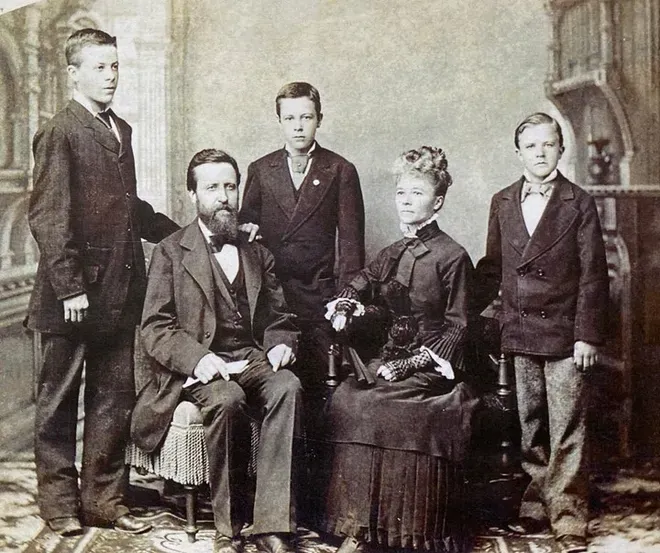
The A.B. Farquhar Family c. 1878: York County History Center
Later in life, he befriended eight U.S. presidents, such as Abraham Lincoln, and titans of industry, such as Andrew Carnegie, known for being the second-wealthiest person of the modern period, achieving a peak net worth of more than $300 billion in today’s inflation-adjusted dollars.
Arthur Farquhar would have his first encounter with Andrew Carnegie during the Civil War, when they were brought together by Secretary of War Edwin Stanton to converse on issues relating to trade. Farquhar recounted:
> He \[Carnegie\] was a young man, of about 25 years, I think, not imposing in appearance and rather shy in manner, but it took only a moment or two of conversation to gain a peculiar sort of confidence in him. Carnegie was one of those men you instinctively had to trust. That is why I call the confidence he inspired “peculiar.” You did not stop to wonder, “Will he do?” and then answer, “Yes.” You simply decided at once, “He will do.”
Each encounter with Andrew Carnegie, made Farquhar respect him even more:
> Carnegie was as keen a businessman as ever lived; he was keen in the large way—he saw not merely tomorrow but the day after. And one of the reasons that he so quickly got into large business was that through his study of literary masterpieces he came to know human characteristics. For after all, great literature is only the preservation of the best thought of human nature.
> Having this greater mastery, Carnegie never became lost in details. He kept in close touch with the affairs of the world—he read and travelled widely. Thus, he gained a perspective that enabled him usually to see what was coming and then to arrange his affairs accordingly. He believed that knowledge was power and demonstrated that fact.
Much like Farquhar himself, Andrew Carnegie, at a young age, loved to read, study, and gain wisdom from others. Farquhar would share this story:
> As a youngster he \[Carnegie\] had access to the library of Mr. Anderson of Allegheny; he studied while others played.
> I might mention a very interesting incident connected with his introduction to this library. While a messenger boy, he was sent over early in the morning with a telegram to Mr. Anderson, with instructions to wait for an answer, as it was important. Mr. Anderson had returned late that night, and the butler said he could not wake him. Young Carnegie walked into the library, took a seat, and became immersed in a volume upon steel making and the tremendous advantages of steel over iron. Mr. Anderson finally came down with his answer to the dispatch. The lad turned, apologizing for having taken the book. The steel master—Anderson was engaged in the steel business—asked if he was interested in the subject.
> Carnegie said: “Oh yes, it is fascinating to me.”
> “Take the book home and read it, and return it when you are through with it,” answered Mr. Anderson. This he did; was told he could take another, and that he might have access to the library; and Mr. Carnegie told me that then and there he made up his mind if he ever became wealthy he would found libraries and give young men the same opportunity that had been afforded him.
> The knowledge Mr. Carnegie thus attained through reading and study he applied first to one thing and then to another. By the time the other boys had finished playing, Carnegie had almost finished working and was ready to play. He used his knowledge of men and things to direct; while in his early twenties he had already the capacity to get others to carry out his plans. He knew he had that capacity and used it, and thus apparently with ease he became a great captain of industry.
By the late 1890s, Arthur Farquhar was a very successful businessman and was well respected. But compared to Andrew Carnegie’s Carnegie Steel, Farquhar’s company was a small minnow next to a whale. Carnegie Steel’s annual profits were likely ten times larger than Farquhar’s total revenues.
Farquhar was proud of the fact that he was disciplined and worked hard to grow and manage his company. Most people would be impressed. When he spoke to Carnegie, he told him of his practice of reaching the office at seven in the morning and how much he worked, and Carnegie, laughing, remarked:
> “You must be a lazy man if it takes you ten hours to do a day’s work.
> “What I do,” he said, “is to get good men, and I never give them orders. My directions seldom go beyond suggestions. Here in the morning, I get reports from them. Within an hour I have disposed of everything, sent out all my suggestions, the day’s work is done, and I am ready to go out and enjoy myself.”
> And that, I think is about the most striking contrast between the men of yesterday and those of today—and the mere matter of making money, Mr. Carnegie made more than all of the men I have mentioned and met with put together. They were individualists—not managers.
Carnegie’s comment made a big impression on Farquhar. The lesson was that to build a great business you need great people around you. This certainly is exemplified in one of Andrew Carnegie’s most quoted sayings, “No man will make a great leader who wants to do it all himself, or to get all the credit for doing it.”
Companies that can harness the full potential of human capital can build nimble, sustainable organizations that are hard to replicate. Most intelligent fanatics overcame [difficult industry](https://microcapclub.com/the-little-things-that-result-in-the-big-things/) and competitive challenges. Like shapeshifters, these great organizations maneuvered quickly as they grew and as the markets in which they competed changed. They accomplished this feat by getting extraordinary results out of ordinary people.
What is the #1 characteristic of an exceptional business?
Some would say – The fastest growing companies.
Many would say – The largest companies.
Most would say – The companies that earn the most money.
Very few would say – An exceptional business is one that can endure over a long period of time.
For a business to survive 100 years, it must survive multiple recessions, wars, regimes, competitive threats from inside and outside the industry. It would have to survive all the bad luck, fate, and random incidences time throws at the business. Farquhar had to survive his manufacturing center burning to the ground twice. The second time, in 1876, he absorbed a $175,000 loss, an incredible sum in those days.
Time is always trying to put you out of business.
For a business to survive 50-100 years it must evolve with the environment and create new products or services (or servicing new products) and do it better and faster than others. A fun exercise is looking at an old business and comparing what they sell today to when they were founded. If a company was founded on a successful innovation, it only takes them so far. The first innovation might give them a 5-year head start. The company must continue to innovate to survive and properly expand into adjacent areas to form a beachhead against competition and time.
If you want to study great businesses, study a business that has survived. It might be a small business in your town or a larger business in your area. My grandfather started our family business in 1947\. I’m not involved with it, but the business looks nothing like it did back then. It sells nothing that it did back then. When you think about these things you form a deep appreciation for the effort necessary to sustain.
Survival is the ultimate performance measure of a business.
#### Interact and learn with 250+ of the best microcap investors on the planet:
[Join Us](https://microcapclub.com/join-now)
MicroCapClub is an exclusive forum for experienced microcap investors focused on microcap companies (sub $500m market cap) trading on United States, Canadian, European, and Australian markets. MicroCapClub was created to be a platform for experienced microcap investors to share and discuss stock ideas. Since 2011, our members have profiled 1000+ microcap companies. Investors can join our community by applying to become a member or subscribing to gain instant view only access. MicroCapClub’s mission is to foster the highest quality microcap investor Community, produce Educational content for investors, and promote better Leadership in the microcap arena. For more information, visit and
### Investing in “Special” Situations
URL: https://microcapclub.com/investing-in-special-situations/
Last updated: 2024-05-22T11:27:23.000Z
There’s nothing *special* about special situations. It’s like that line from Shawshank Redemption where Red says,
> *“I know what you think it means, Sonny. To me, it’s just a made-up word, a politician’s word, so that young fellas like yourself can wear a suit and a tie and have a job.”*
Buffett used to call them workouts. That’s closer to the nature of these investments.
Special Situations, Event Driven, workouts — or whatever you want to call them — trade on the expectation of a corporate event. To keep it simple, if bankers are hired to run a process / advise on fair value or lawyers are hired to draft agreements, there is a corporate event. Mergers, acquisitions, spin-offs, unsolicited offers, restructurings, liquidations are some examples.
You make money if a value-generating corporate event plays out. *When* that corporate event plays out is also important. This is the analysis in a nutshell:
(i) how certain is the value being negotiated?
(ii) how certain is the event that will crystallize value?
(iii) what conditions need to be satisfied to make it all happen?
The amount you might lose if you’re wrong keeps the analysis honest.
If you look at a bunch of corporate events, you’ll notice that ‘if it looks like a duck, walks like a duck and quacks like a duck’, you can group them. If the negotiation dance and agreements are similar, i.e. sale processes are conducted the same way, agreements are versions of the same basic template (merger agreements, asset sales, registrations, disclosures, etc.) and the corporate event follows a defined process (SEC review of filings, antitrust review, judge’s approval etc.) the securities will behave similarly. If you can group them, you can compare them.
That’s the theory of it. In practice, it’s a lot more hectic!
Here’s one from late last year (what’s going through my head is in italics):
In October of last year, Neighbourly Pharmacies (NBLY.TO) issued a press release “Neighbourly Enters into Letter of Intent to go Private with its Controlling Shareholder Persistence Capital Partners (PCP).”
> *Immediately interesting!*
When a company receives an unsolicited offer from a majority shareholder, the odds of a negotiated deal are high. Approximately 2 out of 3 unsolicited offers result in a deal, based on historical base rates.
The press release told us that PCP, a 50.2% owner put an offer price of C$20.50 per share in front of the Board. An Independent Committee of the Board had already commissioned a fairness opinion from TD Securities, and TD Securities had arrived at a C$20.50 - C$25.50 fair value.
> *This has clearly been in the works for a bit. We already have an initial price. The board has already hired advisors. TD has already provided a fairness opinion. Game on!*
Proposals from a majority owner are a well-choreographed three-step tango. The dance steps - a Board receives an offer from a controlling shareholder, an independent special committee pushes for a sweetener to show their effort to get the best deal for minority shareholders, the parties agree on a price bump, *et voila*, you have a deal.
> *With the stock trading in the C$18.50 context, looks like we can make C$2.00 to C$7.00 a share (11% - 38% upside) if the final price comes withing the fairness opinion range. At the mids - that’s C$4.50 or 24% upside- that’s compelling.*
To diligence this corporate event, we go through the analysis steps we laid out above:
(i) How certain is the value being negotiated?
(ii) How certain is the event that will crystallize value?
(iii) What conditions need to be satisfied to make it all happen?
(iv) How much can we lose if things go wrong?
Taking it from the top, how certain is the value being negotiated? In 2021, Neighbourly IPO’d at C$17/sh, climbing to a high of C$40/sh. It remained comfortably above C$20/sh all the way to the beginning of 2023\. Persistence, involved with Neighbourly since 2015, was rolling up rural pharmacies in Canada. The algorithm: buy pharmacies for 6-7x EBITDA, drive same-store-sales in the 3-4% range, improve operations and get margins to 10%. Rinse and repeat, acquiring 35-50 stores a year. Precedent take-private transactions averaged \~ 12x -15x EBITDA, creating Neighbourly at C$18.50 – C$26.00\. In 2023, the company was beating expectations, but with interest rates rising rapidly on inflation concerns, there was no public market bid for levered equities.
Sanity check, in June of 2023, Stuart Elman, the chairman of the Board and a principal at Persistence bought C$600k worth of stock in the open market at C$17.78/sh.
The company was covered by 3 analysts, one called the offer a “bitter pill” and another lowered her price target from C$33.00/sh to C$25.50, saying in a note that shareholders should push for higher than C$20.50 offered.
> *Alright, it’s all triangulating to a deal in the low-to-mid C$20s. Have a couple of sanity checks. The fairness opinion re-affirms the expected takeout range. Second step of this three-step tango is a price bump to…lets call it the middle of the fairness range…C$23.00…and this deal should come together.*
Next diligence step, how certain is the event that will crystalize value? Neighbourly was one of a vintage of levered roll-ups that IPO’d in 2020 and 2021\. With the public markets so negative on levered equities in 2023, many PE sponsors of these companies were taking them private again. Precedents included Dialogue Health, Magnet Forensics and 9 others with strategic reviews / take privates announced during the year. The cautionary tale was Dentalcorp, where the Independent Board and PE Sponsor weren’t able to agree on terms.
With that context, there were a couple of specifics in the Neighbourly review stood out. First, there was a letter of intent at an indicated price. To get to that stage itself is a commitment. Second, the Board was already spending money and had hired TD Securities who had *already* delivered a fairness opinion. Third, the press release stated that equity and debt financing were in advanced stages of negotiation. And finally, the press release had guided to the transaction closing in Q4 2023 or early in Q1 2024\. As highly lawyered as this press release was, all the data points guided to a high probability a deal comes together.
> *Feeling pretty comfortable with the value we’re looking to get. Feeling pretty confident this deal is going to come together. Need three things to happen here: the parties agree on a final price, the debt financing has to come together and the equity financing has to come together. It’s unlikely Persistence even started this process without indications from an equity anchor investor and banks.*
A month later, in mid-November, Neighbourly drops another press release titled “Neighbourly Extends Exclusivity and Provides Update on Letter of Intent with Persistence Capital Partners.” The incremental details: debt financing in place from the Bank of Nova Scotia and RBC. Exclusivity extended to mid-Jan to allow Persistence to finalize equity financing. The transaction is expected to close in Q1 2024.
> *Wait a sec?!? Why does Persistence need an extension? Neighbourly stock had fallen down to the C$17.50 context. That said, Persistence paid for that Debt Commitment, no bank rents out its balance sheet for free – that’s a sign of commitment. Is there an issue with the Equity Commitment? What’s going on here?*
The third diligence step, what conditions need to be satisfied here to make it all happen? The parties have to agree on a final price and equity financing has to be firmed up. By my math, Persistence needed C$275m in incremental equity. I called Neighbourly’s Investor Relations to talk through Persistence’s Equity financing and negotiations with the special committee – here’s the Q&A:
“Does Persistence need to find new sources of equity for their *existing* Neighbourly fund vehicles? Do Persistence’s existing LPs need an exit through a GP led secondary?” No. Persistence’s current equity financing doesn’t have a vintage and timeline – that money is committed long term.
“Weren’t Equity financing discussions already in an advanced stage with an anchor investor etc.? Has the sentiment in the Equity syndicate changed – why the delay?” There were certain partners that were being contemplated at first and those partners were at the table. Further equity partner options subsequently emerged that were very serious. From what I understand, there’s no shortage of strong interest from very serious partners.
> *A broader equity syndicate of still interested parties? Why do you need a broader equity syndicate? Didn’t the original equity indications commit? Unsatisfying call. But it’s unlikely Persistence would pay for Debt Commitments and gone through all this trouble if they felt a deal wasn’t possible.*
A month later, in mid-December, Neighbourly drops a press release titled “Neighbourly Provides Update on Proposal from Persistence Capital Partners.” The bombshell – Persistence revised its indication down to C$18.50 with the claim that this is the price it’s equity financing sources support. Simultaneously, Persistence put out a press release titled “Persistence Capital Partners Proposes Fully Financed Offer to Take Neighbourly Private at C$18.50 per share.” The PR elaborated that Persistence had approached and discussed the transaction with over 90 potential equity financing sources.
> *What the @@@@! That’s a twist. We’ve gone from a C$20.50 offer to C$18.50? The company’s numbers have been good and they’re doing better than expectations. How did this happen? Neighbourly stock was trading down to the C$15.00 context.*
The focus now shifts to the final and most important element of diligence – how much can we lose if things go wrong? Before Persistence’s initial offer, Neighbourly’s stock was trading at an undisturbed C$12.00 per share. But a levered security with limited liquidity and no exit, wouldn’t the stock fall lower? The market had rallied, but apart from Persistence, who was the incremental buyer? Best assumption, Neighbourly stock trades down to high single digits, low double digits on technical.
With a fully financed offer on the table, the only condition left to be satisfied was the parties agreeing to a price. Based on our downside estimates, the Neighbourly stock at C$15.00 was certainly suggesting higher than a 50% probability of a deal.
> *Somebody must know something! The stock keeps inching higher. This is trading like the deal is on. Somebody definitely knows something.*
Another month later, in mid-Jan, Neighbourly entered into a definitive agreement to go private at C$18.50 per share plus a contingent value right of $0.61 per share.
> *For the time and effort invested, we ended up netting a C$0.61 untradeable CVR. Well played Persistence Capital Partners! Well played!*
Basically, Canadian investors in the register were eager for liquidity. Persistence knew it. The Board’s Special Committee knew it. The Three Step Tango ended up in a price negotiated down for liquidity, which the minorities were glad to accept.
—
While Neighbourly’s Take Private didn’t work out as expected, there is always a constant stream of corporate events, some of which work out spectacularly.
If you’re intrigued and want to dive in, here are a few current unsolicited offers from majority (or very large) shareholders:
Target Hospitality Corp (TH) – On March 25th, 2024, TDR Capital LLP, a 64% holder of TH has offered $10.80 per share for all the shares they don’t own.
23ANDME Holding Co. (ME) – On April 18th, 2024, Anne Wojcicki, CEO, Founder and Chairman of the Board with 20% of shares outstanding and 49% voting power, is considering making a proposal to acquire the shares she does not currently own.
WideOpenWest (WOW) – On May 2nd, 2024, Crestview Partners, a 38% holder of WOW has offered $4.80 per share for all the shares they don’t own.
Finally, here are a few hard learned lessons as you start your special situations journey:
(i) Figuring out what are the financial and strategic incentives of the key party driving the outcome is a key principle. Sometimes it’s hard to figure out who the key party is that’s driving the outcome. It could be a foreign regulator. It could be a large shareholder. It could be a board pre-empting an acquiror. The key party driving the outcome may change as the corporate evolves.
(ii) Don’t annualize expected returns (a 2% return over six months is 4% annualized). In some buckets i.e. merger arbitrage, investors annualize returns for an apples-to-apples comparison with other yield instruments. Annualizing has its purposes, but it assumes you will find other similarly yielding investments right after the corporate event is done – that’s a bird in the bush you cannot count on. Also implicit in annualizing returns, since most corporate events take under a year, you’re invariably making a nominal yield look more attractive. Inverting, to make the argument, risk is by far the more important variable, but no one seems to annualize that.
(iii) Don’t get tempted by what looks like a technical dislocation, which of course makes annualized returns look even more juicy. It could be real risk and an unexpected variable baking in. The patience to confirm your assumptions can protect you from being psychologically short a costly put on your time.
*Disclaimer: Rukun owns none of the stocks mentioned. This Article Shall Not Constitute an Offer to Sell or the Solicitation of any offer to Buy. No part of this Article is a recommendation or a solicitation. The information and beliefs contained herein are believed to be correct, but there is no guarantee.*
#### Interact and learn with 250+ of the best microcap investors on the planet:
[Join Us](https://microcapclub.com/join-now)
MicroCapClub is an exclusive forum for experienced microcap investors focused on microcap companies (sub $500m market cap) trading on United States, Canadian, European, and Australian markets. MicroCapClub was created to be a platform for experienced microcap investors to share and discuss stock ideas. Since 2011, our members have profiled 1000+ microcap companies. Investors can join our community by applying to become a member or subscribing to gain instant view only access. MicroCapClub’s mission is to foster the highest quality microcap investor Community, produce Educational content for investors, and promote better Leadership in the microcap arena. For more information, visit and
### Control Yourself
URL: https://microcapclub.com/control-yourself/
Last updated: 2024-05-15T09:34:44.000Z
When you buy a stock, you are betting that the business trajectory will stay the same or get better. No one ever buys a stock thinking the business will get worse. What is interesting is how often the business does get worse. It happens more often than we like to admit. In fact, it’s probably the base case, and yet we are always “surprised” when things get worse.
Long only stock pickers are naturally wired “bullish” when we like something. When we like something, we want to like it more. When we own something, we look for reasons to own more. We seek confirming evidence to own more.
It’s more fun to focus on what could go right and what could accelerate growth - Not what could go wrong. When we buy something that is growing 20%, we only think about it growing 30%, not dropping back to 10%.
When a company disappoints us, 50% of the time it’s management’s fault for overpromising and underdelivering. The other 50% of the time we still blame management, but we are normally to blame.
It’s hard to control the bullish echo chamber in our brains. It doesn't take long for our [expectations](https://microcapclub.com/expectations/) to get a full standard deviation away from reality. It’s hard to control yourself.
When a business is doing well, we take the highest quarter ever posted and annualize it to justify the stock being cheap. This sometimes works but it often doesn’t.
Every successful business must invest ahead of growth. This creates challenges and unforeseen bumps in the road. Growth often comes in stages with higher plateaus. It’s similar to a stock price that goes up too far and then it takes 12-24 months for fundamentals to backfill into the valuation. It’s the same for a business where people, processes, scale need to backfill before it can take the next leg up.
I’m invested in a small microcap business right now who has maxed out their office space and warehouse. The current office space is in the same building as the warehouse. It might seem like a small thing, but management likes everyone under the same roof. They like management, marketing, sales, in the same building as the warehouse. It creates a culture where everyone is just a short walk away. Most larger warehouses in the area that are available don’t have a large enough office. It’s lead to a few quarters of sales plateauing as they assess the next step. The positive side effect is they are overearning because they aren’t investing (yet) for the new building that is necessary. And of course that is the quarter we all want to annualize.
We stock pickers like to think that small businesses are excel spreadsheets where we adjust some inputs, and the outputs take care of themselves. No friction. Revenue and income linearly progressing up and to the right every year.
We forget that businesses are simply groups of people aligned and incentivized to solve a problem. When a small business grows up. Real people need to be hired. Real people need to be fired. Real people need to be trained. Real people need to sell more to other real people. Real people need to deal with all the “Whac-A-Mole” issues that no one prepared for.
I can’t tell you how many times I’ve been slightly disappointed by a quarterly result, and when I talk to the CEO, he/she is genuinely happy with the results. They respond, “You have no idea what we had to deal with. The team really rallied together to make this a good quarter.”
Perhaps a key person left, supply chain disruption, a random fire destroyed inventory, a large order got pushed or cancelled, etc. This is what 90% of small business is – the messy “making the sausage” – that stockholders never see. We just see the numbers and analyst estimates.
This is why [guidance](https://microcapclub.com/i-hate-guidance/), especially for small businesses, is dumb. Guidance puts management in a position to lose credibility by not hitting short-term targets they can’t control. Yes, they can directionally control them but not exactly control them.
Let me ask you this.
When a company you own or follow issues guidance does it make you want to buy or sell?
Sell.
Why? Now you know the future. Guidance takes away the fun part of stock picking - anticipation. Now you know what management thinks about the future. The guidance provided is also a conservative number that causes more questions than answers. Then something unforeseen happens and they grow 17% instead of 20% and the stock drops 20%. If the company wouldn't have guided investors and grew 17% the stock would be higher with no disappointment.
When a company doesn’t give guidance, the investor is left to do the work themselves and form their own opinions. If the company doesn’t hit my overly optimistic expectations – I’m to blame. Not the company. When management provides short-term guidance, it shows a lack of discipline and self-control. They’ve been told by bankers, analysts, short-term investors to give guidance. They give in and then they get the shareholders they deserve.
It's our own expectations that get us in trouble. How many of your successful investments have occurred in the timeframe you originally predicted? How many times do you ever remember saying, “Well that happened a lot quicker than I thought”? Not often enough, right. Most of my successful investments took longer, in some cases a lot longer than I originally expected. This proves that even with our winners, let alone our losers, our expectations are too high.
If your thesis takes 12-months longer to play out what is the risk? Dilution. This is why profitability is so important and why the [multi-bagger magic formula](https://microcapclub.com/multi-bagger-first-principles/) is finding a small company that can grow revenues and earnings and not dilute. The last part is key, so you can afford to wait longer.
I try to always keep my timeframe to 3-years. I also encourage companies to issue 3-year goals over annual guidance. It keeps investors and companies aligned with a longer-term focus. It acknowledges the shorter term will not be linear like an excel spreadsheet.
I like to hold my short-term expectations like a tube of toothpaste – not too tight. Give a company a little room to disappoint you in the short-term and a lot of room to exceed your expectations in the long-term.
You can’t control the short-term. Control yourself.
#### Interact and learn with 250+ of the best microcap investors on the planet:
[Join Us](https://microcapclub.com/join-now)
MicroCapClub is an exclusive forum for experienced microcap investors focused on microcap companies (sub $500m market cap) trading on United States, Canadian, European, and Australian markets. MicroCapClub was created to be a platform for experienced microcap investors to share and discuss stock ideas. Since 2011, our members have profiled 1000+ microcap companies. Investors can join our community by applying to become a member or subscribing to gain instant view only access. MicroCapClub’s mission is to foster the highest quality microcap investor Community, produce Educational content for investors, and promote better Leadership in the microcap arena. For more information, visit and
### Shelf Life
URL: https://microcapclub.com/shelf-life/
Last updated: 2024-05-09T00:48:31.000Z
What if Warren Buffett would have bought ten stocks in the 1950’s, held onto them, and they all turned out to be monster winners? Like Moses coming down from the mountain with ten stocks carved in stone tablets. Isn’t this what we really want our stock picking heroes to look like? A few decisions. 10 for 10\. All winners. Perfection.
His results were still spectacular. It just took some [portfolio turnover](https://microcapclub.com/portfolio-turnover-is-the-price-of-progress/).
In 1988, Warren Buffett famously said, “Our favorite holding period is forever.” Some people took the statement literally, meaning every stock he buys will be held forever. Most of us that are true students of stock picking knew what he meant. His intention is to find stocks he can hold forever, but reality is much different.
He finally got sick of people misrepresenting what he said, and in 2016 responded,
> “Sometimes the comments of shareholders or media imply that we will own certain stocks “forever.” It is true that we own some stocks that I have no intention of selling for as far as the eye can see (and we’re talking 20/20 vision). But we have made no commitment that Berkshire will hold any of its marketable securities forever.”
Intentions are important in life and in stocks. Here is the difference between trading and investing:
Investing - your intention with every purchase is to hold.
Trading - your intention with every purchase is to sell.
Over the past 50+ years Buffett has owned hundreds of stocks in Berkshire’s public stock portfolio. He sold most of them very quickly. In fact, of the 230 stocks he owned between 1980 and 2010, 60% were sold in less than a year. He’s owned many for a few years. He’s owned <5% for 15+ years.
His intentions were to hold forever, but the business or macro situation changed so he sold. He still made money on many of them.
This proves what we know to be true but don’t like to admit.
All stocks have a different shelf life.
Shelf life is a term mostly used to describe the amount of time that a commodity or food can be stored without becoming unfit for consumption or sale.
- Fish has a shelf life of 1-2 days in the refrigerator
- Bananas 5 days
- Milk 7 days
- Lettuce 10 days
- Bread 14 days
- Apple 14 days
- Eggs 21 days
- Canned vegetables, fruit, and soup has a shelf life of 2-5 years
We all have these types of food in our refrigerator and pantry. They all give us nourishment. They all serve a purpose. It’s the same for stocks in our portfolios. Every stock you buy has a different shelf-life.
The key difference between food and stocks is we don’t know the shelf life of a stock when we buy it. There is no one size fits all cookie cutter time frame because every business evolves in different ways. Some businesses will age like a fine wine and others like raw fish left on a kitchen counter.
No one wants to admit the right timeframe to hold a stock is different for every business and for every investor. There is no, one size fits all.
In a recent interview, [@AlbertBridgeCap](https://twitter.com/@AlbertBridgeCap?ref=microcapclub.com) of Albert Bridge Capital said,
> "A lot of my good friends like Guy Spier and Chris Bloomstran want to buy good companies and hold onto them. We don't. We want to know where we are versus the street over the next 2-3 years. We might own some longer. That's our whole story. Is this company going to beat numbers."
I found this statement refreshing. Drew knows exactly who he is and what he’s trying to do. He has fully developed [active patience](https://microcapclub.com/active-patience/). He isn’t trying to be something he's not. He isn’t misrepresenting his strategy.
Most stock pickers define their strategy with some variation of the following:
> “I do exhaustive research turning over thousands of rocks to identify a handful of wonderful businesses to buy and hold for the long-term.”
Isn’t it funny how we define our strategies by the exception and not the norm?
Like Buffett, maybe 2 out of 50 you buy might be worthy of owning 10+ years. These are the exception, not the norm. We love to define our strategy as “finding those two", but our strategies are really based on how we’ve dealt with the other 48\. We can still make a lot of money on the 48\. You get a lot of nutrients from eating perishable foods.
All stocks have a different shelf life.
No one likes to talk about the fact that most winning stocks only deserve to be held for 1-5 years. The ones you ultimately hold for 10+ years are wonderful, but they are the exception. Even for Buffett.
No one wants to talk about the skill of [selling](https://microcapclub.com/when-to-sell/) (aka not holding) because it’s either an admission you were wrong, or that you “don’t hold stocks forever”. Admitting you are wrong means you aren’t perfect, and no one wants to admit they aren’t perfect even though none of us are perfect. Admitting you don’t hold stocks forever just isn’t “cool” and won’t get you invited to compounder cocktail parties.
My intention with every purchase is to hold forever (5+ years), but <5% will earn that right. I’ve owned 50-60 stocks over the last 5-7 years, and I’ve owned two for 5+ years. The natural shelf life of a small microcap business on average is much shorter than mid and large cap businesses. They are smaller more volatile businesses. My average holding period is 1-2 years.
I’ve found that most winning stocks in microcap have a winning season that lasts 2-10 quarters.
Perhaps management got lucky with product market fit for a year. Maybe it was COVID that drove demand for 12-months. Maybe it was a new regulation that increased demand. Maybe a competitor had temporary supply issues. Maybe the VP of Sales wined and dined the right executive and got the big contract. Etc. But none of it was sustainable.
Microcap Due Diligence = analyzing if management is lucky or skilled and how long it will last.
Robert Wilson was a legendary trader who turned $15,000 into $800 million over his 40-year career. He used to call himself a "long-term trader". I like that term. He would sell positions after a few days, or after a decade. He just rode them as long as they were winning.
Isn’t Wilson’s strategy closer to our reality than we want to admit?
Most small (microcap) stock pickers try way too hard to fit into this buy and hold forever camp of investing. The shelf life of most “winning” microcaps is less than 3 years. There will be exceptions that you can hold for 5+ years and hopefully much longer. But just like Buffett - they are the exceptions.
My intention is to hold stocks forever, but the harsh reality is every stock has different shelf life.
#### Interact and learn with 250+ of the best microcap investors on the planet:
[Join Us](https://microcapclub.com/join-now)
MicroCapClub is an exclusive forum for experienced microcap investors focused on microcap companies (sub $500m market cap) trading on United States, Canadian, European, and Australian markets. MicroCapClub was created to be a platform for experienced microcap investors to share and discuss stock ideas. Since 2011, our members have profiled 1000+ microcap companies. Investors can join our community by applying to become a member or subscribing to gain instant view only access. MicroCapClub’s mission is to foster the highest quality microcap investor Community, produce Educational content for investors, and promote better Leadership in the microcap arena. For more information, visit and
### The Little Things that Result in the Big Things
URL: https://microcapclub.com/the-little-things-that-result-in-the-big-things/
Last updated: 2024-05-10T10:52:25.000Z
One of the core things Sean Iddings and I noticed from studying intelligent fanatics was that transformative business leaders excel in industries that most would consider low-margin, mundane, or outright disliked.
Take, for example, Herb Kelleher at Southwest Airlines, Ken Iverson at Nucor, Sol Price at FedMart, Les Schwab at his tire centers, Robert Kierlin at Fastenal, and Ingvar Kamprad at IKEA. I could rattle off another ten intelligent fanatics that created dominant businesses in unglamourous industries.
These leaders mastered the art of sweating the small stuff. Their relentless energy, commitment, and focus on doing small things at an exceptional level led to their success. They showed that even the most unglamorous fields are ripe with opportunity for those that push the boundaries of the status quo.
Mining might be the most hated and under allocated industry of our generation. Nowhere is the need for thoughtful attention more necessary to succeed. Investing in mining is hard.
In Chris Mayer’s book, How Do You Know?, he gives a great example from an article written by O’Higgins Asset Management to illustrate this point.
> “Suppose that on January 31, 2006, you knew with certainty that the price of gold would more than triple over the next five years, from $569 per ounce to $1,900 per ounce. Knowing that, might you have invested in Newmont Mining, the world’s second-largest gold producer? Odds are high that you would have gladly bought Newmont Shares. What that kind of surge in the price of gold, buying in one of the world’s largest gold companies would seem like a no-brainer. Yet, the share price of Newmont fell 5% over that time.”
Yet, amidst these challenges, intelligent fanatics are working under the radar, transforming their industries in quiet yet impactful ways. They are tough to spot because they often operate discreetly in unloved industries or are misunderstood by the broader market. However, discovering such individuals can be incredibly rewarding as they have the potential to keep compounding for decades.
In 1985, Franco-Nevada (FNV) co-founders Seymour Schulich and Pierre Lassonde approached their investors with a new gold royalty business plan. Investors didn’t exactly love the idea. They were only able to raise $930,000 in a secondary offering.
But by 2001, Franco-Nevada (FNV) shareholders had realized a 38% compounded annual return over 16 years or a return of 173x their initial investment. A phenomenal accomplishment in an industry known for capital destruction. What is even more impressive is the price of gold dropped during this period.
In resources it’s normally not the resource but the people that are the true “precious metal”. It’s the people that find the resource, develop a plan, finance the plan, and allocate capital, to grow and survive. It’s the people that unlock value.
I would like to highlight a real-world microcap example to drive a point home, not to drive the stock up. **Caveat emptor**. This is an excerpt from my [IFCM](https://if.capital/?ref=microcapclub.com) Q1 2024 letter.
Idaho Strategic Resources (IDR) is a profitable Idaho based gold producer that also owns the largest, rare-earth element (REE) and thorium land package in the United States. I’ve owned the stock since 2013\.
IDR is a unique resources company in the public markets. It’s the only public company that can give an investor exposure to both gold and rare earth elements in one investment vehicle. Investor appetite for both of these resources is increasing, and IDR is a one of one way to play those tailwinds. But the real differentiator is that it’s run by an exceptional operator in John Swallow. He's also the largest shareholder.
All public company CEO’s have a report card. It’s called a long-term stock chart. Here is John Swallow’s report card since becoming President of IDR on August 30th, 2013, versus the industry. The price of gold is up 75% during this time period.
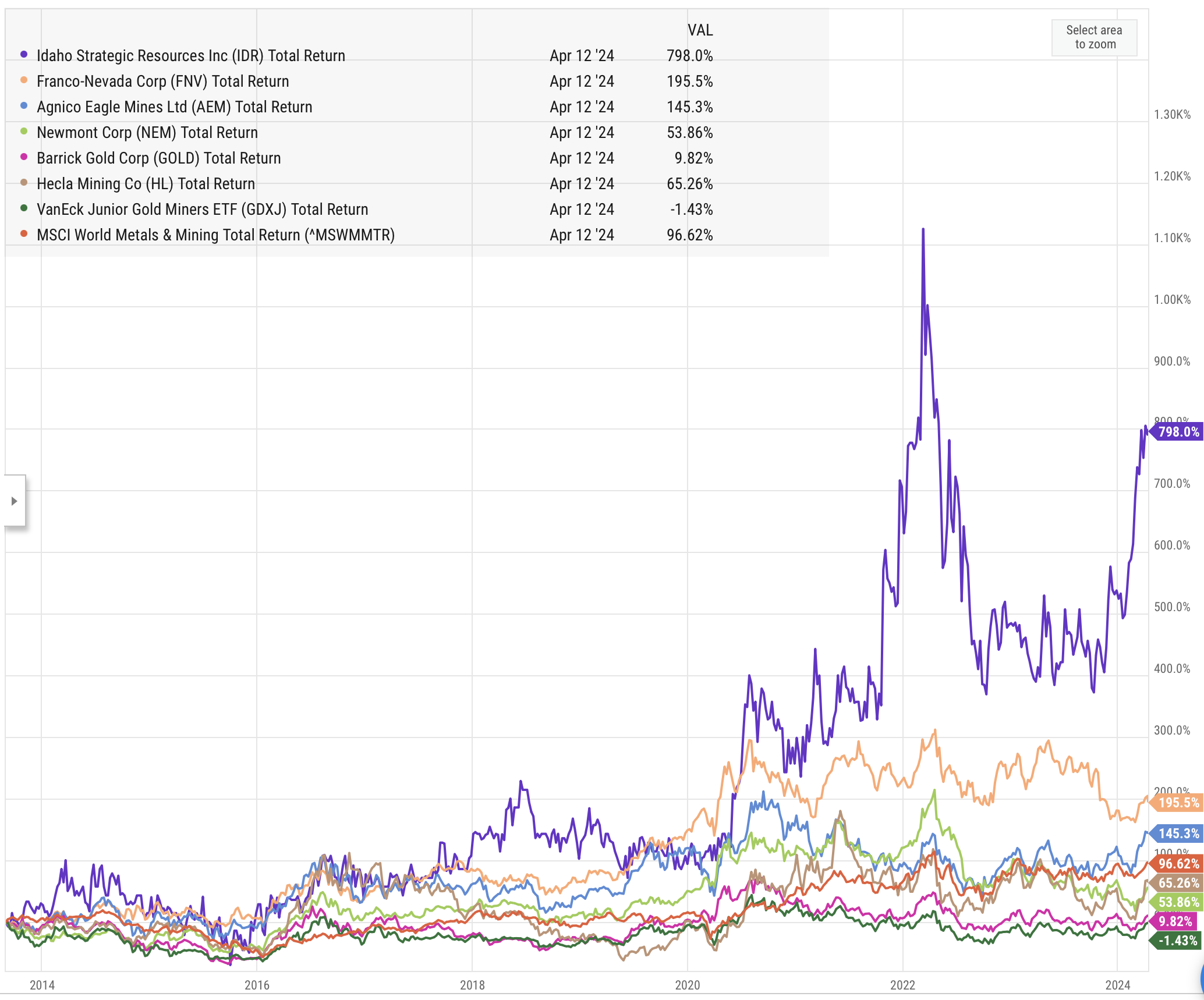
When I initially bought shares in IDR a decade ago, I didn’t do so because I held some macro view on fiat currencies or inflation. I bought the position because of the people. Over the past ten years John and his team built a company under the radar and acquired assets when no one wanted them. They built the business when the price of gold was 50% lower than it is now. Fast forward to today - IDR has the right people with the right assets in the right locations at the right time.
Resource companies can trade at 5x or 100x PE’s (Price/Earnings) depending on sentiment and growth expectations. Even large miners like Newmont and Hecla don't even have an “E” right now due to layering on so much debt. I would estimate IDR is trading at 25x my 2024 earnings estimate. I think it’s undervalued.
I know some of you are thinking. I can buy XYZ gold producer at 10x earnings.
It begs the question - **Should all gold mining companies be valued the same way? Are all ounces created equal?**
**Are ounces mined in the United States worth more?** Where there is rule of law, private property rights, and no threat of government nationalization. In fact, out of the 23,000 public companies listed in the United States and Canada - How many profitable gold producers under $500 million market cap with their main production assets in North America?3 out of 23,000\. Only 3\. Scarcity. I think domestic production of all things (gold, copper, REE, etc) is going to become a big focus in the future. Yes, IDR ounces are worth more. IDR is a profitable US based gold producer.
**Are ounces mined where employees go home to their families every night worth more?** Most miners work on 6-month contracts and are forced to work away from their families (even in Nevada). It leads to addictions, divorce, and broken families. Yes, going “home” at night is worth more. IDR miners go home to their families every night.
**Are ounces mined in a known mining friendly state worth more**? Good luck trying to build a mine in California or Montana. Yes, being in a mining friendly state is worth more. It’s easier to get things done. IDR’s mine and REE properties are in Idaho – the 7th most mining friendly jurisdiction in the world.
**Are ounces mined in a beautiful location (not in a desert or frozen tundra) worth more?** Few people want to work where most mines are located. Many mining companies have to build a town in the middle of nowhere. Logistics are a nightmare. Yes, mining ounces in a beautiful location where people actually want to live is worth more. The infrastructure, industry, and communities are already in place. It was done naturally.
**Are ounces mined from a profitable gold producer worth more?** Yes, when a mining company is profitable, they don’t have to dilute to explore. In addition, most major discoveries aren’t discovered by “exploration”, they are found by “mining into something”.
**Are ounces mined from a company that has a culture worth more?** IDR has a waiting list of miners wanting to work for them. They have six father/son combos. They have 20 additional miners from the same families (uncles, brothers, nephews, etc) working out of 50 miners. IDR has a unique incentive system that helps drive allignment. This is a huge advantage.
**Are ounces mined from a company that also owns the largest known REE and Thorium land package in the United States worth more?** Yes, it provides an unquantifiable upside to the business.
**Perhaps the most important - Are ounces mined from a management team you can trust worth more?** Yes, they are extremely rare in the mining industry.
It’s all these little things that add up to big things that are hard to duplicate. But let me attack this from a slightly different angle.
**Why does Costco trade at 2-5x the multiple of other discount grocers?** They all sell the same low margin stuff just packaged and branded differently. No offense to the Kirkland brand.
It's all the little things Costco does right. It's the culture, the values, the history of treating customers, employees, partners right and fair. [It’s the $1.50 hot dogs](https://microcapclub.com/the-power-of-small-invisible-gestures/). Costco members pay $60 per year for the right to spend money in Costco stores. The Costco strategy is well known. The competition knows what Costco is doing, even how they do it, and they still can't duplicate it. It's all the little things that taken together are big things that are insanely hard to duplicate unless a company was built on a certain bedrock of values.
Isn’t this the ultimate moat?
Especially in industries that are often viewed through an unfavorable lens like mining and resources. It's all these little things that make an investor feel good about investing in these areas, instead of bad. This is how you gain a premium valuation for selling a commodity. You can find "cheaper" things that give you the same exposure, but they aren't as valuable.
#### Interact and learn with 250+ of the best microcap investors on the planet:
[Join Us](https://microcapclub.com/join-now)
MicroCapClub is an exclusive forum for experienced microcap investors focused on microcap companies (sub $500m market cap) trading on United States, Canadian, European, and Australian markets. MicroCapClub was created to be a platform for experienced microcap investors to share and discuss stock ideas. Since 2011, our members have profiled 1000+ microcap companies. Investors can join our community by applying to become a member or subscribing to gain instant view only access. MicroCapClub’s mission is to foster the highest quality microcap investor Community, produce Educational content for investors, and promote better Leadership in the microcap arena. For more information, visit and
### MCC Profitable Index Q1 2024 Update
URL: https://microcapclub.com/mcc-profitable-index-q1-2024/
Last updated: 2024-04-14T11:27:53.000Z
The MCC Profitable Index (MCCPI) is an equal weight index of all global profitable companies (trailing twelve months aka TTM) profiled on MicroCapClub.
Since 87% of all global equities that went up 1000% or more over the last 10 years were microcaps, and 82% of those were profitable, we feel this index is not only a unique tracking mechanism but also a great idea generation tool for the community.
Several multi-baggers are likely hiding in plain sight in the index. As part of our community, you gain access to this incredible tool and will be able to view its constituents.
Every quarter we rebalance the index. New companies enter that are new TTM profitable, and companies get dropped that are no longer profitable TTM. In addition, we drop companies that move over $500 million market cap. The index is not optimized for "performance", but for idea generation.
**MCCPI Q1 2024 Rebalance Update:**
274 total companies/ 33 companies added / 26 companies dropped

Top/Bottom Performers:

#### Interact and learn with 250+ of the best microcap investors on the planet:
[Join Us](https://microcapclub.com/join-now)
MicroCapClub is an exclusive forum for experienced microcap investors focused on microcap companies (sub $500m market cap) trading on United States, Canadian, European, and Australian markets. MicroCapClub was created to be a platform for experienced microcap investors to share and discuss stock ideas. Since 2011, our members have profiled 1000+ microcap companies. Investors can join our community by applying to become a member or subscribing to gain instant view only access. MicroCapClub’s mission is to foster the highest quality microcap investor Community, produce Educational content for investors, and promote better Leadership in the microcap arena. For more information, visit and
### Dear Investor Relations
URL: https://microcapclub.com/dear-investor-relations/
Last updated: 2024-04-01T10:08:02.000Z
Dear LampLand Investor Relations,
My name is Alexander F. Drake and my investment firm AFD Capital is a significant shareholder in LampLand. I’d like to congratulate you on your business pivot from being a distributor of “The Clapper” to a lighting store consolidator. I’m extremely bullish on the lighting industry and I believe LampLand is perfectly positioned as the Louis Vuitton of lighting. I’m also hopeful that the Watt’s Up! promotional sales event will be accretive to Q1 financial results.
I believe that lighting solutions is the last remaining industry that hasn’t been consolidated by private equity and I think there’s a huge opportunity to roll-up “mom and pop” lighting stores. Overall, you’re all doing a great job. However, I would like to offer you a few suggestions to improve your investor relations efforts.
I’d like to focus my suggestions on your quarterly conference calls. I have to say, I appreciate you doing these because a lot of microcap companies don’t. I’m not sure if these other companies don’t do calls because they think most investors are uninterested in microcap companies (they’d be right) or they’re scared nobody will show up for the call (probably true). Or maybe they don’t want to call attention to the fact that they have no revenues. I really don’t know why these other microcap companies avoid doing calls, but I applaud your efforts to do them.
My first suggestion is that I think you should hire a professional conference call service instead of having Jerry from the IT department run the calls. I know Jerry from IT is pretty good with technology and I get that you want to save some money. But on the last call, I would have preferred not to hear someone eating a bag of potato chips midway through the call when Jerry forgot to put all the lines on mute. Same goes for the toilet flush at the end of the call. You’re already paying $10,000 a month for IR services, so I’m sure they can figure out a more professional option.
For my second suggestion, I think you should skip the long-winded prepared remarks and go straight to Q&A. On the last LampLand call, these prepared remarks consisted of CEO Charles reading your twelve page financial results press release verbatim. I know this because I was following along reading the press release as Charles was speaking. I noticed the words he was narrating were the exact same as the written press release except for the opening sentence where he said “we had another sex full quarter”. I’m pretty sure he meant to say “successful”. But either way, it sounds like it was a good quarter.
If you insist on opening remarks before the Q&A, my suggestion would be to keep it to two minutes or less with a few highlights from the quarter. I think it would be acceptable to also have a minute or two of friendly banter back and forth between Charles and CFO Nancy. Or maybe even a comment about the weather. But if you keep the prepared remarks short, I guarantee your audience will be much happier. Plus, if no analysts show up for the call, and it only lasts a few minutes, you all get the morning off to go play pickleball.
That reminds me, for my next suggestion, could you also start the calls a bit later than 8 am EST. Maybe the reason you hold them so early is because you think the financial world revolves around the east coast. Or maybe it’s because you hope nobody will show up at the crack of dawn. Regardless, 8 am PST or later would be appreciated because I would like to be fully caffeinated and alert for the call.
The next suggestion is to avoid using a conference room that backs onto the fire hall because a four alarm fire inevitably breaks out right in the middle of every LampLand conference call. It would be a little less distracting for all if we didn’t have to hear that.
My last suggestion would surely result in a more pleasant experience for all participants. I know you only take questions from analysts and I’m OK with that. But I think you should make a hard rule that their lines get terminated if:
a) they say “I missed the first part of the call and this question may have already been asked…….”;
b) they say “I’d like to double click on…..”;
c) the operator says “our next question comes from so and so”, and there’s a long delay because the analyst forgot to unmute themselves. And then finally they say “hello, hello, can you hear me?”;
d) anyone that says "good quarter guys" when it wasn't a good quarter.
In my opinion, these should all be automatic call terminations and maybe should even result in a ban from next quarter’s call.
I hope these suggestions are helpful and I look forward to seeing some of these suggestions implemented for the year-end conference call. If I get some positive feedback from your department, I’d be willing to provide some feedback on your investor relations website.
Sincerely,
Alexander F. Drake
AFD Capital
AFD = April Fool's Day 😄
#### Interact and learn with 250+ of the best microcap investors on the planet:
[Join Us](https://microcapclub.com/join-now)
MicroCapClub is an exclusive forum for experienced microcap investors focused on microcap companies (sub $500m market cap) trading on United States, Canadian, European, and Australian markets. MicroCapClub was created to be a platform for experienced microcap investors to share and discuss stock ideas. Since 2011, our members have profiled 1000+ microcap companies. Investors can join our community by applying to become a member or subscribing to gain instant view only access. MicroCapClub’s mission is to foster the highest quality microcap investor Community, produce Educational content for investors, and promote better Leadership in the microcap arena. For more information, visit and
### But We Are Long-Term Investors
URL: https://microcapclub.com/but-youre-a-long-term-investor/
Last updated: 2024-04-24T10:38:46.000Z
In 1951, at the age of 21, Warren Buffett put 53% of his portfolio into GEICO and wrote up his thesis in [The Commercial and Financial Chronicle](http://www.grahamanddoddsville.net/wordpress/Files/Gurus/Warren%20Buffett/The%20Security%20I%20Like%20Best.pdf?ref=microcapclub.com). Buffett would make a quick 50% return in a year - turning $10,282 ($122,000 in today’s dollars) into $15,259 ($180,000). Not bad for a young 20-something. He sold GEICO and put the proceeds into a cheaper stock. This was part of a five year run where Buffett would average \~50% annual returns, growing his capital 10x breaking the $100,000 mark, equivalent to [$1 million today.](https://microcapclub.com/the-first-million/)
I think about this story quite often. Not the GEICO part. Not the concentration part. Not “[the first million](https://microcapclub.com/the-first-million/)” part. It’s the fact he wrote up GEICO and published an article after he bought a position. Even the Oracle of Omaha talked his book. He is the same as us.
We love to talk our book and tout them on social media, blogs, substacks, spaces, 1950’s newspapers 😊, even private forums like ours. Our positions and convictions are like our children. We must promote them. We feel it’s our duty to be the change agent that unmasks a wonderful opportunity to the world.
We want to help nudge, push, force the stock price closer to our estimate of intrinsic value.
We prefer to have tomorrow's gains today and not wait around for time to prove us right.
**But we are long-term investors.**
As we accumulate a position, we curse the stock for moving higher, and as soon as we are done acquiring the position, we curse the stock for not immediately moving higher. We are all “long-term” investors that prefer our gains come as quickly as possible.
**But we are long-term investors.**
We do exhaustive research and analysis to find that one company where we can form a [1–3-year variant view](https://microcapclub.com/turnarounds/). We take a position and wait. When the stock doesn’t move for 6-months we start questioning everything.
**But we are long-term investors.**
Holding winners is difficult because you keep looking back at your cost basis instead of looking forward at the business. When you are standing on top of Mount Everest all you can see is what is beneath you. It’s hard to imagine the climb is just beginning.
**But we are long-term investors.**
Microcap management teams that can execute are rare. We spend 95% of our time looking for any excuse to sell our winners instead of selling our losers.
**But we are long-term investors.**
We love to dabble in our positions. Add a little bit here and sell a little bit there and in the end, we conclude we would have been better off focusing on making fewer bolder decisions instead of a thousand smaller ones. We love to think that activity equals productivity. We hate being bored.
**But we are long-term investors.**
We do a ton of work identifying a wish list of businesses we would buy if they were cheaper. The stock market finally has a correction, and we hesitate. We sit there sucking our thumbs. “Let’s see how things shake out first.”
**But we are long-term investors.**
When a microcap stock moves against us in the short-term, we like to blame management. Management isn’t telling the story correctly. Why hasn’t the investor relations page been updated with the latest investor deck? Why aren’t insiders buying? Normally nothing fundamental has changed. The stock is down 20% because someone decided to sell $50k worth of stock to pay for a wedding, college, any number of reasons. Short-term volatility in life, business, and markets bring out who we really are. Apply a little pressure and our façade crumbles. Our true conviction (or lack thereof) is seen.
**But we are long-term investors.**
We see a CEO sell some stock after it runs 200%-500%-5,000%. We get alarmed and start questioning him/her. We forget they have children in college. We forget they have new memories they want to make with their kids and grandkids with a new lake house, boat, etc. We forget that taking a little bit off the table and enjoying life a little more makes us more productive (not less productive). We forget that 100% of us would sell if we were in their shoes.
**But we are long-term investors.**
The investor that worries about “next quarter” will sell at any sign of imperfection. Since no company is perfect, it means we always sell winners too soon. More importantly, it's a bad sign whenever you start worrying about "the next quarter" because it proves you don't have enough conviction to look past "the next quarter".
**But we are long-term investors.**
As self-described long-term investors we are all faced with these situations hundreds if not thousands of times. What has helped me is being self-aware of my own emotional and phycological delusions. Human nature can be hilarious. We love to do the wrong thing at the wrong time. Sometimes I just sit back and laugh at what I’m feeling. The only thing that has changed over time is how I react to what I’m feeling. It's often how you react (or don't) to the same situations that shows you how much you’ve grown. But just like Buffett, I probably won't stop talking my book.😁
#### Interact and learn with 250+ of the best microcap investors on the planet:
[Join Us](https://microcapclub.com/join-now)
MicroCapClub is an exclusive forum for experienced microcap investors focused on microcap companies (sub $500m market cap) trading on United States, Canadian, European, and Australian markets. MicroCapClub was created to be a platform for experienced microcap investors to share and discuss stock ideas. Since 2011, our members have profiled 1000+ microcap companies. Investors can join our community by applying to become a member or subscribing to gain instant view only access. MicroCapClub’s mission is to foster the highest quality microcap investor Community, produce Educational content for investors, and promote better Leadership in the microcap arena. For more information, visit and
### An Article to Re-read - "Charlie Silk's 150-Bagger"
URL: https://microcapclub.com/an-article-you-keep-and-re-read-charlie-silks-150-bagger/
Last updated: 2024-03-25T10:25:34.000Z
It was the 150-Bagger in the title of Peter Lynch's 1994 article 'Charlie Silk's 150-Bagger' that caught my attention.
Here's the back and forth in my head as I was reading it:
Ok, how'd he find it - he got lucky right? Sure there was some luck involved, but he was fishing where the fish are.
Alright, how'd he know he was looking at a 150-Bagger? He didn't know, no one can see that far, but the ingredients were there and the stew got better over time.
How'd he do his diligence - was the CEO a friend/family member? He did what we all do - he analyzed the size of the market, looked at the shareholder list, talked to the company, went to the stores and saw how crowded they were.
So he coffee-can'd it and the beanstalk sprouted magically? He was active, spending a few hours every month tracking the growth in stores, tracking whether people were still flocking to them, looking at what was changing.
He held through the crash of '87 and large draw-downs - did he have a meditation routine? He'd followed the company since the beginning and knew the company so well, it would have taken a lot to separate this man from his well-reasoned conviction.
You know what - good for this huckleberry. This article was written three decades ago. Blockbuster isn't even around anymore. Wasn't the game a lot easier back then? All true - but here's a quote from the article: "volume is something Charlie watches very closely. In his experience, stocks on the way down usually don't hit bottom until the volume has subsided. Heavy volume in the upward direction is often a harbinger of more big moves." Tell me you don't see this in the market today.
This evergreen article is inspiring and a worthwhile read. After reading it, how can you not be romantic about microcaps.
View Article Below:
[Charlie Silk's 150 baggerCharlie Silk's 150 bagger.pdf673 KBdownload-circle](https://microcapclub.com/content/files/2024/03/Charlie-Silk-s-150-bagger.pdf "Download")
This is one of my favorite lines:
> "Call Charlie a lucky man for stumbling onto Cook Data Service, but luck didn't make him a millionaire. The hard part was holding on to the stock long enough to get the full benefit. After the price had doubled and then tripled, he didn't say to himself, I'll take my profits and run, like many investors who invent arbitrary rules for when to sell. He wasn't scared out when the price dropped, as it did several times, and he ignored the highly publicized negative comments made by forecasters and "experts" who knew less about Blockbuster than he did. He had the discipline to hold on as long as the fundamentals of the company were favorable. It was not a guess on his part. He was doing his homework all along." - Peter Lynch
#### Interact and learn with 250+ of the best microcap investors on the planet:
[Join Us](https://microcapclub.com/join-now)
MicroCapClub is an exclusive forum for experienced microcap investors focused on microcap companies (sub $500m market cap) trading on United States, Canadian, European, and Australian markets. MicroCapClub was created to be a platform for experienced microcap investors to share and discuss stock ideas. Since 2011, our members have profiled 1000+ microcap companies. Investors can join our community by applying to become a member or subscribing to gain instant view only access. MicroCapClub’s mission is to foster the highest quality microcap investor Community, produce Educational content for investors, and promote better Leadership in the microcap arena. For more information, visit and
### Turnarounds
URL: https://microcapclub.com/turnarounds/
Last updated: 2025-01-29T11:12:30.000Z
Prior to the 19th century people would wait until 12:00pm (noon), when the sun was directly overhead at its highest point, to synchronize their clocks and time pieces. Of course, this meant every community had its own time.
Noon in Washington was 12:02 in Baltimore, 12:12 in New York, and 12:24 in Boston. Back then, people didn't travel far very often, so it didn't really matter if one place's time was a bit different from another's. In the early 1800's there were over 300 local times in the United States.
The railroads changed everything. In 1830 there were 23 miles of railroad track. By 1850, there were 2,000 miles of track. The Civil War spurred an explosion in railroad construction resulting in 80,000 miles of track by 1877\. People could travel further faster and time differences became more important. Several rail car accidents occurred resulting in fatalities due to train schedules not synchronized to the correct time. The railroads set out to solve this issue.
On November 18, 1883, America’s railroads began using a standard time system involving four time zones, Eastern, Central, Mountain and Pacific. Within each zone, all clocks were synchronized. It took until the passage of the 1918 Standard Time Act for the time zone system to become official throughout the United States.
The key in investing is finding growth in value. You want to find something that is undervalued that can get overvalued. I’ve found you make the most money by having a 1–3-year variant view on a business and buying the stock before the business turns up, inflects, or accelerates. You must be willing to buy and hold dead money and look wrong before you’re right.
As microcap investors we normally don’t have our investing time pieces synchronized with reality. We buy a train ticket, but the train arrives late or never at all. In microcap, we are often too “early” to the turnaround, catalyst, acceleration of growth.
I’ve found I’m normally 2-4 quarters earlier than I think I am. This is why position sizing in turnarounds is so important and keeping the position smaller than you want it to be. Winning normally looks like sitting on dead money for 1-2 years longer than you thought and then having the stock triple in a month.
Being early and being forced to wait a few more quarters is a curse in the short-term, but a blessing in the long-term. It forces you to form a deeper [conviction to hold](https://microcapclub.com/the-conviction-to-hold/). “Delayed Gratification” would be the best investing book title.
Stocks rarely perform in the time frames we predict, and it’s why the market only works for investors that have more patience than they thought they would ever need.
Being early isn’t an issue unless the business is losing money. Money losers are always targeting profitability within 12-months, and then it takes 24 months longer. This could mean 1-2 more dilutive financings which could turn an above average IRR into no IRR. It’s why it’s important to at least find a company that can tread water (breakeven) while you wait. This way if you are wrong, you won’t lose much.
A microcap investor’s biggest risk is dilution. Find companies that can self-fund their growth so you can afford to wait for the train. If the train doesn’t arrive, you won’t lose the money you spent on the ticket. You can transfer it to another train.
Turnarounds are exhilarating when you get the timing right:
1. You establish a 1–3-year variant view on a business. Variant = the business is better than most investors think.
2. You buy a few quarters ahead of the inflection/acceleration when the stock is still hated, misunderstood and cheap.
3. You are willing to look wrong before you are right and hold dead money.
4. You realize you were 1-2 quarters earlier than you thought. This is fine if the business is profitable.
5. The business suddenly turns, inflects, accelerates, and the stock goes up 100% in a month. All your peers that passed initially are starting to get interested. The best investments are the ones your peers won’t agree with/look at until after they go up 100%+.
6. Then the business puts up a second surprisingly good quarter, and the stock goes up another 100%.
7. Then the business puts up a third surprisingly good quarter, and the stock goes up another 100%.
The opportunity in most turnarounds is the majority of investors only remember the company for what it was. Even after a new management with a new strategy starts to execute there is an extra 1-2 quarter lag in the stock taking notice. The "re-discovery" process is a function of management execution + slow converting of non-believers.
Here is the investor psychology of a hated/misunderstood turnaround stock as the business turns up:
- 5 PE = Value trap. Dogsh!t business.
- 10 PE = They had a decent quarter, but I don’t trust it.
- 20 PE = Two quarters does not make a trend!
- 40 PE = Three good quarters. This is a high-quality business with an Outsider CEO. Back up the truck!
One of the hardest parts of turnarounds is holding onto them as the business transitions from a value multiple (not valuing the future) to a growthier multiple (valuing the future). It’s hard to hold onto a stock that gets a little expensive when 90% of the reason you bought it was because it was cheap. You are anchored to what it was, not what it is, or what it could be. It’s hard to pull up that anchor of value and raise the sail of growth. You need to grow with your investments to hold on and capture the right tail of life changing returns.
It's the same as past relationships. There are plenty of people that only remember you for who you were when they knew you. 5-10-20-30 years ago when you were a different person. Sometimes you cringe when you see certain people because they remind you of the person you used to be. You aren’t that person anymore. You've grown. It’s the same with companies.
On MicroCapClub we have over 1000 microcap companies profiled. Here is a little secret. The best ideas often aren’t the 10-15 new ideas posted per month, but the ideas that were posted 1-5 years ago where the story/thesis has evolved but no one has paid attention.
Every microcap I analyzed/almost bought a few years ago is a different situation today. They are basically a new story. It’s too easy and lazy to say, “I’m sure it hasn’t changed”, and then 6-12 months later you see someone else who took the time to read the transcript, talk to management, do the work, make the 500% return on it that you should have made. The best stock pickers are those that make the extra effort to look at old ideas through fresh eyes.
Most microcaps are turnarounds stories.
Most microcaps are underdog stories.
Most microcaps are underestimated.
Your greatest achievements occur when the odds are against you. When people have underestimated you and your potential. When all they remember is your past mistakes. They haven’t stayed in contact to see how much you’ve grown and how hard you've prepared. They don't see you coming, but they soon will.
Most turnaround stories are just like you.
#### Interact and learn with 250+ of the best microcap investors on the planet:
[Join Us](https://microcapclub.com/join-now)
MicroCapClub is an exclusive forum for experienced microcap investors focused on microcap companies (sub $500m market cap) trading on United States, Canadian, European, and Australian markets. MicroCapClub was created to be a platform for experienced microcap investors to share and discuss stock ideas. Since 2011, our members have profiled 1000+ microcap companies. Investors can join our community by applying to become a member or subscribing to gain instant view only access. MicroCapClub’s mission is to foster the highest quality microcap investor Community, produce Educational content for investors, and promote better Leadership in the microcap arena. For more information, visit and
### The Ultimate Edge in Investing
URL: https://microcapclub.com/the-ultimate-edge-in-investing/
Last updated: 2024-03-14T11:30:38.000Z
In 1982, Warren Buffett was 52 years old with a net worth of $900 million. He crushed the market for 26 years. If he would have quit or died suddenly, I’m sure plenty of books would still be written about him. Rod MacIver would feel slightly better about [passing on Berkshire at $97 per share](https://microcapclub.com/i-passed-on-berkshire-hathaway-at-97-per-share/).
But Buffett didn’t quit. He kept compounding. Buffett found what Juan Ponce de Leon couldn’t –the fountain of youth in a daily intake of Coke’s and See’s Candies. He now has a public track record dating back 68-years since he first established his partnership.
It's Buffett’s longevity and those few extra decades of compounding that puts the exclamation point at the end of GOAT! (GOAT = Greatest Of All Time). He is the greatest investor ever because he started young, outperformed, and has lived a long time.
If you were to ask Buffett, “What is your edge?”, he would probably say it’s his ability to do rational things during irrational times. I would argue his edge quickly evolved from rationality and intellect to one of reputation.
Buffett has been compounding his reputation for 70 years with investors, operators, financiers, world leaders, everyone. The result is people desire his opinion and approval. Business owners are willing to sell to him for less. Financiers are willing to give him a better deal to have him involved. When the markets are in free fall investors look to him to put in the floor and tell us it’s going to be okay. Reputation means influence.
Reputations take time to develop and can only be earned. They normally start from humble beginnings. Most of the people you admire today weren’t known by anyone the first 10 years of their career. They kept their heads down. They weren’t seen. They worked in unglamorous positions, but they started building a reputation that they could be relied upon.
If you're an investor looking to build your reputation - find a great company early before institutions. Do the work. Be public about it. Be the axe in the name (axe = no one knows the company better than you). Be right. Then do it again and again. If you can do this, it won’t matter whether you went to Harvard or flunked out of the 4th grade. Investors, employers, money will find you.
15-20 years ago, I would pound the table on stocks when I liked them. I wanted people to know I was the axe in the stock. I would post on public message boards and on my blog about my convictions. Not all the ideas worked but some did. Business/investing reputations are first built on the back of great track records. Fund managers and larger private investors would reach out and want to talk about my ideas. The seeds of many great relationships started 20 years ago.
My best advice to young people is work hard. Be positive. Be intense. A positive attitude and extreme intensity produces a gravitational force that pulls great people into your orbit. Winners want to be around winners. They want to be around that positive energy.
As you mature as a stock picker/business picker, relationships become your greatest assets – those relationships with investors, CEO’s, industry experts you’ve built over years and decades through reciprocity. It’s the gold plating on your reputation.
A great reputation manifests itself in three ways:
1. **Opportunities find you**. Investors and operators bring you opportunities. You’re the first call.
2. **Companies listen to you**. They respect you.
3. **Decisiveness**. You can get to the truth quicker than other investors because you know the people that have the answers.
Let me provide a little nuance into what reputation means to me.
My investment approach in public markets is like that of a venture capital or private equity firm in private markets. VC and PE firms view themselves as partners with their portfolio companies. They buy controlling/preferred stakes through direct placements and advise their investee companies over time. I also view myself as a partner.
The key difference is I’m a minority shareholder. I try to keep my ownership at or below 5% so I don’t have to file and “show my hand” publicly. I’m not forcing companies to listen to me through majority control or a preferred class of stock or even sitting on the board. Companies don’t have to listen to me. They choose to listen to me because of my reputation.
I wrote about this in a past article, but all too often there is a critical lack of capital markets expertise even among high-quality businesses and operators in the microcap space. Sometimes CEOs have just been given bad advice. Most small microcaps take advice from service providers or banks that are often misaligned in creating long-term shareholder value. This is where I like to step in to fill the gap. The fact I’m normally one of the first calls is proof of the trust I’ve earned. My reputation is my moat.
Andrew Brenton of [Turtle Creek Asset Management](https://microcapclub.com/how-are-you-different-2/) mentions this in his presentations. They might be the 11thlargest institutional holder in a company, but they are often the first call the CEO makes. Reputation means influence.
What I’ve realized over the years is I need management to listen to me. It is a crucial part of my strategy. I’m not interested in being a passive shareholder. At [IFCM](https://if.capital/?ref=microcapclub.com) we’ve passed on new positions and sold existing positions when we’ve felt we couldn’t develop the relationship we require.
As you develop your reputation you will see its power more and more. Then it’s up to you to protect the reputation you’ve built. Work every day to make your name, your word, your handshake, your counsel, worth more than the day before. Reputation means influence.
#### Interact and learn with 250+ of the best microcap investors on the planet:
[Join Us](https://microcapclub.com/join-now)
MicroCapClub is an exclusive forum for experienced microcap investors focused on microcap companies (sub $500m market cap) trading on United States, Canadian, European, and Australian markets. MicroCapClub was created to be a platform for experienced microcap investors to share and discuss stock ideas. Since 2011, our members have profiled 1000+ microcap companies. Investors can join our community by applying to become a member or subscribing to gain instant view only access. MicroCapClub’s mission is to foster the highest quality microcap investor Community, produce Educational content for investors, and promote better Leadership in the microcap arena. For more information, visit and
### You Have Time
URL: https://microcapclub.com/you-have-time/
Last updated: 2025-08-09T10:35:32.000Z
Building conviction is the same thing as building a relationship. Time and effort are necessary ingredients in all great relationships and great stock positions.
Relationships and stock selection have a bunch of similarities. When you start dating someone it’s normally because they passed your initial “hurdle”. The person has the right look, education, background, faith, and/or values.
For some, it only takes one date to realize “this person isn’t the one.” For others it can take 6-12-24+ months to decide yes or no. The person you are married to today is the special one. The person you grew to love more the longer you got to know them.
Time is a very effective hurdle. With most microcaps you will like the management, business, and situation less 6-12 months later. The special ones, the rare ones, are those you genuinely like more the longer you own them.
A year ago, we were alerted to a small obscure microcap. We quickly got on a call with management to find out their plans and intentions.
We didn’t rush it. We let the relationship develop.
Three months and several conversations later we got on a plane and spent the day with them.
Three months after that we watched them post their first profitable quarter and make a smart acquisition.
During this time we gave them advice and they listened. What we find quite often in microcap is even when we find exceptional operators doing unique things, they lack capital markets experience. They take advice from service providers or banks that are often misaligned in creating long-term shareholder value. This is where we like step in, give our advice, and help produce a positive outcome.
Admittedly, we got lucky because the stock didn't move even though the business showed substantial fundamental progress. Only after 9-months did we pull the trigger and make an investment.
This company was one of the rare ones we liked more the longer we got to know them. We had time to build the relationship. It’s the way it should be.
Time is not a luxury most microcap investors feel they have. Why?
One retail investor buying $10,000 of stock can make a situation slightly less interesting. It’s why finding a great idea in microcap before others feels so important, and why microcap investors are naturally wired for aggression.
We sprint at new ideas like it's the last cup of water in a desert. The result is most microcap investors rush into things too soon. Shoot first, ask questions later.
The truth is we over-emphasize the importance of discovery. Only on a few occasions over a 20-year career do I ever remember buying a stock where the stock immediately went up and never came back down.
Think of your own portfolio. It always feels like you’ll never get another shot to buy a company, but almost every year the market gives you another opportunity to buy that same company.
In each of the last three years I’ve been able to buy all my core holdings at similar risk adjusted prices. The stocks may have moved higher, but the risk adjusted return was even better at a higher price.
Sometimes a microcap is a better buy at a higher price as fundamentals backfill, the business becomes larger, stronger, and more diversified, and business quality increases.
In 95% of situations, you have more time than you think. Being “first’ to something isn’t as important as being right. Go on a few dates. Go on a hundred dates. Follow the company and get to know them.
The beauty of small stocks is they have a long runway when you pick the right management team and business. If you miss the first 100% of a 1000% move, does it really matter? No, not really. Chances are you will be able to buy it at a similar or better risk adjusted price anyway.
Slow down. Get to know management. The best relationships are built over time.
#### Interact and learn with 250+ of the best microcap investors on the planet:
[Join Us](https://microcapclub.com/join-now)
MicroCapClub is an exclusive forum for experienced microcap investors focused on microcap companies (sub $500m market cap) trading on United States, Canadian, European, and Australian markets. MicroCapClub was created to be a platform for experienced microcap investors to share and discuss stock ideas. Since 2011, our members have profiled 1000+ microcap companies. Investors can join our community by applying to become a member or subscribing to gain instant view only access. MicroCapClub’s mission is to foster the highest quality microcap investor Community, produce Educational content for investors, and promote better Leadership in the microcap arena. For more information, visit and
### What's new at MicroCapClub
URL: https://microcapclub.com/microcapclub-update/
Last updated: 2024-02-08T12:32:19.000Z
Our goal is to make MicroCapClub the best microcap community in the world. We rolled out several new features in 2023 which led to record idea generation and discussion.

In 2024, we've already introduced two new features we think will make the community experience even better:
1. **Subscribers can now Reply!**
Since 2016, subscribers have had VIEW ONLY privileges. In 2024, subscribers can now reply to discussion topics and interact with members. Many of our subscribers are experienced retail and institutional investors that just don’t have the time or ability (compliance restrictions) to become a member. We are excited about this new functionality, and it’s already added valued discussion to the community.
1. **Launch of the MCC Profitable Index (MCCPI)**
The MCCPI is an equal weight index of all profitable companies (trailing twelve months aka TTM) profiled on MicroCapClub. Since 87% of all global equities that went up 1000% or more over the last 10 years were microcaps, and 82% of those were profitable, we feel this index is not only a unique tracking mechanism but also a great idea generation tool for the community. We currently have 267 profitable global microcaps in the index. The index will be rebalanced every quarter, so new companies will be added that become profitable (based on TTM), and others dropped (that become unprofitable TTM). Our community profiles 5-15 new microcap companies every month, so a quarterly rebalance lets the new companies get included every quarter. We will post quarterly updates after rebalancing so the community can see the updated list of constituents (companies in the index). We will also be adding features that will allow you to search by geography, sector, and market cap so you can view the segment of profitable microcaps that most interest you.

1. [**MicroCap Leadership Summit 2024**](https://microcapclub.com/summit/) **– Registration Ends March 31st**
Don’t miss the best and most exclusive event in microcap. We just added another great speaker.
**Keith G. Myers** is co-founder of LHC Group and served as chairman and CEO from 1994 until the company was acquired by UnitedHealth for $5.4 billion in 2023\. Mr. Myers helped establish LHC Group as a single freestanding home health agency in rural St. Landry Parish, La. Along with his wife Ginger, a nurse, and a core group of concerned residents, he began out of concern for four elderly members of his small community who were unable to access home health services due to their rural location. From this foundation, they built what would become one of the largest and highest quality in-home healthcare providers in the U.S. – a publicly traded company (NASDAQ: LHCG) with 29,000 employees supporting more than 900 agency locations serving cities, towns, and communities in 38 states and the District of Columbia. LHCG was sold to United Health for $5.4 billion in 2023\. Keith will retell the story of LHCG and provide valuable lessons to investors and entrepreneurs on going from hustle to scale.
#### Interact and learn with 250+ of the best microcap investors on the planet:
[Join Us](https://microcapclub.com/join-now)
MicroCapClub is an exclusive forum for experienced microcap investors focused on microcap companies (sub $500m market cap) trading on United States, Canadian, European, and Australian markets. MicroCapClub was created to be a platform for experienced microcap investors to share and discuss stock ideas. Since 2011, our members have profiled 1000+ microcap companies. Investors can join our community by applying to become a member or subscribing to gain instant view only access. MicroCapClub’s mission is to foster the highest quality microcap investor Community, produce Educational content for investors, and promote better Leadership in the microcap arena. For more information, visit and
### Used Cars and Microcaps
URL: https://microcapclub.com/used-cars-and-microcaps/
Last updated: 2024-02-06T11:51:43.000Z
We were making our way up the west coast of Australia with a short stop in Perth when the car was stolen. I nervously reported the theft to the police, and they said they’d be sure to let me know as soon as there was any update. When I hadn’t heard anything after the end of the first day, I started to panic, thinking this might put a major kink in our travel plans.
Four months earlier, I had gotten an email from my friend Greg. “Hey dude, I’m in Cairns and found us a car. It’s a lime green Ford Falcon station wagon. It’s twenty years old but it’s a beauty. I took it for a test drive and the mechanic said it’s in great shape. $3,000\. Let me know if you’re good with paying half and I’ll buy it.”
It sounded perfect, so I gave him the green light. A month later, on January 2, 1999, I hopped on a plane and made the twenty-hour journey from Canada to Australia, and it was the start of a six-month long road trip around Australia with Greg.
The first problem we noticed with the Falcon was on our first long road trip. We pulled over for a short lunch break, and when we tried re-starting the engine, it wouldn’t turn over. We finally got it started after twenty minutes. After this happened a few more times, we learned that anytime the Falcon overheated, it stalled like this.
There were other problems that showed up. The Falcon started to have trouble climbing steep hills and we discovered that the accelerator cable needed replacing. Then the tailgate door started sticking. And there were several more problems including multiple flat tires because they just weren’t built for the rugged outback roads we were driving on.
Back to the theft of the Falcon. After waiting anxiously for a full day, I finally got a call from the police telling me they had found our car parked a few blocks away. When I went to pick it up, there were two things I noticed that were different about it - there was a small triangle shaped window on the driver’s side that was broken. And the oil dipstick was sitting on the front seat.
I asked the police officer why the oil dipstick was there, and he said, “Mate, that’s what they used to start your car to take it for a joyride. Everybody knows you can start a Ford Falcon with a dipstick.”
I didn’t know that and we had owned this car for four months.
We finally arrived back in Cairns in July after driving a full loop around the country. It was time to part with the Falcon and we put it up for sale. A young backpacker from New Zealand who was starting his own journey around Australia bought it, and we informed him about all the problems we had. I’m sure he discovered several more during his ownership. That’s how it is with used cars – they all have problems.
Investing in microcap companies is similar to owning used cars in this way - all microcap companies have problems and things are always going wrong. Even with the good ones. The problems might be things like:
- **People problems** – the wrong people in key seats or good people quitting;
- **Product/market problems** – offering a product or service that customers don’t need;
- **Capital structure/debt issues** – a poor balance sheet with lots of high interest debt and continually issuing shares to finance operations;
- **Profitability issues** – the inflection point to higher profitability always seeming to be a quarter or two away because of slowing revenue growth and lack of cost control.
Running a business can be brutally hard. Sometimes as investors, we don’t appreciate that from our perch. But problems are always boiling over in businesses.
Some of the best investing opportunities I’ve found are when a microcap company has a problem or series of problems that seem insurmountable but there’s a sensible plan in place to solve them. I’d like to tell you about one of these situations that I invested in several years ago.
It was early 2009, right in the thick of the financial crisis and I was researching a company called The Brick Group Income Fund. At the time, the Brick Group was one of the largest retailers of furniture, electronics and appliances in Canada. They had a strong brand and a network of 230 stores called “the Brick”. I had shopped there occasionally and had heard the company jingle “nobody beats the Brick” hundreds of times.
But after decades as a thriving retailer, the Brick ran into problems starting in early 2009\. The economy was crashing and consumers were hunkering down. There were operational problems caused by poor decisions by previous management that resulted in same store sales declines that were three times worse than their publicly traded competitors Leon’s furniture and BMTC. They had recently cut their dividend. And to top it off, they were on a path toward defaulting on their senior debt at the worst possible time.
The founder of the Brick, Bill Comrie, stepped out of retirement to help navigate the company through this mess. First, the debt problem was fixed through a debt restructuring in June 2009\. Then in July, Comrie helped recruit a new CEO named Bill Gregson who had previously turned around another retailer named Forzani Group, owner of the largest sporting goods chain in Canada. To attract Gregson to take over the mess at the Brick, he was granted a heap of stock options that would only pay off if he was successful.
Gregson thought that by returning to merchandising basics, they could fix the mess. To do this, he proposed a four-point plan:
1. Adding sales associates back on the floors. Previous management had chopped 442 sales jobs which Gregson estimated cost about $300 million in lost sales.
2. Improved inventory mix. Gross margins had deteriorated because previous management had prioritized lower margin electronics over higher margin mattresses, furniture and appliances.
3. Marketing alignment with inventory. Previously, the print and tv ads were promoting items that were out of stock, which resulted in lost sales and frustrated customers.
4. Improving liquidity. Inventory stock-outs were a result of suppliers holding back deliveries because they weren’t getting paid.
5. Gregson also had a plan to invest in outdated IT systems that lead to poor product forecasting.
The stock price had dropped from a high of $15 to a low of $0.60 and the company was being thrown in the dumpster valued at $60 million. Although there was also some debt, this was a company that had done $1.4 billion in annual revenues and $80 million in EBITDA prior to the recession. There was risk, but Gregson’s plan made sense and if they could return to anywhere close to their performance prior to the recession, I thought the stock could be a home run.
I chose to make my bet through warrants that had been issued as part of the debt restructuring. The warrants gave holders the right to purchase shares at $1.00 at any time over the next five years. I thought five years would be plenty of time to see the Brick sink or swim. If it failed, it wouldn’t really matter if I owned the common stock or warrants. But if they pulled it off, the warrants could really juice my returns. I was able to build a 5% position size in the warrants.
Within a month of Gregson taking over, the company started rehiring sales associates. And Gregson had negotiated increased borrowing capacity from their lender to pay for inventory. All suppliers had been repaid in full and he met with each one of them and convinced them to restock the Brick’s warehouses. Sometimes a CEO’s most important job is creating a sense of confidence in their company.
As 2009 progressed, you could see the strategy was working. Gregson made a few key hires to build out his team and you could see the sales, margins and profitability improving each quarter. He was doing exactly what he said he would do.
By 2010, the Brick Group was almost back to pre-crisis levels of revenue and exceeded pre-crisis levels of profit. Their results continued to improve into 2011 when Gregson stepped down from his CEO role. He had fixed all the problems and the company was now leaner and stronger than its previous best years. The stock had quadrupled from $.60 to $2.40 over the period he was CEO and he was rewarded with the vesting of 6 million performance-based stock options.
So how did the warrant investment work out? I sold them all for between $1 and $1.50 on an average cost of $0.22 which I was ecstatic about. Unfortunately, I left a lot of gains on the table. If I had held until the Brick Group was acquired in 2012 for $5.40 a share, I would have had a 20X gain. But I was still happy with the outcome.
To get back to the used car analogy, the lesson I learned is to always be on the lookout for microcap companies where there’s been a change of the driver (management) and the engine’s been replaced (new strategy), but still priced like a clunker ready for the scrapyard. Look for companies with difficult problems like the Brick Group had, and capable management with a sensible plan to fix the problems. Because the great management teams are able to solve problems that look nearly impossible to everyone else.
#### Interact and learn with 250+ of the best microcap investors on the planet:
[Join Us](https://microcapclub.com/join-now)
MicroCapClub is an exclusive forum for experienced microcap investors focused on microcap companies (sub $500m market cap) trading on United States, Canadian, European, and Australian markets. MicroCapClub was created to be a platform for experienced microcap investors to share and discuss stock ideas. Since 2011, our members have profiled 1000+ microcap companies. Investors can join our community by applying to become a member or subscribing to gain instant view only access. MicroCapClub’s mission is to foster the highest quality microcap investor Community, produce Educational content for investors, and promote better Leadership in the microcap arena. For more information, visit and
### Mentors
URL: https://microcapclub.com/mentors/
Last updated: 2024-04-20T11:18:24.000Z
Whether you agree or disagree with someone, you always respect them for putting their money where their mouth is. It isn’t courage unless you have skin in the game. It isn't courage unless you're willing to lose something. Many have opinions. Few have courage.
In the early 2000's, when I was learning how to invest in microcaps (aka losing money) I stumbled upon the person that would become my first mentor. I met him virtually on a public stock message board and he would later take me under his wing and teach me.
He was a full-time gambler, literally. When I first met him he lived in Florida, and a few years later he moved to Las Vegas so he could gamble every day. He was loud. He was authoritative. He had a radio announcer's voice. In his previous career he trained stock brokers.
He was cut from the cloth of the 1970's and 1980's stock markets. When Type A personalities ruled and were respected. When the Michael Steinhardt's of this world with their "I'm your competition" and "I'm right You're wrong" mentality was the norm. No touchy feely "we can all win together" like it is today. It was a different time of different men.
I grew to love that about him. The certainty. The conviction. The willingness to piss people off at any moment if he disagreed. The type of man that will stop a conversation mid sentence or get up from a dinner table and end a 30 year relationship if certain lines are crossed. The type of man that has a lot of colleagues but few friends. These personalities are lightening rods and you just get ready to hear the crack.
But their personality is also what you respect about them. You know exactly where they stand and where they stand with you. I didn't agree with him all the time or how he lived his life, neither did his three ex-wives, but I loved him nonetheless.
The first day I met him, he picked me up at the airport in a silver porsche and we went straight to a casino. He loved the action. He knew all the dealers by first name and they knew him. Watching him play craps was like watching a master conductor lead an orchestra. It was like magic.
In college I would fly to his house every month or so and stay the weekend. We would talk stocks and he would put me through the gauntlet. I think he missed training brokers, so I became the person he trained. He had no patience for "uhmmmms" or "I thinks" or half convictions. There was no gray. It was only black or white. A stock was either a buy or a sell when you owned it. Never a hold. A hold just meant you couldn't make up your mind so it was a sell.
He was the first [conviction investor](https://microcapclub.com/conviction-investing/) I met. He owned 4 stocks and spoke to management frequently. Like any mentor-mentee relationship his best four ideas became my best four ideas and so we started traveling to meet management teams together. I had a system down where I would only miss one day of college classes, but be able to make it anywhere in the United States to make a meeting or dinner. Late nights and red-eye flights.
He was insanely good at getting people to like him. He would say, “There is no money to be made being an asshole. People tell you more when they like you.” He was extremely likable. He just wasn't lovable for most.
He would normally take the lead in conversations and meetings, and at dinner have a few cocktails with the CEO's while I took notes. I remember one night I flew into Pittsburgh (a short flight for once) and his flight was cancelled. I took the lead with the CEO and I had a few cocktails. I didn't know how a person could do both those things at the same time and remember anything. Well it just took practice is what I learned.
The other thing he taught me was “skin in the game.” He had no interest in hearing about stocks I thought were interesting. He only cared about stocks I owned. He only cared about what I was doing, not what I was saying. I still remember it like it was yesterday, but one of the first stocks I pitched him. He asked me, “Do you own it?”, and I said, “No”. He put in finger in my chest and looked me dead in the eyes and said, “This world is full of analysts and not enough investors. Put your money where your mouth is or shut your mouth.”
He would share his stock ideas via email to a list of a hundred or so people. I would meet half of them in person over the next few years of traveling with him. They probably ended up making a little more money than they lost, but even after the big losers they still respected him. They knew he had 10x more skin in the game in each idea.
He also lived by a certain code. When he was young he went to West Point, and his father was a General. Those values stayed with him. He may have been the first one into his stock ideas, but he was always the last one out. He would tell a few of his closest colleagues, "I'll hold the door open when we leave and shut it behind us". That was his code and it was hard not to respect it. It lead him to make more on some stocks but lose a lot more on many others.
Toward the end of his life we grew apart because I kept evolving and he stayed how he was. Any normal person would have cut ties with him completely, but I loved him too much. Mentors don't have to be perfect, they just have to teach you something. He taught me the things I needed to learn. Over the years you realize people come into your life for a reason. They are meant to show us what we could or shouldn’t let our lives become. Often seeing the bad is just as educational as seeing the good.
It was 10 years after I had first met him. The years and decades of hard living finally caught up to him. Years of gambling would strip him of almost all his wealth. His health began to fail. His son called me and told me his Dad's health was getting worse. It ended up being a false alarm but I didn't know. I was married, but I jumped on a plane. I showed up on his front door step.
He opened the door using a walker. He could barely walk, but he still had that personality. That baritone voice you could hear across the room. He still had that spark. The type of person that if you met him for the first time, within 5 minutes you would have thought, "I wish I could have met him 30 years prior to see what he was like."
After we embraced I held up an envelope with $10,000 in cash and said, "Let's go gambling." His eyes lit up. It's like I rewound time 10 years back when we first met. Back when I knew nothing and I thought he knew everything. It was the best money I ever lost.
#### Interact and learn with 250+ of the best microcap investors on the planet:
[Join Us](https://microcapclub.com/join-now)
MicroCapClub is an exclusive forum for experienced microcap investors focused on microcap companies (sub $500m market cap) trading on United States, Canadian, European, and Australian markets. MicroCapClub was created to be a platform for experienced microcap investors to share and discuss stock ideas. Since 2011, our members have profiled 1000+ microcap companies. Investors can join our community by applying to become a member or subscribing to gain instant view only access. MicroCapClub’s mission is to foster the highest quality microcap investor Community, produce Educational content for investors, and promote better Leadership in the microcap arena. For more information, visit and
### Grow Yourself
URL: https://microcapclub.com/grow-yourself/
Last updated: 2024-01-15T13:34:53.000Z
John Mackay was born in Dublin, Ireland in 1831\. At the age of 9, the Mackay family immigrated to the US, living in the notorious Five Points in lower Manhattan, which was known as the worst slum in the United States.
John was lucky in that his parents scraped together enough money to send him to school, only him. His schooling only lasted for two years, when his father suddenly died, and John, at age 11 had to quit school to work to support the family. He was somewhat lucky in those two years because he learned how to read and write. This was the only formal education he would ever receive in his life. He would work selling newspapers for the next four years and then became an apprentice at a ship builder for another four years.
The Mexican–American War took place from 1846 to 1848\. Nine days before the treaty was signed between to the two countries whereby the US was given California and New Mexico, gold was found in a riverbed in California that would spark the greatest gold rush in history.
Gold was discovered on January 24, 1848 by John W. Marshall, a carpenter and sawmill operator who worked at Sutter’s Mill, owned by pioneer and German-born immigrant John Sutter. Sutter tried to keep it quiet but the news broke by March.
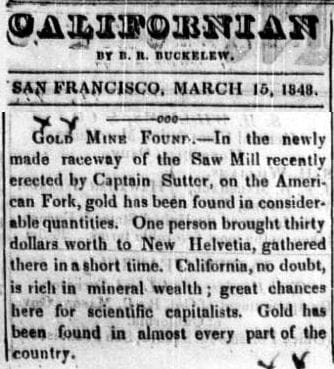
On March 15, 1848 the **Californian* newspaper published the news, although many were skeptical that there was anything much in the report. It would be another two months before the rush to the hills began.
It would be a few months until news of the gold discovery hit New York, and a few months more before the excitement really hit. The trigger point were articles written about mining laborers making $50-70 per day which was 50x what a normal unskilled laborer made in the United States.
Tens of thousands of people started flooding into California and the gold rush was the main catalyst that kickstarted people moving from East to West during that time period. But during this time Mackay stayed at the shipyard earning $1-2 per day.
When you think about the California Gold Rush and how it ignited an excitement that pulled so many people West I think it’s easy to think these people were dumb, undisciplined gamblers. But put yourself in the position of a common unskilled laborer making $1-2 per day here in the United States in the early 1850’s. There were no advancement opportunities. Your best case scenario as an unskilled laborer was in 10 years you would be doing the exact same thing making the same amount of money. That was your upside.
#### 87% of all global equities that went up 1000% or more over the past ten years were microcaps.
[Find Multibaggers](https://microcapclub.com/multibaggers)
What would you do? Stay at home making $1-2 per day for the rest of your life or go west and see if you can make 50x more. You too would be on the next horse/boat out of town.
By late 1851, a solid 2-3 years into the gold rush, Mackay quit his apprenticeship, boarded a ship, and headed for the west coast. He was late to the gold rush. By this time there would have been thousands of people already coming back East from the Sierra foothills empty handed. The easy pickings were picked and by late 1851 the cost of living had exploded in and around the gold rush.
In three years, San Francisco went from 800 people to 35,000 and became the fastest growing city in America. San Francisco became the melting pot of culture – you could hear English, Spanish, French, German, Chinese, Malay, and Hawaiian all spoken on the same city block. San Francisco was a place of new beginnings, because the city itself had no past.

View down Stockton Street, May 1855: View north from Sacramento Street, with Alctraz and Angel Islands visible in bay. G.R. Fardon / UC Berkeley, Bancroft Library
But at the same time, anyone that came west with a moral compass, left it on the boat. Mining was extremely hard, and the outcome was much more like gambling. Many people went broke. Disease was rampant in mining towns. Alcohol and gambling were the main distractions. Violence and murder were common day behavior. Drinking, gambling, and gold were the top three endeavors. California quickly became the devil’s playground.
When Mackay landed in San Francisco in late 1851 he went straight to Downieville, California (100 miles north of Sacramento). He lived there for seven years mining gold in the gulches. He never made a big strike during these years, but he earned enough to support himself and send what he could back to his mother and sister.
Mackay actually loved the life – the outdoors, the physical work, the camaraderie, the chaotic menacing life of the mining camps. In his first few years Mackay built a hard working reputation. No one worked harder than he did. He was well liked among his peers. What made him different was at night when everyone drank and gambled, he stayed home and read about mining, geology, and also studied great men. He visualized himself in situations competing and winning.
In Downieville, at the start of the gold rush if you worked with a good team, you made $20 per day. But the pay was steadily coming down as the easy gold was taken out of the earth. By 1855 miners made $5 per day, and by 1858, you were lucky to make $3 per day.
By 1858, Mackay was 27 years old and had been mining seven years with nothing to show for it. He was working hand to mouth just like the first day he arrived. The Downieville gold district was dying, and it was time to make a move. Mackay and a friend packed up and literally walked 110 miles to Virginia City in Nevada that would later become the Comstock Lode.
It’s hard to imagine that within 20 years John Mackay would own the entire district and become one of the richest men in the world. If you would like to learn more about John Mackay read this [amazing book](https://www.amazon.com/Bonanza-King-Mackay-Greatest-American/dp/1501108190?ref=microcapclub.com).
John William Mackay (1831 - 1902)
I often think about the perseverance it takes to become who you want to be, and how it doesn't happen by accident. It is the result of deliberate thought, effort, and discipline. Mackay studied while everyone else drank and gambled. His effort in self-improvement wasn’t a guarantee he would become successful. But he would have surely guaranteed himself to be poor if he hadn’t put in the hours that others wasted.
I think this is a valuable lesson for life, business, and investing. I was reminded again by this after watching this wonderful presentation by Shyam Sekhar. He outlines his maturation as a stock picker over the past 30-years.
> "When you make a lot of money ahead of when you should have it is your duty to grow yourself first and then handle that money. You need to grow yourself ahead of your portfolio." - Shyam Sekhar
I love the concept of growing yourself ahead of your portfolio. It reminded me of an article I wrote seven years ago, [The Maturation of an Investor](https://microcapclub.com/the-maturation-of-an-investor/). We all want instant fame and fortune, but the problem with instant success is you rarely have the power to keep what you haven’t earned. Almost all successful people went through incredible hardship, obstacles, and challenges. The ability to grow yourself and prepare for success ahead of it occurring is the winner’s quality.
The hardest part of achieving a great long-term investment track record is over half the time your returns will look average. You can go years where it feels like you are working hard for mediocre returns. Then all of a sudden it changes and the previous year’s efforts, perhaps helped by a better macro environment create circumstances where you don't have to work as hard for your returns. The world works for you and pulls forward 5-10 years’ worth of returns and riches in a single year.
Then it’s up to you if this will be a permanent step change in knowledge and wealth. Is this your new base in which to grow from? Or will you stop growing yourself by letting your ego take control thinking you know everything. Will you revert slowly and then quickly back to immature tendencies? If so, your wealth will revert slowly and then quickly.
The growth and maturity to manage $1,000,000 is different than $100,000\. The growth and maturity to manage $10,000,000 is different than $1,000,000\. You must always be growing yourself ahead of your portfolio.
Grow yourself.
#### Interact and learn with 250+ of the best microcap investors on the planet:
[Join Us](https://microcapclub.com/join-now)
MicroCapClub is an exclusive forum for experienced microcap investors focused on microcap companies (sub $500m market cap) trading on United States, Canadian, European, and Australian markets. MicroCapClub was created to be a platform for experienced microcap investors to share and discuss stock ideas. Since 2011, our members have profiled 1000+ microcap companies. Investors can join our community by applying to become a member or subscribing to gain instant view only access. MicroCapClub’s mission is to foster the highest quality microcap investor Community, produce Educational content for investors, and promote better Leadership in the microcap arena. For more information, visit and
### Active Patience
URL: https://microcapclub.com/active-patience/
Last updated: 2024-02-18T00:42:56.000Z
The longer I invest the more I realize you get 1-2 great opportunities every few years. The rest of the time is spent wondering if you will ever get another great opportunity again and convincing yourself to own mediocre opportunities while you wait. Mediocrity is the price you pay for impatience.
Great investors develop Active Patience. Active Patience means knowing what you are looking for and doing nothing until you find it.
I mentioned Active Patience to [Anthony Deden](https://youtu.be/a4%5FU6bS-cU4?si=qIeV%5FJAc18MG3iE-&ref=microcapclub.com) (he's also speaking at our [Summit](https://microcapclub.com/summit/)) and he responded,
> "Active patience, yes. Think of an art collector wishing to add to his collection. He mostly sits around reading auction catalogs."
His comment reminded me of this great quote by memorabilia collector Darren Rovell,
> "I want to be in a market where a specific collectible hasn't sold for three years but there are 11 guys total in the world who want it and I know I can name my price."
Active patience is not an inborn ability or skill. It is developed over years and decades in the following stages:
1. **Developing Your Temperament** – Finding out who you are.
2. **Finding Your Principles** – Finding out what you believe.
3. **Committing to Your Principles** – Living out what you believe.
Many investors never find out who they are. Even fewer figure out what they believe. Only a select few live out what they believe.
**Developing Your Temperament**
Temperament means developing your views on risk, time horizons, volatility, position sizing, and value. It means determining what flavor of investing aligns with your natural inclinations so you can apply it consistently and successfully over time.
I often think about how formative the first few investment decisions are in an investment journey. Whether your first investments were big wins or losses. The outcomes can send you up or down the risk tree permanently. They shape who you are.
If you took risk and won in your early years like I did, even if you suffered big losses later like I did, you likely feel more comfortable taking risk today because you already proved to yourself it could be done.
The opposite is also true.
If you took risk in your early years and lost, you likely have spent more time thinking about developing a strategy to protect yourself from ever feeling that way again.
The feedback loops with investing are long. Developing your temperament and determining the type of investor you are takes time and reps. It takes loss. It takes you overreaching in risk, position sizing, trusting management, and many other factors. You have to push yourself to find your limits.
You must live through, trade through, invest through, many scenarios and circumstances to understand how you will react.
You must experience the emotional highs and lows of greed and despair, several times, before you know how, and in what ways, to exploit these emotions in others for your own benefit.
Investing is 5% intellect and 95% temperament. It means finding the strategy that will allow you to sit quietly when your emotions are screaming at you to do the wrong thing.
Only after you develop your temperament and figure out who you are, can you find your principles.
**Finding Your Principles**
Anthony Deden also once told me, "Ian you aren't a microcap investor. You invest with a certain set of principles."
Principles are what guide us. They are what makes us unique.
It took me 15 years to develop my business principles around scarcity, survival, tailwinds, and discovery.
It took 15 years of investing with different types of leaders, founders, CEO’s - speaking with them regularly, having dinner with them, truly knowing them, until I started seeing patterns in personality and character.
Your principles are the qualities of a business that are mandatory. Principles allow you to say no to entire swaths of the investment universe.
Your principles are the qualities of men and women that are mandatory with whom you can partner and trust. Your principles allow you to say no to certain types of people.
Principles allow you to say "Yes" very quickly because you know what you are looking for. Sometimes within 10 minutes you know "this is the one".
Principles allow you to sell in an instant when trust is broken in a business or person.
I’ve found over the years that “value” is completely subjective. Your principles are the things YOU find valuable. They are the must haves that are necessary for you to buy and hold an investment.
You can't expect others to completely understand your principles. It's how you can be in a room with 100 successful investors and each person is horrified at the next person's best idea. It's how you can be in a room with 100 investors that own the same stock, and each investor is holding for slightly different reasons. Your principles are your uniqueness.
It takes time and reps to find your principles.
It took Buffett two decades to go from deep value to quality.
It took Sleep and Zakaria almost a decade to go from "we will go anywhere in the world to find deep value" to only investing in business models that represented scale economics shared.
It took Reece Duca at IGSB two decades to develop the expertise and insight to only invest in vertical software companies. Reece said in a recent interview,
> “The first decade, we would look at and invest in all kinds of industries and all kinds of models within the industry. And I would say with hindsight, that was good, because it gave us an understanding of how things worked in manufacturing and how they worked in retail and how they worked in oil and gas, and... But what happens is you're not an expert in anything. In fact, your knowledge is pretty superficial of any particular model. And as I would say today is the single most important thing in determining whether a company is an exceptional company or not is going to be their business model.
> So by the time we got to the end of the second decade, we were focusing on essentially software companies. And over the next two decades, we essentially went from the combination of looking at consumer software companies and businesses software companies, basically to business B2B companies, essentially, then SaaS-based companies, then--we didn't distinguish between horizontal and vertical SaaS, but then we focused more on vertical SaaS than we did horizontal SaaS. And one of the byproducts of that was that we really developed expertise in how these models work."
Every investment you make ends up teaching you something about yourself. You can't rush it.
Pastor T.D. Jakes put it so beautifully,
> *"Many people cannot find success because they lack the patience to go through the process to become who they want to be."*
It takes time to find out who you are and what you believe.
After you find your principles, you must commit to them.
**Committing to Your Principles**
> “Until one is committed, there is hesitancy, the chance to draw back, always ineffectiveness. Concerning all acts of initiative and creation, there is one elementary truth the ignorance of which kills countless ideas and splendid plans: that the moment one definitely commits oneself, then providence moves too. All sorts of things occur to help one that would never otherwise have occurred.” - William Hutchison Murray
You are the happiest when you are the most focused. You are the unhappiest when you are the most distracted.
If you want to be miserable, be halfway committed to things.
Halfway committed to your business, halfway committed to your spouse, halfway committed to your faith, halfway committed to your kids, halfway committed to your process, halfway committed to your principles.
The world wants us to believe "halfway committed" is freedom of choice. You are simply keeping your options open - the ability to change course. It seems more productive to have multiple options. It's quite the opposite.
Halfway committed is misery because no one ever sees your full potential. Not even you.
Total commitment is freedom. Total commitment is happiness. Once you find your principles, you must fully commit to them. Anything less is a waste of time.
Distractions come in many different forms. The shiny new ideas that tantalize us but are missing our core principles for investment. The mind games our emotions (greed, fear, boredom) play on us making us sell positions/or buy new ones that we shouldn't. The opinions and criticisms we internalize from investors that haven't done the work. Distractions are anything that causes us to lose focus.
Discipline means having the strength to say no to the thousands of things that distract you.
Courage means having the strength to say yes to the few things that matter.
Commitment means having unwavering confidence in yourself and your principles.
I love this quote from Hall of Fame professional golfer Raymond Floyd,
> “Patience means knowing that your practice and hard work will pay off, and understanding that improvement often comes from plateaus rather than at a steady rate.
> A scorer is patient because he has faith in himself and in his approach. A golfer who believes in himself doesn't panic or lose his composure when things go wrong. He calmly rights the ship, bears down, and waits for things to go his way. Jack Nicklaus has often been admired for his patience on the golf course, and it's no coincidence that no player I've ever seen has believed in himself more than Jack.
> The kind of confidence doesn't just happen. But to develop patience, it's important to have a plan for yourself that you believe in - whether it's for the way you want to swing or the strategy you want to employ. If you're truly committed to your plan you won't abandon it so easily when things go badly - especially if you accept that there will be shots and holes and rounds when things go badly. When you believe in your plan and believe in your ability to carry it out, patience is your ally."
Patience is an asset for those that know it’s only a matter of time.
The longer you commit to your principles the more you naturally set up your life, network, habits to find ideas for you.
You build your network, tools, screens, relationships like a spider builds a web. You keep building it out. Then one day something hits the web. You feel the tremor and you go look at what you caught. This is how the great ideas find you.
It might be months or maybe even years depending on your strategy before you find something new and actionable, but you remain confident because you know what you are looking for.
When you fully understand active patience, you become an art collector. You see your portfolio as a collection of prized assets. Your intention with every purchase is to never sell unless your principles are broken, or you get your price.
#### Interact and learn with 250+ of the best microcap investors on the planet:
[Join Us](https://microcapclub.com/join-now)
MicroCapClub is an exclusive forum for experienced microcap investors focused on microcap companies (sub $500m market cap) trading on United States, Canadian, European, and Australian markets. MicroCapClub was created to be a platform for experienced microcap investors to share and discuss stock ideas. Since 2011, our members have profiled 1000+ microcap companies. Investors can join our community by applying to become a member or subscribing to gain instant view only access. MicroCapClub’s mission is to foster the highest quality microcap investor Community, produce Educational content for investors, and promote better Leadership in the microcap arena. For more information, visit and
### Building an Unfair Advantage
URL: https://microcapclub.com/building-an-unfair-advantage/
Last updated: 2024-01-03T11:46:29.000Z
Justin Ishbia is likely the best microcap investor in the world. He is the founding partner of [Shore Capital Partners](https://www.shorecp.com/?ref=microcapclub.com), a $7 billion private equity firm utilizing a systematic approach to acquire hundreds of private microcap businesses. Since 2009, Shore Capital has acquired 600 small businesses, which makes them the #1 most active private equity firm in the world.
More importantly, Shore Capital is ranked in the top 1% of all private equity firms globally by performance. They have compounded investor capital at 50% net per year for 10+ years. The firm’s success has made Justin Ishbia a billionaire, and the co-owner of the Phoenix Suns/Phoenix Mercury along with his brother Mat Ishbia (CEO of United Wholesale Mortgage).
What makes the firm unique, beyond the track record and velocity of deals, is the small size of the average business acquired: $18 million in revenues, $3 million in EBITDA, enterprise value of $12 million. They focus on finding, acquiring, building, and scaling platforms of small businesses in growing industry niches.
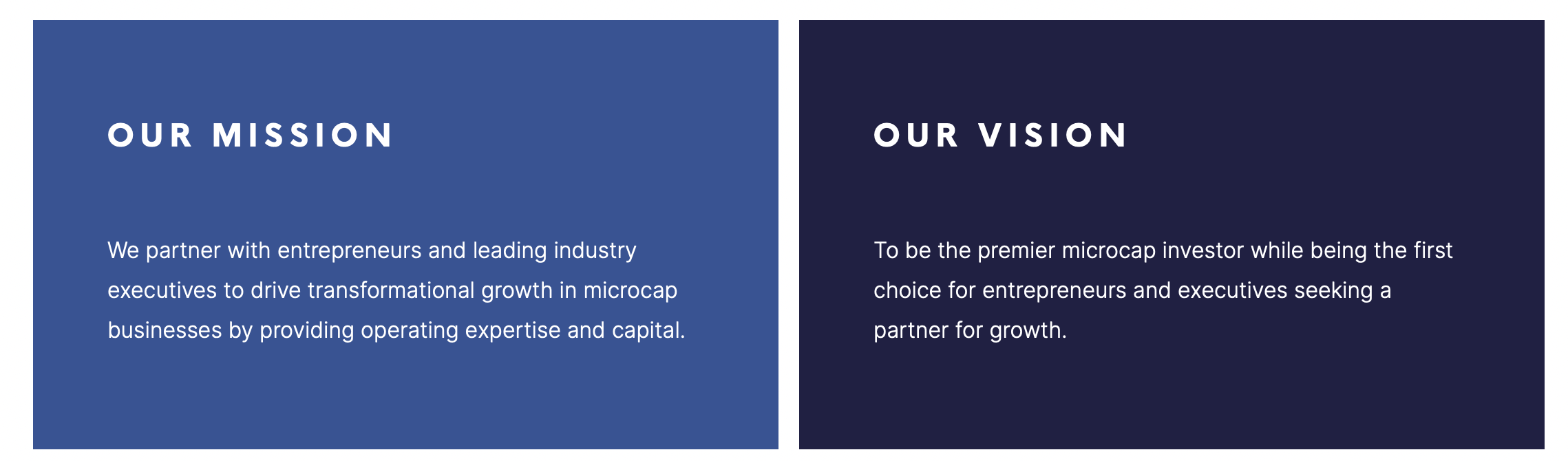
Shore Capital Mission and Vision Statement
Do you think public microcap investors can learn something from their process?
Absolutely. You will probably learn more than reading the 38th book on Warren Buffett.
Justin Ishbia was recently [interviewed](https://podcasts.apple.com/us/podcast/justin-ishbia-lessons-from-acquiring-586-companies/id1154105909?i=1000639053268&ref=microcapclub.com) by Patrick O’Shaughnessy on the Invest Like the Best Podcast. I listened to the podcast five times. I would encourage you to do the same.
> "We have billion-dollar resources and knowledge and apply it to million dollar companies." – Justin Ishbia
Let’s breakdown their approach:
1. **Identify Industry Niche.** They find an attractive industry niche (i.e. veterinary, urgent care) in a long-term growth trend where consolidation and scale could enhance the competitive advantage.
2. **Partner with Executives.** They study the industry, attend all the conferences, identify the Mt. Rushmore businesses and leaders in the industry. They recruit the board members prior to acquiring a businesses in that niche (platform). Only after a 40-60 page white paper is written/presented, and the right board members are selected is a platform greenlighted by the investment committee.
3. **Find MicroCap Targets.** They [get on the ground](https://microcapclub.com/due-diligence-get-on-the-ground/) and use the board to identify high value targets. Partner with the founder of the target by acquiring 60-80% of the business.
4. **Grow Investment for Exit.** The first 100-days after acquisition has 23 standard operating procedures that need implemented to create efficiency for scale. The goal is to turn "line of sight management" into "management by metrics". The result is a platform of businesses that on average will grow 100% per year (organic + inorganic) with the goal of growing EBITDA from $3 million to $15+ million over a few years. They take businesses [From Hustle to Scale](https://microcapclub.com/from-hustle-to-scale/). Finding buyers isn't difficult when the platform of businesses is growing 100%, with best-in-class management/board, in a growing industry niche. They have sold platforms to large public companies, and large private equity firms.
5. **Systematic Approach Produces Consistent Outcomes:** Since inception the firm has invested in 59 platforms (600+ individual business) with 14 exits. The average return has been 7x their money, and the worst return has been 3x their money. In totality the fund’s performance is 70% Gross IRR’s and 50% net since inception.
When Justin Ishbia was asked about the secret sauce of the firm he said:
> “The most important part of our thesis is recruiting the right board members.”
I wasn’t surprised because it immediately answered the question, [“How Are You Different?”.](https://microcapclub.com/how-are-you-different-2/) Most microcap investors don’t focus on the board when they evaluate microcap public companies. What I’ve learned is to be the best in the world (whether it's sports, investing, etc), it normally means a person/firm has innovated on an under appreciated area and it becomes a big differentiator. Shore Capital has turned an area that most investors neglect into its greatest strength.
#### 87% of all global equities that went up 1000% or more over the past ten years were microcaps.
[Find Multibaggers](https://microcapclub.com/multibaggers)
How does Shore Capital build a board?
**No Big Check Writers**: No one gets a board seat because they wrote a big check. This made me laugh because this is exactly how most microcap boards are structured.
**Mt. Rushmore 7-Person Independent Board**: Each platform has its own 7-person independent board. They seek out the Mt. Rushmore leaders in the industry who by industry standards and reputation are best in class. The over-stacked board creates extreme value. Shore Capital builds a board like a coach builds a basketball team. They don’t want 5 point guards. They want a guard, shooting guard, small forward, power forward, and a center. Each player provides value in different ways to help the team win. Similarly, each board member brings a skillset necessary to scale:
- Two people that ran a business in the same sector 3x the size.
- One person that knows the voice of the supply chain.
- One person that knows the voice of the customer.
- One person with functional discipline/CFO type that knows the numbers/KPI’s cold.
- Two people from an adjacent sector with value added expertise.
**No Cash Comp**: All board members get paid in options. They get a number of options where in Shore Capital’s historical base case scenario will equate to $250,000 in 5 years. Most board members reframe it as being paid $50,000 per year for five years and sign up.
**Super Powered Board Ecosystem**: In 2024, Shore Capital expects to close on 12-13 platforms. They will need 90 unique board members. The company puts in a lot of time creating a board member ecosystem across platforms to cross pollinate knowledge. All board members come together twice per year to learn from each other and increase the odds of success.
Shore Capital’s moat is their process + volume of transactions. After hundreds of acquisitions and operational reps, they are learning faster than most. They believe they are the best in the world at scaling microcap companies from $3 million to $15+ million in EBITDA. They can use and reuse talent, which creates operational excellence and mobility for executives. The firm has 150 full time people, half devoted to operations, and they have never lost a person above associate level. 44 Vice Presidents at Shore Capital. No one has ever left. Why would they? I can’t think of a more fascinating firm in the world.
Innovating and creating a systematic approach around an under-appreciated skill is how you create an unfair advantage. Shore Capital has done this with board composition.
Here is great presentation by Justin Ishbia:
#### Interact and learn with 250+ of the best microcap investors on the planet:
[Join Us](https://microcapclub.com/join-now)
MicroCapClub is an exclusive forum for experienced microcap investors focused on microcap companies (sub $500m market cap) trading on United States, Canadian, European, and Australian markets. MicroCapClub was created to be a platform for experienced microcap investors to share and discuss stock ideas. Since 2011, our members have profiled 1000+ microcap companies. Investors can join our community by applying to become a member or subscribing to gain instant view only access. MicroCapClub’s mission is to foster the highest quality microcap investor Community, produce Educational content for investors, and promote better Leadership in the microcap arena. For more information, visit and
### Same Stock Different Returns
URL: https://microcapclub.com/same-stock-different-returns/
Last updated: 2023-12-19T11:14:10.000Z
What’s a quick way to annoy an investor?
Write: “If you bought $1,000 of \[insert 1,000x multibagger\] stock 30 years ago and still owned it, you’d have $1 million dollars.”
You can make a ton of money investing in great companies early and holding. However, these clichés oversimplify the myriad of factors that contribute to holding such a company. In reality, life gives us every reason to sell a great company. Consequently, investors experience wildly different results despite investing in the same stock.
Take Apple, for instance.
Of the three original co-founders of Apple, only two individuals became rich: Ronald G. Wayne was not one of them. He sold his 10% stake in Apple for $1,500 just two weeks after the company’s founding in 1976\. Steve Jobs and Steve Wozniak fared much better. Jobs sold all but one of his millions of shares of Apple in 1985, yielding him hundreds of millions of dollars. Steve Wozniak lost 15% of his shares in the separation to his first wife and either sold or gave away the rest of his Apple shares by 1985, resulting in a number of millions for him.
Same stock; wildly different returns.
Why did Ronald Wayne sell so early? During the initial week, Jobs successfully secured a contract to sell 100 Apple Is to the Byte Shop, a firm notorious for not paying their bills. To fulfill this order, he obtained a $15,000 loan. Given Apple’s non-corporate status at the time, Ronald Wayne found himself personally liable for $1,500 should the Byte Shop live up to its reputation– a sum beyond his means. Wayne, having recently navigated his own prior corporate failure and spent years repurchasing stocks and settling debts, couldn’t bear this financial risk. His decision was firm, as he believed it would have likely led him to a mundane paper pushing role than allowing him to pursue his inventive passions. He didn’t regret his billion dollar decision.
Apple is a $3 Trillion market cap today and all three founders sold most or all of their stock by 1985\. [Investing is hard](https://microcapclub.com/investing-is-hard/).
Mike Markkula was the first and one of the longest holders of Apple stock - out holding Jobs and Wozniak. Markkula invested $91,000 in equity and secured $250,000 in financing, acquiring a 33% stake in the company. He played a pivotal role in guiding Apple in various capacities, eventually becoming Apple’s longest serving board member. Over time, Markkula sold his stock and by 1997 was Apple’s second-largest individual shareholder, possessing 3.1 million shares valued at $40 million–a >500-bagger. He likely continued to hold shares after his retirement as he said he was optimistic that Jobs could help restore the value of the stock and the company.
#### 87% of all global equities that went up 1000% or more over the past ten years were microcaps.
[Find Multibaggers](https://microcapclub.com/multibaggers)
Apple raised their first venture capital round in 1978\. Venrock invested $288,000 for 10%. Sequoia Capital invested $150,000 and Arthur Rock invested $57,600\.
Approximately two years later, just before Apple’s IPO, Sequoia Capital–a venture firm established by Don Valentine–sold their stake for $6 million, a 40-bagger. Allegedly, the reason behind Sequoia’s divestment at that time stemmed from certain LPs urging Don Valentine to liquidate profits to cover taxes. \[This is the main reason why Sequoia now only accepts money from non-profit tax-exempt sources and sticks with companies long after a company’s IPO.\]
Arthur Rock, one of the forefathers of venture capital, became a board member of Apple. At Apple’s IPO, Rock’s shares were worth $21.8 million, a 378-bagger. Rock was selling large blocks of shares in 1983\. By June 1993, Rock had stepped down from the board and sold most of his remaining holdings.
Arthur Rock’s departure from the Apple board and last sale of shares boil down to one pivotal moment. When Apple, IBM, and Motorola jointly took out an ad in all of the newspapers announcing the PowerPC chip, declaring that they’d kill Intel, it posed a conflict for Rock. As an early investor in Intel and a board member, he remarked, “Of course, I had to resign.”
Same stock; wildly different returns.
Venrock, the venture arm of the Rockefeller family, participated in Apple’s second venture round, diluting its 10% stake to 7.9%. Venrock sold out of its position a few years after Apple's IPO for a 430-bagger return. The reason? To invest in other opportunities.
Henry Singleton bought $100,800 in Apple during its second round and became a board member of Apple. Singleton co-founded Teledyne in 1960 and as Warren Buffett stated “ \[he\] created the best operating and capital deployment record in America” by 1980\. Singleton upped his investment in Apple in later rounds for a total investment of $302,800\. By Apple’s IPO, Singleton’s 2.4% stake was worth $40.8 million, a 134-bagger. Like Rock, Singleton was selling large blocks of shares in 1983, largely to fund his land acquisitions.
The venture arm of Continental Illinois Bank in Chicago invested $504,000 in Apple’s second round of funding. During the IPO in 1980, the firm sold $5 million of the position, resulting in a 78-bagger in 28 months. The remaining 1.5 million shares were sold not too long afterwards. The reason for the sales? It helped contribute to the bank’s overall earnings.
During Apple’s third capital raise round, in August 1979, Alan Patricof’s Fifty-Third Street Ventures invested $315,000 in Apple. A short 16 months later, Patricof’s investment was worth $5 million, a 17-bagger. Patricof sold $1 million on the IPO day. He said it was an easy chance to “get the bait back.” He distributed the Apple shares in-kind to his investors, who likely sold their shares immediately.
Same stock; wildly different returns.
After Apple went public, many Apple employees became multi-millionaires on paper. Some, like Jef Raskin, sold their shares because they “didn’t want to have to open the paper each day to find out how much money” they had. Many others sold to retire and live extravagant lifestyles.
It’s plausible to assume that the 1,000s of individuals who invested in Apple’s IPO lost money. From the IPO to Steve Jobs’s departure in September 1985, Apple stock declined 47%.
Surely, there must have been individuals who invested in Apple’s IPO and held it until 1983 when shares went up 300%, like many of the early large investors, or possibly longer. However, it’s probable that the majority of investors did not.
Then you have retail investors like Donna Fenn who invested in Apple in 1985\. Aside from selling some shares in 2009, she continued to hold shares until 2018 \[[HERE](https://www.facebook.com/watch/?v=10155492504847115)\].
Again, it’s safe to assume that many people lost money investing in Apple while a much smaller number made a profit, and an even smaller number made a killing. Here are the drawdowns from Apple’s highs since 1985.
\-20% or more - 224 months (\~48% of time)
\-30% or more - 167 months (\~36% of time)
\-40% or more - 124 months (\~27% of time)
\-50% or more - 94 months (\~20% of time)
\-60% or more - 69 months (\~15% of time)
\-70% or more - 33 months (\~7% of time)
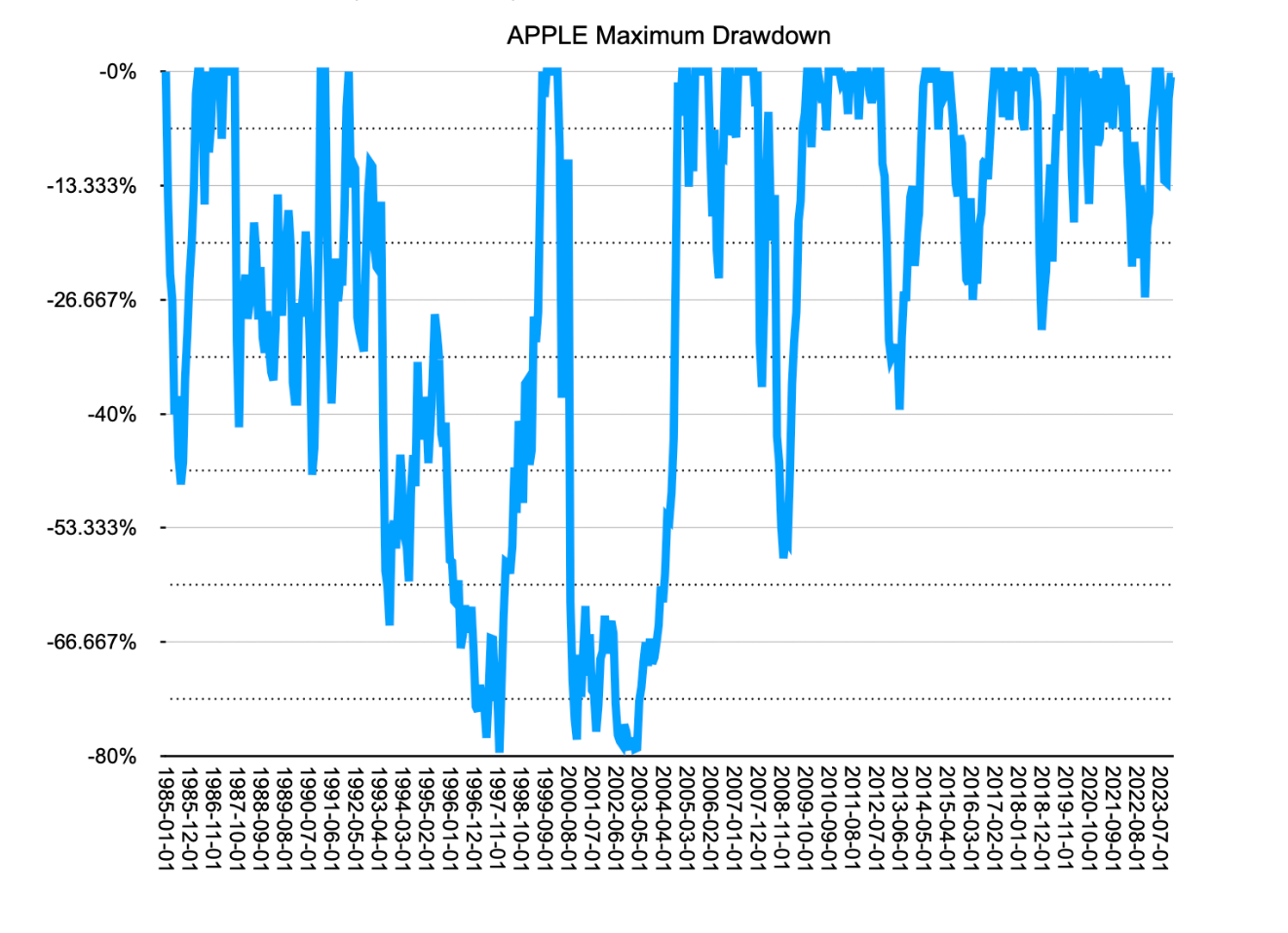
To have made a killing investing in Apple in the 1990s would have been difficult. For much of that decade Apple’s business was a loser. If you bought Apple stock in 1990, it would take nearly a decade to break-even before it skyrocketed higher.
Most Apple investors were like Ted Gioia, a jazz critic, who purchased 300 Apple shares in the 1990s and sold them in 1997 for $9,100\. Had he not sold, his investment would be 700 times larger. He recalled:
> "I probably should have bought those shares back when Jobs returned to Apple. And eventually I did buy a few shares, and made some profits — but they were tiny compared to the gains I could have enjoyed just by holding on to my original investment."
The people on the other side of Gioia’s trade were investors like Saudi Prince Alwaleed bin Talal Alsaud who started buying Apple in 1995 (\~$0.35), and held as the stock fell to a split adjusted $0.11\. In 1997, the Prince increased his position to 5% of Apple’s shares as Steve Jobs returned to Apple as CEO. The Prince held at least until 2011, when he paid the following tribute to Jobs at the time of his death:
> “I knew Steve Jobs for the past 20 years. When I first invested in Apple the share price was $9! I met him three times at Apple’s offices and had lunch with him once. …I remember him saying to me ‘Prince, you trusted me in investing in Apple & \[I\] won’t let you down. Well, he didn’t let anyone down!!! Three apples changed the world: Adam’s, Newton’s and Steve’s!”
Same stock; wildly different returns.
After Apple’s business demonstrated significant success with the advent of the iPod, iPad and groundbreaking iPhone, investors started making money. In 2013, Carl Icahn began buying Apple’s shares. He ended up buying 45.8 million shares as he called the investment a no-brainer. Over the next 3 years, he said that he made roughly $2 billion, or roughly a 2-bagger. Icahn fully exited Apple in Feb 2016 despite the stock being cheap on a multiple basis. He said:
> “\[The Chinese government could\] come in and make it very difficult for Apple to sell there ... you can do pretty much what you want there.”
At about the same time Berkshire Hathaway began buying shares in Apple. Berkshire initially purchased 9.8 million shares. Over the next 3 years Warren Buffett purchased another 241 million shares (pre-split) for a 5.2% interest in Apple. Berkshire’s cost basis was \~$36 billion. Despite selling some shares in Apple in 2020, which Buffett and Munger later called a mistake, Berkshire has made roughly $190 billion (as of 12/17/23) on its Apple stake, a 6-bagger.
Same stock; wildly different returns.
I'm reminded of this comment by Ian:
> The beauty of investing is 1000 investors can be in a multi-bagger stock and returns will be dramatically different - some will lose money. Finding a great company isn't even half the battle. Time horizon matters. Temperament matters. Conviction matters. Price paid still matters.
>
> — Ian Cassel (@iancassel) [September 11, 2023](https://twitter.com/iancassel/status/1701271492036620760?ref%5Fsrc=twsrc%5Etfw&ref=microcapclub.com)
There’s only one reason to buy a stock, but there are infinite reasons to sell a stock.
Discovering the next 10-bagger is crucial, yet it’s not as insurmountable a task as many presume. The most challenging aspect of investing in a 10-bagger lies in prematurely selling the stock.
Since 2011, MicroCapClub members have profiled fourteen >10-baggers and one 100-bagger. Many market participants invested in these same winning stocks, but each got wildly different results.
I can speak from experience that MicroCapClub has helped me hold onto a few winners much longer than I would have without it. It’s the place where you can learn from investors who know the business better than most.
#### Interact and learn with 250+ of the best microcap investors on the planet:
[Join Us](https://microcapclub.com/join-now)
MicroCapClub is an exclusive forum for experienced microcap investors focused on microcap companies (sub $500m market cap) trading on United States, Canadian, European, and Australian markets. MicroCapClub was created to be a platform for experienced microcap investors to share and discuss stock ideas. Since 2011, our members have profiled 1000+ microcap companies. Investors can join our community by applying to become a member or subscribing to gain instant view only access. MicroCapClub’s mission is to foster the highest quality microcap investor Community, produce Educational content for investors, and promote better Leadership in the microcap arena. For more information, visit and
### How Are You Different?
URL: https://microcapclub.com/how-are-you-different-2/
Last updated: 2023-12-22T12:48:19.000Z
In a past article, [How Much Are You Hurting Your Returns?](https://microcapclub.com/how-much-are-you-hurting-your-returns/), I highlighted how you can use inertia analysis to pinpoint the areas where your trading activity is hurting your returns.
In this article I wanted to highlight a firm who on the surface looks like a traditional value investing firm. But when you dive below the surface you find a firm that has a very different and disciplined approach to actively creating alpha.
Alpha is generated by being a little different in a disciplined and thoughtful way.
I've been a fan of [Turtle Creek Asset Management](https://www.turtlecreek.ca/?ref=microcapclub.com) ever since a friend of mine and MicroCapClub member [@Valueseeker123](https://community.microcapclub.com/profile/6198-valueseeker123/?wr=eyJhcHAiOiJmb3J1bXMiLCJtb2R1bGUiOiJmb3J1bXMtY29tbWVudCIsImlkXzEiOjExNjEsImlkXzIiOjg2MTQzfQ==&ref=microcapclub.com) brought them to my attention several years ago. I was reminded of them again after Andrew Brenton, CEO and Co-Founder, of Turtle Creek was [interviewed](https://podcasts.apple.com/us/podcast/outperforming-the-market-since-1998-w-andrew-brenton/id928933489?i=1000637882960&ref=microcapclub.com) by [Clay Fink](https://twitter.com/Clay%5FFinck?ref=microcapclub.com) on the We Study Billionaires TIP Podcast.
Turtle Creek has $5 billion in AUM and are value investors that hold 25-30 equities. They are trying to find and buy "generationally great businesses" far below intrinsic value. They “need” facetime with management because “90% of what we do is learning from management.” The firm has been fully invested except for the DotCom bubble.
You are thinking, “this sounds like every fund pitch deck on the planet.”
Turtle Creek has compounded investor capital at 20% over the past 25 years.
You are now thinking, “Okay you got my attention. How are they different?”
That is the right question.
Where Turtle Creek differs from most value fund managers is they actively trade around their core positions. They call it Continuous Portfolio Optimization. They buy more as the price drops from intrinsic value and they sell some as the price gets closer to intrinsic value. Their activity adds alpha to a pure buy and hold strategy. Here is a great video snippet with Andrew Brenton talking about their approach:
#### 87% of all global equities that went up 1000% or more over the past ten years were microcaps.
[Find Multibaggers](https://microcapclub.com/multibaggers)
As stock pickers, the way you invest is like a fingerprint. From a distance we might look the same, but when you zoom in we are all unique. There is no "this is the only way". In fact, your advantage is often in the areas you are different. Don’t be afraid to be unique. Be afraid if you’re not.
Here are more notes on Turtle Creek from this presentation:
**Four Step Investment Process**
1. Picking the right kind of company
2. Valuation: Business (Intrinsic) Value
3. Portfolio Construction: Sizing Positions
4. Continuous Portfolio Optimization
**What Principles do you apply to searching out investment opportunities for detailed study?**
- Meet everyone, talk to everyone and read everything of relevance.
- We don’t run screens.
- Apply pre–Turtle Creek Experience
- Mergers and acquisitions advisors
- Control of many companies across a variety of industries
- We have seen inside hundreds of companies.
- Seek to identify superior companies.
- Honest and well-run
- Founder/owner mentality
- Integrity of management and board-alignment
- Seek out highly intelligent organizations.
**What kinds of information and securities are you seeking**
- Public equities (previously we were private equity investors)
- Anglo Saxon rule of law (North America, Europe, Australia)
- Information
- Access to management
- Focus on Long-term
**What Kind of investor irrationalities do you consider?**
- We do not consider investor irrationalities in our process – but we acknowledge they exist.
- Public markets are increasingly inefficient.
- Common behavioral biases (Loss aversion, recency bias)
- Short termism (increasingly too much “information”
- Agency effects
- More and more passive investing
- Over-valuing current yield
- Artificial intelligence
**What periods lead you to greater or lesser investments?**
- We have always been roughly fully invested, only exception was 2000 (Dotcom bubble)
**How do you define and estimate value?**
- “Intrinsic Vlaue” based, i.e.net present value of all future cash flows.
- Same approach used by buyers of businesses.
- Financial model built from scratch for each company.
- Complex, flexible, nuanced, exhaustive, ever refining and probabilistic
- Over time our models become rich repositories of information and thinking
- Scenario Analysis
- Make all assumptions explicit.
- Test the future.
- Frequent contact with management – focused on the business, not the quarter.
- Approach allows us to generate a more informed view of a company’s intrinsic or Business value
**How do you factor in asset values, related security transactions, industry economics, firm strategies, management behavior?**
- We ignore related security transactions, while everything else referred to above is critical to our company valuation work.
**How do you, if at all, account for differences between market prices and intrinsic values? What collateral information do you examine?**
- We don’t try to explain the difference because there is very often no correlation between market and intrinsic in the short term.
**How do you define and manage risk?**
- Risk is being wrong in your forecast – risk is definitely not share price volatility
- We manage risk through knowledge.
- We construct our diversified portfolios of 25-30 holdings from those companies trading at larger discounts to value – the ones where very few scenarios result in bad outcomes, and most are good to very good.
- “Valuation risk” is the single biggest risk.
**How do you make overall portfolio decisions and determine asset allocations?**
- Collaborative investment team approach.
- Portfolio weightings are chiefly determined by long term expected returns.
- The larger the long term expected returns, from a combination of cash paid out to shareholders and the share price being “pulled” toward Business Value, the larger the weighting.
- Additional factors include:
- Relative risk assessment (dispersion of forecast)
- Quality of management
- Alignment with shareholders
- Context
- Designed to achieve an optimized portfolio.
**Continuous Portfolio Optimization (CPO) is a key source of historical outperformance and risk mitigation.**
- As prices change, long term expected returns change and the portfolio is no longer optimal.
- In response, we incrementally take money from those holdings that are in market favor, where prices are rising and expected returns are therefore falling – and add to our investment in those that are out of favor – where prices are declining and expected returns are therefore increasing.
- This price to value discipline is used in all market environments and has not changed over the past 25 years.
- The price to value discipline reduces risk.
#### Interact and learn with 250+ of the best microcap investors on the planet:
[Join Us](https://microcapclub.com/join-now)
MicroCapClub is an exclusive forum for experienced microcap investors focused on microcap companies (sub $500m market cap) trading on United States, Canadian, European, and Australian markets. MicroCapClub was created to be a platform for experienced microcap investors to share and discuss stock ideas. Since 2011, our members have profiled 1000+ microcap companies. Investors can join our community by applying to become a member or subscribing to gain instant view only access. MicroCapClub’s mission is to foster the highest quality microcap investor Community, produce Educational content for investors, and promote better Leadership in the microcap arena. For more information, visit and
### TerrAscend (TSND.TO / TSNDF) – Jason Wild’s Big Bet on Cannabis
URL: https://microcapclub.com/terrascend-tsnd-to-tsndf-jason-wilds-big-bet-on-cannabis/
Last updated: 2023-12-14T13:13:32.000Z
Jason Wild was a pharmacist. He then launched his [fund](https://jwfunds.com/?ref=microcapclub.com) in 1998 with $80,000 of his own money. He invested in Amazon and other types of stocks, and then he bought controlling interest in in a small pharma company Arbor Pharmaceuticals. A few years later Arbor was doing $100 million in operating income. He sold a portion to KKR, and parlayed that into betting big on Cannabis, first in Canada, and then in the US by building TerrAscend (TSND.TO / TSNDF).
TerrAscend is a vertically integrated North American cannabis company with operations in Pennsylvania, New Jersey, Maryland, Michigan, and California. TerrAscend is the fastest growing MSO in its peer group.
#### 87% of all global equities that went up 1000% or more over the past ten years were microcaps.
[Find Multibaggers](https://microcapclub.com/multibaggers)
In this business breakdowns, Ian Cassel sits down with Jason Wild, Executive Chairman of TerrAscend (TSND.TO / TSNDF). This MicroCap Business Breakdowns discussion aired on December 6th on the MicroCapClub Community.
MicroCap Business Breakdowns (MCBB) is a monthly program where we invite leaders of unique microcap businesses to have in depth conversations with the MicroCapClub member/investor that knows the business best. In each conversation we look to drill down into the history, business, strategy, vision, and bull/bear case. The MicroCapClub community can tune in live and ask questions. We publicize each episode 2-4 weeks after the live discussion. Not part of the MicroCapClub community? [Join Us](https://microcapclub.com/join-now/).
Disclaimer: The purpose of this presentation is for informational and educational purposes only and should not be construed as a recommendation to purchase or sell any security. MicroCapClub is not a registered investment advisor. MicroCapClub, its partners, members, subscribers, and affiliates may or may not hold positions in one or more of the securities mentioned on this program and may trade in such securities at any time. Do your own due diligence and seek counsel from a registered investment advisor before trading in any security.
MicroCapClub is an exclusive forum for experienced microcap investors focused on microcap companies (sub $500m market cap) trading on United States, Canadian, European, and Australian markets. MicroCapClub was created to be a platform for experienced microcap investors to share and discuss stock ideas. Since 2011, our members have profiled 1000+ microcap companies. Investors can join our community by applying to become a member or subscribing to gain instant view only access. MicroCapClub’s mission is to foster the highest quality microcap investor Community, produce Educational content for investors, and promote better Leadership in the microcap arena. For more information, visit and
### When Should You Average Down?
URL: https://microcapclub.com/when-should-you-average-down/
Last updated: 2024-09-10T00:30:43.000Z
When you find yourself constantly averaging down in a microcap it's normally a sign your ego has taken over. Proving you're right has become more important than making money. You've forgotten that being broke and right is the same thing as being wrong.
[John Hempton](https://brontecapital.blogspot.com/2017/01/when-do-you-average-down.html?ref=microcapclub.com) (H/T [Luke](https://twitter.com/LukeWolgram?ref=microcapclub.com) who posted it on our [community](https://community.microcapclub.com/topic/4108-when-should-you-average-down/?do=findComment&comment=85634&ref=microcapclub.com)) wrote a good article on averaging down. In the article he writes about the types of situations that are poor choices for averaging down.
**Highly levered companies**. I too have experienced this and why I tend to stay away from highly levered businesses. The issue with highly levered companies is the market cap and stock price can go down a lot but the enterprise value doesn't go down that much. It’s easy for equity holders to get wiped out figuratively and literally. Don't average down into highly levered companies.
**Companies with obsolescence risk**. These companies often look like they have a great "brand" but they have declining market share. I could give you tons of examples of this in microcap. A small $10-50 million market cap owns a brand most people remember and so you assume "it must be worth more than this". Most times it isn't. Or the company sells a "me-too" product or service with little differentiation. The company's goal is to put marketing lipstick on a pig and hope someone accidentally buys the product. Don't average down into pigs.
I would add two more situations to Hempton's list:
**Unprofitable businesses**. A microcap investors biggest risk is [dilution](https://microcapclub.com/dilution/). If a company has less than 12-months of cash, 98.36% \[sarcasm\] of the time an equity raise is coming. Don't jump in front of the freight train. The stock market is really good at sniffing out a dilutive equity raise. When the stock market knows an equity raise is probable, the stock will be stuck in quicksand. In addition, after a company raises capital, it oftentimes takes months, quarters, even years to churn through the dilution and negative taste left in investor's mouths. Don’t average down into unprofitable businesses.
**Underperforming businesses**. One of my biggest mistakes has been averaging down after a company posts a mediocre or bad quarter. 90% of the time another mediocre quarter is coming right behind it. We all want to believe the bad quarter was a one-time event, "this time is different", but it rarely is. Most microcaps are turnaround stories in some way. We love to root for the underdogs. We all want to believe things will get better – that the proverbial frog will turn into a prince. It's easy to convince yourself to average down one more time. Then you do it again and again. The frog was a frog. No offense to frogs. Don't average down into losers.
#### 87% of all global equities that went up 1000% or more over the past ten years were microcaps.
[Find Multibaggers](https://microcapclub.com/multibaggers)
I was recently interviewed by [Morningstar India](https://www.morningstar.in/posts/75639/ian-cassel-on-obsessing-over-what-is-right.aspx?ref=microcapclub.com) and I was asked about averaging down into losers and this was my answer:
> “If you personally lent someone money, and they only repaid you half of what they owed you, would you give that person more money? Of course not. Yet we continually do this with our investing, where we average down into things that have a history of disappointing us.”
Averaging down can be a wonderful thing. In fact, variable pricing is the best thing about the public markets. Short-term stock prices are yanked like a dog on a leash by the madness of the crowd.
Investor sentiment is a pendulum that swings back and forth between extreme optimism and extreme pessimism and never sits still. It's on the extremes where the astute investor waits patiently buying or selling.
Even Berkshire Hathaway, one of the largest, most durable businesses in the world trades in a 30-50% trading range every year. Every. Year.
Coincidentally this is also why many successful short-term traders focus on trading the same 2-3 stocks every year. There is enough volatility in a couple things to make a living. These successful traders find the pulse of a company's stock. They know when the heartbeat becomes irregular.
Microcap stocks are inherently more volatile which means you will have even more chances to average down.
In the [Art of Catching Falling Knives](https://microcapclub.com/the-art-of-catching-falling-knives/) I wrote about how at least once per year I’ll wake up to a position trading down 30% premarket. Some large holder wakes up grumpy and decides today will be the day to sell their entire position in an illiquid stock as quickly as possible.
It always feels like you’ll never get another shot to buy a company you love, but almost every year the market gives you another opportunity.
This leads us to the most important question - **When should you average down?**
The answer is to invert the list of situations to avoid. You should only average down when:
1. The business is accelerating.
2. The business is profitable with no financing risk.
3. The business has a sustainable growth trajectory.
4. The business doesn’t have a lot of debt.
Don’t average down into losers. Average down into winners.
If a stock is dropping and the underlying business doesn’t have all four characteristics above, let the stock drop. Let the position become a smaller portion of your portfolio. Don't catch the knife.
We all have losses in the portfolio. It's part of game. Don't turn a loss into a mistake. Mistakes are when our actions or inaction turns a small loss into a bigger loss. It's when you are [hurting your returns](https://microcapclub.com/how-much-are-you-hurting-your-returns/).
Averaging down is a skill. Done well it can be your greatest asset. Done poorly it can mean disaster.
The most gut wrenching and emotional times are when stocks fall. Remember the four characteristics you need to justify averaging down. Bookmark this article. It will help you when you need it.
#### Interact and learn with 250+ of the best microcap investors on the planet:
[Join Us](https://microcapclub.com/join-now)
MicroCapClub is an exclusive forum for experienced microcap investors focused on microcap companies (sub $500m market cap) trading on United States, Canadian, European, and Australian markets. MicroCapClub was created to be a platform for experienced microcap investors to share and discuss stock ideas. Since 2011, our members have profiled 1000+ microcap companies. Investors can join our community by applying to become a member or subscribing to gain instant view only access. MicroCapClub’s mission is to foster the highest quality microcap investor Community, produce Educational content for investors, and promote better Leadership in the microcap arena. For more information, visit and
### How Much Are You Hurting Your Returns?
URL: https://microcapclub.com/how-much-are-you-hurting-your-returns/
Last updated: 2023-12-07T13:56:29.000Z
Nicolai Tangen is the CEO of Norges Bank Investment Management, Norway's $1.4 trillion sovereign wealth fund. The fund supports roughly 30% of Norway’s annual budget. The fund owns 12,000 global equities, 1.5% of all global equity value, and 2.8% of all European equity value. They are massive.

Nicolai Tangen was recently [interviewed](https://podcasts.apple.com/us/podcast/value-investing-with-legends/id1459993408?i=1000636404621&ref=microcapclub.com) on Colombia Business School's Value Investing Legends Podcast.
What could a concentrated microcap investor like me learn from a person managing $1.4 trillion across 12,000 global equities?
Oddly enough it was one of the best interviews I've heard in a long time. I listened to it twice.
He dropped this nugget of wisdom:
> "The way to judge yourself is inertia analysis. Run your January 1 portfolio for the full year without any changes and compare it to your actual results. It's awful because some years you realize all you did was subtract value when you went into the office."
This is such a powerful statement.
#### 87% of all global equities that went up 1000% or more over the past ten years were microcaps.
[Find Multibaggers](https://microcapclub.com/multibaggers)
How much are you hurting returns? This is a question every active investor should be asking themselves.
Next year, track your January 1 portfolio with zero changes against your actual portfolio and judge your results.
Start journaling your investment decisions during the year and break each decision down by category. It might take more than one year but over time you will accumulate enough reps/decisions in each category so you can compare your decision making. You don’t know how to judge yourself without a large enough sample size of datapoints, reasoning, and emotional states when making decisions. You might find that generally you are “tinkering” with the portfolio far too much. You also might find you are bad or good in specific areas i.e. averaging up, averaging down, initial position sizing, selling too soon, etc.
This technique will help you find the signal in the noise of your past investment experiences so you can grow as an investor.
Here are some other great nuggets of wisdom from Nicolai Tangen:
> “The fewer decisions you make the better they become.”
> “When you are young (25) you are in such a hurry despite having your whole life ahead of you. When you are about to die like me (57) only then you suddenly develop long term thinking. (Laughing)”
> “The biggest bias you have is you believe you don’t have any biases.”
> “It’s interesting when you think about all the people in the world that make a living from getting information out of people - doctors, lawyers, journalists. Most don’t have any professional training on how to get information out of people and they should. We hire interrogators and forensic linguists to work with our portfolio managers so they learn how to get better information out of management, etc.”
> “If you call it gut feel no one believes in it but if you call it pattern recognition everyone believes in it even though it's the same thing”.
> "9 out of 10 drowning victims in Norway are men. Why? Men take more risk."
> "The two most important traits in high achievers. 1.) bounce back factor - how well you bounce back after a loss 2.) debrief process - learning from wins and losses."
#### Interact and learn with 250+ of the best microcap investors on the planet:
[Join Us](https://microcapclub.com/join-now)
MicroCapClub is an exclusive forum for experienced microcap investors focused on microcap companies (sub $500m market cap) trading on United States, Canadian, European, and Australian markets. MicroCapClub was created to be a platform for experienced microcap investors to share and discuss stock ideas. Since 2011, our members have profiled 1000+ microcap companies. Investors can join our community by applying to become a member or subscribing to gain instant view only access. MicroCapClub’s mission is to foster the highest quality microcap investor Community, produce Educational content for investors, and promote better Leadership in the microcap arena. For more information, visit and
### Idaho Strategic Resources (IDR): Gold Production + The Largest Rare Earth Element Land Package in the United States
URL: https://microcapclub.com/idaho-strategic-resources-idr-gold-production-the-largest-rare-earth-element-land-package-in-the-united-states/
Last updated: 2023-12-07T13:57:07.000Z
Idaho Strategic Resources (IDR) is an Idaho based gold producer which also owns the largest Rare Earth Elements land package in the United States. In today’s volatile geopolitical and macroeconomic environment, IDR finds itself in a unique position as the only publicly traded company with profitable gold production and rare earth element exposure in one stock.
#### 87% of all global equities that went up 1000% or more over the past ten years were microcaps.
[Find Multibaggers](https://microcapclub.com/multibaggers)
In this business breakdowns, Ian Cassel and Luke Steckel sit down with CEO and largest shareholder John Swallow. This MicroCap Business Breakdowns discussion aired live on November 16th on the MicroCapClub Community.
MicroCap Business Breakdowns (MCBB) is a monthly program where we invite leaders of unique microcap businesses to have in depth conversations with the MicroCapClub member/investor that knows the business best. In each conversation we look to drill down into the history, business, strategy, vision, and bull/bear case. The MicroCapClub community can tune in live and ask questions. We publicize each episode 2-4 weeks after the live discussion. Not part of the MicroCapClub community? [Join Us](https://microcapclub.com/join-now/).
Disclaimer: The purpose of this presentation is for informational and educational purposes only and should not be construed as a recommendation to purchase or sell any security. MicroCapClub is not a registered investment advisor. MicroCapClub, its partners, members, subscribers, and affiliates may or may not hold positions in one or more of the securities mentioned on this program and may trade in such securities at any time. Do your own due diligence and seek counsel from a registered investment advisor before trading in any security.
MicroCapClub is an exclusive forum for experienced microcap investors focused on microcap companies (sub $500m market cap) trading on United States, Canadian, European, and Australian markets. MicroCapClub was created to be a platform for experienced microcap investors to share and discuss stock ideas. Since 2011, our members have profiled 1000+ microcap companies. Investors can join our community by applying to become a member or subscribing to gain instant view only access. MicroCapClub’s mission is to foster the highest quality microcap investor Community, produce Educational content for investors, and promote better Leadership in the microcap arena. For more information, visit and
### Could Your Small Business be the Next Multi-Bagger Stock?
URL: https://microcapclub.com/could-your-small-business-be-the-next-multi-bagger-stock/
Last updated: 2023-11-29T13:09:03.000Z
Most of the multi-baggers that occur in the public markets are small businesses that look a lot like yours. I gave this presentation to a group of small business owners at the [Main Street Summit](https://www.mainstreetsummit.com/?ref=microcapclub.com) on November 8th, 2023\. Whether you are a small business owner or small business investor (private or public), I think you will enjoy this presentation.
#### Interact and learn with 250+ of the best microcap investors on the planet:
[Join Us](https://microcapclub.com/join-now)
MicroCapClub is an exclusive forum for experienced microcap investors focused on microcap companies (sub $500m market cap) trading on United States, Canadian, European, and Australian markets. MicroCapClub was created to be a platform for experienced microcap investors to share and discuss stock ideas. Since 2011, our members have profiled 1000+ microcap companies. Investors can join our community by applying to become a member or subscribing to gain instant view only access. MicroCapClub’s mission is to foster the highest quality microcap investor Community, produce Educational content for investors, and promote better Leadership in the microcap arena. For more information, visit and
### Dilution
URL: https://microcapclub.com/dilution/
Last updated: 2023-12-07T13:58:12.000Z
In 2021, over a million people tuned in to watch an exhibition boxing match. Floyd Mayweather Jr., one of boxing's greatest fighters, faced off against the YouTuber-turned-boxer, Logan Paul.
The fight was forgetful, but what caught my attention was Logan Paul’s entrance. He walked into the ring wearing something odd around his neck.
Dangling from a chain was a Pokemon card set in what appeared to be a diamond encrusted frame. The card, a super rare Charizard card, is considered one of the crown jewels of Pokemon card collecting, with an estimated value of $1 million.
Logan Paul’s move signaled the peak of fervor in collecting Pokemon cards. Since the pandemic, both new and vintage Pokemon cards flew off store shelves. Pokemon cards experienced a substantial resurgence in popularity, likely fueled by aspirations of financial gain as prices for all cards were rising.
In response to surging demand, The Pokemon Company International, typically accustomed to producing 1-2 billion cards a year, made a move to inundate the market with more cards. Remarkably, in 2021 alone, their output swelled to over 9 billion cards. From the onset of the pandemic to 2022, the Pokemon franchise churned out more than 15 billion cards. That was equivalent to one-third of the total cards the company ever printed in its 26 years of existence!
The influx of supply diluted Pokemon card values. From the 2021 peak to trough, most Pokemon cards, except the rare ones, lost \~85% of their value.
However, The Pokemon Company International’s business continued to thrive. According to the Japanese government’s official gazette, the company posted the following results:
2020 - $1.1 billion sales, $170 million USD profit (21% growth over prior year)
2021 - $1.6 billion sales, $320 million USD profit (115% growth over prior year)
2022 - $1.67 billion sales, $480 million USD profit (20% growth over prior year)
What was good for The Pokemon Company International, was a disaster for the secondary market of card owners.
Dilution kills, if you are on the wrong side of the card.
[A microcap investor’s biggest risk is dilution.](https://microcapclub.com/a-microcap-investors-worst-enemy-is-dilution/)
Dilution is the subtle erosion of ownership. This hidden, persistent addition of new supply of shares leaves shareholders with less and less of the company’s value. Dilution, like inflation, is a silent killer of returns.
#### 87% of all global equities that went up 1000% or more over the past ten years were microcaps.
[Find Multibaggers](https://microcapclub.com/multibaggers)
Some companies have a valid reason for raising capital and diluting shareholders: to secure capital for growth.
For example, Amazon has diluted shareholders 96% - split adjusted - since its IPO in 1997\. In other words, if you bought at the IPO and continued to hold it today, you would own 96% less of Amazon than you originally did.
Did dilution matter? Of course not. Amazon shares are up 2,293 times since the IPO. Capital raised was reinvested back into the business, and those dollars built an asset that prints astronomically more dollars than it cost.
In other words, it was more valuable to own a smaller, and smaller piece of this as it got built:

As opposed to owning a large piece of this:

Nearly all microcap companies aren’t Amazon, however. Like The Pokemon Company International, many microcap companies are in the business of perpetually supplying the market with stock.
Many microcaps fail to graduate from stories to real businesses. Instead, they act as conduits channeling money to management and service providers. Here is the dilutive cycle:
Create a story -> investment banks raise money -> investment banks, attorneys, consultants, investor relations, and management take the money back out -> Rinse and repeat as long as possible.
On MicroCapClub, \~1,000 companies have been profiled by our members since 2011\. The losers, those whose stock values have declined 50-99% since being posted at least 5 years ago (100 companies) diluted their shareholders on average 61%.
When we look at the winners, those companies whose stock values have increased at rates higher than the market and were profiled at least 5 years ago (76 “multibaggers”). These companies diluted their shareholders on average 22%, or 64% less than the losers.
Two things come to mind: 1) an increase in dilution hurts returns and 2) zero dilution - or even share buy backs - don’t automatically mean you won’t lose money. A turd is a turd, regardless how much you dilute it.
It’s the lack of dilution and the long-term revenue and earnings growth that drove the greatest returners phenomenal gains. See some of the top returners below.
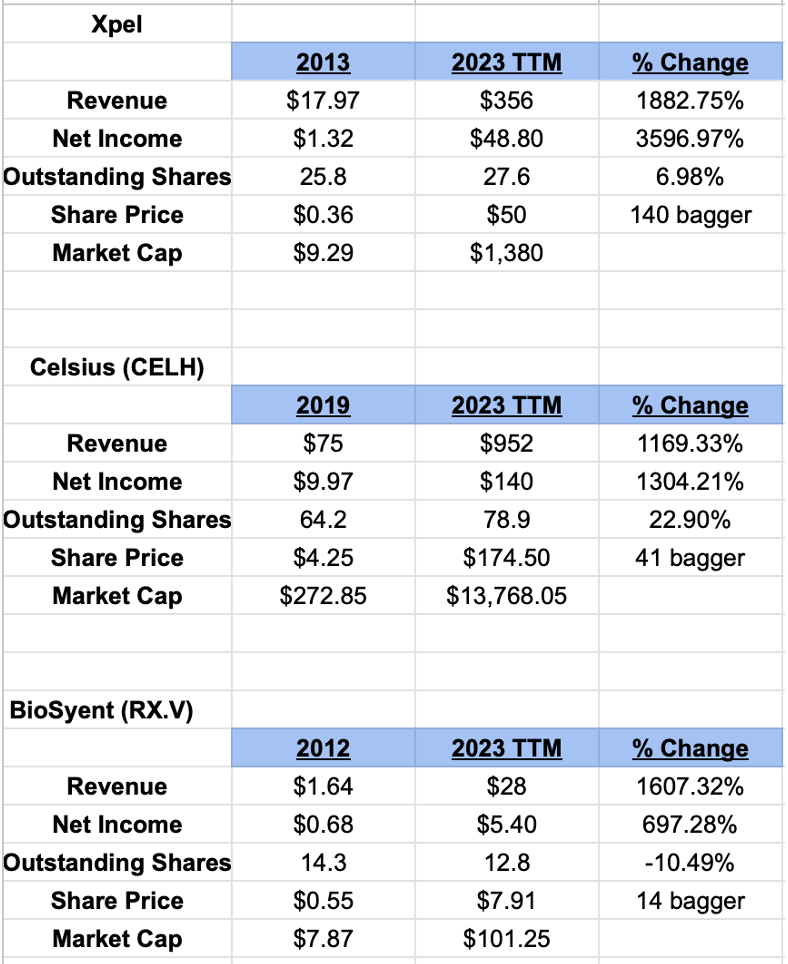
Dilution waters down greatness.
Ryan Pape became CEO of XPEL in February of 2009\. Since then, the stock has risen 100,000%. He’s probably one of a dozen or so CEO’s ever that can say they lead a 1000+ bagger the entire journey. At our [MicroCap Leadership Summit](https://microcapclub.com/summit/), Ryan spoke about the importance of skin in the game, constraints and keeping dilution minimal [\[WATCH FULL INTERVIEW\]](https://microcapclub.com/a-1500-bagger-conversation-with-ryan-pape-ceo-of-xpel/).
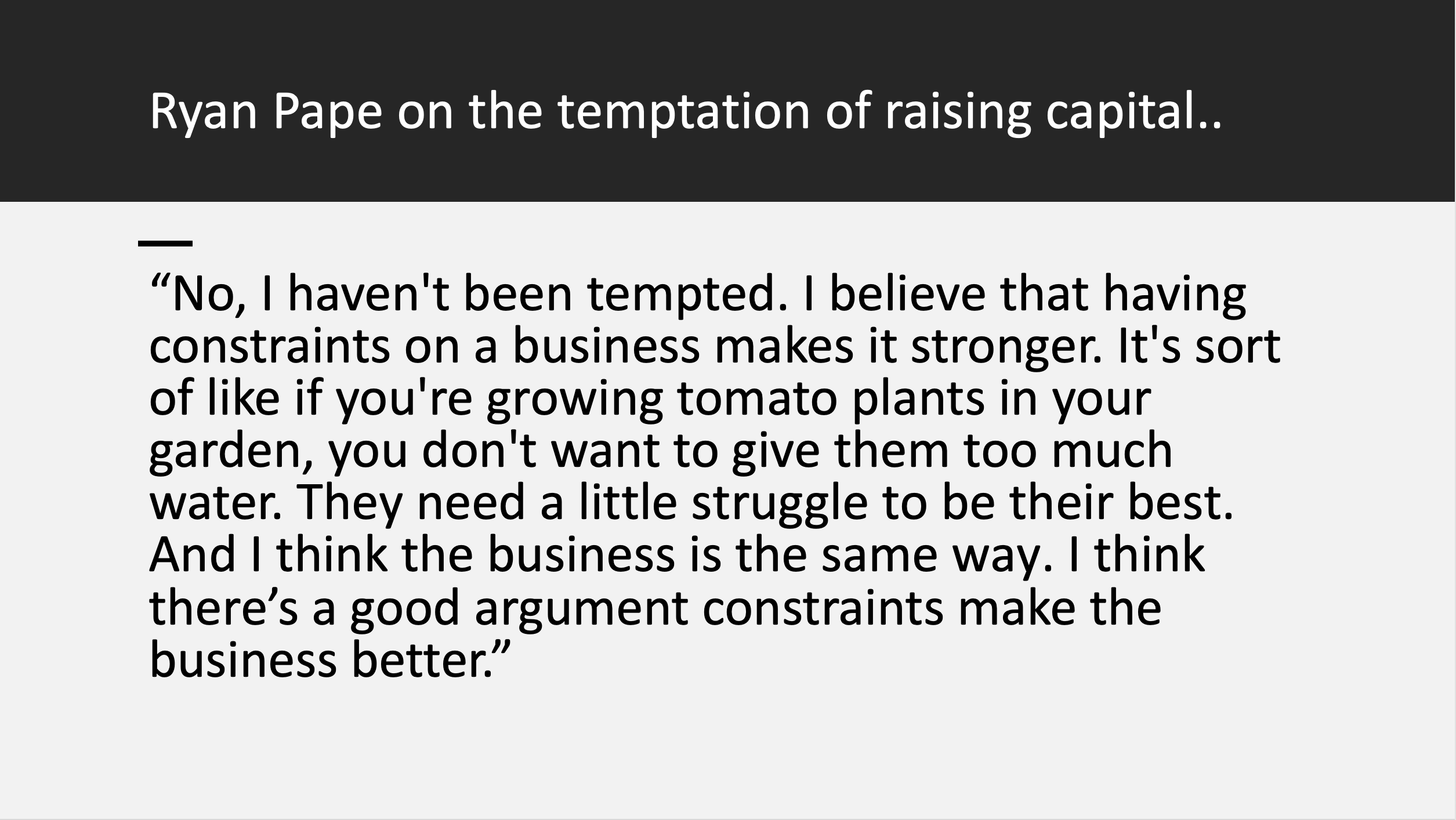
In October, Ian Cassel, gave a presentation titled: [Multi-Bagger First Principles](https://microcapclub.com/multi-bagger-first-principles/). I would encourage you to watch it twice. We all want to find great companies early. We all want to find multi-baggers. At the end of the presentation, Ian boils it down to one sentence below.
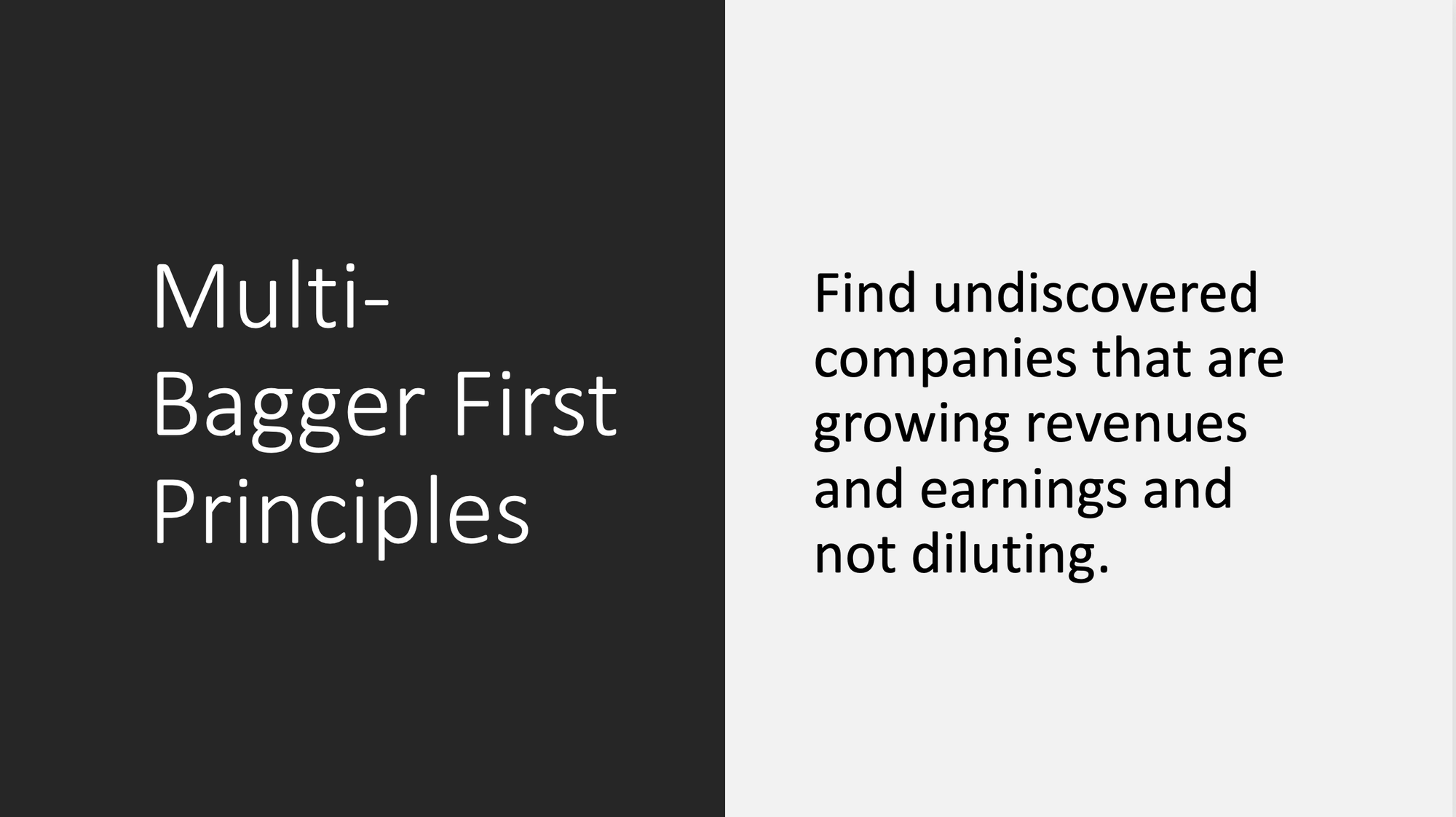
“Tattoo this sentence on your spouse’s forehead so you don’t forget it” Ian says. I’d like to stay married so I won’t, but the point is valid. The multi-bagger formula is this simple and this hard.
Invest in companies that are not only growing revenue and profits at impressive rates but are also thoughtful about issuing additional shares. By doing so you have house odds of getting a multi-bagger. As more share issuance is added into the equation, the chances of multi-bagger success drop with each dilutive event.
#### Interact and learn with 250+ of the best microcap investors on the planet:
[Join Us](https://microcapclub.com/join-now)
MicroCapClub is an exclusive forum for experienced microcap investors focused on microcap companies (sub $500m market cap) trading on United States, Canadian, European, and Australian markets. MicroCapClub was created to be a platform for experienced microcap investors to share and discuss stock ideas. Since 2011, our members have profiled 1000+ microcap companies. Investors can join our community by applying to become a member or subscribing to gain instant view only access. MicroCapClub’s mission is to foster the highest quality microcap investor Community, produce Educational content for investors, and promote better Leadership in the microcap arena. For more information, visit and
### Multi-Bagger First Principles
URL: https://microcapclub.com/multi-bagger-first-principles/
Last updated: 2023-11-14T01:31:58.000Z
I gave this keynote presentation at the [SmallCap Discoveries Conference](https://smallcapdiscoveries.com/?ref=microcapclub.com) on October 11th, 2023\. I think you will enjoy it.
#### Interact and learn with 250+ of the best microcap investors on the planet:
[Join Us](https://microcapclub.com/join-now)
MicroCapClub is an exclusive forum for experienced microcap investors focused on microcap companies (sub $500m market cap) trading on United States, Canadian, European, and Australian markets. MicroCapClub was created to be a platform for experienced microcap investors to share and discuss stock ideas. Since 2011, our members have profiled 1000+ microcap companies. Investors can join our community by applying to become a member or subscribing to gain instant view only access. MicroCapClub’s mission is to foster the highest quality microcap investor Community, produce Educational content for investors, and promote better Leadership in the microcap arena. For more information, visit and
### Gambler
URL: https://microcapclub.com/gambler/
Last updated: 2023-12-07T13:58:49.000Z
Billy Walters, born in 1946 in Kentucky, is considered by many to be the most successful sports bett0r in the world. With a gambling career that spans six decades, Walters has seen tremendous highs and devastating lows. His talent for identifying value and managing a vast betting network has made him the most influential figure in the world of sports betting.
In his book, [Gambler - Secrets from a Life at Risk](https://www.amazon.com/Gambler-Secrets-Life-at-Risk/dp/1668032856?ref=microcapclub.com), Walters says, "What separated me from the rest of the pack is that I beat all major sports for thirty-six straight years."
The book is a highly entertaining read, chronicling Walter's exploits in gambling, sports betting, and hustling in almost every endeavor. He even devotes a few pages to exposing professional golfer Phil Mickelson's gambling addiction and losses. "In 2011 alone, he \[Phil Mickelson\] made 3,154 bets - an average of nearly nine per day."
In the opening chapter Walters outlines four truths:
> **Truth No. 1:** My bets are based on extensive research, a vast network of experts and insiders across the country, and my own finally honed instincts.
> **Truth No. 2:** Betting sports is about one thing and one thing only: **value**. Which means your prediction needs to be better than the bookmaker's and you need to get the right number at the right price. Nothing else counts. And that leads me to:
> **Truth No. 3:** The percentage of gamblers who are successful enough to earn a living is less than 1 percent. Frankly I think most people would make more money washing cars. Why? The professional term is "eleven to ten odds". A sports gambler must lay down $11 to win $10 and pay $11 for a loss.
> This mathematical formula means that gamblers need to win 52.38 percent of their bets just to break even. For the average bettor, that's like trying to swim the English Channel at night, doing the backstroke, without a wetsuit. Surrounded by sharks.
> **Truth No. 4:** There are a very small number of gamblers who gain an edge by specializing in one sport and betting as soon as the line comes out. Those guys make a living, but not what I would consider serious money. Most of them last fewer than five years. The problem with this approach is that their betting limits are very small and the lines move very fast.
#### 87% of all global equities that went up 1000% or more over the past ten years were microcaps.
[Find Multibaggers](https://microcapclub.com/multibaggers)
Professional bettors and professional stock pickers have a lot in common. Amateur gamblers and amateur stock pickers also have a lot in common. Whether it's gambling or stock picking, amateurs approach the opportunity by happenstance and gut feel. As we know, human nature and gut feel are manipulated by our emotions. Don't get me wrong, professionals rely on gut feel, but it's only after a systematic approach has identified some value rich targets.
This is how I think about Professionals vs Amateurs:
Professionals are 90% systematic/ 10% gut feel
Amateurs are 10% systematic / 90% gut feel
Both stock picker and gambler need to develop a systematic approach to become consistent enough to take money from the casino, sportsbook or the stock market over the long-run.
Since 2018, Connor Haley at [Alta Fox Capital](https://www.altafoxcapital.com/?ref=microcapclub.com) has one of the best investment track records in the business. I loved his answer to my question at the [MicroCap Leadership Summit 2023](https://microcapclub.com/a-conversation-with-brian-bares-and-connor-haley/):
**In a world where great due diligence is sort of table stakes and the flow of information is so open, what sets a great investor apart from an average investor?**
> I'd start by challenging a little bit the premise of the question if I can. Yes, information is freely available, but how many investors are actually reading all of the filings are building a detailed model, are meeting with the management team, are speaking with competitors, are trying to understand the suppliers. What percentage of fundamental investors are actually doing that? I think a shockingly low percentage, I think there's a lot of people, very smart people that for a variety of reasons take shortcuts and in doing so, divorce themselves from some of the insights that someone going through a full process who's really disciplined may discover. Now that being said, how does one analyst differentiate themselves from another analyst who is actually going through all the steps? I think there's a few different ways. I think one is, look, you have to find your own style.
> There are different ways to outperform, there's different ways to put up good returns. I think my style is probably a little different than Brian's. There's many examples of ways that investors have crafted how they do things for us and Alta Fox specifically velocity of ideas is very important. Now we run a fairly concentrated portfolio, but we turn over a lot of rocks. And so on a three person research team today we speak to approximately probably high teens, number of companies per week. That's a lot of calls. It takes a lot of effort and that's a KPI that we track every single week and people are accountable for. It's not because now we only invest in that many companies at any given time and we'd like to hold our winners for a long time. I think you have to turn over a lot of rocks.
> I believe in Peter Lynch, the person who turns over the most rocks is most likely to win the game. You have to turn over a lot of rocks, but if you turn over a lot of rocks, you have to have a systematic process for synthesizing that information. So we can get into this as deep as you'd want in this conversation, but if you're trying to keep it all in your head, I think that's a really bad process. For us our best idea this year might be an idea that was a pass 24 months ago. And so how did you synthesize that information? How did you make sure you got an alert that it's now interesting? And how do you do that with a team that's growing and so that the communication flow is consistent? I think you have to have a really systematic process to compare the sort of relative merit of risk reward across different ideas and have really crisp discussions so you can get to sort of the truth of the matter. So I'd say do the work that'll differentiate you significantly, shockingly from a large percentage of sort of the investing world. And then number two is try to have a really systematic process that you iterate on that's sort of true to who you are, how you want to invest. So you can compare relative investment merit across a very high velocity of ideas.
Toward's the end of the book, Billy Walter's illustrates the same thing,
> "I've been successful because I've worked with some of the brightest minds in the business, true geniuses when it comes to computer modeling and probability theory. For years, my proprietary betting models were built by teams of the best in class handicappers, quants, and statisticians.
> Our team members act like hedge fund analysts, assigning a numerical value to every conceivable factor or variable capable of affecting sporting events to within a tenth of a point.
> In the NFL alone, I have several teams of experts working independently. They have never met each other, even though most have worked with me for more than thirty years, funneling their information to one common denominator: me.
> After more than six decades of sports wagering, I know the strengths and weaknesses of every player on my team, which allows me to weigh their numbers and ratings. Then, and only then, do I decide whether or not to make a bet."
Develop a systematic approach like a professional. Don't "gut feel" your way through the investment process like an amateur. Give serious thought to your strategy. Don't believe you can keep it all in your head. Start building out your system. The more systematic you make your approach, the quicker the feedback loops, and the more you will learn from your winners and losers. The more systematic you make your approach the easier it will be to iterate and fine tune your skills of stock picking (identifying, buying, holding, selling) over the long-term.
#### Interact and learn with 250+ of the best microcap investors on the planet:
[Join Us](https://microcapclub.com/join-now)
MicroCapClub - An Introduction, Tour and Best Practices
MicroCapClub is an exclusive forum for experienced microcap investors focused on microcap companies (sub $500m market cap) trading on United States, Canadian, European, and Australian markets. MicroCapClub was created to be a platform for experienced microcap investors to share and discuss stock ideas. Since 2011, our members have profiled 1000+ microcap companies. Investors can join our community by applying to become a member or subscribing to gain instant view only access. MicroCapClub’s mission is to foster the highest quality microcap investor Community, produce Educational content for investors, and promote better Leadership in the microcap arena. For more information, visit and
### Risk is What You Don’t See Coming
URL: https://microcapclub.com/risk-is-what-you-dont-see-coming/
Last updated: 2023-12-17T21:20:39.000Z
> Harry Houdini used to invite the strongest man in the audience onstage. Then he'd ask the man to punch him in the stomach as hard as he could.
>
> Houdini was an amateur boxer and told crowds he could withstand any man's punch with barely a flinch. The stunt matched what people loved about his famous escapes: The idea that his body could conquer physics.

Houdini jumps from Harvard Bridge, Boston, Massachusetts
> After a show in 1926 Houdini invited a group of students back-stage to meet him. A guy named Gordon Whitehead walked up and started punching Houdini in the stomach without warning.
>
> Whitehead didn't mean any harm. He thought he was just recreating the same trick he'd just seen Houdini perform.
>
> But Houdini wasn't prepared to be punched like he would be on-stage. He wasn't flexing his solar plexus, steadying his stance, and holding his breath like he normally would before the trick. Whitehead caught him off guard. Houdini waved him off, clearly suffering.
>
> The next day Houdini woke up doubled over in pain. His appendix ruptured, almost certainly from Whitehead's punches.
>
> And then Harry Houdini died.
>
> He was probably the most talented person in history at surviving big risks. Tie him up in chains and throw him into a river? No problem. Bury him alive in sand? No issue, he could escape in seconds – because he had a plan.
>
> But a little jab from a student that he didn’t see coming and wasn’t prepared for?
>
> That was the biggest risk. What you don’t see coming always is.
The above excerpt is from Morgan Housel’s new book, [Same as Ever](https://www.amazon.com/Same-Ever-Guide-Never-Changes/dp/0593332709?ref=microcapclub.com). I highly recommend it.
Same as Ever - By Morgan Housel
When you buy a stock, you are betting that the business trajectory will stay the same or get better. No one buys a stock thinking the business will get worse.
What is surprising is how often the business does get worse.
Few investors focus on this risk. It’s more fun to focus on what could go right, what could accelerate growth - Not what could go wrong. It’s an obvious risk we like to overlook.
The best question to ask yourself and management- What would cause this business to decline?
Tom Russo said the late Bill Ruane used to always [ask management](https://microcapclub.com/asking-right-questions/): What are the chances that your business will lose money next year? All the conversations management normally has with Wall Street were about whether they’d make $2.10 or $2.11 per share next year or whatever. At first management would be a little perplexed, then a little disturbed, but at the end, they’d say something like: “Look, for that to happen, the following 3 things would have to happen…” And those are about the only 3 things you should really care about. It tells you a lot about the business.

I like to play golf. The average width of the fairway on a golf course is 40 yards. It isn’t a small landing area.
Why is it so hard to hit the fairway? It’s 40 yards wide right in front of me. If aliens were looking down at the game of golf, they would think players are trying to hit the ball in the rough. Even the average PGA Tour professional only hits the fairway 50% of the time.
Everything in life, business, sports, and investing is easier said than done. Nothing is easy.
#### 87% of all global equities that went up 1000% or more over the past ten years were microcaps.
[Find Multibaggers](https://microcapclub.com/multibaggers)
The most desirable, "easy" setup for microcap investors is a company with a growing core profitable business that can self-fund some blue sky/green shoot opportunities.
It’s the best of both worlds. You get stability with upside optionality without the risk of dilution. The cherry on top is purchasing a company like this below the intrinsic value of the core business. You get the upside optionality for free. The core business provides an ascending floor of valuation.
Low risk, high reward. Perfection.
This setup should work 100% of the time, right? Not exactly - they work 50% of the time. Why wouldn’t they work out?
The following scenario happens quite often:
1. Microcap companies have limited resources, even if they are profitable.
2. Management starts diverting resources (too much) to the green shoots/science projects.
3. Management stops focusing on the core business.
4. The core business stops growing. The golden goose stops laying eggs.
5. Existing shareholders get startled.
6. A business that looked anti-fragile becomes fragile.
7. The ascending floor of valuation is broken.
8. The stock drops 50%.
9. With a broken core business - management now needs a successful green shoot/science project to work to justify the existing valuation let alone a higher valuation.
10. Management doubles down on the science projects.
11. The balance sheet weakens.
12. Balance sheets don't matter until they are the only thing that matters.
13. Existing shareholders become more startled.
14. The stock drops 30% more.
15. Management raises capital to bridge the gap to commercialization of a green shoot/science project.
16. The stock drops 20% more.
17. Everyone sells.
18. An activist shows up.
19. New investors buy.
20. The board and management are replaced.
21. Management cuts out all the science projects to focus on the core business.
The obvious risk in stock picking is the business declines. The cause isn’t as obvious. What is the random gut shot Houdini wasn’t ready for?
The business gut shot can come from anywhere - Management loses focus, wrong strategy, competition, losing a large customer, toxic workplace, losing key people, supply chain issues, reimbursement shift, macro black swan event, etc.
The list is endless. Each taken independently, they can be dealt with, but one thing often leads to another which leads to another. It’s like dominos. The compounding of small good things leads to huge results. The compounding of small bad things leads to disastrous results.
It happens slowly and then all at once.
Successful investing isn’t about being right all the time; it’s more about the ability to identify when you are wrong quicker.
Look for the first domino. Be prepared for a gut shot. Risk is what you don’t see coming.
#### Interact and learn with 250+ of the best microcap investors on the planet:
[Join Us](https://microcapclub.com/join-now)
MicroCapClub is an exclusive forum for experienced microcap investors focused on microcap companies (sub $500m market cap) trading on United States, Canadian, European, and Australian markets. MicroCapClub was created to be a platform for experienced microcap investors to share and discuss stock ideas. Since 2011, our members have profiled 1000+ microcap companies. Investors can join our community by applying to become a member or subscribing to gain instant view only access. MicroCapClub’s mission is to foster the highest quality microcap investor Community, produce Educational content for investors, and promote better Leadership in the microcap arena. For more information, visit and
### Narrative Drives Price
URL: https://microcapclub.com/narrative-drives-price/
Last updated: 2023-12-07T14:00:05.000Z
Last year on History Channel’s “Pawn Stars”, a gentleman named David walked in with a guitar case.
Rick Harrison, owner of the shop and star of the show, inquired, “What do we have here?”
As David opened the case, he calmly stated, “It’s a 1963 American-made Fender Stratocaster. But there is something very, very special about this Strat. This guitar was played by Jimi Hendrix.”
Rick’s astonishment was evident as he exclaimed, “That’s a big wow factor right there.”
This guitar’s narrative transformed from being a rare, well-preserved ‘Strat’ that rested quietly in a closet for six decades to becoming an ultra-rare artifact of rock history commanding significantly more demand.
Consequently, the value adjusted accordingly. A nearly identical ‘63 Stratocaster could be acquired for $35,000\. However, given Jimi Hendrix owned and recorded on this particular guitar, it’s worth soared to a range of $750,000 to $1,000,000\.
A thirty fold price differential, all attributed to the power of the narrative.
Narrative drives price.
#### 87% of all global equities that went up 1000% or more over the past ten years were microcaps.
[Find Multibaggers](https://microcapclub.com/multibaggers)
In 2001, Joshua Bell, violin virtuoso, was in London to play a concert at the Royal Albert Hall. Bell needed some new strings, so he went to the famous violin shop J&A Beare. Upon entering, he saw the owner coming out of the back room with a stunning violin. The owner told him that it was the famous Huberman Stradivarius violin.
Bell was floored. He had played that violin once before when it was owned by violinist Norbert Brainin. This violin had a remarkable history. It was one of six instruments made in 1713 by legendary violin builder Antonio Stradivari. And this particular violin was owned by a few world famous violinists, most notably Bronislaw Huberman.
During the early 1920s, Bronislaw Huberman was one of the most celebrated musicians of his time. During Hitler’s rise to power, Huberman established the Palestinian Orchestra hiring Jewish artists throughout Europe, giving them and their families impossible-to-get exit visas to Palestine. To raise funds he partnered with Albert Einstein in 1936 doing a tour throughout the US. It was a success and helped many families escape the Holocaust.
Bell later said after purchasing the violin, “It is overwhelming to think of how many amazing people have held and heard it (this violin). When I perform in Israel with the Israel Philharmonic, I am always touched to think how many of the orchestra and audience members are direct descendants of the musicians Huberman saved from the Holocaust with funds raised by concerts performed on the very same instrument I play every day.”
How much did Josh Bell pay for the Huberman “Strad”? In 2001, he paid $4 million. For comparison, a high-end modern handcrafted violin by Joseph Curtin cost around \~$30,000 during that time.
This represents a substantial 130-fold difference in price, largely due to the narrative surrounding the Stradivarius. But the narrative behind Bell’s Stradivarius isn’t just who played it; it’s also about the maker.
Since the early 19th century violins crafted by Antonio Stradivari have a reputation as the finest violins ever made. They carry an aura that rivals the legendary sword Excalibur. Renowned violinists often assert that Stradivarius violins are tonally superior to every other violin. Some attribute this unique sound to the wood Stradivari used, which was significantly more dense due to the Little Ice Age, a period of lower average global temperatures from 1300 – 1850, which hit hard in Europe.
Certain scholars even suggest that Antonio Stradivari treated his wood with special chemical concoctions to achieve that distinct tone. However, double-blind studies conducted amongst violinists and audiences have revealed that both can’t consistently distinguish a Stradivarius from a modern hand built violin. Furthermore, [many violinists tend to prefer](https://www.ncbi.nlm.nih.gov/pmc/articles/PMC3271912/?ref=microcapclub.com) playing and listening to modern violins as opposed to the pricey Stradivarius violins.
None of the above matters with a strong narrative. Joshua Bell’s Stradivarius is likely worth >3x more today than he paid, based on auction prices of similar Stardivari violins.
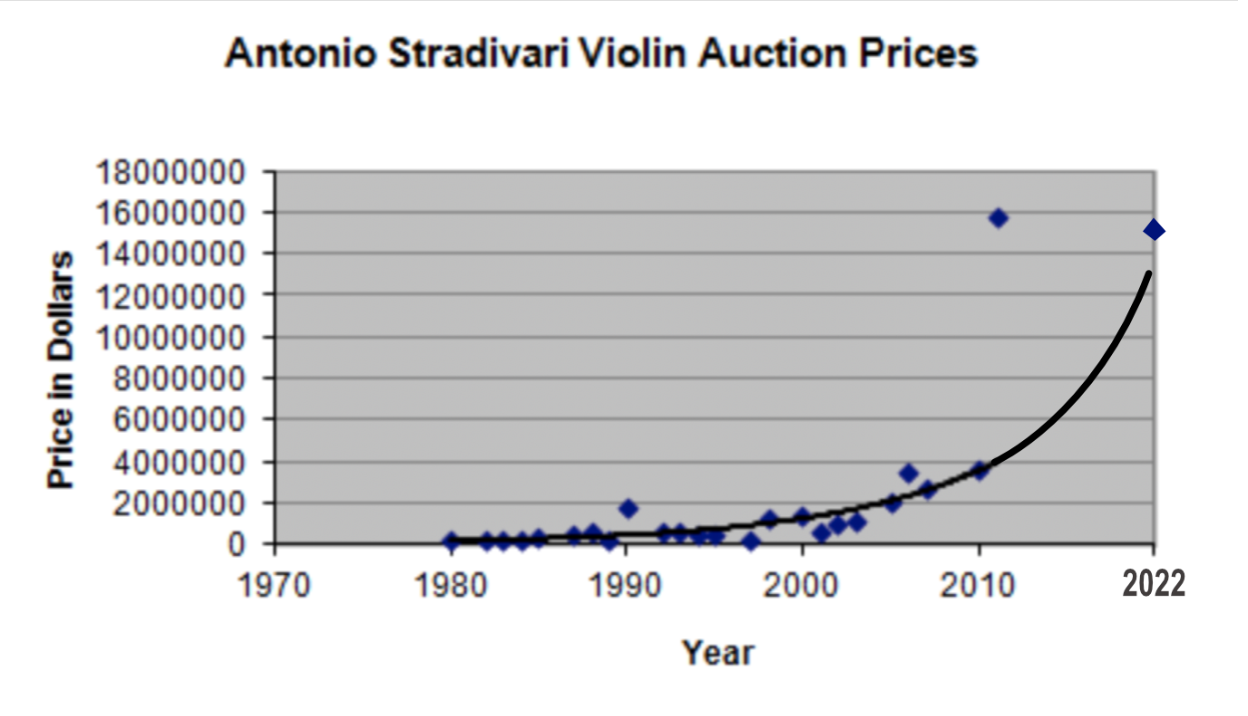
As both Jimmy’s Strat & Josh’s Strad demonstrate, humans value narratives. Nearly identical items can be valued at wildly different prices if a strong narrative is attached.
The above stories are also extremes. But narratives drive demand and prices all around us from the ketchup we buy, to where we vacation and cars we buy.
Now you may think, “You are talking about brands.” Well, yes, but brand is only the tip of the iceberg. Brand is the symbol, name, term or design that allows one to differentiate two like items from each other. Narrative is the story behind the brand, the engine that drives people to choose one from another. It’s also the engine that allows the owner to raise prices ad infinitum without losing customers and growing supply.
Take LVMH, for instance. They own some of the world’s strongest luxury brands and have spent decades building their narrative. And boy do they care about their narrative. They spent a whopping 28 billion Euros (35% of revenues) on marketing & advertising alone in 2022\.
The narrative engine for LVMH is status. Humans are inherently social creatures, and our place within a social hierarchy or group has historically been crucial to our survival and well being. LVMH solves this social hierarchical insecurity with goods that place people at the top of the social group.
This narrative allows LVMH to maintain the highest prices and to hike prices every year, well beyond inflation, and customers don’t think twice. For example, the price of a Louis Vuitton Toiletry Pouch increased 341% from 1991 – 2021\. Nearly all of Louis Vouitton’s goods (see [HERE](https://www.youtube.com/watch?v=xEH7Cmg0DuA&ref=microcapclub.com) and [HERE](https://www.youtube.com/watch?v=CMmySy4lzN8&ref=microcapclub.com)) increased by >5% CAGRs over the same time period. That was well beyond the 2% inflation rate of Europe and the US.
See’s Candies has built a strong narrative in Southern California. Unlike LVMH, See’s doesn’t have to spend much to build their narrative. See’s is embedded in the So Cal culture. Want to woo or win over a loved one? Get them See’s. Want to share happiness and nostalgia with your kids? Get them See’s. Whether it is the warm fuzzy feelings you felt growing up eating See’s or the joy you receive giving See’s chocolates, it is a regional tradition for more than 39 million people.
See’s strong narrative has allowed Warren Buffett and Charlie Munger to raise prices every single year since taking over See’s in 1972\. From ‘72 to ‘82 they raised prices \~10% per year, while inflation soared to 7%. Then from ‘82 to today, See’s has increased prices \~4.5% per year, while inflation has hovered around 2% without losing business.
The narrative of these companies are rooted in an organic, compelling value proposition. They scratch a deep itch. The Stratocaster played by Hendrix is as unique and priceless as the legendary guitarist himself, reflecting the profound impact he had on both music and culture. The same is true with the few Stradivarious violins still in existence. By owning either you are becoming one with key moments of history that left a lasting mark on the landscape of human culture.
Consider, for a moment, no value proposition such as those found in many microcap companies, often called story stocks. Many fail to address a genuine need and are forever unprofitable. Instead they serve as conduits channeling investors’ capital into the pockets of their management. Such a narrative is one that would scarcely attract a cent of investment. So an enchanting story, where authenticity is eclipsed by contrivance, is meticulously crafted. Unlike a true organic narrative, these story stocks are mere mirages or illusions like footprints in the sand, easily washed away by the tide of time, leaving little trace behind.
Compare the organic, robust value proposition of See’s, LMVH or the Strats and Strads with the contrived Beanie Babies story. Ty Warner, Beanie Babies creator, tried to mass produce scarcity. The public was told Beanie Babies were rare. Customers bid up the prices. In reality, the toys were mass-produced, so beyond the earliest generations, few were actually rare. Over time people realized they were bamboozled and the Beanie Baby craze fizzled.
Pan American World Airways (Pan Am) lacked a robust narrative. Pan Am was one of the most iconic airlines of the mid-19th century. Pan Am’s early aircraft were large luxurious aircrafts called “Clipper Ships,” an homage to the elegant clipper ships of the past. Juan Trippe, Pan Am’s founder, deliberately chose this nautical-theme to create an air of romance and adventure around air travel.
Initially, the story worked as air travel was only open to the elite few. But as commercial aviation expanded, air travel became less exclusive. Pan Am’s value proposition vanished in the midst of budget airlines. Southwest Airlines and others, provided the same point A to point B travel – with less frills – at a much lower price. Pan Am’s weak story didn’t allow it to raise prices to combat rising fuel costs in the 70s. And geopolitical events such as the 1988 Lockerbie bombing, took a toll on Pan Am’s operations and reputation. Pan Am filed for bankruptcy and ceased operations in 1991.
Narrative drives price.
A true organic, compelling narrative is rare and valuable. It gives a business the freedom to set its prices without provoking second thoughts from its customers. Such enterprises often achieve exceptional, low-risk, high-yield returns with long duration.
As we navigate the treacherous waters of investment, let us distinguish the authentic from the contrived and remain vigilant against the siren song of enticing stories.
---
#### Interact and learn with 250+ of the best microcap investors on the planet:
[Join Us](https://microcapclub.com/join-now)
MicroCapClub is an exclusive forum for experienced microcap investors focused on microcap companies (sub $500m market cap) trading on United States, Canadian, European, and Australian markets. MicroCapClub was created to be a platform for experienced microcap investors to share and discuss stock ideas. Since 2011, our members have profiled 1000+ microcap companies. Investors can join our community by applying to become a member or subscribing to gain instant view only access. MicroCapClub’s mission is to foster the highest quality microcap investor Community, produce Educational content for investors, and promote better Leadership in the microcap arena. For more information, visit and
### A 1500 Bagger Conversation with Ryan Pape CEO of XPEL
URL: https://microcapclub.com/a-1500-bagger-conversation-with-ryan-pape-ceo-of-xpel/
Last updated: 2023-10-22T17:51:19.000Z
Ryan Pape became CEO of XPEL in February 2009\. The company was a $1 million market cap. The stock was at $0.04 per share. He personally bought stock and maxed out personal credit cards to pay off a company debt. Since 2009, XPEL has grown revenues from $3 million to $350 million TTM, from $500,000 is losses to $50 million in earnings TTM. 7% dilution in 14 years. The stock is now at $75 per share, a 150,000% return since Ryan became CEO. [Jason Hirschman](https://youtu.be/rkNIyOozfzw?si=lQsRKkCpioGVtHpC&ref=microcapclub.com) is the private investor that made more money from XPEL than anyone outside of insiders. He did the work few others did to form conviction. It’s time to learn from both of them.
The full transcription of the conversation can be found below the video.
On June 7th, 2013, Paul Andreola profiled XPEL at $0.36 per share on our community (18,600% return). Since then, there have been 2,200 comments (87 pages) of chronological history covering XPEL on our community. All great companies started as small companies. Our mission is to find them first.
---
#### Interact and learn with 250+ of the best microcap investors on the planet:
[Join Us](https://microcapclub.com/join-now)
MicroCapClub is an exclusive forum for experienced microcap investors focused on microcap companies (sub $500m market cap) trading on United States, Canadian, European, and Australian markets. MicroCapClub was created to be a platform for experienced microcap investors to share and discuss stock ideas. Since 2011, our members have profiled 1000+ microcap companies. Investors can join our community by applying to become a member or subscribing to gain instant view only access. MicroCapClub’s mission is to foster the highest quality microcap investor Community, produce Educational content for investors, and promote better Leadership in the microcap arena. For more information, visit and
### Jake Taylor – An Investment Hygiene Blueprint
URL: https://microcapclub.com/jake-taylor-an-investment-hygiene-blueprint/
Last updated: 2023-10-22T17:51:33.000Z
Jake Taylor presented how investors can improve their investment hygiene at the MicroCap Leadership Summit on September 20th, 2023\. The MicroCap Leadership Summit can only be attended live by the MicroCapClub Community.
---
#### Interact and learn with 250+ of the best microcap investors on the planet:
[Join Us](https://microcapclub.com/join-now)
MicroCapClub is an exclusive forum for experienced microcap investors focused on microcap companies (sub $500m market cap) trading on United States, Canadian, European, and Australian markets. MicroCapClub was created to be a platform for experienced microcap investors to share and discuss stock ideas. Since 2011, our members have profiled 1000+ microcap companies. Investors can join our community by applying to become a member or subscribing to gain instant view only access. MicroCapClub’s mission is to foster the highest quality microcap investor Community, produce Educational content for investors, and promote better Leadership in the microcap arena. For more information, visit and
### A Conversation with Brian Bares and Connor Haley
URL: https://microcapclub.com/a-conversation-with-brian-bares-and-connor-haley/
Last updated: 2023-10-22T17:50:37.000Z
Brian Bares and Connor Haley sat down to have a conversation with Ian Cassel at the MicroCap Leadership Summit on September 20th, 2023\. The MicroCap Leadership Summit can only be attended live by the MicroCapClub Community.
---
#### Interact and learn with 250+ of the best microcap investors on the planet:
[Join Us](https://microcapclub.com/join-now)
MicroCapClub is an exclusive forum for experienced microcap investors focused on microcap companies (sub $500m market cap) trading on United States, Canadian, European, and Australian markets. MicroCapClub was created to be a platform for experienced microcap investors to share and discuss stock ideas. Since 2011, our members have profiled 1000+ microcap companies. Investors can join our community by applying to become a member or subscribing to gain instant view only access. MicroCapClub’s mission is to foster the highest quality microcap investor Community, produce Educational content for investors, and promote better Leadership in the microcap arena. For more information, visit [http://microcapclub.com](https://microcapclub.com/) and
### The True Costs of Being Public Are Less Than You Think
URL: https://microcapclub.com/the-true-costs-of-being-public-are-less-than-you-think/
Last updated: 2023-10-08T11:25:07.000Z
Since the mid-1990’s, the number of listed US public companies has been declining. We always hear the same two reasons. First, the rise of venture capital and private equity has made it easier for companies to stay private. Second, the cost of being public is too prohibitive.
There are 7,500 companies sub $100 million market cap that trade on US markets (Nasdaq, NYSE, OTC). Most articles state (and most people believe) that being public adds $2-3 million onto a companies cost structure. Even $2 million of additional costs per year would make it prohibitive for almost any small company to be public. It amazes me how many people believe these numbers. I think this misperception alone has hurt the amount of companies desiring to go public when they are small. It’s time to set the record straight.
What is the real number? What is the true cost for a NYSE listed sub $100 million market cap company to be public?
I asked three of them. Here is a blended average of their responses:
Auditor Fees: $88,000
Broadridge: $19,000 (annual meeting NOBO reports, proxy printing and mailing)
Legal: $51,000
Transfer Agent: $11,000
NYSE: $110,000
SEC EDGAR filings/News Release Distribution: $15,000
The above expenses are the public company mandatory expenses that a private company would not incur. I did not include investor relations expenses since they are not mandatory. I also don’t include board of director compensation (and D&O insurance which can be $50,000 – 100,000 per year) as an expense since meaningfully sized private companies would have this expense as well.
The total additional cost of being public for a NYSE listed sub-$100 million market cap is $300,000 per year. The total additional cost for an SEC filing microcap on the OTC Markets is likely $150,000 per year. This is far less than the $2-3 million everyone thinks is true.
“Ok, good info Ian, but it’s easier to stay private and raise money from venture capitalists, search funds, and private equity.”
Yes, it has never been easier to raise money as a private company. But what are the terms of the capital? Have you looked at the term sheets from most venture capital firms or private equity firms? Preferred shares, multiple ratchets if you don’t hit your numbers. They have you by the throat. This is why every rich person loves venture capital – they couldn’t get away with these types of term sheets in public markets. They win if you win and they win if you lose (they get your company). At least with public markets you’re mainly raising capital through selling common equity. It’s cleaner. It’s simpler.
I’m not saying being a small public company is for everyone, quite the contrary, but it isn’t as bad as what you’ve been told. The way we bring back small companies desiring to go public is to attack these misguided misperceptions with facts.
**\===> Interact and learn with 250+ of the best microcap investors on the planet. [\[Join Us\]](https://microcapclub.com/join-now/)**
MicroCapClub is an exclusive forum for experienced microcap investors focused on microcap companies (sub $500m market cap) trading on United States, Canadian, European, and Australian markets. MicroCapClub was created to be a platform for experienced microcap investors to share and discuss stock ideas. Since 2011, our members have profiled 900+ microcap companies. Investors can join our community by applying to become a member or subscribing to gain instant view only access. MicroCapClub’s mission is to foster the highest quality microcap investor Community, produce Educational content for investors, and promote better Leadership in the microcap arena. For more information, visit [http://microcapclub.com](https://microcapclub.com/) and
### From Mistake to Marketing Masterpiece
URL: https://microcapclub.com/from-mistake-to-marketing-masterpiece/
Last updated: 2023-10-08T11:29:33.000Z
There has been much discussion on how Coca-Cola became so dominant. Could it be that it was all from a mistake?
[](https://microcapclub.com/content/images/wordpress/2023/09/325-1-scaled.jpg)
From 1886 to the mid 1950’s the price of a 6.5 oz bottle of Coke was a nickel. The price didn’t change for 70 years. In 1950, you had 460,000 Coke vending machines across the US dispensing Coke at the same low price as your grandfather bought it. That is how you build a brand. Make it a tradition.
How did this happen?
In 1899, two lawyers visit the president of Coca-Cola. They tell him they’re interested in selling Coke in bottles (normally sold as fountain drinks). They want to buy the bottling rights. The president of Coke tells them they are out of their minds, but he signs a piece of paper agreeing to sell them the syrup concentrate for 90c a gallon.. forever.
The Coke bottles took off. People loved them. Coca-Cola found themselves in a pinch. They’ve agreed to sell Coke at fixed price forever. If the bottlers and retailers increase the price, they make all the margin. In fact, if they raise the price aggressively it makes Coca-Cola look bad, so what does Coca-Cola do?
They blanket the United States in advertising. Radio, billboards, buildings, magazines, “Coca-Cola at 5c is delicious and refreshing”. Make it impossible for the bottlers and retailers to increase the price without significant backlash from the consumer. You can still find tons of historical 5c signs from this era.
Genius. The marketing move by Coca-Cola should be on the Mount Rushmore of turning lemons into lemonade.
Since 1992, AriZona Iced Tea company has kept the price of its 23-ounce can at 99c. 30 years. Even though his costs are higher, Don Vultaggio, founder of the company said, “I don’t want to do what the bread guys and the gas guys and everybody else are doing,” Vultaggio said. “Consumers don’t need another price increase from a guy like me.”
Vultaggio has the power to keep the price low. AriZona is one of the few independent private companies remaining in a consolidating industry. The company sells 1 billion 99-cent cans each year, roughly 25% of its total revenue. It has allowed it to capture the #2 market share spot behind PepsiCo’s slate of tea brands that include Lipton, Pure Leaf and Brisk.
We all know about Nick Sleep’s Scale Economics Shared or what Josh Tarasoff calls the Volume-Price Virtuous Circle. The companies that keep prices low, margins low and in doing so share their growing scale with their customers. Customers then reciprocate by purchasing even more goods or services from the company, which provides the company even more scale and more cost savings to share with the customer. This is the flywheel effect.
You can see it all around us. Costco, Amazon, the local diner that’s been around for 50 years still serving 40c coffee. Henry Ford lowering the price of the Model-T seven years in a row to increase demand and production. Elon Musk lowering the price of Tesla’s to increase global adoption. Keeping prices low has always been a great lever for loyalty.
Back in 2018, HBO did a special on Warren Buffett. Buffett talks about why he likes Coca-Cola and how the company and its affiliates serve 2 billion 8 oz servings worldwide per day. He says something like, “If you just get an extra 1 penny per day that is $20 million more profit per day, just 1 penny more”. This is a classic way he looks at a brand and its potential. Ironically, it was the opposite way Coca-Cola built the brand.
**\===> Interact and learn with 250+ of the best microcap investors on the planet. [\[Join Us\]](https://microcapclub.com/join-now/)**
MicroCapClub is an exclusive forum for experienced microcap investors focused on microcap companies (sub $500m market cap) trading on United States, Canadian, European, and Australian markets. MicroCapClub was created to be a platform for experienced microcap investors to share and discuss stock ideas. Since 2011, our members have profiled 900+ microcap companies. Investors can join our community by applying to become a member or subscribing to gain instant view only access. MicroCapClub’s mission is to foster the highest quality microcap investor Community, produce Educational content for investors, and promote better Leadership in the microcap arena. For more information, visit [http://microcapclub.com](https://microcapclub.com/) and
### Even If You Knew The Future
URL: https://microcapclub.com/even-if-you-knew-the-future/
Last updated: 2024-12-06T12:22:47.000Z
What if you knew the future and you could position yourself ahead of it?
What if you knew in early 2022 that the fed was going to raise rates 11 times in a row? The cost of capital was about to skyrocket.
What if you knew in early 2022 that the 30-year fixed mortgage rate was going to rise from 2.8% to 7.3%. 18 months ago 35% of US households could afford a $450,000 home. Today 20% of US households can afford a $450,000 home.
What if you knew in early 2022 that Russia was going to invade Ukraine and disrupt energy and fertilizer markets.
How would you position yourself?
Short builders, short tech, short consumer discretionary, long energy, long fertilizer.
What would have happened? The largest residential home builder in the United States, D.R. Horton, is up 5% in 18 months. Nasdaq down 12%. Consumer descretionary down 15%. Oil is down 18%. Fertilizer prices are down 25%. You got two out of the five right.
Even if you knew the future, you would still be mostly wrong.
Even. If. You. Knew.
When Covid hit in early 2020, I quickly sold off the one stock in my portfolio I knew could be crippled by restrictions.
I sold ClearPoint Neuro (CLPT) at $4.00 per share. It pained me to sell it. Michael Liu and I had just met with the CEO a few months prior. I really admired the company, the CEO, and unique roll they were playing in advancing gene therapies. I was right. The business was hampered, but I was wrong on the stock. The stock closed 2020 at $16.00 per share, +300%.
[](https://microcapclub.com/content/images/wordpress/2023/09/CLPT%5FSPXTR%5Fchart.png)
The only stock I sold during covid was the one that went up the most. My reasoning was right, but the result was all wrong.
There have been numerous other times in my investing career when I knew the business better than most. I knew through channel checks and scuttlebutt the company was going to have a couple weak quarters, and I knew the market wasn’t expecting it. I cut the position in half. What happens? The stock goes up 50% in spite of the mediocre results. Then I’m forced to rebuy the stock higher. My reasoning was correct, but the result was all wrong.
In Chris Mayer’s book, [How Do You Know?](https://www.amazon.com/How-Do-You-Know-Investing/dp/1980410674?ref=microcapclub.com), he gives another great example from an article written by O’Higgins Asset Management:
“Suppose that on January 31, 2006, you knew with certainty that the price of gold would more than triple over the next five years, from $569 per ounce to $1,900 per ounce. Knowing that, might you have invested in Newmont Mining, the world’s second-largest gold producer? Odds are high that you would have gladly bought Newmont Shares. What that kind of surge in the price of gold, buying in one of the world’s largest gold companies would seem like a no-brainer. Yet, the share price of Newmont fell 5% over that time.”
O’Higgins gave another example, “Suppose that at the start of 1973 you knew that the earnings of the Dow Jones Industrial Average would rise 50% over the next two years. Seems you would bet on the Dow, right? Well, the Dow was cut in half.”
Isn’t playing the short-term macro game such madness?
The way you handle the macro is to handle the micro. Find companies that can grow, earn more money, and not dilute you. Buy them at good prices and wait. The returns will come to you. Don’t get distracted by macro conversation or trying to pivot your portfolio based on where you think things are going. Even if you knew the future, it wouldn’t help you.
MicroCapClub is an exclusive forum for experienced microcap investors focused on microcap companies (sub $500m market cap) trading on United States, Canadian, European, and Australian markets. MicroCapClub was created to be a platform for experienced microcap investors to share and discuss stock ideas. Since 2011, our members have profiled 900+ microcap companies. Investors can join our community by applying to become a member or subscribing to gain instant view only access. MicroCapClub’s mission is to foster the highest quality microcap investor Community, produce Educational content for investors, and promote better Leadership in the microcap arena. For more information, visit [http://microcapclub.com](https://microcapclub.com/) and
### I Hate Guidance
URL: https://microcapclub.com/i-hate-guidance/
Last updated: 2023-10-08T16:05:34.000Z
I love transparency. I hate guidance. Transparency is when management teams are open and honest during good times and bad times. In fact, something I look for is how management communicates and acts during the bad times. If they are transparent in the bad times, it allows you to trust them in the good times.
Transparency ≠ Guidance
I talk to microcap CEO’s about “Guidance” at least once per month. I get it. They are under pressure to perform. Many CEO’s think if they let investors see the future, then they will get paid for it today. But it rarely works that way. Especially when you consider that microcap companies, are small(er), more fragile businesses. A microcap’s future has another standard deviation of outcomes (mostly worse outcomes) when compared to larger more robust businesses.
Ironically – quarterly and annual guidance doesn’t make sense for larger businesses either. There have been several studies analyzing the impact of quarterly or annual earnings guidance by public companies.
One of the most recent was a 2020 study by three economists at the Federal Reserve Bank of Cleveland. They analyzed S&P 500 companies from 1994 to 2015\. The sample included over 24,000 firm-year observations. The study found that companies providing quarterly guidance had significantly higher stock price volatility, by 5-10% depending on the model used. The authors argue this shows how frequent earnings guidance facilitates herding behavior among analysts and investors, aligning expectations over short periods in a way that increases volatility.
Furthermore, the study found that quarterly guiders focused more on hitting near-term targets rather than long-term value creation. Guiding firms had lower R&D expenditures, lower capital expenditures, and were more likely to cut R&D spending to meet quarterly estimates. Given these findings, the economists conclude that companies should reduce guidance frequency and instead focus on conveying long-term strategic vision to shareholders in order to refocus attention on intrinsic business performance.
I would take it a step further. Guidance is a lose-lose proposition whether the company meets guidance or misses guidance. Here are a few points to consider:
1. **You get the shareholders you deserve**. The timeframes management uses to discuss the business are the same timeframes investors will use to judge them.
2. **Guidance produces lower multiples**. Microcap/smallcap companies that are executing will get a higher multiple if they don’t cap expectations. Whether we microcap investors want to admit it or not, a big part of our love of microcaps/smallcaps is our anticipation of the unknown. It isn’t management’s job to set short-term expectations. The job of management is to articulate a longer-term vision, strategy, goal and provide shareholders with a framework on how to judge the progress.
3. **Guidance puts management in a position to lose credibility by not hitting short-term targets**. If you aren’t going to get paid with a higher multiple for giving guidance, then why bother. By not providing guidance, the investor is left to do the work themselves and form their own opinions. If the company doesn’t hit my own bullish scenario that I’ve let percolate in my mind’s echo chamber – I’m to blame. Not the company.
4. **Guidance attracts short-term lazy investors – t**he type of investors that can’t or won’t do their own work to form their own opinions.
A company that is executing will attract a higher quality investor, get a higher multiple, and never look dumb, if they don’t give guidance.
What should a company do? Should a company do nothing?
My main valuation hurdle is – **Can I at least double my money in 3 years (25% CAGR) from the current price based on fundamental reasoning?** Whether your goal is to double or triple or whatever your money in three years, I believe a three year timeframe aligns best with how investors should think about valuation, risk, and reward when investing in a microcap.
If a company feels compelled “to do something” provide a three year goal. It’s important that it’s a genuine goal, and not an embellished one to sell investors. I think if it’s done with sincerity it can be a great tool for management teams and allows them to get off of the quarterly and annual guidance treadmill.
On December 18th, 2011 I profiled NAPCO Security Technologies Inc (NSSC) on MicroCapClub at $2.15 per share ($1.07 split adjusted). At the time management gave a three year goal. The goal was to grow revenues from $70 million to $100 million. At $100 million in revenues management believed they would earn $1.00 per share. They expressed that quarter to quarter results would be lumpy.
It was the perfect timeframe and messaging. Growing a company from $70 million to $100 million in three years seemed rational. The upside of a $2 stock that “could” earn $1 EPS in three years was clearly visible. Since it was a goal, investors weren’t going hold management’s feet to the fire in the interim. It was the perfect carrot.
So what happened? Did they reach $100 million in sales by 2014?
No.They hit $74 million in sales. They extended the goal again.
They finally hit $100 million in sales in 2020\. The delays didn’t matter. The stock is up 2000% since 2011.
I can’t help but chuckle at how bad companies are at predicting the future. I hate quarterly and annual guidance, but if a microcap company feels they have to do something – provide a genuine 3 year goal and be transparent with the progress.
**\===> Interact and learn with 250+ of the best microcap investors on the planet. [\[Join Us\]](https://microcapclub.com/join-now/)**
MicroCapClub is an exclusive forum for experienced microcap investors focused on microcap companies (sub $500m market cap) trading on United States, Canadian, European, and Australian markets. MicroCapClub was created to be a platform for experienced microcap investors to share and discuss stock ideas. Since 2011, our members have profiled 900+ microcap companies. Investors can join our community by applying to become a member or subscribing to gain instant view only access. MicroCapClub’s mission is to foster the highest quality microcap investor Community, produce Educational content for investors, and promote better Leadership in the microcap arena. For more information, visit [http://microcapclub.com](https://microcapclub.com/) and
### Reaction Time is Important
URL: https://microcapclub.com/reaction-time-is-important/
Last updated: 2024-05-11T00:33:03.000Z
Your initial due diligence might get you into a position, but it is your maintenance due diligence that will keep you invested and/or save you from big losses. With small stocks your future returns are based upon your ability to course correct and adapt to new information. Reaction time is important.
[Sports Illustrated](https://www.si.com/mlb/2023/05/01/high-velocity-pitching-what-it-means-for-mlb-pitchers?ref=microcapclub.com) reported earlier this year that the number of major league pitches clocked at 100 mph or more tripled over the past three years ([H/T Todd Wenning](https://twitter.com/ToddWenning?ref=microcapclub.com "H/T Todd Wenning")). A 100-mph fastball takes roughly 375-400 milliseconds to reach the plate. It’s about as much time as it takes to blink your eye. But a batter has far less time to identify the pitch and decide to swing. It takes roughly 75-100 milliseconds for the human brain to identify the ball. Then it takes a batter 100-150 milliseconds to swing. This means a batter has 150 milliseconds to decide to swing and how to swing at the ball. This leaves zero time for error. A batter has less than a half a second to react. Reaction time is important.
[](https://microcapclub.com/content/images/wordpress/2023/08/baseball-reaction-time.png)
In men’s tennis, the typical speed of a first serve hovers around 115 mph. Given this speed, a player in a standard return position has roughly 0.47 seconds to respond and produce a return. The record for the fastest serve goes to Australian Sam Groth, clocking in at 163.7 mph, which requires an impressive reaction time of just 0.325 seconds for the returner. Here is Roger Federer effortlessly returning a 140 mph serve from a stunned Andy Roddick. Reaction time is important.
The length of a cricket pitch is 22 yards, equivalent to 20.12 meters. With the popping crease situated 1.22 meters away from the stumps, the actual distance between the bowler and batsman is about 17.68 meters. From this gap, several fast bowlers consistently deliver balls at speeds exceeding 150 Kmph (or 93 mph). When bowled at 150 Kmph, the batsman has a mere 0.42 seconds to make their move. Reaction time is important.
Snakes have intrigued scientists and enthusiasts for centuries, largely due to their unique mode of movement and lightning-fast reactions. A snake is built like a powerful rubber band. Snakes possess a linear body dominated by long, slender muscles, attached to a long vertebral column. This vertebral column comprises of up to 400 individual vertebrae, each attached to a pair of ribs. Such a design grants the snake an incredible degree of flexibility. When a snake wants to move or strike – this flexibility combined with 10,000 muscles produces acceleration of up to 20 g’s. Normal humans can withstand no more than 9 g’s, and even that for only a few seconds.
In 2016, David Penning and his colleagues at the University of Louisiana at Lafayette analysed the defensive strikes of snakes. The study found that the average strike lasts between 44 and 70 milliseconds, faster than the 300 milliseconds it takes you to blink your eye. This reaction time is crucial in surprising prey and also evading predators. Reaction time is important.
It only takes tens of thousands or hundreds of thousands of dollars to move a microcap stock. It takes millions of dollars to move a smallcap. It takes hundreds of millions to move a midcap and billions to move a largecap. Finding a great idea in microcap before others is important. Discovery is important because one or two investors can move the market.
Reaction time is even more important once you own a position. As microcap investors, we are investing in small emerging businesses and their business trajectories can change in an instant. Successful microcap investing isn’t about being right all the time; it’s more about the ability to identify when you are wrong quicker. Most of the stocks you own today you will end up selling. Once you embrace this fact – you can be free to look for disconfirming evidence. In illiquid stocks the ability to react quickly to positive or negative earnings, press releases, filings, and other data is crucial.
Here is an example – A 10Q (quarterly financial filing in US) is posted on SEC.gov. You are immediately notified. The stock market is open, and the company is slow to issue an earnings press release. While 90% of investors that own the stock are unaware, in 10 seconds you are able to discern this is a big miss. You are quickly able to sell all, or a portion of your position, and lock in gains/or small(er) loss. When everyone else wakes up to this reality the stock is down another 30%.
Here is another example – As a stock picker matures your edge goes from only being analytical to relational. The relationships you build with other investors, CEO’s, industry participants becomes your #1 asset. Your ability to get to the truth quicker becomes your advantage. Someone in your network attended an industry conference where a company you own also attended. Your friend knows you own the stock so he/she pokes around. Your friend speaks to a few sales reps of a competitor and they let you know the company you own started to drop the price of the product to keep market share. You know this is going to impact margins in future quarters. You quickly sell down and/or out of the position over the coming weeks.
Reaction time is important. You almost got bit.
0:00
/0:16
1×
The ultimate edge for [conviction investors](https://microcapclub.com/2023/04/conviction-investing/) is our ongoing maintenance due diligence and knowing what we own at all times. It’s fun to talk about how maintenance due diligence gives you the [conviction to hold](https://microcapclub.com/2014/08/the-conviction-to-hold/), but the real advantage is it allows you to sell before others see what you see. Maintanence due diligence keeps you from getting bit.
**\===> Interact and learn with 250+ of the best microcap investors on the planet. [\[Join Us\]](https://microcapclub.com/join-now/)**
MicroCapClub is an exclusive forum for experienced microcap investors focused on microcap companies (sub $500m market cap) trading on United States, Canadian, European, and Australian markets. MicroCapClub was created to be a platform for experienced microcap investors to share and discuss stock ideas. Since 2011, our members have profiled 900+ microcap companies. Investors can join our community by applying to become a member or subscribing to gain instant view only access. MicroCapClub’s mission is to foster the highest quality microcap investor Community, produce Educational content for investors, and promote better Leadership in the microcap arena. For more information, visit [http://microcapclub.com](https://microcapclub.com/) and
### Tiny Ltd (TINY.V) – The IPO of Andrew Wilkinson
URL: https://microcapclub.com/tiny-ltd-tiny-v-the-ipo-of-andrew-wilkinson/
Last updated: 2023-10-08T16:00:57.000Z
Tiny Ltd (TINY.V / TNYZF:OTC) is a technology holding company with over 30 holdings across several technology buckets as well as an investment fund. Tiny is the result of the vision and direction of Andrew Wilkinson who owns 70% of the company and his co-founder Chris Sparling who owns 10%.
Ian Cassel and Chip Maloney have a conversation with Andrew Wilkinson ([https://twitter.com/awilkinson](https://www.youtube.com/redirect?event=video%5Fdescription&redir%5Ftoken=QUFFLUhqbjFxNUpDX1ZpR0otRDBUMmtmeTkzc3Nyckw2QXxBQ3Jtc0ttR1NQYTg2Y3R2cUF1dFZiTmo2N3ZsQS1lbVFuZDVkVHNhX2FaTEdsaElKYnNzYW1lRk4waGQ4NGZwWGFPQW9ha3BMWldFRHFUbS11ZnVyV05qaDltZGNVeGozUFJhNjc2dWs5alN2NlJ4czlLY21icw&q=https%3A%2F%2Ftwitter.com%2Fawilkinson&v=S%5FnJ-8U%5FgQk&ref=microcapclub.com)), Co-Founder and Co-CEO of Tiny (TINY.V / TNYZF:OTC). This MicroCap Business Breakdowns discussion aired on July 25th on the MicroCapClub Community.
**\===> Interact and learn with 250+ of the best microcap investors on the planet. [\[Join Us\]](https://microcapclub.com/join-now/)**
MicroCap Business Breakdowns (MCBB) is a monthly program where we invite leaders of unique microcap businesses to have in depth conversations with the MicroCapClub member/investor that knows the business best. In each conversation we look to drill down into the history, business, strategy, vision, and bull/bear case. The MicroCapClub community can tune in live and ask questions. We publicize each episode 2-4 weeks after the live discussion. Not part of the MicroCapClub community? [Join Us](https://microcapclub.com/join-now/).
Disclaimer: The purpose of this presentation is for informational and educational purposes only and should not be construed as a recommendation to purchase or sell any security. MicroCapClub is not a registered investment advisor. MicroCapClub, its partners, members, subscribers, and affiliates may or may not hold positions in one or more of the securities mentioned on this program and may trade in such securities at any time. Do your own due diligence and seek counsel from a registered investment advisor before trading in any security.
MicroCapClub is an exclusive forum for experienced microcap investors focused on microcap companies (sub $500m market cap) trading on United States, Canadian, European, and Australian markets. MicroCapClub was created to be a platform for experienced microcap investors to share and discuss stock ideas. Since 2011, our members have profiled 900+ microcap companies. Investors can join our community by applying to become a member or subscribing to gain instant view only access. MicroCapClub’s mission is to foster the highest quality microcap investor Community, produce Educational content for investors, and promote better Leadership in the microcap arena. For more information, visit [http://microcapclub.com](https://microcapclub.com/) and
### The Power of Small Invisible Gestures
URL: https://microcapclub.com/the-power-of-small-invisible-gestures/
Last updated: 2023-10-08T16:10:51.000Z
When I was a kid I loved going to the grocery store with my mom. She would order cheese and they would slice it and offer me a slice and it was the best thing ever. It’s a great example of how a big brand forms a personal connection. I only wanted to go to that grocery store chain. I would beg to go to that specific store. I would seek out that one deli slicer that would give me a slice of cheese. I often think about how small, kind, sometimes invisible gestures like this are crucial in building loyalty in competitive industries. I would force my Mom to go to that same store every time.
Costco’s $1.50 hot dog deal is perhaps one of the most recognized and cherished food bargains in America. For just a buck and a half, you get a quarter-pound all-beef hot dog or Polish sausage and a 20-ounce soda. Since the introduction of this combo meal in 1985, the price has remained the same, bucking inflation trends and showcasing Costco’s commitment to providing value to its members. In 2022, Costco’s CFO suggested the wholesaler will keep its famous hot dog and soda combo at $1.50 “forever.” In 2019, Costco sold 150 million hot dog and soda combos. Costco says they don’t lose money from the combo but they don’t make much either. They save on costs because they literally have two hot-dog production factories in the US. Few people would blame Costco for raising the price to $2.00 or $3.00\. This would still be half the price of what a hot dog and soda sell for at an average restaurant in the United States. But they choose to keep it $1.50\. It’s fascinating how these small gestures can produce loyalty in a brand – you ultimately end up trusting Costco more because they could easily “take more” but choose not to.
In June I traveled to New York City to record the [The Compound](https://youtu.be/eAyJpdYDjEw?ref=microcapclub.com) with Downtown Josh Brown and Michael Batnick. It was an honor to be invited on the program to talk about microcap investing. I honestly think it might be the first time microcap was presented in a favorable light on a more mainstream media outlet in a decade. A month prior to the recording the show’s creative team, Josh Brown and Michael Batnick circulated an email and we started going back and forth as they filled in the show schedule and talking points. At the end of every email Josh would say, “Ian if you need anything, just call my cell \[cell number\]”. I didn’t know Josh. This small gesture struck me. Who does that? It immediately formed trust. It’s similar to when I talk to Morgan Housel and he ends every conversation with, “How can I help you?”, and my immediate reaction is, “Morgan, you’re one of the most successful authors on the planet, why on Earth would you waste your time helping me.” But it’s these small invisible gestures that matter – that form real connection.
In every small company the CEO/founder is trying to execute on their vision. In microcap these small companies just happen to be public and have a trading symbol. I view every small public company as a living embodiment of its leader – their values, principles, mission flow down and through the organization. The thing I love to find is personal sacrifice. This can manifest itself in a bunch of different ways. For example, a low salary (taking less even though they could take more), personally guaranteeing a business loan, giving the business additional resources at no cost (leveraging personnel, talent, technology from another business the CEO owns), free/lowered rent (if they own the building), etc. These small, sometimes invisible gestures can be the difference maker. It shows the long-term mission is more important than any short-term personal gain.
Legendary author Michael Lewis lost his 19 year old daughter Dixie in a car accident and less than a year later he talked about grief, love, friendship on the Smartless podcast \[clip below\]. Lewis said, “The most emotional moments came when people insisted on being there.” Lewis talks about his friend Dave Eggers. An hour after Dixie died Dave was on Michael’s doorstep crying with him and telling him he’s not going to leave. Lewis said, “I never thought that would be something I wanted but in retrospect it was such a gift. Someone knowing they can’t help you but insisting on being there anyway… It was such an heroic act \[Dave being there\]. It isn’t easy to sit with someone that just found out they lost a child in a car crash. It still moves me.”
Ten years ago my Mother died in a freak pedestrian car accident. At her funeral my father, sister, and I greeted people that came to give their condolences. The people I remember most from the funeral weren’t the people I expected to see but the people I wasn’t expecting to see. As an example, a childhood friend came who I hadn’t seen or spoken to in twenty years. They lived down the street and we played on the same soccer teams while growing up. The fact he made the effort struck me. He had all the excuses in the world not to come. He chose me over all those excuses. I saw him and immediately lost it and broke down.
It’s these small invisible gestures and acts of kindness that matter. The things you do for others that don’t make their way onto twitter (X) or instagram on anyones highlight reels. They may seem insignificant to most people but not to the people that matter.
**\===> Interact and learn with 250+ of the best microcap investors on the planet. [\[Join Us\]](https://microcapclub.com/join-now/)**
MicroCapClub is an exclusive forum for experienced microcap investors focused on microcap companies (sub $500m market cap) trading on United States, Canadian, European, and Australian markets. MicroCapClub was created to be a platform for experienced microcap investors to share and discuss stock ideas. Since 2011, our members have profiled 900+ microcap companies. Investors can join our community by applying to become a member or subscribing to gain instant view only access. MicroCapClub’s mission is to foster the highest quality microcap investor Community, produce Educational content for investors, and promote better Leadership in the microcap arena. For more information, visit [http://microcapclub.com](https://microcapclub.com/) and
### When Inexperience is an Asset
URL: https://microcapclub.com/when-inexperience-is-an-asset/
Last updated: 2023-11-19T14:28:26.000Z
You can’t become a great investor overnight because the most important lessons can’t be taught. They must be experienced. Experience can be an asset, but it can also be a liability.
Michael Liu works with me at [IFCM](https://if.capital/?ref=microcapclub.com). He’s a talented 23 year old, and truth be told he probably has more stock picking/investing reps than most 40 year olds. One day one of our positions was [down 25%](https://microcapclub.com/2023/04/the-art-of-catching-falling-knives/) for no business related reasons – just a fat finger seller. I was cautiously placing some buy orders below the market price just so I could say I bought the dip. Then Michael messages me, “A younger Ian wouldn’t be this timid.” I let that sink in for 30 seconds, and he was right. I immediately modified my orders, added 10x to the size, and took offers like I wanted to buy it.
In 2015, Stanley Druckenmiller, gave a speech at the [Lost Tree Club](https://microcapclub.com/content/files/2023/11/Druckenmiller-%5FSpeech.pdf). I love this excerpt:
>
> “Ken Langone knows my first mentor very well. He’s not a well-known guy, but he was absolutely brilliant, and I would say a bit of a maverick. He was at Pittsburgh National Bank. I started there when I was 23 years old. I was in a research department. There were eight of us. I was the only one without an MBA, and I was the only one under 32 years of age. I was 23 years old.
>
>
> After about a year and a half – I was a banking and chemical analyst – this guy calls me into his office and announces he’s going to make me the director of research, and these other eight guys and my 52-year old boss are going to report to me. So, I started to think I’m pretty good stuff here. But he instantly said, “Now, do you know why I’m doing this?” I said no. He says, “Because for the same reason they send 18-year-olds to war. You’re too dumb, too young, and too inexperienced not to know to charge. We around here have been in a bear market since 1968.” This was 1978\. “I think a big secular bull market’s coming. We’ve all got scars. We’re not going to be able to pull the trigger. So, I need a young, inexperienced guy. But I think you’ve got the magic to go in there and lead the charge.” So, I told you he was a maverick, and as you can already see, he’s a little bit eccentric. After he put me in there, he was gone in three months. I’ll get to that in a minute.
>
>
> But before he left, he taught me two things. A. never, ever invest in the present. It doesn’t matter what a company’s earning, what they have earned. He taught me that you have to visualize the situation 18 months from now, and whatever that is, that’s where the price will be, not where it is today. And too many people tend to look at the present, oh this is a great company, they’ve done this or this central bank is doing all the right things. But you have to look to the future. If you invest in the present, you’re going to get run over.
>
>
> The other thing he taught me is earnings don’t move the overall market; it’s the Federal Reserve Board. And whatever I do, focus on the central banks and focus on the movement of liquidity, that most people in the market are looking for earnings and conventional measures. It’s liquidity that moves markets.
>
>
> Now, i told you he left three months later, and here’s where the dumb luck came in in terms of my investment philosophy. So, right after he leaves, the Shah of Iran goes under. So, oil looks like it’s going to go up 300%. I’m 25, and I don’t have any experience. I don’t know anything about portfolio managers. So, I think well, this is easy. Let’s put 70% of our money in oil stocks and let’s put 30% of our money in defense stocks and let’s sell all our bonds. The portfolio managers that were competing with me for the top job, they, of course, thought it was crazy. I would have thought it was crazy too if I’d have had any experience, but the list I proposed went up 100%. The S&P was flat. And then at 26 years old they made me chief investment officer of the whole place. So, the reason I say there was a lot of luck involved is because it was my youth and it was my inexperience, and I was ready to charge.”
Inexperience sometimes lets us react quicker because we don’t feel the pressure of the moment.
Inexperience frees us up to ask “obvious” or even “dumb” questions everyone else is too afraid to ask.
Inexperience lets us attack problems with enthusiasm because we don’t have [battle scars](https://microcapclub.com/2023/04/battle-scars/) from past failures.
Inexperience allows us to “charge” and figure it out as we go. It’s why most successful entrepreneurs looking back say, “If I knew back then how hard this was going to be, I wouldn’t have started.”
Whether you are building a business, investment firm, or trying to solve a problem, I think the key to success is combining experience and inexperience. If you are experienced, it is crucial to have a few talented inexperienced people around you. If you are inexperienced, it is crucial to have a few experienced people around you that accomplished similar things to what you are trying to do.
The more you experience the more you respect what you are up against. Inexperience almost always underestimates risk. They are the perfect combination.
[Druckenmiller-\_SpeechDruckenmiller-\_Speech.pdf1 MBdownload-circle](https://microcapclub.com/content/files/2023/11/Druckenmiller-%5FSpeech.pdf "Download")
---
MicroCapClub - An Introduction, Tour and Best Practices
#### Interact and learn with 250+ of the best microcap investors on the planet:
[Join Us](https://microcapclub.com/join-now)
MicroCapClub is an exclusive forum for experienced microcap investors focused on microcap companies (sub $500m market cap) trading on United States, Canadian, European, and Australian markets. MicroCapClub was created to be a platform for experienced microcap investors to share and discuss stock ideas. Since 2011, our members have profiled 1000+ microcap companies. Investors can join our community by applying to become a member or subscribing to gain instant view only access. MicroCapClub’s mission is to foster the highest quality microcap investor Community, produce Educational content for investors, and promote better Leadership in the microcap arena. For more information, visit and
### Stock Picking is a Game of Nuance
URL: https://microcapclub.com/stock-picking-is-a-game-of-nuance/
Last updated: 2024-02-26T01:01:40.000Z
In 2008, I visited ZAGG when it was a $10 million market cap. [It was a hustle](https://microcapclub.com/2023/06/from-hustle-to-scale/). ZAGG sold clear plastic screen protection film direct to consumer to protect your iPhone/smartphone. I invested, but I had no idea it would be able to scale as quickly as it did. From 2007 to 2011, the company grew annual revenues from $10 million to $180 million, and earnings from zero to $18 million. The stock went up 3000% in a few years.
In 2013, I visited XPEL when it was a $13 million market cap (now $2.3 billion). [It was a hustle](https://microcapclub.com/2023/06/from-hustle-to-scale/). XPEL’s core business was selling paint protection film (a clear plastic film – sound familiar?) for vehicles through their dealer network. In 2013, the business was generating $15 million in revenue, growing 50%, and making a little money. I kept asking myself, “Who is going to spend $1,000 – $2,000 to have some invisible plastic put on their car? In addition, it needs a professional to apply it. How is this ever going to scale?” I didn’t invest. 10 years later the stock is up 10,000% and the business is generating $330 million in revenues and $45 million in earnings.
It was a huge mistake to not invest in XPEL at $0.50, and $1.00, and $10.00 per share. Ryan Pape, CEO of XPEL, is presenting at our [Summit](https://microcapclub.com/summit/) \[Registration Ends August 15th\], which is my way of rubbing my nose in this failure.
ZAGG and XPEL looked very similar, but they are the exceptions to the norm. Often times we investors love to draw thick lines or absolute parallels connecting two situations, but in reality these lines aren’t as thick as we think. There is much more nuance.
No two companies are the same even though they might look the same. Lowe’s and Home Depot look the same but they are very different companies.
Investors are born, bred, groomed to look for patterns. I do it too. You have to study great stocks, great businesses, and great leaders. Hundreds of them. Put in the reps so you develop pattern recognition – and then go find them when they are small. Pattern recognition (studying things you didn’t own) and experience (studying things you do own) is how you learn. A few times per year you’ll stumble on a stock with a business, product, management, opportunity, and “set up” that reminds you of a past winner.
We love to compare a new small thing to a past big winner. But most of the time we oversimplify the comparison and forget about all the nuances that made it a big success. With every big winner, with every big success story, there were 5-10 times during the journey where one bad decision or unlucky break could have curtailed the whole thing. These big anti-fragile companies had a bunch of fragile points along the way.
Every 10-20-100- bagger is the result of brilliant management execution in the right place at the right time – all while flipping a two sided coin 10 times and getting heads every time.
We love to say, “Company X is the next Amazon or \[Insert 100-bagger\].”
We love to say, “Company X is taking Constellation Software’s strategy or \[Insert 100-bagger\] and applying it to this other niche, industry, geography.” But you really can’t compare them. We love to compare things that aren’t really comparable.
It’s easy to de-emphasize timing, luck, and culture’s impact on the overall outcome. Great companies tend to execute on the small things really well that result in the big things everyone wants. Upstart copycats just try to reverse engineer the results and don’t have the ethos to do the small things that really matter. I think that is why it is so hard to simply replicate someone else’s culture. Costco’s looks easy to replicate. Chick-fil-A looks easy to replicate. Good luck.
It’s all about the nuances that are hard to quantify.
Watch this 2-minute clip of Phil Mickelson talking about all the nuances he’s calculating when hitting a 145 yard shot. Look at David Feherty’s face during the clip. Feherty was no slouch – he won 11 times as a professional golfer.
Two 145 yard shots have a hundred variables that will make them completely different shots to execute. It’s the same with stock picking. Stock picking is also a game of nuance.
I recently sat down with Eddie Palmgren and Niklas Savas on [“Investing by the Books”](https://podcasts.apple.com/us/podcast/47-ian-cassel-on-golf-is-not-a-game-of-perfect/id1577368197?i=1000622196385&ref=microcapclub.com) Podcast. During the podcast I talk about the book, “Golf is Not A Game of Perfect”, and Raymond Floyd’s book, “The Elements of Scoring.” I pull out ten lessons like the one above from Phil Mickelson and apply it to stock picking. Both golf books are amazing stock picking books.
**\===> Interact and learn with 250+ of the best microcap investors on the planet. [\[Join Us\]](https://microcapclub.com/join-now/)**
MicroCapClub is an exclusive forum for experienced microcap investors focused on microcap companies (sub $500m market cap) trading on United States, Canadian, European, and Australian markets. MicroCapClub was created to be a platform for experienced microcap investors to share and discuss stock ideas. Since 2011, our members have profiled 900+ microcap companies. Investors can join our community by applying to become a member or subscribing to gain instant view only access. MicroCapClub’s mission is to foster the highest quality microcap investor Community, produce Educational content for investors, and promote better Leadership in the microcap arena. For more information, visit [http://microcapclub.com](https://microcapclub.com/) and
### Issuer Direct (ISDR) - The Disruptor in PR News Distribution
URL: https://microcapclub.com/issuer-direct-isdr-the-disruptor-in-pr-news-distribution/
Last updated: 2023-10-08T16:15:20.000Z
Issuer Direct (ISDR), is the fourth largest newswire company in North America and taking market share from the top three. The company has over 10,000 customers across 23 countries. The business has close to 80% gross margins and is profitable. Brian Balbirnie is the founder and CEO and owns around 16% of the company. The stock has gone from less than $1 per share to around $19 per share under his leadership.
Ian Cassel and member/investor Auri Hughes have a conversation with Brian Balbirnie, Founder and Chief Executive Office of Issuer Direct. This MicroCap Business Breakdowns discussion aired on July 11th on the MicroCapClub Community.
**\===> Interact and learn with 250+ of the best microcap investors on the planet. [\[Join Us\]](https://microcapclub.com/join-now/)**
MicroCap Business Breakdowns (MCBB) is a monthly program where we invite leaders of unique microcap businesses to have in depth conversations with the MicroCapClub member/investor that knows the business best. In each conversation we look to drill down into the history, business, strategy, vision, and bull/bear case. The MicroCapClub community can tune in live and ask questions. We publicize each episode 2-4 weeks after the live discussion. Not part of the MicroCapClub community? [Join Us](https://microcapclub.com/join-now/).
Disclaimer: The purpose of this presentation is for informational and educational purposes only and should not be construed as a recommendation to purchase or sell any security. MicroCapClub is not a registered investment advisor. MicroCapClub, its partners, members, subscribers, and affiliates may or may not hold positions in one or more of the securities mentioned on this program and may trade in such securities at any time. Do your own due diligence and seek counsel from a registered investment advisor before trading in any security.
MicroCapClub is an exclusive forum for experienced microcap investors focused on microcap companies (sub $500m market cap) trading on United States, Canadian, European, and Australian markets. MicroCapClub was created to be a platform for experienced microcap investors to share and discuss stock ideas. Since 2011, our members have profiled 900+ microcap companies. Investors can join our community by applying to become a member or subscribing to gain instant view only access. MicroCapClub’s mission is to foster the highest quality microcap investor Community, produce Educational content for investors, and promote better Leadership in the microcap arena. For more information, visit [http://microcapclub.com](https://microcapclub.com/) and
### Going the Distance
URL: https://microcapclub.com/going-the-distance/
Last updated: 2024-08-16T11:07:16.000Z
Great investment careers can span 10 years, 20 years, 30 years and more. Reputations are normally built by stepping away after a streak of good years, or evolving and adapting your strategy, or simply by making sure you have the duration to grind through the tough years to get to the good ones. When your performance is public record it adds pressure to perform and makes going the distance even more difficult. The ultimate goal for any stock picker is survival.
I’ve always enjoyed studying the greats of different areas and seeing how they navigated success. Seeing how some retired at the top of their game, some kept going way past their prime, some stayed too long but persevered, and others reached for too much but kept their legacy in tact.
“Seinfeld” first premiered on NBC in the United States on July 5, 1989\. It ran for nine seasons until its final episode aired on May 14, 1998\. Jerry Seinfeld was offered over $110 million for one more year. He said no. In 2013, Jerry Seinfeld was on the [Howard Stern Show](https://youtu.be/sk6O1pCXFno?ref=microcapclub.com) and was asked about the decision to end the show and not reach for more:
> “To be honest – the love affair with the people making the show and the audience was so intense, so white hot. I had to respect that. I could not let the show get to the point where it started to age and wither. It doesn’t take long. You go see a comedian and at an hour you love the guy but at 70 minutes you are like “ehhh” and walk out with a whole different feeling. It’s a small amount of “too much”, too much cake, too much anything, and it changes the whole feeling. I wanted it to end with “it was never bad”. As a comedian, I have a sense for timing. I knew it was time.”
>
> Jerry Seinfeld
The Simpsons was created by Matt Groening in 1989\. The show revolves around the Simpson family, consisting of Homer, Marge, Bart, Lisa, and Maggie, residing in the fictional town of Springfield. This fall will mark the animated sitcoms 35th season. The first nine years of the show were historic for ratings – each episode pulled in over 15 million viewers. Then it declined. And declined. Earlier this year an espisode had less than 1 million viewers. Why doesn’t it get cancelled? Between licensing, streaming, merchandise sales, The Simpsons is still a money maker for 21st Century Fox (Now Disney). For Simpsons fans it’s painful to watch its owners try to get every last coin out of the piggy bank. With every passing bad season you forget a little bit more about the great seasons. Greatness has a shelf-life.
In 1999, at the age of 30, Barry Sanders shocked the NFL and fans by announcing his retirement. Despite being in the prime of his career and coming off a season where he rushed for over 2,000 yards, he decided to step away. Barry Sanders is widely considered one of the greatest running backs in NFL history. He played his entire professional career for the Detroit Lions, from 1989 to 1998\. He rushed for 15,269 yards, which ranks him third in all-time rushing yards in the NFL. He led the NFL in rushing yards four times (1990, 1994, 1996, 1997 (Won MVP). In Sander’s autobiography, he writes “Physically I knew I could still perform at a high level, but mentally I just wasn’t as sharply focused…I lost my edge, and I wanted to stop before that started to show.” There is something beautiful about seeing an athlete retire at peak performance. It’s the ultimate sign of discipline.
Albert Pujols retired at the end of 2022 and is considered one of the greatest hitters in Major League Baseball (MLB) history. He played 22 seasons and his career statistics are impressive: .296 batting average, 3,384 hits, 703 home runs, 2,218 RBIs and 1,914 runs scored. Pujols had a distinguished career that straddled two distinct phases. In the first half of his career with the St. Louis Cardinals (2001-2011), Pujols put up blistering offensive numbers hitting .328, 445 homers, and 1,329 RBIs. He won three MVP awards and two World Series titles.
From 2012 to 2022, Albert Pujols played for the Los Angeles Angels and briefly for the Los Angeles Dodgers, and finished his career with the Cardinals. During this second act he had six seasons he hit below .250\. Another baseball statistic – On-base plus slugging (OPS+) is a sabermetric baseball statistic calculated as the sum of a player’s on-base percentage and slugging percentage. The ability of a player both to get on base and to hit for power, two important offensive skills, are represented. From 2017 to 2021, Pujols OPS+ was 13% worse than the leagues average hitter. It was painful to watch the decline, but he was such a likable person fans chose not to watch. When he blasted his 700th homer in 2022 everyone cheered, and we all cheered even more when he retired. It hurts us to see immortals become mortal on a grand stage.
In the 1990’s, no one sold more albums than Garth Brooks. In fact, he’s sold more albums than Elvis Presley, and is second only to the Beatles in total album sales. Billboard recently ranked Garth Brooks the greatest male solo artist of all time. By the late 1990’s he was on top of the world. In 1999, Garth Brooks took a break from country music, and created an alter-ego for himself around a fictional pop-rock artist Chris Gaines. He even came up with the storyline and developed a movie “The Lamb” around Chris Gaines which was supposed to debut in 2000\. He recorded a pop-rick-rap album called Chris Gaines Greatest Hits which was meant to build an audience for the character and gain momentum for the film. The album hit #2 on the charts but fell flat with Brooks core audience. The movie was never released. I don’t know whether it was a God complex, boredom, subconsciously wanting to fail at something? Why did he think this was a good idea? I don’t know, but sometimes it’s hard to grow without reaching for too much.
Peter Lynch ran the Magellan Fund from 1977 to 1990\. Peter Lynch started with $20 million and grew it $14 billion in AUM during his tenure.
> “When the fund reached a billion, critics said it’s too big, stop managing it, then $3 billion, they said get out now. In the last five years I managed the fund we beat 99% of all funds and it was the largest fund in the country. That’s what I’m most proud of.”
>
> Peter Lynch
Under his leadership the Magellan Fund delivered a compounded annual return of approximately 29.2% compared to 15% on the S&P 500\. In May of 1990, Peter Lynch retired at the age of 46\. “One of the reasons I left Magellan was that I wanted to retire while I still had a good record. I left the party when the cake and champagne were still being served.” I love Peter Lynch. We all love Peter Lynch. Why? We never saw him decline. In fact, four years after he retired he gave the speech below. You can see and hear he was an absolute force of nature – the whit, charisma, storytelling. This is how we want to remember our investment heroes.
In 1985, Greenblatt started a hedge fund, Gotham Capital, with $7 million, most of which was provided by “junk-bond king” Michael Milken. During his tenure at Gotham Capital, Joel Greenblatt established one of the most impressive 10-year performance records in the industry, achieving an annual compound growth rate of 50% from 1985 to 1994 (with a net return of 34.4% for this period). Following this extraordinary run, Greenblatt returned all the capital to his partners. Greenblatt said of this time he was “young enough to pursue other interests and old enough to realize what a great run we had.” He was also burned out by the run and stress of trying to beat the market while managing larger AUM. He stepped away for a few years, wrote a book, taught some classes, and then stepped back into the ring again. It’s like Roger Federer said, “If you look at the big picture, sometimes you have to step away to come back stronger.”
Bill Miller, as the head of Legg Mason Capital Management Value Trust, achieved the impossible, 15 straight years, from 1991 to 2005, of outperforming the S&P 500 Index. Morningstar named him mutual-fund manager of the decade in 1999\. The fund had an annualized return of 15.8 percent, compared with 11.9 percent for S&P. The fund’s AUM grew from $750 million to $20 billion. Miller would step down from managing The Legg Mason Capital Management Value Trust after underperforming the S&P from 2007 to 2011\. He parted ways with Legg Mason in 2016, and in 2017 completed a deal to buy out Legg Mason’s 50% stake in his boutique LMM LLC, which bought out interest in his two funds. He flew under his own banner, Miller Value Partners, until is retirement in late 2022\. The core, Miller Opportunity Trust, has underperformed since inception, but I love Bill Miller. I think he would have done a lot better not trying to institutionalize his approach. He’s now a billionaire. His personal portfolio is mainly 2-3 massive core positions. He was the largest individual holder of Amazon for a time period. He forms deep conviction and swings hard. Howard Marks once said, “There are old investors, and there are bold investors, but there are no old bold investors.” Not true. Bill Miller is 73, He’s still a “gunslinger” making bold bets.
While at Morgan Stanley, Robert Auer turned $100,000 (1986) into $32 million (2007) using an investment discipline developed by his father. From 1986 to 2007 their [performance](https://microcapclub.com/content/images/wordpress/2012/04/PerformanceAuer.jpg) beat most of the greatest investors ever. In 2007, Robert Auer started the Aeur Growth Fund by rolling the $32 million into a public fund. I [interviewed](https://microcapclub.com/2012/04/robert-auer-a-fund-manager-finding-cheap-growth-in-micro-cap/) Robert Auer back in 2012 when the fund had reached $100 million. The Auer Growth Fund has underperformed since inception with 3% annual returns vs 8.6% on the S&P, although in the last five years they are the top fund in their category. The Auer’s are good people and I hope they have another 20-year streak. 20 years of massive outperformance followed by 11 years of underperformance, and now 5 years of outperformance. Investing is hard.
How does Jerry Seinfeld know when to say No to one more episode? How does Barry Sanders know when to say No to one more season? How does Peter Lynch know when to say No to one more year? [Discipline is having the strength to say No](https://microcapclub.com/2017/08/discipline-strength-say-no/), right? I think many factors come into play. I think it’s when you know you’ve been lucky, it’s easier to shut it down. I think it’s when your interest, curiosity, and desire starts to fade. I think it’s also if your life, strategy is sprinting versus running a marathon. You get tired and burnout.
Jerry Seinfeld knew the show’s “white hot” intensity wasn’t sustainable. Barry Sanders knew that NFL running backs have a shelf life – father time catches up slowly and then all at once. No one worked harder than Peter Lynch – how else do you stay on top of 1000 stocks in the portfolio. He burned out.
Whatever game you are playing you have to decide if you are playing it for a season or a lifetime and set up your environment so you can do so. Yes, investing is about the W’s but also about survival. I love this statement from Marc Cohodes:
> “I’ve been doing this since 1982\. When you go at it that long – you’re like Nolan Ryan. You set the record for wins. You set the record for losses. You set the record for strikeouts. You set the record for walks because you’ve been doing it so damn long.”
Leadership speaker and Author John Maxwell was once asked, “How did you become such an accomplished author?”, and he replied, “I’ve published 70 books. When you write 70 books one of them has to be good.”
Love of the game. Curiosity. Desire. Consistency. Growing without reaching too far. Survival.
If you love to invest and pick stocks like me, you want to be Peter Lynch, but Albert Pujols is much more relatable. Albert Pujols loved to play baseball, so he kept playing. In the final 51 games of Albert Pujols career he batted .313 and hit 15 homers, some of the best offensive numbers of his career. Samson was given his strength one last time. It’s the way we all deserve to leave the game.
**\===> Interact and learn with 250+ of the best microcap investors on the planet. [\[Join Us\]](https://microcapclub.com/join-now/)**
MicroCapClub is an exclusive forum for experienced microcap investors focused on microcap companies (sub $500m market cap) trading on United States, Canadian, European, and Australian markets. MicroCapClub was created to be a platform for experienced microcap investors to share and discuss stock ideas. Since 2011, our members have profiled 900+ microcap companies. Investors can join our community by applying to become a member or subscribing to gain instant view only access. MicroCapClub’s mission is to foster the highest quality microcap investor Community, produce Educational content for investors, and promote better Leadership in the microcap arena. For more information, visit [http://microcapclub.com](https://microcapclub.com/) and
### Microcap Life Science Investing with Daron Evans
URL: https://microcapclub.com/microcap-life-science-investing-with-daron-evans/
Last updated: 2023-10-08T16:40:43.000Z
Daron Evans runs a family office, [PoC Capital](https://www.poccap.com/?ref=microcapclub.com), that focuses on microcap life science investing. In this presentation Daron gives us an overview of his strategy, process, while providing case studies on winners, losers and lessons learned. Daron has been a MicroCapClub member since 2023.
**\===> Interact and learn with 250+ of the best microcap investors on the planet. [\[Join Us\]](https://microcapclub.com/join-now/)**
MicroCapClub is an exclusive forum for experienced microcap investors focused on microcap companies (sub $500m market cap) trading on United States, Canadian, European, and Australian markets. MicroCapClub was created to be a platform for experienced microcap investors to share and discuss stock ideas. Since 2011, our members have profiled 900+ microcap companies. Investors can join our community by applying to become a member or subscribing to gain instant view only access. MicroCapClub’s mission is to foster the highest quality microcap investor Community, produce Educational content for investors, and promote better Leadership in the microcap arena. For more information, visit [http://microcapclub.com](https://microcapclub.com/) and
### Take the High Road
URL: https://microcapclub.com/take-the-high-road/
Last updated: 2023-10-08T16:43:04.000Z
Before producing Michael Jackson’s Thriller and prior to earning 28 Grammy Awards, Quincy Jones tirelessly pursued opportunities and gleaned wisdom from the industry’s finest.
For example, Count Basie’s band couldn’t perform a gig in Hartford, Connecticut in the mid 1950s. Basie offered Quincy Jones’s band the chance to substitute. Jones leapt at the chance.
The concert, however, fell short of expectations, with only 700 attendees instead of the anticipated 1,800\. After the performance, Jones collected his due payment and prepared to leave town when Basie unexpectedly showed up.
Basie, in his wisdom, said, “Give the promoter half of his money back. He put your name out front, and people didn’t show up. That’s not his fault.”
Jones was taken aback and asked, “Are you serious?”
Basie replied, “Your name was on the poster. You didn’t draw. That ain’t his fault. You may have to meet this promoter down the road again. Give him half the money back.”
Young Quincy Jones begrudgingly gave the promoter half his money back. Jones later added, “It was my money, plain and simple. And here came Basie to tell me what I couldn’t do with it. Man, you bet I was mad, but I wouldn’t dare talk back. I respected him too much.”
In hindsight, Quincy Jones recognized the profound impact of that encounter. He stated, “I realize what he (Count Basie) did. Through that one encounter, he taught me the importance of becoming a man of integrity because only then could I be a good businessman and musician. I could have walked away with the money since it was contractually mine, but because my name didn’t deliver what it was expected to, acting in the best interest of the promoter was the right thing to do. Basie made sure that I treated people fairly, even if it meant getting the short end of the stick.”
—–
A number of years ago Costco was in a dilemma. The company had one of the richest healthcare and benefit plans in the retail industry. However, each year, over the previous decade, health care costs increased at double-digit rates. Costs were rising so fast that Costco had to tell employees the company would only be able to pay 90% of their health care costs instead of 95%. At the end of the year, Costco reviewed the actual cost and over estimated the increases by several millions of dollars.
What was Costco to do with all that extra money?
The easier, more profitable, choice would have been for Costco management to tell no one and pocket the money. Jim Sinegal – Co-founder and former CEO of Costco – did the opposite. He distributed the excess to employees’ 401k based on their contribution. Sinegal said, “We felt that our word to our employees was much more important than the money that was involved in this. And it was significant to them relative to their life.”
**It’s Not Altruism, It’s Good Business**
Quincy Jones and Costco did the right thing. They took the high road despite challenges, conflicts and temptations.
The morally upright path isn’t always easy. Quincy Jones probably could have eaten better after that concert if he hadn’t made that promoter whole. Costco could have reported more profit that year if they didn’t give money back to their employees.
Instead, taking the high road has led them to phenomenal reputations and magnificent long-term gains. Today Quincy Jones is one of a handful of individuals in the music industry with a net worth above $500 million. Similarly, Costco is one of the rare companies to graduate from being a microcap in the 1980s to a mega cap company today.
Taking the high road is not altruism. It’s good business. Doing the right thing leads to deeper relationships and saves a person/business from future headaches or [Battle Scars](https://microcapclub.com/2023/04/battle-scars/).
Many microcap companies don’t follow the morally or ethically upright path. Instead, they choose the path of least short-term resistance. Misleading investors, exaggerating company prospects and in some cases manipulating stock prices pads the pocket book faster than taking the high road. With these companies short-term profits and personal enrichment take priority over long-term viability and business success. Investors should exercise extreme caution when dealing with these companies, as the odds are severely against them.
Many other microcap companies operate in a moral gray area. They don’t bite the hand that feeds them or intentionally deceive investors, but they still choose the path of least resistance.
For instance, when faced with product defects and customer complaints, they may fail to fully honor warranties, leaving customers dissatisfied. They might make canceling a subscription service needlessly difficult, or treat employees, suppliers, or the community in subtly unfair ways. Had Quincy Jones not made the promoter whole and had Costco not given back money to employees would be further examples.
The danger of operating in a moral gray area is that sin feeds on itself. Small moral compromises on Wednesday make you more likely to commit other bigger moral compromises on Thursday. Relationships don’t deepen, customers get fed up, employees seek other employment and business growth slows.
But every once in a while you come across a CEO leading a microcap that does take the high road. When faced with challenges or temptations, they do what is right. It doesn’t matter if the right thing hurts them in the short run, it is the right thing to do.
CEOs that take the high road are like lighthouses that stand tall and steadfast, guiding ships safely through stormy seas. They provide moral guidance and serve as beacons of truth and fairness. Just as a lighthouse illuminates the darkness and guides others towards safety, they illuminate the path of righteousness and inspire others to do the same. Their unwavering integrity and honesty serve as a guiding light, earning respect and trust from those around them.
Take for instance Ryan Pape’s entrance as CEO of Xpel in February 2009\. At that time Xpel was nearly bankrupt. The company couldn’t pay its bills and faced a $250,000 unpaid sponsorship fee. Most CEOs would have left the sponsorship fee unpaid. Instead, Ryan Pape called to settle the payment and said, “Look, I’m the CEO. I’m new to this job. I don’t own any of the company and there is very little I can do for you. But I have a credit card and if you will take a $25,000 settlement (which is the limit of the card), we’ll call it a day.” The person accepted the settlement.
What signal did that send to that event organizer and Xpel employees? Xpel takes the high road.
So when 3M launched the phony lawsuit on 12/31/2015 was Xpel going to go the low road and drag it out or back down? No, they took the high road. They mutually agreed to drop the lawsuit with no damage to Xpel’s business.
When supply disruptions (caused by Xpel’s supplier) in Q4 of 2016 through Q2 of 2017 caused quality issues in Xpel’s PPF (paint protection film), was Xpel going to throw their supplier and customers under a bus? No. Xpel did the right thing and honored their warranties with a product recall while absorbing costs.
What if issues arose with employees or other counterparties? Would Xpel treat those individuals unfairly? No, Xpel takes the high road. That is how they operate.
Taking the high road is the surest route to a great reputation and going [From Hustle to Scale](https://microcapclub.com/2023/06/from-hustle-to-scale/). Everyone wants to do business with them, over and over, and their companies just grow. In 2009, Xpel generated $3.8 million in revenue. In 2022, Xpel generated $324 million in revenue. Shareholders have been treated well over the long term too. Xpel’s shareholder returns have been 20,473% since being profiled on MicroCapClub.
“Take the high road. It’s far less crowded.” – Charlie Munger
The future is inherently uncertain. But as investors, we need to gain an advantage that increases our chances of success. We need something that gives us house odds, a favorable position that tilts the probabilities in our favor. Investing in microcaps that take the high road is one way of investing with house odds. It is far less crowded.
Don’t just look for those on the high road, live it. When you choose to live life on the high road, you will also encounter others who have made the same decision.
**\===> Interact and learn with 250+ of the best microcap investors on the planet. [\[Join Us\]](https://microcapclub.com/join-now/)**
MicroCapClub is an exclusive forum for experienced microcap investors focused on microcap companies (sub $500m market cap) trading on United States, Canadian, European, and Australian markets. MicroCapClub was created to be a platform for experienced microcap investors to share and discuss stock ideas. Since 2011, our members have profiled 900+ microcap companies. Investors can join our community by applying to become a member or subscribing to gain instant view only access. MicroCapClub’s mission is to foster the highest quality microcap investor Community, produce Educational content for investors, and promote better Leadership in the microcap arena. For more information, visit [http://microcapclub.com](https://microcapclub.com/) and
### From Hustle to Scale
URL: https://microcapclub.com/from-hustle-to-scale/
Last updated: 2023-10-08T18:02:02.000Z
> “It’s quite interesting to think about Wal-Mart starting from a single store in Bentonville, Arkansas against Sears, Roebuck with its name, reputation, and all of its billions. How does a guy in Bentonville, Arkansas with no money blow right by Sears, Roebuck? And he does it in his own lifetime—in fact, during his own late lifetime because he was already pretty old by the time he started out with one little store….”
>
> – Charlie Munger
I love the story of Sam Walton and Wal-Mart. In 1962, at the age of 44, Sam Walton started with 1 store. In just 30 years, Wal-Mart became the #1 retailer in the United States. At the time of his death in 1992, there were 1,735 Wal-Marts, 380,000 employees and annual sales approaching $50 billion. The fact this was all accomplished in the second half of Sam Walton’s life is staggering. This wasn’t a present-day tech company that could scale effortlessly. Walton had huge tangible and logistical challenges. He was CEO up until 1988, and Chairman until his death. He was in charge. Only an exceptional leader can successfully lead a company from hustle to scale.
All great companies started as small companies. The smaller the company the more important the CEO, founder, management becomes. The smaller the company the more hats the founder is forced to wear which amplifies his or her impact on the business. Bad decisions can destroy a small company. Great decisions have a compounding effect on a small company. If you don’t believe that founders and management are important to small companies like microcaps, just wait a little longer. You will.
The MOAT of any small business is the management.
**Hustles – 0 to $50 million market cap**
Every small company starts the same way. The founder/co-founders do everything. They are the CEO, Bookkeeper, VP Sales, Garbage Man, Human Resources, company contact person, etc. They do everything because they have limited resources. They do everything so the work is done to their standards. They do everything so they have control. Some get used to doing everything.
[Brent Beshore](https://twitter.com/BrentBeshore?ref=microcapclub.com) defines them as “hustles”. If they are at the right place at the right time, hustles can go from zero to $20 million in annual revenues with just a few capable people. But the hustle it takes to start and initially grow a business isn’t always the same skillset to scale a business. The road from 0 to $20 million in revenues is oftentimes different from $20 million to $100 million. The hustling CEO might be the floor to the business, but they also might be the ceiling. All of those hats the CEO gets used to wearing – They need to eventually pass those hats to talented people.
Microcaps are public companies with market caps less than $500 million. But there is a huge difference between a $10 million market cap and a $200 million market cap business. A $10 million market cap is a hustle. A $200 million market cap is normally a larger more robust businesses that have proven they can scale.
In my early investing career, I made a lot of money investing in $15 million market cap companies growing into a $50 million market cap companies. The beauty of hustles is it doesn’t take much fundamental progress to make this 200% move. If management can get to sustained profitability, the stock will likely make that move. In fact, it might only take a narrative or sentiment shift to the story. Most hustles can’t scale past $50 million market cap. You buy a $15 million market cap knowing they are a bit like cigar butts in that you are betting on one or two easy puffs of growth before a big question needs to be answered.
Is this the CEO, founder, management that can transition from hustle to scale? Is this company that has gone from $15 million to $50 million market cap now capable of growing to $200 million market cap?
**Scale – Growing from $50 million to $200+ million market cap**
A mentor once told me – *“For a stock to double, other investors need to think it can triple.”* For a $50 million market cap to go to $100 million market cap, most investors in the stock need to think it can go to $150 million market cap. The move from $50 million to $150 million or $200 million market cap takes serious fundamental drivers and deliberate execution.
Fundamentally speaking for a microcap to go from $50 million to $200 million market cap you are looking for a management team and business that can grow earnings from $1-3 million to $10-15 million. This isn’t easy. Few microcaps can cross this chasm.
In [Lightening in a Bottle](https://microcapclub.com/2023/06/lightning-in-a-bottle/), I talk about the characteristics of companies that can cross the chasm from $50 million to $200 million market cap very quickly. They prove out that the business can scale profitably and sustainably.
**How do you find these management teams, these intelligent fanatics, that can make the transition from hustle to scale? What visible qualities and characteristics do they possess? How do you find them early?**
Past success isn’t invisible. Invest in management teams that deserve to be running much larger companies.
Once or twice per year my “Spidey sense” is triggered. An accomplished management team takes over a small obscure microcap company. They provide a cash infusion and implement a new strategy. When you dig into the management team, they have all “done it before” in their bios. They are Winners. What does this mean? It doesn’t mean they have Fortune 500 C-Suite experience. It means they have successfully founded, built, scaled, and sold other businesses. They look like a management team and board that could run a business 50x the current size.
I love to invest with repeat winners. Their past successes has allowed them to form key relationships in business, industry, politics, banking ie funding sources, which increases their chances of success. Their past successes allow them to move quicker the next time. Key stakeholders, core investors, partners, already trust them. Repeat winners already know the right accounting software, CRM software, HR processes, marketing systems, incentive systems to implement. The know how to form win-win partnerships, structure contracts, and get things done the right way. They’ve already made the dumb mistakes. They know how to scale.
These types of management teams also surprise you with products and partnerships that prove they are already thinking 3-steps ahead. As microcap investors we are often so short-term minded wondering if the company can grow 30% this quarter, when great management are busy laying the foundation so they can grow 20% per year five years from now.
When I find this setup, it forces me to clear the calendar and dig in. It’s a race to find out the truth before someone else finds it. I try to get on a plane to meet them as soon as possible. Why? This type of management team isn’t going to tell you the plan over the phone or zoom. They aren’t talkers. They are doers. They don’t need your money. They are funding the company themselves. These quality individuals rarely pander to Wall Street – there isn’t a need for it. The only thing they respect are investors making the effort to truly understand them.
Michael Liu and I recently traveled to meet with a sub $20 million market cap company that had this type of setup. We immediately got on a plane and met them. We met with the largest investor, the patriarch, who’s provided the funding and vision. We met with the CEO and team. We met with the controller who used to run a $500 million revenue company. The public company utilizes talent, office space, and resources that is expensed to the family office. This is what winners do – focused on making the business a success is more important than expensing $20k per month to the public company. We met with them all day. We didn’t take notes. Taking notes while someone is talking isn’t how you build a relationship. We just asked questions and [listened](https://microcapclub.com/2023/06/listening-is-a-superpower/).
If you can find this setup it increases the chances of success from 20% to 70%. It’s like getting dealt an Ace / King or Ace / Queen in poker. You can still lose but the odds move heavily in your favor. To find great companies early, you need to find great leaders early. Winning isn’t invisible.
When you think about the big winners you’ve held – you rarely had to make excuses for them. Why? They executed. The fundamentals, the numbers, proved out management’s vision and strategy. Great management teams lead and build trust with execution and transparency.
The great thing about microcap investing is you can make a lot of money on small companies that can become larger small companies. You don’t need to find the next Google. All you must do is find is a great management team that can take a business from 0 to $10+ million in earnings. [These are 5-10+ Baggers](https://microcapclub.com/about/company-performance/). Is this easy to find? No. Is this easy to do? No. But it isn’t impossible either.
All great companies started as small companies. Let’s find them.
**\===> Interact and learn with 250+ of the best microcap investors on the planet. [\[Join Us\]](https://microcapclub.com/join-now/)**
MicroCapClub is an exclusive forum for experienced microcap investors focused on microcap companies (sub $500m market cap) trading on United States, Canadian, European, and Australian markets. MicroCapClub was created to be a platform for experienced microcap investors to share and discuss stock ideas. Since 2011, our members have profiled 900+ microcap companies. Investors can join our community by applying to become a member or subscribing to gain instant view only access. MicroCapClub’s mission is to foster the highest quality microcap investor Community, produce Educational content for investors, and promote better Leadership in the microcap arena. For more information, visit [http://microcapclub.com](https://microcapclub.com/) and
### Lightning in a Bottle
URL: https://microcapclub.com/lightning-in-a-bottle/
Last updated: 2024-07-26T10:11:17.000Z
In 1746, Pieter van Musschenbroek invented the Leyden jar. It was a glass jar coated inside and out with metal foil that could hold and discharge electricity. Musschenbroek discovered it could produce and store a high-voltage electric charge. It was the first iteration of the modern-day capacitor. News of the Leyden jar spread rapidly among scientists.

Benjamin Franklin learned about it and obtained one of the jars to experiment with in Philadelphia. Franklin theorized that the Leyden jar’s inner and outer foils held positive and negative charges that attracted each other. When connected by a conductor, they discharged in a jolt of electricity. This was a seminal insight into the nature of opposingly charged particles.
In his famous kite experiment of 1752, Franklin flew a kite during a thunderstorm and used the Leyden jar to capture and store the electric charge from lightning, showing its connection to electricity. This proved his theory that lightning was an electrical phenomenon in the atmosphere.
The ability to capture lightning in a bottle lead to multiple discoveries and inventions around electricity. The image of capturing lightning, one of Earth’s most powerful phenomena, in a jar and holding it in your hands – it’s inspiring.
Many of the best investors ever started in microcaps. Many of the best performing stocks ever started as microcaps. Most of the best performing stocks over the last 10 years came out of the microcap ecosystem.
Great microcaps are lightning in bottle. They are the most powerful force in the public markets. All this power held within a tiny public company ready to be unleashed. The lightning is a small, unique, fundamentally robust business. The bottle is the constraints of a low outstanding share count.
**Lightning in a Bottle Characteristics:**
- Micro/Small Market Cap
- High Organic Growth and/or Operating Leverage
- A small outstanding share count
**Why micro/small market caps?**
Let’s not forget how small public companies are discovered: Smart retail -> Institutions -> Dumb retail. The smallest decile (sub-$100 million market cap) of the market isn’t owned by institutions. By default, small market caps are still in this first wave of discovery. They come out of nowhere to surprise institutions. Institutions are always attracted to fast growing profitable businesses they don’t own. Low to no institutional ownership is always best.
As I wrote in, [An Essay on Investing in Small Stocks](https://microcapclub.com/2021/09/an-essay-on-investing-in-small-stocks/), “There are a bunch of small stocks that will 10x over the next five years that are waiting to be found. Institutions can’t buy them. Only you can. The opportunity in small stocks (microcaps) exists because institutions can’t own them until they go up. It is the small retail investor’s duty to find them and collect the reward for doing so.”
As management executes the business accelerates. The expectations and fundamentals drive the stock price up. As the stock goes up the liquidity increases allowing institutions to take a position. First smaller institutions. Then larger institutions and indices start buying. Lightning strikes. I wrote this 9 years ago, but it still holds true, “[Don’t worry about illiquidity, worry about being right](https://microcapclub.com/2014/03/dont-worry-about-illiquidity-worry-about-being-right/).”
The great thing about small market caps is they can 2-3-5-10x and still be small companies/a new idea to someone else.
**Why is high organic growth and/or operating leverage important?**
I love organic growth and high operating leverage. The higher the better as long as the business is profitable or has a cash runway to massive EPS growth. Why is organic growth important? If you are paying a fair price (at or below historical multiples), and the company isn’t diluting, the long-term forward returns should match the organic growth rate. Lower organic revenue growth can also be explosive if it’s a high operating leverage business. Operating leverage is when a small percentage increase in sales can lead to a large percentage increase in operating profit. The most explosive ideas have both organic growth and high operating leverage. They are rare.
**Why is a small outstanding share count important?**
First, scarcity is the most powerful driver of price. Great businesses in microcap are scarce. Illiquidity is the scarcity of shares. It’s the combination of these two forms of scarcity that are powerful. Less shares outstanding means less turnover (on average) to increase the share price. Put simply, there are fewer total shares available to buy. Illiquidity is very powerful when it’s combined with a great business. Why? Investors are forced to pay up to own shares.
Pablo Picasso only painted 1,900 original works. Most of these are held by private collectors or museums that are never selling. Only a small fraction of original works are available for sale each year. His paintings are always in high demand by the world’s elite. They are status symbols. When one or two come up for sale each year they sell for tens of millions to over a hundred million dollars. Scarcity.
Here is the second reason a low outstanding share count is important. Let’s compare two companies:
- Company A: 10 million shares outstanding earning $10 million earns $1.00 in EPS.
- Company B: 100 million shares outstanding earning $10 million earns $0.10 in EPS.
You might be thinking, “Now Ian they are both earning $10 million, it shouldn’t matter.” But it does. Company A will be a $10+ stock. Company B will be a $1+ stock. Some institutions aren’t allowed to buy Penny Stocks which most define as a stock less than $5.00 per share. When you are a $10+ you are automatically on the radars of larger pools of capital.
Here is the third reason a low outstanding share count is important. Investors are generally more attracted to companies that can make larger, more visible, EPS increases. A business that can rapidly grow EPS from $0.00 to $1.00 to $2.00 over a 12–36-month period creates 10-baggers. It’s the optically large EPS numbers, driven by a low share count, combined with it growing quickly that creates a euphoria of interest that excites the crowd. Investor’s minds wander as to the upper limits of the earnings power. The PE moves from undervalued to fairly valued to overvalued and priced for perfection. The move can be explosive. EPS goes from $0.20 to $2.00 while the PE goes from 12 to 50 in a few years. This is lightning in a bottle.
**A word of caution**. These are small businesses. You want to constantly ask yourself – Is the current EPS sustainable let alone the growth trajectory sustainable? In most cases the explosive rise in EPS is driven by one or two products taking off over a period of time, or one or two partners making large purchases, or perhaps the company is taking advantage of the system (ex. high healthcare reimbursement), or cyclical buying patterns, or covid pull forwards of demand etc. We all want to find sustainable EPS growers, but there is nothing wrong with riding a wave. Your job is to seek the truth and stay in reality. If you know the current EPS trajectory has a short shelf life, then take profits before the wave hits the shore. Everyone likes high organic growth, but I like figuring out the broader trends because nobody ever takes the time to verify if organic growth is sustainable – they just extrapolate upwards until a bad quarter forces them to extrapolate downwards and that’s how you lose money.
**Second word of caution**. When you find lightning in a bottle and the stock goes up 3-5-10x in a short period of time – the stock eventually becomes priced for perfection. When this occurs, there is a 90% chance the business will have an upcoming quarter where it stubs its toe and misses expectations. The stock will fall 50-70% from highs as the lightning dissipates as the multiple contracts. The investor base turns over. Traders, momentum algos, and all short-term investors leave. The cultish long-term investors are the only bid support. It takes quarters, years, maybe never for the fundamentals to backfill into a valuation where an upward move is reinitiated, and new highs can be made. This is where balancing conviction and being opportunistic comes into play. How much if any should you sell on the rise? This can only be answered by you.
Nonetheless, the goal is to find lightning in a bottle. The goal is to find XPEL early or [\[insert symbol of any of the top performers in our company performance\]](https://microcapclub.com/about/company-performance/) that shows sustainable operating performance. The key is to find a small business that has the right product, people, processes, and culture to scale up and out of the microcap ecosystem.
**\===> Interact and learn with 250+ of the best microcap investors on the planet. [\[Join Us\]](https://microcapclub.com/join-now/)**
MicroCapClub is an exclusive forum for experienced microcap investors focused on microcap companies (sub $500m market cap) trading on United States, Canadian, European, and Australian markets. MicroCapClub was created to be a platform for experienced microcap investors to share and discuss stock ideas. Since 2011, our members have profiled 900+ microcap companies. Investors can join our community by applying to become a member or subscribing to gain instant view only access. MicroCapClub’s mission is to foster the highest quality microcap investor Community, produce Educational content for investors, and promote better Leadership in the microcap arena. For more information, visit [http://microcapclub.com](https://microcapclub.com/) and
### Listening is a Superpower
URL: https://microcapclub.com/listening-is-a-superpower/
Last updated: 2023-10-08T22:13:17.000Z
In business and life, you can win over almost anyone by just listening to them during a conversation. It’s hard to dislike someone that listens too much. It’s easy to dislike someone that talks too much. Humans are innately tribal. We have a strong need to belong to groups (tribes) and maintain fulfilling relationships with others. 99% of building relationships is listening.
Have you ever spoken to someone that wasn’t listening to you? You were trying to bring up an important topic, challenge, or issue. They were hearing you, but they weren’t listening to you. They were distracted by choice or by circumstance. They kept looking at their phone. They hurried the conversation along. They responded in ways that made it clear they weren’t listening. Bottom line – you weren’t important enough to listen.
Maybe it was a boss, partner, colleague, client. Maybe it was a friend, parent, or spouse. Few things hurt more than when someone makes you feel invisible when you are right in front of them. We’ve all been on the receiving end. It is annoying. It hurts. Even worse is we can all point to occasions where we were the ones not listening. I know I’m guilty.
When you think of your closest relationships, your best relationships, it’s with people that give you their undivided attention. You like people that listen to you. You end up loving people that listen to you.
Listening is the greatest gift you can give someone, and it’s free.
**Country.**
Abraham Lincoln, Bill Clinton, Ronald Reagan were all great listeners. Regardless of their personal flaws (and perhaps a scandal or two) they were beloved Presidents because they were known for giving people their undivided attention.
Lincoln held an open-door policy as President where he made himself available to listen to anyone who came to the White House to speak with him. He spent hours each day listening to citizens who wished for an audience. This helped Lincoln gain insight into public sentiment during the war.
In 1863, striking coal miners in Pennsylvania petitioned the White House, demanding higher wages. Rather than side with industry leaders, Lincoln agreed to hear the miners’ appeals in person. He listened patiently to their grievances, asked probing questions, and decided their requests were fair. Lincoln took action to have them met, believing it important to protect workers and the right to organize. His careful listening and empathy resulted in a pioneering decision.
Bill Clinton was famous for keeping long work hours and an exhaustive schedule of meetings and public events. But in conversations, he gave people his complete focus. He made eye contact, listened without distraction, and asked engaging follow up questions. This made people feel genuinely valued, heard, and understood.
In 1993, Clinton met with Nelson Mandela during his first official state visit to Washington as South African president. Clinton invited Mandela to an intimate lunch where they spoke for hours. Clinton listened intently as Mandela shared his life story, vision and hopes for South Africa’s future. Mandela said of Clinton, “He possesses an all-consuming curiosity to know everything about you…It’s been a long time since I have met someone with such a gift for personal connection.” Their friendship helped steer South Africa’s transition.
Ronald Reagan was known as the ‘The Great Communicator’. Reagan’s leadership was also marked by an underappreciated ability to listen. Soviet leader Mikhail Gorbachev said of Reagan, “He never took cheap shots at his opponent to score points…He believed in dialogue. He listened and made an effort to understand the other’s point of view.” Gorbachev noted Reagan’s patience for listening to understand rather than attack during debates or disagreements.
Each one of these Presidents weren’t perfect. When you talk to people (or read in Lincoln’s case) it wasn’t necessarily their policies that made them special. \~50% of people will always be against policies. They were loved because they knew what 100% of people want – to be listened to.
**Business.**
In 1907, two teenagers, Claude Ryan and Jim Casey took out a $100 loan and opened the American Messenger Company. They would create what would become the world’s largest package delivery service, United Parcel Service (UPS).
In 1929, Jim Casey, added to the company policy book that UPS people would always be addressed by their first name. Casey was known for knowing all the employees first names down to those that washed trucks. “He had genuine interest in people whenever he met someone, he wanted to hear their stories and ideas on making the company better. He would never rush a conversation and would give the person his full undivided attention.”
In 1966, Ron Wallace was hired to be a UPS delivery driver. He would then move up the corporate ladder occupying many leadership roles. He was the head of UPS North German district for six years and then president of UPS Canada for three years and then President of UPS International before retiring in 2002.
In [Leadership Lessons from a UPS Driver](https://www.amazon.com/Leadership-Lessons-UPS-Driver-Delivering/dp/1520004656?ref=microcapclub.com), Ron Wallace tells the story of his first encounter with Jim Casey in the late 1960’s at a UPS building in Seattle:
> “It was late in the day, and I was the only person around. I was focused on hooking up a charger to a dead battery in one of our package cars when I suddenly felt someone standing next to me. I turned, and there he was, Jim Casey himself. I couldn’t believe my eyes, and I’m sure he saw the look of shock on my face.
>
> He stuck out his hand and said, “Hello, my name’s Jim. What’s yours?” Fortunately, I could remember it.
>
> Then he said, “Here, let me help you, I’ll hold the cables if you want to try to start it.”
>
> For a few seconds I thought I was dreaming. Here was Jim Casey, our founder, a legend, and a man I idolized, getting his hands dirty while working alongside me at the very end of the day.
>
> After the car started, Jim asked if I could take a few minutes to talk with him. He motioned toward a bench, where we sat and talked for about thirty minutes. During this conversation, he asked me what I thought about “our” company and what ideas I might have to help us better serve our customers and become more efficient in our operations. Jim treated me as if I was his mentor, instead of the other way around.
>
> It was a day that I’ll never forget and an experience that shaped my approach to leadership for the rest of my career.”
**Investing.**
I’m a [conviction investor](https://microcapclub.com/2023/04/conviction-investing/). Conviction is like building any relationship. It takes time to develop. It can’t be rushed. It’s impossible to have the same conviction at the beginning of a new investment that you had at the end of a successful investment. Every new investment is a new relationship.
In [A Beginner’s Guide to Researching MicroCap Stocks](https://microcapclub.com/2023/05/a-beginners-guide-to-researching-microcap-stocks/), I mentioned how frequency and consistency of management conversations can become a big edge. I put in a lot of reps with management through in-person, on-site, and virtual meetings. I try to read/listen to everything they say publicly. I ask other investors that own the stock to ask the same questions so I can see if management is consistent. I’m making notes about answers, comments, tone ([Journalytic](https://journalytic.com/?ref=microcapclub.com) is a great tool for this).
It’s the same with any relationship – When you consistently talk to someone over a long period of time you can sense when something is wrong. They don’t have to tell you.
I’ve been investing for 20 years and every day I still wake up paranoid of what I don’t know about my investments. Productive paranoia and humility are crucial to winning. I was able to be a full-time private investor for ten years not because of my gains, but because of the losses I didn’t take. Your gut feeling, aka intuition, is the sum of all your senses combined with your past experiences. The ability to identify the signs of something changing in management, before others, is pivotal. Talking to management and listening can be an incredible edge.
> “As an aside I occasionally give talks to MBA classes about Sleuth Investing (in Ivey’s business school in Canada, or in Columbia in the U.S.), and found it odd that very often, the smarter the students, the more difficult it is for them to grasp the idea of physical stock research. And even those who do, usually right away they want to computerize it, automate it, do it with databases, A.I. algorithms …What most instinctively resist is the hard work of person-to-person contact, and the use of all five senses, so as to generate an un-quantifiable, un-modellable gut feel.”
>
> \-Avner Mandelman, [The Sleuth Investor](https://microcapclub.com/2014/04/book-review-the-sleuth-investor-by-avner-mandelman/)
**Family.**
A few weeks ago, I was having a rough day. It was a combination of a few things plus lack of sleep. At the end of the day, I walked into the house staring at my phone trying to return some last-minute emails. My 7-year-old daughter was at the kitchen table drawing.
“Hi Daddy. I can’t wait for summer…”
I gave her a smile and a nod and continued typing away on my phone.
“Daddy, do you want to go outside, and you can watch me roller skate …”
“Sure honey just give me minute.”, She gets up and sets a 1 minute timer on the oven timer.
“Daddy, it’s been a minute…”
I don’t even hear her I’m glued to my phone. “Daddy, you said …”
“Just give me another minute.”
Rinse Repeat ten more times. She’s getting upset and I’m getting unnerved.
“Daddy, but you said…”
I snap in anger, “Stop nagging me! I’ll be done when I’m done!”
She’s visibly in tears and runs to her room. I press send on the email I was writing and walk up the stairs and sit down next to her on her bed.
“I’m sorry. I’m working on a lot of things right now. This house, our vacations, your summer camp, those clothes…I work really hard for this and sometimes it gets stressful.”
She looks up at me, “But Daddy you weren’t listening to me. I don’t care about any of that stuff. I just want you.”
I melted. My eyes welled up in tears. I got on my knees, grabbed her little shoulders, looked her in her eyes and said, “I love you. I’m sorry.”
The worst thing you can do as a human is not listen to the people you love.
**\===> Interact and learn with 250+ of the best microcap investors on the planet. [\[Join Us\]](https://microcapclub.com/join-now/)**
MicroCapClub is an exclusive forum for experienced microcap investors focused on microcap companies (sub $500m market cap) trading on United States, Canadian, European, and Australian markets. MicroCapClub was created to be a platform for experienced microcap investors to share and discuss stock ideas. Since 2011, our members have profiled 900+ microcap companies. Investors can join our community by applying to become a member or subscribing to gain instant view only access. MicroCapClub’s mission is to foster the highest quality microcap investor Community, produce Educational content for investors, and promote better Leadership in the microcap arena. For more information, visit [http://microcapclub.com](https://microcapclub.com/) and
### Conquer Your Fears
URL: https://microcapclub.com/conquer-your-fears/
Last updated: 2023-10-08T22:15:33.000Z
“Tom and Jerry” was a cartoon series created by William Hanna and Joseph Barbera for MGM. It featured a rivalry between a cat named Tom and a mouse named Jerry. Tom is always chasing Jerry. Tom is clever and is always coming up with elaborate schemes to catch Jerry, but they always backfire and end up hurting Tom instead.
[](https://microcapclub.com/content/images/wordpress/2023/06/HannaBarberaTomAndJerry.jpg)
The cartoon originally ran from 1940 to 1957\. A total of 114 Tom and Jerry theatrical shorts had been created. A single Tom and Jerry short cartoon cost between $50,000 to $75,000 to produce in the 1940s, equivalent to $750,000 to $1.1 million today adjusted for inflation. Each short could earn $500,000 or more at the box office, so they were very profitable. When MGM discontinued the series in 1957, Cumulatively, they grossed over $500 million at the worldwide box office, equivalent to $4.5 billion today adjusted for inflation.
The interplay between a cat and mouse is easily understandable. Who wouldn’t fear a creature 20x your size that wants to eat you? When you are at the bottom of the food chain fear is an asset. Fear is survival.
Toxoplasma gondii is a parasite that can infect almost all warm-blooded animals, but it has some interesting effects in mice. The parasite reproduces in the intestines of cats, and mice can become infected if they ingest anything contaminated with cat feces. The parasite then forms cysts in the mouse’s tissues, especially the brain and muscles. Once infected, the mouse’s behavior changes in ways that benefit the parasite.
For example, infected mice lose their innate fear of cat odor and even become attracted to it. This makes the mice easier prey for cats, so the parasite can complete its reproductive cycle. The parasite also makes female mice more promiscuous. This results in higher mating frequency and more offspring, creating more opportunities for the parasite to spread into the population.
Toxoplasma gondii is an example of a parasite manipulating its host for its own benefit. The parasite accomplishes its mission by killing the fear in the mouse.
Fear protects us from commonsensical physical harm, but in most other ways fear hurts us.
**Fear can stop of us from doing heroic things.**
Shavarsh Karapetyan was born in 1953 in Armenia. He was a champion swimmer. From 1972 to 1975 he earned eight gold medals and set numerous world records in finswimming, an underwater sport where athletes compete using fins (flippers) for propulsion. Shavarsh was good at two things: holding his breath and thrusting forward underwater with his powerful legs.
[](https://microcapclub.com/content/images/wordpress/2023/06/Shavarsh-Karapetyan.jpeg)
In 1976, Karapetyan was cut from the Soviet National team without explanation. His dream to compete in the 1980 Olympics was shattered. When he received the news he needed to work off his anger. He grabbed his brother, coach, and hoisted a 45-pound bag of sand on his back and started on a 13 mile run around Yerevan Lake.
While running he heard a loud noise, “it was so loud, as if a bomb went off.” Karapetyan looked up and saw a bus in the distance which had veered off the road and plunged straight into the lake. Karapetyan sprinted to the scene. When he arrived two minutes later, he dove into the water and down to the bus 15 feet below the surface.
The water was dark with silt, and he could barely see a foot in front of him. When he reached the bus, he broke one of the windows with his legs and began pulling passengers out of the drowned bus and bringing them to the surface. Shavarsh Karapetyan dove until rescue workers begged him to stop. 40 times he dove down to the bus. He mistakenly grabbed a seat cushion during one of his dives.
“I had nightmares about that cushion for a long time,” Karapetyan said. “I could have saved someone else’s life.”
In the end, he pulled 37 people out of the lake, 20 of whom survived. Nine others escaped on their own through the broken window.
Savarsh Karapetyan would sustain major injuries including blood poisoning and pneumonia. The incident permanently damaged his respiratory system. It would be 3 weeks until he could walk again. His swimming career was over. But he was a national hero.
In 1985, nine years after the incident, Karapetyan happened to be walking near Yerevan’s Sports Arena when a fire broke out in the building. His instincts kicked in – he rushed into the burning building to help people get out. He got burned and injured in the process.
Some people are meant to be heroes. Fear didn’t stop him.
**Fear stops us from having hard conversations.**
In 1983, Daryl Davis, a black man, was playing piano at an all-white lounge in Frederick, Maryland. A man came up to Davis and invited him to his table to chat. He admired Davis’s playing style because it reminded him of Jerry Lee Lewis.
The man said, “You know, this is the first time I’ve ever had a drink with a black man.” Davis asked why. One of the man’s friends said, “Tell him! Tell him!” Finally, the man said, “I’m a member of the Ku Klux Klan.” He showed Davis his Klan membership card. But he also gave Davis his phone number and told him to call him next time he was in town playing.
Davis would let him know, and the man would bring his friends, all of which were KKK members to watch him play. Some wouldn’t even enter the bar because of Davis skin color. Others would keep their distance. This intrigued Davis because he really wanted to know how people could hate someone they don’t even understand.
Davis’s curiosity got the best of him and he showed up at the man’s house unannounced and asked him to set up a meeting with him and the Klan Leader, the Grand Dragon of Maryland, Roger Kelly. The man warned Davis, “Do not fool with Roger Kelly. He will kill you.”
[](https://microcapclub.com/content/images/wordpress/2023/06/daryl-davis-at-kkk-rally.jpg)
The man reluctantly gave him Roger Kelly’s phone number. Davis had his secretary set up an interview with Kelly, not telling Kelly that Davis was a black man.
The meeting was tense. Kelly had his bodyguard and when he saw Davis was black you could cut the tension with knife. But they ended up speaking for hours.
Davis asked Kelly questions about his beliefs and why he joined the KKK. Rather than confronting Kelly, Davis listened with an open mind. His genuine interest caught Kelly off guard – no one had shown interest in understanding his views before.
At the end of their talk, Davis and Kelly exchanged phone numbers. Davis called Kelly a few weeks later, continuing their discussion. Over time, as Davis shared stories about his life and asked Kelly probing questions, Kelly began to recognize their common humanity. His racist views slowly started to change.
Kelly had never interacted with an open-minded, intelligent black man like Davis before. His stereotypes and hatred were built on indifference and lack of familiarity. But Davis’s friendly persistence and patience began dismantling Kelly’s prejudices, piece by piece.
After several years of ongoing conversations, Kelly gradually realized his racism was misguided. Davis had become his friend – a living contradiction of the KKK’s anti-black propaganda. In 1987, Kelly left the Klan. He developed a close friendship with Davis that lasted until Kelly’s death in 2016\.
“I would go to hell and back for that man. A lot we don’t agree with, but he respects me and listens to me,” Kelly said of Davis.
Over 30+ years, Davis has become friends with over 200 Klansmen and gotten them to renounce their membership. His one-on-one, compassionate style of confronting racism has proved remarkably effective in changing people. Davis says, “When two enemies are talking, they’re not fighting.”
“Do I not destroy my enemies when I make them my friends?” – Abraham Lincoln
**Fear keeps us from our best life.**
Do you ever have big dreams? Dreams where you see yourself accomplishing, achieving, getting rich, serving others, being recognized, making an impact.
We all had these dreams when we were younger. I know I did.
What happens next? As soon as you wake up you start convincing yourself “I couldn’t ever do that”.
Negative thoughts start swirling. You start adding up all your past mistakes, setbacks, failures, wasted time, below average performances, as a way to disqualify yourself from being more than what you are today. You sadly laugh at how ridiculous those dreams seem.
But here is the hard reality. Those dreams aren’t a fluke. They aren’t a joke. They aren’t the result of some bad sushi you ate the night before. Those images, those dreams are put there by God to show you your potential. It’s God, the Universe, whatever you believe in, literally showing you what you should be doing with your life.
I envision God up in heaven planting these images, these dreams in our minds. He sees us awaken and watches us as we immediately convince ourselves we aren’t good enough, capable enough, qualified enough, to live that life. The life we should be living.
I have dreams. I also have nightmares. A nightmare I had recently was the ability to see my son and daughter’s thoughts. I’m sure some of you are laughing thinking what a nightmare \[sarcasm\]. But in this nightmare, I was watching my kids struggling with negativity and self-doubt. I saw them feeling incapable. I saw them give up on goals and dreams they had. I think the worst nightmare for any parent is watching your kids giving up on themselves. I woke up emotional, my face wet in tears.
The crazy thing is we are fine giving up on ourselves. God tries to show us over and over what we should be doing with our lives and over and over we say no.
Fear will always try to convince you to stay where you. Fear will always try to convince you it’s too late. Fear is a liar.
**Fear hurts our investing.**
Fear impacts the mind and body in ways that reinforces short-term thinking. It narrows focus, fuels pessimism, amplifies stress and anxiety, activates loss aversion, and leads to overreactions. Fear undermines every pillar of long-term investing success.
Fear activates our fight or flight mechanism in our brain. When you are being chased by a bear (in a real sense or a bear market sense) you aren’t thinking about next year, next month, or next week. You are thinking about surviving today. Your focus with in our investments becomes next quarter instead of the next three years. You need “the next quarter” to be perfect. If anything is slightly off about the quarter, you sell. Fear shortens your time horizon because you can’t take being more wrong. Fear causes “tunnel vision,” blocking out the bigger picture. You only see present dangers in all your investments instead of future opportunities.
You become impatient and wanting to react quickly with your gut instead of logic. Your trading activity increases because the sense of “doing something” gives you some emotional relief. The trading activity is usually in new areas and new strategies instead of simply averaging down into businesses you already know and trust.
Fear amplifies pessimism and worries about the future. You often see fearful investors turn from being stock pickers to market strategists. Investors become more convinced that the short-term drop they see is the start of a bigger, longer downturn. Investors focus on every macro datapoint – interest rates, inflation, unemployment, manufacturing data, GDP. You get more and more negative. You look to grasp onto any short-term negative data point that reflects your bearish viewpoint so you can mentally regain a sense of control over something, anything. You focus on timing the market and picking the bottom instead of slowing nibbling on the stocks you’ve always wanted to own.
As stock pickers age we accumulate [Battle Scars](https://microcapclub.com/2023/04/battle-scars/). As Howard Marks said, “There are old investors, and there are bold investors, but there are no old bold investors.” The more experience you gain the more you respect what you are up against. Sometimes you “respect” a bit too much. The accumulation of experiences (losers) chips away at you. The risk slowly but surely gets scared out of you. It gets diluted away through diversification and risk aversion. The ability to absorb the blows of the market and your experiences is key. The ability to quickly acknowledge, accept, sell, and forget when you are wrong on an investment is a superpower.
It is true the way you make your money might not be the way you keep it. But it’s hard for scared money to make money. I’m a big fan or playing offense. You can’t win unless you put points on the board. If you are a shooter in basketball, you can’t be afraid to shoot. If you are a stock picker you can’t be afraid to pick stocks. The best shooters in basketball have complete confidence. With every missed shot they know it increases the odds (not decreases) the next shot will go in. A series of missed shots doesn’t make them fearful to shoot. It increases their confidence. The next shot must go in. They reframe failure in a beautiful way. It might not work this way in investing, but just think if we lived life with that attitude.
**\===> Interact and learn with 250+ of the best microcap investors on the planet. [\[Join Us\]](https://microcapclub.com/join-now/)**
MicroCapClub is an exclusive forum for experienced microcap investors focused on microcap companies (sub $500m market cap) trading on United States, Canadian, European, and Australian markets. MicroCapClub was created to be a platform for experienced microcap investors to share and discuss stock ideas. Since 2011, our members have profiled 900+ microcap companies. Investors can join our community by applying to become a member or subscribing to gain instant view only access. MicroCapClub’s mission is to foster the highest quality microcap investor Community, produce Educational content for investors, and promote better Leadership in the microcap arena. For more information, visit [http://microcapclub.com](https://microcapclub.com/) and
### A Beginner’s Guide to Researching Microcap Stocks
URL: https://microcapclub.com/a-beginners-guide-to-researching-microcap-stocks/
Last updated: 2023-10-08T22:17:55.000Z
With more and more investors entering the microcap space, I get asked quite often: **How do you research a microcap stock?** This is a great question. It is a difficult question to answer. But Michael Liu and I were up for the challenge. We created this presentation to be a high level overview of how to research microcap stocks. We hope you take what you want from this presentation and shape it into your own research method. Investing is a highly personal endeavor. Stock picking is an art and a science. You shouldn’t look to clone how I do things. Your goal as an aspiring stock picker is to learn from successful investors, learn from your own experiences, and then develop a process and strategy that is unique to you.
**\===> Interact and learn with 250+ of the best microcap investors on the planet. [\[Join Us\]](https://microcapclub.com/join-now/)**
MicroCapClub is an exclusive forum for experienced microcap investors focused on microcap companies (sub $500m market cap) trading on United States, Canadian, European, and Australian markets. MicroCapClub was created to be a platform for experienced microcap investors to share and discuss stock ideas. Since 2011, our members have profiled 900+ microcap companies. Investors can join our community by applying to become a member or subscribing to gain instant view only access. MicroCapClub’s mission is to foster the highest quality microcap investor Community, produce Educational content for investors, and promote better Leadership in the microcap arena. For more information, visit [http://microcapclub.com](https://microcapclub.com/) and
### The Things That Shape You
URL: https://microcapclub.com/the-things-that-shape-you/
Last updated: 2023-10-08T22:52:18.000Z
I was born and raised in Lancaster, Pennsylvania. This is a rural area mostly known for being the home of the largest Amish community in the United States. In fact, 8+ million tourists come to Lancaster every year to visit the Amish. Tourists watch the Amish milk cows. Go on horse and buggy rides. Buy some hand made furniture. Eat some Pennsylvania Dutch food, and then leave. Thank goodness.
Most people think Amish are simpleton agrarian people, stuck in the lifestyle of the 1800’s. I will tell you from experience, Amish are some of the most business savvy people you will ever meet. They have no cars, no electricity, no tv, no internet, they wear the same style of clothes, they have no debt – they have no vices. All they have is time to think. Go ahead and underestimate the mind that has this much time to think – that has no distractions. All they think about is family, God, and business.
I was once at a real estate auction where an Auctioneer sold a farm. The Amishman pulls up in his horse and buggy with a pickup bed in the back. He unloaded six 5-gallon metal milk jugs full of cash. Pays $2 million, shakes the cashier’s hand, and rides away.
I still remember the first time a tourist asked me if I was Amish. I was only 7 years old. I was riding bike with a friend, and we were at a Stop sign and this car pulls up and lady yells out the window. “Are you Amish?!”. I was really confused. I remember thinking, “Am I wearing all black clothes? Do I have a bowl haircut? Do I smell like a farm?”
Not everyone in Lancaster, PA is Amish. Lancaster county has a population of 550,000\.
40,000 are Amish.
I am not Amish.
Another odd fact about Lancaster, PA.
In 2022 it was ranked #1 in U.S News and World Report’s ‘Best Places to Retire’. A big reason is Lancaster is also Ranked #1 for most retirement communities per capita in the United States. More than Sarasota, Naples, Scottsdale….Yes, Lancaster, PA.
My cynical view of Lancaster is people come here for two reasons – to stare at Amish and to get old and die.
My father was a small business owner. My Grandfather started the business in 1945\. My father took it over in 1980\. I was expected to take the business over. I worked at the family business since I was “knee high to grasshopper” – child labor laws be damned. It was a very small business. Two employees and my Mom did the bookkeeping. We weren’t rich, but we weren’t poor. My Dad earned enough to buy a new pickup every four years and put food on the table. That is how “success” is defined for 90% of small businesses.
I was truly blessed. My parents were 100% in love with each other 100% of the time. My Mom passed away several years ago, but they are still in love. They are the pinnacle of what marriage and love should be. My parents loved me and my sister and let us both know.
My upbringing was as American as apple pie.
My family wasn’t Amish, but we were raised in a conservative Brethren Church. My parents were active in the Church. We went to church every Sunday. We went to Church every Wednesday too. We even went most Saturdays to help clean, mow, pull weeds, etc. 10%+ of all income went to the church. My Dad would say, “The 10% is before tax, not after tax. God gave you everything, so don’t try to give him less.”
Most of my friends growing up were from the Church. Many of my friends were also sons of fathers who owned small businesses. My best friend today is still my best friend from when I was 5 years old.
I was expected to take over my father’s business. Everyone expected this. I was handed a golden goose. But deep inside I hated it. I felt like my life was planned for me. I still remember when I was 15 years old telling my Dad I wasn’t interested in taking over the business. I had so much built-up emotion. I had been thinking about it for months. I remember crying, like I was letting my hero down. And he accepted it with such grace. He just gave me a hug and said “It’s okay I just want you to be happy.”
It was my first life lesson – When you are stressed out about having a hard conversation. The more you worry about it, the longer you wait to address it, the bigger the problem gets in your mind. It becomes bigger than it needs to be. You should always have hard conversations as quick as you can.
We didn’t talk about investing or even business much when I was growing up even though we were always around it. We just lived it out.
The family business was next to our house in an old barn that was partially renovated into a working space. When I was 12 years old the barn was struck by lightning and burned to the ground. I remember feeling horrified watching the flames and watching the local fire fighters try to save it. When the last fire fighter left that night I was standing with my Dad staring at the ashes. I asked him, “What are we going to do?”. My Dad looked at me and said, “I’m hungry, let’s go out to eat.”
I remember thinking: How can he be this calm? How do we even have money to eat? How are we going to make money? These were the thoughts going through my 12-year-old brain. But that was how my Dad was. He wasn’t going to sit around staring at the ashes of the past. He already moved on. His goal was to rebuild bigger and stronger. He did.
I still remember the day the direction of my life flipped. I was 13 or 14\. My parents were strict with letting us watch TV. We listened to a lot of radio, mostly a local Christian radio station. I was listening to the radio while I was helping my Dad clean up around his business, and I heard the host say, “You weren’t put on this Earth to be average.”
I don’t know why but that sentence just resonated with me. It replayed over and over in my head. It was actually what planted the seed for me to have that conversation with my Dad about not wanting to join the family business.
What does all this have to do about stock picking? Your experiences, your environment, your past, shape your temperament and your stock picking.
When I saw my father working hard at his business – I knew what hard work and focus looked like.
When I saw my father taking calculated risks in business – I knew what appropriate risk taking looked like.
When I saw my parents tithe to the Church on a consistent basis, even in the years the business barely made any money – I knew what commitment looked like.
When I watched my Dad stay calm and not lose any sleep after losing the entire business in a fire – I knew what self-confidence and bouncing back from loss looked like.
When you watch your parents have 30+ year love affair – I knew what conviction looked like.
What does all this have to do about stock picking?
It has everything to do about stock picking.
Your environment. Your parents. Your values. They have a big influence on what you believe and how you get started. During the journey nothing seems to make sense because you are living through it in the present. It’s only when you stop and look back when it all makes sense.
**\===> Interact and learn with 250+ of the best microcap investors on the planet. [\[Join Us\]](https://microcapclub.com/join-now/)**
MicroCapClub is an exclusive forum for experienced microcap investors focused on microcap companies (sub $500m market cap) trading on United States, Canadian, European, and Australian markets. MicroCapClub was created to be a platform for experienced microcap investors to share and discuss stock ideas. Since 2011, our members have profiled 900+ microcap companies. Investors can join our community by applying to become a member or subscribing to gain instant view only access. MicroCapClub’s mission is to foster the highest quality microcap investor Community, produce Educational content for investors, and promote better Leadership in the microcap arena. For more information, visit [http://microcapclub.com](https://microcapclub.com/) and
### One of Jesse Livermore's Favorite Books
URL: https://microcapclub.com/one-of-jesse-livermores-favorite-books/
Last updated: 2023-10-08T22:53:24.000Z
Dickson Watts was at the height of his powers when Jesse Livermore was born. Watts’s book would greatly influence his views on speculation.
Dickson G. Watts was President of The New York Cotton Exchange between 1878 and 1880\. He is one of the first speculators to put his thoughts down in a publication. Watts wrote “Speculation As A Fine Art and Thoughts On Life” in the 1880’s. I first saw an excerpt of the book reprinted in [Stock Market Technique – Number One](https://www.amazon.com/Market-Technique-Fraser-Publishing-Library/dp/0870340700?ref=microcapclub.com) by Richard Wyckoff (1932). Speculation as A Fine Art was reprinted in 1965 by Jack R. Levien, and reprinted almost every decade since up until 2010\.
In the 1965 reprint, the foreward by Jack R. Levien reads, “*You have opened the tomb of a great man. His name, his hooks and his exchange have almost vanished. Dickson G. Watts, author* of SPECULATION AS A FINE ART *and* THOUGHTS ON LIFE, *was a charter member and President of the New York Cotton Exchange.The revival of Edwin Lefevre’s book,* REMINISCENCES OF A STOCK OPERATOR, *has renewed interest in the book because “Old Dickson” wrote the bible for successful speculators. Reference is constantly made of* SPECULATION AS A FINE ART , *yet there is not a copy in the Library of Congress or The New York Public Library. This was one of the few books written on speculation by a successful speculator.”*
Below is an excerpt of the book. You can’t help but think how little has changed in 140 years.
> Let us first consider the qualities essential to the equipment of the speculator. We name them: Self-reliance, judgment, courage, prudence, pliability.
>
> 1. **Self-Reliance**. A man must think for himself, must follow his own convictions. George MacDonald says: “A man cannot have another man’s ideas any more than he can another man’s soul or another man’s body.” Self-trust is the foundation of successful effort.
> 2. **Judgment**. That equipoise, that nice adjustment of the faculties one to the other, which is called good judgment, is an essential to the speculator.
> 3. **Courage**. That is, confidence to act on the decisions of the mind. In speculation there is value in Mirabeau’s dictum: “Be bold, still be bold; always be bold.”
> 4. **Prudence**. The power of measuring the danger, together with a certain alertness and watchfulness, is very important. There should be a balance of these two, Prudence and Courage; Prudence in contemplation, Courage in execution. Lord Bacon says: “In meditation all dangers should be seen; in execution one, unless very formidable.” Connected with these qualities, properly an outgrowth of them, is a third, viz: promptness. The mind convinced, the act should follow. In the words of Macbeth; “Henceforth the very firstlings of my heart shall be the firstlings of my hand.” Think, act, promptly.
> 5. **Pliability** – the ability to change an opinion, the power of revision. “He who observes,” says Emerson, “and observes again, is always formidable.”
>
> The qualifications named are necessary to the makeup of a speculator, but they must be in well-balanced combination. A deficiency or an overplus of one quality will destroy the effectiveness of all. The possession of such faculties, in a proper adjustment is, of course, uncommon. In speculation, as in life, few succeed, many fail.
You can read the PDF Copy [\[HERE\]](https://rybn.org/ANTI/ADMXI/documentation/ADMXI/III.%5FFINANCE/1880/1965%5FDickson%5FG%5FWatts%5F-%5FSpeculation%5Fas%5Fa%5FFine%5FArt%5Fand%5FThoughts%5Fon%5FLife.pdf?ref=microcapclub.com) or Support the Reprinting Efforts by purchasing a physical copy [\[HERE\]](https://www.amazon.com/Speculation-Fine-Art-Thoughts-Life/dp/1607962659?ref=microcapclub.com) for $7.00 USD.
**\===> Interact and learn with 250+ of the best microcap investors on the planet. [\[Join Us\]](https://microcapclub.com/join-now/)**
MicroCapClub is an exclusive forum for experienced microcap investors focused on microcap companies (sub $500m market cap) trading on United States, Canadian, European, and Australian markets. MicroCapClub was created to be a platform for experienced microcap investors to share and discuss stock ideas. Since 2011, our members have profiled 900+ microcap companies. Investors can join our community by applying to become a member or subscribing to gain instant view only access. MicroCapClub’s mission is to foster the highest quality microcap investor Community, produce Educational content for investors, and promote better Leadership in the microcap arena. For more information, visit [http://microcapclub.com](https://microcapclub.com/) and
### Galaxy Gaming (GLXZ) – The Largest Independent Provider of Proprietary Casino Table Games in the World
URL: https://microcapclub.com/galaxy-gaming-glxz-the-largest-independent-provider-of-proprietary-casino-table-games-in-the-world/
Last updated: 2023-10-08T22:55:21.000Z
Welcome to our inaugural episode of MicroCap Business Breakdowns. In this episode, Ian Cassel and Artem Fokin have a conversation with Todd Cravens, CEO of Galaxy Gaming.
Galaxy Gaming is the largest independent provider of proprietary casino table games in the world. Galaxy currently has an installed base of over 6,000 gaming tables located in over 600 casinos. The company also licenses its IP with iGaming sites worldwide. In 2022, more than 2 billion wagers were placed on Galaxy iGames across 1000 iGaming sites, representing 2% of US Gross Gaming Revenue. Galaxy Gaming trades on the OTC markets under the symbol GLXZ.
**\===> Interact and learn with 250+ of the best microcap investors on the planet. [\[Join Us\]](https://microcapclub.com/join-now/)**
MicroCap Business Breakdowns (MCBB) is a monthly program where we invite leaders of unique microcap businesses to have in depth conversations with the MicroCapClub member/investor that knows the business best. In each conversation we look to drill down into the history, business, strategy, vision, and bull/bear case. The MicroCapClub community can tune in live and ask questions. We publicize each episode 2-4 weeks after the live discussion. Not part of the MicroCapClub community? [Join Us](https://microcapclub.com/join-now/).
Disclaimer: The purpose of this presentation is for informational and educational purposes only and should not be construed as a recommendation to purchase or sell any security. MicroCapClub is not a registered investment advisor. MicroCapClub, its partners, members, subscribers, and affiliates may or may not hold positions in one or more of the securities mentioned on this program and may trade in such securities at any time. Do your own due diligence and seek counsel from a registered investment advisor before trading in any security.
MicroCapClub is an exclusive forum for experienced microcap investors focused on microcap companies (sub $500m market cap) trading on United States, Canadian, European, and Australian markets. MicroCapClub was created to be a platform for experienced microcap investors to share and discuss stock ideas. Since 2011, our members have profiled 900+ microcap companies. Investors can join our community by applying to become a member or subscribing to gain instant view only access. MicroCapClub’s mission is to foster the highest quality microcap investor Community, produce Educational content for investors, and promote better Leadership in the microcap arena. For more information, visit [http://microcapclub.com](https://microcapclub.com/) and
### Creating
URL: https://microcapclub.com/creating/
Last updated: 2023-10-08T22:56:40.000Z
Rick Rubin is one of the greatest music producers of all time. He has worked with some of the most well-known artists across genres including Beastie Boys, Eminem, Metallica, LL Cool J, Kanye West, Tom Petty, Johnny Cash, Dixie Chicks, Aerosmith, Adele, Red Hot Chili Peppers, and Jay-Z just to name a few.
Rick Rubin recently wrote a book, [The Creative Act: A Way of Being](https://www.amazon.com/Creative-Act-Way-Being/dp/0593652886/ref=sr%5F1%5F1?crid=1OV29C72I8VI8&keywords=rick+rubin+book+the+creative+act&qid=1682606389&sprefix=rick+rubin+%2Caps%2C110&sr=8-1&ref=microcapclub.com). If you are a writer, artist, musician, builder, inventor, entrepreneur – anyone who “creates” you will enjoy the book. I read the book through the lens of a writer. I will likely read it again through the lens of an investor, and write a bit more about how creativity and investing intersect.
I’ve always enjoyed writing. Writing is a reflection of who you are in this moment. I’m sure many of you enjoy writing as well, but you sometimes find it hard to share it with the world. We often sit on our words waiting for the perfect time to share them. But there is no perfect time. We often sit on our words waiting for the words to be perfect. But we aren’t perfect. We often sit on our words thinking we aren’t qualified to share them. But we are fully qualified – the person you can impact most is the person you used to be. We often sit on our words, instead of letting them go.
I loved this excerpt from Pages 196-197 of The Creative Act: A Way of Being:
> Hanging on to your work is like spending years writing the same entry in a diary. Moments and opportunities are lost. The next works are robbed of being brought to life. How many pages will be left empty because your process was dampened by doubt and deliberation? Keep this question in the front of your mind. It might allow you to move forward more freely.
>
> In an environment where nothing is permanent, we produce static artifacts. Mementos of spirit. We hope they’ll live forever, holding resonance through each passing decade. Some might, many won’t. It’s impossible to know. We can only keep building.
>
> When you and the work are in sync, there’s a time to put it out and move on.
>
> Each new project is another opportunity to communicate what’s coming through you. It’s another chance at bat. Another opportunity to connect. Another page filled in the diary of your inner life.
>
> Concerns about releasing a work into the world may be rooted in deeper anxieties. It could be fear of being judged, misunderstood, ignored, or disliked. Will more ideas come? Will they ever be this good again? Will anyone even care?
>
> Part of the process of letting go is releasing any thoughts of how you and your piece will be received. When making art, the audience comes last. Let’s not consider how a piece will be received or our release strategy until the work is finished and we love it.
>
> This is different from a work being perfect. We can engage with any of the works we’ve been a part of and recognize things wrong with them. Maybe we didn’t in the moment we finished them, but when looking back we often do. There are forever changes to be made. There is no right version. Every work of art is simply an iteration.
>
> One of our greatest rewards of making art is our ability to share it. Even if there is no audience to receive it, we build the muscle of making something and putting it out into the world. Finishing our work is good habit to develop. It boosts confidence. Despite our insecurities, the more time we can bring ourselves to release our work, the less weight insecurity has.
>
> Avoid overthinking. When you’re happy with the work and you’re moved to share it with a friend, it might be time to share it with the world as well.
**\===> Interact and learn with 250+ of the best microcap investors on the planet. [\[Join Us\]](https://microcapclub.com/join-now/)**
MicroCapClub is an exclusive forum for experienced microcap investors focused on microcap companies (sub $500m market cap) trading on United States, Canadian, European, and Australian markets. MicroCapClub was created to be a platform for experienced microcap investors to share and discuss stock ideas. Since 2011, our members have profiled 900+ microcap companies. Investors can join our community by applying to become a member or subscribing to gain instant view only access. MicroCapClub’s mission is to foster the highest quality microcap investor Community, produce Educational content for investors, and promote better Leadership in the microcap arena. For more information, visit [http://microcapclub.com](https://microcapclub.com/) and
### Battle Scars
URL: https://microcapclub.com/battle-scars/
Last updated: 2026-08-18T05:06:55.000Z
Often times your biggest opponent is you. You look for reasons to sell because the stock isn’t moving. You buy something else. The thing you sold immediately goes up. Then you realize you are just like everybody else. Nothing screws with your head more than watching something you used to own outperform the things you own. It’s those stocks you used to own that could have and should have changed your life. They haunt your soul. Battle scars.
Have you ever bought and held a stock/business and made 100-500-1000%+? When you look back at the win you realize the thing that propelled the stock wasn’t even in your thesis. The win was all luck. You start wondering, “Am I good or am I lucky?” Battle scars.
Have you ever bought and held a stock/business and made 100-500-1000%+? The win was 10-years ago. If you went back in time with today’s wisdom you would never buy that stock. You realize how much you’ve grown. You start wondering, “Am I evolving in good ways or bad ways?” Battle scars.
Have you ever bought a stock/business early? But maybe you bought it too early. You hold for a year and nothing happens. Investing is hard because in the moment we don’t know if “smart holding” is actually “dumb holding”. Sometimes being too early is the same thing as being wrong. Battle scars.
Have you ever bought a stock/business after a mountain of work and it went nowhere? The company “sort of” performs to your expectations – enough to keep you holding. The stock acts like a piece of driftwood in the ocean. It has no direction – floating around between +50/-50% from your cost basis. Sometimes the most painful positions aren’t the ones that go down but the ones that go nowhere. Battle scars.
Have you ever bought a stock/business and held too long? Let’s wait another quarter. “Just another quarter” stocks can drive you insane. You hope the business inflects. You hope the business accelerates. You hope they sign a partnership. You hope they get the financing done. You hope. You accumulate so much knowledge on the position trying to justify holding that it almost becomes your prison. You can’t let it go. You can’t get out. You want to be right so bad. Being right becomes more important than making money. Battle scars.
Have you ever bought and held a stock/business and the CEO lied to you or embellished the truth? You thought you knew them. You thought they were better than that. It’s painful when trust is broken. Battle scars.
Have you ever bought and held a stock/business, the stock drops, and you get frustrated that new investors are getting a better price than you did? You paid full price right before it went on sale. These new investors did half the work you did and now they are getting the stock 40-50% cheaper. They don’t deserve it. You held on when no one else would. You deserve to gain the most for what you’ve been through. Battle scars.
Have you ever bought and held a stock/business and then let the world know about it? You attach your name to it. You write about it. You tweet about it. In fact, that stock becomes your identity. It’s like the symbol is tattooed on your forehead. Worse yet you tell friends and family. Then the thesis changed, and you feel humiliated. You lost money, but worse yet you helped people you love lose money. Battle scars.
As stock pickers you will accumulate battle scars. Especially in micro and smallcap stocks where the spectrum of outcomes are wider – more violent. The more battle scares you accumulate the more the risk gets scared out of you. You hesitate instead of acting instinctively. As [conviction investors](https://microcapclub.com/2023/04/conviction-investing/) you need to accept you won’t be perfect. You will buy stocks you shouldn’t. You will sell winners too soon. You will hold losers too long. You will get lucky and you will get unlucky. You will make mistakes.
The key is a consistent due diligence process, checklist, framework, the investment principles you apply to your watchlist and existing positions. It’s the consistency that allows you to benchmark new ideas against other opportunities and against what you already own. A consistent research process, due diligence and order ranking ideas is very important and it can become your greatest asset as an investor as this knowledge accumulates over years and decades. More importantly you will be able to find the signal in the noise of your own experiences. This will keep the battle scars of the past from accumulating.
**\===> Interact and learn with 250+ of the best microcap investors on the planet. [\[Join Us\]](https://microcapclub.com/join-now/)**
MicroCapClub is an exclusive forum for experienced microcap investors focused on microcap companies (sub $500m market cap) trading on United States, Canadian, European, and Australian markets. MicroCapClub was created to be a platform for experienced microcap investors to share and discuss stock ideas. Since 2011, our members have profiled 900+ microcap companies. Investors can join our community by applying to become a member or subscribing to gain instant view only access. MicroCapClub’s mission is to foster the highest quality microcap investor Community, produce Educational content for investors, and promote better Leadership in the microcap arena. For more information, visit [http://microcapclub.com](https://microcapclub.com/)
### Conviction Investing
URL: https://microcapclub.com/conviction-investing/
Last updated: 2025-01-21T11:03:31.000Z
Finding a great company early is hard. How hard? You don’t have to look much further than your investment heroes. Warren Buffett has owned hundreds of stocks over his career. He’s owned some for a few months. He’s owned most for a few years. He’s only owned a dozen or so for 10+ years.
It takes the best stock pickers in the world a few decades of owning hundreds of stocks to find a handful that are worthy of holding long-term.
Time and turnover.
> Peter Lynch had 300% turnover per year, Greenblatt around the same, Buffett 50%+ during his best decades. Investors love the thought of buy and hold, but a big part of being right is spotting when you are wrong quicker and redeploying. Portfolio turnover is the price of progress.
>
> — Ian Cassel (@iancassel) [March 9, 2023](https://twitter.com/iancassel/status/1633959635697672195?ref%5Fsrc=twsrc%5Etfw&ref=microcapclub.com)
Most of the best stock pickers of all time were very active under the surface. You have to go on a lot of dates before you find your spouse. You have to kiss a lot of frogs to find a prince. You have to turn over a lot of rocks to find a great one. When you think you’ve found one only a small percentage of those will deserve to be held for more than a year or two. It is incredibly difficult to find a small emerging company that has the people, product, processes, and culture to scale, adapt, and survive over the long-term.
How many small stocks have you liked more the longer you owned them? Be honest. Not many. The great ones you like more as time goes on because vision + execution occur and this creates a flywheel of trust. Those are the rare ones. They ultimately become your largest positions because management executes, the stock goes up, and you realize you may have found a stock that is truly worth holding.
During a lifetime you will have 10-20 big winners and hundreds that didn’t live up to your expectations. Time and interest are the primary components of compounding. Identifying the losers in your portfolio is as important as holding winners because losers dilute your returns. Losers are a waste of time.
In 1984, Robert Kirby wrote a publication for the Journal of Portfolio Management titled “The Coffee Can Portfolio”. The coffee can term comes from a time in America when people used to keep their most valuable possessions in coffee cans under the bed. A coffee can portfolio is a term used to describe a “buy and forget”or “never sell” approach to investing. The coffee can approach solves too primary issues investors face. Getting scared out of big winners while lowering transaction costs, commissions, and taxes to the lowest point possible.
As stock pickers you hold big winners two ways:
1. **Coffee Can Portfolio**. An “active” coffee can portfolio is when you put time, effort, diligence into the initial purchase but you take the sell decision out of the equation. This is a diversified (30+ stocks), never-sell portfolio, where you are investing 3% or less at cost into each position. You let your winners run and losers fall. You continue to follow the company progress and buy more on rare occasions. You can hold through the volatility because you never sell. Examples: The Motley Fool Approach (won’t sell) and PE/Venture Capital Approach (hard to sell). A “passive” coffee can portfolio is taking a very small position and forgetting that you own it. Some people do this annually in their self-directed retirement accounts when they make contributions. The small position allows them to live with the big gains as they grow and not lose much if they lose.
2. **Conviction Investing**. Conviction is when you feel you know a business/stock better than the average investor in that business/stock. Conviction investors normally manage a concentrated portfolio (30 stocks or less) so they can focus on accumulating knowledge on their best ideas. The ultimate edge for conviction investors is their ongoing maintenance due diligence and keeping an accurate pulse on the company. They try to know what they own at all times. True conviction can only be obtained by trusting your own research over that of others. They do independent research to form independent conviction. They do the work, so they know when to buy. They do the work, so they know when to hold. They do the work, so they know when to sell.
Coffee Can and Conviction Investing are opposites. When you take the sell decision out of the investment process you don’t need conviction. You hope for the best and move on to the next one. Coffee Can views selling as a liability. Conviction Investing views selling as an asset.
**The best part of public markets investing is variable pricing**. Over the past 12-months Berkshire Hathaway A Shares have traded in a range of $393,000 – $531,000 per share. Almost every year the market will give you an opportunity to buy something you own 30-50% off the highs. My largest position, and our largest position at [IFCM](https://if.capital/?ref=microcapclub.com), was down 60% peak to trough over the last 18 months, and is now back near the highs. Already in 2023, we had a couple [falling knives situations](https://microcapclub.com/2023/04/the-art-of-catching-falling-knives/). In a matter of 48 hours both stocks dropped 40% for non-fundamental reasons. We scooped up more shares. Conviction allows you to be decisive when the majority are indecisive. One or two times per year you will get a no brainer price on a high conviction position.
> “You just can’t copy other people’s insights. Sooner or later, the position turns against you. If you don’t have any insights into the business, when it goes from $100 to $50 you aren’t going to know if it will go back to $100 or $200”
>
> – Li Lu
When conviction investors evaluate new opportunities, they are constantly evaluating them against what they already own. A new opportunity can’t have similar upside to an existing position, it needs to have considerably more upside to replace the “trust” in what they already own. There is a time value in accumulating knowledge on a position. The best place for new capital is often times in an existing position. All you have to do is wait for that one time per year they go on sale. But eventually you will find something new that is exceptional – that forces you to sell your least convicted position.
**The second-best part of public markets investing is you can sell.** You don’t have to continue holding companies you no longer believe in. Especially in microcaps which are predominantly smaller, more fragile businesses where the spectrum of outcomes is wider. The risk of permanent capital loss is higher. Selling isn’t just prudent, it is necessary. You can’t coffee can microcaps.
It’s romantic to think you can be the Terry Smith of microcap and smallcap gloating about your low turnover, but this isn’t reality. You can’t say “I’m going to hold this stock for 1-5-10-40 years”. No, you are going to hold it as long as management executes. This could be 3 months, or it could be 30 years. This is what Buffett does with his public portfolio. Most of the companies you own today will only deserve to be rented. Ownership is earned.
If you invest in microcaps you will have turnover. You must have turnover. 20% of what you own today will likely deserve to be owned 5 years from today. This means that 80% of what you own today will deserve to be sold. My intention with every purchase is to hold forever but very few will earn that right.
Successful stock picking isn’t just picking winners. It also means picking out the losers in your portfolio. Warren Buffett wasn’t a coffee can investor. Most of the stock pickers you admire are conviction investors. They focus on finding the best opportunities, knowing them better than most, holding the ones that are worth holding, and selling mediocrity.
The ultimate goal for a conviction investor is to find a handful of businesses that become a **self-driving portfolio** (H/T Josh Tarasoff term). This occurs when you hold a business where the flywheel of management vision + execution keeps spinning year after year, decade after decade. You can’t force it. Conviction is a lot like love and trust. It takes time to develop and it needs to be earned. Just like Buffett and others – it will take 10-20-40 years of owning hundreds of stocks to find the select few that are worthy of you taking your hands off the steering wheel.
From 2001 to 2013 Nicholas Sleep and Qais Zakaria grew investor capital 921% versus 116% MSCI All World Index. A majority of this outperformance was simply holding Amazon, Costco, and Berkshire Hathaway. At the end of Nomad’s epic 13-year run they communicated to their partners they would ride out Costco, Amazon, and Berkshire until the end. They had such high conviction and trust in these businesses they were ready to take their hands off the steering wheel. They found their self-driving portfolio. There was nothing else to say or do or prove, so they gave their investor’s money back. An epic ending. It took them 10+ years and some turnover to find a handful of companies worth holding.
Time and turnover.
I don’t know if this is doable in microcap, but it’s a goal worth pursuing. I can only imagine how it must feel to reach that point where you’ve found that self-driving portfolio – when you can finally write to yourself or to your investors, “This is it. I’ve found them. I have nothing more to say or do or prove.”
What a day that will be.
**\===> Interact and learn with 250+ of the best microcap investors on the planet. [\[Join Us\]](https://microcapclub.com/join-now/)**
MicroCapClub is an exclusive forum for experienced microcap investors focused on microcap companies (sub $500m market cap) trading on United States, Canadian, European, and Australian markets. MicroCapClub was created to be a platform for experienced microcap investors to share and discuss stock ideas. Since 2011, our members have profiled 900+ microcap companies. Investors can join our community by applying to become a member or subscribing to gain instant view only access. MicroCapClub’s mission is to foster the highest quality microcap investor Community, produce Educational content for investors, and promote better Leadership in the microcap arena. For more information, visit [http://microcapclub.com](https://microcapclub.com/) and
### Three Golf Stories About Investing
URL: https://microcapclub.com/three-golf-stories-about-investing/
Last updated: 2023-10-08T23:03:32.000Z
John Daly burst onto the golf scene in 1991 at the age of 25\. He was selected the ninth, and final alternate, for the PGA Championship. He drove through the night to make the tournament. He wasn’t even able to play a practice round. Crooked Stick Golf Club was a Pete Dye designed course. 7,289 yards – the second longest course in PGA history at that time. During a practice round Jack Nicklaus said it was the toughest course he had ever played. John Daly was completely unknown.
Daly had a one-shot lead after two rounds. His fanfare grew throughout the tournament. He looked like a blonde-haired used car salesman. But he played with charisma, smoked cigarettes, and hit the ball a mile. Similar to Arnold Palmer decades prior, he seemed to captivate and connect with the blue-collar fan. People loved him. The morning of the final round of the tournament Jack Nicklaus left a note on Daly’s locker, “Go get him, John – Jack Nicklaus”. Daly won by 3 strokes.
John Daly’s career would be a series of peaks and valleys. He was believed to have the most raw talent of anyone since Jack Nicklaus, but his lifestyle and addictions would only let fans see his full potential a handful of times during his career.
On several occasions during his 20 year career he would completely fall off “the wagon” and the world rankings while struggling with drug addiction, alcohol addiction, gambling addiction – sometimes all three at the same time. And then he would get clean, devote himself to the game, and you would see him work his way up the leaderboard of tournaments – and win. Then he would fall back into addiction, and the same series of events would happen again and again – every few years getting clean, redevoting himself to golf, and winning a random tournament. It was his way of saying “I’m still here.”
In 1998 or 1999 (I can’t remember) Daly was playing a PGA tournament. Tiger Woods was in the lead. Daly was 10 strokes back, out of contention. Tiger was lining up a birdie putt, the gallery was quiet, and suddenly a roar could be heard that made Tiger step away. The camera pans out and you see Tiger look through the trees. It was John Daly. He holed a bunker shot. It wasn’t the bunker shot that was astonishing but the roar. John Daly wasn’t even in contention, but his gallery was just as large as Tiger’s. After the tournament the announcer asked John Daly why he had such a big following. I’m paraphrasing this from a journal entry, but Daly said:
> “When people see Tiger, they see perfection. When people see me, they see imperfection. I smoke, drink, eat too much, gamble too much, failed marriages, they see it all. But they also see I’m not giving up. When people see me, they see themselves. When they see me win, they believe they can win too.”
I always loved his response. You impress people with your successes, but you connect with people through sharing your struggles. If you want to build real connection, it’s more important to be honest/authentic than perfect.
Zach Johnson learned to play golf when he was 10 years old. He was the #2 player on his high school golf team. After high school he enrolled at Drake University in Des Moines. He was the #2 player on the Drake golf team. Zach Johnson didn’t win a single junior golf tournament or college golf tournament.
When he was asked about how he became a top professional golfer he said, “I just kept getting better.” He would turn professional in 1998 and played on several development tour circuits before obtaining his PGA Tour card in 2003\. Zach would go on to win 16 professional golf tournaments, including Two-Major Championships, and has earned over $60 million during his career. Not bad for a guy that wasn’t even the best player on his high school or college golf team.
The #1 player on Zach’s high school team said: “He wasn’t the best in high school, not the best in college, but every single year you saw continual improvement. In a sport where a lot of guys peak early, level off and plateau, he just got better.”
**Lesson:** You are nowhere near the best investor you can be. Inside every investor is a better investor.
In 1996, a 29-year-old PGA Tour Pro named Steve Stricker won two tournaments. He was no slouch. He was nervous but confident for the 1997 season. In one of the first rounds of the season, Steve Stricker was paired for the first time with a 22-year-old phenom named Tiger Woods. The round destroyed his self-confidence. Stricker said,
> “Several times, I would really connect with a drive only to be stunned to see that Tiger’s ball had landed 40 to 50 yards beyond mine. After the first round had ended, I told Nicki, my wife and caddy, what I had been thinking since the moment we left the course: “I can’t compete with that type of game. I just can’t compete with that.”
When he played Tiger, he saw a cyborg. How could he compete against someone that could drive the ball 50-yards further than him? After a drive Stricker would have a 200 yard 4-iron, while Tiger would have a 150-yard pitching wedge. How could he compete against that? How could anyone compete against that? Stricker points to that round of golf with Tiger as the start of a 10-year slump that would result in him losing his PGA Tour card. Stricker would make his comeback when he refocused on his strengths, his accuracy and putting. He stopped watching the playing field and comparing himself to Tiger Woods. Steve Stricker would win comeback player of the year in 2006 and win 9 more times on the PGA Tour.
**Lesson:** Golf is the sport that is most like investing and stock picking. Your opponent isn’t the other players. The opponent is the golf course and yourself. Play your own game. Don’t get distracted by what other investors are doing.
**\===> Interact and learn with 250+ of the best microcap investors on the planet. [\[Join Us\]](https://microcapclub.com/join-now/)**
MicroCapClub is an exclusive forum for experienced microcap investors focused on microcap companies (sub $500m market cap) trading on United States, Canadian, European, and Australian markets. MicroCapClub was created to be a platform for experienced microcap investors to share and discuss stock ideas. Since 2011, our members have profiled 900+ microcap companies. Investors can join our community by applying to become a member or subscribing to gain instant view only access. MicroCapClub’s mission is to foster the highest quality microcap investor Community, produce Educational content for investors, and promote better Leadership in the microcap arena. For more information, visit [http://microcapclub.com](https://microcapclub.com/) and
### The Art of Catching Falling Knives
URL: https://microcapclub.com/the-art-of-catching-falling-knives/
Last updated: 2023-10-08T23:05:51.000Z
The stock market’s job is to find your breaking point. It normally happens when you are the most confident. Mr. Market walks up to you with a sh!t-eating grin on his face. He stands a foot away from you, looks you in the eye, “Oh you think you have conviction, isn’t that cute. We’ll see about that.” Then bam! Something you believe is down 40-50%. Nothing tests your conviction like falling stock prices.
At least once per year I’ll wake up to a position trading down 30% premarket. Some large holder wakes up grumpy and decides today will be the day to sell their entire position in an illiquid stock as quickly as possible.
I always wonder what sparks this rage filled seller. Did they wake up on the wrong side of the bed? Was it a nightmare about the stock? Did the seller find out the CEO flirted with his wife at a cocktail party? Did they get back from a meditative retreat where they became enlightened? Do they hate me personally?
The worst part is they are rude about it. The seller decides to slap some bids in pre-market trading. Indiscriminate pre-market selling scares all the longs. Are they raising capital? Did they lose a large customer? Is it a short report? Accounting irregularities? The market freezes. Everyone is thinking the same thing, “someone knows something”.
[](https://microcapclub.com/content/images/wordpress/2023/04/spider-man.png)
By the time the regular session opens for trading there is no bid support. The bid ask spread is a mile wide and Level 2 (market depth) looks literally like Level 2 – two levels of support to Zero.
While pointing at yourself in the mirror you say some positive words of affirmation, “I’m a man (or woman). I’m knowledgeable. I can do this.” You swallow the throw up in your mouth.
You place a buy order below market hoping it doesn’t get hit. But it gets hit. As you stare at the executed trade notification, you throw up in your mouth again. “Well, I don’t need breakfast”.
I had two such situations occur in Q1 of this year. Two positions. Two forced sellers driving the equity down 40% in minutes in one and over a few days in another. It’s hard to catch a falling knife even if you know how. If you are a sizable investor that builds a relationship with management you text the CEO, “What is going on?”. If they text you back, you know it’s nothing. If they don’t text you back, you know it’s something.
The opportunity presents itself for seconds, minutes, hours, or maybe days. While most investors freeze, you are decisive. You buy the pain. The only reason you can find the courage is because you did the work others didn’t do and you trust management. 99% of the time in investing you need to be a stoic investor. The other 1% you need to be a savage.
Then the madness stops. The stock recovers. Everyone that wasn’t buying near the lows starts to buy 30% off the lows so they can mentally tell themselves they bought the dip even though they didn’t buy the real dip.
The art of catching falling knives is determining whether the fall is business or non-business related. If it is non-business related you buy. If it is business related you don’t buy or maybe even sell.
Falling knives can also occur over weeks or months during bear markets in microcaps. Microcap stocks become more illiquid as they drop over longer periods of time. Why? The long-term holders run out of money or conviction to buy more lower.
We’ve all been there in a position. It isn’t a drawdown until you start hesitating to buy something you believe in lower. You loved it 20% lower but not 50%. When you are down 50% off the highs you start thinking, “Let me see how this shakes out first”. It is in that moment in time you would rather buy it 50% higher than another 20% lower. You can’t handle being any more wrong than you are right now. That feeling of mental and emotional exhaustion – that is the low in the stock.
This is so savage and true. Written in 1930\.
> “The day you sell is reasonably certain to mark the end of the decline, because you are not the only one who was finally scared into selling. You, being an average man, were merely representative.”
>
> Fred Kelly
**\===> Interact and learn with 250+ of the best microcap investors on the planet. [\[Join Us\]](https://microcapclub.com/join-now/)**
MicroCapClub is an exclusive forum for experienced microcap investors focused on microcap companies (sub $500m market cap) trading on United States, Canadian, European, and Australian markets. MicroCapClub was created to be a platform for experienced microcap investors to share and discuss stock ideas. Since 2011, our members have profiled 900+ microcap companies. Investors can join our community by applying to become a member or subscribing to gain instant view only access. MicroCapClub’s mission is to foster the highest quality microcap investor Community, produce Educational content for investors, and promote better Leadership in the microcap arena. For more information, visit [http://microcapclub.com](https://microcapclub.com/) and
### The Business Brew Podcast with Ian Cassel
URL: https://microcapclub.com/the-business-brew-podcast-with-ian-cassel/
Last updated: 2023-10-08T23:08:08.000Z
I sat down with Bill Brewster to talk microcaps, conviction, patience, illiquidity, quality, value, and more during this hour-long conversation. I hope you enjoy it.
**\===> Interact and learn with 250+ of the best microcap investors on the planet. [\[Join Us\]](https://microcapclub.com/join-now/)**
Watch here:
MicroCapClub is an exclusive forum for experienced microcap investors focused on microcap companies (sub $500m market cap) trading on United States, Canadian, European, and Australian markets. MicroCapClub was created to be a platform for experienced microcap investors to share and discuss stock ideas. Since 2011, our members have profiled 900+ microcap companies. Investors can join our community by applying to become a member or subscribing to gain instant view only access. MicroCapClub’s mission is to foster the highest quality microcap investor Community, produce Educational content for investors, and promote better Leadership in the microcap arena. For more information, visit [http://microcapclub.com](https://microcapclub.com/) and
### Due Diligence - Get On The Ground
URL: https://microcapclub.com/due-diligence-get-on-the-ground/
Last updated: 2023-10-09T10:54:19.000Z
In the weeks following September 11th there was immense political pressure “to do something”. Pete Blaber was part of a special forces unit that was the first to touch down in the Persian Gulf to prepare for combat in Afghanistan. The order from the top was simple. Find something to attack – a terrorist training camp, some tanks, Usama bin Laden’s house, anything. The US Government had to make a statement.
The best they could find was an old airfield in the middle of the desert and an abandoned house of one of the Taliban leaders. To reach these empty targets they would have to go through/around the city of Kandahar, which was known as the “ring of fire”. Satellite imagery showed enemy tanks were positioned around the city. It was also said the city was protected by rockets, missile launchers, anti-aircraft guns and thousands of capable Taliban soldiers. In addition, it was assumed the Afghan people were helping and supporting Al Qaeda and Taliban forces. Winter was approaching in Afghanistan which added to the rush to do something before it got too cold for ground movement.
To make matters worse – the newly constructed mobile US military base was stationed on a small desert island and the only way to reach these empty targets were large CH-47 helicopters. They would have to make an 8-hour journey (1,000 miles) to the targets. This would be the longest wartime helicopter mission in history. The problem with the CH-47 is they are loud, and the enemy can literally hear them coming from miles away. The mission sounded like insanity – especially given the targets were duds.
Pete and his team were dumbfounded. “For my comrades and me in the Unit, we were beginning to understand a stark new reality concerning our role in the global war against terrorists. Instead of rolling up our sleeves, immersing ourselves in the mission, and developing out of the box concepts and ideas for our country’s most sensitive missions, we now found ourselves on the receiving end of the massive military decision-making hierarchy.”
Pete was frustrated. Other units were frustrated. They decided to come together to formulate a plan and do real work into the situation. The goal was to convince headquarters to drop the empty target plan. Instead of relying simply on satellite imagery, they needed on the ground input from Afghans and input by someone who understood Al Qaeda. Pete knew he wasn’t going to find the answers sitting inside a tent. “I had to take action to make action.”
Pete and the other Units started reading everything they could find about Afghanistan and the current situation. Pete reached out to some old friends that used to be high ranking officials in the Government asking if they knew of anyone stateside with local knowledge of the situation in Afghanistan.
One of Pete’s contacts replied that he had some Afghan American friends he met with weekly at an Afghan restaurant just outside of Washington D.C. One of these friends was an ex-Afghan general who had fought against the Soviets in the mid 1980’s. Pete spoke to the old general over satellite phone the next day.
This is what he learned:
1. There were tanks surrounding the city but “very few, if any, were operational.” In fact, most of the advanced technologies they thought the enemy had they didn’t. Al Qaeda wasn’t preparing defenses around the city.
2. The Afghan Locals hated Al Qaeda.
3. The Harsh Afghan winter averages mid 30’s °F, not exactly harsh.
Pete explained, “Slowly but surely, a different picture was beginning to form for me and my comrades as we accrued more and more on-the-ground information. We began to challenge everything we thought we knew about the reality of the situation on the ground in Afghanistan.”
“Back in D.C both the secretary of defense and the president were expressing well-earned frustration with the dearth of intelligence being fed to them from a trillion dollars’ worth of space-age intelligence technology. Ironically just a few miles away from the White House, across the Potomac River in Virginia, there were men sitting around a table in an Afghan restaurant who had better, and more accurate, intelligence.”
When information was presented to senior officers it was immediately dismissed. No one wanted to listen. The empty targets would be destroyed.
When I read the story above, I couldn’t help but see parallels with investing. We often feel the urge “to do something”. We love to come to quick conclusions by analyzing what is on the surface (satellite imagery). But reality is much more nuanced. Sometimes what is easily seen is meant to distract us. 100% of investors can see what is on the surface. 5% are willing to dig below the surface to find the truth.
Here are four things we can learn from Pete Blaber when doing reconnaissance into a business:
**Read Everything** – When you are analyzing a company, competition, and industry read everything you can get your hands on. But you must realize this is what everyone else is doing. Don’t fool yourself into thinking you know what is happening on the ground by reading secondary sources instead of talking to primary sources.
**Utilize your Network** – We like to fool ourselves, “I don’t want to talk to other investors about my ideas because I don’t want them to know what I’m looking at.” We would rather be first and naive rather than second and educated. It makes no sense. Don’t be afraid to ask your network, “Does anyone know anything about company XYZ?”. We underestimate the power of our networks.
**Talk to people on the ground, but not just one** – Talking to on-the-ground experts are incredibly important. The rise of expert networks (Tegus, Stream by Mosaic, etc) is making this easier. When you are locating an expert or paying a firm to do this for you it’s important you are finding the right expert. Your goal is to find experts with direct knowledge of an industry in addition to years/decades of tacit knowledge (knowledge that can only be expressed through long, in person meetings). Not all “experts” are created equal. Some experts come into the conversation with certain motivations. For example, Ex-employees/previous management might be negatively biased towards a company or product. In addition, if an expert is being paid by an expert network it’s in their best interest “to talk” to you and seem important. You need to be able to spot these biases. When you talk to experts it’s important to talk to 5 or more.
**Get on the ground** – Make the extra effort to get on the ground yourself and talk to people. The types of subtleties, emotion, body language, you can only pick up on in person. 99% of investors won’t make the effort to do this, so this is a real difference maker. I’m reminded of this great quote by pastor Craig Groeschel, “It’s often the small things no one sees that result in the big things everyone wants.”
Pete Blaber concludes, “Until we get on the ground input, we should expect that most of what we think we know will likely turn out to be incorrect or incomplete. This mind-set allows us to maintain our most prized freedom, the freedom of choice to change our minds and liberate our thinking from the commonsense blocking emotions of pride and hubris.”
Quotes taken from [The Mission, the Men, and Me: Lessons from a Former Delta Force Commander](https://www.amazon.com/Mission-Men-Me-Lessons-Commander/dp/0425236579?ref=microcapclub.com).
**\===> Interact and learn with 250+ of the best microcap investors on the planet. [\[Join Us\]](https://microcapclub.com/join-now/)**
MicroCapClub is an exclusive forum for experienced microcap investors focused on microcap companies (sub $500m market cap) trading on United States, Canadian, European, and Australian markets. MicroCapClub was created to be a platform for experienced microcap investors to share and discuss stock ideas. Since 2011, our members have profiled 900+ microcap companies. Investors can join our community by applying to become a member or subscribing to gain instant view only access. MicroCapClub’s mission is to foster the highest quality microcap investor Community, produce Educational content for investors, and promote better Leadership in the microcap arena. For more information, visit [http://microcapclub.com](https://microcapclub.com/) and
### Consider Your Competition
URL: https://microcapclub.com/consider-your-competition/
Last updated: 2023-10-09T10:55:47.000Z
> “It’s not how well you play the game, it’s deciding what game you want to play.”
>
> Kwame Appiah
There are countless games and strategies that can be played within the investment universe, and success or failure is highly influenced by which game you choose to play. Yen Liow, Managing Partner and founder of Aravt Global recently gave a fascinating presentation at the 2021 Microcap Leadership Summit called [“The Game Within the Game”.](https://microcapclub.com/2021/10/the-game-within-the-game-by-yen-liow/) In the presentation, he emphasized that game selection is the most important decision you will make as an investor. His research shows that you can often find a persistent edge investing in inefficient market niches where there’s less competition.
To expand on the theme of game selection, I’d like to tell you the story of Jon Montgomery who is a master at game selection in sports. You may be wondering what an athlete’s story has to do with investing success, but stay with me.
Jon’s a Canadian skeleton racer who won a gold medal in the men’s skeleton event at the 2010 Winter Olympics. He became one of the most well-known Canadian Olympians when after winning gold, he made a triumphant walk through the Olympic Village holding a pitcher of beer with the Canadian crowd surrounding him singing the national anthem. You might imagine that as an Olympic Gold medalist, he probably found his chosen sport at a young age, trained relentlessly for the next 10 years and achieved his Olympic dream at the peak of his athletic development. But that couldn’t be further from the truth.
Jon grew up on the Canadian prairies and from a very young age he had a burning desire to represent his country at the Olympics. In his early years he spent his free time playing sports. He excelled at ice hockey, but eventually realized that he didn’t quite have the elite skill level that would get him to the Olympics. He tried speed skating for awhile, but soon realized the competition was too far ahead of him and it’d be too difficult to catch up. At the age of 22, he moved to Calgary, Alberta and got a job as an auctioneer. He had all but given up on his Olympic dream. But then he saw the Canadian men’s hockey team win gold at the 2002 Winter Olympics, and his dream was rekindled. As luck would have it, around this time, he visited the Canada Olympic Park which was the venue for the ice track sports at the 1988 Calgary Winter Olympics. It was here that he first witnessed a skeleton racer bomb down the ice track.
If you’re unfamiliar with this sport, here’s the gist of it: from a running start skeleton athletes plunge head first down a steep twisty ice track on a sled that looks like a cafeteria tray with blades on the bottom. Gliding only a few inches off the ground, the fastest racers achieve speeds of 140 kilometres per hour. Skeleton racing’s not for the faint of heart.
Jon decided right there that he had to try this sport he knew nothing about.
Starting a new sport at 22 years old is not the usual path that future Olympians take. In many sports, by the time an athlete reaches their early twenties, they have often been training in their sport for more than a decade and are nearing peak performance. But Jon realized very quickly that unlike the previous sports he had tried, despite his very late start, the barriers to achieving Olympic success would be much lower in skeleton racing. There were a few reasons for this.
Firstly, skeleton racing was a relatively unknown sport and wasn’t included in the Olympics before 2002 other than a handful of years. This naturally discouraged serious athletes who had Olympic dreams from taking up the sport. Secondly, there were significant geographic barriers to training with only a handful of ice tracks in the world suitable for skeleton racing. Lastly, there is a high perceived risk to the sport of skeleton racing. These factors naturally eliminated a significant portion of his potential competition and gave Jon a much higher chance of winning at this game.
Fortunately for Jon, one of the few ice tracks in the world happened to be located a short drive from where he was living. He immediately signed up for a Discover Skeleton school and his skeleton career was set in motion. He stumbled through the first few years of racing with several crashes and lots of ups and downs. But his hard work paid off when he earned a spot on the World Cup team in 2006\. He kept moving up the rankings on the World Cup circuit and in 2009, he finally qualified for the Canadian Olympic skeleton team.
Jon came into the 2010 Vancouver Olympics as a hometown hopeful. He put up some very good training runs, but after the third of four runs he was sitting in second place within spitting distance of Martin Dukurs of Latvia. On his final run, he had one of the best runs of his career and he edged out Dukurs by a fraction of a second to take home the Olympic gold and his Olympic dream was achieved.
There are lots of investing lessons that can be learned from studying Jon. For example, there is a lesson to be learned about resiliency and bouncing back after adversity. But in my opinion, the most important lesson is picking a game that you can win. There’s no question you have to be a phenomenal athlete, as Jon was, to win a gold medal in any Olympic sport. But if he chose a different sport with a much greater pool of elite competitors, he might have been less likely to achieve success. He was able to increase his chances of winning because he found a sport with much less competition. Likewise, if you can choose an investing game in an inefficient market niche with fewer competitors, you are more likely to win that game.
So how do you pick an investing game you can win? Well, if you follow Jon’s example, you may want to focus on a game that weeds out most of your high-level competitors with the following strategies:
First, you can focus on obscure niches of the market that are the investing equivalent to skeleton racing where pricing inefficiencies are more common. The average retail investor is much more likely to be attracted to sexy and exciting companies like Tesla over an obscure microcap company with a monopoly in a niche industry .
Second, you can eliminate most of your elite competition by investing in corners of the market where they are restricted from investing. There are 160,000 chartered financial analysts (CFAs) and countless more smart investors with other three letter finance designations. Because of the size of the institutional assets most of them manage, and the investment mandates they need to follow, they are shut out of certain areas of the investment universe by market cap size and geography. Wouldn’t you want to compete in the nooks and crannies of the market that would eliminate most of these professionals from competing against you?
Third, look for areas where the perceived risk is much higher than the actual risk. You would think that skeleton racing is a dangerous sport, but severe injuries and fatalities are so rare there is not even a fatality database kept for the sport. Likewise, there are areas of investing that are perceived as high risk areas, but are actually much less risky if you know what you’re doing. These are ripe areas to look, with the potential for market beating returns.
Being a skilled investor doesn’t guarantee success. But if you choose the right investing game and play it against limited competition, you will most definitely increase your chance of outperforming even the best investing professionals.
**\===> Interact and learn with 250+ of the best microcap investors on the planet. [\[Join Us\]](https://microcapclub.com/join-now/)**
MicroCapClub is an exclusive forum for experienced microcap investors focused on microcap companies (sub $500m market cap) trading on United States, Canadian, European, and Australian markets. MicroCapClub was created to be a platform for experienced microcap investors to share and discuss stock ideas. Since 2011, our members have profiled 900+ microcap companies. Investors can join our community by applying to become a member or subscribing to gain instant view only access. MicroCapClub’s mission is to foster the highest quality microcap investor Community, produce Educational content for investors, and promote better Leadership in the microcap arena. For more information, visit [http://microcapclub.com](https://microcapclub.com/) and
### The Game Within The Game by Yen Liow
URL: https://microcapclub.com/the-game-within-the-game-by-yen-liow/
Last updated: 2023-10-13T11:40:18.000Z
Yen Liow presented “The Game Within The Game” at the MicroCap Leadership Summit 2021\. Yen Liow is the Managing Partner and founder of Aravt Global LLC. He started the firm in 2014\. The firm focuses on investing in companies that exude monopolistic or oligopolistic tendencies that can compound earnings per share at 2-3x the broader market over the long-term.
**\===> Interact and learn with 250+ of the best microcap investors on the planet. [\[Join Us\]](https://microcapclub.com/join-now/)**
More From Yen Liow:
Yen on Twitter: [https://twitter.com/yliownyc](https://www.youtube.com/redirect?event=video%5Fdescription&redir%5Ftoken=QUFFLUhqbVUtaE5SbkJZNTZBOWo3ZUd6eHJ0NC1uNGF0Z3xBQ3Jtc0tsandLV2VUSFR0UTBEb1JmUmdQdFY4bFp5VDdQeEU4U2xLdmVDMTM4dWtuRzhRbkxlbmc2enNNY0RzS3hOSlhRYWZDeld6TGZBZ2ZkV3lnei11RDZYREhmblJ5NzI2ZzVDaTFQQm9uZHpQbDREU1cyZw&q=https%3A%2F%2Ftwitter.com%2Fyliownyc&ref=microcapclub.com)
Yen on YouTube: [https://www.youtube.com/channel/UC0IG…](https://www.youtube.com/channel/UC0IGb2ivJ9LCcKAlnMCqPjw?ref=microcapclub.com)
Yen’s Website: [https://aravtglobal.com](https://www.youtube.com/redirect?event=video%5Fdescription&redir%5Ftoken=QUFFLUhqbF9DSWU4MmtNUFNNWlBzZlJQSUQteWlPV1pPUXxBQ3Jtc0tscjJyeDVTTEFlTmhUZHRHTFI0S3dKNnZMYW16bTk5cEUtMW9LZFh6cHg1Szgtb3BuNWF5Sk56dzExYWNXODJkTXJnV01KNTZ3aEY5Qi1KQ3F5Vks1VS1PV3kyV0JrMnJ5ZU4tUkNscW90TEhDMDZQbw&q=https%3A%2F%2Faravtglobal.com&ref=microcapclub.com)
MicroCapClub is an exclusive forum for experienced microcap investors focused on microcap companies (sub $500m market cap) trading on United States, Canadian, European, and Australian markets. MicroCapClub was created to be a platform for experienced microcap investors to share and discuss stock ideas. Since 2011, our members have profiled 1000+ microcap companies. Investors can join our community by applying to become a member or subscribing to gain instant view only access. MicroCapClub’s mission is to foster the highest quality microcap investor Community, produce Educational content for investors, and promote better Leadership in the microcap arena. For more information, visit [http://microcapclub.com](http://microcapclub.com/) and
### Good Reasons to Ignore Valuation by Brian Feroldi
URL: https://microcapclub.com/good-reasons-to-ignore-valuation-by-brian-feroldi/
Last updated: 2023-10-13T11:39:24.000Z
Brian Feroldi presented “Good Reasons to Ignore Valuation” at the MicroCap Leadership Summit 2021\. Brian is a freelance writer, podcast host, FinTwit content creator, and superstar of a human being. He has a real gift for distilling complex subjects down to simple, digestible nuggets of wisdom.
**\===> Interact and learn with 250+ of the best microcap investors on the planet. [\[Join Us\]](https://microcapclub.com/join-now/)**
More From Brian Feroldi:
Brian’s Website: [https://www.brianferoldi.com](https://www.youtube.com/redirect?event=video%5Fdescription&redir%5Ftoken=QUFFLUhqa0dfSHk4Mkk5NGdXQjh1QTk2dHZlc0M1SnF4QXxBQ3Jtc0ttTjJKMnNFNE9zMVRlWW9iNVdBWWk4a2o0MDJrXzVfdmRrN25BR005OWRiZlZoRm9oZnZ2Y095cV9odm9TbXp0bkQtWGxhcS1qVDVQcUF3VkllOVV6UW9TQnJkR210WU9QTThwTXgxX0ZVRzE4c1RGaw&q=https%3A%2F%2Fwww.brianferoldi.com&ref=microcapclub.com)
Brian on Twitter: [https://twitter.com/BrianFeroldi](https://www.youtube.com/redirect?event=video%5Fdescription&redir%5Ftoken=QUFFLUhqbTJBVHVOb3RUekFHX1d3OHE3Y2hlTmItYWtrd3xBQ3Jtc0tsNUFtZW5EQzM4LUR2d29xeW9GSVdVRmpiLWFESEtTWTJuVEdnUWdBY00yd0JHV2dVWTUwMGpCbkdoYy1XdFhOMlJmbXFiZndhOVoyaTd4R1JuXzlURy1HY1JiNE5fUW1JX19NZnRiWUFLOHE3eFJfTQ&q=https%3A%2F%2Ftwitter.com%2FBrianFeroldi&ref=microcapclub.com)
Brian on YouTube: [https://www.youtube.com/c/BrianFeroldiYT](https://www.youtube.com/c/BrianFeroldiYT?ref=microcapclub.com)
MicroCapClub is an exclusive forum for experienced microcap investors focused on microcap companies (sub $500m market cap) trading on United States, Canadian, European, and Australian markets. MicroCapClub was created to be a platform for experienced microcap investors to share and discuss stock ideas. Since 2011, our members have profiled 1000+ microcap companies. Investors can join our community by applying to become a member or subscribing to gain instant view only access. MicroCapClub’s mission is to foster the highest quality microcap investor Community, produce Educational content for investors, and promote better Leadership in the microcap arena. For more information, visit [http://microcapclub.com](http://microcapclub.com/) and
### Understanding and Assessing SmallCap Boards
URL: https://microcapclub.com/understanding-and-assessing-microcap-and-smallcap-boards/
Last updated: 2023-10-09T10:59:28.000Z
Assessing management and the board are a big part of my investment process. I was honored to participate in creating [Small Cap Institutes](https://smallcapinstitute.com/?ref=microcapclub.com) FREE online course, Understanding and Assessing Small-Cap Boards. This course was built for investor, by investors. I hope you enjoy it.
**[\[View Here\]](https://smallcapinstitute.com/understanding-and-assessing-small-cap-boards-landing/?ref=microcapclub.com)**
MicroCapClub is an exclusive forum for experienced microcap investors focused on microcap companies (sub $300m market cap) trading on United States, Canadian, UK, and Australian markets. MicroCapClub was created to be a platform for experienced microcap investors to share and discuss stock ideas. Investors can join our community by applying to become a member or subscribing to gain instant view only access. MicroCapClub’s mission is to foster the highest quality microcap investor Community, produce Educational content for investors, and promote better Leadership in the microcap arena. For more information, visit [http://microcapclub.com](https://www.youtube.com/redirect?v=j7bOUX7gC04&event=video%5Fdescription&redir%5Ftoken=QUFFLUhqbElma18zVHFaWlhWY1JhZ1FzSnpBV2dyamxtQXxBQ3Jtc0ttMGI1NmhsaEg0cHNyOWV5VzE5eHJPRjBxVFZ6MnRaNWMwejlrXzdlVEZuMlVrV0MxMWdENzZDb3k3aVVEaEVUWDR6QW1Oc1k3cEFFQkxLNHZYVHhPWnZSWEh3RHEyWUtDb21hdmNKMFA3OFR0NEEtQQ%3D%3D&q=http%3A%2F%2Fmicrocapclub.com&ref=microcapclub.com) and [https://microcapclub.com/summit/](https://www.youtube.com/redirect?v=j7bOUX7gC04&event=video%5Fdescription&redir%5Ftoken=QUFFLUhqblZwbUVWbHd4dDJVdlA2QWlkTXllMTd2S3Bwd3xBQ3Jtc0trZlhURFl6NEpFa2lmS3VqYzU3TmhXdWRJVm1vY2dha3kzbG96cnExY2pFUUpSS2VLNnVGeTUwZ1NGRXZhX3U1WXVrTTFvei02Mm40b0F1UWNzcm1oNUV4Ui0yamFOcWNuUFh2YWpjX1VLZ2FrTFVEYw%3D%3D&q=https%3A%2F%2Fmicrocapclub.com%2Fsummit%2F&ref=microcapclub.com)
### From MicroCap to LargeCap with Brian Bares
URL: https://microcapclub.com/from-microcap-to-largecap-with-brian-bares/
Last updated: 2023-10-09T11:00:29.000Z
Brian Bares and Ian Cassel discuss Bares Capital Management’s ascension from microcap to largecap at the [MicroCap Leadership Summit 2021](https://microcapclub.com/summit/). Brian Bares founded Bares Capital Management in 2000\. He launched the firm as a concentrated microcap strategy. As the firm succeeded, they moved up the food chain to smallcap, and then mid-large cap. 21 years later the firm has $5+ billion in assets under management. The two constants or pillars of the firm have been their focus on concentrating (10 stock portfolios) and qualitative, investing in quality and on the ground qualitative research. Brian is a real success story for microcap investors to emulate and also emerging managers on how to build a differentiated investing strategy whose edge can scale up and out of microcap.
**\===> Interact and learn with 250+ of the best microcap investors on the planet. [\[Join Us\]](https://microcapclub.com/join-now/)**
MicroCapClub is an exclusive forum for experienced microcap investors focused on microcap companies (sub $500m market cap) trading on United States, Canadian, European, and Australian markets. MicroCapClub was created to be a platform for experienced microcap investors to share and discuss stock ideas. Since 2011, our members have profiled 900+ microcap companies. Investors can join our community by applying to become a member or subscribing to gain instant view only access. MicroCapClub’s mission is to foster the highest quality microcap investor Community, produce Educational content for investors, and promote better Leadership in the microcap arena. For more information, visit [http://microcapclub.com](https://microcapclub.com/) and
### An Essay on Investing in Small Stocks
URL: https://microcapclub.com/an-essay-on-investing-in-small-stocks/
Last updated: 2023-10-13T11:41:19.000Z
There are a bunch of small stocks that will 10x over the next five years that are waiting to be found. Institutions can’t buy them. Only you can. The opportunity in small stocks (microcaps) exists because institutions can’t own them until they go up. It is the small retail investor’s duty to find them and collect the reward for doing so.
When you find a winner, people will say you are wrong. When you hold a winner, people will say you are stupid. When you get rich from a winner, people will say you got lucky. You tell them you love being wrong, stupid, and lucky.
> “You don’t have to invest like a big bureaucratic institution. If you choose to invest like one, then you’re doomed to perform like one.”
>
> Peter Lynch
If you consider yourself stock picker – At some point in your life you are going to have to do the work others aren’t willing to do and bet big on something you believe in. But it takes work and conviction. YOU must do the work and YOU must form the conviction. You will make mistakes. You will buy stocks you shouldn’t. You will sell winners too soon. You will hold losers too long. But whatever you do don’t blame others. When you blame others for your investing mistakes it proves you didn’t do enough of your own work. Own your mistakes so you learn from them.
The idea of investing in small stocks sounds reckless. It isn’t. The greatest advantage a microcap investor has is the rest of the financial world thinks you’re an idiot for investing in small stocks aka “penny stocks” and that you don’t think deeply about your investing process. Prove them wrong. Alpha is generated by being just a little bit different in a disciplined and thoughtful way.
My investment philosophy is quite simple. I study great stocks, great businesses, and great leaders – hundreds of them. I put in the reps to develop pattern recognition and then go find them when they are small. I want to invest in undervalued companies that will get overvalued. Great companies always trade at a premium because there is a scarcity of them. All great companies started as small companies and it’s my mission to find them. This isn’t easy. I’ve been doing this for 20 years and I’m still wrong quite often. Perfection is not the goal. If you aren’t taking some small losses from time to time you aren’t taking enough risk.
> “Nothing in the world is worth having or worth doing unless it means effort, pain, difficulty… I have never in my life envied a human being who led an easy life. I have envied a great many people who led difficult lives and led them well.”
>
> Theodore Roosevelt
I’m a growth investor at heart. The two most important frameworks or mental models I try to apply is combining tailwinds (top-down) and scarcity (bottom-up). When these two are combined they become powerful drivers of returns.
A tailwind is a wind that blows in the direction you are going. When I think of tailwinds, I picture the jet stream pushing a commercial jetliner. In the United States there is a westerly jet stream above 30,000 feet. The winds can reach 100+ mph. Commercial jetliners will use the jet stream when flying west to east. A 6-hour flight can be made in 4.5 hours. The aircraft doesn’t work as hard, burns less fuel, and still gets to the destination quicker because the jet stream naturally pushes the aircraft in that direction.
Another way to think about tailwinds is what venture capitalist Josh Wolfe of Luxe Capital calls undeniable directional arrows of progress. Simply put – investing in an area where technology is headed in a direction that is hard to stop. For example, we went from horses to horse drawn carriages, to cars, to electric cars, and soon to be autonomous cars. We’re not going back to horses unless you are Amish and never stopped using them. Another example Wolfe uses is mainframe computers, to personal computers, to laptop computers, to computers you hold in your hand, on your wrist, and perhaps in the future linked to your brain. It is hard to deny the future is headed in this direction.
When you zoom out you can find these directional arrows of progress everywhere. They might be geopolitical tailwinds or industry focused tailwinds or technological tailwinds or a combination of them. When you find a tailwind that is hard to stop, and you combine this with best of breed business, idea, or technology then you find an investment that is hard to stop. Don’t make investing harder than it needs to be. Invest where there is a tailwind. You will get to your destination quicker with less effort.
Scarcity is a powerful driver of price. Scarcity is when demand outstrips supply and prices go up and up and up. The most extreme examples involve a tidal wave of consumer demand hitting a single product category like tickle me Elmo dolls, or the Beanie Baby bubble, or even some of the meme type stocks of today. You see the effects of scarcity when demand is focused on one product, company, stock. We don’t want to try to guess at the next superficial bubble, but scarcity also applies to quality businesses.
We want to invest in businesses that are unique – not businesses where there are 1000 others doing the same thing, selling a similar product or service. We want to invest in special businesses. Just like a Picasso, investors are willing to pay up for high quality that is scarce. Scarcity can be found in different forms throughout a business and stock. Illiquidity is the scarcity of shares. Illiquidity is very powerful when it’s combined with a great business. Why? Investors are forced to pay up to own shares.
My primary hurdles for new investments:
1. A business that can grow through a recession.
2. A balance sheet that can weather a storm and act with occasional boldness.
3. A leadership team and organization that show signs of intelligent fanaticism ie Find management teams that deserve to be running much larger companies.
4. A valuation that can conservatively double in three years.
These hurdles focus on quality and survival as much as upside. The best companies have all three. I used to invest in shorter term, lesser quality situations that could 2-3-5x quickly, but they couldn’t sustain those moves. Their stories, promises and momentum pushed their stocks to prices where their fundamentals couldn’t keep them. They fell right back down. You will cut out 90% of the pain of investing in small stocks by focusing on profitable businesses.
I can’t predict the short-term, so I do my best to underwrite the next 3 years. I talk to management and industry experts to form my expectations and to determine what the KPI’s/variables are to track progress. I track quarterly progress against this 3-year objective.
Why 3 years?
First, if you ask management about 1-year goals, it’s guidance. If you ask management about 3-year goals, it’s strategy. Management will be more open in talking about strategy.
Second, you’ll be one step ahead of most investors if you can simply look beyond “the next quarter”. Most other investors are focused on the next 20% move in the stock. You need to stay focused on the next 100%+ move. Trying get a multi-bagger by focusing on the next quarter is like trying to find an elephant with a magnifying glass. Zoom out. Track quarterly results against a 3-year thesis.
Third, anything can happen, good or bad, in a quarter or two. These are small business. A big order/contract win pulled in or pushed out of a quarter can distort reality. Give the next quarter or two some wiggle room. Hold your positions like a tube of toothpaste. Don’t hold them too tight. No company is perfect. Give them enough room to disappoint you a little.
Fourth, the best companies are investing for the long-term in ways shareholders don’t fully grasp or appreciate. It sometimes shows up as short-term underperformance as they invest in the future or go above and beyond for a customer.
80% of the time winners will exceed your expectations. I would implore you to not be so valuation centered. If a small company with a unique business and exceptional management team is attacking a big problem with a great strategy, then let them. If they are executing, the business is probably worth more than you think is reasonable. The goal is to find undervalued companies that can get overvalued. Let them get overvalued.
All my winners had one thing in common, I was always averaging up. Most of my losers had one thing in common, I was always averaging down. The best investments are the ones where the fundamentals accelerate, and the stock is a better risk reward higher than it was lower. Don’t be afraid to average up. Often times the best place for new capital is buying more of the companies that make it look easy.
Holding losers is easier than holding winners. Why? Because losers always look cheap. Holding winners is not easy. You will have to hold while the stock doubles in a year. You will have to hold as the stock pulls back 50% from its highs. You will have to hold as the stock goes nowhere for months, quarters, maybe years, as fundamentals backfill into a higher stock price. You will have to hold as expectations get too high or management goes through growing pains. You will have to hold as the stock is cheap and expensive. You will have to hold while the stock is loved and hated by other investors. Holding winners is hard. The key is focusing on the business, not the stock.
I was listening to Patrick O’Shaughnessy’s podcast with John Harris, managing partner of Ruane, Cunniff & Goldfarb. The firm’s flagship Sequoia Fund has outperformed for 50 years in a highly concentrated equity portfolio. In the interview Harris mentioned that 10 big winners made up the bulk of their outperformance over 50 years. It was a good reminder that it only takes a few great decisions.
Harris also talked about his deepest regrets in investing. He mentioned his single biggest loss. He was short Volkswagen which means he was betting that the stock would go down. The stock did the opposite going up 10x in one week. He lost 30% of the fund. The interesting part was this massive loss didn’t even make his top five biggest regrets. Harris said all his biggest regrets were passing on investments that would become big winners.
It’s fascinating to think that over a career you will pass on more winners than you will let into the portfolio. This is okay. Successful investing is a game of subtraction – looking at thousands of opportunities/companies and filtering the list down to a select few that have characteristics that you can believe in and invest through the volatility. But it doesn’t make passing on winners any less painful.
When I reflect on my 20 years of investing experience, I can connect with what Harris was saying. I never think about the losers. All my biggest regrets were selling winners too soon. The ones I sold for a 100% gain only to watch them go up another 1,000%. Those are the mistakes that haunt me. Nothing screws with your head more than watching something you used to own outperform the things you own. Losers aren’t as painful because you can only lose what you invested. When you sell winners too soon you can miss out on making multiples of your invested capital.
In 2015, JP Morgan did an analysis of the Russell 3000 Index. The Russell 3000 is a good proxy for the US Stock market. The study found that 2/3 of all stocks included in the Index underperformed the entire Russell 3000 Index as a whole. In March 2021, a further analysis of the index concluded: “The winners generate enormous excess returns, but the median stock ends up underperforming the Russell 3000 Index.”
The JP Morgan study found that the “mega winners”, stocks that produced 500%+ cumulative price returns vs Russell 3000 Index, drove the returns of the entire index. These mega winners made up for the 44% of companies included in the index that suffered “catastrophic stock price loss”, defined as a 70% decline in price from peak levels and never recovered. This phenomenon is known as a positively skewed distribution. This is a fancy way of saying the most a stock can lose is 100%, but potential returns can be multiples more than 100%. In other words, one big winner can make up for a lot of losers and drive outperformance. Not selling your winners is crucial.
In May, I had the pleasure of speaking with Ho Nam, co-founder of Altos Ventures. Altos is one of the most successful, yet unknown, venture capital firms in the country. They manage $10+ billion across several funds. They differentiate themselves from other VC’s by investing in capital efficient businesses. They don’t follow the normal “growth at all costs” VC mantra, where other VC firms invest for high growth in spite of high losses. Altos focuses on companies that can get to profitability quickly. Why? It protects their downside. If the worst-case scenario is they own a piece of profitable business that didn’t get as big as they thought they can still find a buyer for it.
Ho Nam and I had a great conversation about holding winners, averaging up, and structuring the firm to be able to facilitate this. Altos is most famous for their investment in Roblox (RBLX). They were one of the first outside investors in 2008\. After this initial $1.5 million investment, they invested $400 million more into the company in subsequent funding rounds. When Roblox went public last year, Altos owned 21% of the company. They’ve since sold some, but their position is still worth several billion today. I can’t imagine the pressures they had internally (from themselves) and externally (from their investors/LP’s) to sell. 10% of successful stock picking is picking great stocks. The other 90% is not selling them.
It is easy to think of the Roblox example and think winners are these long linear stairways to heaven. But as many of us know, the biggest winners also have the biggest drawdowns. We study famous investors like Nicholas Sleep and Qais Zakaria from the now closed Nomad Investment Partnership and think to ourselves, “I’d be famous too if I just held Amazon and Costco the last 15 years”. But you didn’t and it wasn’t easy. They bought Amazon aggressively in 2005 around $30 per share. The stock went to $80, and then fell back into the $40’s during the 2008-2009 financial crisis. I’m sure they would tell you being up 150% in 2 years to being up 50% in four years in a position isn’t fun or easy. They bought Costco in 2002 around $25 per share. It would rise to $70 by mid 2008, and then fall back to $42 in 2009\. Going from being up 200% in 6 years to being up 80% in 7 years isn’t fun or easy. Nomad’s extreme outperformance was on the other side of average performance. Amazon would go on to 100x and Costco 10x.
At multiple points in time, with every winner, gaps will form between your expectations and reality. The question is whether you will fill those gaps with worry or trust. A friend of mine said “We are all looking for that one company that will change our lives. Most investors will find that company, but most will also let it go.” I do believe that in most cases it’s our own expectations that cause us to sell our biggest winners. We fall into our own bullish echo chambers and allow our expectations to get far too high. When management doesn’t meet these expectations, we blame them even though it’s our own fault. Find situations that are so good that even low expectations will yield big returns. The investor that holds their winners the longest, wins.
Friend and fund manager Josh Tarasoff recently wrote a brilliant paper on his investment philosophy. He talks about his goal of owning a self-driving portfolio – investing in companies which have a certain set of characteristics that allow you to simply invest for the long-term and not feel pressured to sell them. Producing a self-driving portfolio in microcap is extremely hard.
Microcap businesses are generally small and, in many cases, lower quality and more impressionable because they are small. Our intention with every purchase is to hold for years, but few ultimately earn that right. The select few that do will work their way to the top of the portfolio.
At [IFCM](https://if.capital/?ref=microcapclub.com), we own 11 businesses. The top three represent 50%+ of the portfolio. I would characterize these three as the self-driving portion of the portfolio. They have exemplary management teams, businesses, strategies, and opportunities that are so strong we will never sell them because they become “overvalued”. I’m a firm believer your largest positions should be the ones whose management you trust the most – not necessarily the ones you believe to have the most immediate upside. History has proven I’m awful at timing what will move next, so I stopped playing that game. Stocks rarely perform in the time frames we predict, and it’s why the market only works for investors that have more patience than they thought they would ever need.
**\===> Interact and learn with 250+ of the best microcap investors on the planet.** [\[Join Us\]](https://microcapclub.com/join-now/)
MicroCapClub is an exclusive forum for experienced microcap investors focused on microcap companies (sub $500m market cap) trading on United States, Canadian, European, and Australian markets. MicroCapClub was created to be a platform for experienced microcap investors to share and discuss stock ideas. Since 2011, our members have profiled 1000+ microcap companies. Investors can join our community by applying to become a member or subscribing to gain instant view only access. MicroCapClub’s mission is to foster the highest quality microcap investor Community, produce Educational content for investors, and promote better Leadership in the microcap arena. For more information, visit [http://microcapclub.com](http://microcapclub.com/) and
### The MicroCap Advantage by Ian Cassel
URL: https://microcapclub.com/the-microcap-advantage-by-ian-cassel/
Last updated: 2023-10-13T11:43:44.000Z
I recently gave this presentation entitled “The MicroCap Advantage” to an investment group out of India hosted by Varinder Bansal, founder of Omkara Capital. We covered a wide variety of topics ranging from my story and research process to the structural advantage in microcap investing. I hope you enjoy it. [\[VIEW HERE\]](https://youtu.be/HrVgUmrxx00?ref=microcapclub.com)
[](https://www.youtube.com/watch?v=HrVgUmrxx00&ref=microcapclub.com)
**\===> Interact and learn with 250+ of the best microcap investors on the planet.** [\[Join Us\]](https://microcapclub.com/join-now/)
MicroCapClub is an exclusive forum for experienced microcap investors focused on microcap companies (sub $500m market cap) trading on United States, Canadian, European, and Australian markets. MicroCapClub was created to be a platform for experienced microcap investors to share and discuss stock ideas. Since 2011, our members have profiled 1000+ microcap companies. Investors can join our community by applying to become a member or subscribing to gain instant view only access. MicroCapClub’s mission is to foster the highest quality microcap investor Community, produce Educational content for investors, and promote better Leadership in the microcap arena. For more information, visit [http://microcapclub.com](http://microcapclub.com/) and
### Getting Started in Life Science Investing with Dr. David Sable
URL: https://microcapclub.com/getting-started-in-life-science-investing-with-dr-david-sable/
Last updated: 2023-10-13T11:46:12.000Z
David Sable MD directs healthcare and life science investing for the Special Situations Funds and is portfolio manager of the Special Situations Life Sciences Fund. David gave this presentation on Life Science Investing at the MicroCap Leadership Summit (MLS) in 2020\.
Join us for this year’s [MicroCap Leadership Summit](https://microcapclub.com/summit/).
**\===> Interact and learn with 250+ of the best microcap investors on the planet.** [\[Join Us\]](https://microcapclub.com/join-now/)
MicroCapClub is an exclusive forum for experienced microcap investors focused on microcap companies (sub $500m market cap) trading on United States, Canadian, European, and Australian markets. MicroCapClub was created to be a platform for experienced microcap investors to share and discuss stock ideas. Since 2011, our members have profiled 1000+ microcap companies. Investors can join our community by applying to become a member or subscribing to gain instant view only access. MicroCapClub’s mission is to foster the highest quality microcap investor Community, produce Educational content for investors, and promote better Leadership in the microcap arena. For more information, visit [http://microcapclub.com](http://microcapclub.com/) and
### Rule Breaker Investing by David Gardner
URL: https://microcapclub.com/rule-breaker-investing-by-david-gardner/
Last updated: 2023-10-13T11:48:31.000Z
David Gardner gave this presentation on Rule Breaker Investing at the MicroCap Leadership Summit (MLS) in 2020\.
David co-founded The Motley Fool with his brother Tom in 1993\. The Motley Fool is a financial services company whose purpose is to help the world invest better by speaking the truth about Wall Street and empowering millions of people to take control of their financial lives. The Motley fool is a sizable operation with around 400 fools that help spread the company’s mission, and the company has been twice named Glassdoor’s #1 Best Medium sized Company to work for in America.
In addition to being a successful entrepreuner, David is a very successful investor. David has been co-leading The Motley Fool Stock Advisor since 2002, the company’s flagship subscription offering, and is the lead advisor on The Motley Fool Rule Breakers advisory service, which he’s been doing since 2004\. He has an incredible track record of picking big winners. In this presentation David talks about finding Rule Breaker companies, and becoming a Rule Breaker investor.
Join us for this year’s [Mi](https://microcapclub.com/)[croCap Leadership Summit](https://microcapclub.com/summit/).
**\===> Interact and learn with 250+ of the best microcap investors on the planet.** [\[Join Us\]](https://microcapclub.com/join-now/)
MicroCapClub is an exclusive forum for experienced microcap investors focused on microcap companies (sub $500m market cap) trading on United States, Canadian, European, and Australian markets. MicroCapClub was created to be a platform for experienced microcap investors to share and discuss stock ideas. Since 2011, our members have profiled 1000+ microcap companies. Investors can join our community by applying to become a member or subscribing to gain instant view only access. MicroCapClub’s mission is to foster the highest quality microcap investor Community, produce Educational content for investors, and promote better Leadership in the microcap arena. For more information, visit [http://microcapclub.com](http://microcapclub.com/) and
### Always Be Thinking Ahead
URL: https://microcapclub.com/always-be-thinking-ahead/
Last updated: 2023-10-13T11:53:41.000Z
In 2020, many of us outperformed. But to be honest — 2020 was a year that made most of us look a lot smarter than we are. All you had to do was own some technology stocks, not sell them, and you were up 50%+. Apple (AAPL), the largest public company in the world, was up 80% in 2020\. Amazon (AMZN), the second largest public company in the world, was up 76%. Tesla (TSLA) was up 740%. I communicated to my [IFCM](https://if.capital/?ref=microcapclub.com) investors in my Q4 Letter, “We don’t want to downplay our accomplishments, but truth be told we aren’t sitting around hand slapping and grab-assing about the past. We are focused on the future and this is where we will spend the remainder of this letter.”
> “Make your portfolio reflect your best vision for our future. Always be thinking ahead. Be optimistic. Think about the world that you want to create, because sure enough your dollars and mine, our capital, is helping shape the world.”
>
> – David Gardner, Co-Founder, The Motley Fool
David Gardner spoke at our virtual [MicroCapClub](https://microcapclub.com/summit/) event this past September. His optimism and enthusiasm were quite apparent when he talked about his portfolio and strategy. It made me evolve my thinking in some ways. In the past I’ve invested in some good businesses with good fundamentals, but I didn’t connect with the product or service. Naturally I would focus too much on the quarterly financials because that’s why I was investing in them….*for the next set of numbers*. I’ve concluded these types of investments are a distraction.
If you aren’t excited about the future, you are in the wrong investments. You need to own investments whose mission, management, and products/services excite and energize you. Why? It’s the only way you will be able to hold them. I’ve added this concept as an overarching filter to my diligence process. I exited a couple positions in 2020 that didn’t meet this standard.
To achieve a multi-bagger in the portfolio, you have to hold a multi-bagger in the portfolio. Holding can be excruciating. Especially winners. I know it’s hard to believe given the market conditions so far in 2021, but my largest position is down 40% since the beginning of the year. Nothing has changed with the business, it’s the normal ebbs and flows of holding a winner.
Here is what a multi-bagger looks like over several years:
$1 – $2 – $2 – $3 – $2 – $3 – $4 – $6 – $6 – $12
$1 to $12 in 10 years. This is a 28% compounded annual growth rate (CAGR). This is a phenomenal return. Investors love to consolidate success down to one number. The bad thing about representing growth as a CAGR is it smooths out the volatility and pain to achieve it. High CAGRs aren’t smooth linear lines ascending to heaven. They are rollercoasters.
[](https://microcapclub.com/content/images/wordpress/2021/01/Roller-Coaster-Scared-Kid-1.png)
You will have to hold while the stock doubles in a year. You will have to hold as the stock pulls back 50% from its highs. You will have to hold as the stock goes nowhere for months, quarters, maybe years, as fundamentals backfill into a higher stock price. You will have to hold as expectations get too high or management goes through growing pains. You will have to hold as the stock is cheap and expensive. You will have to hold while the stock is loved and hated by other investors.
Through this war of emotions and volatility you still need to determine which companies deserve to be held. [Portfolio turnover is the price of progress](https://microcapclub.com/2020/10/portfolio-turnover-is-the-price-of-progress/). In many ways microcap investing is like trying to find future NFL quarterbacks while they are still in high school. It’s a tough business, but it isn’t impossible. You can spot high integrity talent even at a young age. You won’t be right all the time. But you have to be willing to make smaller bets and follow their progress. If they develop in the right ways, you buy more. If they evolve in the wrong ways, you sell and move on.
We play a game of slugging percentage, not batting average. The institutional agenda is to never be wrong (batting average) instead of focusing on power laws (slugging percentage). It’s why everyone and their brother is a “compounder investor”. It sounds good and you won’t look dumb at cocktail parties. But the perfect stock today often times looked imperfect in the past. You have to take on a little risk (You might look wrong!) to hit the big ones – so size them accordingly.
> “Show me a guy who’s afraid to look bad, and I’ll show you a guy you can beat every time.”
>
> – Lou Brock
> “It’s not whether you’re right or wrong, but how much money you make when you’re right and how much you lose when you’re wrong.”
>
> – George Soros
One of my investors recently asked me: What does a successful microcap portfolio look like in 5-10 years? A successful microcap portfolio should look “bigger”. We aren’t going to sell out of our winners just because they’ve grown into smallcaps — that sounds like madness. The key to outperformance is to hold your winners as long as you can. I would hope we are holding a few $500m to $2 billion market cap companies in the portfolio. I’d also expect us to hold a few more positions. As we slowly sell a little bit of our winners/ veterans we’ll redeploy into some rookies. Success would be a deeper bench with some $40 million market cap rookies sitting beside some of our $1 billion market cap winners/veterans.
As microcap investors we always need to be thinking ahead, but not too far.
> “Go as far as you can see; when you get there, you’ll be able to see farther.”
>
> – J.P. Morgan
**\===> Interact and learn with 250+ of the best microcap investors on the planet.** [\[Join Us\]](https://microcapclub.com/join-now/)
MicroCapClub is an exclusive forum for experienced microcap investors focused on microcap companies (sub $500m market cap) trading on United States, Canadian, European, and Australian markets. MicroCapClub was created to be a platform for experienced microcap investors to share and discuss stock ideas. Since 2011, our members have profiled 1000+ microcap companies. Investors can join our community by applying to become a member or subscribing to gain instant view only access. MicroCapClub’s mission is to foster the highest quality microcap investor Community, produce Educational content for investors, and promote better Leadership in the microcap arena. For more information, visit [http://microcapclub.com](http://microcapclub.com/) and
### Portfolio Turnover is the Price of Progress
URL: https://microcapclub.com/portfolio-turnover-is-the-price-of-progress/
Last updated: 2023-10-13T11:56:32.000Z
One of my favorite questions to ask other stock pickers is: *How many stocks have you owned over the last five years and how many of those do you still own today?* I don’t believe there is a right or wrong answer. It is just a great question that cuts to the core of several discussion topics like turnover, buy/sell discipline, position sizing, etc. Portfolio turnover is a topic that has always intrigued me.
**Portfolio Turnover** – Investopedia describes portfolio turnover as a measure of how frequently assets within a fund are bought and sold by the managers. Portfolio turnover is calculated by taking either the total amount of new securities purchased, or the number of securities sold (whichever is less) over a particular period, divided by the total net asset value (NAV) of the fund. The measurement is usually reported for a 12-month time period.
This week I was looking at the portfolio turnover in my IFCM MicroCap strategy where I manage my personal capital in addition to capital from several outside investors. I noticed the portfolio turnover since inception (22-month period) was >100%. Per the definition above this doesn’t mean I haven’t held positions for the duration; it means I’m rather active in the positions I’m not holding. When I was a full-time private investor managing my own capital, I never bothered to look at such metrics. But when I was preparing my Q3 2020 letter I printed off the portfolio analysis report and the turnover percentage was staring back at me. I immediately began thinking what the other investors might be thinking:
- *Are we investing or trading?*
- *Isn’t this supposed to be a buy and hold strategy?*
- *Don’t you do enough initial due diligence to hold for at least a year?*
I would like to provide some context to portfolio turnover. I believe there is an over-glorification of buy and hold investing among active managers. With the rise of private equity and venture capital, everyone is trying to invest in public markets with the same permanent capital mantra. The lower the turnover, the more cerebral and thoughtful you appear to be with initial investment decisions. Nothing looks better than being right from the very beginning. More often than not, a low turnover is shown as a badge of honor. Many investors feel great pride and joy being a loyal shareholder of a company. It feels good to say you’ve held a company for 5-10-20 years. But in reality, what really matters is *performance*.
Peter Lynch had 300% turnover per year in the early years of the Magellan Fund. Joel Greenblatt had similar turnover at Gotham Capital. Even Warren Buffett’s public company portfolio ranged between 50-100% turnover per year during his first three decades. In fact, contrary to what most believe, many of the greatest long-only investors had their best performance when they had higher rates of turnover in their portfolios. And these were investors that invested in larger, more established businesses where low turnover is much more achievable.
A big part of what made these investors great was spotting when they were wrong quicker. Successful stock picking isn’t just picking winners. It also means picking out the losers in your portfolio. The greatest advantage in public markets is “You can sell”. But you have to know *when* to sell.
We normally sell a position for three main reasons:
- *Sell when the story changes for the worse*
- *Sell when we find something better*
- *Sell when a company gets very overvalued*
We invest in small emerging companies. Microcap companies evolve in different ways. Not all of them are good ways. We can’t say at the beginning, “I’m going to hold this stock for 1-5-10-40 years”. No, we are going to hold it as long as management executes and constantly compare them against other opportunities. We might hold them 3 months, or it could be 10 years. If I’m being honest, often times companies only deserve to be rented. Ownership is earned. The quickest way to go broke in microcap is buy and forget. Buy and hold forever only works if management executes forever.
We aren’t going to be right all the time. Acknowledging this fact isn’t a justification for not doing upfront due diligence. What we do acknowledge is that we are willing to accept a degree of uncertainty for the sake of speed – *getting in early*. Often times, an opportunity is an opportunity because the conditions aren’t perfect yet. The price of certainty can be expensive as it relates to discovery and valuation. When we find a business that aligns with what we like – speed is more important than certainty. Here is a wonderful quote that perfectly describes successful microcap investing:
> “Most decisions should probably be made with somewhere around 70% of the information you wish you had. If you wait for 90%, in most cases, you’re probably being slow. Plus, either way, you need to be good at quickly recognizing and correcting bad decisions. If you’re good at course correcting, being wrong may be less costly than you think, whereas being slow is going to be expensive for sure.”
>
> Jeff Bezos
Our initial due diligence might get us into a position, but it is our maintenance due diligence that will keep us invested and/or save us from big losses. Our future returns are based on our ability to course correct and adapt to new information. We are going to have turnover, because turnover is the price of progress.
Sometimes when you sell you have gains and sometimes you have losses. I learned a long time ago to not let small losses bother me. A big part of being a successful investor is your ability to admit when you are wrong on a company while not letting it crush your confidence and slow you down.
> “If you’re extremely confident in yourself, taking a loss doesn’t bother you.”
>
> *Stanley Druckenmiller*
> “To others, being wrong is a source of shame; to me, recognizing my mistakes is a source of pride. Once we realize that imperfect understanding is the human condition, there is no shame in being wrong, only in failing to correct our mistakes.”
>
> George Soros
I view portfolio management like running an NFL football team. In a football game, each team is allowed 11 players on the field. Coincidentally, our IFCM portfolio is currently holding 11 investments. It is my job to strategize how to win and to identify the best 11 players to start on game day. Some of the players are veterans and some are rookies. The veterans you trust because they’ve proven themselves in various situations. Rookies aren’t proven but you can get them/sign them cheap and they could mature into greatness. Often times you have to give the rookies some playing time to see how they will perform. At any moment a player can go down due to injury, so you have to develop your bench. You have to be vigilant and watch your players to make sure their skillsets are developing and not declining. If a starting player is losing a step you have to be unemotional and replace them with someone on the rise. You can be more lenient when the veterans trip up. But in the end, the players you win with in five years might be different than the players you win with today.
**\===> Interact and learn with 250+ of the best microcap investors on the planet.** [\[Join Us\]](https://microcapclub.com/join-now/)
MicroCapClub is an exclusive forum for experienced microcap investors focused on microcap companies (sub $500m market cap) trading on United States, Canadian, European, and Australian markets. MicroCapClub was created to be a platform for experienced microcap investors to share and discuss stock ideas. Since 2011, our members have profiled 1000+ microcap companies. Investors can join our community by applying to become a member or subscribing to gain instant view only access. MicroCapClub’s mission is to foster the highest quality microcap investor Community, produce Educational content for investors, and promote better Leadership in the microcap arena. For more information, visit [http://microcapclub.com](http://microcapclub.com/) and
### Multibagger Interview with Alta Fox Capital
URL: https://microcapclub.com/multibagger-interview-with-alta-fox-capital/
Last updated: 2023-10-13T11:59:36.000Z
In this episode we interview Connor Haley and Garrett Finn of Alta Fox Capital. They recently published a 645-slide research presentation: [The Makings of a Multibagger: An Analysis of the Best Performing Stocks over the Past 5 years](https://static1.squarespace.com/static/5aaacb57506fbe4636414126/t/5f5ba8c6bba8c27b79d66af7/1599842551653/Conclusion+Deck-+Makings+of+a+MultiBagger%5Fcompressed+%281%29.pdf?ref=microcapclub.com). Listen in as Connor and Garrett talk about their research and identifying strategies to find the next multi-bagger.
**\===> Interact and learn with 250+ of the best microcap investors on the planet.** [\[Join Us\]](https://microcapclub.com/join-now/)
MicroCapClub is an exclusive forum for experienced microcap investors focused on microcap companies (sub $500m market cap) trading on United States, Canadian, European, and Australian markets. MicroCapClub was created to be a platform for experienced microcap investors to share and discuss stock ideas. Since 2011, our members have profiled 1000+ microcap companies. Investors can join our community by applying to become a member or subscribing to gain instant view only access. MicroCapClub’s mission is to foster the highest quality microcap investor Community, produce Educational content for investors, and promote better Leadership in the microcap arena. For more information, visit [http://microcapclub.com](http://microcapclub.com/) and
### I Hope This Inspires You
URL: https://microcapclub.com/i-hope-this-inspires-you/
Last updated: 2023-10-13T12:01:45.000Z
In 1997, on my 16th birthday, my parents sat me down and gave me a choice.
They told me they had saved approximately $20,000 for my college education. They had also co-signed paperwork so that I could open an account with their financial advisor. I could choose what to do with the money.
I had always been interested in money and the stock market. Technology stocks were starting to make daily headlines in the business section of newspapers. I called the financial advisor and he sent me a few analyst reports to review. I bought $5,000 worth of one technology stock. It doubled in two months.
I was hooked.
I filled out applications to a few private and public colleges. I realised I could spend all my money on one semester at a private college or attend a less expensive public university, live at home and commute, work part time, and continue to invest. I chose the latter path. I was in love with investing.
By 2000, I was a sophomore in college and working part time for a financial advisor. We had over 1,000 clients, so we were a sizeable office. My job was that of a glorified secretary who worked on marketing materials and answered the phone. The money I made working was enough to pay for my college tuition. The $20,000 from my parents I turned into $120,000 riding the technology bubble.
I didn’t realize I wasn’t skilled – I was lucky. A monkey could have picked winning stocks in that environment.
I enjoyed working for the financial advisor. It kept me close to the markets. The financial advisor liked having me there as well. By my second year on the job I was having discussions with him about becoming a financial advisor upon graduation. He even agreed to give me some of his clients to get started.
When the technology bubble burst, so did my portfolio.
By 2001, my portfolio of small–midcap technology companies fell so much they turned into microcaps. My $120,000 was now $8,000\. I was financially and emotionally bruised.
Adding insult to injury, my day job consisted of answering calls from emotional clients and calming them down before sending them to my boss. I didn’t realize that, in addition to my undergraduate degree in economics, my day job would give me a master’s degree in psychology.
It’s often how we navigate the valleys in our lives that dictates our future direction. From this point forward I would solely focus on microcap stocks. I also realized I didn’t want to be a financial advisor. It is hard enough navigating your own emotions when investing, let alone the emotions of others. My goal from that point forward was to become a full-time private investor.
I achieved this goal seven years later in 2008\. I first read *Free Capital* in 2014 and immediately connected with it. I could see pieces of my own story scattered throughout the book. It was the first book written for me. I loved how each investor’s journey and strategies were unique. At its core *Free Capital* is a book about financial independence and doing it your own way.
The first step to becoming financially independent is realizing money is about freedom not consumption – and this freedom can be achieved by anyone. I think a lot of people make the mistake of thinking they need enough money to do nothing. This is incorrect. You just need enough to do whatever you want. The power is having a choice.
You achieve financial independence by saving more than you spend, and investing those savings into an area where you have an advantage. For me it was microcap stocks, the smallest public companies in the world. For you it might be another area of the public markets or maybe even real estate, or some other area of expertise. Through skill and prudence, you get to a point where you finally have a choice. The choice might be to work less to spend more time with family, or go back to school, or start your own business, or perhaps even take a job that pays you less but gives you purpose when you wake up in the morning.
The financial media loves to glorify asset gatherers and managers – those who have built extreme wealth collecting fees by managing the capital of others. There is nothing wrong with this. In fact, today I manage a few outside accounts in addition to my own capital. But I believe the true financial test is turning a small amount of money into a larger amount of money and then supporting yourself on that capital over the long term. This is what the investors in *Free Capital* managed to do. Their stories remain inspirational.
To be successful as a full-time private investor your strategy and lifestyle need to be in harmony. When you support your family by managing your own capital it’s a different mental game. If you take a big loss managing other people’s money it hurts your bonus. If you take a big loss when you’re a private investor you hurt your family.
Becoming a full-time private investor is the pinnacle of financial achievement. Why? You don’t need the help of others for anything. You don’t need a boss. You don’t need clients. You don’t need customers. You don’t need their money. You have your own.
In early 2009, a few months after I became a full-time private investor, a friend invited me to a cocktail party in New York City. This was during the depths of the financial crisis. I was able to book a room at the Waldorf Astoria Hotel for $200 per night. A year earlier it was $800 per night. No one was spending money during this time, not even the rich.
I was one of 20 guests at the party. The guestlist was comprised of fund managers, analysts, and other financial professionals. I think they were the last 20 people who still had jobs on Wall Street. What I remember from that night was getting into an argument with a fund manager. I told him I was a full-time private investor. He gave me this look like I was beneath him. He said, “So I guess you weren’t good enough to keep your job.” I fired back, “You know what you call a fund manager? Someone who can’t support themselves on their own capital.” I left the party and enjoyed a $20 vodka tonic at the Waldorf. (Drink prices hadn’t changed from a year earlier.) Most of the people at that party would lose their jobs.
Here is a fact that few in the financial world want you to know. Individual investors have an edge over investment managers, advisors, analysts, or anyone forced to prove how smart they are to others. You don’t need to have an opinion on everything. You don’t have distractions. All you have to do is focus on making a few good investment decisions per year and living a great life.
One of my mentors is a successful private investor. I won’t call him a full-time private investor because he still has a day job. He works his day job not because he has to but because he likes it. His non-financial job offers him lots of autonomy, so he can focus on his investing when he needs to. His job also shields him from questions from family and friends if he were to quit his job and ‘retire’. What most don’t know about him is he has grown his portfolio from $100,000 to over $50 million over 20 years. You would never know it. He still lives in the same house, still has the same friends, still has the same life. One of his biggest worries is people finding out what he’s done and looking at him differently.
You don’t hear much about full-time private investors because publicity doesn’t benefit them. In fact, publicity hurts them. Full-time private investors like the fact that even family and friends don’t quite know what they do for a living. They like the fact that they’ve built up an extensive knowledge level in a niche of the market where it doesn’t benefit them to arm-wave their successes. The advantage of the private investor is you can go places bigger money can’t, and build up investment knowledge in an area where few others bother. You can live a comfortable life fishing the same small pond because you know where the fish are. The ability to fit into society, live below your means, and do so under the radar is a big advantage.
When I started dating my wife it took her a solid six months to understand what I did for a living. She just saw me working from home, on the phone, and occasionally making trips to “visit companies”. It didn’t help that I bought a new Porsche 911 the same week we started dating. I was coming off a big win and going through an immature materialistic phase. I’m pretty sure she thought I was a drug dealer. To this day, explaining what I do for a living is excruciating. It’s easier to tell them I’m unemployed; then they look at my wife in sympathy.
Several full-time private investors from *Free Capital* – including Vince, Peter, Eric, Vernon, Taylor, Sushil, and John Lee – focus on UK smallcaps and microcaps. Did you know that Warren Buffett, Peter Lynch, and many other great investors started in microcap and smallcap stocks as well? I also exclusively invest in the microcap arena. The reason why I and others focus on this area is because it’s one of the only places in the public markets where a small, astute investor has a clear structural advantage. It is impossible for larger institutions to invest in these small companies until these stocks rise and become more liquid. Great investors don’t follow the institutions; they invest where they are going to go.
A few of the investors in *Free Capital* had to change how they invested as their capital grew. Managing $10,000 is different than managing $1m, is different than managing $10m, is different than managing $50m. Sushil, for instance, only held ten UK small caps when he was younger. As his capital grew, he had to expand the amount of companies to 60 companies. Similarly, I used to invest in six companies, and now I’m in 12–15 companies. If you were to tell me ten years ago I would be investing in 15 companies I would have told you that would be impossible. I would have said, “How could someone keep track of that many companies and know them well?” What I would tell my younger self is: *As you gain experience you realize knowing every detail about your investments isn’t the advantage.* The advantage is knowing what is important and what isn’t important. I own more companies today because I’ve gotten better at focusing on what is important. I can get similar returns without the risks I was taking a decade ago.
Learning and evolving is a big driver of long-term success as a full-time private investor. All the investors in this book have evolved their strategies. If you are still investing exactly the same way you did ten years ago you aren’t growing. Challenge your convictions. Surround yourself with people who share your values but think differently. I run into a lot of investors still talking about the wins they had 15 years ago. Don’t spend the next ten years bragging about the returns you had 20 years ago. Keep learning and evolving.
My hope is that, with this third edition of Guy Thomas’s *Free Capital*, more people will read this book and be inspired by it. Financial independence can be achieved by anyone. The great thing about investing is you can reach your goals in a variety of different ways. Some of the greatest investors ever had almost opposing strategies. Don’t be afraid to be unique. Don’t be afraid to be different. I guarantee your journey won’t be a smooth one. Learn from your losers and draw strength from your winners.
As you grow your capital you will reach a pivot point when you feel you finally have a choice to do what you want in life. Some of you will choose to keep your day jobs because you love them. But some of you will choose to finally break free from a job and routine that have been holding you back. Either way, you will know what it truly means to have free capital.
This was written as the foreword for the [upcoming 3rd Edition of Free Capital: How 12 private investors made millions in the stock market](https://www.amazon.com/Free-Capital-private-investors-millions-dp-0857198823/dp/0857198823/?ref=microcapclub.com)
**\===> Interact and learn with 250+ of the best microcap investors on the planet.** [\[Join Us\]](https://microcapclub.com/join-now/)
MicroCapClub is an exclusive forum for experienced microcap investors focused on microcap companies (sub $500m market cap) trading on United States, Canadian, European, and Australian markets. MicroCapClub was created to be a platform for experienced microcap investors to share and discuss stock ideas. Since 2011, our members have profiled 1000+ microcap companies. Investors can join our community by applying to become a member or subscribing to gain instant view only access. MicroCapClub’s mission is to foster the highest quality microcap investor Community, produce Educational content for investors, and promote better Leadership in the microcap arena. For more information, visit [http://microcapclub.com](http://microcapclub.com/) and
### MicroCapClub Happy Hour with Michael Shearn
URL: https://microcapclub.com/microcapclub-happy-hour-with-michael-shearn/
Last updated: 2023-10-13T12:05:09.000Z
In this episode we interview author and fund manager Michael Shearn. I’m a big fan of Michael because his investment style is truly unique. He does not fit into any box. He wrote a book on checklists but he spends most of his time evaluating management. He focuses on finding great leaders and yet he never meets with management. He mainly invests in technology companies, so you you would think he wouldn’t be price disciplined and yet he is insanely disciplined. He currently owns 5 positions and 40% cash. Can you see why I find him so fascinating? You will enjoy this interview with Michael Shearn.
Michael Shearn founded Time Value of Money (TVM) in 1997 which is devoted to investing in the most innovative leaders of our time who are operating growing businesses that customers love, and where the most talented people want to work. He is the author of *The Investment Checklist: The Art of In-Depth Research* which is a practical guide to making more informed investment decisions.
**\===> Interact and learn with 250+ of the best microcap investors on the planet.** [\[Join Us\]](https://microcapclub.com/join-now/)
MicroCapClub is an exclusive forum for experienced microcap investors focused on microcap companies (sub $500m market cap) trading on United States, Canadian, European, and Australian markets. MicroCapClub was created to be a platform for experienced microcap investors to share and discuss stock ideas. Since 2011, our members have profiled 1000+ microcap companies. Investors can join our community by applying to become a member or subscribing to gain instant view only access. MicroCapClub’s mission is to foster the highest quality microcap investor Community, produce Educational content for investors, and promote better Leadership in the microcap arena. For more information, visit [http://microcapclub.com](http://microcapclub.com/) and
### Deserving It
URL: https://microcapclub.com/deserving-it/
Last updated: 2023-10-13T12:12:25.000Z
It’s frustrating watching investors get a better price than you when they did half the work you did. You did the work. You held on when no one else would. You deserve to gain the most for what you’ve been through. They don’t deserve it, but that isn’t how the world works. Timing and luck matter.
Sometimes the most painful positions aren’t the ones that go down but the ones that go nowhere. Earlier this year, I realized a big win in the portfolio during the darkest days of the COVID-19 decline. I was in this stock for 3.5 years waiting and waiting and waiting. Then in one day it went up 300%. Literally, in one day. I guarantee that few people on this planet knew this business better than me and it went up for reasons I never foresaw.
A few weeks before the stock took off, I mentioned the company to a buddy of mine. He spoke to management and bought a slug of stock 30% below my cost basis. Not only did he make more than me in just a few weeks, but he exited at a higher price. I called him the day the stock rocketed, and he hadn’t even realized the stock was up. This gentleman has a net worth 20x mine and it just wasn’t even a priority to even care about it. He ended up waiting until the next morning to sell when the stock was up another 100%.
The experience made me laugh because I’ve always felt you need a certain degree of complacency to get a multi-bagger. You need to do the work but at the same time YOU CAN’T CARE TOO MUCH. When you need something to happen it rarely does. You need to give your positions and yourself room to breathe. When you hold onto something too tight you will never be able to let them take off. Stocks rarely perform in the time frames we predict, and it’s why the market only works for investors that have patience.
**\===> Interact and learn with 250+ of the best microcap investors on the planet.** [\[Join Us\]](https://microcapclub.com/join-now/)
MicroCapClub is an exclusive forum for experienced microcap investors focused on microcap companies (sub $500m market cap) trading on United States, Canadian, European, and Australian markets. MicroCapClub was created to be a platform for experienced microcap investors to share and discuss stock ideas. Since 2011, our members have profiled 1000+ microcap companies. Investors can join our community by applying to become a member or subscribing to gain instant view only access. MicroCapClub’s mission is to foster the highest quality microcap investor Community, produce Educational content for investors, and promote better Leadership in the microcap arena. For more information, visit [http://microcapclub.com](http://microcapclub.com/) and
### Ian Cassel Talks MicroCaps and 100-Baggers on Chain Reaction Podcast
URL: https://microcapclub.com/ian-cassel-talks-microcaps-and-100-baggers-on-chain-reaction-podcast/
Last updated: 2023-10-13T12:13:28.000Z
I was recently on the Chain Reaction Podcast hosted by Tom Shaughnessy and presented by Delphi Digital. In this episode I talk about microcap investing, the origination of MicroCapClub, and the search for 100-baggers. I hope you enjoy it.
You can listen via [iTunes](https://t.co/rf63VCWkVc?amp=1&ref=microcapclub.com), [Spotify](https://t.co/gomG9YckuI?amp=1&ref=microcapclub.com), or listen on YouTube below:
**\===> Interact and learn with 250+ of the best microcap investors on the planet.** [\[Join Us\]](https://microcapclub.com/join-now/)
MicroCapClub is an exclusive forum for experienced microcap investors focused on microcap companies (sub $500m market cap) trading on United States, Canadian, European, and Australian markets. MicroCapClub was created to be a platform for experienced microcap investors to share and discuss stock ideas. Since 2011, our members have profiled 1000+ microcap companies. Investors can join our community by applying to become a member or subscribing to gain instant view only access. MicroCapClub’s mission is to foster the highest quality microcap investor Community, produce Educational content for investors, and promote better Leadership in the microcap arena. For more information, visit [http://microcapclub.com](http://microcapclub.com/) and
### The Art of Survival
URL: https://microcapclub.com/the-art-of-survival/
Last updated: 2023-10-13T12:24:09.000Z
It’s only when you look back over a 10-20-30+ year investment career do you realize the ultimate prize is survival. I gave this presentation at the [Planet MicroCap Showcase 2020](https://www.planetmicrocapshowcase.com/?ref=microcapclub.com). I hope you enjoy it.
**\===> Interact and learn with 250+ of the best microcap investors on the planet.** [\[Join Us\]](https://microcapclub.com/join-now/)
MicroCapClub is an exclusive forum for experienced microcap investors focused on microcap companies (sub $500m market cap) trading on United States, Canadian, European, and Australian markets. MicroCapClub was created to be a platform for experienced microcap investors to share and discuss stock ideas. Since 2011, our members have profiled 1000+ microcap companies. Investors can join our community by applying to become a member or subscribing to gain instant view only access. MicroCapClub’s mission is to foster the highest quality microcap investor Community, produce Educational content for investors, and promote better Leadership in the microcap arena. For more information, visit [http://microcapclub.com](http://microcapclub.com/) and
### How Are You Different?
URL: https://microcapclub.com/how-are-you-different/
Last updated: 2023-10-13T12:27:04.000Z
When it comes to position sizing, concentration, diversification, etc everyone will be different. There is no right or wrong. You find a strategy that gives you an edge and position sizing that keeps you emotionally neutral. Just like a fingerprint each one of us will be different. Don’t be afraid to be unique. Be afraid if you’re not.
[Turtle Creek Asset Management](http://www.turtlecreek.ca/?ref=microcapclub.com) has produced 18.6% annual compounded returns for its investors over the last 20-years. I encourage you to read their 2019 Annual Letter \[[HERE](http://www.turtlecreek.ca/uploads/pdf/annualletter/2019%5FAnnual%5FLetter.pdf?ref=microcapclub.com)\]. Andrew Brenton, co-founder and CEO of Turtle Creek recently came out of his shell (sorry couldn’t help myself) and gave a rare presentation entitled:
**A Different Type of Value Investing** (H/T recorded by [valueDACH](https://twitter.com/valueDACH?ref=microcapclub.com))
Andrew Brenton articulates Turtle Creek’s four-step investment process.
1. **Picking the Right Kind of Company** – Unique businesses that are hard to understand but not impossible to understand. “We are looking at companies through a lens of ‘This one might get mis-priced at times”.
2. **Valuation: Intrinsic Value** – “We are discounted cash flow investors, but where we are different is we are not conservative in our forecasts. We are trying to get it right. We are not making the most conservative assumptions.”
3. **Portfolio Construction: Sizing Positions** – “We have a logical methodology to size a position appropriately. If we size it correctly at the onset, we know what to do when the price goes down or increases.”
4. **Continuous Portfolio Optimization** – Every day they are buying/selling small bits of their positions based on 1% increases/decreases in stock price. Over a 12-month period on average they turn 55% of the portfolio. “We are buy and hold until the price changes. Our willingness to systematically add as prices drop and sell as prices rise is a big driver of our outperformance.”
If you only read the **bolded words** above you probably thought, “That doesn’t sound unique”, but if you read the descriptions you would think, “hmmm that is different”. Alpha is often generated by being just a little different in a disciplined and thoughtful way.
How are you different?
**\===> Interact and learn with 250+ of the best microcap investors on the planet.** [\[Join Us\]](https://microcapclub.com/join-now/)
MicroCapClub is an exclusive forum for experienced microcap investors focused on microcap companies (sub $500m market cap) trading on United States, Canadian, European, and Australian markets. MicroCapClub was created to be a platform for experienced microcap investors to share and discuss stock ideas. Since 2011, our members have profiled 1000+ microcap companies. Investors can join our community by applying to become a member or subscribing to gain instant view only access. MicroCapClub’s mission is to foster the highest quality microcap investor Community, produce Educational content for investors, and promote better Leadership in the microcap arena. For more information, visit [http://microcapclub.com](http://microcapclub.com/) and
### Controlling the Pendulum of Emotions
URL: https://microcapclub.com/controlling-the-pendulum-of-emotions/
Last updated: 2023-10-13T16:05:36.000Z
When I read long-form investing articles I copy and paste the portions I connect with into word documents and categorize them into folders. I’ve accumulated around 500 files in 85 different categories. I have files for “ROIC”, “long-term”, “concentrated”, “position sizing”, “averaging down”, “averaging up”, “fear”, “jealousy”, “over-confidence”, etc. It is honestly a tangled mess of folders and files, but it’s my tangled mess. I go back to them often for research and reflection.
[Joe Koster](https://twitter.com/jtkoster?ref=microcapclub.com) of [ValueInvestingWorld.com](https://www.valueinvestingworld.com/?ref=microcapclub.com) recently shared a passage from Howard Marks memo “[On the Couch](https://www.oaktreecapital.com/docs/default-source/memos/on-the-couch.pdf?sfvrsn=7&ref=microcapclub.com)”, from January 2016\. I ended up reading the entire letter and was drawn to Marks idea of the “investment pendulum” or what I would call the pendulum of emotions. Given the volatile state of the market I thought I would share a few excerpts that I’ve reflected on and filed away.
Excerpts from On the Couch:
**One of the most notable behavioral traits among investors is their tendency to overlook negatives or understate their significance for a while, and then eventually to capitulate and overreact to them on the downside**. I attribute a lot of this to psychological failings and the rest to the inability to appreciate the true significance of events.
As negatives accumulate – whether they surface for the first time or just are finally recognized as significant – eventually a time comes when they can no longer be ignored, and **instead they come to be treated as being of overwhelming importance.**
Especially during downdrafts, many investors impute intelligence to the market and look to it to tell them what’s going on and what to do about it. This is one of the biggest mistakes you can make. **As Ben Graham pointed out, the day-to-day market isn’t a fundamental analyst; it’s a barometer of investor sentiment. You just can’t take it too seriously.** Market participants have limited insight into what’s really happening in terms of fundamentals, and any intelligence that could be behind their buys and sells is obscured by their emotional swings.
Almost 25 years ago, in my second memo (“First Quarter Performance,” April 1991), I introduced the concept of the investment pendulum:
“**Although the midpoint of its arc best describes the location of the pendulum “on average,” it actually spends very little of its time there**. Instead, it is almost always swinging toward or away from the extremes of its arc. But whenever the pendulum is near either extreme, it is inevitable that it will move back toward the midpoint sooner or later.”
One of the most significant factors keeping investors from reaching appropriate conclusions is their tendency to assess the world with emotionalism rather than objectivity. Their failings take two primary forms: selective perception and skewed interpretation. In other words, sometimes they take note of only positive events and ignore the negative ones, and sometimes the opposite is true. And sometimes they view events in a positive light, and sometimes it’s negative. But rarely are their perceptions and interpretations balanced and neutral.
Investor psychology rarely gives equal weight to both favorable and unfavorable developments. Likewise, investors’ interpretation of events is usually biased by their emotional reaction to whatever is going on at the moment. Most developments have both helpful and harmful aspects. **But investors generally obsess about one or the other rather than consider both.**
It all seems so obvious: investors rarely maintain objective, rational, neutral and stable positions. First they exhibit high levels of optimism, greed, risk tolerance and credulousness, and their resulting behavior causes asset prices to rise, potential returns to fall and risk to increase. But then, for some reason – perhaps the arrival of a tipping point – they switch to pessimism, fear, risk aversion and skepticism, and this causes asset prices to fall, prospective returns to rise and risk to decrease. Notably, each group of phenomena tends to happen in unison, and the swing from one to the other often goes far beyond what reason might call for.
**That’s one of the crazy things: in the real world, things generally fluctuate between “pretty good” and “not so hot.” But in the world of investing, perception often swings from “flawless” to “hopeless.”** The pendulum careens from one extreme to the other, spending almost no time at “the happy medium” and rather little in the range of reasonableness. First there’s denial, and then there’s capitulation.
To explain why these bipolar episodes occur, I want to spend a little time on some of the factors behind investor psychology. For the most part they’re easily observed and dissected, and not mysterious. I discussed some of them in “It’s Not Easy”:
**Emotion is one of the investor’s greatest enemies.** Fear makes it hard to remain optimistic about holdings whose prices are plummeting, just as envy makes it hard to refrain from buying the appreciating assets that everyone else is enjoying owning. Confidence is one of the key emotions, and I attribute a lot of the market’s recent volatility to a swing from too much of it a short while ago to too little more recently. The swing may \[result\] from disillusionment: it’s particularly painful when investors recognize that they know far less than they had thought about how the world works. It’s important to remain moderate as to confidence, but instead it’s usually the case that confidence – like other emotions – swings radically.
The difficulty of understanding events, their significance and their potential ramifications comes in good part from the kinks in investors’ psyches, and it contributes to – and feeds back to exacerbate – investors’ responses. **Thus investors tend to emphasize just the positives or the negatives much more often than they take a balanced, objective approach.** And they tend to become optimistic and eager to buy when good news, positively interpreted, has forced prices up . . . and vice versa. All of this is obvious (especially in retrospect), and thus equally obviously, understanding and dealing with it presents a potential way to improve results.
Notions of market efficiency – the idea that most assets are priced “right” – are based on belief in investor rationality and objectivity. But certainly those traits are little seen in real life. “Inefficiencies” – in everyday language, “mispricings” – stem from biases against one asset or in favor of another: legal, cultural, informational, and especially behavioral and emotional. The first three of these exist much less nowadays than they did 30 or 40 years ago, but the latter two still rear their head from time to time. And I’m sure they always will.
**My Prescription**
To help investors deal with their potential for “human error,” this shrink would prescribe a number of elements that can help with the task:
· The first essential element in coping with markets’ irrationality is understanding. **The importance of psychology and its influence on markets must be recognized and dealt with.**
· The second key lies in controlling one’s emotions. An investor who is as subject as the crowd to emotional error is unlikely to do a superior job of surviving the markets’ swings. Thus it is absolutely essential to **keep optimism and fear in the appropriate balance.**
· Emotional self-control isn’t enough. **It’s also important to have control over one’s circumstances. For professionals, that primarily means structuring one’s environment so as to limit the impact on them of other people’s emotional swings. Examples include inflows to and outflows from funds, fluctuations in market liquidity, and pressure for short-term performance.** At Oaktree we never fail to appreciate the benefit we enjoy from being able to reject “hot money” and limit our funds’ redemption provisions.
· And finally there’s contrarianism, which can convert other investors’ emotional swings from a menace into a tool. Going beyond just fending off emotional fluctuation, **it’s highly desirable to become more optimistic when others become more fearful, and vice versa**.
**\===> Interact and learn with 250+ of the best microcap investors on the planet.** [\[Join Us\]](https://microcapclub.com/join-now/)
MicroCapClub is an exclusive forum for experienced microcap investors focused on microcap companies (sub $500m market cap) trading on United States, Canadian, European, and Australian markets. MicroCapClub was created to be a platform for experienced microcap investors to share and discuss stock ideas. Since 2011, our members have profiled 1000+ microcap companies. Investors can join our community by applying to become a member or subscribing to gain instant view only access. MicroCapClub’s mission is to foster the highest quality microcap investor Community, produce Educational content for investors, and promote better Leadership in the microcap arena. For more information, visit [http://microcapclub.com](http://microcapclub.com/) and
### Intuitive Surgical - The Journey of the $70 billion Robotic Surgery Giant
URL: https://microcapclub.com/intuitive-surgical-the-journey-of-the-70-billion-robotic-surgery-giant/
Last updated: 2023-10-13T12:29:07.000Z

Intuitive Surgical Inc. (ISRG) develops, manufactures, and markets robotic products designed to improve clinical outcomes of patients through minimally invasive surgery, most notably with the da Vinci Surgical System. In 2000, Intuitive surgical raised $46 million in its IPO. In 2001, ISRG hit a low of $131 million market cap (a microcap), and today is a $70 billion market cap. ISRG stock has risen 9,800% since its IPO. The tremendous growth in stock price was the result of increased adoption of the da Vinci Surgical System. In 2002, the da Vinci Surgical System performed less than 1,000 surgical procedures, and in 2019 it performed 1.2 million.
**The History ([Wiki](https://en.wikipedia.org/wiki/Intuitive%5FSurgical?ref=microcapclub.com))**
The research that eventually led to the development of the da Vinci Surgical System was performed in the late 1980s at a non-profit research institute SRI International. In 1990, SRI received funding from the National Institutes of Health. SRI developed a prototype robotic surgical system that caught the interest of the Defense Advanced Research Projects Agency (DARPA), which was interested in the system for its potential to allow surgeons to operate remotely on soldiers wounded on the battlefield.
In 1994, Dr. Frederic Moll became interested in the SRI System, as the device was known at the time. At the time, Moll was employed by Guidant. He tried to interest Guidant in backing it, to no avail. In 1995, Moll was introduced to John Freund, who had recently left Acuson Corporation. Freund negotiated an option to acquire SRI’s intellectual property, and incorporated a new company that he named Intuitive Surgical Devices, Inc.
At that point Freund, Moll, and Robert Younge (also from Acuson) wrote the business plan for the company and raised its initial venture capital. Early investors included the Mayfield Fund, Sierra Ventures, and Morgan Stanley.
The company refined the SRI System into a prototype known originally as “Lenny” (after the young Leonardo da Vinci), which was ready for testing in 1997\. As the company’s prototypes became more advanced, they were named using da Vinci themes. One was named “Leonardo”, and another was “Mona”. The final version of the prototype was nicknamed the da Vinci Surgical System, and the name stuck when the system was eventually commercialized. After further testing, Intuitive Surgical began marketing this system in Europe in 1999, while awaiting FDA approval in the United States.
The company raised $46 million in an initial public offering in 2000\. That same year, the FDA approved use of the da Vinci Surgical System for general laparoscopic surgery, which can be used to address gallbladder disease and gastroesophageal disease. In 2001, the FDA approved use of the system for prostate surgery. The FDA has subsequently approved the system for thoracoscopic surgery, cardiac procedures performed with adjunctive incisions, and gynecologic procedures.
Shortly before going public, Intuitive Surgical was sued for patent infringement by Computer Motion, Inc, its chief rival. Computer Motion had actually gotten into the robotic surgery field earlier than Intuitive Surgical, with its own system, the ZEUS Robotic Surgical System. Although the ZEUS system was approved in Europe, the U.S. Food and Drug Administration had not yet approved it for any procedure at the time that the FDA first approved the da Vinci system. The uncertainty created by the litigation between the companies was a drag on each company’s growth. In 2003, Intuitive Surgical and Computer Motion agreed to merge, thus ending the litigation between them. The ZEUS system was ultimately phased out in favor of the da Vinci system.
From [2004 ISRG Annual Report](https://www.marketscreener.com/INTUITIVE-SURGICAL-INC-9740/pdf/33427/Intuitive%20Surgical,%20Inc.%5FAnnual-Report.pdf?ref=microcapclub.com):

Our company priorities are:
1. Superior products, customer service and patient outcomes;
2. Consistent revenue and operating profit growth
3. A results-driven company culture in which we measure ourselves by our accomplishments.
We remain dedicated to taking surgery beyond the limits of the human hand. We believe that our technology has broad and significant social and economic implications for the future of healthcare.
> “Great economic and social forces flow with a tidal sweep over communities that are only half conscious of that which is befalling them. Wise statesmen are those who foresee what time is thus bringing, and endeavor to shape institutions and mold men’s thought and purpose in accordance with the change that is silently surrounding them.”
>
> Quotation from The Life of Richard Cobden By John Morley
**The Journey**
Our goal on MicroCapClub is to find great companies early. As an experienced microcap investor, I find it beneficial to study the journeys of large public companies that started as small public companies.
- What were the key events and inflection points sub $1 billion market cap?
- What were the valuations (EV/Sales, EV/ EBITDA, P/E, EV/ Unlevered FCF) during their ascent?
- How did the stock react to good and bad news events?
- How did the business perform, and stock react during the crisis of 2008-2009?
Instead of answering these questions as a narrative, MCC member Ian Hunter CFA, has produced a Google Sheet that will allow you to go back in time and get all the answers for yourself. Click the link below and scroll to the bottom of the Events tab to start at IPO date. Work your way up the spreadsheet and follow the significant news events, valuation, market cap, and trends. If investors enjoy these worksheets, we will produce more of them for other companies.
[**\[View ISRG Case Study Worksheet\]**](https://docs.google.com/spreadsheets/d/1q1S9p2QtOkn9GJH0PFvs8tUv4cb5uyfOc-1DmvEOli4/edit?usp=sharing&ref=microcapclub.com)
**\===> Interact and learn with 250+ of the best microcap investors on the planet.** [\[Join Us\]](https://microcapclub.com/join-now/)
MicroCapClub is an exclusive forum for experienced microcap investors focused on microcap companies (sub $500m market cap) trading on United States, Canadian, European, and Australian markets. MicroCapClub was created to be a platform for experienced microcap investors to share and discuss stock ideas. Since 2011, our members have profiled 1000+ microcap companies. Investors can join our community by applying to become a member or subscribing to gain instant view only access. MicroCapClub’s mission is to foster the highest quality microcap investor Community, produce Educational content for investors, and promote better Leadership in the microcap arena. For more information, visit [http://microcapclub.com](http://microcapclub.com/) and
### Morgan Housel Interviews Brent Beshore at MicroCap Leadership Summit 2019
URL: https://microcapclub.com/morgan-housel-interviews-brent-beshore-at-microcap-leadership-summit-2019/
Last updated: 2023-10-13T12:31:24.000Z
Brent Beshore was interviewed by Morgan Housel at the [MicroCap Leadership Summit 2019](https://microcapclub.com/summit/). Brent Beshore is the founder and CEO of [Adventur.es](https://www.adventur.es/?ref=microcapclub.com). Adventur.es is a family of companies investing in family-held companies. They seek to purchase high quality boring businesses and then try to make them a little less boring. They normally look for companies between $2.5 million and $14 million of owner earnings. They help retiring owners to exit gracefully and maintain their legacy. Brent describes his approach as the Lowest Rung of Professional Private Equity.
Join us for the next [MicroCap Leadership Summit](https://microcapclub.com/summit/).
**\===> Interact and learn with 250+ of the best microcap investors on the planet.** [\[Join Us\]](https://microcapclub.com/join-now/)
MicroCapClub is an exclusive forum for experienced microcap investors focused on microcap companies (sub $500m market cap) trading on United States, Canadian, European, and Australian markets. MicroCapClub was created to be a platform for experienced microcap investors to share and discuss stock ideas. Since 2011, our members have profiled 1000+ microcap companies. Investors can join our community by applying to become a member or subscribing to gain instant view only access. MicroCapClub’s mission is to foster the highest quality microcap investor Community, produce Educational content for investors, and promote better Leadership in the microcap arena. For more information, visit [http://microcapclub.com](http://microcapclub.com/) and
### What is Chasing You?
URL: https://microcapclub.com/what-is-chasing-you/
Last updated: 2023-10-13T16:02:12.000Z
At the turn of the 20th century a delicious white flaky fish known as Cod was gaining popularity. The fish was found in the North Atlantic and word quickly spread to the west coast.
The question was, how could you get the cod fish across the country and still keep it fresh?
At first they tried to freeze the fish and ship it by railcar, but when the fish arrived and prepared it was mushy and lacked flavor.
Then someone had the great idea of turning a railcar into a large aquarium and shipping the cod fish alive across the country. The fish would certainly stay fresh. But unfortunately, this was not the case. Even though it was transported alive, the cod was still mushy and tasteless.
Finally someone studied the cod fish and discovered its natural predator was the catfish. They put a few catfish in each tank and shipped cod fish across the country. During the journey the catfish would chase the cod fish. When the cod fish arrived on the west coast and prepared it tasted fresh. In order for the cod fish to be fresh it had to be in an environment of catfish.
> “Apply yourself. Get all the education you can, but then, by God, do something. Don’t just stand there, make it happen.”
>
> – Lee Iacocca
Don’t go through life just standing there. Fresh means being uncomfortable. Fresh means you are being chased. We all want to go through life anxiety free, comfortable, and letting life take us where it wants. But God, destiny, whatever you want to call it puts catfish in our lives for a reason. Because you run the fastest when someone is chasing you. You pray the hardest when something is after you. You go further, harder, faster when you are being chased.
What is chasing you?
In late 2008 during the financial crisis I decided it was time to cut the safety net of income and become a full-time private investor. This was a risky move, but it was something I had thought about every day since 2001\. I waited for a bear market to test myself and the portfolio. A strategy that is tested is a strategy that can be trusted.
I was 27 and single. I had the ability to travel light and travel far. I could live on a dime if I had to. I was never going to work for anyone. That fear is what chased me. It is amazing how disciplined you can become when your livelihood depends on it.
I believe that when you go after your dream you burn the bridge behind you. You don’t burn relationships. You burn your plan B’s. Don’t underestimate what focused and relentless intensity can do to knock down any obstacle in your life. There is no plan B. You pay the price until your dream happens.
A few months later in early 2009, at the height of the crisis, a friend invited me to attend a cocktail party in NYC with a few prominent investors and fund managers. I remember I was able to book a room at the Waldorf Astoria Hotel in NYC for $200/night. By comparison it was probably $800/night a year earlier. This was obviously a sign no one was spending money around the country.
I went to the cocktail party and I was one of twenty guests. It was mostly fund managers, analysts, etc. I think it was the last 20 people that still had jobs on Wall Street. What I remember from that night was getting into an argument with a fund manager. I told him I was a full-time private investor and he just looked at me like I was beneath him. He literally told me, “So I guess you weren’t good enough to keep a job.” I shot back quick, “You know what you call a fund manager? Someone that couldn’t support themselves on their own capital.” I left the party and enjoyed a $20 vodka tonic at the Waldorf. Drink prices didn’t change from a year earlier.
Sometimes the biggest motivator is someone that disrespects you. I thought about that guy for years. Every day I would wake up at 5am motivated to crush it. Anger chased me.
In late 2009 I met my wife. I like to tell her that this was “the peak of my net worth” in which I smile and she furrows her brow. She understood me and I think she was drawn to the fact I didn’t have a normal background. At parties she knew when to interject and change the subject when people asked what I did. It was too confusing and tiring explaining what I did for a living. I would say I was unemployed and they would quickly look at my wife with pity.
When you support your family by managing your own capital it’s a different mental game. If you take a big loss managing other people’s money it hurts your bonus. If you take a big loss when you’re a private investor you hurt your family.
Fear continues to chase me. A few times per week I wake up at 4am worried that someone might know more than me about a businesses I own. This might sound unhealthy but it isn’t. If you aren’t waking up in the middle of the night every once in a while thinking about what you own or what you could own you don’t have enough at stake.
My wife lost her mother in 2012 to ovarian cancer. In 2013, one year later almost to the day I lost my mom in a freak car accident. It was a collision course of emotions that ultimately ended up focusing us on starting a family. In 2015, we had a daughter, and in 2018 we had our son. It also marked my 10 year anniversary as a full-time private investor.
There is something about losing people you love and also having young kids that speeds up time. You start thinking about how your kids will view you once they are old enough to understand you. Will they see courage and compassion? Will they like what they see? If not, I still have time to change. Time starts to chase you.
As you get older you start to think about the skills you have developed and how they could be used for something bigger than yourself. You start to see young people that remind you of you and want to support them and invest in them in time or resources. You realize you aren’t going to be remembered for what you did for yourself but for what you do for others. Your legacy starts to chase you.
We are all being chased by something. That thing is put there for a reason. You weren’t put on this Earth to be average. You were meant to crush it in business and in your personal life. To be successful you need to wake up every day like something is chasing you. As you get older you are chased by different things. Winners have a duality of thinking and action. They have a short-term sense of urgency for action that is guided by their long-term goals. Action is always uncomfortable. Growth rarely happens from a place of comfort.
**\===> Interact and learn with 250+ of the best microcap investors on the planet.** [\[Join Us\]](https://microcapclub.com/join-now/)
MicroCapClub is an exclusive forum for experienced microcap investors focused on microcap companies (sub $500m market cap) trading on United States, Canadian, European, and Australian markets. MicroCapClub was created to be a platform for experienced microcap investors to share and discuss stock ideas. Since 2011, our members have profiled 1000+ microcap companies. Investors can join our community by applying to become a member or subscribing to gain instant view only access. MicroCapClub’s mission is to foster the highest quality microcap investor Community, produce Educational content for investors, and promote better Leadership in the microcap arena. For more information, visit [http://microcapclub.com](http://microcapclub.com/) and
### Evolve or Die
URL: https://microcapclub.com/evolve-or-die/
Last updated: 2023-10-13T16:19:50.000Z
Every successful investor has gone through situations that have rattled them to their core – that made them question their strategy, their abilities, everything. It happens after something you really believe in lets you down. Don’t worry, you aren’t alone. It happens to EVERYONE.
In 2007, fund manager Mark Sellers, gave a speech to a group of Harvard MBA students titled: [So You Want To Be The Next Warren Buffett? How is Your Writing?](https://moiglobal.com/wp-content/uploads/mark-sellers%5Fyou-want-to-be-the-next-warren-buffett.pdf?ref=microcapclub.com)
In his speech, he lead with, “I’m not here to teach you how to be a great investor. On the contrary, I’m here to tell you why very few of you can ever hope to achieve this status.”
If you read past the sentence above you would eventually make your way to a list of seven traits which Sellers believed were imperative to becoming a great investor. But before he gave the list he had another clenched fist gut shot to the aspiring investor:
“The way I see it, there are at least seven traits great investors share that are true sources of advantage because they can’t be learned once a person reaches adulthood. In fact, some of them can’t be learned at all; you’re either born with them or you aren’t.”
Here is an abbreviated list of the seven traits:
1. Ability to buy stocks while others are panicking and sell stocks while others are euphoric.
2. Obsessed about playing the game and wanting to win.
3. The willingness to learn from past mistakes.
4. An inherent sense of risk, based on common sense.
5. Confidence in their own convictions and ability to stick with them, even when facing criticism.
6. Keep both sides of their brains working, details and big picture.
7. The ability to live through volatility without changing your investment thought process.
16 months after giving this speech Sellers closed down his fund.
“I truly love the art of investing, but managing people’s money has taken a large toll on my demeanor and psyche,” Sellers said in a letter obtained by The New York Post. “I feel downright miserable.”
“I have found myself neglecting my personal life (friends, family) in order to put 100% of my energy into managing the fund. I can’t continue to do that; it isn’t healthy.”
Sellers and his wife would move to Grand Rapids, Michigan and open several bars and restaurants and live a much happier life.
“The restaurant-bar business is a lot more fun. It’s not the day-to-day volatility and stress of managing other peoples’ money. This seems like a walk in the park to me after doing that.”
We all have our breaking points.
On a rainy day in 2016, I had planned to tell my wife I was burnt out. I was done.
I had been a full-time private investor for seven years, and before that it might as well been full-time. Sitting at a computer staring at stocks was all I’ve done since I was a teenager. I had carved out a nice little niche in microcap stocks. But I felt unfulfilled. I was becoming the person I didn’t want to be. A miserable lonely person.
It had been a few years since I had a winner, and the longer it went the shorter my time frames became. The hardest part about owning a concentrated portfolio isn’t financial risk but thinking about your positions too much. The shorter your time horizon the more you need your positions to perform to your expectations. The market doesn’t work this way.
Whether it’s relationships or stock positions, when you hold anything too tight you are going to lose them. You grip them tight because you want them to be who you want them to be instead of who they are. In reality you should be doing the opposite. Give them some room to breathe. Some room to disappoint you but still hold on. Some room to exceed your expectations but not sell.
An hour before my wife was supposed to come home that day I snapped out of my mental rut. I wrote down a list of things that I needed to do to keep me in the game.
I sold my biggest loser in the portfolio. Your biggest loser is always the position you think about most. It has the most mindshare. I had to free up my mind and some capital to focus on new things.
For 15 years I had always been a very concentrated investor – holding 3-4-5 companies. This is a great way to start investing but it’s an easy way to end your career in investing. Sellers himself was primarily in three companies when he shut down his fund. The fewer positions you hold the more you think you are in control when in reality you have less control. You have no room for error.
Investing is a mind game. You need to have a win, even a small win, in the portfolio every so often to keep you positive and sharp. If you are in a rut as a concentrated investor, increase your chances of winning and add a couple positions. It also lets you breathe and your positions breathe a bit. You aren’t staring at them “needing a win”. You can just let it happen. I added three more positions.
The third area that I changed was I stopped thinking like a scientist and started thinking like an artist. In the first few years of my career I was mainly a story stock investor. I paid very little attention to fundamentals. I then pivoted to mining for a few years and then life sciences, and then to quality businesses.
In 2013-2016 my portfolio was very bland and one dimensional. All different shades of the same color. There was no evidence in my portfolio of my earlier years, where quite frankly I did very well. So I repainted my portfolio and used all the colors I had at my disposal. Today my portfolio looks like a hot mess. There are mining companies beside life science companies beside story stocks beside deep value companies and quality businesses. But this is my painting and it’s who I am.
After I made these changes I started winning again. I got my confidence back. Great investors evolve or go extinct. Don’t spend the next 10 years bragging about the returns you had 20 years ago. Stay in the game. Challenge your convictions. Make your own painting.
> “Why do I come in at 7 every morning, can’t wait to get to work. It’s because I get to paint my own painting and I like applause.”
>
> – Warren Buffett
**\===> Interact and learn with 250+ of the best microcap investors on the planet.** [\[Join Us\]](https://microcapclub.com/join-now/)
MicroCapClub is an exclusive forum for experienced microcap investors focused on microcap companies (sub $500m market cap) trading on United States, Canadian, European, and Australian markets. MicroCapClub was created to be a platform for experienced microcap investors to share and discuss stock ideas. Since 2011, our members have profiled 1000+ microcap companies. Investors can join our community by applying to become a member or subscribing to gain instant view only access. MicroCapClub’s mission is to foster the highest quality microcap investor Community, produce Educational content for investors, and promote better Leadership in the microcap arena. For more information, visit [http://microcapclub.com](http://microcapclub.com/) and
### The Price of Certainty
URL: https://microcapclub.com/the-price-of-certainty/
Last updated: 2023-10-13T16:21:17.000Z
You learn from hindsight and get paid for foresight. Often times an opportunity exists because the conditions aren’t perfect yet. You have to pull the trigger in advance of all the pieces coming together. Investment success is determined by two things:
1. How well you assimilate imperfect information
2. Your ability to identify when you are wrong quicker
I love this quote. It’s the perfect description of microcap investing:
> “Most decisions should probably be made with somewhere around 70% of the information you wish you had. If you wait for 90%, in most cases, you’re probably being slow. Plus, either way, you need to be good at quickly recognizing and correcting bad decisions. If you’re good at course correcting, being wrong may be less costly than you think, whereas being slow is going to be expensive for sure.”
>
> – Jeff Bezos
The price of certainty is expensive because it slows you down. We want to know everything. If I just knew a little more. A little more. A little more. But knowing more often times breeds confidence but not accuracy.
In the book, [Tribe of Mentors](https://tribeofmentors.com/?ref=microcapclub.com), [Adam Robinson](https://twitter.com/iamadamrobinson?ref=microcapclub.com), provides this wonderful example of the difference between confidence and accuracy:
*In 1974, Paul Slovic — a world-class psychologist, and a peer of Nobel laureate Daniel Kahneman — decided to evaluate the effect of information on decision-making. This study should be taught at every business school in the country. Slovic gathered eight professional horse handicappers and announced, “I want to see how well you predict the winners of horse races.” Now, these handicappers were all seasoned professionals who made their livings solely on their gambling skills.*
*Slovic told them the test would consist of predicting 40 horse races in four consecutive rounds. In the first round, each gambler would be given the five pieces of information he wanted on each horse, which would vary from handicapper to handicapper. One handicapper might want the years of experience the jockey had as one of his top five variables, while another might not care about that at all but want the fastest speed any given horse had achieved in the past year, or whatever.*
*Finally, in addition to asking the handicappers to predict the winner of each race, he asked each one also to state how confident he was in his prediction. Now, as it turns out, there were an average of ten horses in each race, so we would expect by blind chance — random guessing — each handicapper would be right 10 percent of the time, and that their confidence with a blind guess to be 10 percent.*
*So in round one, with just five pieces of information, the handicappers were 17 percent accurate, which is pretty good, 70 percent better than the 10 percent chance they started with when given zero pieces of information. And interestingly, their confidence was 19 percent — almost exactly as confident as they should have been. They were 17 percent accurate and 19 percent confident in their predictions.*
*In round two, they were given ten pieces of information. In round three, 20 pieces of information. And in the fourth and final round, 40 pieces of information. That’s a whole lot more than the five pieces of information they started with. Surprisingly, their accuracy had flatlined at 17 percent; they were no more accurate with the additional 35 pieces of information. Unfortunately, their confidence nearly doubled — to 34 percent! So the additional information made them no more accurate but a whole lot more confident. Which would have led them to increase the size of their bets and lose money as a result.*
How can we apply this to investing? How do you focus on what is important? What is signal? What is noise? Just like the experienced horse betters, the more experience you gain the better you get at knowing what you are looking for and sizing up a situation quickly.
I think if Bezos would have continued his quote he would have said focus on the 70% that matters and be okay if the 30% you don’t know hurts you. You have to live with the possibility that you could be wrong. You can’t let the fear of the 30% steal your courage to move forward if you believe the odds are in your favor.
I’m reminded of this beautiful quote from [Billy Beane about why Lenny Dykstra was a better baseball player than him](https://microcapclub.com/2018/07/fearless/), *“He was able to instantly forget any failure and draw strength from every success. He had no concept of failure. And I was the opposite.”*
Your goal should be to make as few buy decisions as possible but making few decisions doesn’t mean making slow decisions. In microcap, an opportunity may only exist for a short window before others discover it and push the price to levels where it is no longer attractive. Speed is important.
How can you be both quick and accurate? I apply these four filters to every new company I evaluate:
1. An organization with signs of [intelligent fanaticism](https://intelligentfanatics.com/?ref=microcapclub.com)
2. A business that can [grow through a recession](https://microcapclub.com/2018/06/the-best-defense-is-a-quality-business/)
3. A balance sheet that can weather a storm and act with occasional boldness
4. A stock that can [conservatively double in 3 years](https://microcapclub.com/2018/12/slow-down/)
When I apply these four filters I might miss something, but it cuts to the core of what is important. I can normally size up a new opportunity that I’m attracted to in a few hours. Over the years I’ve found being quick has served me better than being slow. If it takes a long-time to get to a buy decision then it probably isn’t a buy. The great opportunities are normally obvious, at least to you.
The greater the margin of safety the quicker you can pull the trigger. As Warren Buffett said, “Price is my due diligence”. Price always matters, and when you pull the trigger quick it should matter more.
In addition, I’ve found buying small and averaging up later as you gain additional conviction is a great way to counterbalance being fast and right with the risk of being fast and wrong. [You aren’t going to be right all the time](https://microcapclub.com/2018/08/you-arent-going-to-be-right-all-the-time/), but try to be wrong as fast as you can and move on.
> “Be willing to make decisions. That’s the most important quality in a good leader. Don’t fall victim to what I call the “ready-aim-aim-aim-aim” syndrome. You must be willing to fire.”
>
> – T. Boone Pickens
**\===> Interact and learn with 250+ of the best microcap investors on the planet.** [\[Join Us\]](https://microcapclub.com/join-now/)
MicroCapClub is an exclusive forum for experienced microcap investors focused on microcap companies (sub $500m market cap) trading on United States, Canadian, European, and Australian markets. MicroCapClub was created to be a platform for experienced microcap investors to share and discuss stock ideas. Since 2011, our members have profiled 1000+ microcap companies. Investors can join our community by applying to become a member or subscribing to gain instant view only access. MicroCapClub’s mission is to foster the highest quality microcap investor Community, produce Educational content for investors, and promote better Leadership in the microcap arena. For more information, visit [http://microcapclub.com](http://microcapclub.com/) and
### Use Your Edge
URL: https://microcapclub.com/use-your-edge/
Last updated: 2023-10-13T16:22:23.000Z
In 1997, Peter Lynch wrote a great article entitled, [Use Your Edge](http://pages.stern.nyu.edu/~adamodar/New%5FHome%5FPage/articles/Lynchgrowthstocks.htm?ref=microcapclub.com). I’ve posted an excerpt of it below.
So, what advice would I give to someone with $1 million to invest? The same I’d give to any investor: Find your edge and put it to work by adhering to the following rules:
- With every stock you own, keep track of its story in a logbook. Note any new developments and pay close attention to earnings. Is this a growth play, a cyclical play, or a value play? Stocks do well for a reason and do poorly for a reason. Make sure you know the reasons.
- Pay attention to facts, not forecasts.
- Ask yourself: What will I make if I’m right, and what could I lose if I’m wrong? Look for a risk-reward ratio of three to one or better.
- Before you invest, check the balance sheet to see if the company is financially sound.
- Don’t buy options, and don’t invest on margin. With options, time works against you, and if you’re on margin, a drop in the market can wipe you out.
- When several insiders are buying the company’s stock at the same time, it’s a positive.
- Average investors should be able to monitor five to ten companies at a time, but nobody is forcing you to own any of them. If you like seven, buy seven. If you like three, buy three. If you like zero, buy zero.
- Be patient. The stocks that have been most rewarding to me have made their greatest gains in the third or fourth year I owned them. A few took ten years.
- Enter early — but not too early. I often think of investing in growth companies in terms of baseball. Try to join the game in the third inning, because a company has proved itself by then. If you buy before the lineup is announced, you’re taking an unnecessary risk. There’s plenty of time (10 to 15 years in some cases) between the third and the seventh innings, which is where the 10- to 50-baggers are made. If you buy in the late innings, you may be too late.
- Don’t buy “cheap” stocks just because they’re cheap. Buy them because the fundamentals are improving.
- Buy small companies after they’ve had a chance to prove they can make a profit.
- Long shots usually backfire or become “no shots.”
- If you buy a stock for the dividend, make sure the company can comfortably afford to pay the dividend out of its earnings, even in an economic slump.
- Investigate ten companies and you’re likely to find one with bright prospects that aren’t reflected in the price. Investigate 50 and you’re likely to find 5.
**\===> Interact and learn with 250+ of the best microcap investors on the planet.** [\[Join Us\]](https://microcapclub.com/join-now/)
MicroCapClub is an exclusive forum for experienced microcap investors focused on microcap companies (sub $500m market cap) trading on United States, Canadian, European, and Australian markets. MicroCapClub was created to be a platform for experienced microcap investors to share and discuss stock ideas. Since 2011, our members have profiled 1000+ microcap companies. Investors can join our community by applying to become a member or subscribing to gain instant view only access. MicroCapClub’s mission is to foster the highest quality microcap investor Community, produce Educational content for investors, and promote better Leadership in the microcap arena. For more information, visit [http://microcapclub.com](http://microcapclub.com/) and
### Unbreakable
URL: https://microcapclub.com/unbreakable/
Last updated: 2023-10-13T16:23:19.000Z
Successful investing is hard work because it means disciplining your mind to do the opposite of human nature. Buying during a panic, selling during euphoria, and holding on when you are bored and crave action. Investing is 5% intellect and 95% temperament. You often have to turn your back to the crowd and stand on your own. It takes strength. It takes courage. If you are a normal passive investor that invests in a bunch of diversified ETFs and mutual funds you only have to worry about market volatility. But if you are a stock picker you have 10x the emotional load. You have to be a rock. You must be unbreakable.
From 1999-2000 I was a Psychology major in college. I was getting more and more into investing and felt a degree in psychology would probably help me more than a finance degree. Then I realized I would have to go to school for another 1,345 years (slight sarcasm) to get a Graduate and PhD so I could eke out a living. I changed my major to Economics. I didn’t realize it then but I was about the get a PhD in Market Psychology. At the time I was also working for a financial advisor so I could pay my way through college. When the technology bubble burst and stocks plummeted I had to answer the phones in the office and talk to clients. They were highly emotional. I also lost 80% of my own money during the crash after making a ton flipping technology stocks on the way up.
By late 2001 most of my mid-cap tech portfolio turned into microcaps. I was already looking at smaller and smaller companies and was trying to make my money back. I stumbled upon an article on XM Satellite Radio. This is when my love affair with microcaps started. You can read about it [\[HERE\]](https://microcapclub.com/2013/07/the-first-microcap-ceo-i-ever-met/). I ended up putting the $10,000 I had left into XM and it went from $1.78 to $34.00 in 14 months. It was all luck, but I felt smart.
From 2002-2005 I learned microcap investing from losing my money and making it back and by listening to a few mentors I met on public stock message boards. I laugh when I think about some of the experiences. Let me tell you a fun one.
In 2005 Hurricane Katrina hit Florida and Louisiana. It was devastating. New Orleans was under water. $125 billion in damage. The government sent resources, aid, and paid whatever was necessary to get it cleaned up as soon as possible. Disaster remediation companies were sent in and made a lot of money. A microcap company was going to do a rollup of the disaster remediation space. The first acquisition was the 2ndlargest disaster remediation company in the US. The company just did $180 million in revenues and earned $60 million in profits cleaning up after Katrina. I purchased shares. It went up 10x in 9- months. I rode the stock the whole way back down. A seven figure lesson. I was broken.
I have other entertaining stories like this. Some are too crazy to repeat. I wouldn’t trade them for all the money I lost. An investor must experience the highs of success and lows of failure several times before they can exploit these emotions in others.
I’ve been a full-time private investor for over 10 years. When you support yourself on your own capital it adds an additional layer of emotions. You have to produce. Your family’s livelihood depends on it. You can’t let them down. I talk about this [\[HERE\]](https://microcapclub.com/2015/01/so-you-want-to-be-a-full-time-microcap-investor/). Most professional investors don’t know what it’s like to sell stocks to pay bills. When you are supporting yourself on your own capital there is no such thing as savings. It’s just different degrees of spending. To make it work you need to be extremely disciplined. You can’t be broken.
When a group of graduate students visited legendary investor Michael Steinhardt one of the students asked him for his best piece of advice. Steinhardt replied, “I’m your competition.”
I would like to share with you some lessons I’ve learned that anyone can put into action to be a better investor. They are so simple that few people actually do them, but if you do you will have edge on almost everyone. You will be unbreakable.
**Unbreakable when the markets are falling**
What is the worst case scenario? We hit a market environment like 2008 and your portfolio is down 50% in a year and you don’t have any cash. This was the scenario for 90% of professional investors. What can you control about this situation? You can’t control stock prices. The answer is CASH. If your portfolio was down 50% but you had cash to deploy how bad would it be? Half as bad. A quarter as bad. It wouldn’t be that bad right? Right. A bear market is only bad if you can’t take advantage of it. The difference between having cash and no cash is confidence vs despondence.
December is a great month to bargain hunt in microcap stocks. Why? Tax loss selling. Illiquid microcaps that were losers during the year are sold off even more aggressively in December as investors take the loss for the year and move on. I’ve often thought you could make almost your entire year’s returns being patient and watching beaten down names in December. Many of the stocks might be losers but their businesses are just fine and can rebound quickly. Very few investors have the discipline to have cash to take advantage of the December sell off in beaten down companies.
When you have cash you have confidence. When you don’t have cash you are just like everybody else. [Cash is a position](https://microcapclub.com/2016/03/cash-is-a-position/).
**Unbreakable when your stocks are falling**
Over a lifetime you will have as many losers as winners. The key is letting your winners run and cutting your losers as quickly as possible. As Andrew Stanton of Pixar says, “Be wrong as fast as you can.” Losing money has deep psychological effects on our thinking. Losing can lead you to make more bad decisions. A series of bad decisions can set you back a long time.
In golf they have a statistic called the Bounce Back percentage. Bounce Back is a statistic that shows the percent of holes that scored over par immediately followed by a hole that scored less than par. This stat shows a players ability to “Bounce Back” to good performance after a bad hole. In 2018, Dustin Johnson had the highest bounce back percentage at 29.3%. When Dustin had a bad hole (a bogey), 29.3% of the time he followed that bad hole with a good hole (a birdie). As an investor you also want a high bounce back percentage.
When you lose money you want to make it back twice as quick because you anchor yourself to your original cost basis and your original expectations for returns. Let me give you an example. You buy a stock at $5 that you think can be $10 in a two years. Instead the stock drops to $2.50\. At $2.50 you are still thinking about $10\. Perhaps the story changed in that stock and you sold, but you are still anchored to that $10 and the desire to now make a 4x return. You start looking for stocks you can make a 4x return instead of a 2x return which are inherently more risky. When you are down in an investment or sell a loser you need to purposefully [slow yourself down](https://microcapclub.com/2018/12/slow-down/).
**Unbreakable with your largest positions**
> My largest positions aren’t the ones I think I’m going to make the most money from. My largest positions are the ones where I don’t think I’m going to lose money. — Joel Greenblatt
Instead of making your largest position the one you think can go up 500% in the next 6 months, your largest position should be the one where you can’t lose over the next few years. Ironically, the latter is where you will often find the next big winner.
**Unbreakable while waiting**
The stock market is similar to life. Wrong decisions are often punished quicker than right decisions are reinforced. Successful investing is delayed gratification. . It is called “delayed” because we always expect the reward sooner than we get it.
How many of your successful investments occurred in the timeframe you originally predicted? How many times do you ever remember saying, “Well that happened a lot sooner than I thought?” Exactly. Not often enough. A majority of my successful investments took longer, in many cases a lot longer than I originally expected. It just proves that even when we are right our timing and [expectations are wrong](https://microcapclub.com/2017/05/expectations/).
> Unless you buy a stock at the exact bottom (which is next to impossible), you will be down at some point after you make every investment. Your success entirely depends on how dispassionate you are towards short term stock price fluctuations. Behavior matters.
>
> – Joel Greenblatt
When you finally realize it’s impossible to be right in the short-term it frees you up to be right in the long-term. Your time horizon can be your biggest competitive advantage. Let others fight over pennies while you hold for dollars. The key to holding is focusing on the business, not the stock. If you own businesses that are growing, earning more money, and not diluting the market will eventually come back to them and push their stocks higher. Also read [Conviction to Hold](https://microcapclub.com/2014/08/the-conviction-to-hold/) and [The Art of Holding](https://microcapclub.com/2017/01/the-art-of-holding/).
**Unbreakable Self-Awareness**
I’m going to be honest with you. A weakness of mine is optimism bias. When I find a company I like I generally think it can get a lot better. I’m self-aware enough to acknowledge this. There are other people that believe that any good situation can get worse. These people love to look through the filings and can find a misplaced comma in a 100-page document. They love finding discrepancies. It gives them joy. They also happen to be really good at financial analysis and picking up on red flags. I have a few friends that fit this mold and I have them help me from time to time. I’m not ashamed to admit it. I can utilize them for their strengths and it frees me up to focus on my strengths.
Know your strengths but also know your blind spots. Acknowledge your weaknesses. Fill the holes.
**Unbreakable You**
I learned investing by losing money, making it, losing money, making it. Investing’s best teacher is loss. These lessons will stay with you a lifetime and help you develop an investment strategy that is unique to you. Many of the best investors ever have almost opposing investment strategies. Don’t be afraid to be different.
Stop trying to prove that your investment strategy is the best one for everyone else. It just needs to be the best one for you. I explain my thoughts on portfolio construction [\[HERE\]](https://microcapclub.com/2019/02/rocket-ships/). The way I think about things will be different than you. It doesn’t mean my way is better than yours. The best strategy for you is the one that keeps you in your winners the longest.
Sometimes what you do doesn’t make sense to others. I like to invest in management teams that have [skin in the game](https://microcapclub.com/2018/05/invest-in-owner-management/). What is interesting is you can find empirical research that shows that high insider ownership, founder ownership, CEO ownership doesn’t yield greater returns. If the evidence shows it doesn’t matter, then why is it still important to me? When I know management has to live with the consequences of their decisions it helps me stay invested longer and hold through the volatility.
I’ve studied many great investors. Great investors aren’t super human. They are super self-aware. They are disciplined and do the simple things that other people don’t do. They embrace being different because it doesn’t matter what other people think. What matters is returns.
I recently launched [Intelligent Fanatics Capital Management](https://if.capital/?ref=microcapclub.com), a firm dedicated to the smaller half of the microcap ecosystem. I now manage a few outside accounts and help others gain some intelligent exposure to this unique investment class. I received some great advice from some phenomenal managers when I was setting up the firm. Since I launched I’ve spent the better part of two months scaring away the wrong investors. The right investors are as important as the right investments because the wrong investors won’t let you stay in the right investments. Be very picky with your investors. Don’t be afraid to say no. You need operate a strategy like it’s a single unit. You must be unbreakable.
**\===> Interact and learn with 250+ of the best microcap investors on the planet. [\[Join Us\]](https://microcapclub.com/join-now/)**
MicroCapClub is an exclusive forum for experienced microcap investors focused on microcap companies (sub $500m market cap) trading on United States, Canadian, European, and Australian markets. MicroCapClub was created to be a platform for experienced microcap investors to share and discuss stock ideas. Since 2011, our members have profiled 900+ microcap companies. Investors can join our community by applying to become a member or subscribing to gain instant view only access. MicroCapClub’s mission is to foster the highest quality microcap investor Community, produce Educational content for investors, and promote better Leadership in the microcap arena. For more information, visit [http://microcapclub.com](https://microcapclub.com/) and
### Buy And Verify
URL: https://microcapclub.com/buy-and-verify/
Last updated: 2023-10-13T16:27:38.000Z
The “[Coffee Can Portfolio](http://csinvesting.org/wp-content/uploads/2016/12/the-coffee-can-portfolio.pdf?ref=microcapclub.com)” approach to investing might work for larger companies, but it’s the surest way to go broke in small microcap companies. Small microcaps evolve in different ways, and a lot of the ways aren’t good ways. You can’t buy and forget, you need to buy and verify, and the smaller the company the more often you verify.
Microcaps are like three year old children. They can be totally unpredictable. One moment they are cuddling with you on the couch and the next minute they are trying to burn your house down. It’s why you have to watch your microcaps like you watch your small children. Closely.
Due diligence doesn’t end with your purchase of a stock. It is just beginning. Your initial due diligence might get you invested but it’s your maintenance due diligence that will keep you invested. Especially with microcaps, don’t take your eye off of them. Situations can change in an instant. Know what you own at all times.
We all want to compound capital at high rates. Time and interest are the primary components of the power of compounding. Over a lifetime you will likely own 10-20 big winners and hundreds of losers. Your future returns will be decided by how well you can hold onto the handful of winners while cutting the plethora of losers. Losers are a waste of your time. I’m still a full-time investor today not because of my gains, but because of the losses I didn’t take. A big part of investment success is identifying the losers quicker.
When you know a company really well you can almost feel the pulse of the company. It has a rhythm. And you can feel when it changes. How do you find the pulse?
**Study the Market**
Understand the tailwinds or themes that are pushing demand. Will it continue? For how Long? What could disrupt it? How are things evolving? e.g. smaller, faster, cheaper, more transparent, etc. Subscribe to trade journals or industry publications. Set up Google Alerts for key phrases and news.
**Study the Customers**
Why would they choose one company over another? Is it price, service, features? What type of customer best fits the company you are looking to invest in? How many competitors are in that subset of customers and does your company really have the best solution?
**Study the Competitors**
Understand the competitive landscape and how each of the major players differentiates themselves. If competitors are public companies, study their financials and listen to their conference calls. Follow the competitive news flow. If they are private competitors – Are they growing? Are they hiring? How do job openings compare to 6 months ago, 1-2 years ago? Keep a look out for anything disruptive. Even if it’s just optical disruption (not literal) it can make an impact on perception and stock price.
**Study the Company and Culture**
Great companies have happy customers and happy employees. Talk to management and a few people right below the C-Suite. Talk to a salesperson or two at the company. Ask them what would allow them to sell more? Talk to lower level employees to gauge the culture. Talk to people. Talk to people. Talk to people. Form relationships so you can check in from time to time.
The only thing more important than having a great investment thesis is knowing what will kill your investment thesis and having the decisiveness to act.
As you study the business write down a list of things, actions, events, that would impact your investment thesis. You should rank them by severity. When appropriate and in the right way, go over the list with management to get their thoughts. You might learn from them that some of the items on the list are more or less important than you originally thought. This list will likely evolve the longer you own an investment. Some items will move up or down the list or drop off completely while other items will be added.
When you do the work you find the pulse of the company. You then need to check the pulse regularly and verify all the areas we outlined above to watch for any sudden changes. The key is identifying these things before the rest of the market. Keep that list of potential thesis killers front and center.
You are looking for external and internal tells. An external tell is when something outside of the company has changed. An internal tell is when something inside the company has changed which could impact your thesis.
The other day I tweeted my top three biggest investing mistakes.
> My Biggest Investing Mistakes:
>
> 1.) Rationalizing my way into mediocre investments due to boredom
> 2.) When I knew the story had changed but didn't sell
> 3.) Selling winners to buy losers
>
> — Ian Cassel (@iancassel) [May 19, 2019](https://twitter.com/iancassel/status/1130091864068112385?ref%5Fsrc=twsrc%5Etfw&ref=microcapclub.com)
There have been several occasions where I did the work and could feel the pulse of the company change for the worse but didn’t sell. 100% of the time it was a mistake not to sell. In some of these instances I had anchored my ego to the position. When the facts and story change don’t let your ego get in the way of selling.
All successful investors have two things in common. They are extremely disciplined and they understand the downside of their investments even more than the upside. A big part of winning big is only losing small.
**\===> Interact and learn with 250+ of the best microcap investors on the planet.** [\[Join Us\]](https://microcapclub.com/join-now/)
MicroCapClub is an exclusive forum for experienced microcap investors focused on microcap companies (sub $500m market cap) trading on United States, Canadian, European, and Australian markets. MicroCapClub was created to be a platform for experienced microcap investors to share and discuss stock ideas. Since 2011, our members have profiled 1000+ microcap companies. Investors can join our community by applying to become a member or subscribing to gain instant view only access. MicroCapClub’s mission is to foster the highest quality microcap investor Community, produce Educational content for investors, and promote better Leadership in the microcap arena. For more information, visit [http://microcapclub.com](http://microcapclub.com/) and
### Winning Your Race
URL: https://microcapclub.com/winning-your-race/
Last updated: 2023-10-13T16:29:55.000Z
Fund managers publish their quarterly letters around this time of year. Here is a good list by the way [\[HERE\]](https://www.reddit.com/r/SecurityAnalysis/comments/b8wryz/q1%5F2019%5Fletters%5Freports/?ref=microcapclub.com). We investors like to act like we are reading them but in reality we are all just skipping to the performance tables to see how we compare against the best of the best.
If you had a good quarter or year you can’t help but feel a bit of a chip on your shoulder, “Aha! I beat that, now where is my 2 and 20 pal?!” Or if you had a bad quarter or year, “What am I doing this for? I should just give all my money to that guy/gal.”
Comparisons can be destructive because the pain of underperformance is far greater than the joy of outperformance. When you underperform you are comparing the worst of who you are against the best of everyone else. It’s like comparing how you look getting out of the bed in the morning to a model on a magazine cover. It’s just stupid and unproductive.
In addition, when you underperform you feel the extra nudge to “do something”, to break away from your strategy and convictions – to chase short-term performance. You chase things instead of letting the market come back to you.
[Don’t compare yourself to others](https://microcapclub.com/2017/05/dont-compare-others/). You aren’t running their race. You are running your race.
I love this quote by Howard Marks:
\[blockquote\]”Every investment approach, even if skillfully applied, will run into environments for which it is ill suited. By and hold. Growth stocks. Value stocks. Small stocks. Large stocks. Foreign. Domestic. And that means that even the best of investors will have periods of poor performance. Nobody performs great all the time. Buffett was considered over with. Now, even if you are correct in identifying a divergence of popular opinion from eventual reality, that varying perception that I mentioned, it can take a long time for the price to converge with value and it can require something that acts as the catalyst. Underpriced does not mean “Going up tomorrow.”. Overpriced does not mean “Going down tomorrow.”. And we, everybody has to know that. And in order to be able to stick with an approach or decision until it proves out, which can be a long time, investors have to be able to weather periods when the results are embarrassing. This can be very difficult.”\[/blockquote\]
Terry Smith, founder and CIO of [Fundsmith](https://www.fundsmith.co.uk/?ref=microcapclub.com), gave a phenomenal presentation a couple months ago. One of my favorite parts is when he compares successful investing to the Tour De France. This snippet plays at the 1:05:55 mark, and I’ve also transcribed it:
Transcript:
The largest cycle tour in the world, most prestigious cycle tour is the Tour de France. Been run for over a 100 years. It’s never been won by somebody who won every stage. And it’s never going to be won by somebody who won every stage.
In fact, on a number of occasions it was won by riders who never won a single stage. The first time they ever stood on the podium was when they were getting the race prize.
There are three different types of stages – There’s the time trial, which is where people are set off individually, wearing a skin tight suit and funny shaped hat. And they can’t get within 20 meters of each other to get any aerodynamic assistance or they’re disqualified. It’s a pure test of the ability of the rider on their own to supply a very high wattage in terms of power output for an hour unassisted.
In contrast in the Peloton stages where everybody rides along together, you can get about a 30% reduction in your effort by being in the middle of the Peloton and cutting the amount of work you have to do. I mistakenly when I did the London/Paris race for the first time after that couple of times, thought that meant it didn’t hurt as much. But it does they just go faster using that particular feature.
That stage is won because when you get within … Every team that’s got one carries a sprinter. And within 300 or 400 meters of the finish line, they let their sprinters go. It’s going to be won by a sprinter.
A sprinter cannot win a time trial. For a time trail think someone like Sir Bradley Wiggins. Six foot three, something like 68 kilos with 7% body fat. He’s got a shape like that. Basically that’s a time trial.
Whereas when you’re looking at Peloton stages with sprinters you’re talking about somebody who’s probably about nearly a foot shorter with a thigh circumference bigger than their waist. A powerhouse basically. And the mountain stages have a combination of this.
So the reason I’m telling you all this is this: I think when people are looking at investments seek a fund manager who can outperform in all market conditions and all reporting periods. There is no such human being. Good luck. If you find one let me know because I’m going to give him some money as well.
We’re trying to win the Tour de France for you. We are not trying to win every stage. Any rider who tried to win every stage would fail and fail to win the Tour as a result. You have to be good at something and get your colleagues and the team to carry you through the bits that you’re not to get the best long term result.
**\===> Interact and learn with 250+ of the best microcap investors on the planet.** [\[Join Us\]](https://microcapclub.com/join-now/)
MicroCapClub is an exclusive forum for experienced microcap investors focused on microcap companies (sub $500m market cap) trading on United States, Canadian, European, and Australian markets. MicroCapClub was created to be a platform for experienced microcap investors to share and discuss stock ideas. Since 2011, our members have profiled 1000+ microcap companies. Investors can join our community by applying to become a member or subscribing to gain instant view only access. MicroCapClub’s mission is to foster the highest quality microcap investor Community, produce Educational content for investors, and promote better Leadership in the microcap arena. For more information, visit [http://microcapclub.com](http://microcapclub.com/) and
### Using Emotions to Your Advantage
URL: https://microcapclub.com/using-emotions-to-your-advantage/
Last updated: 2023-10-13T16:31:20.000Z
As human beings we all experience emotions. However, acting in the way that those emotions dictate can be one of the worst things an investor can do as it usually hurts returns and sometimes it hurts them significantly. I’m going to tell you about some ways you can overcome your emotions and use the emotions of the masses to your advantage.
In investing you can be too euphoric or too pessimistic. Acting on euphopria can cause you to buy at or near the top whereas being too pessimistic can cause you to capitulate and sell at or near the bottom. Our emotions can also cause us to be impatient and sell too early. [The 14 Stages Of Investing Psychology](https://microcapclub.com/2013/04/the-14-stages-of-investing-psychology/) does a great job of depicting and explaining how the cycle of emotions often evolves.
Emotions are often the body’s natural reaction to danger (risks) and success or expectations of success. A peculiarity of the stock market is that the participants in the market often have the same emotions. For example, just think about how you felt on December 24, 2018 when the stock market bottomed. Were you thinking that the market was going to go up or go down from there? I bet most of you thought it was going down as there were “too many risks.” Many people had sold already or were selling when fear was at the maximum. After that, there weren’t as many people to sell and stocks moved back up.
There is an interesting study by Charlie Bilello ([@charliebilello](https://twitter.com/charliebilello?ref=microcapclub.com)) on the performance of the markets after CNBC does a “Markets in Turmoil” special. You can see the performance [\[HERE\]](https://i2.wp.com/pensionpartners.com/wp-content/uploads/2018/10/turmoil-10-25.png?ssl=1&ref=microcapclub.com) and the full article [\[HERE\]](https://pensionpartners.com/markets-in-turmoil-the-upside-of-downside/?ref=microcapclub.com). Note that the performance 12 months out is astounding. Remember that the media likes to report how investors are feeling and fear sells. So when there is massive fear it is the ideal time for the media to capitalize on fear.
When volatility picks up, I like to tune into the media. If most people have the same sentiment, it is usually a good bet to do the opposite. Now I’m generally not proposing market timing. However if you have cash to deploy and everyone is screaming sell, it usually is a good time to be looking around for good values and deploying cash. Likewise if everyone is bullish and complacent, it is often a good time to be trimming positions. More often than not with investing you need to do the opposite of what your emotions are telling you to do.
I find that writing down my thesis for a holding is a good defense for my emotions. When my emotions are telling me to sell, I review the company to see how it is really stacking up against my thesis. The hard part of this often is to have the wisdom to know when your thesis was just wrong, when the data points just show a slight deviation of the path you thought would happen, or when the path has changed but the company is still good. The article [Conviction to Hold](https://microcapclub.com/2014/08/the-conviction-to-hold/) provides some insight into this topic.
As a part of the thesis I find that writing projected valuations and the associated risks for the stock to be a good defense against my emotions. When you have projected valuations you have a better idea of when to sell. I find when euphoria by the holders of a stock is high along with a high valuation relative to my expectations, it is usually a good time to trim my holdings in a stock.
As an individual investor, you have an advantage because you can have [cash as a position](https://microcapclub.com/2016/03/cash-is-a-position/). Institutions generally don’t have that luxury so they are forced to go with the herd over the cliff when valuations get nutty. Having cash when markets crash helps you to be less emotional because you can take advantage of the drop in prices. Again, I’m not proposing market timing but rather am suggesting investors be aware of valuations and act accordingly.
Your emotions and view of risks are a product of your personality and experiences. One of my favorite quotes is by Don Coxe which states: “The most exciting returns are to be had from an asset class where those who know it best, love it least, because they have been burnt the worst.” Being aware of how your past experiences impact your emotions can help you to deal with those emotions.
Morgan Housel ([@morganhousel](https://twitter.com/morganhousel?ref=microcapclub.com)) gave an outstanding presentation at the MicroCap Leadership Summit in 2017\. You can listen to it [\[HERE\]](https://microcapclub.com/2018/01/morgan-housel-industries-teach-us-investing/). Morgan is also giving another presentation at our [2019 MicroCap Leadership Summit](https://microcapclub.com/summit/). Morgan’s presentation from 2017 is entitled “What Other Industries Teach Us About Investing” and discusses several different stories. The stories show how experiences, biases, misconceptions, culture, and perception of risk impact behavior and outcomes. I’m going to conclude this article with what he said near the end of the presentation. He stated:
\[blockquote type=”left” style=”border: none”\]To wrap this up, I think if there is something that underlines all of these stories today, it’s that the biggest risk to you as an investor is yourself and your own biases, your own misconceptions, your own behaviors that impact your returns as an investor. When people talk about risk, they talk about, what is the economy doing? What is the Fed going to do? What is the CEO of the company I own going to do? And those are all risks. I think they absolutely compare to the risks that you yourself pose to yourself as an investor.
And for some people, that’s kind of a difficult realization, to know that you are maybe taking all these actions that hurt yourself. To me, I think it’s one of the most optimistic realizations in investing, because you can’t control what the economy’s going to do next. You can’t control what the Fed is going to do next. The only thing you can control in investing is your own behaviors. And when you realize that the one thing you can control is the thing that makes the biggest difference over time that, I think, is a pretty optimistic realization.\[/blockquote\]
**\===> Interact and learn with 250+ of the best microcap investors on the planet.** [\[Join Us\]](https://microcapclub.com/join-now/)
MicroCapClub is an exclusive forum for experienced microcap investors focused on microcap companies (sub $500m market cap) trading on United States, Canadian, European, and Australian markets. MicroCapClub was created to be a platform for experienced microcap investors to share and discuss stock ideas. Since 2011, our members have profiled 1000+ microcap companies. Investors can join our community by applying to become a member or subscribing to gain instant view only access. MicroCapClub’s mission is to foster the highest quality microcap investor Community, produce Educational content for investors, and promote better Leadership in the microcap arena. For more information, visit [http://microcapclub.com](http://microcapclub.com/) and
### What Sports Teaches Us About Investing
URL: https://microcapclub.com/what-sports-teaches-us-about-investing/
Last updated: 2023-10-13T16:32:26.000Z
We’ve all seen or heard the [Ted Williams hitting grid analogy](https://microcapclub.com/2015/04/wait-for-your-pitch/) used to describe successful investing. Warren Buffett and others use it often. Be patient. Know the strike zone. There are no-called strikes in investing so be patient. But the baseball analogy isn’t entirely accurate. You aren’t standing alone at the plate. There are hundreds if not thousands of other batters looking to swing at the same pitch.
When investing in illiquid microcaps your timing and preparation is even more important. Illiquidity only allows a few people to swing hard (take a big enough position) before the stock ascends over the outfielders and into the bleachers. As the late Harry Kalas would say, “[this ball is outta here!](https://www.youtube.com/watch?v=7PqvMR194nQ&ref=microcapclub.com)” – Replace “ball” with “opportunity”.
You get one or two fat pitches every few years. The rest of the pitches you will swing at are harder to hit.
Those fat pitches – the obvious ones – they don’t happen often enough. The right trend, the right management team, the right business, the right valuation, the right growth, the right margins, the right share structure, the right salaries, the right insider buying, the right incentives, the right board, the right auditor. No debt, no related party transactions, no hair, no red flags. Management is confident but not promotional, extremely long-term oriented but still willing to talk. They are so rare that you cautiously buy them because they look too good to be true. You take half a swing. You never own enough. If you could just go back in time and..

The obvious ones. They are like watching Bryce Harper at age 16 win a home run derby against professional minor league baseball players (see below). At 16, He was 6 ft 2 inches, 200 pounds. At the age of 13 his father would give him a 20-pound rod of steel to practice swinging so that a 3 pound baseball bat would feel like a twig. No one doubted he would become a major league superstar:
But you can also make a lot of money investing in situations that aren’t obvious. Investing is a game of imperfect information. Often times an opportunity is an opportunity because it isn’t obvious yet. As you gain experience you get better at identifying the good that can become great and also knowing what weaknesses can be overcome.

October 23, 2017; Los Angeles, CA, USA; Houston Astros second baseman Jose Altuve (27) and left fielder Marwin Gonzalez (9) during workouts before game one of the World Series against the Los Angeles Dodgers at Dodger Stadium. Mandatory Credit: Gary A. Vasquez-USA TODAY Sports
In 2006, at the age of 16, José Altuve attended a Houston Astros tryout. The scouts looked at the 5 ft 6 inch, 120 pound kid and cut him because they thought he was too short to play a man’s game. His father convinced him to tryout again. When he went back to tryouts an Astros assistant asked him “Can you play?”, without hesitation he responded. “I’ll show you.”
Altuve would spend the next five years bouncing around in different farm leagues and international leagues with the Astros and slowly crept his way higher amongst the minor league ranks. He performed at a high level every year, but no one seemed to care. He was just too short. Finally in 2011, he played for the Class AA Texas League and hit .389 in 357 at bats. The Astros were forced to do something, so they promoted him to the major leagues.
Over the next five years José Altuve would win the AL batting title 3x, AL stolen base leader 2x, Silver Slugger Award 5x, All-Star 6x, the 2017 AL MVP, and become a World Series champion in 2017\.
Everyone saw Bryce Harper coming. No one saw José Altuve coming. Harper was obvious. Altuve was not obvious. He just developed into something amazing. He didn’t look like Mr. Baseball. His gifts stayed hidden longer because they were within a 5 ft 6 inch frame. You had to be aware of him to notice the transformation.
[Misunderstood companies](https://microcapclub.com/2017/07/investing-in-the-misunderstood/) are like José Altuve. They have qualities and potential that boil below the surface. They aren’t obvious to others. The plate is less cluttered with batters. You can make a lot of money investing in these situations if you know what you are looking for. They might not be fat pitches, but you can still connect and turn them into homeruns. I write about this in [Rocket Ships](https://microcapclub.com/2019/02/rocket-ships/).

In 1997, a 30 year old Steve Stricker was paired for the first time with the 21-year old phenom Tiger Woods. After the round, Stricker would tell his wife (also his caddie) he was contemplating quitting the game. When he played Tiger he saw a person he could never beat. He couldn’t compete against someone that could drive the ball 50-yards farther, and when he would have a 200 yard 4-iron, Tiger would have a 150 yard pitching wedge. How could he compete against that? How could anyone compete against that? Stricker points to that round of golf with Tiger as the start of a 10-year slump that would result in him losing his tour card. Stricker would make his comeback when he refocused on his strength, his accuracy and putting. Stricker would win comeback player of the year in 2006 and win 9-times on the PGA Tour. He stopped comparing his game to Tiger, and focused on his own game. [Don’t compare yourself to others](https://microcapclub.com/2017/05/dont-compare-others/).
Zach Johnson learned to play golf when he was 10 years old. He was the #2 player on his high school golf team. After high school he enrolled at Drake University in Des Moines. He was the #2 player on the Drake golf team. Zach Johnson didn’t win a single junior golf tournament or college golf tournament. When he was asked about it he said, “I just kept getting better.” He would turn professional in 1998 and played on several development tour circuits before obtaining his PGA Tour card in 2003\. Zach would go on to win 16 professional golf tournaments, including Two-Major Championships, and has earned over $60 million during his career. Not bad for a guy that wasn’t even the best player on his high school or college team. The #1 player on Zach’s high school team said: *“He wasn’t the best in high school, not the best in college, but every single year you saw continual improvement. In a sport where a lot of guys peak early, level off and plateau, he just got better.”*
Focus on your own game and continue to get better. [Investing Mastery Through Deliberate Practice](https://microcapclub.com/2017/02/investing-mastery-deliberate-practice/).
Sports can teach us a lot about investing. You will get some fat pitches from time to time. Know what they look like so you can swing hard. You can also make a lot of money on finding the overlooked super stars, the misunderstood businesses. You will run into other investors that look to be unstoppable compounding freaks of nature. When you compare yourself to others you often compare the best of them against the worst of you. Don’t do it. Focus on your strengths. Never underestimate yourself. You might not have had a great start in investing or even in life. [Most successful people had rough starts, false starts, slow starts in life](https://www.youtube.com/watch?v=dLsAoYoFLiM&ref=microcapclub.com). People don’t remember how you started but how you finish. Just keep getting better.
**\===> Interact and learn with 250+ of the best microcap investors on the planet.** [\[Join Us\]](https://microcapclub.com/join-now/)
MicroCapClub is an exclusive forum for experienced microcap investors focused on microcap companies (sub $500m market cap) trading on United States, Canadian, European, and Australian markets. MicroCapClub was created to be a platform for experienced microcap investors to share and discuss stock ideas. Since 2011, our members have profiled 1000+ microcap companies. Investors can join our community by applying to become a member or subscribing to gain instant view only access. MicroCapClub’s mission is to foster the highest quality microcap investor Community, produce Educational content for investors, and promote better Leadership in the microcap arena. For more information, visit [http://microcapclub.com](http://microcapclub.com/) and
### Leveraging Luck
URL: https://microcapclub.com/leveraging-luck/
Last updated: 2023-10-13T16:34:30.000Z
Morgan Housel wrote an excellent article entitled [Ironies of Luck](https://www.collaborativefund.com/blog/ironies-of-luck/?ref=microcapclub.com) which contains a great quote that states: “Luck is the flip side of risk.” This is something I’ve come to appreciate over the years and I’d like to tell you why and how you can leverage it. You can also meet Morgan at our upcoming [MicroCap Leadership Summit.](https://microcapclub.com/summit/)
I have been fortunate to have many stocks that make big moves including many that are multi-baggers. My general rule of thumb is that I only purchase stocks that I think have decent odds of appreciating 100% within 24 months with reasonable downside protection. In microcaps, that is a margin of safety that has served me well.
My portfolio generally holds 20-30 positions in microcaps and I usually have a handful or so at any given time that I think have high odds of doubling over the next year. One thing that has struck me over the years, however, is how wrong I often am about which companies actually produce the outsized returns.
The natural reaction to incorrectly handicapping the companies that produce outsized returns is that there must be a flaw in my due diligence process that I haven’t figured out. Sure, that can be part of the problem. But I also appreciate the limitations of research. In fact, I have written on this subject [\[HERE\]](https://microcapclub.com/2017/03/trusting-management-limitations-research/). The article that I just linked, however, focuses on the risks and not on the flip side of risk which is luck which Morgan so elequently states.
What I have come to appreciate over the years is that luck is often a factor in which stocks that I own produce the outsized returns. Let me give you some examples of places where you can have luck:
1. A company obtains a large contract that greatly increases revenue and profits.
2. A company’s growth rate accelerates where it wasn’t expected.
3. A company introduces a new product which will greatly increase their revenue and earnings.
4. A company with a great growth profile is suddenly found by institutions that accumulate significant positions in the stock driving the price and earnings multiple higher.
5. The company is bought out for a significant premium.
I’m sure I could come up with many additional examples of places where luck plays a role but I think the picture is clear.
Now one thing I’ll add is that when you own great companies (see the [My Secret Recipe](https://microcapclub.com/2012/10/my-secret-recipe-the-index-card/)series of blog posts) with great management teams I think it is fair to say that you increase your odds of luck. I can’t back that up scientifically, but I think I can empirically. Let me use a sports analogy to illustrate. A great basketball player generally is more likely to pull off a near miraculous play to win a game than a mediocre player. It is a great athlete’s skills that enables him or her to do the unexpected.
In Morgan’s article he states:
“In investing, a huge amount of effort goes into identifying and managing risk. But so little effort goes into doing the same for luck. Investors hire risk managers; no one wants a luck consultant. Companies are required to disclose risks in their annual reports; they’re not required to disclose lucky breaks that may have led to previous success.”
Taking the above statement a step further, companies usually don’t provide much information on where luck could play a role. Stating these types of things is just plain dangerous for management to do as it creates false expectations that could come back to haunt them. Therefore, these surprises to the upside tend to appear more random because we have less of an idea of where they could happen.
The way I have found it is best to leverage luck is in asset allocation and specifically in diversification. Most people look at diversification only as a way of managing risk. That it certainly is. However, diversification also provides you more opportunities for luck to play a role. I’ll say that another way that is perhaps an oversimplification because no two companies are exactly the same. If I have two companies that I think have the same odds and percentage of appreciation, I’d rather own both companies than have twice the holdings in a single company.
Now I could continue by talking about the mathematics of why this is better. However, I don’t want to put you to sleep. The reason to diversify for luck is the same as the reason to diversify for risk which I think most people inherently understand. That is, it provides you with more consistent results while minimizing the possibility of really bad results and insanely good results. If you put many good companies into that diversified portfolio, you should end out with really good portfolio performance. For those that want to look into the math of diversification there are many resources that discuss it such as this one [\[HERE\]](https://alphaarchitect.com/2018/10/04/summing-up-the-potential-benefits-and-pitfalls-of-diversification-in-3-slides/?ref=microcapclub.com).
In summary, in order to obtain consistently good results I find that the best thing for me to do is to own a diversified set of great companies. I want to have many opportunities for good luck.
**\===> Interact and learn with 250+ of the best microcap investors on the planet.** [\[Join Us\]](https://microcapclub.com/join-now/)
MicroCapClub is an exclusive forum for experienced microcap investors focused on microcap companies (sub $500m market cap) trading on United States, Canadian, European, and Australian markets. MicroCapClub was created to be a platform for experienced microcap investors to share and discuss stock ideas. Since 2011, our members have profiled 1000+ microcap companies. Investors can join our community by applying to become a member or subscribing to gain instant view only access. MicroCapClub’s mission is to foster the highest quality microcap investor Community, produce Educational content for investors, and promote better Leadership in the microcap arena. For more information, visit [http://microcapclub.com](http://microcapclub.com/) and
### Rocket Ships
URL: https://microcapclub.com/rocket-ships/
Last updated: 2023-10-13T16:35:45.000Z
Investors are always looking for the perfect opportunity. A good business you can buy at less than tangible book value. Why not throw in a couple long-term tailwinds and short-term catalysts. Sign me up. I’ll take two.
But in reality you won’t find too many perfect situations. Microcap investing is by an large a game of acting on imperfect information. Often times an opportunity is an opportunity because the conditions aren’t perfect yet.
As you gain experience you get better at identifying the good that can become great, understanding weaknesses that can be overcome, and identifying situations with unique optionality.
I thought I would spend some time talking about microcap portfolio construction. My thoughts on this have changed quite a bit over the years. I’m a firm believer that If your strategy or thought process hasn’t changed in 10 years you aren’t learning. You need to constantly evolve to stay in the game.
My portfolio today is made up of a diverse set of companies. There are product companies and service companies. There are deep value stocks and story stocks. There are profitable and unprofitable companies. There is even a mining company. “My goodness Ian, you have a family. Don’t you know mining is where capital goes to die.” The mix of companies I just described probably sounds chaotic.
If you were to ask a healthy person what they had to eat last week – to list the foods they ate during the entire week. I’m sure it would look like chaos. But you would quickly be able to divide the foods into groups. A well balanced diet consists of dairy, vegetables, fruits, grains, and protein. The food groups are important, but so is the portion sizing. This is how I think about portfolio construction.
My portfolio looks like chaos, but it isn’t. I divide my holdings into groups or categories. Each category serves a purpose and in the right proportions supplies a slightly different set of optionality to the portfolio.
I’m trying to invest in intelligent fanatic led businesses that are misunderstood by the market place. I’m looking for situations whose stocks can conservatively [double in three years](https://microcapclub.com/2018/12/slow-down/). That is the goal.
Over the years I’ve found that these misunderstood situations generally fall into three groups or categories:
- **Good to Great Businesses**
A business that dominates an expanding niche market and whose happy customers continuously pull them into underserved markets. Proven management that has either created their market or have taken market share away from competitors. A product or service that is needed by a diverse set of customers. They are called Good to Great Businesses because they are a good businesses that I believe can turn into a great businesses. For discussion purposes I don’t call any microcap a great business until it ascends out of the microcap arena. These companies can often go misunderstood if earnings are depressed due to reinvestment or if management is not promotional. As long as they keep growing and earning more money they will be found by institutions. This is the largest category of my portfolio.
- **Turnarounds**
A stagnant or declining business whose management is making strategic steps to transition to growth. This normally means cutting cuts, selling off non-core assets, and focusing on a growth vertical where they have a competitive advantage. These situations usually take more time to turn than most shareholders can stomach. The opportunity is to understand the turnaround process and to accumulate when you see the signs of it turning. Successful turnaround investments are companies you initially buy based on the balance sheet (deep value valuation) but eventually trade based on the income statement (growth valuation). This is the second largest category in my portfolio.
- **Rocket Ships**
A situation that offers rocket ship type returns. The issue is rocket ships rarely take off on time or even at all. A recent NASA study showed that 39% of space shuttles take off on time. NASA utilizes the best checklists in the world 30 days prior to take off and the result is still a low takeoff percentage. Half the delays are technical malfunctions, and the other half are weather related. The same can be said for rocket ship stocks. The key to rocket ship investing is finding those rare situations where you won’t lose much money if the launch is delayed or doesn’t take off at all. These are small strategic investments. You never bet the farm. Rocket ships are the smallest category in my portfolio. But if one does take off, it can take the entire portfolio with it.
I own companies in each of these categories. In all three categories I try to only invest in leadership that exudes many of these [intelligent fanatic](https://intelligentfanatics.com/?ref=microcapclub.com) principles and values:
- Mission Driven
- Beginners Mindset
- Learning Machines
- Intrinsically Motivated – Inner Scorecard
- Capacity to Suffer – Personal Sacrifice
- Prevailed through Adversity (GRIT)
- Obsessed with Eliminating Risk
- Large ownership – Low Salary
- Frugal
- Lead by Example – Blue Collar Founders
- Teachers
- Employee First Mentality
My strategy has evolved. I try to utilize the full arsenal of investing disciplines. I think too many start investing a certain way and feel forced to continue down that path – to stay in their lane. “I’m a deep value investor.” “I’m a growth investor”. “I’m a special situations investor”. “I’m a Buffett Disciple”. You don’t need to label yourself. If you study the best investors ever they have almost opposing investment strategies. Don’t be afraid to be unique. Be afraid if you’re not. The key to investing success is thinking different and better.
**\===> Interact and learn with 250+ of the best microcap investors on the planet.** [\[Join Us\]](https://microcapclub.com/join-now/)
MicroCapClub is an exclusive forum for experienced microcap investors focused on microcap companies (sub $500m market cap) trading on United States, Canadian, European, and Australian markets. MicroCapClub was created to be a platform for experienced microcap investors to share and discuss stock ideas. Since 2011, our members have profiled 1000+ microcap companies. Investors can join our community by applying to become a member or subscribing to gain instant view only access. MicroCapClub’s mission is to foster the highest quality microcap investor Community, produce Educational content for investors, and promote better Leadership in the microcap arena. For more information, visit [http://microcapclub.com](http://microcapclub.com/) and
### [Presentation] What Does An Intelligent Fanatic Look Like?
URL: https://microcapclub.com/presentation-what-does-an-intelligent-fanatic-look-like/
Last updated: 2023-10-13T16:36:36.000Z
Microcaps are small emerging companies. The smaller the company, the more you are betting on the founder, CEO, and management’s ability to execute on their vision for the future. If your goal is to find great companies early, you need to find great leaders early.
Charlie Munger refers to great leaders and great business builders as Intelligent Fanatics. We wrote [two books ](https://intelligentfanatics.com/books/?ref=microcapclub.com)on Intelligent Fanatics and now have a community devoted to studying them at [IntelligentFanatics.com](https://intelligentfanatics.com/?ref=microcapclub.com). For a while now I’ve been wanting to focus and present my thoughts on how to apply intelligent fanatic principles to investing, specifically microcap investing. I finally did so when [Jatin Khemani](https://twitter.com/jatin%5Fkhemani?ref=microcapclub.com) was kind enough to invite me to present at the [Indian Investing Conclave](https://indianinvestingconclave.com/?ref=microcapclub.com) in June 2018\. Jatin and his team have been kind enough to publicize this presentation. I hope you enjoy it. You can view it [\[HERE\]](https://player.vimeo.com/video/273857372?ref=microcapclub.com) or by clicking the image below.
[](https://player.vimeo.com/video/273857372?ref=microcapclub.com)
Click to View Presentation
**\===> Interact and learn with 250+ of the best microcap investors on the planet.** [\[Join Us\]](https://microcapclub.com/join-now/)
MicroCapClub is an exclusive forum for experienced microcap investors focused on microcap companies (sub $500m market cap) trading on United States, Canadian, European, and Australian markets. MicroCapClub was created to be a platform for experienced microcap investors to share and discuss stock ideas. Since 2011, our members have profiled 1000+ microcap companies. Investors can join our community by applying to become a member or subscribing to gain instant view only access. MicroCapClub’s mission is to foster the highest quality microcap investor Community, produce Educational content for investors, and promote better Leadership in the microcap arena. For more information, visit [http://microcapclub.com](http://microcapclub.com/) and
### Paul Lountzis on Qualitative Investing and Lessons Learned
URL: https://microcapclub.com/paul-lountzis-on-qualitative-investing-and-lessons-learned/
Last updated: 2023-10-13T16:38:05.000Z
Paul Lountzis spoke on the topic of qualitative investing and lessons learned at our [MicroCap Leadership Summit 2018](https://microcapclub.com/summit/). In the presentation below, he provides some incredible insights into his qualitative framework for investing while also giving informative and entertaining examples of his greatest investing errors and lessons learned.
Join us for this year’s [MicroCap Leadership Summit](https://microcapclub.com/summit/).
**\===> Interact and learn with 250+ of the best microcap investors on the planet.** [\[Join Us\]](https://microcapclub.com/join-now/)
MicroCapClub is an exclusive forum for experienced microcap investors focused on microcap companies (sub $500m market cap) trading on United States, Canadian, European, and Australian markets. MicroCapClub was created to be a platform for experienced microcap investors to share and discuss stock ideas. Since 2011, our members have profiled 1000+ microcap companies. Investors can join our community by applying to become a member or subscribing to gain instant view only access. MicroCapClub’s mission is to foster the highest quality microcap investor Community, produce Educational content for investors, and promote better Leadership in the microcap arena. For more information, visit [http://microcapclub.com](http://microcapclub.com/) and
### Slow Down
URL: https://microcapclub.com/slow-down/
Last updated: 2023-10-14T10:53:25.000Z
The biggest impediment to long-term wealth creation is your desire to get rich as quickly as possible.
You are going to run into people that got rich quickly by taking a lot of risk. Most of them know they got lucky, and unfortunately many of them lose it all. Why is that? Because their luck took them to a place that their character and process couldn’t keep them.
Unfortunately most microcap investors are attracted to high risk situations and the wrong leaders. Many investors like to be sold. They like big bold short-term catalysts and promises. Most microcap investors would rather have a 5% shot at a 500% return in the next in 6 months rather than a 85% chance at a 100% return in the next 36 months.
I get caught up in it as well. For me, it’s when I’m down in an investment or have lost money in an investment. It’s human nature when you lose money quickly you want to make it back twice as quick. Don’t make a bad decision compound.
Slow down.
Here is a question that helps refocus me on what is important:
> **Where can I conservatively double my money in 3-years?**
This might sound boring to most microcap investors. It isn’t.
If you double your money in 3-years it is a 26% compounded annual return. If you can do that over the long-term you are one of the best investors on the planet.
A big misperception is when people think “multi-bagger” means ascending quickly in a short period of time. Just like a fine wine, they often take their time to mature and develop.
In a [previous article](https://microcapclub.com/2017/05/expectations/) I wrote, We investors are such fickle creatures. Immediately after we are done buying a position, our enthusiasm starts to fade. We would have cursed the stock if it would have moved higher as we bought our position, but now that we are done buying, we curse it for not immediately moving higher.
When you feel yourself getting impatient, slow down, recalibrate and ask yourself:
> **Am I still in positioned in investments that can conservatively double in 3-years?**
Instead of focusing on where you can make 500% in the next 6 months, invert that and find situations where you can’t lose over the next few years. The latter is often times where you will find the next great winner.
**\===> Interact and learn with 250+ of the best microcap investors on the planet.** [\[Join Us\]](https://microcapclub.com/join-now/)
MicroCapClub is an exclusive forum for experienced microcap investors focused on microcap companies (sub $500m market cap) trading on United States, Canadian, European, and Australian markets. MicroCapClub was created to be a platform for experienced microcap investors to share and discuss stock ideas. Since 2011, our members have profiled 1000+ microcap companies. Investors can join our community by applying to become a member or subscribing to gain instant view only access. MicroCapClub’s mission is to foster the highest quality microcap investor Community, produce Educational content for investors, and promote better Leadership in the microcap arena. For more information, visit [http://microcapclub.com](http://microcapclub.com/) and
### All it Takes is One
URL: https://microcapclub.com/all-it-takes-is-one/
Last updated: 2023-10-14T10:55:02.000Z
It is incredibly humbling, inspiring, and a bit scary when you realize that one great investment can make your year, decade, and even career.
In 1980, Stewart Horejsi was having doubts that his business would survive. His company, Brown Welding Supply LLC, had been in business for 50 years, but they were slowly losing market share to the competition.
Horejsi heard about Berkshire Hathaway in John Train’s “The Money Masters”. He was frustrated with the growth prospects for his business, so he took some cash and bought 40 shares of Berkshire Hathaway at $265\. Two weeks later he bought 60 shares at $295\. A month later he bought 200 shares at $330 per share.
He went to the annual meetings when there were less than a dozen people in attendance. He actually made his friends go too because he was worried the company would stop having them because attendance was so low.
> ‘I kept running the \[family\] business, but I just kept buying Berkshire. I can’t really believe I put so much into one issue, though,’ he said.
His 4,300 Class A Shares are now worth $1.4 billion.
In 1999, legendary fund manager Bill Miller ran into some Amazon executives at the Santa Fe Institute. The institute is a think tank, and Miller sat on its board. He spoke to the executives for hours. Leaving the meeting he said, “\[Amazon\] has incredible economies of scale, which will eventually become apparent.”
He started buying Amazon in September 1999 when it was $80 per share. Then, after the dot-com bubble crashed the stock plummeted. Miller didn’t sell. He bought more at $20, $10, and $7\. It was 15% of his fund. Everyone said he was out of his mind.
> In early 2002, he made a bold prediction about Amazon. “If we’re right,” he declared, “we think we’ll make 50 times our money over ten years.”
No one was listening. We know what happens next. Miller still holds shares that he purchased in 2001.
In a recent presentation, [Investing is Hard](https://microcapclub.com/2018/10/presentation-investing-is-hard/), I shared with you the story of Masayoshi Son, the founder of Softbank. Masayoshi Son is said to have made [The Most Successful Investment in the History of Mankind](https://community.intelligentfanatics.com/t/the-most-successful-investment-in-the-history-of-mankind/397?ref=microcapclub.com). His $20 million investment in Alibaba in 1999 is now worth $120 billion. A 6500x return.
Perhaps what is even more important is this one investment bailed him out of many failed investments. In fact, the Alibaba position today is worth more than the entire market cap of Softbank.
I give you these investing examples not to endorse going all in on one company.
For every story like Stewart Horejsi there are thousands of other stories where people lost most of their money going all in on one company.
For every story like Bill Miller averaging down and down and down into a contrarian position, there are thousands of others that averaged down into profitless companies that lost everything.
For every story like Masayoshi Son who made over 100 investments during the dot-com bubble, and a couple of those investments saved him from complete disaster, there are thousands of others that didn’t get so lucky.
The fascinating thing is some of the best investment returns will come from positions where you had the least conviction.
Mr. Market has a maddening sense of humor. Time and time again he will make the positions you have the least conviction in perform the best and the positions you have the most conviction in perform the worst. It’s the markets way of forcing you to respect the game.
The beauty of microcap investing is these businesses are small. If management executes there is a lot of room to run to the upside. Because they are small you’ll have plenty of time to own more of the management teams that are executing.
You don’t need to go all in on one to generate alpha. A basket of 6-10-15 positions will give you ample shot to get the big one. All it takes is one.
**\===> Interact and learn with 250+ of the best microcap investors on the planet.** [\[Join Us\]](https://microcapclub.com/join-now/)
MicroCapClub is an exclusive forum for experienced microcap investors focused on microcap companies (sub $500m market cap) trading on United States, Canadian, European, and Australian markets. MicroCapClub was created to be a platform for experienced microcap investors to share and discuss stock ideas. Since 2011, our members have profiled 1000+ microcap companies. Investors can join our community by applying to become a member or subscribing to gain instant view only access. MicroCapClub’s mission is to foster the highest quality microcap investor Community, produce Educational content for investors, and promote better Leadership in the microcap arena. For more information, visit [http://microcapclub.com](http://microcapclub.com/) and
### Presentation – Investing is Hard
URL: https://microcapclub.com/presentation-investing-is-hard/
Last updated: 2023-10-14T10:56:22.000Z
I gave this presentation at the Smallcap Discoveries Conference on October 18th, 2018\. The audience seemed to really enjoy it. I hope you enjoy it as well. Investing is Hard.
**\===> Interact and learn with 250+ of the best microcap investors on the planet.** [\[Join Us\]](https://microcapclub.com/join-now/)
MicroCapClub is an exclusive forum for experienced microcap investors focused on microcap companies (sub $500m market cap) trading on United States, Canadian, European, and Australian markets. MicroCapClub was created to be a platform for experienced microcap investors to share and discuss stock ideas. Since 2011, our members have profiled 1000+ microcap companies. Investors can join our community by applying to become a member or subscribing to gain instant view only access. MicroCapClub’s mission is to foster the highest quality microcap investor Community, produce Educational content for investors, and promote better Leadership in the microcap arena. For more information, visit [http://microcapclub.com](http://microcapclub.com/) and
### Winning It Back
URL: https://microcapclub.com/winning-it-back/
Last updated: 2023-10-14T10:58:00.000Z
It’s human nature when you lose money quickly you want to make it back twice as quick. During these times it’s important to slow down, keep focused, and stick to your strategy.
Stanley Druckenmiller is one of the best investors ever. A GOAT \[Greatest of All Time\]. 30 years never having a down year. 120 quarters, only 5 were down; 30% compounded over 30 years.
Druckenmiller rarely gives interviews. But recently, he sat down with Kiril Sokoloff of Real Vision to discuss trading, investing, philanthropy and life. I’m a Real Vision subscriber. You can subscribe [\[HERE\]](https://www.realvision.com/?ref=microcapclub.com).
Real Vision has given me permission to republish this one Q/A below from this interview. I’ve underlined certain portions for emphasis.
**Sokoloff:** One of the great things I understand you do is when you’ve had a down year, normally a fund manager would want to get aggressive to win it back. And what you’ve told me you do, you take a lot of little bets that won’t hurt you until you get back to breakeven. It makes a tremendous amount of sense. Maybe you could just explore that a little bit with me.
**Druckenmiller:** Yeah, one of the lucky things was the way my industry prices is you price– at the end of the year, you take a percentage of whatever profit you made for that year. So at the end of the year, psychologically and financially, you reset to zero. Last year’s profits are yesterday’s news.
So I would always be a crazy person when I was down end of the year, but I know, because I like to gamble, that in Las Vegas, 90% of the people that go there lose. And the odds are only 33 to 32 against you in most of the big games, so how can 90% lose? It’s because they want to go home and brag that they won money. So when they’re winning and they’re hot, they’re very, very cautious. And when they’re cold and losing money, they’re betting big because they want to go home and tell their wife or their friends they made money, which is completely irrational.
And this is important, because I don’t think anyone has ever said it before. One of my most important jobs as a money manager was to understand whether I was hot or cold. Life goes in streaks. And like a hitter in baseball, sometimes a money manager is seeing the ball, and sometimes they’re not.
And if you’re managing money, you must know whether you’re cold or hot. And in my opinion, when you’re cold, you should be trying for bunts. You shouldn’t be swinging for the fences. You’ve got to get back into a rhythm.
So that’s pretty much how I operated. If I was down, I had not earned the right to play big.And the little bets you’re talking about were simply on to tell me, had I re-established the rhythm and was I starting to make hits again? The example I gave you of the Treasury bet in 2000 is a total violation of that, which shows you how much conviction I had. So this dominates my thinking, but if a once-in-a-lifetime opportunity comes along, you can’t sit there and go, oh well, I have not earned the right.
Now, I will also say that was after a four-month break. My mind was fresh. My mind was clean. And I will go to my grave believing if I hadn’t taken that sabbatical, I would have never seen that in September, and I would have never made that bet. It’s because I had been freed up and I didn’t need to be hitting singles because I came back, and it was clear, and I was fresh, and so it was like the beginning of the season. So I wasn’t hitting bad yet. I had flushed that all out.
But it is really, really important if you’re a money manager to know when you’re seeing the ball. It’s a huge function of success or failure. Huge.
**\===> Interact and learn with 250+ of the best microcap investors on the planet.** [\[Join Us\]](https://microcapclub.com/join-now/)
MicroCapClub is an exclusive forum for experienced microcap investors focused on microcap companies (sub $500m market cap) trading on United States, Canadian, European, and Australian markets. MicroCapClub was created to be a platform for experienced microcap investors to share and discuss stock ideas. Since 2011, our members have profiled 1000+ microcap companies. Investors can join our community by applying to become a member or subscribing to gain instant view only access. MicroCapClub’s mission is to foster the highest quality microcap investor Community, produce Educational content for investors, and promote better Leadership in the microcap arena. For more information, visit [http://microcapclub.com](http://microcapclub.com/) and
### You Aren’t Going To Be Right All The Time
URL: https://microcapclub.com/you-arent-going-to-be-right-all-the-time/
Last updated: 2023-10-14T11:01:05.000Z
When you are trying to find great businesses early, intelligent fanatics early, before it’s obvious in the financials, there are a lot of moving parts and imperfect information. These companies are small. The businesses are emerging and their leaders are still learning.
You aren’t going to be right all the time, and you need to accept this.
We often read quotes like this one from Peter Lynch:
[](https://microcapclub.com/content/images/wordpress/2018/08/Peter-lynch.png)
We all nod our heads in affirmation, but deep down we think we can be right all the time. We think that holding out for perfection makes us better.
You don’t have to look much further than those that create investment checklists that are longer than the Bible. The truth is that perfection doesn’t exist in small public companies. They all have a few warts and they will all have growing pains.
Far too often we investors form these long checklists and try to find businesses that conform to the past. But most times the great companies don’t fit a mold. They are outliers that are misunderstood. And they are led by [intelligent fanatics](https://intelligentfanatics.com/?ref=microcapclub.com) who do things different and better.
The best checklists are short and allow you to explore those things that are different.
Accepting that you aren’t going to be right all the time isn’t an excuse to be lazy. You are still doing an excessive amount of work. You still have a high hurdle and you are not pulling the trigger at everything you see. You are a sharpshooter. You are a sniper.
I pull the trigger about once or twice per year on a new idea, and I do an extensive amount of due diligence. But I still know I’m not going to be right all the time so my position sizing in the beginning reflects this uncertainty.
Your position sizing needs to correlate with management execution.
Let’s say you find a unique small business run by whom you believe to be a person of character, ability, and vision. After you’ve done the work, you buy a little. As management executes you buy more. The best ones are the companies you are [continuously averaging up](https://microcapclub.com/2014/09/buy-low-and-then-buy-higher/) in. But these are also very rare.
Let me ask you a question..
How many companies have you owned where you genuinely liked them more 1-2-3 years later?
Exactly, not very many. So you weight your position sizing in the beginning accordingly. I like to buy about 1/3 of my position in the beginning.
It’s impossible to have the same conviction at the beginning of a new investment that you had at the end of a successful investment.
Conviction is a lot like love and trust, it can only be built over time, and so should your positions. If you are doing it right you will get bigger in the things that are working and smaller in the things that aren’t.
I think one of the most mis-used quotes of Warrant Buffett is “Our favorite holding period is forever”.
He didn’t mean that every stock should be held forever. He certainly wasn’t talking about microcaps. You can’t buy into small microcap companies saying you are going to hold them forever. It’s just silliness. They are too young, too small, too impressionable to make such a statement.
Holding forever only works when management executes forever.
Mistakes are made in microcap when you take your eye off the ball. It’s a constant game of buy and verify your thesis, and the smaller the company the more often you verify. It can sometimes be a full time job to know what you own at all times.
If the business is telling you to hold, you hold. If the business is telling you to sell, you sell.
Be as active as you have to be. No more. No less.
As you gain experience and go through the process your vision for new ideas gets sharper and your reaction time gets better. You will still kiss your fair share of frogs, but you’ll be able to identify when you are wrong quicker. Sometimes being less wrong is as good as being right.
Investing isn’t a game of perfection. It’s a game of continuous improvement. A professional baseball player earns $15-20 million more for getting a hit 5% more often than an average baseball player. The difference between getting a hit 30% of the time versus 25% is a big deal. A small increase in average and productivity can greatly increase your earnings power.
If you liked this article, you would also enjoy:
[Getting Started](https://microcapclub.com/2014/09/getting-started/)
[Fearless](https://microcapclub.com/2018/07/fearless/)
[Invest in Owner Management](https://microcapclub.com/2018/05/invest-in-owner-management/)
[You Need To Do What Others Don’t](https://microcapclub.com/2017/09/need-others-dont/)
**\===> Interact and learn with 250+ of the best microcap investors on the planet.** [\[Join Us\]](https://microcapclub.com/join-now/)
MicroCapClub is an exclusive forum for experienced microcap investors focused on microcap companies (sub $500m market cap) trading on United States, Canadian, European, and Australian markets. MicroCapClub was created to be a platform for experienced microcap investors to share and discuss stock ideas. Since 2011, our members have profiled 1000+ microcap companies. Investors can join our community by applying to become a member or subscribing to gain instant view only access. MicroCapClub’s mission is to foster the highest quality microcap investor Community, produce Educational content for investors, and promote better Leadership in the microcap arena. For more information, visit [http://microcapclub.com](http://microcapclub.com/) and
### A Tribute to Chuck Allmon
URL: https://microcapclub.com/a-tribute-to-chuck-allmon/
Last updated: 2023-10-14T11:04:25.000Z
> “Ben Graham called me on the phone, as I recall in 1969, maybe 1970\. He said, ‘I’ve got a copy of your Growth Stock Outlook and I’ve been very intrigued by what you’re doing here. How are you spotting these values?’ I said, ‘Mr., Graham, I’m taking a lot of your own criteria and trying to crank in my own for value relative to growth potential.’ And he said, ‘Well, it’s a very intriguing idea. I think if I were young again, that might be the course I would take. It sort of speeds things up a bit.’”
>
> – Chuck Allmon
Charles W. (“Chuck”) Allmon (Feb 9, 1921 – Oct 17, 2015) published the Growth Stock Outlook (GSO) newsletter from 1965 to 2008\. During those 46 years he wrote five different investment newsletters and later managed private portfolios for clients. Allmon was tied for second place among HFD-monitored services for risk-adjusted performance over the 28 year period he was tracked. During this 28 year period he never had a down year. He drew national attention on “Black Monday” in October 1987 when the Dow Jones average dropped 22 percent. Mr. Allmon’s equity fund was the only one in the country to gain ground that day. GSO’s managed accounts were up 30 out of 32 years, including the 2000-2003 downturn. When he retired in 2011 he transferred his accounts to two of his former employees who now run [Hendershot Investments](http://www.hendershotinvestments.com/?ref=microcapclub.com).
I never heard of the investor Chuck Allmon before two weeks ago. What is his story?
Chuck was born Feb. 9, 1921, in East Liverpool, Ohio, to Elmer Floyd Allmon and Josephine Tate Allmon. Following graduation from Beaver High School in Beaver, Pennsylvania, and Purdue University, (B.S., Agriculture 1941, Honorary Doctorate, 1994), he took a job with the United Fruit Company, raising bananas in Honduras. During World War II he worked for Firestone Rubber Company in Liberia, producing much-needed rubber for the Allied war effort. It was there that he taught himself the art of photography, using a camera given to him by his mother. Following his freelance career in filmmaking (Polynesia), photography and lecturing, he joined the staff of the National Geographic as an Illustrations Editor.
While on assignment covering the island of Barbados in 1951, Chuck met and eventually married the love of his life, Gwen Drayton Allmon, “the best thing that ever happened to me!” They were a remarkable team for 61 years of marriage, raising two daughters, collaborating on articles for the National Geographic, traveling, and then launching their own business, Growth Stock Outlook (GSO).
The Bozeman Chronicle said Allmon was a voracious reader and energetic, lifelong learner, seeking understanding of global, economic and political issues. His breadth of knowledge informed his process for selecting investment opportunities, which also included looking closely at the character of a company’s leaders, and grilling his teenage daughters and their friends about where they shopped and why.
Allmon was an avid disciple of Benjamin Graham, but added his unique flare in favoring faster-growing companies. But he remained closer to a value investor then a growth investor, and he was extremely disciplined.
According to columnist Mark Hulbert,
> Consider Allmon’s response in the late 1980s when the number of stocks satisfying his criteria of value shrunk to near zero. Unlike many of his fellow value advisers, who became “closet” growth stock advisers, Allmon refused to give up his principles to cater to an investment public increasingly bent on turning a quick profit. As a result, he built up a cash position that, with few exceptions, remained at or greater than 75% until he discontinued his letter in 2008.
>
> Though that large cash position didn’t make Allmon very popular in the go-go 1990s, the stellar performance of the few stocks that he continued to recommend, along with the power of compounding, kept him near the top of the Hulbert Financial Digest’s performance ratings.
For instance, Allmon purchased Wal-Mart and FlightSafety in 1971\. Both of which were up 2,900% and 3,100% by 1982\. We highlight FlightSafety’s founder **[\[HERE\]](https://intelligentfanatics.com/case-study-al-ueltschi/?ref=microcapclub.com)**, which got purchased by Berkshire Hathaway. By the mid 1980’s Allman had a staff of 15 people, including two CPAs, who spent thousands of hours each year poring over annual reports, balance sheets, and income statements.
The stock Allmon held the longest was Automatic Data Processing (ADP). The stock went into GSO in 1966 at a split adjusted 8 cents per share and remained there until his retirement. The stock showed a gain of 48,665% – a 500 bagger from the original investment.
He loved looking for undiscovered bargains in seemingly unglamorous growth areas. “I always check the companies out, no matter how obscure.” Strangely enough, he was a fundamentalist that was quite contrarian to most fundamentalists of the era. He looked at sales growth first, earnings second and balance sheet third.
Mark Hulbert drew these three investment lessons from Allmon’s investment career:
- Slow and steady really can win. Though Allmon’s conservative approach was well-behind a buy-and-hold strategy at the bull market peaks of March 2000 and October 2007, the bear markets that followed each of those tops pulled the broad market averages back down below the return of Allmon’s portfolio. Ask yourself: Is the thrill of being ahead of the market at bull market peaks enough to overcome the agony of being behind at bear market troughs?
- You don’t need to incur huge amounts of risk to produce stellar long-term returns. This, of course, runs counter to the conventional wisdom, but Allmon’s record shows that it isn’t always true. The HFD calculates that the annualized return of Allmon’s portfolio was 1.7 percentage points less than the broad market averages, and 55% less volatile (or risky). Are 1.7 percentage points of annual performance a fair price to pay to cut risk by more than half? The judgment of modern portfolio theory is “yes,” as judged by his risk-adjusted return being well ahead of the market.
- The third lesson of Allmon’s investment career has to do with the power of compounding. Though Allmon’s returns in any given year were never at the top of the rankings, at the same time he never lost money in any calendar year. As a result, his very conservative strategy continued to propel his portfolio’s worth ever higher, even while the market gyrated wildly above and below.
Here are a few Allmonisms:
“Cut your losses and let your profits fly,”
“The one thing I found is that patience is usually worth more than money,”
“Everybody wants to get rich quick. That’s not the way you do it.”
**Sources:**
[This famous investor showed that slow and steady really does win](https://www.marketwatch.com/story/this-famous-investor-showed-that-slow-and-steady-really-does-win-2015-10-27?ref=microcapclub.com)
[Allmon’s Legacy: Returns of 48,665%](https://www.thestreet.com/story/10454649/1/allmons-legacy-returns-of-48665.html?ref=microcapclub.com)
[Charles W. Allmon Obituary – Bozeman Daily Chronicle](https://www.bozemandailychronicle.com/obituaries/charles-w-allmon/article%5F21b5eacb-a5b0-5754-9a42-e3486316bb40.html?ref=microcapclub.com)
Several Local Newspaper Articles 1980-1985
**\===> Interact and learn with 250+ of the best microcap investors on the planet.** [\[Join Us\]](https://microcapclub.com/join-now/)
MicroCapClub is an exclusive forum for experienced microcap investors focused on microcap companies (sub $500m market cap) trading on United States, Canadian, European, and Australian markets. MicroCapClub was created to be a platform for experienced microcap investors to share and discuss stock ideas. Since 2011, our members have profiled 1000+ microcap companies. Investors can join our community by applying to become a member or subscribing to gain instant view only access. MicroCapClub’s mission is to foster the highest quality microcap investor Community, produce Educational content for investors, and promote better Leadership in the microcap arena. For more information, visit [http://microcapclub.com](http://microcapclub.com/) and
### Fearless
URL: https://microcapclub.com/fearless/
Last updated: 2023-10-14T11:05:35.000Z
When I was younger I would immediately take big positions. If I liked something, I would go all in. I was fearless.
This strategy worked until it didn’t.
Today I buy a third to a half of a full position after due diligence and I’ll add more as management executes. Inexperience almost always underestimates risk. The more you experience the more you respect what you are up against.
But it’s a balancing act.
Investing’s greatest lessons can’t be taught in a book or in a classroom. They have to be experienced and often times the teacher is loss. And losses can be painful.
The most painful part of loss isn’t financial but mental. The battle scars left behind can paralyze you. The spirit of courage you were born with turns to fear. Fear slows you down. [Indecision can be an investors biggest adversary.](https://microcapclub.com/2015/09/indecision-an-investors-biggest-adversary/)
You can’t let past failures and losses steal your courage to act when you spot an opportunity. It’s hard for scared money to make money, especially when investing in emerging small companies like microcaps.
Here is an excerpt from the book, [Big Mistakes – The Best Investors And Their Worst Investments](https://www.amazon.com/Big-Mistakes-Investors-Investments-Bloomberg/dp/1119366550?ref=microcapclub.com), by [Michael Batnick](https://twitter.com/michaelbatnick?ref=microcapclub.com):
> A team of researchers studied brain-damaged individuals with normal IQ’s. The parts of the brain responsible for emotions was damaged, which limited their ability to experience ordinary feelings such as stress, regret, and anxiety. The Wall Street Journal reported on this link in 2005:
>
> The study suggests the participants lack of emotional responsiveness actually gave them an advantage when they played a simple investment game. The emotionally impaired players were more willing to take gambles that had high payoffs because they lacked fear. Players with undamaged brain wiring, however, were more cautious and reactive during the game, and would up with less money at the end.
The findings above shouldn’t surprise anyone, and I think it could be applied to business, life, and even sports. Think about how much you could accomplish if you were fearless.
In [Moneyball](https://www.amazon.com/Moneyball-Art-Winning-Unfair-Game/dp/0393324818?ref=microcapclub.com), author Michael Lewis chronicles the life of Billy Beane, a General Manager of the Oakland Athletics. Beane utilized sabermetric principles to run the financially strapped team in an extremely effective way.[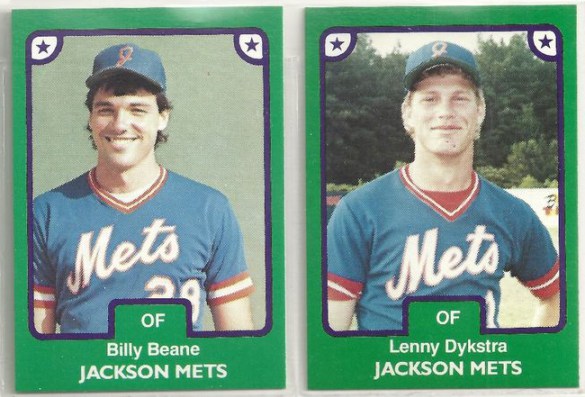](https://microcapclub.com/content/images/wordpress/2018/07/Billy-Beane-and-Lenny-Dykstra.jpg)
In 1980, Billy Beane was drafted in the first round by the Mets, the same year Darryl Strawberry was drafted. Beane looked like Mr. Baseball and was perceived as having an extreme amount of talent, but he never lived up to the hype hitting just .219 with 3 homers in 301 at bats across eight seasons.
Here is a highly entertaining excerpt where Billy Beane compares himself to teammate Lenny Dykstra and why he (Billy) failed as a baseball player (*source: [Intelligent Fanatics](https://community.intelligentfanatics.com/t/billy-beane-of-moneyball-on-why-he-failed-as-a-baseball-player/378?ref=microcapclub.com)*):
> Physically, Lenny didn’t belong in the same league with him. He was half Billy’s size and had a fraction of Billy’s promise – which is why the Mets hadn’t drafted him until the 13th round. Mentally, Lenny was superior, which was odd, considering Lenny wasn’t what you’d call a student of the game. Billy remembers sitting with Lenny in a Mets dugout watching the opposing pitcher warm up. ‘Lenny says, “So who’s that big dumb ass out there on the hill?” And I say, “Lenny, you’re kidding me, right? That’s Steve Carlton. He’s maybe the greatest left-hander in the history of the game.” Lenny says, “Oh, yeah! I knew that!” He sits there for a minute and says, “So, what’s he got?” and I say, “Lenny, come on. Steve Carlton. He’s got heat and also maybe the nastiest slider ever.” And Lenny sits there for a while longer as if he’s taking that in. Finally, he just says, “Shit, I’ll stick him.” I’m sitting here thinking, that’s a magazine cover out there on the hill and all Lenny can think is that he’ll stick him.”
>
> The point about Lenny, at least to Billy, was clear: Lenny didn’t let his mind screw him up. The physical gifts required to play pro ball were, in some ways, less extraordinary than the mental ones. Only a psychological freak could approach a 100-mph fastball aimed not all that far from his head with total confidence.
>
> “Lenny was so perfectly designed, emotionally, to play the game of baseball,” said Billy. “He was able to instantly forget any failure and draw strength from every success. He had no concept of failure. And he had no idea where he was. And I was the opposite.”
I’ve come across a lot of investors whose past battle scars and experiences knocked them out of the game. They weren’t necessarily knocked out financially, they were knocked out mentally.
Research has shown that negative events impact us more than positive ones. Negative emotions generally involve more thinking, and the information is processed more thoroughly than positive ones. In addition, bad events wear off more slowly than good ones.
[](https://microcapclub.com/content/images/wordpress/2018/07/1200px-Loss%5FAversion.png)
Loss aversion is disproportional to gain satisfaction
The same can be said with investing. It is what Daniel Kahneman and Amos Tversky first coined as loss aversion. You are more upset about losing $100 than you are happy about gaining $100\. In fact, in many cases you are 2-3x more upset about losing $100 than you are happy about gaining $100\. We then we go out of our way to avoid negative events and outcomes even if there is a greater probability of a positive outcome.
What does it look like?
You can’t think rationally. You are indecisive, and it cuts both ways. You can’t act but you also can’t decide not to act. You just sit there second and third guessing your research and intuition. When this happens you are done.
> “Experience is what you got when you didn’t get what you wanted.”
>
> – **Howard Marks**
How do we gain experience without losing our fearlessness? Every investor is different, but let me give you a few points that have helped me through the years.
- **Build a foundation that won’t crumble**. Discipline is when your values and long-term goals change your short-term behavior. This process gives you the foundation for success, not only in investing but life. Picture where you want to be and have the self-awareness to eliminate the bad habits and people that are holding you back.
- **Be patient. Focus on the process not the outcome**. Give yourself the time to go through the process to be who you want to be. The process is often filled with disciplined boring days. The outcome can take months or years, so in the meantime keep a journal of your process and keep refining it.
- **You are not going to be right all the time.** If you accept this fact, which few do, it will take the weight of the world off your shoulders. Perfection is not your goal. [It’s not batting average that is important, it’s slugging percentage](https://microcapclub.com/2017/11/not-batting-average-important-slugging-percentage/). Most of the greatest investors ever, a bulk of their lifetime gains came from 10-20 successful investments. 10-20 successful ones out of hundreds of investments made. Ben Graham made more money when he broke his rules ([GEICO](https://microcapclub.com/2015/01/the-first-million/)) than he did adhering to them (the rest of his portfolio). You are not going to be right all the time.
- **Own your mistakes, but don’t dwell on them**. Just like Lenny Dykstra, being dumb in the right areas can be your biggest asset. Especially with black swan events. Sometimes sh!t happens. You don’t need to beat yourself up over it. Control what you can control. Don’t let a single loss take you out of the game.
- **Gains and losses tend to happen in bunches**. The more concentrated you are the higher the likelihood you will go through long stretches when nothing seems to be working in the portfolio. You need to align your life, emotions, spending, and your investors (if you manage other people’s money) in a way that affords you the time to be successful.
- **Don’t talk openly about your positions unless you can turn your back on the crowd**. The more public you become with your positions, the harder it is to let go of a position if the story changes. You can’t let the weight of public opinion slow you down.
- **Don’t worry if no one likes your investment idea**. If the company is profitable and growing and not diluting the crowd will eventually come back to it.
- **Amateur investors focus on the stock price. Professional investors focus on the business**.
- **Compare new opportunities against what you already own**. A new addition to the portfolio needs to be better than what you already own. Raise the average, otherwise you are diluting your returns.
- **[Don’t compare yourself to others](https://microcapclub.com/2017/05/dont-compare-others/)** **.**Let other investors run their race. Too much time is wasted watching stocks you would never buy at any price and then beating yourself up over not owning them when they advance. Howard Marks says, “To be a disciplined investor you have to be willing to stand by and watch other people make money on things that you passed on”.
- **Evolve or go extinct**. Do not rest on your laurels. Stop reliving the memories of when great businesses could be purchased at 3-5 PEs. Those days are over. What worked 10-20 years ago might not work today. What works today might not work in 10-20 years. Keep learning and evolving.
Many investors are fragile. When you apply pressure to an object that is fragile it shatters. I believe the best investors are antifragile. They become stronger under pressure and stress. They weren’t born this way, but their lives and philosophies were built on a solid foundation that wouldn’t crack under pressure. They cared little for public opinion. They learned from mistakes and drew strength from every success. Mr. Market could never connect with a knock-out punch because they wouldn’t stand still long enough. They were always learning, moving and evolving. Their resources accumulated as the result of prudence, patience, and occasional aggression when the odds were in their favor. They were decisive. They were fearless.
> “Experience tends to confirm a long-held notion that being prepared, on a few occasions in a lifetime, to act promptly in scale, in doing some simple and logical thing, will often dramatically improve the financial results of that lifetime. A few major opportunities, clearly recognizable as such, will usually come to one who continuously searches and waits, with a curious mind that loves diagnosis involving multiple variables. And then all that is required is a willingness to bet heavily when the odds are extremely favorable, using resources available as a result of prudence and patience in the past.”
>
> — **Charlie Munger**
>
> (H/T [Vivek Mashrani](https://twitter.com/MashraniVivek?ref=microcapclub.com) for this quote)
**\===> Interact and learn with 250+ of the best microcap investors on the planet.** [\[Join Us\]](https://microcapclub.com/join-now/)
MicroCapClub is an exclusive forum for experienced microcap investors focused on microcap companies (sub $500m market cap) trading on United States, Canadian, European, and Australian markets. MicroCapClub was created to be a platform for experienced microcap investors to share and discuss stock ideas. Since 2011, our members have profiled 1000+ microcap companies. Investors can join our community by applying to become a member or subscribing to gain instant view only access. MicroCapClub’s mission is to foster the highest quality microcap investor Community, produce Educational content for investors, and promote better Leadership in the microcap arena. For more information, visit [http://microcapclub.com](http://microcapclub.com/) and
### The Best Defense is a Quality Business
URL: https://microcapclub.com/the-best-defense-is-a-quality-business/
Last updated: 2023-10-14T11:06:55.000Z
The luckiest part of my investing career is that I’ve been old enough (37) to have emotionally invested through two bear markets (1999-2001 and 2008-2009) but still young enough to take advantage of the lessons learned.
From 1999-2001, while I was in college, I worked part-time for a brokerage firm. I was the “Marketing Administrator” which means I was the secretary who answered the phones. When the Dot Com bubble burst I heard from a large percentage of our 1,200 clients. They called our office in every emotional state you can imagine. And here I was an inexperienced 19 year old trying to calm them down. When I started the job I thought I wanted to be a broker. After the Dot Com experience, I knew I didn’t want to be a broker. Investing is hard enough dealing with your own emotions let alone the emotions of others. Investors can handle volatility as long as it’s only to the upside. In addition, I lost 80% of the capital my parents saved for me to use towards my college education.
In 2008, I had just made the leap to becoming a full-time investor. Simultaneously the markets went into freefall. Great timing right?
During the crisis I realized a few things.
First, The worst place to be invested during a crisis is in liquid, institutionally held microcaps (i.e. the large microcap segment). I found that when the economy or markets show signs of weakening, institutions take risk off. One of the first areas they look to liquidate is exposure to microcaps.
Second, I observed that small microcaps that had great businesses that weren’t institutionally owned did fairly well. Why? Institutions couldn’t sell what they didn’t own. This is a big reason why I try to invest in the least institutionally owned best businesses I can find.
Third, capital continues to flow into new ideas even during a crisis. Institutions are moths, and the flames they are attracted to are growing profitable businesses that they don’t own. During the crisis I got lucky. I say lucky because It was one of those handful of times during an investment career when I timed something perfectly. One of my largest positions hit their inflection point during the crisis. No institutions owned it, and it went up 280% while the markets were down 52%.
The last thing I learned is quality bounces back first. When capital is finally redeployed it floods back into quality businesses first. One of my holdings was down 65% peak to trough during the crisis. Two months after the market bottom the stock was up 200% from its low. In just two months it had recouped all of its crisis losses.
My 2008-2009 experience is burned into my memory, and the result is productive paranoia. As preparation for the next crisis, I constantly reflect upon my portfolio and ask myself the following questions:
- Can the businesses I own continue to grow through a recession? How will they be impacted?
- Are the products and services they sell a luxury or necessity?
- Are their products or services so relied upon that if they didn’t exist it would cause their customers a lot of pain?
- Great businesses are built during recessions. Do the businesses I own have good balance sheets so they can be aggressive and take advantage of opportunities during a downturn?
If I can answer these questions favorably, then I can sleep at night. If I can’t answer these questions favorably then changes need to be made.
The tendency in a bull market is to lower your hurdle rate for new investments. Investors crave action. Most investors go down quality when they get bored and can’t find new ideas that meet their criteria. And it’s why most investors can’t beat the market.
The bottom line is the best defense for a crisis is a quality business. Once your portfolio is properly defended with high quality businesses, you’ll be able to view the next crisis for what it is: An opportunity.
Today in the United States there are \~70 million Americans between the ages of 19-34\. This is roughly 21% of the population. A majority of this age demographic are now investing and have never emotionally experienced a bear market. This age demographic spends a lot of time on social media. Just think of how bad the 2008 crisis would be if it happened today. 70 million people emotionally and financially terrified on social media. This is what I think about and it could be a huge opportunity for those that can disconnect from the crowd.
> “A man who wants to lead the orchestra must turn his back on the crowd.”
>
> — Max Lucado
An iteration of this article was written for [Vishal Khandelwal](https://twitter.com/safalniveshak?ref=microcapclub.com) of [Safalniveshak.com](https://www.safalniveshak.com/?ref=microcapclub.com), in their monthly newsletter, [Value Investing Almanack](https://www.safalniveshak.com/?ref=microcapclub.com), of which I’m also a subscriber.
**\===> Interact and learn with 250+ of the best microcap investors on the planet.** [\[Join Us\]](https://microcapclub.com/join-now/)
MicroCapClub is an exclusive forum for experienced microcap investors focused on microcap companies (sub $500m market cap) trading on United States, Canadian, European, and Australian markets. MicroCapClub was created to be a platform for experienced microcap investors to share and discuss stock ideas. Since 2011, our members have profiled 1000+ microcap companies. Investors can join our community by applying to become a member or subscribing to gain instant view only access. MicroCapClub’s mission is to foster the highest quality microcap investor Community, produce Educational content for investors, and promote better Leadership in the microcap arena. For more information, visit [http://microcapclub.com](http://microcapclub.com/) and
### Invest in Owner Management
URL: https://microcapclub.com/invest-in-owner-management/
Last updated: 2023-10-14T11:08:42.000Z
I’m a full time private microcap investor. The smaller the company the greater the emphasis investors should place on selecting the right founders and CEO’s. I try to find and invest in intelligent fanatics early.
What is an intelligent fanatic?
Intelligent Fanatics are the world’s greatest business builders. They create companies and organizations that dominate and stand the test of time. Charlie Munger was the first person to use the term Intelligent Fanatic. He described them as possessing business talents that allow them to do things that ordinary skilled mortals can’t.
Sean Iddings and I have studied over 100 intelligent fanatics that have built dominant public and private businesses and that operated in different industries, continents, and time periods. Perhaps the most fascinating thing we encountered was even though they were all quite different, their business philosophies were relatively similar. There was a blueprint for success. Intelligent fanatics possess similar attributes, characteristics, and behaviors. I would like to discuss one of these behaviors with you today.
Our research uncovered that intelligent fanatics are owners, not caretakers.
Specifically, this was reflected by **large ownership positions, low salaries, and frugality**.
Looking back at my almost twenty years of micro-small cap investing experience, ten of which I’ve been a full-time investor, I’ve come to the same conclusions as our intelligent fanatic research.
Management and boards who own large pieces of the business make better long-term decisions. In particular I like to see the management and board owning at least 20% of the business. I prefer to see a significant portion of the CEO’s net worth in the company’s stock. It’s even better if he or she purchased their entire position (i.e. it wasn’t given to them in the form of options or RSU’s). You want to see significant skin in the game.
I was recently reminded of the importance of owner management and skin in the game. A company I’ve owned for two years recently got acquired. Management and the board owned \~50% of the company. A significant portion of the CEO and CFO’s net worth was in the stock. They were managing the company for close to 20 years. They decided to sell the company because the inflection point in the business was not occurring. When they looked at the risk-reward of continuing on versus selling the business, the wise decision was to sell.
I spoke to the CEO soon after the press release announcing the transaction was issued. He said it was a hard decision to sell because of the time and effort they had put into the business, but it was an easy decision to sell based on the risk/reward of their large ownership position. Had they not owned a large position, they would have likely chosen the riskier path for shareholders and continued collecting their salaries.
Never invest in a business whose management doesn’t have to live with the consequences of their decisions.
Low salaries are equally important. Frugality is also woven into this. [Bob Kierlin](https://community.intelligentfanatics.com/t/fastenal-co-founder-bob-kierlins-smart-frugality/433?ref=microcapclub.com) co-founder of Fastenal and Ken Iverson of Nucor had the lowest salaries in their industry, and they outperformed everyone in their industry. I’ve always enjoyed venture capitalist Peter Thiel’s thoughts on executive compensation of startups. I think it relates well to microcap companies. Thiel likes to see low executive compensation because it sets the ceiling for the rest of the organization. No one can be greedy and ask for more than the CEO.
When you are investing in public companies, executive compensation is public knowledge. When times get tough for small companies, and they always do, optics matter. A friend of mine said it best, “Looking rich at the wrong time can be a disaster”. If management gets paid an exorbitant amount, employees will know it. When employees also have to walk by the CEO’s brand new Mercedes parked out front, they aren’t going to work as hard. “He or She is rich, let them deal with it” seeps into the culture of the company.
Against the grain of almost everything you see on TV, our research showed that intelligent fanatics were not materialistic ego maniacs. They often didn’t drive fancy cars or live in big mansions. They looked, dressed, and lived like normal people even after they were billionaires. They worked in the trenches with employees and put in longer hours than anyone. They were seen and respected. They lead by example. These are the leaders whose teams will rally around them when times get tough.
Find and invest in owner management, not caretaker management – leaders that have large ownership positions, low salaries, and that are frugal.
Here are a few other articles you would enjoy:
[The Art of Interviewing Management](https://microcapclub.com/2014/11/the-art-of-interviewing-management/)
[How Do You Access MicroCap Management Teams?](https://microcapclub.com/2012/09/how-do-you-access-microcap-management-teams/)
[How Do You Know that Management is Competent?](https://microcapclub.com/2018/03/know-management-competent/)
[The Most Valuable Investment Skill](https://community.intelligentfanatics.com/t/the-most-valuable-investment-skill/1142?ref=microcapclub.com)
**\===> Interact and learn with 250+ of the best microcap investors on the planet.** [\[Join Us\]](https://microcapclub.com/join-now/)
MicroCapClub is an exclusive forum for experienced microcap investors focused on microcap companies (sub $500m market cap) trading on United States, Canadian, European, and Australian markets. MicroCapClub was created to be a platform for experienced microcap investors to share and discuss stock ideas. Since 2011, our members have profiled 1000+ microcap companies. Investors can join our community by applying to become a member or subscribing to gain instant view only access. MicroCapClub’s mission is to foster the highest quality microcap investor Community, produce Educational content for investors, and promote better Leadership in the microcap arena. For more information, visit [http://microcapclub.com](http://microcapclub.com/) and
### Oh the Stocks You Will Buy
URL: https://microcapclub.com/oh-stocks-will-buy/
Last updated: 2023-10-14T11:10:27.000Z
We are entering the graduation season which of course is the time of commencement speeches. It makes me reflect on what I want my children to know about investing particularly in stocks. I have six children and all will need skills in investing to manage their finances. I imagine some may eventually pursue work in the finance field but it is up to them if they want to do that. I just want them to have the skills to manage their investments enabling them to be financially successful.
I believe that educating my children on finances is one of many important parts of my job as a parent. If I were to be speaking at a commencement to tell them about investing in stocks, here is what I would say:
**Oh the Stocks You Will Buy**
Oh the stocks you will buy
investing in your own style.
The journey you follow
can improve life by a mile.
Don’t imagine a dollar amount
as the destination you must achieve.
Investing is a life-long journey.
Warren Buffett absolutely agrees.
There will be plenty of successes
and plenty of mistakes.
Investing has many ups and downs.
You learn those are the breaks.
You can avoid some mistakes
by learning from others.
It is easier this way
than taking your druthers.
You might invest in some story stocks
and overpriced stock plays.
It would be better to purchase cheap
in fundamental ways.
You buy on a tip
without verifying.
It’s sold with great loss
which is terrifying.
Management promises
bought hook, line, and sinker.
The investment becomes
a humougous stinker.
You buy a stock
with an impaired balance sheet.
Soon you notice
massive dilution complete.
The company has
an exorbitant customer concentration.
Some customers leave
creating a financial abomination.
The company’s share structure
has billions of shares.
They dilute, dilute, dilute
because they don’t care.
The management team is
not aligned with shareholders.
The leaders get richer
while you just become older.
A stock hits its sell point
but you hold long term for tax savings.
The stock price declines more
than Uncle Sam would have been gaining.
You scorn legal problems
that could be an issue.
The company’s stock drops
and you need a tissue.
You made a great investment
and gloat confidently.
Your next investment is a
train wreck for all to see.
The market is crashing
with investor panic at its worst.
You sell a perfect stock
in a big emotional outburst.
You fail to create
a good asset diversification.
Your account blows up
and you take an investing vacation.
You have to make some mistakes
to learn the right way.
It’s the mistakes that you make
that teach you to play.
Each time you stumble or blunder
your investing will improve.
If you toil laboriously
investing will become smooth.
There will be success
when you buy something fantastic.
The dough that you earn
will make your spirits ecstatic.
Investing is all about
growing capital long-term.
Don’t expect results quickly.
That you will painfully learn.
Sometimes results come quickly
and sometimes they will be slow.
A lifetime of compounding
makes your accounts grandly grow.
Your education has just commenced
on this glorious graduation day.
One day you will be a great investor
if you continue to study away.
Don’t forget your ethics
when increasing your stash.
Your eternal result
is worth more than some cash.
Remember, however,
that money isn’t everything.
Lavish love will make you
much happier than anything.
**\===> Interact and learn with 250+ of the best microcap investors on the planet.** [\[Join Us\]](https://microcapclub.com/join-now/)
MicroCapClub is an exclusive forum for experienced microcap investors focused on microcap companies (sub $500m market cap) trading on United States, Canadian, European, and Australian markets. MicroCapClub was created to be a platform for experienced microcap investors to share and discuss stock ideas. Since 2011, our members have profiled 1000+ microcap companies. Investors can join our community by applying to become a member or subscribing to gain instant view only access. MicroCapClub’s mission is to foster the highest quality microcap investor Community, produce Educational content for investors, and promote better Leadership in the microcap arena. For more information, visit [http://microcapclub.com](http://microcapclub.com/) and
### Investing is Hard
URL: https://microcapclub.com/investing-is-hard/
Last updated: 2023-10-14T11:14:12.000Z
On June 30th 1997, Amazon.com (AMZN) was trading at a split adjusted $1.50 per share and was valued at $700 million. That day the stock traded 228,900 shares in a range of $1.48 – $1.59\. I’m sure someone traded in and out of a great business that day, not knowing that the stock was about to go up 1,000x.
Bernard Baruch once said, “Nobody ever lost money taking a profit.” I don’t know about that. Investing is hard.
On August 5th 2015, Valeant Pharmaceuticals (VRX) hit $262 per share and was valued at $85 billion. I’m sure someone that day thought they were buying a great business that could be held for the long-term.
Some of the smartest investors in the world were in Valeant. Investing is hard.
On April 1st 1976, Steve Jobs, Steve Wozniak, and Ronald Wayne founded Apple. Wayne drew the first Apple logo, wrote the three men’s original partnership agreement, and wrote the Apple 1 manual. Jobs and Wozniak each owned 45% and Wayne 10%. Two weeks later, he sold his 10% interest for $800\. This 10% interest would be worth $90 billion today. He was closer than anyone to the visionaries of Apple, and he still sold.
It doesn’t matter how close you are to a story. Investing is hard.
[](https://microcapclub.com/content/images/wordpress/2018/03/apple-original-contract.jpg)
In 1963, American’s smoked so many cigarettes that it was equivalent to every adult in the United States smoking over half a pack a day. 43% of American adults were active smokers. By 2014, this number dropped to 18%. Morgan Housel said it best:
> U.S. cigarette consumption has dropped 44% since 1981\. Altria stock is up 71,000% since 1981.
>
> Investing is hard.
>
> — Morgan Housel (@morganhousel) [May 2, 2017](https://twitter.com/morganhousel/status/859422450584625152?ref%5Fsrc=twsrc%5Etfw&ref=microcapclub.com)
Sometimes the facts mislead us. Investing is hard.
In the mid-1990’s, Masayoshi Son, founder of Softbank, set up Softbank Technology Ventures and invested heavily in internet companies. Over a three year period he invested over $2 billion across 100 internet companies. It was estimated that Softbank owned roughly 10% of the publicly traded value of all internet companies in 2000.
But when the technology bubble burst in 2001, Softbank lost 99% of its value from its peak. Masayoshi Son himself lost more money than any other person in history, his net worth declined from $76 billion to $1 billion in three years.
[](https://microcapclub.com/content/images/wordpress/2018/03/jack-ma-and-masayoshi-son.jpg)
In 1999, Masayoshi Son and Softbank made a $20 million investment in Alibaba. This investment is considered today to be [the most successful investment ever in the history of mankind](https://intelligentfanatics.com/forums/topic/successful-investment-history-mankind/?ref=microcapclub.com). Softbank’s 30% ownership position is worth $130 billion, or a 6500x return.
Softbank’s ownership interest in Alibaba is worth more than the market cap of Softbank (high debt). Masayoshi Son made over a hundred investments, almost went bankrupt, but a few investments saved him. Investing is hard.
In 2007, Patrick Industries (PATK) issued senior subordinate notes to Tontine Capital for $14 million in cash. Tontine also purchased 980,000 shares of Patrick Industries in a private placement at $11.25 per share. This capital was used to complete an acquisition.
Patrick Industries manufactures and supplies building products to the Recreational Vehicle (RV), Manufactured Home (MH), and Industrial markets. The majority of their business is manufacturing pre-finished wall and ceiling panels, cabinet doors, cabinet components, fiber reinforced products, cement siding, interior passage doors, furniture, roofing products, lighting, flooring, electrical, wiring, plumbing, and other products to these markets. In other words, most of the stuff that goes inside an RV or manufactured home, Patrick Industries manufactures.
When Tontine Capital provided the capital in 2007 they had no idea the financial crisis was about to punch them square in the jaw. Patrick Industries business was severely impacted. In March 2008, Tontine purchased another 1.1 million shares at $7.00 per share. In May 2008, they purchased 1.7 million shares in a rights offering.
By the time Todd Cleveland took over as CEO on February 1, 2009, Tontine owned 5.1 million shares or 57% of the company. The stock collapsed to under $1 per share.
Patrick Industries was a $5 million market cap company. You couldn’t give the stock away. No one was buying RV’s during a financial crisis. Even Tontine filed a 13D stating they were looking to explore alternatives to dispose of their shares.
No one would have been surprised if Patrick Industries would have ended in bankruptcy. But it didn’t end that way. Todd Cleveland turned things around.
Patrick Industries is up over 26,000% since Cleveland became CEO. In fact, the company is the [best performing stock in North America since 2009](https://microcapclub.com/2016/07/patrick-industries-patk-best-performing-stock-since-2009/).
[](https://microcapclub.com/content/images/wordpress/2018/03/PATK%5Fchart-2.png)
I estimate that Tontine Capital has taken over $200 million off the table. Source: [RocketFinancial.com](http://www.rocketfinancial.com/?ref=microcapclub.com)
[](https://microcapclub.com/content/images/wordpress/2018/03/Tontine-Capital-PATK.png)
Think about that. Their original investment in 2007 was down 95% by 2009\. They averaged down. Since then, they’ve recouped \~10x their money, and they are still long 5% of the company. This wasn’t some private equity firm making up some valuation, “mark to make believe”, on a private business. Tontine saw the real-time market price every day. They lived through the rollercoaster.
Investing is hard.
If you enjoyed this article, you will enjoy this presentation:
**\===> Interact and learn with 250+ of the best microcap investors on the planet.** [\[Join Us\]](https://microcapclub.com/join-now/)
MicroCapClub is an exclusive forum for experienced microcap investors focused on microcap companies (sub $500m market cap) trading on United States, Canadian, European, and Australian markets. MicroCapClub was created to be a platform for experienced microcap investors to share and discuss stock ideas. Since 2011, our members have profiled 1000+ microcap companies. Investors can join our community by applying to become a member or subscribing to gain instant view only access. MicroCapClub’s mission is to foster the highest quality microcap investor Community, produce Educational content for investors, and promote better Leadership in the microcap arena. For more information, visit [http://microcapclub.com](http://microcapclub.com/) and
### How Do You Know that Management is Competent?
URL: https://microcapclub.com/know-management-competent/
Last updated: 2023-10-14T11:17:01.000Z
Management competence is a significant factor that investors should research about a company prior to investing. To be more specific, I mostly mean the CEO.
Being a CEO of a publicly held company requires a special kind of person as the CEO needs to have the proverbial Swiss Army Knife of skills. A few of the laundry list of skills that are required are: ability to navigate the capital markets, vision, charisma, deep understanding of the company’s specialty, ability to delegate, sales skills, financial skills, adaptability, patience, and the list goes on.
So how do you assess if management is competent? It starts by reading management biographies and studying their background. It also includes talking with management or at least listening to management talk on a quarterly conference call, company presentation, or other venue where management talks about the business. Volumes could be written on this topic. In the end I think that the ability to assess management competence is something you gain with years of investing experience.
I do think there is a short cut or rule-of-thumb that can be used to determine if management is competent in many cases. To best explain this rule-of-thumb I’m going to go back in time and tell a story.
Many years ago when I first ran into Ian Cassel, the founder of MicroCapClub, I always wondered why he focused so much on management competence. I always thought management competence was important but he seemed to place disproportionate importance on management competence.
It took me a few years of knowing Ian to understand why he felt differently and why we were both right.
It is no secret that I usually only invest in profitable companies or occasionally in some that are close to profitability. Profitability is ingredient #1 in my investing philosophy which I detail in [My Secret Recipe](https://microcapclub.com/2012/10/my-secret-recipe-the-index-card/).
Most companies require significant management talent to reach profitability. First, the company needs to have the right business model that can become profitable assuming proper execution. Some business models can never reach profitability even with heroic efforts by management. There are a number of reasons for a flawed business model but I think it often boils down to two issues:
1. There isn’t enough demand for the product either because it doesn’t meet the needs of enough potential customers or because there are equal or better solutions to the problem that are available from competitors.
2. The pricing required to generate a profit is too high for customers to pay.
If you have a profitable company, chances are you have a management team that was smart enough to select a suitable business model. Sometimes, however, it means they were just lucky.
Now let’s say that the management team selected a good business model that could reach profitability. Unfortunately, that doesn’t guarantee profitability as they have to execute on that business model and be capable of bringing it to profitability. This means they need to do things like obtain the required capital, create the product, market the product effectively, hire the right people, provide the right incentives, manage expenses, treat customers properly, adjust the business model as necessary, etc. I know there are many more things that should be on that list but you get the idea.
When you have a management team that is managing an unprofitable company, you are generally relying on their skills to bring the company to profitability. While they might have a great idea for business with nearly limitless opportunities, they may not have the competence to bring that business model to fruition.
There are many reports that indicate that around 50% of companies fail in their first five years. This [Gallup article](http://news.gallup.com/businessjournal/178787/why-new-companies-fail-during-first-five-years.aspx?ref=microcapclub.com), while corroborating the 50% number, also indicates that management (the entrepreneur) plays a significant role in determining whether the company succeeds or fails. If you are investing in a company that only has a 50% chance of making it five years, you really want to stack the deck in your favor and have excellent management. Also, that 50% number is for all startups and not just the ones that attempt to be public companies. Based upon personal experience of watching microcap companies for many years I would not be surprised if that statistic is worse for publicly held companies as they are generally trying to create an enterprise that is larger than your typical small company.
As it turns out, when I first met Ian, he invested in more unprofitable companies than I did. That explains why he wanted to make sure that management had the right skills. I, on the other hand, invested almost entirely in profitable companies. In most cases when you invest in a profitable company, you already know that management has some good skills as competence is required to reach profitability. So, understanding management competence at a profitable company, if management has been there for any length of time, is not as important.
Now I am not saying that profitability means that you can check off the management competence box for profitable companies and move on. That is far from true. However, if the management team has been at the helm for any amount of time and they have had profitability and have even improved profitability, then likely they are good managers or at least good enough. I think one can look at it as a rule of thumb.
In unprofitable companies, you don’t have the luxury of knowing management skill merely by examining the financial results unless you know about some other company which they managed to profitability.
I think the other aspect you have to look it is the type of company that is being created. A company attempting to be an enterprise with revenue of $10M with profitability certainly is going to require a talented individual at the helm. However, if the company is attempting to be the next Amazon, Walmart, Southwest Airlines, or Microsoft, it is going to require an [Intelligent Fanatic](https://intelligentfanatics.com/?ref=microcapclub.com) type manager to make it successful.
In short, I agree with Ian that management competence is important. However, I would add if it is an unprofitable company you had better have an extra level of scrutiny to examine the skill level of management because they may not be able to make the company successful and turn a profit. Profitability, especially with growth, gives you a built-in indicator of management competence.
**\===> Interact and learn with 250+ of the best microcap investors on the planet.** [\[Join Us\]](https://microcapclub.com/join-now/)
MicroCapClub is an exclusive forum for experienced microcap investors focused on microcap companies (sub $500m market cap) trading on United States, Canadian, European, and Australian markets. MicroCapClub was created to be a platform for experienced microcap investors to share and discuss stock ideas. Since 2011, our members have profiled 1000+ microcap companies. Investors can join our community by applying to become a member or subscribing to gain instant view only access. MicroCapClub’s mission is to foster the highest quality microcap investor Community, produce Educational content for investors, and promote better Leadership in the microcap arena. For more information, visit [http://microcapclub.com](http://microcapclub.com/) and
### A New Mental Model for Investing
URL: https://microcapclub.com/new-mental-model-investing/
Last updated: 2023-10-14T11:21:10.000Z
One of my favorite investors is Nicholas Sleep of Nomad Investment Partners. He is famous in qualitative investment circles, but rather unknown to the rest of the investment world. He makes little to no public appearances. You won’t find much searching Google. He is a bit like Keyser Soze (movie: Usual Suspects) in that he is rarely seen but you know he is there.
Besides his incredible performance, the reason Nicholas Sleep is so famous is he not only invested in Amazon in the early 2000’s, but his articulation of his investment thesis was a masterpiece. A bullseye. It can only be read in his investor letters which are harder to find than a First Edition of Security Analysis.
The mental model he applied to Amazon fifteen years ago was called Scale Efficiency Shared, which he derived years earlier when investing in Costco. He would later change the name of the mental model to Scale Economics Shared after investing in Amazon. The best articulation and description of the mental model is actually described by Jeff Bezos in [Amazon’s 2005 Investor Letter](http://library.corporate-ir.net/library/97/976/97664/items/193684/shareholderletter2005.pdf?ref=microcapclub.com):
“As our shareholders know, we have made a decision to continuously and significantly lower prices for customers year after year as our efficiency and scale make it possible. This is an example of a very important decision that cannot be made in a math-based way. In fact, when we lower prices, we go against the math that we can do, which always says that the smart move is to raise prices. We have significant data related to price elasticity. With fair accuracy, we can predict that a price reduction of a certain percentage will result in an increase in units sold of a certain percentage. With rare exceptions, the volume increase in the short-term is never enough to pay for the price decease. However, our quantitative understanding of elasticity is short-term. We can estimate what a price reduction will do this week and this quarter. But we cannot numerically estimate the effect that consistently lowering prices will have on our business over five years or ten years. Our judgment is that relentlessly returning efficiency improvements and scale economies to customers in the form of lower prices creates a virtuous cycle that leads over the long-term to a much larger dollar amount of free cash flow, and thereby to a much more valuable Amazon.com. We have made similar judgments around Free Super Saver Shipping and Amazon Prime, both of which are expensive in the short term and – we believe – important and valuable in the long term.”
Businesses that fit this mental model choose to keep prices low, margins low and in doing so share their growing scale with their customers. Customers then reciprocate by purchasing even more goods or services from the company, which provides the company even more scale and more cost savings to share with the customer. This is the flywheel effect.
Scale Economics Shared is simple to understand, but it’s a hard concept for most value investors to buy into, especially in its extreme cases like Amazon. I talk about this mental hurdle for investors in this [\[Article\]](https://intelligentfanatics.com/forums/topic/profitability-not-customers-problem-jeff-bezos/?ref=microcapclub.com). Here is an excerpt:
Warren Buffett recently said, “We haven’t seen any businessmen like him \[Jeff Bezos\].” Which begged the question, “Well then why don’t you own Amazon?” which Buffett replied:
“Well, that’s a good question. But I don’t have a good answer. Obviously, I should’ve bought it long ago because I admired it long ago, but I didn’t understand the power of the model. And the price always seemed to more than reflect the power of the model at that time. So, it’s one I missed big time.”
Bezos just thinks differently than most people, including Buffett. In many ways, Amazon represents the opposite type of company Buffett typically invests in which is why he never bought it and likely never will. And to a lesser degree it’s why Berkshire never really owned a significant stake in Costco even though Charlie Munger sits on Costco’s board and adores the company.
In HBO’s recent documentary on Warren Buffett, Buffett talks about why he likes Coca-Cola and how the company and its affiliates serve 2 billion 8 oz servings worldwide per day. He says something like, “If you just get an extra 1 penny per day that is $20 million more profit per day, just 1 penny more”. I think that is a classic way he looks at a brand and its potential and to date it’s the opposite way Jeff Bezos thinks about Amazon.
But again, Amazon is an extreme case of Scale Economics Shared. You can find many successful and very profitable examples of this mental model going back a hundred years. For example, Henry Ford lowered the price of the Model-T seven years in a row to increase demand and production:
> “Our policy is to reduce the price, extend the operations, and improve the article. The reduction in price comes first…the low price makes everybody dig for profits”. – Henry Ford
A few other investors have iterated on Nick sleep’s Scale Economics Shared.
Josh Tarasoff refers to it as the Volume-Price Virtuous Circle. Here is Tarasoff explaining it in his own words:
“Volume-price virtuous circle is when a company has a cost advantage, so it has a more efficient way of doing something. When you have a cost advantage, there’s two things that you can do. You can take more margin, or you can reinvest that cost advantage into the customer value proposition by lowering prices, by increasing service levels, by increasing product quality. There’s infinite ways to do it. It depends on obviously what business you’re in, how the best way to do it is, but you’re going invest \[in a customer value proposition, and thereby grow your market share, grow your volumes, enhance your cost advantage. Then you go back and you invest further in the customer value proposition, and so on and so forth…. I think that’s very elegant and powerful when it’s done well. Familiar examples of this are Walmart, Costco, Geico, and the example from my portfolio that I’ll talk about is Amazon.” [\[Source\]](https://microcapclub.com/content/images/wordpress/2017/11/Josh-Tarasoff-Presentation-Transcript-Ivey-Business-School-July-2017.pdf)
A more recent iteration that I thoroughly enjoyed is from [Saurabh Madaan](https://twitter.com/saurabh%5Fmadaan?ref=microcapclub.com), former Senior Data Scientist at Google and now Managing Director of Investments at Markel Corporation, who calls his mental model the Octopus Model.
Saurabh was recently interviewed by [Vishal Khandelwal](https://twitter.com/safalniveshak?ref=microcapclub.com) of [Safalniveshak.com](https://www.safalniveshak.com/?ref=microcapclub.com), in their monthly newsletter, [Value Investing Almanack](https://www.safalniveshak.com/?ref=microcapclub.com), of which I’m also a subscriber. Vishal was kind enough to allow me to republish the portion of the interview pertaining to the Octopus Model, as well as this beautiful illustration.
[](https://microcapclub.com/content/images/wordpress/2018/02/Octopus-Model.jpg)
**VK: We’re seeing rapid technological changes all around. You are at the forefront of these changes and you’re also an investor. Since you practice value investing, you also look at businesses from long-term perspective. How do you combine these two aspects in terms of things changing really fast and long-term investing? On one hand Mr. Buffett talks about the concept of sustainable advantages – moats which are sustainable, and on the other hand we are living in a world where most businesses are not looking sustainable. In such an environment, how do you combine the thoughts of investing when businesses are disrupted so fast beyond people’s imagination?**
**SM:** I have a mental model that I call, for the lack of a better word, the Octopus Model. Let’s take a company which has a technology product, and because technology is prone to disruption, its shelf life is very small. This means any new technology can come up. And as you said, value investors stay away from the fact that a new company could come up any day and break this technology with a better one or a cheaper one. So, there is no moat as Mr. Buffett might say. Therefore, value investors typically would stay away.
Now let’s do a small thought experiment, in the spirit of Einstein. Let’s say that this company now has not one product of technology but a few products on technology. And it also reduces its profit margins. Instead of making a 20-30% profit margin, this company makes minimal profit margin. In our thought experiment, two things should happen. One, the multiple lines of products, if they are interrelated and reinforce each other, should start creating some sort of a competitive advantage. Second, the reduced margins. What do you think the reduced margins would do Vishal?
**VK: I think low margins would create a barrier for new players from entering the market. If the incumbent is working and sustaining on lower margins, my understanding is that it creates a moat. In some way it inhibits competition because competitors are looking at industries with high profit margins and not challenging industries with low profit margin. So, this is what my understanding is. I am not sure if that’s right.**
**SM:** Yes, you are right. If someone is making low or no margin, you must lose money to compete with them, assuming you cannot come up with a better technology. Moreover, if the number of technologies and products is more than one and they are related to each other, you must make three of them and lose money on three of them to compete with the incumbent. So, this adds some durability in an otherwise vulnerable situation. There is less incentive for competition to come and lose even more money. Now the shelf life, the lifetime of this company could be, probabilistically speaking, more than the previous company that we had talked about. Therefore, as a value investor it makes sense for you to at least try and look at it because its lifetime is going to be longer than a typical company, and that gives you the opportunity to invest in it at the right time.
The other thing I would add is the effect of scale on longevity. If you are delivering your product not just to one person but lots of people. You have a huge network and network effects start showing up in wonderful ways. A new competitor must first develop multiple products, then at low margin, then gather millions of users to compete with the incumbent. So there is some first-mover advantage beyond a critical mass. You can displace one product, one technology but to do it over all products, all interrelated technologies, across billions of users is going to take time and effort. You can still do it. It’s not impossible but base rates start declining.
Once a company has reached this, it can add an incremental line of product out of which it lights up profit margins. It starts making money. But this line of business is behind the first four or five lines of businesses that were basically low margin. Let’s think Amazon in this case. Amazon has very low (almost negative?) margin on Kindle devices. It gives free shipping to Prime Members, who also have free access to Prime video library and all sorts of other value-added services. But Amazon makes a ton of money on Amazon web services (AWS), on third party merchandise and on third party advertising.
You can see how these several lines of business where Amazon doesn’t make money help it attract and get a sticky customer base. This gives the same economies of scale where you add the Nth line of business and you can light it up with profits. If you were looking at Colgate, instead of looking at their annual revenue growth or profit growth what you should be focused on is that they have the shelf space across all the retailers and when they add a new line of product, let’s say a shampoo, even if they have spent 10- 20 million dollars researching it, the incremental returns on capital on that business are so huge. Because of the network and brand, other things take care of itself.
I call this the Octopus Model where all these lines are the reach of the octopus, building connections with the users. I feel this is one of the many patterns or mental models that as value investors one might want to have. Through your mental models you gain some insights, first or second order. Here we are not talking profit margin and linear growth and revenues. We are not doing any of that modelling. But we’re trying to get to an insight about the business that is not dependent on precise numbers, but could lead to a better predictive outcome than other quantitative models. If you have an insight like that in any business — we just used technology as an example because you asked me — I think that could differentiate you as a value investor.
**VK: Wonderful insights, Saurabh. I can see delayed gratification here where a company is losing money across business, across different areas and because of which it’s inhibiting competition. But it’s willing to hold its ground and sustain business for few years to be able to see profits and then it’s a different story altogether.**
**Since you talked about Amazon, it reminds me of Jeff Bezos who mentioned that the only sustainable advantage that a business has is long- term thinking. If you are thinking in terms of 1 to 3 years, then you are thinking like everyone else. But if you are thinking in terms of 7 to 10 years, then you are thinking uniquely. It’s a very valid point that you made. My feeling is that it applies so well, not just to technology but to any industry, any promoter, any management who in an era of shrinking attention span and shortening business cycles is willing to think long term.**
**SM:** Absolutely, and the other nice thing about this is what Mr. Buffett says, “The secret…is to sit and watch pitch after pitch go by and wait for the one in your sweet spot.” If I might add something to it – you can decide the time at which you are going to swing your bat. What I mean by that is there are various stages in the life cycle of the company that you just talked about. You very rightly connected it to delayed gratification which is the key here. If a company is building one product, one line of business and if you invested at that point and it did well, you’d make a ton of money. But a lot of such companies may not make it to the stage of the Octopus that we were talking about. You can even identify this pattern happening at a later stage. After the critical mass is reached, your margin of safety has gone up so much and your chances of permanent loss are so little that you can then decide to swing. So, you don’t have to swing at every stage of the game either. It is very interesting in that sense.
**\===> Interact and learn with 250+ of the best microcap investors on the planet.** [\[Join Us\]](https://microcapclub.com/join-now/)
MicroCapClub is an exclusive forum for experienced microcap investors focused on microcap companies (sub $500m market cap) trading on United States, Canadian, European, and Australian markets. MicroCapClub was created to be a platform for experienced microcap investors to share and discuss stock ideas. Since 2011, our members have profiled 1000+ microcap companies. Investors can join our community by applying to become a member or subscribing to gain instant view only access. MicroCapClub’s mission is to foster the highest quality microcap investor Community, produce Educational content for investors, and promote better Leadership in the microcap arena. For more information, visit [http://microcapclub.com](http://microcapclub.com/) and
### Morgan Housel on What Other Industries Teach Us About Investing
URL: https://microcapclub.com/morgan-housel-industries-teach-us-investing/
Last updated: 2023-10-14T11:22:16.000Z
Morgan Housel gave an incredible presentation on **What Other Industries Teach Us About Investing** at our second annual [MicroCap Leadership Summit (MLS)](https://microcapclub.com/summit/). Morgan Housel is a partner at The Collaborative Fund and a former columnist at The Motley Fool and The Wall Street Journal. Morgan has won several notable financial journalist awards. I think most would agree that Morgan is one the best financial journalists in the world. Many in finance like to sound smart by making things complex. Successful people simplify things. I find the best thing about Morgan is he simplifies things extremely well. [\[FULL TRANSCRIPT\]](https://microcapclub.com/content/images/wordpress/2018/01/Morgan-Housel-on-What-Other-Industries-Teach-Us-About-Investing.pdf)
Join us for the next [MicroCap Leadership Summit](https://microcapclub.com/summit/).
**\===> Interact and learn with 250+ of the best microcap investors on the planet.** [\[Join Us\]](https://microcapclub.com/join-now/)
MicroCapClub is an exclusive forum for experienced microcap investors focused on microcap companies (sub $500m market cap) trading on United States, Canadian, European, and Australian markets. MicroCapClub was created to be a platform for experienced microcap investors to share and discuss stock ideas. Since 2011, our members have profiled 1000+ microcap companies. Investors can join our community by applying to become a member or subscribing to gain instant view only access. MicroCapClub’s mission is to foster the highest quality microcap investor Community, produce Educational content for investors, and promote better Leadership in the microcap arena. For more information, visit [http://microcapclub.com](http://microcapclub.com/) and
### Changing Your Mind
URL: https://microcapclub.com/changing-your-mind/
Last updated: 2023-10-14T11:23:44.000Z
Closed-minded people put up walls around them. They prohibit new ideas and people from getting in. By doing so they stop growing. The only way to grow and evolve personally or professionally is to constantly challenge your beliefs and convictions. When you see evidence you are wrong, you change your mind.
One of the greatest examples of killing old stupid ideas and changing your mind is found in the [story of Daryl Davis](https://intelligentfanatics.com/forums/topic/getting-rid-stupid-ideas-daryl-davis-model/?ref=microcapclub.com). Davis is an African American who has infiltrated the Ku Klux Klan and has slowly changed the minds of some of its most prominent members.
How? By simply having an open dialogue with them. Davis found that most KKK members haven’t even ever spoken to an African American. He engages with them and asks to hear their side. Davis obviously doesn’t agree with them, but he listens and it ultimately ends with them wanting to hear his side. He slowly breaks down their wall of hate.
Daryl Davis has famously befriended former Imperial Wizard Roger Kelly.
> “I would go to hell and back for that man. A lot we don’t agree with, but he respects me and listens to me,” Kelly said of Davis.
After Kelly got to know Daryl, he would leave the top spot and the whole club. Davis has befriended 25+ top klans members who have eventually gone on leaving the organization.
This is an extreme example of changing your mind, but it’s a perfect example of the type of growth that can occur by doing so.
John Maynard Keynes was a British economist who is considered one of the most influential economists of the 20th century. Some of his detractors complained that the opinions he expressed tended to change over the years. Once during a high-profile government hearing a critic accused him of being inconsistent, and Keynes reportedly answered:
> “When the facts change, I change my mind. What do you do, sir?”
The super power of not letting your ego get in the way of change when the facts change is evident in most [intelligent fanatics](https://intelligentfanatics.com/?ref=microcapclub.com).
David Glass joined Wal-Mart in 1976 as Executive Vice President. He then became Vice President and CFO, and would later become CEO. He would work beside founder Sam Walton to build Wal-Mart into a dominant force in retail.
In Sam Walton’s autobiography, [Made In America](https://www.amazon.com/Sam-Walton-Made-America-ebook/dp/B008ZPG704?ref=microcapclub.com), David Glass says this about Walton:
> “Two things about Sam Walton distinguish him from almost everyone else I know. First, he gets up every day bound and determined to improve something. Second, he is less afraid of being wrong than anyone I’ve ever known. And once he sees he’s wrong, he just shakes it off and heads in another direction.”
And this brings us to investing.
I watched this Google Talk with value investor Bill Nygren, and here is the [\[FULL TRANSCRIPT\]](https://microcapclub.com/content/images/wordpress/2017/12/Bill-Nygren-Presentation-Transcript-Value-Investing-Principles-and-Approach-.pdf). I loved the story below that [Saurabh Madaan](https://twitter.com/saurabh%5Fmadaan?ref=microcapclub.com) forces out of Bill. It showcases the power of being open minded, being disciplined to your strategy, and changing your mind.
Saurabh Madaan:
One of your analysts wrote to us. They said that Bill really likes and remembers the facts when you present something to Bill. They presented a stock to you at $10\. About six years later, when the stock had grown 20 times, you still remembered the presentation, and you liked it even more so you purchased the stock at $200.
Bill Nygren:
Well, things change over time. The stock that we’re talking about is Netflix. One of our analysts presented it about seven years ago. His story was basically everybody’s focused on the wrong numbers here. What you should look at is the market thinks HBO subscribers are worth, whatever the number was, I don’t remember, $800 a sub. Netflix subs are worth a small fraction of that in the market. It seems like that’s wrong. Netflix is growing so rapidly; HBO isn’t.
At that time, we knew a lot of people in the media industry because of investments that we had, we talked to them. They said, “Netflix is hugely risky. HBO spends about three times as much on programming as Netflix does. They could basically squash it any time they want to.”
By the way, look at their churn statistics, especially in the month of February, when they released House of Cards. This is a one-show company. Most of the media companies that have sold programming to them regret the decision. They had no idea it would be sold to so many people. They’re going to see enormous increases in programming costs. When House of Cards goes up for rebid, they’ll easily be outbid by one of the bigger studios.
We looked at it and said, “The stock’s cheap, but it’s really at a very risky stage of its lifetime.” One of the things we do at Oakmark is, the risk and reward have to be in balance to make something interesting. You can’t go into a high-risk situation for a small reward. You’d only want to be in a high-risk situation if the reward is very, very large. As we looked at it, the risks were just too high.
As I was saying earlier, I don’t even think of this as a mistake. I think you learn a lot about investors by what they look back on and say were big mistakes. A lot of people would say this stock went up 10-fold, 20-fold maybe, not buying it was a big mistake. Well, it didn’t meet our criteria. When we researched it thoroughly it didn’t have the risk return profile that we were looking for.
Fast forward to just a few months ago, one of our young analysts comes into a large room. There are about 20 of us, the investment team, that sit around the table. He’d written a report on why we should buy Netflix. I’d gone through it. Of course, it’s hard to get out of your mind that you missed buying it at 5% or 10% of the current price. The report didn’t really jump out at me. We go into the room and he starts by saying, “People subscribe to HBO now and they pay $15 a month. They subscribe to Spotify, they pay $15 a month. Sirius XM, more like $20 a month.” Those same people, when they rate the services they subscribe to say Netflix is more valuable to them. That if Netflix, instead of charging $10 a month charged $15, it would be selling at 13 times earnings.
It was like the bell went off. It’s like that’s a way of thinking about the business value there that I had never thought of. That the willingness of Netflix to sacrifice current income by not charging as much as they could for their product, to instead grow their subscriber base 25% a year, get to the point today where the moat has become almost so large that it’s impossible to think of somebody displacing them. Eight billion dollars a year on programming, that’s almost now two to three times what HBO spends on programming. And because the sub base is growing so rapidly, the cost per subscriber is going to be substantially less for any programming that Netflix considers buying compared to HBO.
Now clearly, that’s a stock most value managers won’t touch. It sells at almost 200 times earnings, markets at 18 times earnings. It’s just a name they don’t even think about. But I think as value investing has evolved more of the interesting opportunities today are coming from these businesses that the P/E ratio does a really poor job of assigning value.
**\===> Interact and learn with 250+ of the best microcap investors on the planet.** [\[Join Us\]](https://microcapclub.com/join-now/)
MicroCapClub is an exclusive forum for experienced microcap investors focused on microcap companies (sub $500m market cap) trading on United States, Canadian, European, and Australian markets. MicroCapClub was created to be a platform for experienced microcap investors to share and discuss stock ideas. Since 2011, our members have profiled 1000+ microcap companies. Investors can join our community by applying to become a member or subscribing to gain instant view only access. MicroCapClub’s mission is to foster the highest quality microcap investor Community, produce Educational content for investors, and promote better Leadership in the microcap arena. For more information, visit [http://microcapclub.com](http://microcapclub.com/) and
### Disrupt Yourself and Grow
URL: https://microcapclub.com/disrupt-yourself-and-grow/
Last updated: 2023-11-19T14:23:09.000Z
I often learn the most by speaking with or studying successful investors that have the complete opposite strategy from my own. There is no better way to find holes in your strategy, or extract the nails that have been pounded down deep into your investment subconscious mind than talking to a successful investor that does things differently. Disrupt yourself and grow.
As many of you know, I run a concentrated portfolio of [misunderstood](https://microcapclub.com/2017/07/investing-in-the-misunderstood/) businesses. I use the term misunderstood because I’ve found too many equate value with cheap. I’m not necessarily looking for cheap. In general, I’m looking for businesses, management teams, and opportunities that are misunderstood by the market place. Perhaps it’s the business quality that is misunderstood. Perhaps it’s the quality level of management that is misunderstood. Perhaps it’s the culture, strategy, or intellectual property. It could even be misperceived negative events that have occurred, and shareholders are selling, and I believe they are wrong. Over the last few years, I’ve invested in about one new investment per year.
My investment philosophy has changed quite a bit from 10-15 years ago when I would have described it as more trading – momentum driven. I’m also not condemning a short-term approach to microcaps because a shorter-term approach likely fits better within the lifecycle of most microcap companies. What I mean by this is most microcap success stories are fad stocks that do well for 1-8 quarters. They go up 100-500% very quickly as they catch a wave or trend, but they soon fall back down to mediocrity when the wave hits the beach. Momentum takes them to levels where their business fundamentals can’t keep them.
Due to these shorter-term lifecycles of microcap businesses, short-term thinking is prevalent among microcap investors. This provides a distinct advantage to those that can focus on the minority of potentially sustainable businesses and look at them through a longer-term lens. My maturation as an investor has occurred through a variety of experiences and also encounters with great investors of all types.
In a recent [Google Talk](https://youtu.be/ejmn%5FpxJwtI?ref=microcapclub.com), François Rochon of Giverny Capital, talks about “The Art of Investing”. Here is the [\[FULL TRANSCRIPT\]](https://microcapclub.com/content/files/2023/11/Fran-ois-Rochon-Presentation-Transcript-The-Art-of-Investing-Analyzing-Numbers-and-Going-Beyond.pdf). I really liked this slide:
[](https://microcapclub.com/content/images/wordpress/2017/12/Rochon-Slide.jpg)
> “If you want to be an artist in the investing world, well, you want to master that art. You want to first choose an art that you really love. You want to study the masters of that art. Also, it’s important that, as master paints, investor invests, so you want to be active in your art. You want also to develop your own style, have an independent mind, and always strive for improvements.”
>
> – François Rochon
Pablo Picasso, Vincent van Gogh, Leonardo da Vinci, Claude Monet, Salvador Dali, Rembrandt, Andy Warhol, etc were all so uniquely talented and different. [The greats of investing are the same way.](https://microcapclub.com/2017/05/think-different-better/) Don’t limit yourself to only studying the greats of value investing.
> “I think I learn more reading about how great investors who weren’t value investors invested than I do about reading the 200th book about value investing.”
>
> – Bill Nygren, recent [Google Talk](https://youtu.be/GhMZ2c4SSlw?ref=microcapclub.com)
Most academic institutions teach the same types of investing courses, so they produce average investors. When is the last time you’ve seen an institution teach a class on venture capital or any other non-value investing course? To grow and mature as an investor, you need to let yourself be open to new ideas and new ways of doing things. Said differently, you need to be open to disruption of your beliefs and mental models.
> “There are two key lessons I’ve learned in my first 10 years. So, the map is not the territory is, I think, a very famous dictum. What it means to me is that, the frameworks that we use to make decisions are always just the frameworks in our head, and they’re not reality itself. Reality is infinitely more complex and dynamic than whatever tools, mental models we use to do our analysis and make our judgements. So, we can’t be trapped in our mental models, although it’s very, very easy to be trapped in our mental models. We have to be committed to changing our mental models, which means somehow stepping outside of them, or discarding them altogether.”
>
> – Josh Tarasoff, [Ivey Business School Presentation](https://microcapclub.com/2017/11/josh-tarasoff-two-biggest-lessons-learned/)
This past summer I attended a conference where Tobias Carlisle [(@Greenbackd](https://twitter.com/Greenbackd?ref=microcapclub.com)) was a speaker. I was so impressed, I asked him to speak at our [MicroCap Leadership Summit 2018](https://microcapclub.com/summit/). Toby’s investment philosophy is very different from my own. He is a diversified deep value quant. I’m a concentrated, quality focused, management focused investor. He is a very successful investor, and I loved his presentation. Afterword we all went out for dinner. He then introduced me to another friend of his who manages a fund in Canada. This fund manager is literally the opposite of me. He is high turnover, deep value focused, and owns 400 companies in his actively managed fund. He owns megacaps and nanocaps. He will own tiny positions ie $500 individual positions in a $30 million fund. I’ve been privy to his performance, so I know his strategy has been quite successful since he launched it a few years ago. I spent 2 hours talking to him. I couldn’t’ stop peppering him with questions. He made me think differently about some of my strongest held investing beliefs, and I thanked him for it.
The experience didn’t change my overall investment philosophy, but by studying him I was inverting myself, and it allowed me to see things that my own mental model was blocking. By disrupting myself, I was able to think differently about things and fill in some gaps.
Similar to how water flows into a depression, as you mature as an investor, you slowly find your way to an investment philosophy that fits your personality. Don’t just study the masters that are similar to you. Learn from all of them, so you can form your own unique style. Be open to disruption. Some of the most productive decisions you will ever make in life are the ones where you change your mind on a longstanding belief. Disrupt yourself and grow.
[François-Rochon-Presentation-Transcript-The-Art-of-Investing-Analyzing-Numbers-and-Going-BeyondFrançois-Rochon-Presentation-Transcript-The-Art-of-Investing-Analyzing-Numbers-and-Going-Beyond.pdf170 KBdownload-circle](https://microcapclub.com/content/files/2023/11/Fran-ois-Rochon-Presentation-Transcript-The-Art-of-Investing-Analyzing-Numbers-and-Going-Beyond.pdf "Download")
**\===> Interact and learn with 250+ of the best microcap investors on the planet.** [\[Join Us\]](https://microcapclub.com/join-now/)
MicroCapClub is an exclusive forum for experienced microcap investors focused on microcap companies (sub $500m market cap) trading on United States, Canadian, European, and Australian markets. MicroCapClub was created to be a platform for experienced microcap investors to share and discuss stock ideas. Since 2011, our members have profiled 1000+ microcap companies. Investors can join our community by applying to become a member or subscribing to gain instant view only access. MicroCapClub’s mission is to foster the highest quality microcap investor Community, produce Educational content for investors, and promote better Leadership in the microcap arena. For more information, visit [http://microcapclub.com](https://microcapclub.com/) and
### It’s Not Batting Average that is Important, It’s Slugging Percentage
URL: https://microcapclub.com/not-batting-average-important-slugging-percentage/
Last updated: 2023-10-14T11:26:48.000Z
Each investor’s strategy is and likely should be different from the next person. [It’s good to be different.](https://microcapclub.com/2017/05/think-different-better/) I think too many focus on cloning others when it’s a mistake. It’s not who they really are. There are 30,000 Elvis impersonators, and their combined income is far less than the original. Instead of cloning someone, take the valuable lessons and nuggets you obtain from studying the greats, and apply it to your own processes, experiences, and personality. This is what intelligent fanatics do. Be original.
In general, microcap investing lends itself more to an active strategy because many microcaps are small emerging companies and things can change quickly. You can’t afford to buy and forget. You need to buy and verify your thesis, and the smaller the company the more often you verify. When you initially make an investment, you can’t say “I’m going to hold this for 1-2-3-10 years”. No, you are going to hold it as long as management executes. This could be 3 months or it could be 30 years. In microcap, hold times are skewed towards the former (3 – 18 months) because there aren’t many microcaps that will prevail over the long-term.
You need to have a high hurdle for new ideas but not too high that you never allow any new investments in. No company, especially a small one, is perfect. They all have a wart or two or fifty, but warts can be removed. It’s why it’s important to stair step into a position and add as management executes and proves themselves. If they don’t execute you sell. Let their execution determine your position sizing, not some formula you read in a book.
I’m reminded by this quote I featured in [The Art of Holding](https://microcapclub.com/2017/01/the-art-of-holding/):
> “The most successful investors I worked with, those who made the most money, all had one thing in common: the presence of a couple of big winners in their portfolios. Any approach that does not embrace the possibility of winning big is doomed.”
>
> – **Lee Freeman-Shor**
It’s not batting average that is important, it’s slugging percentage. You can have a lot of losers and still win big if you let your winners run and quickly kill your losers. What I tend to do over time is move more and more capital into my best performing management teams. For example, a large percentage of my portfolio is in four companies which I’ve owned for 1 year, 4 years, 5 years, and 7 years.
I also hold a handful of smaller positions that I hope will mature into what I think they can become. There tends to be a lot of turnover in my smaller positions. The smaller positions represent the minor-league prospects that I’m looking to bring up to the major leagues if they perform. Some will and some won’t. Management execution or lack thereof will decide their fate. It’s impossible to have the conviction at the beginning of an investment that you have at the end of a successful investment. Conviction, just like trust, takes time to develop.
**\===> Interact and learn with 250+ of the best microcap investors on the planet.** [\[Join Us\]](https://microcapclub.com/join-now/)
MicroCapClub is an exclusive forum for experienced microcap investors focused on microcap companies (sub $500m market cap) trading on United States, Canadian, European, and Australian markets. MicroCapClub was created to be a platform for experienced microcap investors to share and discuss stock ideas. Since 2011, our members have profiled 1000+ microcap companies. Investors can join our community by applying to become a member or subscribing to gain instant view only access. MicroCapClub’s mission is to foster the highest quality microcap investor Community, produce Educational content for investors, and promote better Leadership in the microcap arena. For more information, visit [http://microcapclub.com](http://microcapclub.com/) and
### Asking the Right Questions
URL: https://microcapclub.com/asking-right-questions/
Last updated: 2023-10-14T11:34:20.000Z
The smaller the company and the more illiquid its currency, the more the investment process becomes an art and less of a science. Just like with any art form, whether it’s music, acting, painting, etc it just takes a lot of time and experience to do it well. The art of investing in small companies is evaluating management teams. If you don’t believe that management is important when investing in small companies like microcaps, just wait a little longer. You will.
Chip Maloney, wrote a great article entitled, [The Art of Interviewing Management](https://microcapclub.com/2014/11/the-art-of-interviewing-management/). His article does a great job at giving a general overview of the art-form. Let’s now dig in a bit deeper and talk about which questions are the right questions. Put differently, what are some questions that have a deeper meaning, that drill down into some valuable areas that we can tap into as investors.
I’m going to leverage the knowledge and expertise of several others including [Joe Koster](https://twitter.com/jtkoster?ref=microcapclub.com), of [Boyles Asset Management](http://www.boylesasset.com/?ref=microcapclub.com) and his fabulous blog [ValueInvestingWorld.com](http://www.valueinvestingworld.com/?ref=microcapclub.com). I have also stolen generously from Michael Shearn’s book, [The Investment Checklist](https://www.amazon.com/Investment-Checklist-Art-Depth-Research/dp/0470891858?ref=microcapclub.com). I also want to acknowledge [Todd Wenning’s](https://twitter.com/ToddWenning?ref=microcapclub.com) wonderful article, [15 Questions to Ask Management Teams](http://www.cleareyesinvesting.com/2017/11/15-questions-to-ask-management-teams.html?m=1&ref=microcapclub.com), which in itself provides a robust list of great questions.
Some favorite questions from master investors:
Warren Buffett used to ask this question to all CEO’s after assuring them that their answer would be kept private: “If you could only buy stock in one company that was not your own, which one would it be and why?”
This was Phil Fisher’s most important question to management: “What are you doing that your competitors aren’t doing yet?”
Tom Russo said the late Bill Ruane used to always ask management: What are the chances that your business will lose money next year? All of the conversations they’d normally have with Wall Street were about whether they’d make $2.10 or $2.11 per share next year or whatever. At first management would be a little perplexed, then a little disturbed, but at the end, they’d say something like: “Look, for that to happen, the following 3 things would have to happen…” And those are about the only 3 things you should really care about. It tells you a lot about the business. \[Source: [Wealthtrack](http://wealthtrack.com/russo-long-term-value-transcript-20150522-episode1148/?ref=microcapclub.com)\]
Michael Shearn from *The Investment Checklist* provides some great advice and example questions:
The conversation you want to have will be focused on management’s view of how the business is run. Ask questions that are open-ended rather than closed-ended:
An open-ended question is, “How did you make the decision to hire the senior vice- president of development?” This type of question requires a detailed, conversational answer.
A closed-ended question is, “What is the tax rate for this quarter?” This type of question can be answered with only a one- word answer, which won’t reveal anything about how a manager thinks or makes decisions.
As interviewer, your job is to listen, and then continue to ask questions to clarify what a manager is saying.
Do not ask hypothetical questions, such as, “What would you do if you were confronted with a certain problem?” The answers to these questions do not yield many insights because what managers think they will do is often different than what they will actually do. Instead, ask questions that will help you learn how the manager thinks and how he or she plans to execute.
The following are a few open- ended questions you might ask (in no particular sequence). You should focus on the questions that you think will be most revealing to you:
Why did you join the business?
How did you rise at the business?
What skills made you chief executive officer (CEO)?
What do you believe the job of the CEO is?
What do you want to be known for?
How do you measure whether you are successful?
If you were sitting down with some potential long- term investors, what two or three reasons would you give them to take a look at the business at this time?
Is there a possibility this business is going to be two to four times as big as it is today, five, or seven years down the road?
If you were a private business, how would you operate differently?
What do you like about working here?
Who are your current and past mentors, and what impact did they have on your life?
What character traits are needed for your job?
What character traits do you look for in a successor?
What three things would you do to destroy the business as quickly as possible? Give yourself a one- year time frame.
What type of people are you looking to hire?
How do you find quality candidates?
How are you developing future leaders?
What is the culture you are trying to instill at your business?
If we were meeting three years from today, what would need to have happened during that time for you to feel happy about your progress?
How do you keep the big picture in perspective and not get too bogged down in the everyday details?
What factors do you consider before you expand into a new market?
What are the biggest opportunities the business has?
How many people do you need to hire to grow?
How do you stay close to your customers?
What type of information do you need on a weekly basis?
If you were away for one year, which key metrics would best tell you how the business was doing? Why can’t other people do what you are doing?
Here are some questions for management from Tweedy Browne \[modified\]:
What does your global competition look like over the next several years?
What have your competitors done in the last few years to upset the competitive dynamics?
What have you done to them in the last few years to affect those dynamics?
Who is your toughest competitor? Why?
What worries you about your company in relation to your competitors’ moves and potential moves?
How easy is it to enter the business? What prevents new competitors from entering? Are entry barriers sustainable?
Describe pricing behavior in the company’s industry: Which competitor, if any, typically increases prices first? What has happened next? Who cuts prices? What happens next? Has pricing behavior been rational/“statesmanlike” in the company’s field of business? Describe pricing “signaling” behavior in the company’s field of business. Describe recent pricing moves.
How are the prices of your products compared to competitors?
Could new technology have a dramatic impact on the company’s business model, earning power and growth prospects?
Looking out 5 to 10 years, how does the company plan to invest cash that is retained in the business? Expected return on equity on incremental investment?
What new investments, new ventures, or new experiments that the company is working on (or envisions) could have a significant positive impact on the value of the company in the future?
What is the company’s philosophy/strategy with respect to using free cash flow for stock buybacks when it is not required to support growth?
What information does management monitor and consider to be important in managing its business?
Here is another one I’ve added since writing this post:
In management meetings we never let the meeting end without asking which of their competitors they respect or which of their suppliers or clients have a competitive advantage. (Peter Kinney’s letters, Acacia Capital) – H/T Joe Koster
Whether its microcaps, private equity, or venture capital, investing in small illiquid companies is an art-form because you are investing in people. You need to find out all the valuable nuggets you can which means asking the right questions. You can’t expect to become a master interviewer or master investor overnight. It takes a lot of practice. A common thread with people that ask great questions is they spend more time listening than talking. It’s hard to truly listen and let the conversation take you where you need it to go instead of always thinking about the next question and forcing it. As Chip Maloney stated in his article, it’s important to not be robotic or rude. A CEO or management team isn’t going to give you thoughtful answers if they think you’re an asshole. You need to be respectful and friendly, so you can build rapport and trust quickly. View the questions in this article as tools for your toolbox. The more you use the tools the better you’ll get at using them.
**\===> Interact and learn with 250+ of the best microcap investors on the planet. [\[Join Us\]](https://microcapclub.com/join-now/)**
MicroCapClub is an exclusive forum for experienced microcap investors focused on microcap companies (sub $500m market cap) trading on United States, Canadian, European, and Australian markets. MicroCapClub was created to be a platform for experienced microcap investors to share and discuss stock ideas. Since 2011, our members have profiled 1000+ microcap companies. Investors can join our community by applying to become a member or subscribing to gain instant view only access. MicroCapClub’s mission is to foster the highest quality microcap investor Community, produce Educational content for investors, and promote better Leadership in the microcap arena. For more information, visit [http://microcapclub.com](https://microcapclub.com/) and
### Further Analysis of Multi-Bagger Stocks
URL: https://microcapclub.com/analysis-multi-bagger-stocks/
Last updated: 2024-01-19T20:34:27.000Z
This article and presentation was produced by Kevin Martelli. The following presentation “A Perspective on Value Investing” starts with a brief introduction on value investing based on my professional journey and includes an “Analysis of Multibagger Stocks,” a historical study of stocks around the world that achieved more than 10x return in the 15 years period between 2000 and 2014.
This analysis was inspired by Thomas Phelps book “100 to 1 in the Stock Market,” published in 1972\. Today, just like in 1972, there are many lessons to be learned by observing the exceptional long-term performance of a few selected stocks. In particular, studying historical case studies helps in getting better at: (i) assessing the key drivers of long term value creation; and (ii) identifying how there can be a significant discrepancy between short term market perception of risk vs. long term real risks. Furthermore, observing how most market participants missed great investment opportunities teaches something about the importance of being humble about your own assumptions and opinions and the many challenges we face as long-term oriented investors in making even rough predictions about the future.
Performing this research has also been useful in better understanding that there are many patterns that can lead a particular investment to achieve superior shareholder returns (the 3 case studies in the presentation are in fact very different from one another). Although “the rear-view mirror is always clearer than the windshield,” it is very helpful to increase one’s database of investments that worked in the past in order to be open-minded and better prepared in the search for new investment ideas.
Additionally, one should also keep in mind that studying historical multi-bagger stocks is also a good way to reduce one’s investment mistakes. In fact, for every multi-bagger stock that manages to grow revenues at 20-30% per year there is likely to be at least one traditional company that is probably being disrupted and is likely to disappoint its shareholders in the future (see the case study in the appendix). Avoiding these companies can be as valuable as identifying good investment ideas.
Turning towards the search for multi-bagger stocks over the next 5-10 years, I think it will become increasingly important to be able to identify business leaders and company cultures that are customer-centric and able to be continuously innovative, while avoiding the pitfalls of corporate bureaucracy and hierarchy. Although most firms would argue they are already pursuing these sound business principles, very few are able to execute on them. Thus, in the next few years as the pace of technological disruption accelerates and traditional barriers to entry (such as high distribution costs) continue to diminish, the share of companies that can create value for shareholders regardless of the quality of their leadership team is likely to decline is well. The challenge for investors is being able to identify [“intelligent fanatics”](https://intelligentfanatics.com/?ref=microcapclub.com) CEOs and great company cultures early on and have the conviction to invest in them for the long term. On this topic, I think public equity investors can learn a great deal from Silicon Valley’s leading venture capitalists.
As a final point, it is interesting to note that Thomas Phelps’ book was published at the beginning of 1972, before the 1973-74 bear market, which offered exceptional investment opportunities to rational investors who had cash to deploy. Currently, based on most metrics, asset prices are generally quite expensive, sustained by a combination of unprecedented interventions by monetary authorities and widespread optimism in financial markets. Both interest rates and price volatility around the world are at a historic low. I have no idea what the exact trigger and timing of the next bear market will be, but hopefully this historical analysis will help investors maintain a rational long-term perspective when a more risk-adverse market sentiment eventually returns.
View Presentation Below:
[](https://microcapclub.com/content/files/2024/01/A%5FPerspective%5Fon%5FValue%5FInvesting.pdf)
---
[A\_Perspective\_on\_Value\_InvestingA\_Perspective\_on\_Value\_Investing.pdf1 MBdownload-circle](https://microcapclub.com/content/files/2024/01/A%5FPerspective%5Fon%5FValue%5FInvesting.pdf "Download")
---
If you enjoyed this presentation, you may also like the following article by Kevin Martelli: [Would a 30 Year Old Warren Buffett be Studying Silicon Valley Tech Companies?](https://microcapclub.com/2016/09/30-year-old-warren-buffett-studying-silicon-valley-tech-companies/)
[Chris Mayer’s Presentation on 100-Baggers](https://microcapclub.com/2016/11/chris-mayer-100-baggers/)
[MTY Food Group – A Case Study of a 100-Bagger](https://microcapclub.com/2015/03/mty-food-group-a-case-study-of-a-100-bagger/)
[MIddleby Corporation – Case Study of an Intelligent Fanatic led 100-Bagger](https://microcapclub.com/2016/05/middleby-corporation-midd-case-study-intelligent-fanatic-led-100-bagger/)
**\===> Interact and learn with 250+ of the best microcap investors on the planet.** [\[Join Us\]](https://microcapclub.com/join-now/)
MicroCapClub is an exclusive forum for experienced microcap investors focused on microcap companies (sub $500m market cap) trading on United States, Canadian, European, and Australian markets. MicroCapClub was created to be a platform for experienced microcap investors to share and discuss stock ideas. Since 2011, our members have profiled 1000+ microcap companies. Investors can join our community by applying to become a member or subscribing to gain instant view only access. MicroCapClub’s mission is to foster the highest quality microcap investor Community, produce Educational content for investors, and promote better Leadership in the microcap arena. For more information, visit [http://microcapclub.com](https://microcapclub.com/) and
### Stop Wasting Time
URL: https://microcapclub.com/stop-wasting-time/
Last updated: 2023-10-14T11:38:00.000Z
During a lifetime, you will likely own 10-20 big winners and hundreds of failed impostors. Time and interest are the primary components of the power of compounding. The hard part is we don’t know how much time we have. Identifying the losers in your portfolio is as important as holding winners because losers dilute your returns. Losers are a waste of your time.
> “Take your losses quickly and your profits slowly because your objective is not just to be right but to make big money when you are right”
>
> – **Bill O’Neil**
Many investors do a post-mortem analysis of their investment decisions. A port-mortem is analyzing an investment after you’ve killed it (sold). You may have sold because it was a bad investment or because it was a good investment. The objective of the post-mortem isn’t necessarily to review the individual investment (ie this was a bad investment or good investment) as much as it is to review if making the investment and holding was consistent with your investment strategy and principles. Here is a good video by Steve Jacobs on post-mortem analysis:
Last year my wife and I sat down with an estate attorney to make changes to our Will. Embarrassingly we kept pushing this off for far too long. The attorney asked me, “How will your wife be taken care of if you die?”. I replied jokingly, “I’m not worried about it. She will marry again quickly.” My wife threw a quick glare in my direction 🙂
But in all seriousness, as soon as I got married I created a 911 file. The 911 file is password protected and only my wife can access it. If God decides my time is up, whether it’s later today, next year, or in 40 years, my wife can go to this file to retrieve all the important information on our finances. Brokerage accounts, bank accounts, people I trust that can help, etc. Since I’m heavily invested in a relatively small amount of illiquid public and private company investments I try to keep an updated and detailed account of my thoughts on each investment.
A post-mortem analysis is one thing. Writing down your thoughts on an investment that is to be read and understood upon your demise is a whole other exercise. My hope in providing my thoughts in such a way was to give some sort of guidance. The intention is that many of the acorns I’ve planted that have started to grow will hopefully turn into large oak trees that can support my wife and family long after I’m gone.
The 911 file is organized very simply with my thoughts on each investment outlined in the following structure which I update periodically:
- A paragraph on when and why I made my initial investment.
- A paragraph on how my investment thesis has changed or evolved since making the investment.
- A paragraph on how the management and business have impressed me and disappointed me since making my investment.
- A paragraph defining why the business is special (ie describe the relationship between the business and the customer).
- A list of issues, events, threats, that could hurt the business. What could hurt the relationship between the business and customer? Which ones are glancing blows versus knock out punches to my thesis?
When we sat down with the estate attorney I slid the printed 911 file over to him and said this is all my wife would need. He took 30 seconds, scanned over it, and slid it back and said, “This won’t be necessary. Mr. Cassel all your investments will be sold soon after you die. There is no possible way a portfolio such as yours can be managed by people that don’t have your experience.” As I let that sink in for a moment, I quickly realized he was right. In a fast paced, quickly changing environment of microcap investing which are primarily small emerging public companies, it’s very hard to simply transfer investment knowledge. It was quite stupid of me to think that my positions could survive past me, not to mention the undue stress doing so would put on my wife.
I continue to keep the 911 file updated, even though it won’t be useful to my wife upon my demise. Why? The exercise of writing it helped me invert and balance out my bullishness and biases. It focuses me on when I need to sell. It’s been seven years since I started the 911 file and I can point to three separate occasions where the thought process saved me a lot of money.
It’s OK to fall in love with your microcap positions. I know I love mine. You just have to be prepared to divorce quickly. You can’t let your ego get in the way when the facts change. You need to know your investments better than most so you can spot when something has changed long before other investors. As Keynes said, “When facts change, I change my mind.”
> I’m still a full-time investor today not because of my gains, but because of the losses I didn’t take.
Some other articles you might enjoy:
[When To Sell](https://microcapclub.com/2016/09/when-to-sell/)
[The Art of Holding](https://microcapclub.com/2017/01/the-art-of-holding/)
**\===> Interact and learn with 250+ of the best microcap investors on the planet.** [\[Join Us\]](https://microcapclub.com/join-now/)
MicroCapClub is an exclusive forum for experienced microcap investors focused on microcap companies (sub $500m market cap) trading on United States, Canadian, European, and Australian markets. MicroCapClub was created to be a platform for experienced microcap investors to share and discuss stock ideas. Since 2011, our members have profiled 1000+ microcap companies. Investors can join our community by applying to become a member or subscribing to gain instant view only access. MicroCapClub’s mission is to foster the highest quality microcap investor Community, produce Educational content for investors, and promote better Leadership in the microcap arena. For more information, visit [http://microcapclub.com](http://microcapclub.com/) and
### You Need To Do What Others Don’t
URL: https://microcapclub.com/need-others-dont/
Last updated: 2023-10-14T11:39:27.000Z
The hardest part of achieving 10-20+ baggers is having the patience and conviction to hold through multi-year periods of underperformance. Patience is your biggest asset when investing in a great business. Time always pushes out the weakly convicted and creates opportunities for those with a long-term perspective. The greatest flaw in the short-term investor is they think great business performance is always linear. The truth is that even great businesses suffer growing pains, and so do their stocks.
The investor that always worries about “next quarter” will sell at any sign of imperfection. Since no company is perfect, this means they will always sell too soon. Short-term investors will accept a 20% gain because they didn’t spend the time to develop the conviction and foresight to see the next 500%.
The second hardest part of achieving 10-20+ baggers is holding stocks that sometimes look expensive by traditional metrics. If your aim is to hold a great business for a long time, you are going to have to get used to holding a business that isn’t always “cheap”. This is a topic that David Gardner talks about in this [Invest Like the Best](http://investorfieldguide.com/gardner/?ref=microcapclub.com) podcast.
Whether it’s holding a great business whose stock doesn’t move for months or years, or holding one that doesn’t look “statistically cheap”, there is an [art to holding](https://microcapclub.com/2017/01/the-art-of-holding/). The simple answer is you focus on the business, not the stock.
A successful long-term investor today needs to be incredibly focused on knowing what they own better than others. This means they cannot depend on others for their due diligence. You need to do the work. You can borrow someone else’s stock ideas but you can’t borrow their conviction. A multi-baggers journey is filled with the corpses of highly intelligent-articulate naysayers. There isn’t one great stock or company that wasn’t credibly doubted all the way up (H/T [@EdBorgato](https://twitter.com/EdBorgato?ref=microcapclub.com)). Put on your armor of diligence and conviction so you can hold a great company when you find one.
Thirty years ago the best investors had the biggest funnels of information. Today the best investors have the best filters of information. They know what is important and knowable, and they don’t become distracted by the noise around them. Sometimes important information comes from sources that aren’t obvious.
I recently dug into a CEO’s past so deep that I ended up networking my way back twenty years to his college roommate. The key takeaway from the college roommate was that the now CEO was always incredibly honest and had high integrity. This is from a roommate that likely saw him in many different forms (studying, dating, sports, drunk, etc). The college roommate told me a story from twenty years prior about how he and the now CEO broke a chair at a college party. The following morning the now CEO walked a mile to the person’s house and paid them for the damage. He didn’t have to. No one knew he broke the chair. Now this type of conversation might seem insane to most investors. But is it insane to do a background check on the integrity of the leader you’ve invested 5-10-20% of your net worth? I don’t think so. Do you think that uncovering such a nugget or [differential insight](https://microcapclub.com/2016/10/paul-lountzis-differential-insights/), albeit from 20 years prior, gives me an edge? Yes, I believe so.
If you want above average returns, you need to do what average investors aren’t willing to do. You need to gain perspectives that average investors aren’t willing to gain because it’s just too hard, too uncomfortable, and takes too much time. It’s easier to sit in an office and crunch numbers than it is to get on a phone or plane and talk to people. If you aren’t willing to do so, then don’t complain about being average.
In [Ron Baron’s Q2 Letter at Baron Funds](https://www.baronfunds.com/sites/default/files/2Q17%5FQuarterly%5FReport%5F1.PDF?ref=microcapclub.com), he talks about going the extra mile for research:
As part of our ongoing effort to gain further insight into Tesla’s prospects, we recently met with Dr. Ion Yadigaroglu, a venture capitalist. Ion is an engineer with a doctorate in physics from Stanford. Ion has been programming since he was eight years old! Ion’s dad is a prominent nuclear scientist. So much for Ion’s creds. When Ion studied at Stanford graduate school, his roommate founded eBay. Ion’s $1,300 investment in the eBay startup became worth millions. In 1992, at the dawn of the Internet, Ion met Elon Musk. Elon had come to Palo Alto to research battery technologies in Stanford’s labs. Elon dropped out after only six days! Further, while at Stanford, Ion was the teaching instructor for JB Straubel, Tesla’s CTO and chief engineer. Ion believes JB and his team are better at battery technology than anyone else. It was lucky for Ion that he met both Elon and JB. Ion invested in Tesla when it was just beginning, and so far has made a lot more than he did in eBay. After meeting Ion, we concluded it was lucky for Elon and JB they met Ion as well.
Our meeting with Dr. Yadigaroglu is one example of Baron Funds’ differentiated primary research approach. Few institutional investors have met with Elon and JB. Fewer still, we’re guessing, have met with the co-founder’s teaching instructor at Stanford. We believe fewer and fewer in the investment industry are performing even the most basic research on businesses. There is a reason for this. During the past 15 years, boosted by virtually instantaneous communications, computer algorithms, and the increasing popularity of ETFs, securities trading volumes have multiplied exponentially. As computers and software have replaced traders and marketplaces, brokerage commission revenues have fallen dramatically. Brokerage commissions historically have been used to pay for investment research. Ergo, investment research budgets have been cut significantly; there are now far fewer financial analysts; and “price discovery” and markets have become less efficient.
We believe the fewer people who do research, the more valuable the fundamental research we conduct and the more likely it is that we will continue to outperform. This is although we cannot guarantee that we will. One Tesla executive with whom I speak regularly recently remarked to me, “It is amazing to me how little most people know about Tesla.”
One of my golf friends recently remarked, “I love to play poker with people who think the game is all about luck.” My friend wins so often and so much, he thought he was going to be asked to leave his game. One of our mutual friends who plays in that game marvels how this individual “knows” what cards are in his hand without seeing them. “It’s about mathematics and ‘reading the table,’ studying how your opponents bet their hands,” my friend explained to me. Which is just like world championship bridge. Teams that compete in bridge study books several inches thick on “conventions” and practice diligently. Based on my observation, people who earn lots of “masters points” don’t earn them because they are lucky.
Just like anything else, the harder you “work,” the “luckier” you get. We think the same goes for investors who earn returns significantly greater than those of the market over the long term.
**\===> Interact and learn with 250+ of the best microcap investors on the planet. [\[Join Us\]](https://microcapclub.com/join-now/)**
MicroCapClub is an exclusive forum for experienced microcap investors focused on microcap companies (sub $500m market cap) trading on United States, Canadian, European, and Australian markets. MicroCapClub was created to be a platform for experienced microcap investors to share and discuss stock ideas. Since 2011, our members have profiled 1000+ microcap companies. Investors can join our community by applying to become a member or subscribing to gain instant view only access. MicroCapClub’s mission is to foster the highest quality microcap investor Community, produce Educational content for investors, and promote better Leadership in the microcap arena. For more information, visit [http://microcapclub.com](https://microcapclub.com/) and
### Discipline is having the strength to say No
URL: https://microcapclub.com/discipline-strength-say-no/
Last updated: 2023-10-14T11:40:38.000Z
Goals are accomplished through hard work and great discipline. Discipline is choosing what matters most over what you want now. Whether it’s in life or investing it’s often the individuals that have the strength to say No that succeed. When I was on vacation last week, I was thinking about broad areas in life where it’s important to say No. I wrote them down and combined them with a few of my [tweets](https://twitter.com/iancassel?ref=microcapclub.com) from the past couple years. This isn’t an exhaustive list, so feel free to add to it:
**Say No to being a Loser**
Losers give up on their dreams and then sit back and become critics of people that win. Don’t give up on your dreams. It’s easy to become bitter and fall into a loser’s mentality. Don’t live a defeated life, always thinking the worst of everything and everyone. Live in expectation, anticipation and possibility of what tomorrow brings.
**Say No to Complexity**
Many like to sound smart by making things complex. These people usually work for other people. Successful people simplify things.
**Say No to giving your kids EVERYTHING you didn’t have**
It was the scarcity and struggle in your life that made you who you are today. When you have it easy you don’t appreciate opportunity. We all want to give our kids more than we had, but often times the more we give them the less they appreciate it. Give your kids what they need. Your time. Don’t give them all the stuff they want and desire.
**Say No to Negative Distractions**
Your inability to focus will stop you from being consistent long enough to be successful. Get rid of the negative distractions in your life. Work hard to eliminate negativity, self-doubt, addictions, etc. that are holding you back from reaching your full potential.
**Say No to Negative People**
The person who has never done anything is the one who is sure it can’t be done. You only have so much energy. Get rid of the naysayers and people that only “take from you” and drain your tank. Surround yourself with people that bring out the best in you, not the worst. It is impossible to live the right life with the wrong friends.
**Say No to Useless Sparring**
Don’t respond to trolls and critics. Responding to negative people only empowers them. You can’t win a pissing contest with a skunk. Don’t waste time fighting battles with small-minded people. Walking away from an argument is a sign of strength. Focus on what is important.
**Say No to Comfort**
To grow you have to stretch for things. It’s rarely comfortable. You have to develop the ability to be effective in discomfort. In most cases to step toward your destiny you have to first step away from your security. You have to risk who you are for what you can be.
**Say No to Comparisons**
Don’t compare yourself to others. You aren’t running their race. Compare yourself to yourself two years ago.
**Say No to Creating an Image**
We are often so busy selling an image of what we would like to be that we have no time left to work on who we really are. In addition, we spend so much time trying to impress people that don’t matter that we risk losing the people that care about us most.
**Say No to Selfishness**
It’s hard to be happy if you’re selfish. If you don’t feel joy in your life it’s because you’re not giving enough time, love, and/or resources to others. Complaining and blaming is a derivative of selfishness. You never know when a winner is struggling because they are too focused on other people. They don’t have time to complain because their purpose is bigger than themselves.
**Say No to Jealousy**
Jealousy can destroy you if you don’t kill it. When you are fulfilling your purpose in life you are happy when others are fulfilling theirs.
**Say No to Procrastination**
We all have a purpose. It’s that thing that stirs your spirit. Have the courage and sense of urgency to go after it before someone else does.
**Say No to Dwelling on Past Mistakes**
You may have made mistakes but that’s in your past. It’s not how you start the race, it’s how you finish. Sam Walton at age 44 opened his first Wal-Mart and during his lifetime dominated the industry. Ray Kroc took over McDonald’s at age 52 and built it into a global enterprise. Colonel Sanders first franchised his secret recipe, “Kentucky Fried Chicken” at age 62\. It’s never too late to accomplish your dreams. Your story isn’t finished yet. Make the next chapter a great one.
**Say No to Mediocrity**
You weren’t put on this Earth to be average, so stop thinking like everyone else.
**Say No to Blame**
Your best bet for a successful future is to fully own your past mistakes. Quit thinking about what’s wrong with your life and be thankful for what is right. Opportunity always presents itself to a grateful heart.
**Say No to Self**
Don’t waste time thinking you have all the answers. Most of us think we know more than we really do. We think we are more talented than we really are. Fake it until you make it works until you go broke. You don’t have all the answers. Be a sponge and learn from everyone.
**Say No to Giving Up**
Keep working hard no matter your current situation. When you start doing the small things right, doors will open to bigger opportunities. Every day, people rise up from incredible hardship & prove they aren’t a product of their circumstances, they are a product of their decisions. The power to endure is the winner’s quality. You learn from the journey, not your achievements. You learn that if you don’t give up you win. And that will stay with you a lifetime.
**Say No to Talking and Overthinking. Say Yes to Doing.**
Most people talk too much and do too little. It’s great that you can talk a good game. It’s great that you read 1,000 books last year, and you have an IQ of 160\. It’s all useless unless you apply what you learn to your life, business, family, charity, friendships, etc. Stop overthinking everything. The reason why the kid with a 90 IQ is outperforming you is because he/she wasn’t afraid to take the first step and figure it out as they went. Find a problem, cause, or issue that bugs you. Chances are it annoys a lot of other people. Don’t just sit there and complain about it. Do something about it. Now.
Success takes an incredible amount of discipline. Discipline is having the strength to say No.
**\===> Interact and learn with 250+ of the best microcap investors on the planet.** [\[Join Us\]](https://microcapclub.com/join-now/)
MicroCapClub is an exclusive forum for experienced microcap investors focused on microcap companies (sub $500m market cap) trading on United States, Canadian, European, and Australian markets. MicroCapClub was created to be a platform for experienced microcap investors to share and discuss stock ideas. Since 2011, our members have profiled 1000+ microcap companies. Investors can join our community by applying to become a member or subscribing to gain instant view only access. MicroCapClub’s mission is to foster the highest quality microcap investor Community, produce Educational content for investors, and promote better Leadership in the microcap arena. For more information, visit [http://microcapclub.com](http://microcapclub.com/) and
### The Excessive History of Microcaps
URL: https://microcapclub.com/excessive-history-microcaps/
Last updated: 2023-10-14T11:42:50.000Z
Smaller company stocks outperform larger ones. This is one of the chief attractions for investors to small-cap companies and microcap stocks in particular. In the best-selling book, [*What Works on Wall Street*](https://www.amazon.com/What-Works-Wall-Street-Fourth/dp/0071625763?ref=microcapclub.com), author James O’Shaughnessy and Founder of [O’Shaughnessy Asset Management](http://osam.com/default.aspx?ref=microcapclub.com), confirms from study of historical returns that indeed small caps do outperform large caps by a couple of percent a year. He quibbles with other studies, however, that show microcaps, represented by the smallest decile of the market, outperform small caps significantly. He notes that the first decile includes a lot of tiny stocks that are impossible to buy in practice. These “noninvestable” stocks have outrageously high returns that pull the average for the lowest decile higher. In the fourth edition of the book with data through 2009, he shows that eliminating stocks below $50 million in market cap reduces the microcap return advantage significantly. From 1927 through 2009, the lowest decile excluding noninvestable stocks returns 10.9% , which is just a little higher than the 2nd decile returning 10.6%. Now these are both considerably higher than the 8.8% of the megacaps in the 10th decile, and he agrees that small cap returns are higher; it’s just that microcap returns are only slightly higher than small caps.
To show how noninvestable stocks distort microcap returns, O’Shaughnessy produces some return data from the Compustat database between 1964 and 2009\. After removing stocks trading below $1, and limiting monthly returns to 2000%, the stocks with deflated market caps below $25 million returned annual compounded returns of 18.2%. That return is just astonishing. O’Shaughnessy confirms this result using data from the Center for Research in Stock Prices (CRSP), again for sub $25 million stocks, and finds 17.6% compounded returns for the same time period. That’s not bad either. Clearly such high returns will increase the average for the 1st decile, and it’s true that it’s not feasible for most professional investors to purchase these nanocaps.
But I can. In fact, most things I own would be classified as “noninvestable” by Mr. O’Shaughnessy. An alternative lesson to draw from his study is that microcaps are fine but nanocaps are the ticket to wealth; you just have to be poor enough to buy them. Before drawing that conclusion, you need to consider that the world has changed since 1964\. For instance, stocks are now traded in decimals, not 1/8ths of a dollar. What was the bid/ask spread on nanocaps trading at $2 in 1968? And are you old enough to remember brokerage commissions before deregulation allowed discount brokers in the 1970’s? It was in the hundreds of dollars per trade and that was when a hundred dollars meant something. You couldn’t pick off a few shares between the bid and ask here and there with multiple trades like you can today. Maybe historically they really were “noninvestable” even for the individual in that trading costs significantly diminished those 18% database returns. If that’s the case, it would be expected that nanocap returns lately might be a lot lower than they were historically. O’Shaughnessy doesn’t address more recent nanocap returns, but that should be easy to check; except that it isn’t. Nobody publishes a nanocap index. In fact, until the recently created LD Micro Index there wasn’t a real microcap index either. If you thought there was, check the average market cap on the Russell Microcap Index. The companies are well over $300 million.
Fortunately, the return data for the 10 deciles going back to 1927 in the CRSP database is now available on the internet. This data has been widely studied, but nobody ever cares much to look at or write about the littlest guys. Only professional investors read investing books that have any sophistication, and most professional investors don’t care about nanocaps; they’re noninvestable. The ones that do care are few in number, and in my experience, a little strange. Kidding, kidding, of course. Write a book or a paper about nanocap returns if you want, but only a few people will read it. But my kids say I’m a little strange myself, so of course I’m intrigued. With all this data now available, what can history teach us about microcap investing in general? Then is the data capable of answering the questions about those outrageous nanocap returns? Are nanocaps the ticket to wealth for the individual investor, or were the high historical returns not realizable in the past and not present in modern data?
Table 1 shows historical returns from the CRSP database for the 10 deciles calculated with each decile members returns equally weighted (i.e. without consideration of market cap).
Table 1: Equally weighted returns and standard deviations of returns for the 10 deciles (1927-2016)
[](https://microcapclub.com/content/images/wordpress/2017/08/Pic-1.png)
The smallest decile with a year-end 2016 average market cap of $114 million shows the highest compounded annual return at an astonishing 17.44%. It comes with an equally astonishing standard deviation of 49.67%. If the distribution was Gaussian (the normal distribution or bell curve distribution), 68% of years should show returns within one standard deviation of the mean, that is between -23.8% and 75.5%. That means nearly 1 out of 3 years (32%) should be worse than -23.8% or better than 75.5%. Data outside of two standard deviations (-73.5% to 125.2%) should occur in roughly 1 year out of 20\. Figure 1 plots the annual returns for each year where you can see that there are 3 years (out of 90) exceeding 125% and four years near -50% including the familiar 2008.
[](https://microcapclub.com/content/images/wordpress/2017/08/Pic-2.png)
The Figure 1 plot is noisy so some averaging might identify periods where returns were exceptional. Five year compound returns (the year of the data point and the prior four years) are plotted in figure 2a. The returns for the largest decile, which aren’t too much different than the cap weighted S&P 500, are also plotted for contrast.
[](https://microcapclub.com/content/images/wordpress/2017/08/Pic-3.png)
There are several things to note from the plot in figure 2a.
1. The smallest decile returns are just wild. In the 1930’s during the depression there was a five year period where the compounded annual return exceeded 100%. Stock prices were up 32 times in five years. After some bad years later in the depression, the microcaps rallied during World War II posting compounded annual returns exceeding 80% in the five years through the end of the war in 1945\. A bull market in the 1960’s ended with microcaps appreciating by a factor of four in two years with returns of 134% in 1967 followed by 71% in 1968\. Then they roughly cut in half in 1969 (-34.5%) and 1970 (-18.3%) and then did it again in 1973(-39.9%) and 1974 (-23.4%). This was followed by six consecutive years from 1975 through 1980 where the 35.7% return in 1977 was the bad year. The 1980’s showed relatively weak returns for the microcaps as a bull market in the larger stocks raged on. The microcaps played catchup in the early 1990’s and then trailed the big ones again in the late 1990’s as the large-cap technology bubble inflated. The 2000’s saw the bubble pop while the microcaps were posting 5 year returns exceeding 25%. Since the financial crisis, microcap returns have been relatively weak.
2. Microcaps are often touted as good diversification tools and figure 2a supports this. The late 1960’s through the early 1980’s showed powerful returns for the little guys while the large caps were in a funk. The 1980’s, late 1990’s, early 2000’s also show high differentiation in returns between the smallest and largest decile. There was a long period in the 1950’s and early 1960’s where the returns are similar and well-correlated. Interestingly, since the financial crisis the big ones and the little ones are moving similarly as well.
3. The microcaps appear to go through booms and busts. Choose any data point on figure 2a where returns have been high the prior five years and then count over five data points to see the returns in the subsequent five. They are generally mediocre at best or often just plain bad. Similarly, choose a data point with negative returns and count over five years and you’ll see a big positive number.
What causes the booms and busts? I often read that certain economic conditions favor small companies over large ones. Better for the little ones is high growth economies because small companies can double in size faster than the behemoths. Low interest rates are favorable for the small ones because they need new capital more than mature companies. Inflation somehow is better for small companies than large and that’s why small caps ran like crazy in the late 70’s. I’ll offer no opinion on economic effects, but I would suggest that at least part of the boom and bust is due to investors just being nuts. Once those little guys have rallied a little investors just have to buy them, driving prices higher and higher to excessive levels. Once they’ve fallen or traded directionless for a while nobody needs them and they fall to excessively low levels. John Templeton famously instructed his broker to buy $100 of every stock on the exchange trading for less than $1 in 1939\. Checking figure 2a shows that things worked out pretty well for him (80%+ annual returns from 1941-1945). He was buying because he could see that investors had driven valuations outrageously low. Buffet famously closed down his partnership in 1969 telling his investors that there was nothing to buy and recommending they put their money in municipal bonds. This was just before stock prices cut in half twice in 1969-1970 and 1973-1974\. Buffet could see that the excessive returns in 1967-1968 were not because of economic conditions; it was a bubble. In the late 1990’s, the large stocks outperformed the little ones significantly. You can see this on figure 2b that shows trailing 12 month returns for the smallest and largest deciles for each month from 1980 through May 2017\. The chart shows negative returns for the microcaps in the late 90’s. I started buying microcaps myself about this time and they were very cheap. The general sentiment at the time was that if you owned microcap garbage you should sell those dogs to buy large technology stocks, a dot-com, or an S&P 500 index fund. Economic conditions had nothing to do with microcap underperformance. Then in the early 2000’s you can see on figure 2b that the microcaps were posting 40% twelve month returns. At the same time the largest decile stocks were down 20%. It’s not economics; it’s investors driving microcap prices to excess.
[](https://microcapclub.com/content/images/wordpress/2017/08/Pic-4.png)
The mid 70’s was the beginning of a six year period (1975-1980) where microcap returns remained high for an extended time. Since then, however, it’s often been the case that high five year returns are actually driven by a big run that happened over just a year or so. This is evident on figure 2b. August 1982 was the beginning of an 11 month rally with returns over 120% that ended swiftly and led into years of microcap underperformance. The high 5 year returns in 1995 of 31.3% were from a three year run in 1991 (61.1%), 1992 (41.7%) and 1993 (36.7%). The high 5 year returns from 2003 through 2007 in figure 2a are from a big 10-month run evident in figure 2b beginning in April 2003 (107.5% for year) and ending in January 2004 (25.0% for the year but 10.7% came in January). The high 5 year return ending in 2013 of 29.0% was from a 14 month run spanning from January 2013 (49.2% for year) through February 2014 (8.5% through February before declining to 0.1% for the year ) coupled with the big but short-lived recovery rally in 2009\. You have to be in the stocks through a lot of dull years, often underperforming indexes, while patiently waiting to capture the big run that eventually comes. Those big runs are often sharp (60, 80, 120% in a year) and short-lived.
Figure 3 plots the subsequent five year returns against the preceding five year returns for all the years from 1927 through 2016\. The large cap (top decile equal weighted) data points are shown in orange and the microcap (smallest decile equal weighted) in blue.
[](https://microcapclub.com/content/images/wordpress/2017/08/Pic-5.png)
If you drew a best fit line through the orange large company data points in figure 3, it would slope down slightly to the right. That negative slope indicates there is a slight negative correlation. That is, if the large companies past five year returns have been high, the subsequent returns are likely to be lower, but only moderately so. If you drew a best fit line through the blue small company decile data, however, it would slope sharply down and to the right. That is, if the microcaps have done well in the last five years, the outlook for the subsequent five is really bad. If returns have been poor, however, you’re likely to do really well. In particular, if five year returns have been negative, the subsequent five year returns have always been at least in the 20’s and often in the 40’s or 50’s or higher. If there’s anything you take from this article, let this be it: Stocks mean revert; microcaps mean revert like crazy. When performance has been good for a while, it’s almost certain that investors will drive microcap prices excessively high. Big losses or simply an extended period of weak performance will almost certainly result in microcap prices that are excessively low.
The smallest decile had an average market cap of $114 million at the end of 2016, so this decile has a mix of microcaps and nanocaps. O’Shaughnessy notes in the 4th edition of his book with data through 2009 that most of the outperformance of this decile is due to the nanocaps (under $50 million). The CRSP data doesn’t break out returns for anything smaller than the first decile. However, at least some indication of nanocap performance can be extracted from the numbers they do give. The CRSP data calculates the historical returns for each decile on an equal weight basis, but they also provide returns on a market cap weighted basis. Table 2 shows the historical returns for each calculation method for the smallest decile dating back to 1927.[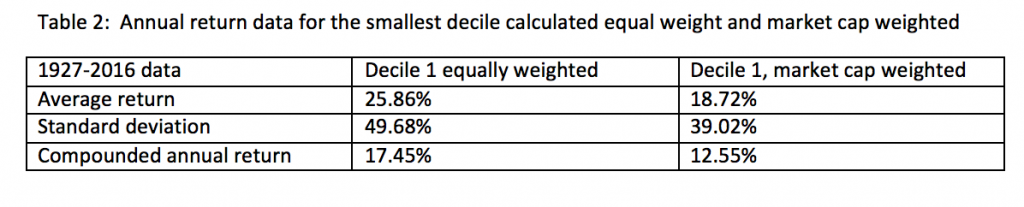](https://microcapclub.com/content/images/wordpress/2017/08/Pic-6.png)Weighting by market cap results in return data that reflects the larger stocks, the microcaps, more than the smaller nanocaps. The result is a reduction in the compound annual return from 17.45% down to 12.55%. The nanocaps clearly are responsible for the outperformance consistent with *What Works on Wall Street*. Table 2 data doesn’t exclude the nanocaps but merely underweights them resulting in a return reduction of 4.9%. For now on, I’ll refer to the decile 1 returns that are market cap weighted as the “microcaps” and the equal weighted data as the “nanocaps”. We’ll generally see that the nanocap returns are higher than the microcap returns. Keep in mind that in reality, the nanocap outperformance is higher than the numbers show. There are some microcaps in the nanocap data that reduce the nanocap returns and some nanocaps in the microcap data that increase the microcap returns. Notice in table 2 that associated with the higher nanocap returns is a higher standard deviation. If standard deviation of returns is your measure of risk, then the nanocaps are riskier.
Figure 4 plots the historical annual returns of the nanocaps verses the microcaps. You can see that many years show higher returns for the nanocaps. As one might expect, the nanocap outperformance is high when the returns are high. Apparently when investors start chasing, they chase the nanocaps higher than they chase the microcaps. What is interesting, however, is that when returns are poor the nanocaps aren’t worse. In fact, in the depression the nanocaps were considerably better. In the latest meltdown in 2008, however, the nanocaps did underperform but made up for it quickly in the up move in 2009\. Nanocap performance that is even with, or better than, the microcaps in down markets is surprising. Is this characteristic of nanocaps exclusively or rather some statistical phenomenon that is present in all the deciles? The 2nd decile shows just a hint of this behavior (equal weight better in up markets but not worse in down markets). It was much less pronounced than the 1st decile, however. The same comparison on the 7th decile didn’t show this behavior at all. Perhaps this is characteristic of the tiniest stocks or perhaps it’s just chance. The number of down-year data points is too limited to draw any solid conclusion.
[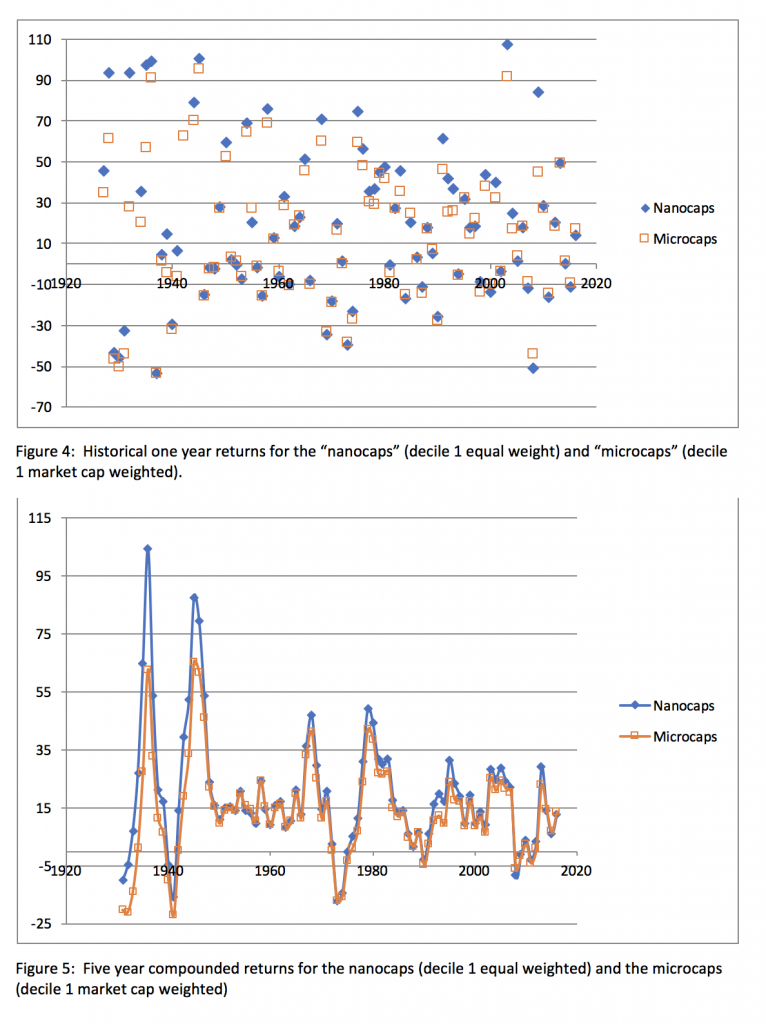](https://microcapclub.com/content/images/wordpress/2017/08/Screen-Shot-2017-08-04-at-6.14.57-AM.png)Figure 5 plots the five year compound annual return of the nanocaps and the microcaps. The outperformance of nanocaps in bull markets is evident. With the exception of 2008, there isn’t any significant underperformance in bear markets. It’s true that the standard deviation of returns is higher for the nanocaps, but that’s coming from insanely bigger up years and generally not from bigger down years. If the chance for a big loss is your idea of risk, then nanocaps don’t appear to be riskier than microcaps, at least not historically. The exception is 2008 where the nanocaps dropped 50.7% rather than the microcaps return of -43.7%.
Figure 6 was created from monthly returns in the CRSP data. To smooth out noise, the compounded returns for the trailing 12 months are calculated and plotted for each month from 1980 through May 2017\. Note that the outperformance of nanocaps in bull markets is still present in modern data after trading costs have fallen. Overall outperformance of nanocaps over microcaps continued all through the 1990’s and through the 2000’s. Beginning in 2007, leading into the financial crisis, they underperformed (-12.1% vs -8.8%) and nanocap outperformance hasn’t yet resumed. Compounded returns for the last 5, 10, 20, 30, and 40 years are shown in Figure 7.
[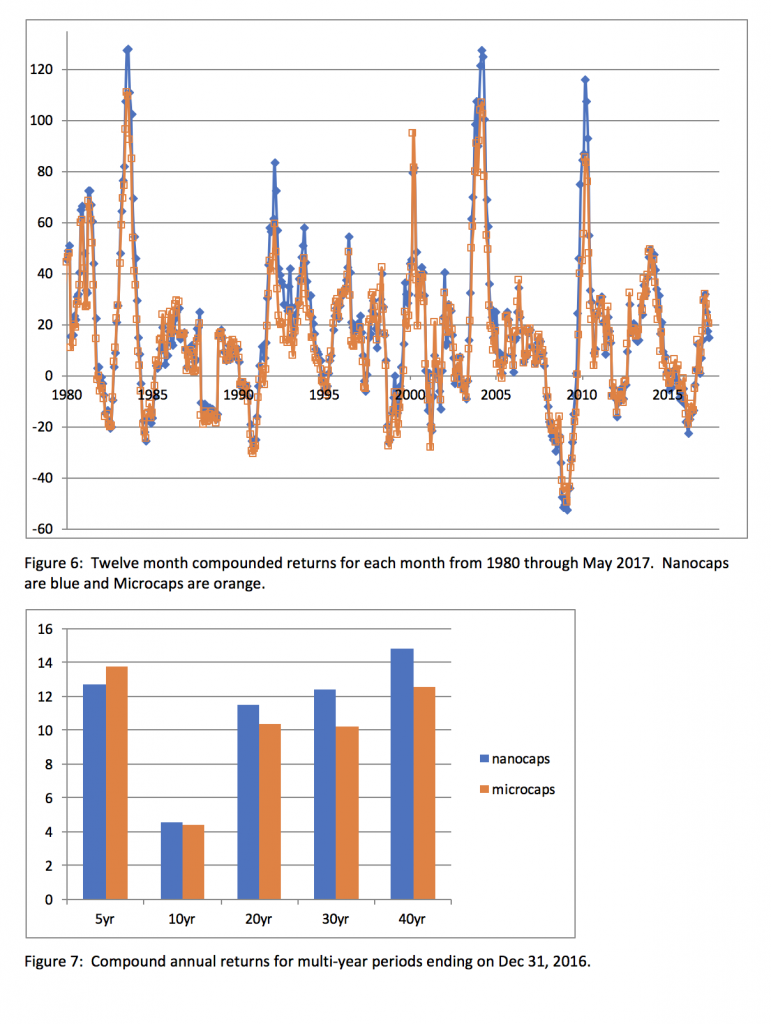](https://microcapclub.com/content/images/wordpress/2017/08/Pic-8.png)The January effect is well-known; smaller caps tend to outperform larger caps significantly in the first month of the year. Does the data confirm that microcaps outperform large caps in January? Has that trend continued into modern times? Yes is the answer to both of these questions. Microcaps outperformed large caps in 72 of the 90 years from 1927 through 2016\. The average return for microcaps was 6.2% higher than large caps (decile 10 equal weighted). The January effect for microcaps is much weaker in the last 30 years, however, averaging just 2.8%. This year (2017), microcaps underperformed large caps by 2.4% in January.
Nanocaps (1st decile equal weighted) have outperformed microcaps (1st decile market cap weighted) in the month of January every year since 1927, the only two exceptions being 1952 and 1955\. The average outperformance is 2.8%. In the last 30 years ended 2016, the nanocap performance advantage has been a little higher, averaging 3.2% in the month of January. Note in figure 7 that the performance advantage of nanocaps over microcaps the last 30 years has only been about 2.2% for the whole year, so nanocaps have outperformed in January and underperformed for the remainder of the year. In January 2017, nanocaps outperformed microcaps by 3.1%, but through May have given back all the advantage.
Figure 8 shows the compounded annual returns for the 10 deciles in recent years. The smallest decile has a long history of outperforming all others by a wide margin dating back to 1927\. They have outperformed in the last 20, 30, and 40 year periods ended Dec 2016 as well. Recently, however, the returns have been relatively poor. Decile 1 has the worst returns in the last 5 year and 10 year periods. This year (2017) through May is no better; the nanocaps have returned 0.9% vs 9.0% for the largest decile. There’s almost no difference between the nanocaps and microcaps in 2017, and the general trend across the deciles this year is that bigger is better. If you’re a microcap investor and it seems like it’s been tough to make money lately you’re not alone. In light of the discussion on microcaps strongly mean-reverting, this should be encouraging. However, we’ve seen that microcaps can just drift around underperforming for years before running like crazy. The hope is that knowing they behave this way will inspire patience.
[](https://microcapclub.com/content/images/wordpress/2017/08/Pic-9.png)
A summary of the findings in this historical study follows:
1. Microcap returns historically have been “wild” with periods of incredible returns sometimes followed by very bad years or years of low returns. The returns are less wild lately, but are still violent (107% in 2003, -50.7% in 2008, 84.4% in 2009, 49.2% in 2013).
2. Returns on microcaps have been strongly mean-reverting historically. A period of high 5 year returns is generally followed by poor subsequent 5 year returns.
3. Microcap returns are often differentiated a great deal from large cap returns. Since the financial crisis they’ve been more closely correlated however.
4. Nanocap returns are much higher historically than microcap returns. Nanocaps appear to run higher when the little ones run up but don’t fall more when they come down. This outperformance has persisted into modern times but the magnitude is not as high as the historical numbers.
5. In the last decade the microcaps and nanocaps have performed about the same. This performance is significantly worse than all the other market cap deciles. Nanocaps have underperformed microcaps in the last five years.
6. Microcaps outperform large caps in January of most years. The average magnitude back to 1927 is much larger than in the last 30 years, however. Nanocaps reliably outperform microcaps in January and have continued to in recent years.
So what’s the outlook for microcaps? The Center for Research on Stock Prices doesn’t have any data on the future, so I’m left to speculate. I think microcaps will likely continue to outperform in the long run because they usually trade at a liquidity discount. I speculate that they eventually realize the higher valuations of their larger brethren either by growing to a larger size or getting bought out, hence their higher returns. The current love of indexing and indexed ETF’s in particular reminds me of the love of S&P 500 index funds in the late 1990’s. The big stocks had outperformed in the 1990’s. Investors really just buy what’s done well recently so index funds were all the rage. Microcaps today are underperforming similarly to the mid to late 1990’s. My guess is they’ll continue to underperform until the big stocks get hit. Then the microcaps will outperform and, when fear subsides, go on a run that makes up for all the underperformance and then some.
Are Nanocaps the ticket to wealth? Nanocap outperformance over microcaps has disappeared in the last decade. This isn’t new as there wasn’t much excess return for the nanocaps in the 1950’s either. Nanocap outperformance came back in the late 60’s and 70’s and then disappeared again in the weakly performing 1980’s. It returned again in the 1990’s and 2000’s and this was after spreads and trading costs were reduced. I suspect the big return numbers in the past for nanocaps partly reflected historical trading costs, but partly an illiquidity discount as well. The illiquidity discount remains. The recent underperformance may reflect that discount widening as investors sell individual stocks and buy ETF’s. It would be no surprise if that discount continues to widen for a while longer, but financial value wins in the end. Eventually the nanocap stocks will realize higher multiples facilitated by growth, buyouts, or another microcap run. When that next microcap run comes, the nanocaps will run too, but higher.
An enterprising investor can build wealth for themselves investing in nanocaps. The high average return is the wind at your back, but the wind comes and goes and sometimes blows in the wrong direction. To build wealth steadily, an investor must make at least some return even when there is no breeze. Fortunately, the nanocaps lie in the least efficiently priced subsector of the least efficiently priced decile. Pick some stocks.
*By Mark Vonderwell, Edited by Cara Vonderwell*
**\===> Interact and learn with 250+ of the best microcap investors on the planet. [\[Join Us\]](https://microcapclub.com/join-now/)**
MicroCapClub is an exclusive forum for experienced microcap investors focused on microcap companies (sub $500m market cap) trading on United States, Canadian, European, and Australian markets. MicroCapClub was created to be a platform for experienced microcap investors to share and discuss stock ideas. Since 2011, our members have profiled 1000+ microcap companies. Investors can join our community by applying to become a member or subscribing to gain instant view only access. MicroCapClub’s mission is to foster the highest quality microcap investor Community, produce Educational content for investors, and promote better Leadership in the microcap arena. For more information, visit [http://microcapclub.com](https://microcapclub.com/) and
### Investing in the Misunderstood
URL: https://microcapclub.com/investing-in-the-misunderstood/
Last updated: 2023-10-14T11:45:10.000Z
A full-time private microcap investor recently commented on our forum:
> I’m quite curious how you all account and measure the relative performance of variables that can be quantified like earnings, balance sheet etc, vs intangibles like quality of management, appointments to the board etc. On balance, I put more weight on things that can’t be objectively measured.
The comment forced me to introspect a bit. First, I’d like to make a topical observation. The current market environment can play a role, at least initially, on how much qualitative you need to apply to your investing. In really good markets it’s all but impossible to find great companies trading at cheap TTM fundamentals so you have to look deeper into the qualitative. In bad markets, known great businesses can trade very cheap so you don’t really have to think that deeply into the qualitative.
Drilling down further, I’m reminded of [Paul Lountzis’s](https://microcapclub.com/2016/10/paul-lountzis-differential-insights/) top four reasons investors don’t conduct qualitative analysis:
1. **Investors don’t concentrate enough to make it worthwhile**
2. **Investors don’t hold stocks long enough to make it worthwhile**
3. It’s hard
4. It’s expensive (in person meetings, travel, etc)
An investor’s time frame (months vs years) and individual position sizing (small vs big as a % of overall portfolio) likely play a significant role in how much an investor is going to dig below the quantitative surface. If you are going to sell a company because they earned $0.01 EPS less this quarter or next quarter, then you aren’t really going to be diving into the long term sustainable qualitative factors of the business as much as someone that is truly making three to five-year investment decisions.
If your goal is to achieve maximum capital gains, then your intention with every purchase should be to hold for years. If you are going to hold for years, you need to put in the work to understand the qualitative.
For my investment style, it’s the quantitative and qualitative factors that initially attract me to the company. I need to see a fundamental reason and quality reason to be interested in an investment. Shortly after making an initial investment, the focus shifts significantly to the qualitative factors because it’s the only way to build conviction for the long-term. What makes the business special and why will it continue to be special? This is what qualitative elements answer.
If it were mostly the quantitative factors, I would never be able to hold onto something long enough to capture the big gains. What do I mean by this? If your aim to is hold a great business for a long time, you are going to have to get used to holding a business that isn’t always “cheap”. This is excruciatingly hard for many value investors who only believe cheap = value. I don’t like to use the word cheap to define value, I would rather use the word misunderstood = value.
In general, I’m looking for businesses, management teams, and opportunities that are misunderstood by the market place. Perhaps it’s the business quality that is misunderstood. Perhaps it’s the quality level of management that is misunderstood. Perhaps it’s the culture, strategy, or intellectual property. It could even be perceived negative events that have occurred, and shareholders are selling, and they are wrong. A majority of investors are focusing on the wrong thing(s). Whatever it may be, misunderstood, represents a big opportunity for investors that are willing to put in the work to piece together reality.
Misunderstood attributes often show up in the qualitative insights you uncover. They are like little colored tiles you find when researching a company. Sometimes the individual tiles mean nothing and sometimes they form a beautiful mosaic. The latter can be so exhilarating, and I’m sure many of you have had it occur at least once. You had differential insights that were spurred on by your past experiences that allowed you to see what others didn’t.
The more experience you gain the quicker you get at recognizing when you don’t need to evaluate a company. We are all impressed by our filters and how in 30 seconds an astute investor can scan an annual report and know whether the business is worthy of further diligence. We all have these pre-conceived “deal killers” built into our System 1 processes (see [Thinking Fast and Slow](https://www.amazon.com/Thinking-Fast-Slow-Daniel-Kahneman/dp/0374533555?ref=microcapclub.com)).
Insiders own <10% of company = Bad
Insider Selling = Bad
Above Average Management Salaries = Bad
Gross Margins <50% = Bad
Revenue Growth <20% = Bad
Debt = Bad
Bad
Bad
Bad
I look at hundreds of ideas per year, and others like [Brent Beshore](https://www.adventur.es/compounding-knowledge-and-returns-2016-year-in-review?ref=microcapclub.com) look at thousands of ideas per year. Our past experience affords us the ability to make quick and fast judgements, but it’s also these System 1 decisions that can shield us from misunderstood situations.
Let me give you an example:
> Six years ago, I was researching a company that had many great characteristics. All but one thing, which coincidentally was the one thing that scared off many others. The CEO sold stock every month, $5,000-$6,000 per month, out of a $3 million position size. It was annoying to see this every month. I know because it annoyed me. When I met with the CEO in person, after having a couple calls, I had to ask him about it.
>
> He told me that his father had health issues throughout his life that limited his abilities and output during his working years. He said that his father was a great person, “One of those people that should have gotten more out of life than he did”. His father didn’t have a lot of money. He was receiving assistance from the government but didn’t have anything left over after paying bills.
>
> The CEO (son) and his wife made the decision they would honor his father by giving him some extra cash every month, so he could enjoy the sunset of his life. The CEO himself was getting paid $220,000 and had two teenage boys and stay at home wife, so he didn’t have a lot of disposable income and was all in on the company.
>
> And this is the part I remember most because it was a great line. The CEO said, “If the choice is between me being slightly wealthier in the future or honoring my father today, I’ll choose the latter.”
The CEO told me he received a lot of complaints from investors about insider selling, but few asked him why. Most investors saw the insider selling, made a quick judgement that he was just another greedy, self-indulgent public CEO, and passed. Few dug deeper to find the truth.
I’m embarrassed to say I never did buy the stock, and it’s up 1,400% since then. It’s amazing how a great business can cure a lot of ills or even overcome a few misperceived negatives, especially misunderstood ones.
I’m interested in finding businesses, management teams, and opportunities that are misunderstood by the market place. The quantitative is what might attract you to invest but it’s the qualitative that will keep you invested. Dig below the surface to truly understand the businesses you own and the people that run them. Don’t let your past experiences and fast System 1 thinking blind you to misunderstood situations. Dig deeper. Seek truth.
**\===> Interact and learn with 250+ of the best microcap investors on the planet.** [\[Join Us\]](https://microcapclub.com/join-now/)
MicroCapClub is an exclusive forum for experienced microcap investors focused on microcap companies (sub $500m market cap) trading on United States, Canadian, European, and Australian markets. MicroCapClub was created to be a platform for experienced microcap investors to share and discuss stock ideas. Since 2011, our members have profiled 1000+ microcap companies. Investors can join our community by applying to become a member or subscribing to gain instant view only access. MicroCapClub’s mission is to foster the highest quality microcap investor Community, produce Educational content for investors, and promote better Leadership in the microcap arena. For more information, visit [http://microcapclub.com](http://microcapclub.com/) and
### Concentrating on a Few Companies is a Great Way to Learn Investing
URL: https://microcapclub.com/concentrating-companies-great-way-learn-investing/
Last updated: 2023-10-14T16:42:20.000Z
The financial world preaches diversification because it’s safe and comfortable, but often times to learn and excel you need to be uncomfortable. The point I’m making isn’t that concentrating is better than diversifying as an investment strategy. Investors can succeed utilizing any strategy. But I do believe that concentrating is a great way to learn investing. When you concentrate on a few positions your successes and mistakes are amplified, and you learn the hard lessons faster. The real educator in investing is making and losing real money. 95% of successful investing is controlling your emotions when your own money is on the line
When I was in college I took a course on “Early American Literature”, and the class focused on literature written pre-1900\. The teacher was an energetic, opinionated, and intimidating African-American woman. I remember one day we were preparing to read a book on the slave trade and specifically the “Middle Passage” where at least 2 million African Americans were taken from West Africa and shipped across the Atlantic Ocean. These slave ships were overcrowded, and the conditions were inhuman. It is said that roughly 40-50% of slaves actually made it alive to their final destination in the United States or elsewhere.
In preparation for reading two books on the Middle Passage, she taped off a rectangular area 6 feet by 12 feet in the front of the classroom. She then had all of us, 40-50 students, stand in this area. She maneuvered us into position. We couldn’t move because we were so cramped together. She then told several students to do things such as:
> “Mike, I want you to start coughing because your sick \[playing sick\]. And don’t turn your head because you can’t. Cough into the person in front of you. Amanda, you have a stomach illness and you are vomiting on people all around you \[making heaving noises\]. Brad, you are going to go to the bathroom right where you stand. John, you have two others leaning on you because they are so weak, and you too are about to fall to the ground under their weight.”
The teacher did this for a few more minutes setting the stage.
> She then said, “It’s also 110 degrees and everyone is sweating. Can’t you smell the odors? See the pain? Hear the cries and moans? Can you think of an environment much worse than this? Probably not. We are faking this scene in an air-conditioned classroom for only a few minutes. When you read these books I want you to imagine being on one of those ships for weeks.”
We all breathed a sigh of relief when we sat down, but the exercise made its impression. It was uncomfortable. It was in your face. It was violent. There was no escaping it. When we read the two books on the Middle Passage we probably absorbed five times the amount of information because of that exercise. I can still remember to this day standing in the front of that room cramped together not being able to move.
Financial pundits don’t like volatility. They don’t like uncomfortable. They don’t like deviating from the status quo. They like S&P 500 ETFs. They would rather preach diversification and teach you how to apply every backward looking financial metric, ratio, etc they can find on a stock in hopes of paralyzing you into never buying anything but an ETF \[sarcasm, sort of\]. It’s hard for many to embrace the fact that concentrating on a few stocks is a far better educator than trying to learn everything about every stock.
When I started out as an investor and aspiring to be a stock picker, I only had a small amount of capital. What’s the point of investing a small amount of capital across a plethora of companies? Not much. When you are learning how to pick stocks, holding a few positions is adequate so you can truly focus on the nuances of those businesses.
When you are concentrated in a few positions, the education of doing so can be violent and uncomfortable. The monetary ramifications of your decisions are amplified. Your emotions are amplified. But this also allows you to absorb and learn the hard lessons faster.
> “Extreme outcomes — good or bad — often educate best.”
>
> – Charlie Munger
You won’t find many people preaching concentrating on a few stocks as a superior form of learning investing. Because no one wants to endorse anything that is uncomfortable or that could hurt someone. But it’s those violent lessons that teach you the most. The irony of it all is that most wealthy people that preach and teach diversification today built their wealth by concentrating heavily on a few ideas early in their life.
Other posts you would enjoy:
[Think Different and Better](https://microcapclub.com/2017/05/think-different-better/)
[Investing Mastery Through Deliberate Practice](https://microcapclub.com/2017/02/investing-mastery-deliberate-practice/)
**\===> Interact and learn with 250+ of the best microcap investors on the planet.** [\[Join Us\]](https://microcapclub.com/join-now/)
MicroCapClub is an exclusive forum for experienced microcap investors focused on microcap companies (sub $500m market cap) trading on United States, Canadian, European, and Australian markets. MicroCapClub was created to be a platform for experienced microcap investors to share and discuss stock ideas. Since 2011, our members have profiled 1000+ microcap companies. Investors can join our community by applying to become a member or subscribing to gain instant view only access. MicroCapClub’s mission is to foster the highest quality microcap investor Community, produce Educational content for investors, and promote better Leadership in the microcap arena. For more information, visit [http://microcapclub.com](http://microcapclub.com/) and
### Ten Valuable Insights on Structuring Your Fund by Robert Vinall
URL: https://microcapclub.com/ten-valuable-insights-structuring-fund-robert-vinall/
Last updated: 2023-10-14T16:44:39.000Z
Even though I don’t manage other peoples money, I’m certain the hardest part isn’t finding the right investments, it’s finding the right investors. From time to time I get asked questions from aspiring or emerging fund managers. I normally point them to other managers (sometimes literally and sometimes to their investor letters) that I think have high integrity that also have a track record of success. One of those individuals is Robert Vinall.
Robert Vinall of RV Capital manages his Business Owner TGV Hedge Fund registered in Germany. Admittedly, I’ve always been a bit biased towards Robert Vinall because our investment philosophies are quite similar. He operates a long-term oriented concentrated strategy with the three largest positions making up 50% of his fund. Vinall sums up his investment philosophy, *“The name – Business Owner – reflects the philosophy of investing like an owner in businesses run by an engaged and rational owner with the capital of investors who think like an owner.”* I would recommend investors sign up to his website where you can then access his letters and commentary at [http://www.rvcapital.ch](http://www.rvcapital.ch/?ref=microcapclub.com)
Earlier this year Robert held his RV Capital Emerging Manager Day where investors and stakeholders come in to share ideas, thoughts, and ask questions. In the video above, Vinall gives ten valuable insights to emerging managers on what to think about when starting their fund. I’ve listed the ten insights below. You can also watch other segments from the event on [ValueWalk](http://www.valuewalk.com/2017/03/rv-capital-investor-day-emerging-manager-day-2017-videos/?ref=microcapclub.com).
1. **Get the structure of your business right on Day 1\. On Day 2 it’s too late**. The structure of the fund has to fit the strategy. If you are a stock picker, you have to have a fund structure that allows you to pick stocks.
1. **Don’t waste time marketing**. Focus on generating a great track record, and the right people will find you.
1. **Keep costs ultra-low.** Too many young managers get a fancy office, hire an analyst, etc. It’s hard to be patient when you have an enormous amount of fixed expenses.
1. **Avoid giving a large percentage of their GP to a promoter to attract capital.** It creates a bad incentive system. Vinall was very influenced by David Swenson (Yale Endowment Fund), and if Swenson sees a bad fund ownership structure, he avoids investing.
1. **Communicate as openly and as transparently as possible with your investors**. Vinall says that the idea of being open and communicative wasn’t normal when he started in 2006\. He is communicative for three reasons: First, there is obviously a financial component with investors where they want a good return, but they also want a good emotional experience (feel relaxed and assured). The only way to give the latter is to consistently and openly explain to investors what you are doing and why. Second, being open and communicative about your positions helps provide transparency with your performance (no “black box”). Third, in the internet age, sharing your investor letters and thoughts helps expand your network of likeminded investors, which is a real asset.
1. **You want to get your investors to self-select**. If you lay out your philosophy in a transparent way, you attract the right people. When you are doing things the right way and you are attracting the right investors, they tell their friends which normally have similar expectations and time horizons. “It’s an amazing flywheel effect.”
1. **You have to say No to the wrong type of investor**. If you are long-term, don’t accept short-term capital.
1. **Seek responsibility**. If you want to be your own boss and make the decisions then embrace the responsibility and authority as the decision maker.
1. **You need to think of your fund as a business**. Analyze your own fund like you would a business you invest in. You want to create a moat around your business. You want to find a structure and investors that allow you to invest for the long-term. This is your moat.
1. **Seek great partners (partners = investors)**. It’s amazing how great partners can really help you. When you are doing things the right way they provide encouragement and they also challenge you. When you’re challenged you often find areas that you can do better.
In Part 2, Robert lets his partners (i.e. investors) such as a couple family offices, Global Endowment Management, MIT Endowment, etc answer some questions.
**\===> Interact and learn with 250+ of the best microcap investors on the planet.** [\[Join Us\]](https://microcapclub.com/join-now/)
MicroCapClub is an exclusive forum for experienced microcap investors focused on microcap companies (sub $500m market cap) trading on United States, Canadian, European, and Australian markets. MicroCapClub was created to be a platform for experienced microcap investors to share and discuss stock ideas. Since 2011, our members have profiled 1000+ microcap companies. Investors can join our community by applying to become a member or subscribing to gain instant view only access. MicroCapClub’s mission is to foster the highest quality microcap investor Community, produce Educational content for investors, and promote better Leadership in the microcap arena. For more information, visit [http://microcapclub.com](http://microcapclub.com/) and
### Differentiating Business Performance from Stock Performance
URL: https://microcapclub.com/differentiating-business-performance-stock-performance/
Last updated: 2023-10-14T16:45:42.000Z
> “If I’d had the slightest idea of what lay ahead of me when I joined up with Chrysler, I wouldn’t have gone over there for all the money in the world. It’s a good thing God doesn’t let you look at a year or two into the future, or you might be sorely tempted to shoot yourself. But He’s a charitable Lord: He only lets you see one day at a time. When times get tough, there’s no choice except to take a deep breath, carry on, and do the best you can.” – **Lee Iacocca**
Wouldn’t it be great to have the ability to see into the future? This ability would most certainly provide instant success. It sure would save us a lot of pain and frustration. You would never have to face any of life’s challenges. You would always choose the least restrictive path to success. But would escaping life’s obstacles really be living? No, it probably wouldn’t. Like Iacocca said above, it’s good we have a charitable Lord, that doesn’t let us see the future. It forces us to work our hardest today, in hopes that tomorrow will be better.
If you’ve read other articles I’ve written you know I like to ask thought provoking questions. Sometimes the questions are meant to [test the quality of a business](https://microcapclub.com/2017/02/what-matters-most/), and sometimes it’s just meant for [preparation](https://microcapclub.com/2017/04/are-you-prepared/). Let me ask you another question. It’s a question that is a great one to ask at some nerdy stock value investing dinner or cocktail reception.
**If you knew a stock you owned today wasn’t going to go up for the next 12 months, would you still own it today?**
For many investors or traders this might seem like a completely asinine question. Why would anyone choose to hold something they knew wouldn’t go up for 12-months? The answer is because the long-term reward is worth the short-term pain and frustration.
In, [The Art of Holding](https://microcapclub.com/2017/01/the-art-of-holding/), I mentioned that great long-term investors can disconnect emotion from investment decisions and can differentiate business performance from stock performance. The ability to differentiate or disconnect business performance from stock performance is extremely difficult because it’s our human nature to focus on the thing that is moving. We anchor ourselves to stock prices instead of the business.
In late 2001, Neogen (NEOG) was a $100 million market cap microcap company. From 2001 to 2007, the company grew revenues from $35 million to $86 million and earnings from $3 million to $9 million. Even though the fundamentals of the business were strong, the stock was extremely volatile. The stock price had three drawdowns of close to 50% over this time period. [No Pain No Gain](https://microcapclub.com/2016/02/no-pain-no-gain/). And it would take six years for the stock to make a sustainable move higher. Only if you were focused on the business and believed in the [intelligent fanatic](https://intelligentfanatics.com/?ref=microcapclub.com) vision of the co-founder James Herbert, who founded the company in 1981 by way of a $50,000 investment from Michigan State University, would you have made it through this period.
[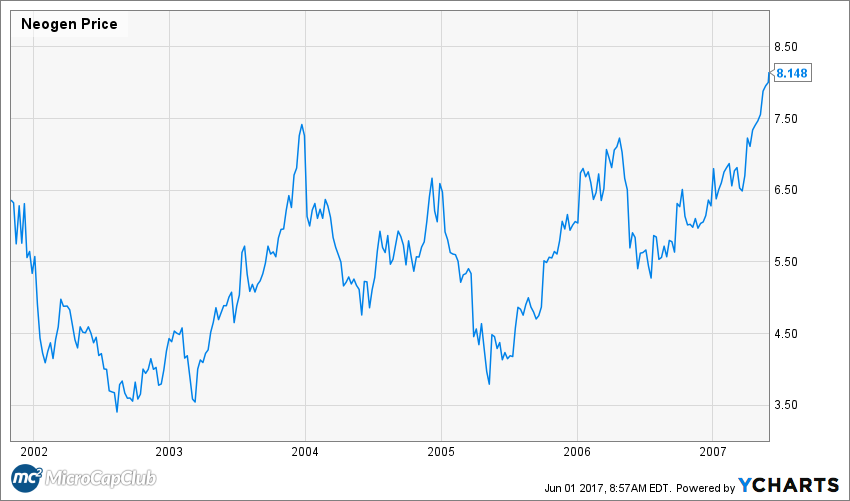](https://microcapclub.com/content/images/wordpress/2017/06/NEOG%5Fchart.png)
Today, Neogen is a $2.4 billion market cap company. Its shares have appreciated 25x since 2001 (24% CAGR), and 100x since 1990 (19% CAGR). The cool thing is it’s still a relatively small company by public company standards.
[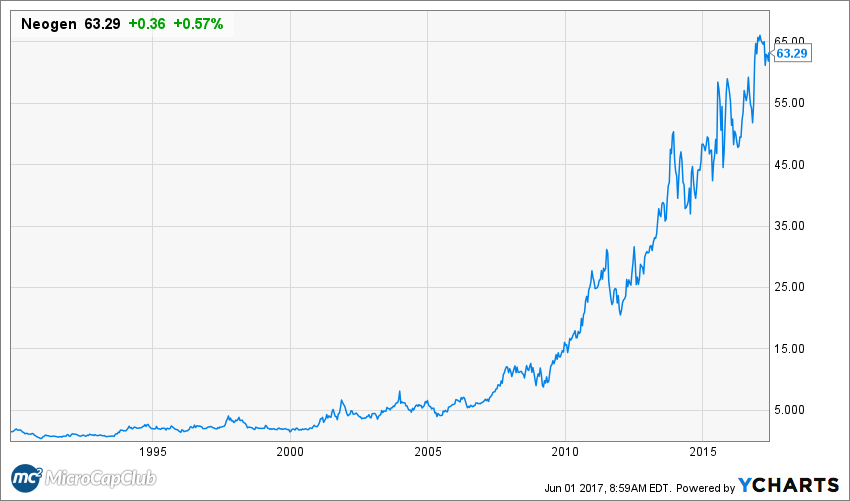](https://microcapclub.com/content/images/wordpress/2017/06/NEOG%5Fchart-copy.png)
There are hundreds of other public companies which had similar multi-year periods where stock performance didn’t align with business performance. Most multi-baggers will have long periods of stagnation as fundamentals backfill, old shareholders get bored, and new shareholders enter. Naysayers to stock picking will say it would have been impossible to hold Neogen or one of these other companies through a multi-year period of ill performance and volatility. I think it would be impossible too if you focus on the wrong thing….the stock price. It is achievable if you focus on the business.
During periods of stock price consolidation and volatility an investor is forced to dig deep, form conviction, and really understand the business. If the business continues to perform, this conviction will come in handy when the stock ultimately ascends. Many financial professionals love to point to “luck” or “naivety” on how someone could actually hold something that goes up 5-10-20-50x or more. It’s easier for them to rationalize that someone was just lucky or too dumb to know any better to sell earlier. Yes, there are certainly those that fall into this camp, but there is an equal or greater portion of successful investors that hold on because they know what they own.
**If you knew a stock you owned today wasn’t going to go up for the next 12 months, would you still own it today?**
The correct answer: If it’s still a great business that is growing and the story hasn’t changed… Absolutely. I’m willing to wait for my pot of gold.
> “I don’t want to spend my time trying to earn a lot of little profits. I want very, very big profits that I’m ready to wait for.” – Phil Fisher
**\===> Interact and learn with 250+ of the best microcap investors on the planet.** [\[Join Us\]](https://microcapclub.com/join-now/)
MicroCapClub is an exclusive forum for experienced microcap investors focused on microcap companies (sub $500m market cap) trading on United States, Canadian, European, and Australian markets. MicroCapClub was created to be a platform for experienced microcap investors to share and discuss stock ideas. Since 2011, our members have profiled 1000+ microcap companies. Investors can join our community by applying to become a member or subscribing to gain instant view only access. MicroCapClub’s mission is to foster the highest quality microcap investor Community, produce Educational content for investors, and promote better Leadership in the microcap arena. For more information, visit [http://microcapclub.com](http://microcapclub.com/) and
### Don't Compare Yourself To Others
URL: https://microcapclub.com/dont-compare-others/
Last updated: 2023-10-14T16:46:39.000Z
> “To be a disciplined investor you have to be willing to stand by and watch other people make money on things that you passed on” – Howard Marks
This Howard Marks quote is brilliant because it strikes a chord in each one of us. We’ve all been there. Maybe you are there today, watching someone else do well in something you passed on. It all relates back to comparisons, and comparisons are unproductive and corrosive. [We all invest differently](https://microcapclub.com/2017/05/think-different-better/). Don’t compare yourself to others. You aren’t running their race. Compare yourself to yourself two years ago.
Extraordinary returns follow extraordinary discipline. An investor’s goal should always be to make as few investment decisions as possible. This means you are going to pass on many investments that will ultimately do well without you. Experienced investors should openly accept this. Why? Because doing well in something you shouldn’t have invested in doesn’t teach you anything. It means you got lucky.
As you mature as investor it’s important NOT to compare yourself to other investors and their performance. If you are a contrarian investor, which many of us claim to be, you also can’t worry about other people’s opinion of you. If you worry about what people think of you it’s because you have more confidence in other people’s opinion of you than you do in your own.
I was going to write a bit more on this topic but realized Howard Marks already did an amazing job with it in his most recent talk [The Truth About Investing](https://www.youtube.com/watch?v=LtogMv--d4g&feature=youtu.be&ref=microcapclub.com). Here is a snippet below:
To be a successful investor you have to have a philosophy and a process you believe in and you can stick to even when the times get tough. This is very important. If you don’t have a courage of your convictions and patience and toughness, you can’t be an investor. Because you’ll constantly be driven to fall in line with the consensus by buying at the top and selling at the bottom.
But, it’s important to note that no approach will allow you to profit from all kinds of opportunities or in all in environments. You have to be willing not to participate in everything that goes up. Only the things that fit your approach. Now, in ’99 in the tech boom Buffett did not buy technology. And in the first quarter of 2000, for any of you that were around, everybody said “That’s it for Buffett. He’s past his prime. He’s too old.”. 17 years ago he was only 70\. They said too old. You know? But the point is “I don’t do tech. I don’t understand it. And it’s not for me. I’m going to sit it out.” The truth is, however, one of the most corrosive of all the difficult human emotions is the feeling of having to sit by and watch other people make money. Nobody likes that. And so, what happens is a process I call capitulation.
You know? You don’t like it at 60\. You don’t like it at 80\. You don’t like it at 100\. But when it hits 150 you say “Okay. I’ll get onboard.” And, of course, that’s usually closer to the top than it was to the bottom. And to be a disciplined investor you have to be willing to stand by and watch while other people make money that you passed on. You don’t have to invest in everything. You don’t have to catch every trend. You should invest within yourself, in the things you know about and stick to it. And among other things success has … One of my sayings is “Success in not good for most people.” And we all know successful people. We all know people who have been successful that makes them think they are smart. It makes them think if they’re smart they must be able to do everything. And, of course, that’s a very dangerous thing. And now, that one success might have been because they were smart one specific field which they should stick to or it might be because they were lucky. Or some combination. But most people, when they are successful reach a dangerous conclusion about their own ability.
Every investment approach, even if skillfully applied, will run into environments for which it is ill suited. By and hold. Growth stocks. Value stocks. Small stocks. Large stocks. Foreign. Domestic. And that means that even the best of investors will have periods of poor performance. Nobody performs great all the time. Buffett was considered over with. Now, even if you are correct in identifying a divergence of popular opinion from eventual reality, that varying perception that I mentioned, it can take a long time for the price to converge with value and it can require something that acts as the catalyst. Underpriced does not mean “Going up tomorrow.”. Overpriced does not being “Going down tomorrow.”. And we, everybody has to know that. And in order to be able to stick with an approach or decision until it proves out, which can be a long time, investors have to be able to weather periods when the results are embarrassing. This can be very difficult.
**\===> Interact and learn with 250+ of the best microcap investors on the planet.** [\[Join Us\]](https://microcapclub.com/join-now/)
MicroCapClub is an exclusive forum for experienced microcap investors focused on microcap companies (sub $500m market cap) trading on United States, Canadian, European, and Australian markets. MicroCapClub was created to be a platform for experienced microcap investors to share and discuss stock ideas. Since 2011, our members have profiled 1000+ microcap companies. Investors can join our community by applying to become a member or subscribing to gain instant view only access. MicroCapClub’s mission is to foster the highest quality microcap investor Community, produce Educational content for investors, and promote better Leadership in the microcap arena. For more information, visit [http://microcapclub.com](http://microcapclub.com/) and
### Expectations
URL: https://microcapclub.com/expectations/
Last updated: 2023-10-14T16:48:05.000Z
How many of your successful investments have occurred on the timeline that you originally predicted? How many times do you ever remember saying, “Well that happened a lot quicker than I thought”? Not often enough, right. In reality, a majority of my successful investments took longer, in some cases a lot longer than I originally expected. This just proves that even with our winners, let alone our losers, our expectations are too high.
A big part of successful investing is spent navigating the gap between expectation and reality.
**\[Expectation\] <————————————-> \[Reality\]**
Developing the conviction to hold and forming realistic expectations go hand and hand. Often times it’s not reality, but it’s our unrealistic expectations that set us up for failure. In my last article, [Think Different and Better](https://microcapclub.com/2017/05/think-different-better/), I mentioned and linked to an excellent interview with Josh Tarasoff. An investor I follow [tweeted](https://twitter.com/June%5FStreet/status/859759108609757184?ref=microcapclub.com) a powerful snippet from the interview which I’ve posted below:
[](https://microcapclub.com/content/images/wordpress/2017/05/Tarasoff-Snippet.jpg)
True conviction can only be obtained by trusting your own research over that of others.When you put a lot of time into due diligence, scuttlebutt, and talking to management, it’s easy to find yourself in your own “personal echo chamber”. Positive thoughts are magnified. Negative thoughts are magnified.
Let’s explore this a bit further.
Finding something new to invest in is fun. Doesn’t it feel really good to buy a new company? It’s also why it’s incredibly hard to hold onto existing positions. The infatuation and rush of excitement you feel when you think you found a gem that was hidden in plain sight. The hours, days, weeks, of due diligence that ultimately confirm this initial belief. Your personal echo chamber is filled with over-confidence and high expectations for the future. How smart you are for finding this special little company. You might already be thinking about how to spend the embarrassment of riches that will soon be bestowed upon you.
[](https://microcapclub.com/content/images/wordpress/2017/05/Expectations-Chart.jpg)
We investors are such fickle creatures. Immediately after we are done buying a position, our enthusiasm starts to fade. We would have cursed the stock if it would have moved higher as we bought our position, but now that we are done buying, we curse it for not immediately moving higher. This universal human desire for immediate gratification is our greatest adversary.
If the stock doesn’t move higher 2-3 months after we purchase a position, we really start to question ourselves. The realization sets in that you aren’t going to get rich tomorrow. Even though you did due diligence into the business and everything is fine your expectations remain anchored to the stock price. The negative echo chamber starts up and your expectations drop through the floor.
What I’ve described above is what we all go through in various degrees. It’s amazing to me how even a long-term investor like myself can’t help but feel despondent when gains aren’t realized quicker than I thought. This leads to an interesting question.
**How many companies have you owned where you genuinely liked them more as time went on (years)?**
For me, very few. I would imagine many microcap investors would answer the same way. I think the reason for this is twofold.
**First, most microcaps are** [**story stocks**](https://microcapclub.com/2015/08/beware-of-story-stocks/) **and many microcap success stories are short lived fad stocks**. So, it’s almost impossible to like them more as time goes on because many won’t exist as time goes on. It took me a few years, early in my journey, to be able to resist the urge to go down quality chasing story stock and storybook returns. Most story stocks don’t have happy endings. Don’t invest in great stories. Invest in great businesses. Similarly, many microcap success stories, past and present, are or were fad stocks. They are one or two product companies that have caught some sort of consumer-commercial tidal wave but have a short shelf life. They grow very quickly while on the tidal wave until the wave hits the shore. It’s hard to find a quality business with staying power, a business that you can own and not rent. Focus on quality businesses.
**Second, investors typically underestimate how difficult it is to grow a small company into a larger company.** When you come up with your guesstimates, everything always looks good on paper. Quarter to quarter growth is always linear. Year to Year growth occurs like clock-work. Right? No. If you’ve ever run a business you know this isn’t the case. The truth is businesses are complex organisms. \[Note: I think you’ll enjoy this article, [Why do cities live forever and companies don’t?](https://intelligentfanatics.com/research/topic/cities-live-forever-companies-dont/?ref=microcapclub.com)\] With most businesses, to double revenues, you have to triple the employees. This isn’t easy. Managing customer relationships while growing isn’t easy. Managing cash while growing isn’t easy. Many founder led businesses reach a [breaking point around 25 employees](https://getlighthouse.com/blog/company-growth-everything-breaks-25-employees/?ref=microcapclub.com). The will power of the founder can only take it so far, and for the company to reach the next level they need to hire great people to support their growth. Culture (or lack thereof) also becomes engrained at this early stage. Growing a company is difficult, let alone a public company. I’ve found it’s always those that have never run a business before that are adamant they can run someone else’s business better. All growing businesses suffer growing pains. As investors make sure you have realistic expectations for growth and profitability.
On many occasions, it’s management themselves that try to set expectations by issuing guidance or worse yet telling you things in private meetings that they shouldn’t. This is a big red flag, and [guidance is always a bad idea.](https://microcapclub.com/2015/10/dont-give-guidance/) All guidance does is reinforce short-term thinking. It’s not management’s job to set expectations. It’s management’s job to execute.
The best way to combat high short-term expectations is making reasonable long-term expectations. I like to use three or five year estimates and gauge quarterly and annual business execution against these estimates or expectations. One thing I always keep in mind is all businesses, even great ones, have a quarter or two where they stub their toe, or suffer growing pains. You need to know your positions better than most to be able to judge a temporary setback (hold) from a permanent change to the investment thesis (sell).
The key to successful investing is finding and buying great businesses early and holding on with a death grip. In life and investing, our disappointments often lie in our assumptions. When we have the wrong assumptions, we have the wrong expectations, and we get disappointed with the company. If we aren’t grounded in reality, or are anchored to the stock price, our personal echo chamber can manipulate us into selling a great business. A big part of successful investing is spent navigating the gap between expectation and reality. The hardest part is deciding whether to fill that gap with trust.
**\===> Interact and learn with 250+ of the best microcap investors on the planet.** [\[Join Us\]](https://microcapclub.com/join-now/)
MicroCapClub is an exclusive forum for experienced microcap investors focused on microcap companies (sub $500m market cap) trading on United States, Canadian, European, and Australian markets. MicroCapClub was created to be a platform for experienced microcap investors to share and discuss stock ideas. Since 2011, our members have profiled 1000+ microcap companies. Investors can join our community by applying to become a member or subscribing to gain instant view only access. MicroCapClub’s mission is to foster the highest quality microcap investor Community, produce Educational content for investors, and promote better Leadership in the microcap arena. For more information, visit [http://microcapclub.com](http://microcapclub.com/) and
### Think Different and Better
URL: https://microcapclub.com/think-different-better/
Last updated: 2023-10-14T16:49:17.000Z
Buffett does it his way while Schloss did it another way. Ichan does it his way while Lynch does it another way. Tepper does it his way while Andreessen does it another. Some are long-term. Some are short-term. Some are value. Some are growth. Some are activist. Some bet on change. Some bet on things that won’t change. The greatest investors ever have opposing strategies. Within the world of “value investing” alone, there are hundreds of successful iterations. If every value investor was investing the exact same way, it would be the most crowded trade around.
It’s fascinating to me how two value investors can look at the same company and have two completely different opinions. I was at a conference recently and ran into another full-time investor whom I always love engaging with because he is successful and has the complete opposite strategy as me. When I met him for the first time, I asked him what he looks for in an investment. He said he actually looks for really bad management teams. And I said, “To short?”, and he replied, “No no, to go long. I don’t short stocks”. He went on to describe his very diversified strategy (30+ companies) of betting on bad management teams. He generally looks for good businesses that are run by idiots. It sounds insane to me, but you know what, he’s been a full-time private investor for 10-years with an incredible track record.
Sanjay Bakshi and the CFA Society of India recently hosted Howard Marks in Mumbai where he gave a brilliant presentation entitled The Truth About Investing. You can view the [video presentation](https://youtu.be/LtogMv--d4g?ref=microcapclub.com) and [slides](https://www.cfasociety.org/india/Newsletters/Howard%20Marks%5FThe%20Truth%20about%20Investing.pdf?ref=microcapclub.com), and I also had it [transcribed](https://microcapclub.com/content/images/wordpress/2017/05/Howard-Marks-CFA-Society-India-2017-Transcript.pdf) to make it easier to take notes. At 20:35 minute mark of the presentation he talks about second-level thinking and shows this slide:
[](https://microcapclub.com/content/images/wordpress/2017/05/Marks-Slide-Presentation.png)To paraphrase, if you think the same as everybody else, you’ll act the same. If you act the same as everybody else, you’ll perform the same. The key to outperformance is to think different and better. You have to do both. Reid Hoffman said it perfectly \[[source](https://intelligentfanatics.com/research/topic/reid-hoffman-great-founder/?ref=microcapclub.com)\], “It’s easy to be contrarian. It’s hard to be contrarian and right.” I believe a big part of successful investing is the development of second-level thinking within your own strategy. Farnam Street wrote a great piece on second-level thinking \[[here](https://www.farnamstreetblog.com/2016/04/second-level-thinking/?ref=microcapclub.com)\].
For me, I’m mainly looking for high quality businesses that can reinvest internally generated cash flows at high rates of return ie compounders. I want to find the small snowballs (microcaps) that are rolling downhill where eventually their size, velocity, and quality will attract institutions. Often times these companies are misunderstood when they are small. And sometimes they are misunderstood for their entire lives like Amazon.
Josh Tarasoff, General Partner of Greenlea Lane Capital Partners LP, has my vote for best interview of the year (H/T Chip Maloney), which you can read [\[here](https://www.ivey.uwo.ca/cmsmedia/3776019/tarasoff-bg-interview-2017.pdf?ref=microcapclub.com)\]. There are so many great nuggets in the relatively short interview, but I’m going to focus on his comments on compounders and thinking different. Here is a power packed paragraph:
> “We \[the financial industry\] have these rules of thumb that say 15x is a middling multiple, 10x is getting cheap, single-digit is really cheap, 20x is not cheap, and over 20x is really expensive. We have these rules of thumb for a good reason which is, on average, they are right. The market as a whole is an average of all businesses. If all of the companies in the market are homogeneous with respect to their future earnings growth and returns on capital, then you can apply these rules of thumb to every single company. But, in realty, companies are so ridiculously different from one another. What I’m looking for is the outliers in the 99.9 percentile of great companies, and what is cheap for those companies is so far from these rules of thumb. I invested in Amazon in 2011, and it was trading at 200x P/E, but actually the multiple of what I thought was normalized sustainable free cash flow is in the 30-40x range. And I thought that was cheap! That’s very different from what most value investors do. This might not be accepted by many people. I’ve had phone calls with prospective investors where I actually would explain the Amazon thesis and I would say “I think it was at 30-40x free cash flow when we bought it”, and the other guy was like “13-14?”. And then I said “no, no, 30-40”. And then it’d be a weird pause, and I knew that the conversation was over. There’s a lesson in that we are getting back to one of the things I said about the advantage of not telling your investment strategy to something that you can sell to other people. I think that most people, whether they admit or not, or whether they know it consciously or not, are making compromises on what they do to make what they do salable. Whenever you do that, you’re trying to appeal to the lowest common denominator to the prospective investors, and by definition, you’re becoming a consensus investor. You can’t do that and expect to have good results. I think that there’s almost literally a direct conflict between salable as an investor and being good as an investor. That’s what it is.”
Tarasoff concludes later:
> “..the most exceptional compounders are by definition doing something idiosyncratic and weird, and people are fundamentally not super comfortable with that; …they usually look statistically not cheap.”
A couple years ago, I started a thread on our MicroCapClub forum \[members-subscribers can view [here](https://microcapclub.com/forums/index.php?/topic/383-free-online-tools-screening-transcripts-etc/&do=findComment&comment=29340)\] talking about idea generation and stock screening. Given my strategy, I’ve always felt stock screening to be rather useless in finding new ideas. I’ve found public/private forums, reading press releases and filings, word of mouth and even serendipity to be better idea generators. Everyone does screens nowadays and is looking at the same results. It’s very first-level thinking. But one of our members had a brilliant response which I’ve applied since.
> “You generally won’t find misunderstood business with revs growing double digits, no debt, +20% roic’s, insider purchases, etc.; and a misunderstood business is the one I want to own. One thing that screeners are good for is screening for those excellent traits I mentioned earlier and then going to the first 10 years of financial statements of that company and seeing where the growing pains were, when it was misunderstood, and when one should have gotten involved… I’d even rather screen for undesirable traits and find the needle in the haystack than look at the same list as so many others (filtering for good traits).”
History has taught us that great investors come from every niche of investing. The key to outperformance is to think different and better. First level thinking only tells you what the consensus already knows. You weren’t meant to be average, so stop thinking like everyone else. Don’t rely only on traditional thinking and traditional metrics. This doesn’t mean to rush out and buy a bunch of expensive stocks. It means to dig deeper. Think deeper. Question everything. You can learn a lot about greatness when you analyze it when it was misunderstood.
**\===> Interact and learn with 250+ of the best microcap investors on the planet.** [\[Join Us\]](https://microcapclub.com/join-now/)
MicroCapClub is an exclusive forum for experienced microcap investors focused on microcap companies (sub $500m market cap) trading on United States, Canadian, European, and Australian markets. MicroCapClub was created to be a platform for experienced microcap investors to share and discuss stock ideas. Since 2011, our members have profiled 1000+ microcap companies. Investors can join our community by applying to become a member or subscribing to gain instant view only access. MicroCapClub’s mission is to foster the highest quality microcap investor Community, produce Educational content for investors, and promote better Leadership in the microcap arena. For more information, visit [http://microcapclub.com](http://microcapclub.com/) and
### Are You Prepared?
URL: https://microcapclub.com/are-you-prepared/
Last updated: 2023-10-14T16:50:20.000Z
In rising markets, it’s easy to nonchalantly talk about risk, patience, and the conviction necessary to hold through volatility. But you will eventually be tested. There will come a period of time when something you have high conviction in quickly drops 40-50-60% due to external forces. You will question your conviction, your strategy, your process. The market will find your pain point, and this will be your test. Few things test your conviction like falling stock prices.
Are you prepared?
A friend of mine manages several hundred million dollars in retirement assets, mostly in low fee indices – ETFs for high net worth families. He’s been a financial advisor for 25 years and rarely loses a client. He gets paid 1% a year with no performance fee. He has very close relationships with his clients (approx. \~80 families). I asked him how his clients viewed the 1% fee given the assault on “fees” by the financial media. He said his clients fully understand why they pay him 1% per year. It’s payment for holding their hands when times get rocky and to keep them from selling at the worst time. He gave me this illustration:
> “We’ve all been on flights that were on time, clear skies, no turbulence, with a smooth landing. The plane lands and the pilot and staff say “Thank You” as you exit the plane. Many of us have also been on a flights that were stressful. When it was raining and windy and the plane is being tossed around and your stomach feels like it’s up in your chest. When you come in for landing it feels like a ship in rough seas. Everyone is gripping their seats with white knuckles wondering…NO PRAYING.. that the pilot knows what he’s doing. At that very moment, you would probably pay $2,000 (4x the price of the ticket) to have the most experienced pilot at the helm. As the back tires of the plane hit the runway some stress leaves, and when the front tire hits you breathe a sigh of relief. The pilot is at the front of the aircraft as the passengers exit and almost everyone, with the sincerest appreciation looks into the pilot’s eyes and says “Thank You”. My clients pay me 1% per year because of my experience and they know I’ll bring them in safely.”
I share this story not to justify asset management fees but because I thought it was a great illustration of the importance of preparation and experience. As the seven-year bull market continues on, a greater and greater percentage of market participants (investors, financial advisors, etc) are entering that have never experienced a bear market. The worst part of bull markets is the increase of inexperienced people educating other inexperienced people.
In 2014, I wrote the most pivotal article in my investing journey, [The Conviction To Hold](https://microcapclub.com/2014/08/the-conviction-to-hold/). I say this for two primary reasons. First, Sanjay Bakshi reached out to me for the first time after reading it which started our fruitful friendship. Second, the reason I wrote the article at that time was as a microcap investor I felt very little attention and importance was being placed on holding. The inspiration for the article occurred when I was reflecting on a stock I had bought in 2007 but sold at a 60% loss near the bottom of the bear market in late 2008\. It was a great business, but I capitulated and sold. By 2014 (the time of the article), that same stock had risen 3,200%, not from the market bottom in 2008, but from my original purchase price in 2007\. This was a painful lesson that I’ll never forget. I like to remind myself of the pain, so I wrote a follow up article this year, [The Art of Holding](https://microcapclub.com/2017/01/the-art-of-holding/), which talks about the importance of separating business performance from stock performance.
Investing’s greatest lessons can’t be taught in a book or in a classroom. They have to be experienced. Painful lessons are the best teachers. Investing isn’t a game. As a [full-time private investor](https://microcapclub.com/2015/01/so-you-want-to-be-a-full-time-microcap-investor/), my family’s livelihood is on the line, so there are some days when I get annoyed at the brashness and boldness of those that like to write educational articles or give advice in an authoritative tone but don’t have the experience to back it up. Be very careful taking advice from anyone that hasn’t successfully navigated a meaningful amount of capital through a bear market or two. Morgan Housel’s [Short Investing Rules #2](http://www.collaborativefund.com/blog/short-investing-rules/?ref=microcapclub.com): You’re not proven until you’ve survived a calamity.
I’m not a market timer. I spend less than five minutes a year worrying about when the next bear market is going to hit. But just because I don’t worry doesn’t mean I’m not prepared. I think one of the best ways to be prepared is to invest in profitable quality businesses which are [hard to kill](https://microcapclub.com/2016/12/how-can-i-hurt-you/), and whose products-services are so relied upon that if they didn’t exist would cause their [customers a lot of pain and aggravation](https://microcapclub.com/2016/11/dont-be-a-chicken/). Stay away from unprofitable [story stocks](https://microcapclub.com/2015/08/beware-of-story-stocks/). If you are invested in an unprofitable company that has less than two years of cash on the balance sheet you should be worried. When markets get bad, the first stocks to get hit are unprofitable story stocks with a short cash runway.
In a recent [interview](http://investorfieldguide.com/ian/?ref=microcapclub.com) with Patrick O’Shaughnessy, I talk about the research of Roger Ibbotson. Ibbotson is a Yale Finance professor and also the Chairman and CIO of Zebra Capital. His research analyzes the US stock market (3,500 stocks) since 1971, and the risk return relationships when categorizing stocks by various characteristics such as volatility, size, value, liquidity, and momentum. In a white paper entitled, Liquidity as an Investment Style \[found [here](http://www.zebracapm.com/research.php?ref=microcapclub.com)\], he focuses specifically on liquidity. Most investors know that microcaps and smallcaps have outperformed large caps over the long-term, but I think the reason for it is often misunderstood. I think most people believe it’s the smallness that creates the opportunity for large returns, but in reality, it’s the illiquidity. As you can see in the table below, illiquid microcaps have produced 16.03% annual returns while liquid microcaps have produced -0.29% returns. Liquidity dominates size as a return predictor. It’s one of the reasons why I personally focus on the smallest 20% of the microcap space. It’s where illiquidity and the potential for large returns is greatest.
[](https://microcapclub.com/content/images/wordpress/2017/04/Ibbotson-Illiquidity.png)
Microcap is most often defined in the United States and Canadian equity markets as < $300 million market cap, but there is a significant difference between a $20 million market cap and a $200 million market cap microcap. At \~$50 million market cap threshold, smaller institutions start taking positions. By $100 million market cap, most microcap companies are 20%+ institutionally held, and these equities start to be included in the Russell MicroCap Index as well as other microcap indices. In general, as a management team executes the stock price increases, market cap increases, and liquidity increases which allows larger market participants to get involved. In an article, [Don’t Worry About Illiquidity, Worry About Being Right](https://microcapclub.com/2014/03/dont-worry-about-illiquidity-worry-about-being-right/), I talk about how successful microcaps become institutionalized.
**Small Retail –> Large Retail –> Small Institution –> Large Institution**
**\[illiquid\] ——————————————\[liquid\]**
My personal investing experience has proven to me that great businesses that have an illiquid stock will do well in any market environment. During the 2008 collapse I was primarily invested in 2.5 positions. The 0.5 position was the one I mentioned earlier in this writeup which I sold at the worst possible time. The other two I held, and their returns gave me the capital, wherewithal, and confidence to become a full-time investor. The first company was a very small, illiquid company, 25% founder owned, self-funded, growing 100% per year, profitable, dominated a small niche, etc. It had no institutional ownership. When the market collapsed 50%, this little gem went up 280% during the same time period. The second company I was invested in went down 50% but it was one of the first companies to bounce back, and it bounced back hard. This experience taught me three things.
1. Like a moth to a flame, capital is always attracted to undiscovered (illiquid), fast growing, profitable companies that can self-fund (compounders) their growth.
2. Great businesses with no institutional ownership do better in bear markets because institutions don’t own them.
3. When a bear market ends, capital flows into quality first.
When I first read Ibbotson’s research a few years ago, what interested me most wasn’t that illiquid microcaps did so well but that liquid microcaps did so poorly. I’ve experienced this first hand during bear markets. When stock markets start to get nervous and shaky, large institutions and allocators sound the alarms and yell “Risk Off!”. Large investors immediately pull money out of the microcap-small cap indices, redeem money out of microcap funds, etc. This puts constant selling pressure on these larger liquid (but still relatively illiquid) microcaps. To put it bluntly, institutionalized microcaps get the sh!t kicked out of them when markets turn negative. It’s always good to remind yourself that institutions can’t sell what they don’t own.
The key to successful investing isn’t to follow the bigger money (institutions). You need to invest where they are going to go. Find great companies early. The way I prepare myself for any market environment is to try to find and invest in the smallest, most illiquid, best businesses I can find run by [intelligent fanatics](https://intelligentfanatics.com/?ref=microcapclub.com).
In addition, if history has taught us anything it’s that bad market environments are the best time to find great opportunities. Great investing opportunities present themselves because most investors do the worst thing at the worst time. The final way to be prepared is to always hold some cash, which Mike Schellinger sums up nicely in [Cash Is A Position](https://microcapclub.com/2016/03/cash-is-a-position/). A long-term investors edge is discipline and patience. Christopher Bloomstran of Semper Augustus summed it up best in his [letter to clients](http://www.semperaugustus.com/?ref=microcapclub.com): “You cannot preach patience and not have cash laying around.”
**\===> Interact and learn with 250+ of the best microcap investors on the planet.** [\[Join Us\]](https://microcapclub.com/join-now/)
MicroCapClub is an exclusive forum for experienced microcap investors focused on microcap companies (sub $500m market cap) trading on United States, Canadian, European, and Australian markets. MicroCapClub was created to be a platform for experienced microcap investors to share and discuss stock ideas. Since 2011, our members have profiled 1000+ microcap companies. Investors can join our community by applying to become a member or subscribing to gain instant view only access. MicroCapClub’s mission is to foster the highest quality microcap investor Community, produce Educational content for investors, and promote better Leadership in the microcap arena. For more information, visit [http://microcapclub.com](http://microcapclub.com/) and
### Turning Over the Most Rocks
URL: https://microcapclub.com/turning-over-the-most-rocks/
Last updated: 2023-10-14T16:51:58.000Z
I’m a big fan of Peter Lynch. One of my favorite Peter Lynch quotes is:
> “The person that turns over the most rocks wins the game.”
>
> – Peter Lynch
When I first started investing full-time I set a quota for myself for looking at new companies. I did this because I wanted to ensure that I found some new ideas rather than just watch stocks trade all day. My quota was five new companies per week. Most weeks early on I hit that quota. I would take electronic notes on each company in a template that I created. I don’t have that quota any more because I have a personal database of research on over 700 companies which makes it difficult to look at that many new companies per week. However, I still look at large number of new companies as well as frequently look at the companies that I already know.
Investigating many new ideas has a number of benefits including the following:
1. Peter Lynch indicated that the more companies you look at, the more good ideas you find. The [full quote](http://www.pbs.org/wgbh/pages/frontline/shows/betting/pros/lynch.html?ref=microcapclub.com) by Peter Lynch which indicated this was: “So I think it was just looking at different companies and I always thought if you looked at ten companies, you’d find one that’s interesting, if you’d look at 20, you’d find two, or if you look at hundred you’ll find ten. The person that turns over the most rocks wins the game.” I’ve also found this to be true in my personal investing.
2. The more you look at companies, the better you become at analyzing companies. To become a good investor requires practice. It is a topic that Chip Maloney discusses in the article [Investing Mastery Through Deliberate Practice](https://microcapclub.com/2017/02/investing-mastery-deliberate-practice/). I think that researching new companies is one of the best forms of practice for investors.
3. Looking at more companies helps you find trends that may be helpful in finding ideas. Perhaps you are looking at several companies in the same industry and are seeing a positive trend that is happening in a few but there are some that haven’t reported it yet. It might provide you with an opportunity to buy the stock of the companies that haven’t reported the trend knowing full well that it is benefiting them too.
While looking at more companies will generate more good ideas, results likely will not be immediate. I often find that an idea that I investigate is typically not purchased for months if not years after initially investigating the company. Sometimes it takes a while to see that a thesis makes sense or for the company’s plans to obtain traction. I find that many times I need to see a couple of quarters of consistent results before I know a trend is in place. Sometimes it is just a matter of knowing a company so that when good news strikes I am poised to purchase it.
The latest stock that I purchased is for a company that I have been following for over seven years. I’ve owned the stock a few times during that time period but now own it in a bigger way than I ever did. They recently reported some good news and I knew the company well enough to react quickly.
I have also found that if I stop looking at new ideas, eventually the performance of my portfolio suffers. It may take six months or a year for that to happen but it does eventually happen. If you want to outperform the general markets, usually you will need new ideas as it is extremely difficult to have a static portfolio of stocks that significantly outperform the general market over the long term. I believe this is especially true in microcaps as small companies often outperform for only a short period of time before they run into some challenges.
You may be thinking that this is a lot of work that I can’t do myself. It is true that investing requires a certain amount of dedication to obtain good results. One thing that I have found is that having a network of other investors to tap greatly increases the number of rocks that I can turn over. Someone in my network can explain their thesis on a company they like and I can look it over quickly by piggybacking on the research they have already done.
You might find other investors through your network of friends but often the best place to find other investors is through online resources like MicroCapClub. I have greatly benefited from harnessing the brains of 150+ investors on MicroCapClub. It allows me to turn over many more rocks by just looking at the ideas they post.
I believe that you should always be looking for new ideas. However, some times are better for searching for ideas than others. In general, the best times to be looking are when nobody else is looking. It is counter intuitive like many things in the stock market. A tweet of mine on the topic is:
> Human nature is to search more often for new ideas when the markets move up but the exact opposite is what should be done. Always search.
>
> — Stock Trader (@MikeDDKing) [October 7, 2016](https://twitter.com/MikeDDKing/status/784497068052131840?ref%5Fsrc=twsrc%5Etfw&ref=microcapclub.com)
One of my best finds was found in May of 2009 shortly after the bottom of the financial crisis. I found a company that had just reported awesome earnings. The earnings that they had reported for Q1’09, when annualized, gave them a PE of just one and they were guiding for improved earnings the following quarter! I purchased every share I could get at or near those low prices. The stock ended out being as much as a 15 bagger in under five months. Another time I purchased stock in a rapidly growing company during the [debt-ceiling crisis of 2011](https://en.wikipedia.org/wiki/United%5FStates%5Fdebt-ceiling%5Fcrisis%5Fof%5F2011?ref=microcapclub.com). Again it was a situation when great earnings came out and nobody else was looking. A little over three years later I sold a portion of that purchase for a 100 bagger!
While I believe that looking over a lot of ideas is a way to obtain better results as an investor, that doesn’t mean that you should purchase more companies as a result. My philosophy is: You should always be hunting for new ideas but that doesn’t mean you should always be pulling the trigger. Think sharpshooter.
Essentially you should [Wait For Your Pitch](https://microcapclub.com/2015/04/wait-for-your-pitch/) while you go to bat as many times as possible (look at many ideas).
Turning over a lot of rocks is important but that should never come at the expense of doing homework on your existing positions. It is very important to keep up-to-date on what you own. If you start to look at more ideas don’t neglect the ideas you own.
After Peter Lynch said, “The person that turns over the most rocks wins the game”, he said, “And that’s always been my philosophy.” I’ve made turning over many rocks my philosophy too and hope that I’ve motivated you to try and make it your philosophy.
**\===> Interact and learn with 250+ of the best microcap investors on the planet.** [\[Join Us\]](https://microcapclub.com/join-now/)
MicroCapClub is an exclusive forum for experienced microcap investors focused on microcap companies (sub $500m market cap) trading on United States, Canadian, European, and Australian markets. MicroCapClub was created to be a platform for experienced microcap investors to share and discuss stock ideas. Since 2011, our members have profiled 1000+ microcap companies. Investors can join our community by applying to become a member or subscribing to gain instant view only access. MicroCapClub’s mission is to foster the highest quality microcap investor Community, produce Educational content for investors, and promote better Leadership in the microcap arena. For more information, visit [http://microcapclub.com](http://microcapclub.com/) and
### Small Things that Make a Big Difference - Peace of Mind
URL: https://microcapclub.com/small-things-make-big-difference-peace-mind/
Last updated: 2023-10-14T17:19:05.000Z
In the moment, it’s hard to understand why we go through hardship. Only years later after you’ve persevered, do you look back and realize the obstacle or struggle you faced was preparing you for something greater. If history has taught us anything it’s that the more you overcome, the more you can overcome.
Your investing strategy is a result of what you learn through reading and mentors combined with your past experiences. Often times experiences from your past (even non-investment experiences) can shape the type of investor you will ultimately become.
A few years ago, I lost my mother in a [freak accident](https://microcapclub.com/2014/02/investing-in-what-matters/). One day she was here and the next day she was gone. After the accident, I spent a lot of time reflecting on her life and how she made me a better person. She was a great mother to my sister and I, and a great wife to my father. Her strengths were abundant and obvious, and I try my best to live my life like she is looking over my shoulder. Interestingly, one of the greatest impacts she had on me professionally wasn’t through her many strengths… but through her one weakness.
*Worry*. My mother was a worrier. Although it improved later in her life, my mother worried- about seemingly everything- during my childhood and teenage years. As a child, this wasn’t something I recognized because, well… I was a kid. However, as a teenager I started to notice her worrying and it started to impact me. I loathed the fact that she worried so much about so many things. When a person is exposed to a set of behaviors over the course of several years, you consciously or subconsciously assume those behaviors or go in the complete opposite direction.
Me? I went in the opposite direction. I didn’t worry about anything. This wasn’t to say I was reckless.Instead, it was more of a choice that I made to focus and work hard- but not *worry* about the outcome.
This mindset would ultimately impact my approach to investing. This isn’t hubris disguised in a thin veil of humility, but I’ve always had the ability to “bet big” when I found a worthy investment. I have no issues holding 50% of my net worth in two positions. I can sleep at night. Many people cannot. In the end, as long as I know my positions better than most, I don’t waste a lot of time worrying about the outcome. When I sit on the proverbial “psychologist’s couch,” I know that my mother has played a big role.. in a *good* way. The years of witnessing her worry ultimately produced *a strength* to bet big on my convictions.
You may also have stories from your past that have developed you into the investor you are today. I’ve found it’s best not to fight it, but lean into it. *Embrace it.*
Early in my investment career, everything I read preached the need for diversification. I thought maybe I *did* have it wrong, so I entered a phase where I genuinely attempted to be more diversified- and owned fifteen companies of equal proportion. This phase of diversification lasted a whopping 30 days.
It drove me *insane*.
There were always 4-6 businesses of the 15 that I really believed in more than the rest. I recall the regret I felt when realizing how little I would make if one of these 4-6 “high conviction” positions did really well. If a 7% position would triple, it would have a 14% effect on my overall portfolio. This didn’t seem like a really good return for being right. Sure, I could own 15 positions with unequal weighting, but then I would have a few 3% positions in the portfolio. What’s the point of that? I might as well just hold cash or own more of what I like most. My diversification experiment didn’t last long because it wasn’t who I was and didn’t give me the peace of mind that others promised it would.
But- this isn’t an article about concentration vs. diversification. This also isn’t an article about how you should invest like me because everyone does it differently.
Buffett does it his way while Schloss did it another way. Ichan does it his way while Lynch does it another way. Tepper does it his way while Andreessen does it another. Some are long-term. Some are short-term. Some are value. Some are growth. Some are activist. Some bet on change. Some bet on things that won’t change. *The greatest investors ever have opposing strategies*. Within the world of “value investing” alone, there are hundreds of successful iterations. If every value investor was investing the exact same way, it would be the most crowded trade around–which is rather ironic when you think about it.
Just like the way water flows into a depression, as you mature as an investor- *lean in to what you’ve learned from past experiences*– and you will find your niche. Use caution when mimicking the investment styles of others, as it may not be the right one for you. You can do it your own way *and* be successful. Having peace of mind is powerful and it’s one of the small things that has made a big difference in my returns.
You can read Part One of Small Things that Make a Big Difference [\[HERE\]](https://microcapclub.com/2017/01/small-things-make-big-difference/).
**\===> Interact and learn with 250+ of the best microcap investors on the planet.** [\[Join Us\]](https://microcapclub.com/join-now/)
MicroCapClub is an exclusive forum for experienced microcap investors focused on microcap companies (sub $500m market cap) trading on United States, Canadian, European, and Australian markets. MicroCapClub was created to be a platform for experienced microcap investors to share and discuss stock ideas. Since 2011, our members have profiled 1000+ microcap companies. Investors can join our community by applying to become a member or subscribing to gain instant view only access. MicroCapClub’s mission is to foster the highest quality microcap investor Community, produce Educational content for investors, and promote better Leadership in the microcap arena. For more information, visit [http://microcapclub.com](http://microcapclub.com/) and
### My Conversation With Jerry Dodson, Founder of Parnassus Funds
URL: https://microcapclub.com/conversation-jerry-dodson-founder-parnassus-funds/
Last updated: 2024-10-09T12:06:28.000Z
Wednesday, March 1, in New York City, I interviewed Master Investor Jerome Dodson, CEO and founder of The Parnassus Funds. The Parnassus Funds under the leadership of Jerry Dodson have built one of the most impressive performance records in the investment business, generating superior returns over the last one, three, five, ten and twenty-five years. According to Barron’s, the Parnassus Endeavor Fund is one of only four domestic stock funds to accomplish superior returns with such consistency. The fund has a five-year annual return of 17.8% versus 14.1% for the S&P 500.
The Parnassus funds have accomplished these returns following simple investment principles: invest in companies with exceptional long term profitability during periods of temporary adversity, or when the market is negative about the prospects of an entire sector, and focus on companies that are socially responsible, in particular that are good places to work, that treat their employees well. In part, this approach evolved out of studies of the investment performance of Fortune’s list of the best 100 companies in the country to work for — they outperformed the market by one to two percent, on average, consistently, over long periods. In our interview, I explored the investment principles behind the Endeavor Fund, as well as the individual holdings in the fund — what positions Jerry feels best about, and which ones concern him.
**Rod MacIver:** What do you look for in potential investments?
**Jerry Dodson:** There are two crucial considerations. One, we look for companies that are out of favor, that are selling at low prices compared to their five-year historic average price to earnings, price to sales, price to cash flow, price to book value. The second thing we look for are companies that are good corporate citizens and that have good environmental policies. We look at charitable contributions. Most importantly, we look at how a company treats its employees. We try to invest in undervalued companies that we think are good citizens and that are socially responsible.
**Rod MacIver:** Average price earnings, price sale, price book over the last, what period of time?
**Jerry Dodson:** Five years. If the average five-year PE ratio is 15, and now the stock is selling at 14 or below, it’s a candidate. If the average PE is 21, and now it is trading at 19, it is cheap on a relative basis.
**Rod MacIver:** I see. If it falls further … let’s say it falls 50% from where you buy it. You have been investing long enough that that must have happened at least a few times.
**Jerry Dodson:** Unfortunately, it has. Just because it is out-of-favor and trading at five year lows, doesn’t mean it can’t go lower. We look at it again to see if the fundamentals are still intact. We look at the qualitative; what Warren Buffett calls “moat”. Of course, we exclude certain areas: tobacco, alcohol, gambling, and, in my fund, fossil fuels.
**Rod MacIver:** How about military suppliers?
Jerry Dodson: There’s a good question. Because we don’t want to give the idea that we’re anti-military. The military keeps America …
**Rod MacIver:** You like living in America.
**Jerry Dodson:** Exactly! Safe and free! We don’t want to invest in weapons manufacturers, which have a lot of different problems. If they’re making, say, uniforms for the military, or they’re selling canned foods or something like that, that’s fine.
**Rod MacIver:** Yes. Okay, so if it falls, you look at it again, review it, and if the fundamentals appear reasonable and it’s now down 50%, you buy more, and if it’s not, you sell it, and move onto the next thing.
**Jerry Dodson:** Exactly.
**Rod MacIver:** Holding period, on average?
**Jerry Dodson:** The average is about three years, but of course it varies from time to time. Sometimes, it’ll go up in a year and we sell it. Sometimes, we should have sold sooner and we didn’t. For instance, Whole Foods. We bought in the low $30s. It promptly went to $60, but we’d held it less than a year so to take a capital gains tax, not an ordinary tax, we held on. Was that a mistake. It promptly plunged back, below where we originally bought it. That was within a year. Typically, you don’t have that happen.
**Rod MacIver:** Would you ever hold a stock for decades?
**Jerry Dodson:** Not that long. We sell when a stock reaches what we calculate as intrinsic value. It’s rare that we hold more than three or four years.
**Rod MacIver:** Yes, and it appears from what you’ve said, that you won’t pay a premium for growth unless it’s reflected in the historic five-year average PE, price book, price to sales, etc. Right? You wouldn’t for instance, apply the Benjamin Graham valuation formula for growth stocks as outlined in the 1962 edition of *Security Analysis,* which proposes appropriate PE ratios for companies based on historic growth rates. They range from nine to 48.4 basically. He’s looking at historic growth rates, but not looking at historic PE ratios. Your approach is fascinating to me. That’s why I’m re-exploring it. Of course, the most standard, widely used, difficult to use well ratio, is the PEG ratio. Price earnings to growth, so if a company is growing at 10%, the PEG ratio is ten times. If it’s growing at 50%, then the appropriate PE ratio is 50, according to the theory. That doesn’t enter into your analysis, correct?
You can read the entire interview here:
[Dodson-Parnassus-InterviewDodson-Parnassus-Interview.pdf203 KBdownload-circle](https://microcapclub.com/content/files/2024/10/Dodson-Parnassus-Interview.pdf "Download")
**\===> Interact and learn with 250+ of the best microcap investors on the planet.** [\[Join Us\]](https://microcapclub.com/join-now/)
MicroCapClub is an exclusive forum for experienced microcap investors focused on microcap companies (sub $500m market cap) trading on United States, Canadian, European, and Australian markets. MicroCapClub was created to be a platform for experienced microcap investors to share and discuss stock ideas. Since 2011, our members have profiled 1000+ microcap companies. Investors can join our community by applying to become a member or subscribing to gain instant view only access. MicroCapClub’s mission is to foster the highest quality microcap investor Community, produce Educational content for investors, and promote better Leadership in the microcap arena. For more information, visit [http://microcapclub.com](https://microcapclub.com/) and
### Book Review: The Great Beanie Baby Bubble
URL: https://microcapclub.com/book-review-great-beanie-baby-bubble/
Last updated: 2023-10-14T16:56:09.000Z
Forbes estimates that Beanie Baby creator Ty Warner’ net worth is $2.7 Billion. This is an amazing achievement considering a bulk of it was earned during a 3-year time frame selling a $5 per unit stuffed animal. The fact that Ty Warner’s Beanie Babies were able, without the benefit of a single ad, to outpace the combined annual profits of the largest toymakers in the world for even a few years is unprecedented.
To illustrate how quickly the bubble grew and how profitable it was for Warner: In 1995, Ty Warner’s company Ty Inc had sales of roughly $28 million. In 1996 sales were $280 million with $90 million in pre-tax income. By 1998, Ty Inc sales reached $1.34 billion with pre-tax income of $700 million.
The Beanie Baby craze ranks right up there with the [tulip mania](https://microcapclub.com/2013/01/the-tulips-of-the-sixties/) of the 1630’s. What started with little kids wanting a nice plush animal turned into adults literally killing for them. Let me give you a few more figures.
In Ebay’s 1998 Annual Report it disclosed Beanie Babies as material. “At times, approximately 7% of our listings involved Beanie Babies”. Furthermore, it was said that 10% of Ebay sales at the time were derived from Beanie Babies.
Ty Warner didn’t believe in doing partnerships or promotions, however he did with two organizations.
In a McDonald’s promotion, McDonald’s gave away 100 million Beanie Babies with children’s happy meals. Adults were going through the drive-thrus ordering 100 happy meals at a time, throwing out the food or telling the attendant to keep the food, and reselling the Beanie Babies. McDonald’s sold out of 100 million Beanie Babies in THREE DAYS. It was supposed to take five weeks.
In a deal with Major League Baseball, teams could give away 10,000 Beanie Babies at a game of their choosing. During these giveaway games, attendance rose 37.4%. The giveaways did more for ticket sales then any promotion in MLB history.
Ty Warner was an obsessive, eccentric, iconoclastic sociopath. He didn’t have many friends. He has only done one formal interview in the last thirty years. This said a lot of the strategies he knowingly and some unknowingly put into place to drive scarcity, which in turn drove up prices of some Beanie Babies from $5 to….. $50 -$100 even $5,000 per unit is quite educational. Hundreds if not thousands of people quit their day jobs to hoard and collect new Beanie Babies and resell them on Ebay or secondary markets.
[](/content/images/wordpress/2017/03/ty-warner.jpg)
Ty Inc. Founder Ty Warner Reclining on Floor with a Beanie Baby Dog — Image by © Kevin Horan/Corbis
Warner would retire (discontinue) certain animals to create demand in primary and secondary markets.
He bucked the trend of the toy industry which said a $5 toy could never become a collectable.
He was obsessive about quality and low price points. He passed the savings from his lower cost of capital onto stores in the form of reduced prices.
He refused to sell to big box retailers. He didn’t want to see his Beanie Babies sold in crates. He only worked with small independent stores. He loved selling them at gift shops in airports because it was the perfect last minute gift for a child with a secondary effect of having them flown around the world to help spread his brand.
He was obsessive about quality and would design almost every animal himself and spend months each year in China picking out fabrics. His office was filled with his creations. He would work out of Ty Inc’s conference room so he could watch what everyone was doing.
Even the things he wasn’t good at like distribution seemed to spur on demand even more by exacerbating supply shortages.
He had a saying around the office, “Control the fad”. In the end, just like with any bubble, it eventually burst. In a few years following the 1998-1999 bubble highs, Ty Inc’s sales would fall by 90%. In 2004, the company would report a $34 million loss. Ty would eventually stabilize the business again with other products.
But in many ways, he had already made his fortune. In an odd pivot, in the late 1990’s/early 2000’s, he started diversifying buying high-end hotels. He bought the Four Seasons in New York for $250 million, the Biltmore Santa Barbara and Coral Casino Beach and Cabana Club for $150 million, San Ysidro Ranch for $30 million, Sandpiper Golf Course for $25 million, Kona Village Resort in Hawaii for $60 million, Montecito Country Club for $40 million, and Las Ventanas al Paraisio in Los Cabos for $100 million.
Business owners, investors, and fans of market history will really enjoy [The Great Beanie Baby Bubble by Zac Bissonnette.](https://www.amazon.com/Great-Beanie-Baby-Bubble-Toy/dp/1591848008?ref=microcapclub.com)
**\===> Interact and learn with 250+ of the best microcap investors on the planet.** [\[Join Us\]](https://microcapclub.com/join-now/)
MicroCapClub is an exclusive forum for experienced microcap investors focused on microcap companies (sub $500m market cap) trading on United States, Canadian, European, and Australian markets. MicroCapClub was created to be a platform for experienced microcap investors to share and discuss stock ideas. Since 2011, our members have profiled 1000+ microcap companies. Investors can join our community by applying to become a member or subscribing to gain instant view only access. MicroCapClub’s mission is to foster the highest quality microcap investor Community, produce Educational content for investors, and promote better Leadership in the microcap arena. For more information, visit [http://microcapclub.com](http://microcapclub.com/) and
### Investing is an Art, Not a Science
URL: https://microcapclub.com/investing-art-not-science/
Last updated: 2023-10-14T16:57:43.000Z
> “Investing in stocks is an art, not a science, and people who’ve been trained to rigidly quantify everything have a big disadvantage.” – Peter Lynch
What I like about the microcap space is that it is full of people with unique backgrounds. Diversity brings many new perspectives and unique insights, and I’ve found many of the successful investors, and greatest business leaders or intelligent fanatics, have been those with no formal investing, business or finance training. They are, or were trained as, engineers, designers, lawyers, doctors and a multitude of different vocations.
I fit right in, my background is unique. My first life was as a musician. I began playing guitar when I was 10 years old. The first few years I’d practice at least five hours a day. I was in the school jazz band and had a few of my own bands. I had dreams of becoming a rock star. My favorite guitarists attended Berklee College of Music so I thought if it was good enough for them, it’s good enough for me. I auditioned and was accepted.
With odds of roughly 1 : 5,000 in making a decent living as a performing musician, I cut my losses as a professional guitarist and settled on studying music therapy. You probably don’t even know what a music therapist even does. I would be surprised if you did. I’ll spare the details (you can read them [here](http://www.musictherapy.org/about/musictherapy/?ref=microcapclub.com)).
Fortunately, I found my true passion in investing while at college. I remember toting around Graham & Dodd’s Security Analysis to my music therapy classes where my peers and teachers gave me funny looks. Whenever the teacher was writing something on the board, my face was generally stuffed in that book.
Unlike almost all of my favorite guitarists who attended Berklee, I actually lasted all four years and graduated.
It might seem counter-intuitive, but music has actually helped me tremendously with investing. Music has helped me understand the art part of investing (or any endeavor). There are many parallels between the two that I’d like to share.
**Shamelessly Steal From the Best**
Pablo Picasso once said, “Good artists copy. Great artists steal.” He also said “art is theft.”
Let me explain.
First, to become an artist of any sort, the shortest path in developing your skills is to stand on the shoulders of giants. To steal isn’t to mindlessly repeat or mimic, although that is a good first step. That cover band you heard at the bar last weekend, they are copying. In other words, they have chauffeur knowledge not Planck knowledge and your ear can tell. There is nothing wrong with copying, it just is not true art.
Stealing is channeling the essence or emotion the artist was trying to convey which includes all of the subtleties. In music if I am trying to steal from Jimi Hendrix, I have to get the rhythms and phrasing just right. Anybody who’s heard Hendrix can tell the phony from the real deal or true artist. You have to understand why he chose which notes and internalize his sound. Then, and only then, can you truly add Jimi Hendrix to your toolbox and “see further.”
I think Mohnish Pabrai gets this, contrary to his simple ideas on cloning (you’ll only be a good investor by mindlessly cloning forever), and other great investors have mastered stealing. Steal from everyone you can, but like Munger recently said, “You really need to do it from some guy that is operating in smaller places and finding places with more advantage.”
> Charlie Munger on cloning top investors. Best plug for following top microcap investors i.e. MicroCapClub. [https://t.co/TppopXpPQF](https://t.co/TppopXpPQF?ref=microcapclub.com) [pic.twitter.com/Fo7psIX1CK](https://t.co/Fo7psIX1CK?ref=microcapclub.com)
>
> — Sean Iddings (@iddings\_sean) [March 1, 2017](https://twitter.com/iddings%5Fsean/status/836906928894799873?ref%5Fsrc=twsrc%5Etfw&ref=microcapclub.com)
Understand their philosophy, try it and internalize them.
Which brings me to my next point. Art is merely bringing a new perspective to something normal or everyday. People like when familiar things are rearranged in novel new ways. Victor Wooten’s rendition of Amazing Grace is a perfect example.
And you’ve heard Munger talk about a few mental models taking up 90% of the freight in becoming a wise-person. The same is with music. All of the greatest of pop hits in western music for the past forty years are essentially the same song with the same four chords (I-V-vi-IV). Taking it further, 80% of all western music is based on the previous progression and this three chord progression (I-IV-V). Every single jazz tune has these three chords (ii-V-I). Learn those chord progressions and you can play almost any song. This video demonstrates this phenomenon with 25 familiar pop hits:
By stealing you are rearranging the familiar, great ideas in new ways. Stealing far and wide helps you find and develop your inner voice.
There are many ways to skin a cat in investing. As you steal from other great investors you start to develop the philosophy that best suits your personality and eccentricities. Take everyone’s best ideas and throw away their bad habits like a banana peel. Let someone else slip over them.
I thankfully threw away the lifestyle choices of many of my musical heroes. I’ve found stealing the habits and behaviors of successful investors and business operators to be much more fruitful.
**Surround Yourself With The Best**
In addition to stealing, surround yourself with people that are better than you. I had a lot of trouble with this at Berklee and after. I was intimidated by the musicians who were clearly ahead of me technically and I avoided playing with them. My ego was hurt, I wanted to cry and smash my guitar. What a huge mistake.
Take for instance one of the first people I met at school. He was a monster at keys and guitar; I avoided playing with him and he’s now a successful musician today. I also lived with John Petronzio ([Road Man](http://www.roadman.us/about/?ref=microcapclub.com) and keyboardist of [John Brown’s Body](http://www.johnbrownsbody.com/videos/?ref=microcapclub.com)). He is one of the most musically gifted individuals I’ve ever met (see below) and great human being to boot. I taught him guitar but shied from playing with him when he played keys.
Any great musician will tell you that they got better not by playing with marginal musicians but by playing with players well beyond their level.
Thankfully I learned my lesson, and I’ve been able to sidestep my ego with investing and business. I get excited talking with investors and business operators who are clearly operating on a much higher level than me. I make sure to shut up and absorb everything they say. I then immediately emulate and steal every good idea they have. Life is too short to learn any other way. A rising tide lifts all boats.
**Don’t Compare Yourself To Others**
As a musician, I know there will always be someone faster, more articulate, better looking and more creative than me. Anytime those things haven’t driven me to push harder, they have blocked me.
Great musicians don’t compare themselves to others. They compare themselves to who they were, and their abilities, of the previous day and year.
One of my guitar heroes Steve Vai said:
> “I believe it’s a law of nature that every person is different, with a unique capacity for self-expression. As a result, we all have the ability to be unique in the way we express ourselves musically. A lot of people don’t believe this, and find themselves copying others and sounding like someone else. They end up frustrated with themselves because they feel they can’t “slack up” with the competition. **But how can you compete with individuality? The only one you’re competing with is yourself. When you can identify with your individuality and accept and respect it, peace of mind comes in. The first falsehood to shoot down is the fear or belief that you lack uniqueness.”**
Likewise, there will always be someone making money faster than you as an investor. Compare your performance with your past self, it is much more constructive. I try to take other people making money quicker as more fuel to learn and [build up my intuition on intelligent fanatics and great businesses](https://youtu.be/qo3jCqSDXJE?t=9m35s&ref=microcapclub.com). Then when opportunities arise, I’ll be fully prepared to act aggressively.
**It’s All About Focus**
I’ve known zero great musicians who were not totally absorbed in their music. Every single one is laser focused to the point that is all they do, talk and think about.
They also have the ability to practice deliberately every single day. I had an ensemble class every Thursday at 8am for a semester. The room was on the same floor as individual practice rooms. I remember seeing one drummer there every week. Anytime I walked by that practice room at any other point in the week, he was there. You could hear his progress.
Great artists aren’t like the gym rat who shows up to the gym and runs through the motions. I’m talking pushing themselves past their limit every single day for up to ten hours straight. Investors can also deliberately practice as pointed out by Chip Maloney [here](https://microcapclub.com/2017/02/investing-mastery-deliberate-practice/).
I’ve learned to focus with investing. Thankfully it flows a little easier than music. I’ve decided that investing is my main focus and have voluntarily put guitar on the back burner. My guitar abilities have significantly regressed and that is okay.
**The Space Between**
Claude Debussy once said, “Music is the space between the notes.” Jazz trumpeter Miles Davis added, “It’s not the notes you play; it’s the notes you don’t.”
I grew up trying to play every note as fast as possible. My friends called it noodling. It sounded cool to me, but sure wasn’t music.
My early investments were also focused on doing something. Investing isn’t about the buys and sells. It’s about the space between the transactions. Can you defer gratification long enough, or short enough, to maximize returns for each given investment?
Most importantly, a majority of your investment returns will be determined by which companies you avoid. Are they out of your circle of competence? Is the business model poor in quality? Is management unethical?
**Contrast**
Almost all music teachers I’ve ever had have said music is all about contrasts. “All You Need is Love” by the Beatles is a common example used to describe rhythmic contrast. It uses short, choppy phrases as the basic rhythmic element in the verse:
*There’s nothing you can do that can’t be done.*
*Nothing you can sing that can’t be sung.*
*Nothing you can say but you can learn how to play the game…*
The chorus switches to longer note values:
*All you need is love,*
*All you need is love,*
*All you need is love, love,*
Investing is about contrasts, too. You have to balance between the times of in-action with aggressive action. It often takes only a few ideas to compound wealth over a lifetime, and when they come, you have to act aggressively.
I like the story Charlie Munger recently gave about his grandfather:
> “What Grandpa Ingham use to tell her is, ‘there’s just a few opportunities you get in a whole life’. This guy took over Iowa when the black topsoil in Iowa was cheap. **But he didn’t get that many opportunities. It was just a few that enabled him to become prosperous.** He bought a few farms every time there was a panic you know. And leased them to thrifty Germans, you couldn’t lose money with leasing a farm to a German in Iowa. But he only did a few things. And I’m afraid that’s the case…you’re not going to find a million wonderful ideas.”
**It’s not about the destination, it’s about the journey**
To be an artist, athlete or craftsman is a lifelong journey. I’ve studied music for nearly two decades, went to school for music and I can tell you I’ve scratched only the surface. If it weren’t for investing, I’d probably would have dug much deeper. I’ve been investing for fewer years and still have so much to learn.
For investing, it’s not about getting multi-baggers, it is about the journey. The process is the most challenging, yet rewarding part about investing.
If you want to be successful at anything, you have to be open to continuously learning the rest of your life. I’ve found the more efficient I become at learning new things, the more enjoyable my guitar playing and investing journeys become.
You also have to surrender to the fact that you’ll never fully master your trade. But, I’ll die trying.
**\===> Interact and learn with 250+ of the best microcap investors on the planet.** [\[Join Us\]](https://microcapclub.com/join-now/)
MicroCapClub is an exclusive forum for experienced microcap investors focused on microcap companies (sub $500m market cap) trading on United States, Canadian, European, and Australian markets. MicroCapClub was created to be a platform for experienced microcap investors to share and discuss stock ideas. Since 2011, our members have profiled 1000+ microcap companies. Investors can join our community by applying to become a member or subscribing to gain instant view only access. MicroCapClub’s mission is to foster the highest quality microcap investor Community, produce Educational content for investors, and promote better Leadership in the microcap arena. For more information, visit [http://microcapclub.com](http://microcapclub.com/) and
### Trusting Management and the Limitations of Research
URL: https://microcapclub.com/trusting-management-limitations-research/
Last updated: 2023-10-14T17:21:28.000Z
One of the things I have learned through my years of investing is that there are limits to the usefulness of research and there is a point of diminishing returns. No matter how much due diligence you perform on a company there will always be blind spots and risks. Even the CEO can’t know and predict everything. Some risks and facts are knowable and others just aren’t. As an investor, I think it is important to be cognizant of these limits and to know where the boundaries might be. I don’t want to spend too much time researching a company when my efforts might be better spent researching another company or another investing activity. Let me illustrate my point with some examples:
1. Companies are involved in lawsuits. It is impossible as an investor to know the details of every business relationship a company has had and whether any of them might lead to a lawsuit. You can even have a competitor or totally unrelated company that sues a company for patent infringement. While reading the legal section of the 10-K can give you some clues here, it is not uncommon to be blindsided by a lawsuit that significantly impacts a company.
2. Competition can often have an impact on the financial future of a company. You can research competition to know the company’s competitive position but it might be difficult to guess moves competitors might make. A company in a seemingly good competitive position today might not be in as good of a position tomorrow. For example, a competitor could drop prices by 20% tomorrow but it is hard to predict that. Sizing up competition is a valuable part of the due diligence process but it can only go so far.
3. Often, government regulation can impact a company. I avoid companies that have significant government regulation but virtually every company has some risk here. Sometimes something comes out of the blue.
4. Companies can occasionally lose customers through faults that are not their own. You can assess how strong a company’s bond is with their customer and look at customer concentration, but beyond that it is hard to know when they might lose customers.
5. Quality issues with a company’s products occasionally happen. Even a good management team can be tripped up by quality issues.
As you can see from the above, there are risks that you just can’t avoid and often large amounts of due diligence will do little to mitigate the risks. Let me be clear by saying that I’m not advocating small amounts of research or buy and forget. I’m simply saying that beyond a certain amount of due diligence you are often wasting your time. I’m reminded of a famous Warren Buffett quote:
> “You should focus on what’s important and knowable.” – Warren Buffett
While there are limits to what you can learn by research, having the right management team in place at the company and knowing that they are trustworthy will go a long way to mitigating many risks. A good management team will know how to take steps to mitigate risks and will also be adept at steering the ship when the waters get choppy. Companies are not just assets and liabilities and are run by people. How good those people are will greatly impact how the company performs.
One of the key steps in due diligence of a company is determining if management is trustworthy. When you buy a stock you are hiring someone to manage your money. It is no different than hiring an electrician or anyone else that provides a service for you. You want someone that is trustworthy.
There are a few aspects of being trustworthy. I think there are two basic categories to examine. First, you want to know if management has the right ethics and is looking out for your best interest. Second, you want to know if management has the skills for the job so you know if you can trust that they will make the right moves. I’m going to focus more on the former than on the latter as I think the later is a much more involved and complex subject. On the later it might be better to read a book like the [Intelligent Fanatics Project](https://intelligentfanatics.com/?ref=microcapclub.com) or some other book on management.
There are lots of different ways to determine if management has the right ethics and is looking out for your best interest. The main key is to look at past actions. Below I list a number of things I evaluate and some tips to determine if management is trustworthy.
1. Is management compensation reasonable and does management own a significant amount of stock? Reasonable compensation and heavy ownership of stock isn’t an indicator of ethics but it does help to know that management is aligned with shareholders and is likely going to look out for them rather than just worry about themselves. If management takes a small salary and has a significant ownership interest you can bet that they value increasing shareholder value more than their salary. See [this article](https://microcapclub.com/2013/08/my-thoughts-on-microcap-executive-compensation/) for more thoughts on the subject.
2. Has management treated stock like gold or have they issued shares like candy? Poor utilization of stock currency often leads to bad investment results. It is important to pay particular attention to stock awards to management. If they give themselves large amounts of stock be very wary.
3. I like to look at past press releases of the company. If the company made forward looking statements such as guidance, did they come true? I want management that follows through on their statements. Often things happen that impact whether forward looking statements come true so a few things that don’t happen or don’t happen in the time frame projected will not turn me off. However, if I see a pattern of promises that never come true then it is really hard to trust management.
4. Talking and meeting with management is a great way to learn how trustworthy management is. Often how they answer questions will give you great clues into their trustworthiness. One particular thing that sets off five station alarms is when management is evasive in answering questions that they should be willing to answer. It can mean that they are hiding something that isn’t particularly good. Adam Epstein does a great great job of covering management discussions in his blog [10 Lessons Learned from Interviewing Hundreds of MicroCap CEOs](https://microcapclub.com/2013/06/10-lessons-learned-from-interviewing-hundreds-of-microcap-ceos/).
5. When I read SEC filings I make note of things that don’t make sense. Even little things like math errors in the filing really turn me off. Some of my worst investments have come from situations where there were errors or problems with the filings. In fact, one turned out to be a fraud. Their reports had many errors and the biggest ones were in the area of share count. If management can’t be trustworthy in small matters like getting the filings right, can you trust them in larger matters?
6. If you find yourself needing to do excessive amounts of research to determine if management is trustworthy or the company is a good investment, then chances are it is the wrong investment and should be placed in the “Too Hard Pile.”
The list above certainly isn’t exhaustive but it gives you some ideas on sizing up management to determine if they have the right ethics and are looking out for your best interests. While I indicated I’m not going to focus on whether management has the right skills for the job, I am going to leave you with one thought on the subject. I invest mostly in profitable companies or at least those that are close to profitability. Investing in profitable companies derisks the business model but it is also a great shortcut in evaluating management skill.
I have often said that..
> A monkey can run an unprofitable company. A growing, profitable company is usually a sign of great skill and discipline of management.
>
> — Stock Trader (@MikeDDKing) [November 12, 2016](https://twitter.com/MikeDDKing/status/797464095125569536?ref%5Fsrc=twsrc%5Etfw&ref=microcapclub.com)
If management has been able to bring the company to profitability, then usually they have some pretty good skills in management. For example, it usually means they know how to create a product or products, they know how to market and sell, and they know how to manage expenses. If the company is not profitable, you need to assess management even more closely because you usually don’t have as much of a track record on which to build trust. That doesn’t mean you can’t make money on an unprofitable company. It is just much harder to pick the ones that are going to make you money.
In summary, performing research on a company is an important aspect of the investing process but there are limits to research so you need to be able to trust management to know that they will be able to steer the ship through the inevitable challenges that any business will encounter. A crucial step in researching a company is assessing management. You should do maintenance research on a company after you own the stock to continue to evaluate the company but remember that there are limits to how much due diligence is effective. Also, all the due diligence in the world will not prevent you from making investing mistakes. Nobody with a significant amount of investing experience will get every company right. That is why you need to diversify your investments so you spread risk around.
**\===> Interact and learn with 250+ of the best microcap investors on the planet.** [\[Join Us\]](https://microcapclub.com/join-now/)
MicroCapClub is an exclusive forum for experienced microcap investors focused on microcap companies (sub $500m market cap) trading on United States, Canadian, European, and Australian markets. MicroCapClub was created to be a platform for experienced microcap investors to share and discuss stock ideas. Since 2011, our members have profiled 1000+ microcap companies. Investors can join our community by applying to become a member or subscribing to gain instant view only access. MicroCapClub’s mission is to foster the highest quality microcap investor Community, produce Educational content for investors, and promote better Leadership in the microcap arena. For more information, visit [http://microcapclub.com](http://microcapclub.com/) and
### Book Review: Power Questions
URL: https://microcapclub.com/book-review-power-questions/
Last updated: 2023-10-14T17:22:36.000Z
Great questions have the power to build immediate connections and deeper relationships in our personal and business lives. A common thread with people that ask great questions is they spend more time listening than talking. I was recently [interviewed](http://investorfieldguide.com/ian/?ref=microcapclub.com) by Patrick O’Shaughnessy and the last question he always asks his guests is: What is the kindest thing anyone has ever done for you? It’s such a great final question because it ends the podcast with a spirit of kindness and gratitude which humanizes the guest.
As a full-time microcap investor, I talk to a lot of management teams. What you ask, how you ask it, and when you ask it, can mean the difference between acquiring useful differential insights or just wasting time. Chip Maloney wrote a great article on – [The Art of Interviewing Management](https://microcapclub.com/2014/11/the-art-of-interviewing-management/).
Power Questions by Andrew Sobel and Jerold Panas is an excellent book that highlights over 300 essential questions that can lead to deeper meaningful answers. In each short chapter, they highlight a question(s) using their real life professional experiences consulting with hundreds of management teams. They go into detail on 44 of these questions and give a list of 293 more in the back to use in different situations.
Quite often I’ve been on the phone with a CEO or management team and you can sense they want to say more. A simple question the authors talk about which I’d like to use more effectively is “Can you tell me more?” Or when someone is complaining about someone and you need to refocus them on fixing the problem, “What do you wish they would do more of?”
Let me give you an example of a bad question \[the authors agree\] to ask in a first-time meeting with management:
“What Keeps You Up At Night?”
Early in my investing career I used to ask this question, until one day I asked it to an executive and he replied, “Son, do you expect me to tell you the truth? I don’t even know you”.
He was right. It was a stupid question to ask him, and I immediately took it out of my question set. Don’t expect a personal and real answer from a person you don’t have a personal and real relationship with. “What keeps you up at night?” is an impersonal lazy question to ask someone you barely know.
The first step to asking great questions is listening more and talking less. Power questions can be very potent and influential. Add them to your life.
You will enjoy [Power Questions: Build Relationships, Win New Business, and Influence Others](https://www.amazon.com/Power-Questions-Relationships-Business-Influence/dp/1491514302?ref=microcapclub.com)
**\===> Interact and learn with 250+ of the best microcap investors on the planet.** [\[Join Us\]](https://microcapclub.com/join-now/)
MicroCapClub is an exclusive forum for experienced microcap investors focused on microcap companies (sub $500m market cap) trading on United States, Canadian, European, and Australian markets. MicroCapClub was created to be a platform for experienced microcap investors to share and discuss stock ideas. Since 2011, our members have profiled 1000+ microcap companies. Investors can join our community by applying to become a member or subscribing to gain instant view only access. MicroCapClub’s mission is to foster the highest quality microcap investor Community, produce Educational content for investors, and promote better Leadership in the microcap arena. For more information, visit [http://microcapclub.com](http://microcapclub.com/) and
### What Matters Most
URL: https://microcapclub.com/what-matters-most/
Last updated: 2023-10-14T17:35:43.000Z
I realized early in my investment career that I neither had the mental horsepower nor the will power to apply complex mental models and robust 300-line item investment checklists, while also assessing whether I’ve fallen prey to a myriad of behavioral biases. Instead I’ve tried my best to replace complexity with simplicity. One of the ways has been to apply simple qualifying statements in a way that focuses me on what matters most.
In the articles, [Don’t Be A Chicken](https://microcapclub.com/2016/11/dont-be-a-chicken/) and [How Can I Hurt You?](https://microcapclub.com/2016/12/how-can-i-hurt-you/), I mentioned two such statements or questions that I use to assess the quality of a business. In this article, I’ll give you a third statement that you can apply to assess what new information, data, news is material to your investments.
Over a lifetime you will likely own 10-20 big winners and hundreds of failed impostors. Finding and buying potentially great companies isn’t the hard part. Holding your winners and identifying and selling your losers quickly is hard. In [The Art of Holding](https://microcapclub.com/2017/01/the-art-of-holding/), I concluded: If you’re invested in great businesses that continue to grow and earn more money, don’t let lulls in stock price and boredom scare you out of them.
Successful long-term investors have the ability to disconnect the business from the stock price. It’s why it’s important to focus on being a great business analyst, not a stock analyst. Active patience is the hardest skill-set to develop.
Active patience = diligently verifying your thesis and doing nothing until there is something to do.
As investors, we are under constant attack of information overload. Most of it is self-inflicted. On average, people spend 8.5 hours each day consuming some sort of media (Television, Internet, Radio, etc). What percentage of this actually makes you a better person let alone a better investor? Correct, very little. This deluge of information can make it difficult to focus and remain disciplined.
I’m not going to bore you with 1,000 more words on why you need to turn off the financial media outlets, stop watching stock prices, today’s politics, interest rates, currencies, jobs data, etc. You know what you need to do. Now do it. Clear your mind of distractions so you can [focus on the long-term](https://microcapclub.com/2015/08/focus-on-the-long-term/).
> “Absorb what is useful, Discard what is not, Add what is uniquely your own.” – Bruce Lee
One of the negative side effects of constant exposure to short-term distractions is it causes you to overthink and overanalyze. You start believing everything is important, when in reality very little of it is important. A butterfly farts in Spain and investors are analyzing its effects. Stop looking for every and any excuse …..to act.
[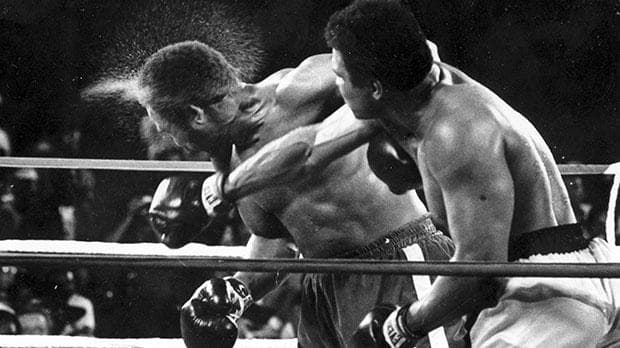](/content/images/wordpress/2017/02/knock-out-punch.jpg)
So how do you easily qualify what new information or data is material to your investment thesis? First and foremost, you need know your positions better than most so you can quickly assess a situation. Negative events, speed bumps, and glancing blows will occur even during the maturation of great companies. It’s your job to know the difference between a glancing blow vs knockout punch to your investment thesis.
Here is a simple yet powerful question that you can use to qualify new information:
> Does any of this new information make a material impact on the relationship or bond the business has with its customers?
I recently saw a similar question by another investor and thought it was brilliant. The most important determinant of long-term business success is the bond businesses have with their customers. Investors that know their investments better than most, and specifically, understand what drives the relationship with their customers will ultimately be successful.
Don’t be lazy and make lackadaisical assumptions about this bond or relationship. “Well, their product is cheaper, better customer service, blah blah, done! I understand the bond.” No, no no. Talk to customers and ask them. Get the [differential insights](https://microcapclub.com/2016/10/paul-lountzis-differential-insights/) that will bring the relationship to life.
A few years ago, I was conducting scuttlebutt research into an investment of mine. I spoke to four customers representing the four customer categories the company sold its products-services into. These customers were in the agriculture industry. One customer was a ranch owner. I asked several open-ended questions. He communicated that he’d been using the company’s service for several years. He used it because it made him more money. When I asked about switching to a competitor he quickly said, “No, I’d probably never do that. The other company hasn’t been around very long. This company has been around a while now, and I know and like their people. I trust them.”
I then spoke to another customer and he mentioned the “Trust” word again. I pushed him, “I’m not really understanding what you mean by Trust?” and he quickly replied, “Let me explain it for you. If someone shows up on my property (he owned 60,000 acres) and we don’t know you, we shoot at you. If we know you, we invite you in for dinner.” I remember thinking to myself, “Well that explains the company’s 99% customer retention rate lol.”
This differential insight allowed me to tune my information filter toward anything that could disrupt trust within the company’s ecosystem. Such an occurrence could be disastrous. But even more importantly, prior to talking to customers I thought certain things were very important, and after talking to customers, my assumptions were wrong. Don’t be lazy. Do the work. No assumptions.
The relationship and bond that your businesses have with their customers is what matters most. Understand the bond so you know what drives them. Everything else is just noise.
**\===> Interact and learn with 250+ of the best microcap investors on the planet.** [\[Join Us\]](https://microcapclub.com/join-now/)
MicroCapClub is an exclusive forum for experienced microcap investors focused on microcap companies (sub $500m market cap) trading on United States, Canadian, European, and Australian markets. MicroCapClub was created to be a platform for experienced microcap investors to share and discuss stock ideas. Since 2011, our members have profiled 1000+ microcap companies. Investors can join our community by applying to become a member or subscribing to gain instant view only access. MicroCapClub’s mission is to foster the highest quality microcap investor Community, produce Educational content for investors, and promote better Leadership in the microcap arena. For more information, visit [http://microcapclub.com](http://microcapclub.com/) and
### Investing Mastery Through Deliberate Practice
URL: https://microcapclub.com/investing-mastery-deliberate-practice/
Last updated: 2023-10-14T17:37:30.000Z
In 2010, Dan McLaughlin was a 30 year old commercial photographer who after much thought, decided to enlist himself in a 10,000 hour experiment of his own design. He wanted to prove that if a person performed the right kind of focused practice over thousands of hours, one could become an expert in the chosen field. Although he had no particular experience as a competitive athlete, McLaughlin settled on golf as his chosen field for his experiment.
[](/content/images/wordpress/2017/02/0604%5Fdan%5Fmcglaughlin-featured.jpg)
Dan McLaughlin
Prior to 2010, McLaughlin had never played a full round of golf. He created a plan known as The Dan Plan, where his goal was to one day play on the PGA Tour. To reach his goal, he would dedicate 30 hours each week to performing focused practice and he hypothesized that it would take roughly 10,000 hours of practice to reach his goal. We’ll come back to McLaughlin and his golf experiment later, but to design his roadmap to get to his goal, he drew heavily on the work of a psychologist named Anders Ericsson.
Anders Ericsson has spent his career analyzing experts. He has studied elite performers from dozens of disciplines, and his study has focused on the routines they use to consistently improve their performance. In every field that he has studied, the common thread that ties these elite performers together is their dedication to thousands of hours of what Ericsson calls deliberate practice. Deliberate practice consists of practice sessions that involve deep concentration and setting well defined goals that focus on a specific skill that needs improvement. These sessions stretch us out of our comfort zone and result in improved mental processes.
To achieve expertise in any field of study usually requires thousands of hours of deliberate practice. Some fields like chess, musical performance, mathematics and several athletic sports have highly developed, broadly accepted training methods that, if intensively followed will likely lead to expertise. For other fields, like investing, the training roadmap to expertise is not quite as clear. However, to guide us in our deliberate practice journey in investing, we can draw from other fields where deliberate practice methods have been much better developed.
**Focus on the Fundamentals First**
In [The Little Book of Talent](https://www.amazon.com/Little-Book-Talent-Improving-Skills/dp/034553025X/ref=sr%5F1%5F1?ie=UTF8&qid=1486388644&sr=8-1&keywords=little+book+on+talent&ref=microcapclub.com), Daniel Coyle wrote about his experience visiting several talent hotbeds. He singled out Spartak, the tennis club in Moscow that is known for developing a number of top Russian tennis stars who have gone on to win Grand Slam titles. Coyle explains:
> “At Spartak, coaches enforce a simple rule: Young players must practice for three years before entering competitive tournaments. While I can’t imagine that such a rule would fly in America, it reflects Spartak’s determination to build trusty, reliable forehands, and backhands before injecting the distorting pressures of competition.”
As with tennis, time spent learning fundamental skills in investing will accelerate the path towards expertise. Learning components of the fundamental skills such as corporate finance, accounting, business valuation and behavioral finance is critical to becoming an expert in investing.
When determining which fundamental skills to focus on, it would help to follow Warren Buffett’s advice in his letter to Berkshire Hathaway shareholders in 1996 that “investment students need only two well-taught courses – How to Value a Business, and How to Think About Market Prices”. The majority of your deliberate practice should focus on building the components to these two broad investment skillsets.
**Study the Grandmasters’ Past Moves**
What sets expert performers including investors, apart from everyone else is the quality and quantity of their mental representations or structures. Through years of practice, they develop highly complex and sophisticated mental structures that help them make faster and better decisions.
Chess is one field that provides insight into how chess masters encode these structures into their memories. In [Peak: Secrets from the New Science of Expertise](https://www.amazon.com/Peak-Secrets-New-Science-Expertise/dp/0544456238/ref=sr%5F1%5F1?ie=UTF8&qid=1486388728&sr=8-1&keywords=peak+book&ref=microcapclub.com), Ericsson and his co-author Robert Pool explain:
> “Anyone who is serious about developing skills on the chessboard will do it mainly by spending countless hours studying games played by the masters. You analyze a position in depth, predicting the next move, and if you get it wrong, you go back and figure out what you missed. Research has shown that the amount of time spent in this sort of analysis – not the amount of time spent actually playing chess with others – is the single most important predictor of a chess player’s ability. It generally takes about ten years of this sort of practice to reach the level of grandmaster. These years of practice make it possible for chess players to recognize patterns of chess pieces.”
If chess players can achieve grandmaster status by spending thousands of hours intensely studying the chess masters’ moves, similarly investors should be able to improve their skills by studying the investing masters by analyzing the masters’ past investing moves. This is exactly what investment grandmaster Eddie Lampert did when he was learning the investment ropes in his early twenties. A Businessweek article from 2004 sheds some light on this:
> “Lampert has carefully studied Buffett for years. He started reading and rereading Buffett’s writings while working at Goldman after college. He would analyze Buffett’s investments, he says, by “reverse engineering” deals, such as his purchase of insurance company GEICO. Lampert went back and read GEICO’s annual reports in the couple of years preceding Buffett’s initial investment in the 1970s. “Putting myself in his shoes at that time, could I understand why he made the investments?” says Lampert. “That was part of my learning process.”
By deeply studying the past investment moves (many of them in microcap companies) of grandmaster investors like Warren Buffett, Charlie Munger, Joel Greenblatt, and Fred Astman \[see article: [The Best Microcap Investor You’ve Never Heard Of](https://microcapclub.com/2016/04/best-microcap-investor-youve-never-heard/)\], an aspiring investor is able to imprint the patterns of these successful investments into their long term memory to be recalled at a later date as needed. By performing a comprehensive analysis of Buffett’s blockbuster investments in companies such as Western Insurance Securities and Mid-Continent Tab Card Company, an investor can create a mental filing cabinet of models to draw from at a later date. This should allow an investor to make faster, more accurate decisions when presented with similar investment situations in the future.
**Get Feedback to Accelerate Your Learning**
Feedback is important in the deliberate practice process. Without feedback (from yourself or outside observers), it is difficult to identify what you need to improve on and how close you are to achieving your goals. In a 2007 Harvard Business Review article, Ericsson pointed to the importance of feedback:
> “Arguably, the most famous violin teacher of all time, Ivan Galamian made the point that budding maestros do not engage in deliberate practice spontaneously: ‘If we analyze the development of the well-known artists, we see that in almost every case the success of their entire career was dependent on the quality of their practicing. In practically every case, the practicing was constantly supervised either by the teacher or an assistant to the teacher.’”
Whether the goal is achieving expertise in violin performance, or investing, it’s clear that immediate feedback is important.
[](/content/images/wordpress/2017/02/buffett-and-graham.png)
Warren Buffett (far left) and Ben Graham (third from left)
Grandmaster investor Warren Buffett and Walter Schloss cut their teeth as analysts working for Benjamin Graham. Seth Klarman learned his craft under Max Heine and Michael Price. Eddie Lampert sought out Robert Rubin and Richard Rainwater as mentors at different points in his career. Many of the greatest investors had a mentor or teacher that provided feedback to them and helped guide their development as investors.
When Buffett and Schloss were analysts under Graham, they most likely presented multiple ideas to their mentor every day. Every time they presented an investment idea to him, they would have been given immediate feedback on the idea in the form of a yes or no. With each bit of feedback, they would have built the mental structures to recognize the patterns that made for a good investment.
Personally, I have never had a formal mentor on my investing journey. But over the years, I have surrounded myself with experienced investors that were willing to give me critical feedback and provide guidance and direction in their areas of expertise. I’ve always considered these investors informal mentors, and I am sure it has accelerated my development as an investor. I was recently listening to an episode of the [Invest Like the Best Podcast](http://investorfieldguide.com/adventures/?ref=microcapclub.com) where Brent Beshore described this type of mentoring as “peer mentoring”. I think it’s a very valuable type of mentoring where having a single mentor may not be feasible. For it to work, you need to soak up as much as you can from each peer mentor. It’s helpful to check your ego at the door, and be willing to ask what may appear to be naive questions. It is also important to find some way to provide value back to these peer mentors.
**Self-Monitoring is the Next Step**
Early in any type of training, much of your feedback may come from coaches, teachers or peer-mentors. With time and experience, you can learn to monitor yourself. After your training has progressed, you should be able to spot mistakes and adjust your practice techniques on your own as needed.
A great way to self-monitor is by keeping an investment decision journal in which you record key investment decisions. Over time, you can review past decisions to identify mistakes to learn where your weaknesses are and where you need improvement. From there you can design practice methods to build the skills to improve on these weaknesses.
Ericsson gives a great example of one method of motivated self-monitoring used by Benjamin Franklin:
> When he wanted to learn to write eloquently and persuasively, Franklin began to study his favorite articles from a popular British publication, the Spectator. Days after he’d read an article he particularly enjoyed, he would try to reconstruct it from memory in his own words. Then he would compare it with the original, so he could discover and correct his faults. He also worked to improve his sense of language by translating the articles into rhyming verse and then from verse back into prose. Similarly, famous painters sometimes attempt to reproduce the paintings of other masters.
An important skill as an investor is being able to pitch a stock idea in a written report. If you wanted to improve this skill, you could apply Franklin’s method of self-monitoring in the following way. There is an investor on Value Investors Club “VIC” who goes by the handle [Charlie479](https://valueinvestorsclub.com/member/charlie479/1180?ref=microcapclub.com). He is an extremely skilled analyst, and one that grandmaster investor and Columbia Business School professor Joel Greenblatt has suggested his students study. As a deliberate practice exercise, you could read one of his company profiles on VIC (which are accessible to the public) and in a few days time, you could do a deep analysis of the company and then write up your own report. When you are done, compare it to Charlie479’s writeup so you can discover and correct your faults. This same exercise could be done by reproducing the reports written by other top ranked members of VIC or MicrocapClub, or your favorite investment bloggers.
**Get Out of Your Comfort Zone**
The purpose of deliberate practice is to figure out where your weaknesses are and focus on getting better in those areas. Deliberate practice is intense, focused practice operating just outside of your comfort zone. This means you should be reaching slightly beyond your current ability making some mistakes. This is the sweet spot of deep practice.
One deliberate practice technique that might push you out of your comfort zone is the blind stock valuation exercise. This exercise was originally used by Benjamin Graham in his investment classes and has been popularized recently by investment blogger Geoff Gannon. As investors, we are so used to looking at a company’s stock price before we value a company. But this often leads to a biased valuation because we are often influenced by the valuation other investors assign when the price is set in the public stock markets. If we want to become better analysts, we should step out of our comfort zones and do our valuation work first and then look at the stock price after.
[](/content/images/wordpress/2017/02/6-blind-men-hans.jpg)
A blind stock valuation is done by performing a valuation exercise on a company, blinded to the company name, industry, and stock price. An easy way to do this is to use a financial data website like rocketfinancial.com. Punch in a random ticker and pull up a company that you do not recognize and bring up the financial information over the last five to ten years. Don’t worry about the lack of any qualitative information. With the financial information provided, value the company and estimate a per share valuation range. At this point, compare your estimate to the current stock price. The purpose of the exercise is not to get as close to the current stock price but to improve your valuation skills. A similar exercise could be done by pulling old Value Line reports and covering up company names and stock charts and running a blind valuation. For a twist, cover up the last 3 years of Value Line data, and try to estimate the revenue and earnings in the missing 3 years, as well as a future projected valuation. You can then reveal the last 3 years of data to check to see how close you were on your projections.
**Getting Past Training Plateaus**
Often in your training, you will reach a plateau where it feels like you have hit a ceiling in your progress. It will usually be just one or two components of a skill that are impeding your progression. To figure out which components are causing the plateau, try pushing yourself a little harder than normal to figure out where your sticking points are.
In the Little Book of Talent, Daniel Coyle provides some insight:
> “The best way past a plateau is to jostle yourself beyond it; to change your practice method so you disrupt your autopilot and rebuild a faster, better circuit. One way to do this is to speed things up – to force yourself to do the task faster than you normally would. Or you can do the task in reverse order, turn it inside out or upside down. It doesn’t matter which technique you use, as long as you find a way to knock yourself out of autopilot and into your sweet spot.”
In investing, there are numerous practice methods to jostle yourself over a plateau in your progress. For example, if you have identified financial statement analysis as an area that needs further skill development, you could try the following exercises:
1. If you are forever analyzing small, one division companies, it may be time to tackle analyzing a larger, more complex company.
2. Challenge yourself to speed up your analysis. If it normally takes you 30 minutes to read through the financial statements and accompanying notes for the average company, challenge yourself to read the next one in 20 minutes.
3. Reverse the order in which you normally read the financial statements and notes. To do this, pull up the financial report of a company you are unfamiliar with. When you begin to read the report, skip over the balance sheet, income statement and statement of cash flows. As you are now blinded to the company’s balance sheet, take out a piece if paper. On this piece of paper, try your best to re-create the balance sheet as you read through the notes to the financial statements.
The areas you are weak in should be more obvious as you struggle to push to accelerate through these tough areas. At this point, you may find that your sticking points are in accounting areas such as business combinations or taxation or perhaps some other area. Once you determine your weaknesses, you could then focus on improving those areas through deliberate practice exercises. For this, you could study the relevant sections of an intermediate or advanced accounting textbook and perform the study guide questions. Or you could design other practice methods to challenge yourself in these areas. Your ability to design practice exercises is only limited by your imagination. Just remember, your practice sessions should be very focused, should stretch you out of your comfort zone, and should focus on building skills, not just knowledge.
**Back to The Dan Plan**
So whatever happened to Dan McLaughlin, our aspiring golfer whose goal was to make the PGA tour?
The first thing he did when he embarked on his golf journey was to enlist a PGA certified golf coach, a strength and rehabilition specialist as well as a mental coach. With the help of his golf coach and following the principles of deliberate practice, he layed out a training roadmap. His first phase focused on building the fundamental skills before he put himself into a real game situation. In the first five months, all he worked on was putting. At 12 months, he took his first full swing. After 18 months, he swung a driver for the first time, and it was nearly 2 years before he played a full round with a full set of clubs in his bag. Nobody said deliberate practice is fun.
During this time, he was getting feedback from his coach on what specifically he needed to improve on and to provide experienced guidance on specific practice drills to perform. McLaughlin also self-monitored his progress and kept a detailed journal where after each practice session, he would record what was working and what wasn’t. When he finally started to play a full round on the golf course, he would hit several shots from the toughest lies on the course.
In late 2015, he was 6,000 hours into his 10,000 hour experiment in deliberate practice and continued to follow the deliberate practice principles meticulously. He had made vast improvements in his game, and had improved his handicap into the 2.6 range the previous golf season. This is a pretty respectable handicap and would have put him in the top 5% of registered golfers. It looked like if he continued on his path, he had a shot at achieving his goal of making the PGA Tour.
Unfortunately, it was at this point that he had a back injury that prevented him from continuing on his journey, and it looks like his plan has been suspended. If McLaughlin is unable to continue, we will never know what may have come of his experiment and we are left to wonder if he might have made the PGA Tour someday.
Some may view this as a failed experiment because he did not reach his goal. But I believe there is a valuable lesson in McLaughlin’s journey. That is, by applying the principles of deliberate practice layed out by Anders Ericsson, virtually anyone, including investors, can show significant improvement in their chosen skill.
As an investor, you don’t have to practice 30 hours a week, as Dan McLaughlin did to get the benefits, although if you did I’m sure it would accelerate your growth immensely. However, I think that if you can dedicate one hour a few times a week on one specific investment skill, it would result in meaningful progress in your investing ability. Whether you are a microcap investor, a large cap investor or an all-cap investor, I hope deliberate practice can help you become a better investor.
**\===> Interact and learn with 250+ of the best microcap investors on the planet.** [\[Join Us\]](https://microcapclub.com/join-now/)
MicroCapClub is an exclusive forum for experienced microcap investors focused on microcap companies (sub $500m market cap) trading on United States, Canadian, European, and Australian markets. MicroCapClub was created to be a platform for experienced microcap investors to share and discuss stock ideas. Since 2011, our members have profiled 1000+ microcap companies. Investors can join our community by applying to become a member or subscribing to gain instant view only access. MicroCapClub’s mission is to foster the highest quality microcap investor Community, produce Educational content for investors, and promote better Leadership in the microcap arena. For more information, visit [http://microcapclub.com](http://microcapclub.com/) and
### Small Things that Make a Big Difference
URL: https://microcapclub.com/small-things-make-big-difference/
Last updated: 2023-10-14T17:39:55.000Z
> “It’s often the small things that no one sees that result in the big things that everyone wants” – Craig Groeschel
I have invested in over 100+ companies over my microcap investment career. A great majority of these microcap companies were founder led. The smaller the company the more important the founder, CEO, and management become to a company. The founders of small companies wear a lot of different hats. They aren’t just the CEO, but they are often the VP of Sales, Marketing, Human Resources, and many things in between.
[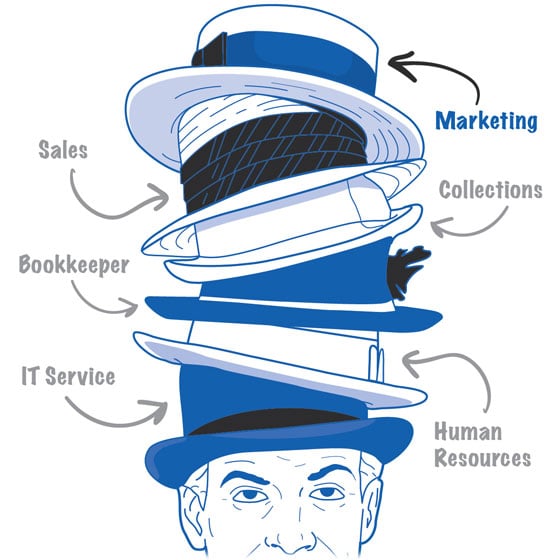](/content/images/wordpress/2017/01/wearing-alot-of-hats.jpg)
Evaluating founders is a big part of what I do as a full-time microcap investor because my success hinges on their ability to execute. I’ve been asked a few times about how I evaluate founders and what key attributes I look for. Over the years I’ve formed my own mental framework based on my experiences. What I’ve found is it’s often the small, intangible, qualitative attributes or characteristics that have made the greatest impact on my future returns. I’m going to highlight a few of these “Small Things that Make a Big Difference” in a series of blog posts over the next few months.
To explain the first attribute, I need to first give a brief history of how small US microcap companies have historically gone public. Up until 2010-2011, a majority of the small microcap companies (sub $50 million market cap) went public through the reverse merger process (aka RTO or Reverse Takeover) versus a traditional IPO. This form of going public is widely accepted in almost every geographic stock market place (Canada, Australia, etc). A reverse merger is when a private company merges with a public shell company (shell = a trading symbol and entity without a business). A shell company is sort of like a commercial office building with no tenants. They are just waiting for a business to move in. Small investment banks, advisory groups, and consultants were the facilitators of lining up private companies with shell companies, and providing funding. This was a simpler, cheaper, and easier way for companies to raise a smaller amount of capital ($1-5 million) and go public.
In the mid-2000’s, there were 400-600 reverse mergers per year in the United States, so there was an ample supply of new microcaps going public on US exchanges. Around the 2010 timeframe several China fraud cases were brought to light. These companies also used the reverse merger process to go public. The financial media and regulators immediately attacked reverse merger companies shining a negative light on this form of “going public”. The negative sentiment surrounding reverse mergers drastically reduced the amount of small microcap companies going public. \[My analogy\] To kill a couple alligators in the lake, they killed everything in the lake. Since 2010, there have been around 100 reverse mergers per year on US markets.
Many microcap companies that go public via reverse mergers are unprofitable and undercapitalized. This isn’t dissimilar to what you would expect in a small emerging company market place (venture capital, etc). Many of the service providers that facilitated the reverse mergers quickly went onto the next deal. The founders of these newly public microcap companies often had very low public company IQs. They had very limited capital markets experience. They were thrown into the deep end of a pool without knowing how to swim. Some ended up drowning.
Failure can take many forms. One form is a business fails because it was a bad business. Another form, is a business fails because they just run out of time and money. In yet another case, it’s the founder’s lack of public company IQ that destroys any hope for long-term value creation. Running a small public company is quite different than running a small private company. In the latter case, the business may have succeeded but they took advice from the wrong people and took money from the wrong people. In the end, they completely blew up the capital structure (ie too many shares out and/or preferred convertible high interest debt, structured financings, etc), and the result was an un-investable company.
**Small Thing #1: Managed through adversity without diluting common shareholders**
When I look back at a majority of my winners, most of them went public through the reverse merger process. These founders too were thrown into the deep end of the pool without knowing how to swim. But these exceptional entrepreneurs were the outliers that somehow figured out how to swim. These people were the business equivalent to this Rocky Balboa quote, “Life is about how hard you can get hit and keep moving forward”. They grinded and bootstrapped their companies and focused on profitability. And most importantly, they turned things around without significantly diluting common shareholders or blowing up their capital structure.
Coincidentally, these successful microcap founders often have iconoclastic traits similar to what William Thorndike describes in, [The Outsiders](https://microcapclub.com/2014/04/book-review-the-outsiders-by-william-thorndike-jr/), and on point with what Sean Iddings and I discovered while writing the [Intelligent Fanatics Project](https://intelligentfanatics.com/?ref=microcapclub.com). They are highly driven individuals with long memories. They remember the pain and feel like they were left for dead by the service providers that took them public. This inner anger is why they never cater to Wall Street. However, they are highly loyal to their long-term investors.
Many investors turn away from companies that went through adversity because it shows management didn’t get it right from the beginning. I actually prefer to see adversity because it lets me see who they really are. When a founder and management team did right by common shareholders in the worst of times, it is much easier to trust them in the best of times.
This is one of several small things I look for in founders that have made a big difference in my returns. I will highlight a few more in subsequent articles.
If you liked this post, you will also enjoy:
[How To Find Intelligent Fanatic CEOs Early](https://microcapclub.com/2016/01/how-to-find-intelligent-fanatic-ceos-early/)
[Success Always Starts With Mistakes ](https://microcapclub.com/2016/04/success-always-starts-mistakes/)
**\===> Interact and learn with 250+ of the best microcap investors on the planet.** [\[Join Us\]](https://microcapclub.com/join-now/)
MicroCapClub is an exclusive forum for experienced microcap investors focused on microcap companies (sub $500m market cap) trading on United States, Canadian, European, and Australian markets. MicroCapClub was created to be a platform for experienced microcap investors to share and discuss stock ideas. Since 2011, our members have profiled 1000+ microcap companies. Investors can join our community by applying to become a member or subscribing to gain instant view only access. MicroCapClub’s mission is to foster the highest quality microcap investor Community, produce Educational content for investors, and promote better Leadership in the microcap arena. For more information, visit [http://microcapclub.com](http://microcapclub.com/) and
### The Art of Holding
URL: https://microcapclub.com/the-art-of-holding/
Last updated: 2023-10-14T17:41:17.000Z
Stocks rarely perform in the time frames we predict, and it’s why the market only works for investors that have a long-term portfolio focus. Performance is never linear, up and to the right, year after year. You sometimes have to hold onto a position for a few years before it goes up 100% in 3 months.
> “I’m accustomed to hanging around with a stock when the price is going nowhere. Most of the money I make is in the third or fourth year that I’ve owned something.” – **Peter Lynch**
Here is a real-life example: I started buying a company I own today in early 2012 when it was at $0.35-0.40 per share. As [my conviction grew I bought more](https://microcapclub.com/2014/09/buy-low-and-then-buy-higher/) and by mid- 2014 the stock hit $2.00 per share. Today (January 2017), the stock is still at $2.00 per share. Yes, I’m up considerably from my average cost basis but this company has been dead money for 2.5 years. Years!
How do I know if I’m right in holding versus just being entrenched in [endowment bias](https://en.wikipedia.org/wiki/Endowment%5Feffect?ref=microcapclub.com)?
Let’s get back to some first principles. Sustainable multi-baggers have three characteristics: Long-term revenue and earnings growth with little to no dilution. When you are holding onto a position ask yourself – Is this business growing and making more money per share than it did a year ago, two years ago? In my real-life example above the company’s business is almost double the size it was 2.5 years ago. Yes, the stock hasn’t gone anywhere but the business is doing really well. I have no problem holding this stock. If the business wasn’t performing, I would sell. Successful investors can differentiate business performance from stock performance and can take advantage of those investors who can’t.
> “I don’t want to spend my time trying to earn a lot of little profits. I want very, very big profits that I’m ready to wait for.” – **Phil Fisher**
In the book, [The Art of Execution](https://www.amazon.com/Art-Execution-worlds-investors-millions/dp/085719495X?ref=microcapclub.com), portfolio manager Lee Freeman-Shor invests $25-$150 million ($1+ billion total) in 45 of the world’s top investors. His instructions to them were simple as there was just one rule. They could only invest in their ten best ideas. Over several years he tracked their positions, trades, performance and was amazed at what he saw. He identified both good and bad habits and divided the investors into groups – Rabbits, Assassins, Hunters, Raiders, and the most successful group, the Connoisseurs.
> “The most successful investors I worked with, those who made the most money, all had one thing in common: the presence of a couple of big winners in their portfolios. Any approach that does not embrace the possibility of winning big is doomed.” – Lee Freeman-Shor
In this excerpt, Lee Freeman-Shor talks about one of the attributes of Connoisseurs.
> “One of the key requirements of staying invested in a big winner is to have (or cultivate) a high boredom threshold.
>
> Meeting some of my Connoisseurs could be very, very boring because nothing ever changed. They would talk about the same stocks they had been invested in for the past five years or longer. On the days I had a meeting scheduled with a Connoisseur, I sometimes struggled to get out of bed.
>
> The fact is, most of us will find it difficult to emulate the Connoisseurs because we feel the need to do something when we get to the office (or home trading desk) every day. We look at stock price charts, listen to the latest market news on Bloomberg TV, and fool ourselves into believing we could add value from making a few small trades here and there. It is very hard to do nothing but focus on the same handful of companies every year; only researching new ideas on the side.
>
> Many of us, seeing we have made a profit of 40% in one of our stocks, start actively looking for another company to invest the money into – instead of leaving it invested. This is precisely why lots of investors never become very successful.”
Every multi-bagger will have long periods (even years) of stagnation as fundamentals backfill, old shareholders get bored, and new shareholders enter. Just like a fine wine, sustainable multi-baggers often take their time to ascend and develop. If you’re invested in great businesses that continue to grow and earn more money, don’t let lulls in stock price and boredom scare you out of them.
If you liked this article, you will enjoy:
[The Conviction To Hold ](https://microcapclub.com/2016/10/the-maturation-of-an-investor/)
[Chris Mayer on 100-Baggers ](https://microcapclub.com/2016/10/the-maturation-of-an-investor/)
[The Maturation of an Investor](https://microcapclub.com/2016/10/the-maturation-of-an-investor/)
[When To Sell](https://microcapclub.com/2016/09/when-to-sell/)
**\===> Interact and learn with 250+ of the best microcap investors on the planet. [\[Join Us\]](https://microcapclub.com/join-now/)**
MicroCapClub is an exclusive forum for experienced microcap investors focused on microcap companies (sub $500m market cap) trading on United States, Canadian, European, and Australian markets. MicroCapClub was created to be a platform for experienced microcap investors to share and discuss stock ideas. Since 2011, our members have profiled 1000+ microcap companies. Investors can join our community by applying to become a member or subscribing to gain instant view only access. MicroCapClub’s mission is to foster the highest quality microcap investor Community, produce Educational content for investors, and promote better Leadership in the microcap arena. For more information, visit [http://microcapclub.com](http://microcapclub.com/) and
### MicroCapClub Year In Review 2016: Performance and Letter
URL: https://microcapclub.com/microcapclub-year-review-2016-performance-letter/
Last updated: 2023-12-12T07:21:55.000Z

I couldn't be prouder of what our community has accomplished in 2016 which is illustrated by the infographic above. In North America alone, microcap companies employ over 2.8 million workers. The best investors ever including Warren Buffett, Peter Lynch, and many others started building their early wealth by investing in microcaps. The best performing stocks ever including, Berkshire Hathaway, Wal-Mart, Apple, Amgen, Netflix, and many others started as microcap companies. \~80% of the best performing stocks over the last ten years originated out of the microcap space.
You would think given these statistics that there would be a love affair or euphoria surrounding microcaps, and yet all we have is a big divide. As private equity and venture capital has pulled in over $800 billion in capital since 2009, over $2 billion has flown out of actively managed US microcap funds. As crowdfunding sites like Kickstarter, Indiegogo, RocketHub, and others allow almost any investor to invest in risky private company startups, increased regulation has all but chocked off funding and even owning small microcap companies. There is a huge misperception about small public companies.
I believe the misperception has been fueled by a lack of leadership in the microcap space. Marc Andreessen, Peter Theil, Ben Horowitz, are billionaire venture capitalists and their success and legion of fans have catapulted the venture capital space to unprecedented growth. It’s hard to go even an hour without seeing a financial journalist praising the venture capital industry.
The Microcap space doesn’t have any billionaire investors that are on the front lines preaching its investing merits and thwarting off the daily deluge of attacks from the financial media. The naysayers, and there are many, point to how bad the returns have been in the microcap space citing failures and frauds. I would make the argument there are just as many failures in private small emerging companies (PE-Venture Capital) than there are public small emerging companies (microcaps). Microcaps are a material part of the economy and worth fighting for.
At MicroCapClub, our #1 priority is to find great companies early, but our long-term mission is to bring credibility and respect back to the microcap space. We intend to do this by relentlessly executing on these five core principles:
1. We will educate the masses on the merits of microcap investing.
2. We will attract quality investors and participants into the microcap space.
3. We will project quality in everything that we do.
4. We will learn and collaborate with each other to become better investors.
5. We will strive to make a positive value added impact on the companies we interact with and invest in.
Six years ago, we focused solely on the US microcap market, and then we expanded into Canada. Now we are entering the UK and Australia. Our message is spreading.
The microcap space is worth fighting for. If you believe this to be true and in our principles above, then join us and lets make a difference together.
Ian Cassel
MicroCapClub is an exclusive forum for experienced microcap investors focused on microcap companies (sub $300m market cap) trading on United States, Canadian, and UK markets. MicroCapClub was created to be a platform for experienced microcap investors to share and discuss stock ideas. Investors can join our community by applying to become a member or subscribing to gain instant view only access. MicroCapClub’s mission is to foster the highest quality microcap investor Community, produce Educational content for investors, and promote better Leadership in the microcap arena. If you enjoy the search for the next great company, [Join Us](https://microcapclub.com/join-now/).
### How Can I Hurt You?
URL: https://microcapclub.com/how-can-i-hurt-you/
Last updated: 2023-10-14T17:43:40.000Z
> “You give me a billion dollars and tell me to go into the chewing gum business and try to make a real dent in Wrigley’s. I can’t do it. That is how I think about businesses. I say to myself, give me a billion dollars and how much can I hurt the guy? Give me $10 billion dollars and how much can I hurt Coca-Cola around the world? I can’t do it. Those are good businesses.” – **Warren Buffett, University of Florida Lecture (1998)**
If a competitor had unlimited resources, how quickly could they duplicate the company’s competitive advantage? This is a simple question that I ask myself and management when I try to measure the moat of a microcap company. Microcap companies are small companies and often times vulnerable to larger competitors with more resources. Paraphrased, even further, How Can I Hurt You?, is very powerful.
In [The Vision To See Economic Moats](https://microcapclub.com/2015/11/the-vision-to-see-economic-moats/), Chip Maloney illustrates this perfectly:
> “The majority of small companies have little to no economic moat around them. In these cases it is pretty easy for upstart competitors to start competing against these companies as there are often few barriers to enter the industry which allows them to steal market share from incumbents. These companies are often situated in industries that are so competitive that it is often impossible to determine what the future holds because industry economics can change rapidly. Developing a vision for these companies’ futures will often prove highly inaccurate.
>
> A much smaller percentage of small companies possess one or more of the economic moats discussed above which prevents new and existing competitors from attacking their businesses. With these companies, you can develop a vision of the future with much more certainty of accuracy because you can see beyond the near term that their economic moat will be enduring. This should allow them to continue to generate good returns on invested capital due to the protections offered by the economic moat.”
A simple way to find a microcap company with a moat is finding one that [dominates their market](https://microcapclub.com/2016/02/firstdominate-a-small-market/) (ie: geography, product-service category, etc). For a microcap company to be a market leader, its market is likely small. An important benefit of focusing on these niche market leaders is it proves management is competent which is always a big question when investing in microcap companies. The management either created the market or they took market share away from competitors. These companies also tend to showcase above average financial performance. They are almost always profitable. There is no sense dominating a small market just to lose money.
Finding a microcap company that dominates its market is difficult, but there are many small markets that are stagnant or even declining. For example, I remember listening to Nate Tobik [(@oddballstocks](https://twitter.com/oddballstocks?ref=microcapclub.com)) give an excellent presentation on investing in market leaders in stagnant or declining niche markets. I believe he gave an example of a company that still produces VHS video cassettes that has well over 50% market share. The business had really good market leading business fundamentals, but their stagnant market was forcing them to stay small. *\[Quick Note: In the book, [Small Giants](https://www.amazon.com/Small-Giants-Companies-Choose-Instead/dp/1591841496/ref=sr%5F1%5F2?ie=UTF8&qid=1482756231&sr=8-2&keywords=small+giants&ref=microcapclub.com), author Bo Burlingham tells the stories of several small companies that had fantastic growth prospects but chose to stay small\].*
For my investment strategy, I like to be even pickier and focus on finding microcap companies that dominate a small market that is expanding. A market where many more customers will want to purchase the product or service in the future. These rare gems are hard to find, and even harder to find at a fair valuation. We have found several on MicroCapClub.
My intrigue with these niche market leaders runs deeper than the business itself. It’s the fact that management had the foresight several years before, or even a decade or more prior to create a sustaining business and moat around an area that few others saw. The person you will find running these types of businesses are often times [Intelligent Fanatics.](https://microcapclub.com/2016/01/how-to-find-intelligent-fanatic-ceos-early/)
Intelligent fanatics are not competitor focused, but customer driven. The ethos of their companies is set up around an established set of enduring customer driven principles. Then, they fanatically execute on these principles using traditional and unconventional means (innovation). Jeff Bezos, appropriately discusses this concept:
> “I very frequently get the question: ‘What’s going to change in the next 10 years?’ And that is a very interesting question; it’s a very common one. I almost never get the question: ‘What’s not going to change in the next 10 years?’ And I submit to you that that second question is actually the more important of the two — because you can build a business strategy around the things that are stable in time. … \[I\]n our retail business, we know that customers want low prices, and I know that’s going to be true 10 years from now. They want fast delivery; they want vast selection. It’s impossible to imagine a future 10 years from now where a customer comes up and says, ‘Jeff I love Amazon; I just wish the prices were a little higher,’ \[or\] ‘I love Amazon; I just wish you’d deliver a little more slowly.’ Impossible. And so the effort we put into those things, spinning those things up, we know the energy we put into it today will still be paying off dividends for our customers 10 years from now. When you have something that you know is true, even over the long term, you can afford to put a lot of energy into it.”
To create a growing sustainable business, you have to have the ability to create a moat that will defend the company from attacks. Famous value investor and author Phil Fisher once said that the most important question to ask management is: “What are you doing that your competitors aren’t doing yet?” or \[in my words\] “What is your competitive advantage?”. I would argue the best question to ask next is “How could I hurt this business?”.
It’s human nature to be drawn to the underdog. The microcap space is filled with David versus Goliath stories. Naysayers will say David was lucky against Goliath. But David was practicing with his sling for years. David knew which stones would be the most accurate. He knew where to hit his larger complacent adversary. He was faster, nimbler, and maybe the most important, he had nothing to lose so he had the courage to step forward and attack. Every day smaller companies topple giants and/or are attacked by larger companies but prevail.
[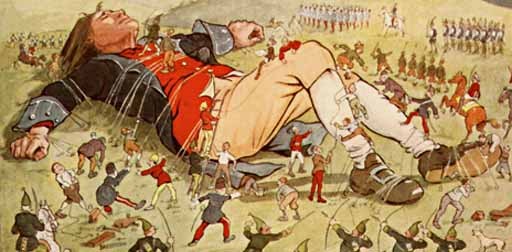](/content/images/wordpress/2016/12/gullivers-travels.jpg)
As a microcap investor, I love the stories of perseverance:
On MicroCapClub we have been following a company that created its niche, is the market leader, and has profitably grown revenues fairly consistently at a 30% CAGR the last several years. This small microcap company has a competitor that just so happens to be a $100 billion market cap company, albeit the product itself is very small to the larger company (1 of 1000 products it sells). Over the last few years the smaller company develops and grows the market for the product and the larger company rides along. Finally, you can almost picture some middle layer manager at the $100 billion company raise his hand and say “I think we need to look at this small product category as it’s gone from being a .001 rounding error to a .01 error (sarcasm). Now it’s becoming material. How do we hurt this small company and push them out of the way?” The large company tries to hurt the smaller company by filing a lawsuit citing some patent infringement claims. Investors in the small company are fearful this could affect the business and the stock drops 50%. This lawsuit is still going on today, but a funny thing happened. The company continues to grow like nothing happened. The company’s customers don’t care about the lawsuit because they love the company’s products and customer service. You can picture the $100 Billion market cap company thinking, “Well…now how are we going to hurt them?”.
There is another company on MicroCapClub we’ve been following for years. A husband-wife management team who started the company 20 years ago. They had a vision for where the industry was headed. They laboriously built the company and now dominate their niche market. They have acquired or competed away most of the competition in their current addressable market which is expanding. A few years ago, on a conference call the CEO said, “It’s not build it and they will come, it is build it because they are coming”. They have spent such a long time developing their product offerings, services, and moat that it would be very hard for a competitor to hurt them. It would take a lot more than money. It would take time, roughly five years to even make a dent in their competitive advantage. So how can I hurt them?
An area that has always fascinated me are larger well-known companies that continue to dominate their markets and industries. Companies like [Costco](http://fortune.com/costco-wholesale-shopping/?ref=microcapclub.com), [Chick-fil-A](http://www.eater.com/2016/6/14/11882716/chick-fil-a-dominating-fast-food?ref=microcapclub.com), or [Wegmans](https://www.valuescentre.com/sites/default/files/case-studies/WegmansLeadershipDevelopmentCaseStudy.pdf?ref=microcapclub.com). In these instances, their competitive advantage and strategy have been known for years, even decades by the competition. You can find numerous case studies on them. These companies don’t necessarily even have anything proprietary, except….perhaps the most powerful moat builder of them all. Culture. You know your culture is an asset when the competition knows what you are doing, how you are doing it, and they still can’t duplicate it. It’s equivalent to knowing that the pitcher is going to throw you a fastball. You know it. He knows, and he knows that you know it. And you still can’t hit the pitch.
[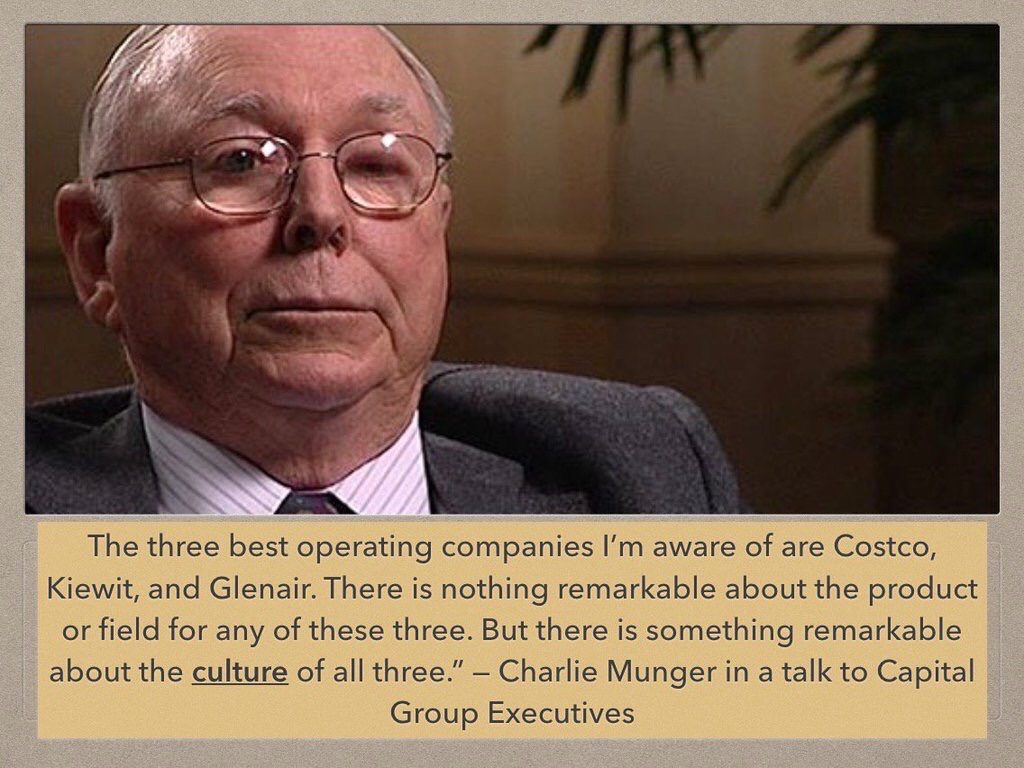](/content/images/wordpress/2016/12/Image-uploaded-from-iOS.jpg)
H/T to Sanjay Bakshi for this quote
[All great companies started as small companies](https://microcapclub.com/2015/12/all-great-companies-started-as-small-companies/). Look for microcap companies that dominate a small market that is expanding because these are normally the niches where intelligent fanatics are born. When you find a company like this, ask them what they are doing that their competitors aren’t doing yet? What is their competitive advantage and how sustainable is it? If a competitor had unlimited resources, how quickly could they duplicate the company’s competitive advantage? How could you hurt this business? If the company is trading at a fair valuation and you objectively conclude that it would be tremendously difficult to hurt the business, then you likely found a winner.
*\*Since this is our last post of 2016, I want to thank all of you that find value from our educational articles. Our mission is to preach the investing merits of the microcap space so that we can continue to attract quality investors and participants into our beloved investment class.*
target="\_blank">Intelligent Fanatics Project Book
[Don’t Be A Chicken](https://microcapclub.com/2016/11/dont-be-a-chicken/)
[How To Find Intelligent Fanatic CEOs Early](https://microcapclub.com/2016/01/how-to-find-intelligent-fanatic-ceos-early/)
**\===> Interact and learn with 250+ of the best microcap investors on the planet.** [\[Join Us\]](https://microcapclub.com/join-now/)
MicroCapClub is an exclusive forum for experienced microcap investors focused on microcap companies (sub $500m market cap) trading on United States, Canadian, European, and Australian markets. MicroCapClub was created to be a platform for experienced microcap investors to share and discuss stock ideas. Since 2011, our members have profiled 1000+ microcap companies. Investors can join our community by applying to become a member or subscribing to gain instant view only access. MicroCapClub’s mission is to foster the highest quality microcap investor Community, produce Educational content for investors, and promote better Leadership in the microcap arena. For more information, visit [http://microcapclub.com](http://microcapclub.com/) and
### Boyd Group Income Fund (TSX:BYD.UN): Terry Smith and Brock Bulbuck’s Collision Course with Success
URL: https://microcapclub.com/boyd-group-income-fund-tsxbyd-un-terry-smith-brock-bulbucks-collision-course-success/
Last updated: 2023-10-14T17:45:25.000Z
In 1990, Terry Smith at age 37, purchased a single location collision repair business called Boyd Autobody in Winnipeg, Manitoba. Over the next few years he would acquire several other locations and in 1998 publicly list the company on the Winnepeg Stock Exchange as the first publicly traded collision-repair business in North America. Today, Boyd Group operates \~400 collision repair centers across North America in addition to overseeing thousands of affiliated retail-glass and emergency road side service locations. The Boyd Group trades under the name, Boyd Group Income Fund (TSX:BYD.UN), and is the best performing stock in Canada over the last 10 years.
[](/content/images/wordpress/2016/12/BOYD-Opening-Chart.png)
In 2006, Boyd Group was a $1 per share, $10 million market cap microcap, and today it is a $84 per share $1.5 billion market cap smallcap. Shareholders that were lucky and skillful enough to buy and hold Boyd Group during this ten-year period have realized a veracious 55.7% CAGR (80-Bagger). We will now take a deeper dive into the story of Boyd Group and its intelligent fanatic founder Terry Smith, and his long-time business partner (now CEO) Brock Bulbuck.
##### **The Beginnings (1987-1990)**
Terry Smith was an investor at a young age having invested in a restaurant chain called Clancy’s. Smith likely learned the art of risk taking from his father. At the age of 62, Terry Smith’s father sold his house in Vancouver to go into business. The business was Docksteader Collision Centre. Terry would invest alongside his father in this venture. He studied the business and liked what he saw. With over 1,200 autobody shops in Manitoba alone, he saw a consolidation opportunity. He also liked the payer dynamic since insurance companies were the payer in 75%+ of repair cases.
He needed money to take advantage of this opportunity, so he formed Cross Canada Collision Centres Limited Partnership to raise capital. Terry was the consummate salesman and had no issues raising money. Due to Manitoba Security Commission rules he had 180 days to raise capital, and he successfully raised $1.5 million (150 units at $10,000 each). Over a subsequent 180-day period, he raised an additional $1.5 million. All in, Terry Smith was able to raise $4 million for Cross Canada Collision Centres Limited Partnership from 325 limited partners. He now had a war chest of cash to execute his grand vision of becoming of a dominant multi-shop collision repair operator (MSO). On November 1st, 1990, after six months of negotiation he paid $100,000 for Boyd Autobody. He now had his first repair center, and it wouldn’t be the last.
##### **The Growth (1991 – 2001)**
By 1993, Terry Smith acquired and managed six collision centers in Manitoba which produced \~$6 million in combined revenues. Just like many intelligent fanatics, Terry Smith had very little industry experience, so he approached the business differently. He wanted to have clean and presentable operations to attract, market, and keep customers. In a 1993 interview, Smith stated:
> “My competitors don’t understand. We’re running this business like a retail operation, not a blacksmith shop, which is the original roots of the autobody repair business. We want clean surroundings in high traffic areas. That’s our marketing strategy.”
Similar to Wal-Mart or Home Depot, one of the key benefits of being a multi-shop operator (MSO) is the ability to pool advertising and marketing dollars to build a brand that is front and center in consumers minds. In an interview in 2000, Smith provided an example to illustrate this:
> “…the Winnepeg market, where Boyd began, has a population of about 600,000 and where we have 10 locations. Those locations contribute approximately $500,000 per year in brand building, marketing, and advertising initiatives. Our next largest competitor spends $50,000.”
Good service, clean locations, and effective mass marketing created a perfect recipe for happy customers and growth. In fact, roughly half of Boyd’s new customers in the mid-late 1990’s came from customer referrals. The company also found they could add significant value to acquired locations by providing diligent financial management, strategic planning, and bulk purchasing.
In January 1993, Terry’s long-time friend Brock Bulbuck joined the company to help him expand operations. Brock would be Terry’s right hand man taking on a variety of roles including: Vice President, Senior Vice President, CFO, President & COO, and finally taking over as CEO in 2010\. Smith said this of his close friend and business partner, “He is a man of the highest integrity and the smartest man I have ever met”.
By 1995, Boyd Group had 12 locations (up from 6 in 1993). The company continued to expand opening additional collision centers in Manitoba and British Columbia. The acquisition strategy was quite simple, “We look for collision repair shops that are leaders in their markets, have strong and consistent earning power, and possess quality, well- respected management personnel.”
In 1997, The Boyd Group Inc. was formed to acquire the Limited Partnership to facilitate a public stock exchange listing. On February 9, 1998, approximately 6.1 million shares were listed on the Winnipeg Stock Exchange and Boyd Group became the first and only publicly traded collision repair company in North America. \[In 1999, the company would upgrade its listing to the Toronto Stock Exchange\]. The company raised an additional $4.5 million of growth capital, and by the end of 1998 the company had 32 locations, including its first locations in the United States.
[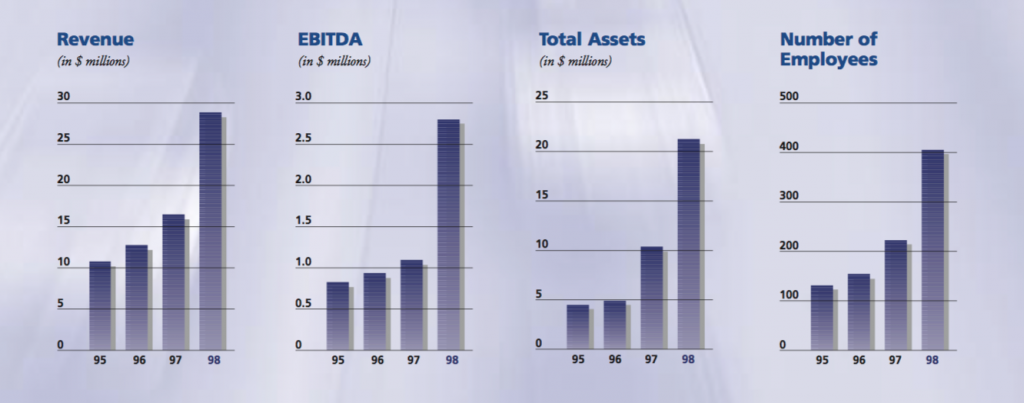](/content/images/wordpress/2016/12/Boyd-Group-1995-1998-Financials.png)
Most intelligent fanatics look to run decentralized organizations that decrease management layers and increase employee autonomy. Companies with strong leadership that focus on maintaining a culture will win in the long-term. In 1995, 1996, and 1997, Boyd Group was recognized by the Financial Post and Arthur Anderson as one of Canada’s 50 best managed companies.
In Boyd Group’s first annual report as a public company there are big bold letters, “**PEOPLE ARE OUR STRENGTH**” and under this title, “People are now, and will continue to be, our strength. Commitment to, and from all our employees will always be one of our top priorities. We are constantly challenged to provide an environment which allows us to attract, develop, and keep quality people.”
In 2000, Boyd Group would define its culture and values as having four cornerstones:
1. Value Creation for Shareholders
2. A Focus on our Customers
3. Respect for our People
4. A commitment to Innovation and Continuous Improvement.
Other differentiating factors that set Boyd Group apart from the everyday Mom and Pop autobody shops was Terry Smith and Brock Bulbuck’s relentless dedication to customer service and quality control. Boyd Group hired an external firm to set up Customer Satisfaction Indexing (CSI), a mechanism to randomly survey customers and provide an assessment to managers. Store managers and senior management were compensated based in part on the basis of their CSI performance.
In 1999, Boyd’s King Edward location in Winnipeg was the first collision repair center in North America to earn ISO 9002 registration. The company then developed plans to introduce and develop the ISO program in all of its locations and by the end of 2000, 32 locations achieved ISO 9002 certification. Around this same time the company launched its Common Branding Strategy to rename acquired units to achieve the benefits of having one common name.
[](/content/images/wordpress/2016/12/Boyd-Group-1997-2001-Financials.png)
##### **The Growing Pains (2002-2006)**
In Greek mythology, the Sirens were dangerous mermaid like creatures whose seductive music would lure sailors to their doom. Terry Smith was not immune to the siren song of growth. In 2000, when the company was on a $100 million revenue run rate, Terry Smith made a bold projection. He proclaimed that the company would hit $500 million in sales and $1 per share in earnings by 2004\. He was wrong.
[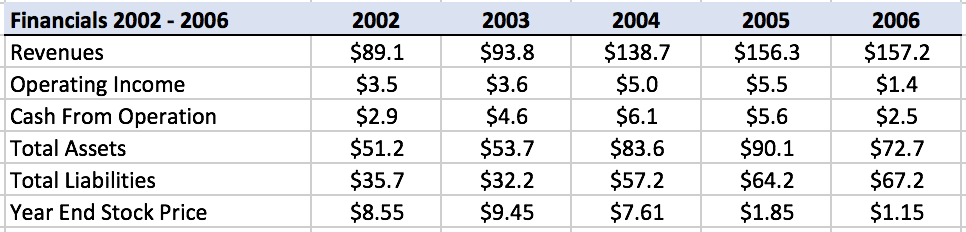](/content/images/wordpress/2016/12/Boyd-FInancials-2002-2006.png)
In addition, in 2002, the board evaluated converting the company into an income fund for tax purposes. In 2003, shareholder approved the conversion renaming the parent company Boyd Group Income Fund and sold 1 million trust units in an IPO on the Toronto Stock Exchange. The fund would make monthly cash distributions to the “maximum extent possible”.
In the early 2000’s, expansion into the US proved harder than previously thought and they had to shut down a few locations due to lack of performance. The United States was still a huge opportunity for Boyd Group. They just needed to attack it differently. Instead of buying single units, they decided to focus on acquiring a larger best in class collision repair chain. In February 2004, they acquired Gerber Group and its 16 repair facilities in the greater Chicago area. Gerber Group was a large acquisition at roughly half the size of Boyd Group. Boyd would then rebrand all their remaining US locations under this one brand, Gerber Collision & Glass.
During this time, the North American auto collision repair industry was weakening, and combined with a strong Canadian dollar, the effects were seen in Boyd Group’s financial performance. The company funded its acquisition strategy mainly through a credit facility and stock issuances. Financial performance was lagging and the company was paying out a bulk of its operating cash flow in monthly distributions.
In early 2005 the company started reducing the monthly distributions and by late 2005 the board made the hard decision to temporarily suspend monthly distributions. In 2006 they took a $17.8 million non-cash write down of goodwill. Investors punished the stock below $1 per share.
[](/content/images/wordpress/2016/12/BOYD-Beat-Down-Chart-1.png)
##### **From Resurgence to Dominance (2007 – Present)**
In 2007, the macro and currency headwinds started to neutralize and the hard, laborious work put into the US strategy started to show in the financials. US same store sales were up almost 6% in 2007\. Insurance companies also stepped up giving Boyd commitments of $7.5 – 20 million per year of additional business. The company paid down more debt, and by YE 2007 they reinstituted a sustainable monthly distribution. The board would modify the distribution based on current and prospective performance of the business with the goal of increasing it over time.
Boyd Group’s business continued to grow right through the financial crisis of 2008, and since few institutions really owned the stock, the stock went up 8% for the year. \[Authors Note: Coincidentally I had a similar experience as an investor in 2008\. What I’ve found is when you own a great business that no one owns it only has one way to go, Up.\]
Great allocators know when to use their stock as currency and when to eat themselves. With the stock at all-time lows and the business turning positive, it was time to eat themselves. On October 15, 2007, the company announced a Normal Course Issuer Bid (Canadian for “Buy Back”) and bought back 90,900 shares ($2.60 average price) in 2007, 565,900 shares ($2.72 average price) in 2008, 338,000 shares ($3.50 average price) in 2009\. From October 2007 to December 2009, the company repurchased \~9% of their outstanding shares.
In 2009, Terry Smith was seriously injured in a snowmobile accident, and it immobilized him for six months. In his absence, Brock Bulbuck and management stepped in and the company didn’t skip a beat. When Terry finally recovered, he felt it was time to hand over the reins, so in January of 2010, Terry Smith stepped down as CEO, and Brock Bulbuck stepped in.
From 2006 until mid-2010 the company made no large MSO acquisitions, opening 6-8-10 new locations per year under the Gerber and Boyd brands.
[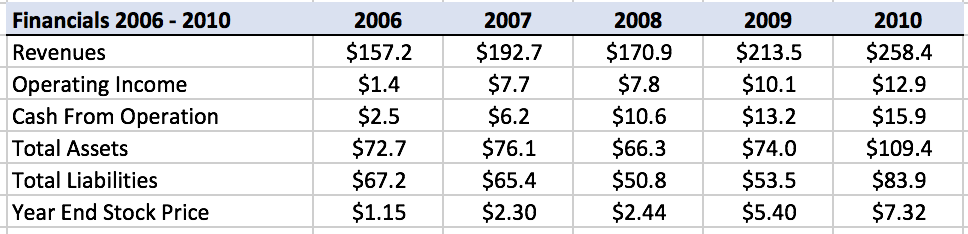](/content/images/wordpress/2016/12/Boyd-Financials-2006-2010.png)
Brock Bulbuck and the board had been waiting patiently to make larger MSO acquisitions. The time had come. Here is a list of their larger MSO acquisitions from Mid-2010 to Present:
- On June 28th, 2010, they fired their elephant gun and bought True2Form Collision Repair Centers (37 Centers), one of the largest multi-location collision repair center companies in the United States with locations in North Carolina, Ohio, Maryland, and Pennsylvania.
- On June 30, 2011, they acquired Cars Collision Center and their 14 locations in Illinois, 8 locations in Indiana, and 6 locations in Colorado.
- On January 3, 2012, they acquired Master Collision Repair and their 8 locations in Florida.
- On July 3, 2012, they acquired Pearl Auto Body and their 6 locations in Colorado.
- On November 16, 2012, they acquired The Recovery Room and their 11 locations in Florida.
- On November 30, 2012, they acquired Ellice Hopkins, Timron Holdings, and S&L Auto Glass and their 14 locations in Florida.
- On May 31, 2013, they acquired Glass America and their 23 locations.
- On September 3, 2013, they acquired Hansen Collision and their 25 repair centers.
- On April 14, 2014, they acquired Collision Revision and their 25 centers in Illinois, Indiana, and Florida.
- ON June 6, 2014, they acquired Collex Collision Experts and their 16 centers in Florida and Michigan.
- On September 12, 2014, they acquired Champ’s and their 7 centers in Louisiana.
- On January 2, 2015, they acquired Craftmaster Auto Body and their 6 locations in Florida.
- On March 21, 2016, they acquired J&M and their 5 locations in Oregon.
The amount of large MSO acquisitions above may seem aggressive, but Boyd Group is very strategic and disciplined in their strategy. Boyd won’t acquire MSOs if they don’t meet certain return hurdle rates. So in periods of high deal competition, like in 2015 and 2016, you won’t see Boyd acquire many large MSOs. In fact they adapted their strategy the last couple years to be able to do more single shop acquisitions where there is almost never any deal competition. They will usually do a large acquisition to enter a new territory, then they will add single locations around that area. They usually spend around $500,000 for single locations and make 25% EBITDA ROIC after a 12-24-month period where they get revenue synergies from insurers that redirect traffic to their newly acquired location and also from productivity enhancement.
If you can reduce repair cycle times you can increase productivity, customer satisfaction, and same store sales growth. The US industry average repair cycle time for MSO’s is 10.5 – 12 days. Boyd was averaging 2 days faster than the average, but they weren’t happy with this. Starting in 2013, Boyd spent 18 months and $3.5 million working with consultants developing a system to reduce their repair cycle times to 5-7 days. They called the system the “WOW Operating Way”. The company has been slowly implementing the WOW Operating Way across all its facilities.
[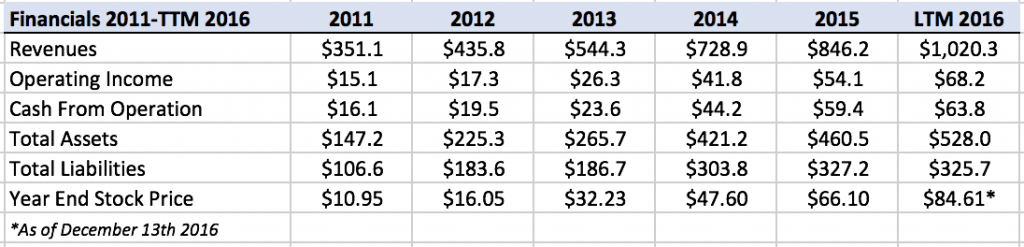](/content/images/wordpress/2016/12/Boyd-Financials-2011-2016-1.png)
In 2010, the tax advantages of being organized as a Fund extinguished. The board evaluated a reorganization into a corporation, but after a thorough investigation they concluded it was in the unit holders best interest to remain a Fund. Boyd Group has consistently increased its monthly distributions to unitholders.
[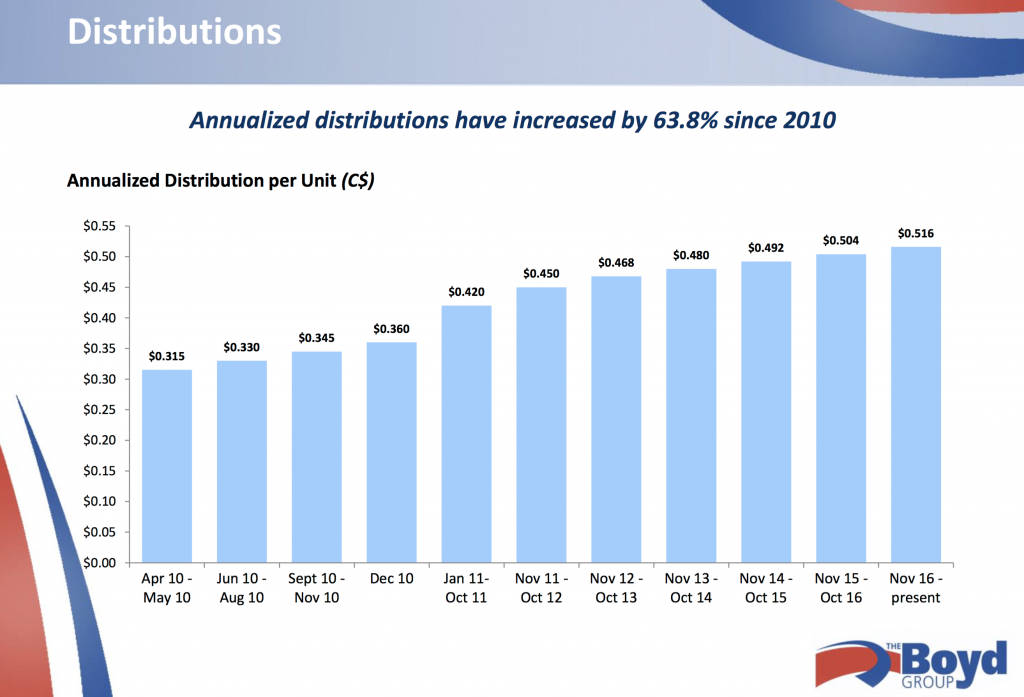](/content/images/wordpress/2016/12/Boyd-distributions.png)
##### **Conclusion**
In 1990, Terry Smith had a vision of becoming a dominant MSO in North America. He succeeded with the help of Brock Bulbuck and many other capable managers and employees. The company’s success has attracted other financial institutions to the MSO consolidation story. There are four big consolidators. Boyd is one, and the other three are owned by private equity funds.
[](/content/images/wordpress/2016/12/Boyd-Competition.jpg)
Today, Boyd Group is still the only public company in the auto collision repair industry. Perhaps the most interesting thing is Boyd Group only has a 3.7% market share of its addressable market, and the most exciting thing is Boyd Group is still a relatively small $1.5 billion market cap smallcap. In late 2015, the company announced they expect to double their revenues in five years (implied 15% growth).
If you look at Boyd Group’s stock chart in the beginning of the article (2006 – Present), it’s easy to assume the company’s success was immediate, obvious, with linear up and to the right results. But reality kicks in when you view the previous eight years (1998-2006) of hardship. It is tremendously difficult to scale a business from nothing to $1 billion in revenues without growing pains along the way. A commonality in all intelligent fanatics and great companies is perseverance. Almost all successful people and companies at some point went through incredible hardship, obstacles, and challenges. The power to endure is the winner’s quality. If you enjoyed this article, I know you will enjoy reading our new book: [The Intelligent Fanatics Project: How Great Leaders Build Sustainable Businesses](https://intelligentfanatics.com/?ref=microcapclub.com).
*\*I want to thank a couple of our members, who wish to remain anonymous, for helping me write this article.*
In addition to SEDAR filings, I used the following sources for quotes and information:
Our MicroCapClub Members [\[Join Us\]](https://microcapclub.com/join-now/)
[Collision kingpin: Terry Smith collides with success](https://www.thefreelibrary.com/Collision+kingpin%3A+Terry+Smith+collides+with+success.-a014095040?ref=microcapclub.com)
[TWST Interview with Terry Smith ](https://www.twst.com/interview/terry-smith-the-boyd-group-inc-byda-to?ref=microcapclub.com)
[Raymond James Boyd Group Initiation Report](https://www.raymondjames.ca/en%5Fca/equity%5Fcapital%5Fmarkets/equity%5Fresearch/sample%5Fresearch/docs/BoydGroupIncomeFund.pdf?ref=microcapclub.com)
[Boyd Group founder handing over the reins](http://www.winnipegfreepress.com/business/boyd-group-founder-handing-over-the-reins-80982797.html?ref=microcapclub.com)
[Boyd Group Income Fund Investor Presentation](https://www.boydgroup.com/assets/docs/presentations/2016-q3-presentation.pdf?ref=microcapclub.com)
[Collision M&A Consolidation Trends Update](http://supp-co.com/2016/10/04/collision-ma-consolidation/?ref=microcapclub.com)
If you enjoyed this article on Boyd Group, you will also enjoy reading these [articles](https://microcapclub.com/intelligent-fanatics/):
[Patrick Industries (PATK): The Best Performing Stock Since 2009](https://microcapclub.com/2016/07/patrick-industries-patk-best-performing-stock-since-2009/)
[Bank of the Ozarks (OZRK): The Story of Intelligent Fanatic George Gleason](https://microcapclub.com/2016/09/bank-ozarks-ozrk-story-intelligent-fanatic-george-gleason/)
[DaVita HealthCare Partners (DVA): An Intelligent Fanatic Led Turn Around](https://microcapclub.com/2016/07/davita-healthcare-partners-dva-intelligent-fanatic-led-turn-around/)
[Middleby Corporation (MIDD): Case Study of an Intelligent Fanatic Led 100-Bagger](https://microcapclub.com/2016/05/middleby-corporation-midd-case-study-intelligent-fanatic-led-100-bagger/)
[MTY Food Group – A Case Study of a 100-Bagger](https://microcapclub.com/2015/03/mty-food-group-a-case-study-of-a-100-bagger/)
**\===> Interact and learn with 250+ of the best microcap investors on the planet.** [\[Join Us\]](https://microcapclub.com/join-now/)
MicroCapClub is an exclusive forum for experienced microcap investors focused on microcap companies (sub $500m market cap) trading on United States, Canadian, European, and Australian markets. MicroCapClub was created to be a platform for experienced microcap investors to share and discuss stock ideas. Since 2011, our members have profiled 1000+ microcap companies. Investors can join our community by applying to become a member or subscribing to gain instant view only access. MicroCapClub’s mission is to foster the highest quality microcap investor Community, produce Educational content for investors, and promote better Leadership in the microcap arena. For more information, visit [http://microcapclub.com](http://microcapclub.com/) and
### 5 Things I Wish I Knew About Corporate Boards When I Was An Institutional Investor
URL: https://microcapclub.com/5-things-wish-knew-corporate-boards-institutional-investor/
Last updated: 2023-10-14T17:46:46.000Z
The best part of undertaking more than 80 speaking engagements in the last few years around the world has been the incredibly smart, diverse, fascinating people I’ve met; investors, academics, students, world leaders, scientists, visionary business leaders, social activists, amazingly helpful event planners, and a 12 year-old playing Jimi Hendrix covers on a Chicago street corner who made all the plane trips worthwhile.
Throughout all of those experiences, I’ve been asked a few questions that I continue to think about months, sometimes years, later. One of those questions was: “what have you learned from advising scores of pre-IPO boards and small public companies that you wish you knew when you were co-managing a small-cap special situation hedge fund?” Such a great question. Here are my top five answers.
1. **ROI**. BlackRock, CalSTRS, and CalPERS et al. spend millions and millions of dollars a year analyzing the corporate governance efficacy of their largest portfolio positions for the same reason that Jamie Dimon and Warren Buffett, among others, published [this](http://www.governanceprinciples.org/wp-content/uploads/2016/07/Governance%5FPrinciples%5FOpen%5FLetter.pdf?ref=microcapclub.com): because better governed companies make more money. If the folks who manage *trillions* of dollars and run the largest companies know that better governed companies make more money, how on earth does that not apply equally to small public companies? If you’re one of those people who still don’t buy it, I have two more words for you: [Darden Restaurants](http://www.businessinsider.com/corporate-governance-in-vc-backed-tech-companies-2016-7?ref=microcapclub.com).
2. **Follow the numbers**. Forget what you hear on CNBC and read in the *WSJ,* shareholder activism is not a large-cap phenomenon. Roughly 7 out of every 10 shareholder activist campaigns are actually in small-cap companies (and smaller). Heck, in October 2016, according to *Activist Insight,* 40% of activist overtures were in companies with market caps below just $50 million. Moreover, approximately 60-70% of activist “asks” are corporate governance related. Put it all together and you get this: better governed companies make more money, but most small public companies are poorly governed.
3. **You’re holding the wrong people accountable**. When I was a fund manager, it was my opinion that two things predominantly cause small public companies to underperform: getting strategy wrong, and misallocating capital. Like many small-cap fund managers I’ve met over the years, I was 100% convinced that both of those shortcomings were management issues. I couldn’t have been more wrong. Strategy and capital allocation failures aren’t management issues – they are board issues. Active, objective, appropriately comprised boards head off strategy and capital allocation problems long before they cause substantive diminution in shareholder value.
4. **Objective vs. independent*.*** Director independence requirements iterated by the exchanges are important, but of limited value. Companies can comply with the “letter” of those regulations, yet simultaneously have boards exclusively comprised of the CEO and their friends. Put differently, objectivity is what’s most important. It’s pretty hard to effectively oversee management on behalf of shareholders (a board’s central role), when the person you’re principally governing is a friend who gave you the job. It’s even more unlikely when all of the directors are also friends/acquaintances. The best-case scenario for any given company in your portfolio is that most/all board members lack preexisting relationships with the CEO (or each other), and were predominantly recruited by the chair of the nominating/governance committee. When CEO’s handpick boards, the likeliest outcome is “oversight lite.”
5. **Speak directly to board members**. In the not too distant past, corporate lawyers advised directors not to speak directly with investors. But today, in large public companies, those conversations happen every business day. Take it from someone who regularly assesses boards from a buy-side perspective, those conversations should take place in small public companies every day as well. Here’s what to ask a director if you were limited to just one question: “how does the board benchmark whether key strategic initiatives are failing or succeeding?” Board members who don’t have cogent answers to that question are either: (a) disengaged; (b) largely dependent on whatever management tells the board; (c) inexperienced; or (d) lack the right background to be on that board. In the absence of CEOs like Jobs or Zuckerberg, companies that are comprised of board members (a) through (d) are much more likely to either fail or underperform.
Here is Adam Epstein’s presentation at our [MicroCap Leadership Summit](https://microcapclub.com/summit/):
[\[Download Presentation Here\]](http://microcapclub.com/wp-content/uploads/2016/11/Adam-Epstein.mp3)
Register for our next [MicroCap Leadership Summit](https://microcapclub.com/summit/) today.
**\===> Interact and learn with 250+ of the best microcap investors on the planet.** [\[Join Us\]](https://microcapclub.com/join-now/)
MicroCapClub is an exclusive forum for experienced microcap investors focused on microcap companies (sub $500m market cap) trading on United States, Canadian, European, and Australian markets. MicroCapClub was created to be a platform for experienced microcap investors to share and discuss stock ideas. Since 2011, our members have profiled 1000+ microcap companies. Investors can join our community by applying to become a member or subscribing to gain instant view only access. MicroCapClub’s mission is to foster the highest quality microcap investor Community, produce Educational content for investors, and promote better Leadership in the microcap arena. For more information, visit [http://microcapclub.com](http://microcapclub.com/) and
### Don't Be A Chicken
URL: https://microcapclub.com/dont-be-a-chicken/
Last updated: 2023-10-14T17:47:58.000Z
A few years ago I went on a company due diligence trip with a friend of mine who manages a microcap fund. We spent the morning with management and the afternoon visiting a few of their customers. At dinner that evening we replayed the day’s events. Towards the end of the discussion my friend says, “You know the thing I like most about this company is their customers would really be screwed without their product.” I let what he said sink in for several seconds and replied, “that is brilliant”. I had never really thought about it that way, and rewrote it down in my my notes as follows:
> Invest in companies whose products or services are so relied upon that if they didn’t exist it would cause their customers a lot of pain
I have tried to apply this powerful statement to every one of my investments ever since. Its greatness is its simplicity, and just like a sharp steak knife, it cuts away the fat and BS very quickly. In a manner of seconds, you can apply it and come away with some worthwhile conclusions. In general, a business’s product or service should be a pain reliever to its customers.
> “One of our directors said very simply, ‘We should make a list of everything that irritates the customer, and then we should eliminate those defects one by one.’ That is the way to compete in a service business.” – **Charlie Munger**
The best businesses relieve so much pain, that their customers couldn’t imagine operating without them. Earlier this year I visited another company and one of their customers. In preparation I emailed the CEO of the company and asked him if he were in my shoes what questions he would ask the customer. The CEO said if he were me, he would ask the customer what type of ROI they were seeing with the product and also how disruptive it would be to the customer if they didn’t have the company’s product. Hmm, there it was again.
> Invest in companies whose products or services are so relied upon that if they didn’t exist it would cause their customers a lot of pain
A few of you might sarcastically be thinking: “It would really be painful if we didn’t have electricity, water, heat, so you want me to buy utilities?” Or perhaps you’re thinking, “Well using that statement you would never invest in Coke or any big consumer brand because you don’t necessarily need their product right? If Coke went away, I’d just buy Pepsi or some other sugary concoction.” I believe well-known brands, especially those with a cult following, do fall under the pain reliever criteria. The point I would make is you might find some areas of the market, especially with larger companies, where the statement above doesn’t exactly fit. But I believe it is very useful in qualitatively evaluating small companies like microcaps.
The market is filled with companies whose products or services have an abundance of look-a-like competitors with low switching costs. It is rare to find a small company whose product or service is very lucrative to its customers. Few small companies will make it over this high qualitative hurdle. Many might argue that when expressed in the literal sense it screens out too many, but few could argue when you find a small company that fits, it is likely an exceptional business.
Don’t be afraid to say no to 99.9% of investment opportunities. You only need to find one great company, before others, to change your life. Extraordinary returns follow extraordinary discipline. An investor’s goal should always be to make as few investment decisions as possible. Keep your hurdle rate high and embrace inaction.
Chickens will eat anything you put in front of them. They will eat insects, bugs, meat, fruit, vegetables, fish, and yes even chicken. They have no self-control and will even eat their own eggs and feces. A hawk can see up to 8x more clearly than the sharpest human eye. To put in comparison, if you had a hawk’s vision you could see an ant on the ground from on top a ten story building. A hawk’s eye is so large that it occupies a big portion of its skull. The hawk knows what it’s looking for. The visual capabilities let the hawk distinguish the size, shape, and speed of the potential prey so it can recognize, target, and capture it quickly.
Don’t be a chicken, be a hawk. Be picky. As you fly above the investment world looking for opportunities, develop tools, strategies, even statements like the one discussed in this article, that you can apply quickly to evaluate opportunities. Know what you are looking for so you can develop the vision to recognize an opportunity quicker.
**\===> Interact and learn with 250+ of the best microcap investors on the planet.** [\[Join Us\]](https://microcapclub.com/join-now/)
MicroCapClub is an exclusive forum for experienced microcap investors focused on microcap companies (sub $500m market cap) trading on United States, Canadian, European, and Australian markets. MicroCapClub was created to be a platform for experienced microcap investors to share and discuss stock ideas. Since 2011, our members have profiled 1000+ microcap companies. Investors can join our community by applying to become a member or subscribing to gain instant view only access. MicroCapClub’s mission is to foster the highest quality microcap investor Community, produce Educational content for investors, and promote better Leadership in the microcap arena. For more information, visit [http://microcapclub.com](http://microcapclub.com/) and
### Chris Mayer on 100-Baggers
URL: https://microcapclub.com/chris-mayer-100-baggers/
Last updated: 2023-10-14T17:50:00.000Z
In 1972, Thomas Phelps wrote [100 to 1 In the Stock Market](https://www.amazon.com/100-Stock-Market-Distinguished-Opportunities/dp/1626540292/ref=sr%5F1%5F1?ie=UTF8&qid=1479207499&sr=8-1&keywords=thomas+phelps&ref=microcapclub.com) where he studied the 365 companies that made 100-Bagger returns from 1932 to 1971\. In 2014, Chris Mayer wrote [100-Baggers](https://microcapclub.com/2015/11/book-review-100-baggers-by-chris-mayer/). Mayer picked up where Phelps left off, studying the 365 (not a typo) companies that made 100-Bagger returns from 1962 through 2014\. Both of these books are exceptional. We were honored to have Chris Mayer speak at our [MicroCap Leadership Summit](https://microcapclub.com/summit/) where he shared some of his findings.
Join us for the next [MicroCap Leadership Summit](https://microcapclub.com/summit/)
**\===> Interact and learn with 250+ of the best microcap investors on the planet.** [\[Join Us\]](https://microcapclub.com/join-now/)
MicroCapClub is an exclusive forum for experienced microcap investors focused on microcap companies (sub $500m market cap) trading on United States, Canadian, European, and Australian markets. MicroCapClub was created to be a platform for experienced microcap investors to share and discuss stock ideas. Since 2011, our members have profiled 1000+ microcap companies. Investors can join our community by applying to become a member or subscribing to gain instant view only access. MicroCapClub’s mission is to foster the highest quality microcap investor Community, produce Educational content for investors, and promote better Leadership in the microcap arena. For more information, visit [http://microcapclub.com](http://microcapclub.com/) and
### Book Review: The Vagabonds
URL: https://microcapclub.com/book-review-vagabonds/
Last updated: 2023-10-14T17:51:19.000Z
Henry Ford, Thomas Edison, Harvey Firestone, and John Burroughs were all good friends. In fact, they were known as the [Four Vagabonds](https://www.thehenryford.org/collections-and-research/digital-resources/popular-topics/the-vagabonds/?ref=microcapclub.com). Between 1915 and 1924 the four would go on seven camping trips for weeks at a time. Edison would plan each trip and he wouldn’t tell the others where they were headed until they met at the start of each trip. Henry Ford would retrofit Model-T’s and other vehicles with kitchen equipment, cold boxes, food, so they could comfortably enjoy their solitude. They would often invite other people whom they respected, even US Presidents, to join them. They would spend countless hours traveling, talking, and enjoying each other’s company before disbanding. These camping trips would end in 1924 because they began to attract too much attention which defeated their purpose.
A friend of mine encouraged me to read these three books in the following order, and I would encourage you to do the same:
1. My Life and Work by Henry Ford (1922)
2. Men and Rubber by Harvey Firestone (1926)
3. Edison As I Know Him by Henry Ford (1930)
My Life and Work by Henry Ford is an exceptional look into the mind of one of the world’s greatest entrepreneurs. His impact on the transportation industry as well as other industries cannot be overstated. At the same time the automobile industry was ascending, so was the tire industry. Cars, trucks, tractors needed tires. Men and Rubber by Harvey Firestone is a look into the tire industry, and how he grew Firestone Tire and dominated the industry. Edison As I Know Him is Henry Ford’s tribute to his friend and mentor Thomas Edison.
Henry Ford worked for Edison until 1899 (chief engineer at Edison Illuminating Company), and credits Edison for being the only person that gave him early encouragement to push forward developing an automobile with an internal combustion engine. Here is a beautiful account by Henry Ford remembering his first encounter with Thomas Edison (source: Edison As I Know Him).[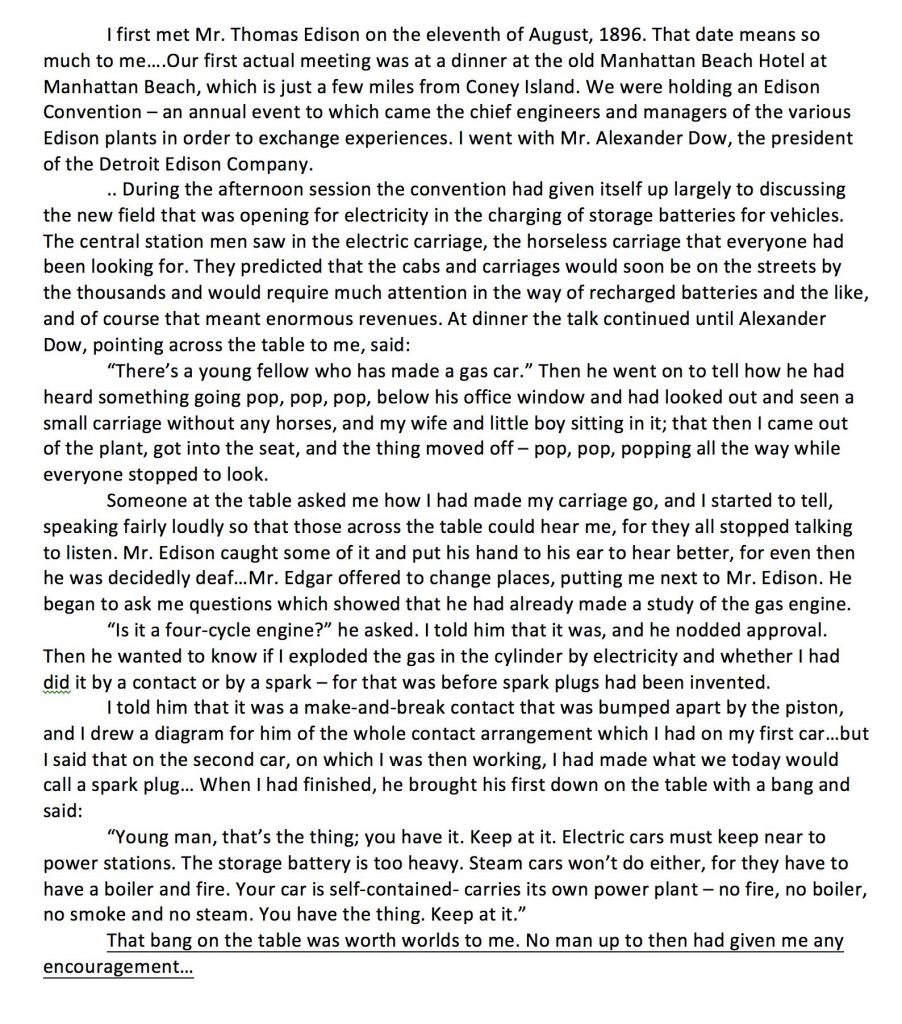](/content/images/wordpress/2016/10/Ford-Credits-Edison.jpg)Harvey Firestone, founder of Firestone Tire and Rubber Company, credits Henry Ford for much of his company’s success. Henry Ford would give Harvey Firestone his first major contract for tires that would catapult the company into dominance. In 1902, Firestone Tire had $150,000 in sales and grew to $115 million by 1920\. In the fantastic book, Men And Rubber, he tells the story of starting and growing Firestone Tire, and also devotes several chapters to the camping trips he had with Ford, Edison, Burroughs, and others.
You can understand why these men got a long so well because they had very similar business philosophies. They all believed in simplicity and driving down costs, even to the short-term detriment of their businesses. On a few occasions they would price the car (Henry Ford), light bulb (Edison), or tire (Firestone), lower than the cost of production to force the engineers to make changes to make it profitable at that lower price. When Edison invented the incandescent light bulb it cost his company $1.25 per bulb to manufacture. He sold them for $0.40 and took the loss because he knew that was the price it made economic sense for resellers and consumers. He took losses for four years before his cost to manufacture dropped to $0.22, and by that time millions were sold. His company was quickly bought out. He took short term pain for long term gain. Henry Ford said, “Our policy is to reduce the price, extend the operations, and improve the article. The reduction in price comes first…the low price makes everybody dig for profits”.
[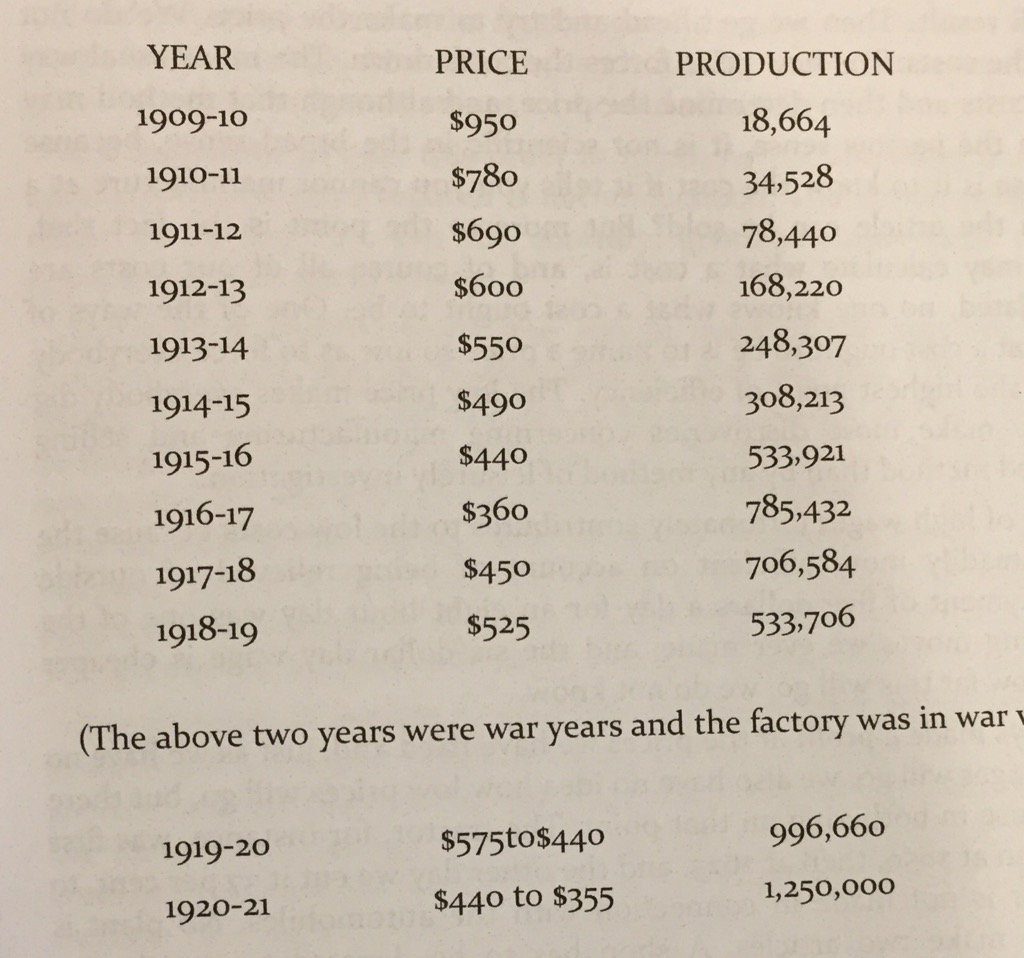](/content/images/wordpress/2016/10/Henry-Ford-Reducing-price.jpg)
Model-T Price and Production
A testament to Henry Ford’s integrity and long-term values, “During one year our profits were so much larger than we expected them to be that we voluntarily returned fifty dollars to each purchaser of a car. We felt that unwittingly we had overcharged the purchaser by that much.”
All of these men revered each other. Henry Ford on Edison, “Nearly every important factor in our prosperity directly or indirectly traces back to some invention by him…I often think how pleasant an experience has befallen me, in that my boyhood’s hero became my later manhood’s friend. It is a circumstance that in the nature of things cannot occur very often.”
Harvey Firestone on Henry Ford and Thomas Edison, “And so this may be a final – and the only – record of our wanderings \[Camping Trips\], and I want to set down, partly in my own words and partly in the words of others, something about Thomas Edison and Henry Ford, for they certainly own the most outstanding sets of brains in the world today. I doubt if any two men ever contributed more to the public welfare than have they, although that may not be as generally appreciated as it ought to be…. I have always liked to be with big men – with men whose ideas extend beyond the little things near at hand and whose vision has no horizon.”
I have covered 1% of these books usefulness above, so I hope I have helped seduce you to read these three books for yourself. You might be wondering what these books have to do with microcap investing. These men were [intelligent fanatics](https://microcapclub.com/intelligent-fanatics/). To find great companies early, you need to understand how greatness thinks.
**\===> Interact and learn with 250+ of the best microcap investors on the planet.** [\[Join Us\]](https://microcapclub.com/join-now/)
MicroCapClub is an exclusive forum for experienced microcap investors focused on microcap companies (sub $500m market cap) trading on United States, Canadian, European, and Australian markets. MicroCapClub was created to be a platform for experienced microcap investors to share and discuss stock ideas. Since 2011, our members have profiled 1000+ microcap companies. Investors can join our community by applying to become a member or subscribing to gain instant view only access. MicroCapClub’s mission is to foster the highest quality microcap investor Community, produce Educational content for investors, and promote better Leadership in the microcap arena. For more information, visit [http://microcapclub.com](http://microcapclub.com/) and
### The Pursuit of Financial Independence
URL: https://microcapclub.com/pursuit-financial-independence/
Last updated: 2023-10-14T17:56:50.000Z
Given a reasonable rate of return utilizing your investment strategy, how much capital would you need to become financially independent? Don’t think about some obvious huge number but what is the borderline number that would enable you to start thinking about it? $500,000? $1,000,000? $2,000,000? How much capital to provide an ample return needed to pay your bills and live a “good” life?
I became financially independent in 2008 at age 27, and back then I remember asking myself these same questions. I looked at my A account, my expenses, did some quick math using an expected compounded rate of return into the future, and decided it was time. It was that simple, so it seemed. It’s human nature to think highly of our abilities and to overlay the success of the past onto the future. We look at the future and see unemotional, consistent, up and to the right returns, described best in my penned chart below:
[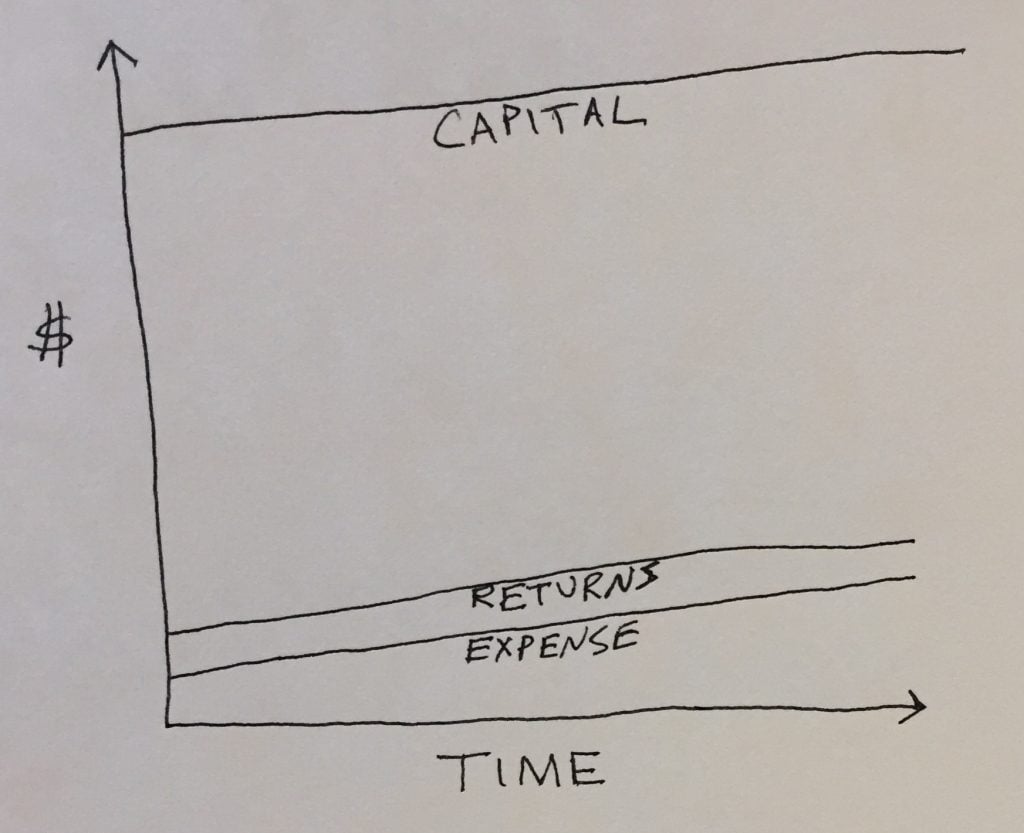](/content/images/wordpress/2016/10/Pic1.jpg)
A couple years after I became a full-time investor I hit a rough patch, and I quickly realized the simple questions above weren’t the right ones at all. The following ones were:
What if my portfolio is down 20-30-40% next year and still drawing down on the capital base to pay bills? How would this affect me emotionally, psychologically? Would two or three bad years in a row cripple me? At what point would my investment strategy start to crumble by these emotions? At what point does my advantage of “focus on the long-term” shift to “this next quarter needs to be good” because I have bills to pay? When will it start affecting my communications with management, bugging them too much, because damn it I need this next quarter to be good? Am I mentally prepared to perhaps go to my wife and tell her I failed and can’t support us anymore? That I need to get a job, that she needs to get job. This set of questions are the real ones, and they can be paralyzing.
The chart below is reality. One that hasn’t been smoothed over by the CAGR in our minds:
[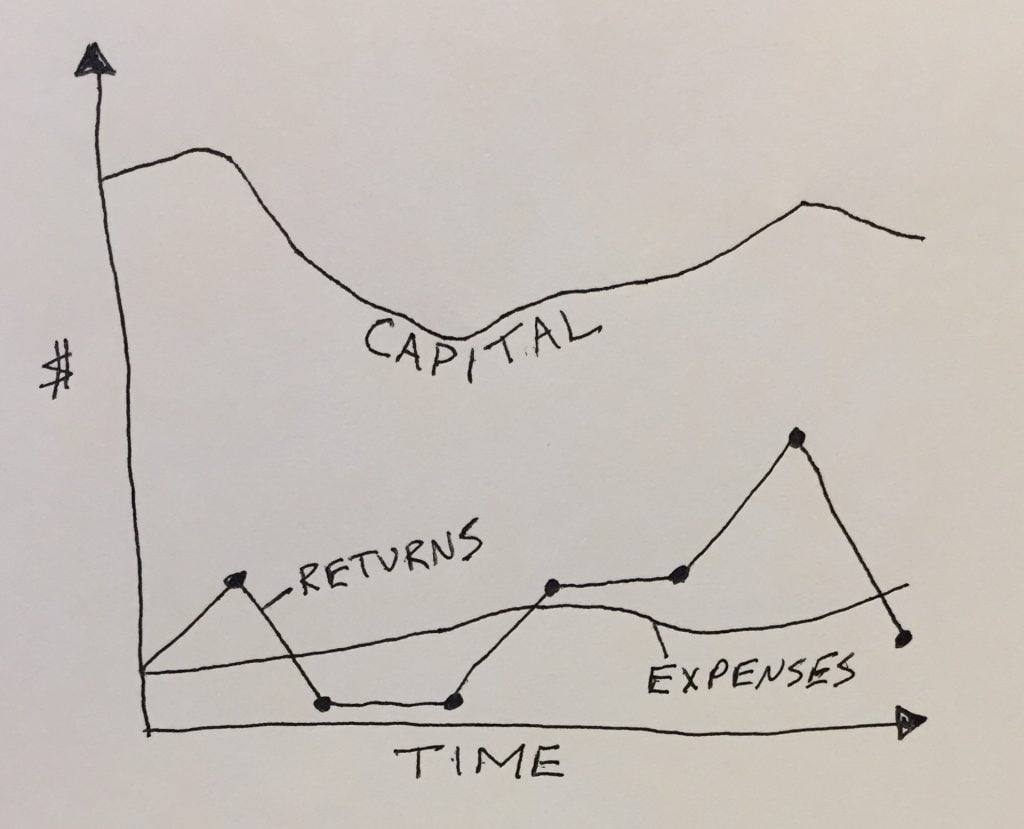](/content/images/wordpress/2016/10/Pic2.jpg)
Now that I’ve completely scared you off from being a full time private investor, let me tell you that financial independence is amazing. I will take it a step further. Not having to deal with bosses, customers, employees, clients is amazing. The thought of never having to wear a suit ever again, except for my daughters eventual wedding, is amazing. The time I’m able to allocate to honing my craft (microcap investing), making an impact at MicroCapClub, and spending time with family is worth the stress.
The first step to becoming a full time investor is realizing money is about freedom not consumption. The freedom you gain when you become a full time investor is worth 100x the income you lose when you leave your job. The motivation isn’t greed, but having the time to pursue your passion or purpose. You’re never going to be great at something you do part time. You need to see what you are fully capable of without restriction. It’s this determination that allows you to look at the second set of questions above and say, “Yes, it’s worth it”.
If you enjoyed this article, please read: [So You Want To Be A Full Time MicroCap Investor?](https://microcapclub.com/2015/01/so-you-want-to-be-a-full-time-microcap-investor/), [Getting Started](https://microcapclub.com/2014/09/getting-started/), [You’re Smarter Than You Think](https://microcapclub.com/2016/04/youre-smarter-think/), [The Maturation of an Investor](https://microcapclub.com/2016/10/the-maturation-of-an-investor/), and [Protect Yourself From Yourself](https://microcapclub.com/2014/04/protect-yourself-from-yourself/).
**\===> Interact and learn with 250+ of the best microcap investors on the planet.** [\[Join Us\]](https://microcapclub.com/join-now/)
MicroCapClub is an exclusive forum for experienced microcap investors focused on microcap companies (sub $500m market cap) trading on United States, Canadian, European, and Australian markets. MicroCapClub was created to be a platform for experienced microcap investors to share and discuss stock ideas. Since 2011, our members have profiled 1000+ microcap companies. Investors can join our community by applying to become a member or subscribing to gain instant view only access. MicroCapClub’s mission is to foster the highest quality microcap investor Community, produce Educational content for investors, and promote better Leadership in the microcap arena. For more information, visit [http://microcapclub.com](http://microcapclub.com/) and
### The Maturation of an Investor
URL: https://microcapclub.com/the-maturation-of-an-investor/
Last updated: 2023-10-14T18:12:23.000Z
Many of us have had early success in investing. My first microcap investment fifteen years ago was a 15-bagger. Instant success can be a great imposter because you think it’s skill instead of luck. Your head starts to swell. After this first big win I thought to myself, “[Warren Buffett](https://microcapclub.com/2015/08/warren-buffetts-net-worth-by-age/) who? Investing a marathon? Pfff..This is going to be a race and they better get a spot ready for me on the Forbes 400 list”. Here is a chart I shared in a previous post on my maturation as an investor:
[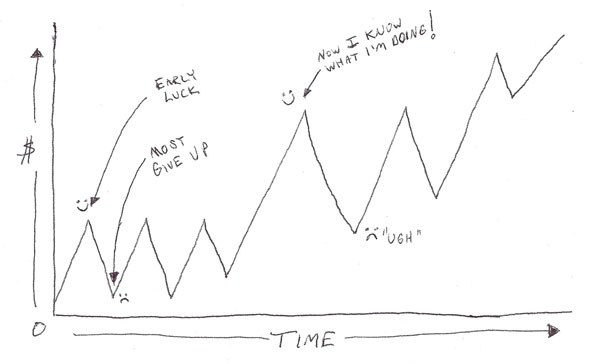](/content/images/wordpress/2016/10/maturationofinvestor.jpg)
We all want fame and fortune, but the problem with instant success is you rarely have the power to keep what you haven’t earned. If you don’t have a firm foundation and understanding on how and why you received something, it’s really hard to keep it let alone duplicate it. Deep down we all know it’s not what we do randomly that will produce long-term returns; it’s what we do consistently. So the education begins to try to turn random luck into consistent skill
Unfortunately, investing’s greatest lessons can’t be taught in a book or in a classroom. They have to be experienced and often times the teacher is loss. Don’t get me wrong, you can learn a lot from books and from other people’s experiences, but they are no substitute for making your own experiences. 95% of successful investing is controlling your emotions when your money is on the line. This is why paper trading/investing is almost useless. You have to put your own money on the line.
> In most cases to step toward your destiny you have to first step away from your security. You have to risk who you are for what you can be.
The market loves to destroy egos because only through humility can it prepare your mind to accept truth. Just like military training, the market needs to tear you down and destroy all your selfish beliefs and tendencies before it can build you back up. It is no accident that the greatest lessons occur when we are the most confident. My biggest losses have all occurred after my biggest wins. During periods of over-confidence is when we decide to get lax with our checklist, analysis, maintenance due diligence, or expand outside our circle of competence into areas we don’t have competence. This is when the market comes in and destroys our ego again. It is not surprising that many successful investors are not arrogant or brash, but self-reserved and humble.
> “Wisdom flows into the humble man like water flows into a depression”
An investor must experience the highs of success and lows of failure several times before they can exploit these emotions in others. Through the peaks and valleys of your investing experience you begin to learn and pick up nuggets of truth that begin to shape your investment philosophy. In a recent article, [When To Sell](https://microcapclub.com/2016/09/when-to-sell/), I shared a bit on how my own personal investment philosophy shifted from short(er) term trading to longer term investing.
I’d like to share with you another story:
In 2008, during the financial crisis, I was well diversified (sarcasm), invested in primarily two companies of equal proportion. The first company was a junior mining company. During the crisis, the stock was down 70% from its highs a year earlier. I held on. I knew the management and company really well. It was a high quality junior mining company, if there ever was such a thing. The stock recovered all its losses before the market bottomed in early 2009, and 18 months later was up 600% more.
The second company was a consumer products company. I had traveled to meet management and did field based research. The company’s products were sold online and in large retailers. Even during the worst economic backdrop since the great depression, consumers bought the product. During Q1-Q4 2008, Revenues were up 200%, 200%, 450%, 320%, compared to Q1-Q4 2007\. The company produced record results during the crisis. Since no one else owned the stock it only had one way to go…Up…300% during the crisis while the broader markets were down 50%.
I’m not naïve enough to think the success I had navigating the financial crisis of 2008-09 was all skill. You will become a better investor when you accept the role that luck plays (good and bad) in your winners and losers. The mining company literally outperformed all other mining companies in North America for a 5-year period. The consumer company was one of only a handful of companies that doubled or more during the crisis. These two companies were probably in the top 0.1% of all companies during this time period. I just happened to find them (one randomly at a conference, second one through word of mouth), did the work, bought them early, and had the conviction to hold. When the next bear market comes, whenever that may be, it would be hard to duplicate this success.
Nevertheless, I learned a great deal from this experience which ultimately gave me the confidence to become a full time private investor. A few years prior I learned the importance of knowing my positions better than most, and this nugget helped me greatly during the crisis. Owning these two companies during the crisis taught me two more valuable lessons. First, invest in quality because quality always pays you back first. Even before the bottom was put in the bear market, capital started flowing back to quality first. This is something I always remember to this day. Second, invest in the best companies you can find that no one else owns because these companies can do well in any market environment. What does “No one else owns” mean. For me it means zero or very limited institutional ownership.
We as human beings are very impatient, so the hardest part of maturing as an investor is allowing ourselves the time. You can’t force it. Many investors “force it” by being active for activity’s sake. I believe it was [Ed Borgato](https://twitter.com/EdBorgato?ref=microcapclub.com) that said, “I find that a lot of what Wall Street perceives as productive activity is needless complexity”. Just like a fine wine, you have to be patient and allow yourself the time to mature. Pastor T.D. Jakes in his book, Destiny, says it best, “Many people cannot find success because they lack the patience to go through the process to become who they want to be.”
You cannot force the maturity process but you can shorten it in five ways:
1. **Experience**. Don’t be afraid “to do” and learn from experience.
2. **Read**. Read a lot of annual reports and industry reports. The key is to develop a circle of competence so you can act quickly and decisively. Read up on business leaders, investing leaders, thought leaders, and even some fiction. Why Fiction? It keeps your creative mind balanced which ultimately makes you more focused.
3. **Mentors**. Picture in your mind where you want to be in 10-years, and then go find that person today and learn from them.
4. **Self-Awareness**. In this context self-awareness is the ability to identify and evaluate your strengths, deficiencies, and outcomes. For example, you need to have the self-awareness to recognize luck versus skill. Sometimes you will make the right decision but you will still lose money. This doesn’t mean you made the wrong decision. Sometimes you will make a wrong decision but you will still make money. Don’t play games with yourself. Have enough self-awareness to recognize that even though you made money your actions were wrong.
5. **Own Your Mistakes**. When you blame others for your investing mistakes it proves you didn’t do enough of your own work. Fully own your past mistakes so you learn from them.
Only after you’ve experienced failure can you fully appreciate success. You aren’t defined by your past. You are prepared by it. A big part of the preparation is so you develop a thick skin. True conviction can only be obtained by trusting your own research over that of others. Most multi-baggers will have long periods of stagnation as fundamentals backfill, old shareholders give up or get bored, and new shareholders enter. A multi-baggers journey is filled with the corpses of highly intelligent articulate naysayers. Every investors strategy is different, so don’t waste a lot of time defending your positions to others. Do the work. Trust your work. Let company execution prove you right or wrong.
I’d like to leave you with this. You weren’t put on this Earth to be average so stop thinking like everyone else. The greatest investors ever, they all had different investing strategies. Some of them strikingly different. The commonality amongst all of them is they focused on the downside. Find an area of investing that connects with you and your personality. You will have some painful lessons as you mature as an investor, but it’s all part of the journey. Almost all successful people went through incredible hardship, obstacles, and challenges. The power to endure is the winner’s quality.
If you enjoyed this article, please read: [Getting Started](https://microcapclub.com/2014/09/getting-started/), [Getting There](https://microcapclub.com/2016/01/getting-there/), [The Conviction To Hold](https://microcapclub.com/2014/08/the-conviction-to-hold/).
**\===> Interact and learn with 250+ of the best microcap investors on the planet. [\[Join Us\]](https://microcapclub.com/join-now/)**
MicroCapClub is an exclusive forum for experienced microcap investors focused on microcap companies (sub $500m market cap) trading on United States, Canadian, European, and Australian markets. MicroCapClub was created to be a platform for experienced microcap investors to share and discuss stock ideas. Since 2011, our members have profiled 1000+ microcap companies. Investors can join our community by applying to become a member or subscribing to gain instant view only access. MicroCapClub’s mission is to foster the highest quality microcap investor Community, produce Educational content for investors, and promote better Leadership in the microcap arena. For more information, visit [http://microcapclub.com](http://microcapclub.com/) and
### Paul Lountzis on Differential Insights
URL: https://microcapclub.com/paul-lountzis-differential-insights/
Last updated: 2023-10-14T18:14:19.000Z
Over the last twenty years, technology and the internet has made financial information and secondary research a click-a-way for almost every investor. Today more than ever, investors need to focus on qualitative analysis, scuttlebutt, and field based research to gain an advantage. At our [MicroCap Leadership Summit](https://microcapclub.com/summit/), value investor Paul Lountzis gave a great presentation on acquiring differential insights, those unique strategic insights that bring the numbers to life.
**\===> Interact and learn with 250+ of the best microcap investors on the planet. [\[Join Us\]](https://microcapclub.com/join-now/)**
Join us for the next [MicroCap Leadership Summit](https://microcapclub.com/summit/)
If you enjoyed this presentation, you will also find value in these:
[Interview with Paul Lountzis: Investing & Scuttlebutt Research](http://www.simoleonsense.com/conversation-with-paul-lountzis-investing-scuttlebutt-research/?ref=microcapclub.com)
[The Art of Interviewing Management](https://microcapclub.com/2014/11/the-art-of-interviewing-management/)
[Quality Over Quantity](https://microcapclub.com/2015/07/quality-over-quantity/)
[Book Review: The Sleuth Investor by Avner Mandelman](https://microcapclub.com/2014/04/book-review-the-sleuth-investor-by-avner-mandelman/)
MicroCapClub is an exclusive forum for experienced microcap investors focused on microcap companies (sub $500m market cap) trading on United States, Canadian, European, and Australian markets. MicroCapClub was created to be a platform for experienced microcap investors to share and discuss stock ideas. Since 2011, our members have profiled 1000+ microcap companies. Investors can join our community by applying to become a member or subscribing to gain instant view only access. MicroCapClub’s mission is to foster the highest quality microcap investor Community, produce Educational content for investors, and promote better Leadership in the microcap arena. For more information, visit [http://microcapclub.com](https://microcapclub.com/) and
### When To Sell
URL: https://microcapclub.com/when-to-sell/
Last updated: 2024-01-23T02:43:26.000Z
Great companies always make it look easy. You never have to rationalize your investment. Management does it for you by executing. Vishal Khandelwal of [Safalniveshak.com](http://www.safalniveshak.com/?ref=microcapclub.com) was kind enough to ask me to write about “selling” for the readers of his Value Investing Almanack. I thought I would share and expand a bit on these thoughts here. Before I dive into my four basic rules for selling, I’d like to give them some context.
As many of you know, I’m a full-time microcap investor investing in the smallest 5% of public companies. My goal is to own the smallest, most illiquid, least institutionally owned, best businesses I can find that are run by [intelligent fanatics](https://microcapclub.com/intelligent-fanatics/). All great companies started as small companies, and I want to find and buy great companies early.
Over the last ten years I’ve bought and sold over two hundred companies in my portfolio. When I look back at my tax records from just seven-eight years ago, greater than 75% of my capital gains income was short-term (bought and sold within 12 months). Although I looked for similar business characteristics as I do today, I wasn’t concentrating on sustainable businesses and my holding period was much shorter. I was looking for unique businesses within a trend or fad that would create a scarcity in the market place that would propel the stock price over the next 12-months. I would sell the positions when I felt the run in the stock and valuation was overextended. Often times it would occur within a year of my initial purchase.
Many of the companies I bought and sold back then were similar to cigar-butt companies where their businesses were tied to one product or a fad that lasted 2-4-8 quarters and then fell apart. During this time period I also watched a few companies do extremely well long after I had sold them. It didn’t take me long to realize these companies had high quality sustainable businesses which seemed like a much better, healthier, and fun way to invest.
Many microcap investors today invest the way I did several years ago, and I don’t blame them. It is really hard to find high quality sustainable businesses in the microcap space. But this also provides a real edge to someone with a business quality focus combined with a longer time horizon. Many investors say they focus on the long-term but their actions-communications prove otherwise. Most are incredibly nearsighted, investing for the next quarter or two. This gives the longer-term investor, willing to put in the work, a huge advantage. [Qualitative analysis](https://microcapclub.com/2015/07/quality-over-quantity/) and field based research acts like corrective lenses that will let you see further. You will have an edge on most investors if you make investments based on expected 3 – 5 year returns instead of 3 – 12 month returns.
> “The stock market is a device for transferring money from the impatient to the patient.” – Warren Buffett
Over the last two years roughly 80% of my capital gains income is long-term. The amount of activity in my portfolio has dropped significantly. In fact, in the last two years I’ve only purchased one new company in my portfolio. This phenomenon is partially due to the current bull market that is reducing great buying opportunities, but also because I’m becoming more disciplined as an investor.
All successful investors have two things in common. They are extremely disciplined and they understand the downside of their investments. Extraordinary returns follow extraordinary discipline in buying, holding, and selling. It’s not what you do randomly that will produce long-term returns; it’s what you do consistently. You need to have the right mental models and framework to sell for the right reasons.
One of the biggest mistakes or wrong reasons to sell a stock is boredom. Don’t be a bumble bee buzzing around from one position to the next. Find a few great companies early and FOCUS on evaluating their business performance, not stock performance. The hardest part of achieving multi-baggers is having the patience and conviction to hold through multi-year periods of under-performance. Successful investors can disconnect emotion from investment decisions and can differentiate business performance from stock performance.
I was asked in a recent interview, “Do I believe in holding forever?”. The principle of holding forever is good in theory, but it’s likely not realistic for microcap investing unless you truly find that rare 100-bagger. The unfortunate truth is that most microcap successes are often 3-5-10-20 baggers that occur over a five-year time horizon. Then the company ultimately outgrows the management, mistakes occur, and the business and stock descend back to mediocrity.
Microcaps are small, emerging, often times impressionable companies. They are like Children. You can’t let your four-year-old child alone for several hours or days because you don’t know what will happen. You need to watch them. The same can be said for microcaps. You need to be constantly watching and conducting maintenance due diligence on microcaps so you are aware when things change for better or for worse and can react before others. You have to anticipate how other people’s thinking is going to change before they know it themselves. This is also why the most important thing for microcap investors is to know your positions better than most.
I sell a position for four main reasons:
1. Sell when the story changes: My experience has taught me that when you start to see cracks in your investment thesis, you sell immediately or someone else will. What constitutes the “story changing”? Normally it’s timelines being continually pushed out or scuttlebutt research that has unearthed something. It could also just be the tone or body language of management. 70% of communication is transmitted by body language, 23% voice tone & inflection, and 7% spoken words. This is why periodically talking to management on the phone or in person is very important. The “story changing” could also be a [transformational acquisition](https://microcapclub.com/2016/06/acquisitions-microcaps-destroy-shareholder-value/) involving lots of equity dilution. Lastly, it’s easy to fall in love with your positions when you spend hundreds of hours getting to know them. It’s OK to fall in love with your positions, just be prepared to divorce quickly. When the facts and story change don’t let your ego get in the way of selling.
2. Sell when you find something better: When evaluating new opportunities, you are constantly evaluating them against what you already own. Often times the best opportunities are already in your portfolio. You already know them. There is a real time value in accumulating knowledge on a position. A new opportunity can’t have similar upside to your stable of investments, it needs to have considerably more upside to replace the “trust” in what you already know. Keep your hurdle rate high for new investments. Eventually, you will find something that is so compelling that you’ll need to sell an existing position to buy it.
3. Sell at the first sign of management incompetence or unethical behavior: The management team is the head or brain of the company. The operations ie sales, marketing, distribution, product, service is the body. If the head is deaf, dumb, and blind, the body is useless. Life is too short to be investing in management who aren’t rational and trustworthy. The biggest test of management’s rationality is the decision on how to allocate cash. Leadership author and speaker John Maxwell says, “Most people have uphill dreams but have downhill habits.” You want to find and invest in intelligent fanatics that have the habits of winners.
4. Sell when the company gets overvalued: I’ve never believed in selling strategies based on stock performance (i.e. sell half when a stock doubles). [Holding on to your winners](https://microcapclub.com/2014/08/the-conviction-to-hold/) and cutting your losers is the key to investment success, but there are times when reality and expectations become too imbalanced. On a few occasions (not often enough 🙂 I’ve owned companies trading at single digit PE’s that got discovered by institutions and all of a sudden they were trading at 80 PEs (priced for perfection). In my experience, almost all stocks that go up 10x in a short period of time will have at least a 50% pullback at some point. It’s just what happens. In these times it’s ok to sell and buy back when the valuation is right.
There will be some instances when the best checklist or mental model won’t stop you from making a wrong decision. Warren Buffett says, “A checklist is no substitute for thinking”. These four rules for selling are no different. I use them like guardrails and as I’ve gained experience they become more defined and help me stay on the road of financial freedom. My judgements on selling will never be 100% correct just like my batting average in picking winners will never be 100%. But selling is very important. The overriding theme is you sell when you start rationalizing your investments. I’m “still” a full time private investor today not because of the gains I’ve made but because of the losses I haven’t taken.
**\===> Interact and learn with 250+ of the best microcap investors on the planet.** [\[Join Us\]](https://microcapclub.com/join-now/)
MicroCapClub is an exclusive forum for experienced microcap investors focused on microcap companies (sub $500m market cap) trading on United States, Canadian, European, and Australian markets. MicroCapClub was created to be a platform for experienced microcap investors to share and discuss stock ideas. Since 2011, our members have profiled 1000+ microcap companies. Investors can join our community by applying to become a member or subscribing to gain instant view only access. MicroCapClub’s mission is to foster the highest quality microcap investor Community, produce Educational content for investors, and promote better Leadership in the microcap arena. For more information, visit [http://microcapclub.com](https://microcapclub.com/) and
### Bank of the Ozarks (OZRK): The Story of Intelligent Fanatic George Gleason
URL: https://microcapclub.com/bank-ozarks-ozrk-story-intelligent-fanatic-george-gleason/
Last updated: 2023-10-14T18:20:17.000Z
In March of 1979, George Gleason II became the owner/operator of a small Arkansas community bank in Ozark, Arkansas. Gleason’s background and how he purchased the bank was anything but ordinary. The 25 year old former attorney had zero banking experience and only $10,000, but was able to convince a Little Rock Arkansas bank to help finance the $3.6 million purchase of Bank of the Ozarks ([OZRK](https://finance.yahoo.com/quote/ozrk?ltr=1&ref=microcapclub.com)). It didn’t matter that Gleason had zero banking experience. He, like other intelligent fanatics, possessed all the right qualities to achieve unusual results and those who knew him could guess he’d be successful.
Since George Gleason’s arrival in 1979, Bank of the Ozarks has grown total assets from $28 million to roughly $18 billion today. Each year the bank has been profitable and not surprisingly, the bank was prepared during the financial crisis. Fifteen acquisitions have occurred since 2010 making Bank of the Ozarks the largest bank in Arkansas. Investors who partnered with George Gleason in the bank’s 1997 IPO, have achieved a 22% compounded annual return, including dividends. To contrast, the S&P 400 mid cap index has only returned 10% annually and many competing banks have earned less than 4%. Just like our other intelligent fanatic case studies on [Middleby Corporation (MIDD)](http://microcapclub.com/2016/05/middleby-corporation-midd-case-study-intelligent-fanatic-led-100-bagger/), [Patrick Industries (PATK)](http://microcapclub.com/2016/07/patrick-industries-patk-best-performing-stock-since-2009/), [MTY Food Group (MTY.TO)](http://microcapclub.com/2015/03/mty-food-group-a-case-study-of-a-100-bagger/), and [DaVita Corporation (DVA)](http://microcapclub.com/2016/07/davita-healthcare-partners-dva-intelligent-fanatic-led-turn-around/), Bank of the Ozarks too was a microcap company before its ascension.
[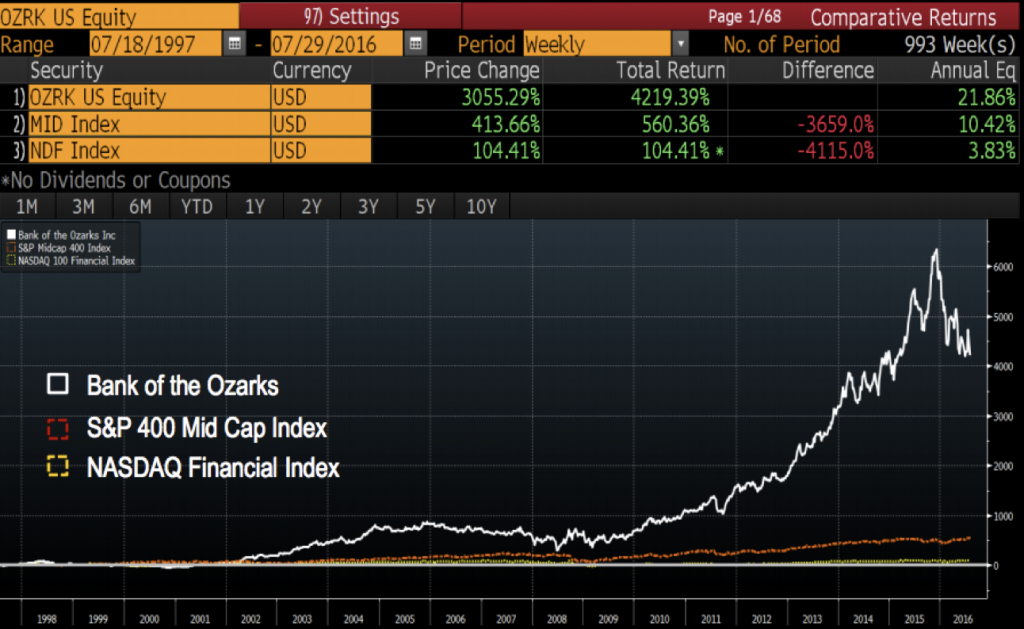](/content/images/wordpress/2016/09/OZRK-performance.png)
**Background**
A reoccurring theme amongst intelligent fanatics is that they lack direct experience in the industry they eventually dominate. This provides them with a fresh perspective necessary to see things differently. George Gleason fit the mold well. He acquired significant business experience from his parents, both owners of small businesses in the small town Dardanelle, Arkansas. They owned cattle, poultry, row crops, rental property, a retail store and a feed mill.
From the age of five Gleason began taking over simple responsibilities at the different businesses. As he grew older, those responsibilities grew. He was running books at age twelve and filing tax returns at age fourteen.
> Gleason said, “My dad provided me an incredible opportunity as a kid to experience and work in and know a little bit about a lot of different businesses. So when I arrived in Ozark in 1979 and would sit in a loan committee, if it was a loan to a poultry operator or a row crop farmer or small businessman or person who owned rental property, I had some point of reference and some personal experience with all of those things even if at sometimes a very low level.”
Having various business experiences from a young age doesn’t automatically guarantee an entrepreneur can grow a microcap into a large successful company. George Gleason also possesses a superior intellect, work ethic and focus on being the best that was apparent early on. He was valedictorian of his high school class, graduated with a degree in economics from Hendrix College in two years achieved the highest score for his bar in Arkansas. Richard Atkinson, one of Gleason’s law professors at UA Fayetteville, recalled in 2005 that Gleason was special when he was a student.
> Atkinson said, “I do know that if the students realized George was going to be in a class, the class was always smaller because people knew he would set the curve. They liked and respected him, but they didn’t want to compete because even then he was – and is – a remarkably bright person.”
Employees and businessmen could see George’s abilities early on, too. Bob East partnered with Gleason on development and construction deals in the 80s and served on the bank’s board of trustees for numerous years.
> Bob said, “He’s one of the most brilliant guys I’ve ever known. He has just an unbelievable capacity to retain knowledge, to define the knowledge he has — to understand it and the way it relates to the economy, the business and people. … I was thrilled when he asked me to be on the board because I knew whatever he did would be successful.”
George Gleason was a learning machine. Right after George acquired Bank of the Ozarks, board member Kennith Smith recalled, “he had a long conference table back in his office, and he had that thing full of bank regulation books. He’d study those books every day, all day long, until he got to know what he could do and couldn’t do legally. It didn’t take him very long to learn the banking business.”
**Value Based Strategy – People Centered Approach**
Gleason acquired a few branches early on, but for the first fifteen years the bank’s growth was slow. He focused [first on dominating a small market](http://microcapclub.com/2016/02/firstdominate-a-small-market/), building his knowledge of banking, and building a foundation of the bank’s culture. An opportunity arose in 1994 when banks in Arkansas were able to expand into other counties. Gleason smartly expanded not through automated tellers but through a “de novo” strategy, opening new branches. He believed offering services comparable to a larger regional bank, but with a small town feel on building customer relationships was the right strategy for the time. This allowed him to continue to build the culture from the ground up since he thought, “If two banks of size merge, there are two different cultures, two different ways of doing business, two different philosophies that have to come together. But by building one branch at a time, we may typically have 20 or 30 new employees with whom you can sit down and talk about your bank and your way of doing business.” Gleason was creating a culture that mimics his own drive to succeed and he needed a strong cultural foundation for his employees to work off of.
A key focus at the bank from the beginning has been to identify, hire, direct and motivate highly capable managers to constantly stretch themselves and meet the company’s goal of not being the biggest, but the best financial institution. Gleason created an environment that encouraged employees to reach higher and act like owners. An ownership mindset was developed through a decentralized management structure of 11 separate profit centers allowing managers to make credit and other banking decisions efficiently.
Profit center managers and their staff have been encouraged to pursue what they believe is the best course for their business. This was an outgrowth of how Gleason treated employees when he first joined the bank. When he took over the bank he acknowledged employees knew more about banking them him. He said, “So I would listen to them pose the question and I would then say, ‘Well, I want you to tell me what you think we ought to do, and why you think that’s the right solution.’ ” This built up trust amongst the early employees and their young inexperienced owner/operator and set the course for future success.
Contrast Bank of the Ozarks’s quick acting, decentralized management style with the byzantine, slow bureaucracies found at most banks, big or small. The bank’s success also could be attributed to each employee’s tangible incentive. They were paid directly on performance of their profit centers, each with slightly different metrics to achieve.
**Opportunity Set Changes**
Aside from business lessons, George Gleason’s parents instilled in him an above-average appreciation for and aversion to risk. In the housing bubble while other banks were over stretching their risk with subprime and questionable commercial real estate loans, Bank of the Ozarks was scaling back risk and sitting on the sidelines. Opportunity arose after other bank’s high-risk actions came to an end with the financial crisis.
The bank was extremely active in deploying capital. Bank of the Ozarks bought close to $700 million worth of undervalued, quality municipal securities and bonds. Profits from this endeavor helped stem some of the bank’s development and construction loan losses, and prepared them for an opportunity of a lifetime. As banks were failing to operate after the credit crisis, Bank of the Ozarks acquired seven banks at bargain basement prices assisted by the FDIC with loss-sharing agreements. \[This is a handy video explainer on the arrangement [https://www.fdic.gov/bank/individual/failed/lossshare/index.html](https://www.fdic.gov/bank/individual/failed/lossshare/index.html?ref=microcapclub.com)\]
The bank grew total assets well over a $1 billion during this time period with the following acquisitions:
[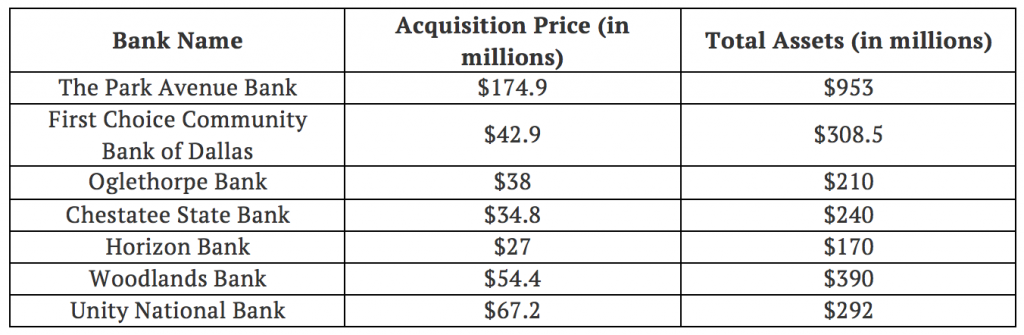](/content/images/wordpress/2016/09/ozrk1.png)
George Gleason then did another pivot to best serve his opportunity set. While organic growth continues to be a focus for the bank, Bank of the Ozarks went about transacting in traditional acquisitions with banks in highly attractive areas to further expansion. The time was right, as the Bank of the Ozarks culture of excellence had been firmly established and the prices for banks continued to be at attractive prices. The following is a list of the acquisitions the bank has completed after the FDIC assisted acquisitions:
[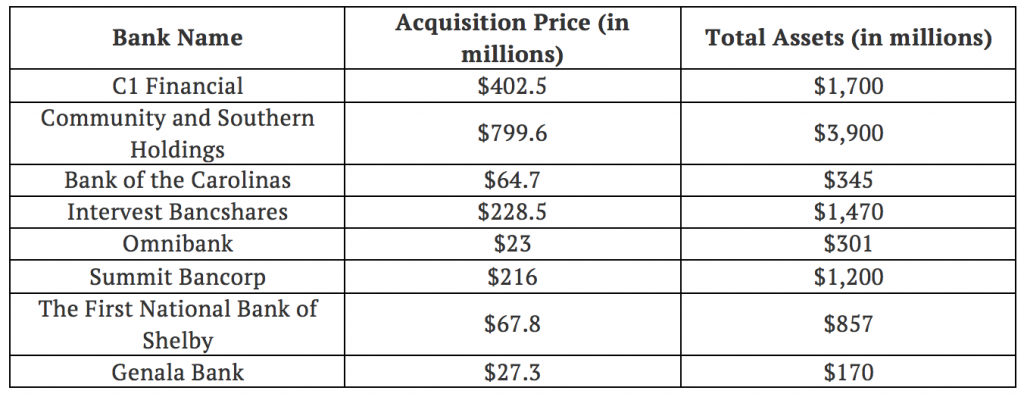](/content/images/wordpress/2016/09/ozrk2.png)
The results of the disciplined capital allocation have compounded Bank of the Ozarks’s capital at a high rate over the past decade. Net income grew 18.7% annually and has maintained returns on equity and efficiency ratios at the top of the banking industry. Clearly George Gleason’s culture of excellence has been performing extremely well and is likely to maintain the performance into the future.
[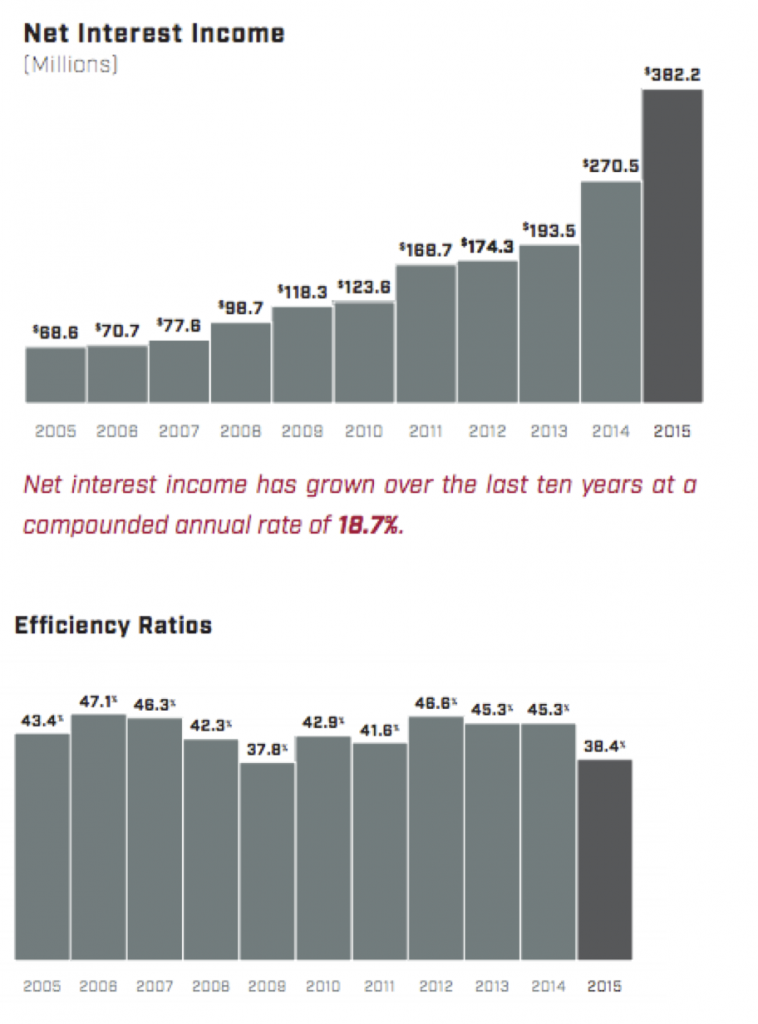](/content/images/wordpress/2016/09/ozrk3.png)
As one MicroCapClub member highlighted on our forums, George Gleason could be considered a contrarian value investor running a bank. Below is a quote from a conference call that highlights his, and the banks, mentality:
> A lot of our competitors tend to move as a pack and are heavily driven by headline risk and headline perceptions of market conditions. We have always tried to have a much more nuanced and intelligent and deeply analytic approach to originating credits. You can read the headlines and run with the herd, but when you do you miss tremendous opportunities and you often are running in the wrong direction. So what we have tried to do is sort of ignore the headlines to a great extent, I mean certainly you to have to take larger macroeconomic and market themes into account. But we have really tried to not let that drive our decisions, but instead to look at the supply demand metrics of each sub-market market and macro market and the relative competitive position of each product in the market and do a much deeper level of analysis on projects. So as a result of that, we are finding tremendous opportunities in Manhattan, Miami, Houston, Dallas as well as markets that probably have gotten better headlines, such as California and Seattle and Denver. So we are really doing our homework as we always have done and really developing detailed supply-demand analytics and models on the market and finding great business in a lot of markets where you are seeing some fairly negative headlines.
George Gleason in retrospect clearly is an intelligent fanatic, however, early on he shared many of the same characteristics as other intelligent fanatics we have studied. We do not think this is a coincidence. As you might have noticed with our write-ups on intelligent fanatics, such as [Selim Bassoul at Middleby Corp](http://microcapclub.com/2016/05/middleby-corporation-midd-case-study-intelligent-fanatic-led-100-bagger/) or [Kent Thiry at DaVita](http://microcapclub.com/2016/07/davita-healthcare-partners-dva-intelligent-fanatic-led-turn-around/), there is a fairly consistent pattern. Extremely adept business leaders run these companies. Their corporate cultures and strategies might not be exactly the same but are quite similar. It takes a significant amount of qualitative due diligence to find these leaders early. If you’d like to continue to build your mental model on intelligent fanatics, read the [Intelligent Fanatics Project](http://intelligentfanatics.com/?ref=microcapclub.com), which provides more in-depth case studies and further ties in the common characteristics and strategies of these rare leaders.
Quotes Taken From Following Links:
- [Supervisory Management: The Art of Inspiring, Empowering and Developing](https://books.google.com/books?id=mF3B7RfvWwQC&pg=PT96&lpg=PT96&dq=bank+of+the+ozarks+employee+culture&source=bl&ots=LD56lLRkSa&sig=8NvAl7JXB0j4hmYFWKXDDX0zVis&hl=en&sa=X&ved=0ahUKEwi%5F5cv-svjOAhWEOSYKHTvFAkgQ6AEIRjAH#v=onepage&q=bank%20of%20the%20ozarks%20employee%20culture&f=false)
- [Investor Presentation](https://www.bankozarks.com/assets/docs/ozrk%5Finvestor%5Fpresentation%5Faugust%5F2016.pdf?ref=microcapclub.com)
- [Born to Succeed](http://www.regionalmagazines.org/downloads/competition/ARL-2011-ctgy12-Single-Photo.pdf?ref=microcapclub.com)
- [Community Banker of the Year](http://www.bankozarks.com/assets/docs/Gleason%5FAB2010.pdf?ref=microcapclub.com)
- Johnson, Scott A., “George Granville Gleason II” *Arkansas Democrat-Gazette, 2005.*
**\===> Interact and learn with 250+ of the best microcap investors on the planet.** [\[Join Us\]](https://microcapclub.com/join-now/)
MicroCapClub is an exclusive forum for experienced microcap investors focused on microcap companies (sub $500m market cap) trading on United States, Canadian, European, and Australian markets. MicroCapClub was created to be a platform for experienced microcap investors to share and discuss stock ideas. Since 2011, our members have profiled 1000+ microcap companies. Investors can join our community by applying to become a member or subscribing to gain instant view only access. MicroCapClub’s mission is to foster the highest quality microcap investor Community, produce Educational content for investors, and promote better Leadership in the microcap arena. For more information, visit [http://microcapclub.com](http://microcapclub.com/) and
### Would a 30 Year Old Warren Buffett be Studying Silicon Valley Tech Companies?
URL: https://microcapclub.com/30-year-old-warren-buffett-studying-silicon-valley-tech-companies/
Last updated: 2024-01-19T20:28:17.000Z
Kevin Martelli, who is part of the MicroCapClub community, has given me permission to republish a memo he wrote 18 months ago which I thought to be very thought provoking and applicable to microcap investing. Enjoy.
The following pages are a collection of interesting facts and considerations on various topics related to entrepreneurship, start-ups and innovation. I have tried to summarize this in 20 pages after reading a significant amount of material on these fascinating subjects. There are probably no original thoughts in this memo, nevertheless some of the considerations provided may sound a bit provocative, but this was done to stimulate the reader’s thinking about these interesting topics (and to keep the memo short).
Overall I think studying how great entrepreneurs operate and how top venture capitalists select their investments is useful to become a better investor also in mature businesses (after all every mature business has once been a start-up and many of its traits and characteristics were set at the beginning).
Finally according to Ray Kurzweil’s Law of Accelerating Returns of human history, the amount of technological changes that occurred between 1750 and 2015, will probably take place in the next 20 years or so (since progress occurs at an ever faster rate in more advanced societies)1\. This implies that technological innovation will become increasingly important for investors, regardless of their investment approach.
**Key questions I have been trying to address:**
1. Why, from an investment and business perspective, is it important to understand (i) what is happening in Silicon Valley today and (ii) which are the main drivers that over the last 50 years have led to Silicon Valley’s unquestionable dominance (vs. other parts of the world) in generating new tech businesses and innovations?
2. What are the key traits and characteristics of great entrepreneurs over the last couple centuries?
3. How do top venture capitalists select the start-ups to bet on?
4. Would Warren Buffett be studying Silicon Valley “tech companies”, if he was 30 years old today?
5. With specific reference to tech-related innovations and the start-up world discussed in this memo, which are the important questions that an investor should be asking himself/herself today?
**Selected books that have inspired the considerations contained in the following pages:**
1. Zero to One: Notes on Start-ups, or How to Build the Future by Peter Thiel and Blake Masters
2. The Hard Thing About Hard Things: Building a Business When There Are No Easy Answers by Ben Horowitz
3. The Innovators: How a Group of Investors, Hackers, Geniuses, and Geeks Created the Digital Revolution by Walter Isaacson
4. Technology Revolutions and Financial Capital by Carlota Perez
5. Venture Capitalists at Work: How VSs Identify and Build Billion-Dollar Successes by Tarang Shah and Shital Shah
6. The Change Masters: From Carnegie to Gates, How the Great Entrepreneurs Transformed Ideas into Industries by Maury Klein
7. The Myth of the Robber Barons by Burton W. Folson
8. Start-Up: What We May Still Learn From Silicon Valley by Herve Lebret
9. Red Wired: China’s Internet Revolution by Sherman So, J. Christopher Westland
10. America’s Most Successful Start-Ups by Oliver Samwer (Rocket Internet Founder) and Max Finger
11. The Innovator’s Dillemma by Clayton Christensen
12. In the Plex – How Google Thinks, Works, and Shapes our Lives by Steven Levy
13. Steve Jobs by Walter Isaacson
14. Outliers by Malcolm Gladwell
15. Antifragility by Nassim Taleb
---
[Entrepreneurship\_start-ups\_and\_innovation\_January\_2015\_KMREAD THE FULL MEMO HEREEntrepreneurship\_start-ups\_and\_innovation\_January\_2015\_KM.pdf819 KBdownload-circle](https://microcapclub.com/content/files/2024/01/Entrepreneurship%5Fstart-ups%5Fand%5Finnovation%5FJanuary%5F2015%5FKM.pdf "Download")
---
**\===> Interact and learn with 250+ of the best microcap investors on the planet.** [\[Join Us\]](https://microcapclub.com/join-now/)
MicroCapClub is an exclusive forum for experienced microcap investors focused on microcap companies (sub $500m market cap) trading on United States, Canadian, European, and Australian markets. MicroCapClub was created to be a platform for experienced microcap investors to share and discuss stock ideas. Since 2011, our members have profiled 1000+ microcap companies. Investors can join our community by applying to become a member or subscribing to gain instant view only access. MicroCapClub’s mission is to foster the highest quality microcap investor Community, produce Educational content for investors, and promote better Leadership in the microcap arena. For more information, visit [http://microcapclub.com](https://microcapclub.com/) and
### The Perfect Pitch
URL: https://microcapclub.com/the-perfect-pitch/
Last updated: 2023-10-14T18:52:08.000Z
We all like to talk about the stocks we own. If you are anything like me, you also do a lot of analysis into the companies you own. You can’t develop the conviction to hold without spending the time to know your positions better than most. It could take weeks or months to conduct due diligence and to acquire shares for the A-account (yours), preferably before others. After you’ve bought your position you would like to tell others about this gem you found that was buried in the weeds.
Some investors like to look down upon those that talk their book. I laugh at this because EVERYONE talks their book. It’s the way we are hardwired as humans. You spend countless hours doing anything and of course you want to tell others about what you’ve been doing. My rule has always been, [Put Your Money Where Your Mouth Is Or Shut Your Mouth](http://microcapclub.com/2014/07/put-your-money-where-your-mouth-is-or-shut-your-mouth/).
One of the best ways to find new ideas is [networking and communicating](http://microcapclub.com/2015/01/building-your-network/) with other investors online or in person. MicroCapClub is a collaborative microcap idea engine that utilizes the talents of the membership (network effect) to turn over thousands of microcap rocks in search of the next great company. The Club has been very successful in generating actionable ideas, but I still enjoy talking to investors in person and on the phone.
> “Our best source of deals is word of mouth, generally in industries we’re invested in.” – Warren Buffett
Talking to other investors is one of the best ways to hear about new ideas. My favorite question is: What is your favorite company at the current price? I want to hear an investor’s best pitch. Coincidentally, it’s also why we have an afternoon devoted to the Pitch Session at the [MicroCap Leadership Summit](http://microcapclub.com/summit/).
The perfect pitch is an art. I learned from one of the best in the game, but before I get into the delivery itself, the most important thing is to find a company that is worth pitching. The perfect pitch doesn’t mean putting lipstick on a pig ie: bad or mediocre business, it means finding a truly great opportunity. Ultimately the businesses characteristics and industry dynamics should make it an easy and compelling story.
Last week I watched a fascinating Google Talk with Chris Voss who was the former FBI lead international kidnapping negotiator. He wrote a book earlier this year called, [Never Split The Difference: Negotiating As If Your Life Depended On It](https://www.amazon.com/Never-Split-Difference-Negotiating-Depended/dp/0062407805/ref=sr%5F1%5F1?s=books&ie=UTF8&qid=1471259495&sr=1-1&keywords=chris+voss&ref=microcapclub.com).
Several minutes into the Google Talk, Voss mentions that one of the tools he uses to get the person on the other side of the negotiating table to say yes is to first get them to say “that’s right”. He said there is a mental epiphany that occurs when a person sees or hears something that they completely agree with and believe to be a complete truth.
When I heard this I had a flashback to 12-13 years ago during my own investing journey. I was still in graduate school during this time, trying to compound my capital while also building up my reputation on public stock message boards. I formed friendships with several people on the stock message boards, first virtually online, and then in person. One of them was someone I would consider a mentor. He was a stock promoter of sorts but he had this way about him. He was the best stock pitchman I ever met. He could sell you anything. Many would be turned off by his promoting nature, but I was a firm believer that I could learn something from anyone. So I befriended him and he would show me the ropes on how to “pitch a stock”. He was also a real professional when talking to management teams. He had this likeability about him which made him even more persuasive. We actually traveled together to meet management teams and invest in a few companies. I learned a lot from him.
The most important part of the perfect pitch is the first 30 seconds. One of the first things he told me was that when you are pitching a stock to someone you have less than 30 seconds to get them to agree with you. In essence, out of the gate, get a “that’s right”. Communicate the “Why” of a company in a convincing way. He had me practice it. He would give me a few companies and like a drill sergeant would tell me to pitch him on the companies. Over time I became very good at “the pitch”. When I started my own advisory firm after graduate school I used a lot of these skills with management teams and also other investors to pitch my investments.
The older I get the less interested I’ve become in convincing others of the investing merits of my positions. This is mostly due to my long-term investment time horizon while most microcap investors have short-term time horizons. Quite frankly, attracting traders and short-term thinkers into my positions doesn’t benefit me or the company.
But one of the ways I still find creating “the pitch” useful is breaking down a company into a simple, digestible form. [Keep it simple](http://microcapclub.com/2016/03/keep-it-simple/). The ability to quickly communicate to someone what need a company fulfills is a great mental exercise. A big part of my investment strategy is focusing on simple businesses. Simple businesses aren’t always great businesses but great businesses are almost always simple businesses.
Like Voss does in negotiating, I think it’s very useful to develop a mental model and deconstruct a business into its simplest form to get a “that’s right” or a “yes” quickly. The purpose isn’t necessarily to convince others, but to convince yourself. I know I’ve passed on several companies because they were just too complicated. Extraordinary returns follow extraordinary discipline. Warren Buffett and Charlie Munger call it the “too hard pile”. Use it often.
When I find what I believe is a new, possibly great company, I’ll research it, talk to management, and formulate an investment thesis. When I’m done buying [my first third](http://microcapclub.com/2014/09/buy-low-and-then-buy-higher/) I’ll often times call a couple close investor friends and deliver “the pitch” to see how they react. I’m not pitching them to necessarily receive confirmation on the investment, but more so to find holes in my thought process. That said, I fire strong out of the gate trying to get a “that’s right” in the first 30-60 seconds. Let me give you a couple examples:
**The Pitch- Company A:** Would you or any investor trust a company’s financials if they didn’t have audited financials? Of course not. Then why is it you trust what you eat. Most of the organic, gluten free, natural, non-GMO labeled food you buy and feed your kids isn’t audited or verified. You’re taking the producer-manufacturers word for it. Does this make sense to you? Company A dominates the North American market in auditing/third party verifying food production practices. Consumers are now demanding “trust but verify” in what they eat. Large brands like McDonalds and Dannon are now adopting third party verification across their supply chain. The rest will likely follow. The company is 48% management and board owned, profitable, with a long runway of self-funded growth.
**The Pitch – Company B:** The 2nd largest industry in the world is the textile industry. The clothes that you wear, the upholstery in your car, on your furniture, even the tires on your car. Did you know that 99% of the textile industry still uses humans for quality assurance and visual inspection? They pay people to stare at loom or finishing line watching fabric and other material flying by to pick out defects. Does this make sense to you? Company B has 60%+ market share of those textile companies that have adopted automatic inspection systems. The ROI for customers is normally less than 12-months, and less than 1% of the industry has adopted it which should provide for a long runway of self-funded growth. Company B is 58% management and board owned.
After this first 30-60 seconds, I let the recipient shape the rest of the conversation. Know your positions better than most so you can answer most questions. Focus on finding simple great companies early, not onions where you have to peel back multiple layers to understand them. When you can succinctly and clearly communicate your thesis it helps you solidify your [conviction to hold](http://microcapclub.com/2014/08/the-conviction-to-hold/).
I hope you can absorb this article in the spirit it was given. Talking about stocks is fun. Making money in stocks is even more fun. Go out and find [great companies early](http://microcapclub.com/2015/12/all-great-companies-started-as-small-companies/) so you can give the perfect pitch.
**\===> Interact and learn with 250+ of the best microcap investors on the planet.** [\[Join Us\]](https://microcapclub.com/join-now/)
MicroCapClub is an exclusive forum for experienced microcap investors focused on microcap companies (sub $500m market cap) trading on United States, Canadian, European, and Australian markets. MicroCapClub was created to be a platform for experienced microcap investors to share and discuss stock ideas. Since 2011, our members have profiled 1000+ microcap companies. Investors can join our community by applying to become a member or subscribing to gain instant view only access. MicroCapClub’s mission is to foster the highest quality microcap investor Community, produce Educational content for investors, and promote better Leadership in the microcap arena. For more information, visit [http://microcapclub.com](http://microcapclub.com/) and
### Searching for Gold in SEC Filings
URL: https://microcapclub.com/searching-gold-sec-filings/
Last updated: 2023-10-14T18:54:01.000Z
Most investors read press releases issued by the companies they own or are considering owning. However, I’m sure that many investors skip reading through SEC filings. That is a big mistake as there are often gold nuggets in SEC filings that can provide crucial clues as to whether a company is a good investment or a bad investment.
Scanning through SEC filings is an important component of my process for prospecting for great new investments as I describe in [My Secret Recipe: Shopping and a Taste Test](http://microcapclub.com/2012/10/my-secret-recipe-shopping-and-a-taste-test/) and is an important part of evaluating a new investment idea as described in [My Secret Recipe: Inspecting the Ingredients](http://microcapclub.com/2015/02/my-secret-recipe-inspecting-the-ingredients/). The clues you can find in SEC filings are often overlooked by the market and can provide you with an edge over other investors.
While this article focuses mostly on positive pieces of information you can find in SEC filings it also hits on some of the negative items. For more information on things to avoid in investments and to seek in SEC filings, I suggest reading my article [Investing Pitfalls to Avoid](http://microcapclub.com/2016/01/investing-pitfalls-to-avoid/).
This article doesn’t talk about everything that is included in SEC filings as that could be a topic for a book. Rather it focuses on those nuggets of information that you should try to find in SEC filings. Some of the items covered in this article may be discussed in a company press release and/or conference call but rarely are all of the important points in filings covered in those venues and some companies gloss over most of these items. Also, there are some companies that only issue SEC filings and have no press releases. I have made significant money on these kinds of companies as they are really off the radar.
While this document focuses on US SEC filings, almost all of what is included in this article is applicable to Canadian SEDAR filings and likely regulatory filings in other jurisdictions.
Generally the most important SEC filings to read are the quarterly and annual filings. With the exception of certain foreign companies, these are known as 10-Qs (quarterly) and 10-Ks (annual) filings. Below I detail some of the things I look for. In this analysis I’m going to assume that the company issues press releases that include both the statement of operations (AKA P&L) and the balance sheet. So, I’m not going to cover obvious things like earnings and revenue growth.
**Commentary on the Results**
Companies often give detailed commentary on their results for the reporting period within a 10-Q or 10-K. If included, the information usually can be found in Item 2 of a 10-Q and Item 7 of a 10-K. These sections should be entitled Management’s Discussion and Analysis of Financial Condition and Results of Operations.
This commentary may provide all kinds of useful information about the results. For example, it may provide reasons for revenue increases or decreases. Perhaps there is a macro trend that is causing revenue to increase or decrease. Perhaps there was a large, one-time order that will not repeat. Comments on revenue changes provide clues to the future as it may tell you that the results for the period were an aberration or they may indicate that a new trend is starting.
Two other areas that companies may discuss in this section include gross margins and expenses. The reasons that these metrics are better or worse for the quarter can provide very important clues for the future.
**Backlog and Deferred Revenue**
Backlog is a favorite item of mine to investigate in a filing as it provides a very useful clue for the future. If backlog is increasing significantly, you usually will see increased revenue going forward. The opposite is true for decreasing backlog. Note that many businesses don’t report backlog either because they choose not to provide the information or because it isn’t relevant for their type of business.
[Deferred revenue](http://www.investopedia.com/terms/d/deferredrevenue.asp?ad=dirN&qo=investopediaSiteSearch&qsrc=0&o=40186&ref=microcapclub.com) is another area that is similar to backlog and will be located on the balance sheet if it is applicable to the company. Like backlog, significant increases in deferred revenue are often signs that revenue is going to increase in the future.
**Guidance**
Some companies provide guidance within their SEC filings. This isn’t extremely common but it is done by a small percentage of companies. Guidance may be provided overall on revenue or earnings or it may be on particular financial metrics such as gross margin, or expenses. Usually guidance in an SEC filing is more about general expectations (e.g. We expect revenue to improve.) rather than specific guidance (e.g. We expect revenue next quarter to be $3-4M.).
**Major New Contracts**
Some companies announce major new contracts in SEC filings rather than issuing press releases. These can be particularly valuable nuggets as it can indicate an inflection point for the company which others may not know about until they hit the bottom line at which it may be too late to take advantage of the information.
**Cashflow Statement**
The cashflow statement is often not contained in a press release. It can provide valuable information about the company. For example, one can examine how cashflow compares to earnings as that will provide some clues on the quality of earnings.
**Risks**
A section on risks is contained in 10-K filings. This section is sometimes included in 10-Q filings as well. Much of the risks are legal boilerplate information that isn’t that important. However, there are some things that come out in these sections that provide important clues. For example, customer concentration can be an issue particularly in microcaps. The risk section should tell you if there are large customers that would have a significant impact on future financial results if they were lost. The list of risks can cover a large range of issues. The important thing is to find those that are truly critical to the company and properly incorporate them into your analysis of the company.
**Debt**
The terms of debt (e.g. interest rate, covenants, & due dates) are included in 10-K filings and often in 10-Q filings. Any debt is important to monitor to know in advance if the company may have a problem paying back such debt.
**Share Structure/Dilution**
Companies will indicate the number of shares outstanding for each class of stock (common and preferred) in each 10-Q or 10-K and will also indicate any potentially dilutive shares to be issued in the future (e.g. options, warrants, convertible debt, convertible preferred, etc.). It is important to examine any growth in the share count to make sure it is justified. Issuance of a large number of shares can be a red flag that indicates you should avoid the company particularly when the company has repeated stock offerings. What is important to understand is the necessity and reasonableness of the issuance as well as what it means to the overall investment thesis.
Sometimes companies will indicate in filings when they are looking to raise money and the preferred method they will use for financing (e.g. share issuance via private placement, debt, management loan, rights offering, etc.). Raising money especially via share issuance can potentially have a significant impact on the stock price (almost always negative) so it is important to be aware of a company’s need for capital.
For more information on this topic read [A MicroCap Investors Worst Enemy is Dilution](http://microcapclub.com/2013/07/a-microcap-investors-worst-enemy-is-dilution/).
**Legal**
Any material legal issues should be published in a 10-K and may also be indicated in a 10-Q. Most businesses have some level of legal issues that are normal in the course of business and aren’t a problem. However, sometimes there are major issues (e.g. patent lawsuit) that can have a major impact on the company. Keeping abreast of such legal issues is important for analyzing a company.
**Subsequent Events**
Companies indicate material events that happened after the end of the reporting period but before the date of the filing as subsequent events. These events can cover a wide variety of topics such as new customers, lost customers, product problems, stock issuance, departure of executives, new legal agreements, etc. These nuggets are often very important clues for the future.
**Subtle Clues as Compared to Prior Filings**
Sometimes there are subtle clues in SEC filings that can provide great insight. Occasionally, I find it interesting to compare the wording between filings from the same company. I’ve seen companies change a word or two in a sentence or remove a sentence altogether. For example, past filings may have indicated that they expect future revenue growth but then they suddenly omit the sentence that indicated that. That may indicate that they believe that the good times have ended but you would only know that by comparing a current filing to a prior filing or filings.
Another example is that sometimes a company writes a concern of theirs in the filing which you may find worrisome as a new investor. However, when you look back through the history you find that they have written the same thing for the past several years. A company’s attorney may have them write something conservative that has only a remote chance of happening. So past history can definitely be a clue.
In short, sometimes just knowing management’s past disclosures and comparing them to current disclosures tells you much more than what you would figure out from reading just the latest filing.
**Information in 8-Ks**
Companies report material corporate events in 8-K filings. These filings are used to fill in the gaps between quarterly and annual filings when important events happen. While these events are material, they may not be published in a press release particularly if they are negative developments. If you have invested in a company it is important to look at each 8-K filing to keep current on the developments of the company.
In conclusion, you can see that there are many nuggets of gold you can find in SEC filings. They can be dry documents to read, but reading them is crucial to proper analysis of a company. I have found that reading SEC filings can provide significant opportunities to make money as the information is often overlooked by other investors. That is why I spend multiple hours each day reading SEC filings.
**\===> Interact and learn with 250+ of the best microcap investors on the planet.** [\[Join Us\]](https://microcapclub.com/join-now/)
MicroCapClub is an exclusive forum for experienced microcap investors focused on microcap companies (sub $500m market cap) trading on United States, Canadian, European, and Australian markets. MicroCapClub was created to be a platform for experienced microcap investors to share and discuss stock ideas. Since 2011, our members have profiled 1000+ microcap companies. Investors can join our community by applying to become a member or subscribing to gain instant view only access. MicroCapClub’s mission is to foster the highest quality microcap investor Community, produce Educational content for investors, and promote better Leadership in the microcap arena. For more information, visit [http://microcapclub.com](http://microcapclub.com/) and
### Microcap Activism is a Hard Road to Travel
URL: https://microcapclub.com/microcap-activism-hard-road-travel/
Last updated: 2023-10-14T19:33:09.000Z
Some people know me by my book, [Dear Chairman](https://www.amazon.com/Dear-Chairman-Boardroom-Shareholder-Activism/dp/0062369830/ref=sr%5F1%5F1?ie=UTF8&qid=1469700972&sr=8-1&keywords=dear+chairman&ref=microcapclub.com), but what they don’t know is I’m an avid microcap investor. Along with teaching value investing at Columbia Business School, I co-manage a fund called Bandera Partners and we are active in the microcap space. I sent Ian one of my quarterly letters from a few years ago describing a long and arduous story with a microcap company, and he thought it was interesting enough to share with the world.
In 2003, I found a company called UCI Medical Affiliates with a market capitalization of about $3 million. I was in my twenties, working as an analyst at a distressed debt hedge fund in New York City. UCI, which ran urgent care clinics in South Carolina, had recently emerged from a rare bankruptcy that preserved the equity. Several large blocks of stock were available, but I failed to convince my superiors to buy them. I then bought some shares in my PA and embarked on an intense, eight-year, hard knocks education in microcap investing. I’ve been hooked on microcaps ever since, for better and for worse.
In early 2011, Bandera Partners (which I run with my partner Greg Bylinsky) negotiated UCI’s sale for $65 million. It felt like a minor miracle. A mere two years earlier, UCI’s valuation had fallen all the way back to the $3 million it garnered when I first found it. I ended up writing 6,000 words about the investment in our next quarterly letter. I also attached some of our correspondence with UCI’s majority owner, Blue Cross Blue Shield of South Carolina, as an exhibit. The letter was so well-received by our investors, that it gave me confidence to write “Dear Chairman.” The book takes its structure from this quarterly letter—a fun narrative followed by an original letter from shareholder to company.
I’m excited to share the UCI saga here, for investors that have learned the hard lessons that microcap investing offers. It is a lurid tale with all the hallmarks of value investing: drug addiction, suicide, prison, and, worst of all, accounting restatements. When I waltzed into this investment, I was incredibly naïve about public companies, boards of directors, and corporate governance. In fact, with UCI I committed the cardinal microcap investing sin: I bought into a company controlled by a majority shareholder. Don’t worry, as you’ll see, it got much worse.
You can read the full story in my Bandera Partners Q1 2011 Letter [\[HERE\]](http://microcapclub.com/wp-content/uploads/2016/07/Bandera-Q1-2011.pdf).
**\===> Interact and learn with 250+ of the best microcap investors on the planet.** [\[Join Us\]](https://microcapclub.com/join-now/)
MicroCapClub is an exclusive forum for experienced microcap investors focused on microcap companies (sub $500m market cap) trading on United States, Canadian, European, and Australian markets. MicroCapClub was created to be a platform for experienced microcap investors to share and discuss stock ideas. Since 2011, our members have profiled 1000+ microcap companies. Investors can join our community by applying to become a member or subscribing to gain instant view only access. MicroCapClub’s mission is to foster the highest quality microcap investor Community, produce Educational content for investors, and promote better Leadership in the microcap arena. For more information, visit [http://microcapclub.com](http://microcapclub.com/) and
### DaVita HealthCare Partners (DVA): An Intelligent Fanatic Led Turn Around
URL: https://microcapclub.com/davita-healthcare-partners-dva-intelligent-fanatic-led-turn-around/
Last updated: 2023-10-14T19:34:56.000Z
In October 1999, Kent Thiry, a businessman with a positive track record in the dialysis industry and former Bain & Company consultant, was hired to lead the turnaround of a near bankrupt dialysis company called Total Renal Care (TRC). Warren Buffett says that turnarounds rarely turn. [Intelligent fanatics](http://microcapclub.com/intelligent-fanatics/) have the capacity to lead turnarounds and Kent Thiry’s leadership at TRC, now known as DaVita HealthCare Partners (DVA), is a great case study.
[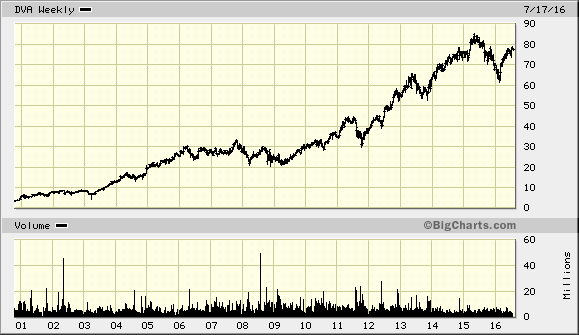](/content/images/wordpress/2016/07/DVA-Stock-Chart.gif)
From 1999-2016, Thiry turned DaVita from a $200 million microcap on the brink of failure into a $16 Billion midcap and the best dialysis company in the world. Business and stock performance has been stellar. DaVita revenues have grown from $1.3 billion to $14 billion, net losses of $147 million have turned to net income of $477 million LTM 2016, and retained earnings have increased from negative $100 million to a positive $4.4 billion. Thiry executed an astute capital allocation strategy without diluting shareholders. The company actually has 37 million fewer shares outstanding. Kent Thiry and his “village” have compounded shareholder value at a 31% CAGR during his sixteen-year tenure, producing a 70-bagger for shareholders. That compares to a 4.8% CAGR total return for the S&P 500 over the same time period.
[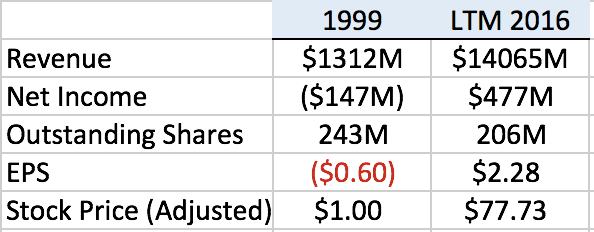](/content/images/wordpress/2016/07/DVA-1999-2016-Comparison.png)
In terms of clinical outcomes, DaVita went from mediocre (at best) to leading the industry. Today, 46% of DaVita’s facilities receive 4 or 5 stars on The Centers for Medicare and Medicaid Services (CMS) quality rating system compared to peers 22%. By the end of 2013 the company had a gross mortality rate of 13.7%, the lowest mortality rate in the dialysis industry. If your life depends on dialysis, your preferred choice would be DaVita.
**Would it have been possible to identify Kent Thiry as an intelligent fanatic and form the conviction to buy and hold DaVita soon after he took control?**
Ian Cassel and I propose that it is possible to identify intelligent fanatic led organizations early. There are patterns amongst great leaders and organizations. And yes, Berkshire Hathaway’s Ted Weschler knew the dialysis market very well and picked up on the pattern at DaVita. His fund disclosed it bought shares in 2003, but was likely buying prior. It is likely his investment has compounded at an 18% CAGR over a fourteen-year period. [Berkshire Hathaway](http://www.bloomberg.com/news/articles/2013-05-24/berkshire-s-weschler-holds-almost-150-million-of-davita?ref=microcapclub.com) is now the largest shareholder in DaVita, owning [18.6%](http://www.nasdaq.com/symbol/dva/ownership-summary?ref=microcapclub.com) of the company. In 2014, Ted Weschler [explained on CNBC](https://youtu.be/-Cg1QrM5G6E?ref=microcapclub.com) why he likes DaVita.
In 1999, DaVita, then named Total Renal Care (TRC), was on the brink of bankruptcy. A hasty roll-up strategy had left the company in total disarray. The company couldn’t track their clinical outcomes nor could they correctly bill or collect, leading to delays in insurance reimbursement, their sole source of revenue. Cash flow was stymied with collection issues and the company was violating its debt covenants. If lenders had asked for advanced payment of any of the $1.4 billion in outstanding debt, TRC would have folded and the DaVita success story would have never transpired.
Previous CEO Victor Chaltiel and other executives had either left the company or had been fired. Employee morale was at an all time low. Fortunately, in October 1999 the board of directors was able to convince Kent Thiry to suspend his plan to spend six months with his family and instead attempt to turnaround TRC. Kent had successfully grown another dialysis business, Vivra, and sold it to Grambro AB for $1.5 billion.
Building a Village
Thiry first “got the right people on the bus.” Many of the talented individuals he knew and trusted during his tenure at Vivra joined TRC. Even with talent, however, the numerous nurses and front line staff at the dialysis centers had extremely low morale. Employee turnover was extremely high. Thiry’s first order was to turn around the beliefs and behaviors of employees starting in May 2000 at a company gathering in Phoenix Arizona. There, 500 to 600 clinic managers, senior managers and other staff discussed, debated and voted on the company’s new core values. The mission, values and culture were the levers to pull to turn DaVita into a great dialysis company. As Bill Walsh, former coach of the San Francisco 49ers, often said, “Champions behave like champions before they are champions.” Thiry and his team had to convince teammates to believe they were champions at rock bottom.
During the meeting, employees chose the new name DaVita, Italian for “giving life,” and chose the following core values:
- Service Excellence
- Integrity
- Team
- Continuous Improvement
- Accountability
- Fulfillment
- (later) Fun
The mission and core values were easy to understand and since employees chose them, they had ownership. DaVita’s mission and core values also are very similar to Southwest Airlines and other highly successful intelligent fanatic led organizations. This was not a coincidence as senior managers were benchmarking their culture against these successful companies.
Kent found ways to bring the mission and values to life. DaVita gatherings now had skits, senior managers dressed as the three musketeers, chants, call and response and other activities. While odd, each activity encouraged people to talk about the mission and core values of the company in a way that was memorable. A dry memo and other forms of communication, commonly used by organizations, would have been boring and fallen flat. Many of these activities acted as bonding opportunities similar to those found in other communities such as the armed forces and sports teams. The clips below were taken from Kent Thiry’s 2005 presentation at Stanford Graduate School of Business entitled [“From Demoralization to Living Community”](https://www.youtube.com/watch?v=oRsMIOdR2dc&ref=microcapclub.com)
Here is an example of the songs:
Chants such as “One for all, all for one” have been the backbone of DaVita. Thiry got the idea after watching the Three Musketeers and it encompassed the ethos that he wanted to create at the new DaVita.
Rehabilitating the culture of the company was not easy in the beginning for Thiry. He had to take a risk and persist with the new change to fully transform the business. The following video shows the response he received during the meeting in Phoenix in 2000 and the transformation in the ensuing years.
Kent Thiry and other senior managers also created the concept of a village in hopes that DaVita would become a “community first and a company second.” Such a mental framework made many of the changes they wanted seem logical as a community with quality citizenship which otherwise would look like a bad idea from the corporate perspective. Employees were considered teammates and if they “crossed the bridge” of believing the company was special, they became “citizens” of the “village” where the leader, Kent Thiry, known as KT was “mayor.”
To be a village, KT had to act like a “mayor” and treat his “village” like a true village. Town hall meetings were instated where employees could ask senior management questions and were meant to provide extreme transparency. DaVita also celebrated “village” victories. Once the company reached solvency, like an army general, Thiry announced victory. He recorded the following message sending it to 1,500 teammates.
All of these cultural changes could have been identified as early as May 2000 when DaVita’s share price was at its lowest. Over time, the cultural shift could have been evident. All these changes, while weird and highly unconventional, were the precursor in turning the dysfunctional team into a well-oiled organization achieving the best clinical outcomes in the industry.
DaVita has [won multiple awards](http://www.davitaclinicalresearch.com/press-releases/davita-healthcare-partners-celebrates-milestones-of-2015/?ref=microcapclub.com) in different areas which shows how successful their “village” culture has become.
You Can’t Fix What You Can’t Measure
In 1999, TRC couldn’t track any clinical outcomes and loosely tracked financial transactions. DaVita was not delivering a net savings to our healthcare system. Managers spent a great deal of time openly communicating the elephant in the room, getting to solvency. A significant portion of time would also be spent talking about the company’s core values. What could have been identified during that time were the systems being developed to increase efficiency and productivity.
In the early 2000’s, the company implemented tracking and analytics so that clinical outcomes and financial results could be tracked and evaluated by everyone. Kent Thiry and all other DaVita “villagers” had a sense of accountability and used it as a way to motivate each other.
While employee turnover was extremely high when Kent Thiry joined TRC, the new DaVita culture retains them much longer. Employee turnover decreased by almost 50% between 2000 and 2005, which was a real cost savings to the company.
Incentives and Team Unity
DaVita honors their teammates’ values with celebrations and rewards for performance. The Triple Crown Profit Sharing Program either gives cash bonuses or 401(k) contributions to teammates. These bonuses can be earned in three ways: the village meets financial and clinical goals, teams meet various goals, or individuals demonstrate core values at work. No other dialysis company has similar financial rewards.
In addition, the DaVita Village Network was established as an unconventional benefit to maintain the DaVita “village”. Many of the DaVita teammates make less than $15 per hour and have few, if any, financial safety nets, so DaVita’s Village Network provides that safety net. Every teammate takes a dollar out of their after tax pay check to help a neighbor in financial need and DaVita at least matches it with another dollar.
By 2012, the program raised $2 million and the impact on DaVita “villagers” in financial need has been significant. There are many stories of the village helping each other out, but Kent often repeats the story of a lower-paid teammate experiencing difficulties. As a single mother with a daughter experiencing grand mal seizures, she was experiencing significant financial hardships. She sent the following letter to the “village” after receiving financial assistance:
> “I came to work with a lingering worry in my heart. Ever since my daughter Emma has been in hospital, I have been afraid. Afraid that it would happen again to her. There’s a 50 percent chance of her having more seizures. Afraid of how I will provide for her financially, from the hospital bills calling my name from that devastating night. Afraid if I will make it. I’ve really tried to stay positive throughout all of this, but it is hard. Then during our weekly home-room, my manager presented me with a Village Network grant and letter. I cannot even begin to tell you how this has affected me today. Not only did I feel a huge relief from the recent pressures, but I have a feeling of family and love. A feeling of a village that will stop at nothing to help another person in their time of need. Never in my life have I experienced anything to make me feel this special. So from here on out, my day has a different outlook. My heart feels calmness. I feel calm simply because it has been proven to me this morning that the human soul is one of the most powerful forces in making good things happen. Thank you, DaVita, for showing me the true meaning of team. One for all, and all for one.”
By providing both the external financial and the internal higher cause motivations, DaVita has been able to significantly increase the efficiency of their work force. Retention of quality human capital and higher efficiency lowers costs delivering a net savings to the company and the US healthcare system.
Growth Through M&A
Companies that have successful M&A strategies often times have strong cultures. We see this in intelligent fanatic 100-Bagger case studies like [Middleby Corporation (MIDD)](http://microcapclub.com/2016/05/middleby-corporation-midd-case-study-intelligent-fanatic-led-100-bagger/) and [Patrick Industries (PATK)](http://microcapclub.com/2016/07/patrick-industries-patk-best-performing-stock-since-2009/). These companies, just like DaVita, are able to inject their culture into the acquired companies and get the most out of their often times neglected human capital. DaVita has been able to sustain growth by acquiring other dialysis companies. They have made three large acquisitions and seventeen smaller acquisitions since 2000\. Below are the three large acquisitions:
Gambro Healthcare (Dec 7, 2004) – $3.05 Billion
HealthCare Partners (Nov 1, 2012) – $4.42 Billion
Renal Ventures Management (Aug 24, 2015) – $415 Million
Shareholder friendly management is a bit harder to forecast before their capital allocation record is evident and obvious. What can be observed early is how management and the CEO talks about their organization and shareholders. Interestingly, most intelligent fanatics do not spend a lot of time catering to Wall Street and even to their own shareholders. Their goal is first and foremost to provide the best experience for the customer and employees. By treating both of those groups extremely well, they retain talent and produce happy, repeat customers. Both of those driving forces, combined with growth, lead to ecstatic shareholders.
In Kent Thiry’s case, he often talked about the means to an end. The means for most companies is to run operations to achieve the end, greater profits. To Thiry and DaVita, more profits were the means to the end of providing better quality of care to patients and creating a better community for the company. To create the best dialysis company in the world, he had to invest heavily into its infrastructure and employees.
It also helps to observe positive capital allocation actions as time goes on by management. Unlike the previous leadership of TRC, Thiry and DaVita grew by acquisitions in a disciplined way. When acquisition targets were not available and shares were undervalued, the company repurchased shares. In 2003, DaVita purchase 27 million shares for $630 million and from 2009 to 2012 repurchased $1.2 billion worth of shares.
[All Great Companies Started As Small Companies](http://microcapclub.com/2015/12/all-great-companies-started-as-small-companies/). Early on in DaVita’s transformation, it could have been evident that DaVita was an intelligent fanatic lead organization. You can often times spot intelligent fanatics early by looking for a leader with an unconventional strategy with a strong emphasis on culture and customers.
If you enjoyed this short case study, you’ll enjoy [Intelligent Fanatics Project: How Great Leaders Build Sustainable Businesses](http://intelligentfanatics.com/?ref=microcapclub.com) scheduled for release on September 15, 2016.
In addition to annual filings, I used the following sources for information:
Kent Thiry’s 2005 presentation at Stanford Graduate School of Business entitled [“From Demoralization to Living Community”](https://www.youtube.com/watch?v=oRsMIOdR2dc&ref=microcapclub.com)
[Kent Thiry and DaVita: Leadership Challenges in Building and Growing a Great Company](https://hbr.org/product/kent-thiry-and-davita-leadership-challenges-in-bui/an/OB54-PDF-ENG?ref=microcapclub.com)
[Kent Thiry: Developing Successful Leaders Takes a Village](https://www.gsb.stanford.edu/insights/kent-thiry-developing-successful-leaders-takes-village?ref=microcapclub.com)
[Kent Thiry, CEO of DaVita: Voices of Experience](https://www.youtube.com/watch?v=j56qPlMC8Dw&ref=microcapclub.com)
**\===> Interact and learn with 250+ of the best microcap investors on the planet.** [\[Join Us\]](https://microcapclub.com/join-now/)
MicroCapClub is an exclusive forum for experienced microcap investors focused on microcap companies (sub $500m market cap) trading on United States, Canadian, European, and Australian markets. MicroCapClub was created to be a platform for experienced microcap investors to share and discuss stock ideas. Since 2011, our members have profiled 1000+ microcap companies. Investors can join our community by applying to become a member or subscribing to gain instant view only access. MicroCapClub’s mission is to foster the highest quality microcap investor Community, produce Educational content for investors, and promote better Leadership in the microcap arena. For more information, visit [http://microcapclub.com](http://microcapclub.com/) and
### Book Review: Leadership Lessons from a UPS Driver by Ron Wallace
URL: https://microcapclub.com/book-review-leadership-lessons-ups-driver-ron-wallace/
Last updated: 2023-10-14T19:35:56.000Z
The management team at UPS, including the CEO and management committee, started as drivers, part time loaders, car washers, and clerks. Ron Wallace writes, “We promote from within to ensure that the company can pass on our legacy and culture seamlessly from one generation to the next.” In 1966, Ron Wallace was hired to be a UPS delivery driver. He would then move up the corporate ladder occupying many leadership roles. He was the head of UPS North German district for six years and then president of UPS Canada for three years and then President of UPS International before retiring in 2002.
“88% of the companies on the Fortune 500 list in 1955 are now dead and buried. So how can a company that traces its roots back to 1907 still be going strong today?” In [Leadership Lessons from a UPS Driver](https://www.amazon.com/Leadership-Lessons-UPS-Driver-Delivering/dp/1626566887/ref=sr%5F1%5F1?s=books&ie=UTF8&qid=1468752668&sr=1-1&keywords=leadership+lessons+from+a+ups+driver&ref=microcapclub.com), Ron Wallace goes into detail on why UPS has succeeded for 100+ years. As Wallace would say, it’s because they have a culture of we, not me.
UPS culture was driven by its founder Jim Casey. In 1929, Jim Casey, added to the company policy book that UPS people would always be addressed by their first name. Casey was known for knowing all of the employees first names down to those that washed trucks. “He had genuine interest in people whenever he met someone, he wanted to hear their stories and ideas on making the company better. He would never rush a conversation and would give the person his full undivided attention.”
Ron Wallace tells the story of his first encounter with Jim Casey in the late 1960’s at a UPS building in Seattle:
> It was late in the day, and I was the only person around. I was focused on hooking up a charger to a dead battery in one of our package cars when I suddenly felt someone standing next to me. I turned, and there he was, Jim Casey himself. I couldn’t believe my eyes, and I’m sure he saw the look of shock on my face.
>
> He stuck out his hand and said, “Hello, my name’s Jim. What’s yours?” Fortunately, I could remember it.
>
> Then he said, “Here, let me help you, I’ll hold the cables if you want to try to start it.”
>
> For a few seconds I thought I was dreaming. Here was Jim Casey, our founder, a legend, and a man I idolized, getting his hands dirty while working alongside me at the very end of the day.
>
> After the car started, Jim asked if I could take a few minutes to talk with him. He motioned toward a bench, where we sat and talked for about thirty minutes. During this conversation, he asked me what I thought about “our” company and what ideas I might have to help us better serve our customers and become more efficient in our operations. Jim treated me as if I was his mentor, instead of the other way around. It was a day that I’ll never forget and an experience that shaped my approach to leadership for the rest of my career.
Former UPS CEO George Smith said that Jim Casey taught him that great leadership is made up of just four basic things:
1. To Teach
2. To Coach
3. To be Taught
4. To Learn
**\===> Interact and learn with 250+ of the best microcap investors on the planet.** [\[Join Us\]](https://microcapclub.com/join-now/)
MicroCapClub is an exclusive forum for experienced microcap investors focused on microcap companies (sub $500m market cap) trading on United States, Canadian, European, and Australian markets. MicroCapClub was created to be a platform for experienced microcap investors to share and discuss stock ideas. Since 2011, our members have profiled 1000+ microcap companies. Investors can join our community by applying to become a member or subscribing to gain instant view only access. MicroCapClub’s mission is to foster the highest quality microcap investor Community, produce Educational content for investors, and promote better Leadership in the microcap arena. For more information, visit [http://microcapclub.com](http://microcapclub.com/) and
### Patrick Industries (PATK): The Best Performing Stock Since 2009
URL: https://microcapclub.com/patrick-industries-patk-best-performing-stock-since-2009/
Last updated: 2023-10-14T19:37:16.000Z
On February 1, 2009, Todd M. Cleveland became the CEO of a $5 million market cap microcap called Patrick Industries (PATK). In just seven years, he would transform the company through acquisitions and organic growth into a $61 per share, $940 million market cap, compounding machine. Since Todd Cleveland’s appointment to CEO, Patrick Industries has outperformed every other stock in North America. Shares have risen 16,000%, an astounding 106% CAGR.
[](/content/images/wordpress/2016/07/PATK-Chart.gif)
[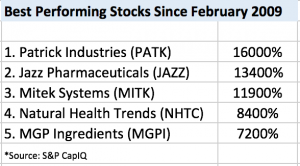](/content/images/wordpress/2016/07/PATK-Stock-Performance.png)What does Patrick Industries do? Certainly it must be an exciting cutting edge technology or infrastructure company. No, quite the contrary. Similar to our intelligent fanatic [100-Bagger case study](http://microcapclub.com/2016/05/middleby-corporation-midd-case-study-intelligent-fanatic-led-100-bagger/) of Selim Bassoul of Middleby Corp (MIDD) that manufactured commercial kitchen equipment, Patrick Industries also operates in an unglamorous industry.
Patrick Industries manufactures and supplies building products to the Recreational Vehicle (RV), Manufactured Home (MH), and Industrial markets. The majority of their business is manufacturing pre-finished wall and ceiling panels, cabinet doors, cabinet components, fiber reinforced products, cement siding, interior passage doors, furniture, roofing products, lighting, flooring, electrical, wiring, plumbing, and other products to these markets. In other words, most of the stuff that goes inside an RV or manufactured home, Patrick Industries manufactures.
As mentioned in [The Conviction To Hold](http://microcapclub.com/2014/08/the-conviction-to-hold/), we all would like to think we would have had the conviction and foresight to invest in a company like Patrick Industries in 2009\. A picture is worth a thousand words, and it would have taken a very special person to want to dive into the RV and MH industry during the crisis of 2008-2009:
[](/content/images/wordpress/2016/07/MH-Shipments.png)
[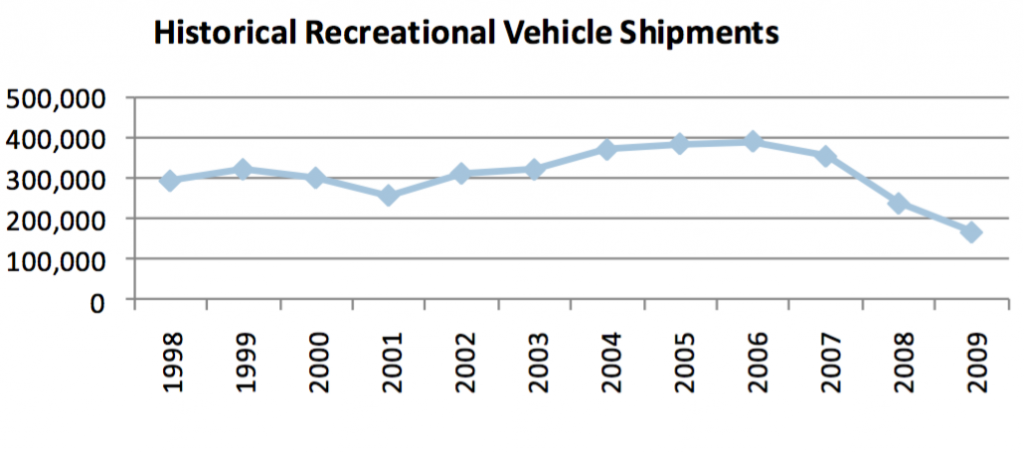](/content/images/wordpress/2016/07/RV-Shipments.png)Patrick Industries was founded in 1959 by Mervin D. Lung. The Company’s operations began as a distributor of paneling to the Elkhart, Indiana area’s manufactured housing industry. The company went public in 1968 and expanded by opening facilities in Kansas, Pennsylvania, Texas, North Carolina, and Florida. David Lung, Mervin’s son, becomes President in 1989, and would later become CEO in 2000\. Some would say Mervin left at the top. As the chart showcased above, 1998 would prove to be a multi-year high point for the MH industry.
The manufactured housing industry shipped 170,700 units in 1991 and showed tremendous growth throughout the 1990’s peaking in 1998 with 372,800 units shipped. The 348,700 units shipped in 1999 was still more than double the 1991 shipments; however in 2000, this industry, which represented 55% of Patrick Industries sales, had a nearly 29% decline to 250,600 units. The Recreational Vehicle industry shipments in 2000 were down 6.6% from a 1999 record high, but the fourth quarter showed a decline of 21%.
[](/content/images/wordpress/2016/07/PATK-1998-2009.png)David Lung would resign in 2003, and Paul Hassler would become CEO in 2004\. Hassler would put a three –year strategic plan in place to improve operational performance, while also looking at strategic acquisitions to diversify and expand the company. The company’s operating performance improved over these years.
In April 2007, Patrick Industries [acquired](http://www.prnewswire.com/news-releases/patrick-industries-to-acquire-adorn-llc-58220682.html?ref=microcapclub.com) Adorn Holdings (the acquisition was the largest in the company’s history), a major manufacturer and supplier to RV, MH, and Industrial markets. Todd Cleveland was the CEO of Adorn Holdings, and would become President and COO of Patrick Industries. Adorn was almost the same size as Patrick Industries, so both companies spent the rest of the year integrating.
> “We spent the majority of the year intensely focused with a “heads down” approach to ensure that the integration of Adorn into Patrick was completed in a proficient and timely manner and according to an aggressive consolidation schedule. We worked diligently with the Adorn management team immediately following the acquisition to put together a detailed plan and timeline to successfully capitalize on the efficiencies and maximize the synergies that were identified in our due diligence process. We combined our efforts in all functional areas and our team members worked at an exhausting pace to guarantee that we met our identified objectives. Additionally, our senior management teams spent countless hours focused on the cultural integration of the two successful companies and their related management teams in what we consider to be a merger of equals, with both companies bringing its own set of strengths to the new organization.” – Patrick Industries 2008 Letter to Shareholders
Paul Hassler’s strategic plan was starting to work, but then the financial crisis hit in 2008\. Paul Hassler retired, and Todd Cleveland became CEO in February of 2009\. Cleveland was thrown into the CEO role in the worst year in the company’s history. Unit shipment levels in the RV industry declined 55% in the first half of 2009, down 30% for FY 2009\. The RV shipments track the consumer confidence index which was at an 18-year low. Unit shipments in the MH industry were down 39% for FY 2009\. MH shipments were at 50 year lows.
In 2009, Todd Cleveland had to make some bold moves to rightsize the company and pay down debt (2009 10K):
- Sold Non-Core Business Units: Completed the sale of American Hardwoods and the aluminum extrusion operation
- Closed/consolidated facilities to improve operating efficiencies in our plants through increased capacity utilization
- Managed inventory costs by reducing supplier lead times and minimum order requirements, and by increasing inventory turns
- Further reduced workforce and production capacities to accommodate anticipated customer demand and maintain
- Managing our delivery costs through the reduction in our fleet size and consolidating our delivery loads.
Cleveland also focused on boosting morale and company culture: “We have intensified our focus on our “Customer First – Performance Based” culture which is anchored in exceeding our customers’ expectations and proactively adapting to their changing needs, and on developing and growing our talent and capabilities to meet those needs.”
The following year in 2010, Todd Cleveland continued to focus on cash flow and debt reduction. He sold two more non-core facilities and reduced debt by $69 million. He also instituted a branding campaign to highlight the entrepreneurial spirit within the company’s decentralized business units to drive accountability and an ownership mentality within Patrick. The company also entered a new $50 million credit facility with Wells Fargo which supported the long-term working capital needs of the company as well as strategic acquisitions.
Cleveland’s plan was to aggressively expand its RV market share through launching or acquiring quality product lines and line extensions, and the industry was primed for consolidation. He looked to acquire companies with solid management teams and strong customer and supplier relationships that had quality product lines primed for growth. In a very Berkshire Hathaway type of way, Patrick would give the acquired business and management team autonomy and allow their creative entrepreneurial spirit to continue to thrive while back stopping their capital, administrative and operational support needs. Patrick could then increase cross selling opportunities in its extensive product catalog, while increasing revenue per customer.
[](/content/images/wordpress/2016/07/Patrick-Acquisition-Summary.png)
In 2010, the company made its first acquisition since Adorn in 2007 and would go on to make 25 more acquisitions over the next six years mainly in the RV industry.What is even more impressive is the lack of equity dilution which is the [achilles heal of most microcaps that utilize M&A](http://microcapclub.com/2016/06/acquisitions-microcaps-destroy-shareholder-value/). As Patrick’s operational performance increased, so did Wells Fargo’s trust in Cleveland’s strategy. The Wells Fargo credit facility was increased to $80 million in 10/2012, $125 million in 6/2014, $165 million in 11/2014, $185 million in 2/2015, $250 million in 4/2015, and finally to $300 million in 8/2015.
Todd Cleveland has proven to be very good capital allocator. Since 2010, his “Capital Allocation Strategy” invested $348 million in acquisitions, capital spending, and buy backs, while debt has only increased $168 million. A good portion of the capital allocation strategy is funded by strong operating cash flows due to low capex maintenance. The company expects to continue to utilize their leverage for strategic acquisitions.
In February 2013, the board approved a $10 million share repurchase program, purchasing \~$6 million during 2013\. The share repurchase would be expanded by $10 million in February of 2014, again in 2015, and increased to $50 million in January 2016\. Since February of 2013, the company has repurchased 1.8 million shares (\~11% of the company) at a cost of $46 million ($25.04 average cost per share). The share price of Patrick Industries today is $61 per share.
[](/content/images/wordpress/2016/07/PATK-2009-2016.png)
Todd Cleveland is an intelligent fanatic and has done a tremendous job since becoming the CEO in 2009\. He successfully rightsized the company during the great recession of 2008-09, and then skillfully executed his capital allocation strategy to grow the company. Patrick Industries has made 26 acquisitions since 2010 focusing mainly on the RV industry. Critics will say the company has succeeded because of several years of increased consumer confidence and low interest rates. This is true, but RV shipments still haven’t rebounded to 2006 levels when the company was a third its current size. The company will certainly be tested yet again when the US economy inevitably weakens, but you could say this about many intelligent fanatics that slowly built up compounding machines in cyclical industries. Sean Iddings and I showcase a few of them in our upcoming book: [The Intelligent Fanatics Project.](http://intelligentfanatics.com/?ref=microcapclub.com)
[All Great Companies Started As Small Companies](http://microcapclub.com/2015/12/all-great-companies-started-as-small-companies/). Perhaps the most exciting thing about Patrick Industries is it is still a relatively small company (< $1 billion market cap), and Todd Cleveland is still a relatively young intelligent fanatic (48 years old). It will be fun to watch this duo perform for years to come. Interesting to also note: While researching Patrick Industries and Todd Cleveland I quickly realized there was very little outside of public filings. No industry articles. No CEO interviews. I couldn’t even find a picture of Todd Cleveland, which makes him and the company even more alluring.
If you enjoyed reading this article, you will like these:
[How To Find Intelligent Fanatic CEOs Early](http://microcapclub.com/2016/01/how-to-find-intelligent-fanatic-ceos-early/)
[MTY Food Group – A Case Study of a 100-Bagger](http://microcapclub.com/2015/03/mty-food-group-a-case-study-of-a-100-bagger/)
[Middleby Corporation (MIDD): Case Study of an Intelligent Fanatic Led 100-Bagger](http://microcapclub.com/2016/05/middleby-corporation-midd-case-study-intelligent-fanatic-led-100-bagger/)
**\===> Interact and learn with 250+ of the best microcap investors on the planet.** [\[Join Us\]](https://microcapclub.com/join-now/)
MicroCapClub is an exclusive forum for experienced microcap investors focused on microcap companies (sub $500m market cap) trading on United States, Canadian, European, and Australian markets. MicroCapClub was created to be a platform for experienced microcap investors to share and discuss stock ideas. Since 2011, our members have profiled 1000+ microcap companies. Investors can join our community by applying to become a member or subscribing to gain instant view only access. MicroCapClub’s mission is to foster the highest quality microcap investor Community, produce Educational content for investors, and promote better Leadership in the microcap arena. For more information, visit [http://microcapclub.com](http://microcapclub.com/) and
### Why Do Most Acquisitions by Microcaps Destroy Shareholder Value?
URL: https://microcapclub.com/acquisitions-microcaps-destroy-shareholder-value/
Last updated: 2023-10-14T19:38:46.000Z
With over 13,000 microcap companies on US, Canadian, and UK markets, we see a lot of M&A activity. In fact, since 1992, over 60% of all public M&A has occurred at the microcap level. On MicroCapClub alone we’ve had over 40 companies acquired since mid-2011\. Larger companies can use cash on hand or borrow money at very low interest rates to acquire great businesses at low(er) valuations in the microcap arena. Management teams and investors are drawn to M&A activity. We love to see companies getting bigger, faster.
According to [McKinsey & Company](http://www.mckinsey.com/business-functions/strategy-and-corporate-finance/our-insights/the-five-types-of-successful-acquisitions?ref=microcapclub.com), these are the strategic reasons for M&A:
- Improve the target company’s performance
- Consolidate to remove excess capacity from industry
- Accelerate market access for the target’s (or buyer’s) products
- Get skills or technologies faster or at lower cost than they can be built
- Strategic smaller investments, acquisitions in the life cycle of a new industry or product line
- Roll-up strategy
- Consolidate to improve competitive behavior
- Transformational Merger
- Buy a company simply because it’s cheap
Capital allocation is the main responsibility of a management team to deliver long term shareholder value. The dark side of M&A is that soon after a deal closes successfully, it often fails miserably. Numerous research studies have shown that between 50-90% of all mergers and acquisitions fail to meet financial expectations. Finding, negotiating, structuring, closing, and integrating acquisitions is difficult. On paper all acquisitions look like 1+1 = 3, but in reality most are 1+1 = 0\. Taking this into account, as microcap investors, we should be skeptical when a microcap company we own makes an acquisition.
Michael Mauboussin [(@mjmauboussin](https://twitter.com/mjmauboussin?ref=microcapclub.com)), Head of Global Financial Strategies at Credit Suisse, co-authored this great report on [Capital Allocation](https://plus.credit-suisse.com/researchplus/ravDocView?docid=E12g3I&ref=microcapclub.com) \[H/T [@HurriCap](https://twitter.com/HurriCap?ref=microcapclub.com)\]. In the report he showcased the table below showing the probability of M&A success based on type of deal.
[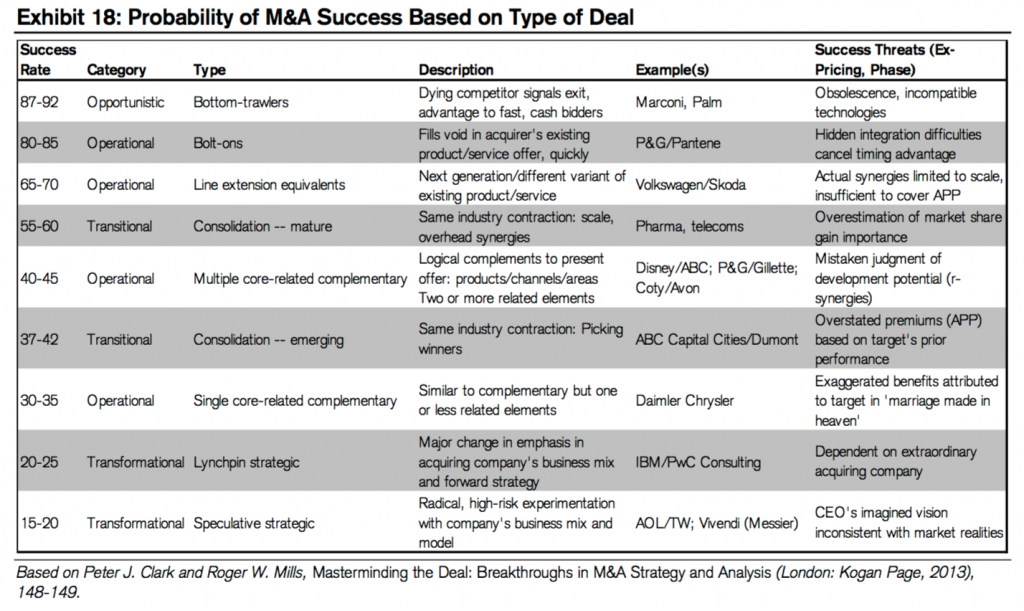](/content/images/wordpress/2016/06/Credit-Suisse-MA.png)
Even though M&A is rarely successful, the irony is that some of the biggest microcap success stories had disciplined acquisition strategies, including: Cisco (CSCO) 200+ acquisitions, Automatic Data Processing (ADP) 100+ acquisitions, [Middleby Corporation (MIDD)](http://microcapclub.com/2016/05/middleby-corporation-midd-case-study-intelligent-fanatic-led-100-bagger/) 50+ acquisitions, Autodesk (ADSK) 35+ acquisitions, [MTY Food Group (MTY.TO)](http://microcapclub.com/2015/03/mty-food-group-a-case-study-of-a-100-bagger/) 20+ acquisitions, and many others.
This begs the question which was asked by one of our [blog readers](http://microcapclub.com/2016/05/middleby-corporation-midd-case-study-intelligent-fanatic-led-100-bagger/#comment-16814): When we look at microcaps that make acquisitions, how can a microcap investor evaluate the potential success or failure of an acquisition? To help answer this, I think it’s best to evaluate why most microcap acquisitions fail.
**Quality**
According to S&P Capital IQ, there are 13,332 microcaps traded on US, Canadian, and UK markets. 6,900 (52%) have revenues and 3,200 (24%) have positive operating income. Perhaps the biggest reason why microcap acquisitions fail is the acquirer itself isn’t under sound financial footing. They might be unprofitable or slightly profitable, barely capable of sustaining their own operations let alone integrating another business that may or may not be profitable. I went through this recently with a position where they had a growing profitable business but then acquired an unprofitable business. A year later they liquidated the acquisition after the losses nearly took down both businesses. Worse yet is when two undercapitalized unprofitable companies merge, which I call a POS Merger (use your imagination as to what POS means). You have two small POS’s merging to form one giant POS.
**Equity Dilution**
Most microcaps use equity either by issuing shares or raising capital through the equity markets to make acquisitions. They are forced to use equity because they don’t have a choice. It’s unfortunate but true that many microcaps don’t produce enough cash, have the cash on hand, and/or have a long enough track record to acquire debt at attractive interest rates to make acquisitions.
The biggest reason why most microcap acquisitions/M&A strategies fail is because most microcaps have to use all equity for acquisitions, and many microcap management teams are not good capital allocators. Not all CEOs that treat their shares like gold are good capital allocators but almost all great capital allocators treat their shares like gold.
I can’t tell you how many times I’ve heard a microcap CEO’s say, “Well there is no point to being public unless we can use our stock as a currency.” I somewhat agree with them, but there is a time and place for using their stock as currency. [Intelligent fanatics](http://microcapclub.com/intelligent-fanatics/) know when to use their stock as currency (when it’s expensive and accretive) and when to cannibalize and eat themselves (share buy backs when it’s cheap). I’m reminded of Henry Singleton of Teledyne who made 130 accretive acquisitions when his stock was expensive (>25 PE), and in the 1970s and 1980’s bought 90% of Teledyne’s stock back when it was cheap (<8 PE).
[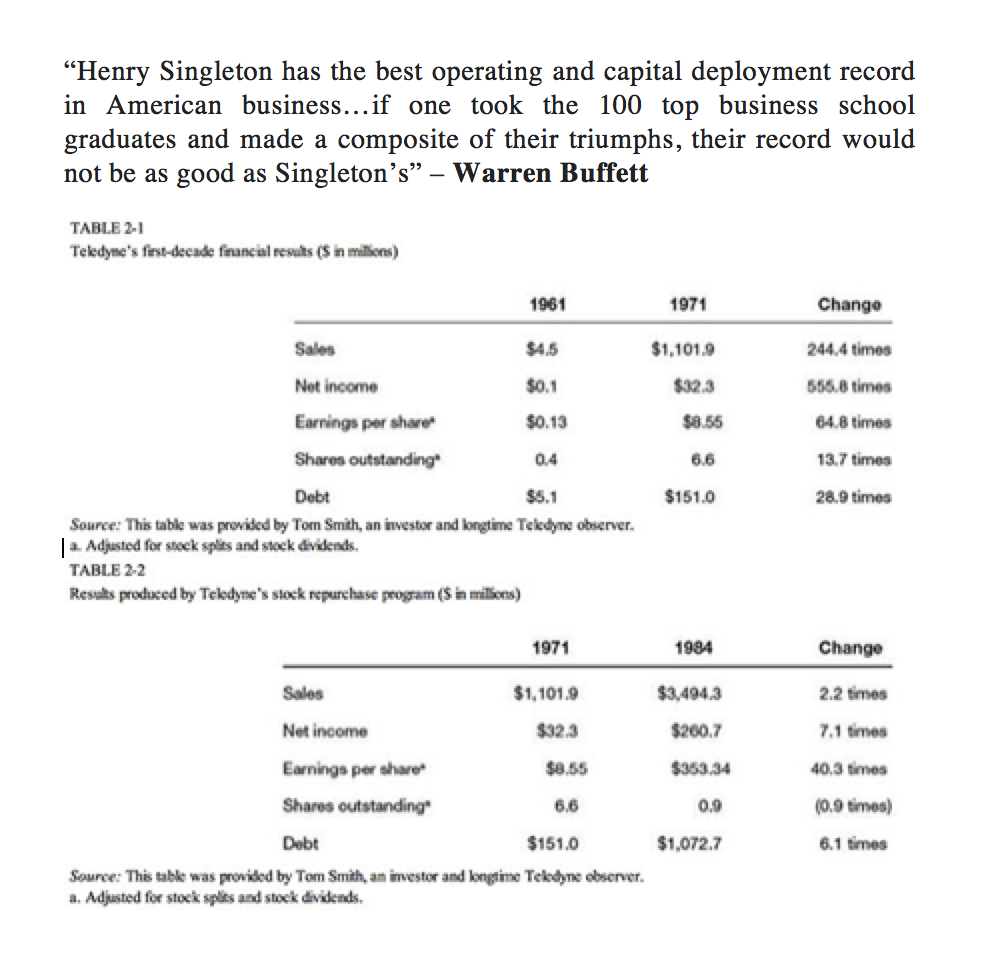](/content/images/wordpress/2016/01/henry-singleton.png)
**Acquisitive Management Teams Using Equity**
Some microcap management teams are very acquisitive. In fact, they discuss their acquisition strategies in their investor presentations and during conference calls. This is fine if the company has the balance sheet to conduct acquisitions. However, if forced to use equity they are basically announcing to larger investors to hold off from buying shares in the open market. Smart money doesn’t buy stock in the open market when they know a big equity raise or share issuance of an unknown size for an unknown purpose is likely. The stocks of such businesses are often stuck for years in a purgatory of sorts of naïve short term investors entering and exiting while real long-term investors move on to other opportunities.
**Large “Transformational” Acquisitions Using Equity**
Issuing equity for acquisitions can be especially harmful when issuing a large amount of equity. I’ll define large as issuing shares (directly or indirectly by raising capital) >10% of the outstanding shares. Unfortunately, a large percentage of the acquisitions done by microcaps are done by issuing large amounts of equity. When a small microcap company acquires anything, it is often material. In the best case scenario, the integration goes smoothly and the combined company performs very well. The shares are issued in a way that restricts the immediate selling of those shares (leak out provisions on acquired shareholders and management or equity is sold to finance the acquisition to truly long term investors \[rare\]). The most likely outcome is the synergies were over-played, the performance is “Ok” at best, and you have to eat through a lot of shares once the restricted equity that was issued becomes unrestricted. This is why you see the stock prices of companies that issue large amounts of equity for acquisitions perform very poorly for 1-2-3 years (maybe forever) following an acquisition. As the “Probability of Success” table above illustrates, be very careful of “transformational” acquisitions (aka big dilutive acquisitions) from a business perspective and stock perspective.
**Too many Too Fast Using Equity**
As discussed earlier, capital allocation is the #1 priority of a management team and [intelligent fanatics](http://microcapclub.com/intelligent-fanatics/) treat their shares like gold. An area for concern, especially by those companies that must issue equity for their acquisition strategy, is doing too many acquisitions too quickly. There are quite a few acquisitive management teams that can only use equity that don’t have the patience to wait for the stock to digest and revalue shares higher before making the next one. These management teams keep issuing equity at similar or lower stock prices and the stock never has a chance to increase. The market cap of the company might be increasing but the stock price will not (ie dilution), and the more shares that are outstanding the harder it is for a stock to move up.
Let’s keep things simple and remind ourselves of how multi-baggers occur. Sustainable multi-baggers have three characteristics: Long-term revenue and earnings growth with little to no dilution. These same principles hold true for companies that use M&A as an avenue for growth. Below is simple illustration of three microcap companies from yesteryear that turned into 100+ Bagger stocks: Monster Beverage (MNST), MTY Food Group (MTY.TO), and Middleby Corporation (MIDD):
[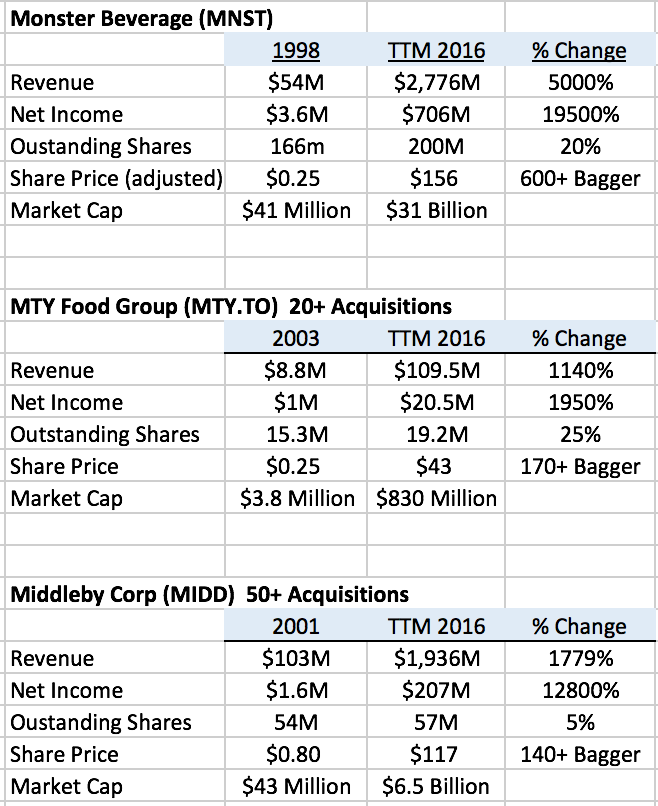](/content/images/wordpress/2016/06/Screen-Shot-2016-06-27-at-10.28.55-AM.png)
In these 100-bagger examples, you can see the power of long-term revenue and earnings growth with little dilution. MTY Food Group and Middleby Corporation have successfully utilized an aggressive but disciplined acquisition strategy combined with organic growth to produce phenomenal returns for shareholders. Companies that have successful M&A strategies are extremely disciplined. Middleby Corporation’s CEO’s talks about his disciplined acquisition strategy in this [case study](http://microcapclub.com/2016/05/middleby-corporation-midd-case-study-intelligent-fanatic-led-100-bagger/).
Middleby, MTY Food Group, and other companies that utilized successful M&A strategies when they were microcaps have one big thing in common. They were intelligent fanatic led businesses whose management teams were in most cases the largest shareholders of the company. These management teams didn’t issue tens of millions of shares early on to do transformational or “swing for the fences” acquisitions. They focused on building their companies and making a series of great small decisions, and then doors opened to larger opportunities. Owner-operator management make better decisions because their net worth is on the line (H/T [@HorizonKinetics](https://twitter.com/HorizonKinetics?ref=microcapclub.com)):
[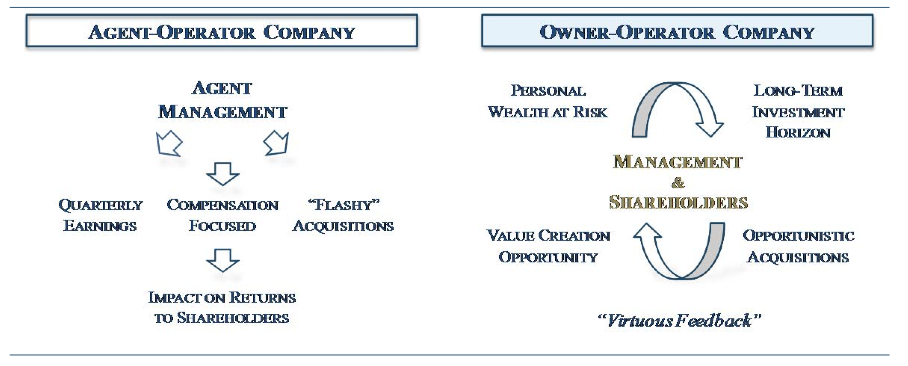](/content/images/wordpress/2016/06/CS44ra1W4AE0DZQ.png-large.png)
Albert Einstein said, “Compound interest is the eighth wonder of the world.” If compound interest is the eighth wonder of the world, then the compounding effect of great decision making is the ninth. A microcap management team that can string together several great decisions in a row can yield huge returns for shareholders. But it all starts with the first great decision. That first great decision could be to say NO to a good acquisition because it wasn’t a great one. The quote below is perhaps Warren Buffett’s best and is a powerful one for investors and management teams.
> “The difference between successful people and very successful people is that very successful people say “no” to almost everything.” – Warren Buffett
Microcap investors should be skeptical of dilutive, equity based acquisitions. Early stage microcaps often times don’t have the financial-fundamental horsepower to utilize cash flow, cash on hand, and/or debt for acquisitions. These management teams need to thoughtfully weigh the pros and cons of issuing equity. Many 100-bagger stocks originated out of the microcap arena, and several of them had M&A strategies even when they were small. These intelligent fanatic, owner-operator led businesses took dilution very seriously because their net worth was tied to the stock. These disciplined operators focused on creating growing, profitable, self-funding compounding machines. They creatively structured smaller acquisitions with little dilution and later used debt or equity (only when very accretive) as their businesses matured.
The topic of M&A encompasses many other aspects such as price, structure, incentives, pros and cons of debt, etc, which I’ll go over in later posts. I wanted to first address the biggest problem I see with many microcaps making acquisitions. A microcap investor’s biggest risk is dilution, and a microcap’s worst enemy is a management team that wants to get bigger at any cost.
**\===> Interact and learn with 250+ of the best microcap investors on the planet.** [\[Join Us\]](https://microcapclub.com/join-now/)
MicroCapClub is an exclusive forum for experienced microcap investors focused on microcap companies (sub $500m market cap) trading on United States, Canadian, European, and Australian markets. MicroCapClub was created to be a platform for experienced microcap investors to share and discuss stock ideas. Since 2011, our members have profiled 1000+ microcap companies. Investors can join our community by applying to become a member or subscribing to gain instant view only access. MicroCapClub’s mission is to foster the highest quality microcap investor Community, produce Educational content for investors, and promote better Leadership in the microcap arena. For more information, visit [http://microcapclub.com](http://microcapclub.com/) and
### Microcaps: Value Uncovered
URL: https://microcapclub.com/microcaps-value-uncovered/
Last updated: 2023-10-14T19:41:36.000Z
DGHM & Co recently published a white paper, [Microcaps: Value Uncovered](http://dghm.com/wp-content/uploads/Microcaps-Value-Uncovered.pdf?ref=microcapclub.com). In the white paper, they illustrate that Microcaps have outperformed Large Caps since 1926 (+11.7% vs +9.4% annualized returns), and that microcap value stocks have greatly outperformed (16.1% annualized return) during this time period. The report also offers statistics on microcap sell side coverage, ROE, insider ownership, geographic exposure, debt to ebitda, and volatility when compared to private equity and other market cap classes.
I think we’ve all felt that the last several years have been difficult for microcap investors. Microcaps have in fact underperformed large caps since 2009 and are below historical averages when comparing return spreads and price to book spreads (see below):
[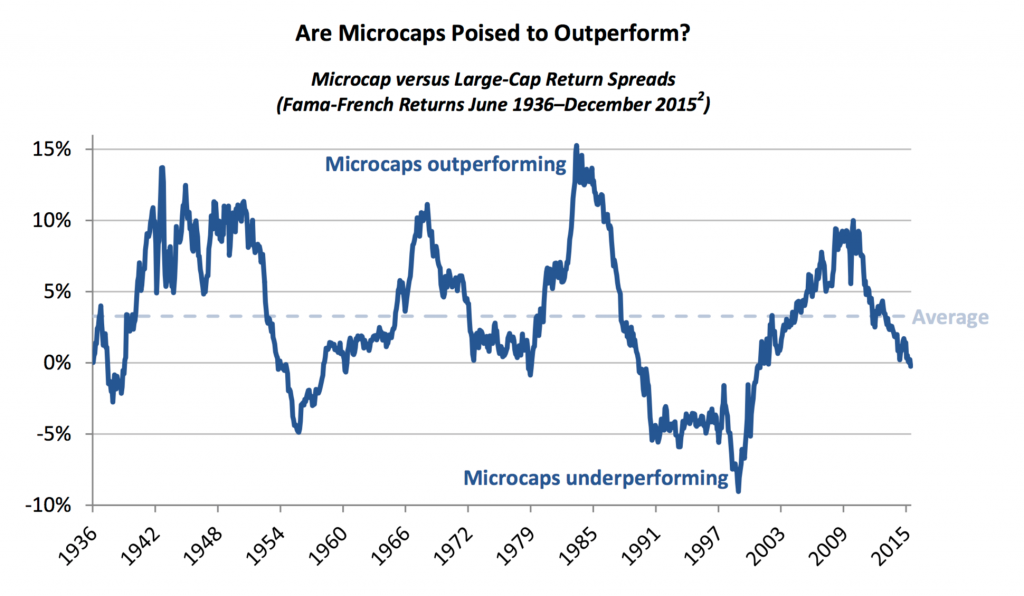](/content/images/wordpress/2016/06/microvslargereturnspreads.png)
[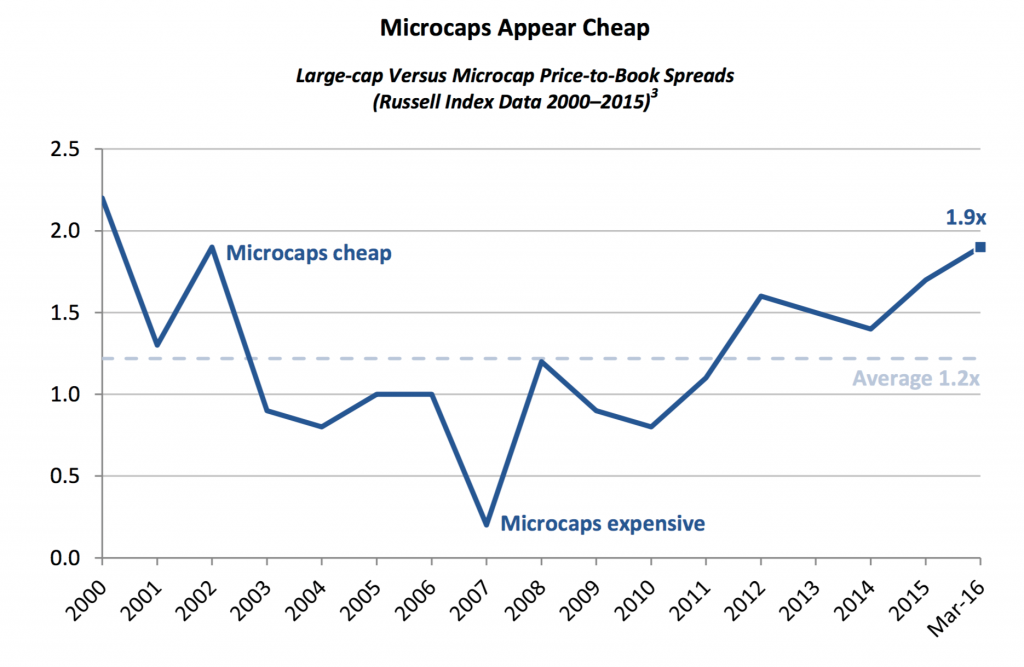](/content/images/wordpress/2016/06/microvslargepricetobook.png)
The fall off of microcap performance in 2009 also correlates with the huge capital inflows into private equity and venture capital. Microcaps are setting up for a resurgence as they offer greater value with less risk.
“High returns, or the expectation of future high returns, tends to attract capital. This can lead to too much capital chasing too few solid ideas. The private equity and venture space has attracted fantastic amounts of capital since 2009: Fund flows show that global private equity has raised over $800 billion on a net basis since 2009, compared to net outflows of $2 billion for US actively managed microcap mutual funds. According to Preqin, the number of private equity funds has steadily increased over time, rising from 1,145 funds in 2013 to 1,684 through the first quarter of 2016, which represents a 47% increase. These funds have an aggregated $775 billion in dry powder—an all-time high. We find it difficult to believe this amount of capital can be deployed at anywhere near historical reported returns.”
I agree with their conclusion: Microcap investing offers compelling returns for the long-term investor well in excess of large-cap returns because microcaps are an underfollowed and less efficient asset class. Many of these companies take an entrepreneurial and dynamic approach to managing and growing their businesses. Microcaps are not without risk, of course, as they typically have less liquidity which leads to higher volatility. Overlaying microcaps with a value-quality tilt significantly improves these returns and reduces risk. Further, given their inefficiency and limited coverage, this asset class is ripe for active management. Microcaps also enjoy higher insider ownership, greater exposure to the domestic economy, and increased M&A activity relative to larger stocks. Microcap investing presents a viable alternative to private equity investing given its increased relative liquidity, unlevered return profiles, more reliable performance metrics, and much lower fees. Microcaps are an exciting place to invest and have proven themselves as a viable asset class that can add significant value to an investor’s portfolio over the long run.
If you enjoyed this white paper, you’ll also enjoy [It’s Time to Change Your Perception of Microcaps](http://microcapclub.com/2016/05/time-change-perception-microcaps/).
**\===> Interact and learn with 250+ of the best microcap investors on the planet.** [\[Join Us\]](https://microcapclub.com/join-now/)
MicroCapClub is an exclusive forum for experienced microcap investors focused on microcap companies (sub $500m market cap) trading on United States, Canadian, European, and Australian markets. MicroCapClub was created to be a platform for experienced microcap investors to share and discuss stock ideas. Since 2011, our members have profiled 1000+ microcap companies. Investors can join our community by applying to become a member or subscribing to gain instant view only access. MicroCapClub’s mission is to foster the highest quality microcap investor Community, produce Educational content for investors, and promote better Leadership in the microcap arena. For more information, visit [http://microcapclub.com](http://microcapclub.com/) and
### It's Time to Change Your Perception of Microcaps
URL: https://microcapclub.com/time-change-perception-microcaps/
Last updated: 2023-10-14T19:43:12.000Z
What truly is a microcap? The common answer would be a small public company with a market capitalization of less than $300 million. But does the label tell us anything about microcap businesses or help us become better microcap investors? No, thinking purely in labels turns us into Oscar Wilde’s definition of a cynic – “A man who knows the price of everything and the value of nothing.”
The term “microcap” has a negative perception or label perpetuated by most financial pundits, regulators, and even investors. Most look at the 11,000+ microcaps in North America and judge them as being sleazy, slimy, and insignificant. This label couldn’t be further from the truth. Many of the best investors ever, including Warren Buffett and Peter Lynch started their careers investing in microcaps. Some of the best performing companies ever, including Berkshire Hathaway, Wal-Mart, Apple, started as small microcap companies. Today, North American microcap companies employ over 2.8 million jobs. More jobs than Google, IBM, Home Depot, Berkshire Hathaway, AT&T, Pfizer, Cisco, Microsoft, Boeing, General Electric, and GM combined. [All Great Companies Started As Small Companies](http://microcapclub.com/2015/12/all-great-companies-started-as-small-companies/), and it’s time people changed their perception of this unloved equity class. Our long-term mission at MicroCapClub is to bring credibility and respect back to the microcap space [\[Presentation\]](https://youtu.be/gYUL2BdNpNA?ref=microcapclub.com).
Labeling always reminds me of Richard Feynman’s little story about knowing the name of something. In it he described a story growing up as a child, recounted below:
> The next day, Monday, we were playing in the fields and this boy said to me, “See that bird standing on the stump over there? What’s the name of it?”
>
> I said, “I haven’t got the slightest idea.”
>
> He said, “It’s a brown-throated thrush. Your father doesn’t teach you much about science.”
>
> I smiled to myself, because my father had already taught me that \[the name\] doesn’t tell me anything about the bird. He taught me “See that bird? That’s a brown-throated thrush, but in German it’s called a halsenflugel, and in Chinese they call it a chung ling and even if you know all those names for it, you still know nothing about the bird-you only know something about people; what they call that bird.
Small companies are everywhere; they, like birds, have different labels given and used by different people:
- In the public markets they are called *microcaps*
- In the private local markets they are called *small businesses*
- In Silicon Valley they are called *technology startups*
Each term conjures different images in our minds. Microcaps, often referred to by the derogatory term “penny stocks”, have a negative stigma even though over 120 microcap companies have gone up 1,000% or more [over the last five years](http://microcapclub.com/2015/06/microcaps-with-the-highest-return-over-the-last-5-years/). Small businesses have a good perception. They are the mom and pop shops that can be found throughout the U.S. and other countries: the neighborhood plumber, construction company or antique shop. Technology startups, particularly those found in Silicon Valley, have great perceptions mostly due to Peter Thiel, Marc Andreessen, Ben Horowitz, and other famous venture capitalists endorsing the space. When the public thinks of technology startups they think of gutsy founders, opportunity, and unicorns (those that have reached $1 billion valuations). Even though Berkshire Hathaway, Wal-Mart, Netflix, and many other companies started as small microcap companies, we have no well-respected opinion leaders blazing the public opinion path for microcaps. While there are plenty of truths in the public’s perception and the associated stereotypes, taking a wider view uncovers that microcaps, small businesses, and technology startups are all quite similar.
Microcaps, small businesses, and technology startups are all emerging businesses mostly run by founders with an entrepreneurial spirit. Investing in such companies is a bet on the jockey (founder) even more so than the horse (product/service). More than 90% of new businesses fail. The founding entrepreneur and their team (combined with a little luck) are the only things that separate the average, who are likely to fail, from the highly successful.
> “A strong team is the most important element of a company’s ability to achieve success.” – Vinod Khosla
As microcap investors, we can learn a lot from successful venture capitalists on how they evaluate founders and management teams. They are looking for [intelligent fanatics](https://intelligentfanatics.com/?ref=microcapclub.com) just like we are. The successful venture capitalist understands the importance of a founder and their team. They spend a great amount of time vetting founders and their teams. Great founders attract top talent, while the B and C founders attract lower quality talent. The idea is to weed out the great entrepreneurs with large long-term visions from the other entrepreneurs with different goals.
Below is a great Q&A session with Marc Andreessen of Andreessen Horowitz and Ron Conway of SV Angel. Ron Conway is an angel investor so he normally invests at an earlier stage than most venture capital firms. In fact many of Andreessen Horowitz’s investments were first invested in by Ron Conway of SV Angel. Ron Conway and SV Angel have invested in over 750 companies over the last twenty years. Conway mentions they have invested in 1 out of every 30 companies-founders they interview which means they’ve looked at 20,000+ businesses and founders.
Here are the following types of entrepreneurs (some borrowed from Steve Blank):
- Lifestyle entrepreneur – do enough work to live their passion. Think of the musician who wants to play music all day and night. They teach just enough music classes to pay the bills and supplement by playing out at night. They don’t need to make a profit.
- Small business entrepreneur – happy to be self-employed by operating a known small business model. They have no ambition to take over the world. Think of the plumber, website designer, or carpenter. They just need to make a small profit to keep afloat.
- Intelligent fanatic entrepreneur – these founders either have +$1 billion visions from the first day or they are pulled into much larger visions after achieving initial success. In either case, they are seeking scalable, repeatable business models that can lead to domination. They are intensely competitive so they are never satisfied dominating small niches. Visions of world domination will come. These are the leaders who, if they are aligned financially with shareholders, have the inner alignment as well.
Microcap investors, who want outsized long-term returns, should understand that lifestyle and small business entrepreneurs are abundant and aren’t the best partners to achieve large long-term returns. These entrepreneurs, even while owning significant pieces of their business, are just as happy collecting their $250K salary while not upsetting the apple cart too much. Investors should focus mainly on partnering with the intelligent fanatic entrepreneur and holding on as the they, and their highly talented team, execute on a scalable, repeatable business model. The returns possible under such partnership is where true wealth is created.
Ian Cassel and I are working on the Intelligent Fanatics Project ([www.intelligentfanatics.com](http://intelligentfanatics.com/?ref=microcapclub.com)) that outlines the similar qualities, cultures and strategies that intelligent fanatics possess to enable scalable, repeatable business execution over the long-term. I’ll use a short example of a company that has gone from nothing to mega billion corporation under its founder.
Intelligent fanatic Larry Ellison bootstrapped a $2,000 investment in Software Development Laboratories in 1976 and turned it into the $160 billion Oracle that we know today. Larry Ellison generated significant shareholder value creation over his tenure of roughly 25% compounded annually since Oracle became public.
[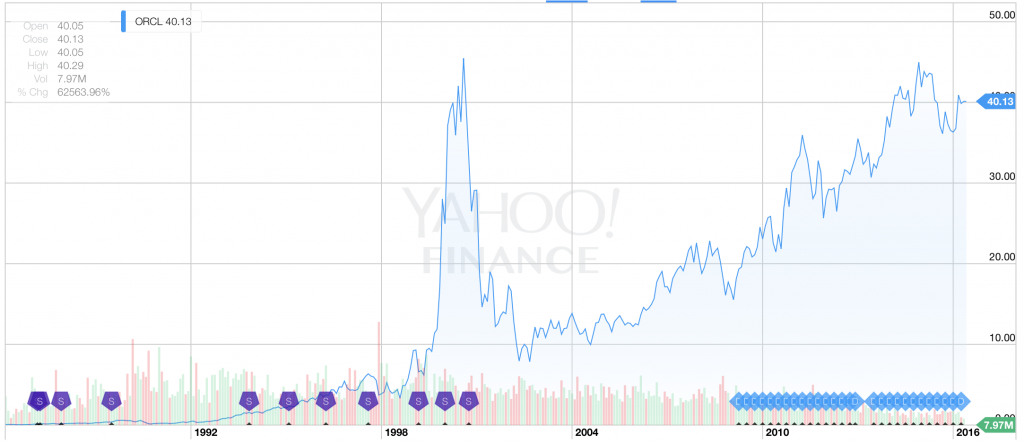](/content/images/wordpress/2016/05/orcl.png)
Oracle was slightly larger than a microcap, $500 million valuation in today’s dollars, when they had their initial public offering in 1986\. This same year the company had $55 million in revenues which quickly ballooned to $584 million by 1989\. Larry Ellison continued to sustain enormous business growth and execution right up until he stepped down as CEO in 2014.
In 1981, Kathryn Gould was Oracle employee #10, and she would later become a successful venture capital investor. She believed, as do many others, that Larry Ellison possessed potent leadership skills and characteristics that made him a winner. Ellison was the yardstick that Gould would use to evaluate every other founder she came across. The full write up can be found [\[HERE\]](https://steveblank.com/2014/09/25/watching-larry-ellison-become-larry-ellison-the-dna-of-a-winner/?ref=microcapclub.com), but Kathryn Gould’s DNA of a great leader is summarized below:
- Have a clear mission and inspire everyone to live it every day
- Are the best salesman in the company
- Hire the smartest people
- Have a technological vision and the ability to convince others that it’s the right thing
- Know it’s about winning customers and don’t spend money on things that aren’t mission-critical
- Are relentless in pursuit of their goals and never take NO for an answer
- Know humor is powerful — and fun!
**Conclusion**
It’s time many investors change their perception of the microcap space. There have been many great companies that have come out of the public microcap arena. Microcaps are small businesses led by entrepreneurs with different motivations. Similar to venture capital investors, microcap investors should put significant thought and due diligence into which entrepreneur they partner alongside. Steer clear of the lifestyle and small business entrepreneurs and focus on the intelligent fanatics who have the vision, leadership skills and characteristics to build a scalable, repeatable business model. [Intelligent fanatics](https://intelligentfanatics.com/?ref=microcapclub.com) do not come around often but when they do, they are observable running smaller enterprises. If you work hard, you’ll be lucky enough to find a few of them over your lifetime, and then the goal will be to develop the [conviction to hold](http://microcapclub.com/2014/08/the-conviction-to-hold/) them to reap the rewards.
I’ll leave on this quote from Phillip Fisher:
> “Those companies which decade by decade have consistently shown spectacular growth might be divided into two groups. For lack of better terms I will call one group those that happen to be both ‘fortunate and able’ and the other group those that are ‘fortunate because they are able.’ No company grows for a long period of years just because they are lucky. It must have and continue to keep a high order of business skill.”
**\===> Interact and learn with 250+ of the best microcap investors on the planet.** [\[Join Us\]](https://microcapclub.com/join-now/)
MicroCapClub is an exclusive forum for experienced microcap investors focused on microcap companies (sub $500m market cap) trading on United States, Canadian, European, and Australian markets. MicroCapClub was created to be a platform for experienced microcap investors to share and discuss stock ideas. Since 2011, our members have profiled 1000+ microcap companies. Investors can join our community by applying to become a member or subscribing to gain instant view only access. MicroCapClub’s mission is to foster the highest quality microcap investor Community, produce Educational content for investors, and promote better Leadership in the microcap arena. For more information, visit [http://microcapclub.com](http://microcapclub.com/) and
### Middleby Corporation (MIDD): Case Study of an Intelligent Fanatic Led 100-Bagger
URL: https://microcapclub.com/middleby-corporation-midd-case-study-intelligent-fanatic-led-100-bagger/
Last updated: 2023-10-14T19:44:31.000Z
In 2001, Selim Bassoul became CEO of a $40 million market cap microcap called, Middleby Corporation (MIDD). He had joined Middleby in 1996 and turned around the company’s Southbend division, and in 1999 became COO to help turn the rest of the company around. In 2001, now the CEO, he had the weight of the entire company on his shoulders, but he was confident in his abilities, strategy, and the Middleby Brand. He was so confident that he sold his brand new home so he could buy shares in Middleby and become the second largest shareholder in the company. Selim Bassoul, mentored by Jim Sinegal (Co-Founder of Costco), was an [intelligent fanatic](http://microcapclub.com/2016/01/how-to-find-intelligent-fanatic-ceos-early/) in the making.
Over the next 15 years, Selim Bassoul would transform Middleby Corporation from an unfocused, cultureless, slow moving, sleepy food equipment manufacturer into a compounding machine. Under Bassoul’s leadership Middleby Corporation’s revenues have grown from $101 million in 2001 to $1.8 billion in 2015, cash from operations has grown from $13.9 million to $249 million, net income has grown from $1.6 million to $191 million, while the amount of shares outstanding has remained relatively the same. Middleby shareholders have seen shares appreciate at a compounded annual return of 38.6% over the last 15 years (100+ Bagger).
[](/content/images/wordpress/2016/05/MIDD-Chart.gif)
[All great companies started as small companies](http://microcapclub.com/2015/12/all-great-companies-started-as-small-companies/), and at some point most great companies were either founded or operated by an [intelligent fanatic](http://microcapclub.com/2016/01/how-to-find-intelligent-fanatic-ceos-early/). As investors, we analyze the lives and businesses of known intelligent fanatics so we can better find the next one before others. Sean Iddings and I are working on the Intelligent Fanatics Project and we’ll be releasing our first book later this year. Sign up to our blog email list here on MicroCapClub, or visit [IntelligentFanatics.com](http://intelligentfanatics.com/?ref=microcapclub.com) for updates. Lets now dive into the story of Selim Bassoul and Middleby Corporation.
**Selim Bassouls’s Journey:**
Selim was born in Lebanon and at the age of 12, and he remembers Beirut falling into civil war. His family was well connected in Lebanon and were “asset rich but cash poor”. During this time Selim remembers overhearing a conversation between his father and mother and his father saying, “I have only $20 left in my pocket. That’s all we have now. What am I going to do?”. It made a big impression on young Selim. “I knew in that moment I would never be poor,” Selim says.
Selim’s parents were very proud and honorable people, but times were tough. Salim was close to having to quit school to find work, but his parents refused to give up.
> “I recall my mother shaking me by the shoulders and saying, ‘You will never work for anyone else,’” Selim says. “That had a big effect on me.”
Selim excelled as a student, achieving the highest grades in his class. He would attend the American University in Beirut, and then move to the US for post graduate studies at the Kellogg School of Management at Northwestern University. His parents had to sell a piece of land that was meant for their retirement to fund Selim’s college education.
> “I will never forget the sacrifice they made. They sold the only asset they had left to send me to school. It shapes your personality and your ambition”, Selim said
One of the biggest lessons he learned at Northwestern was from a finance professor. “He said to me, ‘It doesn’t matter how rich you are, how financially solid you are, cash is king. You have to manage cash.’ I got that ingrained in me. We don’t run our company through net income, we run it through cash. Coming from a culture in the Middle East where cash is everything, it meant something to me. There was no borrowing to be had in during a civil war. It was all about cash.”
After graduation Selim would work for eight years in the healthcare industry for American Hospital Supply and Baxter Healthcare working a variety of positions. He then pivoted from Healthcare into Foodservice and worked for eight years for Premark Inc, as director of marketing of the cookchill division and then later as VP of Sales for the Vulcan cooking division.
Bassoul was aware of Middleby’s struggles but thought the company had significant potential. “It was a great brand,” he says. “They had done a wonderful job developing the revolving oven and automating the pizza business, but they had lost focus. They were no longer dealing with core competency. This was a huge challenge. Nobody lied to me. From the beginning, they told me, ‘Selim, we can’t guarantee where we’re going’, because they were struggling and they wanted me to be part of the turnaround.”
Soon after joining Middleby, Selim sold his house which he had just built to buy a large stake in Middleby Corporation’s stock. Selim bought shares and became the second largest stockholder of the company “when nobody was willing to invest in the company.”
**Middleby Corporation Turnaround:**
Middleby Marshall Oven Company was founded in 1888 and focused on manufacturing high quality custom ovens in the United States. Fast forward 100-Years and the company had diversified into many product categories in the diversified food equipment (DFE) manufacturing industry. The DFE industry can be cyclical, seasonal, and customer orders lumpy as new eating habits and trends take hold affecting quick-service and fast casual restaurant chains buying new equipment. DFE manufacturers need to stay lean and innovate to weather the low times and take advantage of the good times. By the second half of the 1990’s, consumer tastes were changing away from the normal pizza, hamburgers, fast food offerings, towards healthier alternatives. Middleby was caught in a down cycle with too many products in a declining market.
In 1996, Selim Bassoul joined Middleby tasked with turning around the Southbend division. Over the course of two years Bassoul turned the facility around and instituted the industry’s first “no quibble” guarantee. Any customer could return a product with a 100 percent refund within 90 days no questions asked. The “no quibble” guarantee was very powerful, “our market share sky-rocketed and pricing became a smaller factor in the buying decision”.
> “I have a mentor called Jim Sinegal, the founder of CostCo. At CostCo you can return anything. So he taught me that the best way to improve your quality and your suppliers is to implement a no questions- asked return policy, because the customer will then tell you exactly how they felt about that product. We’re the only ones to do that in our industry now. The highest return I’ve done was $6 million. And we won the customer again, because we became better. Maybe that’s why we’ve been so blessed with the huge success we’ve had.”
In 1998, some misguided decisions led to the company triggering some debt covenants on its $20 million credit line. This forced the board to take a deep look into the company, its financials, and strategy. They didn’t like what they saw, so they called on Bassoul to move to Chicago to be Chief Operating Officer. Bassoul would use the same methods in turning the entire company around as he did at the Southbend division.
[](/content/images/wordpress/2016/05/Middleby-1998-2002-1.png)
When he looked at Middleby as a whole he saw a company with no focus or direction. The company had over 10,000 product lines and 1,064 employees. The company had expanded into product categories with low margins where they had no competitive advantage. Bassoul immediately got rid of over 5,000 products, shut down manufacturing lines, and reduced headcount by 200 employees. He refocused the company on the “the hot side of the business” which reduced the amount of vendors used and drove down raw material costs.
Bassoul then closed down the division headquarters for international operations and the US based international sales office relocating them into existing regional facilities. He also moved the corporate headquarters from a rather posh office building to office space within the Elgin manufacturing plant.
When Bassoul started, Middleby had close to 40% annual turnover of employees. Bassoul focused on rewarding and recognizing the achievements of employees and building corporate culture. A profit sharing plan and bonus structure based on operating income was put in place for Middleby employees. Goals were posted each month with daily updates so employees knew exactly where they stood to reach a bonus threshold. In two years, employee turnover dropped below 10%. Bassoul also set up a system to where employees are asked to submit ideas for improving workplace performance and each idea is tracked for implementation and effectiveness. If an idea contributed to quality and productivity the employee would receive a $75 bonus. In the first two years the company received 1,728 suggestions, the company adopted 68% of them, with total cost savings of $850,000\. Between 1998-2000 sales per employee rose 35%, reduced scrap and rework by 50%, and reduced system cycle time by 35%.
> Our work force is our “greatest competitive weapon. They are the power that drives our company. World-class competitiveness requires the development of world-class human resources,” says Selim.
The next area of focus was product innovation and diversifying Middleby’s customer base. In 1998, 50% of the company’s sales were to Papa John’s, Pizza Hut, and Domino’s Pizza. Bassoul pushed his sales people to focus on smaller chains (150 or fewer stores) in the fast casual market like Panda Express, Jason’s Deli, etc. He also encouraged his sales and product development teams to work together and meet with these customers to develop new equipment that would work for their menus. From 1998-2001, Bassoul reduced the average time to market for new products from 36 months to 18 months. By 2001, the revenue base was smaller but the customer base was more diversified which put the company on more sound footing. Middleby designed a new pizza oven for Domino’s Pizza that cooked pizzas 25% faster and reduced electricity costs by 30%. They did the same thing for other large and small restaurant chains. Around this same time Bassoul rolled out his “no quibble” policy to all of the company’s customers.
> “We changed our philosophy to be ‘customer driving’. We told the customer what they wanted and how much they would pay for our state of the art cooking technology. When there was a non-diverse customer base as there was in the late 1990’s, we were forced to be customer driven. When we diversified that base, we became customer driving. We walked away from situations that were not in our best interesting. Diversifying our customer base was key.”
In 2001, Selim Bassoul was promoted to CEO, and in 2004 would become Chairman of the Board. Selim focused on two things. First, there were seven layers of management, so he flattened the organizational chart. He wanted to reduce the bureaucracy and increase communication. Second, within months of becoming CEO, Bassoul proposed to the board to make an unsolicited bid for Blodgett Corporation, a company of similar size to Middleby. Shareholders and the board still had a bad taste in their mouth from a few failed acquisitions a decade earlier. Bassoul won them over through massive due diligence and an LOI from Bank of America to be lead lender on the deal. The Blodgett acquisition would further prove out Bassoul’s strategy and would be the first of many acquisitions.
**Acquisition Strategy:**
Middleby has made close to 50 acquisitions under Bassoul’s leadership, the biggest acquirer in the industry’s history. In 2013, Middleby acquired Viking Range for $380 million, and in 2015 acquired Rangemaster for $200 million. These acquisitions were used to roll out Middleby’s commercial oven technology into US, UK, and [worldwide residential markets](http://www.wsj.com/articles/middleby-chases-fame-in-the-kitchen-1445283693?ref=microcapclub.com). In 2015 alone the company completed seven acquisitions. Many investors may view the frequency of Middleby acquisitions as being undisciplined or not well thought out, but they would be wrong. In a 2013 interview with [The Motley Fool](http://www.fool.com/investing/general/2013/07/20/selim-bassoul-discusses-his-thoughts-on-company-ac.aspx?ref=microcapclub.com), Bassoul explains his acquisition strategy:
> Gardner: Why have the acquisitions at Middleby succeeded? What is your checklist on making acquisitions? Because we know that there are CEOs that make acquisitions for a lot of reasons that might not be about long-term value creation, so why is it different at Middleby?
>
> Bassoul: Well, I can tell you the reasons that we don’t make an acquisition. Growth, or size, or buying a market. So all those three reasons, we will not go after an acquisition to buy a market.
>
> Gardner: And most people would think that, in fact I really don’t know where your answer is going here, so I’ll just say most people would think when an acquisition is going to happen, it’s about growth, size, or buying a market.
>
> Bassoul: I think, Tom, there is a lot cheaper way to attack growth. I can discount my product and go after a market. I can go steal my competitor’s engineers and get some type of a product emulation. We buy a company because we believe that they have two things that are important to us. One, they have the ability to be already a brand and a patented technology, that is already disruptive. That will take us many, many years to get to.
>
> Number two, the ability to buy it and retain the management so that that management allows us to basically, with some capital infused by us and some DNA from Middleby, whether it’s taking them internationally … is that in five years or less, would like to have the multiples of that acquisition translate into a price of five times multiple or less after the acquisition integration. Would like also to be accretive in no more than 18 months.
>
> So let’s repeat the three things. One, it has to have a brand with a disruptive technology.
>
> Gardner: That’s patented.
>
> Bassoul: That’s patented. Number two, we need to be able to get within five years or less to a five times multiple or less after we realize the synergies and the integration benefits. Number three, it has to be accretive in 18 months or less.
Today, Middleby dominates their foodservice category. The company is #1 in Pizza Chains, #1 in Convenience Stores, #1 in Fast Casual, #1 in Deli Sandwich Shops, #1 in Steahouses and Seafood, #1 in Chicken Outlets, #1 in Pan-Asian Cousine, and #1 in Casual Dining. Basoul would say, if you are eating at McDonalds, Five Guys, Morton’s Steakhouse, Panera, PF Changs, Starbucks, Cracker Barrel, Subway, Pap Johns, and many others, your food was prepared on or in a Middleby product. The company also dominates specific product categories and are #1 or #2 in Fryers, Convection Ovens, Combi Ovens, Deck Ovens, Conveyer Ovens, Broilers, Ranges, Griddles, and many others. The company is now focusing on residential markets, and innovation in kitchen waste and water consumption.
[](/content/images/wordpress/2016/05/Middleby-2011-2016-1.png)
Someone asked Selim how he divides up his working day. He said 30% of his time is spent with customers, learning what they are interested in. “I don’t want to ever become what the horse and cart was to the automobile,” he says. Another 30% of his day is spent making sure his people are focused, properly incentivized, and have the right resources. “And that encompasses a lot of saying ‘no’. ‘No, we don’t need to do this’. ‘No, you don’t need to hire that individual.’” The next 30% is focused on finding and driving innovation at Middleby. Bassoul says, “Nobody told Steve Jobs ‘you need to create an iPhone or an iPod’.” The last 10% of his day is spent in prayer. Selim is a Christian and spends two hours a day in the morning and evening asking God for guidance and purpose to lead his life and company in the right direction.
Middleby’s success is a direct result of strategies put into place by its intelligent fanatic CEO, Selim Bassoul. I think you will enjoy the video below from December 2014, where Selim Bassoul tells his story at the Baron Funds Investment Conference.
In addition to annual filings, I used the following sources for quotes and information:
[Leading Corporate Renewal: Selim Bassoul at Middleby Corporation, Kellogg School of Management](http://www.kellogg.northwestern.edu/kellogg-case-publishing/case-search/case-detail.aspx?caseid=%7B5875D954-757C-4D0D-9921-395ADE00EDB2%7D&ref=microcapclub.com)
[Titans of Industry: Selim Bassoul](http://www.fcsi.org/foodservice-consultant/the-americas/titans-of-industry-selim-bassoul/?ref=microcapclub.com)
[Middleby Chases Fame in the Kitchen](http://www.wsj.com/articles/middleby-chases-fame-in-the-kitchen-1445283693?ref=microcapclub.com)
[The Middleby Corporation Case Study](http://www.middleby.com/MidCorp/InvestorServices/articles/class%5Fa.htm?ref=microcapclub.com)
[Middleby’s CEO on How to Make Successful Acquisitions](http://www.fool.com/investing/general/2013/07/20/selim-bassoul-discusses-his-thoughts-on-company-ac.aspx?ref=microcapclub.com)
**\===> Interact and learn with 250+ of the best microcap investors on the planet.** [\[Join Us\]](https://microcapclub.com/join-now/)
MicroCapClub is an exclusive forum for experienced microcap investors focused on microcap companies (sub $500m market cap) trading on United States, Canadian, European, and Australian markets. MicroCapClub was created to be a platform for experienced microcap investors to share and discuss stock ideas. Since 2011, our members have profiled 1000+ microcap companies. Investors can join our community by applying to become a member or subscribing to gain instant view only access. MicroCapClub’s mission is to foster the highest quality microcap investor Community, produce Educational content for investors, and promote better Leadership in the microcap arena. For more information, visit [http://microcapclub.com](http://microcapclub.com/) and
### Book Review: Confessions of A Stockbroker by Andrew Lanyi
URL: https://microcapclub.com/book-review-confessions-stockbroker-andrew-lanyi/
Last updated: 2023-10-14T19:46:00.000Z
Andrew A. Lanyi (1925-2009) grew up in Hungary, escaped from a Nazi labor camp during WWII, became a Hungarian stage director, and later fled Hungary with his wife when the Russians attacked in 1956\. He didn’t have a job, money, or speak any English when he landed in New York City, but thirty years later Lanyi would be considered one of the best stockbrokers of his generation.
[](/content/images/wordpress/2016/05/andrew-lanyi.jpg)
Andrew Lanyi
In 1958, Lanyi got his start on Wall Street peddling mutual funds. He quickly excelled because “1.) I put in substantially more time than anyone else, 2.) I listened to the advice everyone gave me and then considered whether doing exactly the opposite might be more beneficial. Very often it was.” He bounced around with a few different firms. By the late 1970’s, Lanyi grew tired of Wall Street Research “most Wall Street research shoots for mediocrity and never quite makes it.” He wanted to find tomorrows blue chips today, and developed a disciplined research and investment strategy.
Lanyi would become a very successful broker and set up his own division at Ladenburg Thalmann, and later with Oppenheimer & Co. He and his team of 28 analysts and salesman would do deep research into micro-smallcap securities. He preferred companies that traded on the OTC because they were undiscovered. They would meet with management, and do hours of scuttlebutt research talking to a prospective company’s customers, suppliers, and printers (printers = those that produced the packaging or marketing materials for the product/service that was sold). If the company passed due diligence Lanyi and his brokers would hit the phones getting his clients into these undiscovered companies and in most cases buying 10-30% of a company’s float.
How Did He Select Stocks?
1. Find companies whose sales increased more than 15% and earnings by more than 30% over the previous years quarter.
2. Prefer companies that totally dominate their industry, niche, or geographic areas. Looking for monopolies or near monopolies.
3. Find companies that even during recessions can increase their sales and earnings every year.
4. The stocks should not be known by Wall Street.
5. Ever-growing repeat orders. Recurring business.
6. Does the company have or lend itself to, a cookie cutter approach? Scalability.
When applying the six criteria he would remain flexible, “We do not want our criteria to turn into a straitjacket”, but he also noted an overwhelming majority of exceptions did not work out well. Lanyi believed that his criteria and diligence was more rigorous than 99% of brokerage firms, and it led to exceptional results. Lanyi and his team went on to find many great companies early including: Automatic Data Processing (ADP), H&R Block (HRB), and many others that went on to be acquired since the publication of this book (1992).
In the book you will learn more about Lanyi’s research methods, buying and selling philosophies, and his life story. My favorite section of the book is where Lanyi publishes interviews he did with a series of founders before their stocks were known by Wall Street. These interviews include Henry Taub founder of Automatic Data Processing (ADP), Henry Bloch co-founder of H&R Block (HRB), Joel Gordon founder of Surgical Care Affiliates (Acquired by HealthSouth in 1995 for $1.2 billion), and others.
Below is a snippet of the interview with Dr. Robert Becker, founder of Healthcare Compare Corp. At the age of 65, Dr. Becker sold everything he owned to start Healthcare Compare Corp. 20 years later the company would be sold to Coventry for $1.8 billion.
> An entrepreneur is a person who exchanges security for total insecurity [pic.twitter.com/dxcsC0W43N](https://t.co/dxcsC0W43N?ref=microcapclub.com)
>
> — Ian Cassel (@iancassel) [May 9, 2016](https://twitter.com/iancassel/status/729747144828178434?ref%5Fsrc=twsrc%5Etfw&ref=microcapclub.com)
Lanyi mentored many professionals that went on to lead other companies in the financial industry. One employee that worked in the mailroom said of Lanyi, “He said he would be my ambition whether I liked it or not.” Andrew Lanyi [died in 2009 at the age of 84](http://www.wsj.com/articles/SB124960931505413229?ref=microcapclub.com). You will enjoy his story and can buy it [\[HERE\]](http://www.amazon.com/Confessions-Stockbroker-Andrew-Lanyi/dp/0131757466?ref=microcapclub.com).
**\===> Interact and learn with 250+ of the best microcap investors on the planet.** [\[Join Us\]](https://microcapclub.com/join-now/)
MicroCapClub is an exclusive forum for experienced microcap investors focused on microcap companies (sub $500m market cap) trading on United States, Canadian, European, and Australian markets. MicroCapClub was created to be a platform for experienced microcap investors to share and discuss stock ideas. Since 2011, our members have profiled 1000+ microcap companies. Investors can join our community by applying to become a member or subscribing to gain instant view only access. MicroCapClub’s mission is to foster the highest quality microcap investor Community, produce Educational content for investors, and promote better Leadership in the microcap arena. For more information, visit [http://microcapclub.com](http://microcapclub.com/) and
### Book Review: Why You Win Or Lose - The Psychology of Speculation by Fred Kelly
URL: https://microcapclub.com/book-review-win-lose-psychology-speculation-fred-kelly/
Last updated: 2023-10-14T19:47:11.000Z
Fred C. Kelly (1882-1959) was an “amateur psychologist”, writer, traveler, columnist, and even a special agent for the FBI. Kelly went on to be the official biographer of the Wright Brothers (1943). In addition, Kelly was a trader and active market participant in the late 1920’s.
In 1930, Kelly wrote: Why You Win or Lose: The Psychology of Speculation. I love reading these older books as it provides a window back in time. If this book was written today, it would not receive much acclaim, but in 1930 I’m sure Kelly’s thoughts on investor psychology were ahead of their time. Kelly said, “I learned that men win or lose not so much because of economic condition as because of human psychology.” The book doesn’t get much mention anywhere, so I thought I would highlight it. Readers must also understand that Kelly was a trader, not necessarily an investor, but many of his thoughts transcend into investing. Here are a couple snippets:
[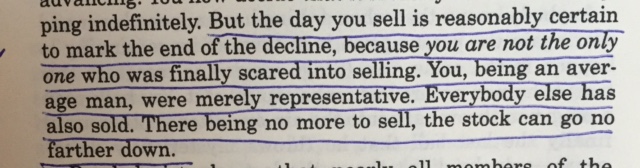](/content/images/wordpress/2016/05/kelly-2.jpg)
[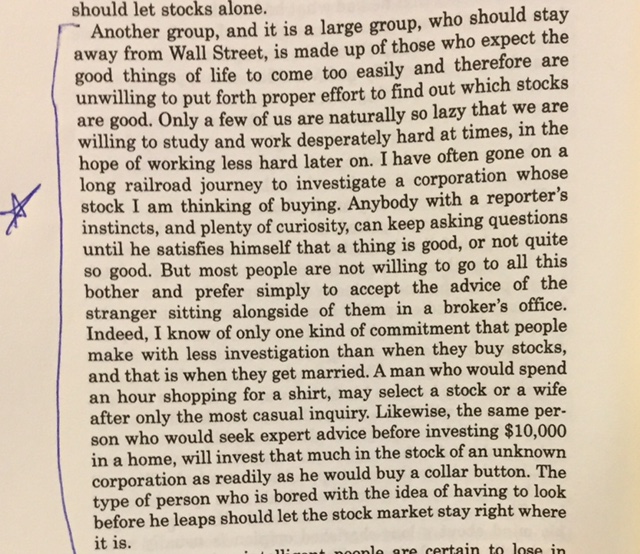](/content/images/wordpress/2016/05/Kelly1.jpg)
If you enjoy reading about investor-trader behavior, psychology, and are a student of market history, you will enjoy this book. You should add Why You Win Or Lose to your “Classics” library as it is short (70 pages) and inexpensive ($4.50). You can find it on Amazon [\[HERE\]](http://www.amazon.com/Why-You-Win-Lose-Speculation/dp/1614271615/ref=sr%5F1%5F1?ie=UTF8&qid=1462365946&sr=8-1&keywords=fred+c+kelly&ref=microcapclub.com).
**\===> Interact and learn with 250+ of the best microcap investors on the planet.** [\[Join Us\]](https://microcapclub.com/join-now/)
MicroCapClub is an exclusive forum for experienced microcap investors focused on microcap companies (sub $500m market cap) trading on United States, Canadian, European, and Australian markets. MicroCapClub was created to be a platform for experienced microcap investors to share and discuss stock ideas. Since 2011, our members have profiled 1000+ microcap companies. Investors can join our community by applying to become a member or subscribing to gain instant view only access. MicroCapClub’s mission is to foster the highest quality microcap investor Community, produce Educational content for investors, and promote better Leadership in the microcap arena. For more information, visit [http://microcapclub.com](http://microcapclub.com/) and
### The Best Microcap Investor You've Never Heard Of
URL: https://microcapclub.com/best-microcap-investor-youve-never-heard/
Last updated: 2023-10-14T19:48:34.000Z
When I first started researching individual stocks, I initially decided to expand my search to the entire North American equity market. There was an investment firm named First Wilshire Securities that was showing up on a number of microcap companies I examined. I’ve never been shy of stealing stock ideas from smart investors, so I started to look deeper at some of the other holdings in First Wilshire’s portfolio for potential ideas. I found that many of these companies turned out to be really interesting ideas trading at attractive valuations; this spurred me into needing to find out more about First Wilshire Securities and the person behind the firm. This search in turn led me to discover a superinvestor named Fred Astman who helped shape my early investment philosophy as much as any other investment master.
For his amazing track record, very few investors have heard of Astman. He spent his entire investment career under the radar. There has been very little written about Astman, however, he did do a handful of interviews with The Wall Street Transcript and The Bowser Report over the years. A few short profiles of Astman also appeared in BusinessWeek, Equities, and a few other business publications. In this article, I tried to distill what I learned from these sources.
Fred Astman was born on May 29, 1922\. He served in the U.S. Air Force during World War II and when he returned from service overseas, he earned a business administration degree from the University of Connecticut. He was later recalled to active duty during the Korean War. Following his active duty, in 1961 he became a stockbroker in Los Angeles, and immediately found a niche investing in small company stocks. In 1969 he was named as manager of a very small mutual fund and found success early on as an investment manager investing in microcap stocks; during one thirty month period in the 1970’s the fund’s net asset value grew by more than three hundred percent. Fred decided to start First Wilshire Securities in 1977, and he would go on to have one of the best long term investment records with average annual returns of nearly 20 percent through the next three decades. According to First Wilshire’s CEO Scott Hood, who shared portfolio management duties with Astman starting in 1998, Astman was “one of the best pure stock pickers that ever lived”. Here are the keys to how he achieved stellar returns.
Astman had a very methodical approach to finding attractive stocks. His search process often started by screening through the thousands of small cap and microcap companies listed in North America, looking for companies that met his criteria. He was a voracious reader and often got ideas from Value Line, the major business news publications like BusinessWeek, Forbes, Fortune, and The Wall Street Journal as well as Standard and Poor’s stock guides. Once he found an interesting idea, he would often look at the competitors, which could often result in his buying other industry players if the whole industry was out of favor. Astman often looked for an interesting change in a company for a reason to buy. For instance, it might have been a change in management, a new acquisition, closing an unprofitable division, a change in product, or a change in direction in an overseas division.
He preferred to own stocks that were neglected by other investors and analysts. Often, the companies that made their way into his portfolio were too small to be of interest to other institutional investors. Astman invested in unpopular industries like direct selling (multi-level marketing) and payday loans. He would invest in companies that were headquartered in far off geographies like Hungary, China, Brazil or Guyana, where most investors were unwilling to tread. Companies on his buy list often had endured a recent industry cycle bottom. For example, Astman loaded up on reinsurance companies after the extreme 2005 hurricane season had temporarily depressed the companies’ earnings. Around the same time, one-quarter of his portfolio was in Asian-American banks spread between six or seven of these banks. Even though these bank stocks were trading at very attractive multiples of book value and earnings, and growing faster than their peers in the traditional banking sector with very little exposure to the overheated residential real-estate market, they were completely ignored by most investors. The common theme among all these stocks was that they were neglected by other investors and mispriced.
He liked to buy stocks with above average growth at below average multiples. Growth was very important to Astman, and he believed that truly small companies held the greatest promise for growth. He liked to buy companies that were growing earnings, cash flows and/or dividends at a minimum of 10-15 percent per year. As important as growth was to Astman, he wanted to buy stocks at a Price/Earnings ratio of less than 10X current year’s earnings – the lower the better. He made numerous purchases of stocks over his career at a single digit earnings multiple, and some as low as 1X earnings. For example, in early 1989, he bought Kentucky Medical Insurance stock at $2.75 per share, when he projected they would earn $2.45 in earnings that year. These early buys resulted in a sevenfold gain within twelve months when his earnings projections came through. That was a common theme among most of his stock picks – buying growing companies at below average earnings multiples.
Astman mitigated risk by insisting on certain qualitative and quantitative factors. He looked for companies with a sustainable competitive advantage who were industry leaders. He wanted to see a solid balance sheet, preferably with more cash than debt, and conservative accounting methods. Companies with short operating histories were discarded and many of the companies he bought had been around for decades, which kept him out of more speculative sectors like technology and biotech.
He was a contrarian in how he bought stocks, and patient in building positions. He liked to buy stocks well before other institutions started buying. Astman preferred to see no more than 5 percent institutional ownership in the stocks that he was buying, and he would often start selling once institutional investors like pension funds and small cap mutual funds got more involved in the stocks he owned.
Astman ran a relatively concentrated portfolio. The majority of his holdings were often in his top twenty to thirty stocks. He set a maximum position size at cost of 5 percent, and he was very disciplined about not chasing stocks that would move out of his buy range. He would mitigate risk by trimming holdings that would grow to above 10 percent of the portfolio, and he was not afraid to hold cash if he couldn’t find anything attractive to buy. Despite being a great stock picker, he was humble enough to admit that one out of four of his picks would be losers, and he diversified accordingly.
Astman was a long-term investor. He had a very low turnover of stocks in his portfolio and averaged about 25% turnover in any one year. Despite thinking long term, he had a strong sell discipline, trimming stocks that became overvalued. However, if earnings and cash flows continued to grow in lockstep with the share price, he continued to hold, sometimes for as long as a decade.
He continued to follow sold stocks and would often recycle old names back into his portfolio. There were a number of stocks that showed up in his portfolio on and off over many years. He called these recycled stocks. He would buy these stocks when they were out of favour and then sell them when optimism returned. He continued to follow the stories, and he would often buy them back again the next time they went out of favor. These recycled stocks often comprised 10-20 percent of his stock purchases. Nature’s Sunshine was one such stock that showed up in his portfolio on and off over nearly 25 years.
Astman preferred a team approach to investment analysis. Over the years, he grew First Wilshire Securities from a one man shop to several analysts and two portfolio managers. He attracted like-minded investment professionals who shared his investment philosophy. He mentored and trained his analysts as generalists, and allowed them to pursue their research wherever it needed to go. Astman guided the investment philosophy of the investment firm, but he felt that taking a team approach resulted in better analysis, and they could cover more companies.
He had a meticulous process for evaluating management. He and his team of analysts would often visit management at their company headquarters, which would often give them clues about how the company was running. He evaluated management based on whether or not they had skin in the game through stock ownership, and whether they were taking an excessive amount of stock options. He was interested in evaluating the CEO but also looked at the history of the other management team members. He also sized up the board to see if they were autonomous. In addition, he evaluated whether management was reporting their numbers on time or not. Astman and his team performed ongoing research to keep up to date on companies.
Astman made an effort to attract long term investors as clients. He wasn’t interested in accepting short term money because he knew that there would be temporary periods of underperformance. However, he was confident that over three to five year periods, his performance would be satisfactory and his clients would do well if they stuck with him. And quite well they did do. If a client had invested $10,000 with Astman when he first put out his shingle in 1977, over a 30 year period it would have compounded to roughly $2.7 million at a 20% annual growth rate.
Astman had a passion for stock picking and shared the rewards of his success. At 82 years old, he was still going into the office for twelve hour days, six days a week, and at 90 years old still showed up five days a week. He was very generous with his time, mentoring not only his analysts, but also met with up and coming money managers who made the trek to visit Astman in Pasadena, California to seek his council. He was also very generous in his philanthropy. He and his wife Jean set up a foundation that focused on helping children locally and globally and did it in a way that was under the radar.
On April 2, 2013, at the age of 90, Fred Astman passed away. Even though he had no children of his own, his legacy is carried on through the charitable foundation he and his wife started, as well as the investment family that he left behind at First Wilshire Securities. For those of us who never had the chance to meet him, but are willing to study his investment process, Astman laid out a framework that investors could use to achieve enormous success investing in small companies. Fred Astman left this world as one of the best stock pickers that ever lived and I, for one, am a better investor for having studied him.
**\===> Interact and learn with 250+ of the best microcap investors on the planet.** [\[Join Us\]](https://microcapclub.com/join-now/)
MicroCapClub is an exclusive forum for experienced microcap investors focused on microcap companies (sub $500m market cap) trading on United States, Canadian, European, and Australian markets. MicroCapClub was created to be a platform for experienced microcap investors to share and discuss stock ideas. Since 2011, our members have profiled 1000+ microcap companies. Investors can join our community by applying to become a member or subscribing to gain instant view only access. MicroCapClub’s mission is to foster the highest quality microcap investor Community, produce Educational content for investors, and promote better Leadership in the microcap arena. For more information, visit [http://microcapclub.com](http://microcapclub.com/) and
### You’re Smarter Than You Think
URL: https://microcapclub.com/youre-smarter-think/
Last updated: 2023-10-14T19:49:43.000Z
Individual investors have an edge over “financial professionals” because you don’t have to prove how smart you are. Successful investing is hard because it’s counter to our human nature. Having to take a public or semi-public stance on the world of investing is a big disadvantage because you are now being judged by the peanut gallery. Just think about Jim Cramer on CNBC. He’s on TV every weeknight, and he has to have an opinion on 1,000 different stocks. I think I’d rather walk through Dante’s Inferno and its eight levels of hell. Cramer has a target on his back, and not many have the stomach for it. I actually loved Cramer’s [“Just Show Up”](http://www.businessinsider.com/jim-cramer-bad-moment-jon-stewart-revenge-show-up-cnbc-mad-money-2015-12?ref=microcapclub.com) response when asked about his national humiliation on John Stewart’s, The Daily Show.
Individual investors have an edge over fund managers, financial advisors, analysts, guru newsletter services, and anyone else that is forced to have a public persona and/or swing the bat. As an individual investor you don’t have to waste time caring about every stock or what the general market is doing. You don’t have to come up with a pick of the month. You don’t have to be right on all of these companies you don’t understand. All you have to do is focus on making one good decision per year on a few companies you do understand.
Financial professionals have to deal with the emotions of others. Individual investors just have to [control their own emotions](http://microcapclub.com/2014/03/master-your-emotions-before-you-go-broke/). This is very important because the way to financial freedom is buying great companies early and holding on with a death grip. As [Morgan Housel](https://twitter.com/TMFHousel?ref=microcapclub.com) pointed out in, [The Agony of High Returns](http://www.fool.com/investing/general/2016/02/09/the-agony-of-high-returns.aspx?ref=microcapclub.com), and I with, [No Pain No Gain](http://microcapclub.com/2016/02/no-pain-no-gain/), most professional money managers would have been fired for owning the best performing stocks. For example, if a money manager had the foresight to buy Monster Beverage (MNST) in 2003, the stock would have been up 13,000% (130-bagger) by late 2007\. Over the next year the stock dropped by 50%. With all those clients in the peanut gallery yelling at you thinking/saying “Are you that naïve? How could you hold something you’re up that much in?” That money manager, even though he/she picked the stock a few years earlier for massive gains, would have been fired and/or forced to sell the position. In doing so the money manager and clientele would have missed out on the next seven years when MNST would go up an additional 50,000% from your cost basis in 2003.
Monster Beverage, Southwest Airlines, and all the other 100-Bagger super stocks have ten, twenty, even thirty of these heart attack inducing mini-cycles. In fact, the more successful the business over the long-term (10-20-40 years) the more you will experience these mini-cycles. Many below average or even average companies experience fewer and/or less volatile mini-cycles. Why? Lack of expectation. The chart below which was tweeted by [@jatin\_khemani](https://twitter.com/jatin%5Fkhemani?ref=microcapclub.com) best illustrates why they occur.
> Story of most Growth Stocks – price/expectations vs. actual earnings [pic.twitter.com/AF85gpfNqc](https://t.co/AF85gpfNqc?ref=microcapclub.com)
>
> — Jatin Khemani, CFA (@jatin\_khemani) [March 24, 2016](https://twitter.com/jatin%5Fkhemani/status/713078846153592832?ref%5Fsrc=twsrc%5Etfw&ref=microcapclub.com)
Often times expectation, not reality, drive stock prices. The chart above accurately portrays one of these mini-cycles that many growing companies encounter. With growth stocks in particular, shareholder expectations swing like a pendulum from unrealistic to pessimistic and back again. A growth stock transitions to profitability, expectations rise, the stock rises, buying attracts more buying, and analysts initiate coverage creating greater waves of capital inflows. Finally, while retrieving the mail your neighbor tells you that he recently purchased shares in said company. Expectations officially reach the tipping point. Then reality kicks in with the next earnings report. The pendulum swings back in the other direction. Momentum traders and short-term investors exit, analysts go quiet, the stock falls 40-60% from its highs, fundamentals back-fill, new shareholders enter, and the float is turned over. This is one mini-cycle. They can last for 6-12-24-36 months or more. The deciding factor is how quickly the fundamentals backfill. If the business keeps performing, at some point “the crowd” will once again drive expectations too high, and the cycle begins again. The [14 Stages of Investing Psychology](http://microcapclub.com/2013/04/the-14-stages-of-investing-psychology/) often correlate with these mini-cycles and are humorous only because they are so true.
[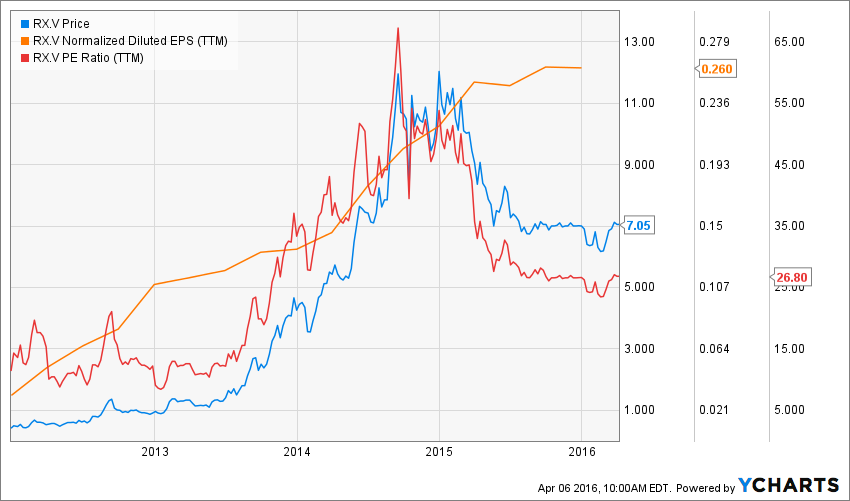](/content/images/wordpress/2016/04/RX.V%5Fchart.png)
We can all find companies with stock charts that look similar to Jatin’s mini-cycle chart. [Mike Schellinger](https://twitter.com/MikeDDKing?ref=microcapclub.com) profiled BioSyent (RX.V) on MicroCapClub at $0.55 per share in February 2012\. The stock was very illiquid, trading 10,000 shares ($5,000 worth of stock) per day. Over the next year, BioSyent’s stock moved over $1.00 per share. The business continued to perform which attracted more and more attention and 18 months later the stock was $12.00 per share, trading 100,000 shares ($1 million worth of stock) per day. I wrote about this a bit more in [Don’t Worry About Illiquidity, Worry About Being Right](http://microcapclub.com/2014/03/dont-worry-about-illiquidity-worry-about-being-right/). The irony is you didn’t see much institutional interest or analyst coverage until the stock was $7.00+ per share which was close to the time expectations outpaced reality. Institutions and analysts were on BNN (CNBC equivalent in Canada) touting the stock the whole way until the expectation bubble burst. Investors tend to under-analyze when stocks are going up (greed) and over-analyze when stocks are going down (fear). The stock dropped, the institutions and analysts with public microphones went silent, and the pendulum swung to pessimism. During this time the company kept performing. The fast money exited, new and existing shareholders built positions, the float turns over, and eventually a new platform for stock appreciation is put in place. I used BioSyent in this example, but you can use hundreds of other companies that follow this same pattern.
As an aside, [intelligent fanatic CEO’s](http://microcapclub.com/2016/01/how-to-find-intelligent-fanatic-ceos-early/) know when their stock is expensive. When it’s expensive you start seeing some of them use equity to make acquisitions, like Henry Singleton. Other intelligent fanatics like Elon Musk actually come out and say the stock is expensive, like [he did in 2013](http://money.cnn.com/2013/10/25/investing/tesla-netflix-momentum-stocks/?ref=microcapclub.com). Sean Iddings and I will be highlighting intelligent fanatic Sol Price in our upcoming [Intelligent Fanatic Project](https://intelligentfanatics.com/?ref=microcapclub.com). Sol Price was a retailing visionary whom Sam Walton (Founder of Wal-Mart), Jim Sinegal (Co-Founder of Costco), and Bernard Marcus (Co-Founder of Home Depot) credit for many of their successful strategies. When Sol Price’s, Price Club, traded at 60x earnings and analysts had irrational expectations he said, “I think Wall-Street tends to get crazy. They fall in love…pretty soon they run your stock up. I hate to see the stock get hysterical.” These intelligent fanatics are so focused on the long-term that they don’t mind being honest about the short-term.
This is a flippant plug for microcap investing but another big edge individual investors have is microcap investing. Individual investors don’t have to wait for a company to be large, liquid, and known before buying it. Financial professionals are trained to believe volatility and illiquidity increase risk. The biggest advantage of microcap investing is larger, “smarter” money, can’t own these companies until they are larger. You saw this in the example of BioSyent above where analysts and institutions had to wait to buy it. Don’t invest where the institutions are, invest where they are going to go. Microcap investing is [A Game You Can Win.](http://microcapclub.com/2014/09/a-game-you-can-win/)
In conclusion, individual investors have an edge over “financial professionals” because you don’t have to prove how smart you are. You don’t have to be active for activity sake. You don’t have to come up with a stock pick of the week, month, even year. You don’t need to have an opinion on things that don’t matter. You don’t have to open yourself up to the peanut gallery. Individual investors can sit at the plate and wait because no one is in the stands yelling “Swing you bum!” \[a bit of Buffett\]. You can sit on great companies through mini-cycles and wait for your pay day. Experienced individual investors, even those managing small sums, should always have an edge. You have the advantage of only worrying about your own emotions and not caring what the world thinks. Don’t ever think bigger, more “popular” money is smarter money. With a little bit of patience, experience, and discipline, you can and you should beat any of the professional’s performance.
**\===> Interact and learn with 250+ of the best microcap investors on the planet.** [\[Join Us\]](https://microcapclub.com/join-now/)
MicroCapClub is an exclusive forum for experienced microcap investors focused on microcap companies (sub $500m market cap) trading on United States, Canadian, European, and Australian markets. MicroCapClub was created to be a platform for experienced microcap investors to share and discuss stock ideas. Since 2011, our members have profiled 1000+ microcap companies. Investors can join our community by applying to become a member or subscribing to gain instant view only access. MicroCapClub’s mission is to foster the highest quality microcap investor Community, produce Educational content for investors, and promote better Leadership in the microcap arena. For more information, visit [http://microcapclub.com](http://microcapclub.com/) and
### Success Always Starts With Mistakes
URL: https://microcapclub.com/success-always-starts-mistakes/
Last updated: 2023-10-14T19:51:38.000Z
Investing is hard. Microcap investing is even harder. Turning a small sum into your [first million](http://microcapclub.com/2015/01/the-first-million/) rarely happens in the time frames we want. [No Pain No Gain](http://microcapclub.com/2016/02/no-pain-no-gain/). Symbolically, we would all like our stock and portfolio returns to look like this:
[](/content/images/wordpress/2016/04/Success-e1459859809429.jpg)
Unfortunately, the markets do not work this way. Nor do businesses. But you may say, “Sean, there are overnight success stories found in the news, like the break out investor who has been leaving the market and competitors in the dust or the private tech company that is receiving another round of funding pushing their valuation up another billion dollars.” Sure, but what we hear in the news is the tip of the iceberg. Individuals are lucky because they were prepared and most people do not want to prepare by experimenting and learning from mistakes.
\[blockquote cite=”Steve Jobs” type=”center”\]
“If you look really closely, most overnight successes took a long time.”
\[/blockquote\]
Steve Jobs and a myriad of other successful individuals, past and present, have come to the same conclusion; success is a combination of luck, hard work, determination, smarts, and appetite for risk. There is no such thing as an overnight success. It usually takes years for a company to become successful and it can take years for an investment to bear fruit. Mark Twain might have said it best:
\[blockquote cite=”Mark Twain” type=”center”\]
“Overnight success is a fallacy. It is preceded by a great deal of preparation. Ask any successful person how they came to this point in their lives, and they will have a story to tell.”
\[/blockquote\]
The problem is that we hear next to nothing of the challenges, hard work, and dedication necessary to achieve success. Like Mark Twain said, successful individuals have a story to tell and I think not hearing these journeys toward success is a big mistake for the microcap investor.
I’ll pick on Steve Jobs for a moment. He introduced the iPod 25 years after he co-founded Apple, at which time Apple really started hitting its stride. It is easy to forget the years of mistakes Steve Jobs had endured to get to that point. The Apple III was a flop with only 65,000-75,000 units sold. His pet project the Apple Lisa and the G4 cube were blunders and, not to mention, Jobs had been kicked out 9 years after co-founding the business. Steve Jobs essentially was never afraid of failing. He talked about his mindset in this clip:
https://youtu.be/zkTf0LmDqKI
Jobs also had to encounter a number of challenges as an investor. His $10 million investment in Pixar was a dud for the first 9 years. He sunk an estimated $50 million more into the company and was close to giving up many times along the way. Eventually Pixar took off with the release of Toy Story and had an IPO in 1995\. Jobs’ 80% stake in Pixar was then valued at $1.1 billion. In 2006, Disney acquired Pixar for $7.4 billion leaving Steve Jobs with 138 million shares of Disney for a $4.5 billion valuation. That was roughly a 23% compounded annual return over 21 years. Pixar was actually the investment that made Steve Jobs a billionaire, not Apple. Steve Jobs stuck to his higher calling in the face of countless challenges and failures. Each of his challenges set him up to be better prepared for opportunities that came about in the future for Apple.
As Ian has mentioned, I am working with him on [The Intelligent Fanatics Project](http://intelligentfanatics.com/?ref=microcapclub.com) and Herb Kelleher is one of our case studies. Herb Kelleher co-founded Southwest Airlines in 1971 and led the company for many decades. The company reached profitability in 1973 and has been profitable every year since. Yes, this track record flies in the face of the worst industry capitalism has ever seen; the airline industry. Warren Buffett even got burned on airlines after losing $350 million buying debt in USAir in 1989\. Buffett says, “Investors have poured their money into airlines and airline manufacturers for 100 years with terrible results.” This isn’t exactly true. Investors made a fortune betting on Herb Kelleher of Southwest Airlines. $10,000 invested in the IPO would have compounded at 19.3% for 43 years and resulting in $17,722,914 today (170,000% return).
Most people do not know that Herb Kelleher and Southwest had to endure significant challenges before the company ever flew its first flight. Competitors Braniff International Airways and Texas International operated in a regulated monopoly and did not want another competitor to enter into the market. From 1967 to 1971, the incumbents filed temporary restraining orders and other legal devices to thwart Southwest from ever flying. Herb Kelleher, acting as Southwest’s lawyer, fought against these established competitors and finally succeeded, nearly going bankrupt in the process. All of the initial challenges imbued a warrior spirit within Kelleher and within Southwest Airlines’ culture. This warrior spirit prepared the company for the many challenges they would later face.
So, success is not a line straight up and to the right. Success looks more like this:
[](/content/images/wordpress/2016/04/SuccessReal-e1459859886887.jpg)
[All great companies started as small companies](http://microcapclub.com/2015/12/all-great-companies-started-as-small-companies/). Apple and Southwest started as microcap companies and endured numerous challenges before they were successful. This is an important observation for investors to remember when evaluating microcap management teams. A microcap CEO might have made numerous mistakes in the past, but if they learned their lessons it can be a powerful springboard toward success. You can think of mistakes as lessons. Writing off someone who has experienced a number of valuable lessons is a mistake. A rare number of leaders *will* learn from their mistakes and are likely to be better prepared for future opportunities.
Chip Maloney provides great insight on the [art of interviewing management teams](http://microcapclub.com/2014/11/the-art-of-interviewing-management/) and my added suggestion would be to follow Warren Buffett’s advice, “Is management candid with shareholders?”. My process includes specifically asking management what mistakes they’ve made in the past. Humble managers will candidly describe one or more past failures as well as what they learned. These are the leaders who are preparing themselves for future success.
If you look at the data, intelligent fanatics are often late bloomers. Ian posted the following on Twitter:
> That idea you've been thinking about. That dream you have. It’s time to move things forward and reach your destiny. [pic.twitter.com/Qgu8aD3kCD](https://t.co/Qgu8aD3kCD?ref=microcapclub.com)
>
> — Ian Cassel (@iancassel) [January 16, 2016](https://twitter.com/iancassel/status/688174852616798208?ref%5Fsrc=twsrc%5Etfw&ref=microcapclub.com)
These leaders had to experience life and many challenges to be prepared for their later success. It is inspiring to think that Sam Walton at age 44 opened his first Wal-Mart and during his lifetime dominated the industry.
The same is true with the individuals found in [The Intelligent Fanatics Project](http://intelligentfanatics.com/?ref=microcapclub.com). Every single one of our case studies, 10 in all, started as small companies and their leaders had at least one large mistake or challenge that they had to overcome. Many had multiple mistakes or challenges early on or in previous ventures. This means it took years before the CEO’s started the businesses that led to their ultimate success. The average age of the CEO’s in The Intelligent Fanatics Project is 35 years old, many starting in their late 30’s. Keep in mind that some intelligent fanatics, especially the youngest, experienced failure early in their business and needed to continuously learn and adapt to be successful. Below is a list of the ages of each case study:
[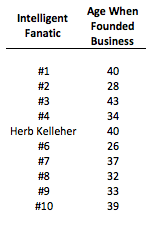](/content/images/wordpress/2016/04/IF-Age.png)
Another important factor for companies to succeed in the long-term is for the microcap CEO to constantly adapt. Consumer preferences change, so CEO’s need to be a step ahead of those changes. And the only way for managers to stay ahead of market changes is to experiment. A by-product of trial and error is of course error, so managers need to embrace small failures. On the other hand, fear of making mistakes leads to complacency and allows smaller companies, who do not fear adapting, to innovate and siphon profits of larger companies. Large corporations, their professional CEOs, and their corporate bureaucracies despise failing and will shy away from adapting to change. Lean towards investing in founders or those who have a founder mentality and an experimental mindset to adaptation.
As investors we too are going to make mistakes and lose money. Your investment strategy is molded and shaped through these experiences. Not all your investments will work out in your anticipated time frame. Success often takes longer than we think. Learn from your mistakes and keep focusing on the long-term. The lessons you learn from your investment mistakes will stick with you forever and prepare you to handle the great opportunities that are around the corner.
I’ll leave on this quote from Scott Adams, the creator of Dilbert:
> “Failure is where success likes to hide in plain sight. Everything you want out of life is in that huge, bubbling vat of failure. The trick is to get the good stuff out.”
**\===> Interact and learn with 250+ of the best microcap investors on the planet.** [\[Join Us\]](https://microcapclub.com/join-now/)
MicroCapClub is an exclusive forum for experienced microcap investors focused on microcap companies (sub $500m market cap) trading on United States, Canadian, European, and Australian markets. MicroCapClub was created to be a platform for experienced microcap investors to share and discuss stock ideas. Since 2011, our members have profiled 1000+ microcap companies. Investors can join our community by applying to become a member or subscribing to gain instant view only access. MicroCapClub’s mission is to foster the highest quality microcap investor Community, produce Educational content for investors, and promote better Leadership in the microcap arena. For more information, visit [http://microcapclub.com](http://microcapclub.com/) and
### Cash Is A Position
URL: https://microcapclub.com/cash-is-a-position/
Last updated: 2023-10-14T19:52:25.000Z
One of the biggest advantages that a retail investor has over funds is that they can be in cash. Most funds, due to their mandates, must deploy most of their cash and thus are virtually fully invested at all times. As an individual investor, you don’t have that restriction.
In my fourth article in the My Secret Recipe series entitled [My Secret Recipe: The Bargain Rack](http://microcapclub.com/2015/06/my-secret-recipe-the-bargain-rack/) I detail how I like to buy stocks with a margin of safety. Also, I like to take the approach that Warren Buffett stated when he said: “I don’t look to jump over 7-foot bars: I look around for 1-foot bars that I can step over.” I like to buy when I have great conviction and not when I have low conviction in an idea. Because I am very patient in this regard, I find myself sitting in cash often while I [wait for my pitch](http://microcapclub.com/2015/04/wait-for-your-pitch/).
The following graph shows my cash percentage over time superimposed over the Russell 2000\. My cash position has varied widely from roughly 10% to 80%. The correlation between market performance and cash levels is quite strong. That is, when the market is moving up, my cash levels tend to go up as I sell stock, and when the market is going down, I tend to buy stock as bargains present themselves. I do like to keep some level of cash at all times as I prefer not to need to sell stock to pay bills.
[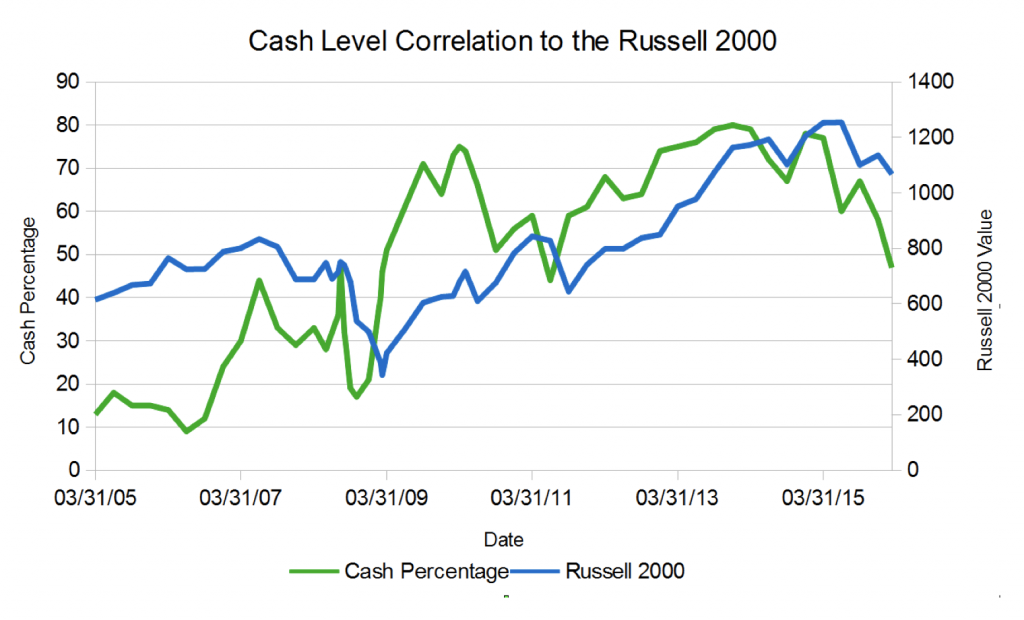](/content/images/wordpress/2016/03/Cash-Pic1.png)
The correlation with the market is best illustrated by talking about some examples. My cash level started steadily rising starting in fall of 2006 and hit a peak in August of 2008\. It was at a level it had never seen before. I deployed cash during the coming months after August 2008 as the market plunged. I was early in deploying cash but the point wasn’t to time the market. The point was I saw attractive opportunities and purchased those attractive opportunities.
As we all know, the market bottomed in March of 2009\. As the recovery progressed, I saw my cash level steadily increase into 2010\. Cash hit another peak right around spring of 2010 which is right around the time the Russell 2000 hit it’s first major peak post crisis. I then saw my cash levels start to decrease.
Berkshire Hathaway, run by Warren Buffett, is also known for using their cash position judiciously. Below is a graph that shows the cash level held by Berkshire Hathaway. Note that it bottomed in June of 2009 just after the market bottomed and has been growing ever since. Warren Buffett uses cash very strategically. Since he is going after larger companies and has to do it in big chunks, he is hunting for whales as compared to my guppies. So, the way he deploys cash is different than me but the point is the same. That is, cash is a position that can be used strategically when the time is right. He doesn’t wake up in the morning and think, I have cash that I must deploy today.
[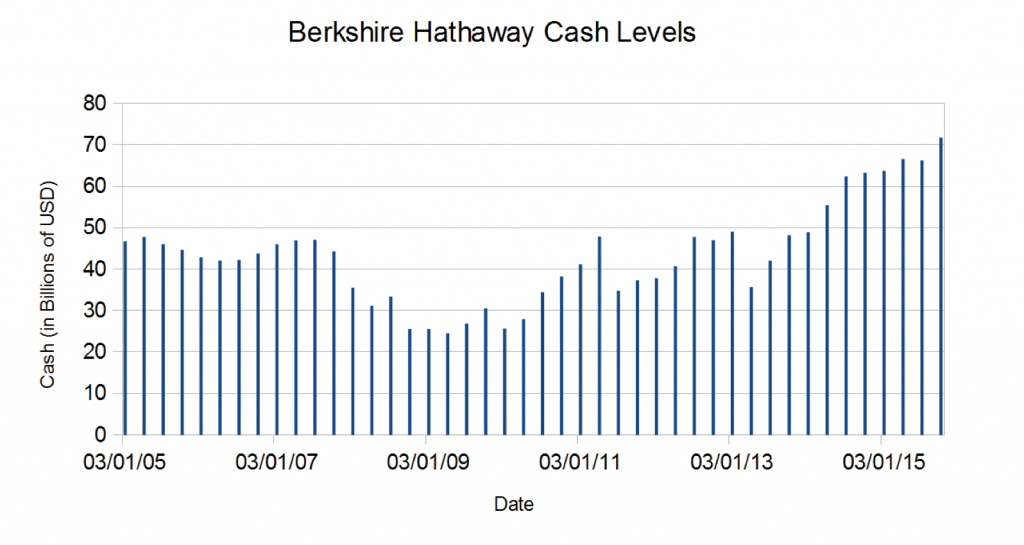](/content/images/wordpress/2016/03/Cash-Pic2.png)
Over the past few years my cash has been at more elevated levels. There just haven’t been that many opportunities in the microcap space as the microcap space got overheated. In fact, the Russell 2000 had an astounding 38.6% return in 2013 and is now lower than its level at the end of 2013\. Additionally, the Russell MicroCap Index was up 45.2% in 2013\. Given the lack of opportunities, I sat patiently and waited. However, since early 2015 I’ve started to see my cash level decrease. Assuming the trend continues, and I think it will, I’ll soon be at cash levels that haven’t been this low since 2009\. I’m simply seeing a lot of opportunities right now and I haven’t seen much in a long time. Of course, all of my due diligence on these companies can be found in the company discussions on [MicroCapClub](http://microcapclub.com/join-now/).
My cash position over the past decade has helped me to magnify my returns. My strict discipline helps me to improve the odds of making money and not losing money. Now I may not make the most money during periods of blow-off tops in the market but I also lose a lot less in market contractions. Using cash has helped me to obtain market beating returns of around 23% annually over the long haul (Jan 1, 2000 to March 10, 2016). That return includes cash which means that my return on invested capital has been considerably higher.
Now I’ve heard people say that there is no excuse for cash. You can always short stocks. MicroCaps are very difficult to short for technical reasons (e.g. difficulty of borrowing) and also are very dangerous to short because it is quite possible to have a bullish PR come out of left field that results in a huge upside move in the stock. There have been a few times where I used shorting on larger companies but they have been few and far between. I find it difficult to be both an expert in microcaps and watch larger companies at the same time.
Some people will look at this article and say that I’m market timing. While that may be true indirectly, it isn’t something that I am doing directly. I don’t wake up in the morning and say, I think the market is going to be down over the next six months so I’ll sell stocks. I simply buy companies when their valuation and future prospects look attractive and sell them when the valuation looks rich relative to their future prospects. This approach helps me to buy when the market is pessimistic and sell when the market is overly optimistic.
While my cash position does have a strong correlation to market performance, I don’t proclaim that my cash level is perfect or that people should even try to correlate their cash level to market performance. I simply try to buy companies when they are priced attractively and sell them when the risk of owning them outweighs the potential return.
The number and quality of attractive opportunities that I see may not always correlate to the market. One reasons for this is that there are companies that outperform in times of market contraction. Also, there are companies that have minimal economic sensitivity. I do find that the number of attractive opportunities does seem to correlate quite well (inversely) with general market performance.
The hardest part of having cash is being patient. I derive my income from the stock market and it is hard to make money when I am lightly invested. I have to force myself to sit on my hands. On the other hand, buying when everyone is pessimistic is also difficult. I remember posting online in late 2008 that I was buying and feeling like I was talking to myself. Being contrarian isn’t easy emotionally.
Many individual investors use cash in exactly the wrong way. They try to market time and capitulate when the pain hits the maximum level. Conversely, they get sucked into the stock market when everyone is making money and buy near the top. Instead of buy low sell high they sell low and buy high. [Mastering your emotions](http://microcapclub.com/2014/03/master-your-emotions-before-you-go-broke/) is an important part of investing that every investor must do.
Now, just to be clear, I generally buy growing companies. So, don’t take this article as I just try to buy solely based upon valuation. If you want to read more about my approach, I suggest reading the entire My Secret Recipe series including: [My Secret Recipe: The Index Card](http://microcapclub.com/2012/10/my-secret-recipe-the-index-card/), [My Secret Recipe: Shopping and a Taste Test](http://microcapclub.com/2012/10/my-secret-recipe-shopping-and-a-taste-test/), [My Secret Recipe: Inspecting the Ingredients](http://microcapclub.com/2015/02/my-secret-recipe-inspecting-the-ingredients/), and [My Secret Recipe: The Bargain Rack](http://microcapclub.com/2015/06/my-secret-recipe-the-bargain-rack/).
I think it is important for individual investors to realize that cash is a valid position. You shouldn’t feel like you need to deploy all of the cash siting in your accounts. As Waren Buffett famously stated, “There are no called strikes in investing.” It is possible that most ideas are not attractive and they should be tossed in the”too hard” pile as Warren Buffett and Charlie Munger often do. You don’t have to swing at pitches that are barely in your strike zone or just outside. If you play things right, your patience will be rewarded.
**\===> Interact and learn with 250+ of the best microcap investors on the planet.** [\[Join Us\]](https://microcapclub.com/join-now/)
MicroCapClub is an exclusive forum for experienced microcap investors focused on microcap companies (sub $500m market cap) trading on United States, Canadian, European, and Australian markets. MicroCapClub was created to be a platform for experienced microcap investors to share and discuss stock ideas. Since 2011, our members have profiled 1000+ microcap companies. Investors can join our community by applying to become a member or subscribing to gain instant view only access. MicroCapClub’s mission is to foster the highest quality microcap investor Community, produce Educational content for investors, and promote better Leadership in the microcap arena. For more information, visit [http://microcapclub.com](http://microcapclub.com/) and
### Keep It Simple
URL: https://microcapclub.com/keep-it-simple/
Last updated: 2023-10-14T19:53:11.000Z
Many in finance like to sound smart by making things complex. These people usually work for other people. Successful people simplify things. Warren Buffett is the best at making a complex subject like investing seem simple. It’s Buffett’s ability to focus on the meat of the subject and not the useless fat that so many other financial pundits like to debate. I was further reminded of this when I listened to this 9-minute interview with Warren Buffett (H/T [@Sanjay\_Bakshi](https://twitter.com/Sanjay%5F%5FBakshi?ref=microcapclub.com)):
https://youtu.be/RJIb55WK6Pk
Let’s dive into four of Warren Buffett’s “Keep it Simple” investment strategies:
1. **Any Good Investment Idea Can Be Put In One Paragraph**
It’s human nature to want to prove how smart you are by writing and talking more instead of less. Albert Einstein said, “If you can’t explain it simply you don’t understand it well enough.” The quality of your investment thesis isn’t proportional to the length of your thesis. It’s why we specifically ask [MicroCapClub Applicants](http://microcapclub.com/join-now/) for a 2-Page investment thesis and not a 20-page analyst report. When you turn over as many microcap rocks as we do, we don’t have time to read 20-pages. It takes a greater amount of talent to say more with less words. If investors like what they see, they should do their own work and verify/collaborate further details.
When searching for the next great company look for simple, easy to understand businesses. Simple businesses aren’t always great businesses but great businesses are almost always simple businesses. The market always pays a premium for simple businesses. Stay away from the onions where you have to peel back multiple layers to understand them. If it’s complicated, dumb money will never buy your shares multiples higher.
1. **Circle of Competence and No Called Strikes**
The most important thing isn’t how big your circle of competence is but how well you define the perimeter. Buffett said, if you know where the edges are you are far better off than someone that has a circle of competence 5x as large but is fuzzy around the edges.
The market will throw you thousands of pitches. [Wait for your pitch](http://microcapclub.com/2015/04/wait-for-your-pitch/). There are no called strikes in investing. Focus on quality businesses and wait for the market to give you a fat pitch. You don’t have to be right on all of these companies you don’t understand. You just have to be right on \~1 decision per year on the companies you do understand. I love Buffett’s punch card analogy:
\[blockquote cite=”Warren Buffett”\]If you got a punch card with 20 punches on it when you left school and every time you made an investment decision you used up one punch, you’d get very rich…because you would think about every single decision you made… and when you knew enough to make a decision you would do it on a big scale… Most of the fortunes have been made in a relatively few securities.\[/blockquote\]
Most investors go down quality when they can’t find new ideas that meet their checklist and it’s why most investors can’t beat the market. Invest every dollar like it’s your last. Keep your hurdle rate high[, wait for your pitch](http://microcapclub.com/2015/04/wait-for-your-pitch/), and when you get it… swing hard. Investing every dollar like it’s your last is a good mindset because we are geared to make our best decisions when we have to.
1. **Invest in great businesses that have a terrific person running it**
In the video, Warren Buffett quotes Peter Lynch, “Buy a business that is so good that any idiot can run it because sooner or later one will”, but then laughs and says he would rather have a terrific person running it. Buffett is also quoted to have said something similar. Value investors love to take the quote out of context which Sanjay Bakshi refutes [\[HERE\]](https://fundooprofessor.wordpress.com/2015/03/20/why-you-shouldnt-invest-in-a-business-that-even-a-fool-can-run/?ref=microcapclub.com). In my experience the smaller the company the more you should focus on management and [qualitative analysis](http://microcapclub.com/2015/07/quality-over-quantity/). Rose Blumkin (video below) couldn’t read or write but built Nebraska Furniture Mart into the largest furnishing store in North America. Rose was an intelligent fanatic. Invest with [intelligent fanatics](http://microcapclub.com/intelligent-fanatics/).
1. **Great businesses are so hard to find that I don’t believe in selling them very often**
Buffett says if you can find a quality business with a durable product, universal appeal, with honest and competent management the time to sell is almost never. Wall Street and its pundits make money off activity (commissions, advertising, newsletters), but you will make money by embracing inactivity. A [Long-Term Focus](http://microcapclub.com/2015/08/focus-on-the-long-term/) doesn’t sell headlines but it’s how you build wealth. If you are invested in great businesses and the story hasn’t changed, develop the [conviction to hold](http://microcapclub.com/2014/08/the-conviction-to-hold/) and don’t let [volatility](http://microcapclub.com/2016/02/no-pain-no-gain/) and lulls in stock price scare you out of your positions.
In conclusion, Warren Buffett became one of the wealthiest people in the world by keeping it simple [(Buffett’s Net Worth By Age),](http://microcapclub.com/2015/08/warren-buffetts-net-worth-by-age/) but he’s also quick to say “Investing is simple, but not easy”. Successful investing is hard work because it means disciplining your mind to do the opposite of human nature. It takes an incredible amount of long-term focus to not be distracted by emotion and short-term influences. Goals are accomplished through hard work and great discipline. Discipline is choosing what matters most over what you want now. Investors tend to add complexity to investing to rationalize why it’s so hard. Don’t do it. Keep it simple and focus.
\[blockquote cite=”Steve Jobs”\]That’s been one of my mantras – focus and simplicity. Simple can be harder than complex: You have to work hard to get your thinking clean to make it simple. But it’s worth it in the end because once you get there, you can move mountains.\[/blockquote\]
**\===> Interact and learn with 250+ of the best microcap investors on the planet.** [\[Join Us\]](https://microcapclub.com/join-now/)
MicroCapClub is an exclusive forum for experienced microcap investors focused on microcap companies (sub $500m market cap) trading on United States, Canadian, European, and Australian markets. MicroCapClub was created to be a platform for experienced microcap investors to share and discuss stock ideas. Since 2011, our members have profiled 1000+ microcap companies. Investors can join our community by applying to become a member or subscribing to gain instant view only access. MicroCapClub’s mission is to foster the highest quality microcap investor Community, produce Educational content for investors, and promote better Leadership in the microcap arena. For more information, visit [http://microcapclub.com](http://microcapclub.com/) and
### No Pain No Gain
URL: https://microcapclub.com/no-pain-no-gain/
Last updated: 2023-10-14T19:55:44.000Z
So you want to be [a full-time microcap investor](http://microcapclub.com/2015/01/so-you-want-to-be-a-full-time-microcap-investor/)? Perhaps you are focused on making your [first million](http://microcapclub.com/2015/01/the-first-million/)? In either case you are focused on growing your capital at high rates of return. But are you emotionally ready for the pain? Do you have the stomach for it?[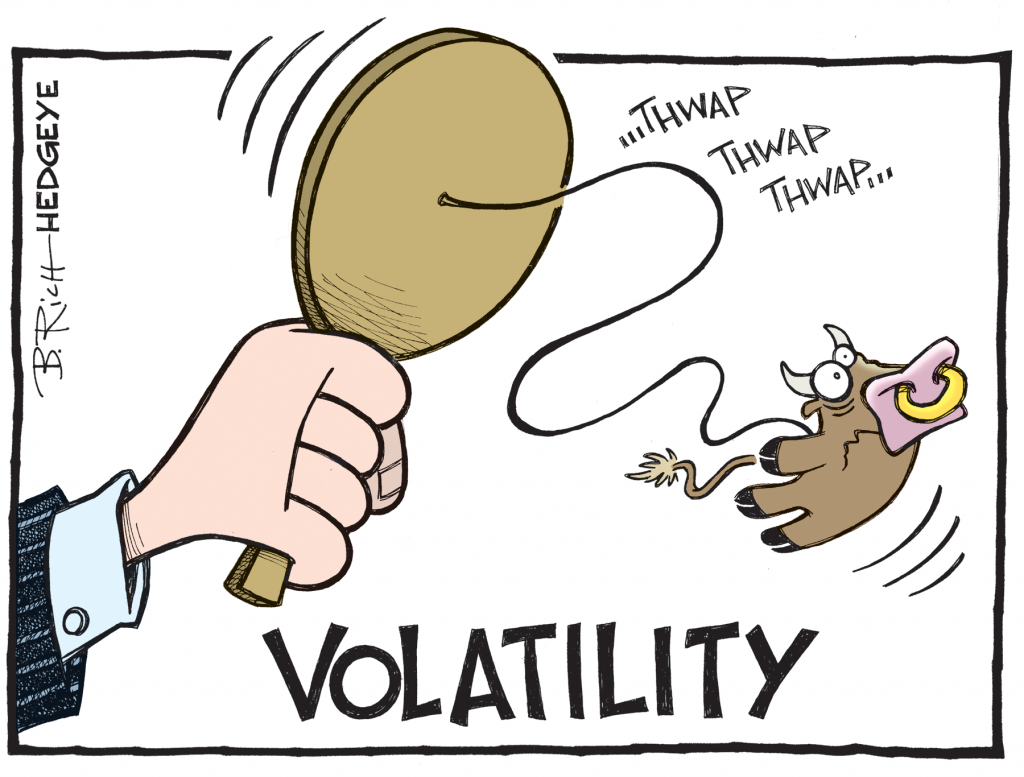](/content/images/wordpress/2016/02/Volatility%5Fcartoon%5F09.02.2015.png)
Microcap companies are illiquid and volatile. Stock price moves of +/- 10% on a weekly or even daily basis are the norm. Most investors are OK with volatility as long as it’s only to the upside, but become unnerved when it occurs to the downside. [Morgan Housel](https://twitter.com/TMFHousel?ref=microcapclub.com) recently wrote a great article, [The Agony of High Returns](http://www.fool.com/investing/general/2016/02/09/the-agony-of-high-returns.aspx?ref=microcapclub.com), in which he highlights the price volatility in the best performing stocks over the last twenty years. For example, Monster Beverage has gone up 105,000% over the last twenty years and yet it has suffered four separate drops of 50% or more. Housel’s sub-title to his article is also a fitting conclusion, “Even with a time machine, a lot of people wouldn’t want to own the best performing stocks.”
[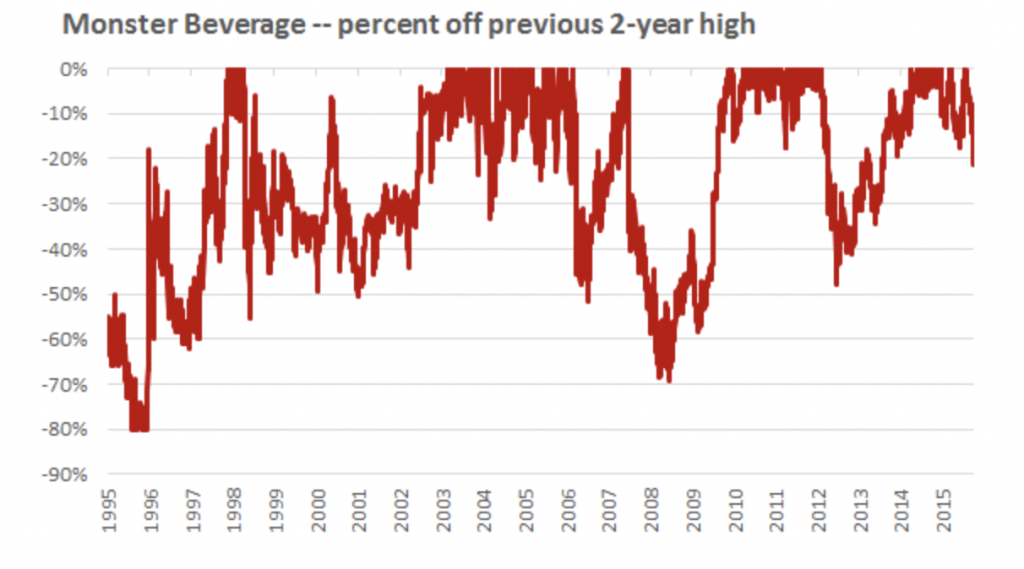](/content/images/wordpress/2016/02/Monster-Beverage-Volatility.png)Successful investing consists of long periods of boredom and short periods of horror. In [Roller Coaster Investing](https://dl.dropboxusercontent.com/u/28494399/Blog%20Links/Roller%20Coaster%20Investing.pdf?ref=microcapclub.com) Sanjay Bakshi highlights Wabco India Ltd a company that faced similar volatility during its six-year rise. I’m working with [Sean Iddings](https://twitter.com/uncapwisdom?ref=microcapclub.com) on a series of case studies we call, The [Intelligent Fanatics Project](http://www.intelligentfanatics.com/?ref=microcapclub.com), that we’ll be publishing later this year. One of the [intelligent fanatics](http://microcapclub.com/intelligent-fanatics/) is Herb Kelleher of Southwest Airlines (LUV). In 1971, Southwest Airlines went public at a $8.5 million valuation (2016 inflation adjusted: $50 million), a microcap even by todays standards. Soon after IPO, Southwest fell to a $2 million market cap, but for those that held their shares over the long-term….$10,000 invested in the IPO would have compounded at 19.3% for 43 years and resulting in $17,722,914 today (170,000% return). How is this possible in a shitty industry like airlines?! It was Herb Kelleher’s vision and leadership. Sean Iddings and I will tell you more about him later this year. Southwest’s monstrous 43 year run consisted of 22 drawdowns of 20% or more. Sanjay Bakshi writes, “If you end up owning a fantastic business, then plan to hold it for a long time. And prepare yourself for a roller coaster ride. If you have chosen the right business to own, the ride will be worth it.”
[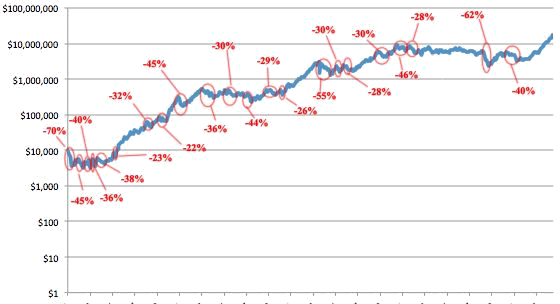](/content/images/wordpress/2016/02/Southwest-Airlines-Draw-Downs.gif)
Southwest Airlines $10,000 Invested in 1971 IPO
Volatility in multi-baggers is normal as influxes of capital move and shake the stock price. Similarly, most multi-baggers will have long periods of stagnation as fundamentals backfill, old shareholders get bored, and new shareholders enter. The key in developing the [conviction to hold](http://microcapclub.com/2014/08/the-conviction-to-hold/) is to have a [long-term focus](http://microcapclub.com/2015/08/focus-on-the-long-term/). This long-term focus allows successful investors to disconnect emotion from investment decisions so they can differentiate business performance form stock performance. The thought process of, “The stock is down 20-30-40-50% from its highs, but the business hasn’t changed, so I will hold”, is the psychological-emotional state an investor must get to when holding great businesses. Stock performance is rarely linear. It can take two years for a position to go up 400% in six months. Unfortunately, this type of conviction to hold can only be fully developed through experience. Over the last year I’m down 40% in one of my largest positions, but the story hasn’t changed, so I will continue to hold. Ten years ago I wasn’t able to disconnect stock performance from business performance. The rough volatile seas of the market would have easily thrown me overboard. An investor must experience the highs of success and lows of failure several times before they can exploit these emotions in others, but let me offer some advice that will hopefully shorten the learning curve.
We all want to get rich quicker, and this desire is our biggest impediment. Often times we have already envisioned spending our returns before we achieve them. “These stocks should double in a year, and when that happens I will buy xyz”. Our returns are linked to consumption. The first step to turning small money into big money is realizing money is about freedom not consumption. Don’t obsess about the goal. Focus on the things you can control like your actions and behaviors.
Successful investing is extremely difficult because it’s one of the only life endeavors where you often times don’t receive short-term positive feedback. For example, lets say you want to lose ten pounds over the next few months. You are in control of what you eat and how you exercise. So you change your eating habits, add exercise to increase your metabolism, and on a weekly basis you can track your progress. The pound or two you lose each week gives you reinforcement and encouragement to keep going.
Unfortunately investing isn’t so kind. Investors rarely get short-term encouragement and positive feedback. The short term is often filled with pain, uncertainty, isolation, and volatility. It is common place for investors to go through 6-12-24 month stretches of underperformance. This is why it’s important to not judge your long-term performance with a short-term yardstick. Warren Buffett in his 1963 Partnership Letter [“The Ground Rules”](http://www.rbcpa.com/WEB%5Fletters/1963.01.18.pdf?ref=microcapclub.com) focused on providing his investors with the right yardstick to judge performance:
> Rule #5: While I much prefer a five-year test, I feel three years is an absolute minimum for judging performance. It is a certainty that we will have years when the partnership performance is poorer, perhaps substantially so, than the Dow. If any three-year or longer period produces poor results, we all should start looking around for other places to have our money. An exception to the latter statement would be three years covering a speculative explosion in a bull market.
Once you understand your yardstick then you get rid of all distractions that promote short-term thinking. Turn off the noise. Why? Because to beat the market you can’t think like everyone else and be manipulated like everyone else. Only listen, read, follow, take advice from those sources that make you better. Stay within your circle of competence and know your positions better than most. Spend twice as much time knowing what you own versus new ideas. What you don’t own can’t hurt you.
If you don’t have much experience investing through turbulent markets, then prepare yourself mentally. I’ve invested through two bear markets, one when I was just [Getting Started](http://microcapclub.com/2014/09/getting-started/) and the second when I was a full time microcap investor. Even though I’m not inexperienced, I still like to test my psyche with mental exercises. When my portfolio is “beat up” and I’m feeling drained I like ask myself: “What if I wake up tomorrow and my positions are all down another 25%?” I think to myself… I will quickly check and see if anything material had changed in the businesses I own. If nothing has changed I will hold or buy more. If something did change, shaking short-term investors, but was immaterial against my 3-5 year long-term expectations then I will hold or buy. If something did change and it’s material against my 3-5 year long-term expectations then I will evaluate and may sell based on its severity and the company’s current valuation. This exercise is most crucial during bad markets and/or when your positions aren’t doing well. Don’t hope for the best, prepare for the worst, and have a mental framework or plan. Famous hedge fund manager and trader Paul Tudor Jones would call this “writing a script for the market” which would help give him the correct mental state.
> P. Tudor Jones on preparing for the trading day.Good advice for investors too,just "write the script" over long-term [pic.twitter.com/n0yySEbprX](https://t.co/n0yySEbprX?ref=microcapclub.com)
>
> — Ian Cassel (@iancassel) [February 24, 2016](https://twitter.com/iancassel/status/702477045440364548?ref%5Fsrc=twsrc%5Etfw&ref=microcapclub.com)
Don’t concentrate on your investing goal, focus on your actions and behaviors. The most valuable action for any investor is reading. Have you ever noticed that great investor’s offices are filled with books, not computer screens? Becoming a learning machine helps you connect the dots and develop mental models for [better faster decision making](http://microcapclub.com/2015/09/indecision-an-investors-biggest-adversary/). You can read about great investors, intelligent fanatics, or other broad subject matter. Reading also keeps your eyes off the flickering lights of the stock market.
> Great way to block out the noise is to do it with books 🙂 [pic.twitter.com/FqLtQLUApa](https://t.co/FqLtQLUApa?ref=microcapclub.com)
>
> — Ian Cassel (@iancassel) [February 21, 2016](https://twitter.com/iancassel/status/701389864000950272?ref%5Fsrc=twsrc%5Etfw&ref=microcapclub.com)
> “In my whole life, I have known no wise people (over a broad subject matter area) who didn’t read all the time – none, zero.” – Charlie Munger
Keep your body active. A [recent study](https://www.brooksrunning.com/en%5Fus/06-04-2014.html?ref=microcapclub.com) by Berkshire Hathaway’s subsidiary Brooks showed 83% of respondents agreed that they come up with their best ideas while running. You also need to keep your spirit happy. Whether it’s meditation, prayer, or whatever .. sitting in a quiet place without any distractions is a powerful way to clear your mind. Although my wife says I have no problems clearing my mind 🙂 When your body and spirit are happy, your mind is happy.
In conclusion, if you want to make big money focus on the long-term and develop the conviction to stomach volatility. The best performing companies ever had extreme stock price volatility. Experienced individual investors should always have an edge over those managing other people’s money because they only have to manage their own emotions and expectations. Over time you’ll be able to disconnect stock performance from business performance. If you are invested in great businesses and the story hasn’t changed, don’t let volatility and lulls in stock price scare you out of your positions. Measure your performance with a yardstick not a ruler. Get rid of everything and everyone that promotes short-term thinking, and create a balanced lifestyle anchored in reading, exercise, and meditation.
**\===> Interact and learn with 250+ of the best microcap investors on the planet.** [\[Join Us\]](https://microcapclub.com/join-now/)
MicroCapClub is an exclusive forum for experienced microcap investors focused on microcap companies (sub $500m market cap) trading on United States, Canadian, European, and Australian markets. MicroCapClub was created to be a platform for experienced microcap investors to share and discuss stock ideas. Since 2011, our members have profiled 1000+ microcap companies. Investors can join our community by applying to become a member or subscribing to gain instant view only access. MicroCapClub’s mission is to foster the highest quality microcap investor Community, produce Educational content for investors, and promote better Leadership in the microcap arena. For more information, visit [http://microcapclub.com](http://microcapclub.com/) and
### First…Dominate a Small Market
URL: https://microcapclub.com/firstdominate-a-small-market/
Last updated: 2023-11-01T15:04:33.000Z
The majority of microcap success stories were first able to dominate a small niche market that was expanding. Once they dominated one small market, they used what they learned to enter additional or complimentary markets. Often these companies didn’t push into new markets, their happy customers pulled them into new geographies, products, or services.
Small companies have constraints of capital and experience. Constraints can be powerful. They force you focus, service and please the customer in a small market before expanding. They The problem with most microcap companies is they don’t have the discipline to focus on a small market. Peter Thiel talks about this in one of my favorite books, [Zero to One.](https://microcapclub.com/2015/09/book-review-zero-to-one-by-peter-thiel/) We have a thread devoted to talking about Peter Thiel type microcaps on [MicroCapClub](https://microcapclub.com/join-now/).
> “The perfect target market for a startup is a small group of particular people concentrated together and served by few or no competitors. Any big market is a bad choice, and a big market already served by competing companies is even worse. This is why it’s always a red flag when entrepreneurs talk about getting 1% of a $100 billion market. In practice, a large market will either lack a good starting point or it will be open to competition, so it’s hard to every reach that 1%. And even if you do succeed in gaining a small foothold, you’ll have to be satisfied with keeping the lights on: cutthroat competition means you profits will be zero.” - Peter Thiel
Microcap companies are somewhat similar to startups in that microcap companies are generally small, young, emerging companies with short operating histories. Many of these company’s founders are new entrepreneurs, so you don’t have much history on which to judge. The smaller the company the more influence founders and management have over the direction of the company. When you invest in microcap companies that dominate (market leaders) a small niche market, at the very least it proves management is competent. The management either created the market or they took share away from competitors. Often times these owner-operators are [Intelligent Fanatics](https://microcapclub.com/2016/01/how-to-find-intelligent-fanatic-ceos-early/) that were able to create [economic moats](https://microcapclub.com/2015/11/the-vision-to-see-economic-moats/) in these small markets.
We investors tend to have cognitive or [behavioral biases](https://www.credit-suisse.com/media/pb/docs/us/privatebanking/services/cs%5Fwp%5Fbehavioralfinance%5Ffinal.pdf?ref=microcapclub.com) that can impact our returns if not properly addressed. The best investors set up rules and checklists to guard against and countermeasure such biases. I’ve found many investors have a **Large Market Bias**. If the total available market isn’t more than $1 billion (pick a number) an investor thinks the market opportunity isn’t attractive because it isn’t big enough. Most investor’s bias against investing in small niche markets means the companies that dominate them fall under the radar. In reality small(er) niche markets can be very attractive.
> “Many species of animals and plants live in niches and not only survive but thrive; so too niche companies.” - Charlie Munger
Markets aren’t static. They are constantly in a state of flux, which makes them hard to measure. I’d like to drill down further into the concept of niche markets and measuring the market. The illustration below is a good educational reference point on how to think about a company’s market:
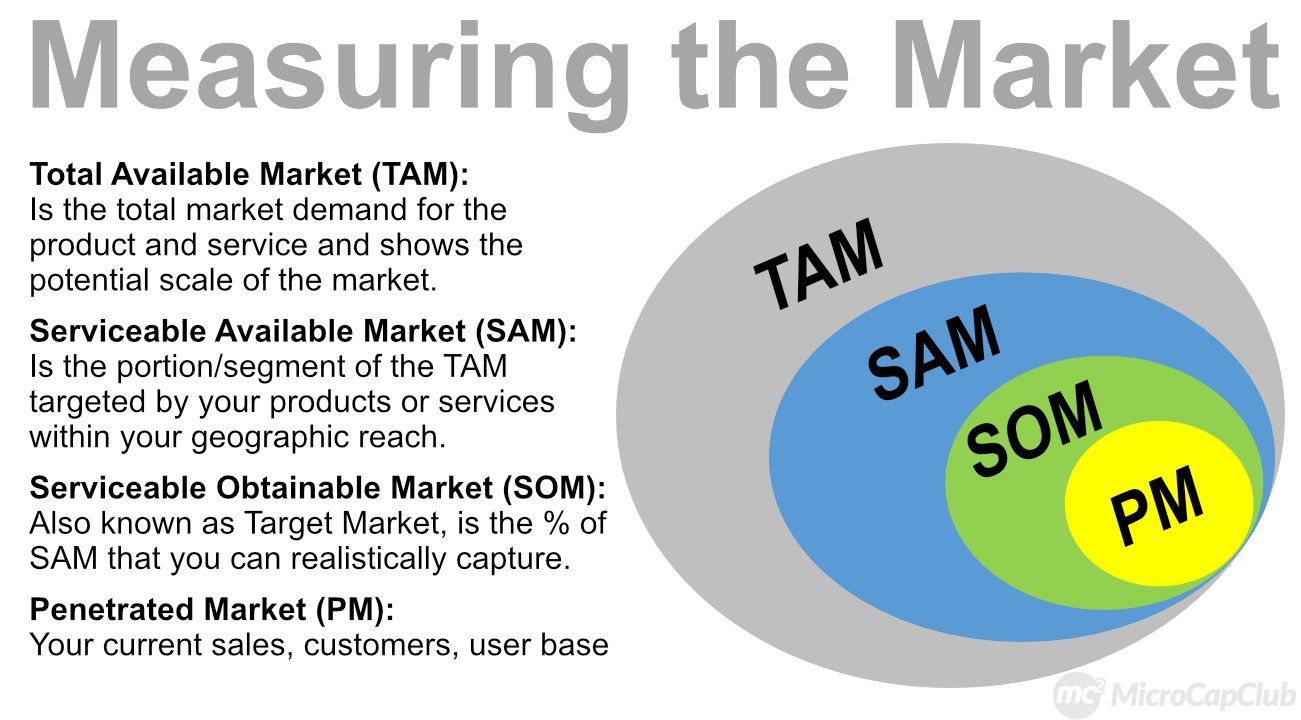
I’m not interested in investing in market leaders in a dying market that might offer a few more puffs on the cigar butt. My mission is to find great companies early, so I want to find great businesses operating in markets that are growing. Many investors put too much emphasis on the size of the TAM, when the focus should be the growth of the TAM. A growing TAM provides a tailwind to the company.
This isn’t to say that large TAM’s are bad. Wal-Mart had a huge TAM when Sam Walton founded the company. Intelligent fanatics like Sol Price of Fed Mart paved the way for the “discounting model”. Sam Walton was successful because of his patience, discipline, focus, and intelligence. Sam Walton also had years of experience operating independent stores before he started Wal-Mart. He than proved out the Wal-Mart model by attacking the small town merchant in a few towns. As he beat up small local merchants he gained scale and leverage to take on larger markets.
> “Niche businesses find an area of the market that is not being serviced and in a short time dominates that area. Examples of companies that have exploited this type of opportunity can be found in almost every industry. Sam Walton founded Wal-Mart because he saw that the big chains, such as Sears, Kmart, and Montgomery Ward, were not servicing the small towns in the South. He created a much more efficient system of servicing small towns that caught them sleeping at the switch and built one of the largest companies in the world.” - Charlie Munger
Sam Walton was successful because he focused on his target market (SOM) and at the same time expanded his SAM (no pun intended) through innovation (new products/relationships) and geographical expansion. Many early stage companies fail due to a lack of focus. Just think of how many microcaps immediately hire a “national sales force”. How many times has that worked out? Microcaps are mostly undercapitalized companies that need to take calculated risks and learn through small failures. When a company is unfocused with a shotgun approach to their market, they risk failing big. Aim small. Miss small.
As a microcap investor I love to invest in companies that are leaders, or better yet dominate, their target market (SOM). These market leader attributes tend to flow down the financials. As long as the TAM is growing I’m not concerned with its size. Measuring a market is difficult and abstract because we don’t have perfect information, but you can certainly get a sense if a market is growing. For example, I’m currently invested in a company that dominates its SOM and operates in a small but growing TAM. The TAM is only \~$100 million USD, SAM is \~$25 million, SOM is \~$18 million, and their actual market share of the SOM is 60%. They really dominate their niche in their geographical footprint. Over the next five years, given consumer trends and tailwinds I expect the TAM to increase to $500 million (5x). Due to expanding product lines and geographical expansion I estimate their SAM to increase to $200 million (8x), and due to their moat I believe they can realistically capture 50%. As long as the TAM is growing, don’t discredit a small TAM.
When you are analyzing a company and talking to management it’s important to get a feel for how the company will expand into the future. Look for companies that have adjacent markets, which I call multipliers. When a company dominates one small market they are naturally pulled into complimentary markets they can address/attack quite easily given their dominant brand, reputation, product, and/or service.
Often times, companies that dominate their SOM in a small TAM that is growing fall under the radars of larger potential entrants or competitors. These markets can be too small or will remain too small for larger companies to bother. Depending on the industry, product, or service, these small markets can also be very resilient.
In conclusion, successful investing is counter to our human nature. If you want above average returns you can’t think like everyone else. Eliminate your large market bias and start looking for companies that dominate small niche markets that are growing.
#### Interact and learn with 250+ of the best microcap investors on the planet:
[Join Us](https://microcapclub.com/join-now)
MicroCapClub - An Introduction, Tour and Best Practices
MicroCapClub is an exclusive forum for experienced microcap investors focused on microcap companies (sub $500m market cap) trading on United States, Canadian, European, and Australian markets. MicroCapClub was created to be a platform for experienced microcap investors to share and discuss stock ideas. Since 2011, our members have profiled 1000+ microcap companies. Investors can join our community by applying to become a member or subscribing to gain instant view only access. MicroCapClub’s mission is to foster the highest quality microcap investor Community, produce Educational content for investors, and promote better Leadership in the microcap arena. For more information, visit and
### Getting There
URL: https://microcapclub.com/getting-there/
Last updated: 2023-10-14T19:57:19.000Z
There are two people in all of us. The person you are and the person you ought to be. It’s your job to make sure they meet. After [Getting Started](http://microcapclub.com/2014/09/getting-started/), your focus shifts to Getting There. The journey could take months or years, so you need to first get your mind right. The only thing you have control over is your attitude. Every day wake up grateful and thankful for what is right in your life. When you feel uninspired, listen to or read something that will inspire you. It will make you 10x more productive. Get rid of negative people from your life. The person who has never done anything is the one who is sure it can’t be done. Don’t waste time fighting battles with small-minded people. Walking away from an argument is a sign of strength. Stop obsessing about what’s in the rear view mirror. Every obstacle, every setback and struggle was preparation for the victory ahead. It is time to focus on Getting There and what is important.
Investing’s greatest lessons can’t be taught in a book or in a classroom. They have to be experienced and often times the teacher is loss. 90% of successful investing is controlling your emotions when your money is on the line, which is also why paper trading/investing is almost useless. Some of the best lessons occur when you don’t even realize the lesson is taking place. It takes a great deal of patience and discipline to just sit and wait for the market to educate you and for your portfolio to snowball. It isn’t easy, but don’t give up. As Les Brown says, “It’s Not Over Until You Win”.
> One of the best motivational speeches you will ever hear [https://t.co/V9maZiZ3Yv](https://t.co/V9maZiZ3Yv?ref=microcapclub.com)
>
> — Ian Cassel (@iancassel) [December 12, 2015](https://twitter.com/iancassel/status/675672151010230272?ref%5Fsrc=twsrc%5Etfw&ref=microcapclub.com)
Investing might not be physically exhausting but it sure is mentally draining. You may be frustrated but don’t let fear slow you down and steal your courage. The battleground isn’t in the market, it’s in your mind. The current market environment has been challenging. I can speak from experience that investing is very easy until it isn’t. What I believe to be true is the shorter your investment time horizon the more you have to worry about market conditions. Many people have short-term aspirations and goals that are tied to their portfolio performance. “Well, in a year I expect these stocks to double, and then I can buy this car or house or quit my job”. We all want to reach our goals quicker but it’s harmful to have time frames on things that are outside our control. Stocks rarely perform in the time frames we predict, and it’s why the market only works for investors that have a long-term portfolio focus.
Microcap companies are illiquid and volatile. Stock price moves of +/- 10% on a weekly or even daily basis are the norm. Most investors are OK with volatility as long as it’s only to the upside, but become unnerved when it occurs to the downside. Volatility doesn’t increase risk, transposing short-time frames onto your portfolio increases risk. Not knowing what you are doing increases risk, not illiquidity. Some of the riskiest investments are the ones everyone else owns. Illiquidity and volatility are friends of the long-term investor. [Focus on the long-term](http://microcapclub.com/2015/08/focus-on-the-long-term/).
Many investors haven’t invested through a bad market environment or if they have it was with an insignificant sum. You’ve grown your capital over the last five years during a bull market, but the truth is you don’t know how good you are until you’ve invested through a bear market. A strategy that’s tested is a strategy that can be trusted. During bear market corrections even the best investor’s portfolios go down. Warren Buffett’s portfolio (via Berkshire Hathaway) has dropped 50% or more four times. If you are investing in growing profitable microcap companies that don’t need to raise money you can afford to wait out the market cycle. It’s important not to capitulate and sell. Successful investors can disconnect emotion from investment decisions and can differentiate business performance from stock performance. When emotion compels you into making a bad trade-investment, remember that there is a successful investor on the other side of that trade.
> “When you sell in desperation, you always sell cheap.” – Peter Lynch
During the bear market of 2008-2009 I was primarily invested in two microcap companies. One of those companies did very well, going up 300% during the crisis. The other company went down 70% in four months. The company stayed down for several months, and when the overall market sentiment turned in early 2009, the stock snapped back regaining all that was lost in less than three months. Capital flows back into quality companies first. Berkshire Hathaway stock recovered after each 50% drop because it owns quality businesses and capital ultimately flows back into quality. MicroCapClub member Rod MacIver said so eloquently in this [article](http://microcapclub.com/2015/05/i-passed-on-berkshire-hathaway-at-97-per-share/), “Money has an almost metaphysical attraction to places where it is put to careful, good use.” Buy and hold quality businesses.
If history has taught us anything it’s that bad market environments are the best time to find great companies early. The combination of lower valuations and less competition looking for new ideas creates incredible opportunities. Most investors complain, get emotional, and stop looking for ideas during bad markets. It’s also why most investors don’t beat the market. If the opinions of the herd make zero impact on you, then you are ready to make money.
MENTOR: *a wise and trusted counselor or teacher*
You need a mentor. Since my early 20’s my goal was to be a full time private microcap investor, but I knew I couldn’t get there by myself. I needed to find a mentor. Even today after reaching this early goal, I still need a mentor. Fear and greed are powerful forces that can wreck your portfolio, so it’s good to have someone to look up to for advice. A mentor can be someone you work for (or with) or simply being advised by someone that is a reflection of what you want to be. This is great career advice from Warren Buffett:
[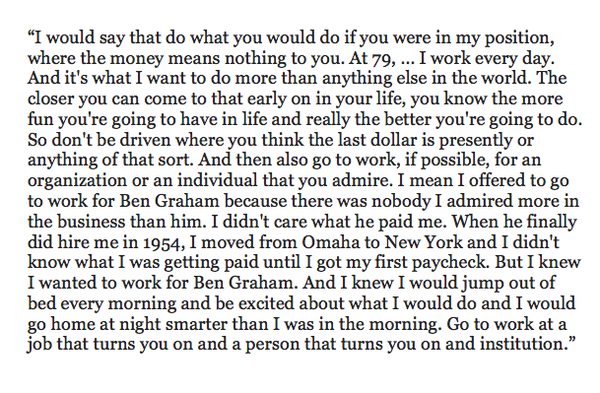](/content/images/wordpress/2016/01/warren-buffett-career-advice.png)You need a mentor you can actually communicate and have a relationship with. I can learn from Warren Buffett’s letters and lectures but he is on another planet. He hasn’t invested in microcaps for 60 years. You need a mentor that is 10 steps ahead of you, not 1,000\. Look out ten years and figure out where you want to be, and then go find someone that is there today. Find the person you aspire to be not just financially, but relationally, spiritually; a person with integrity, as well as tenacity. An illogical, irrational, relentless person that doesn’t believe in mediocrity. Find them and learn from them. Never seek advice from people that haven’t done what you are about to do.
> “Go as far as you can see and when you get there you will always be able to see further” – Zig Ziglar
When you “Get There”, stay hungry. Your goals should constantly evolve so that you’ll never entirely achieve them. As you set out to Get There again, and again, you will need the help of others. If you can accomplish all your goals by yourself you aren’t thinking big enough. Have a positive attitude and think the best of people instead of the worst. You can’t reach your dreams without believing in and trusting others. Lastly, Hope isn’t the way to invest, but it’s the only way to live. Give it to others. When you see someone stumble, lift them up. Spend every day learning and educating, inspiring and motivating, giving hope to the hopeless, and declaring war on mediocrity.
If you enjoyed this article, please read: [Getting Started](http://microcapclub.com/2014/09/getting-started/) and [The First Million](http://microcapclub.com/2015/01/the-first-million/). There is also a great book called [Getting There: A Book of Mentors](http://microcapclub.com/2015/07/book-review-getting-there-a-book-of-mentors/).
**\===> Interact and learn with 250+ of the best microcap investors on the planet.** [\[Join Us\]](https://microcapclub.com/join-now/)
MicroCapClub is an exclusive forum for experienced microcap investors focused on microcap companies (sub $500m market cap) trading on United States, Canadian, European, and Australian markets. MicroCapClub was created to be a platform for experienced microcap investors to share and discuss stock ideas. Since 2011, our members have profiled 1000+ microcap companies. Investors can join our community by applying to become a member or subscribing to gain instant view only access. MicroCapClub’s mission is to foster the highest quality microcap investor Community, produce Educational content for investors, and promote better Leadership in the microcap arena. For more information, visit [http://microcapclub.com](http://microcapclub.com/) and
### Investing Pitfalls to Avoid
URL: https://microcapclub.com/investing-pitfalls-to-avoid/
Last updated: 2023-10-14T22:27:30.000Z
I’ve written much about what I look for in a microcap investment such as profitability, sustainable growth, and compelling valuation in the My Secret Recipe series of articles which include: [The Index Card](http://microcapclub.com/2012/10/my-secret-recipe-the-index-card/), [Shopping and a Taste Test](http://microcapclub.com/2012/10/my-secret-recipe-shopping-and-a-taste-test/), [Inspecting the Ingredients](http://microcapclub.com/2015/02/my-secret-recipe-inspecting-the-ingredients/), and [The Bargain Rack](http://microcapclub.com/2015/06/my-secret-recipe-the-bargain-rack/). However, I haven’t written much about what I don’t want in an investment. These pitfalls are attributes that may lead to a bad investment. In this article I lay out the major pitfalls that I have found so that you don’t have to fall into them. I’m assuming in this article that the company generally meets my criteria so you don’t have to read through attributes that you already know I avoid such as unprofitable businesses, no growth, etc.
While this guide can be helpful, it is only outlines some of the pitfalls I try to avoid. I’m sure I’m forgetting at least a few of these pitfalls. Also, when investing in microcaps you will find that most companies have some aspects of at least one of these. These negatives need to be evaluated in the context of all the attributes of a company to determine if the positives outweigh the negatives.
**Poor Share Structure**
Some companies have very poor share structures. The worst kind is usually when you have convertible debt which converts at a discount to the market for the stock. That can create what is known as a death spiral. Let me explain how this works. First, the holder converts some of the debt at a discount to market prices and sells it at a profit. The selling puts pressure on the stock price causing it to drop. Next, the holder converts more of the debt at a discount to the now lower stock price and in turn sells it at a profit. The cycle continues until the debt holder converts and sells all of the debt. A big problem with this arrangement is that each time the debt holder converts, he or she gets more shares for the dollar because the stock price drops. What can happen in this situation is that a company with a decent share structure can see their share quantity balloon. Convertible preferred stock can also be structured with a death spiral. I will never invest in a company with death spiral financing because it is a quick way to see your investment dollars fall into the abyss.
Just because a company doesn’t have death spiral financing doesn’t mean they have a good share structure. I always investigate the total diluted share count for each company. In addition to the outstanding common shares, one needs to examine any preferred stock (especially convertible), convertible debt, options, and warrants. With that information you have a view into what the total share count might look like in the future and can factor that into your analysis. For example, if the share count is going to double over time, the future per share earnings potential might not look as good as it seems on first glance. I also look at the company’s history of share issuance. If don’t like it when a company has a history of handing out options like candy. I much prefer a company that treats their shares like gold.
Further commentary on share structure can be found in [The Importance of Share Structure](http://microcapclub.com/2012/08/the-importance-of-share-structure/).
**Weak Balance Sheet**
The first thing I look at on a balance sheet is the [tangible book value per share](http://www.investopedia.com/terms/t/tbvps.asp?ref=microcapclub.com). When it is negative I have to be careful. Let’s say you have a company that has a stock price of $1/share and is expected to earn $0.12/share in the next year. If the tangible book value is slightly negative, let’s say -$0.02/share, that is a cause for caution. When it is say -$1/share, that is usually a cause for great concern.
A negative tangible book value isn’t the only thing to cause caution on a balance sheet. Debt coming due soon can be a cause for concern especially if it will be difficult to refinance that debt. If a company cannot renew their debt or otherwise pay it off, there usually are some pretty negative consequences. I like to examine a company’s debt to see how big it is, the interest rate on the debt, and when the debt comes due?
Along with debt, one also needs to look at a company’s cash position. If they don’t have enough cash to operate and don’t have access to debt (e.g. a line of credit), they may have to raise money which will mean dilution of your holdings. Usually when a company raises money by selling stock it is below market prices for the stock which will cause a drop in the stock price. I much prefer to avoid companies that need financing. [A MicroCap Investors Worst Enemy is Dilution](http://microcapclub.com/2013/07/a-microcap-investors-worst-enemy-is-dilution/) is a good article which delves into a company’s future need for capital.
There is much more to analyzing a balance sheet than I have said here. Some poor balance sheets can be OK where as others are not. It is an art you have to learn.
**Poor Quality of Earnings**
Sometimes companies have great earnings but they are of poor quality. For example, maybe they have significant revenue but they can’t collect their bills fast enough. This will show up in a metric called DSO or [Days Sales Outstanding](http://www.investopedia.com/terms/d/dso.asp?ref=microcapclub.com). When I analyze a company I usually ignore the nuance of credit sales versus overall sales and just use overall sales as credit sales levels are rarely disclosed. I have found that when the DSO calculation gets above 90 days you need to look very carefully. Repeated numbers that high can indicate that the customers are of poor credit quality. I usually calculate DSO on a quarterly basis.
Sometimes recent earnings are not sustainable which also falls into poor quality of earnings. For example, maybe there was a factor that temporarily increased gross margin. Maybe there was some sort of one time gain that boosted earnings such as winning a lawsuit. Maybe the company is just about to start paying taxes whereas they haven’t in the past. Perhaps there was a large piece of revenue that came in that isn’t repeatable. Earnings could grow dramatically when the large order is fulfilled, but then sink afterwords.
Customer concentration can also fall into this category. For example, if ACME Widget is receiving 80% of their revenue from one customer, there is a huge problem if that customer goes away. Customer concentration doesn’t necessarily scare me away but it often will reduce the size of the position I’m willing to take on.
The main way to investigate the quality of earnings is to read the footnotes in filings and the details in PRs. What one has to do is to factor the quality of earnings into the valuation model for the company. Just because some earnings are not repeatable doesn’t mean the company is a bad investment. It is just a part of the entire analysis that one has to do.
**Low Gross Margins**
I don’t like low gross margin (GM) businesses because one small mistake or problem can often turn a profitable business into an unprofitable business. Those problems can come in a variety of ways. Some examples include increasing input costs, pricing pressure from competitors, and loss of scale from decreased revenue.
While it is hard to be precise, I’ve said before that a high GM business is one with a GM greater than 50% and a very low GM business is one that is less that 20%. Also, one thing to consider is that sometimes businesses can grow their GM as they increase scale. Thus, the current GM isn’t always indicative of what to expect going forward.
**Lack of Moat**
Companies lacking a moat can be a problem because they can rapidly go from producing good results to bad results as it is difficult for them to differentiate. Mostly all they can do to compete is to be a low cost producer or provide greater service. A background article on moats is [The Vision To See Economic Moats](http://microcapclub.com/2015/11/the-vision-to-see-economic-moats/).
A good shortcut for knowing if a company is in a commodity business and thus has little to no moat is if they have low gross margins. Highly differentiated businesses usually have high gross margins although that isn’t always the case.
There are three general categories for these companies that I will address including commodities, commodity product, and intellectual property risk.
*Commodities*
I usually avoid companies in the commodity space or companies that service this space. I’m talking about companies in the oil, gas, and minerals businesses. To win in this space you have to be right about the commodity price and the business. I find that it is hard enough to be right about the business that I don’t need to add commodity price risk. In a pure commodity business, even being a low cost producer is no guarantee of profitability as we have seen recently in the oil industry. There are times where I will go out on a limb and invest in a company in the commodity space but they are becoming increasingly rare. There are people that specialize in this space that are very good but it isn’t for me.
*Commodity Product/Service*
There are companies that have products or services that are commodities. Here I’m not talking about oil and gas per se, but products that really aren’t differentiated. For example, imagine a company that sells construction nails or a company that sells cheese. Unless they have a special type of nail or a special flavor of cheese, they are unlikely to be able to have any kind of pricing power. Services sometimes fall into this category too. However, services often can be very sticky which means that there is some level of pain involved in the customer switching to another provider.
*Intellectual Property Risk*
Intellectual property risk is probably most drastic in pharmaceutical patents although it does come up elsewhere. A company with a great product that is about to come off patent can suddenly be up against a slew of competitors. Also, sometimes you see a company that has a great product but hasn’t done anything to protect it. Perhaps the idea isn’t patentable. Sometimes, the best way to protect a product is with trade secrets.
There can also be risks that a company is violating a competitor’s present or future patent. This is often hard to investigate but it is something to watch especially when there are similar products in the market.
A great product that isn’t protected will find itself up against competition eventually. In microcaps sometimes this is OK because it is such a niche market. However, any product of even moderate scale will soon find a competitor and that can be very damaging to margins.
**Excessive Management Compensation/Lack of Alignment with Shareholders**
Let’s go back to ACME Widget. Let’s say that they have annual revenue of $3M and have $300K of net income. However, the CEO has a salary of $750K and has a history of granting himself significant blocks of options. Furthermore, this CEO has never purchased shares on the open market and only owns shares that he acquired through option grants. This CEO is not someone that is likely to have shareholders’ interest in mind and appears to be treating the company as a piggy bank. I much prefer to have a CEO that owns a lot of stock and pays himself a reasonable salary of say $175K or less. A CEO that makes money when the stock goes up is more likely to focus on doing the right things and is more likely to treat shareholders fairly. For a more detailed analysis of this pitfall I suggest reading this [article](http://microcapclub.com/2013/08/my-thoughts-on-microcap-executive-compensation/).
**Overly Promotional Management**
One of the job’s of management of a public company is to maximize the value of the stock. I’m a firm believer that the first step in that process is to produce good results. While management should be a cheerleader for the company, sometimes there are management teams where it appears they think that is their first job. If I see outlandish projections, that usually is a sign that management isn’t focusing on job one (results) and often is more focused on selling stock. If the story that management is telling sounds too good to be true, it often is. [Beware of Story Stocks](http://microcapclub.com/2015/08/beware-of-story-stocks/) is a good article to read on the subject.
When you hear a story that sounds outlandish, one thing I like to do is to check past management projections. If they have a history of making their projections I’ll find them much more credible than if they miss their projections. Again, I don’t mind management telling the story because that is part of their job. It is just that if they become too promotional, that is a sign to be careful. The worst situation is when you uncover a company that is part of a [pump and dump](http://microcapclub.com/2013/11/pump-dumps-race-zero/).
**Business Models with Major Uncontrollable Risks**
There are some businesses that have some major risk that they can’t control that just scares me away. For example, maybe the business is a pawn shop business and the government is looking to increase regulation. Sometimes businesses like this are a value trap. They look highly profitable but with one quick change their profitability decreases. Another major risk can be an industry that is declining in size. I’d rather swim with the current on a growing industry than swim against the current with a shrinking industry.
Cyclic industries also fall into this category. Some industries go through major boom/bust cycles. I will certainly invest in cyclic industries but I much prefer if the industry isn’t cyclic.
I find that reading the risk section in annual filings (see Risk Factors in the 10-K for US companies) is a good place to read to check for major risks like this that you might not see on the surface.
**Conclusion**
Proper due diligence requires that you examine both the positives and the negatives about a company. This document provides a framework to look for some of the negative items. Next time you are looking at a new investment, be sure to check the company against these pitfalls. Also, please share any other pitfalls you would like to add to this list by posting a comment below.
**\===> Interact and learn with 250+ of the best microcap investors on the planet.** [\[Join Us\]](https://microcapclub.com/join-now/)
MicroCapClub is an exclusive forum for experienced microcap investors focused on microcap companies (sub $500m market cap) trading on United States, Canadian, European, and Australian markets. MicroCapClub was created to be a platform for experienced microcap investors to share and discuss stock ideas. Since 2011, our members have profiled 1000+ microcap companies. Investors can join our community by applying to become a member or subscribing to gain instant view only access. MicroCapClub’s mission is to foster the highest quality microcap investor Community, produce Educational content for investors, and promote better Leadership in the microcap arena. For more information, visit [http://microcapclub.com](http://microcapclub.com/) and
### How To Find Intelligent Fanatic CEOs Early
URL: https://microcapclub.com/how-to-find-intelligent-fanatic-ceos-early/
Last updated: 2023-10-14T22:30:49.000Z
Wal-Mart, Nike, Amazon.com, Starbucks, Ford, Oracle, Microsoft, Facebook, Celgene, Amgen, and others are considered great companies. It is human nature to look at a long-term chart of these companies and think, “well that was easy”, but we all know that isn’t true. Whether it’s business, sports, art, performance, greatness always looks easy because the populace only sees the final result, not the hard work behind the scenes. All great companies faced what looked like insurmountable challenges when they started.
\[blockquote cite=”Charlie Munger”\]”It’s quite interesting to think about Wal-Mart starting from a single store in Bentonville, Arkansas against Sears, Roebuck with its name, reputation and all of its billions. How does a guy in Bentonville, Arkansas with no money blow right by Sears, Roebuck? And he does it in his own lifetime—in fact, during his own late lifetime because he was already pretty old (44) by the time he started out with one little store….”\[/blockquote\]
How/Why did Wal-Mart succeed?
The answer is Sam Walton. If you had the ability to invest in Wal-Mart in the 1960’s when it had a few stores, you weren’t betting on Wal-Mart, you were betting on Sam Walton. Even after Wal-Mart had grown to a hundred stores, $200+ million revenues \[$1.2 billion – 2015 inflation adjusted\], Sam Walton was still flying around in his little airplane finding and negotiating store locations.
For the most part, microcap companies are small, young companies, with short operating histories. Successful microcap investing is similar to successful venture capital investing in that both are bets on founders (on people). Shane Pharrish, founder of [Farnam Street](https://www.farnamstreetblog.com/?ref=microcapclub.com), recently [interviewed Chris Dixon](https://www.farnamstreetblog.com/2015/11/chris-dixon-venture-capital-artificial-intelligence/?ref=microcapclub.com). Chris Dixon is a partner at one of the most famous venture capital firms in the world, [Andreessen Horowitz](http://a16z.com/?ref=microcapclub.com).
\[blockquote cite=”Chris Dixon” type=”center”\]“I would say my biggest learning is it’s probably more people than I ever thought…I probably thought originally it was 70% people and now I think it’s 98% people” \[/blockquote\]
Many investors roll their eyes at the qualitative aspects of investing, but when investing in small microcaps, people (Founders) are the difference makers. In the past there were times where I invested in microcap companies in spite of management. In most cases the company/stock would do well in the short-term, but in the long-term it was like gravity, the business followed the management back down.
The smaller the company the more important the CEO-founder becomes. Often times CEO-founders of microcap companies wear many hats so their influence is multiplied. Not only are they the CEO but also the COO, VP Sales, Garbage Man, Company Contact person, etc. Bad decisions can destroy a small company and great decisions have a compounding effect on a small company. If you don’t believe that founders and management are important to small companies like microcaps, just wait a little longer. You will.
My goal is to own the smallest, most illiquid, least institutionally owned, best businesses I can find that are run by intelligent fanatics. All great companies started as small companies, and intelligent fanatics founded most great companies. Charlie Munger first coined the term “Intelligent Fanatic” but Sanjay Bakshi is the one making it famous today. In Sanjay’s lecture, [Seven Intelligent Fanatics From India](https://dl.dropboxusercontent.com/u/28494399/Blog%20Links/Seven%20Intelligent%20Fanatics%20from%20India.pdf?ref=microcapclub.com), he identifies three essential ingredients: Integrity, Energy, and Intelligence. In a [recent presentation](http://microcapclub.com/2015/12/all-great-companies-started-as-small-companies/), I spoke about investing in companies who are run by Intelligent Fanatic Iconoclasts. I’d like to first define “Intelligent Fanatic”:
**Intelligent Fanatic = (Long Term Vision + Focus + Energy + Integrity + Intelligence) x Execution**
The combination of all these traits multiplied by execution is what makes an intelligent fanatic. Many investors mistake an executive with charisma for being an intelligent fanatic. This isn’t the case, and in fact, many intelligent fanatics are not charismatic. The microcap space in particular is filled with snake oil salesman and executives that talk too much and do too little. Don’t mistake a story telling, charismatic CEO as an intelligent fanatic. Intelligent fanatics let their execution do the talking. Sean Iddings and I are teaming up on the [Intelligent Fanatics Project](http://www.intelligentfanatics.com/?ref=microcapclub.com) which will highlight several intelligent fanatics and how they built sustainable businesses.
How do we find intelligent fanatics early? How can we find the next Sam Walton, Elon Musk, or Howard Schultz? It’s great to read about them after they’ve made other investors billions, but we want to find them early in their careers. How can we find Reed Hastings 13 years ago when he was leading an $80 million market cap microcap called Netflix (NFLX)?
\[blockquote cite=”Max Lucado” type=”center”\]“A man who wants to lead the orchestra must turn his back on the crowd.”\[/blockquote\]
If you want to find intelligent fanatics early, look for intelligent iconoclasm.
Iconoclast: *a person who attacks cherished beliefs or institutions.*
I’ve found the best resource describing these behaviors in William Thorndike’s great book, [The Outsiders: Eight Unconventional CEO’s and Their Radically Rational Blueprint for Success](http://microcapclub.com/2014/04/book-review-the-outsiders-by-william-thorndike-jr/). There is a wealth of information and wisdom in the passage below:
> This group of happily married, middle-aged men (and one woman) led seemingly unexciting, balanced, quietly philanthropic lives, yet in their business lives they were neither conventional nor complacent. They were positive deviants, and they were deeply iconoclastic. The word iconoclast is derived from Greek and means “smasher of icons.” The word has evolved to have the more general meaning of someone who is determinedly different, proudly eccentric. The original iconoclasts came from outside the societies (and temples) where icons resided; they were challengers of societal norms and conventions, and they were much feared in ancient Greece….. Like Singleton, these Outsider CEOs consistently made very different decisions than their peers did. They were not, however, blindly contrarian. Theirs was an intelligent iconoclasm informed by careful analysis and often expressed in unusual financial metrics that were distinctly different from industry or Wall Street conventions.
>
> They seemed to operate in a parallel universe, one defined by devotion to a shared set of principles, a worldview, which gave them citizenship in a tiny intellectual village. Call it Singletonville, a very select group of men and women who understood, among other things, that:
>
> - Capital allocation is a CEO’s most important job.
> - What counts in the long run is the increase in per share value, not overall growth or size.
> - Cash flow, not reported earnings, is what determines longterm value.
> - Decentralized organizations release entrepreneurial energy and keep both costs and “rancor” down.
> - Independent thinking is essential to long-term success, and interactions with outside advisers (Wall Street, the press, etc.) can be distracting and time-consuming.
> - Sometimes the best investment opportunity is your own stock.
> - With acquisitions, patience is a virtue . . . as is occasional boldness.
>
> Interestingly, their iconoclasm was reinforced in many cases by geography. For the most part, their operations were located in cities like Denver, Omaha, Los Angeles, Alexandria, Washington, and St. Louis, removed from the financial epicenter of the Boston/New York corridor. This distance helped insulate them from the din of Wall Street conventional wisdom. (The two CEOs who had offices in the Northeast shared this predilection for nondescript locations—Dick Smith’s office was located in the rear of a suburban shopping mall; Tom Murphy’s was in a former midtown Manhattan residence sixty blocks from Wall Street.) The residents of Singletonville, our outsider CEOs, also shared an interesting set of personal characteristics: They were generally frugal (often legendarily so) and humble, analytical, and understated. They were devoted to their families, often leaving the office early to attend school events. They did not typically relish the outward-facing part of the CEO role. They did not give chamber of commerce speeches, and they did not attend Davos. They rarely appeared on the covers of business publications and did not write books of management advice. They were not cheerleaders or marketers or backslappers, and they did not exude charisma.
Most intelligent fanatics are owner-operators that own significant pieces of their businesses. They have their net worth on the line so every decision is made for long-term business reasons. They treat their shares like gold. They normally take below average salaries because they expect to get rich off the stock, not the salary. Elon Musk made $165 million when Paypal was sold to Ebay in 2002\. Over the next six years he put his entire net worth into Tesla, SpaceX, and SolarCity, owning substantial pieces of these businesses. He also paid himself California State minimum wage as he was going “all in”. This is an extreme example, but this is what shareholders want to see. I can’t overstate the importance of management-board ownership, compensation, and incentives. Many microcap management teams own meaningful positions in their companies but their compensation and incentives reinforce the wrong things. I also find that most microcap CEO’s view their board of directors as a waste of time. Intelligent fanatics don’t waste time. They create powerful boards that are filled with individuals that create positive feedback loops for the business. They are what Warren Buffett calls an “owners board” where each board member owns a meaningful amount of stock that they paid for with their own money.
\[blockquote cite=”Warren Buffett” type=”center”\]“At Berkshire, almost everyone on the board has a lot of Berkshire stock. They’re in the same position as shareholders. They don’t have D&O \[Directors and Officers\] insurance and they bought the stock in the open market. It’s a real owners board.”\[/blockquote\]
Intelligent fanatic iconoclasts distance themselves physically and mentally from Wall Street. Most hold a disdain for publicity and talking up their stock. They mostly view convincing the prospective investor of the investing merits of their company a waste of time and resources. They are communicative to shareholders but never to the detriment of the business. Be cautious of any CEO that talks about his/her stock price before mentioning the business. They are focused on the wrong thing. Ed Borgato said it best:[ ](/content/images/wordpress/2016/01/How-To-Find-Intelligent-Fanatic-CEOs-Early.jpg) [](/content/images/wordpress/2016/01/ed-borgato.png)
Intelligent fanatic iconoclasts [Focus On The Long-Term](http://microcapclub.com/2015/08/focus-on-the-long-term/). In the interview below, William Thorndike (@28:20), talks about how Outsider CEO’s optimize long-term value per share (3-5 years) and when the Owner-Operator owns a substantial piece of the company, like Jeff Bezos, they can look out even further because they can afford to not give time-attention to short term influencers. Due to this long-term focus you rarely hear intelligent fanatics talk in short time frames, and they [don’t give guidance](http://microcapclub.com/2015/10/dont-give-guidance/).
\[x\_video\_embed\]\[/x\_video\_embed\]
\[blockquote cite=”Jeff Bezos” type=”center”\]“If we have a good quarter it’s because of work we did 3, 4, 5 years ago. It’s not because we did a good job this quarter.”\[/blockquote\]
William Thorndike (@33:35) also talks about how to find the next Outsider CEO and that the markers are mostly qualitative. He says to look at Vocabulary, how the CEO talks and writes about their business. You want a CEO that discusses “Per Share” metrics, focus on free cash flow not net income, and they get extra credit for using “internal rates of return”. In addition, I would add that intelligent fanatics act and communicate with integrity. It’s not only the business decisions they make during good and bad times that define them but also when they make the right decisions when they don’t have to. Their decision to continue to take a below average salary even though they deserve an above average one. It’s their decision to talk openly about the headwinds affecting the business as well as the tailwinds.
\[blockquote cite=”Lou Brock” type=”center”\]“Show me a guy who’s afraid to look bad, and I’ll show you a guy you can beat every time.”\[/blockquote\]
Many intelligent fanatic founder-CEO’s didn’t have previous industry experience. They weren’t taught what was impossible. Their minds weren’t fenced in by conventional norms. They were iconoclasts that intelligently attacked convention. They rose to dominance by trying new things, experimenting, taking calculated risks, and [not giving in to the fear of failure](http://www.theguardian.com/technology/2014/dec/03/jeff-bezos-billions-dollars-failures-amazon?ref=microcapclub.com). Intelligent fanatics aren’t afraid to shoot a lot of calculated bullets, and when a bullet hits a target they recalibrate and shoot a cannon ball. They don’t dwell on failures.
[](/content/images/wordpress/2016/01/david-glass-quote.jpg)
David Glass started with Wal-Mart in 1976, would be CFO, COO, and then CEO from 1988 -2000.
As Thorndike points out, many intelligent fanatic iconoclasts run businesses with decentralized organizations. Strong leadership and corporate culture are imperative to to the success of decentralized organizations. Leadership and culture is driven from the top down in a way that influences employee devotion and buy-in.
[](/content/images/wordpress/2016/01/6th-wal-mart.jpg)
Wal-Mart Store #6, Manager-Employee Buy In
Intelligent fanatic iconoclasts know they can’t be everywhere at once. They know what they don’t know, and they fill those gaps with talented people. This is one big issue I see with many microcap companies. The sheer will power of the founder-CEO can make up for talent gaps, but vigor and energy can only take them so far. Many microcap founders don’t have the awareness and humility to realize when their organizations have outgrown them. Intelligent fanatics hire talented people from the very beginning and focus on creating leaders so they can promote from within.
\[blockquote cite=”Tom Peters” type=”center”\]“Leaders don’t create more followers, they create more leaders.”\[/blockquote\]
It is human nature to look for companies attacking huge markets, but most great companies started by dominating a smaller niche. Even Sam Walton of Wal-Mart started by attacking the local merchant in rural towns.
\[blockquote cite=”Charlie Munger”\]“Walton, being as shrewd as he was, basically broke other small town merchants in the early days. With his more efficient system, he might not have been able to tackle some titan head-on at the time. But with his better system, he could destroy those small town merchants. And he went around doing it time after time after time. Then, as he got bigger, he started destroying the big boys.”\[/blockquote\]
Most investors look for “big stories” with “big addressable markets”, but in many ways to find the next Wal-Mart you need to think smaller. Intelligent Fanatics dominate small markets first. After they become a big fish in a small pond they look for larger ponds to dominate. The great thing about microcap investing is you can make a lot of money on small companies that can become larger small companies. I’m somewhat oversimplifying but if you can find an undiscovered $5 million revenue profitable business that can grow to $50 million in a reasonable time period without diluting you, this alone will result in 10-20-30+ baggers.
Intelligent fanatics are great capital allocators. They know when/where to reinvest into the business, when to use their stock as currency, and when to buy their stock back. The perfect example of this is Henry Singleton of Teledyne. In the 1960’s, Henry Singleton made 130 accretive acquisitions when his stock was expensive (>25 PE), and in the 1970s and 1980’s bought 90% of Teledyne’s stock back when it was cheap (<8 PE). AutoZone is another modern day example which I tweeted about [\[HERE\]](https://twitter.com/iancassel/status/682555875165376512?ref=microcapclub.com).
[](/content/images/wordpress/2016/01/henry-singleton.png)
\*Source: The Outsiders
In conclusion, if you want to find intelligent fanatic CEOs early, a good starting point is finding a company whose founder-CEO owns a significant piece of a good business. It might not be a great business just yet. Second, look for intelligent iconoclasm. In many regards, intelligent fanatics build companies that positively reinforce their iconoclastic behavior. Their business performance and ownership positions allow them security from short-term influences. Intelligent fanatics aren’t distracted by raising money and catering to Wall Street because they create [compounding machines](https://youtu.be/eEO5G1SjCeU?ref=microcapclub.com). A majority of the best performing microcap stocks ever were profitable growth companies that could self-fund their growth which allowed the intelligent fanatic to focus on execution and capital allocation. This introversion and obsession with the business often creates [regrettable personalities](http://bigthink.com/ideafeed/why-visionary-leaders-often-have-regrettable-personalities?ref=microcapclub.com). The businesses they create allow them to give Wall Street, the analyst community, and short-term investors the cold shoulder. Why? Because they can. They don’t need them, and it’s exactly what makes intelligent fanatic iconoclast CEOs and their businesses so attractive for long-term investment.
If you liked this article, read this one: [All Great Companies Started As Small Companies](http://microcapclub.com/2015/12/all-great-companies-started-as-small-companies/)
**\===> Interact and learn with 250+ of the best microcap investors on the planet.** [\[Join Us\]](https://microcapclub.com/join-now/)
MicroCapClub is an exclusive forum for experienced microcap investors focused on microcap companies (sub $500m market cap) trading on United States, Canadian, European, and Australian markets. MicroCapClub was created to be a platform for experienced microcap investors to share and discuss stock ideas. Since 2011, our members have profiled 1000+ microcap companies. Investors can join our community by applying to become a member or subscribing to gain instant view only access. MicroCapClub’s mission is to foster the highest quality microcap investor Community, produce Educational content for investors, and promote better Leadership in the microcap arena. For more information, visit [http://microcapclub.com](http://microcapclub.com/) and
### All Great Companies Started As Small Companies
URL: https://microcapclub.com/all-great-companies-started-as-small-companies/
Last updated: 2023-10-14T22:33:02.000Z
Microcap companies (<$300m market cap) represent 48% of all public companies in North America. The \~11,000 microcap companies in North America have a combined market value of $490 billion, smaller than the current market capitalization of Google. Some of the best investors ever, including Warren Buffett, Peter Lynch, Joel Greenblatt, and many others started their careers investing in microcaps. Some of the best performing public companies ever, including Berkshire Hathaway, Wal-Mart, Amgen, Netflix, and many others started as small microcap companies. The key to outsized returns is finding great companies early because all great companies started as small companies.
> “How do you get into these great companies? One method is what I’d call the method of finding them small – get’em when they’re little. For example, buy Wal-Mart when Sam Walton first goes public and so forth. And a lot of people try to do just that. And it’s a very beguiling idea. If I were a young man, I might actually go into it.” – **Charlie Munger**
I am humbled and honored to say I’ve been a full time private microcap investor since 2009\. “Full time private microcap investor” is just a fancy way of saying I support myself by managing my own capital, and I only invest in small microcap companies. I don’t run a fund or manage other people’s money. Last week I was invited to present my story at Google, explain my strategy, and the case for microcap investing. They seemed to enjoy the presentation, so I thought others might find the presentation useful as well.
**\===> Interact and learn with 250+ of the best microcap investors on the planet.** [\[Join Us\]](https://microcapclub.com/join-now/)
MicroCapClub is an exclusive forum for experienced microcap investors focused on microcap companies (sub $500m market cap) trading on United States, Canadian, European, and Australian markets. MicroCapClub was created to be a platform for experienced microcap investors to share and discuss stock ideas. Since 2011, our members have profiled 1000+ microcap companies. Investors can join our community by applying to become a member or subscribing to gain instant view only access. MicroCapClub’s mission is to foster the highest quality microcap investor Community, produce Educational content for investors, and promote better Leadership in the microcap arena. For more information, visit [http://microcapclub.com](http://microcapclub.com/) and
### Book Review: 100-Baggers by Chris Mayer
URL: https://microcapclub.com/book-review-100-baggers-by-chris-mayer/
Last updated: 2023-10-14T22:34:50.000Z
Studying 100-Baggers is important because most were microcaps when they started their ascent. We’ve actually had ten 100-Baggers that made this incredible journey in just [five years](http://microcapclub.com/2015/06/microcaps-with-the-highest-return-over-the-last-5-years/). In 1972, Thomas Phelps wrote “[100 to 1 in the Stock Market](http://www.amazon.com/100-Stock-Market-Distinguished-Opportunities/dp/1626540292/ref=sr%5F1%5F1?s=books&ie=UTF8&qid=1447326833&sr=1-1&keywords=100+to+one+in+the+stock+market&ref=microcapclub.com)”. Phelps studied the 365 stocks that returned 100 to 1 (aka 100-Baggers) between 1932 and 1971\. You can find some great nuggets of wisdom in his book.
Chris Mayer picks up where Phelps left off analyzing all 100-Bagger stocks from 1962-2014\. Chris Mayer’s “[100-Baggers: Stocks That Return 100-To-1 And How To Find Them](http://www.amazon.com/100-Baggers-Stocks-100-1/dp/1621291650?ref=microcapclub.com)” is a very easy (<200 pages) and enjoyable read (c’mon how can’t you enjoy reading about 100-Baggers?). It’s great to read about 100-Baggers, but we want to find them early. Chris does a great job outlining the attributes of great businesses, from high ROE to owner-operator intelligent fanatics. Mayer and his analysts offer 100-Bagger case studies on Monster Beverage (700-Bagger), Amazon (146-Bagger), Electronic Arts (104-Bagger), Comcast (200-Bagger), and others. In the book, Mayer also mentions investor and MicroCapClub member Chip Maloney’s case study: [MTY Food Group – A Case Study of a 100-Bagger. ](http://microcapclub.com/2015/03/mty-food-group-a-case-study-of-a-100-bagger/)
Finding great companies early is only half the battle. We then have to learn how to hold them. The book packs a punch of wisdom by providing modern day analysis and discussion on “buying right and sitting tight”. Most investors crave action instead of lethargy and sloth. I highly recommend investors read this book. You can also meet author Chris Mayer at our [MicroCap Leadership Summit 2016](http://microcapclub.com/summit/).
I think one of the biggest assets of this book is the list of 100-Bagger stocks in the back. I love reading about the intelligent fanatics that started these businesses. If you want a fun exercise, go through the list of 100-Bagger stocks, Google their founders, and read articles-books that have been written on them.
Let me give you an example how fun this is.
Polaris Industries ([PII](http://finance.yahoo.com/q?s=PII&ref=microcapclub.com)) went public in 1988, took 22.5 years to be a 100-Bagger, on its way to being a 500-Bagger today. Polaris was founded by Edgar Hetteen. What is also interesting is Edgar later founded a competitor Arctic Cat ([ACAT](http://finance.yahoo.com/q?s=ACAT&ref=microcapclub.com)), another public snowmobile/ATV company. Edgar has been long considered the father of the snowmobile industry.
Here is the quick story from Edgar Hetteen’s [obituary](http://www.ascoa.org/tribute-to-edgar-hetteen-1921-2011-founder-of-polaris--arctic-cat.html?ref=microcapclub.com).
> By 1954, Johnson and Allan Hetteen (Edgar’s brothers) had cobbled together their first prototype of a snowmobile, using a 10-horse Briggs and Stratton engine from the local hardware store mounted in back, a track made from a steel binder chain — “the kind used on manure spreaders,” Johnson said — and a seat of steel in the middle of a “tunnel” of sheet metal.
>
> “The first one only went 10 mph,” Johnson said.
>
> Edgar was a skeptic, figuring it would never work or never sell.
>
> But there was a market ready for it. The lumber man across the street bought it for $425, Johnson remembers: “he used it to hunt rabbits, fox and wolves.”
>
> Sales rose in the late 1950s, but the board of directors of Hetteen Hoist and Derrick kept pressuring him to nix the unknown new snowmobile product for the steadier farm implement business, which they had done for a decade or more.
>
> Edgar Hetteen decided to show everyone: in a long-celebrated long journey in 1960, he and three others took the Sno-Travelers on a 1,200-mile trek in Alaska, from Bethel to Fairbanks, in three weeks. It proved snowmobiles were reliable enough to replace dog sleds, Johnson said.
[](/content/images/wordpress/2015/11/Edgar-Hetteen.jpg)
Edgar Hetteen pictured in 1960 during his trip across Alaska
**\===> Interact and learn with 250+ of the best microcap investors on the planet.** [\[Join Us\]](https://microcapclub.com/join-now/)
MicroCapClub is an exclusive forum for experienced microcap investors focused on microcap companies (sub $500m market cap) trading on United States, Canadian, European, and Australian markets. MicroCapClub was created to be a platform for experienced microcap investors to share and discuss stock ideas. Since 2011, our members have profiled 1000+ microcap companies. Investors can join our community by applying to become a member or subscribing to gain instant view only access. MicroCapClub’s mission is to foster the highest quality microcap investor Community, produce Educational content for investors, and promote better Leadership in the microcap arena. For more information, visit [http://microcapclub.com](http://microcapclub.com/) and
### The Vision To See Economic Moats
URL: https://microcapclub.com/the-vision-to-see-economic-moats/
Last updated: 2023-10-14T22:38:03.000Z
Nearly two decades ago when I was in my early 20’s, I fell into the role of director of our local service club’s community service committee. Within this role, I was tasked with the oversight of the building of a day-use park in our community. The first time I visited what would be the future site of our park was with our club president. The city had assigned us a piece of land that was located on top of a former landfill. Let’s just say that I had a difficult time imagining that one day in the not too distant future, families would be enjoying their Sunday afternoons chasing their kids around a park that would be built on this piece of barren land that was a former garbage dump. However, our club president, who I considered a mentor, started to tell me about his vision for the land. He pointed out where he envisioned the playground would be, complete with swings, a play structure and benches for grandparents to watch their grandchildren play. We walked over to the area where the barbecues and picnic tables would be located. He described where the restrooms would be in case little Timmy suddenly found himself with a full bladder. He pointed out where trees would be planted to provide shade for families from the afternoon sun for many years to come. Not only did he have a vision of what he wanted for this park, he had a way of getting the rest of the club members to adopt his vision. In the years that unfolded, the park was built and today families enjoy this park almost exactly as our club president had envisioned it many years earlier. That experience taught me how powerful having a vision can be if you act on it in a meaningful way.
[](/content/images/wordpress/2015/11/vision.jpg)
In his book [“100 to 1 in the Stock Market”,](http://www.amazon.com/100-Stock-Market-Distinguished-Opportunities/dp/1626540292?ref=microcapclub.com) author Thomas Phelps emphasizes the importance of vision in stock selection. He writes that to make money in stocks you must have “the vision to see them, the courage to buy them and the patience to hold them”. Vision can be an important tool in an investor’s toolbox, and it is a skill that can be learned.
At the heart of it, vision is the ability to anticipate what the future could look like. As an investor, in order to figure out what to pay for a company’s stock today, you really need to attempt to estimate the company’s value some years into the future. Vision involves looking into the future and assessing the fundamental factors that will influence revenues, earnings and cash flows that will determine a company’s potential value a number of years out.
Trying to predict an accurate future for some companies in ultra-competitive industries can be like looking through a fog at midnight and can be very difficult. Yet for other companies, visualizing the future can be like looking down from a mountain on a sunny day with no clouds – the view into the future can look pretty clear. These companies where you can predict the future with a higher degree of certainty tend to fall into a small group of companies that possess an economic moat.
I first read about economic moats many years ago in the Berkshire Hathaway Letters to Shareholders written by Warren Buffett. An economic moat, according to Buffett, is a durable competitive advantage that a company possesses that protects its high returns on invested capital from being eaten away by competitors. The best economic moats around a business are similar to moats around a castle – they provide strong barriers to prevent its enemies (competitors) from crossing the moat to destroy the economic castle.
[](/content/images/wordpress/2015/11/moat.jpg)
Pat Dorsey in his excellent book [“The Little Book that Builds Wealth”](http://www.amazon.com/Little-Book-That-Builds-Wealth/dp/047022651X?ref=microcapclub.com) lays out a framework for identifying economic moats. Based on the research he did on moats while he was the head of research at Morningstar, the following are the four most common categories of economic moats he and his team identified:
1. **Intangible assets:** Companies with this type of moat often have a strong brand, license or patent that allows them to sell products or services that cannot be matched by competitors. A strong brand increases a consumer’s willingness to pay because it gives them a consistent or aspirational experience (think Heinz Ketchup or Tiffany diamonds) or lowers a consumer’s search costs (think Amazon which saves a consumer time and/or money because they trust Amazon has the lowest prices). A company may also hold a license to operate a virtual monopoly like companies within the landfill industry – it is safe to say that most municipalities are not granting any more licenses to operate garbage dumps within city limits. Companies may hold a patent or better yet, a series of patents, as in the pharmaceutical industry. These intangible assets create a durable competitive advantage that prevents the competition from making inroads into these companies’ niche.
2. **Network effect:** Some businesses have moats that rely on a network of customers, where each customer added to the existing network makes the network more and more valuable. The most valuable network-based products or services are the ones that attract the most users. This creates momentum that squeezes out smaller networks and increases the size of the largest networks in a winner-take-all phenomenon. Companies like Facebook, Ebay and Visa and Mastercard all benefit from the network effect.
3. **Switching costs:** Companies that make it tough for customers to switch over to use a competitor’s product or service have an economic moat because their customers rarely leave them. You find switching costs when the benefit of changing from company A’s product to company B’s product is less than the cost of doing so. The software industry is one of the biggest beneficiaries of switching costs. Because software is often mission critical, and tightly integrated with a company’s business processes, in order to switch to using a competitor’s product it would require not only monetary costs, but retraining costs and lost productivity for a period of time. There is a reason that the software industry has had many of the best performing companies over a long period of time.
4. **Cost advantages:** Cheaper processes, better locations, greater scale, or access to a unique low-cost resource allows a company to offer a product or service at a lower cost than its competitors. Cost advantages are most important when price is a large portion of a customer’s purchasing criteria. Gravel quarries benefit from this moat because the cost to transport their product is high compared to the cost of the physical product. This results in the quarries closest to busy economic centres having a location-based cost advantage. Another example of a cost advantage is a commodity-based company like an oil and gas producer that has access to a world-class resource that benefits from low extraction costs. Even if commodity prices become depressed, these low-cost producers often continue to mint money, and in good times, they tend to gush cash. In addition, large manufacturing companies and companies with distribution networks tend to have scale-based cost advantages. These companies are often able to spread fixed costs over a larger volume of products or services delivered.
The majority of small companies have little to no economic moat around them. In these cases it is pretty easy for upstart competitors to start competing against these companies as there are often few barriers to enter the industry which allows them to steal market share from incumbents. These companies are often situated in industries that are so competitive that it is often impossible to determine what the future holds because industry economics can change rapidly. Developing a vision for these companies’ futures will often prove highly inaccurate.
A much smaller percentage of small companies possess one or more of the economic moats discussed above which prevents new and existing competitors from attacking their businesses. With these companies you can develop a vision of the future with much more certainty of accuracy because you can see beyond the near term that their economic moat will be enduring. This should allow them to continue to generate good returns on invested capital due to the protections offered by the economic moat.
Some of my biggest investing mistakes over the years have come from investing in companies lacking an economic moat where my vision of the companies’ future turned out to be totally wrong and resulted in disastrous investment results. However, one past investment I made where I got it right demonstrates the value of identifying a company with a strong economic moat and having a vision for where the company could be a few years out. The microcap company was called Century II Holdings, and its sole division was a niche document and package delivery company called ICS Courier.
I bought my first shares in Century II in late 2004 at $.85 per share after a friend introduced the idea to me when the company was still unprofitable. The courier division had been mis-managed, but the company had hired a new CEO who had been on the job for seven months to turn around the business. After selling the telecommunications division, it now had over $1 of net cash per share and a renewed focus on the ICS division. It was the fact that the stock price was selling below the net cash in the company that initially attracted me. However, not even factoring in the net cash on the balance sheet, this company was trading at a valuation of 12% of revenues, so there was a large margin of safety even if the turnaround failed.
Shortly after I made my initial investment, I was fortunate to spend some time with the branch manager of one of the local distribution centers who had many years of experience in the transportation industry and who gave me unique insights into ICS. She told me about the new CEO, and how he had turned around other businesses that were in worse shape than ICS. She shared with me how the new CEO had visited every facility in Canada within his first six months on the job and had already met almost every single employee in the company. She relayed to me how the management structure had been flattened to pull out unnecessary expenses and how the new CEO had re-invested those savings into IT and facility upgrades, investing in customer service that had been lacking prior, and adding routes where needed. She explained how the recent small acquisition that he had made had increased their market share even further in the optical industry. She helped me understand that this was a growth business, that a renewed focus on increasing the higher margin Next Day delivery service should lead to growth over the medium to long term. But most importantly, she shared with me what she felt were the competitive advantages or moats that ICS benefitted from that would protect the business from competitors as the turnaround took hold, and could result in decent rates of return on capital once the business was turned around. I learned that ICS had the following economic moats:
1. **Network Effect:** Although she did not call it the network effect, nor did she even use the word network, she helped me understand that ICS had a very strong distribution system within a number of niche industries, resulting in a high market share in the insurance, financial services, dental, and optical industry niches. In optical, for example, ICS delivered packages of eyeglasses from optical labs to optician clinics and eyewear stores. The connections within the distribution network were solely between the optical labs and the optician clinics, which resulted in a hub-and-spoke network. Hub and spoke networks are not as strong as interactive networks where there are connections between all the users. Nonetheless, ICS still benefitted from the network effect as they had more than 90% market share in this industry and every additional eyeglass store they added to the network strengthened the value of the network because it made the delivery routes even more dense and profitable. It would have taken a competitor a significant amount of capital and years of operating losses to try to penetrate ICS’ moat because of the strength of its distribution network in each of it’s niches.
2. **Switching costs:** Because its customers dealt in such high volumes, ICS had fixed routes where the drivers would visit every customer in the network every single day. So the customer was guaranteed that their package or document would be picked up without having to call for a pick-up. This saved customers time, and having one of the larger competitors doing this would have increased the amount of time a customer would have to deal with arranging for package pickup. In addition, ICS had less handling and conveyor belting than the larger competitors which, in turn, lead to less damage of documents and packages.
3. **Cost advantage:** ICS could undercut the other document and package delivery companies like Purolator, Fedex, UPS, and Canada Post because its delivery routes were so dense and high volume. The cost to delivery or pick-up an incremental document or small package was very small when the driver was already doing a pickup or delivery at a location, which they visited every single day. ICS would have had trouble competing in most industries outside of its niches, but within its niches ICS was significantly cheaper than larger competitors due to greater economies of scale, and competitors could not match them on price.
In hindsight, I don’t think I had a full appreciation for the strength of the economic moat that this business possessed. But it seemed that everything the new CEO was doing was with the goal of improving the moat that they already had. With the insights I learned about the business and especially it’s economic moat, I was able to develop a rough vision for what the company’s economic fundamentals might look like two or three years out. By the first quarter of 2005, the turnaround started to manifest itself in the financial results as margins began to improve. With my knowledge and confidence in the ICS moat, I gained the [conviction to hold](http://microcapclub.com/2014/08/the-conviction-to-hold/), and the confidence to [average up](http://microcapclub.com/2014/09/buy-low-and-then-buy-higher/) on my position a few times at higher prices along the way. Ultimately, Century II went from losing 16 cents per share in 2004 to a run-rate of 80 cents EPS before it was acquired by a competitor in late 2007\. In the end, the stock price went from 85 cents per share in late 2004 to $10.20 less than three years later.
Hopefully, you now have a better understanding of how analyzing economic moats can improve your vision. Even though it was a turnaround, the case of Century II required an investor to have a vision of the future, and along with other factors, identification of the economic moat helped to improve the accuracy of that vision once the moat was harnessed by a competent manager.
Obviously the future is always uncertain, but you do not have to be Nostradamus to see the future potential of small companies if you have a good understanding of economic moats. If you can identify a business with a durable economic moat, and if you can have the vision to see that the moat will continue to produce business success in the future, as long as the company is being run by able management and you pay a reasonable valuation, that combination will more often than not lead to successful investment returns. I just hope you won’t have to build a park on top of an old landfill to learn the lesson that I learned about vision.
**\===> Interact and learn with 250+ of the best microcap investors on the planet.** [\[Join Us\]](https://microcapclub.com/join-now/)
MicroCapClub is an exclusive forum for experienced microcap investors focused on microcap companies (sub $500m market cap) trading on United States, Canadian, European, and Australian markets. MicroCapClub was created to be a platform for experienced microcap investors to share and discuss stock ideas. Since 2011, our members have profiled 1000+ microcap companies. Investors can join our community by applying to become a member or subscribing to gain instant view only access. MicroCapClub’s mission is to foster the highest quality microcap investor Community, produce Educational content for investors, and promote better Leadership in the microcap arena. For more information, visit [http://microcapclub.com](http://microcapclub.com/) and
### Don't Give Guidance
URL: https://microcapclub.com/dont-give-guidance/
Last updated: 2023-10-14T22:40:11.000Z
One of the biggest mistakes I see microcap management teams make is giving guidance. Most microcap management teams believe that because [\~75% of large(r) caps](http://ww2.cfo.com/forecasting/2012/11/letting-go-of-guidance/?ref=microcapclub.com) give guidance and 37% of those companies give short-term quarterly guidance, that they should as well. They are mistaken. In 2006, [McKinsey & Company](http://www.mckinsey.com/insights/corporate%5Ffinance/the%5Fmisguided%5Fpractice%5Fof%5Fearnings%5Fguidance?ref=microcapclub.com) analyzed companies that issued guidance versus those that didn’t. They concluded guidance provided scant value, imposed a direct cost in management time, and fostered excessive short-term focus. As a full time private microcap investor, when I see a microcap management give guidance, it is a red flag that tells me they are not [focused on the long-term](http://microcapclub.com/2015/08/focus-on-the-long-term/).
I’d like to share with you part of my background as it will give further insight into my “no guidance” belief system:
> In 2005, I was [Getting Started](http://microcapclub.com/2014/09/getting-started/) and about to graduate from Villanova University with an MBA. The time leading up to graduation was very stressful. I was completely addicted to microcaps, but what was I going to do upon graduation? When you are young-passionate about microcaps and trying to build capital, the hardest decision is how to make a living doing what you love. Even the thought of working for a larger Wall Street firm made me want to throw up in my mouth.
>
> During my two years at Villanova, I spent my excess time talking to management teams and other microcap investors. I didn’t apply for the traditional internships, so I felt I was more or less unemployable. A few months before graduation, I evaluated my options and chose the path that aligned best with my long-term objectives. I decided to work for an investor relations firm that catered to microcaps.
>
> After six months on the job, I realized I didn’t really need the infrastructure the firm provided, so I formed my own advisory firm. I didn’t take any clients with me, so I started from scratch. I wanted to hand pick my clients like I did my investments. I watched my expenses like a hawk because I had to. My first year advising I made a whopping $19,000 in revenue. It didn’t matter though because I was in control, and I was doing things my way. I would rather earn $19,000 doing what I love than $190,000 working for someone else doing something I hate. My goal was to make enough money to support myself and give my portfolio time to snowball.
>
> One thing I realized early on in my career was that microcap companies that gave guidance weren’t rewarded for doing so. In fact, it was a lose-lose scenario. All guidance did was set investor expectations and put management’s neck on the guillotine. Small microcap companies are owned mostly by retail investors. Retail investors need to let their minds wander in “potential”. When management sets expectations it kills the retail investors wandering mind. They get bored. It is much better to let investors do the work and set their own expectations. The other issue is there are so few real investors in the microcap space. Management cannot afford to be in a position to lose investors trust by not hitting guidance. How do you not lose investors trust and not set expectations? DON’T ISSUE GUIDANCE.
>
> I advised a handful of companies between 2005-2008\. A few went down, a few went nowhere, and a few became 10-baggers. “No Guidance publicly or privately!” is what I would preach to my advisory clients. I would drill this message into the executive’s skulls. Some listened to me, and some didn’t. One CEO I worked with really got it. He had this professional yet nonchalant demeanor that was sort of, **“This is what is happening in the industry, this is what we are doing, this is how I think and see things, we are in the right place at the right time, I don’t know or care what we will earn next quarter, buy the stock if you want”.** The company didn’t issue guidance and missed analyst estimates four quarters in a row. It was the craziest thing because the stock actually rallied after every missed quarter. Investors and analysts still loved the company and management. They had no one to blame but themselves because they set the expectations, not the company.
>
> In late 2008, I quit advising to become a [full time private microcap investor](http://microcapclub.com/2015/01/so-you-want-to-be-a-full-time-microcap-investor/).
Successful investing is difficult because everything about it is counterintuitive to human nature. Most investors do the wrong thing at the wrong time. The same thing can be said for management teams trying to increase shareholder value. It should be the goal of every company to have a full valuation. A fully valued share price opens doors for the business, increases morale among employees, and creates many other positive feedback loops. Many companies believe the way to increase shareholder value is through promotional IR campaigns, countless road shows, and telling investors everything they want to know. The irony is to get a fully valued share price you really need to do the opposite. It is important for management to be accessible but never to the extent it takes too much time away from the business. The best performing microcap companies focus on business execution and never tell investors everything they want to know (publicly or privately).
When I evaluate my past and present multi-bagger CEO’s they had an ever-present long-term focus. They were/are not interested in attracting short-term focused investors. Very few, if any, provided guidance of any kind. All guidance does is reinforce short-term thinking. No guidance requires investors to come to their own assumptions and expectations. It attracts a shareholder that is willing to dig deep to understand the businesses that they own. The short-term focused lazy investor will be quick to complain and say a lack of guidance is a reflection of management’s lack of understanding of the business. I would just say this: There is a reason why Warren Buffett, Sam Walton, [Jamie Dimon](http://www.bloomberg.com/news/articles/2015-10-19/dimon-says-ceos-should-abstain-from-giving-guidance-on-earnings?ref=microcapclub.com), and many of the best managers of all time are vehemently opposed to guidance.
If microcap management teams want to attract quality long-term investors then they must communicate a long-term focus. It isn’t just management’s fault. It’s our job as shareholders to encourage long-term thinking in our management teams even if it’s against our short-term tendencies. We need to eliminate the influence of short-term investors on microcap management teams. We need to look in the mirror and become better investors ourselves (myself included}, which is one of the goals of the first ever [MicroCap Leadership Summit](http://microcapclub.com/summit/). Next time you meet with a microcap management team look them in the eyes and tell them, “Don’t Give Guidance”.
**\===> Interact and learn with 250+ of the best microcap investors on the planet.** [\[Join Us\]](https://microcapclub.com/join-now/)
MicroCapClub is an exclusive forum for experienced microcap investors focused on microcap companies (sub $500m market cap) trading on United States, Canadian, European, and Australian markets. MicroCapClub was created to be a platform for experienced microcap investors to share and discuss stock ideas. Since 2011, our members have profiled 1000+ microcap companies. Investors can join our community by applying to become a member or subscribing to gain instant view only access. MicroCapClub’s mission is to foster the highest quality microcap investor Community, produce Educational content for investors, and promote better Leadership in the microcap arena. For more information, visit [http://microcapclub.com](http://microcapclub.com/) and
### Book Review: Sam Walton – Made in America
URL: https://microcapclub.com/book-review-sam-walton-made-in-america/
Last updated: 2023-10-14T22:41:38.000Z
I recently finished reading Sam Walton’s fabulous autobiography, “Sam Walton: Made in America”. The book should really be mandatory reading in business schools and especially for microcap investors. Sam Walton, the intelligent fanatic founder of Wal-Mart (WMT), can teach us a lot about what traits to look for in owner-operators of microcap companies. Wal-Mart went public via IPO on the OTC in the spring of 1970 at a $21.5 million valuation ($134 million: 2015 Inflation Adjusted). If you bought 100 shares in the 1970 IPO, by 1999 after 11 splits, you would own 204,800 shares. Wal-Mart ranks up there with Berkshire-Hathaway (a microcap when Buffett took over) as one of the biggest microcap success stories of all time. Even Warren Buffett acknowledges not paying up for Wal-Mart was one of his biggest [mistakes](http://buffettfaq.com/?ref=microcapclub.com#what-have-been-your-business-mistakes).
As microcap investors we want to find the next Sam Walton, Phil Knight, Jeff Bezos, Elon Musk, Bill Gates etc before their greatness is obvious. To do so we need to study these intelligent fanatics and learn everything we can about them. As investors we learn from hindsight and get paid for foresight.
\[blockquote cite=”Charlie Munger”\]
“How do you get into these great companies? One method is what I’d call the method of finding them small get ’em when they’re little. For example, buy Wal-Mart when Sam Walton first goes public and so forth. And a lot of people try to do just that. And it’s a very beguiling idea. If I were a young man, I might actually go into it.”
\[/blockquote\]
I read “Sam Walton: Made in America” very slowly, and when I was done about 20% of the book was underlined. I would be giving the book a disservice by trying to highlight all the nuggets of wisdom because there are too many. You need to read it for yourself.
I highly recommend reading [Made in America](http://www.amazon.com/gp/product/0553562835?keywords=made%20in%20america&qid=1445529561&ref%5F=sr%5F1%5F1&s=books&sr=1-1&ref=microcapclub.com).
[](/content/images/wordpress/2015/10/FullSizeRender-2.jpg)
If you liked this post, please read [How To Find Intelligent Fanatic CEOs Early](http://microcapclub.com/2016/01/how-to-find-intelligent-fanatic-ceos-early/).
**\===> Interact and learn with 250+ of the best microcap investors on the planet.** [\[Join Us\]](https://microcapclub.com/join-now/)
MicroCapClub is an exclusive forum for experienced microcap investors focused on microcap companies (sub $500m market cap) trading on United States, Canadian, European, and Australian markets. MicroCapClub was created to be a platform for experienced microcap investors to share and discuss stock ideas. Since 2011, our members have profiled 1000+ microcap companies. Investors can join our community by applying to become a member or subscribing to gain instant view only access. MicroCapClub’s mission is to foster the highest quality microcap investor Community, produce Educational content for investors, and promote better Leadership in the microcap arena. For more information, visit [http://microcapclub.com](http://microcapclub.com/) and
### Indecision: An Investor’s Biggest Adversary
URL: https://microcapclub.com/indecision-an-investors-biggest-adversary/
Last updated: 2023-10-14T22:43:31.000Z
Investors tend to over-analyze when stocks are going down (fear) and under-analyze when stocks are going up (greed). [](https://twitter.com/hashtag/investing?src=hash&ref=microcapclub.com)I think most would say the latter, under-analyzing, is the greater sin. I believe both are equally harmful. An investor’s goal should be to make as few investment decisions as possible but making few decisions doesn’t mean making slow decisions. Waiting too long to buy or sell can be very unprofitable. In fact I would conclude that indecision is an investors biggest adversary.
> “ACCURATE analysis of over 25,000 men and women who had experienced failure, disclosed the fact that LACK OF DECISION was near the head of the list of the 30 major causes of FAILURE. This is no mere statement of a theory–it is a fact. PROCRASTINATION, the opposite of DECISION, is a common enemy which practically every man must conquer…. Analysis of several hundred people who had accumulated fortunes well beyond the million dollar mark, disclosed the fact that every one of them had the habit of REACHING DECISIONS PROMPTLY, and of changing these decisions SLOWLY, if, and when they were changed. People who fail to accumulate money, without exception, have the habit of reaching decisions, IF AT ALL, very slowly, and of changing these decisions quickly and often.”
>
> – **Napoleon Hill, Think and Grow Rich (1937)**
Successful business leaders/investors (aka intelligent fanatics) have a high mental horsepower, a deep understanding of what is within their circle of competence, and can therefore make very quick decisions. These traits allow them to outmaneuver the competition.
John Malone, one of [The Outsiders](http://microcapclub.com/2014/04/book-review-the-outsiders-by-william-thorndike-jr/), was CEO of Tele-Communications (TCI). $1 invested in 1973 at the beginning of the Malone era was worth over $900 by mid-1998\. Brian Roberts, CEO of Comcast, said this of Malone, *“People say John has a three-dimensional-chess type of mind, and it’s true, and a lot of time you feel like you’re still playing in one dimension.”* John Malone received this advice from his father, which helped him in school and in business:
[](/content/images/wordpress/2015/09/John-Malone.jpg)
Elon Musk is an intense intelligent fanatic. Vishal Khandelwal ([@safalniveshak](https://twitter.com/safalniveshak?ref=microcapclub.com)) wrote this great piece on Elon Musk [\[HERE\]](http://www.safalniveshak.com/elon-musk-on-life-business-investing/?ref=microcapclub.com). Steve Davis, Director of Advanced Projects at SpaceX had this to say about Elon Musk, *“One of my favorite things about Elon is his ability to make enormous decisions very quickly.”* Elon Musk tasked, Kevin Watson, then head of SpaceX flight computing group to deliver a $10,000 computing system to power the rockets, a system that normally costs well over $10 million. Kevin had this to say about Elon:
[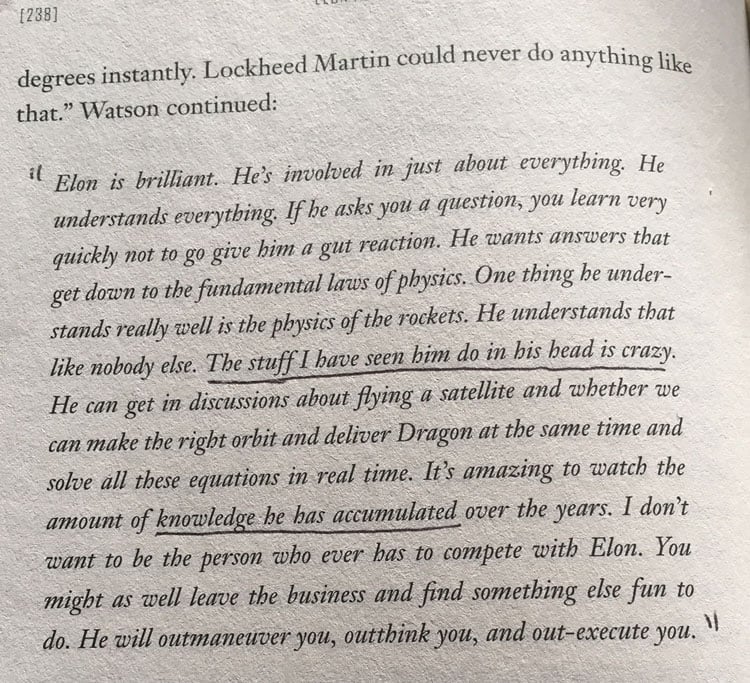](/content/images/wordpress/2015/09/ElonMusk.jpg)
Alice Schroeder, author of [The Snowball: Warren Buffett and the Business of Life](http://www.amazon.com/Snowball-Warren-Buffett-Business-Life/dp/0553384619/ref=sr%5F1%5F1?s=books&ie=UTF8&qid=1442485622&sr=1-1&keywords=snowball&ref=microcapclub.com), knows Warren Buffett as well as anyone. Alice was asked in this [interview](http://www.simoleonsense.com/alice-schroeder-the-snowball-warren-buffett-and-the-business-of-life/?ref=microcapclub.com):
> When did you get an “Aha!” feeling that Warren wasn’t a typical human being?
>
> Alice: That was obvious when I met him as an analyst in the first 5 minutes into the conversation. When he opens his mouth it just comes through. His way of articulating ideas is very original. He is a great synthesizer and especially strong at pattern recognition. He’s also able to follow what I would call decision trees and figure out probabilities in his head at an astonishing pace.
>
> So when you are in a conversation with him, he has worked out many of the directions in which the conversation can go, the likelihood of each, and how he wants to manage his end of it. He’s reading you emotionally too. You recognize that right away in a conversation with him. You realize he’s many moves ahead of you on the chessboard. It is eerie, but also fascinating.
>
> You also can see how unusual he is because he’s a great teacher. If you ask him questions he loves to convey the things he’s learned.
##### So how do we investors make faster-better investment decisions?
**1\. Become a Learning Machine:** I enjoyed Jana Vembunarayanan’s ([@jvembuna](https://twitter.com/jvembuna?ref=microcapclub.com)) eight steps to becoming a learning machine found [\[HERE\].](https://janav.files.wordpress.com/2015/09/be-a-learning-machine.pdf?ref=microcapclub.com) As a full time microcap investor and entrepreneur it is important to have high creative and intellectual mental horsepower. Since microcap investing is highly correlated to entrepreneurial investing, I read a lot of books focusing on business leaders and entrepreneurs. When I read, I read slowly, with a note pad (physical notepad or notes on iPhone/IPad) beside me. I’ve always been amazed at the creative sparks that occur when you are reading something that you truly connect with. Similarly, life happens and I go through a lull in reading that can last weeks. During these times I can literally feel my creative and mental horsepower decline, and my decision-making becomes slower. Read what you are interested in. Don’t be afraid to put a book down that you aren’t engaged with to pick up another. You don’t get an award for finishing a book you don’t like. The goal is to keep reading and become a learning machine. I’ve found great investor’s offices aren’t filled with computer screens. They are filled with books.
[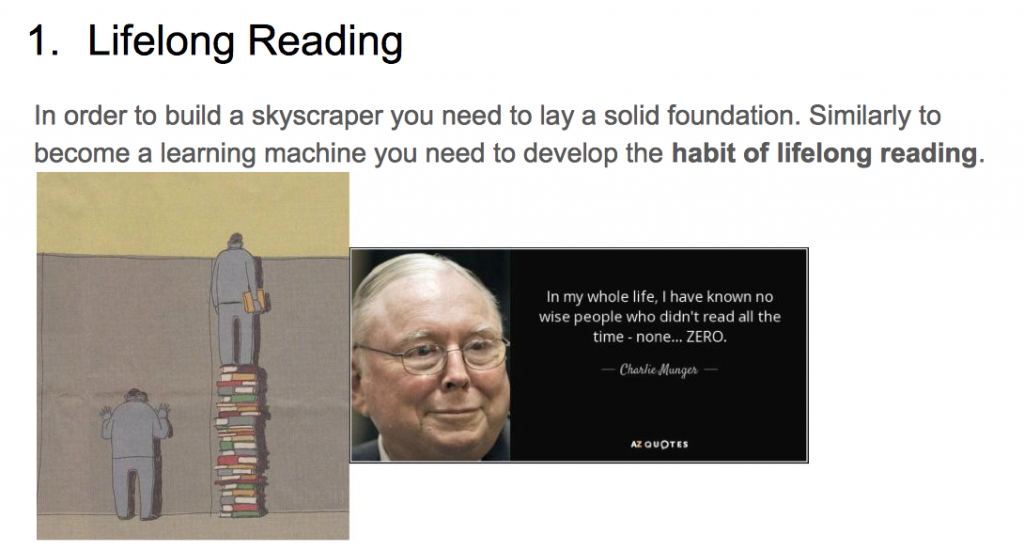](/content/images/wordpress/2015/09/charlie-munger.png)
Similarly, when I was [getting started](http://microcapclub.com/2014/09/getting-started/) as an investor it would take me a long time to read through a annual reports and analyze the financials. After you’ve read hundreds and/or thousands of company annual reports you can analyze much quicker. Instead of taking a couple hours to make a decision it now takes 10 minutes. Making quick decisions doesn’t mean getting to a “Yes” quicker, it’s more often saying “No” quicker. [Guy Thomas](http://microcapclub.com/2014/08/book-review-free-capital-by-guy-thomas/) said, *“Investment skill consists not in knowing everything, but judicious neglect: making wise choices about what to overlook”.*
**2\. Know your Circle of Competence:** There are 12,000+ microcap companies that trade on US/Canadian markets. I personally only look to initially invest in microcaps <$30 million market cap. I don’t like small companies that operate in capital-intensive industries like mining, life sciences, and oil & gas. I generally stay away from pre-revenue story stocks. I look for companies with clean share structures and owner operator management teams. These qualitative and quantitative filters take 12,000 companies down to several hundred. You then evaluate these companies looking for great businesses or good businesses that can become great. You are left with maybe 50-100\. You might find one or two that you want to buy today. The others you want to know fairly well so you can wait for the right price or an inflection point. Know them better than most so you can buy them quicker than most if you have to.
> “Everybody has got a different circle of competence. The important thing is not how big the circle is, the important thing is the size of the circle; the important thing is staying inside the circle. And if that circle only has 30 companies in it out of 1000s on the big board, as long as you know which 30 they are, you will be OK. And you should know those businesses well enough so you don’t need to read lots of work. ……The nice thing about investing is that you don’t have to learn anything new. You can do it if you want to, but if you learn Wrigley’s chewing gum forty years ago, you still understand Wrigley’s chewing gum. There are not a lot of great insights to get of the sort as you go along. So you do get a database in your head. I had a guy, Frank Rooney, who ran Melville for many years; his father-in-law died and had owned H.H. Brown, a shoe company. And he put it up with Goldman Sachs. But he was playing golf with a friend of mine here in Florida and he mentioned it to this friend, so my friend said “Why don’t you call Warren?” He called me after the match and in five minutes I basically had a deal. But I knew Frank, and I knew the business. I sort of knew the basic economics of the shoe business, so I could buy it.”
>
> **— Warren Buffett**
**3\. Invest in Great Businesses:** Invest in simple businesses that you can understand. Simple businesses aren’t always great businesses but great businesses are almost always simple businesses. They are rarely onions where you have peel back layers to understand them. Great businesses make for great stocks and the market always pays a premium for them. As a microcap investor I have no inclination to buy an undervalued company that will stay undervalued. I want to find undervalued companies that will get overvalued. Great businesses always become overvalued because they are simple to understand and there is a scarcity value placed on simple great businesses. For the same reason you want to focus on such businesses, others will too. My rule of thumb is I need to be able to explain a company in a minute or less. If it’s complicated and takes more time, “dumb money” will never buy my shares multiples higher. In the case of small microcaps, “dumb money” are the institutions. To be a successful microcap investor, you don’t want to invest where the institutions are, you want to invest where they are going to go.
The key is finding these great businesses when they are small. When you find them when they are small and undiscovered you have the luxury of not only earnings growth but also multiple expansion. This combination creates multi-baggers, sometimes very quickly, and it’s why it’s important to find these great simple businesses early.
**4\. Organize Your Research:** Organizing your research is important for full time investors and part time investors. As Warren Buffett said, *“Everything you learn in investing in cumulative.”* Alex Rubalcava ([@AlexRubalcava](https://twitter.com/AlexRubalcava?ref=microcapclub.com)) did a great [presentation](http://www.scribd.com/doc/98207906/ValueXVail-2012-Alex-Rubalcava?ref=microcapclub.com#scribd) on this subject a few years ago. We have a thread started on our MicroCapClub member’s forum on how different investors organize their research. Mike Schellinger ([@MikeDDKing](https://twitter.com/MikeDDKing?ref=microcapclub.com)), a full time private microcap investor, has a template he uses to organize his database of over 600+ companies he passively follows. Of those 600+ he actively follows around 10%.
> “I only update those that interest me. Often, I’ll update one after years of inactivity. In the microcap space, sometimes a company is interesting for a while, hits a rut, and then takes time to hit its stride again. Even after years of no update, I find the notes useful as the history is helpful and allows me to make quicker decisions.”
>
> **— Mike Schellinger**
**5\. Keep an Investing Journal:** Investing is a life long education and its teacher is loss. Keep a journal of your losses. When you are fully cognizant of your past mistakes you can make quicker better decisions. However painful losses seem at the time, sometimes we forget our lessons from 3-5-10-20 years ago. Similarly to reviewing notes of a lecture, I like to read through the journal annually to remind myself of the painful lessons of years past. Sanjay Bakshi ([@Sanjay\_\_Bakshi](https://twitter.com/Sanjay%5F%5FBakshi?ref=microcapclub.com)) makes a great point in this [interview](http://microcapclub.com/2015/06/interview-with-professor-and-fund-manager-sanjay-bakshi/) about keeping track of not only mistakes of commission but also mistakes of omission:
> “I have my own mental “hall of shame” where I display my mistakes I have made, and the tuition fee I have paid. It’s something I look at often. I share it with my colleagues and students. My hall of shame contains not just mistakes of commission, which I referred to above, but also mistakes of omission. I think it’s terribly important to understand the role of mistakes of omission in one’s career as an investor. Many investors I know don’t do this. Their logic is based on their belief that real losses matter while opportunity losses don’t. In my view, that kind of thinking is deeply flawed. It arises from a P&L account prepared by using accounting conventions which only allow the recording the results of what you did, and not what you could have done, but didn’t. The metaphor of an “Opportunity P&L Account” is a powerful one because it records the true tuition fee paid in return for the education acquired. That’s because it reflects both errors of commission and omission.”
>
> **— Sanjay Bakshi**
**6\. Go With Your Gut:** Your gut feeling, aka intuition, is the sum of all your senses combined with your past experiences. My gut has earned me/saved me millions of dollars over my investment career especially when it came to selling a position. What I’ve found is if you’re focusing too much on the decision at hand it often shields your gut/intuition. The best way to leverage your gut/intuition is to create “white space” and unfocus for a bit. It’s almost like one of those stereograms where you have to relax your vision and look through the picture to see the image. Go workout, hang out with friends, read a book, or whatever you have to do to clear your mind. Fortunately clearing my mind has always come natural to me, just ask my wife 🙂
When I evaluate my biggest winners, the purchase decision was “obvious” meaning it didn’t take me very long to come to the conclusion to buy an initial position. Often times the fact that it is taking me longer to come to a conclusion is reason enough for my gut to say “No”. Similarly on the sell side, I’ve had many instances where my gut provoked me to sell a position even after holding for years.
In conclusion, the greats are great because they are relentless learning machines that focus on what’s within their circle of competence. Great investors have an ability to wait for their pitch and when that pitch arrives to swing quick and hard. Focusing on great businesses, organizing your research, keeping an investing journal, and going with your gut are all things I do to make quick decisions. Napoleon Hill said it best, *“PROCRASTINATION, the opposite of DECISION, is a common enemy which practically every man (and woman) must conquer”.*
**\===> Interact and learn with 250+ of the best microcap investors on the planet.** [\[Join Us\]](https://microcapclub.com/join-now/)
MicroCapClub is an exclusive forum for experienced microcap investors focused on microcap companies (sub $500m market cap) trading on United States, Canadian, European, and Australian markets. MicroCapClub was created to be a platform for experienced microcap investors to share and discuss stock ideas. Since 2011, our members have profiled 1000+ microcap companies. Investors can join our community by applying to become a member or subscribing to gain instant view only access. MicroCapClub’s mission is to foster the highest quality microcap investor Community, produce Educational content for investors, and promote better Leadership in the microcap arena. For more information, visit [http://microcapclub.com](http://microcapclub.com/) and
### Proposed Regulations for Retirement Accounts to Impact Microcap Investors
URL: https://microcapclub.com/proposed-regulations-for-retirement-accounts-to-impact-microcap-investors/
Last updated: 2015-09-09T10:09:08.000Z
OTC companies represent over half of all public companies in the United States. A majority of OTC companies are microcaps. Over the past few days I learned of new proposed regulations for retirement accounts including IRAs that could have significant impacts upon the OTC and microcap community.
The U.S. Department of Labor (“DOL”) has proposed a new set of rules with the goal of reducing conflicts of interest between financial firms and retail investors who are seeking investment advice. Among other things, the DOL is seeking to establish a “best interest” standard for financial firms when they advise certain retirement plans and Individual Retirement Accounts (“IRAs”). This is an excellent goal but the implementation will have significant impacts upon retail investors if the proposed regulations are implemented as they currently are stated. The text for the two main proposals, which are lengthy and complicated, can be found [here](http://www.regulations.gov/contentStreamer?documentId=EBSA-2010-0050-0204&disposition=attachment&contentType=pdf&ref=microcapclub.com) and [here](http://www.regulations.gov/contentStreamer?documentId=EBSA-2014-0016-0003&disposition=attachment&contentType=pdf&ref=microcapclub.com).
Under the proposed rules, it likely will be more difficult for individual investors to hold OTC Securities in an IRA. It is difficult to assess exactly how the proposed regulations might be implemented by each broker due to the complexity of regulations and the variety of ways that brokers may respond to the proposed regulation if enacted. **However, possible outcomes that retail investors may experience at their broker if the regulations are enacted as proposed are that OTC securities will not be allowed in their IRAs; the support, information resources, and tools available to individual investors holding OTC securities in their IRAs will be greatly reduced; or a higher cost fee-based investment advisory account will be required in order to hold OTC securities.** The irony in the last possible outcome is that the purpose of this set of regulations is to improve returns by reducing fees that retirement investors pay to their brokerages.
The biggest cause of the problems identified in the paragraph above stems from one of the proposals called the Best Interest Contract Exemptions (BICE) which allows brokers to charge commissions and and receive compensation as they have in the past. One provision of BICE is that it limits the type of assets that can be held in an IRA to: “bank deposits, CDs, shares or interests in registered investment companies, bank collective funds, insurance company separate accounts, exchange-traded REITs, exchange-traded funds, corporate bonds offered pursuant to a registration statement under the Securities Act of 1933, agency debt securities as defined in FINRA Rule 6710(l) or its successor, U.S. Treasury securities as defined in FINRA Rule 6710(p) or its successor, insurance and annuity contracts (both securities and non-securities), guaranteed investment contracts, and equity securities within the meaning of 17 CFR 230.405 that are exchange-traded securities within the meaning of 17 CFR 242.600.” Currently, IRAs allow a broader range of products to be held than this limited list. Three specific examples of what would be prohibited in BICE accounts are OTC securities, exchange-traded options, and futures.
I find it very concerning that this new regulation if enacted as proposed will have negative effects upon anyone that wants to own OTC securities in an IRA. Not being able to trade OTC securities from my IRA would be a disaster for me as a large and growing percentage of my assets are contained in IRA accounts and they largely contain OTC securities. Likewise, I don’t want to either pay more so that I can trade OTC securities or lose access to the broad array of features currently offered by brokers.
This proposed new regulation has had little in the way of discussion by the media. To the best of my knowledge, the impact to OTC securities hasn’t been discussed by the media and has only been minimally mentioned in a few comments to the Department of Labor. I’m raising this concern so that the microcap community is aware of the issue and can provide feedback to the Department of Labor so that they are aware of the impact that this proposed regulation would have on many investors.
To this end, we have submitted comments to the Department of Labor which are shown below:
[](http://microcapclub.com/wp-content/uploads/2015/09/MicroCapClub-Letter-to-DOL.pdf)
Click To View Comment
As a reader you can help this cause in two ways. First, submit you own comments to the Department of Labor. Secondly, you can make other microcap investors aware of this issue by distributing a link to this article so that they can act as well. The easiest way to submit your comments to the DOL is to go to this [link](http://www.regulations.gov/?ref=microcapclub.com#!submitComment;D=EBSA-2014-0016-0013) and submit them. A sample comment that you could use is as follows:
> I have become aware of new regulations in ZRIN 1210-ZA25 that will impact the assets I hold in my retirement account (IRA). Specifically, I’m concerned that I may be limited in the type of assets I hold in my IRA due to the definition of assets in the proposed Best Interest Contract Exemption (BICE).
>
> I have invested in OTC securities which I independently selected through my retirement account and am concerned that I will not be able to have those securities in my account in the future should my broker need to invoke BICE to continue servicing my account. My retirement account is my hard earned money which I believe I should be able to invest in any type of asset which supports my needs. I don’t want my freedom restricted by this new rule.
>
> I request that you change BICE such that all assets are allowed in retirement accounts as they currently are in an IRA. Specifically, I want to make sure that OTC securities are allowed in BICE as they have proven to be a good area for me to invest my retirement funds.
The deadline for comments is September 24, 2015\. So please act quickly to let the DOL know your thoughts.
MicroCapClub is an exclusive forum for experienced microcap investors focused on microcap companies (sub $300m market cap) trading on United States and Canadian markets. MicroCapClub was created to be a platform for experienced microcap investors to share and discuss stock ideas. MicroCapClub’s mission is to foster the highest quality microcap investor Community, produce Educational content for investors, and promote better Leadership in the microcap arena. If you are a passionate microcap investor, [Join Us](http://microcapclub.com/join-now/).
### Book Review: ZERO to ONE by Peter Thiel
URL: https://microcapclub.com/book-review-zero-to-one-by-peter-thiel/
Last updated: 2023-10-14T23:27:50.000Z
Have you ever read an article or book that defined something that you’ve abstractly believed for years? When you read it you let out an affirmative mental “aha!”. I had one of these moments recently when I read Zero to One by Peter Thiel. This book helped shape and better define my investment strategy.
Far too often I see a microcap company’s investor presentation start off with some enormous addressable market ($20 billion, $100 billion, etc) and what follows is “If we just capture 2%….”. This has always annoyed me because in many ways the worst thing an undercapitalized public microcap can do is try to attack a huge highly competitive market.
In Zero to One, Peter Thiel talks about how small emerging companies/and investors need to take the opposite approach. In simple terms, aim for monopoly, competition is for losers. Monopolies have far greater profits, pricing power, and ability to think long-term. For small companies like microcaps to be a monopoly they need to focus on dominating a small market that is expanding, and then further grow into other complimentary markets. “Capitalism is premised on the accumulation of capital, but under perfect competition all profits get competed away.” When a company dominates a market (large or small) it is much more profitable and valuable then one owning 1% of a large competitive market.
Peter Thiel’s lecture: Competition is for Losers:
When I look back at some of the best microcap performers they too had this characteristic of dominating a small market that is expanding rapidly. These companies normally have high organic growth rates, profitability, and pricing power. These powerhouse businesses can fund high rates of growth from internal cash flows. Their market leadership and profitability allows them to make longer-term strategic decisions that provide an even wider moat.
I highly recommend reading [ZERO to ONE](http://www.amazon.com/Zero-One-Notes-Startups-Future/dp/0804139296/ref=sr%5F1%5F1?ie=UTF8&qid=1441103987&sr=8-1&keywords=peter+thiel&ref=microcapclub.com).
You will also enjoy: [First…Dominate a Small Market ](http://microcapclub.com/2016/02/firstdominate-a-small-market/)
**\===> Interact and learn with 250+ of the best microcap investors on the planet.** [\[Join Us\]](https://microcapclub.com/join-now/)
MicroCapClub is an exclusive forum for experienced microcap investors focused on microcap companies (sub $500m market cap) trading on United States, Canadian, European, and Australian markets. MicroCapClub was created to be a platform for experienced microcap investors to share and discuss stock ideas. Since 2011, our members have profiled 1000+ microcap companies. Investors can join our community by applying to become a member or subscribing to gain instant view only access. MicroCapClub’s mission is to foster the highest quality microcap investor Community, produce Educational content for investors, and promote better Leadership in the microcap arena. For more information, visit [http://microcapclub.com](http://microcapclub.com/) and
### Microcap Investing During Market Corrections and Bear Markets
URL: https://microcapclub.com/microcap-investing-during-market-corrections-and-bear-markets/
Last updated: 2023-10-14T23:29:20.000Z
Mike Schellinger and I have been full time private microcap investors for several years, and we have successfully invested through two bear markets and several market corrections. You don’t know how good you are until you’ve invested through a bear market. A strategy that’s tested is a strategy that can be trusted. In this program, Mike and I talk about the current market environment in microcaps and how we navigate market corrections and bear markets. **(Click Play Button To Listen or Download File)**
[\[Download Here\]](http://microcapclub.com/wp-content/uploads/2015/08/Market-Corrections-and-Bear-Markets.mp3)
Did you like this program? Here are two more programs we think you will like:
[Part 1: So You Want To Be A Full Time MicroCap Investor?](http://microcapclub.com/2015/01/so-you-want-to-be-a-full-time-microcap-investor/)
[Part 2: So You Want To Be A Full Time MicroCap Investor?](http://microcapclub.com/2015/02/so-you-want-to-be-a-full-time-microcap-investor-part-2/)
**\===> Interact and learn with 250+ of the best microcap investors on the planet.** [\[Join Us\]](https://microcapclub.com/join-now/)
MicroCapClub is an exclusive forum for experienced microcap investors focused on microcap companies (sub $500m market cap) trading on United States, Canadian, European, and Australian markets. MicroCapClub was created to be a platform for experienced microcap investors to share and discuss stock ideas. Since 2011, our members have profiled 1000+ microcap companies. Investors can join our community by applying to become a member or subscribing to gain instant view only access. MicroCapClub’s mission is to foster the highest quality microcap investor Community, produce Educational content for investors, and promote better Leadership in the microcap arena. For more information, visit [http://microcapclub.com](http://microcapclub.com/) and
### Warren Buffett’s Net Worth By Age
URL: https://microcapclub.com/warren-buffetts-net-worth-by-age/
Last updated: 2023-10-14T23:31:53.000Z
Warren Buffett’s right hand man, Charlie Munger is quoted, “The first $100,000 is a bitch”. Warren Buffett made his [first $100,000](http://microcapclub.com/2015/01/the-first-million/) in the early 1950’s when he was still an individual investor, compounding his capital 50% annually over several years.
I was talking to a passionate young microcap investor the other day, and I was giving him some advice based on my many failures over the years. We spoke about how I [got started](http://microcapclub.com/2014/09/getting-started/) and my path to becoming a [full time private microcap ](http://microcapclub.com/2015/01/so-you-want-to-be-a-full-time-microcap-investor/)investor. I could tell he was starting to compare his progress to mine. My advice to him was to [focus on the long-term](http://microcapclub.com/2015/08/focus-on-the-long-term/) and don’t’ compare yourself to others. This is easier said than done, myself included.
This week [@awealthofcs](https://twitter.com/awealthofcs?ref=microcapclub.com) shared an [article](http://www.marketwatch.com/story/from-6000-to-67-billion-warren-buffetts-wealth-through-the-ages-2015-08-17?ref=microcapclub.com) illustrating Warren Buffett’s net worth from age 14 to the present. As with most people, I looked at the chart, traced over to my age (34) and saw $3.4 million. I thought to myself, hmmm, well that’s not too unrealistic. When I looked at the comments on the chart, many inquired what Warren Buffett’s net worth figures would look like adjusted for inflation (2015 USD). I decided to calculate Buffett’s inflation adjusted net worth and overlay it onto the chart:
[](/content/images/wordpress/2015/08/Warren-Buffett’s-Net-Worth-By-Age-chart.png)
I then stared at Warren Buffett’s inflation adjusted net worth at my age and felt totally inadequate. Comparing yourself to others and especially to the best performer ever in your skill/expertise is unhealthy. Don’t compare yourself to others. Compare yourself to yourself two years ago. View the greats as mentors. It took me a long time to realize this but don’t try to copy what your mentor does because you can’t. Learn how they think.
**\===> Interact and learn with 250+ of the best microcap investors on the planet. [\[Join Us\]](https://microcapclub.com/join-now/)**
MicroCapClub is an exclusive forum for experienced microcap investors focused on microcap companies (sub $500m market cap) trading on United States, Canadian, European, and Australian markets. MicroCapClub was created to be a platform for experienced microcap investors to share and discuss stock ideas. Since 2011, our members have profiled 1000+ microcap companies. Investors can join our community by applying to become a member or subscribing to gain instant view only access. MicroCapClub’s mission is to foster the highest quality microcap investor Community, produce Educational content for investors, and promote better Leadership in the microcap arena. For more information, visit [http://microcapclub.com](https://microcapclub.com/) and
### Focus On The Long-Term
URL: https://microcapclub.com/focus-on-the-long-term/
Last updated: 2023-10-14T23:33:13.000Z
The key to unlocking wealth in the stock market is changing your mindset to stop renting stocks and start owning businesses. I find that most investors say they focus on the long-term but very few actually practice it. Focusing on the long term is hard because it is counter to our human nature that craves action and immediate gratification. The truth is that short-term thinking paralyzes your returns. If your goal is to achieve maximum capital gains, then your intention with every purchase should be to hold for years.
Look at Warren Buffett’s holding period compared to the average US investor:
\[block\_grid type=”two-up”\]
\[block\_grid\_item\] \[image class=”folio-1″ src=”/content/images/wordpress/2015/08/WB-Holding-Period-1.png” link=”true”\] \[/block\_grid\_item\]
\[block\_grid\_item\] \[image class=”folio-1″ src=”/content/images/wordpress/2015/08/WB-Holding-Period-2.png” link=”true”\] \[/block\_grid\_item\] \[/block\_grid\]
\[lightbox selector=”.folio-1″\]
When we look at the greatest investors of all time with the longest track records, most are long-term investors:
\[image class=”folio-2″ src=”/content/images/wordpress/2015/08/best-investors-of-all-time.jpg” link=”true” lightbox\_caption=”Top Investors”\]
\[lightbox selector=”.folio-2″\]
Many try to misrepresent buy and hold investing as buy and forget. Nothing can be further from the truth. The best long-term investors conduct constant maintenance due diligence to reinforce their long-term investment thesis. Their edge in investing is finding great companies early and knowing them better than most. This deep understanding of what they own gives them the [conviction to hold](http://microcapclub.com/2014/08/the-conviction-to-hold/) and the ability to sell before the masses.
You will have an edge on most investors if you make investments based on expected 3-5 year returns instead of 12-month returns. 95% of investors are investing for the next quarter or two, not the next few years. If you can train yourself to think in multi-year time horizons it frees your mind to think more clearly. Investing is one of the only art forms where opportunities and decisions become clearer when you look out further. There is a high degree of farsightedness in successful investing.
Short-term thinking is a disease and the best way to kill it is focusing on great companies and setting a high bar/hurdle. Great companies at good prices don’t come around very often. For me a great mental hurdle is limiting my investments to those I think will increase 500% in three years if I’m right and increase 100% if I’m wrong. [Wait for your pitch](http://microcapclub.com/2015/04/wait-for-your-pitch/). When I look at the 12,000 microcaps that exist on North American exchanges, I own 5 and follow 25 others closely. In the last four years I’ve swung the bat 7-8 times. In the last 21 months I haven’t swung the bat at all. If you set a high bar often times your biggest risk is boredom. When you concentrate on your best ideas you can devote the time to knowing them better than most. To achieve a multi-bagger in the portfolio, you have to hold a multi-bagger. Don’t bother finding the next multi-bagger if you aren’t going to develop the [conviction to hold](http://microcapclub.com/2014/08/the-conviction-to-hold/) them. Only after you hold onto a great company as the stock goes up 5-10-20x+ do you realize how wealth is truly created.
During earnings season I judge my positions quarterly progress against my 3-5 year expectations. I use a range of 3-5 years because some businesses I can form a reasonable five year expectation and others three years. The 3-5 year expectation is derived from doing countless hours of quantitative and [qualitative analysis](http://microcapclub.com/2015/07/quality-over-quantity/). If the quarterly result fits within a spectrum or range that keeps your 3-5 expectations on track, then you are good to go. If the quarterly result impacts your 3-5 year expectation you need to dig further. Even though I haven’t swung the bat at any new pitches in 21 months, I have sold two positions because they broke from my long-term expectations, and I redeployed that capital into two other existing positions that are performing. I want to be invested in the best companies I can find at all times. This can be three, five, eight positions, etc. The market and company execution will decide this for me.
David Rolfe, CIO of Wedgewood Partners, manages approximately $6 billion in assets under management. In this great interview he talks about focusing on great businesses and how Wedgewood only swung the bat once in 2014.
\[x\_video\_embed\]\[/x\_video\_embed\]
If you want to be a better long-term investor get rid of all distractions that promote short-term thinking. Listening to financial pundits, watching your positions every second of the trading day, and watching hundreds of other stocks that you would never own at any price are big distractions. Focus on owning the best companies you can find. You will be amazed at how well you can focus by getting rid of these distractions. Don’t let the daily price action in your positions influence your long-term resolve. For me, this is also why I don’t swing trade a portion of my position. It promotes short-term thinking. It’s hard to be a long-term investor when you watch your stocks every second. Retraining your mind to not care if a position is making a 52-week high or is down 10% in a day will make you a better investor. Similarly, who cares how many Apple iPhones were sold this quarter, or that the ISM Manufacturing Index hit 53, or that the Jobs Report last Friday was weak. Does any of this impact any of the great companies you own? No, not if they are great. You know you are doing it right when your wife is telling you about what happened in the market at dinner.
A long-term focus is imperative to successful investing, and it’s equally important that the management/CEO’s you invest in share this quality. Warren Buffett said, “I am a better investor because I am a businessman and a better businessman because I am an investor.” Great investors and great businessman (aka intelligent fanatics) focus on the long-term.
If you were to analyze [intelligent fanatic CEO’s](http://microcapclub.com/2016/01/how-to-find-intelligent-fanatic-ceos-early/) of today and yesteryear like Warren Buffett, Henry Singleton, Phil Knight, Elon Musk, Steve Jobs, Howard Schultz, Bill Gates, Jeff Bezos and others, what sets them apart is their extreme focus, energy, and intelligence combined with an iconoclastic and long-term vision.
Intelligent fanatics have no interest in attracting investors that don’t’ share their long-term vision. In 1997, when Amazon.com went public, CEO Jeff Bezos devoted most of his Shareholders Letter to [“It’s All About The Long Term”](http://www.sec.gov/Archives/edgar/data/1018724/000119312513151836/d511111dex991.htm?ref=microcapclub.com). You will find similar things said by Howard Schultz in his [first shareholder letter](http://starbucksmelody.com/2010/05/19/the-1993-starbucks-annual-shareholders-report/?ref=microcapclub.com) after going public in 1993.
\[blockquote cite=”Warren Buffett, BRK Letter 1988″\]We try, through our policies, performance, and communications, to attract new shareholders who understand our operations, share our time horizons, and measure us as we measure ourselves. If we can continue to attract this sort of shareholder – and, just as important, can continue to be uninteresting to those with short-term or unrealistic expectations – Berkshire shares should consistently sell at prices reasonably related to business value.\[/blockquote\]
When I evaluate my past and present multi-bagger CEO’s they too have this same long-term focus in common. They were/are not interested in attracting short-term focused investors. Very few, if any, provided guidance of any kind. All guidance does is reinforce short-term thinking. [No guidance](http://microcapclub.com/2015/10/dont-give-guidance/) requires investors to come to their own assumptions and expectations. It attracts a shareholder that is willing to dig deep to understand the business that they own. The short-term focused lazy investor will be quick to complain and say a lack of guidance is a reflection of management’s lack of understanding of the business. But lets see what Warren Buffett says about guidance.
\[blockquote cite=”Warren Buffett, BRK Letter 2002″\]“Be suspicious of companies that trumpet earnings projections and growth expectations. Businesses seldom operate in a tranquil, no-surprise environment, and earnings simply don’t advance smoothly (except, of course, in the offering books of investment bankers). Charlie and I not only don’t know today what our businesses will earn next year – we don’t even know what they will earn next quarter. We are suspicious of those CEO’s who regularly claim they do know the future – and we become downright incredulous if they consistently reach their declared targets. Managers that always promise to “make the numbers” will at some point be tempted to make up the numbers.”\[/blockquote\]
Intelligent fanatics long-term focus isn’t just hyperbole. It is a competitive edge in their businesses, just like it is in investing.
\[blockquote\]“If everything you do needs to work on a three-year time horizon, then you’re competing against a lot of people,” Bezos [told Wired in 2011](http://www.wired.com/magazine/2011/11/ff%5Fbezos/all/1?ref=microcapclub.com). “But if you’re willing to invest on a seven-year time horizon, you’re now competing against a fraction of those people, because very few companies are willing to do that.”\[/blockquote\]
As investors we want to find great companies early and develop [the conviction to hold them](http://microcapclub.com/2014/08/the-conviction-to-hold/). How can we find the next Elon Musk or Howard Schultz? It’s great to read about them after they’ve made other investors billions, but we want to find them early in their careers. I want to find Reed Hastings 12 years ago when he was leading an $80 million market cap microcap called Netflix (NFLX). A dominant character trait of intelligent fanatics is their ability to focus on the long-term while repelling short-term thinking within their organizations. As investors the way we find them early is to start thinking like them.
**\===> Interact and learn with 250+ of the best microcap investors on the planet.** [\[Join Us\]](https://microcapclub.com/join-now/)
MicroCapClub is an exclusive forum for experienced microcap investors focused on microcap companies (sub $500m market cap) trading on United States, Canadian, European, and Australian markets. MicroCapClub was created to be a platform for experienced microcap investors to share and discuss stock ideas. Since 2011, our members have profiled 1000+ microcap companies. Investors can join our community by applying to become a member or subscribing to gain instant view only access. MicroCapClub’s mission is to foster the highest quality microcap investor Community, produce Educational content for investors, and promote better Leadership in the microcap arena. For more information, visit [http://microcapclub.com](http://microcapclub.com/) and
### Stock Research in Unusual Places
URL: https://microcapclub.com/stock-research-in-unusual-places/
Last updated: 2023-10-14T23:34:50.000Z
Typically when most investors think of stock research, they think of a computer activity such as starting up yahoo finance and searching through symbols to find that stock that is attractive. However, some of the best ideas are found in different ways just observing your surroundings and paying attention to new trends.
Peter Lynch, in his book *Beating the Street*, wrote a chapter entitled “Shopping for Stocks” in which he talks about his experiences with his daughters and his local mall. He found that his daughters were very good at identifying trends which he could capitalize on as an investor. In fact, he reached the point that he would take his daughters shopping just to see what interested them.
I had an experience similar to this in late 2008 to 2009\. My niece, who was in second grade at the time, asked for a gift card to the clothing store Justice for her birthday. This was her favorite store which has a target audience of grade school girls. My wife asked me to go there and purchase the card for her.
When I walked into the store, there was music playing with famous teen bands on TV. The motif was brightly colored. The store was filled with trendy clothes and accessories geared towards grade school aged girls. My grade school girls today say they have lots of “glam.” Don’t ask me what that means but I know it means they like it. I was probably the only male in the store as it was filled with girls and their mothers. Keep in mind that this was in the middle of the market crash so a filled store was an unusual thing. There was lots of activity which was really good to see as a potential investor. Given the motif, products, and brisk activity, I quickly understood that it was a dream place that young girls would like and would want to shop.
Later, back home, I remembered the experience and investigated Tween Brands which was the owner of Justice and happened to be a public company. Also, I spoke with one of my trading friends, who confirmed that his daughters were also interested in Justice. After fully researching the company, I purchased shares in late March of 2009 in Tween Brands. In June of 2009 they announced that they were being bought out by Dress Barn. In that short period of time, the stock almost tripled. Unfortunately, I didn’t own a big position and didn’t own it the whole way up but I did make a decent amount of money. This example gives you a flavor of what you can learn about investing opportunities by paying attention to your surroundings.
There is another example that is more recent. It happened last year. I was looking for a home improvement store and pulled into the parking lot just before the store. This parking lot was in front of a grocery store. As I was driving along, I noticed a semi trailer with an awning off in the distance. It was clear to me that this was some special promotional event.
Part of the reason that this trailer caught my eye was that there was a logo that looked a bit familiar. It was hard to see at first because of the distance away. However, as I got closer, I realized why it was that it caught my eye. It was the logo for Nathan’s Famous (NATH). Now it just so happened that I owned stock in Nathan’s Famous at the time. They had recently started a new marketing campaign. However, I had never seen Nathan’s Famous products before and wasn’t aware that the marketing campaign was coming to my area.
Naturally, I had to stop and check out the activity at this promotional event. As it turned out, the display was in the process of being disassembled. However, I was able to talk with the people that ran the event. They told me that they were going to a different city every few days to show the product. I also found out that the grocery chain there just started selling Nathan’s Famous products. I learned that their product received a good reception at this promotional event and also confirmed that the customers at the store had never heard of Nathan’s Famous. So, I knew that this promotional activity was going to help sales grow especially since they were expanding their territory.
The rest of that day I was blown away at the dumb luck of running into this promotional event. At the time I wasn’t totally convinced that this investment was great but this promotional event significantly increased my confidence. Later in the year, Nathan’s Famous reported a great quarter where earnings increased by 47.4%. To be fair, the increase in earnings was not just related to that promotion. However, seeing that promotion was what gave me the [conviction to continue holding](http://microcapclub.com/2014/08/the-conviction-to-hold/). I made a quick return of 32% in a few months and I probably wouldn’t have made as much had I not been paying attention and spent the time to investigate.
Shopping isn’t the only unusual place where you can do stock research. Perhaps at work you learn about a customer that is doing well which leads you to an investment in that industry or company. Perhaps it is a party where a friend tells you about how they are very busy at work or a neat new product that they really like. In a little bit of conversation you might learn about a trend that is happening that you might be able to capture in an investment.
There are virtually limitless ways of finding about new trends that might lead you to a good investment idea and many of them don’t revolve around sitting in front of your computer. Even with a drink at the local bar you might find out about the hottest new trend in liquor that leads you to an investment idea. Whenever there is a new product that my kids receive as a present which they really enjoy, I always check the manufacturer to see if they are a publicly held company. Another place to pay attention is when commercials come on TV. That is one way to find out about new trends that may lead you to an investment idea.
The important thing about finding investment ideas in unusual places, however, is to keep an eye out for these things while you are out exploring the world and living your life. Also, it is important when you find one of these situations to learn as much as you can so that you can exploit the opportunity. Don’t be afraid to ask questions at a store or other business as the employees are usually more than willing to provide information. Anyone can do this as it doesn’t require special training. It just requires some attentiveness and inquisitiveness.
One of the things that I most enjoy about the members of MicroCapClub is that we are an eclectic mix of people with diverse experiences yet all have significant investment experience. This eclectic mix gives us expertise in many areas and diverse perspectives. We have investors who are fund managers, analysts, home builders, engineers, computer programmers, accountants, doctors, lawyers, and many more professions. The members are able to use everyone’s unique knowledge, experience, and talents to find ideas in different areas. Our broad skills and perspectives are also very helpful in researching companies as often there is someone with specialized skills that can provide a unique perspective and information that the average person can’t.
Having a network of people with diverse backgrounds is a way to help you find ideas in unusual places as it broadens your scope to unusual areas that you wouldn’t otherwise encounter. Sometimes, you can also piece together a part of a new trend just by talking with other investors as there are often multiple pieces to the puzzle and it takes more than one person to complete the puzzle. It can be helpful to brainstorm with your network regarding trends that they are seeing to help find new ideas.
If you have had an interesting experience doing research in an unusual place, please leave a comment below so that we can enjoy and learn from your experience.
**\===> Interact and learn with 250+ of the best microcap investors on the planet.** [\[Join Us\]](https://microcapclub.com/join-now/)
MicroCapClub is an exclusive forum for experienced microcap investors focused on microcap companies (sub $500m market cap) trading on United States, Canadian, European, and Australian markets. MicroCapClub was created to be a platform for experienced microcap investors to share and discuss stock ideas. Since 2011, our members have profiled 1000+ microcap companies. Investors can join our community by applying to become a member or subscribing to gain instant view only access. MicroCapClub’s mission is to foster the highest quality microcap investor Community, produce Educational content for investors, and promote better Leadership in the microcap arena. For more information, visit [http://microcapclub.com](http://microcapclub.com/) and
### Beware of Story Stocks
URL: https://microcapclub.com/beware-of-story-stocks/
Last updated: 2023-10-14T23:37:30.000Z
Confession. I have invested in companies based on promise and promise alone in the past. I have met CEO’s and listened to pitches on opportunities so compelling that I’ve felt the need to take action and take it quickly. And… on more occasions than I’d like to admit, I have lost money investing in such story stocks.
This is the challenge in navigating “story stocks.”
A story stock is a company who has yet to show execution fundamentally though profitability or revenue growth. The value in the equity reflects expectations and future potential. Earnings, revenue, and/or assets are typically nonexistent except for cash reserves, which are burning away. Keep in mind, story stocks do not make money. And, valuation, as a result, is much harder to assess as it is influenced much more so by expectations. That expectation barometer can swing wildly depending on management, their tendency to lean aggressive vs. conservative, and how the profile for their growth trajectory changes over time. When you invest in a story stock, you must trust management exhaustively. Their word is all you have.
Story stocks are most prevalent in the technology, biotechnology, and resource (mining and oil & gas exploration) sectors where the promise for new products and new resources can be profound. Imagine if I told you the name of a company who will cure cancer! Look at the growth companies like Apple and Netflix have realized in recent years. Our enthusiasm for Microcap opportunities is derived from asymmetric risk reward, thus the returns from bellwether disruptive companies like those mentioned validate our wild expectations. It can happen to large companies just as it happens to small companies. However, separating emotion from discipline in this business is paramount. Learning from your mistakes and understanding the reasons why you have success, or the lack thereof, is a stepping stone to achieving a stronger process in the long run. And… losing money, while counter intuitive to the greater goal, is not always a bad thing. Consider it an investment in the stream of profits you will receive in the future, or a type of tuition expense.
I’ve focused the past several years of my career solely researching sub $250 mln market cap companies. During that time, I’ve interviewed over 300 micro cap CEO’s. Most executives in this subset of the capital markets need to be salesmen, whether it’s a pitch for their business to customers or investors. If they can’t convince you they have a compelling opportunity, there is likely not a good opportunity to be had at all. The challenge therein lies with differentiating the business plan that is simply a story vs. one that is close to reality. You want to seek tangible results, traction and revenue or earnings inflection points. Channel partners, customers, industry awards are all nice, but don’t necessarily lead to long term price appreciation.
The story can appear in several different forms too. Just like the movies, we have action stories, love stories, and unfortunately some sad stories too. The traditional and most popular version is simply that of an early stage company building a pipeline which is on the verge of significant sales traction. A product is coming out or a service is ready to be launched. Just watch the revenue floodgates open! A different version focuses on an acquisition that will literally change the game going forward. Perhaps it’s a junior mining or oil & gas exploration company drilling right next door to a major. Maybe there is a management change that could be the difference maker, or perhaps it’s even a new strategic relationship. The story can exist is any number of varieties, and I haven’t even touched on the pitfalls yet.
Whatever the specifics may be, the takeaway should always be this. Results speak much louder than hype and speculation. The company in the pipeline is simply in the pipeline until it’s brought over the goal line. There is a big difference in “pipe” vs “goal” when we’re referencing “lines.” The new CEO won’t make tangible changes for quarters. The new strategic relationship likely won’t yield results anytime soon either. Events such as these provide positive spin for a story and most definitely impact expectations when announced, but when all you have are expectations, they can fade as times passes by. Taking that into consideration is very important. Understanding that meaningful appreciation should and will follow tangible results is equally as important. As mentioned prior, expectations can swing wildly and a story stock is simply a barometer of those expectations floating in the market wind. That being said, here are a number of anecdotal story scenarios to watch out for:
1. Technology as a whole can be argued as very disruptive, and is evolving quickly. Computers, tablets, and phones are replaced every few years. The consumer no longer needs to pay for hardware because it is often subsidized or simply sold to promote the use software. iPhones and the Kindle are examples of this. With so much change, disruption can happen very fast. For that reason, I watch for and seek out new technology more so than any other industry. The profile of a company I like is one where there is a massive tail wind rising the tide for all boats, and thus the success of my investment should be predicated on what they do, but excellence aside, they should be shooting fish in a barrel either way. This scenario makes losing harder to realize. There are several keys to success in technology. Here are two. First is identifying the tail wind, whether it’s the Internet of Things, Machine to Machine communication, monetization of mobile, mobile advertising, robotics, etc. Upon identifying the tail wind, you must assess whether the demand environment exists. A market that needs education is one that can elongate a sales cycle significantly. Please avoid this. It simply adds chapters to the story. You want to finish the book after all. Secondly, technology without a barrier to entry is risky. Intellectual property helps. Your investment needs protection, especially when it comes to technology. Every company claims they have the next best thing. It’s rarely true. Venture capital and private equity have their hands in any number of emerging technologies. A competitor almost always exists. When the public market sees the best technology, it’s typically at a market cap exponentially larger than that which I would be interested in. That being said, traction is the only testament and validation for a product or service. Wait for it. Patience is key. If it truly is that disruptive, you may miss the first inning, but capturing the next 8 will be a fun ride.
1. Big Brother relationships. Several years ago I thought the big brother relationship could be viewed as a point of validation. When a multi-billion dollar company decides to take on company risk with a sub $50 mln micro cap, that says something! Fast forward to today and I would argue that such an announcement should be viewed as a signal to sell… almost immediately. First, the strategic relationship is always a positive on the surface. Expectations fly high, only to fade over time into what can be a long cycle before fundamentals actually change. Capture the move, hopefully binary at first, and step to the sidelines. Second, and more importantly, the interim period post announcement and before revenue is recognized is typically a scenario where the balance of risk vs. reward has swung out of your favor. Be cognizant of this as execution is on the come, especially with companies exponentially larger than your baby micro cap.Assuming the stock has had a substantial rally on the announcement, you’re risk reward has likely changed and is now temporarily unfavorable.
1. I struggle citing an acquiring company in the microcap universe that has performed well after announcing a strategic acquisition recently. The story is always much sexier afterwards. Management takes a shot of enthusiasm to the arm and can run circles around revenue increases, expanding margins, and how it may literally rain profits down on their headquarters. The hard truth is that synergies always take time, integration is challenging, and similar to the big brother relationship, expectations fly high only to fade, which means fundamentals matter most. Skepticism breeds lower valuations and acquisitions create more variables. It’s linear in that sense. I’ve learned to move interesting companies who have been acquisitive to the sidelines until signs of progress are shown… or wait and buy at a great discount. You may get your price.
1. Municipality/Government traction. Government and Municipality opportunities are a red flag. The pipeline is never captured as planned. And, if the value proposition applies to one such opportunity, it typically applies to many. Insert township, state, etc as needed. As a result, companies can talk about very large addressable markets. However, changes to funding and budgets impact the timeline considerably. Political leadership is an additional curve ball. My suggestion is to tread carefully in this universe.
Microcap investing can be treacherous. Companies without fundamental earnings or revenue have no choice but to tell a good story. The only way they can grow when they’re not making money is to invest in growth and raise more money. Essentially, they are marketing machines. A good question to ask the CEO of a story stock is “how much stock have you purchased with your own money?” If the answer is zero, then the story may be too good to be true.
**\===> Interact and learn with 250+ of the best microcap investors on the planet.** [\[Join Us\]](https://microcapclub.com/join-now/)
MicroCapClub is an exclusive forum for experienced microcap investors focused on microcap companies (sub $500m market cap) trading on United States, Canadian, European, and Australian markets. MicroCapClub was created to be a platform for experienced microcap investors to share and discuss stock ideas. Since 2011, our members have profiled 1000+ microcap companies. Investors can join our community by applying to become a member or subscribing to gain instant view only access. MicroCapClub’s mission is to foster the highest quality microcap investor Community, produce Educational content for investors, and promote better Leadership in the microcap arena. For more information, visit [http://microcapclub.com](http://microcapclub.com/) and
### The Three P's of Investing
URL: https://microcapclub.com/the-three-ps-of-investing/
Last updated: 2023-10-14T23:39:15.000Z
I recently returned from a vacation in the Williamsburg, VA area. It was fascinating to see and learn about the rich history of the United States. While there, I learned some astounding information in a movie entitled “The Road to Yorktown” at the [Yorktown Victory Center](http://www.historyisfun.org/yorktown-victory-center/?ref=microcapclub.com) regarding the history leading to the [Battle of Yorktown](https://en.wikipedia.org/wiki/Siege%5Fof%5FYorktown?ref=microcapclub.com) which was the last major land battle of the American Revolutionary War in the North American theater and effectively ended the war. The movie, speaking about George Washington who was the Commander-in-Chief of the Continental Army, states: “Under his command we hadn’t had a victory in four years. But now we sensed we were nearing the ultimate test. Yorktown.”1 In fact, the American military [teetered](http://www.mountvernon.org/george-washington/the-revolutionary-war/ten-facts-about-the-revolutionary-war/?ref=microcapclub.com) upon total collapse yet Washington persevered. Continuing without winning for four years and with his forces near collapse really required some perseverance and patience for George Washington. What I found inspiring about this history is that great things take time and hard work. I think we are often too impatient and want immediate results in this day of instant food, instant messages, and instant everything.
The first seven months of 2015 haven’t been the easiest for investing as the broader markets are barely up so far this year. Over the past few weeks I’ve been noticing the noise as investors and traders increasingly beat the drum of the difficulty of the market. If you listen to the major media, there is lots of talk of the recent downtrend in the market. I think what many people forget is that investing is a game of patience. It is a marathon and not a sprint. Success can take years just as it did for George Washington and his Continental Army. My statements here are not meant to be a prediction on the direction of the market as that is very difficult to do. Rather, it is more to talk about the investment process including the patience and perseverance that is required to succeed. Furthermore, keep in mind that the markets are only a few percent off of all-time highs. So, while this hasn’t been an easy year, it still isn’t that bad.
My own investing career has had many times where patience and perseverance were required. I started investing in the early 90’s when I coat-tailed my father’s investments in small bank stocks. In late 1999 I started picking my own stocks for investments. I had some small success in 1999\. The year 2000, of course, was much harsher although I fortunately didn’t invest in the highflying stocks of the technology world. Through the end of 2002 I was up only a few percent. I had spent over three years of hard work learning and investing in the markets and I hardly had anything tangible to show for it. My patience and perseverance paid off in 2003\. It was a great year as I was up 89% for the year. It took me four years of learning, work, and patience to have success.
There is another major time in my investing career that required a lot of patience and perseverance. It was early 2009 and the markets were near their lows in the crash that may be of the biggest magnitude I will see in my lifetime. I remember being near ready to give up on full-time investing. I specifically remember a conversation with my mother at that time. She wasn’t an investor but was a very wise woman and was extremely conservative financially and otherwise. When I told her that I was thinking of going out and finding a job, she encouraged me to continue. That little bit of encouragement, especially with my mother’s conservative nature, inspired me to continue for a while longer. Soon the market was moving up again and I was able to get back on my feet. Had I not persevered, I probably wouldn’t be writing this article today.
Success in investing takes time especially as you are starting out. Typically, you will not have immediate success. However, with some patience and perseverance I believe that anyone that has motivation and the right temperament can be successful. Results in investing often can’t be measured in weeks or months. It usually takes years.
So what does that mean and what should investors do? First, let’s not confuse patience with prudence in [cutting your losses](http://microcapclub.com/2015/05/cutting-your-losses/). We need to have the wisdom to know when to hold a stock and when to fold. What it does mean is that investors need to wait patiently while continuing in their investment process. I believe that an effective investment process needs to contain a balance of activities including learning about investing, continuing to do home work on existing positions, search for new ideas, and monitoring the macro trends. If you keep doing these activities and are smart about your investments, you should eventually be successful. You can’t stop doing these activities just because your portfolio is down.
Researching new ideas when the market is declining is something I want to delve into a little further. It is easy to be motivated to look for new ideas when your portfolio is hitting new highs as you are making money. Ironically, often the most important time to be looking for new ideas is when the market is pulling back. That is when fewer investors are generally looking and when the bargains can be had. Investing is often counter intuitive. To be most successful, you need to be doing the opposite of what the herd is doing. The famous Warren Buffett quote comes to mind. He states: “We simply attempt to be fearful when others are greedy and to be greedy only when others are fearful.” Another famous quote that comes to mind is one by Peter Lynch. He said: “I’ve found that when the market’s going down and you buy funds wisely, at some point in the future you will be happy.” Now I’m not necessarily saying that now is the time to buy. However, the best purchases are usually made during market declines.
One personal example shows how researching new ideas during a market decline is one of the best times to be looking. Probably my all-time best purchase so far in my career was in PFHO in 2011\. Ironically, I found it on August 12 at $0.55 during a period where the market was crashing and was highly volatile. At that time, nobody was interested in looking for new ideas. I remember that trade as clear as yesterday. I was sitting in a hotel room, saw the news of a great quarter, and purchased shares. The stock was very illiquid, I knew I would either make a lot of money or I was going to sell for a substantial loss but was pretty confident in my purchase. As things turned out, the former was the case as I sold a block of those shares in 2014 at $58 for more than a 100 bagger.
When I first started full-time trading and investing I even had a written plan that stated that I was going to investigate five new companies a week to make sure I continued to look for new ideas. That rule helped ingrain a practice of continually searching for new investment ideas. I try to never stop looking for new ideas, as you never know when or where you will find the next idea.
If you want good or even revolutionary results in your portfolio, you are going to need to have patience and perseverance as well as a mastery of your emotions. Sometimes having a wise mentor or significant other to support and encourage you is important, as success in investing is just as much of a psychological game as it is a game of finance. I think it is wise to keep in mind the phases of investing psychology that are shown in this [article](http://microcapclub.com/2013/04/the-14-stages-of-investing-psychology/). Understanding your own emotions is important, as you need to make sure they don’t lead you astray. Success doesn’t come without work. That work is even more important when the going gets tough than when profits are rolling in. I firmly believe that most people have the ability to succeed in the stock market. Yes, you too can do this!
*1 I would like to extend a special thanks to Tracy Perkins of the Jamestown-Yorktown Foundation for providing the exact quote from “The Road to Yorktown” movie.*
**\===> Interact and learn with 250+ of the best microcap investors on the planet.** [\[Join Us\]](https://microcapclub.com/join-now/)
MicroCapClub is an exclusive forum for experienced microcap investors focused on microcap companies (sub $500m market cap) trading on United States, Canadian, European, and Australian markets. MicroCapClub was created to be a platform for experienced microcap investors to share and discuss stock ideas. Since 2011, our members have profiled 1000+ microcap companies. Investors can join our community by applying to become a member or subscribing to gain instant view only access. MicroCapClub’s mission is to foster the highest quality microcap investor Community, produce Educational content for investors, and promote better Leadership in the microcap arena. For more information, visit [http://microcapclub.com](http://microcapclub.com/) and
### Book Review: Getting There - A Book of Mentors
URL: https://microcapclub.com/book-review-getting-there-a-book-of-mentors/
Last updated: 2023-10-14T23:40:15.000Z
Each day you wake up feeling uninspired, listen to or read something that will inspire you. It will make you 10x more productive. This is one of those books that I guarantee will recharge your batteries. “Getting There – A Book of Mentors” is a compilation of stories written by 30 leaders in diverse fields such as Warren Buffett, Kathy Ireland, Leslie Moonves, Laird Hamilton, Sara Blakely, John Paul Dejoria, etc. Each leader tells their story of hardship, failure, triumph, and lessons learned. The best part is each story is only 3-5 pages long, so you can spend 15 minutes to read a couple or several hours and read several. Either way, it’s pure inspiration.
The quote from Warren Buffett I used in this tweet was from this book:
[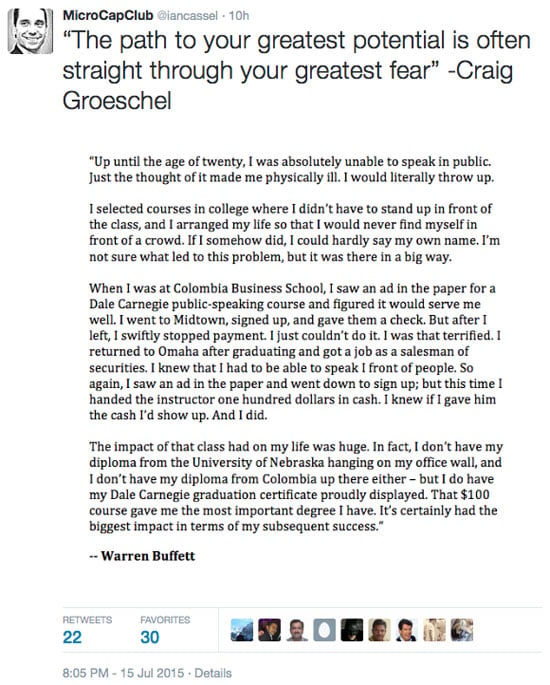](/content/images/wordpress/2015/07/getting-there-image.jpg)
Many look at successful people and believe their path was easy, a linear “up and to the right” chart. This is certainly not the case, and I enjoyed hearing about what these leaders had to overcome. I highly recommend the book.
[](http://www.amazon.com/Getting-There-A-Book-Mentors/dp/1419715704?ref=microcapclub.com)
BUY IT HERE
If you liked this book review, you will also like these blog posts: [Getting Started](http://microcapclub.com/2014/09/getting-started/) and [Getting There](http://microcapclub.com/2016/01/getting-there/)
**\===> Interact and learn with 250+ of the best microcap investors on the planet.** [\[Join Us\]](https://microcapclub.com/join-now/)
MicroCapClub is an exclusive forum for experienced microcap investors focused on microcap companies (sub $500m market cap) trading on United States, Canadian, European, and Australian markets. MicroCapClub was created to be a platform for experienced microcap investors to share and discuss stock ideas. Since 2011, our members have profiled 1000+ microcap companies. Investors can join our community by applying to become a member or subscribing to gain instant view only access. MicroCapClub’s mission is to foster the highest quality microcap investor Community, produce Educational content for investors, and promote better Leadership in the microcap arena. For more information, visit [http://microcapclub.com](http://microcapclub.com/) and
### Quality Over Quantity
URL: https://microcapclub.com/quality-over-quantity/
Last updated: 2023-10-14T23:41:29.000Z
Our personality and experiences shape our investment philosophy. Similar to an artist molding a clump of clay into something desirable, investors mold and shape their investment philosophies over time into something more lasting and profitable. Since your investment philosophy is the cumulative effect of your past experiences, it also forms a focal point or lens on different investing topics. Market participant’s love to debate topics such as: Investing versus Swing Trading, Growth versus Value, Diversification versus Concentration, and finally Qualitative versus Quantitative Analysis.
Great descriptions of Quantitative Analysis and Qualitative Analysis can be found on [@BaseHitInvestor’s](https://twitter.com/BaseHitInvestor?ref=microcapclub.com) blog [\[HERE\].](http://basehitinvesting.com/quantitative-vs-qualitative-methods-for-stock-analysis/?ref=microcapclub.com) Imitation is the best form of flattery, so I’ve asked for John’s permission to copy/paste his descriptions of the two schools of thought below:
**Quantitative Analysis:**
- Analyzing income statements, balance sheets, cash flows
- Comparing current valuations with historical valuations
- Comparing valuations and company financials with other companies in the same industry
- Rarely talk to company management
- Studies the stock, but not the company (not overly concerned with the company’s products or services)
- Doesn’t rely on anything other than publicly available data
- Doesn’t put much weight on the industry or sector, nor the trends of those sectors
- Doesn’t rely on macro economic trends or overall top down analysis
- Usually run diversified portfolios since they don’t analyze each company in depth
**Qualitative Analysis:**
- Talking to management
- Relies on “scuttlebutt”: i.e. talking with a company’s competitors, vendors and distributors to gain legal information that others might not have
- Analyzing in depth the company’s products or services
- Determining the capability of the company’s management
- Determining the competitive advantages a company has or doesn’t have
- Making judgments on the prospects for the industry or general line of business the company is in (sustainable, growing, etc…)
- Often concentrates the portfolio in a select few positions that have been thoroughly researched
You won’t find anyone that ever says Quantitative Analysis is useless, so the real debate has always been the importance of Qualitative Analysis. I would like to give my perspective, but keep in mind I’m looking at it through the lens of a quality focused microcap investor. I make my living exclusively investing in small public companies less than $100 million market cap. My #1 priority isn’t finding cheap companies, it’s finding great companies early.
Quantitative analysis is very important and it’s what brings to light most new opportunities. It is an important first step which I like to call surface due diligence. To really understand a company you need to look below the surface. Refusing to conduct qualitative analysis is like driving a car without being able to hear. You can still drive. You might even be able to drive pretty well, but most would agree the ability to hear would make you more comfortable and decisive behind the wheel. In the same way you must use all five senses when you conduct analysis into a company.
I hate to break it to you, but there is no such thing as an even playing field. Those investors that work the hardest and make the best decisions win. Period. The more informed you are the better decisions you will make. Going the extra mile to uncover exclusive public information is always a benefit. If I attend a conference where a company presents to a group of investors and the presentation is also broadcast live on the internet. Because I was sitting in the room I could pick up on body language. I could see the CFO roll his eyes when the CEO talked enthusiastically about an upcoming product. I also heard two questions/answers that didn’t make it on the internet broadcast. That is an edge and it’s why going the extra mile to meet management in person is always an advantage.
When Warren Buffett was just getting started and making his [first $100,000](http://microcapclub.com/2015/01/the-first-million/), he was more of a quantitative analysis Ben Graham disciple. Even back then in 1950 he decided to do qualitative analysis and visited with GEICO’s Lorimer Davidson for hours before investing a bulk of his capital into the company.
\[blockquote cite=”Howard Marks” type=”center”\]
“To achieve superior results, you have to have an edge in either information or analysis, or both.”
\[/blockquote\]
In my experience the smaller the company the more you should focus on management and qualitative analysis. Microcap companies become microcaps two different ways. Either they were larger companies that became small (fallen angels), or they were always small. I tend to focus on the latter. This subset of microcap companies are normally more unknown and don’t have long operating histories. Greater emphasis needs to be placed on qualitative attributes to form a high conviction investment decision. In addition, you will find the smaller the business the greater the impact the CEO has on the company and its future. We have written about the importance of Talking to Management [\[HERE\]](http://microcapclub.com/2014/11/talking-to-management/) and The Art of Interviewing Management [\[HERE\].](http://microcapclub.com/2014/11/the-art-of-interviewing-management/)
\[blockquote cite=”Charlie Munger” type=”center”\]
“If you get an opportunity to get into a wonderful business that’s being run by an intelligent fanatic and if you don’t load up, it’s a big mistake”
\[/blockquote\]
Beyond talking to management to see if they are capable managers, you are really looking for these intelligent fanatics. Sanjay Bakshi (a must follow [@Sanjay\_\_Bakshi](https://twitter.com/Sanjay%5F%5FBakshi?ref=microcapclub.com)) wrote this excellent piece on [Intelligent Fanatics.](https://fundooprofessor.wordpress.com/2015/07/10/intelligent-fanatics/?ref=microcapclub.com) Intelligent fanatics are those CEO’s that have intense focus, integrity, energy, and intelligence. As Sanjay says, “(1) an intelligent fanatic has the ability to turn what looks like a poor business into a very good one; and (2) the force (I call it “fire in the belly”)” of an intelligent fanatic, when combined with a good business, has a tendency to produce what Charlie Munger calls a “lollapalooza” outcome.”
In this [fascinating video interview](http://www.simoleonsense.com/conversation-with-paul-lountzis-investing-scuttlebutt-research/?ref=microcapclub.com), value investor Paul Lountzis talks about qualitative and scuttlebutt research. I would encourage everyone to view the entire interview. (@ 1 hour 10 min) Paul says:
\[blockquote cite=”Paul Lountzis”\]
“Companies today in many cases are becoming commoditized. Two examples are banking and insurance. They are inherently commodities; they’re not that complicated. What’s the difference? It’s the people. And the ability to find the young Phil Knight, a young Howard from Starbucks, a young John Mackey from Whole Foods, it is becoming ever more important and I don’t mean identifying one person. I mean maybe identifying that one person like a Phil Knight in 86′ that has a unique vision, drive, focus that consumes him. And as a result of him and how he thinks, he is creating a culture that is so different and unique and everlasting…. You need managements that are adaptive, flexible, creative, and innovative in a multitude of ways... This is becoming more important today because things are changing at a phenomenally rapid pace that if management isn’t like that, then you’ve got a problem.”
\[/blockquote\]
If you want to understand a company’s moat and staying power you should analyze a company’s product/service and talk to industry experts and competitors. Some of this you can do by reading annual reports and exploring the internet, but for the real value add information you’re going to have to get your hands dirty and do some physical stock research.
\[blockquote cite=”Philip Fisher”\]
“Go to five companies in an industry, ask each of them intelligent questions about the points of strength and weakness of the other four, and nine times out of ten a surprisingly detailed and accurate picture of all five will emerge.”
\[/blockquote\]
So why don’t more people do qualitative analysis? The bottom line is because it is hard work. At first it is uncomfortable to visit companies, management teams, or cold call competitors, suppliers, and customers. Anyone can be taught quantitative analysis. Qualitative analysis is the real “edge” because so few do it, and it takes time and experience to do it well.
Fund manager Avner Mandelman wrote a great book on qualitative analysis called, “[The Sleuth Investor](http://microcapclub.com/2014/04/book-review-the-sleuth-investor-by-avner-mandelman/)”. When Avner conducts due diligence he approaches it like a detective. In the book he gives his sleuthing techniques to uncover information that can give him an edge.
\[blockquote cite=”Avner Mandelman”\]
“As an aside I occasionally give talks to MBA classes about Sleuth Investing (in Ivey’s business school in Canada, or in Columbia in the U.S.), and found it odd that very often, the smarter the students, the more difficult it is for them to grasp the idea of physical stock research. And even those who do, usually right away they want to computerize it, automate it, do it with databases, A.I. algorithms …What most instinctively resist is the hard work of person-to-person contact, and the use of all five senses, so as to generate an un-quantifiable, un-modellable gut feel.”
\[/blockquote\]
Don’t let your entitlement handcuff your returns. Don’t be lazy. This is a competition. In a recent [blog post](http://awealthofcommonsense.com/world-class-comedy-investing-are-they-teachable/?ref=microcapclub.com) by Ben Carlson, he talks about legendary hedge fund manager Michael Steinhardt. When Steinhardt was asked what the most important thing an average investor could learn from him, he replied, **“I’m their competition.”** If you are looking for great companies early, you want to find them before others.
Your “edge” is knowing your investments better than most. This is a must if you are going to be successful and quite frankly your fiduciary duty if you manage OPM (other peoples money). The only way to develop the [Conviction To Hold](http://microcapclub.com/2014/08/the-conviction-to-hold/) is to know your positions better than most. Don’t bother finding the next multi-bagger if you aren’t going to develop the conviction to hold them. You can’t do this by quantitative analysis and surface due diligence alone. This can only be achieved by having a deeper understanding of your investments. The smaller the company the greater the impact that management has on the business. The smaller the company the more important qualitative analysis becomes. Qualitative analysis doesn’t just mean analyzing things that can’t be quantified. Qualitative analysis is looking for quality. Quality over Quantity in everything.
**\===> Interact and learn with 250+ of the best microcap investors on the planet.** [\[Join Us\]](https://microcapclub.com/join-now/)
MicroCapClub is an exclusive forum for experienced microcap investors focused on microcap companies (sub $500m market cap) trading on United States, Canadian, European, and Australian markets. MicroCapClub was created to be a platform for experienced microcap investors to share and discuss stock ideas. Since 2011, our members have profiled 1000+ microcap companies. Investors can join our community by applying to become a member or subscribing to gain instant view only access. MicroCapClub’s mission is to foster the highest quality microcap investor Community, produce Educational content for investors, and promote better Leadership in the microcap arena. For more information, visit [http://microcapclub.com](http://microcapclub.com/) and
### My Secret Recipe: The Bargain Rack
URL: https://microcapclub.com/my-secret-recipe-the-bargain-rack/
Last updated: 2023-10-14T23:42:36.000Z
This is the fourth article in the My Secret Recipe series. In the first article, [My Secret Recipe: The Index Card](http://microcapclub.com/2012/10/my-secret-recipe-the-index-card/), I talked about the three essential ingredients including profitability, sustainable growth, and compelling valuation. I’m going to focus on the compelling valuation ingredient in this article.
Simply put, I like to buy stocks that have a margin of safety and thus they are on the bargain rack. This term was popularized by Benjamin Graham. A short discussion on this topic can be found [here](http://www.investopedia.com/terms/m/marginofsafety.asp?ref=microcapclub.com). What essentially this means is you are buying a stock on the bargain rack for less than what you determine it is worth. When I determine a margin of safety it is usually either based upon a multiple of trailing earnings or forward earnings. I usually only buy stocks that I think can double in price in the next two years.
I’m an engineer by training and have been accused of being very analytical. Given that, you probably expect that I would have a complicated formula or spreadsheet that analyzes all the factors to mathematically calculate a margin of safety. Unfortunately, there is no such simple metric. So, this is something that is determined more by experience than anything else.
More often than not, buying from the bargain rack means I’m buying right after a major catalyst has been announced in a company press release or filing which implies that this news has not been factored into the stock price yet. This catalyst could be the announcement of a large order, a breakthrough product, excellent guidance, or more simply the announcement of increased earnings. All of these imply an improved earnings situation. I find this information early after it is disseminated so that the good news isn’t reflected into the stock price. By buying on news I am investing based upon facts and not on speculation.
When I’m buying, the catalyst usually means that I’m buying a stock that that is cheap on a price-to-earnings ratio ([PE](http://www.investopedia.com/terms/p/price-earningsratio.asp?ref=microcapclub.com)) or price/earnings-to-growth ratio ([PEG](http://www.investopedia.com/terms/p/pegratio.asp?ref=microcapclub.com)). It could be cheap based upon trailing and/or forward earnings ratios (PE or PEG). I have found that buying a stock when a change in earnings has just been announced often precedes a very predictable increase in the stock price if the purchase is made at the correct price.
Someone could misinterpret my bargain rack purchases as waiting for a stock price to retreat significantly so it is less expensive than what it once was. It is rare that I use that as a strategy unless it is a company that is already in growth mode and the stock price simply got ahead of the company’s performance. Buying a stock solely because it has retreated in price is like buying day-old bread at the grocery store. Often, you are buying a product that isn’t as good as it once was.
Buying with a margin of safety provides some protection if your thesis is not precisely correct. For example, if company xyz announces a large order that wasn’t expected by the market, the stock price will usually rise in response to that news. My thesis usually has multiple facets to it and it could be that in practice I’m wrong on one or more of them. However, the stock will usually increase in value because of the catalyst so I’ll make money even if parts of my thesis are wrong. Buying the stock on announcement of a catalyst often gives me a heads-I-win, tails-I-don’t lose situation.
What I have written in this article probably seems easy but it is far harder to execute. I comb through a universe of approximately 14,000 companies to find my investments. I don’t have precise statistics, but I usually own stock in the neighborhood of 60 companies each year although it is roughly half that at any given time. My strategy results in a high turnover rate. I’d say that less than half of the stocks owned in a year are found as new ideas and the others are ones that I have owned in a previous year. I have to look through hundreds of companies before I find a new company to buy. My process of combing through companies literally takes several hours each day. Depending on the news flow that could be anywhere from 2 hours to 16 hours in a day and is probably averages in the 4-5 hour range. Once I find something that is interesting, I have to research the company as I have discussed in the third installment, [My Secret Recipe: Inspecting the Ingredients](http://microcapclub.com/2015/02/my-secret-recipe-inspecting-the-ingredients/). Research has to be done quickly when I am buying on news as that news rapidly is factored into the stock price. This research time isn’t factored into the time I mentioned above. I have a personal database of research on almost 700 companies which I have collected over nine years. That database helps to speed my research as many times the company with news is one I have researched previously and often one that I have owned previously.
What I have found is that by being careful about my margin of safety and by carefully researching a company, I can greatly increase the odds that I make money. I reported in my first installment that “Over the years I’ve refined the process that I use and am able to select winners roughly 73% of the time based upon positions closed between 1/1/2010 and 9/27/2012 in my personal accounts.” I looked at how I’ve done more recently just to see how I’m doing. In 2013 my success rate was 82%, in 2014 it was 81%, and YTD it is 85%. I believe the incremental improvement has come largely because I have refined my recipe to be even more particular about buying from the bargain rack.
Previous My Secret Recipe articles:
Part 1: [The Index Card](http://microcapclub.com/2012/10/my-secret-recipe-the-index-card/)
Part 2:[ Shopping and a Taste Test](http://microcapclub.com/2012/10/my-secret-recipe-shopping-and-a-taste-test/)
Part 3: [Inspecting the Ingredients](http://microcapclub.com/2015/02/my-secret-recipe-inspecting-the-ingredients/)
**\===> Interact and learn with 250+ of the best microcap investors on the planet.** [\[Join Us\]](https://microcapclub.com/join-now/)
MicroCapClub is an exclusive forum for experienced microcap investors focused on microcap companies (sub $500m market cap) trading on United States, Canadian, European, and Australian markets. MicroCapClub was created to be a platform for experienced microcap investors to share and discuss stock ideas. Since 2011, our members have profiled 1000+ microcap companies. Investors can join our community by applying to become a member or subscribing to gain instant view only access. MicroCapClub’s mission is to foster the highest quality microcap investor Community, produce Educational content for investors, and promote better Leadership in the microcap arena. For more information, visit [http://microcapclub.com](http://microcapclub.com/) and
### Interview with Professor and Fund Manager Sanjay Bakshi
URL: https://microcapclub.com/interview-with-professor-and-fund-manager-sanjay-bakshi/
Last updated: 2023-10-14T23:44:05.000Z
[Sanjay Bakshi](http://www.sanjaybakshi.net/?ref=microcapclub.com) is Adjunct Professor at Management Development Institute (MDI), Gurgaon — one of India’s top business schools — where he teaches a popular paper on Behavioral Finance and Business Valuation. MDI students have elected Sanjay as the its best professor for several years.
Sanjay is also a successful value investor with an audited long term track record of of delivering a gross USD return of 24% a year from 2001 to 2012\. He is Managing Partner at ValueQuest Capital LLP— a specialist in moats investing. ValueQuest advices some of India’s large family offices in making conservative but meaningful, long-term public market investments. The firm is also the sub-advisor to “ValueQuest India Moat Fund” — an offshore fund which makes long-term, public market investments in undervalued moated businesses run by talented and honest managers. From launch in April 2014 till May 2015, the fund has delivered a gross USD return of 108%, hugely outperforming benchmark indices.
Sanjay writes a popular blog called [Fundoo Professor](https://fundooprofessor.wordpress.com/?ref=microcapclub.com) and is also on [Twitter](https://twitter.com/Sanjay%5F%5FBakshi?ref=microcapclub.com). He received his M.Sc. (Economics) from London School of Economics and Political Science. He is also a fellow member of the Institute of Chartered Accountants of India.
He lives in New Delhi with his two daughters, wife, and mother.
---
In 2005, Sanjay Bakshi wrote this [great piece](http://arvindt.blogspot.com/2005/09/prof-called-sanjay-bakshi.html?ref=microcapclub.com) on his background, and everyone should read it before reading this interview. I also need to point out a great interview by Safal Niveshak from 2014\. I will try my best to ask supplemental questions to these interviews/commentaries.
\[accordion id=”my-accordion”\] \[accordion\_item parent\_id=”my-accordion” title=”**QUESTION:** I found these comments about your early career very interesting, “Whenever I made big decisions…I never had a Plan B” and “I never wanted to work for anyone ever again”. Can you talk a bit more about these two areas in particular and how it helped motivate you and focus you?” open=”false,true” color=”grey-lite”\]
**ANSWER:** Oh, I [wrote](http://www.fundooprofessor.blogspot.in/2005/12/to-burn-bridge-or-to-cross-it-only.html?ref=microcapclub.com) about this in 2005\. I went back and looked it up and I find that it’s still valid.There are times, when one should “preserve optionality” and times when one should “burn bridges.” In all the big decisions in my life, the burning bridges model has helped me in intensifying my commitment to a decision because there is really no turning back anymore.
Too much choice is in any case not good because it creates decision paralysis. Remember those twenty-page menus in restaurants and 25 types of ketchups in grocery sores? What you should really be looking for are a few very good choices and then make a decision. No chess grandmaster can figure out all the choices he has on the chess board. Rather, he tries to recognize a few patterns and then makes a choice causing the burning of bridges.
The decision to never work for anyone again came about early in my life when I discovered that I was unemployable. I did work for American Express that helped me reach that conclusion. It took just about six months. I was a total misfit there but I am glad I recognized that early in my life.
You asked about *focus*. That’s a very powerful mental model. I love Warren Buffett’s quote in which he says that the difference between successful people and very successful people is that the very successful people say no to almost everything. That’s the correct way to get focus.
Many years ago I look up photography as a hobby. I joined a couple of photography workshops and picked up the basic tricks. One of them, of course, is learning how to focus your camera’s lens. You use a lens with a wide open aperture, say f/1.4, and focus on an object. If you do that, the object would appear to be in very sharp focus while everything else around it would be blurry. Anyone who sees the picture knows exactly where to look.

Any expert in any field will attribute his or her expertise to focus.
\[/accordion\_item\] \[/accordion\]
\[accordion id=”my-accordion”\] \[accordion\_item parent\_id=”my-accordion” title=”**QUESTION:** In 1996, the first year you launched your fund (was it a fund?) with family and friends money, you were down 40%. I too was down a similar percentage the first year after becoming a full time private investor. It is amazing how losing money focuses an investor, and I truly believe losing money is the best educator. When you look back at positions where you lost money were there any common elements or themes?” open=”false,true” color=”grey-lite”\]
**ANSWER:** Seems like we have had very similar journeys!I actually started my career as a value investor in 1994 after returning from London. At the time, I had no track record and no money. So, the only people I could approach were my friends and family. I raised about Rs 2 million from them and promptly started applying my ideas derived from whatever I had read up in the Buffett letters until then, and of course the two famous books of Ben Graham.
By about 1996, I was down about 40% and some of the money belonged to my mother in law. You can imagine my situation. It was horrible.
But, in retrospect, it was the best thing that happened to me as an investor. That experience helped me become more risk averse. So, I completely agree with you that losing money is a great educator. Moreover, framing losses as “tuition fee” for lessons learnt has really helped me.
Sometimes, I am faced with a situation when I am clearly wrong about some investment decision I have made. Confronted with the facts which ruin my original thesis, I now face two choices: (1) take the shelter of psychological denial; or (2) pay the tuition fee and move on.
Picking (2) is obviously the correct choice. It’s been a great idea for me to pay the tuition fee and let the resulting pain re-wire my brain so I am unlikely to make the same type of mistake again.
When my students ask for my blessings I bless them by wishing that they lose money early in their career, because they are young and full of energy and have the ability to bounce back and they really need that lesson to rewire their brains to become risk averse and the *earlier* this happens the better.
Whenever I lost money, it happened because of my own shortcomings. There were occasions when I was focusing too much on the business and too little on the people who were running it. On other occasions, I focused too much on the cheapness of the stock and not enough on the quality of the business or the management.
When thinking in terms of decision making one has to recognize that you are going to make mistakes. Indeed, if you’re not making any mistakes, then you are not innovating enough. Making mistakes is ok, so long as they don’t destroy you and also that you don’t repeat those types of mistakes again. People often behave like the guy who jumps out of a plane with a parachute that opens up 99% of the time. If you develop the mindset of never doing that, you’ll do fine.
I have my own mental “hall of shame” where I display my mistakes I have made, and the tuition fee I have paid. It’s something I look at often. I share it with my colleagues and students.
My hall of shame contains not just mistakes of commission, which I referred to above, but also mistakes of omission. I think it’s terribly important to understand the role of mistakes of omission in one’s career as an investor. Many investors I know don’t do this. Their logic is based on their belief that real losses matter while opportunity losses don’t. In my view, that kind of thinking is deeply flawed. It arises from a P&L account prepared by using accounting conventions which only allow the recording the results of what you did, and not what you could have done, but didn’t. The metaphor of an “Opportunity P&L Account” is a powerful one because it records the true tuition fee paid in return for the education acquired. That’s because it reflects both errors of commission and omission.
\[/accordion\_item\] \[/accordion\]
\[accordion id=”my-accordion”\] \[accordion\_item parent\_id=”my-accordion” title=”**QUESTION:** You started teaching around the same time you launched your fund, How long was it until you became financially independent and how did it effect you emotionally, psychologically when you hit this milestone?” open=”false,true” color=”grey-lite”\]
**ANSWER:**
Actually, I started teaching in 1996.I became financially independent in 2001 when, to borrow Robert Kiyosaki’s words, I could say to myself that that I don’t work for money anymore, rather money works for me. It changed me profoundly because now I understood the importance of Upton Sinclair’s words:
> “It is difficult to get a man to understand something, when his salary depends upon his not understanding it!”
That quote refers to what Charlie Munger calls as “incentive-caused bias” which is one of the key biases in human cognition. And anyone who is working for a salary is prone to fall under its influence. But becoming financially independent produces conditions that should enable people to escape from the clutches of this bias. That’s one of best things I learnt from Mr. Munger which is that when you are not dependent on someone else to pay for your bread and butter, then you can have to privilege of looking at the world as it *really* is.
Now, it’s very hard for a graduate student to understand what incentive-caused bias does to people who work in the tobacco industry or the banking industry or the credit rating industry or even the money management industry. But if you are financially independent, you are free to look at the world from a different point of view.
Here is an interesting question: Ben Graham says that when you buy shares in a business you should think of yourself as a partner in that business and not as a owner of a piece of paper to be traded. If you agree with Ben on this, then should you invest in a business if it sells a product or service that on a net basis is bad for civilization?
Most investors I know don’t want to think about such questions. Why?
I recall something I [read](http://www.brainpickings.org/2014/09/09/wisdom-in-the-age-of-information/?ref=microcapclub.com) a while back:
> “At its base is a piece of information, which simply tells us some basic fact about the world. Above that is knowledge — the understanding of how different bits of information fit together to reveal some truth about the world. Knowledge hinges on an act of correlation and interpretation. At the top is wisdom, which has a moral component — it is the application of information worth remembering and knowledge that matters to understanding not only how the world works, but also how it should work. And that requires a moral framework of what should and shouldn’t matter, as well as an ideal of the world at its highest potentiality.”
You can’t always add a moral component to complex issues when you need money to feed your family. Most such people are better off dealing with cognitive dissonance by rationalizing their behavior. Man is not a rational animal. Rather, man is a rationalizing animal.
If you work for a tobacco firm whose products cause death and misery or a firm that makes money through predatory lending practices, but you need or want the money, you’re not likely to question the morality of what you’re doing. You’re likely to rationalizing your being part of that system by inventing excuses like “it’s perfectly legal,” or “everyone is doing it,” or “what will happen to the tobacco farmers or the poor credit collection agents if these businesses were to shut down?”
But when you are financially independent you *don’t* have to compromise. So, Upton Sinclair was absolutely right when said those words. Being financially independent broadens your worldview. You can look at it the way it is.
\[/accordion\_item\] \[/accordion\]
\[accordion id=”my-accordion”\] \[accordion\_item parent\_id=”my-accordion” title=”**QUESTION:** The fund you started in 1996, did this evolve into your current ValueQuest Capital LLC? Has your investment philosophy changed much through the years as your capital has grown?” open=”false,true” color=”grey-lite”\]
**ANSWER:**
Yes, life as a value investor over the last 21 years, has seen many twists and turns. For the most part, I practiced classic Graham-and-Dodd style of value investing. This involved investing in statistically cheap businesses without much regard to their inherent quality. The key focus was on low price. Low price in relation to liquidation value of assets. Low price in relation to average past earning power and cash flows. And low price in relation to dividends and dividend paying capacity of the corporation. Other factors like reasonable quality balance sheets, the presence of insider buying, the strong possibility of cyclical upturn or the eventual arrival of a bull market also played a role in selecting stocks. Portfolio construction required wide diversification.Such investment operations involved building screens and Graham’s two books on investing provide a lot of clues to do that. One screen that I came across is what I call “debt-capacity bargains” did incredibly well. It involved buying stocks of debt-free businesses at aggregate market valuations which were less than their conservatively-estimated debt capacity. I found the mental construct of “debt capacity” in a debt free business as a very powerful idea and [talked](https://fundooprofessor.wordpress.com/2011/04/24/vantage%5Fpoint/?ref=microcapclub.com) about it on several occasions.I also got very interested in Special Situations investing which is now called Risk Arbitrage. It started with an obscure essay titled “Special Situations” tucked away in an appendix to the 3rd edition of Ben Graham’s Security Analysis. In that essay, Graham provides a framework to analyse opportunities arising out of corporate events like spinoffs, recapitalisations, special distributions, and mergers. I got very interested in this field because: (1) it was very analytical requiring little or no predictions about future fundamental performance of businesses; (2) there was little competition in this field in mid 1990’s in India; and (3) the returns were largely uncorrelated to overall market movements.I did dozens of special situation operations and it was a lot of fun, although sometimes one had to go through a lot of pain because of a failed transaction. I wrote about some of the good experiences [here](https://www.dropbox.com/s/8b4bse09b239911/Special%252520Situations.pdf?dl=0&ref=microcapclub.com) many years ago.But, over the years the competition caught up and now we have funds in India which only do risk arb. As returns became far less compelling, I moved out of the space. Over the years I also started seeing the futility of investing in situations where you could earn 4% a month for 5 months and deliver a sensational IRR but when the money came back, you had *reinvestment risk*. And while you were monitoring five or six special situation operations at any given time, you had no time whatsoever to find exceptional businesses at very reasonable valuations which would earn you 20% a year for a long time. And so there was this huge opportunity cost.
So I left risk arb. But I retained the lessons I learnt from doing it. One of them is what I call as “shit happens.” If you do risk arb for a few years you will ultimately encounter a deal that blows up in your face. Under those circumstances only two things will protect you: (1) diversification; and (2) adherence to Keynes’ acute observation that “when facts change, I change my mind.”
Every budding value investor must do risk arb. It’s a great way to learn about the uncertainties of investing and how to deal with them.
Sometime in late 2012, I shifted gears completely and decided to become a moat investor. Up until then I had delivered an audited track record of compounding capital from 2001 till 2012 at 24% a year in USD terms. But the shift to buying moated businesses was instrumental in subsequent returns increasing to 45% a year.
As I reflect upon my journey towards quality I want to highlight two errors which don’t show up in the track record but which have cost me a great deal of money in terms of opportunity loss.
Error # 1 was to *prefer* to own *mediocre* businesses often run by *poor* managements but acquired at bargain prices. While I was doing all that, I ignored *great* businesses run by *great* managements but where entry prices were low double-digit earnings multiples which prevented me from buying. I guess one could call this mistake as reluctance to pay up for quality — without obviously overpaying for it.
Error # 2 was that once in a while I did end up buying a great business run by an intelligent fanatic. But I sold too early. In one instance the stock appreciated by more than 30x my sale price. That *really* hurt.
Buying quality, making concentrated bets, and holding on to winners (something I know you love to do as well) has made a huge difference…
\[/accordion\_item\] \[/accordion\]
\[accordion id=”my-accordion”\] \[accordion\_item parent\_id=”my-accordion” title=”**QUESTION:** I’ve always felt being financially independent should be a prerequisite for teaching security analysis or investments at a graduate degree level. I often think as a student would I really want to learn from a professor that hasn’t successfully practiced what he teaches? No. What are your thoughts on this?” open=”false,true” color=”grey-lite”\]
**ANSWER:**
Everything I learnt about investing, I learnt by observing the experts in my field who were financially independent.When I started teaching in 1996, I was doing it for the money. I needed it. I had no income, a very small portfolio, and a family to take care of. At one time I used to teach at three different business schools in a day. There were times when I used take classes at all three locations in the month of June when the day temperature often soared to 45 degrees Centigrade. That’s 113 degrees Fahrenheit. The round trip would add up to more than a 100 kilometres (62 miles) and my car had no air conditioning. Getting roasted in the Delhi sun was no fun. And I wasn’t even teaching something I did believed in. I taught stuff like Efficient Market Theory, the Capital Asset Pricing Model and Markowitz’s Portfolio Optimisation. A classic case of whose bread I eat, his song I sing.When I became financially independent, I gave up *that* kind of teaching. And then in 2001, I was offered to teach at MDI where I was allowed and encouraged to design my own course. By then I had also completed an activist transaction which was widely reported in the media and so my future students knew about me. Designing my own course and of course financial independence helped me to become intellectually honest. I could now tell my students how I thought and invested without ever talking about beta or any of the other greek symbols approvingly. I could tell them about my accomplishments and my mistakes. Teaching, over time, became a spiritual experience. I won’t give it up for anything.
\[/accordion\_item\] \[/accordion\]
\[accordion id=”my-accordion”\] \[accordion\_item parent\_id=”my-accordion” title=”**QUESTION:** You mention positive feedback loops often and how teaching has made you a better investor and being a better investor has helped you become a better teacher. Can you describe and/or give some examples of how teaching has improved your investment process?” open=”false,true” color=”grey-lite”\]
**ANSWER:**
eaching has helped me become a better investor in three ways. *First*, every year it forces me to reflect upon what has *really* worked for me, what I have learnt from my mistakes and the mistakes of others, what patterns have I observed that have really worked or not worked. And so I change the cases I do in my class every year. That’s obviously very helpful to the students but it’s also very helpful to me.*Second*, every time I teach investing, the best ideas that have really worked get pounded in my brain because I read the value investing super texts all over again and then relate them to examples. By the time I go to class every year, I have read a few dozen new books as well and some of the best ideas from those books end up on my slides.Repeating the best lessons in the class ensures that correct associations in my brain get reinforced and important new ones are created. So, as I am re-wiring my students’ brains through my teaching, the experience also rewires my own brain.There is a wonderful quote by William Glasser:
> We Learn
> 10% of what we read
> 20% of what we hear
> 30% of what we see
> 50% of what we see and hear
> 70% of what we discuss
> 80% of what we experience
> 95% of what we teach others.
My own experience tells me that Glasser was absolutely right.
*Third*, over the years I have had the privilege of creating a talent pool of dozens of value investors most of whom, when they leave business school, qualify as what [Allen Greenberg](http://www.amazon.com/Memos-Chairman-Alan-C-Greenberg/dp/0761103465/ref=sr%5F1%5F1?ie=UTF8&ref=microcapclub.com) calls “PSD’s” — poor, smart, and a deep desire to become rich. I have had the privilege of working closely with some of these wonderful investors and human beings many of whom are no longer poor, but boy are they smart. And this amazing network keeps growing every year.
\[/accordion\_item\] \[/accordion\]
\[accordion id=”my-accordion”\] \[accordion\_item parent\_id=”my-accordion” title=”**QUESTION:** I think for many the thought of being financially independent seems like an insurmountable challenge. Part of this is because most new investors overestimate what they can do in the short run but greatly underestimate what they can achieve over the long(er) term. What advice would you give new investors with a goal of financial independence?” open=”false,true” color=”grey-lite”\]
**ANSWER:**
*One*, massively underspend your income. Don’t take credit card debt or any debt. Don’t buy that new car or that new house. Don’t carry credit cards when you go shopping. Don’t become what MasterCard wants you to [become](https://www.youtube.com/watch?v=ysyFqkHXusc&ref=microcapclub.com).Cook at home. Buy clothes only when you need them and in a sale. Learn to *cherish* frugality instead of being ashamed of it. Look for and emulate rich but frugal people. Read [The Way to Wealth](http://www.amazon.com/Way-Wealth-Benjamin-Franklin/dp/9788352138/ref=sr%5F1%5F1?ie=UTF8&ref=microcapclub.com) by Ben Franklin and *follow* his advice even though most Americans didn’t.You are only entitled to spend on yourself what is left *after* you have made an investment. Build a nest egg.When I was poor, I came across an essay by P.T. Barnum in a [book](http://www.amazon.com/Classics-Investors-Anthology-Charles-Ellis/dp/1556230982/?ref=microcapclub.com) which influenced me deeply. Here is an extract:
> “Avoid extravagance; and always live considerably within your income, if you can do so without absolute starvation!
>
> It needs no prophet to tell us that those who live fully up to their means, without any thought of a reverse in life, can never attain to a pecuniary independence.
>
> Men and woman accustomed to gratify every whim and caprice, will find it hard at first to cut down their various unnecessary expenses, and feel it a great self-denial to live in a smaller house than they have been accustomed to, with less expensive furniture, less company, less costly clothing, a less number of balls, parties, theatre-goings, carriage ridings, pleasure excursions, cigar smokings, liquor-drinkings, etc., etc., etc.; but, after all, if they will try the plan of laying by a “nest egg,” or in other words, a small sum of money, after paying all expenses, they will be surprised at the pleasure to be derived from constantly adding to their little “pile,” as well as from all the economical habits which follow in pursuit of their peculiar pleasure.
>
> The old suit of clothes, and the old bonnet and dress, will answer for another season; the Croton or spring water will taste better than champagne; a brisk walk will prove more exhilarating than a ride in the finest coach; a social family chat, an evening’s reading in the family circle, or an hour’s play of “hunt the slipper” and “blind man’s buff,” will be far more pleasant than a fifty or a five hundred dollar party, when the reflection on the difference in cost is indulged in by those who begin to know the pleasures of saving.
>
> Thousands of men are kept poor, and tens of thousands are made so after they have acquired quite sufficient to support them well through life, in consequence of laying their plans of living too expensive a platform. . .
>
> Prosperity is a more severe ordeal than adversity, especially sudden prosperity. “Easy come easy go,” is an old and true proverb. Pride, when permitted full sway, is the great undying cankerworm which gnaws the very vitals of a man’s worldly possessions, let them be small or great, hundreds or millions. Many persons, as they begin to prosper, immediately commence expending for luxuries, until in a short time their expenses swallow up their income, and they become ruined in their ridiculous attempts to keep up appearances, and make a “sensation.””
Reading [The Way to Wealth](http://www.amazon.com/Way-Wealth-Illustrated-Benjamin-Franklin-ebook/dp/B00L88VDVI/ref=sr%5F1%5F1?s=books&ie=UTF8&ref=microcapclub.com) by Ben Franklin was also a wonderful guide. Here are a few quotes I loved in that book:
> “What maintains one vice, would bring up two children. You may think perhaps that a little tea, or a little punch now and then, diet a little more costly, clothes a little finer, and a little entertainment now and then, can be no great Matter; but remember what Poor Richard says, many a little makes a mickle, and farther, beware of little expenses; a small leak will sink a great ship, and again, who dainties love, shall beggars prove, and moreover, fools make Feasts, and wise men eat them.”
> “It is foolish to lay our money in a purchase of repentance; and yet this folly is practised every day.”
> “Silks and satins, scarlet and velvets, as Poor Richard says, put out the kitchen fire.”
> “These are not the necessaries of life; they can scarcely be called the conveniences, and yet only because they look pretty, how many want to have them. The artificial wants of mankind thus become more numerous than the natural; and, as Poor Dick says, for one poor person, there are an hundred indigent. By these, and other extravagancies, the genteel are reduced to poverty, and forced to borrow of those whom they formerly despised, but who through industry and frugality have maintained their standing; in which case it appears plainly, that a ploughman on his legs is higher than a gentleman on his knees, as Poor Richard says.”
> “When you have bought one fine thing you must buy ten more, that your appearance maybe all of a piece; but Poor Dick says, ’tis easier to suppress the first desire than to satisfy all that follow it. And ’tis as truly folly for the poor to ape the rich, as for the frog to swell, in order to equal the ox.”
> “These are not the necessaries of life; they can scarcely be called the conveniences, and yet only because they look pretty, how many want to have them. The artificial wants of mankind thus become more numerous than the natural; and, as Poor Dick says, for one poor person, there are an hundred indigent. By these, and other extravagancies, the genteel are reduced to poverty, and forced to borrow of those whom they formerly despised, but who through industry and frugality have maintained their standing; in which case it appears plainly, that a ploughman on his legs is higher than a gentleman on his knees, as Poor Richard says.”
> “But what madness must it be to run in debt for these superfluities! We are offered, by the terms of this when due, six months’ credit; and that perhaps has induced some of us to attend it, because we cannot spare the ready money, and hope now to be fine without it. But, ah, think what you do when you run in debt; you give to another power over your liberty. If you cannot pay at the time, you will be ashamed to see your creditor; you will be in fear when you speak to him, you will make poor pitiful sneaking excuses, and by degrees come to lose you veracity, and sink into base downright lying; for, as Poor Richard says, the second vice is lying, the first is running in debt. And again to the same purpose, lying rides upon debt’s back.”
*Two*, invest wisely. Don’t get into trading in derivatives. Look for good role models and learn how they invest for the long term.
*Three*, find a new source of income. If you have an old car (you are not allowed to have a new one) and some free time, become an Uber driver. Be creative. The world is offering you a chance to rent your free time like never before.
*Four*, when you have some confidence about investing, get float. That is, get your friends and family to invest through you for a performance fee.
*Five*, when you become financially independent (it will happen if you follow the above advice and have reasonable luck) you must still love the idea of frugality. You can live it up a bit, but never forget that you still have to massively underspend your income no matter how rich you become.
\[/accordion\_item\] \[/accordion\]
\[accordion id=”my-accordion”\] \[accordion\_item parent\_id=”my-accordion” title=”**QUESTION:** It’s often the small things that no one sees that result in the big things that everyone wants. What are some small disciplines you’ve put into your life that have made the biggest impacts?” open=”false,true” color=”grey-lite”\]
**ANSWER:**
Thanks to a wonderful family, I get a lot of “me time.” A few hours every day. Charlie Munger likes to say that you should give yourself at least an hour a day for learning. Over time, these hours add up.Slowly building a network of really smart people — you are one of them — has been very helpful to me. And writing a blog has been very helpful too. Recently I did a couple of brainstorming sessions on Twitter and was blown away with the results.
\[/accordion\_item\] \[/accordion\]
\[accordion id=”my-accordion”\] \[accordion\_item parent\_id=”my-accordion” title=”**QUESTION:** As you know I’m primarily a microcap investor, defined here in United States as public companies less than $300 million market cap. I don’t know what the dynamics are in India or what is considered “micro” in India, but here in the US over half the publicly traded companies are microcaps. Many famous investors got their start in microcaps because of the inefficiencies within the space. Have you invested in microcaps and what are your thoughts on the space?” open=”false,true” color=”grey-lite”\]
**ANSWER:**
Oh, I am overwhelmingly in sync with you on micro-caps and would love to meet and exchange my learnings with you. I think you are doing a wonderful service to the investment community by telling them in a very articulate manner why it make sense to invest with great, yet to be discovered, businesses and entrepreneurs. I *love* your ideas on illiquidity and inactivity too.I think any investor who has long-term money which cannot be withdrawn at a short notice but has a relatively small sum of money *should* invest in microcaps. There is so much inefficiency there simply because its too small for the big boys.
\[/accordion\_item\] \[/accordion\]
\[accordion id=”my-accordion”\] \[accordion\_item parent\_id=”my-accordion” title=”**QUESTION:** I’m part of a group called MicroCapClub, which is a group of experienced like-minded investors that are looking for great microcap companies. It’s meant to be an idea generator of sorts. I’ve always believed having 100 intelligent investors looking for and discussing great companies is more productive then doing it alone. I found it fascinating that you and Sumit Khanna started a similar themed online group called Lollapalooza. Can you explain the beginnings and your biggest takeaways from Lollapalooza?” open=”false,true” color=”grey-lite”\]
**ANSWER:**
It’s always a good idea to have like-minded people to talk to. (But it’s an even better idea to interact with people who don’t agree with you). Over the years, I built friendships with many value investors who look up to me as their friend, philosopher, and guide. It didn’t happen by design, but by accident, like so many things in life and Lollapalooza too was an accident. While that particular group is not too active now, I do have Paresh — my partner, and our own team members to talk to. And then I have dozens of my ex-students who share the same intellectual philosophy.The biggest lesson for me is that that investing is a lot like treasure hunting. And to be a successful treasure hunter, you need a lot of *curiosity*. Anyone who is not very curious and does not see patterns which look odd and worthy of investigation is unlikely to become a successful treasure hunter. What I found was that sometimes young people, with fresh minds full of curiosity and energy and who are willing to do ethical, yet unconventional things need help and guidance from someone who is more experienced in the field. They need direction. They need good guides. They need someone to tell them if they are on the right track or the wrong one. So, somehow, I got that role by accident. And I feel so proud to have been chosen to be a guide, or an influence for some of the very good value investors here in India.
\[/accordion\_item\] \[/accordion\]
\[accordion id=”my-accordion”\] \[accordion\_item parent\_id=”my-accordion” title=”**QUESTION:** You have spoken about idea generation in previous profiles and how “serendipity” has played a big role. Can you talk about this and even give some examples in your own investing?” open=”false,true” color=”grey-lite”\]
**ANSWER:**
The idea of [Serendipity](https://en.wikipedia.org/wiki/Serendipity?ref=microcapclub.com) or accidental discovery is a very powerful mental model and is, in a sense, a counter to the model of deep focus. You need both models to become a successful thinker in my view. As I have already mentioned focus earlier, I will talk about serendipity now.Any good scientist knows the importance of finding something she is not looking for. “Oh, that’s funny!” is a common observation which leads to great discoveries.Nassim Taleb has written about this in his book, [The Black Swan](http://www.amazon.com/Black-Swan-Impact-Highly-Improbable-ebook/dp/B002RI99IM/ref=sr%5F1%5F1?s=books&ie=UTF8&ref=microcapclub.com). One of the reviewers of that book, Arlene Goldbard, had this to say:
> “I love what Taleb has to say about inventions, how almost all of the discoveries that have had tremendous impact on our culture were accidents in the sense that they were discovered while searching for something else. Because of hindsight bias, he says, histories of economic life and scientific discoveries are written with straightforward story lines: someone set out to do something and succeeded, it’s all about intention and design. But in truth, “most of what people were looking for, they did not find. Most of what they found they were not looking for…
>
> Penicillin was just some mold inhibiting the growth of another lab culture; lasers at first had no application but were thought to be useful as a form of radar; the Internet was conceived as a military network; and despite massive National Cancer Institute-funded cancer research, the most potent treatment—chemotherapy—was discovered as a side-effect of mustard gas in warfare (people who were exposed to it had very low white blood cell counts). Look at today’s biggest medical moneymakers: Viagra was devised to treat heart disease and high blood pressure.”
But to become a great thinker, you have to sometimes abandon focus on what you’re working on, especially when you encounter something extraordinary. When Louis Pasteur sad that “chance favors the prepared mind” he was on to something.
Having a prepared mind to allow the power of serendipity is terribly important. Charlie Munger has stated that “opportunity comes, but it doesn’t come often so seize it when it does come.”
Great entrepreneurs understand this completely. Jeff Bezos, for example has said that “there’ll always be serendipity involved in discovery” and that “if you double the number of experiments you do per year you’re going to double your inventiveness.”
Some people are inherently constructed to welcome serendipity. They recognize unusual patterns and ask why is this occurring. Something they notice something is amiss and ask what could that mean? Sherlock Holmes was like that when he wondered about the dog who didn’t bark. Peter Bevelin a written a wonderful [book](http://www.amazon.com/Few-Lessons-Sherlock-Holmes/dp/1780924488/?ref=microcapclub.com) which shows that one can train oneself to think like Holmes. He writes:
> When an event differs from what Holmes expect, it draws his attention — What is out of the ordinary or atypical? The absence of something we expect to see or happen is information and a clue in itself.
>
> “Is there any point to which you would wish to draw my attention?”
>
> “To the curious incident of the dog in the night-time.”
>
> “The dog did nothing in the night-time.”
>
> “That was the curious incident,” remarked Sherlock Holmes.
There have been many happy accidents in my own investing career when I have spotted something I was not looking for. An unusual combination of facts for instance. The key thing to ask when one finds such unusual combinations is: Why? If you keep doing it, you will start recognising certain patterns. For instance, in moat investing, I found [seven patterns of inefficiency](https://fundooprofessor.wordpress.com/2015/05/17/seven-patterns/?ref=microcapclub.com) which led to hidden treasures. I also have a wonderful team of colleagues who love treasure hunting this way.
There one trick I use which is incredibly important. It’s about capturing that *aha moment* before it escapes my memory. Sometimes the best ideas come in the shower. When they do you need to remember them. And if you continue to shower you will almost certainly forget them. You need to get out of that shower jot down your insight as quickly as possible. I am using this just as an example. You have to stop what you are doing when you get those amazing flashes of inspirations. You have chase those flashes. If you keep doing that, they come to you…
The other trick I love is to do things differently. Try it out. Take a different route to office every other day, don’t listen to same type of music, don’t read papers from front page, order desserts before the main course, expose yourself to different cultures — you don’t know what you idea might stumble upon… and when you get that flash of inspiration — your big idea — jot it down on something, anything. And don’t lose that thing.
Some of the best business plans were made on [napkins](http://www.amazon.com/gp/product/1591841992?ref=microcapclub.com).
\[/accordion\_item\] \[/accordion\]
\[accordion id=”my-accordion”\] \[accordion\_item parent\_id=”my-accordion” title=”**QUESTION:** I’m curious about your current portfolio, not individual names (unless you want to), but the portfolio characteristics.
How has your fund performed?
How many positions do you currently hold?
What is the average market cap of your equity positions?
What percentage of your current portfolio is the largest equity position?
The position you are up the most in, how much are you up and how long have you been holding it?
Do you have any selling disciplines based solely on stock performance? (i.e we sell half once a stock doubles)
How many new positions have you put on in the last 12 months?
With the bull market in India are finding it much harder to find new investment opportunities?”\]
**ANSWER:**
The ValueQuest India Moat Fund was launched in 2014 and recently completed one year. Audited net returns for 2014 were 69% as compared to Nifty’s return of 17%. Since launch till April 30, 2015, (unaudited) net returns were 85%, while Nifty delivered 15% over the same period. The return figures have been computed *after* considering management fee of 1% and a performance fee of 20% over a hurdle of 8% and are in USD. The gross return of the fund from launch till April 2015 was 108%.
I would avoid talking about specific names because I don’t want to promote my fund’s positions here. But I am happy to provide some details.
- At this time, there are 11 positions in the portfolio.
- Very high quality of earnings: The aggregate pre-tax ROE\* of the portfolio is 37% a year while Pretax AAA bond yields in India are 10% p.a. ROE’s are based on estimated pre-tax owner earnings (a metric used by Warren Buffett) of the last available audited financial period as compared to average net operating assets employed in the business during that period.
- Exceptionally strong balance sheet quality: Of the 11 businesses we own, 8 have no net debt and the most leveraged business has interest cover of more than 3x.
- Highly Scalable Businesses: The aggregate pre-tax “look-through earnings” (another metric used by Warren Buffett) increased by 21% p.a while “look-through revenues” of the portfolio businesses increased by 15% a year over the last five accounting periods. “Look-through earnings” represent our share of the owner earnings of the businesses we own. These figures are in USD. Given that INR has depreciated against the USD, the INR numbers are much better.
- The weighted average market cap is about $600 million.
- The largest position is about 13% of assets. The [portfolio turnover ratio](http://www.morningstar.com/invglossary/turnover%5Fratio.aspx?ref=microcapclub.com) as defined by Morningstar is very low. For 2014 it was just 13%. According to Morningstar “A low turnover figure (20% to 30%) would indicate a buy-and-hold strategy.” Clearly, we are reluctant sellers. We don’t sell just because the stock went up. We sell if we made a mistake about the business or the management or subsequent events made it unworthy of investment as per our investment process. We also sell if the valuation is really extreme. I wrote about that [here](https://fundooprofessor.wordpress.com/2015/03/30/buying-vs-holding/?ref=microcapclub.com).
- We make about 3 or 4 decisions in a year. Anything new that comes inside the portfolio has to be at least as good as what we already own.
- When we make a mistake we spend time discussing it. We talk about what went wrong and why and how to ensure we don’t make that type of mistake again. It’s very important to do this.
- The bull market has made it *difficult* to buy very exceptional opportunities. But not *impossible*. We are finding opportunities that will help us compound capital at 18% a year or so. An year ago we were finding 26% a year compounding machines, so clearly expected returns have come down. But given that AAA bond yields are about 10% (and may head lower but we don’t predict that), we think 18% opportunities are good enough.
\[/accordion\_item\] \[/accordion\]
\[accordion id=”my-accordion”\] \[accordion\_item parent\_id=”my-accordion” title=”**QUESTION:** What are your goals and aspirations for the next 10 years? How would you like your life to be different?” open=”false,true” color=”grey-lite”\]
**ANSWER:**
I don’t like marketing but you have to do that in a startup. But it also takes away the time I need to read my books. And my anti library (books I own but have yet to read) keeps growing.
I love inspiring my students on how to think, using investing as an excuse. I want to do that forever. There is nothing more than what a teacher would want than to see his students become great thinkers and achievers.
Charlie Munger has said that being an effective teacher is a high calling. He is right. Everything else is just icing on the cake.
\[/accordion\_item\] \[/accordion\]
\[accordion id=”my-accordion”\] \[accordion\_item parent\_id=”my-accordion” title=”**QUESTION:** I imagine you love teaching and investing, but what else do you enjoy doing? Driving ☺” open=”false,true” color=”grey-lite”\]
**ANSWER:**
Read, read and read. Those are three of my favorite things now.I also love play pranks on my kids, wife, friends, and their kids. One should never grow up. It’s a trap.
\[/accordion\_item\] \[/accordion\]
\[accordion id=”my-accordion”\] \[accordion\_item parent\_id=”my-accordion” title=”**QUESTION:** Behind many strong men is a strong supportive woman. You mentioned the poverty you and your wife pushed through as well as both of you working at Burger King for minimum wage to get you through graduate school. How important has your wife been in the overall direction of your early career and today?” open=”false,true” color=”grey-lite”\]
**ANSWER:**
My wife has been instrumental in everything I have achieved since I turned 18 (that’s when I met her). I couldn’t have done it without her. Our kids grew up and got into the best universities and I hardly got to know. The bills get paid on time. She takes care of *everything* including helping me identify my own bags at airports in the US while she is in India. She handles relationships with bankers, brokers, custodians. I can’t even sign my own checks because my signatures keep changing and then the checks bounce. So, even for my personal accounts, she signs under a power of attorney for me.I am a very quirky, moody fellow. I once dropped out of a family holiday to the US because I had discovered Charlie Munger’s talks on mental models. I sent her alone with the kids. She understood (I think). And while she was away, my course at MDI, was born.Getting along with me is not easy. So, hats off to her. I will make sure she reads this because I am not very demonstrative. Last I showed her my appreciation, I did it by sending her this [tweet](https://twitter.com/googlefacts/status/608992137410191360?refsrc=email&s=11&ref=microcapclub.com).
\[/accordion\_item\] \[/accordion\]
**\===> Interact and learn with 250+ of the best microcap investors on the planet.** [\[Join Us\]](https://microcapclub.com/join-now/)
MicroCapClub is an exclusive forum for experienced microcap investors focused on microcap companies (sub $500m market cap) trading on United States, Canadian, European, and Australian markets. MicroCapClub was created to be a platform for experienced microcap investors to share and discuss stock ideas. Since 2011, our members have profiled 1000+ microcap companies. Investors can join our community by applying to become a member or subscribing to gain instant view only access. MicroCapClub’s mission is to foster the highest quality microcap investor Community, produce Educational content for investors, and promote better Leadership in the microcap arena. For more information, visit [http://microcapclub.com](http://microcapclub.com/) and
### Greatness and Humility: The Perfect Combination
URL: https://microcapclub.com/greatness-and-humility-the-perfect-combination/
Last updated: 2023-10-15T14:01:18.000Z
I was sitting in the Denver airport several years ago and sparked up a conversation with an older gentlemen sitting next to me. We talked about random topics for 30 minutes. I couldn’t put my finger on it but there was something about him. He was dressed in casual attire. He looked normal. He didn’t tell me anything that lead me to believe he was a prominent successful individual. But I knew instantly he was a great man. It was obvious. We exchanged pleasant good byes and he gave me his business card. I didn’t even know his name until his back was turned and he was walking away. I quickly looked him up on my phone. He was worth $2.5 billion.
I know I’m not alone in saying I’ve always been drawn to successful people that don’t seek the limelight, that don’t tout and flaunt their successes. I think it’s why we all love the strong silent types. Even our comic book superheroes are slow to talk and hide under a mask. The most beloved athletes are those like Barry Sanders that were the greatest and yet conducted themselves like they didn’t even care. They didn’t arm wave, didn’t self promote. We are drawn to them because it’s how we wish we would be if we had their gifts, talents, and abilities. Silent greatness is such a magnetic character trait. It’s why if you’re aspiring to be a great artist, athlete, entrepreneur, investor, work hard and be great. Talk about your failures more than your successes. Never tout your accomplishments. Why? Greatness is always obvious.
The richest person in the room is usually the quietest in the room
As a full time investor in microcap companies I’ve found the smaller the company the more of a bet you are making on the jockey. Far too many microcap CEO’s are promotional blowhards that can’t even do 5% of what they say. They can talk a good game, but they can’t deliver. They are so trained by investment bankers, service providers, or whomever to take realistic expectations, multiply by 10x, and sell that to the investment public. The hard part is finding a management team that can do >50% of what they say. Or even better yet, the management team that produces and then talks about it afterword. In my early investing years I was easily swooned by CEO’s that could tell a great story. CEO’s that talk too much often produce too little. I quickly learned to stay away from stories that sparkled and glittered too much (ie: [Story Stocks](http://microcapclub.com/2015/08/beware-of-story-stocks/)). I can’t tell you how many times a CEO has tried to impress me with the car they drove or the $3,500 bottle of wine they bought for the table at dinner. Most of these CEO’s failed/will fail at building shareholder value.
I think it’s important to look for the right character traits in the CEO’s we invest in. I’ve had far better luck investing in CEO’s who drove pick up trucks versus Ferraris. The great CEO’s don’t care what the world thinks about them. They are highly confident but never too promotional.
\[blockquote cite=”C.S. Lewis” type=”center”\]
“Humility is not thinking less of yourself, it’s thinking of yourself less.”
\[/blockquote\]
Humility is a great attribute to look for in leaders. Leaders with humility never let their ego stop them from hiring people smarter than them. Humility is highly important when building a company. When you are analyzing management look for qualities that represent those of great people, not great salesmen. You will know it when you see it. Greatness is always obvious.
**\===> Interact and learn with 250+ of the best microcap investors on the planet.** [\[Join Us\]](https://microcapclub.com/join-now/)
MicroCapClub is an exclusive forum for experienced microcap investors focused on microcap companies (sub $500m market cap) trading on United States, Canadian, European, and Australian markets. MicroCapClub was created to be a platform for experienced microcap investors to share and discuss stock ideas. Since 2011, our members have profiled 1000+ microcap companies. Investors can join our community by applying to become a member or subscribing to gain instant view only access. MicroCapClub’s mission is to foster the highest quality microcap investor Community, produce Educational content for investors, and promote better Leadership in the microcap arena. For more information, visit [http://microcapclub.com](http://microcapclub.com/) and
### I Passed on Berkshire Hathaway at $97 Per Share
URL: https://microcapclub.com/i-passed-on-berkshire-hathaway-at-97-per-share/
Last updated: 2023-10-15T14:00:19.000Z
In 1982, working as a 26-year-old money manager, I passed on Berkshire Hathaway, which was trading at $97, because I thought it was too expensive. The price represented a 50 percent price to earnings and price to book premium to the broad market. Had I made a different decision – at the time I was sitting on a large cash position from a successful real estate investment – I would now be smoking $10 cigars and hanging out with swell chicks. I’ll wait, I thought, until it hits $60\. I’m still waiting. On Friday BRK.A closed at $217,000.
Although I was familiar with Warren Buffett’s investment record – he was widely regarded as one of the best investors of his generation, and I carefully read the Berkshire Hathaway annual report each year – he had not attained the prominence he now has. I mentioned this to Ian, and he suggested I might write about what I learned from passing on Berkshire Hathaway, and the years I worked as an investment analyst on Wall Street.
By way of background, I did not finish high school. I left home at the age of fifteen and hitchhiked up into Canada’s subarctic and worked fighting forest fires and then as a forest tower lookout. The loneliness was too much for me, so at the age of eighteen I became a real estate salesman. In my early twenties I sold hotels and nursing homes, and then met with some success as a real estate investor. I became fascinated by the stock market, and a full time investor in my mid-twenties. Within a couple of years I was managing money, specializing in mismanaged, undervalued companies. They ran the gamut from companies whose stock had declined significantly, had new management, heavy insider buying, to the bonds of bankrupt or distressed companies, to companies with substantial real estate holdings, low insider ownership and minimal or no profitability. I was fairly successful at this in Toronto, acquired some major clients in New York City and in my late twenties moved to the US and started an investment research firm serving institutional money managers and corporate acquirers. I did that for five years, made some money and retired to the Adirondack woods.
Overall, I was successful but my performance was extremely volatile including two years in a row down over 40 percent. Most of my investments lost money or broke even; the few winners were up so much that overall my portfolio averaged a thirty percent return. Among my clients were some of the most successful corporate acquirers of the day – Sam Zell, Richard Rainwater, Leucadia, Jay Jordan, and some of the most successful money managers of the day, Chuck Royce, Leon Levy, Michael Price, Seth Klarman, Fidelity’s Alan Leifer, Ernie Kiehne of Legg Mason (Bill Miller was Ernie’s assistant at the time), George Soros — about 100 money mangers paid my firm $20,000 a year in soft dollars for my “contrarian research.” They followed my work because I studied, in an in-depth way, companies not otherwise followed by analysts.
Much of what I learned I learned from watching extremely successful investors make and lose money. And from losing my own money.
What did I learn?
**Lesson 1:** The role of financial markets is to take money away from mediocre and underperforming companies and put it in stable, growing, high return on capital companies. Money has an almost metaphysical attraction to places where it is put to careful, good use. You can fight that trend, and invest in companies, for instance that are deeply undervalued and mismanaged – and some people are successful investing in the dregs – but very few over the long term. To use a whitewater kayaking analogy, freshwater seeks salt water, and you can fight that if you want, but paddling upstream eventually is likely to become highly problematic.
The approach that’s worked best in my experience is investing in high return on capital, low debt, growing companies that have the ability to reinvest earnings in the business and generate high returns on those reinvested earnings. The power of compound interest is so profound (mind-boggling really) that over time, returns in investments in those companies are enormous. The trick is finding companies that are compound interest machines. I remember Leon Levy, founder of Odyssey Partners, once telling me that John Paul Getty became the wealthiest man in the world by achieving a 17%percent compound rate of return, on average, over his career.
As in the case of Berkshire Hathaway, trying to invest in those companies based on an analysis of value is more likely to result in opportunities missed than it is make money. An approach that is much more likely to be successful – investing in high quality companies after a market decline of thirty percent, and retaining the liquidity to build positions in those companies after a fifty percent decline in the broad market averages. That takes extraordinary patience, which is a matter of personality.
**Lesson 2:** I’ve worked for two extremely successful investors who were experts in cyclical, commodity-dependent, capital intensive industries – real estate and mining – and learned that almost all of the real money made in those areas is made only by extremely patient investors who invest once every ten or twenty years, liquidate their holdings once a decade and spend long, long periods of time in cash.
One of those investors, Pat Sheridan, an owner of mines all over the world, once said to me that the classic business mistake was to be fully invested at the top of the market. The objective, he said, was to be liquid at the bottom because business cycles are primarily caused by the creation and destruction of debt. Those are functions of greed and fear, in other words of emotions. He built inventory (by buying mines) during times of low demand, and sold them during times of high demand, including one for $10 million in 2011\. Managing cash is crucial to his strategy, he told me.
When oil or real estate prices increase, money flows in to take advantage of what appears to be above-average returns. Overcapacity results, prices decline, debt can’t be serviced and gets converted into equity or otherwise written off, capacity declines and within a few years commodity prices begin to recover. Then the whole cycle starts over again. The swings are unpredictable in terms of duration, but successful investors in those areas look for opportunities after a major (20 percent or more) capacity reduction in an industry, when the debt of the bottom thirty percent of companies in terms of quality of management and assets no longer exists and the debt of mediocre companies (the next ten or twenty percent of companies) trades at pennies on the dollar.
Three approaches, I’ve observed, work best over time: investing in the low cost producer with a durable cost advantage, investing in premium assets such as well-located real estate, and buying debt at pennies on the dollar after an industry wide collapse. All three strategies are most successful after a severe market decline when emotionally it is difficult to do.
The approach that almost always results in disaster – investing in cyclical stocks based on P/E ratios. Cyclical stocks are cheapest when, industry-wide, companies are losing money or have very low earnings, and most risky when they have low P/E and high price-to-book ratios.
**Lesson 3:** Most successful investors share some common personality characteristics.
They have superior analytical skills in at least one important area of investing. This results from an obsession with investing. They are students of the art. Ian, your commentary on this subject has helped me really focus on what I think I do better than most other investors. In your case Ian, I think that you have an important long term advantage in being willing to, and knowing how to, build relationships with management based on mutual trust and respect. In my case it is an ability to identify superior companies based on financial statement trends. I think. I hope. Only time will tell.
My skill evolved out of the realization that I could have avoided 90 percent of my disasters by spending a couple of hours with a company’s quarterly balance sheets and income statements. Instead, I would routinely fly thousands of miles, interview management, interview former executives and directors, especially those bearing grudges, visit company real estate and local appraisers, interview competitors, suppliers, and customers. I even, on occasion, would sit in a bar outside company factories and have a beer (or two) with workers coming off shifts. I studied accounting at night, read Ben Graham’s classic *Security Analysis* (twice) and spent twenty years running a business with customers, distributors, suppliers, employees and, as part of that, prepared financial statements once a month. I learned what fluctuations in twenty criteria including inventory, accounts payable and receivables and gross profit margin indicate about a company’s competitive position and prospects. That makes me uniquely qualified, I think, to analyze companies based on their financial statements. We’ll see.
Investing can be looked at as an emotional competition – your emotions and ability to control them versus the emotions of those you buy or sell securities from and to. A primary function of investment strategy is to counteract emotional impulses and thus survive (and take advantage of) adverse market developments. Investment performance is mostly determined by patience, risk management, a willingness to study, and what you do when things go differently than you anticipated. Those factors are personality driven.
In addition to having a clear concept of what their competitive advantage is over others, successful investors, I’ve learned, incorporate into their investment strategy clear concepts of acceptable risk, what constitutes an acceptable level of inactivity and length of holding period after funds are committed. And successful investors stick to their strategy. That strategy – for instance sitting on cash, sitting on losing positions, sitting on winning positions — must be based on self-knowledge. If the strategy is out of sync with the personality, it won’t work, no matter how well it has worked for others.
There are successful short and long term investors, but rarely are there successful investors who do both. A long-term investor must be a patient person. A short term trader who thrives on, perhaps needs, constant activity is likely to be an impatient person.
Regardless of short or long term investor/trader, risk management is crucial to survival and success. Once again, this is a personality issue. A successful investor’s strategy will anticipate adverse market developments – will assume that sooner or later they will be wrong and will lose money. Cash position versus invested capital is perhaps the single most important area of risk management, although acceptable debt levels (both in one’s own financial structure, and the companies in one’s portfolio) is also important. Does an investor have a cash management plan that fits with the other key elements of his or her investment strategy? Successful investors, in my experience, think their cash position through very, very carefully and they pursue a strategy that mitigates risk in what is otherwise a very risky field of endeavor – investing. Depending on the stage of the market cycle, very high or very low cash positions have a major impact on portfolio returns. And on investment survival.
Does and investor buy on strength or buy on weakness? Fluctuations in security prices are often determined by factors other than the underlying fundamentals of the companies involved. A stock can decline due to a major investor needing to raise cash, emotion, faulty analysis, and macro economic factors that do not affect the particular company in question. Is an investor a victim of those factors or a beneficiary? Does an investor know more about a particular company than the market? If yes, buying on weakness augments an investor’s returns. If not, returns are diminished by buying on weakness. Does an investor have the ability to admit when he or she is wrong and take action? Does an investor have the courage to buy during irrational price declines, when economic collapse is widely anticipated and discussed in the news media? Those factors impact long term returns, and they too are personality driven.
Ian, I find your belief that quality companies with market caps of under $30 million are more or less immune to general market declines because they have low institutional ownership very intriguing. Regardless, I strongly suspect that investing in quality companies that used to have market caps of over $100 million, and high institutional ownership, but now have market caps of under $30 million and no institutional ownership because the market is down 50%percent, is a lower risk variant on your strategy.
Whatever one’s position on that subject, an investment strategy needs to anticipate significant market declines, as well as declines in the securities in one’s portfolio, since declines have been a part of markets ever since markets were first created. Humans are emotional, therefore markets are emotional, debt results, markets collapse, and humans become more emotional. And master investors invest.
Or something like that.
**\===> Interact and learn with 250+ of the best microcap investors on the planet. [\[Join Us\]](https://microcapclub.com/join-now/)**
MicroCapClub is an exclusive forum for experienced microcap investors focused on microcap companies (sub $500m market cap) trading on United States, Canadian, European, and Australian markets. MicroCapClub was created to be a platform for experienced microcap investors to share and discuss stock ideas. Since 2011, our members have profiled 1000+ microcap companies. Investors can join our community by applying to become a member or subscribing to gain instant view only access. MicroCapClub’s mission is to foster the highest quality microcap investor Community, produce Educational content for investors, and promote better Leadership in the microcap arena. For more information, visit [http://microcapclub.com](https://microcapclub.com/) and
### Cutting Your Losses
URL: https://microcapclub.com/cutting-your-losses/
Last updated: 2016-02-13T21:41:37.000Z
The difference between where you are and where you want to be is the pain you’re unwilling to endure. Microcap investing isn’t easy. If you aren’t prepared to lose money while the market educates you, then you will never learn and succeed. Unfortunately, investing’s greatest lessons can’t be taught in a book or in a classroom. They have to be experienced and often times the teacher is loss.
My early investing career was very painful. I learned by making and losing money over and over again. The road to success isn’t paved in gold. It is paved in blood, sweat, and tears. Losing money over and over wasn’t fun, but there was no way of getting around these painful lessons. An investor must experience the highs of success and lows of failure several times before they can exploit these emotions in others. Here is a chart of my maturation as an investor over the last 15 years:
[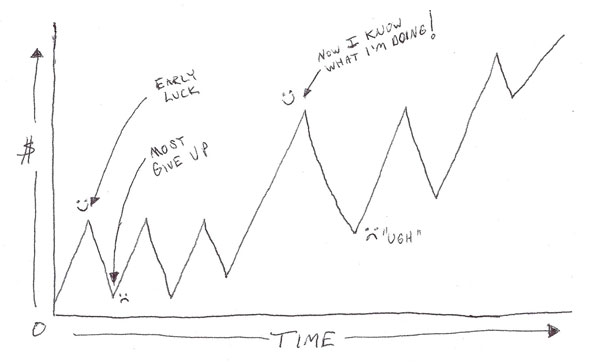](/content/images/wordpress/2015/05/maturationofinvestor.jpg)
My first big winner (the first spike on the chart) was a 15- bagger and it was 95% luck. The bad part of early success is you think it’s skill. You get over confident and the market takes its money back. This is when most people just give up. Those that persevere will go through this a few more times each time learning something and forging an investment philosophy around their experiences. Eventually you start losing less money.
The reason why there aren’t many great investors is successful investing is difficult. It is the opposite of human nature. It is hard to discipline your mind in such a way. You are only as strong as you are honest. It’s human nature to blame others for your misfortunes in life and investing, but your best bet for a successful future is to fully own your past mistakes. If you blame others for your investment mistakes it is the same as admitting you didn’t do enough of your own work. But even more importantly when you blame others you won’t learn from your mistakes.
In 2010 my investment philosophy got a little sloppy and I made a series of bad investments and lost $600,000 over a 12-month period of time. In the months that followed I became very bitter and blamed everyone and everything but myself. It was easier to blame others than to look in the mirror. Investing is like golf; there is no one to blame for your score but yourself. I hit my own golf ball. I place my own trades. When I fully owned my losses, I learned from them, and slowly climbed back out of the hole. **Rule #1: Fully Own Your Past Mistakes**.
\[blockquote cite=”William O’Neil” type=”center”\]
“Take your losses quickly and your profits slowly because your objective is not just to be right but to make big money when you are right”
\[/blockquote\]
The key to building wealth isn’t just investing in great companies early, it’s also cutting your losses early. Warren Buffett’s famous quote “Rule No.1: Never lose money. Rule No.2: Never forget rule No.1.” I think many read that quote and think, “Well duh, of course I don’t want to lose money. Thanks for that brilliant advice.” It is a simple concept, but I want to take it a step further. To illustrate, if you’re down 50% in Year 1, you need to be up 100% in year 2 just to be back to break-even. You need to stay away from big losses because it takes a long time to bounce back from them. If you take a big loss one year it could take you a few years to get back to break-even. Those are precious years that you could be building capital instead of just getting back to break-even. Perhaps you could have retired five years sooner or became a full time investor years earlier. Big mistakes not only cost you financially but also cost you time. Time is one thing we can’t get back. Andrew Stanton says “Be wrong as fast as you can”. We investors are going to be wrong, and we are going to lose money from time to time. The key is **Rule #2: Take Your Losses Quickly.**
It is human nature that pushes us to sell our winners and hold onto and/or buy more of our losers. Investors normally have an [anchoring bias](https://espacemc.com/en/general-en/anchors-aweigh?ref=microcapclub.com) towards their cost basis. If you own two stocks both of which you have an initial cost basis of $1 per share and one now trades at $1.25 and the other at $0.75 human nature pushes you to sell the winner to buy more of the loser. Something in all of us says, “I want to average down on my losers so I can break even quicker”. In most cases you should be doing the opposite, selling your losers and buying more of your winners. **Rule #3: Work on Eliminating Anchoring Biases.**
Cutting your losses quickly can be hard especially if you are a concentrated investor. It’s why I’m a big proponent of scaling into a position. I want to buy more as management and the business prove themselves. [I love averaging up](http://microcapclub.com/2014/09/buy-low-and-then-buy-higher/). I’m a concentrated investor and invest in a total of 5-7 companies. I am not perfect and don’t expect perfection. I fully expect one, two, even three of my positions to be losers. I just don’t know which ones. Living in this reality lets me work in a state of “Productive Paranoia” (read [Great By Choice](http://www.amazon.com/Great-Choice-Uncertainty-Luck--Why-Despite/dp/0062120999/ref=sr%5F1%5F1?ie=UTF8&qid=1431873740&sr=8-1&keywords=great+by+choice&ref=microcapclub.com)). The more concentrated and larger your investments in illiquid companies the more important it is to know your positions better than most. Spend twice as much time knowing what you own versus new ideas. What you don’t own can’t hurt you. As soon as I see cracks forming in the façade of my investment thesis, I start to sell. I cannot afford to wait until it is obvious to the masses. Limiting losses is just as important as fully realizing gains. **Rule #4: Know Your Positions Better Than Most.**
Taking big losses is not only detrimental to your wealth but also to your psyche and confidence. After a big loss your confidence is shattered which slows your thinking and leaves you second-guessing your decisions. When you are [Waiting For Your Pitch](http://microcapclub.com/2015/04/wait-for-your-pitch/), you need to be able to make disciplined and timely decisions. In bear markets, pitches can look like softballs (more ideas and less competition for ideas) giving you ample time to swing. In bull markets you get less pitches and the ones that are thrown look like 102 mph fastballs. You have much less time to swing the bat. You can’t be second-guessing yourself and your abilities. **Rule #5: Don’t Lose Your Confidence.**
\[blockquote cite=”Napoleon Hill”\]
“Analysis of over 25,000 men and women who had experienced failure disclosed the fact that lack of decision was near the head of the list of the thiry-one major causes of failure. Procrastination, the opposite of decision, is a common enemy which practically every man must conquer.”
\[/blockquote\]
Don’t be too hard on yourself after your losses or you might be tempted to give yourself too much credit after your winners. You must control your ego while also not giving into your fear of failure. When you are sitting on a loser and you keep averaging down it’s your ego that says “I have to be right, keep buying”, but the scoreboard says you are wrong. When I get in this mindset I need to remind myself that being broke and right is the same thing as being wrong. Investing is hard and no one is perfect. Fully own your mistakes so you can learn from them. When you know your positions better than most you’ll know when to sell. Take your losses quickly when they are still small and you will be amazed at how quickly you can compound your capital.
MicroCapClub is an exclusive forum for experienced microcap investors focused on microcap companies (sub $300m market cap) trading on United States and Canadian markets. MicroCapClub was created to be a platform for experienced microcap investors to share and discuss stock ideas. MicroCapClub’s mission is to foster the highest quality microcap investor Community, produce Educational content for investors, and promote better Leadership in the microcap arena. If you are a passionate microcap investor, **[Join Us](http://microcapclub.com/join-now/)**.
### When Diversification Dilutes Returns
URL: https://microcapclub.com/when-diversification-dilutes-returns/
Last updated: 2023-10-22T17:08:58.000Z
In my previous article, Wait For Your Pitch, I outlined the importance of finding your sweet spot and waiting for the right investment. For most experienced investors, your biggest risk is boredom. Extraordinary returns follow extraordinary discipline.
> You have to be like a man standing with a spear next to a stream. Most of the time he’s doing nothing. When a fat juicy salmon swims by, the man spears it. Then he goes back to doing nothing. It may be six months before the next salmon goes by. -Charlie Munger
A decade ago when I was [Getting Started](https://microcapclub.com/2014/09/getting-started/) having any cash would result in a pavlovian response. When excess capital is built up by saving or after selling a position the adrenaline starts flowing to find the next one. I would search frantically like a ravenous dog for another company to invest in. There is a certain lure about a new idea, a new potential investment. I would quickly locate several potential investments, conduct due diligence, and add one or two batters to my lineup.
One of the big mistakes I was making was comparing new potential investments against other new potential investments. Instead I should have been comparing these potential investments against my current investments. If you have a baseball lineup full of .320 hitters a .250 hitter won’t help you.
When evaluating a new company it needs to be better than what you already own.
Over the last few years my portfolio hasn’t changed much except for one area. Instead of owning seven positions, I now own five. I sold my two smallest positions aka my lowest conviction positions. This resulted in having some extra cash. After evaluating many potential new investments I came to the conclusion the best investments were already in my portfolio, so I bought more of what I already owned.
I’m a firm believer that whether you are investing $500 or $50 million you need to deploy capital into the best investments you can find. Put another way, you should only own your highest conviction positions. I say this within reason but do not diversify for diversifications sake. Eric Burnside said it best:
[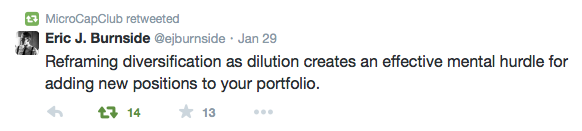](https://microcapclub.com/content/images/wordpress/2015/04/Screen-Shot-2015-04-20-at-8.08.54-PM.png)If you have excess cash and the best company at the best valuation is already in your portfolio, own more of it. Position sizing should never have defined or rigid rules. There is nothing wrong with owning more of a great thing.
In [Buy Low And Then Buy Higher](https://microcapclub.com/2014/09/buy-low-and-then-buy-higher/), I wrote about how all my winners had one thing in common, I was always averaging up. Averaging up hasn’t always come naturally to me. In fact it is counter to human nature. There is something in all of us that makes it hard to add to a position that is materially higher than our original purchase price. It’s the same type of psychological force that drives us to sell our winners to buy more of our losers. William O’Neil, author of [How To Make Money In Stocks](http://www.amazon.com/How-Make-Money-Stocks-Winning/dp/0071614133?ref=microcapclub.com), calls it the “Price Paid Bias”. Focusing on your initial cost basis causes the mind to do silly things. Whether it’s the urge to sell your winners too soon, or buy more of your losers, investors need to overcome this mental disease and do the opposite. The market doesn’t care what your cost basis is so neither should you. The price you paid for a stock two years ago has nothing to do with what the company is worth today. If a stock is 100% higher than what you originally paid for it, and it’s still a great buy, Buy more of it.
\[blockquote type=”left” style=”font-size:1.2em;color:#aaaaaa ;”\]An investor recently asked me the following question:
Question: Imagine a situation where you would be fully invested and the market would throw yet another perfect pitch at you. I know this is a case by case situation but what has your experience taught you? Is it even worth it to consider reducing some of the others to ”bat” this one? Or even, ask a batboy to lend you another bat (read: leverage) to go for it?
Answer: I’d like to premise this by saying my way of investing might not be right for everyone. For me a new potential investment needs to be significantly better (not just incrementally better) than a current position to get me to sell a current position to buy a new position. I like to look at 3 year expected returns, not 1 year. I’m not going to sell a current position that I’m up 500% in that I think has 200% additional upside over the next 36 months to buy a new position that I think has 300% upside in 36 months. It takes months, even years to build conviction in a company. You need to put a value on that trust and conviction. The new position needs to be significantly better. In most cases, the potential return needs to be multiples better. Most reading will think this is insane, but we are talking about buying and holding multi-baggers. I have never gone on margin and would never condone anyone going on margin. Looking back, in almost every circumstance where I’ve been tempted would have ended in disaster. The mindset of spending money you don’t have doesn’t produce good investing decisions.\[/blockquote\]
When evaluating potential investments remember to compare them against the companies you already own. Do not dilute your returns by adding mediocre companies to your stable of great companies. In many cases the best place to deploy new capital is into the great companies you already own.
> “If the new thing you are considering purchasing is not better than what you already know is available then it hasn’t met your threshold. This screens out 99% of what you see.” -Charlie Munger
**\===> Interact and learn with 250+ of the best microcap investors on the planet.** [\[Join Us\]](https://microcapclub.com/join-now/)
MicroCapClub is an exclusive forum for experienced microcap investors focused on microcap companies (sub $500m market cap) trading on United States, Canadian, European, and Australian markets. MicroCapClub was created to be a platform for experienced microcap investors to share and discuss stock ideas. Since 2011, our members have profiled 1000+ microcap companies. Investors can join our community by applying to become a member or subscribing to gain instant view only access. MicroCapClub’s mission is to foster the highest quality microcap investor Community, produce Educational content for investors, and promote better Leadership in the microcap arena. For more information, visit [http://microcapclub.com](https://microcapclub.com/) and
### Wait For Your Pitch
URL: https://microcapclub.com/wait-for-your-pitch/
Last updated: 2023-10-15T13:58:20.000Z
Two years ago I sat down with a board member of a small microcap company that traded for $1 per share. I was introduced to the company and this board member by another shareholder of the company. I had looked at the company a couple different times over the previous year, but I couldn’t get comfortable with the industry or the geography where most of its products were sold. I spoke to the board member at length about the company. He was a person I respected, but I still couldn’t get a good comfort level. Two years later that $1 stock would shoot past $20 per share.
Over the last five years I can think of several instances where I sat down with management, passed on investing, and then watched as their stock prices rose 500-1,000-2,000% over the next few years. In a few cases I felt compelled to send the management teams an email congratulating them on their success because it was well deserved. Execution is rare in the microcap space and it needs to be celebrated whether I’m invested in them or not.
Was I annoyed that I had missed these incredible moves? Sure, but all of these companies were outside my comfort zone. My previous experience looking at similar companies with similar characteristics showed me for every ten I looked at, one or two would end up working. These companies were out of my comfort zone and weren’t in my sweet spot. They weren’t the fat pitches that I knew I could hit out of the park.
The pitcher versus the batter in baseball is probably the best sports analogy to investing. The pitcher represents the market, the ball is a particular company, and the batter is you. The market can throw you a lot of different pitches: fastballs, curveballs, breaking balls, knuckle balls etc. They can either be balls, strikes, or the occasional wild pitch.
You won’t have a very long career in baseball or in investing if you swing at every pitch. Your personality combined with your experiences will shape your investment philosophy. Over the course of several years you will develop your investment philosophy and know your sweet spot. Your sweet spot is the type of company and valuation (the pitch) that you know you can hit out of the park. You need to know where your sweet spot is.
In 1971, Ted Williams, arguably the greatest hitter of all time, wrote a book called The Science of Hitting. In it he talks about the strike zone and specifically his heat map:
[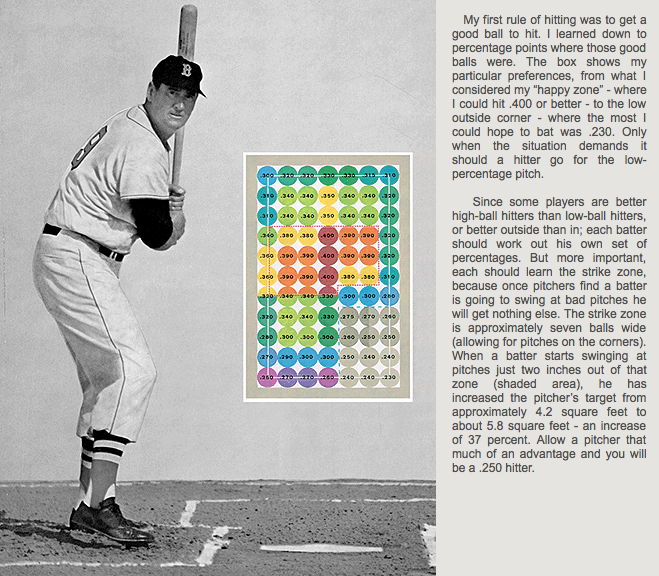](/content/images/wordpress/2015/04/Screen-Shot-2015-04-14-at-9.08.53-AM.png)
In Ted Williams heat map you can see his sweet spot. William’s called this area his “happy zone”. A few inches made a big difference. He knew exactly what pitch he was looking for. He wasn’t just looking for strikes; he was looking for pitches he knew he could hit. Aim small miss small as they say. In Williams famous 1941 season where he batted .406, he had 661 plate appearances, walked 147 times, and only struck out 27 times. There are quite a few takeaways that we can learn from Ted Williams approach to hitting. The biggest lesson is: Know your sweet spot, and only swing at pitches you can hit.
As an investor it takes great discipline and patience to wait for the right company. In bear markets you’ll find yourself swinging at more pitches. There are more opportunities because valuations come down combined with less competition for new ideas. Bull markets, like the one we are in today, are actually much tougher because you can go months or even years without seeing that perfect pitch to hit. When you don’t find a new investment that fits perfectly in your sweet spot it’s easy to become impatient and start looking outside your sweet spot. Companies that are still in the strike zone but where your success rate is far less on average. This is when the biggest mistakes are made. Often times your biggest risk is boredom. Do not rationalize your way into mediocre investments.
The biggest difference between baseball and investing is in investing there are no called strikes. You can simply wait for your pitch.
> “The stock market is a no-called-strike game. You don’t have to swing at everything–you can wait for your pitch. The problem when you’re a money manager is that your fans keep yelling, ‘Swing, you bum!’” – Warren Buffett
It has been over 18 months since I’ve bought a new company. Since then I’ve seen a lot of pitches. Many are out of the strike zone and almost all are outside my sweet spot. I will continue to look for the right pitch. Some of the pitches that I let go by might be homeruns for other batters that have different sweet spots. I will only swing at pitches I know I can hit, and I will wait as long as it takes.
Wait for the pitch in your sweet spot and then swing hard with everything you’ve got.
**\===> Interact and learn with 250+ of the best microcap investors on the planet.** [\[Join Us\]](https://microcapclub.com/join-now/)
MicroCapClub is an exclusive forum for experienced microcap investors focused on microcap companies (sub $500m market cap) trading on United States, Canadian, European, and Australian markets. MicroCapClub was created to be a platform for experienced microcap investors to share and discuss stock ideas. Since 2011, our members have profiled 1000+ microcap companies. Investors can join our community by applying to become a member or subscribing to gain instant view only access. MicroCapClub’s mission is to foster the highest quality microcap investor Community, produce Educational content for investors, and promote better Leadership in the microcap arena. For more information, visit [http://microcapclub.com](http://microcapclub.com/) and
### MTY Food Group - A Case Study of a 100-Bagger
URL: https://microcapclub.com/mty-food-group-a-case-study-of-a-100-bagger/
Last updated: 2023-10-15T13:56:59.000Z
In late 2003, I had been investing in microcaps for about 3 years when I came across a small microcap company called [MTY Food Group](http://finance.yahoo.com/q?s=MTY.TO&ref=microcapclub.com) that was trading on the TSX Venture Exchange. At the time, MTY had a market cap of under $5 million. Incredibly, $1 invested in MTY stock in 2003 would go on to be worth $100 by 2013.
[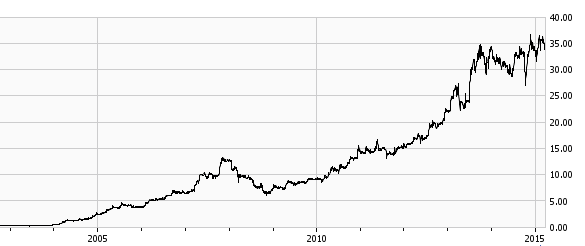](/content/images/wordpress/2015/03/MTY-Chart.png)
So how did MTY management achieve this, and could an investor have foreseen this multi-bagger potential at the start of the run?
With some hindsight bias, let’s go back to 2003 and look at the circumstances that led to this incredible investment opportunity. In early 2003, MTY Food Group was then known as iNsu Innovations. INsu consisted of two divisions – a profitable fast food restaurant franchisor, as well as an unprofitable technology business. On April 10, 2003, MTY announced they would be divesting their unprofitable technology business to focus on the fast food restaurant franchising business, and they announced the name change to MTY Food Group to symbolize their focus on the franchising business. The annual results from 2002 had just been released and buried in the footnotes to the financial statements were the segment results, and the fast food franchising division had earned $.07 in the previous year, doubling earnings over the previous two years. Since the collapse of the tech bubble, the unprofitable technology division had been masking the profitable fast food franchise business. So from now on, the profitable franchising business would start to show through in the financial statements.
On April 17, 2003, Stanley Ma was appointed President of MTY. Ma was the entrepreneur who started the company’s very first restaurant concept Tiki Ming – Chinese Cuisine in 1987 as a recent immigrant to Canada. Ma was a fanatic about the fast food franchising business. He had previously been the Chairman of the company with it’s unsuccessful foray into the tech business, but now he was stepping in to lead the company in it’s expansion of the fast food franchising business. He had guided the accretive acquisition of four fast food franchise concepts over the previous three years.
On Sept 25, 2003, Stanley Ma purchased 3.1 m shares or 20% of shares outstanding for $.25 per share from two large shareholders. The total cost was $.8 million (to be paid over 5 years in installments) to bring his shareholdings to 4.3 million shares or 29% of the total outstanding shares. Ma was now heavily incentivized to make this business a success.
On Oct. 24, 2003, MTY announced they had earned 3.5 cents per share for the third quarter. Revenues were up 20% year on year, but without the unprofitable technology division, earnings had rocketed up 178%. The restaurant franchising business had very little seasonality, and so an astute investor could annualize this quarter’s results to come up with an approximate forward EPS number of 14 cents EPS.
Throughout the summer and fall of 2003, there was a fair amount of liquidity in the stock, and a small investor could have acquired a decent sized position between 25 and 35 cents.
At this point in 2003, the stars were lining up for this to be a very good investment. Here were the key reasons why:
1). Q3 2003 had just shown massive growth in revenues and earnings per share quarter on quarter and year on year. In relation to run-rate EPS, the shares at 30 cents were trading at an absurd valuation of 2X forward earnings, not even factoring in the 30 cents per share of excess cash.
2). MTY was a cash cow with high gross margins in the 70% range, EBITDA margins in the 35% range, and was growing organically with a capital light business model.
3) The franchise business had very high returns on invested capital (greater than 60%) with the ability to reinvest incremental capital at similar high rates. In other words, MTY was generating substantial cash flows, and because it didn’t have to reinvest that cash back into the business, it was plowing it into acquiring more fast food franchising concepts at similar high returns, which would lead to rapid earnings growth if continued.
4). MTY was run by an owner operator who was incentivized to run the business to maximize growth and profitability over the long term, and who was a fanatic about the business.
5). The business had a durable competitive advantage. There were two sources to the competitive advantage. First, MTY owned regional fast food restaurant brands that were very strong in Eastern Canada. In a mall setting, eating decisions are made in a few seconds, so brand recognition is important. Secondly, and more importantly, MTY’s customers (the franchisees) had large switching costs. The initial franchise fee to start an MTY location is $25,000 to $40,000\. In addition, the capital investment to build out a location for a new MTY franchise is between $150,000 and $450,000\. If a franchisee wants to switch restaurant brands, they would need to rip out all the signage and equipment, and pay another franchisor another franchise fee as well as make another capital investment into equipment and signage. So unless the customer went bankrupt, they would probably continue to pay MTY a monthly royalty.
6). The business had a long runway of growth. In 2003, MTY’s market share was a fraction of the total quick service restaurant franchise market in Canada, not even considering the U.S.
7). There was little risk of obsolescence. Unless shoppers and office workers abandoned food courts, this business would be around for many years.
8). The restaurant franchise royalty business was a very stable business with recurring revenues that would grow throughout the economic cycle and MTY had a perpetual option on any growth in a franchisee’s revenues. Because MTY was paid, depending on the brand, 4.5-6% of a franchisee’s revenues, any growth in the franchisee’s same store sales resulted in growth in MTY’s royalty stream.
9) MTY had a very tight share structure with around 15 million shares outstanding, and the company had bought back 5% of shares outstanding in the previous year. In other words, they treated their shares like gold.
So in essence, at 30 cents, you were buying a great business at 2X forward earnings, with a Fort Knox balance sheet.
Here’s what happened to MTY from 2003 to 2013:
[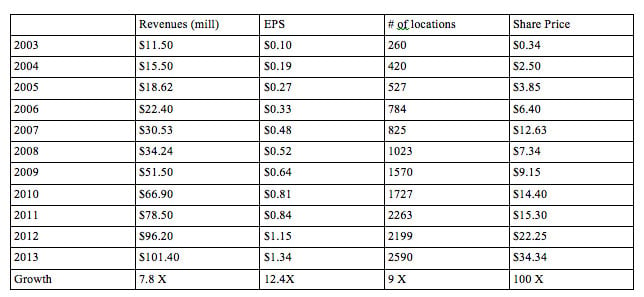](/content/images/wordpress/2015/03/MTYchart.jpg)
Between 2003 and 2013, MTY launched 5 new restaurant concepts, and acquired another 19 restaurant franchise concepts, which added 2029 locations to it’s franchise network. Except for a small sale of shares, all these acquisitions were financed out of cash flow.
As you can see in the above table, over 10 years, MTY increased it’s share price by one-hundred fold.
Earnings per share grew by a factor of 12.4X. But if the company only grew earnings by 12.4X, how did the stock grow 100X? The answer lies in the price to earnings (P/E) multiple expansion. Investors in MTY went from paying roughly 3.5X earnings when it was left for dead in 2003 to a more optimistic 26X earnings in 2013.
So how did I do on this investment you may ask? The answer is I didn’t make a single dollar of profit on it. I was paralyzed by two behavioral biases that prevented me from buying shares. The first was that I had anchored onto the price of 25 cents that Stanley Ma had paid for his 3.1 million shares, and was unwilling to up my bid to the $.30 ask. The other bias that paralyzed me was recency bias. I had just read Kathryn Staley’s excellent book The Art of Short Selling, and there was a chapter on the Jiffy Lube franchise failure, and I saw that MTY was on the hook for leases if it’s franchisees failed, so I was hesitant to pay up for the shares. Short story is I never bought any shares, even though there were multiple opportunities along the way to make 2X, 5X, or 10 X my money all the way up.
The painful lessons I learned from this experience were:
1. A large part of the return on a multi-bagger will come from performance of the business and earnings per share growth. However, if you pay a very low multiple for a great business, you can really juice your returns because you get a double whammy from earnings growth and the P/E multiple expansion.
2. When all the stars line up, swing for the fences. Make these rare opportunities a significant part of your portfolio because they don’t come around very often.
3. Buy right and sit tight. When you own a great company with great management, hold on for the ride.
4. Be cognizant of behavioral biases. They can cost you a lot of money in missed opportunities.
5. At least I don’t feel as stupid for missing this 100 bagger as the two large shareholders who sold Stanley Ma 20% of the company for 25 cents a share, to be paid back in installments over five years.
The moral of this story is that the investor who has the ability to find great stocks but does not buy them has no advantage over the investor who has no idea how to find them. The next time you find a stock like MTY Food Group, back up the truck and load up.
If you liked this article, you would enjoy this book: [100-Baggers by Chris Mayer](http://microcapclub.com/2015/11/book-review-100-baggers-by-chris-mayer/)
**\===> Interact and learn with 250+ of the best microcap investors on the planet.** [\[Join Us\]](https://microcapclub.com/join-now/)
MicroCapClub is an exclusive forum for experienced microcap investors focused on microcap companies (sub $500m market cap) trading on United States, Canadian, European, and Australian markets. MicroCapClub was created to be a platform for experienced microcap investors to share and discuss stock ideas. Since 2011, our members have profiled 1000+ microcap companies. Investors can join our community by applying to become a member or subscribing to gain instant view only access. MicroCapClub’s mission is to foster the highest quality microcap investor Community, produce Educational content for investors, and promote better Leadership in the microcap arena. For more information, visit [http://microcapclub.com](http://microcapclub.com/) and
### So You Want To Be A Full Time MicroCap Investor? Part 2
URL: https://microcapclub.com/so-you-want-to-be-a-full-time-microcap-investor-part-2/
Last updated: 2024-03-15T09:48:05.000Z
As a follow on to **[\[PART 1\]](https://microcapclub.com/2015/01/so-you-want-to-be-a-full-time-microcap-investor/)**, Mike Schellinger (aka MikeDDKing) and I answer additional questions on our microcap investing strategies and becoming full time microcap investors. Although Mike and I are both full time microcap investors our investment styles are quite different. We hope listeners will find the content educational and thought provoking. **(Click Play Button To Listen or Download File)**
[\[Download Here\]](https://microcapclub.com/content/media/2024/03/So-Your-Want-To-Be-A-Full-Time-MicroCap-Investor-Part-2.mp3)
In this program we address the following questions:
- Have our investing strategies changed as our capital has grown?
- When fully invested..
- How do we react to short term trading opportunities?
- How often do we sell positions to cover your expenses?
- What is our average hold time?
- How do we buy into illiquid stocks?
- How do we sell illiquid stocks?
- How do you build relationships with management?
- How do we control our emotions when making investing decisions?
- Do our strategies change in a bear market?
**\===> Interact and learn with 250+ of the best microcap investors on the planet. [\[Join Us\]](https://microcapclub.com/join-now/)**
MicroCapClub is an exclusive forum for experienced microcap investors focused on microcap companies (sub $500m market cap) trading on United States, Canadian, European, and Australian markets. MicroCapClub was created to be a platform for experienced microcap investors to share and discuss stock ideas. Since 2011, our members have profiled 900+ microcap companies. Investors can join our community by applying to become a member or subscribing to gain instant view only access. MicroCapClub’s mission is to foster the highest quality microcap investor Community, produce Educational content for investors, and promote better Leadership in the microcap arena. For more information, visit [http://microcapclub.com](https://microcapclub.com/) and
### My Secret Recipe: Inspecting the Ingredients
URL: https://microcapclub.com/my-secret-recipe-inspecting-the-ingredients/
Last updated: 2023-10-15T13:54:54.000Z
In my [first installment](http://microcapclub.com/2012/10/my-secret-recipe-the-index-card/) I discussed the recipe of what I want in a stock that I purchase. I talk about the ingredients of profitability, sustainable growth, and compelling valuation. In the [second installment](http://microcapclub.com/2012/10/my-secret-recipe-shopping-and-a-taste-test/) I touched on where I shop for my stock ideas. I talk about scanning SEC filings/press releases, [networking](http://microcapclub.com/2015/01/building-your-network/) with friends, reading message boards such as [MicroCapClub](http://microcapclub.com/), and using stock screeners. However, I haven’t talked about the process of determining if a prospective company is actually one that meets the recipe. Are the ingredients really good, or are they filled with chemicals that aren’t healthy and will be toxic to your portfolio? The purpose of this third installment is to provide the highlights of how I research a company.
When you are researching a company you are trying to learn both positive and negative aspects (ingredients) about a company. Every company has both positive and negative ingredients. Your job as an investor is to find out if the positive ingredients outweigh the negative and thus the company makes a good investment. Furthermore, we all have different financial needs or tastes which need to be considered.
**Press Releases and Regulatory Filings**
The first place I look is the company provided information such as press releases and regulatory filings (e.g. SEC filings). These sources are analogous to the labels on a food product. The first order of business is to inspect the financial summaries for the past few years to find trends. Are revenues and profitability increasing or decreasing? Are margins improving? Are expenses being managed well? Once I have a handle on the financial trends for a company, I will read the press releases and delve further into the regulatory filings. When I read these documents at first I’m often looking for disclosures which give me hints as to why trends are happening. Were these trends caused by one-time events or are they sustainable? One-time events can impact revenue, expenses, and margins. Has the company introduced a new product or penetrated a new market that will give them growth in the future? Is backlog increasing or has the company received a number of new orders? Is the market for their product or services growing or shrinking?
Three other aspects I investigate are the balance sheet, share structure, and cashflow. The balance sheet is important to investigate to determine if the company has the necessary resources to continue in their business plan and to weather any storms. The valuation of a company is significantly impacted by the strength of it’s balance sheet. The share structure is important to inspect to know if the number of shares are going to increase going forward and how much they might increase. Finally, checking out the cashflow is important. A company that has good earnings but bad cashflow can be a recipe for disaster. If I like enough of what I see at this point I’ll continue on with my analysis of the company. Otherwise, I’ll move onto the next company.
**Conference Calls and Investor Presentations**
If the company has quarterly conference calls or does investor presentations, I will usually listen to these next. These often provide additional information that further expands upon what you learn by reading the press releases and regulatory filings. When listening to a quarterly conference call, I often find that the question and answer session is more enlightening that the company prepared remarks. The reason this is often more enlightening is that other investors tend to ask questions about key points that are important for the company’s future. This often gives me hints regarding other aspects of the company to consider.
**Annual Report and Most Recent Quarterly Filing**
My next step is usually to read the annual report (e.g. 10-K) and the most recent quarterly filing (e.g. 10-Q) in detail. This is where the negative aspects often come out. It is like reading the fine print on a label. In this read I’m looking for items like lawsuits that may harm the company, risks to the company that may derail their success, information regarding debt that may cause problems going forward, etc.
**Company Web Site**
If a company has made it past my scrutiny so far, the next step is usually to look at their web site. This is often a great source to learn more about their products and their business. You can also learn more about management of the company. How long have they been in charge, where did they work before, etc. Companies often list their hiring needs on their web site. This can often provide insight into their growth as growing companies often need more employees. If they are hiring too many employees, it can also be a sign of expenses out of control.
**Talking with Management**
Talking with management is another thing that is helpful. Often this is a good way to learn more about items such as how the company’s business model works, the competitive landscape, management strength, etc. There are a few really good articles on this topic on [MicroCapClub](http://microcapclub.com/) that I recommend reading including [one](http://microcapclub.com/2014/11/talking-to-management/) by Ian Cassel and [one](http://microcapclub.com/2014/11/the-art-of-interviewing-management/) by Chip Maloney.
**Social Media, Internet Searches, and Networking**
Another way I investigate is to look at comments on the company by other investors. Searching through social media such as comments on [MicroCapClub](http://microcapclub.com/), [Twitter](http://twitter.com/?ref=microcapclub.com), and other investment sites can often provide clues to other positive or negative aspects about the company. Internet searches for information on the company’s products and management can also be a great way to glean more information on the company. Utilizing my investing network is also helpful as I may know of someone that has investigated this company before and can provide me a different perspective on the company.
**Valuation**
I assess the current value of the stock based upon a number of parameters to determine if the stock is undervalued or overvalued. As much as possible I also determine what I believe the company will be worth in the future. I’m not going to talk about the details of this process as there would be too much to discuss in this article.
**The Final Product**
The whole process of researching a company is time consuming. To fully research a company takes several hours to days. It is more like baking something from scratch than cooking a prepackaged food in the microwave. Also, while I’ve hit the high points of research I haven’t touched on everything as this whole topic could be a book rather than an article.
At the end of the process a decision has to be made. I weigh all the good and bad ingredients and decide if the company is for me. The decision doesn’t need to be a binary decision either. In addition to deciding a stock is a buy or is not a buy, I often decide that I need to see the story play out a little bit further. Often this is the case when a company is near or just at an inflection point as one data point does not make a trend.
The next time you are looking at a new company, consider using the techniques in this article to inspect the ingredients as I believe they will make your portfolio tastier.
My Secret Recipe Series:
Part 1: [The Index Card](https://microcapclub.com/2012/10/my-secret-recipe-the-index-card/)
Part 2: [Shopping and a Taste Test](https://microcapclub.com/2012/10/my-secret-recipe-shopping-and-a-taste-test/)
Part 4: [The Bargain Rack](https://microcapclub.com/2015/06/my-secret-recipe-the-bargain-rack/)
**\===> Interact and learn with 250+ of the best microcap investors on the planet.** [\[Join Us\]](https://microcapclub.com/join-now/)
MicroCapClub is an exclusive forum for experienced microcap investors focused on microcap companies (sub $500m market cap) trading on United States, Canadian, European, and Australian markets. MicroCapClub was created to be a platform for experienced microcap investors to share and discuss stock ideas. Since 2011, our members have profiled 1000+ microcap companies. Investors can join our community by applying to become a member or subscribing to gain instant view only access. MicroCapClub’s mission is to foster the highest quality microcap investor Community, produce Educational content for investors, and promote better Leadership in the microcap arena. For more information, visit [http://microcapclub.com](http://microcapclub.com/) and
### Building Your Network
URL: https://microcapclub.com/building-your-network/
Last updated: 2023-10-15T13:53:54.000Z
About ten years ago, I was re-reading the classic investment book [Common Stocks and Uncommon Profits](http://www.amazon.com/Common-Stocks-Uncommon-Profits-Writings/dp/0471445509/ref=sr%5F1%5F1?s=books&ie=UTF8&qid=1422130088&sr=1-1&keywords=common+stocks+uncommon+profits&ref=microcapclub.com) written by the legendary investor Philip Fisher. In Chapter 10, Fisher wrote that during his investment career, he had always assumed that most of his profitable growth stock ideas came from getting out and talking to industry insiders, business executives, university researchers – people in the trenches of the industries he was interested in investing. When he performed a study of where all his best growth stock ideas actually came from, he was surprised to learn that four out of five came from a small network of like-minded investment professionals. I was already investing mostly in microcaps at this time, but it was after reading that insight from Fisher that really kickstarted my desire to start to build my network of like-minded microcap investors.
In this article, I would like to share what I have learned in building and maintaining my own network, as well as observing other successful investors develop their abundant investment networks.
If you are anything like me, your initial impressions of the concept of networking was negative. I used to have this image that networking involved going to conferences and speaking to as many people as possible, and talking to them just long enough to get a business card into their hand. However, over the years, my impression of networking has changed. Whether you know it or not, you are probably already involved in networking with other investors to some extent. My experience is that it is absolutely necessary to connect with other investors if you want to improve your chances of success as an investor.
In my experience, and from observing other investors with strong networks, the key to building a strong network is being generous with your time and talent to help make other investors more successful. If you do this, without focusing on what’s in it for you, it will come back to you over time, as many of your best investment ideas will come from your network, and you will be able to draw on your network for knowledge and expertise when you need it.
The internet and social media has made it much easier to connect with other investors. Here are ten ways that you can use your time and resources to help build your microcap investment network:
1. **Become a regular contributor on microcap investment forums**. There are many microcap focused forums on investment sites like Stockhouse, InvestorsHub, Silicon Investor, and Investor Village. If you become a regular contributor, and provide good quality content, whether it is with stock write-ups, or links to other relevant content, or just feedback on other’s ideas, you will build strong relationships that will extend off-forum. Even better yet, start a microcap focused investment forum yourself, invite your current network to participate and moderate the forum. If you build it and provide quality content, good microcap investors will find it. The only downside here is that the forum activity tends to ebb and flow based on the moderator’s activity until it reaches scale.
2. **Twitter.** I have seen a number of microcap investors build a very large network in a short amount of time by regularly sharing relevant information on Twitter. If you tweet and retweet quality content, other investors will find you.
3. **Start a blog.** Besides the benefit of having a permanent record of the evolution of your investment process, a microcap-focused investment blog is an excellent way to develop an investor network. In order for it to be a success, I think you probably have to post new content at least twice a month. If you provide good content, people will find you. Blogging is a great way to build a network of like-minded investors.
4. **Write a blog article as a guest.** Blogging is a time intensive activity. If you don’t have the time to manage a blog, write and submit blog articles as a guest author. Many bloggers in the microcap world would welcome a guest blog post if you provide good quality content on a relevant topic or a good stock writeup.
5. **Attend microcap focused conferences.** There are a number of microcap focused investment conferences that happen throughout the year. They are great places to meet microcap investors. Don’t make the mistake I did and wait until you are a seasoned investor to start attending these. Keith Ferrazzi, author of Never Eat Alone suggests that if you want to be a conference commando, organize a conference within a conference. For example, you could rent a room at the conference hotel and arrange a mixer at the end of one of the conference days, and invite a number of investors that you would like to reconnect with. Or, if there is no formal conference banquet, you could arrange a dinner gathering at a restaurant for a small group of investors. When you meet a new acquaintance at a conference, send them an email within a day or two of arriving home, saying that you enjoyed meeting them (be sincere) with a brief note about what you discussed to jog their memory, as they probably met a lot of other investors.
6. **If you are really ambitious, organize a small conference in your area and invite local microcap companies to attend.** Microcap investors will find the conference if it has good companies presenting. There is no better way to meet every single attendee at a conference than as the event organizer.
7. **Attend microcap company annual general meetings.** Not only will you get a chance to speak one on one with management, by attending AGMs you will often meet other passionate investors who probably travel in the same circles, investing in similar microcap companies as you do.
8. **Organize or attend an informal meetup in your area.** Invite other microcap investors in your local area to attend. If you don’t know any microcap investors in your area, post a note on a few microcap focused investment forums to spread the word. Some investors do a meetup monthly at the same local restaurant, whereas others do it informally and change geographic locations.
9. **Build a brand and broadcast it.** Create a brand around your name in the microcap space. If you post on public discussion sites, post under your first and last name. Same thing with Twitter. People will associate quality content with your name, and will want to be a part of your network.
10. **Join a microcap-focused private forum like MicroCapClub.** If you are an experienced microcap investor, there is no better way to potentially connect and collaborate with 170 experienced microcap investors. With MicroCapClub, Ian Cassel has created a first class forum for connecting a phenomenal group of people together who happen to share a passion for microcap investing. If you are serious about investing in microcaps, and you are not yet a member of Microcapclub, you should make it a priority in 2015 to apply.
Obviously there are only so many hours in a day, (and so many dollars in a travel budget), so you probably can’t focus on building all of these networking activities. But if you dedicate time to becoming active in a few of these activities, your network will grow rapidly.
Once you’ve started to build your network, in order to maintain your network, you need to keep in regular contact with the investors in your network. Keith Ferrazzi, author of [Never Eat Alone](http://www.amazon.com/Never-Eat-Alone-Expanded-Updated/dp/0385346654/ref=sr%5F1%5F1?s=books&ie=UTF8&qid=1422130650&sr=1-1&keywords=never+eat+alone&ref=microcapclub.com), calls this pinging. Some people who you have a stronger relationship with, you may ping once a week or monthly. Others may be once every two or three months. This may involve sending a private message, a quick email or making a short phone call about a specific stock or investment idea. It may just be posting content regularly on your blog or forums you frequent, or tweeting content out to your followers. Because good relationships progress with time, regular contact and follow-ups are important. Over time, every interaction you have with your network adds to a deeper relationship.
If you want to continue to grow your network, and take it beyond this level, you need to look for ways to nurture and strengthen the connections in your network, by adding more value to your network than you get back. The business world is not zero sum, so you need to do this without worrying about whether you are getting your fair share back. You need to look for ways to make those in your network become more successful without keeping score. According to Adam Grant, author of [Give and Take](http://www.amazon.com/Give-Take-Helping-Others-Success/dp/0143124986/ref=sr%5F1%5F1?s=books&ie=UTF8&qid=1422130493&sr=1-1&keywords=give+and+take&ref=microcapclub.com), an easy way to do this is to make time to provide five minute favors. In his book, Grant tells the story about the most successful networker in Silicon Valley named Adam Rifkin. Rifkin is a self-described introvert, and doesn’t fit the mold of what you would think of as a master networker. However he attributes much of his success as a successful connector to his mastery of the five minute favor, where the help he gives benefits the person on the receiving end much more than the cost (in time) to him. Here are a few examples of five minute favors:
1. **Introduce two people in your network that would mutually benefit from knowing each other.** Rifkin strives to provide 3 introductions within his network every day. For the rest of us mere mortals who have smaller networks, it may only be once or twice a month that you do this. Maybe it’s as simple as connecting two people in your network who have a common interest in the same stock, so they can compare notes. If you are active on Twitter, send out a tweet to your followers recommending they follow someone within your network that you think they could benefit from following. Weak networks tend to operate like a hub and spoke model, whereas strong networks operate more like an interconnected community. The more links between the investors within your network, the stronger your network will be.
2. [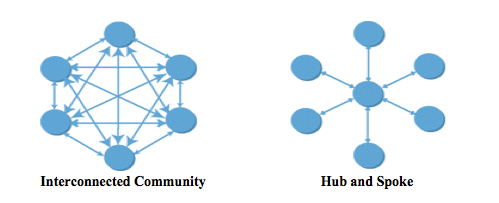](/content/images/wordpress/2015/01/Screen-Shot-2015-01-24-at-3.04.22-PM.png)**Knowledge sharing.** If you come across an analyst report or write-up on a stock that someone in your network owns or follows, pass it along to that person. Maybe it is an investment book that you just read that you think they might enjoy. Send them a copy. Maybe you just spoke to management of a company you own, and you learned some key insights about the business. Send a brief synopsis along to those who might have an interest. Or maybe it is just an article on an industry they follow, or an interview with an investment manager they respect. Pass it along with a brief note saying something like “I thought you might find this interesting”.
3. **Mentoring investors with less experience than you.** No matter what investment skill level you are at, there is always someone you could share your expertise with to help them learn the ropes of investing. Take the time to do this. It may be something as simple as suggesting a book for an area someone within your network would like to develop their knowledge in. Maybe it is answering a question on an investment forum from a young investor. Maybe you’ve answered the question 20 times previously. Take the five minutes to craft a response or provide a link to a previous response where you answered the question in the past. The small amount of cost to you is far outweighed by the benefit that you have provided. The other area you may find opportunities for informal mentorship, are helping experienced investors expand their area of expertise into an area where you have some expertise. For example, over many years, I have developed a pretty good knowledge of the non-resource Canadian microcap area. There are a number of U.S. based investors over the years that have reached out to me requesting information about the Canadian markets. Maybe they are just looking for occasional guidance like where to find Canadian insider filings or regulatory filings. It is an occasional five minutes of my time, but it benefits the person on the receiving end immensely. I have found mentoring other investors is an area that builds strong relationships and connections.
4. **Offer to provide advice or feedback on an idea.** Maybe it is just writing a short note to recognize or recommend someone on LinkedIn. Play devil’s advocate or provide constructive feedback on a stock idea that you have looked at. Taking a few minutes to provide feedback can sometimes save the other person hours of research.
There are lots of ways to help others at little cost to you, yet benefit those in your network in ways you don’t expect. If you can add a few more five minute favors to each week, it’s a great way to contribute more value to other investors within your network without making a large personal sacrifice, and a great way to strengthen and nurture your network. Again, you should do this without expecting anything in return. If you insist on the other side reciprocating every time you help someone, you will have a much narrower network. The investors that I have observed who have the strongest networks think about how they can make others successful through their generosity. The key to building and nurturing your network is to add more value to your network than you get back.
If you are an microcap investor just starting out, I hope this article provided you with a few ideas for building relationships and connecting with other investors. If you are a more experienced investor, and have a large network of like-minded microcap investors, I hope this gave you a few ideas on how to strengthen the connections within your network. If you work at consistently building and nurturing your network, I guarantee you will reap the benefits over time as your network will help you become a more successful investor.
**\===> Interact and learn with 250+ of the best microcap investors on the planet.** [\[Join Us\]](https://microcapclub.com/join-now/)
MicroCapClub is an exclusive forum for experienced microcap investors focused on microcap companies (sub $500m market cap) trading on United States, Canadian, European, and Australian markets. MicroCapClub was created to be a platform for experienced microcap investors to share and discuss stock ideas. Since 2011, our members have profiled 1000+ microcap companies. Investors can join our community by applying to become a member or subscribing to gain instant view only access. MicroCapClub’s mission is to foster the highest quality microcap investor Community, produce Educational content for investors, and promote better Leadership in the microcap arena. For more information, visit [http://microcapclub.com](http://microcapclub.com/) and
### The Case for Global SmallCaps
URL: https://microcapclub.com/the-case-for-global-smallcaps/
Last updated: 2023-10-15T13:52:11.000Z
[Wasatch Funds](https://secure.wasatchfunds.com/?ref=microcapclub.com) published this white paper which gave some interesting statistics on global smallcaps. One of the most interesting areas is their analysis of smallcap stocks in developed vs emerging markets/countries. Even though this white paper is geared towards smallcaps I think it is also relevant to microcaps.
[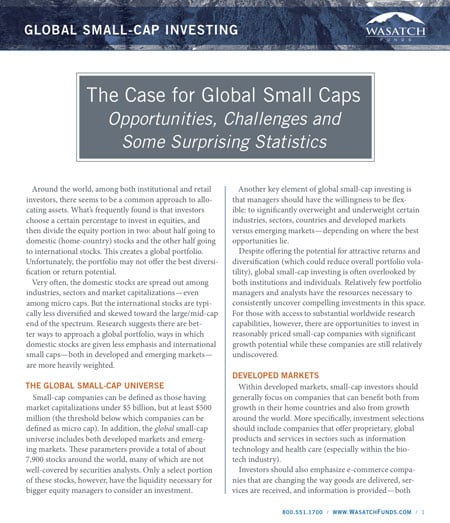](https://secure.wasatchfunds.com/Literature-and-Forms/~/media/08F3EA4497C847028B72EB14AF12DF02.ashx?ref=microcapclub.com)
Click To View Full Report
**\===> Interact and learn with 250+ of the best microcap investors on the planet.** [\[Join Us\]](https://microcapclub.com/join-now/)
MicroCapClub is an exclusive forum for experienced microcap investors focused on microcap companies (sub $500m market cap) trading on United States, Canadian, European, and Australian markets. MicroCapClub was created to be a platform for experienced microcap investors to share and discuss stock ideas. Since 2011, our members have profiled 1000+ microcap companies. Investors can join our community by applying to become a member or subscribing to gain instant view only access. MicroCapClub’s mission is to foster the highest quality microcap investor Community, produce Educational content for investors, and promote better Leadership in the microcap arena. For more information, visit [http://microcapclub.com](http://microcapclub.com/) and
### The First Million
URL: https://microcapclub.com/the-first-million/
Last updated: 2023-10-15T13:51:03.000Z
[Getting Started](http://microcapclub.com/2014/09/getting-started/) is hard work. Warren Buffett’s right hand man, Charlie Munger is quoted, “The first $100,000 is a bitch”. Warren Buffett made his first $100,000 in the early 1950’s when he was still an individual investor, compounding his capital 50% annually over several years. $100,000 in 1950 is equivalent to about $1 million today. So perhaps Munger’s 2015 version would be, “The first $1 million is a bitch”.
In 1948, Ben Graham through his company Graham-Newman Corporation bought 50% of GEICO for $712,000\. By 1972, this investment was worth $400 million, a 562 bagger. The gain in GEICO would contribute more profit to Graham’s partnership than all the gains from all other investments combined. The irony is that Graham rarely invested more than 5% of the firm’s capital in one company, but with GEICO he invested 20% of the firms capital. Graham’s most successful investment ever came when he broke his rules and made an educated concentrated bet.
Warren Buffett, age 20, was introduced to GEICO in 1950 when he was Graham’s student at Columbia Business School. Buffett would soon travel to GEICO head quarters to conduct due diligence on the company. He would talk for hours with Lorimer Davidson (would later become CEO) and gain valuable insight into the business. Less than two days after the meeting with Davidson, Buffett would put 75% of his net worth into GEICO. About two years later he would sell GEICO for a 50% gain. *\[side note: Buffett would later join GEICO’s board of directors even though he didn’t own the stock. This would change in the 1970’s when he would start buying shares, adding through two decades, and finally in 1995 buying the remaining 49% of GEICO he didn’t own for $2.3 billion.\]*
Throughout his early 20’s, Buffett would continue allocating capital to only his highest conviction investments. In some cases this meant placing big bets on one, two, or three companies in particular. When reading Warren Buffett’s comments during this time period, he often used phrases like, “I bought as much as I could”. You don’t hear him using phrases like, “I was worried about owning too much”. From 1949 to 1954, he would average \~50% annual returns, growing his capital 10x breaking the $100,000 mark, equivalent to $1 million today.
> “If I was running $1 million today, or $10 million for that matter, I’d be fully invested. Anyone who says that size does not hurt investment performance is selling. The highest rates of return I’ve ever achieved were in the 1950s. I killed the Dow. You ought to see the numbers. But I was investing peanuts then. It’s a huge structural advantage not to have a lot of money. I think I could make you 50% a year on $1 million. No, I know I could. I guarantee that.”– Warren Buffett
I talk to a lot of highly intelligent investors and some are just [getting started](http://microcapclub.com/2014/09/getting-started/) with $2,000 – $5,000 – $20,000\. The road to $1 million might seem impossible like it’s ascending straight up Mt. Everest. It is not. All you need to do is find and buy a couple great companies early and you will get there. I wrote down $10,000 and two 10-Baggers in my journal when I was 20 years old, and then I saw MicroCapClub Member Tom Klein post the same thing 15 years later. Some people get offended at the notion, but the people that have done it know it’s true:
[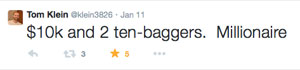](/content/images/wordpress/2015/01/MillionTweet.jpg)
Now we aren’t going to start comparing ourselves to Warren Buffett, but what we can do is analyze how he grew his initial capital from $10,000 to $100,000 in his early twenties. Even Buffett didn’t have it all figured out when he was getting started, and his investment philosophy would evolve over time. When I was managing $25,000 my approach wasn’t nearly as disciplined as it is now. Now unlike Warren I was human and took a few big losses during my early capital building years. Most people reading this will also experience your fair share of loss along the way. It will test your psyche, emotions, and discipline, but there is no greater educator than loss. You will learn by losing and then you will prosper.
Warren Buffett’s greatest asset was (and is) his ability to focus. In his early years he wanted to grow his capital as quickly as possible. He didn’t do that by investing in ten good companies. He did it by finding one, two, three great opportunities and buying as much as he could. He didn’t have position sizing rules. The more he liked something, the more he owned. Even Graham broke his own rules and bellied up to the bar when he saw a great opportunity in GEICO. When I was building my capital base from $10,000 to $100,000 to $500,000 I was at most in three positions. I found the best investments I could find and bought as much as I could. If you want to build capital quickly, only invest in your best ideas. [Life is Too Short To Diversify](http://microcapclub.com/2014/11/life-is-too-short-to-diversify/).
When Buffett was in his early 20’s building his capital base to $100,000 he conducted great due diligence, visited companies, and spoke to management. Most wouldn’t be surprised by the first one, but many would be surprised that he went as far as visiting companies and speaking to management. Even though he was investing small amounts he took the initiative to meet management. Your edge is knowing your investments better than most. To know your investments better than most you have to do what most don’t. Most of your competitors for great investments do not talk to management. [Talk to management](http://microcapclub.com/2014/11/talking-to-management/).
Now I’d like to add a couple more important things ……
If you want to grow your capital quickly you need to find companies that can be multi-baggers. You need to find stocks that can get big. Most investors assume this means taking on more risk. This isn’t the case at all; in fact I would say this is less risky then most value investing strategies. It is just harder to find such companies. You want to find and buy undervalued companies that will get very overvalued. Through the years I’ve found when you find these elements in one stock, it’s a good formula for success:
[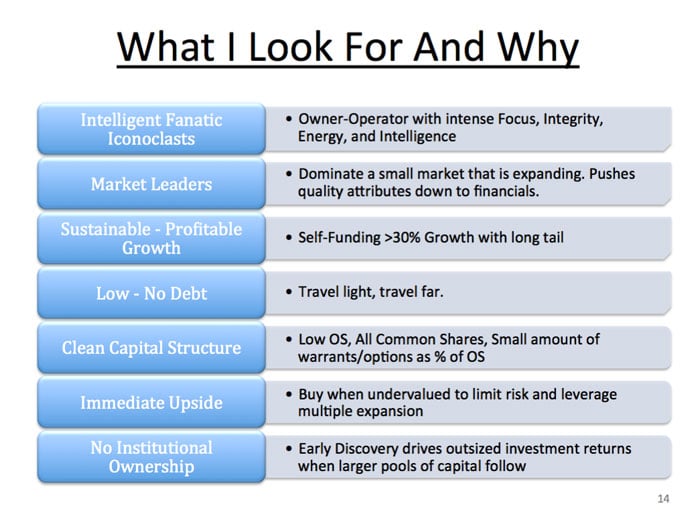](http://microcapclub.com/2015/12/all-great-companies-started-as-small-companies/)
From Presentation: All Great Companies Started As Small Companies
When you find companies with all of these attributes being led by quality management, it’s usually only a matter of time until institutions start to own them, driving the stock prices up significantly. To be a successful investor, you don’t want to invest where the institutions are, you want to invest where they are going to go.
Extraordinary returns follow extraordinary discipline. Discipline in buying and [selling](http://microcapclub.com/2014/06/selling-is-harder-than-buying/), and maybe the most important one of all, Holding. Don’t bother finding the next multi-bagger if you aren’t going to develop the conviction to hold it. Ben Graham didn’t achieve a 500+ bagger in GEICO because he bought his position in 1948\. He achieved a 500+ bagger because he held his position. When you find great companies, develop [The Conviction to Hold](http://microcapclub.com/2014/08/the-conviction-to-hold/).
There is no reason you can’t turn $10,000 into $1 million in ten years or less regardless of the macro economy. Learn from Warren Buffett and from others on how they turned small amounts of capital into wealth. Don’t listen to those that have never done it. Never seek advice from people that haven’t done what you are about to do. To do great things you can’t think like everyone else. The first million is a bitch, but you will get there.
You might also find this interesting: [Warren Buffett’s Net Worth By Age](http://microcapclub.com/2015/08/warren-buffetts-net-worth-by-age/)
**\===> Interact and learn with 250+ of the best microcap investors on the planet. [\[Join Us\]](https://microcapclub.com/join-now/)**
MicroCapClub is an exclusive forum for experienced microcap investors focused on microcap companies (sub $500m market cap) trading on United States, Canadian, European, and Australian markets. MicroCapClub was created to be a platform for experienced microcap investors to share and discuss stock ideas. Since 2011, our members have profiled 1000+ microcap companies. Investors can join our community by applying to become a member or subscribing to gain instant view only access. MicroCapClub’s mission is to foster the highest quality microcap investor Community, produce Educational content for investors, and promote better Leadership in the microcap arena. For more information, visit [http://microcapclub.com](https://microcapclub.com/) and
### So You Want To Be A Full Time MicroCap Investor?
URL: https://microcapclub.com/so-you-want-to-be-a-full-time-microcap-investor/
Last updated: 2024-03-15T09:47:40.000Z
Mike Schellinger (aka MikeDDKing) and I get asked quite often about being full time microcap investors. Although Mike and I are both full time microcap investors our investment styles are quite different in a few areas. We hope listeners will find the content educational and thought provoking. **(Click Play Button To Listen or Download File)**
[\[Download File Here](https://microcapclub.com/content/media/2024/03/Full-Time-MicroCap-Investors.mp3)\]
In this program we address the following questions and topics:
- Our Backgrounds and How we got started
- At what point did we know it was time to go full time?
- How much capital is needed?
- Investing Styles
- How do we find microcap ideas?
- Amount of positions and position sizing
- How do we buy/When do we sell
- Do we hedge our microcap long positions?
- Evaluating Management
- Learning through failure
- What is the best and worst parts of investing full time?
- What is a typical day like?
- What keeps us going?
Did you like this program? [Here is Part 2](https://microcapclub.com/2015/02/so-you-want-to-be-a-full-time-microcap-investor-part-2/)
**\===> Interact and learn with 250+ of the best microcap investors on the planet. [\[Join Us\]](https://microcapclub.com/join-now/)**
MicroCapClub is an exclusive forum for experienced microcap investors focused on microcap companies (sub $500m market cap) trading on United States, Canadian, European, and Australian markets. MicroCapClub was created to be a platform for experienced microcap investors to share and discuss stock ideas. Since 2011, our members have profiled 900+ microcap companies. Investors can join our community by applying to become a member or subscribing to gain instant view only access. MicroCapClub’s mission is to foster the highest quality microcap investor Community, produce Educational content for investors, and promote better Leadership in the microcap arena. For more information, visit [http://microcapclub.com](https://microcapclub.com/) and
### The New Small: Adding Alpha With MicroCap Stocks
URL: https://microcapclub.com/the-new-small-adding-alpha-with-microcap-stocks/
Last updated: 2023-10-15T13:45:49.000Z
[Altair Advisers](https://www.altairadvisers.com/?ref=microcapclub.com) published this white paper on microcap stocks with a lot of good information in it. An interesting point is made about how microcap and smallcap market cap thresholds have been increasing over time.
[](http://altairadvisers.gate39site.com/docs/default-source/education/altair-advisers%5Fmicro-caps%5F2014.pdf?sfvrsn=2&ref=microcapclub.com)
Click To View Full Report
**\===> Interact and learn with 250+ of the best microcap investors on the planet.** [\[Join Us\]](https://microcapclub.com/join-now/)
MicroCapClub is an exclusive forum for experienced microcap investors focused on microcap companies (sub $500m market cap) trading on United States, Canadian, European, and Australian markets. MicroCapClub was created to be a platform for experienced microcap investors to share and discuss stock ideas. Since 2011, our members have profiled 1000+ microcap companies. Investors can join our community by applying to become a member or subscribing to gain instant view only access. MicroCapClub’s mission is to foster the highest quality microcap investor Community, produce Educational content for investors, and promote better Leadership in the microcap arena. For more information, visit [http://microcapclub.com](http://microcapclub.com/) and
### Empowering Management
URL: https://microcapclub.com/empowering-management/
Last updated: 2023-10-15T13:44:38.000Z
Most US microcap success stories were first turnaround stories. Let me explain. In most cases a private company’s management team is approached about going public from a consultant, investment banker, etc. These people will make money from taking the company public either by way of advising fees, financing fees, or owning a piece of the public shell that the company will be merged with. Management teams are persuaded with the promises of growth capital and a liquid currency. In most cases the company is only able to raise a fraction of the money promised, and the consultants, investment banks, etc leave the company for the next deal. This undercapitalized public company is now left to figure it out on their own. Put a simpler way, they were thrown into the deep end of a pool without knowing how to swim. Many companies drown. This is why there is such a high failure rate in the microcap space. The ones that do figure it out, that bootstrap their businesses, that don’t dilute shareholders while turning around their companies…these few companies become microcap success stories.
[](/content/images/wordpress/2014/12/MC4.jpg)
This past October we had our first conference. We put the 70 best investors we could find in a room with the 13 best companies we could find. Most of the companies were high growth, profitable companies. All 13 companies that presented were success stories, but they were first turnaround stories. Some of the companies were on bankruptcy’s doorstep just a few years earlier. Their management teams turned the companies around and many of their stocks had rebounded 200%, 1,000%, even 10,000% in just a few years. In my opening remarks at the conference, I made it a point to say every company in that room should be celebrated. Digging your way out of a hole isn’t easy. Microcap success stories are as rare as the dodo bird.
That morning I also asked the following question to the management teams of these companies, all of which built an amazing amount of shareholder value over the previous few years:
> How many times has an investor said thank you?
You could have heard a pin drop. Crickets. I wasn’t surprised, and it’s something I truly believe needs to change. If we as shareholders are going to nitpick every little thing a management does wrong, we have an obligation to let them know when they do the big things right.
I don’t know why we investors put a different set of relational rules on our interaction with management teams. I’m guilty of this as well. When it comes to our normal relationships with friends or family we wouldn’t think twice about giving sincere appreciation. We know it builds people up and makes them stronger, but for some reason we rarely give sincere appreciation towards a CEO or management team. Maybe it’s because we feel doing so makes us look weak, or by doing so we’ll give the CEO a reason to take it easy and not work as hard. As if it might go to their head in a negative way. We sometimes think this way even though 100% of our experiences receiving compliments tell us differently. When someone says, “Ian I think you did a great job on XYZ”. It makes me want to work harder, not less. After I receive a compliment, I know someone is watching and more importantly I know someone cares. It makes me want to work even harder because I don’t want to let them down.
A couple years ago I started sending hand written cards over the Holidays to the CEO’s of the companies I’m invested in. I’m only invested in 5-7 companies so it doesn’t take that much time. In each card I tell each CEO that I know their job being a CEO of a public company is a thankless job. It’s not a job I, or any sane person would want. I then give sincere appreciation for the work they do day in and day out, for being “All in” like most of them are, and for the sacrifices they make. I write these cards first and foremost because I mean it. I know these CEO’s rarely if ever get a Thank You. Nine times out of ten the only time they hear from investors is when someone is complaining. I also know that I’m probably the only investor that personalizes a card to them, and it’s worth 10x more than any gift I could have sent. But even more important is I know they will work 10x harder after receiving that card because they won’t want to let me down.
The key to success isn’t getting everything you can out of everyone you meet. It’s about adding value to everyone you meet. This includes management teams. We investors, myself included, need to remember that robots do not run companies, people do. [In most cases management has much more on the line than we do](http://microcapclub.com/2014/06/always-be-respectful/). When you are invested in a great company that is managed properly, don’t be afraid to tell management you appreciate them. It might be the first time they’ve ever received a compliment from a shareholder. I guarantee that they will remember it forever. What I’ve found is when you compliment great people, it empowers them to be even greater. In addition, if you want a great relationship with management, show value back to them. Being a great investor is much more than finding great companies early, it’s also about being a better investor to the companies we already own.
Happy Holidays to our Members and Readership. You are appreciated.
We look forward to seeing many of you at our upcoming [MicroCap Leadership Summit](http://microcapclub.com/summit/).
**\===> Interact and learn with 250+ of the best microcap investors on the planet.** [\[Join Us\]](https://microcapclub.com/join-now/)
MicroCapClub is an exclusive forum for experienced microcap investors focused on microcap companies (sub $500m market cap) trading on United States, Canadian, European, and Australian markets. MicroCapClub was created to be a platform for experienced microcap investors to share and discuss stock ideas. Since 2011, our members have profiled 1000+ microcap companies. Investors can join our community by applying to become a member or subscribing to gain instant view only access. MicroCapClub’s mission is to foster the highest quality microcap investor Community, produce Educational content for investors, and promote better Leadership in the microcap arena. For more information, visit [http://microcapclub.com](http://microcapclub.com/) and
### Hard Mailer Pump and Dump Performance Part 10
URL: https://microcapclub.com/hard-mailer-pump-and-dump-performance-part-10/
Last updated: 2016-01-26T08:39:08.000Z
Pump and dumps have been going on since the beginning of the stock market and are most prevalent amongst penny stocks. The hard mailer is one of the most used avenues to pump a stock. The company themselves, affiliates, or large shareholders pay millions of dollars to mail out glossy 20 page reports trying to dupe investors into buying the underlying stock so they can sell their positions or conduct a financing. Just like gravity, when a hard mailer pushes a stock up, the buying eventually ends and they always crash back down to Earth.
It has been several months since I’ve updated my Pump and Dump Performance matrix. Since we are so close to Christmas, just be thankful that Santa didn’t give you this bag of coal 🙂
Here is a performance matrix of every hard mailer I’ve received at my home over the past few years. As you will see, time is a pump and dumps worst enemy. Over time, most of the companies that are mentioned in hard mailers lose most of their value. Some even go to zero.
[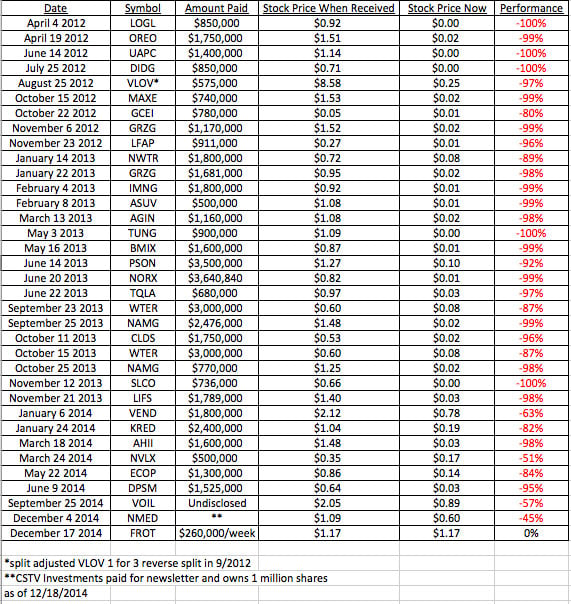](/content/images/wordpress/2014/12/PumpAndDumpPerformance.jpg)
Many hard mailers look like this one below, which I received on December 17th on Falconridge Oil Technologies ([FROT](http://finance.yahoo.com/q?s=FROT&ref=microcapclub.com)). You will see the cover page and the compensation disclaimer.
[](https://microcapclub.com/2014/12/hard-mailer-pump-and-dump-performance-part-10/frot-page-1/)
Cover Page
[](https://microcapclub.com/2014/12/hard-mailer-pump-and-dump-performance-part-10/frot-page-2/)
It’s unfortunate that in many cases an investors first entre into the microcap space is from unscrupulous sources such as a hard mailer or some pump and dump website. It’s important for investors to know that only a small percentage of microcaps indulge in such unethical tactics. Many microcaps have great businesses, management teams, share structures, and conduct themselves with integrity.
At MicroCapClub, many of our members make a living exclusively investing in microcap stocks. If you want to find out how we do what we do, check out some of our [educational articles](http://microcapclub.com/blog/) and [Join Us](http://microcapclub.com/join-now/).
MicroCapClub is an exclusive forum for experienced microcap investors focused on microcap companies (sub $300m market cap) trading on United States and Canadian markets. MicroCapClub was created to be a platform for experienced microcap investors to share and discuss stock ideas. MicroCapClub’s mission is to foster the highest quality microcap investor Community, produce Educational content for investors, and promote better Leadership in the microcap arena. If you are a passionate microcap investor, [Join Us](http://microcapclub.com/join-now/).
### Life Is Too Short To Diversify
URL: https://microcapclub.com/life-is-too-short-to-diversify/
Last updated: 2023-10-15T13:42:06.000Z
In [MicroCap Portfolio Management and Position Sizing](http://microcapclub.com/2014/03/microcap-portfolio-management-and-position-sizing/), I wrote about successful investors like Walter Schloss who owned over 100 positions, and Warren Buffett having held as few as five positions. Success has been shown on both extremes. The key lesson is these two men in particular knew what they were doing. My experience, investment style, and personality are quite different from someone else. One investor’s diversification can be another investor’s concentration. It is up to the individual investor to figure out their sweet spot. As your investment philosophy evolves, you will figure out where you need to be. Let me tell you a bit about my investment philosophy and how it shaped my thoughts on diversification with the caveat that what works for me might not work for you.
[](/content/images/wordpress/2014/11/Walter-Schloss-and-Warren-Buffett.jpg)
Walter Schloss and Warren Buffett
When I was [Getting Started](http://microcapclub.com/2014/09/getting-started/) I read every investment book I could get my hands on. I became really annoyed by the status quo of investing that preached diversification. I thought the only reason people think 12% annual rates of return are great is because that’s what they were taught. If you want to be average go ahead and think the way the rest of the world thinks. I felt if the world preaches diversification, well the opposite is probably the way to go. There is no reason a person can’t expect more out of their investments if they are willing to put forth the work to educate themselves and find great companies early. This is what led me to microcaps. There is no reason you can’t make 30%, 40%, dare I say 50% per year, consistently. Don’t ever put boundaries on your success.
> “If I was running $1 million today, or $10 million for that matter, I’d be fully invested. Anyone who says that size does not hurt investment performance is selling. The highest rates of return I’ve ever achieved were in the 1950s. I killed the Dow. You ought to see the numbers. But I was investing peanuts then. It’s a huge structural advantage not to have a lot of money. I think I could make you 50% a year on $1 million. No, I know I could. I guarantee that.”– Warren Buffett
If I were to sum up my investment philosophy in one sentence it would be this: I want to buy an undervalued company that has the potential to get very overvalued. This is my margin of safety. This might be alarming to many value investors, but I have no intention on buying undervalued companies that will only become less undervalued or even fairly valued. I want to find undervalued companies that over time due to their uniqueness-greatness and scarcity of shares creates a premium multiple. These types of companies are even harder to find. For the masses to ultimately buy in to these companies their businesses have to be simple. The market always pays a premium for simple businesses. I stay away from the onions where you have to peel back multiple layers to understand them. I try to buy stocks that I can explain in a minute or less. If it’s complicated, dumb money will never buy my shares from me multiples higher.
I have always been a rather concentrated investor, buying and holding the best 5-7 companies I can find. Before MicroCapClub, I had a personal investing blog where I would post about my core holdings. The slogan for my blog was, **“Life is too short to diversify”**. The slogan was somewhat tongue-in-cheek because I think a portfolio of 5-6-7 companies can be diversified. If you want superior returns, find an inefficient and illiquid market, and work everyday to be one of the best investors in that market. You don’t have to be a genius to be a great investor. To change your life, all you need to do is find and buy a couple great companies before the institutions and hold them. But you need to own enough of them.
> “Diversification may preserve wealth, but concentration builds wealth” – Warren Buffett
A 3% allocation that goes up 10x barely moves the needle but a 10-20% allocation will. I want to only invest in my highest conviction positions. The rest is noise. I’m a much better investor when a position is big enough that it can change my life if it works. Naysayers will say, “That’s great Ian, but what happens when you are wrong or when some Black Swan event occurs. When one of your five positions goes to 0?” I’ve certainly been wrong and have lost money in positions, but I’ve never rode a stock down to zero. Most importantly, when I initiate a position I’m looking for undervalued companies, so there is a fundamental floor on the stock. Companies where if my investment thesis is totally wrong, I’m still going to make money. I’m just looking for those stocks and stories that can get big, that can attract the masses. Furthermore, I’m hunting for multi-baggers. This might sound insane to most traditional investors, but if 20% of my portfolio would actually go to zero, another successful position can easily make up that gap.
> “It makes sense that if you limit your investments to those situations where you are knowledgeable and confident, and only those situations, your success rate will be very high.” — Joel Greenblatt
Owning meaningful positions and developing [The Conviction to Hold](http://microcapclub.com/2014/08/the-conviction-to-hold/) is how you make the big money. The only way I can develop the conviction to hold is by knowing my positions better than most. I hold a few high conviction positions and work everyday to try to know them better than anyone else. The most companies I feel I can get to know really well is 5-7 positions. That is my mental capacity, and it’s important to know your limitations. I’ve never believed in holding small positions because it normally means low conviction. Position sizing should never have defined or rigid rules. As your conviction grows in a company, own more of it. The better you know your investments the easier it is to hold them. The better you know your investments the sooner you’ll be aware if the story changes which will allow you to sell before the masses.
When I was inexperienced and just learning the art of investing, I was even more concentrated, going “all in” on 1-2 companies. The lessons I learned during these years were crucial. Charlie Munger said, *“Investors can have 90% of their wealth in a single company, if it is the right company.”* For me it wasn’t healthy to have only one or two eggs in my basket. The risk for me wasn’t the risk of loss as much as it was more psychological. There were certainly times when I was just wrong and lost money, but what was really harmful was the fact that I was thinking about my positions way too much. This made it very hard to hold them. It’s hard to be a long-term investor when you think about your positions every second. It wasn’t just thinking about them, it was worrying about them. I hadn’t developed the mental fortitude to handle it. There is a big difference between thinking and worrying about your positions. The latter can be very destructive.
[](/content/images/wordpress/2014/11/sleep-at-night-e1417292231294.jpg)
> “If you can’t sleep at night because of your stock market position, then you have gone too far. If this is the case, then sell your position down to the sleeping level.”
>
> – Jesse Livermore
Other psychological nuances also made it hard to hold a super concentrated portfolio of 1-2 companies. Long periods of inactivity in stock price, or slow deterioration of stock price can take its toll on a person’s psyche. Nothing is worse than when your whole portfolio isn’t working for long periods of time, which can happen quite often if you only own a couple companies. Over time I realized owning 5-7 positions gave me a much better state of mind. If a position works it can still change my life and that amount of positions keeps me from overthinking them.
As I mentioned in [The Conviction to Hold](http://microcapclub.com/2014/08/the-conviction-to-hold/), a big part of successful investing is becoming content doing nothing. You want to find great companies before others and then hold them. I’ll give you a personal example. Currently, I own six core positions, and the position I’ve owned the least amount of time is 12 months.
I’ve owned Position #1 for four years, and it’s up 900%
I’ve owned Position #2 for three years, and it’s up 600%
I’ve owned Position #3 for 18 months, and it’s up 200%
I’ve owned Position #4 for 16 months, and it’s up 650%
I’ve owned Position #5 for 14 months, and it’s up 75%
I’ve owned Position #6 for 12 months, and it’s up 100%
Positions 1-3 make up 70% of my portfolio. My portfolio returns aren’t as high as these percentages reflect because I’ve [averaged up](http://microcapclub.com/2014/09/buy-low-and-then-buy-higher/) in most of these positions. For example in Position #2, I recently bought more shares 500% higher than my initial buy three years ago. I actually own more shares today than I ever have. They don’t teach you that in school. The point is, when you find great companies make sure you own enough of them.
> “Don’t screw up a perfectly good stock-market strategy by diversifying your way into mediocre returns.” — Joel Greenblatt
Successful investing isn’t just about doing well in bull markets like we’ve had over the last five years but losing less money in bear markets. This is why I primarily look to invest in the smallest 10% of the microcap space (sub $30 million market cap). This is one of the last arenas where [investors managing small sums have an edge](http://microcapclub.com/2014/09/a-game-you-can-win/). In case you were wondering, as of last Friday’s close there were 7,718 public companies on US and Canadian exchanges <$30 million market cap. That is a lot of companies, more companies than trade on the NYSE and NASDAQ combined (5,900). In general, larger microcaps ($100+ million market cap) and smallcaps do horribly in bear markets. The reason isn’t fundamental, but more so because of who owns them. Institutions and indices own big percentages of these companies. When markets turn bearish, fund managers reduce microcap and a smallcap exposure. The Russell MicroCap, Russell 2000, Russell 3000 indices also have capital outflows. These two forces put constant selling pressure on these relatively illiquid stocks. This is why I want to find great companies that have no institutional ownership because there is no one of size to sell them in bear markets. It just so happens the only place to find great companies with no institutional ownership are very small microcaps. Great businesses that are high growth, profitable, can fund growth from internal cash flows, \[–And just as important –\] that have no institutional ownership do well in any market. It’s how a company like ZAGG went up 380% while the S&P went down 41% from May 2008- April 2009\. ZAGG went on to become one of my biggest winners, and all of this during the worst economic backdrop in decades. Don’t worry about the stock market, focus on finding great unknown companies.
[](/content/images/wordpress/2014/11/ZAGGvsMarket.jpg)
A concentrated portfolio isn’t for everyone. I believe the less experienced you are the more positions you should own. Now you might be asking yourself, am I experienced? If you even have to ask yourself that question, you probably fall into the inexperienced camp. This is fine and nothing to be ashamed of. Howard Marks has this great definition, *“Experience is what you got when you didn’t get what you wanted”.* I like to say, experience is expensive. The more money you have lost the more experienced you are, so I am quite experienced. You can’t become a great investor overnight because the most important lessons can’t be taught. Investing is a life long education and its teacher is loss. View those losses as your tuition. When you’re getting your education, own more positions so your losses will be minimized and you can live to fight another day. If you are a passive investor that doesn’t have the time to do necessary maintenance due diligence on your positions, you should be more diversified. Another way of saying this is…if you don’t have the time or ability to know your investments better than most, then you should be more diversified.
When experience and potential collide amazing things can happen. You weren’t put on this Earth to be average, so stop thinking like everyone else. You and your portfolio were meant for bigger things. It took me several years to figure out an investment philosophy that made sense for me, my goals, and my personality. I would encourage you to do the same. No one can do this for you, and you can only figure it out from experience. Don’t be afraid to fail. Go make a fortune and then get out and do something that really matters. Life is just too short. Life is too short to diversify.
**\===> Interact and learn with 250+ of the best microcap investors on the planet.** [\[Join Us\]](https://microcapclub.com/join-now/)
MicroCapClub is an exclusive forum for experienced microcap investors focused on microcap companies (sub $500m market cap) trading on United States, Canadian, European, and Australian markets. MicroCapClub was created to be a platform for experienced microcap investors to share and discuss stock ideas. Since 2011, our members have profiled 1000+ microcap companies. Investors can join our community by applying to become a member or subscribing to gain instant view only access. MicroCapClub’s mission is to foster the highest quality microcap investor Community, produce Educational content for investors, and promote better Leadership in the microcap arena. For more information, visit [http://microcapclub.com](http://microcapclub.com/) and
### The Art of Interviewing Management
URL: https://microcapclub.com/the-art-of-interviewing-management/
Last updated: 2023-11-15T07:01:05.000Z
In the last blog post, [Talking To Management](https://microcapclub.com/2014/11/talking-to-management/), Ian argued for the importance of talking with management of microcap companies. Over my 15 years of investing in microcaps, talking with dozens of CEOs and CFOs, I have discovered that there is an art to interviewing management. When asking questions of management, there are certain principles – do’s and don’t’s – that, if they are followed, lead to much better information gathering. I would like to share these interview techniques in this post.
I am an advocate of taking the best ideas from one discipline, and applying that knowledge to other disciplines. With that in mind, the interview techniques I use when talking to public company executives are largely influenced by knowledge I have gained from outside of the investment world. Firstly, my health care training has strongly influenced my approach to interviewing management. Some of the most vital information during a patient consultation comes out during the patient history, or interview. The questions that are asked of the patient, and the way they are asked gives you the information to narrow down your possible diagnosis, and it will guide you on what tests you should perform to come to a definitive diagnosis. If you ask good questions, you are much more likely to arrive at the right diagnosis. An investor should have the same focus on asking pertinent questions of management, in a way that yields good answers that helps build a true picture of a company’s potential as an investment.
I have also been heavily influenced by studying the techniques and principles of interviewing developed by a former investigative reporter named [John Sawatzky](http://en.wikipedia.org/wiki/John%5FSawatsky?ref=microcapclub.com). Sawatzky has dedicated his life to studying the art of interviewing. He has spent years meticulously analyzing what makes for a good question. He has consulted with some of the largest media organizations in the world to teach his interview techniques, and for the last ten years, he has worked for ESPN where he trains the in-studio and on-field reporting staff on how to conduct better interviews.
With that, here are ten do’s and don’t’s that i have used over the years when interviewing management.

Build Rapport with Management
Things to do:
1) **Build rapport with management**. During your research, before you talk to management, try to find something in common with them. It may be something as simple as a link to the city they are headquartered in – maybe you lived there previously. Have a look at their LinkedIn summary. Maybe you know someone who worked with them in the past. Maybe you share the same alma mater. Mention it to them at the beginning of your initial conversation. A connection, however small can help you to build rapport early on and get them to open up to you. It could be something as simple as joking around with them, as Ian suggested, which might help them to lighten up and drop their guard. Once you build rapport with a CEO, they are much more likely to give you better quality information.
2) **Ask open-ended questions.** Open-ended questions are questions that can’t be answered with a yes or no answer. An open-ended question often involves the words what, how or why, and to a lesser extent who, when and where. These types of questions that encourage a subject to describe or explain have a better chance of giving you a complete response.
A close-ended question yields a yes or no answer. Close-ended questions are fine if you are trying to verify core information, but they do not give detailed answers. An example of a close-ended question would be “do you still think you can improve your gross margin to 50%?”. On the other hand, an open-ended question would be “what specific steps do you plan to take to improve your gross margin to 50%?” It is a subtle difference, but the open ended question will probably yield much deeper information compared to the close-ended question.
3) **Questions should be lean**. Keep each question short, and focused on a single subject. Some management teams have had media training, and have learned how to tactfully avoid answering your questions, and divert the discussion to their own agenda instead. Questions that are unfocused and cover a broad subject matter allows them too much range to do this. The more focused your questions are, the more meaningful the answers you will get back.
4) **Questions should be neutral.** Neutral questions are free of values or opinions of the investor. Avoid using charged words and try to keep your opinion out of your questions as that can distract management. When values or opinions are added by the interviewer, either positive or negative, it may bias the executive into answering your question how you want it answered. In the very worst cases, the subject closes up because they feel they have been criticized, and it may be difficult to get them to open up again. For example, a microcap company i have a holding in recently granted a large amount of stock options to management. I could have asked the CEO “a lot of shareholders are pissed off about this option grant, how do you defend it?”. Instead, I asked “what criteria did your board use in rewarding management in the recent stock option plan?” Instead of using charged words in my question, and him getting defensive, i got a very thoughtful answer that made sense once it was looked at from his standpoint.
[](https://microcapclub.com/content/images/wordpress/2014/11/sawastkys%5Fquestions-e1416228730302.png)
5) **Listen to answers and build new questions from there.** Don’t be in too much of a rush to get to your next question on your list. By listening and asking them to elaborate, you will help management to articulate the subject matter. Also, by doing this, you are showing that you are listening, and it builds trust and credibility, which will allow management to open up deeper. When I first started interviewing public company management, i would stick very close to my question list, because i didn’t want to sound like an idiot ad-libbing off script. However, as my interview technique has improved over the years, I have noticed that a lot of the best information comes from going off script and asking for elaboration of an answer. As you gain experience interviewing management, don’t abandon the possibility of deeper information by jumping too quickly to your next question. Instead, pick up on a comment and follow-up.
6) **Use acknowledging words that show you are listening.** When management are answering your questions, use words like mmhmmm, i understand, and go on. This builds trust and rapport, and encourages them to open up further.
7) **Use the uncomfortable silent pause to your benefit.** When I first started interviewing management, they would be finishing up their answer to one of my questions, and I would be starting to look for the next one on my list. I sometimes would pause for a brief period until I could find my next question. A funny thing happened. Some of them continued to talk when there was a few seconds of silence. Humans hate lulls in conversations, and it makes a lot of people uncomfortable. So they feel the need to fill the void with something better. Sometimes those extra little nuggets of information contain some gems You have to use this technique sparingly, but i have found it can be a very effective technique for getting management to open up.
Things to avoid:
1) **Don’t ask questions with multiple parts to them.** Ask one question at a time. When long, multi-part, convoluted questions are asked, they may end up leaving management confused about what information you are looking for. Or it may give the executive the option to answer either one question or the other. If they are good at diverting questions, they may answer neither of your questions and will go off on their own carefully rehearsed message track and by the time they are done with their answer you will have forgotten your original questions. I see this all the time during conference calls when analysts ask long questions with multiple parts to them. I don’t know if it’s because they fear that they will only get to ask one question on the call, but by the time the executive is done answering he has often picked which part of the question he wants to answer and left it at that.
2) **Don’t ask leading questions.** When you convey your expectations to management by way of a leading question, it limits the possible answers, and their answer may not reflect the truth. I have seen this happen on conference calls, when investors are trying to tease guidance out of a CEO who is reluctant to provide it. The question will often go something like “I am using a 50% gross margin in my model for next quarter. Is that a reasonable expectation?”. Management will often reluctantly confirm that it is reasonable, because they have been influenced by the leading question. If they were willing to answer the direct question “what will gross margins look like next quarter?”, I am sure it would be a different number than the investor suggested most of the time. The investor is worse off than before he asked the leading question because he then plugs this faulty information into his earnings model.
Another example of a leading question asked on conference calls is when an analyst or investor’s question starts off with “you probably can’t answer this, but”, and then they go on to ask their question. You’ve just given management an out to not answer your question, if they are at all hesitant. Nine times out of ten, management will say something like “we can’t answer that because we haven’t given out that information to the market for competitive reasons”, or something along those lines. Whereas if they had just asked the question without adding “you probably can’t answer this, but”, management might answer the question 50% of the time.
3) **Don’t interrupt them.** You are trying to get information out of management, so let them talk after you ask them a question. We like the sound of our own voices, and we want to demonstrate that we are knowledgable about the subject being discussed, so we interrupt. Let management finish talking. You’ll get more complete answers to your questions.
The next time you listen to a conference call, or even a reporter interviewing someone on t.v., listen to the types of questions they ask. You will notice a pattern that good quality questions result in good quality answers.
I am certainly not a perfect interviewer of management. But over time, and with practice, i think my interviewing skills have improved dramatically. By following these interviewing techniques, and asking better quality questions, the answers you get back from management should help you make better decisions on whether to make a stock 20% of your portfolio or to sell every last share that you own.
**\===> Interact and learn with 250+ of the best microcap investors on the planet.** [\[Join Us\]](https://microcapclub.com/join-now/)
MicroCapClub is an exclusive forum for experienced microcap investors focused on microcap companies (sub $500m market cap) trading on United States, Canadian, European, and Australian markets. MicroCapClub was created to be a platform for experienced microcap investors to share and discuss stock ideas. Since 2011, our members have profiled 1000+ microcap companies. Investors can join our community by applying to become a member or subscribing to gain instant view only access. MicroCapClub’s mission is to foster the highest quality microcap investor Community, produce Educational content for investors, and promote better Leadership in the microcap arena. For more information, visit [http://microcapclub.com](https://microcapclub.com/) and
### Talking To Management
URL: https://microcapclub.com/talking-to-management/
Last updated: 2023-10-15T12:15:26.000Z
Talking to management is one of the most important things I do as a microcap investor. Some investors disagree and say that public filings, press releases, and other surface due diligence give them all the information they need. Their argument against talking to management is that management won’t give you an honest assessment because they are more or less paid advocates for the company. They say, the facts are in the filings, so no reason to talk to management. Let these investors think this way, because they are wrong. You really think that talking to the person that leads the company won’t give you additional insight? In almost every circumstance you will gain an edge by talking to management. In fact, one of my rules before buying a position is to talk to management. This is a hard topic to discuss in writing, so I’ll do my best to hit on some of the broader points.
> “To achieve superior results, you have to have an edge in either information or analysis, or both.” — Howard Marks
A big fallacy is when people believe talking to management is about acquiring insider information. This certainly isn’t true. [Joseph P. Kennedy](http://www.biography.com/people/joseph-p-kennedy-9362978?ref=microcapclub.com#synopsis), the father of President John F. Kennedy, made a large fortune in the stock market a well as real estate. In 1934, President Roosevelt would appoint Joseph Kennedy to be the very first chairman of the Securities and Exchange Commission. Thomas Phelps, author of [100 to 1 In The Stock Market](http://www.amazon.com/100-stock-market-distinguished-opportunities/dp/0070497729/ref=sr%5F1%5F1?s=books&ie=UTF8&qid=1415540480&sr=1-1&keywords=100+to+1+in+the+stock+market&ref=microcapclub.com), asked Joseph Kennedy if he regarded insider information as a major problem or hazard for investors. His response, “If I had all the money that has been lost on inside information I’d really be rich.” I whole-heartedly agree with this. The management teams that tell you too much are almost always the ones that do too little. Such information rarely is true in the first place. It is a red flag when a management team crosses the line, and it’s never that type of information that I’m looking to collect. When I talk to management, I’m looking for their help to answer questions I have after conducting surface due diligence.
The smaller the company the more you are betting on management. I’ve always felt the best illustration of a small company is that of the human body.
[](/content/images/wordpress/2014/11/humanbody2.jpg)
The management team is the head/brain and the product-service is the body.
Think about how many extremely gifted people you’ve known that never lived up to their potential because of bad decision-making. All of their gifts and talent wasted. Similarly, it doesn’t matter how great a company’s product or service is if the management doesn’t make the right decisions. It doesn’t matter that a technology is 10x better than the competition. It doesn’t matter that a company has $10 billion of gold, silver, and copper buried in the ground. If the management team makes the wrong decisions marketing/selling the technology, or the mining company uses the wrong financing mechanism to fund its project, shareholders will lose money. If the head is deaf, dumb, and blind, the body is useless.
The key to microcap investing is finding great companies before the next investor. You can’t just wait around and watch the company perform (or not) for a few years before investing. You need to find them early. You can analyze with hindsight but you get paid for foresight. You need to talk to management and really drill down on their strategy so you know what assumptions to use to build out your model. Through discussion you also find out how the CEO thinks and problem solves. Maybe most important you can develop a report card, and see if the management are doers or talkers. When evaluating small emerging companies like microcaps, talking to management is crucial. It has saved me and made me more money than anything else.
**Why Are Some MicroCap Management Teams Hard To Access?**
You will find some resistance when trying to access management. Some microcap management teams are hard to reach, don’t respond to phone calls, and run their companies like private companies. So why is this? It is true that some management teams just don’t care about communicating with investors, but I’ve found the main culprit is the following: Management teams are solicited by all sorts of service providers (Investor Relations, Investment Banks, Consultants, Attorneys, etc) on a daily basis trying to sell them services. Don’t believe me? Just ask a CEO. In fact, I would say this is the biggest reason microcap management teams are hard to get a hold of. At a certain point they just shut down and tune out the capital markets because all they’ve known it to be is a bunch of snake oil salesmen. Investors often times are also thrown out via baby thrown out with the bathwater.
What this means is it sometimes takes persistence. In every case, always be nice. No one responds to anyone that is annoying and rude. I believe a lot of investors, even experienced ones, contact management with a “chip” on their shoulder, like they are above management. Their tone reflects it and they wonder why they have issues getting through to management. Always be nice. [Always be respectful](http://microcapclub.com/2014/06/always-be-respectful/).
I’ll give you a real life example. A few years ago I finished my surface due diligence into Where Food Comes From ([WFCF](http://finance.yahoo.com/q?s=WFCF&ref=microcapclub.com)). I called and emailed the CEO, John Saunders. I got no reply. A couple weeks later, I did the same thing, this time in an even nicer tone. It took a month, but I finally spoke to him. I broke the ice with the call, but it wasn’t exactly easy from there on out to communicate with John. He still had his wall up. Here is a story I shared in our members forum about traveling to meet John at WFCF headquarters:
> I first met John Saunders in early 2012 in Castle Rock, CO when the stock was $0.40\. The company was 16 years old, and my bet was it would take 4 more years for it to be an overnight success. When I sat down with John he didn’t trust me at all, in fact he didn’t trust anyone from the capital markets side. When I sat down with him in his office he asked the first question, and it was, “Are you here because you want my job?” It was such a distrusting question to ask, but one I had to respect because he was the one that went through hell and back. He just like many other microcap CEO’s trusted the wrong people in the microcap space. A few years earlier he went public too soon, was undercapitalized, and was left to die. He was thrown into the deep end of a pool without knowing how to swim. It’s why so many microcaps that start out microcaps don’t succeed. They are set up to fail. It’s also why most microcap success stories are also turn around stories. It is very rare when a microcap company turns itself around and does so without diluting shareholders. This is a common theme in microcap successes. Because John had done this, I already knew he was a winner, so I responded, “No John, I wouldn’t be here if I thought I could do your job”. I then told him what I tell every CEO I meet with. That I wasn’t there to sell him anything, I would never have my hand out, and that I had just bought 1% of his company in the open market and was looking for a reason to buy more. My only motivation was my A account, so I was completely aligned with him. At that point, his wall was officially broken down, and we dove into the business.
**How Do You Access Management?**
We already wrote an article on this \[[HERE](http://microcapclub.com/2012/09/how-do-you-access-microcap-management-teams/)\]
**Confidence**
When I was just getting started as a microcap investor in my early 20’s, the thought of talking to management was very intimidating. I was a bit lucky though because I had a mentor who showed me how to communicate with management. This mentor was an established and wealthy investor, so of course management was going to respect an investor that had the potential to buy hundreds of thousands or millions of dollars worth of their stock. We would do a lot of management calls together. In the beginning he would take the lead, and every so often I would interject with my shaky nervous voice to ask a few questions. But after several calls, my mentor encouraged me to lead the calls, and I gained more and more confidence. Just like most things in life, practice makes perfect. Don’t let fear stop you from picking up the phone.
**Combat Fear With Preparation**
If a CEO is going to give you 30-60 minutes of his or her time, you need to respect that. I’ve found that management teams are very cordial, polite, and responsive to investors that do their homework. I do as much work as possible before getting on the phone with management. If the company has been around a long time, I like to read the last five years of annual reports to really get a sense of the history of the company. I read through the annual reports from top to bottom starting with the oldest report, and work my way to the present. I first focus on management’s discussion and analysis of the business to see how/if their strategy changed through the years. This also helps link strategy shifts with possible financial shifts. If three years ago, the company knowingly shifted the product mix, which led to lower gross margins, it’s good to know this before diving into the financials. As you do this, take notes and write down any questions that pop up. These types of questions are good ones for your call with management because it shows you did your homework.
**Management Background**
I want to know as much as I can about management. Their successes will be in their public bio/resume. Their failures will be on the Internet. Google search the officers in the management team to find out all you can about them. A lot of things in the microcap space are counter-intuitive. Most investors view a “Great Background” as one where the microcap executive had successful mid-upper level roles at large notable companies. The problem with this is microcaps are not large companies. Most microcap companies operate on small budgets, thus needing more of an entrepreneurial mindset by management. I’ve seen many microcaps fail under the leadership of individuals with great backgrounds running large companies. In general, I would much rather see an executive who’s shown entrepreneurial success, starting and growing small companies. With that said, success doesn’t come from the same cookie cutter background. It comes in all shapes, sizes, and backgrounds. When I talk with management I like to explore why they made the decisions they did in the past. Success is determined by execution, and a lot of times the past can only tell us so much about the future.
**Don’t Be Turned Off By Failure**
I like to see success and failure in a CEO and management team’s background. I’m not turned off by failure, in fact most of my successful investments were betting on CEO’s who’ve first failed. In the case of failure, the question is, did they learn from it? If so, a failure can be the best thing, since they will not make those same mistakes again. Like I said earlier in this writeup, most microcap success stories were first turn around stories. It’s just the nature of the microcap space. A company is brought public too soon and undercapitalized, and after a year or so the stock craters. Now the management team needs to figure it out. MicroCapClub had an invite only (investor and company) conference earlier this year. We invited 13 of the best microcap companies we could find along with the top 70 microcap investors and put them in a room together to see what would happen. The interesting thing was almost all of the companies that presented were turnaround stories. Some were on bankruptcy’s doorstep just a few short years earlier. For example, BioSyent ([RX.V](http://finance.yahoo.com/q?s=RX.V&ref=microcapclub.com)) was at $0.06 in 2010, now it’s at $11 (180-bagger). XPEL Technologies ([XPLT](http://finance.yahoo.com/q?s=XPLT&ref=microcapclub.com)) was at $0.06 in 2012, now it’s at $3.00 (50-bagger). Where Food Comes From ([WFCF](http://finance.yahoo.com/q?s=WFCF&ref=microcapclub.com)) was at $0.10 in 2011, now it’s at $2.80 (28-bagger). Just think if you found them that early and had [The Conviction To Hold](http://microcapclub.com/2014/08/the-conviction-to-hold/) these stocks. These management teams learned the hard lessons when they were turning around these companies. Now they are thriving. The key was they turned their companies around with minimal dilution to shareholders. If a management team did right by shareholders in the worst of times, it’s a good sign they will do right by shareholders in the best of times.
**The First Call**
On most initial calls with companies, management goes through their most recent investor presentation. Some of the very small microcaps don’t even have an investor presentation, so be prepared for either case. Have a good list of questions ready and try to put them in an order that makes sense for the conversation. Very rarely does a call go exactly as planned, but it’s good to at least approach the meeting with a plan. Lastly, have fun. I like to joke around a little bit on calls where appropriate to lighten the mood a bit. I’ve found management teams appreciate this as well.
Not everyone can beat the market since collectively they are the market. Think about that. To outperform you need to think differently. Microcap investing is one of the few arenas where the small retail investor actually [has an edge](http://microcapclub.com/2014/09/a-game-you-can-win/). The edge is that “smarter”, larger investors can’t even invest in these companies. Due to [illiquidity](http://microcapclub.com/2014/03/dont-worry-about-illiquidity-worry-about-being-right/), they literally have to wait for the stocks to go higher and be more liquid before they can buy. The other part of the edge is access. I fell in love with the microcap space because even a small investor like me can gain access to management. Most investors don’t even try to access management. This is crazy to me. Howard Mark’s tells this short story of an efficient market believing finance professor who takes a walk with a student:
> “Isn’t that a $10 bill lying on the ground?” asks the student
>
> “No, it can’t be a $10 bill,” answers the professor. “If it were, someone would have picked it up by now.”
>
> The professor walks away, and the student picks it up and has a beer.
The ability to access management is a gift. It’s a $10 bill laying on the ground. Pick it up.
You like this article? Read Part 2: [The Art of Interviewing Management](http://microcapclub.com/2014/11/the-art-of-interviewing-management/)
**\===> Interact and learn with 250+ of the best microcap investors on the planet.** [\[Join Us\]](https://microcapclub.com/join-now/)
MicroCapClub is an exclusive forum for experienced microcap investors focused on microcap companies (sub $500m market cap) trading on United States, Canadian, European, and Australian markets. MicroCapClub was created to be a platform for experienced microcap investors to share and discuss stock ideas. Since 2011, our members have profiled 1000+ microcap companies. Investors can join our community by applying to become a member or subscribing to gain instant view only access. MicroCapClub’s mission is to foster the highest quality microcap investor Community, produce Educational content for investors, and promote better Leadership in the microcap arena. For more information, visit [http://microcapclub.com](http://microcapclub.com/) and
### Book Review: The Most Important Thing Illuminated By Howard Marks
URL: https://microcapclub.com/book-review-the-most-important-thing-illuminated-by-howard-marks/
Last updated: 2023-10-15T12:14:32.000Z
Howard Marks is a highly regarded value investor and cofounder of Oaktree Capital Management with $75 billion under management. Warren Buffett even believes Howard Mark’s [memos](http://www.oaktreecapital.com/memo.aspx?ref=microcapclub.com) are a must read, so the rest of us humans should pay attention. Even though I don’t think of myself as a value investor (more of a growth-value hybrid), I certainly respect the craft, especially since the wealthiest investors on this planet are value investors. Several years ago I started reading Howard Mark’s memos and really enjoyed his writing style as he doesn’t waste words. His thoughts on investing usually run a bit deeper than most. Like this one: [The Role of Luck](http://www.oaktreecapital.com/MemoTree/Getting%20Lucky%5F2014%5F01%5F16.pdf?ref=microcapclub.com).
I finally got the chance to read his book, [The Most Important Thing Illuminated](http://www.amazon.com/The-Most-Important-Thing-Illuminated/dp/0231162847/ref=sr%5F1%5F1?ie=UTF8&qid=1414870948&sr=8-1&keywords=the+most+important+thing+illuminated+howard+marks&ref=microcapclub.com) when I was on vacation this past week. I can see why it’s used as mandatory reading at Columbia Business School. Marks’s memos are intertwined throughout the book as well as comments from Joel Greenblatt, Christopher Davis, Paul Johnson, and Seth Klarman. It truly is a classic that I should have read earlier.
Marks’s goes into detail about the type of thinker it takes to be a successful investor, and also that a lot of lessons can’t be taught they have to be experienced.
> “Experience is what you got when you didn’t get what you wanted.” – Howard Marks
>
> “Few people have what it takes to be great investors. Some can be taught, but not everyone…and those who can be taught can’t be taught everything.” – Howard Marks
He also does a great job of talking about inefficient markets and going against the crowd:
> “Inefficiency is a necessary condition for superior investing” – Howard Marks
>
> “I should limit my efforts to relatively inefficient markets where hard work and skill would pay off best.” – Howard Marks
>
> “Inefficiencies – mispricings, misperceptions, mistakes that other people make – provide potential opportunities for superior performance. Exploiting them is, in fact, the only road to consistent outperformance. To distinguish yourself from the others, you need to be on the right side of those mistakes.” – Howard Marks
Marks’s devotes a lot of the book on the topics surrounding the psychology of investing and evaluating risk. Instead of me quoting the rest of the book, go read it for yourself 🙂 it is well worth it.
[](http://www.amazon.com/The-Most-Important-Thing-Illuminated/dp/0231162847/ref=sr%5F1%5F1?ie=UTF8&qid=1414870948&sr=8-1&keywords=the+most+important+thing+illuminated+howard+marks&ref=microcapclub.com)
Buy it Here
**\===> Interact and learn with 250+ of the best microcap investors on the planet.** [\[Join Us\]](https://microcapclub.com/join-now/)
MicroCapClub is an exclusive forum for experienced microcap investors focused on microcap companies (sub $500m market cap) trading on United States, Canadian, European, and Australian markets. MicroCapClub was created to be a platform for experienced microcap investors to share and discuss stock ideas. Since 2011, our members have profiled 1000+ microcap companies. Investors can join our community by applying to become a member or subscribing to gain instant view only access. MicroCapClub’s mission is to foster the highest quality microcap investor Community, produce Educational content for investors, and promote better Leadership in the microcap arena. For more information, visit [http://microcapclub.com](http://microcapclub.com/) and
### Book Review: Think And Grow Rich By Napoleon Hill
URL: https://microcapclub.com/book-review-think-and-grow-rich-by-napoleon-hill/
Last updated: 2023-10-15T12:13:52.000Z
When I was in college a professor handed me a book that would change my path forever. The book was Think And Grow Rich by Napoleon Hill. I quickly read the book in two days, and then I read it again and again and again. The book was originally published during the Great Depression in 1937 and since then has sold over 100 million copies, making it one of the top selling books of all time.
The book originated when Napoleon Hill was doing research on what made successful people successful for an article he was writing. He had a chance to interview Andrew Carnegie, one of the richest and most powerful men in the world at the time. Carnegie was so impressed with Hill, that he gave him the task of interviewing and following closely the lives of other successful men and women. Hill’s compilation of research and interviews took 25 years. During those years he studied and interviewed over 500 of the most successful people in the world, mostly made available because of Carnegie’s influence. Hill would interview Henry Ford, Alexander Graham Bell, Elmer Gates, Thomas Edison, Luther Burbank, William Taft, John D. Rockefeller, and many others.
After Hill studied and interviewed all of these successful men and women, he noted their was a formula to success, and he published the formula in Think and Grow Rich. The book is a must read, not only once, but several times.
[](http://www.amazon.com/Think-Grow-Rich-Original-Unedited/dp/193764135X/ref=sr%5F1%5F4?s=books&ie=UTF8&qid=1414063823&sr=1-4&keywords=think+and+grow+rich&ref=microcapclub.com)
Buy Here
**\===> Interact and learn with 250+ of the best microcap investors on the planet.** [\[Join Us\]](https://microcapclub.com/join-now/)
MicroCapClub is an exclusive forum for experienced microcap investors focused on microcap companies (sub $500m market cap) trading on United States, Canadian, European, and Australian markets. MicroCapClub was created to be a platform for experienced microcap investors to share and discuss stock ideas. Since 2011, our members have profiled 1000+ microcap companies. Investors can join our community by applying to become a member or subscribing to gain instant view only access. MicroCapClub’s mission is to foster the highest quality microcap investor Community, produce Educational content for investors, and promote better Leadership in the microcap arena. For more information, visit [http://microcapclub.com](http://microcapclub.com/) and
### Lessons Learned after Two Years of Managing a MicroCap Fund
URL: https://microcapclub.com/lessons-learned-after-two-years-of-managing-a-microcap-fund/
Last updated: 2023-10-15T12:13:12.000Z
I launched Blueprint Capital Management with my partner, Jason Revland, in October of 2012\. [He wrote a post](http://microcapclub.com/2013/08/lessons-learned-after-one-year-of-managing-a-microcap-fund/) one year ago highlighting a series of lessons we had learned during our first year post launching the strategy. Our strategy approach is to build a concentrated, long-only portfolio of high-conviction microcap companies that over a full market cycle deliver annualized returns exceeding 15%, with a low correlation (50% or better) vs. the broad equity market. Our philosophy embraces a disciplined, multi-step investment process including direct access to management blended with our own research. Finding “edge” in the investment management business is very difficult, but we believe our approach offers this to our investors by focusing exclusively on the highly inefficient microcap equity universe. Information, quite simply, is king, and our process is purpose-built to uncover and exploit it through direct management communication, company site visits, and thorough industry and competitor channel checks. There are many nuances that play a critical role in our process, whether they are fundamental to the company and their business model, or perhaps more specific to the short-term trading dynamic of each individual security. In last year’s post, we discussed partnership, peer networks, red and green flags one should look for. This year, I thought it would be valuable to highlight and discuss the benefits and pitfalls of some of these investing nuances.
**Elevated social media activity**
Microcap investors often witness the impact Seeking Alpha, Twitter, independent blogs and other investment websites can have on small and sometimes illiquid stocks. Their impact can be dramatic, and seem more pronounced than ever, as the dissemination of opinions and research has become far more decentralized, and is no longer the singular domain of investment banks and their sell-side research analysts. As an example, we followed a company, Digital Ally (**DGLY**), for over 12 months waiting for management to show signs of execution. This waiting period was challenging for us, with frequent execution delays combined with the stock being fairly illiquid and in general decline. Over our holding period, the company was pumped several times on social media resulting in brief periods of extreme volume. This can often be fortuitous and desirable liquidity that enables opportunity to add or exit positions, as well as cause outsized moves in the share price. You may have even made 200%+ in one day if you were lucky! That is not a typo. The result was a series of momentum traders getting involved, pushing a low float stock up, touting it to their peers on Twitter, message board forums, etc only to sell on a quick flip as everyone else was pouring in.
TAKEAWAY: If you’re lucky enough to be in a position that is obviously being pumped hard via social media, and there is no corresponding fundamental development to support the move, our experience suggests that you take the win, and move to the sidelines, with possible re-entry once volume and behavior normalizes. Especially with lower float names, it is akin to a game of musical chairs, where the eventual selloff leads to hard and fast selling. Our mandate is to be long term investors, but that horizon does not preclude us from being cognizant of the short-term changes in risk-reward dynamics. The “pump” does not warrant a fundamental change in the valuation, and is largely a technical event from our perspective. These new buyers have a much shorter term horizon than you do, along with a potentially higher cost basis. They seek out and crave momentum and volume, and are often quick to move on once the action subsides. You’ll likely get a chance to buy back your position cheaper than where you sold it, when the music stops and the short term money exits, sometimes in reckless fashion.
**Lumpy business model**
Microcaps are more often subjected to the pitfalls of a lumpy business model, more so than larger companies. By “lumpy”, I mean 1) large contracts or customer wins resulting in abnormal/inconsistent quarter to quarter results or 2) seasonality causing one or two quarters to be materially different than others. It can be a struggle forecasting this type of business model, and often frustrating for microcap investors. As a result, valuations may not reach the premium they may deserve, and short-term volatility can cause more pain than seems tolerable. Microcap equities are inefficient to begin with. Any dynamic that breeds skepticism or uncertainty can disproportionately impact valuation.
We’ve followed a company called Xplore Technologies (**XPLR**) for nearly two years, which has historically produced very lumpy quarterly results, but the overall annual trajectory has been on track. The company is currently undergoing an important expansion of their available product suite. As they expand their addressable market, industry and customer base, we expect results should soon transition to being more consistent, and less lumpy. Detecting this type of business model evolution can be interesting to watch and can produce very positive investment results. We believe this evolution is currently under way for Xplore, though investors have yet to fully embrace this new paradigm. The valuation framework should improve substantially when lumpiness transitions to higher normalized quarterly results with multiple revenue streams coming into the mix.
TAKEAWAY: Seek out companies with consistent business models. Those that are lumpy become even more of a “show me” story and execution fundamentally can be unpredictable at times. If a company is transitioning from a lumpy business to one that has more consistency, investment returns can be even more dramatic. Persistent lumpiness should be considered within your overall risk-reward calculation, as it will mostly likely drive higher volatility quarter to quarter.
**Information Blackout**
Consistency is key, and it encompasses earnings results (revenue, EPS, margins), methods of communication (conference calls, IR activities) as well as management track record of success. Companies that issue guidance, but then stop doing so typically pay a penalty. Issuing forward-looking guidance is not always appropriate, depending on the company or industry, but a change in the routine established is deemed inconsistent and is often perceived as a negative. Another example would be conference calls. Companies that are not transparent and openly communicating at least once per quarter with their investor base often have a harder time establishing a solid investor base than companies who consistently host calls every quarter.
We begin building a relationship with management long before we ever purchase any stock. This relationship and communication consistency is a very important component to our investment philosophy and process. When communication patterns change, we can often identify red flags more quickly.
Example. Charles & Colvard (**CTHR**). In late 2013, the company hired a new CFO and subsequently stopped talking to investors after the calendar year ended. Companies often are more careful communicating after a quarter has just ended and prior to reporting their results, but in this case, it was a significant change in style. Additionally, the company missed their historical earnings release date and ultimately reported a few days before the SEC mandated deadline. The stock suffered disproportionately during this time as investors had no choice other than to speculate on reasons behind the change in communication. The conflict for an investor in this situation is challenging. You may have strong conviction on a company, but are then forced to digest unforeseen variables. Human nature may drive an investor who is already biased in owning the shares to make excuses for management or the situation at hand. In reality, the uncertainty is what you need to be ahead of because uncertainty directly influences share price. Call this a lesson learned for the future, and Charles & Colvard has spent the better part of 2014 trying to build back shareholder support.
TAKEAWAY: If you lose your “edge” for any number of reasons, follow your discipline and reassess the position. When you identify elements that have changed, try to acknowledge the significance of such change and take immediate action. Trust your instinct. A high level of conviction should not turn to doubt easily and when it does, that means something.
**Conference Calls**
The quarterly earnings conference call is a critically important part of the investment process. It provides important information and color on the business, and is an opportunity for you, as a shareholder, to interact with management in a public forum. Listening very closely to what management has to say, information updates/changes, the number of participants and questions relative to previous calls, and the tone of the conversation and questions being asked are all key variables to consider. Passion, enthusiasm, frustration, caution, disappointment are all valuable and real emotions that can be detected from audio speech, none of which translate very accurately when reading text transcripts. We have experienced many situations where companies disclose material changes to their business pipeline, strategic relationships, and this lays the groundwork for additional follow up questions, whether live or during subsequent calls. Connecting the dots on those details and timeline of activities can result in immense value. Sometimes management announces new relationships or contracts during conference calls, without putting this information in a formal press release, as they may be constrained by legal or competitive reasons.
For example, Mandalay Digital (**MNDL**) held their quarterly call this past August. They had previously launched their mobile advertising enabling software on a single Android phone through a trial period with Verizon. When the call began, they kicked it off with revealing a multi-year agreement with Verizon that would include deployment of their software across the entire Android line up. This was an extraordinary and surprising development. The company later provided formal financial guidance reflecting the value of this relationship. The stock closed at $3.50 on the day of the call. Six trading days later it closed at $5.85, a gain of \~65%, a majority of which came in the days that followed and not immediately after the call
TAKEAWAY: While this example is uncommon, it proves that inefficiencies do exist and identifying them by listening to conference calls can deliver outstanding returns. Conference calls can be very valuable for many reasons, as opportunities big and small commonly present themselves. The subtleties of dialogue and information are where the most knowledgeable investors derive their edge. You can excel at this too by building relationships with management and thoroughly knowing the company story.
**The Giant Contract**
The coveted Big Brother relationship is one we seek out as such partnerships provide credibility and validity to a service or product offering. If a Fortune 500 company is willing to take business risk in relying on a small company for something strategically important, as well as the risk associated with the product, it goes a long way towards vetting a story. We’ve seen this play out many times in different iterations, and the most important takeaway is that it does not always mean a growth inflection point is about to unfold.
For example, Bridgeline Digital (**BLIN**) signed a strategic partnership with UPS, as well as the UPS Stores, a few years ago. Both UPS relationships were internally awarded independent of each other and validated two large and separate growth opportunities for the company. Unfortunately, they were not a precursor to what might have seemed like exponential growth. While the relationships are still in place and working to this day, they are not driving the interest which seemed plausible at the time of announcements. In this case, the UPS agreement validated their technology but there may not have been a true alignment of interest to drive material incremental business. The UPS Store opportunity validated the company’s attractive SaaS offering, but it did not move the needle for their prospects and equally as important, did not help shorten the already long sales cycle.
TAKEAWAY: The Fortune 500 relationship undoubtedly de-risks a service or product on some level. It can validate a company and provide a roadmap to an inflection in topline growth and earnings. However, the relationship does not mean immediate sales and in many cases, as it can take a long time for the impact to be felt, especially when dealing with very large corporations. We often see companies have very large increases in valuation around such announcements only to give back some, if not all, during the ramp period. Keep this in mind as expectations are critical to watch in situations where there is a significant time gap between relationship announcement and realized revenue/earnings.
**Management: Track Record and Promotional Behavior**
We are often asked how we source our ideas. The answer is simple, meet management teams. We try to perform at least three management calls per week, resulting in a steady flow of new stories, and companies we are monitoring. Getting to know management and hearing their story is essential as the team is critical to investment success, or “betting on the jockey”. A great product in the hands of bad management is a recipe for disappointment. Determining the strength of your management team is extremely important and often starts with understanding their pedigree and background experience. Micro caps run the gamut in this sense as you come across start up entrepreneurs with little experience to those that have already managed and sold billion dollar companies. While previous demonstrated success is very easy to spot because it is often touted and can be easily validated, the lack thereof is often skillfully hidden and quickly glossed over. Simple Google searches that include the name of a person in question and past companies often yield interesting results. There are a lot of characters in micro caps. It’s also important to screen management names with the SEC/FINRA databases to ensure they have a clean record.
Track record is fairly black and white. Promotion behavior is not. This aspect of communication is very important though. CEO’s that promote themselves with BIG forecasts are a problem. As investors, we prefer reasonable and measurable expectations that can be met or exceeded over time. If management can consistently deliver on this premise, the company is likely to grow at a healthy clip and investors will remain content and stick with them over time. When they set high bars, there is a greater chance of disappointment and thus an obstacle for momentum in share price/valuation. Regaining investor attention and confidence can take a long time, once management has destroyed its credibility.
For example, we spoke with a software company in June of this year, whose software could translate website text into speech. I immediately felt the company would either be something really big or a complete implosion. They seemed to be on the verge of several inflection points with a compelling product, but yet remained mostly unknown to the Street. The first red flag was on a slide in their investor presentation labeled “Projected Five Year Revenue Vertical Split & Growth.” This slide essentially guided five year revenue growth from $0 to $78,867,968\. Yes, down to the specific dollar! I don’t know many companies that issue one year guidance, let alone five year guidance. There is no benefit to setting expectations at this level, that far out, and no one will take that estimate seriously. We interpreted this as promotional, foolish, and indicative of a lack of experience dealing with serious investors. The second red flag occurred when we researched the management team, via Google. In this case, they both came from a prior failed microcap and the Chairman had state-level charges filed against him alleging fraudulent practices where he engaged in unauthorized trading. That is a BIG red flag and when paired together, one might see why this investment quickly became a pass for us.
TAKEAWAY: Find good management teams that have reputable backgrounds with demonstrated success that can be easily verified. Also, look for teams that set reasonable expectations and do not hype their story, or make ridiculous claims or promises.
**\===> Interact and learn with 250+ of the best microcap investors on the planet.** [\[Join Us\]](https://microcapclub.com/join-now/)
MicroCapClub is an exclusive forum for experienced microcap investors focused on microcap companies (sub $500m market cap) trading on United States, Canadian, European, and Australian markets. MicroCapClub was created to be a platform for experienced microcap investors to share and discuss stock ideas. Since 2011, our members have profiled 1000+ microcap companies. Investors can join our community by applying to become a member or subscribing to gain instant view only access. MicroCapClub’s mission is to foster the highest quality microcap investor Community, produce Educational content for investors, and promote better Leadership in the microcap arena. For more information, visit [http://microcapclub.com](http://microcapclub.com/) and
### So You Want To Get Rich
URL: https://microcapclub.com/so-you-want-to-get-rich/
Last updated: 2023-10-15T12:11:51.000Z
A few months after I became a full time private investor I had a nightmare, and I can still remember it in vivid detail. It goes something like this: I’m eating breakfast, and I turn on the TV. I watch ESPN (Sports) for 30 seconds, and I flip the channels until I land on CNBC. Joe Kernen is talking to Rebecca Quick when all of a sudden Joe puts his hand to his earpiece. Joe’s face turns to confusion, and as he faces the camera he says, “I’ve just been alerted that all microcap stocks will be delisted as of end of day yesterday. Regulatory bodies have decided that only smallcap companies and greater shall remain on public stock exchanges.” At this point I’m standing 10 inches from the TV in total shock. My mind starts to race from fear to anger and back to fear. What am I going to do? I’m now broke. What am I going to do for money? I have no skillset other than analyzing these little companies and now I can’t monetize it. I mean I do have an education. I went to college and also got my MBA, but I certainly don’t remember anything I learned. I don’t see how I could get a real job. Maybe I’ll be able to get a job in construction, masonry, paving or something. But I’m not particularly handy. I can’t fix anything; I can barely change a light bulb. This is awful. My mind is just racing, and then BAM! I wake up.
When I told my “soon to be wife” at the time about the nightmare she just laughed UNTIL I told her I would rather live on the street then work for anyone. Then she just stared at me. “Soon to be wives” don’t like hearing there is a chance they will be living on the street 🙂 but I was being truthful. Not only would it be very hard for me to work for anyone, but the microcap investing skillset is not very transferrable to an employee position. I’m sure many reading this feel the same way.
If you are a microcap investor isn’t it hard to explain to others what you do? They probably just label you a “finance” person. It’s funny, I often get asked questions about retirement accounts, ROTH IRA’s, 401K’s, Rollovers, mutual funds, etc from friends and relatives. I can’t help them, but there are plenty of financial advisors that do know the answers. They say, “What do you mean you don’t know? I thought you were in finance?” I tell them I know very little about finance, but if you want to know how to evaluate very small public companies, I’m your guy. When I see they are confused, I quickly move onto another topic like sports or something.
Microcap investing is specialized and it certainly can’t be taught in a classroom. After high school, I went to college and got a degree in Economics, and then went onto get an MBA. I use only a small fraction of the general knowledge I was taught during those years. 95%+ of what I apply everyday, I learned from experience (ie: making mistakes) and mentors. Similarly, you drop a newly printed Ivy League business school graduate into the microcap arena, and they would have no clue what to do.
> If your goal is to beat the market, an MBA or a Ph.D. from a top business school will be of virtually no help. – Joel Greenblatt
>
> “You don’t need to be a rocket scientist. Investing is not a game where the guy with the 160 IQ beats the guy with 130 IQ.” – Warren Buffett
Successful microcap investing is so much more than the ability to read financial statements. If it were that easy, everyone would be doing it. The smaller the company, the bigger the bet is on the jockey, the CEO and management. You have to know how to evaluate management teams. The human element often throws the “smart” guys/gals off their game. If it can’t be quantified they can’t analyze it. It takes years, ie: tens if not hundreds of meetings, to know how to evaluate management teams. Over time you can make very quick decisions and judgments based on your experiences.
> “Investment skill consists not in knowing everything, but judicious neglect: making wise choices about what to overlook” – Guy Thomas
When I was [Getting Started](http://microcapclub.com/2014/09/getting-started/), I used to get frustrated because I thought I needed to know a lot about a lot of things. It took me a few years to realize, I just need to know a lot about a little and then apply it. When you look at some of the richest and most brilliant people in history, many had very little schooling, but they acquired very specialized knowledge. Most importantly they knew how to apply it to get rich. Thomas Edison had only 3 months of “schooling” during his entire life, and yet he held over 2000 patents and his inventions changed the world. Henry Ford had very little “schooling”, and he became one of the richest people in America. You do not need to be a genius. Never blame your lack of education for not being successful. In many instances the educational system only teaches us what is already known. Learn to educate yourself. Microcap investing is very specialized, and when you figure out how to apply it, it can unlock the doors to unlimited possibilities and wealth.
Here is a great excerpt from one of the greatest books ever written:
> ##### **Think And Grow Rich By Napoleon Hill, written in 1937**
>
> ##### Chapter 5: Specialized Knowledge
>
> THERE are two kinds of knowledge. One is general, the other is specialized. General knowledge, no matter how great in quantity or variety it may be, is of but little use in the accumulation of money. The faculties of the great universities possess, in the aggregate, practically every form of general knowledge known to civilization. *Most of the professors have but little or no money*. They specialize on *teaching* knowledge, but they do not specialize on the organization, or the *use* of knowledge.
>
> KNOWLEDGE will not attract money, unless it is organized, and intelligently directed, through practical PLANS OF ACTION, to the DEFINITE END of accumulation of money. Lack of understanding of this fact has been the source of confusion to millions of people who falsely believe that “knowledge is power.” It is nothing of the sort! Knowledge is only *potential* power. It becomes power only when, and if, it is organized into definite plans of action, and directed to a definite end.
>
> This “missing link” in all systems of education known to civilization today, may be found in the failure of educational institutions to teach their students HOW TO ORGANIZE AND USE KNOWLEDGE AFTER THEY ACQUIRE IT.
>
> Many people make the mistake of assuming that, because Henry Ford had but little “schooling,” he is not a man of “education.” Those who make this mistake do not know Henry Ford, nor do they understand the real meaning of the word “educate.” That word is derived from the Latin word “educo,” meaning to educe, to draw out, to DEVELOP FROM WITHIN.
>
> An educated man is not, necessarily, one who has an abundance of general or specialized knowledge. An educated man is one who has so developed the faculties of his mind that he may acquire anything he wants, or its equivalent, without violating the rights of others. Henry Ford comes well within the meaning of this definition.
>
> During the world war, a Chicago newspaper published certain editorials in which, among other statements, Henry Ford was called “an ignorant pacifist.” Mr. Ford objected to the statements, and brought suit against the paper for libeling him. When the suit was tried in the Courts, the attorneys for the paper pleaded justification, and placed Mr. Ford, himself, on the witness stand, for the purpose of proving to the jury that he was ignorant. The attorneys asked Mr. Ford a great variety of questions, all of them intended to prove, by his own evidence, that, while he might possess considerable specialized knowledge pertaining to the manufacture of automobiles, he was, in the main, ignorant.
>
> Mr. Ford was plied with such questions as the following:
>
> “Who was Benedict Arnold?” and “How many soldiers did the British send over to America to put down the Rebellion of 1776?” In answer to the last question, Mr. Ford replied, “I do not know the exact number of soldiers the British sent over, but I have heard that it was a considerably larger number than ever went back.”
>
> Finally, Mr. Ford became tired of this line of questioning, and in reply to a particularly offensive question, he leaned over, pointed his finger at the lawyer who had asked the question, and said, “If I should really WANT to answer the foolish question you have just asked, or any of the other questions you have been asking me, let me remind you that I have a row of electric push-buttons on my desk, and by pushing the right button, I can summon to my aid men who can answer ANY question I desire to ask concerning the business to which I am devoting most of my efforts. Now, will you kindly tell me, WHY I should clutter up my mind with general knowledge, for the purpose of being able to answer questions, when I have men around me who can supply any knowledge I require?”
>
> There certainly was good logic to that reply.
>
> That answer floored the lawyer. Every person in the courtroom realized it was the answer, not of an ignorant man, but of a man of EDUCATION. Any man is educated who knows where to get knowledge when he needs it, and how to organize that knowledge into definite plans of action.
MicroCapClub is an exclusive forum for experienced microcap investors focused on microcap companies (sub $300m market cap) trading on United States and Canadian markets. MicroCapClub was created to be a platform for experienced microcap investors to share and discuss stock ideas. MicroCapClub’s mission is to foster the highest quality microcap investor Community, produce Educational content for investors, and promote better Leadership in the microcap arena. If you are a passionate microcap investor, **[Join Us](http://microcapclub.com/join-now/)**.
### Getting Started
URL: https://microcapclub.com/getting-started/
Last updated: 2023-10-15T12:10:47.000Z
I believe God has created us with the ability to achieve our dreams. It is up to us to dream big. Everyone is born with a spirit of courage but as we age slowly develops into a spirit of fear. The quickest path to a mediocre life is to give in to your fear of failure. Do not let doubt and negative thoughts creep into your head. Do you hang out with negative people? People that are constantly complaining about their spouse, their job, their life, etc. Don’t they just suck the life and energy right out of you? Get rid of them, let them live their mediocre lives. Do you ever hear really successful people complaining? No, because they are too busy doing. The only difference between you and the people you admire is they have zero doubt where they are headed. You have to train your mind to have zero doubt. Your thoughts influence your words, and your words influence your actions. If you want to be a great investor, know that you will be one.
I get asked quite often, “I want to be a full time investor someday, how do I get started?” First and foremost, investing isn’t for everyone. If you want to be great at something, it must be your passion. Many mistake greed for passion. Greed and passion are two completely different things. Here is a little test to find out if you are passionate about investing. If you invested all your money and lost it all would you still have the same drive and desire to invest? Would you dig yourself out of that hole or would you just give up and move onto another way to make money? If it’s the former you have passion, and you are ready to succeed.
When I was in my early 20’s managing a meager sum of $10,000 my dream was to become a full time private investor. In six years I would reach my goal, and I would have my freedom. If I can do it, you can too. Every day I would wake up with an unapologetic, fierce, and unwavering passion to reach this goal. I had many naysayers try to push me towards getting a job on Wall Street to “gain experience”, and so many people just looked at me and said, “Why don’t you get a job like everyone else?” The truth is I didn’t want to live like everyone else. Remember when I said get rid of negative people from your life? I actually decided to move away to get away from all negative influences. In most cases to reach your goals you can’t think the way the world thinks.
If you ever want to become good at something you have to immerse yourself in it. If you want to learn a language, you immerse yourself in it. If you want to learn Spanish, go to Spain for a few months. If you want to be a great investor, yes you know what’s coming, immerse yourself in it. When I moved away I was living on my own far away from my friends and family. I had a lot of time on my hands, so I just started reading every investment book I could get my hands on. I wanted to find out what everyone else was doing. It took thousands of hours of reading and researching before I started putting the pieces together. It was really important for me to understand what worked in the past so I could start to develop my investment philosophy for the future.
As a small retail investor just starting out, success might seem like an insurmountable challenge. Even Charlie Munger is quoted by saying, “The first $100,000 is a bitch”. He is right, the first $100,000 – $200,000 – $500,000 is a real grind, but that is when you learn the hard lessons. The knowledge you gain in those years will give you the expertise to make $1 million – $2 million – $5 million a whole lot quicker. Investors generally overestimate what they can do in the short run but greatly underestimate what they can do over a lifetime. There is no reason you can’t make $10 million, $20 million, $50 million or more starting with a very small amount of capital. Other investors have done it, and there is no reason why you can’t either.
When I was on my own and trying to build a capital base, I watched every penny. I was a scrooge. I viewed one dollar I spent as ten dollars I wasn’t going to have in a few years. I got very efficient with eating, buying clothes, etc. My extravagance wasn’t going to the pub and spending $40 on beers and dinner, it was going to Taco Bell and spending $2.48 (yes I still remember) for two beef baja chalupas for dinner. I remember being able to make ends meet on $1,080 per month. You do what you have to do during these crucial capital building years.
New investors like to use the excuse of lack of resources for not getting started. They say, “I don’t have enough money, I don’t have 6 trading screens, I don’t have the right screening software, I don’t have the right technology, I don’t, I don’t”. First, stop using words like Can’t, Don’t, and Won’t. Losers use these words. The truth is you will learn far more without these resources because it will force you to be resourceful. The only resource you need is between your ears.
Be patient. You can’t become a great investor overnight because the most important lessons can’t be taught. They have to be experienced. You are going to make mistakes and lose money. You might lose most of your money a couple of times, like I did, but that is how you learn. Every time I took a loss I never doubted I was going to make it back. In most cases you need to fail so you know what will work the next time. Failure is often the first step toward success. Some of my best investment decisions were right after a big loss. I found that the loss (failure) often times refocused me on what was important and it honed my skills.
> “There are two ways to receive wisdom: mistakes and mentors” – Mike Murdock
Mentors are very important in business and personal development. Don’t take advice from someone who has never done what you are about to do. I had a mentor early in my investment career, and it rapidly increased my learning. Mentors are rarely your best friend because they only care about your success, not your comfort. I learned how to effectively communicate with management teams from my mentor. It was irreplaceable.
> “As iron sharpens iron, so one person sharpens another” – Proverbs 27:17
Turn off the mainstream financial media outlets. All they do is alert lemmings to investment opportunities that are in their last leg. A great investor and friend of mine Paul Andreola tweeted the other day: “It’s no coincidence that my portfolio returns improved dramatically when I stopped listening to mainstream financial media”. He is 100% correct. Nothing new that is actionable is ever going to come from the mainstream. If the opinions of the herd make zero impact on you, then you are ready to make money.
So now we are at the conclusion. Conclusion? I didn’t even tell you how to invest or what to invest in. The truth is I have no right to do so. You might be a value investor, growth investor, GARP, heck maybe it’s not even stocks. It isn’t for me to decide. Your investment philosophy will be shaped by your experiences. You have to create your own path, your own success story. I’m just here to tell you everything that you dream is possible. Now get started.
**\===> Interact and learn with 250+ of the best microcap investors on the planet.** [\[Join Us\]](https://microcapclub.com/join-now/)
MicroCapClub is an exclusive forum for experienced microcap investors focused on microcap companies (sub $500m market cap) trading on United States, Canadian, European, and Australian markets. MicroCapClub was created to be a platform for experienced microcap investors to share and discuss stock ideas. Since 2011, our members have profiled 1000+ microcap companies. Investors can join our community by applying to become a member or subscribing to gain instant view only access. MicroCapClub’s mission is to foster the highest quality microcap investor Community, produce Educational content for investors, and promote better Leadership in the microcap arena. For more information, visit [http://microcapclub.com](http://microcapclub.com/) and
### The Next Big Thing Could Be Really Small
URL: https://microcapclub.com/the-next-big-thing-could-be-really-small/
Last updated: 2023-10-15T12:09:45.000Z
[The Brandes Institute](http://www.brandes.com/institute?ref=microcapclub.com) published this white paper on Global MicroCap stocks last month. I think you will find it very useful and interesting except for the fact they left out all the microcaps on the OTCBB and OTC Markets.
[](http://www.brandes.com/docs/default-source/brandes-institute/the-next-big-thing-could-be-really-small.pdf?ref=microcapclub.com)
Click To View
**\===> Interact and learn with 250+ of the best microcap investors on the planet.** [\[Join Us\]](https://microcapclub.com/join-now/)
MicroCapClub is an exclusive forum for experienced microcap investors focused on microcap companies (sub $500m market cap) trading on United States, Canadian, European, and Australian markets. MicroCapClub was created to be a platform for experienced microcap investors to share and discuss stock ideas. Since 2011, our members have profiled 1000+ microcap companies. Investors can join our community by applying to become a member or subscribing to gain instant view only access. MicroCapClub’s mission is to foster the highest quality microcap investor Community, produce Educational content for investors, and promote better Leadership in the microcap arena. For more information, visit [http://microcapclub.com](http://microcapclub.com/) and
### A Game You Can Win
URL: https://microcapclub.com/a-game-you-can-win/
Last updated: 2023-10-15T12:08:17.000Z
Over the last four years I’ve been in a casino thirteen times. Now you might ask, “How do you remember?” Well, I have this thing I’ve been doing which helps me remember. Every time I step foot in a casino I find a roulette table, reach into my wallet, pull out $100, get one $100 chip, and put it on Black. After thirteen visits to a casino in 4 years I am 0-13, I’ve lost thirteen times in a row!! That is pretty bad luck on a bet that is a little less than 50/50 odds. I think it was after the 10th loss in a row, I brought my wife with me to witness this bad luck streak. I put down $100 on black, I lost, I threw up my arms in disgust, and my wife furrowed her brow and walked away unimpressed. But that is gambling.
[](/content/images/wordpress/2014/09/Screen-Shot-2014-09-17-at-1.03.16-PM.png)
No this isn’t me. I always wear a white tuxedo 🙂
Many view investing and especially investing in microcap stocks as gambling. I view investing in anything but microcaps as gambling, and here is why.
There is always someone on the other side of every trade you make. When you buy 1,000 shares of a company, someone is selling 1,000\. In the stock market it is you against the world, especially with larger equities, smallcap and larger. You against some of the biggest, smartest, most well educated investors in the world. Some of these firms manage tens of billions of dollars and employ thousands of employees to make sure they are always smarter than you. What edge can I get in liquid, known companies, which have multiple analysts covering them? Not much. [< 1% of active fund managers](http://http//www.marketwatch.com/story/almost-no-one-can-beat-the-market-2013-10-25?page=1&ref=microcapclub.com) in these known, liquid markets, consistently beat the market over the long term. This is not a game I want to play. I might as well just go spin the roulette wheel.
Let’s put it another way…
I enjoy playing golf, and I’m decent at it with around a 6 handicap. I can beat most of the people I play against here locally. Remember I live in Lancaster, PA (Amish Country), so there are only three other people here that play 🙂 Not for one second do I think I can compete against Rory McILroy, Tiger Woods, or any other professional golfer. If Rory and Tiger showed up at my doorstep, which they always do, wanting to play a heads up round of golf for $100,000, would I do it? Heck no, they would beat me every single time.
The microcap space is one of the few places where experienced investors like me managing small amounts have a real edge, where the odds are actually stacked in our favor. The underlying dynamics that produce these constant inefficiencies and opportunities have been in place for decades and aren’t going to change anytime soon.
**Dynamic #1:** Microcaps are illiquid. Small market caps don’t necessarily drive outsized returns. What drives outsized returns is illiquidity. It just so happens that most small market caps are illiquid.
[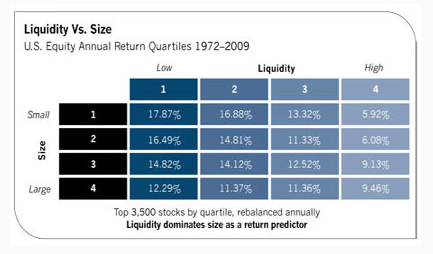](/content/images/wordpress/2014/09/Screen-Shot-2014-09-17-at-12.55.33-PM.png)**Dynamic #2:** There are a lot of microcap companies. Microcaps make up 51% (11,735/22,894= 51%) of all public companies on the US and Canadian stock exchanges.
**Dynamic #3:** The mainstream financial media’s constant attacks on microcaps and penny stocks keep investors away. This is quite comical given the fact that most investing gurus got their start in the microcap space. Warren Buffett, Peter Lynch, Joel Greenblatt and many others all started in microcaps. Berkshire Hathaway was an $18 million market cap when Buffett started buying shares. The companies he purchased like See’s Candies for $25 million in 1972 were effectively microcaps (hat tip @ejburnside). Investing gurus often go where inefficiencies are the greatest, and microcaps have historically been that place.
**Dynamic #4:** The really good, highly experienced microcap managers, quickly and literally move on to “bigger” things. As their assets grow, they need to invest in bigger companies so that it can move their performance needle. So for me as an investor this is great because there is a constant outflow of quality “competitors” for new ideas. The cream of the crop is constantly moving up the market cap threshold. A microcap investor friend of mine started a fund two years ago and now it’s up to $70 million. He told me this week that he just can’t look at anything under $50 million market cap anymore. Sounds good to me!
**Dynamic #5:** Bigger “smarter” money can only buy microcaps when they are higher. Connected to #3, larger funds can only buy microcaps when their stock price and liquidity profiles increase. As a company executes, the stock rises, the liquidity rises, and institutions can buy. I talk about this [\[HERE\]](http://microcapclub.com/2014/03/dont-worry-about-illiquidity-worry-about-being-right/).
Now I don’t want you to get the impression that microcap investing is easy. In many ways it is very challenging because of the human element, management, which has a far greater impact on these small companies. Management teams can do unpredictable things, but this added nuance is balanced out by a far greater reward profile in microcaps.
Becoming a great microcap investor is less about being smart, and more about working harder than other investors.
> “If your goal is to beat the market, an MBA or a Ph.D. from a top business school will be of virtually no help.” – Joel Greenblatt
I can attest to this. I’m a full time investor, and although I have an MBA, I can guarantee I’m rarely the smartest person in the room, even in a room of first graders. But I know what I know, and more importantly I know what I don’t know. My experience allows me to be able to make very quick, very precise decisions when evaluating a company and its management team.
Experienced individual investors and small institutions have a huge advantage when it comes to investing. That advantage is the ability to invest in microcaps, and with a little experience it’s a game you can win.
**\===> Interact and learn with 250+ of the best microcap investors on the planet.** [\[Join Us\]](https://microcapclub.com/join-now/)
MicroCapClub is an exclusive forum for experienced microcap investors focused on microcap companies (sub $500m market cap) trading on United States, Canadian, European, and Australian markets. MicroCapClub was created to be a platform for experienced microcap investors to share and discuss stock ideas. Since 2011, our members have profiled 1000+ microcap companies. Investors can join our community by applying to become a member or subscribing to gain instant view only access. MicroCapClub’s mission is to foster the highest quality microcap investor Community, produce Educational content for investors, and promote better Leadership in the microcap arena. For more information, visit [http://microcapclub.com](http://microcapclub.com/) and
### Buy Low And Then Buy Higher
URL: https://microcapclub.com/buy-low-and-then-buy-higher/
Last updated: 2023-10-15T12:05:28.000Z
How many times have you looked back at past investment decisions and thought, “What the heck was I thinking?!”. Don’t worry, that happens to everyone, even the professionals. Early on I started keeping an investment diary to track my thought processes and experiences on every investment I’ve owned.
> You can’t become a great investor overnight because its most important lessons can’t be taught, they have to be experienced
When I read through the diary I see commonalities amongst the winners and losers. The types of companies, management teams, share structures, etc. However one of the most glaring things that correlated to performance was how I bought my positions. All my winners had one thing in common, I was always averaging up. Most of my losers had one thing in common, I was always averaging down.
My buying strategy has evolved over the years. Early on I would pile into positions too quickly after naively believing what management would tell me. Overtime I realized giving up a small amount of upside to de-risk the investment was well worth it. I normally buy my positions in thirds as my conviction grows. If something doesn’t check out along the way I’m not stuck in a huge position.
I buy my first third after extensive due diligence and after talking to management. I dig through all the filings, industry journals, place some calls into customers, suppliers etc. Think of this as passing the smell test. I’m also making sure I have ample margin of safety.
**Margin of safety = if your investment thesis is completely wrong you will still make money**
I buy my second third after traveling and meeting management at their head quarters. I want to see what their offices look like, the interaction between management. Is it a dictatorship or a democracy at the management level? Can I find an employee who hasn’t been told “to be nice to me” and ask them questions? Does the company do the little things well? Do they pay attention to detail? What do they drive? What are their motivations? etc.
I buy my last third after the management team does 25% of what they say. The majority of microcaps over promise and under deliver. You make money on the ones that under promise and over deliver. It takes time to make sure you are betting on the right jockey. They need to prove this to you by executing, so buying this last third might not happen for months. With most of my winners, I bought this final third 100%+ higher than my first third.
My personal investment philosophy is to buy microcaps that I think can be 5-10x in a few years. It might sound insane, but I don’t buy stocks where the peak potential return is less than 100%. I’m trying to find and buy undervalued companies that have the potential to get very overvalued. That is my margin of safety. If I’m initially buying a $0.50 per share stock, I’m likely buying it because I think it can be a $5.00 stock in a few years. So who cares if I’m buying my last third at $1.10 after the investment has been greatly de-risked by management execution. Even after these small microcaps double, lets say from $10 million market cap to $20 million, they are still very under followed and not even on institutional radars. In all my big winners, I was constantly averaging up.
We’ve all heard investors say in a boastful tone, “XYZ stock is down again today, thank you very much Mr. Market for a great buying opportunity!”
We’ve all been there, so we all know they are full of SH!T. Averaging down never feels good. There are some instances when averaging down makes sense, but constantly averaging down never makes sense.
This one lesson of constantly averaging down was taught to me very early, in a rather extreme way. When I turned 18 years of age I took control of my college savings and decided to invest it. This was 1999-2000, the peak of the Dot Com bubble. A broker convinced me the next big thing was a recent smallcap tech IPO called Ibasis. I don’t remember the exact prices, but I believe I bought my first shares at $35, bought more at $25, more at $17, more at $10, more at $4, and sold everything close to $1\. In a matter of 12 months I lost close to 90% of my college savings that my parents saved for me over 20 years. Luckily I was working full time and I was going to a cheap college, so I could continue to pay my tuition. Over the years that followed I would be taught this lesson over and over again. Investing is a life long education and its teacher is loss.
When you find yourself constantly averaging down it’s normally a sign that your ego has taken over. You’ve convinced yourself you have to be right, but you forget that being broke and right is the same thing as being wrong. Your ego clouds your judgment and slows your thinking. Many investors have gone broke trying to prove the market wrong, and you certainly aren’t going to prove yourself right by throwing good money after bad.
> Successful investing isn’t about being right all the time; it’s more about the ability to identify when you are wrong quicker.
Andrew Stanton of Pixar sums this up even better – “Be wrong as fast as you can”.
Investing is tough because you have to constantly anticipate how other peoples thinking is going to change before they know it themselves. This means you have to buy investments early, before the investment is obvious, but there is a thin line between being early and being wrong. If you are constantly buying the stock lower it is likely the latter. If you find and buy great investments, you’ll likely be making subsequent purchases at higher levels. This is something to be proud of.
**\===> Interact and learn with 250+ of the best microcap investors on the planet. [\[Join Us\]](https://microcapclub.com/join-now/)**
MicroCapClub is an exclusive forum for experienced microcap investors focused on microcap companies (sub $500m market cap) trading on United States, Canadian, European, and Australian markets. MicroCapClub was created to be a platform for experienced microcap investors to share and discuss stock ideas. Since 2011, our members have profiled 1000+ microcap companies. Investors can join our community by applying to become a member or subscribing to gain instant view only access. MicroCapClub’s mission is to foster the highest quality microcap investor Community, produce Educational content for investors, and promote better Leadership in the microcap arena. For more information, visit [http://microcapclub.com](https://microcapclub.com/) and
### The Conviction To Hold
URL: https://microcapclub.com/the-conviction-to-hold/
Last updated: 2023-10-15T12:04:13.000Z
Extraordinary returns follow extraordinary discipline. Discipline in buying and [selling](http://microcapclub.com/2014/06/selling-is-harder-than-buying/), and maybe the most important one of all, holding. Developing the conviction to hold is something that I’ve learned over time. It didn’t come easy. The basis of this article is to give some insight on how to develop the conviction to hold your winners. It is very tempting to sell along the way, and it’s okay to take a little off the table, but the big money is made by holding.
> “It never was my thinking that made the big money for me. It always was my sitting.” — Reminiscences of a Stock Operator
Many of us, myself included, look at stocks that have made big moves and think to ourselves, “If I would have only knew about that company and bought it back then.” But would you really have developed the conviction to hold during the run up? The problem is that to achieve a multi-bagger in the portfolio, you have to hold a multi-bagger. And if you want it to change your life, you need to hold a lot of it.
**Don’t bother finding the next multi-bagger if you aren’t going to develop the conviction to hold it**
Over the last decade, I’ve been lucky enough to be invested in a few stocks that have gone up 5-10-20-30x over a multi-year time horizon. From my experience, the only way to hold onto a big position after it makes a big move is to know the underlying company better than anyone else. Greed and fear will test your resolve, so you need to learn to keep these emotions in check. You need to believe in your due diligence and form an unwavering conviction.
**So how do you develop the conviction to hold?**
A lot of due diligence is on the front-end of a buying decision, but it certainly doesn’t stop there. The maintenance due diligence following the buy decision is even more important. For me, I talk to management regularly and keep close watch of all the ancillary forces and trends that are driving the company’s business. My “edge” is knowing my positions better than anyone else. This doesn’t mean I’m going to be right, but the more I know the better.
I think many misperceive high conviction for close-mindedness, ignorance, and arrogance. The conviction I’m talking about is quite the opposite. You need to constantly assess your positions and openly listen to counter arguments. Only then will you have the conviction to hold multi-baggers because you will understand all sides to the story. You also need to develop a thick skin. If you are not ready to be criticized for your convictions than you aren’t ready to make real money.
I believe most investors focus too much on selling strategies and not enough time on knowing what they own. Selling strategies such as, “Sell half after a stock doubles” or “When a position reaches 10% of the portfolio, sell it down to 8%” are meant for lazy investors. These selling metrics-formulas-strategies sound great in academia or when selling an investment strategy to a bunch of lemmings who can’t think for themselves. The truth is if you know what you own at all times, you’ll know when to sell.
In many cases the stocks I’ve owned were better buys after they doubled then when I initially bought them. In many cases when a position became 30% of my portfolio there was a reason for it. The underlying business was doing really well, or institutions were just starting to nibble on shares, so why would I sell it. Just because a stock doubles, triples, etc, doesn’t mean it should be sold. Stocks should be sold when your maintenance due diligence shows something has changed. If you know the story better than anyone, you’ll likely get clues well before the rest of the market. When a company performs, and the story hasn’t changed, stop trying to change it. Enjoy the ride.
When a stock goes on a multi-year run there will be long periods of time when nothing happens. These are consolidation periods when old shareholders are selling and new investors are buying in. You will notice a 12-month period of time in this three-year chart where the stock does nothing. This is very normal.
[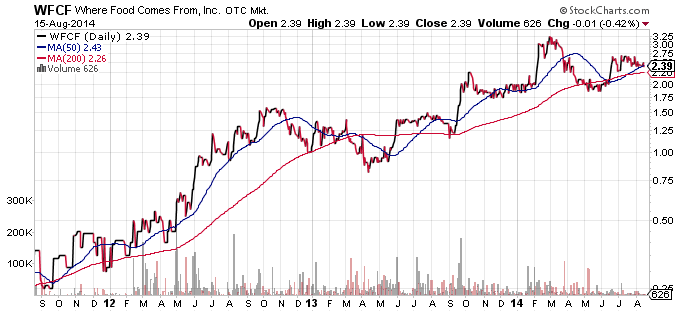](/content/images/wordpress/2014/08/wfcf.png)
Even in this amazing chart you’ll find a 10-month period where the stock didn’t go anywhere
[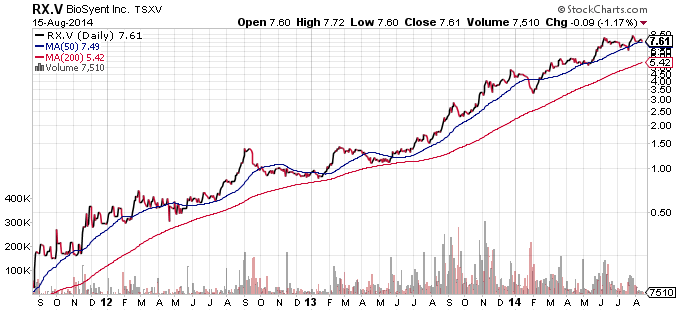](/content/images/wordpress/2014/08/rx.png)
A big part of successful investing is becoming content doing nothing. If you are in great companies, a lot of times your biggest risk is boredom. Warren Buffett’s famous quote, “Our favorite holding period is forever”. If he likes where the business is headed, he’ll continue to hold it and probably buy more. Don’t be active for activity sake. Remember, there are no day traders on the Forbes 400 list. Learn to be content holding and doing nothing.
> “Patience is power.
>
> Patience is not an absence of action;
>
> rather it is “timing”
>
> it waits on the right time to act,
>
> for the right principles
>
> and in the right way.”
>
> — Fulton J. Sheen
As a microcap investor who invests in companies with little to no institutional ownership, I want to hold for the institutional rally. When a management continues to execute on a great story, at some point it’s going to attract institutional inflows. You will see this when an illiquid stock all of sudden gets propelled by a sustained period of above average volume. Hello Institutions!
You can literally see the institutional rally in this chart of Vertex Energy (VTNR):
[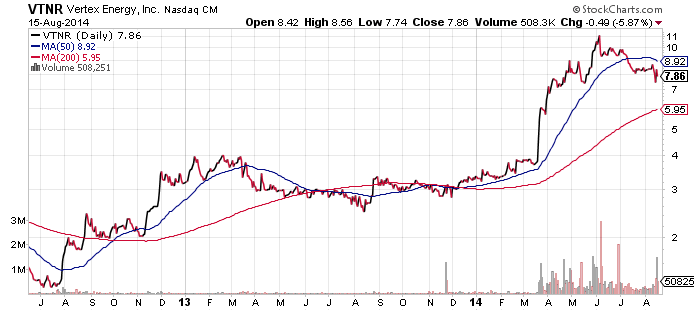](/content/images/wordpress/2014/08/vtnr.png)
A multi-year run is made up of a bunch of mini-cycles that can last weeks or months. During these times the stock can become undervalued or overvalued. Quite a few professional investors I know like to trade 10-20% of their full position during these swings. For my psyche I’ve found it to be counter productive. If I own a $5 stock and think it might go back to $4 before it goes to $10 in 12 months, I’m fine simply holding it through the mini-cycles.
I hope I’ve helped shed some light on a hard but lucrative topic. Many investors spend all their time trying to find great microcap companies only to sell them after quick paltry gains. If management is executing and the story hasn’t changed, hold on for the real money. Find great companies, develop the conviction to hold them, and it will change your life.
**\===> Interact and learn with 250+ of the best microcap investors on the planet. [\[Join Us\]](https://microcapclub.com/join-now/)**
MicroCapClub is an exclusive forum for experienced microcap investors focused on microcap companies (sub $500m market cap) trading on United States, Canadian, European, and Australian markets. MicroCapClub was created to be a platform for experienced microcap investors to share and discuss stock ideas. Since 2011, our members have profiled 1000+ microcap companies. Investors can join our community by applying to become a member or subscribing to gain instant view only access. MicroCapClub’s mission is to foster the highest quality microcap investor Community, produce Educational content for investors, and promote better Leadership in the microcap arena. For more information, visit [http://microcapclub.com](https://microcapclub.com/) and
### Adding Micro-Caps to Small-Caps: Unlock the Potential to Enhance Return and Lower Risk
URL: https://microcapclub.com/adding-micro-caps-to-small-caps-unlock-the-potential-to-enhance-return-and-lower-risk/
Last updated: 2015-07-10T09:14:47.000Z
Many investors have long recognized the benefits of adding small-cap stocks to diversified portfolios. An allocation to small-cap stocks can increase return potential, add to diversification and provide exposure to a relatively inefficient market. Yet many have not yet recognized the potential additional upside that comes from adding micro-cap stocks to their traditional asset allocations. Exposure to micro-caps can further boost potential returns, augment diversification through non-correlated performance and deliver many of the benefits of private equity and venture capital within a liquid vehicle. The strong benefits of micro-caps, combined with investors’ relative lack of attention to this dynamic asset class creates an opportunity. We believe exposure to micro-caps can further boost potential returns to your small-cap allocations: you can enhance returns while modestly reducing volatility and, in doing so, participate in the corporations of tomorrow by investing in the entrepreneurs of today.
[](http://www.perrittcap.com/wp-content/uploads/Perritt%5FAdvisorGuide%5FPUBLIC%5F08-11-14.pdf?ref=microcapclub.com)
CLICK TO VIEW WHITE PAPER
MicroCapClub is an exclusive forum for experienced microcap investors focused on microcap companies (sub $300m market cap) trading on United States and Canadian markets. MicroCapClub was created to be a platform for experienced microcap investors to share and discuss stock ideas. MicroCapClub’s mission is to foster the highest quality microcap investor Community, produce Educational content for investors, and promote better Leadership in the microcap arena. If you are a passionate microcap investor, **[Join Us](http://microcapclub.com/join-now/)**.
### Book Review: Free Capital by Guy Thomas
URL: https://microcapclub.com/book-review-free-capital-by-guy-thomas/
Last updated: 2023-10-15T12:00:42.000Z
When getting to know someone for the first time a question that ultimately comes up is, “What do you do for a living?”, and I hate this question. I find being a “full time private investor” is very hard to explain to those with financial-stock market experience let alone those that don’t. My wife knows this all too well. We are at a cocktail party or something and this question will be asked, and my wife and I exchange glances with a smirk. I don’t know why but however I explain it, I get the feeling that people leave the conversation thinking I’m definitely doing something illegal. Heck, when I first met my wife and I explained it to her I think she really thought I was a cocaine dealer. Over the years I’ve found the best answer to be that I’m “unemployed” because it will most certainly be the end to the conversation 🙂
I think the biggest reason people don’t quite understand how someone can be a full time private investor is because it’s so rare. Most successful investors end up starting a fund and managing other people’s money so they can scale and monetize their expertise. Staying a full time private investor is an enigma.
First, I would like to give a hat tip to Anil Tulsiram ([@Anil\_Tulsiram](https://twitter.com/Anil%5FTulsiram?ref=microcapclub.com)) and his blog at [ContrarianValue Edge](http://contrarianvalueedge.com/?ref=microcapclub.com) for bringing Free Capital to my attention. [Anil’s review of Free Capital is much better than mine and should be read.](http://contrarianvalueedge.com/2014/06/09/free-capital-amazing-journey-of-some-private-investors/?ref=microcapclub.com)
Free Capital is a book covering the lives and investment philosophies of 12 private full time investors mostly based in the UK. Their investment styles range from traders to investors, from momentum to value investors. I would estimate that most in the book manage a private portfolio of $2-5 million (USD) while a few of them $10-50 million.
The book gives a background on each investor, how they became a full time investor, and how their experiences seemed to shape their investment philosophies. It was really hard for me to put the book down, as I felt a close connection with a few of the investors. An overriding theme that stuck with me through the book was freedom. Freedom from clients, customers, a boss, a job, a geography, etc. Here is a great quote from one of the investors:
**“I found that it was possible to live a satisfying life on far less money than a banker’s salary……I realized that freedom is like income that cannot be taxed.”**
If you are a full time investor-trader or aspire to be one, I highly recommend Free Capital. You can buy it [\[HERE\]](http://www.amazon.com/Free-Capital-private-investors-millions/dp/1906659745/ref=sr%5F1%5F1?s=books&ie=UTF8&qid=1407066727&sr=1-1&keywords=free+capital&ref=microcapclub.com).
If you liked this book review, you’ll enjoy this podcast: [So You Want To Be A Full Time MicroCap Investor?](http://microcapclub.com/2015/01/so-you-want-to-be-a-full-time-microcap-investor/)
**\===> Interact and learn with 250+ of the best microcap investors on the planet.** [\[Join Us\]](https://microcapclub.com/join-now/)
MicroCapClub is an exclusive forum for experienced microcap investors focused on microcap companies (sub $500m market cap) trading on United States, Canadian, European, and Australian markets. MicroCapClub was created to be a platform for experienced microcap investors to share and discuss stock ideas. Since 2011, our members have profiled 1000+ microcap companies. Investors can join our community by applying to become a member or subscribing to gain instant view only access. MicroCapClub’s mission is to foster the highest quality microcap investor Community, produce Educational content for investors, and promote better Leadership in the microcap arena. For more information, visit [http://microcapclub.com](http://microcapclub.com/) and
### Investing in MicroCap Private Placements
URL: https://microcapclub.com/investing-in-microcap-private-placements/
Last updated: 2023-10-15T11:59:32.000Z
In general, you can invest in microcaps in one of two ways. First, you can buy a company’s stock in the open market, or Second, you can invest directly into the company via Private Placement. As an accredited investor I get pitched tons of private placement opportunities. Just like the IPO market, private placements and funding of microcap companies have been on the rise thanks to the bullish market we are currently in. The purpose of this article isn’t to showcase what types of companies to invest in, but rather what structural things to consider when investing in companies via private placements.
> [Definition of ‘Private Placement’](http://www.investopedia.com/terms/p/privateplacement.asp?ref=microcapclub.com): The sale of securities to a relatively small number of select investors as a way of raising capital. Since a private placement is offered to a few, select individuals, the placement does not have to be registered with the Securities and Exchange Commission. In many cases, detailed financial information is not disclosed and a the need for a prospectus is waived. Finally, since the placements are private rather than public, the average investor is only made aware of the placement after it has occurred.
[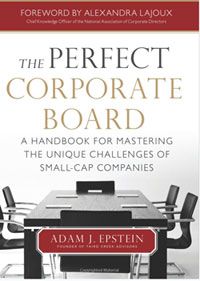](http://www.amazon.com/Perfect-Corporate-Board-Mastering-Challenges/dp/0071799540/ref=sr%5F1%5F1?s=books&ie=UTF8&qid=1405426343&sr=1-1&keywords=the+perfect+corporate+board&ref=microcapclub.com)For the basis of this article I’m using Private Placement interchangeably with any funding structure such as restricted common stock, registered common stock, convertible preferred stock, convertible notes, equity lines, etc. A great book hitting on many of the challenges of microcaps, specifically those that need to raise money is, [The Perfect Corporate Board](http://www.amazon.com/Perfect-Corporate-Board-Mastering-Challenges/dp/0071799540/ref=sr%5F1%5F1?s=books&ie=UTF8&qid=1405426343&sr=1-1&keywords=the+perfect+corporate+board&ref=microcapclub.com), by Adam Epstein.
Successfully investing in microcaps is all about stacking the deck in your favor. Much of that favor goes out the window when a company needs to raise capital.
I normally stay away from private placement investing because I tend to look for companies that don’t need to raise money, [A MicroCap Investors Worst Enemy is Dilution](http://microcapclub.com/2013/07/a-microcap-investors-worst-enemy-is-dilution/). But for this article I’m going to focus on the companies that do need to raise money.
There are currently 7,000 public companies on all US Exchanges (including OTCBB/OTC Markets) under $100 million market cap. 1,100 (15%) of these companies are profitable LTM. Said another way, 85% of companies under $100 million market cap don’t make money.
This is also why “microcap” investing has such a negative connotation by the mainstream financial media. I’m broad brushing a little bit here, but when you have 85% of a market with unprofitable businesses, many will fail, and the media loves to bring publicity to failure. Very little attention is brought to the fact that EVEN TODAY, 41% of the 1,100 profitable microcaps are trading at less than a 12 PE. But I digress…
An interesting phenomenon is that a lot of microcap institutions can only buy into microcap companies if there is a private placement opportunity because of lack of liquidity in the open market. So, a lot of the perceived “smart money” can only look at the 85% of unprofitable companies, and also a small percentage of profitable companies that need to raise capital to grow.
All of the above said, there are times when even I participate in private placements. I have personally participated in about 23 private placements over the last eight years. I normally have a small speculative slice devoted to such investments, but I only do them under certain circumstances.
**In general, I only invest in small private placements, when I know all the investors that are participating, when terms are right for the company, and when I know the story better than anyone else.**
I only invest in private placement when I know the story better than anyone else. Take the same approach to buying microcaps in the open market as you do when doing a private placement. Know the story better than anyone else. I often times see investors just throwing money at private placements. This is a big mistake. I have lost more money passively investing in companies via private placements than I’d like to admit.
I only invest in private placements where I know and trust the participants. It is important you know who the villains and heroes are as it relates to private placement investors.There are certain institutions in particular that you have to watch out for. As a side story, the churn and burn microcap financing years of pre-2008 (pre-financial crisis) had several large institutions ($500 million – $5 billion in AUM) that strictly invested in microcaps and smallcaps. These institutions would do “structured deals” with microcap companies. They were normally convertible debt structures that had 100%, 200%, even 300% warrant coverage that also paid a yield of cash and or stock. They would structure them in this way because accounting rules at the time would give the funds a cost basis of close to -0- but a value on their books near market which allowed them to show great performance for their investors, but also the ability to leverage these illiquid investments to do even more of these types of structured deals. When the financial crisis hit, Goldman, Smith Barney, etc would not let these funds leverage these types of investments, so most of these institutions have gotten much smaller or have closed down.
There are still quite a few funds around that do this and you don’t want to invest alongside them. There motivations are often times not the same as yours. For example, if there is significant warrant coverage these institutions will dump the stock (even at a loss) and hold the warrant(s). These types of participants often times force the company to deploy a percentage of the money raised (sometimes up to 25%) into hiring stock promoters and even deploying [hard mailers](http://microcapclub.com/2014/04/hard-mailer-pump-and-dump-performance-part-9/) to provide liquidity around the same time their stock becomes unrestricted. Also, if a company is simultaneously reverse merging into a shell and raising money, some institutional investors will be given free shares from the shell. So in essence, their cost basis is much lower than other participants in the private placement. There are a lot of games played by these slimy institutions, and if you don’t know how the game is played, you will get played.
[](/content/images/wordpress/2014/07/hero-vs-villain.jpg)
Know who the villain and heroes are
On the other side of the quality spectrum are a group of great institutions that will immediately attract other quality shareholders. These funds are not looking to flip the stock but to own it for years. I’ve invested alongside a couple of such funds, and it’s been a wonderful experience. Bottom-line, stay away from the slimy institutions, and make sure the other participant’s motivations are the same as yours.
I only invest in private placements that are good for the company. Beware of structured deals and private placements with too much warrant coverage (multiple warrants). These deals might look good for the investor but they aren’t for the company. Companies still take the money because they are weak and don’t have a choice. Don’t invest in these types of companies or deals. The terms of the private placement should be good for the company and for investors.
Everyone in a private placement invests on the same terms and everyone is unlocked and can sell at the same time. If there is significant warrant coverage, when the underlying stock becomes free trading, many will sell their shares at a loss and hold the warrant(s). Beware of this dynamic.
The real investors and institutions that don’t just want to “rent” the stock, but own it longer term make it a priority to do simple, straight forward, private placements. They don’t want the dilution and overhang that significant warrant coverage and structured deals create.
I prefer doing straight equity at a slight discount with no warrants. Here is an [example](http://biz.yahoo.com/e/140703/wfcf8-k.html?ref=microcapclub.com) of a recent private placement I participated in. There were no warrants, no investment banking fees, no registration statements, no BS. It was a good deal for the company and let myself and another investor build a position.
[](/content/images/wordpress/2014/07/smaller-is-better.jpg)
Smaller is better
I only invest in small private placements (<$2 million deals) in microcap companies. I don’t like participating in large financings in small microcap companies because these companies are normally illiquid. For example, when a $0.50 per share company that averages 10,000 – 50,000 in daily volume raises $10+ million, issuing 20 million shares plus likely millions of warrants, I pass. All of that stock will hit the market at the same time and create an impenetrable wall for the stock price. It’s not a winning situation. Smaller is better. You will not get crushed by the overhang of stock.
In conclusion, be very careful when investing in companies via private placements, and use the same investment philosophy you use for buying companies in the open market. Be sure you know who you are investing with and be leery of structured private placements with a lot of warrant coverage. Lastly, be cautious of large private placements because you will be eating through all that stock in the months ahead. This is a hard subject matter to explain in a brief article, but I hope I’ve outlined a few points you will find useful. Even taking this all into consideration, my rule of thumb is don’t write a check unless your willing to write another one.
**\===> Interact and learn with 250+ of the best microcap investors on the planet.** [\[Join Us\]](https://microcapclub.com/join-now/)
MicroCapClub is an exclusive forum for experienced microcap investors focused on microcap companies (sub $500m market cap) trading on United States, Canadian, European, and Australian markets. MicroCapClub was created to be a platform for experienced microcap investors to share and discuss stock ideas. Since 2011, our members have profiled 1000+ microcap companies. Investors can join our community by applying to become a member or subscribing to gain instant view only access. MicroCapClub’s mission is to foster the highest quality microcap investor Community, produce Educational content for investors, and promote better Leadership in the microcap arena. For more information, visit [http://microcapclub.com](http://microcapclub.com/) and
### Put Your Money Where Your Mouth Is Or Shut Your Mouth
URL: https://microcapclub.com/put-your-money-where-your-mouth-is-or-shut-your-mouth/
Last updated: 2023-10-15T11:58:32.000Z
One of my mentors in the business was a full time investor who had a big following. When I met him early in my investing career he showed me what to look for, how to talk to management, and even how to communicate a stock idea to others. He would find a company he liked, buy a position for the A account (his) and then let some friends know about it. His network of investors would buy some stock, and if management executed, would buy more and more. This isn’t dissimilar to what I do as well as most others. Some of the stocks worked out and some didn’t. Whether the idea worked out or not, the network always respected him. Why? Because he always put his money where his mouth was and he almost always bought more stock than anyone else. So if the story didn’t work out, he normally lost more than anyone else, so you couldn’t exactly hate the guy. You actually respected him for that.
He had this saying “Put your money where your mouth is or shut your mouth”.
This ideology really stuck with me as my own network of investors grew and my investment philosophy took shape.
One of my biggest annoyances is someone that is enthusiastically bullish or bearish on a stock and doesn’t even hold a position. I mean that makes no sense to me. When an analyst or fund manager comes onto CNBC and they list the chart that shows the individuals “conflicts of interest”: Do they own it personally? Anyone in his or her family own it? Does their fund own it? CNBC wants to see NO’s across the board, but I laugh because I want to see YES! across the board. I want to know that this person has something to lose if this pick doesn’t work.
In the world of social networks, message boards, twitter, it is mostly all noise, but it doesn’t mean you shouldn’t invest and communicate with a higher standard. You gain the respect of investors not through words but through courage. You do this by being early, being right, and putting your money on the line.
If you talk about stocks publicly, and in particular in a more aggressive bullish or bearish tone, here are three codes to live by:
First, Don’t talk bullishly about a stock unless you own it and would buy it at the current price. Own your ideas. Act like an owner not like an analyst. If you don’t own it, it must not be that great of an opportunity. This goes for service providers in the industry like investment bankers and investor relation’s professionals. If you are a banker raising money for a company, how much are you personally doing of the deal? If you are a company’s outside investor relation’s person, how much have you bought of the stock with your own money? If the answer is zero, then I normally have zero interest.
Second, Don’t ever talk bullishly about a stock if you are selling it.
Third, Don’t be cocky. No one likes talking to, following, or hanging out with a know-it-all. If you think you are smart, wait a little longer. The only people constantly touting their gains are those trying to sell you something. You gain much more respect and adoration by humbling yourself rather than glorifying yourself.
When talking with another investor, the most important question IS NOT:
“What is your favorite stock?”
it should be..
“What are you buying at the current price?”
When talking about stock ideas an investor is most prone to talk about a stock they are up a lot in, not necessarily one they are buying. The easiest way to get around this is simply to ask what they are buying.
As a microcap company executes it attracts greater and greater waves of capital. As a microcap stock increases, liquidity increases, and larger and larger funds will take positions. The irony is the larger money can only buy them when the stocks are higher and more liquid. I spend quite a bit of time talking to funds that could be the next wave of buyer in stocks that I’m in. They look to me for ideas. They likely can’t buy them now, but if management executes, the stock increases, and liquidity increases, they can become a buyer. There is a mutual respect because they know whatever stock I’m pitching to them I own a significant position in, and I likely know it better than anyone else.
I normally start of the conversation; “I own 500,000 shares of XYZ company that I purchased between $0.40 – and $1.40 with an average of $0.75\. I believe if management executes this could be a $5 in two years based on …….”
Through the years I’ve been right and I’ve been wrong, but investors that know me always know where I stand. I think it’s important to present yourself and your ideas in a respectful way. Especially for you younger investors, it takes years to build a reputation and seconds to destroy it. Set yourself apart from the noisy crowd. The financial media and others love to paint the picture that talking your book is a bad thing. That’s only because they don’t have the conviction to do it. Find great companies, put your money where your mouth is, communicate with integrity, and gain the respect of your peers.
**\===> Interact and learn with 250+ of the best microcap investors on the planet.** [\[Join Us\]](https://microcapclub.com/join-now/)
MicroCapClub is an exclusive forum for experienced microcap investors focused on microcap companies (sub $500m market cap) trading on United States, Canadian, European, and Australian markets. MicroCapClub was created to be a platform for experienced microcap investors to share and discuss stock ideas. Since 2011, our members have profiled 1000+ microcap companies. Investors can join our community by applying to become a member or subscribing to gain instant view only access. MicroCapClub’s mission is to foster the highest quality microcap investor Community, produce Educational content for investors, and promote better Leadership in the microcap arena. For more information, visit [http://microcapclub.com](http://microcapclub.com/) and
### Selling Is Harder Than Buying
URL: https://microcapclub.com/selling-is-harder-than-buying/
Last updated: 2023-10-15T11:48:56.000Z
I really enjoy meeting investors face to face. A couple times per year we try to have MicroCapClub member meetups where those that are interested get together and just talk stocks for a day or two. We just had one of these events in Idaho, YES, [Coeur d’Alene, Idaho](http://www.cdaresort.com/?ref=microcapclub.com). There is nothing quite like sitting around with likeminded investors telling stories and pitching ideas.
One evening a few of us got on the subject of “round trippers”. These are stocks that you’ve ridden up and the whole way back down. There are a slew of microcaps that make big gains, but many of them come right back down. They are some fad or momentum stocks that for a few weeks or months get thrown into the spotlight. “Round Trippers” happen to everyone, and they’re part of the learning process. I’ve been lucky and really have only had one really bad experience with a round tripper.
I’ve tried to bury the memory of this investment, but it was in 2006\. The company was Charys Holdings and the overview of the story is [HERE](http://microcapclub.com/2012/10/the-ultimate-hurricane-stock-that-ended-in-disaster/). My cost basis was around $1, and literally in two months it went to $11\. Then I road it down, and down, and down, and down and sold for a loss. At the peak I was up $1 million, and several months later I took a $50,000 loss. Another MicroCapClub member, a very successful microcap investor, told a similar horrific story from the mid 90’s when he was up $35 million in a position and road it the whole way back down.
> There is no greater motivator or educator than experiencing loss.
The Psyche of Selling: Selling is harder than buying, so when and how do I sell?
First and foremost, I try to know my investments better than anyone else. This helps me to initially buy, to hold, and to sell. My position sizing might be unorthodox to most as I normally hold several days to several weeks worth of volume. When I know a company and especially the ancillary forces (industry, consumer tailwinds, etc) better than anyone else it gives me an edge. This edge might give me minutes, hours, or day’s advantage over anyone else. Being on the front lines has given me unwavering conviction to hold multi-baggers and also the ability to spot changes quicker than others and sell before the masses.
> Your “gut feeling” is normally right because it’s the sum total of all your perceptions.
When you know you should be selling it’s normally too late. Through the years I’ve found that when I start to see cracks form in my investment thesis, I should be selling. When I start thinking about selling, I should be selling. When I start to rationalize holding a position, I should be selling. When I feel management has lied to me, I should be selling. Listen to your gut.
> Over-Confidence is the only emotion or state of mind that helps me as an investor, and it’s not for the reason you might think.
I’ve said this in other blog posts, but when I start to really get over confident, basically when I turn into an asshole, I need to start selling. Several years ago when I was vacationing with my wife and in laws, a position I was in was up 1000% in 6 months. I made some sly remark to my wife one morning at breakfast in front of her family. My wife said, “Ian, don’t be a dick”. I immediately went and sold half my position. Two months later the stock was down 60%. Believe it or not, but my over-confidence has pin pointed some amazing exits over the last several years.
When you’ve spent months or years in an investment being bullish, once your brain switches to the sell side, you’re mind almost becomes divorced from the stock. I’ve found that once I start selling a position it’s hard to stop selling it.
Rules for Selling
I’ve never had a fixed set of guidelines for selling based on stock price. I really don’t have rules such as: I’m going to sell half once a stock doubles, or I’m going to sell my position if the stock drops to X price, or when XYZ stock goes over 10% of the overall portfolio I’m going to sell it down to 8%.
For my strategy, it’s just a waste of time to have such rules because my position size will ultimately grow with my confidence level. Just because a stock doubles or triples doesn’t mean it’s a sell. I’ve been in many stocks whose situations were far better and even less risky after their stocks doubled.
Here are four reasons why I would sell:
1. **Sell when you find something better**. You want to always evaluate new opportunities against what you already own. When you find an investment that is much better than a current investment you sell.
2. **Sell when the story changes**, and I try to know the companies better than anyone so I can spot the changes before anyone.
3. **Sell at the first sign of management incompetence or unethical behavior**. Sometimes management teams make a decision that is so bad you have to sell. The reason is because of the cockroach theory. When you see one bad decision there will be more that follow.
4. **Sell when the company gets very overvalued.** I’m a long-term investor but there are cases where the stock price gets way too far ahead of the business. Evaluate the current valuation against your three or five year expectations-estimates.
How To Sell
I always TRY to sell on the offer and into strength, but the reality is not every stock you are going to want to sell is going to go up and to the right. So lets divide this up into two groups, selling winners and selling losers.
**Selling Winners** (stocks that are going up)
If I own 100,000 shares of a $5 stock and I’ve made the decision to sell, I normally use limit orders and might sell 1,000 – 2,000 shares every 0.10 up from $5\. The greater I feel the gap is between expectation and reality the more quantity I will sell. I don’t like to sell on round even numbers, say 5.10, 5.20, 5.30, 5.40 because that’s what everyone else does, so I’ll sell at 5.08, 5.18, 5.28 etc.
**Selling Losers** (stocks that are going sideways or down)
When I stock is flat lining or falling, psychology plays a big role in exiting a position. You don’t want to make a weak stock even weaker because you’ll just shoot yourself in the foot. You also don’t want to be too cute about selling it because it’s probably only a matter of time until someone else sells. If I feel I have time, I normally look for a larger bid and sell a percentage of the bid. So if someone is bidding for 10,000 shares, I might hit it for 6,000\. This way I won’t make the stock even weaker if I were to take the whole bid. It once took me a couple months to exit a position in this manner, but the stock price wasn’t affected.
On the fringes of extreme volatility is volume. Meaning if a stock is down 15-20% in a day you will find more buyers, then if the stock trickled down 3% per day over five days. If I feel I don’t have much time and there is significant downside, I will just sell the stock down 15% so I can find the volume to just exit a nice percentage of my position.
To be a successful investor you need to know when to sell and how to sell. It’s taken several years for my selling strategy to evolve. For me it’s more of an art than an exact science. Feel free to comment and give me your thoughts on selling.
**\===> Interact and learn with 250+ of the best microcap investors on the planet.** [\[Join Us\]](https://microcapclub.com/join-now/)
MicroCapClub is an exclusive forum for experienced microcap investors focused on microcap companies (sub $500m market cap) trading on United States, Canadian, European, and Australian markets. MicroCapClub was created to be a platform for experienced microcap investors to share and discuss stock ideas. Since 2011, our members have profiled 1000+ microcap companies. Investors can join our community by applying to become a member or subscribing to gain instant view only access. MicroCapClub’s mission is to foster the highest quality microcap investor Community, produce Educational content for investors, and promote better Leadership in the microcap arena. For more information, visit [http://microcapclub.com](http://microcapclub.com/) and
### Book Review: Bouncing Back - The Life of Bill Bartmann by Bill Bartmann
URL: https://microcapclub.com/book-review-bouncing-back-the-life-of-bill-bartmann-by-bill-bartmann/
Last updated: 2023-10-15T11:46:45.000Z
I absolutely love reading business biographies because there is always some nugget of information that helps me to be a better investor. How do I find good business biographies? Searching Amazon for the highest rated business biographies that exist. Bouncing Back: The Life of Bill Bartmann published September 2013 is ranked #9.
Bill Bartmann’s story is one of perseverance and determination, and I have no doubt it will be made into a movie at some point. Bartmann grew up dirt poor, in an abusive family, and dropped out of High School when he was 15\. Soon after he moved out of his parents place, he found a job at a traveling circus (literally), joined a gang so he could live at their head quarters (a shack), and became an alcoholic by the time he was 16\. He got so drunk one evening that he fell down a flight of stairs and was paralyzed and told he would never walk again. This was all before the age of 18\. Does this sound like a promising story? And this is just the beginning.
Through sheer determination, Bill Bartmann ended up walking again, getting his GED, getting his college degree, and law degree. He would start several businesses involving real estate, to oil exploration, to oil services and each time went from nothing to millionaire to back to nothing.
Bartmann would end up founding Commercial Financial Services (CFS) when he was dead broke, and created a whole industry. Bartmann grew CFS into a multi billion-dollar operation, with 3900 employees, with net margins as high as 48%. Bartmann became a billionaire.
In 1998, an anonymous letter was sent to regulators by a rogue employee, which started an investigation into CFS. Was it a fraud? As a result, a domino effect ensued which forced CFS into bankruptcy. Bartmann would be charged with criminal and civil litigation. The IRS, SEC, DOJ, FBI took their case against Bartmann to court. He faced something like 57 counts and 600 years in prison. They wanted him bad. The only problem was CFS wasn’t a fraud and Bartmann was found Not Guilty on all counts. In 2005, after all the litigation expenses and his ownership in CFS now worthless, Bartmann was broke again.
Just like before, he kept moving forward and started CFS (Part 2). His new company is now on the Inc. 500 list (for the 5th time).
The book was an amazing read. You can buy it [\[HERE\]](http://www.amazon.com/Bouncing-Back-Life-Bill-Bartmann-ebook/dp/B00FK6XFZQ/ref=sr%5F1%5F9?s=books&ie=UTF8&qid=1403443043&sr=1-9&ref=microcapclub.com).
**\===> Interact and learn with 250+ of the best microcap investors on the planet.** [\[Join Us\]](https://microcapclub.com/join-now/)
MicroCapClub is an exclusive forum for experienced microcap investors focused on microcap companies (sub $500m market cap) trading on United States, Canadian, European, and Australian markets. MicroCapClub was created to be a platform for experienced microcap investors to share and discuss stock ideas. Since 2011, our members have profiled 1000+ microcap companies. Investors can join our community by applying to become a member or subscribing to gain instant view only access. MicroCapClub’s mission is to foster the highest quality microcap investor Community, produce Educational content for investors, and promote better Leadership in the microcap arena. For more information, visit [http://microcapclub.com](http://microcapclub.com/) and
### Always Be Respectful
URL: https://microcapclub.com/always-be-respectful/
Last updated: 2023-10-15T11:45:48.000Z
Our experiences on the extremes of investing are often very memorable. You invested in a company and almost the very next day the rest of the world seemed to wake up to the story too and the stock goes on an epic run. Or you invested in a company and it’s almost like the investing gods were waiting for you to invest before trouncing the stock. These instances on the fringes, on the extremes, are the ones burned into our psyche, but there are many more experiences that fall somewhere in the middle.
Several years ago I found a great company. I found the symbol while scanning public message boards, dove into the financials and liked what I saw. Soon after I flew down to visit the management team and really got a comfort level for the company. Over the course of several months I built up a sizable position, just under 5% of the company.
During this time I spent hours with the CEO getting to know him. He had started the business by quitting his corporate job and cashing in his and his wife’s retirement accounts. He was “All In”.
Later that year he invited me to join him at the company’s Christmas Party. I obliged and felt this would be a good time to meet other employees within the company.
There were a couple hundred people at the Christmas party, which included spouses and kids. I could tell very quickly the employees loved working there, and they loved working for the CEO.
When the CEO got up to speak, he started off by singling out 7-10 people from low-level line workers to his CFO, personally commending them on the job they did. As he went from praising one individual to the next I’d watch the faces of their families as you could see the sense of pride boil over inside of them. The CEO showed sincere appreciation to his workers, and he inspired passionately. They would have taken a bullet for him. The culture at the company was amazing and it came from the top down.
The company was expanding aggressively at the worst possible time, late 2007-early 2008.
- As a side note, hindsight is 20/20 and we all like to think we are smarter then what we really are. I know I was naïve to the possibilities of a 2008 market crash, so I can’t blame a CEO for being the same way.
The economy went into recession. The tide went out on the business and the company’s over expansion almost bankrupted them. The CEO had to lay off 70% of his workforce, and the stock went down 80%. The stock was what I call a round trip for me. I bought, it went up, and then came down and I sold. I think I broke even.
What I remember though is the last conversation I had with the CEO. He was coming up to Philadelphia for a business meeting, so I met him for breakfast. It was in early 2009 as the walls were crashing in around him. Knowing how much he respected his employees and vice versa, and knowing that he was “All In” I can’t imagine the stress he was under.
If you ever want to see how stress ages a person, look at a picture any President of the United States when he is sworn into office, and then look at a picture of him the day he leaves office. You can literally see a person age 25 years in a few short years. This CEO was no different; he looked 10 years older than he did a year earlier.
He asked me what I thought he should do and I was frank with him and told him I thought he was doing everything he should be doing, but that it probably wasn’t going to be good enough.
After dinner while taking the train back to Lancaster, I couldn’t stop thinking about the situation. I was lucky. I could just sell the stock and move on, but for him the company was his whole life, his family’s net worth, and his legacy.
The company is still around today, worth a little more then it was back at the 2008-2009 lows mostly because the emerging trend the company was in several years ago came and went. I haven’t talked to the CEO since.
Over the last ten years I’ve had a handful of great winners, a handful of disastrous losers, and the rest somewhere in the middle. Not every company I will invest in will be great, but it’s often times not the management’s fault. Market forces and just plain [luck play a greater role](http://microcapclub.com/2014/05/how-lucky-are-you/) then we like to admit.
A big part of my investment philosophy is getting to know management. Always be respectful of management because if they think you are a prick, they will never talk to you. As an investor it’s easy to give management teams a cold shoulder and almost think they are beneath us as investors when in fact in most instances they have much more on the line then we do. We are lucky; we can just sell and move on.
**\===> Interact and learn with 250+ of the best microcap investors on the planet.** [\[Join Us\]](https://microcapclub.com/join-now/)
MicroCapClub is an exclusive forum for experienced microcap investors focused on microcap companies (sub $500m market cap) trading on United States, Canadian, European, and Australian markets. MicroCapClub was created to be a platform for experienced microcap investors to share and discuss stock ideas. Since 2011, our members have profiled 1000+ microcap companies. Investors can join our community by applying to become a member or subscribing to gain instant view only access. MicroCapClub’s mission is to foster the highest quality microcap investor Community, produce Educational content for investors, and promote better Leadership in the microcap arena. For more information, visit [http://microcapclub.com](http://microcapclub.com/) and
### A Basic Primer On Starting A MicroCap Fund
URL: https://microcapclub.com/a-basic-primer-on-starting-a-microcap-fund/
Last updated: 2023-10-15T11:44:30.000Z
I co-manage Blueprint Capital Management ([www.blueprintcm.com](http://www.blueprintcm.com/?ref=microcapclub.com)) which is a MicroCap growth equity strategy focused primarily on the Technology and Consumer sectors. I launched my fund almost two years ago and, over time, have fielded many inquiries, both general and specific, regarding the initial setup, preferred structure, and actual investment procedures we have put in place to manage our client assets for the long-term. This blog may serve useful to others considering starting their own investment management business, and I hope you find it useful as an instructive tool.
The Basics – Investment Philosophy and Expectations
First off, one needs to develop a sound philosophy for their strategy. This relates to what you believe in and how, exactly, you plan to execute on those beliefs. We have a detailed presentation book that covers these topics, and many others, upfront when talking to prospective clients. This openly lays out our business model, and helps set realistic expectations for the ongoing relationship. This may seem like obvious business strategy, but one would be surprised! We have seen some very unstructured business plans out there. An investment strategy should not be open-ended, as it will give too much leeway to destroy value over time. Money managers should have a clear focus and discipline to stay within their area of expertise or specialty. This will limit the undesired evolution of a manager that has been hired to pick MicroCaps from suddenly dabbling in convertible bonds or another strategy for which they were not hired. Our investors know what to expect. For example, we do not dabble in biotech or energy, and state this very clearly. If there are well-articulated expectations and parameters, then investors will clearly know when you have met them, or not. This enables trust and accountability on both sides of the relationship.
Portfolio Construction, Investment Process & Discipline
[](/content/images/wordpress/2014/05/your-mother-called.jpg)Having a framework, or “blueprint” is important to know how to build a house or run an investment portfolio. Having clear guidelines regarding portfolio construction, investment process and discipline are paramount. It will allow investors to better evaluate you, and it demonstrates that what you are doing is repeatable. We drive outsized returns based on taking concentrated bets across 12-15 MicroCap investments. We first get to know our companies very well using a repeatable process and a key tenet to this approach is accessibility to management. Without accessibility to the CEO or CFO, we will not invest with a company. It is a black and white deal breaker for us. Going deeper with each investment enables us to take more concentrated positions. I don’t see how a money manager can have a Portfolio Manager (PM) to Position ratio greater than 10 to 1\. In other words, it takes time and resources to truly understand a company, gain an edge, and continue to monitor the investment. Blueprint has two PMs, and we don’t own more than 15 total names. This is very manageable from a bandwidth perspective. When a client asks, why should I invest with you? You must be able to outline why the strategy is different and where you derive an advantage. Our advantage is information… and yours should likely be the same as well. Clients will want to see a replicable plan with a performance track record reflecting good performance. A manager who strays from their core discipline will struggle with messaging the true direction of the strategy without such focus.
Discipline with position sizing, entry and exit points, and ongoing due diligence and risk management are all additional points to consider before taking steps forward. A simple structure likely makes the most sense. Concentrated also makes sense in micro cap as you take relatively larger investments in companies you feel have asymmetric risk reward. The bets can be bigger in micro caps because the reward should, in theory, be much greater when you are correct. Our goal is 3x reward relative to risk, at least, from our initial purchase. That being said, if something has 30% downside, we must therefore envision a realistic scenario where the investment could increase 90%. Based on that risk reward multiple, we determine a weighting within the portfolio. Most positions begin at 5% but more speculative and/or less liquid opportunities can start at 2.5%. Our best ideas frequently are bought up to 10% and can exceed that as they appreciate. This framework is a simple basis for constructing a portfolio. Managing risk and downside are critical, and often the sell-discipline is the hardest part of this business. We have put in place clear guidelines for this.
Structure: Limited Partnership (LP) vs. Separately Managed Accounts (SMA)
A topic that can be debated more so than any other is that which focuses on the more traditional LP hedge fund structure or attempting to build a fund using an SMA platform. In a post Bernie Madoff world, we feel it is imperative to offer clients separately managed accounts, but also full transparency. There are pros and cons to each of course.
LP: The LP structure is a very common approach to managing an investment strategy, often referred to as a hedge fund. However, as a startup it is fairly expensive out of the gate, and can have onerous ongoing service costs relating to legal, administration and auditing expenses. In the long run, this investment may make it easier to attract larger institutional clients and it may also provide greater ease when participating in private placements or other types of non-standard transactions. The downside of the LP structure is lack of real-time transparency and infrequent performance disclosure. One could also argue that your investors are taking hiding risk by sharing, or co-mingling their liquidity, which can have negative implications which were felt during the 2008 financial crisis.
SMA: The SMA structure, most importantly, allows for complete real-time transparency. Each client owns their own account and can always see what is happening. There is nothing to hide. Each account can be viewed via the web in real time which we feel is incredibly valuable in a world where scandal sometimes makes the headlines more often than it should. The inability to participate in private placements can be a key limitation of this structure, and should be considered to the extent your investment philosophy warrants this type of flexibility. If all of your clients are accredited investors, this limitation becomes less relevant, but logistical hurdles remain. Liquidity is not commingled, and each investor can be liquidated individually.
Fees: Fixed vs. Performance
The topic of fees is an important one. There are asset gatherers and asset managers. We are the latter. My partner and I want to focus on two things: finding investment opportunities and taking measured risk to yield a commensurate investment return. Quite frankly, marketing and raising assets is a distraction, and our least favorite activity. The majority of asset gatherers do not have proper alignment of interests with their clients. Financial advisors are incentivized to wrap your account with a 50bps to 100bps (1.00%) annual fee. With that structure, the advisor does not win when you win and they do not lose when you lose. This is a structural flaw in compensation, and encourages time spent on marketing, rather than investing. When you think about your strategy and the assets you manage, you should 1) invest heavily alongside your clients, and 2) you should charge a performance fee so that you are incentivized to wake up early and make your clients money, and protect them from losses.
MicroCap strategies also command a pricing premium over large caps. MicroCap equities are not as liquid, do not attract larger institutions, and have yet to be found. This requires more work in the form of travel and resources. For that, you should charge a premium and when your performance reflects outsized returns, that premium is further justified. I would discourage future PM’s against a fixed only fee when managing MicroCaps and would suggest a hybrid approach that incorporates both a fixed (to help offset the cost of running your business) and a variable performance fee (which essentially pays you for your hard work).
Platform
Platform is very important with a few choices to weigh as you move forward. Start up managers do not have the same brokerage services at their disposal that larger funds do. In fact, an LP structure offers even more variety in the path towards setting up your fund appropriately. We have had a very positive experience using Interactive Brokers (IB), which incidentally was named Best Online Broker in 2014 by Barron’s.
IB has an amazing low cost platform for managers that works brilliantly for managing SMA’s across any number of clients, whether 5 or 500\. The platform is essentially free, but IB primarily earns its revenue via transactions fees, which in our experience are the lowest in the SMA world. Competitors to IB’s SMA platform would include Schwab and Fidelity and several others. IB receives lower grades when comparing it to larger firms, in terms of web/user interface and client reporting. Clients overwhelmingly prefer to pay lower execution fees, in our conversations with them. We also produce custom monthly letters for our clients to augment what IB can offer.
When clients sign up with you as the money manager, they open an account directly with IB Brokers as they normally would any other brokerage account. The only difference is that you have discretionary investment authority as the advisor over their account. This means a few different things. One, you can only trade the account. Two, they can access their account any time they want. And three, any back office/administrative type action occurs directly with IB. As a result, there is no risk that your startup fund will have issues with audits, where money is held, allocation of shares via trading, etc. IB covers it all and all of our clients thoroughly enjoy the safety and benefits that such a relationship offers.
Liquidity
[](/content/images/wordpress/2014/05/598793-31230-55.jpg)The norm in LP structures has typically been quarterly redemption with 90 days notice. Similar to our belief on transparency, we think this feature is out of date and that investors should be provided with greater liquidity where appropriate, and which should match the underlying strategy. An equity strategy can provide more attractive terms and thus should do so. We suggest managers seriously consider offering monthly liquidity on a rolling basis. The beauty of SMA’s is that accounting is less complex with assets held in each individual account. As a result, the risk with liquidity is simply moving assets from individual securities to cash. We offer monthly terms and as such position the portfolio accordingly to accommodate such requests. The reason one would not want to offer a shorter frequency is that 30 days provides ample time to maneuver the portfolio. However, if the markets were volatile and a large portion of the strategy decided to redeem, the 30 day window is a protective measure for all clients.
Client Service
Effective and frequent communication cannot be understated. We have an open-door and completely transparent policy on what we own and why. Our investors can pick up the phone at any time and discuss their account or any of our holdings. We write very detailed monthly letters that discuss our actions, whether these are new positions or updates on existing ones. We are often complemented on these letters, and believe the time spent in preparing them go a very long way in client satisfaction and retention. Talk to your clients often. Sometimes you learn things that are really important, about them, their financial profile, and maybe you can help them in other ways that don’t relate to getting paid. Build a relationship based on mutual respect and trust, and it will pay off in good times and bad.
**\===> Interact and learn with 250+ of the best microcap investors on the planet.** [\[Join Us\]](https://microcapclub.com/join-now/)
MicroCapClub is an exclusive forum for experienced microcap investors focused on microcap companies (sub $500m market cap) trading on United States, Canadian, European, and Australian markets. MicroCapClub was created to be a platform for experienced microcap investors to share and discuss stock ideas. Since 2011, our members have profiled 1000+ microcap companies. Investors can join our community by applying to become a member or subscribing to gain instant view only access. MicroCapClub’s mission is to foster the highest quality microcap investor Community, produce Educational content for investors, and promote better Leadership in the microcap arena. For more information, visit [http://microcapclub.com](http://microcapclub.com/) and
### Book Review: Benjamin Graham And The Power of Growth Stocks by Frederick K. Martin
URL: https://microcapclub.com/book-review-benjamin-graham-and-the-power-of-growth-stocks-by-frederick-k-martin/
Last updated: 2023-10-15T11:43:09.000Z
[*Benjamin Graham And The Power of Growth Stocks*](http://www.amazon.com/Benjamin-Graham-Power-Growth-Stocks/dp/0071753893/ref=sr%5F1%5F1?ie=UTF8&qid=1400691192&sr=8-1&keywords=benjamin+graham+and+the+power+of+growth+stocks&ref=microcapclub.com) is the most important investment book I’ve ever read. Employing the principles outlined in the book, the author’s firm (Disciplined Growth Investors) has generated exceptional results for his clients. One offers this summary in the book’s foreword:
> When Frederick Martin “took over management of the (my firm’s) account in 1980, we had a total of $841,338 in the pension fund. Since then, some money has been added and some has been withdrawn, adding up to a total net addition to the original amount of $967,943\. That means that, all in all, we have contributed a net total of about $1.8 million. Under Fred’s management, that sum had grown to $96.9 million as of April 30, 2011 – an increase of more than 5,000 percent.”
– Craig R. Weflen, Administrator, Noran Neurological Clinic
Benjamin Graham of course wrote *Security Analysis* and *The Intelligent Investor*, two books widely considered to be classics of investment literature. He was also [Warren Buffet’s professor, employer and mentor](http://en.wikipedia.org/wiki/Benjamin%5FGraham?ref=microcapclub.com) for twenty years. While primarily known for the principles of value investing that he developed during the 1930s, Graham’s most successful single investment was a growth stock, GEICO, which yielded a greater return than all of the other investments he made in his career *combined.* His investment firm put roughly a quarter of its investable assets into GEICO at $27 a share. It rose to the equivalent of $54,000 a share.
The two investment principles in the book that I find particularly fascinating and useful:
1. Growth stocks tend to be more volatile than value stocks because their pricing reflects a prediction of future growth. When investors, in the aggregate, are optimistic, growth stocks trade at big premiums. When pessimistic, growth stocks often trade at values close to those of “value” stocks.
2. Buying high-growth stocks of companies that offer something exceptional to their customers after a 30-50% decline from a market top has historically provided returns to investors way in excess of those of the overall market. Such an investment strategy requires doing battle with one’s own psyche – researching companies for years without investing, investing only every few years, holding for long periods of time, and buying during times of widespread negativity about the economy and the market.
The two investment principles espoused in the book that I find questionable and that I do not incorporate into my investment practices:
1. Valuing a growth stock based on estimating earnings over the next seven to ten years is important to successful growth stock investing. (I don’t believe that most investors can reliably enough estimate future earnings or P/E ratios (which are highly-dependent on future interest rates) to be consistently useful.
2. It is important to growth stock investing to purchase securities at a significant discount to the estimated present value of future earnings to insure a “margin of safety.” (I’m concerned that this rules out growth stocks with the best long-term prospects).
The book also offers:
1. Important perspectives on how to identify companies that have sustainably high growth rates.
2. Fascinating case studies of investments by the author’s firm, including those that worked out fabulously (Apple, for instance), were losers or mediocrities.
3. The entire chapter “Newer Methods for Valuing Growth Stocks” from the 1962 edition of *Security Analysis* 1962 (a section unfortunately excluded from editions of *Security Analysis* after 2009). The chapter includes the simple mathematical formula Graham developed to value growth stocks, and a detailed analysis of appropriate P/E ratios for companies growing at various sustainable rates. I find the analysis fascinating, but do not accept the conclusions because I believe it to be too dependent upon future estimates of earnings and interest rates.
I offer this review in order to try to make a contribution to other members-readers of the MicroCapClub during this period when I am reluctant to offer opinions of specific small cap stocks due to concerns over the global economy, and stock market cycle.
For any reader interested in a longer version of this review, including extensive quotes from the book, and from Graham & Dodd’s *Security Analysis,* please contact me at [rodmaciver@gmail.com](mailto:rodmaciver@gmail.com).
If you liked this book review, you’ll enjoy [I Passed on Berkshire Hathaway at $97 Per Share](http://microcapclub.com/2015/05/i-passed-on-berkshire-hathaway-at-97-per-share/)
**\===> Interact and learn with 250+ of the best microcap investors on the planet.** [\[Join Us\]](https://microcapclub.com/join-now/)
MicroCapClub is an exclusive forum for experienced microcap investors focused on microcap companies (sub $500m market cap) trading on United States, Canadian, European, and Australian markets. MicroCapClub was created to be a platform for experienced microcap investors to share and discuss stock ideas. Since 2011, our members have profiled 1000+ microcap companies. Investors can join our community by applying to become a member or subscribing to gain instant view only access. MicroCapClub’s mission is to foster the highest quality microcap investor Community, produce Educational content for investors, and promote better Leadership in the microcap arena. For more information, visit [http://microcapclub.com](http://microcapclub.com/) and
### Invest With A Passion
URL: https://microcapclub.com/invest-with-a-passion/
Last updated: 2023-10-15T11:41:10.000Z
When I was 11 years old I swung my first golf club, and I was hooked. It was my passion. At that very minute my love for soccer ended. I remember thinking even back then, “How long can I really kick this ball around for? What? 10 years tops? This is a waste of my time. Now golf is a game I can play until I’m 80 years old. This makes sense to me”.
The problem was that I was 11 years old and golf cost money. I saved up enough money from mowing lawns to buy a used set of golf clubs, but chipping around the backyard got old really fast.
Our neighbor was a farmer and his barn (with a metal roof) was about 160 yards away. When I got bored of chipping, which happened more and more regularly, I would tee up my driver and aim right for that barn. I would swing as hard as I could, and as soon as I made contact, turn and run to the other side of the house and wait.
A few seconds later, “Crash!!”, the golf ball would hit the tin roof and make a horrendous noise. On several occasions I’d see the farmer run around from the other side of the barn looking upward not knowing what had happened. I would laugh and laugh. I didn’t think the farmer knew what was happening. Then one day the farmer stopped by while I was mowing and handed me a bucket with 30 or so golf balls in it. He surprisingly wasn’t that angry except for a stray drive that came inches from hitting his wife who was tending to the garden. I decided to stop such activity.
Soon after I started playing once per week at an executive course (a 2/3 scale course) about 4 miles away from my house. I would get up early and try to get all my work done as soon as possible so I might be able to convince my Mom to drive me to the course. Maybe 25% of the time I would convince her.
On one day in particular I wasn’t going to take “No” for an answer. In fact as soon as my Mom said “No”, I ran out to the garage, grabbed my golf clubs, hopped on my bike and started peddling. The golf bag was very heavy (I was only 11 years old) and awkward (before backpack straps). I made it about a half mile before the bag fell off my shoulder onto my back tire and I careened off the road crashing into a field. I brushed myself off and made it a bit further. I don’t remember how many times I had to stop but it was a lot, but I had made it to the course. On that very day I would make my first par on a hole. I remember it like it was yesterday.
Charles Barkley (in video above) loves golf but also has the absolutely worst golf swing perhaps, ever.
When you first start golfing you’re not sure exactly how to play but you know you want to play. Your swing is some primitive homemade concoction you’ve pieced together from other sports you played like hockey or baseball. The most used words during the first rounds are: topped, chunked, duffed, sliced, worm burner, out of bounds, in the water, etc. It doesn’t matter though because it’s the passion that drives you. You don’t remember the 111 bad strokes you had during the round, it was that one drive on #16 that you hit pure that went right down the fairway, or that one putt you made from 30 feet to save triple bogey. Over time though you start thinking about the bad shots more and more. It’s the golfers with a real passion that will succeed.
Passion is a powerful. It gives you the drive and courage to do amazing things. The best thing passionate people do well is not give up. They have the ability to shrug off failure and not dwell on it too much. They use failure as motivation, not an excuse to give up. It’s also why these people go to amazing lengths to become the best at what they do.
There are numerous parallels between golf and investing. When you start off investing you need to be like a new golfer, shaking off the bad shots and using them as well as the good shots as motivation. The key though is keeping that passion.
My passion is microcaps. I get asked quite often from new investors, “Can you teach me how to invest in microcaps?”.
My response is normally, “The first thing you need to do is lose all your money and then let me know if you still want to learn.”
I’m not really joking either. The valuable lessons you only learn by losing your own money. Your psyche needs to be tested. Your emotions need to reach a breaking point. Most people give up, but there are those where failure motivates them to work harder. If you are the later you will do very well.
I think it’s human nature to want to do things your own way and not really listen to advice. For many of us it doesn’t matter what you read, who tells you to invest this way or stay away from these things, you won’t learn until you lose your money. That is how I was.
I was especially pigheaded early in my investing career, and I didn’t like to listen to other people’s advice. I lost hundreds of thousands of dollars learning the hard way. But every time I got knocked down I bounced back, and every time I got knocked down I learned something.
Most great golfers have the uncanny ability to forget bad shots. In fact they have a statistic for it, the bounce-back percentage. It is the percentage that a player making birdie or better on the hole following a bogey or worse. Luke Donald currently has the [highest bounce-back percentage](http://www.pgatour.com/stats/stat.160.html?ref=microcapclub.com) at 30.99%. When he has a bad hole, 31% of the time his next hole will be a great one.
Early in my investment career I chased everything that glittered and sparkled paying very little attention to management. Pain, destruction, and loss followed.
I would not be such a strong believer in betting on the jockey not the horse if it weren’t for my losses:
**Invest in Great Management**: Mediocre-Bad management teams are the biggest destroyers of shareholder value. They can turn something amazing into something worthless quicker than you think. A great management team can turn something worthless into something amazing. Never invest in a company because of an underlying asset, IP, technology, etc. Invest in great management.
Like everything else I think it’s important for new investors to realize investing is a life long educational process. Tiger Woods is great partly because he has the genes, but also because he started playing as soon as he was out of his mother’s womb. I started investing when I was a teenager, so I’ve had much more experience (experience = losing money) then my age implies. To be a good investor, it just takes time to go through the necessary experiences.
Personally with my own investing, I have to watch out for another demon now, one I’ve seen creep into the psyches of many experienced microcap investors and fund managers. You often here golf commentators say, “Wow look at that putt, to have the nerves of a 20 year old, just fearless”, after a young golfer makes a putt in a pressure situation. This “ fearless nerve” is because the golfer is young with not many battle scars, not many responsibilities, probably no wife or kids or major bills. He/she plays like they have nothing to lose because they really don’t have anything to lose. As the golfer ages they take on more responsibilities, start thinking about the money, endorsements, and maybe wife and kids also enter the picture. They lose the fearless edge. They have something to lose now.
I see this happen with investors too. After you experience so much it’s easy to become too cynical, non-trusting of everything, so risk averse it paralyzes you. You’ve built up capital through the years and you get more and more conservative and can’t pull the trigger. Hindsight is 20/20 but it’s sometimes a bad thing. Looking back, one of my biggest winners in my investment career, one I made a million dollars on, was mostly luck, and that scares the shit out of me. If that company were to exist today just as it did years ago when I bought it, I would never buy it. I now have a wife, a mortgage, responsibilities, and you better believe that creeps into my thinking. I don’t have the nerves of a 20 year old anymore because I can’t, but it doesn’t mean I have to invest like I’m scared. Scared money doesn’t make any money.
It’s important to invest with a passion and get everything you can out of your experiences, good and bad. Don’t let your experiences make you too risk averse and cynical and keep an open mind to new ideas and companies.
**\===> Interact and learn with 250+ of the best microcap investors on the planet.** [\[Join Us\]](https://microcapclub.com/join-now/)
MicroCapClub is an exclusive forum for experienced microcap investors focused on microcap companies (sub $500m market cap) trading on United States, Canadian, European, and Australian markets. MicroCapClub was created to be a platform for experienced microcap investors to share and discuss stock ideas. Since 2011, our members have profiled 1000+ microcap companies. Investors can join our community by applying to become a member or subscribing to gain instant view only access. MicroCapClub’s mission is to foster the highest quality microcap investor Community, produce Educational content for investors, and promote better Leadership in the microcap arena. For more information, visit [http://microcapclub.com](http://microcapclub.com/) and
### How Lucky Are You?
URL: https://microcapclub.com/how-lucky-are-you/
Last updated: 2023-10-15T11:38:47.000Z
Sometimes you evaluate how lucky you are by how unlucky you are. I’m not a trader, but sometimes I try to act like one. I was trading a couple microcap biotech stocks in 2009\. I was looking for biotechs that the street thought had less than a 50% shot at gaining FDA approval. I would buy them 3-4 months before their FDA decision. In a lot of cases the stocks would gradually increase in price leading up to the decision and you could make 10-50%.
One of these companies was Vanda Pharmaceuticals ([VNDA](http://finance.yahoo.com/q?s=VNDA&ref=microcapclub.com)). If I remember correctly their drug had less than 10% chance of gaining approval. I bought 10,000 shares at $0.75 in February 2009 and it slowly but surely rose to $1 by the end of April. I sold two days prior to the FDA decision date. I made $3,000 and I took the stock off my screen. Winning!
[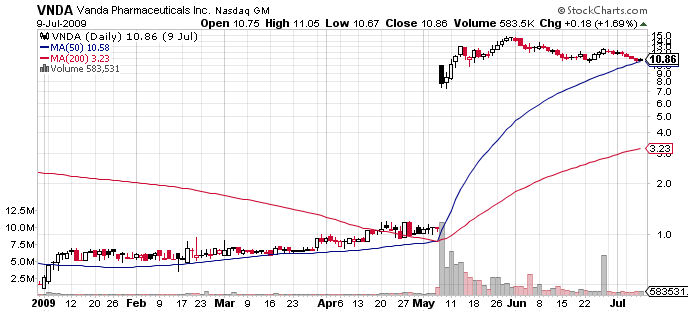](/content/images/wordpress/2014/05/Screen-Shot-2014-05-02-at-7.32.46-AM.png)
Three days later I got a call from a friend of mine who also bought VNDA when I did. The key difference was he forgot to sell it. To the amazement of everyone, even the company, the drug got approved. The stock opened up 900% to $10 per share the next morning. I couldn’t believe how lucky my friend was. I almost threw up.
Life is all about shoulda, coulda, woulda’s. The story above is one of just pure luck, a spin of the proverbial roulette wheel.
Back in January, esteemed investor Howard Marks of Oaktree wrote this thought provoking memo on [Getting Lucky](http://www.oaktreecapital.com/MemoTree/Getting%20Lucky%5F2014%5F01%5F16.pdf?ref=microcapclub.com).
Marks goes into detail about how demographic luck played a big role in his success. From his accounting teacher in High School writing a recommendation letter that likely got him into Wharton to later getting his MBA from the University of Chicago after getting turned down from Harvard. University of Chicago was just turning into the epicenter of new approaches to finance where “no more than a few hundred students could have beat me to the capital asset pricing model, modern portfolio theory, the efficient market hypothesis, the random walk, and other components of today’s investment theory”. Or in 1978 when a new CIO asked Marks to start funds in high yield bonds, which paved the way for his career.
When thinking about your own life I’m sure you have these points in time you can go back and see distinct strokes of luck that put you on you path. For me, it was the [first microcap CEO](http://microcapclub.com/2013/07/the-first-microcap-ceo-i-ever-met/) (XM Satellite Radio) I met with face to face. Soon after the meeting I put all the money I had into the stock and 18 months later the investment was up 1,200%. There was a lot of luck involved, but this started my love affair with microcap stocks. Even though I would go broke several times after this, if I would have lost all my money in XM Satellite it surely would have sent my life and investing philosophy on a different path.
Luck would continue to shape some of my biggest winners….
A few years later in early 2006, I was at a microcap conference. I was there to listen to a particular company’s presentation. I listened to it and thought it was ok, not great. I had a 1×1 with the CEO. Again it was ok, not great. I stayed around a bit longer and watched as a very highly respected investor talked to this CEO for over 2 hours. This was a $0.35 per share, $8 million market cap company. The duration of the meeting seemed really interesting to me. I bought a position a few days later around $0.35-40\. Over the next three months the stock would go to $0.75 per share and the large investor I saw meeting with the CEO months earlier filed as a 10% holder. After the investor filed, the investor continued to buy shares and filed Form 4 insider buys almost everyday. I kid you not, over the next 4 months the stock would go from $0.75 to $6 per share. I didn’t hold the whole way to $6\. I WISH! I exited around $2\. To this day it was one of the craziest runs I’ve ever been invested in. But I’m not about to tell you skill had anything to do with it. I was at the right place at the right time and was lucky.
Later in 2006 that same year I was looking for a stock leveraged to the price of gold-silver. I was really looking for something unique and trying to find a diamond in the giant cesspool of junior exploration/mining companies. I just so happened to be at a conference where one such company was presenting, Gold Resource Corporation ([GORO](http://finance.yahoo.com/q?s=GORO&ref=microcapclub.com)).
[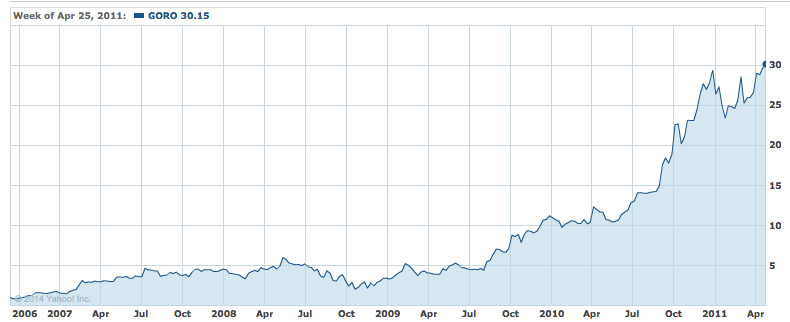](/content/images/wordpress/2014/05/Screen-Shot-2014-05-04-at-10.15.52-AM.png)
I latched onto it and got to know management. From 2006 – 2011 the stock would go from $1 to $30 per share and was literally the best performing gold stock during that time period, better than Silver Wheaton ([SLW](http://finance.yahoo.com/q?s=SLW&ref=microcapclub.com)) and many others. Now was this skill or luck? A big part of it was luck. In 2006 when I first heard the company present it was the company’s first ever-public presentation. Only a few people could have had any chance of beating me to it. Of course I could say that I worked hard, the fact I was even at the conference proves that. Yes, but I could have worked hard and stayed home too.
What about lucks evil brother Bad Luck? I’ve had plenty of that as well. In 2010 I had half of my net worth in one company. I visited with management several times and had a very good comfort level. One day I wake up and the auditors can’t find the cash, the stock is halted for a week, and when it reopens 60% lower I sell. The stock ultimately goes to zero.
Microcap investing is all about stacking the odds in your favor:
- Company operating in an emerging trend
- Company with a great share structure
- Company profitable or very close to profitability
- Company doesn’t need to raise capital
- Company with a moat
- Management that owns a good % of the company
- An experienced management team (already made the big mistakes)
- Defined inflection points over the short and medium term
- Very little or no institutional ownership
The more you have in your favor the better, and I believe the more you have the lesser the risk of the unknown. But there is no such thing as a sure thing and luck always plays a bigger role than our egos allow us to admit. It’s also why I can’t stand investors with egos. On very few occasions has an investment played out just as I envisioned, maybe a couple of times over the last decade. Investing isn’t a science because people are involved, humans are making decisions, and management doesn’t always make rational decisions. With most investments a gap forms between expectation and reality. It’s important to stay close to management and competitive forces so you can decide whether you fill that gap with trust.
I think it’s healthy to admit that luck plays a material role in investing. It keeps us honest. We are never in control of every variable. We are always going to be tested on the extremes with good luck and bad luck. In the end it’s also what makes investing so much fun.
**\===> Interact and learn with 250+ of the best microcap investors on the planet.** [\[Join Us\]](https://microcapclub.com/join-now/)
MicroCapClub is an exclusive forum for experienced microcap investors focused on microcap companies (sub $500m market cap) trading on United States, Canadian, European, and Australian markets. MicroCapClub was created to be a platform for experienced microcap investors to share and discuss stock ideas. Since 2011, our members have profiled 1000+ microcap companies. Investors can join our community by applying to become a member or subscribing to gain instant view only access. MicroCapClub’s mission is to foster the highest quality microcap investor Community, produce Educational content for investors, and promote better Leadership in the microcap arena. For more information, visit [http://microcapclub.com](http://microcapclub.com/) and
### Hard Mailer Pump and Dump Performance Part 9
URL: https://microcapclub.com/hard-mailer-pump-and-dump-performance-part-9/
Last updated: 2014-04-27T09:39:36.000Z
Pump and dumps have been going on since the beginning of the stock market and are most prevalent amongst penny stocks. The hard mailer is one of the most used avenues to pump a stock. The company themselves, affiliates, or large shareholders pay millions of dollars to mail out glossy 20 page reports trying to dupe investors into buying the underlying stock so they can sell their positions or conduct a financing. Just like gravity, when a hard mailer pushes a stock up, the buying eventually ends and they always crash back down to Earth.
Here is a performance matrix of every hard mailer I’ve received at my home over the past two years. As you will see, time is a pump and dumps worst enemy. Over time, many of the companies that are mentioned in hard mailers go down significantly.
[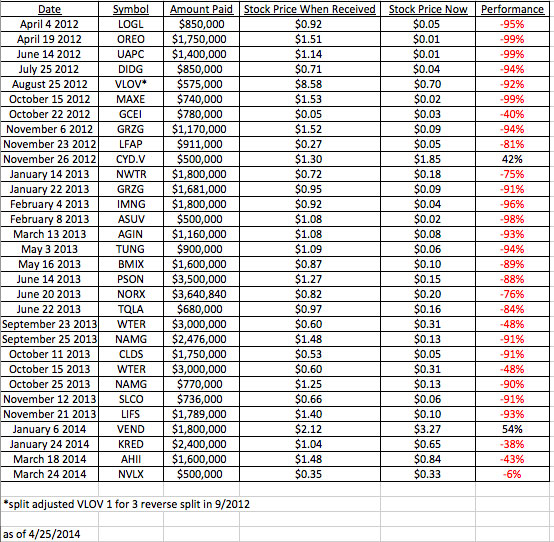](/content/images/wordpress/2014/04/hardmailerPerf.jpg)
Many hard mailers look like this one below, which I received on March 18th on American Heritage International ([AHII](http://finance.yahoo.com/q?s=AHII&ref=microcapclub.com)). You will see in the disclaimer the cost of production for the hard mailer. Of course, the stock is down 43% since I’ve received it.
[](https://microcapclub.com/2014/04/hard-mailer-pump-and-dump-performance-part-9/ahiipage1/)
[](https://microcapclub.com/2014/04/hard-mailer-pump-and-dump-performance-part-9/ahiipage2/)
It’s unfortunate that in many cases an investors first entre into the microcap space is from unscrupulous sources such as a hard mailer or some pump and dump website. It’s important for investors to know that only a small percentage of microcaps indulge in such unethical tactics. Many microcaps have great businesses, management teams, share structures, and conduct themselves with integrity.
At MicroCapClub, most of our members make a living exclusively investing in microcap stocks. If you want to find out how we do what we do, check out some of our educational articles [\[HERE\]](http://microcapclub.com/blog/educational/).
MicroCapClub is an exclusive forum for experienced microcap investors focused on microcap companies (sub $300m market cap). MicroCapClub was created to be a platform for experienced microcap investors to share and discuss stock ideas. Our goal at [MicroCapClub.com](http://microcapclub.com/) is quality membership, quality stocks, and quality content. If you are an experienced microcap investor, feel free to [Apply today](http://microcapclub.com/forums/index.php?/forum/2-applicant-ideas/).
### What A Billionaire Whispered In My Ear
URL: https://microcapclub.com/what-a-billionaire-whispered-in-my-ear/
Last updated: 2015-07-10T09:23:47.000Z
In the fall of 2008, institutions were punting positions left and right due to redemptions. This was a great time for some swing trades, as many stocks were under constant bid whacking pressure. The opportunity was finding the microcaps that had a few (not a lot) of institutional holders. You could call the company’s investor relations and they knew which fund was pressuring the stock and you could get a good estimate based on volume how much more they had to sell.
As an aside, this is also what helped shape my investment philosophy of only initiating positions in stocks that have very little or no institutional holders. You need to find these microcaps before they buy them, not after, because you want to sell to them not buy from them. Also, the really good, unlisted microcaps with little to no institution/index ownership do much better in bad macro environments since their stocks aren’t under this constant selling pressure. That said, you can certainly find some good trades.
The following is a very true story..
One such company was a small oil & gas exploration company called Far East Energy ([FEEC](http://finance.yahoo.com/q?s=FEEC&ref=microcapclub.com)). I had followed this company for years, never owning it. It was a $2 stock a couple years earlier and now it was under 0.15, and I knew enough about it to follow it for a potential swing trade. The remaining institutions were just punting it.
[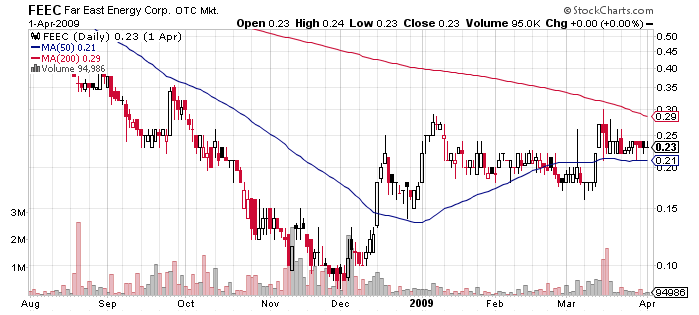](/content/images/wordpress/2014/04/Screen-Shot-2014-04-20-at-8.36.22-AM.png)
In November of 2008 during the economic crisis, I traveled to New York City to attend a microcap conference where FEEC was presenting. If I remember correctly, I may have been the only investor in attendance J. It was worth spending $1,000 to travel to meet management to potentially make a quick 100% return. FEEC was starting to capitulate now at $0.12, and by my estimate there were a few million more shares of selling to go.
The economy was getting so bad that even the Waldorf Astoria Hotel had dropped their room rates to a level that I couldn’t pass up. The Waldorf has always been a symbol of capitalism going back to the 1930’s. The hotel even had it’s own railway platform which was used by Franklin D. Roosevelt. Business leaders have hammered out some of the largest deals in history within its walls. The bar within the hotel, the Bull and Bear, has equal prestige. You can just feel “old money” oozing out of its walls.
It was the night before the conference, and I wanted to get a drink at the Bull and Bear, so I put on a suit (jackets mandatory) and went to the bar. I ordered a vodka tonic and exchanged pleasantries with a gentleman to my left. While he was talking I quickly realized that there weren’t many women in the place except for one. Capturing the attention of several men was an attractive blonde who sat by herself at the corner of the bar. After some time had past, I was almost done with my drink and at $19 per vodka tonic, I wasn’t going to order another. I figured somewhere on the walls was a list of the Top-50 Poorest People to ever step foot in the place, and I was sure to be on that list.
As I was about to motion for my tab, the bartender brought me another drink, and the bartender motioned it was from the woman.
\[INSERT: I was single at this point in my life\]
Well this was a first I thought to myself as I nodded politely while acknowledging the woman’s gesture with a smile. My humility soon vanished, and I quickly sat up a couple inches taller on my barstool. I caught a few annoyed looks from the other men sitting at the bar, but they were obviously just jealous and annoyed with the reality of their solitude. It was obvious who the real winner was out of this group!
Then nervousness started to set in. What do I do now? This blonde was a knockout.
As I surveyed the situation, I nervously drank the second drink very quickly. At the very least I had to go over to this woman to acknowledge her kind gesture. I was starting to stand up to walk over and thank her for the drink when…..
The gentleman to my right put his hand on my shoulder holding me down, leaned over so close I could feel his mustache touch my ear and says…
“Son, that woman is a hooker!”
As shock set in, I leaned away from the gentleman to look at him and realized he was none other than a well-known billionaire. I will keep his name from public record.
My mind was racing. Now not only has a high-end prostitute bought me a drink, but a billionaire is sitting next to me staring at me while grinning from ear to ear.
But more importantly I thought to myself, “this woman bought me a drink”, is this the normal custom. In the movies I watched wherever there was a prostitute there was an angry pimp looking to get his money. She is out $19\. Is there a pimp around that is going to follow me and clock me over the head because I cost him money?
My mind was racing. I did not sign up for this. I should have stayed up in my room. I come from the land of open fields, Amish buggies, and good God fearing folk.
I looked at the woman, and she was staring at me. I looked at the billionaire, and he was smiling at me.
At that point in time I came to the conclusion I would reciprocate the woman’s gesture by buying her a drink. This way if there was a pimp to deal with at least we were even. So I quickly bought her a drink, paid my tab, and raced up to my room. Of course it did occur to me that maybe she wasn’t a prostitute. At this point though, I certainly didn’t have the nerve to ask a good-looking woman I didn’t know if she was a prostitute. I lived to fight another day.
The next day I went to the investment conference, listened to the FEEC presentation, and had a 1×1 with management. I knew the story fairly well, but I wanted to be sure they weren’t doing a financing or something at these valuations. If not, I felt the stock would rally pretty quickly once everyone was out of the stock that wanted out. Post meeting, I felt the bet was worth placing. I accumulated a sizeable position around $0.10 in the days that followed. Sure enough when there was no one left to sell the stock it went higher. 30 days later the stock was $0.20, a quick double.
My New York City trip in the fall of 2008 was memorable for a lot of reasons. I stayed at a great hotel, was solicited by a high-end prostitute, met a billionaire, and found a good trade.
MicroCapClub is an exclusive forum for experienced microcap investors focused on microcap companies (sub $300m market cap) trading on United States and Canadian markets. MicroCapClub was created to be a platform for experienced microcap investors to share and discuss stock ideas. MicroCapClub’s mission is to foster the highest quality microcap investor Community, produce Educational content for investors, and promote better Leadership in the microcap arena. If you are a passionate microcap investor, **[Join Us](http://microcapclub.com/join-now/)**.
### Book Review: The Sleuth Investor By Avner Mandelman
URL: https://microcapclub.com/book-review-the-sleuth-investor-by-avner-mandelman/
Last updated: 2023-10-15T11:37:48.000Z
If you were buying a brand new car, would you do so without a test drive? No of course not. Not only that but you would likely do a Google search to see what buyers are saying about the car, maybe buy a consumer reports magazine to compare similar models, talk to friends who may drive that particular model, and if you have a friend in the car business ask them for their advice. I think all of this would be considered rather normal before you made a purchase decision.
The irony is that most investors put more due diligence into a car purchase then where they are putting their life savings. So many investors, even professional investors, only conduct surface due diligence on companies. Surface due diligence is information that is readily available like SEC Filings, financial statements, and press releases. Yes, surface due diligence is very important and necessary but this is only where due diligence starts. Analyzing a company and management team without meeting management or visiting their facility is like buying a car without test-driving it. At the very least you should talk to management, and this is a must with microcap investing.
The Sleuth Investor is the best book I’ve read on conducting due diligence beyond the norm. Sleuth is another word for being a detective and this book highlights sleuthing tactics to get little known facts about a company that can give you an edge in investing. Mandelman goes into detail about his three physical elements of sleuthing: People (management, customers, suppliers), Product (analyzing products), and Plant & Periphery (touring factories, offices etc). I felt some of the approaches he used were a bit extreme, and even Mandelman notes to check with an attorney before conducting certain types of due diligence. Overall though I felt the book was a great read and provided thorough insight into how sleuthing is done as it relates to investing. You will enjoy [The Sleuth Investor](http://www.amazon.com/The-Sleuth-Investor-Uncover-Stocks/dp/0071481850/ref=sr%5F1%5F1?ie=UTF8&qid=1397586440&sr=8-1&keywords=sleuth+investor&ref=microcapclub.com).
**\===> Interact and learn with 250+ of the best microcap investors on the planet.** [\[Join Us\]](https://microcapclub.com/join-now/)
MicroCapClub is an exclusive forum for experienced microcap investors focused on microcap companies (sub $500m market cap) trading on United States, Canadian, European, and Australian markets. MicroCapClub was created to be a platform for experienced microcap investors to share and discuss stock ideas. Since 2011, our members have profiled 1000+ microcap companies. Investors can join our community by applying to become a member or subscribing to gain instant view only access. MicroCapClub’s mission is to foster the highest quality microcap investor Community, produce Educational content for investors, and promote better Leadership in the microcap arena. For more information, visit [http://microcapclub.com](http://microcapclub.com/) and
### Using Microcap and International Small Cap to Improve Returns
URL: https://microcapclub.com/using-microcap-and-international-small-cap-to-improve-returns/
Last updated: 2014-04-13T06:53:57.000Z
I found this white paper by [Acuitas Investments](http://www.acuitasinvestments.com/?ref=microcapclub.com) this week, and I think it has some valuable insights in it.
In the wake of the market volatility over the last six years, many investors have become more risk averse in the management of their equity portfolios. This is despite the fact that many defined benefit plans are underfunded and it has been difficult to replace equities with other return-generating assets in order to achieve return targets. In addition to the greater risk aversion in response to volatile markets, other factors contributing to declining equity risk budgets include a push toward liability-driven investing and efforts to immunize maturing portfolios.
Regardless of the cause, a widespread trend has emerged toward lowering the amount of equity risk in portfolios, with a corresponding drive to identify more efficient strategies that can improve the risk/reward characteristics within the equity portfolios. This effort has led investors to embrace many “smart beta” strategies. Unfortunately, the move toward lowering risk in what has traditionally been the dominant return-seeking portion of portfolios often means sacrificing expected long-term returns. This leaves investors at risk of not being able to meet their return targets. Acuitas believes a lower risk budget does not preclude investors from taking advantage of inefficiencies in the equity markets to improve returns. Instead, it *increases* the importance of getting as much return as possible on a limited risk budget. Using investments in less efficient areas of the equity markets like US Microcap and Non-US Small Cap alongside smart beta strategies is a way to improve returns while lowering volatility.
#### [\[VIEW FULL REPORT\]](http://www.acuitasinvestments.com/insights/Acuitas%5FSmartBeta.pdf?ref=microcapclub.com)
MicroCapClub is an exclusive forum for experienced microcap investors focused on microcap companies (sub $300m market cap). MicroCapClub was created to be a platform for experienced microcap investors to share and discuss stock ideas. Our goal at [MicroCapClub.com](http://microcapclub.com/) is quality membership, quality stocks, and quality content. If you are an experienced microcap investor, feel free to [Apply today](http://microcapclub.com/forums/index.php?/forum/2-applicant-ideas/).
### Protect Yourself From Yourself
URL: https://microcapclub.com/protect-yourself-from-yourself/
Last updated: 2023-10-15T11:36:49.000Z
I became a full time microcap investor in late 2008, and about 18 months later my portfolio got the sh!t kicked out of it. When you make 100% of your income from capital gains it can get very stressful. You still have to pay healthcare, electric, mortgage, credit card, and other bills every month, so you have to sell something somewhere to pay those bills. You don’t notice it as much when things are going well, but when your portfolio goes through a bad stretch it magnifies things tremendously. This is also why there are so few full time microcap investors that simply manage their own money. Going from income to no income is a big mental hurdle, much bigger than you think.
My goal since my early twenties was to be a full time microcap investor, but it didn’t happen over night. You have to develop an investment philosophy-strategy, build your capital base, and even do some maturing (talk about this [HERE](http://microcapclub.com/2014/02/investing-in-what-matters/)). I also think it’s very important to have experience investing through a bear market. 2002-2009 were capital building years for me. I get asked quite a bit how much capital you need to make the leap to being a full time investor. It’s different for each person but it’s based off a realistic return rate during normal macro environment (if there is such a thing) plus some expectations of expenses. Or sometimes I answer it with: You are ready when you can mentally and financially handle your portfolio being down 50% and selling to pay bills. *\[Subsequent to this post, Mike and I produced: [So You Want To Be A Full Time MicroCap Investor](http://microcapclub.com/2015/01/so-you-want-to-be-a-full-time-microcap-investor/)\]*
So a year or so after I went full time, my portfolio takes a big hit and unfortunately I couldn’t blame it on the macro environment, it was my own dumb fault. My ego was my enemy, and I got cocky. I had drifted away from my investment strategy and invested in industries where I had no edge and had very limited knowledge of the industry. I didn’t even talk to management! For those that know me, you know that is a must for me. I had an eight-month stretch in 2011 where I was down close to 50%, several hundred thousand dollars.
At the pinnacle of all this I was getting married in the fall of 2011, so I was spending tens of thousands of dollars more than I normally would have. When your net worth gets slashed, you are trying not to think about it. My wife was making the wedding plans, and I was the CCW (Chief Check Writer). It didn’t matter that I lost another $40k in the market that week. I was not going to burden her with all of it. I just kept smiling..
“The super expensive platinum reception package makes total sense to me!”
“I wish we could spend even more money on flowers!”
As is often the case, you make your best decisions when your back is against the wall. There is no better educator or motivator than losing money. I eventually cut the losers, redeployed the capital into new ideas that fit my investment strategy and starting digging my way out of the hole. Oh yeah, and I got married and lived happily ever after 🙂
First lesson, stick to your strategy. We all know that one.
The second lesson is really for full time investors. I wanted to start protecting myself from myself. I don’t mean protecting myself from bear markets but from my own ego. When I was single it didn’t matter if I blew up my portfolio because it was just me. I have dealt with that several times before when I was cutting my teeth in the early 2000’s, but now that I’m married and hopefully eventually having kids \[edit: First child expected mid 2015\], I don’t want them to have to deal with it.
So what does that mean?
When I have good years in the market I invest a percentage of proceeds into real assets and/or investments that will pay me an income. It could be real estate, land, or even ownerships in private companies. Preferably it is something that I could sell but not too easily. I know what I know and that is microcaps, but more importantly I know what I don’t know. I spend a fair bit of time networking and getting to know highly experienced professional investors in these other investments-asset classes. It’s taken some time to really find the “real” people that I can trust, but it’s well worth it. So I like to invest alongside experts in these respective fields.
This only makes sense for full time or established investors. If you are a new investor you can’t be sinking capital into such things. As referenced earlier, during my capital building years I was able to be invested in five different companies that would end up being 10 baggers. It took 3-5 years for each one to become a 10 bagger and I rode them. During this time I would have never sunk money into buying a house or similar things. I was trying to build capital as intelligently and quickly as possible. Owning a home, buying private companies, etc wouldn’t have fit that strategy.
A bulk of my income will always come from microcap investing, but now the worst case is I have some real assets I can fall back on and in some instances a passive income stream as well. In many ways it is good asset management to build wealth in other areas and expand your horizons a bit.
As you get older, things change, you stop thinking about yourself and start thinking about worst-case scenarios. You adapt your strategy to fit your circumstances. In my case I had to learn how to protect myself from myself.
If you enjoyed this article, read [Getting Started](http://microcapclub.com/2014/09/getting-started/), [Getting There](http://microcapclub.com/2016/01/getting-there/), and [The First Million](http://microcapclub.com/2015/01/the-first-million/).
**\===> Interact and learn with 250+ of the best microcap investors on the planet.** [\[Join Us\]](https://microcapclub.com/join-now/)
MicroCapClub is an exclusive forum for experienced microcap investors focused on microcap companies (sub $500m market cap) trading on United States, Canadian, European, and Australian markets. MicroCapClub was created to be a platform for experienced microcap investors to share and discuss stock ideas. Since 2011, our members have profiled 1000+ microcap companies. Investors can join our community by applying to become a member or subscribing to gain instant view only access. MicroCapClub’s mission is to foster the highest quality microcap investor Community, produce Educational content for investors, and promote better Leadership in the microcap arena. For more information, visit [http://microcapclub.com](http://microcapclub.com/) and
### Book Review: The Outsiders By William Thorndike Jr.
URL: https://microcapclub.com/book-review-the-outsiders-by-william-thorndike-jr/
Last updated: 2023-10-15T11:34:47.000Z
If you never picked up a book and only got information through financial media outlets you would think the best CEO’s ever were Jack Welch, Donald Trump, Mark Cuban, and a few others that love media attention. I’ve always been obsessed with reading business biographies, especially on those CEO’s that are rarely interviewed on CNBC. Often times these less visible CEO’s have track records far greater than their counterparts. I want to learn how they grew their companies and built shareholder value.
The Outsiders is a great book that looks at eight CEO’s who produced above average returns for shareholders over the long term. In most cases these CEO’s were not attention junkies and were not only great capital allocators but also time allocators. Over 29 years Tom Murphy of Capital Cities produced a 19.9% compounded annual return. Over 27 years Henry Singleton of Teledyne produced a 20.4% compounded annual return. Over 17 years Nick Chabraja of General Dynamics produced a 23.3% compounded annual return. Over 46 years (to 2011) Warren Buffett of Berkshire Hathaway produced 20.7% compounded annual returns for shareholders.
These CEO’s as well as four others in the book were not your cookie cutter capital allocators and did not fit the mold of most business books you read today. Every one of the CEO’s was a first time CEO (no past history of success) and more than half had very little industry experience before taking over as CEO. I found these two things very interesting especially has it relates to microcap investing. So often I’m trying to find great management in microcap, which can be difficult if there is no prior resume. In all instances the Outsider CEO’s led decentralized organizations empowering others to make decisions and they were great capital allocators.
Outsider CEO’s ran high cash flowing businesses, which allowed them to take on debt (few ever issued equity) to make the strategic acquisition or to buy back stock when it was historically cheap. All but one of the eight companies bought back 30%+ of outstanding shares over a period of time. Some took on debt to buy back shares at depressed levels. For those that did use equity to make acquisitions they always knew when to do it (when the stock was expensive).
There are many more takeaways from the book, but you’ll just have to read it. I found the book very easy to read and in many cases reinforced management principles I’ve always felt were important. You will enjoy [The Outsiders](http://www.amazon.com/The-Outsiders-Unconventional-Radically-Blueprint/dp/1422162672/ref=sr%5F1%5F3?ie=UTF8&qid=1396784549&sr=8-3&keywords=the+outsiders&ref=microcapclub.com).
You can view the rest of our bookshelf [\[HERE\]](http://microcapclub.com/book-shelf/).
**\===> Interact and learn with 250+ of the best microcap investors on the planet.** [\[Join Us\]](https://microcapclub.com/join-now/)
MicroCapClub is an exclusive forum for experienced microcap investors focused on microcap companies (sub $500m market cap) trading on United States, Canadian, European, and Australian markets. MicroCapClub was created to be a platform for experienced microcap investors to share and discuss stock ideas. Since 2011, our members have profiled 1000+ microcap companies. Investors can join our community by applying to become a member or subscribing to gain instant view only access. MicroCapClub’s mission is to foster the highest quality microcap investor Community, produce Educational content for investors, and promote better Leadership in the microcap arena. For more information, visit [http://microcapclub.com](http://microcapclub.com/) and
### Master Your Emotions Before You Go Broke
URL: https://microcapclub.com/master-your-emotions-before-you-go-broke/
Last updated: 2023-10-15T11:33:00.000Z
When I was in college (1999-2003) I worked full time for a local stockbroker. He was a top producer and well known in the local area. During those years I witnessed an entire boom and bust cycle. In the office I was the person that answered any questions clients would have to save my boss the time, effort, and annoyance.
We had over 1,100 clients, and when the markets crashed I think I heard from all of them over a 6-month period of time. I witnessed sadness, anger, hopelessness, and despair. I would go to work, the markets would drop again, the phones would ring, I would get the sh!t kicked out of me, rinse-repeat. When I met with my old boss just last month he reminded me if I wasn’t there during that time period he would of quit. I was the first line of defense, a human punching bag.
This experience was probably the best education I would ever receive. First hand seeing how human emotion and the stock market are intertwined helped prepare me to be a better investor. What I witnessed during those couple of years saddened me, but I was also disgusted. It made me numb and since then I’ve always been able to distance my emotions from the markets.
> “Individuals who cannot master their emotions are ill-suited to profit from the investment process.”—Benjamin Graham
The other unfortunate result of my experience above is I cannot stand holding investors hands while the market or a particular stock drops. I have no empathy. The market pulls back and a position is down 20-30% quickly and all of a sudden panic sets in and investors first inclination is to start questioning everything and anything and wanting their hands held. Even on our members forum you will rarely see me respond to investors posting out of emotion. I’m more apt to tell you to sell your entire position.
As an aside, just last week one of my positions was down 20%. A fund manager emailed me, “What is wrong with this stock, how low will it go?”
My response, “It’s going to zero, please sell!”
I know it may sound cold, but I don’t get paid to deal with other peoples emotions, just my own. Coincidentally, this is also why I could never manage other people’s money 🙂
It is very important to keep your emotions and the market separated. How many times have you painfully threw in the towel on a stock because it was dropping and the very next day it pops and moves back the other way. More than once right? That is because everyone else is feeling the same emotions you are and everyone is throwing in the towel right around the same time.
Or the opposite, investors are always attracted to stocks that are rising. You’ve been watching a stock go up for days, weeks, months. You knew you should have bought it when you first saw it. Finally you can’t take it anymore and you buy it. A couple weeks later you realize your purchase was basically the all time high on the stock as it starts to go lower.
It’s human nature when you lose money quickly you want to make it back twice as quick. You start looking at companies in industries you would never look at. You might even skip necessary due diligence steps or start relying on other people.
Believe it or not this can also happen after making a lot of money. You become over confident and invest in areas outside your area of expertise. In 2010, I was coming off two major winners. I was cocky and invested in a couple biotechs. You sort of have the mindset, “Well if I invest in it I’m sure it will be a fabulous investment!” A year and several hundred thousand dollars later, Mr. Market taught me a lesson.
> “A man who wants to lead the orchestra must turn his back on the crowd.” —Max Lucado
Slow down, keep focused, and stick to your strategy. Don’t let market fluctuations or stock volatility unnerve you. Understand human emotions and irrationality and use it to your advantage. Invest in what you know and more importantly understand what you don’t know. Invest in great management not great products. A great management can turn absolutely nothing into something extraordinary. An ordinary management can turn something extraordinary into nothing. Invest in companies not in stocks. Control your emotions and you’ll instantly have an edge over 95% of investors.
**\===> Interact and learn with 250+ of the best microcap investors on the planet.** [\[Join Us\]](https://microcapclub.com/join-now/)
MicroCapClub is an exclusive forum for experienced microcap investors focused on microcap companies (sub $500m market cap) trading on United States, Canadian, European, and Australian markets. MicroCapClub was created to be a platform for experienced microcap investors to share and discuss stock ideas. Since 2011, our members have profiled 1000+ microcap companies. Investors can join our community by applying to become a member or subscribing to gain instant view only access. MicroCapClub’s mission is to foster the highest quality microcap investor Community, produce Educational content for investors, and promote better Leadership in the microcap arena. For more information, visit [http://microcapclub.com](http://microcapclub.com/) and
### Don't Worry About Illiquidity, Worry About Being Right
URL: https://microcapclub.com/dont-worry-about-illiquidity-worry-about-being-right/
Last updated: 2023-10-15T11:30:14.000Z
I’m a full time microcap investor and I make my living exclusively from capital gains in microcap companies. I’m not any smarter than anyone reading this blog. My only advantage has been my passion for microcaps started at a young age. This has been beneficial since it has allowed me to lose lots of money early in life. I continue to lose money in microcaps from time to time, but my win percentage has increased through the years. My goal with investing has always been finding great growth companies before the masses. Microcap investing is hard so it’s important to stack the deck in your favor.
I get asked quite often, What do you look for in a microcap company?
I’m looking for companies in an emerging trend with a great management team, share structure, with a unique product or service where there are few if any competitors and public comps. When the underlying emerging trend has emerged and the public and institutions are looking for an investment vehicle, I want this one company to be it. This is called scarcity and it’s one of the most powerful forces in any stock move where valuations are thrown out the window. Oh yeah, and I also want to find them very small, preferably sub $20 million market cap and the more illiquid the better. I want high insider ownership and no institutional ownership. I want companies that are profitable or have the cash runway to get to profitability.
Other than that I’m pretty open-minded.
[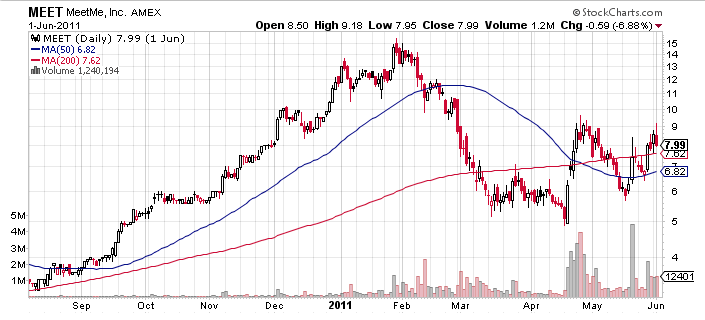](/content/images/wordpress/2014/03/Screen-Shot-2014-03-26-at-8.48.42-AM.png)
Scarcity can create some of the biggest gains in the market. Quepasa (QPSA), now MeetMe ([MEET](http://finance.yahoo.com/q?s=MEET&ref=microcapclub.com)), in 2010 was the only public social network, and this scarcity value drove shares from $3 to $14 in less than a year. Volume also increased tremendously. When I started buying it volume was 10,000 shares per day, 9 months later it was 1 million shares per day. There were no alternatives and institutions had to own it and they didn’t care what they paid. MeetMe quickly dropped when alternatives in the social networking space came to market. What you want is scarcity as well as fundamentals. This is the dynamic I’m going after. It is rare and hard to find but they are out there. You combine this with a company that doesn’t need to raise money and it creates the perfect storm, as investors need to buy the stock in the open market.
Investing takes foresight, so you need to find these companies early, before the institutions…
There are [4,396 public companies](http://microcapclub.com/2014/02/microcap-statistics-by-the-numbers-part-2/) on US Exchanges with market caps less than $50 million. The average dollar volume in these small microcaps (aka nanocaps) is less than $15,000 per day. Most investors shriek like a vampire to a cross at the very thought of such illiquidity. But this is my playground.
Illiquidity is a beautiful thing. The more illiquid the stock the less known and cheaper the company normally is. I love it when it takes a month or more to buy a full position. My position sizing is unorthodox to most but I’m very comfortable holding a week to several months’ worth of volume.
Illiquidity is never a reason to not invest in a company. Why? If your investment thesis plays out and management executes liquidity will increase significantly.
[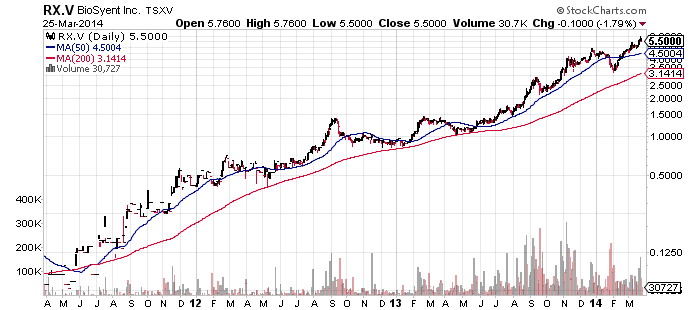](/content/images/wordpress/2014/03/Screen-Shot-2014-03-26-at-8.55.21-AM.png)
For example, 18 months ago BioSyent ([RX.V](http://finance.yahoo.com/q?s=RX.V&ref=microcapclub.com)) was a $0.60 stock trading $5,000 worth of stock a day. Management has executed very well and now it’s a $5 stock trading $250,000 worth of stock a day. A little over a year ago Plug Power ([PLUG](http://finance.yahoo.com/q?s=PLUG&ref=microcapclub.com)) was trading $50,000-$100,000 worth of stock a day, and just last week it was trading $1 billion of stock per day. So what this illustrates is as a management team executes and the market awakens to the story the stock rises and so does liquidity.
**Small Retail -> Large Retail -> Small Institution -> Large Institution**
**(Dumb Money) ——————————————–(Smart Money**)
When a company with a good share structure executes and volume goes from 10,000 shares a day to 100,000+ shares per day it represents not only increased liquidity but also a maturation of the shareholder base. Normally small retail investors find them first, what most would characterize as the “dumb money”. Then larger retail buys, small institution and large institution. This maturation can be seen when you analyze a group of $20m market cap companies’ versus $100m market cap companies. The former have very little if any institutional ownership while the latter are usually 20%+ owned by institutions. Each wave of buyer has a greater appetite for shares and each one thinks they are smarter then the person they are buying from. The small retail investor is always perceived as dumb even though they found the stock long before the institutions did.
The key is finding them and buying them early like small retail and selling them when the institutions buy them. Be the dumb money and sell to the smart money. You want to find them early when they are unknown and illiquid. I’ve made my living on finding them early and then selling to the smart money. You want to find them at $10-20 million market caps and sell them at $100m+ valuation.
When an investment thesis plays out and the management team executes, liquidity often increases 10-100x. So when you are searching for the next great microcap, don’t worry about illiquidity, worry about being right.
**\===> Interact and learn with 250+ of the best microcap investors on the planet.** [\[Join Us\]](https://microcapclub.com/join-now/)
MicroCapClub is an exclusive forum for experienced microcap investors focused on microcap companies (sub $500m market cap) trading on United States, Canadian, European, and Australian markets. MicroCapClub was created to be a platform for experienced microcap investors to share and discuss stock ideas. Since 2011, our members have profiled 1000+ microcap companies. Investors can join our community by applying to become a member or subscribing to gain instant view only access. MicroCapClub’s mission is to foster the highest quality microcap investor Community, produce Educational content for investors, and promote better Leadership in the microcap arena. For more information, visit [http://microcapclub.com](http://microcapclub.com/) and
### Book Review: The Frackers By Gregory Zuckerman
URL: https://microcapclub.com/book-review-the-frackers-by-gregory-zuckerman/
Last updated: 2023-10-15T11:28:35.000Z
2013 US crude oil production reached its highest levels in 24 years. FY 2013 oil production was up 15% from 2012\. Oil production from hydraulic fracturing, or fracking, in North Dakota and Texas made up 83% of the US oil production growth. Natural gas production has seen an equally incredible rise in production and reserves. US natural gas reserves are at an estimated 2,203 trillion cubic feet or enough to last 92 years. This is up \~20% from just a few years ago. The Frackers is the story of a few small oil-gas companies whose wildcatting CEO’s paved the way for this US oil-gas resurgence, while creating billions of dollars of wealth in the process. 10-15 years ago shale formations were the ugly stepchild of the oil-gas industry. Why? First off no one could figure out a way to effectively get the oil-gas out of the shale. The majors didn’t care about shale formations, but that didn’t stop one man.
George Mitchell’s, Mitchell Energy & Development Corp, was the first company to really believe shale formations were the future of domestic oil and gas production. He started testing hydraulic fracturing techniques in the Barnett Shale back in the 1980’s. He drove his board members absolutely crazy as he refused to give up on trying to get oil-gas out of shale formations. If George Mitchell weren’t the largest shareholder in his own company the board would have surely kicked him out. It wouldn’t be until he reached the ripe age of 80 when he figured it out, and it would change the oil-gas industry and country forever. Mitchell was the pioneer that paved the way for the next wave of Frackers: Aubrey McClendon of Chesapeake Energy (CHK), Tom Ward of SandRidge Energy (SD), Harold Hamm of Continental Resources (CLR), Mark Papa of EOG Resources (EOG), and Charif Souki of Cheniere Energy (LNG). The book tells the story of each person, their humble beginnings, and the role they played in the US oil-gas boom.
It wasn’t Exxon Mobil, ConocoPhillips, or Chevron that pushed to find these huge shale formations and develop technologies to extract energy from them; it was these small independent oil and gas companies led by headstrong wildcatting CEO’s that wouldn’t take no for an answer. These CEO’s created vast amounts of wealth for themselves in the process. Harold Hamm of Continental is now the richest oilman in the country (net worth $14 billion). Not all of the stories had happy endings. Aubrey McClendon and Tom Ward were kicked out of their companies, but their contributions cannot be under estimated. With a $50,000 investment in 1989, Aubrey built Chesapeake Energy into the 2nd largest natural gas producer in the country. Aubrey was seen as very reckless which forced his dismissal, but he is one of eight CEO’s (including Warren Buffett) that produced at least 20% returns annually over 20 years of service.
“Ok great Ian, but what does this book have to do about microcaps?” Good question.
Microcap investing in its essence is always an underdog- bet on the jockey type of story. If you find the right company with the right CEO you can make 2-5-10-50x on your money. These oil-gas men and their companies were underdogs, just like many microcaps, but they figured it out and made a killing. Most of the reading I do is reading business biographies. I love reading how an entrepreneur got their start, what they learned, where they failed, etc. This helps me quite a bit when evaluating microcap companies and management. You will really enjoy reading [The Frackers](http://www.amazon.com/The-Frackers-Outrageous-Billionaire-Wildcatters/dp/1591846455/ref=sr%5F1%5F1?ie=UTF8&qid=1394976046&sr=8-1&keywords=the+frackers&ref=microcapclub.com).
**\===> Interact and learn with 250+ of the best microcap investors on the planet.** [\[Join Us\]](https://microcapclub.com/join-now/)
MicroCapClub is an exclusive forum for experienced microcap investors focused on microcap companies (sub $500m market cap) trading on United States, Canadian, European, and Australian markets. MicroCapClub was created to be a platform for experienced microcap investors to share and discuss stock ideas. Since 2011, our members have profiled 1000+ microcap companies. Investors can join our community by applying to become a member or subscribing to gain instant view only access. MicroCapClub’s mission is to foster the highest quality microcap investor Community, produce Educational content for investors, and promote better Leadership in the microcap arena. For more information, visit [http://microcapclub.com](http://microcapclub.com/) and
### MicroCap Portfolio Management and Position Sizing
URL: https://microcapclub.com/microcap-portfolio-management-and-position-sizing/
Last updated: 2023-10-15T11:27:42.000Z
We recently had a good discussion in our member’s forum about portfolio management and position sizing. What we found is whether your investment strategy is taking hundreds of positions or just a handful you can find an investment guru that has done well over the course of time. [Walter Schloss](http://www.valuewalk.com/walter-schloss/?ref=microcapclub.com) invested in an average of 100 positions. If you don’t know Schloss, he is one of the icons of value investing. For the 45 years Schloss managed his fund, he crushed the S&P 500 by producing returns of 15.3 percent versus 10 percent for the S&P 500\. On the other hand, when Warren Buffett was managing “smaller” amounts of capital he had as [few as five positions](http://www.gurufocus.com/news/248721/how-buffett-crushed-the-dow-in-1951--lessons-for-investing-with-small-sums?ref=microcapclub.com) making up 97% of his portfolio, and one investment making up 50% of his portfolio. Bob Auer who we [interviewed here on MicroCapClub](http://microcapclub.com/2013/10/interview-portfolio-manager-bob-auer-auer-growth-fund/), uses a purely quantitative approach, and holds an average of 90-120 stocks in the portfolio. This strategy allowed him to grow $100,000 to $30 million from 1986 – 2007 without any new capital added during this timeframe.
In 1977 Elton and Gruber worked out an empirical example of the gains from diversification. Their approach was to consider a population of 3,290 securities available for possible inclusion in a portfolio, and to consider the average risk over all possible randomly chosen n-asset portfolios with equal amounts held in each included asset, for various values of n. Their results are summarized in the following table. It can be seen that most of the gains from diversification come for 30 positions or less. ([source](https://www.boundless.com/image/12181/?ref=microcapclub.com))
[](/content/images/wordpress/2014/03/eltongruber.jpg)
In the end, I don’t think there is a right or wrong answer as your position sizing likely fits your investing strategy, personality, and also the amount of capital you have to invest. Investors that use a purely quantitative approach can manage many positions at once. Those that use a more qualitative approach normally can’t manage more than a 10-20 positions.
Here are some thoughts on this subject by some of our members:
**Member 1:**
I’m in the process of working my way down from 15-20 companies down to a maximum of 10\. I buy up to a 3% position based on an initial look. After determining either the CFO or CEO is accessible and liking what I’ve learned after more thorough dd I then buy 5-8%. After seeing at least one earnings report and having had a chance to go through every possible negative scenario I can imagine and eliminating it, I then buy up to 12% at cost.
**Member 2:**
Buffett talks in code sometimes and what he says is so insanely simple that most investors tend to gloss right over his best advice. I read an article one time that said that Buffett was constantly asked to write a book about his investing style, but he won’t because he has already shared what he knows in various speeches, interviews and shareholder letters. The fact is that if people took the time to piece together his different quotes and allegories, it spells it all out right there for you.
Here’s my takeaway from Warren:
1. Stocks are a piece of a business therefore you must KNOW the business well and keep up with the news of the business.
2. If you know and understand the business then you should be confident in placing a valuation on it.
3. Take advantage of Mr. Market and the various mispricings in relation to your valuation that occur as a result of the general public’s fear or greed.
4. When these mispricings occur react with conviction by placing huge bets on them.
Buffet said a few years ago that he “Guaranteed” that he could make 50%+ annually in the markets in present day if he was a smaller individual investor because its easier to find information these days and the best opportunities exist in small companies. If you pay attention to how he invested when he was younger, in terms of company size and portfolio concentration, I think it’s fairly obvious how he would do it. He’d probably be right here on MicroCap Club finding a few of the best companies every year or so and betting heavily on them!
My philosophy has tried to mirror Buffet’s younger years. I find underfollowed (Micro Cap) companies and get to know the business. Because of the (at times) extremely irrational price behaviors of these stocks, I take my time forming a position at a reasonable margin of safety to my valuation. And I bet big in terms of the % of my portfolio. It makes more sense to me to be concentrated because the central tenet to my investing style is to “know thy company”. I just don’t have time to get to know/keep up with a dozen companies in the manner that would make me comfortable. I have 3-5 positions that make up 80% of my portfolio plus a few multi-baggers (mature companies) that I keep a small amount of stock around just to remind me of the value of “sitting tight” as Livermore would say.
In regards to Schloss or “quantitative value” guys like Greenblatt’s Magic Formula. Since you don’t get to know the business investing like them, you need to have more diversification for smoothing tendencies. Everyone knows that the numbers don’t tell the whole story but over a larger sample size they will outperform if you have the right strategy. Just a small out-performance with one of these investing styles will compound over a long period of time to deliver extremely great results in comparison to a standard index. This makes sense for most people who want to beat the market but not put a ton of time into it. However, I think if you want extreme returns, it takes concentration. It’s definitely higher risk/higher reward, but I think that’s what most of us are after if we’re on here anyways…
Lastly, ever since I read “Fortune’s Formula” about the Kelly Formula, I’ve been obsessed with it. The investing applications of it really describe what Munger and Buffett did early on, although they claim to not know of the formula (although they admit it describes what they did to a T). Anyways, my allocation of money within my 3-5 main positions is based on this “formula”.
**Member 3:**
My philosophy may be somewhat different than others here. My investing heroes are Graham and Schloss and I am probably closest to Schloss in how I invest. I would not say I am a microcap investor per se, I simply will buy what’s cheap and hold it until it isn’t. I’ll buy just about anything, whether it’s an illiquid, unlisted nanocap or a well known megacap. My only requirement is that it be cheap. Usually of course what I buy is in the nano and microcap area, but I don’t put any labels on myself in that regard.
In addition, I will take small positions in things and usually have around 100 positions at any onetime. That’s not a target or a goal, just how it tends to work out. I’ll go a bit larger in size if the opportunity arises, but that’s more rare for me. I think that investors can often be put into one of 2 categories. There are those who view their investments as art and those who view their investments as inventory. The former often like their investments to be beautiful. They want to hang them on the wall and admire them. At a 10,000 foot level many of these folks are avid followers of Buffett. They want to buy and hold and just admire the beauty (although of course the reality is that other than a handful of positions Buffett doesn’t actually hold in that manner, but I digress). On the other hand, there are those, like me, who view their investments as inventory. I liken what I do to stocking a grocery store. You have everything from filet mignon to packs of gum. I don’t care what it is as long as it will make me money. Likewise, I don’t subscribe to the view that a smaller position doesn’t move the needle. Many of these positions can be purchased within an hour or two (or less) of work. It’s like the gum or diet coke in a store. Stock it, sell it, wash, rinse and repeat. I’d do that all day long if possible.
I am primarily a quantitative based investor. I let the numbers tell me a story. One thing that I am not is someone who simply buys off a screen. So while I do prefer low p/b for example I would never buy anything because a screen says to do so. It’s simply a means of finding the right pond to fish in. For those older timers out there, one of my favorite pieces on investing is the one on Tweedy Browne in John Train’s Money Masters in the Ben Graham section. This was in the late 70s and Tweedy Browne at the time probably had $50 mil AUM and were much different than the run of the mill value guys they are today buying MSFT and talking about their moat. Then they would buy just about anything that met their quantitative parameters (they had around 900-1000 positions) and would purchase in positions as low as $50-200\. They would hold until someone wanted to pay “full price” for it.
**Member 4:**
For me, portfolio management is all about “it depends”. I may hold upwards to 15 issues, but they may be spread over 5-8 LT holds and other swing trades. I do enter a position and then ladder in to increase the % port. At one time in 2013 the port was 40% in one issue, and I started to ladder out. At this time, with the general market iffiness, I am more cautious and thus shifting the port to higher volume issues that can be exited if necessary. So in my mind, one develops a strategy that suits them.
In discussions with another member about this same topic, he also implied that “it depends” and that it may be a number of technical and emotional items that he uses to determine port balance. Should you have a high ownership in a very thinly traded issue? Does the potential risk/loss damage your port? Should you own a biotech? etc.
Everyone has a different approach and none should be applied or taken “because, that’s what he does” – it needs to support personal needs, goals, and emotions.
It is quite clear though that people tend to sell winners and hold losers – and that psychology is written about broadly. By setting up a set of rules for yourself, one can act without emotion. E.g. if any one holding is showing red more than a $$ amount, SELL – regardless; if you own a winner, add more as it advances and set stops along the way to assure gains; if you have individual stock loses in any timeframe (say a month) of more than $x, then take yourself out; if your port declines by greater than X% sell remaining and reassess. IMO port management and control is mostly about goals balanced by money management/risk management.
**Member 5:**
I love the topic of diversification and position sizing and wanted to add my two cents. Diversification has its place and benefits, but probably not for anyone involved in these forums. A friend of mine recently asked what stock I liked to buy, hold and forget for the next twenty years and i told him to just buy SPY. If you’re trying to be ignorant about your investments, diversification is great.
*Warren Buffett* — “*Diversification* is protection against ignorance. It makes little sense if you know what you are doing.”
I previously worked in a brokerage office and I can tell you diversification is also great at doing two things.
1. Transferring the risk and responsibility of a broker to the market
2. Selling product.
Its a lot easier for a broker to justify a losing position in GLD when its a “Hedge”. Its also a lot easier to convince a client to own 30 stocks when they need a small, mid and large cap stock in 10 different sectors.
I’m a big believer of a concentrated portfolio 4 – 8 investments. I believe the more time you spend doing this, the more concentrated positions you should have. If you’re doing this full time, its makes no sense not to allocate to your very best 5 ideas. Yeah, its risky and it takes guts, but real money is made when you have your large position become a multi-bagger. I also believe to have an edge in this game, its a full time job to really follow and understand a dozen companies.
**Member 6:**
I like to have 3 tiers of positions: medium term trading, long term confident, and long+short term no-brainer.
Medium term stocks are ones that I have good faith in their long term prospects, but I’m much more confident that they are undervalued in the short term. Usually I believe they can have strong runs, and will sell if they go parabolic. I look for at least +100% price target, and will either wait until a run or sell if something about my valuation changes. A position is usually 3-6% of my portfolio. I would like to have 2-3 of these.
Long term holds are companies that I think have successful models, good management and financials, and I’m willing to see the position through in the long term. I’ll probably take profits over 100%, but I’ll hold at least half until either it becomes cleary overvalued, or something material changes about the long-term prospects. I know I’ve found one of these when it no longer feels like I’m purchasing stock, rather becoming a part owner of a company. I need to feel like I could sell my friends and family on the product/service, not the stock. I initialize a position with 10-20% of the portfolio. I have 2 of these right now.
Long/Short term no brainers are basically a combination of those two, where I like a company long-term and I think it’s extremely undervalued in the short term as well, such that it could easily run. It’s when there is no foreseen downside but a huge list of upside, and a high probability of good performance in the next immediate quarters. I know I’ve found one of these when I feel like I want to buy as much as possible. I’ll look for a run close to fair value and sell half, and the rest becomes a long-term hold. A long-term hold can also become a no-brainer if it falls enough. I’ll put 30-40% into it, but I have gone higher. Only 1 of these.
I don’t ever want to go over ten positions. You may be able to track more than 10 stocks, but I don’t feel like you can pay close attention to more than 10 companies. My ideal is 5-6
I also have a principle of “Always wish you bought more, and always sell too much” If I have a gut target allocation in a stock, I try to hold myself back from buying the full amount at that level. If I have an amount mentally allocated to sell at a certain level, I’ll sell a little more than that.
I find this helps prevent me from getting caught up emotionally with the movement of the stock. On the upside, I find the regret of not having as much as I initially wanted counteracts the euphoria of being right and making money. On the other hand, if my medium term stock goes down, thank goodness I bought less than I wanted to. And if my long-term stock goes down, fantastic, I get to average down and complete my allocation.
Although, I’m a naturally emotional guy, so I need this. Maybe if I was stone cold, it would be unnecessary.
**Member 7:**
I don’t think position sizing is static and among the stories attributed to Livermore is that he approached trading with a military mind. He would send out patrols as he called the trades to test the market, and if he sustained losses he considered it a small price to pay for the accurate feel it gave him of the market. One can see an example of this approach in how plays in football in the first half that may gain little or even lose yardage are used to set up winning plays in the second half.
I agree with those who would limit their coverage to a half dozen or so, with room to change and drop as situations change. There is an ebb and flow to pricing for stocks and much money can be made knowing how to play those cycles, One of the virtues of sending out patrols is that it gives real data about what is going on in the market and in your mind. Just like it is very difficult to learn from a paper portfolio because emotions are not involved, the same holds true for trading to test the market as opposed to just watching the prices and the trend.
One of the first things I learned when I went into the market full time was that money is just a commodity, and if you are in the market it is a position and fungible, so if the price of your stocks goes up or down, you don’t treat the up or down like it was taken or given to you, it is just fluctuations in the value of your inventory and there can be intangible capital in what you have learned from your losses. It is the same psychology that comes into play knowing that you must not give in to the fiction that you have not succeeded if you have not bought at the low and sold at the high.
I find that knowing when to sell is the most difficult thing to do. The psychology is so strong to wait until a stock has peaked and then you are forced into selling on the way done when volume is working against you. The alternative is to sell on the way up and that can create recriminations later that you sold too soon, which is often the case if you are playing with scared money. At the end of the day you have to stay in your comfort zone and know whether you are a singles or long ball hitter.
Last but not least about what comes to mind about position and sizing is Soros’ rule that supposedly he forgave you if you were wrong, but if you were right he expected you to have bet big.
**\===> Interact and learn with 250+ of the best microcap investors on the planet.** [\[Join Us\]](https://microcapclub.com/join-now/)
MicroCapClub is an exclusive forum for experienced microcap investors focused on microcap companies (sub $500m market cap) trading on United States, Canadian, European, and Australian markets. MicroCapClub was created to be a platform for experienced microcap investors to share and discuss stock ideas. Since 2011, our members have profiled 1000+ microcap companies. Investors can join our community by applying to become a member or subscribing to gain instant view only access. MicroCapClub’s mission is to foster the highest quality microcap investor Community, produce Educational content for investors, and promote better Leadership in the microcap arena. For more information, visit [http://microcapclub.com](http://microcapclub.com/) and
### The Herd Mentality
URL: https://microcapclub.com/the-herd-mentality/
Last updated: 2023-10-15T11:26:51.000Z
There is a pervasive herd mentality on Wall Street today. This is not a new phenomenon; however it is becoming even more evident due to the advent of new mediums. Financial advisors lack alignment and creativity, and are stymied by arbitrary guidelines, in order to fit within their scalable business models of efficiently servicing large amounts of clients. Furthermore, with the advent of Twitter and Seeking Alpha, and the like, companies can be easily bullied by hucksters and pumpers, who can drive millions of shares in trading volume. Is this a new paradigm for how research and investment advice is disseminated or is it simply a new mechanism for creating hype and attention to companies that are underfollowed? The case for both arguments is strong, and these new outlets (web and social media) are further fueling a herd mentality where almost any unregulated individual can build a brand to steer followers in one direction or another, not unlike the herding of sheep.
As a basis for this discussion, it is important to first consider how the average investor accesses the financial markets, which is through a traditional financial advisor. This model is long-standing, and has structural defects that contribute to investor herding, on a massive scale. When a financial advisor chooses individual equities or mutual funds on your behalf, you’re likely at a disadvantage. Why? The advisor is not, in any way, incentivized to make you money other than collecting a commission or an annual wrap fee. They are likely deploying these investment choices across hundreds of clients, therefore constraining each of their clients to arbitrary common denominators. Sounds like herding to me. Furthermore, when you lose, they still win, as their downside is only realized when you fire them, which is rare. The average investor portfolio is highly predictable, lacks originality and lacks true diversification. When it comes to compelling, smaller company growth stories, investors invariably lack exposure, often because their financial advisor doesn’t have the time, skill or motivation to uncover them. They stick with the larger “safer” names, selected from a very small pool of hundreds of choices. What do they really know about these companies? Did they talk to the CEO to get a stronger understanding of the company and its growth prospects? Most of the larger brokerage firms even prevent client ownership of smaller companies, for arbitrary reasons that are designed to limit their liability, at the firm level. There are literally thousands of smaller companies out there! This traditional approach forgoes exceptional market opportunities that drive meaningful returns and diversification. Try buying a smaller company via your broker, and you will be dissuaded or shut down, in almost every circumstance. Financial advisors love to herd sheep into their corrals and push each one through their systematic process.
As far as the new media changing the landscape, Seeking Alpha contributors are paid and typically already have established their position, in advance of publishing, long before you do. Where is the alignment there? Just read the disclosure at the bottom of the page. And with Twitter, the ‘tweeter’ may be exiting their position as you, and others enter, en masse. Again, no alignment. We see this game quite often, which is akin to musical chairs – the last person standing always loses. There’s a reason more and more people are touting their subscription services and stock picks on Twitter. Anyone can do it, and it is an unregulated regime, and the research quality is often very low. Are they talking to management teams? Are they doing channel checks and talking to suppliers or customers? Or are they just finding buzzy stories with low float share structures that will move more than the average stock when they’re finished pumping it? The obvious need not be stated.
As a portfolio manager of a microcap strategy, I am the target of endless investor relation (IR) calls as well as companies that would like to introduce themselves and pitch their story. In recent years, I’ve noticed that both parties typically ignore the impact these new mediums can have on their valuation. Companies struggle in knowing where their trading volume is coming from and their IR reps are often equally puzzled. I would term this volume as “fast money,” which can either be a detriment to investing, or create advantageous liquidity, depending on your perspective or positioning.
Enter the psychology of investing. It has always fascinated me. My career has spanned positions in trading, research/analysis, and the management of capital portfolios across numerous asset classes. While some asset classes are more efficient than others, the opportunities are always there. One just has to take the time, roll up your sleeves, and find them. As a contrarian investor first, I believe firmly that the best opportunities are found either 1) when the world hates the investment in question or 2) when the investment in question has yet to be found by the masses. Negative sentiment is easy to identify with the first point as declines in valuation, insider selling, unfavorable news, etc are all components we come across frequently. Capitulation is a bit more of an art than a science but one that can be even more fruitful, especially in the small and microcap universe. However, finding the company before the masses is the true challenge.
I’m often asked how I source ideas and the common belief is that fundamental screens yield the best opportunities. While that may be true for many, my approach is different and I aim to beat the screens. Therein lies the point, if the consensus within the population is doing one thing, you want to do something else. Discovering companies before they tout their inflection points on a conference call or in a press release is not as hard as it may seem. It takes a good deal of time preparing to speak with management and connecting the dots with supplemental research. When you can succeed at this, you will succeed in the microcap space. And when you find that opportunity, the herd will come to you long after you’ve already established your position.
I began my career trading options on the Philadelphia Stock Exchange. A mentor once said, the real money in options is made trading volatility, not the day to day move in price. The theory is that volatility increases or decreases are worth much more than daily fluctuations in the price of an underlying stock. I never forgot this principle and the same can be applied to investing in microcap stocks. Those who find the companies early stand to benefit much greater than those who follow the herd to capture a smaller, faster move.
In sum, investors need to be extra mindful of the legacy and newer, continuously evolving dynamics that are driving the financial markets today, often by improperly aligned actors.
**\===> Interact and learn with 250+ of the best microcap investors on the planet.** [\[Join Us\]](https://microcapclub.com/join-now/)
MicroCapClub is an exclusive forum for experienced microcap investors focused on microcap companies (sub $500m market cap) trading on United States, Canadian, European, and Australian markets. MicroCapClub was created to be a platform for experienced microcap investors to share and discuss stock ideas. Since 2011, our members have profiled 1000+ microcap companies. Investors can join our community by applying to become a member or subscribing to gain instant view only access. MicroCapClub’s mission is to foster the highest quality microcap investor Community, produce Educational content for investors, and promote better Leadership in the microcap arena. For more information, visit [http://microcapclub.com](http://microcapclub.com/) and
### Top 10 Reasons to Allocate to Microcap In Portfolios
URL: https://microcapclub.com/top-10-reasons-to-allocate-to-microcap-in-portfolios/
Last updated: 2014-02-23T09:16:45.000Z
[Perritt Capital Management](http://www.perrittcap.com/index.php?ref=microcapclub.com) manages two microcap focused funds, the five star rated Perritt Ultra MicroCap Fund ([PREOX](http://quotes.morningstar.com/fund/f?t=PREOX®ion=usa&culture=en-US&ref=microcapclub.com)) and the Perritt MicroCap Opportunities Investor Fund ([PRCGX](http://quotes.morningstar.com/fund/prcgx/f?t=prcgx&ref=microcapclub.com)). You can listen to my interview with Perritt’s head portfolio manager Michael Corbett [\[HERE\]](http://microcapclub.com/2013/12/interview-with-portfolio-manager-michael-corbett-of-perritt-capital-management/). The Ultra MicroCap Fund has the smallest average market cap ($87m) of any fund rated by Morningstar and it was the #1 performing fund in its category in 2013 (+56%). Perritt always puts out some interesting data points covering the microcap space, and here is another one:
MicroCapClub is an exclusive forum for experienced microcap investors focused on microcap companies (sub $300m market cap). MicroCapClub was created to be a platform for experienced microcap investors to share and discuss stock ideas. Our goal at [MicroCapClub.com](http://microcapclub.com/) is quality membership, quality stocks, and quality content. If you are an experienced microcap investor, feel free to [Apply today](http://microcapclub.com/forums/index.php?/forum/2-applicant-ideas/).
### Hard Mailer Pump and Dump Performance Part 8
URL: https://microcapclub.com/hard-mailer-pump-and-dump-performance-part-8/
Last updated: 2014-02-16T07:32:41.000Z
Pump and dumps have been going on since the beginning of the stock market and are most prevalent amongst penny stocks. The hard mailer is one of the most used avenues to pump a stock. The company themselves, affiliates, or large shareholders pay millions of dollars to mail out glossy 20 page reports trying to dupe investors to buy the underlying stock so they can sell their positions or conduct a financing. Just like gravity, when a hard mailer pushes a stock up, the buying eventually ends and they always crash back down to Earth.
[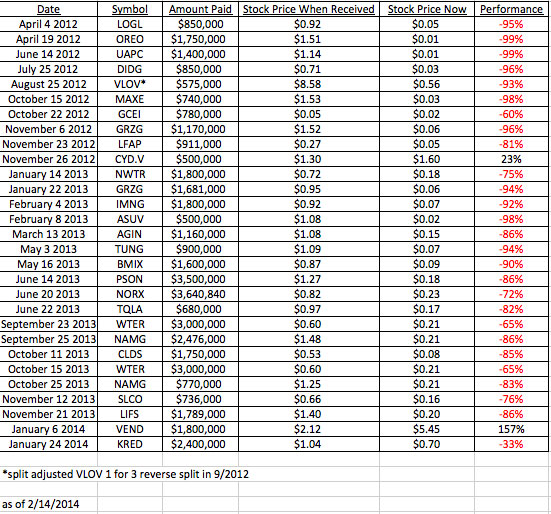](/content/images/wordpress/2014/02/pumpanddumpmatrix.jpg)Here is a performance matrix of every hard mailer I’ve received at my home over the past two years. As you will see, time is a pump and dumps worst enemy. Overtime many of the companies that were involved with hard mailers ended up going to zero.
Many hard mailers look like this one below, which I received on November 21st on Life Stem Genetics ([LIFS](http://finance.yahoo.com/q?s=LIFS&ref=microcapclub.com)). You will see in the disclaimer the cost of production for the hard mailer. Of course, the stock is down 86% since I’ve received it.
[](https://microcapclub.com/2014/02/hard-mailer-pump-and-dump-performance-part-8/lifs1/)
Hard Mailer Cover
[](https://microcapclub.com/2014/02/hard-mailer-pump-and-dump-performance-part-8/lifs2/)
Hard Mailer Disclaimer
It’s unfortunate that in many cases an investors first entre into the microcap space is from unscrupulous sources such as a hard mailer or some pump and dump website. It’s important for investors to know that only a small percentage of microcaps indulge in such unethical tactics. Many microcaps have great businesses, management teams, share structures, and conduct themselves with integrity.
At MicroCapClub, most of our members make a living exclusively investing in microcap stocks. If you want to find out how we do what we do, check out some of our educational articles [**\[HERE\]**](http://microcapclub.com/blog/educational/).
MicroCapClub is an exclusive forum for experienced microcap investors focused on microcap companies (sub $300m market cap). MicroCapClub was created to be a platform for experienced microcap investors to share and discuss stock ideas. Our goal at [MicroCapClub.com](http://microcapclub.com/) is quality membership, quality stocks, and quality content. If you are an experienced microcap investor, feel free to [Apply today](http://microcapclub.com/forums/index.php?/forum/2-applicant-ideas/).
### Investing In What Matters
URL: https://microcapclub.com/investing-in-what-matters/
Last updated: 2023-10-15T11:25:30.000Z
As most of our members already know, I lost my Mom a little over a month ago. It was a freak accident, one of those things that only happens “to other people”. My family and I are at peace with it. When it comes to loss it’s really up to you whether you fill that void with something positive or negative. You can fill it with anger, despair, depression, sadness, and blame everyone and anything. It’s always a good time to pick up an addiction or two. Or you can fill that void with understanding, courage, passion, and make it a rallying cry to live everyday like it could be your last.
Most often when you hear people talking about living their life like everyday is their last day, they normally mean focusing on themselves. “I need to focus on me now” and/or “I’m going to buy xyz, I deserve it”. There is nothing wrong with this to a certain point. Everything around you including the media preaches to do what feels right, right now, but that is exactly what a fulfilling life isn’t about.
When I was in my mid-20’s and single I had my first material big win in the microcap space, a 10 bagger in nine months. I immediately paid off debt and went out and bought myself a new BMW. Life was good. In fact, I started dating my soon to be wife a couple weeks later. No she didn’t date me because of my car 😉 Up to this point, I don’t think it was wrong to spend a little bit, but I got totally engrossed in the “it’s all about me” phase. A month later I went out and bought a Rolex. Two months later wearing jeans, golf shirt un-tucked, and sneakers I walked into a local Porsche dealer and bought a brand new black/black Porsche 911 4S. I laugh thinking about it now because they really didn’t see me coming. The salesman who wasn’t paying attention when I was telling him how I wanted the car ordered, finally stops and asks, how will you be paying for this young man in a condescending tone. I answer, “how about cash, and how about I pay for it right now”. Needless to say I had his attention. This 6-month period of time was all about me, and there were dire consequences.
Your friends and even family look at you differently and not in a good way. You basically just turned yourself into “that guy”. It only took a few months for these purchases to become unfulfilling. I’ve never been a “look at me!” type person, so I ended up never really driving the Porsche. I put around 1,000 miles on it in 16 months and got rid of it. My wife often brings this period of my life up and laughs and calls it my pre mid life crisis. During this time my portfolio took a big hit as well. I was down 50% over the following year. Everything and anything I was invested in seemed to be cursed. It was almost God’s way of saying; I didn’t give you this wealth to spend it all on yourself you douchebag and now I’m going to take it from you.
> “Whoever can be trusted with very little can also be trusted with much, and whoever is dishonest with very little will also be dishonest with much.” Luke 16:10
Over the last few years I’ve found giving money away to be much more satisfying. I’ve set financial goals, not for how much wealth I want to accumulate but how much I want to give away, every year. Your heart does follow your money. So the more you pour your time, energy, and resources into a cause whether it’s a charity, church, or family(s) in need, your heart will follow. It changes you for the better. It is true that you should live everyday like it’s your last, not for yourself, but for others. The people that are impressed with the car you drive are likely not the people you care about anyway. The one thing losing someone close to you does is it focuses you on what is important and that is really making a difference in the here and now.
As it relates to investing, I have the most fun meeting other microcap investors. Even though MicroCapClub is an investment club of sorts, it’s really about the investors, not the companies. There are over 9,000 microcaps trading in the US. Most companies won’t succeed. Companies come and go. Even most of the ones that end up being winners will ultimately end up going right back down. The only constant are the few of us real investors left that invest in these whacky stocks. At conferences or club events, I get so excited about just seeing other investors, sharing experiences, and getting to know the person. I enjoy that so much more than even seeing the companies. 2013 was a great year for most of us financially, and even with the death of my Mom it was a great year personally due to the new lifelong friendships that were started with a lot of new investors. Every minute is precious. Invest in great microcaps and then invest your winnings in what really matters.
**\===> Interact and learn with 250+ of the best microcap investors on the planet.** [\[Join Us\]](https://microcapclub.com/join-now/)
MicroCapClub is an exclusive forum for experienced microcap investors focused on microcap companies (sub $500m market cap) trading on United States, Canadian, European, and Australian markets. MicroCapClub was created to be a platform for experienced microcap investors to share and discuss stock ideas. Since 2011, our members have profiled 1000+ microcap companies. Investors can join our community by applying to become a member or subscribing to gain instant view only access. MicroCapClub’s mission is to foster the highest quality microcap investor Community, produce Educational content for investors, and promote better Leadership in the microcap arena. For more information, visit [http://microcapclub.com](http://microcapclub.com/) and
### MicroCap Statistics: By the Numbers Part 2
URL: https://microcapclub.com/microcap-statistics-by-the-numbers-part-2/
Last updated: 2014-02-05T08:41:22.000Z
Microcap companies make up almost half of all publicly traded companies on all US exchanges, including the [OTC Markets](http://www.otcmarkets.com/home?ref=microcapclub.com) and [OTCBB](http://otcbb.com/?ref=microcapclub.com). Until recently, microcaps have been under appreciated by a bulk of investors and especially the financial press. The tremendous returns garnered by the Russell MicroCap Index ([IWC](http://finance.yahoo.com/q?s=IWC&ref=microcapclub.com)) in 2013 (+45%), and by well known microcap funds like the Perritt Ultra MicroCap Fund ([PREOX](http://quotes.morningstar.com/fund/f?t=PREOX®ion=usa&culture=en-US&ref=microcapclub.com)) +56%, has put the equity class back on the map. Here are a few statistics about the microcap space.
There are currently 18,726 public companies on all US Exchanges (including OTC). Lets now take out the 2,016 companies that are less than $1 million market cap (shells, no corporate entity or operating business) leaving us with 16,710 public companies. *(source S&P CapIQ- data calculated on 2/5/14)*
[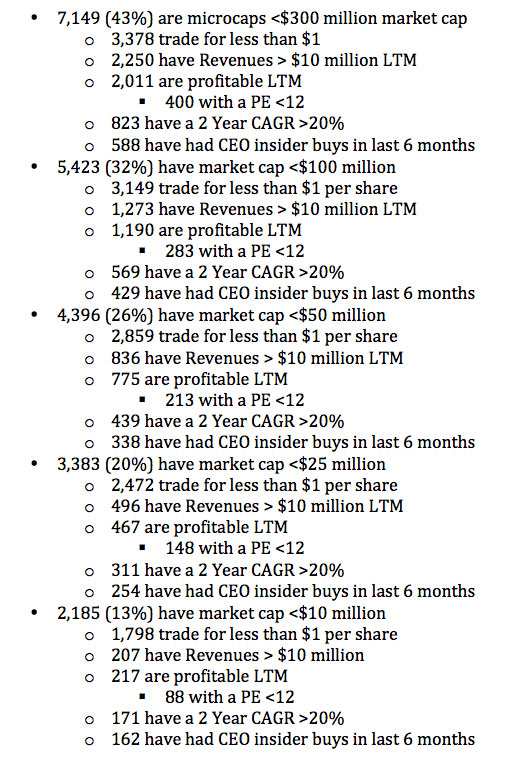](/content/images/wordpress/2014/02/MicrocapStats.jpg)
At MicroCapClub, most of our members make a living exclusively investing in microcap stocks. If you want to find out how we do what we do, check out some of our educational articles [\[HERE\]](http://microcapclub.com/educational/).
MicroCapClub is an exclusive forum for experienced microcap investors focused on microcap companies (sub $300m market cap). MicroCapClub was created to be a platform for experienced microcap investors to share and discuss stock ideas. Our goal at [MicroCapClub.com](http://microcapclub.com/) is quality membership, quality stocks, and quality content. If you are an experienced microcap investor, feel free to [Apply today](http://microcapclub.com/forums/index.php?/forum/2-applicant-ideas/).
### MicroCapClub Invitational: Innovative Food Holdings (IVFH)
URL: https://microcapclub.com/microcapclub-invitational-innovative-food-holdings-ivfh/
Last updated: 2015-07-03T10:28:57.000Z
Innovative Food Holdings ([IVFH](http://finance.yahoo.com/q?s=IVFH&ref=microcapclub.com)) is a leading nationwide provider of direct from source specialty foods, healthcare foods, gluten free foods, and artisanal foods. The company’s specialty food platform powers some of the largest food distributors in the country. Innovative Food Holdings has showcased over 50 consecutive months of year over year growth while increasing profitability. A few of us MicroCapClub members visited the company’s headquarters in Florida last summer and came away impressed with how management is positioning itself in the Specialty Food space. The industry is ripe for consolidation. In the month of January alone, there were 21 M&A transactions in the food distributor industry. In the specialty food distributor category The Chefs’ Warehouse ([CHEF](http://finance.yahoo.com/q?s=CHEF&ref=microcapclub.com)) and United Natural Foods ([UNFI](http://finance.yahoo.com/q?s=UNFI&ref=microcapclub.com)) have been growing rapidly, mostly by way of acquisitions. With Amazon.com ([AMZN](http://finance.yahoo.com/q?s=AMZN&ref=microcapclub.com)) now entering the direct to consumer space by way of amazonfresh, we feel Innovative Food Holdings is right in the sweet spot of the industry and also likely in the crosshairs of industry participants.
**[MicroCapClub Invitational: Innovative Food Holdings (IVFH)](//www.slideshare.net/iancassel/microcapclub-invitational-innovative-food-holdings-ivfh "MicroCapClub Invitational: Innovative Food Holdings (IVFH)")** from **[Ian Cassel](//www.slideshare.net/iancassel)**
Disclosure: Jason, Sean, and Ian are LONG IVFH. This presentation was recorded on Feb 3rd. All participants were not active in the stock on Feb 3rd. The company DID NOT compensate MicroCapClub to present.
More information on the MicroCapClub Invitational and presentation schedule can be found [\[HERE\]](http://microcapclub.com/invitational/2014-invitational/).
MicroCapClub is an exclusive forum for experienced microcap investors focused on microcap companies (sub $300m market cap). MicroCapClub was created to be a platform for experienced microcap investors to share and discuss stock ideas. Our goal at [MicroCapClub.com](http://microcapclub.com/) is quality membership, quality stocks, and quality content. If you are an experienced microcap investor, feel free to [Apply today](http://microcapclub.com/forums/index.php?/forum/2-applicant-ideas/).
### MicroCapClub Invitational: OurPet's Company (OPCO)
URL: https://microcapclub.com/microcapclub-invitational-ourpets-company-opco/
Last updated: 2015-07-03T10:32:20.000Z
OurPet’s Company ([OPCO](http://finance.yahoo.com/q?s=OPCO&ref=microcapclub.com)) develops and markets innovative products for improving the health, safety, comfort, and enjoyment of pets. The company sells over 1,000 products for dogs, cats, and domestic and wild birds. According to the most recent report from the American Pet Products Manufactures Association (APPA) approximately 82.5 million U.S. Households reported owning a pet with an estimated pet population of 83.3 million dogs, 95.6 million cats, and 20.6 million birds. US pet industry sales totaled $59.1 billion in 2012 and expected to grow to $75 billion by 2017\. This under followed nano cap has a very tight share structure of only \~18.6m shares out FD. TTM the company has earned $929,000 or 5c in EPS on a Fully Diluted basis compared to $193,000 or 1c in EPS FY 2012 doing just about the same amount of revenue of \~$21m. We feel that OurPet’s is operating as a well oil machine versus the past several years. The company is showing significant increases in sales in all of their primary sales channels. Their Pet Specialty sales channel along with the “mass retail” channel are gaining real traction. The company is launching several new innovative products this year supported by it’s strong IP portfolio of 100 patents and about 125 pending.
**[MicroCapClub Invitational: OurPet's Company (OPCO)](//www.slideshare.net/iancassel/microcapclub-invitational-ourpets-company-opco "MicroCapClub Invitational: OurPet's Company (OPCO)")** from **[Ian Cassel](//www.slideshare.net/iancassel)**
Disclosure: Mike, Sean, and Ian are LONG OPCO. This presentation was recorded on January 29th. All participants were not active in the stock on January 29th. The company DID NOT compensate MicroCapClub to present.
More information on the MicroCapClub Invitational and presentation schedule can be found [\[HERE\]](http://microcapclub.com/invitational/2014-invitational/).
MicroCapClub is an exclusive forum for experienced microcap investors focused on microcap companies (sub $300m market cap). MicroCapClub was created to be a platform for experienced microcap investors to share and discuss stock ideas. Our goal at [MicroCapClub.com](http://microcapclub.com/) is quality membership, quality stocks, and quality content. If you are an experienced microcap investor, feel free to [Apply today](http://microcapclub.com/forums/index.php?/forum/2-applicant-ideas/).
### MicroCapClub Invitational: ViryaNet (VRYAF)
URL: https://microcapclub.com/microcapclub-invitational-viryanet-vryaf/
Last updated: 2015-07-03T10:34:11.000Z
ViryaNet ([VRYAF](http://finance.yahoo.com/q?s=VRYAF&ref=microcapclub.com)) is a provider of mobile workforce and field service management software. Companies in field service intensive industries, such as utilities and telecoms, rely on ViryaNet’s solutions to optimize their mobile workforce and respond to scheduling changes in real-time. We were first drawn to the company by it’s compelling valuation, blue-chip customer base, and niche positioning, where it has been recognized as an innovator in the $1.5B field service management industry. The company’s flagship product, ViryaNet G4, has gained traction lately through the support of a key partnership with GE Energy, leading to an impressive 34% increase in revenues and 155% increase in total bookings for the third quarter of 2013\. CEO Memy Ish-Shalom and Chairman Samuel HaCohen together own over 20% of the shares outstanding and have demonstrated their confidence in the business recently through open-market purchases. With ViryaNet’s addressable market only 25% penetrated and a new cloud-based solution in the offering, we believe the company can continue its double-digit growth trajectory in 2014 and attract more attention as management tells their story to investors.
**[MicroCapClub Invitational: ViryaNet (VRYAF)](//www.slideshare.net/iancassel/microcapclub-invitational-viryanet-vryaf "MicroCapClub Invitational: ViryaNet (VRYAF)")** from **[Ian Cassel](//www.slideshare.net/iancassel)**
Disclosure: Ian and Brandon are LONG ViryaNet. This presentation was recorded on January 27th. All participants were not active in the stock on January 27th. The company DID NOT compensate MicroCapClub to present.
More information on the MicroCapClub Invitational and presentation schedule can be found [\[HERE\]](http://microcapclub.com/invitational/2014-invitational/).
MicroCapClub is an exclusive forum for experienced microcap investors focused on microcap companies (sub $300m market cap). MicroCapClub was created to be a platform for experienced microcap investors to share and discuss stock ideas. Our goal at [MicroCapClub.com](http://microcapclub.com/) is quality membership, quality stocks, and quality content. If you are an experienced microcap investor, feel free to [Apply today](http://microcapclub.com/forums/index.php?/forum/2-applicant-ideas/).
### MicroCapClub Invitational: Avante Logixx (XX.V / ALXXF)
URL: https://microcapclub.com/microcapclub-invitational-avante-logixx-xx-v-alxxf/
Last updated: 2015-07-03T10:33:27.000Z
Avante Logixx ([XX.V](http://finance.yahoo.com/q?s=XX.V&ref=microcapclub.com) / [ALXXF](http://finance.yahoo.com/q?s=ALXXF&ref=microcapclub.com)) has built its reputation as a preeminent security company by providing premium security services through the use of advanced technology and a focus on client service. Avante’s security business provides a complete suite of security services ranging from system design, sales, installations, and monitoring to services such as alarm response, patrols, personal protection and secure transportation. We were initially attracted to the company because of the significant growth in both revenues and earnings. The company has shown consistent revenue growth over the last three years and was able to grow sales by 43% in the last 12 months from $6.15 million to $8.82 million and earnings from a loss of $57,000 to a profit of just over $1.3 million giving evidence to the leverage within the business. Management and directors are well vested in the company and own approximately 45% of the 59 million shares issued and outstanding. Shares in Avante currently trade at a price earnings ratio of 15.8 times, significantly below the industry average of 29\. The company has a solid balance sheet and has accumulated over $1.5 million in cash and has zero debt. We expect growth to continue both organically and now with a healthier balance sheet through accretive acquisitions.
**[MicroCapClub Invitational: Avante Logixx (XX.V / ALXXF)](//www.slideshare.net/iancassel/microcapclub-invitational-avante-logixx-xxv-alxxf "MicroCapClub Invitational: Avante Logixx (XX.V / ALXXF)")** from **[Ian Cassel](//www.slideshare.net/iancassel)**
Disclosure: Paul and Sean are LONG Avante Logixx. This presentation was recorded on January 22nd. All participants were not active in the stock on January 22nd. The company **DID NOT** compensate MicroCapClub to present.
More information on the MicroCapClub Invitational and presentation schedule can be found [**\[HERE\]**](http://microcapclub.com/invitational/2014-invitational/).
MicroCapClub is an exclusive forum for experienced microcap investors focused on microcap companies (sub $300m market cap). MicroCapClub was created to be a platform for experienced microcap investors to share and discuss stock ideas. Our goal at [MicroCapClub.com](http://microcapclub.com/) is quality membership, quality stocks, and quality content. If you are an experienced microcap investor, feel free to [Apply today](http://microcapclub.com/forums/index.php?/forum/2-applicant-ideas/).
### MicroCapClub Invitational: International Commercial Television (ICTL)
URL: https://microcapclub.com/microcapclub-invitational-international-commercial-television-ictl/
Last updated: 2015-07-03T10:35:53.000Z
International Commercial Television ([ICTL](http://finance.yahoo.com/q?s=ICTL&ref=microcapclub.com)) sells various health and beauty products through infomercials and other channels in the United States and internationally. Some of the best management teams I’ve invested in were those that successfully dug there way out of a hole and turned the company around without much dilution to shareholders. As an investor this is important because management has proven they can navigate the company through the worst of times. A few years ago ICTL was on the brink of bankruptcy, but the management team lead by Kelvin Claney and Richard Ransom would not give up. They felt they had a company-making product with the DermaWand. They ended up scratching and clawing to raise $300,000 to give it one last shot. With this little bit of capital they built the company from $3 million in revenues in 2011 to $30+ million and profitability in 2013\. In 2014, the company is looking to continue its profitable growth trajectory with the launch of additional products.
**[MicroCapClub Invitational: International Commercial Television (ICTL)](//www.slideshare.net/iancassel/microcapclub-invitational-international-commercial-television-ictl "MicroCapClub Invitational: International Commercial Television (ICTL)")** from **[Ian Cassel](//www.slideshare.net/iancassel)**
Disclosure: Ian, Jason and Ken are LONG ICTL. This presentation was recorded on January 20th.The company **DID NOT** compensate MicroCapClub to present.
More information on the MicroCapClub Invitational and presentation schedule can be found [**\[HERE\]**](http://microcapclub.com/invitational/2014-invitational/).
MicroCapClub is an exclusive forum for experienced microcap investors focused on microcap companies (sub $300m market cap). MicroCapClub was created to be a platform for experienced microcap investors to share and discuss stock ideas. Our goal at [MicroCapClub.com](http://microcapclub.com/) is quality membership, quality stocks, and quality content. If you are an experienced microcap investor, feel free to [Apply today](http://microcapclub.com/forums/index.php?/forum/2-applicant-ideas/).
### MicroCapClub Invitational: Xpel Technologies (DAP.U / XPLT)
URL: https://microcapclub.com/microcapclub-invitational-xpel-technologies-dap-u-xplt/
Last updated: 2015-07-03T10:35:06.000Z
Xpel Technologies ([DAP.U](http://finance.yahoo.com/q?s=DAP-U.V&ref=microcapclub.com) or [XPLT](http://finance.yahoo.com/q?s=XPLT&ref=microcapclub.com)) sells paint protection products that protect the vehicle from damage caused by rocks, gravel, salt, acid rain and sand. The company’s [Ultimate Film](http://www.xpel.com/products/xpel%5Fultimate%5Fpaint%5Fprotection%5Ffilm.asp?ref=microcapclub.com) has driven significant sales growth since 2011\. When we first looked at Xpel it reminded us a lot of ZAGG ([ZAGG](http://finance.yahoo.com/q?s=ZAGG&ref=microcapclub.com)) from back in 2008-09 when sales were just starting to ramp. Xpel has profitably grown revenues from $6 million in 2011, to \~$16 million for the LTM. The company has no debt, and a very clean share structure with only 25.7m shares outstanding with no options or warrants. We expect the growth trend to continue as more [independent installers](http://locator.xpel.com/?ref=microcapclub.com), new car dealerships, and international distributors, partner with Xpel. Several members on MicroCapClub have done exhaustive due diligence traveling to numerous dealers and attending car shows. As the company scales it’s business in 2014 and beyond we expect to start to see operating leverage drop more income to the bottom line. We also believe a possible up-listing to a major exchange in 2014 will bring many more eyes on the name.
**[MicroCapClub Invitational: Xpel Technologies (DAP.U / XPLT)](//www.slideshare.net/iancassel/2014-xpel-mcc-inv "MicroCapClub Invitational: Xpel Technologies (DAP.U / XPLT)")** from **[Ian Cassel](//www.slideshare.net/iancassel)**
Disclosure: Paul and Sean are LONG Xpel Technologies. This presentation was recorded on January 15th. All participants were not active in the stock on January 15th. The company **DID NOT** compensate MicroCapClub to present.
More information on the MicroCapClub Invitational and presentation schedule can be found [**\[HERE\]**](http://microcapclub.com/invitational/2014-invitational/).
MicroCapClub is an exclusive forum for experienced microcap investors focused on microcap companies (sub $300m market cap). MicroCapClub was created to be a platform for experienced microcap investors to share and discuss stock ideas. Our goal at [MicroCapClub.com](http://microcapclub.com/) is quality membership, quality stocks, and quality content. If you are an experienced microcap investor, feel free to [Apply today](http://microcapclub.com/forums/index.php?/forum/2-applicant-ideas/).
### MicroCapClub Invitational: Xplore Technologies (XPLR)
URL: https://microcapclub.com/microcapclub-invitational-xplore-technologies-xplr-2/
Last updated: 2015-07-03T10:41:12.000Z
Xplore Technologies ([XPLR](http://finance.yahoo.com/q?s=XPLR&ref=microcapclub.com)) manufactures two forms of tablet computers: Ultra rugged, which has been their core business for many years, and rugged, which is a new growth driver that expands their previously addressable market by a factor of 10\. Their legacy, ultra-rugged product has customers on record such as AT&T ([T](http://finance.yahoo.com/q?s=T&ref=microcapclub.com)) and the US Military. This highly differentiated product is waterproof, can withstand a 7 foot drop, and can function in a temperature range of -40 to 167 degrees. One of the key reasons we became involved with the stock is their new rugged line of tablets, called Ranger X. In July of this past year, they unveiled the Ranger X, which the company just recently announced its first multi million dollar purchase order from a major U.S. telecom provider. We expect the Ranger X to be a major growth catalyst in 2014\. Phil Sassower, Chairman and CEO, owns 33% of the company through his private equity vehicle, and has successfully led the company to the inflection point on which it stands today.
**[MicroCapClub Invitational: Xplore Technologies (XPLR)](//www.slideshare.net/iancassel/microcapclub-invitational-xplore-technologies-xplr "MicroCapClub Invitational: Xplore Technologies (XPLR)")** from **[Ian Cassel](//www.slideshare.net/iancassel)**
Disclosure: All participants are LONG XPLR. This presentation was recorded on January 13th. All participants were not active in the stock on January 13th. The company **DID NOT** compensate MicroCapClub to present.
More information on the MicroCapClub Invitational and presentation schedule can be found [**\[HERE\]**](http://microcapclub.com/invitational/2014-invitational/).
MicroCapClub is an exclusive forum for experienced microcap investors focused on microcap companies (sub $300m market cap). MicroCapClub was created to be a platform for experienced microcap investors to share and discuss stock ideas. Our goal at [MicroCapClub.com](http://microcapclub.com/) is quality membership, quality stocks, and quality content. If you are an experienced microcap investor, feel free to [Apply today](http://microcapclub.com/forums/index.php?/forum/2-applicant-ideas/).
### MicroCapClub Invitational: VolitionRx (VNRX)
URL: https://microcapclub.com/microcapclub-invitational-volitionrx-vnrx/
Last updated: 2015-07-03T10:40:19.000Z
The cure for cancer still eludes us. The next best thing to a cure is the early detection of cancer. In most cases if you detect cancer early enough it can be treated successfully. The holy grail of cancer diagnostics would be a simple blood test with high specificity and sensitivity. VolitionRx ([VNRX](http://finance.yahoo.com/q?s=VNRX&ref=microcapclub.com)) is a clinical stage cancer diagnostic company working on a series of blood-based tests for a range of cancers, beginning with Colorectal Cancer (CRC). The company is starting a lucrative 11,000 patient clinical trial in early 2014 to validate their CRC test. The company expects to have multiple data points throughout 2014 and 2015\. If early results prove successful, Volition’s current $25 million valuation will likely expand closer to comparables such as Exact Sciences ([EXAS](http://finance.yahoo.com/q?s=EXAS&ref=microcapclub.com)) $950 million valuation. Listen to CEO Cameron Reynolds as he tells the story.
**[MicroCapClub Invitational: VolitionRx (VNRX)](//www.slideshare.net/iancassel/microcapclub-invitational-volitionrx-vnrx "MicroCapClub Invitational: VolitionRx (VNRX)")** from **[Ian Cassel](//www.slideshare.net/iancassel)**
Disclosure: *All participants are LONG VNRX. This presentation was recorded on January 8th. All participants were not active in the stock on January 8th. The company *DID NOT* compensate MicroCapClub to present.*
More information on the MicroCapClub Invitational and presentation schedule can be found [**\[HERE\]**](http://microcapclub.com/invitational/2014-invitational/).
MicroCapClub is an exclusive forum for experienced microcap investors focused on microcap companies (sub $300m market cap). MicroCapClub was created to be a platform for experienced microcap investors to share and discuss stock ideas. Our goal at [MicroCapClub.com](http://microcapclub.com/) is quality membership, quality stocks, and quality content. If you are an experienced microcap investor, feel free to [Apply today](http://microcapclub.com/forums/index.php?/forum/2-applicant-ideas/).
### MicroCapClub Invitational: FitLife Brands (FTLF)
URL: https://microcapclub.com/microcapclub-invitational-fitlife-brands-ftlf/
Last updated: 2015-07-03T10:42:08.000Z
FitLife Brands ([FTLF](http://finance.yahoo.com/q?s=FTLF&ref=microcapclub.com)) is a profitable and fast growing nutritional supplements company that is the #1 vendor in the GNC franchise system. The company has showcased a 39% CAGR over the last three years, and expects to grow at a double digit CAGR over the next 3-5 years. John Wilson, CEO of FitLife, and his management team have successfully turned the company around since he joined the company in 2009\. In September of 2013, the company completed a recapitalization, which cleaned up the share structure and balance sheet. We feel the perceived customer concentration risk with GNC Holdings ([GNC](http://finance.yahoo.com/q?s=GNC&ref=microcapclub.com)) isn’t well understood by the market, and creates an interesting value proposition for investors. Listen to CEO John Wilson as he tells the story.
**[MicroCapClub Invitational: FitLife Brands (FTLF)](//www.slideshare.net/iancassel/microcapclub-invitational-fitlife-brands-ftlf "MicroCapClub Invitational: FitLife Brands (FTLF)")** from **[Ian Cassel](//www.slideshare.net/iancassel)**
*Disclosure*: *All participants are LONG FTLF. This presentation was recorded on January 6th. All participants were not active in the stock on January 6th. The company *DID NOT* compensate MicroCapClub to present.*
More information on the MicroCapClub Invitational and presentation schedule can be found [**\[HERE\]**](http://microcapclub.com/invitational/2014-invitational/).
**MicroCapClub** is an exclusive forum for experienced microcap investors focused on microcap companies (sub $300m market cap). MicroCapClub was created to be a platform for experienced microcap investors to share and discuss stock ideas. Our goal at [MicroCapClub.com](http://microcapclub.com/) is quality membership, quality stocks, and quality content. If you are an experienced microcap investor, feel free to [**Apply today**](http://microcapclub.com/forums/index.php?/forum/2-applicant-ideas/).
### Generating Microcap Stock Ideas
URL: https://microcapclub.com/generating-microcap-stock-ideas/
Last updated: 2023-10-15T11:24:00.000Z
I’ve learned over the years that there are several different techniques to finding microcap ideas. Each investor has their own technique to finding ideas. I’ve tried to stick to a unique approach that my mentor taught me about 5 years ago.
One piece of technology that I use is called 10k wizard ([http://10kwizard.com/](http://10kwizard.com/?ref=microcapclub.com)) and allows you to search using keywords and allows you to search through filings. They are now owned by Morningstar and offer a good service for the price. I would recommend the professional version, which costs $802/year and allows you to do two very important things. It allows you to search key words using advanced Boolean operators throughout all filings and allows you to identify the changes that happened between filings.
**Identify Trend** – Many trends are happening right before our eyes and we don’t even realize it. I read the book “The Invisible Gorilla” which related well to investing. If you can identify the trend before the masses you should be in good hands. [http://www.theinvisiblegorilla.com/gorilla\_experiment.html](http://www.theinvisiblegorilla.com/gorilla%5Fexperiment.html?ref=microcapclub.com)
Some of the strong trends that I see moving are food verification, bluetooth low energy, proximity based data, natural gas engines, tanker railcars, advanced metering infrastructure, food transparency, EHR workflow, obesity, just to name a few.
**Keyword Search** – Searching for specific keywords through filings is extremely important. It also allows you to use advanced Boolean operators to search any specific way that you want. Once you identify a niche you may have more than just one opportunity in that niche/sector that could work. Most of the time I find investors aren’t specific enough to their searches.
**Identifying changes between filings** – I find this very useful seeing what was added and what was deleted from the previous filing. It helps you more efficiently scroll through the filings. Over the years this has helped ask questions on my initial call that I have with the company or future conference calls that the company has with investors.
**Filings Alerts** – REFRESH….REFRESH….REFRESH…Yes call me crazy but this is what I used to do back in the day on Yahoo Finance or SEC.gov. Microcap companies are pretty predictable in terms of when they will release their 10Q or 10K’s. I look back to the prior year and see when they reported to see how consistent they are. I enjoy reading the 10k filing as it has the much more detailed information than the 10Q.
I typically search specific exchanges that I’m interested in depending on the number of results that are pulling up. I then go through each company and identify the ones that seem interesting. My sweet spot are is a Nanocap company between a $7-25m market cap company that is illiquid. I like the chart that has range bound and has traded very tight for a long period of time with no breakout. I generally look for companies with cash and that have little to no debt with clean share structures, preferably < 30m shares OS. When management treats their shares like gold…that holds a very high bar with me.
All investors have their own methods to their madness, but I’ve found that doing my own homework and Due Diligence has helped me make better investment decisions over the years.
**\===> Interact and learn with 250+ of the best microcap investors on the planet.** [\[Join Us\]](https://microcapclub.com/join-now/)
MicroCapClub is an exclusive forum for experienced microcap investors focused on microcap companies (sub $500m market cap) trading on United States, Canadian, European, and Australian markets. MicroCapClub was created to be a platform for experienced microcap investors to share and discuss stock ideas. Since 2011, our members have profiled 1000+ microcap companies. Investors can join our community by applying to become a member or subscribing to gain instant view only access. MicroCapClub’s mission is to foster the highest quality microcap investor Community, produce Educational content for investors, and promote better Leadership in the microcap arena. For more information, visit [http://microcapclub.com](http://microcapclub.com/) and
### Interview with Portfolio Manager Michael Corbett of Perritt Capital Management
URL: https://microcapclub.com/interview-with-portfolio-manager-michael-corbett-of-perritt-capital-management/
Last updated: 2023-10-15T11:22:52.000Z
Michael Corbett is the CIO and portfolio manager for all equity portfolios at [Perritt Capital Management](http://www.perrittcap.com/index.php?ref=microcapclub.com). Perritt Capital Management is one of the preeminent microcap fund managers over the last 20+ years. Michael manages two microcap funds, the Perritt Opportunities Fund ([PRCGX](http://quotes.morningstar.com/fund/prcgx/f?t=prcgx&ref=microcapclub.com)) and the Perritt Ultra MicroCap Fund ([PREOX](http://quotes.morningstar.com/fund/preox/f?t=preox&ref=microcapclub.com)). The Ultra MicroCap Fund has the lowest average market cap of any fund rated by Morningstar, $78 million, and is also the top performing fund in its category over the last 12 months (+52%). We [first interviewed](http://microcapclub.com/2012/06/microcapclub-interview-with-portfolio-manager-michael-corbett-of-perritt-capital-management/) Michael 18 months ago, so our membership came up with a few more questions for round two.
[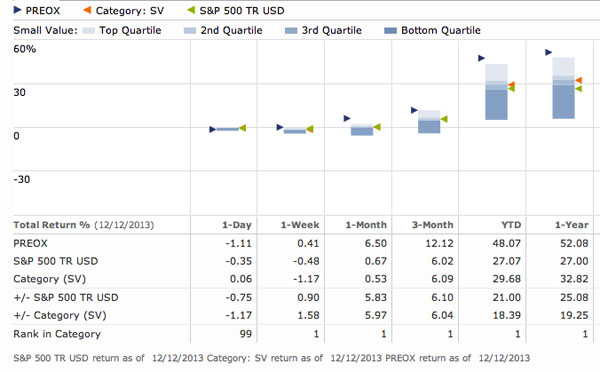](/content/images/wordpress/2013/12/preoxperformance.jpg)
**\===> Interact and learn with 250+ of the best microcap investors on the planet.** [\[Join Us\]](https://microcapclub.com/join-now/)
MicroCapClub is an exclusive forum for experienced microcap investors focused on microcap companies (sub $500m market cap) trading on United States, Canadian, European, and Australian markets. MicroCapClub was created to be a platform for experienced microcap investors to share and discuss stock ideas. Since 2011, our members have profiled 1000+ microcap companies. Investors can join our community by applying to become a member or subscribing to gain instant view only access. MicroCapClub’s mission is to foster the highest quality microcap investor Community, produce Educational content for investors, and promote better Leadership in the microcap arena. For more information, visit [http://microcapclub.com](http://microcapclub.com/) and
### Is MicroCap Getting Too Big?
URL: https://microcapclub.com/is-microcap-getting-too-big/
Last updated: 2013-12-08T08:49:29.000Z
Thirty years ago a microcap was defined as a public company < $50 million market cap. Most investors today define microcap as <$300 million, and that is what we use here at MicroCapClub. I’ve seen fund managers such as [Royce Funds](http://www.roycefunds.com/insights/whitepapers/small-cap-evergreen-asset-class?utm%5Fsource=twitter&utm%5Fmedium=120113-0835&utm%5Fcampaign=smallcaps) define microcap as < $750 million. For those of us that exclusively invest in microcaps, we know there is a big difference between a $600 million market cap company and a $25 million market cap company. The Russell MicroCap Index ([IWC](http://finance.yahoo.com/q?s=IWC&ref=microcapclub.com)) in fact isn’t very micro. It’s more of a small cap index with an [average market cap](http://www.russell.com/indexes/data/fact%5Fsheets/us/Russell%5FMicrocap%5FIndex.asp?ref=microcapclub.com) of $430 million, and holds quite a few companies with a $1 billion+ market cap.
I attended a smallcap conference this summer where I sat next to a well known smallcap fund manager. We were talking about what companies we liked and why. The dialogue that transpired is one I’ve had dozens of times, but it went something like this:
The fund manager started first and gave a few interesting names, most of which were $200-400 million market cap companies. I remarked jokingly, “Gary, I might as well just buy GE, what is the smallest piece of crap in your portfolio?”. He laughs and says, “XYZ company, $124 million market cap is the smallest. We really can’t buy anything sub $100 million due to liquidity. Our average market cap in the portfolio is $300 million” I tell him, “I think if I added the market caps of all my holdings together it doesn’t equate to $124 million”. He says, “I wish we could invest in the really small microcaps, but we are just too big”. This is a fairly typical conversation I have with most micro-smallcap money managers/fund managers.
These professionals aren’t dumb. They know the real area to make great returns is the super small microcaps, but they can’t because their funds are just too big. If you manage a $500 million fund, and you need to put 1% ($5 million) to work in a position, that is just impossible to do in a $30 million market cap that trades $50,000 worth of stock per day. However, the real value is found in these very small microcaps <$50 million. Let me give you a few statistics that prove this:
- Of the 919 profitable companies between $300–750 million market cap, 112 (12%) are currently trading at < 12 PE LTM.
- Of the 831 profitable companies between $100–300 million market cap, 107 (13%) are currently trading at < 12 PE LTM.
- Of the 424 profitable companies between $50–100 million market cap, 69 (16%) are currently trading at < 12 PE LTM.
- **Of the 882 profitable companies < $50 million market cap, 275 (31%) are currently trading at < 12 PE LTM.**
**The smaller you go in microcap the more inefficient the markets become. Roughly half (49.4% to be exact) of all public companies on all US Exchanges + OTCBB + OTCM are microcaps defined by <$300 million market cap. A more staggering statistic is that 35% of all public companies are < $50 million market cap. These smaller microcaps, <$50m market cap, is where the greatest inefficiency lies. So not only are the cheapest stocks very small but there are a whole lot of them. This is why Warren Buffett and Peter Lynch first built their early wealth in this bastion of inefficiency before their assets grew so large they were forced up the food chain.**
[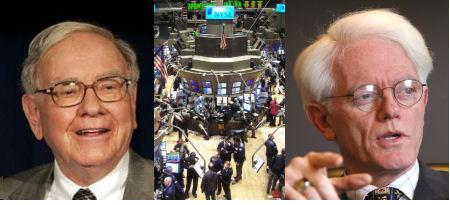](/content/images/wordpress/2013/12/buffetlynch.jpg)
In 2005, [Warren Buffett](http://www.fool.com/community/pod/2005/050713.htm?ref=microcapclub.com) was asked the following question:
Question: According to a business week report published in 1999, you were quoted as saying: “It’s a huge structural advantage not to have a lot of money. I think I could make you 50% a year on $1 million. No, I know I could. I guarantee that.”…would you say the same thing today?”
Buffett Answer: “Yes, I would still say the same thing today. In fact, we are still earning those types of returns on some of our smaller investments. The best decade was the 1950s; I was earning 50% plus returns with small amounts of capital. I could do the same thing today with smaller amounts. It would perhaps even be easier to make that much money in today’s environment because information is easier to access. You have to turn over a lot of rocks to find those little anomalies. You have to find the companies that are off the map – way off the map.”
When you really dive into why there are more cheap companies in the <$50 million, a major reason is this is where illiquid stocks call home. There have been a few academic studies, such as the [Ibbotson Study](http://www.fa-mag.com/news/ibbotson-finds-liquidity-rules-5841.html?ref=microcapclub.com), which analyzed returns of liquid vs illiquid small-mid-large cap companies. Ibbotson found that over a 37-year period liquid smallcaps returned just 5.9% annually compared to illiquid smallcaps, which returned a staggering 17.87% annual return over the same time frame. I’m sure this is also a big reason why the fund with the smallest average market cap ($78m) rated by Morningstar, Perritt Ultra MicroCap ([PREOX](http://quotes.morningstar.com/fund/f?t=PREOX®ion=USA&culture=en-US&ref=microcapclub.com)), is also the [top performing microcap](http://performance.morningstar.com/fund/performance-return.action?t=PREOX®ion=USA&culture=en-US&ref=microcapclub.com) fund over the last year by Morningstar.
[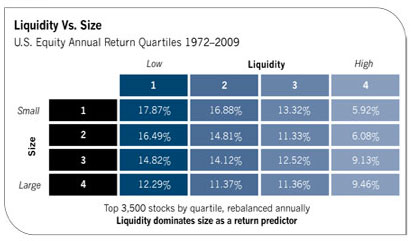](/content/images/wordpress/2013/12/liquidity-vs-size.jpg)
In 2013, it became cool again to say you invest in microcaps. This hasn’t been the case for a couple of decades. Historically, the only publicity mainstream financial outlets ever gave microcaps is to say how awful microcaps were. Of course, anyone with half an IQ just laughed because that thought process is what creates such ineffiency in the first place. Of course I’ve read several positive articles from these same sources recently. What a difference a year makes.
Ok, so I’ve basically got way off track since the first paragraph. To bring this back full circle, is microcap getting too big? Yes, I think the definition of what is microcap has gotten a bit out of hand. I cringe when I think of a $300-400-500 million company as microcap, and if I had a vote I would say a definition of <$100 million is about right. In the end I guess it doesn’t really matter, but it’s fun topic to debate. I’m sure in another ten years <$1.5 billion will be considered microcap.
At MicroCapClub, most of our members make a living exclusively investing in microcap stocks. If you want to find out how we do what we do, check out some of our educational articles [**\[HERE\]**](http://microcapclub.com/educational/).
**MicroCapClub** is an exclusive forum for experienced microcap investors focused on microcap companies (sub $300m market cap). MicroCapClub was created to be a platform for experienced microcap investors to share and discuss stock ideas. Our goal at [MicroCapClub.com](http://microcapclub.com/) is quality membership, quality stocks, and quality content. If you are an experienced microcap investor, feel free to [**Apply today**](http://microcapclub.com/forums/index.php?/forum/2-applicant-ideas/).
### Learning From Losing Money In MicroCaps
URL: https://microcapclub.com/learning-losing-money-microcaps/
Last updated: 2023-10-15T11:21:49.000Z
> “We may impress people with our strengths but we connect with people through our weaknesses” – Craig Groeschel
Talking about your winners all the time might lift the ego and attract lemmings, but it will do little towards gaining the respect of your peers. I picked the right stock, it went up, boy I’m smart and wasn’t that impressive. No, what I truly enjoy talking about most are my losers because I’ve had plenty of them, and I believe lessons can be learned from analyzing the losers. I’ve been a full time microcap investor since 2008, and I still make stupid mistakes. The key is learning from your mistakes. The difference between Major League Baseball players consistently hitting .230 versus .330 BA is $15-20 million per year. Keeping your losses small in the portfolio is just as important as holding on to your winners.
One of my first big losses came in 2000\. I swear I was trying to lose all my money as fast as I could. I bought a tech stock at the top of the internet bubble based off a brokers recommendation. As the stock dropped I was told to dollar cost average, so I bought more at $100, $80, $60, $40, $10, and $5\. The stock eventually fell to $0.32 per share, and I gave in and sold at $0.55\. I ended up losing 97% of my investment. In the Guinness Book of World Records, my name is highlighted next to Quickest Loss, and Biggest Sucker. This wouldn’t be the last time I would lose almost everything, but losing money is a great educator and motivator. These early losses are what eventually guided me to microcaps, and a year or so after this big loss is when [I met my first microcap CEO](http://microcapclub.com/2013/07/the-first-microcap-ceo-i-ever-met/).
The reason why we love microcaps is they are one of the last investment classes where you can get an edge. That edge is information, and it may simply be nothing more than knowing a company exists. The information edge goes both ways. Not only can having an edge get you into a position before the masses, but it can also get you out of a position before the masses sell. When events occur that challenge and change your investment thesis, the fact that you are aware and sell quickly can save you lots of money.
All investors struggle with justifying or rationalizing their positions. I can’t tell you how many times I’ve held a position way too long after something negative happened. Instead of selling based on my gut instinct, I rationalized my position, convincing myself to hold or maybe even buy more. In almost all of these instances I lost a substantial amount of money. When you know your positions better than most, you’ll know when the story changes. When the story changes it’s almost always time to sell. Don’t rationalize your investment. When the investment thesis starts cracking, you start to sell because everyone else will when it becomes obvious. Here are a few real life examples when rationalizing my position cost me hundreds of thousands of dollars:
[](/content/images/wordpress/2013/11/fewer-facts-more-fiction.jpg)
Example #1, Sudden CFO Departure: On more than one occasion I’ve been a shareholder in a company where the CFO suddenly resigns. CFO’s leave companies all the time, but it’s important for the company to telegraph the departure months before it actually happens so shareholders aren’t surprised. Bad things can happen when a company provides little warning. When a CFO resigns, questions get raised, Are the financials in order? Is there fraud? The types of questions that if true can completely derail a stock. In many ways this is worse then even the CEO resigning suddenly. When a CEO suddenly resigns, most people just think he probably got caught sleeping with the secretary or something (Just kidding). Heck, in certain situations the stock might even rally if a CEO resigns 🙂 A few years ago I held a position after a CFO suddenly resigned. I thought it was odd because I spoke with management frequently and I never got the impression they were searching for a new CFO. I convinced myself to hold while the stock dropped. A month later the auditor resigned from the company, and the stock got cut in half. A month later most of the board resigned. Two months later the stock went to zero. This is an extreme example, but I’ve found in these scenarios it is much better to shoot first (sell) and ask questions later.
[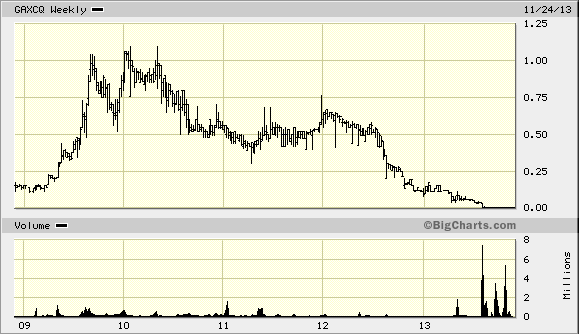](/content/images/wordpress/2013/11/gaxcchart.png)
Example #2, Industry – Consumer Shift: In 2009, I bought a 3-4% position in a company called Global Axcess (GAXCQ) between 0.40-0.60\. The company managed a portfolio of 5,000 ATM’s machines across several states. If you know much about the ATM business, their profitability is inverse to fed funds rate changes because the cash they put in the ATM’s is borrowed. If the fed increases the fed funds rate, it basically squeezes the margins of the ATM operators and vice versa. As you remember, the fed funds rate was lowered significantly in 2008-2009 to thwart an economic depression. This was inherently good for GAXC’s ATM business. I bought the stock because of increasing margins of the ATM business, but soon after management announced an exciting new venture. At this same point in time RedBox DVD Kiosks were bursting onto the scene and their growth was exploding. GAXC thought why not leverage their ATM experience by rolling out DVD kiosks. It sounded good to me. RedBox was a hot stock and if little GAXC could be successful rolling out their DVD kiosks, this is something that could really increase the valuation. On the news of entering this space, GAXC stock went over $1.00\. Literally within a few weeks of GAXC entering the DVD kiosk space, NetFlix (NFLX) started to really gain traction, which instantly sucked the buzz out of the DVD kiosk plays. You could just feel it. As a shareholder, I’ve never been in a company whose opportunity opened and closed literally within a couple months like that. The industry shifted. The difference between an industry/consumer tailwind vs headwind is huge. It’s the difference between a 50 PE and an 6 PE. I waited too long rationalizing my position, but I should’ve sold it immediately. The debt the company took on to fund the DVD kiosk expansion eventually bankrupted the company.
[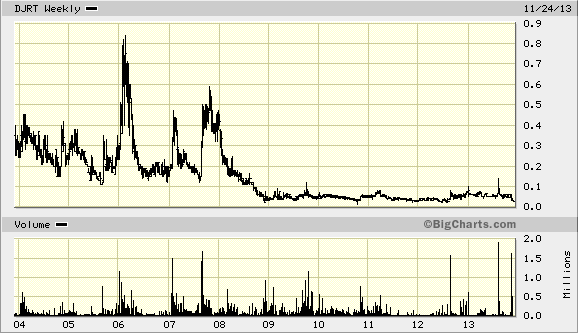](/content/images/wordpress/2013/11/djrtchart.png)
Example #3, Economic Shift: In 2007, I bought a big position in Dale Jarrett Racing (DJRT) between 0.10 – 0.20\. The company operated an authentic NASCAR racing experience at several racetracks around the United States. I took several friends and family from PA down to Talladega Motor Speedway in Alabama to experience the thrill of racing 180 mph in authentic stock cars. Everyone loved it. It was exhilarating. I liked the company because it was profitable and trading at a $3 million market cap. If the company was successful in marketing and filling up their racing days at the track the company would become very profitable. There was also talk of partnering with a major casino or brand and building a track in Las Vegas. Remember this was 2007 and Las Vegas was in full bubble mode. The company was going to significantly increase their advertising dollars over the winter of 2007-2008 to fill up more track days in 2008\. By my calculations, if the company increased their racing days as much as I thought, the company could earn another 0.02-0.03c EPS, and this could be an easy 4-5 bagger. If you remember we started to see the economy start to get sluggish around this same time while the company was aggressively advertising. Consumers were just not willing to spend on luxury purchases such as this when the economy was heading into free fall. I justified the position and held on, and the longer I held the lower the stock fell.
We all take losses from time to time, but the important thing is learning from them. In most of my large losses I ended up rationalizing my position. When you start to see signs of weakness in your investment thesis, it’s human nature to try to justify that position and convince yourself to hold on. The hardest thing to do is to admit things have changed and you are wrong. Remember the “edge” that we enjoy in microcaps is one of information. Use the “edge” to buy and also to sell. Keeping a pulse on the company while monitoring outside forces affecting the company are key in successful microcap investing. When things change, gauge the situation, but react quickly. It can mean the difference between a capital gain, and a large capital loss.
If you enjoyed this article, you will like [Cutting Your Losses](http://microcapclub.com/2015/05/cutting-your-losses/).
**\===> Interact and learn with 250+ of the best microcap investors on the planet.** [\[Join Us\]](https://microcapclub.com/join-now/)
MicroCapClub is an exclusive forum for experienced microcap investors focused on microcap companies (sub $500m market cap) trading on United States, Canadian, European, and Australian markets. MicroCapClub was created to be a platform for experienced microcap investors to share and discuss stock ideas. Since 2011, our members have profiled 1000+ microcap companies. Investors can join our community by applying to become a member or subscribing to gain instant view only access. MicroCapClub’s mission is to foster the highest quality microcap investor Community, produce Educational content for investors, and promote better Leadership in the microcap arena. For more information, visit [http://microcapclub.com](http://microcapclub.com/) and
### MicroCap Statistics: By the Numbers
URL: https://microcapclub.com/microcap-statistics-numbers/
Last updated: 2013-11-12T07:32:00.000Z
Microcap companies make up half of all publicly traded companies on all the US exchanges, including the OTC Markets and OTCBB. Microcaps have always been under appreciated by a bulk of investors and especially the financial press. Even most professional investors I talk to don’t realize the size and scope of the microcap space or the value that can be found in it. Here are a few statistics that help illustrate this:
There are currently 18,712 publicly traded companies on all US Exchanges (including OTCM/OTCBB)
- 45% (8,464) are profitable LTM
- 49.7% (9,315) are microcaps (sub $300m market cap)
- 24% of all microcaps are profitable
- 38% (7,120) are nanocaps (sub $75m market cap)
- 16% of all nanocaps are profitable
Not surprisingly, a greater proportion of microcaps are not profitable when compared to other market capitalizations…
[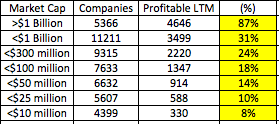](/content/images/wordpress/2013/11/statpic1.png)
Another way to look at it…
[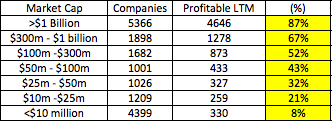](/content/images/wordpress/2013/11/statpic2.png)
But you will certainly find more value in microcaps than anywhere else, of the 8,464 profitable companies…
[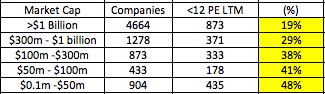](/content/images/wordpress/2013/11/statpic3.png)
One of the key things professional microcap investors look for are companies with good share structures…of the 2,211 profitable microcaps that exist a majority of them have less than 25m shares outstanding..
[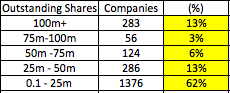](/content/images/wordpress/2013/11/statpic4.png)
*Source: Statistics from S&P Capital IQ*
The fact that no one really looks at these small public companies is also the opportunity. At MicroCapClub, most of our members make a living exclusively investing in microcap stocks. If you want to find out how we do what we do, check out some of our educational articles [**\[HERE\]**](http://microcapclub.com/educational/).
**MicroCapClub** is an exclusive forum for experienced microcap investors focused on microcap companies (sub $300m market cap). MicroCapClub was created to be a platform for experienced microcap investors to share and discuss stock ideas. Our goal at [MicroCapClub.com](http://microcapclub.com/) is quality membership, quality stocks, and quality content. If you are an experienced microcap investor, feel free to [**Apply today**](http://microcapclub.com/forums/index.php?/forum/2-applicant-ideas/).
### Pump and Dumps: The Race to Zero
URL: https://microcapclub.com/pump-dumps-race-zero/
Last updated: 2013-11-10T08:00:14.000Z
Pump and dumps have been going on since the beginning of the stock market and are most prevalent amongst penny stocks. The hard mailer is one of the most used avenues to pump a stock. The company themselves, affiliates, or large shareholders pay millions of dollars to mail out glossy 20 page reports trying to dupe investors to buy the underlying stock so they can sell their positions or conduct a financing. Just like gravity, when a hard mailer pushes a stock up, the buying eventually ends and they always crash back down to Earth.
[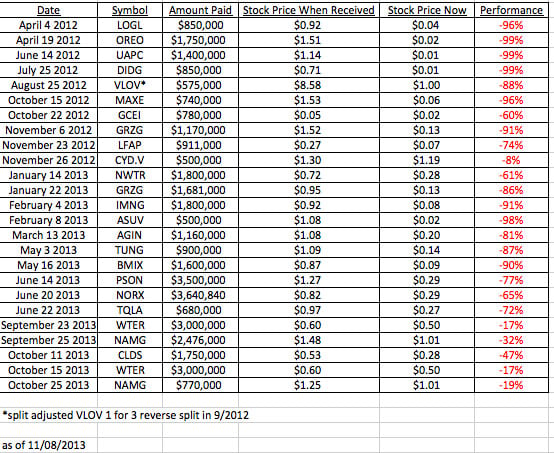](/content/images/wordpress/2013/11/Screen-shot-2013-11-09-at-3.29.jpg)
Here is a performance matrix of every hard mailer I’ve received at my home over the past 18 months. As you will see, time is a pump and dumps worst enemy. Overtime many of the companies that were involved with hard mailers ended up going to zero.
Many hard mailers look like this one below, which I received on October 25th on North American Oil & Gas ([NMAG](http://finance.yahoo.com/q?s=namg&ql=1&ref=microcapclub.com)). You will see in the disclaimer below that [Tobin Smith](http://microcapclub.com/2013/06/tribute-to-tobin-smith-hard-mailer-performance/) received $20,000 for putting his face on it, and the remaining $770,000 towards to the publication and distribution.
[](https://microcapclub.com/2013/11/pump-dumps-race-zero/tobinnamg1/)
[](https://microcapclub.com/2013/11/pump-dumps-race-zero/tobinnamg2/)
It’s unfortunate that in many cases an investors first entre into the microcap space is from unscrupulous sources such as a hard mailer or some pump and dump website. It’s important for investors to know that only a small percentage of microcaps indulge in such unethical tactics. Many microcaps have great businesses, management teams, share structures, and conduct themselves with integrity.
At MicroCapClub, most of our members make a living exclusively investing in microcap stocks. If you want to find out how we do what we do, check out some of our educational articles **[\[HERE\]](http://microcapclub.com/educational/)**.
**MicroCapClub** is an exclusive forum for experienced microcap investors focused on microcap companies (sub $300m market cap). MicroCapClub was created to be a platform for experienced microcap investors to share and discuss stock ideas. Our goal at [MicroCapClub.com](http://microcapclub.com/) is quality membership, quality stocks, and quality content. If you are an experienced microcap investor, feel free to [**Apply today**](http://microcapclub.com/forums/index.php?/forum/2-applicant-ideas/).
### Alternative To An Alternative: Active Microcap Vs. Private Equity
URL: https://microcapclub.com/alternative-alternative-active-microcap-vs-private-equity/
Last updated: 2023-10-15T11:20:14.000Z
The current market environment is creating potential opportunities for investors seeking alternative options. These investors can benefit from a discussion comparing active microcap investing and private equity. The topic is a timely one, especially as it pertains to longer-term investment approaches.
Investors look to microcap investments for possible alpha generation tem- pered with risk management, much like other market sectors. However, they approach the sector with a higher tolerance for some of the unique factors inherent in the microcap space: lower liquidity, longer investment horizons, minimal analyst coverage, ‘lumpy’ return streams, and a higher risk/reward ratio than has been typical for larger-cap equity strategies.
The returns and underlying investments of microcap securities provide many similarities to private equity. However, the access, liquidity, trans- parency, low fee structure, and flexibility of the active microcap fund structure may provide a significant advantage for many investors. In a February 12, 2013 article by Bloomberg reporter David Carey, “Buyout- Boom Shakeout Is Seen Leaving One in Four to Starve,” the private equity market’s current difficulties are explained:
> *\[Private equity\] Firms that attracted an unprecedented $702 billion from investors from 2006 to 2008 must replenish their coffers for future deals and avoid a reduction in fee income when the investment periods on those older funds run out, typically after five years. As many as 708 firms face such deadlines through 2015, according to London-based researcher Preqin Ltd.*
>
> *The combination of underperformance and funding needs has set the stage for a purge as investors pull the plug on the weakest firms. Only the scope of a shake-out is a matter of debate. “The shakeout will be rather massive,” said Antoine Drean, chairman of Triago SA, a Paris-based firm that helps private-equity firms raise money. Drean estimates that as many as a quarter of private-equity managers will see their funding pulled by 2018.*
#### [**\[VIEW FULL REPORT HERE\]**](http://www.perrittcap.com/wp-content/uploads/Whitepaper-Alternative-to-an-Alternative-2.pdf?ref=microcapclub.com)
**\===> Interact and learn with 250+ of the best microcap investors on the planet.** [\[Join Us\]](https://microcapclub.com/join-now/)
MicroCapClub is an exclusive forum for experienced microcap investors focused on microcap companies (sub $500m market cap) trading on United States, Canadian, European, and Australian markets. MicroCapClub was created to be a platform for experienced microcap investors to share and discuss stock ideas. Since 2011, our members have profiled 1000+ microcap companies. Investors can join our community by applying to become a member or subscribing to gain instant view only access. MicroCapClub’s mission is to foster the highest quality microcap investor Community, produce Educational content for investors, and promote better Leadership in the microcap arena. For more information, visit [http://microcapclub.com](http://microcapclub.com/) and
### How Microcaps Add Value to a Smallcap Value Strategy
URL: https://microcapclub.com/microcaps-add-value-smallcap-value-strategy/
Last updated: 2023-10-15T11:18:44.000Z
Heartland Funds published this white paper on microcaps earlier this year with some good historical data points on the microcap space. The Heartland Value Fund ([HRTVX](http://quotes.morningstar.com/fund/f?t=HRTVX®ion=USA&culture=en-US&ref=microcapclub.com)) is a value based micro-smallcap fund. The fund’s average market cap in the portfolio is $472 million.
**Historical Micro-cap Returns**
Over time, micro-caps have outperformed equities in all other capitalization ranges. In our view, this suggests that any investor whose portfolio allows for micro-cap exposure would be wise to seek it. The rather dramatic chart below shows the long-term outperformance of micro-caps versus other small-cap, mid-cap, and large-cap stocks. The data reflects the total return of one hypothetical unit if it were invested in each capitalization range, from 1926 through December 31, 2012\. Not surprisingly, micro-caps exhibited greater volatility than other cap ranges.
[](/content/images/wordpress/2013/11/microcaphistorical.jpg)
Many small-cap managers tend to gravitate toward the larger end of the market-cap spectrum, where information and liquidity are more readily available. In the micro-cap range, information is scarcer and liquidity less abundant. We believe most small-cap equity managers stay away from micro-caps for these reasons, which helps explain why they behave differently than larger small-caps.
#### [**\[VIEW FULL REPORT HERE\]**](http://www.heartlandfunds.com/media/Views-Commentary/Portfolio-Manager-Perspectives-/HeartlandValueFundPortfolioManagerPerspectiveMicro-CapsSmall-Caps.pdf?ref=microcapclub.com)
**\===> Interact and learn with 250+ of the best microcap investors on the planet.** [\[Join Us\]](https://microcapclub.com/join-now/)
MicroCapClub is an exclusive forum for experienced microcap investors focused on microcap companies (sub $500m market cap) trading on United States, Canadian, European, and Australian markets. MicroCapClub was created to be a platform for experienced microcap investors to share and discuss stock ideas. Since 2011, our members have profiled 1000+ microcap companies. Investors can join our community by applying to become a member or subscribing to gain instant view only access. MicroCapClub’s mission is to foster the highest quality microcap investor Community, produce Educational content for investors, and promote better Leadership in the microcap arena. For more information, visit [http://microcapclub.com](http://microcapclub.com/) and
### Mike Schellinger (aka MikeDDKing) Wins MicroCapClub Contest!
URL: https://microcapclub.com/mike-schellinger-aka-mikeddking-wins-microcapclub-contest/
Last updated: 2013-11-01T07:06:19.000Z
Congratulations to Mike Schellinger (aka MikeDDKing) for taking first place in our [MicroCapClub Stock Contest](http://microcapclub.com/contest/) with a cumulative return of +156% in his portfolio of microcap stocks. Mike is one of the most successful microcap investors I know, so this was not a surprise.
Mike’s Prize for Winning: $2,500 cash, plus an expense paid trip to LD Micro 2013 (Up to $500 for Airfare + 2 Nights Accommodation)
Mike’s individual picks and returns:
[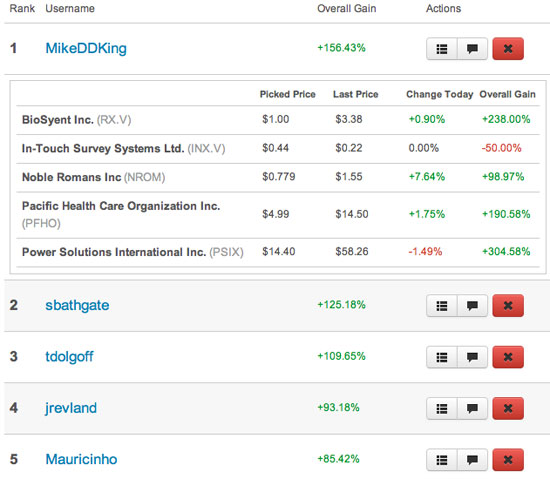](/content/images/wordpress/2013/11/Screen-shot-2013-11-01-at-6.56.jpg)
**MicroCapClub** is an exclusive forum for experienced microcap investors focused on microcap companies (sub $300m market cap). MicroCapClub was created to be a platform for experienced microcap investors to share and discuss stock ideas. Our goal at [MicroCapClub.com](http://microcapclub.com/) is quality membership, quality stocks, and quality content. If you are an experienced microcap investor, feel free to [**Apply today**](http://microcapclub.com/forums/index.php?/forum/2-applicant-ideas/).
### Lessons Learned Investing in MicroCap Spinoffs
URL: https://microcapclub.com/lessons-learned-investing-microcap-spinoffs/
Last updated: 2023-10-15T11:17:16.000Z
What do the following four MicroCapClub stocks have in common? Atlas Financial Holdings ([AFH](http://finance.yahoo.com/q?s=afh&ql=1&ref=microcapclub.com) which I own) insures taxi-cab drivers, Nova Copper ([NCQ](http://finance.yahoo.com/q?s=ncq&ql=1&ref=microcapclub.com)) is developing a copper mine in Alaska, Parametric Sound ([PAMT](http://finance.yahoo.com/q?s=pamt&ql=1&ref=microcapclub.com)) makes and licenses out-of-this-world directional sound speakers, and Straight Path Communications ([STRP](http://finance.yahoo.com/q?s=strp&ql=1&ref=microcapclub.com)) sues big tech companies for infringing their patents. What’s the common link? They’re all recent spinoffs.
Some investors specialize in technology stocks, others in the resource industry or financial services. I specialize in special situations. Spinoffs, rights offerings, divestitures, restructurings bankruptcy emergence, regardless of the industry, I’m interested. But spinoffs are where I’ve made the most money. Famous and accomplished value investors like Seth Klarman, Joel Greenblatt, Charlie Munger, and even Cramer cite spinoffs as a favorite source of ideas. From the recommendations above, MicroCapClub members apparently have an interest in spinoffs too. Much has been written on the topic before, but the notable and popular book is Joel Greenblatt’s [“You Can Be a Stock Market Genius”](http://microcapclub.com/2012/07/book-review-you-can-be-a-stock-market-genius-by-joel-greenblatt/). After 15 years of buying spinoffs I’ve found the advice in this book to be so spot-on that there is only a little to add related specifically to the microcap space. So let me begin by summarizing the reasons Mr. Greenblatt cites for the academically verified spinoff outperformance.
1. Indiscriminate selling. In a spinoff, securities of some company shows up in your brokerage account. You didn’t ask for it, you didn’t buy it, and you may know very little about it. Perhaps you’re an Index Fund and you’re only allowed to own stocks in the S&P 500\. Perhaps you’re a mid-cap mutual fund and you’re not allowed to own microcaps. Perhaps your fund specializes in financials and the spinoff is the banking software business that you’re not interested in. In the case of microcap spinoffs, it’s often the case the dollar value of the spinoff shares is a small fraction of the value of your investment in the parent. You’re not going to investigate what the spinoff is worth, you’re just going to sell. Perhaps a majority of the shareholders of the new spinoff are in similar situations. Lots and lots of selling and all at the same time and nobody cares much what price they get.
2. Lack of information about the spinoff. If you ever look at say Yahoo Finance for the Key Statistics for a recent spinoffs the numbers will be “wrong”. They and every other reporting service will have the companies historical financial numbers not the Pro-Forma. Furthermore, especially in the case of micro-cap spinoffs, there will be no analyst coverage. There won’t be an investment banker touting the new issue with an IPO roadshow. The spinoff company’s communications are often, in fact, dead quiet as the stock begins to trade with little or no investor presentation or spinoff conference call. Mr. Greenblatt notes that management stock options are often priced based on the first day or first week of trading. Management wants a low initial stock price. You’re a technical analysis guy that doesn’t care about fundamentals anyway? There’s no historical chart to read.
3. Release of small company entrepreneurial spirit. An often-cited reason for spinning off little companies is to tie executive incentive options to the performance of the spun-off division. I’m a corporate employee of a Dow Jones member company that receives restricted stock as partial compensation. While I have a big impact on the performance of my division, I have so little impact on my company’s stock price that stock ownership provides no incentive at all to me. By freeing little divisions from their large corporate bureaucracies, an incentivized and entrepreneurial management team can often dramatically improve financial performance.
I’ll add one more reason for spinoff outperformance, perhaps relevant only to microcap spins, later. But first, let me share some advice on microcap spin-off investing from my own 15 years of experience. Most of this advice is also in Mr. Greenblatt’s book but I’ve added some small stuff of my own.
1\. You should thoroughly read the Form 10 filing from the first page to the last and read between the lines. Well, of course, you say but the fact is lots of people make investment decisions without reading the SEC filings. Furthermore, spinoff investing can be a game of hide and seek. It’s often true that spinoff insiders don’t want you to understand anything until after their option prices are struck. But the SEC requires fairly elaborate disclosure in the Form 10 filing and there’s often important information hidden in there that helps you to understand the company’s prospects.
The clearest example of this came as I was evaluating the spinoff of Cavco Industries ([CVCO](http://finance.yahoo.com/q?s=cvco&ql=1&ref=microcapclub.com)) from Centex Corporation in 2003\. Centex is a large homebuilder and Cavco was their very small manufactured homes division. S&P 500 member Centex would issue one share of microcap Cavco for every 20 shares of Centex owned. “Honey, it’s a 1 for 20, a 1 for 20 for heaven’s sake” I said to my wife as she was cooking dinner. I was so excited I could pop. These are the best spinoffs; when the dollar value spun is a small fraction of the parent’s value there will be crazy indiscriminate selling. And fortunately the manufactured housing industry was in the crapper. I had owned Green Tree Financial when it was purchased by Conseco in the late 1990’s and received Conseco stock in the merger. A year or two later Conseco stock plunged and the company began a shocking downward spiral to bankruptcy. Green Tree and then Conseco had been financing manufactured housing the way Fannie Mae would later finance stick-built homes preceding the events of 2008\. Now that Conseco was out of the business, no one would finance a manufactured home. A mortgage is rather important to most home-buyers, so manufactured housing Industry sales were falling like a rock. But Cavco’s sales were rising modestly; they were taking market share like crazy. This was a good company but in a very bad environment. Was Centex spinning off their loser in a loser industry to avoid losses on their income statement as the manufactured housing industry evaporated? Cavco wasn’t talking, no conference call, no investor presentation. But on page 38 of the form 10 was the answer.
*The Company performed its annual goodwill impairment analysis as of March 31, 2003\. This analysis used a discounted cash flow methodology with respect to the anticipated future cash flows of the manufacturing operations, and resulted in the conclusion that there was no indication that goodwill was impaired.*
*To further validate its analysis, the Company engaged an independent valuation firm to issue an opinion on the fair value of the manufacturing reporting unit as of April 1, 2003\. The valuation firm utilized both discounted cash flow and market comparable analyses to determine fair value. … Using results from each of these valuation approaches (with significantly more emphasis placed on the discounted cash flow approach), the valuation firm concluded that there was no indication that goodwill was impaired.*
So there you have it. The company believes there’s no goodwill impairment and an investment banker agrees. This was really important to me as the book value of the company was over $30 a share, much of it goodwill. Both the company’s own projections and an independent investment banker thinks the stock is worth at least $30\. I was heavily buying shares at $18.50\. As I recall the stock actually started trading around $23, but I applied the two week rule that I still abide by to this day. If you really, really want the spinoff, you can buy after it’s traded for two weeks. Often times you want to wait longer, but you have to wait at least two weeks. Spinoffs almost always go down in the first two weeks of trading no matter how ridiculously undervalued they might be. I wanted this one so I bought a full position on the 10th day of trading. It turned out this time that one of my Cavco trades was at the all time low for the stock, $18.06 I think I recall. The stock price went up from there although it took some time before it even reached book value.
[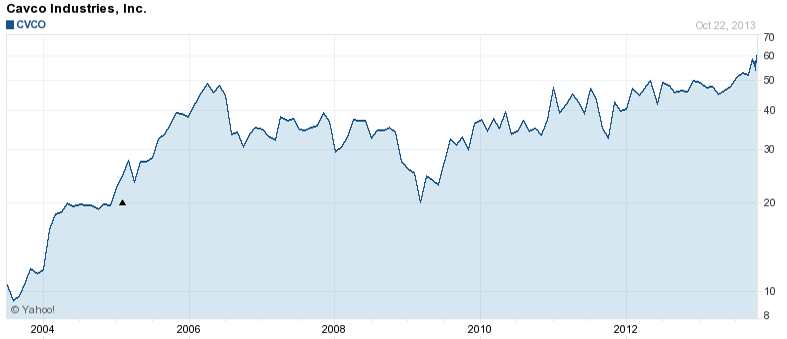](/content/images/wordpress/2013/10/Screen-shot-2013-10-23-at-2.49.36-PM.png)
Of course this one turned out well with the company growing like a weed while the rest of the industry continued to decline. The stock split three for two and I sold out at $45 in 2006 for nearly a four banger in three years. As I write, Cavco is trading at $58 so an investor would have made 5 times their money in 10 years if they still held from the spinoff.
In a spinoff, like most other special situations, there’s lots of uncertainty. There’s no analyst report, there’s no chart, and often times no investor presentation or conference call. The spinoff company management may not want to tell you anything until options are struck. You have to figure it all out yourself. The company does have to file a form 10, however, and there’s often information buried in there that explains what management is thinking. In Cavco’s case, the industry was crashing and there was no insider buying. The only indication that company management was bullish was in the goodwill impairment evaluation on page 38.
2\. Favor the apparent garbage. Yeah, that’s right. Joel Greenblatt tells you the same thing in his book and my experience confirms his advice. The best spinoff deals arise from businesses that appear undesirable. Cavco was in an industry that was reeling and continued to reel for years afterward and is only now even beginning to show weak signs of a turnaround. They had just shut down their retail operations taking impairment charges so the historical financials didn’t look so good. Of course, those retail businesses were gone and the remaining manufacturing businesses were taking market share … but I’ve already written articles on dispositions.
Another spinoff situation where a relatively unattractive looking businesses was distributed to shareholders was the 2002 spinoff of EnPro Industries ([NPO](http://finance.yahoo.com/q?s=npo&ql=1&ref=microcapclub.com)) from Goodrich. You older folks know the Goodrich name from Goodrich tires back in the 1980’s. They long ago dumped all their industrial businesses, however, and were purely a very successful aerospace company in the late 1990’s. They acquired another primarily aerospace company that also owned an industrial seals and bearings business around 1999\. Successful aerospace operations can be really terrific businesses and Goodrich stock had gone straight up for years. This continued after the spinoff, too, until just recently Goodrich was sold out for a small fortune. But back to the spinoff situation. Goodrich shareholders would have 1 share of EnPro, their seals and bearings business, dumped into their account for every 5 shares of Goodrich. That’s an attractive ratio but it was really much better than that. EnPro started trading a little above $9 while the parent’s stock price was way higher. It’s the percentage dollar value of the spinoff that determines the extent of indiscriminate selling and this was a real attractive one.
[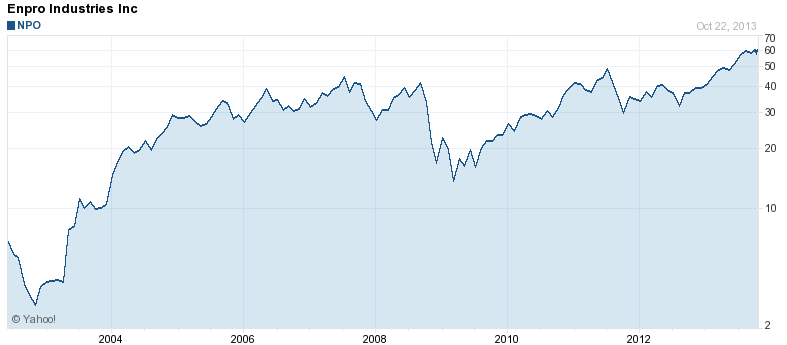](/content/images/wordpress/2013/10/Screen-shot-2013-10-23-at-2.52.00-PM.png)
The EnPro industrial business wasn’t near as good as the Goodrich parent, but it too was successful. Fortunately for me, the moderately high quality of the business was disguised somewhat by the 2001-2002 recession and they had another scary problem too that kept superficial investors from buying, asbestos liability. Bearings and seals sound boring but EnPro had high market share in higher margin self-lubricating, non-rolling, metal polymer bearings with strong brand names and worldwide distribution. Worldwide distribution is important for quick repair of expensive equipment so OEM’s will pay a little more. In fact, EnPro had earned $28.4 million on $533 million in revenue in the nine months ended September 30, 2001\. That’s a $1.40 a share in 9 months on a $9 stock. And 2001 was a recession! If you look at calendar year 2000 numbers you’d see right there in the form 10 filing pro-forma sales of $753 million and earnings per share of $2.73\. But scaring away investors was massive asbestos liability. Now probably when a small dollar value of a spinoff is dumped into your account you just sell without looking. But if you did take a quick look at EnPro you’d immediately see “Asbestos liability” and then you’d dump. And a possible motivation for the spinoff is the dumping of asbestos liability off Goodrich’s balance sheet. Frankly, this scared me too. But when I looked deeper, I saw that the company was fully insured for their asbestos liability with some additional insurance capacity if the estimated dollar volume went higher. I was bouncing up and down excited about this one although still wary of the asbestos liability. I watched the stock drop as I waited my required two weeks and then bought in the high $7’s congratulating myself on what a genius I was for waiting two weeks. And the stock continued straight down to the $1’s. No kidding, this stock that earned $2.73 the prior year was trading in the $1 area. That asbestos liability must be a problem after all and I was just an idiot. I did, in fact, prove that I was an idiot when I ignored insider buying in the $1’s. Isn’t this confirmation that the spinoff didn’t happen to dump asbestos liability? And isn’t then a stock trading for less than their single year earnings the buy of a lifetime? I was shell-shocked from watching my $7 purchase go to $1 and did nothing. I sold out slightly more than three years later at $30\. I quadrupled my money, but if I had the sense to buy when the insiders did I would have made more than twenty times. Today NPO trades at $61.
So there are some lessons here. First, you can really get seriously low prices when the spinoff dollar value is a small fraction of the parent’s value. Second, when the spinoff is at first blush unattractive, the mispricing is even more extreme. Third, you should follow the insiders. I believe insider buying is much more important in special situations than just an ordinary insider buy. There’s some crazy change of some kind in a special situation and the insiders understand the motivations behind these changes better than you. Double weight insider buying in microcap special situations as there is often little or no communication from management about what’s going on.
Now it’s often the case that stocks are grossly mispriced and insiders do nothing. They stand to get rich from options after all anyway. So Mr. Greenblatt would advise that you carefully read the management incentives package right there in the form 10 when you evaluate a spinoff. If that package is generous with a modest cash salary, you may already have your message from the insiders. So while you’re reading that form 10 thoroughly, including reading between the lines, pay special attention to the management compensation section. I would simply add that Mr. Greenblatt is a very wise fellow.
3\. You should look at the parent too. I won’t elaborate with a historical example on this one but the smaller of the two new entities is the one most likely to be mispriced. Investors own a company for the dominant business and many didn’t really want the smaller one. You can see on the list of upcoming spinoffs ([http://www.stockspinoffs.com/upcoming-spinoffs](http://www.stockspinoffs.com/upcoming-spinoffs?ref=microcapclub.com)) that United Online ([UNTD](http://finance.yahoo.com/q?s=untd&ql=1&ref=microcapclub.com)) is spinning off FTD, the online flower delivery business, at the end of this month. FTD is a very high quality business representing perhaps 80% of the value of United Online. The remaining businesses staying with the parent include Classmates.com, and some dial-up internet service providers. I would spend my time looking at the remaining United Online stock. It’s going to be the one dumped as its both smaller and lower quality. I’ve also had success buying the parent when the spinoff is announced. It’s often a year before the spinoff happens but I’ve found that when the stock pops a little on the spinoff announcement it often runs up until the spin.
4\. Find the reason for microcap spins. Spinning off a business costs significant money. That form 10 has to be written by an expensive investment banker and submitted to the SEC. Then the SEC’s questions have to be answered to their satisfaction, and finally the spinoff shares distributed to shareholders. This can run into the millions of dollars. When a $5 billion dollar company spins off a $1 billion company the cost is relatively small. But there’s generally a compelling reason to spin off a microcap and an especially strong reason to spin a nanocap. Shareholders generally are not pleased to have investment banking expenses eating into earnings so that little dinky securities they don’t want can be dumped into their accounts. Management doesn’t do these little spins for kicks. In fact, I propose that one more reason microcap spins outperform is that there is often some compelling value-creating reason to do them in the first place.
Now there are all kinds of reasons to spin off a little company. Leucadia National ([LUK](http://finance.yahoo.com/q?s=luk&ql=1&ref=microcapclub.com)) recently spun off microcap Crimson Wine Group ([CWGL](http://finance.yahoo.com/q?s=cwgl&ql=1&ref=microcapclub.com)). Leucadia was a big operation selling itself and the buyer didn’t want a vineyard so they spun it first. You’ll often see big mergers happen and the government finds the combined operation will have no competition in some area of business. A sale or spinoff is mandated for some small part prior to the merger. You should be interested in such a spin as they have limited competition right? Another reason to spin that you should get excited about is that the spinoff was creating conflicts of interest or competitive problems with the parent. A new technology or software was developed that should serve the entire industry. But other industry participants aren’t going to buy it from their enemy so spin it off so it can sell to its old parent and everyone else too. The SEC requires disclosure of the reasons for the spin in the form 10 filing so read it. There’s usually some truth to the reasons cited but almost all spins cite the generic three or four reasons; to incentive separate managements, to eliminate competition for capital between the two businesses (what a silly reason), to allow investors to buy businesses with the characteristics they want, to permit acquisitions by issuing stock of an entity in the same industry as the target companies. Beware of one reason they don’t include, to eliminate debt from the parent by dumping it on the spinoff. It’s illegal to spin an insolvent company but sometimes a lot of debt is dumped and they do go down. Recent Sears ([SHLD](http://finance.yahoo.com/q?s=shld&ql=1&ref=microcapclub.com)) spinoff Orchard Supply Hardware just filed for bankruptcy. Because the same reasons are so often cited and so many different reasons are cited you can’t always tell which one is the real reason. But figure it out because if you can’t immediately see the reason there may be an underlying reason that leads to a multi-bagger. Keep in mind that employees act in their own best interests not necessarily in the best interests of the corporation. Is the CEO of the bigger parent joining the small spin-off? Is the stock option package for the spinoff significantly different than the parent?
MicroCapClub stock Parametric Sound ([PAMT](http://finance.yahoo.com/q?s=pamt&ql=1&ref=microcapclub.com)) was spun from LRAD Corporation ([LRAD](http://finance.yahoo.com/q?s=lrad&ql=1&ref=microcapclub.com)) in 2010\. LRAD’s prior attempts to commercialize their directional sound technology had been a miserable failure. While the sound was mesmerizing the speakers were too expensive and too unreliable. But big improvements had been made and the fact that the board of directors were willing to go to the expense and trouble of spinning off Parametric Sound was evidence they believed there was something to it. I spent hours investigating this stock right after the spin but ultimately decided it was too speculative. The CEO at the time was an engineer and a brilliant one but I worried about business skills. Insiders started buying shares on the open market so now there were two strong signals there was something good here. But I never bought any and today it’s up about 7 times from the spinoff price. There’s a reason for microcap spinoffs. Find it. And when insiders buy, pay attention.
So to summarize advice to spinoff investors. Get excited when the spinoff dollar volume is a small fraction of the parent. Pay special attention when a superficially unattractive business is spun off as it’s likely to become grossly mispriced. Dig to find value in that unattractive business keeping in mind that spinning a microcap is expensive and there must be a reason. Realize that a microcap management often doesn’t want to communicate with investors initially so work hard on that form 10 and any other information you can get to gain understanding. Follow the insiders as they have an understanding of what is happening in a complicated and limited-information situation. Watch open-market buys but also consider their options packages. Consider that the parent may be the better buy especially if its smaller and uglier. You might buy both the parent and the spinoff on announcement of the spinoff as the two are often worth more than the one. Finally, don’t assume you’re missing something when the spinoff price gets absolutely silly; it’s just what microcap spinoffs do.
**\===> Interact and learn with 250+ of the best microcap investors on the planet.** [\[Join Us\]](https://microcapclub.com/join-now/)
MicroCapClub is an exclusive forum for experienced microcap investors focused on microcap companies (sub $500m market cap) trading on United States, Canadian, European, and Australian markets. MicroCapClub was created to be a platform for experienced microcap investors to share and discuss stock ideas. Since 2011, our members have profiled 1000+ microcap companies. Investors can join our community by applying to become a member or subscribing to gain instant view only access. MicroCapClub’s mission is to foster the highest quality microcap investor Community, produce Educational content for investors, and promote better Leadership in the microcap arena. For more information, visit [http://microcapclub.com](http://microcapclub.com/) and
### Interview with Portfolio Manager Bob Auer of the Auer Growth Fund
URL: https://microcapclub.com/interview-portfolio-manager-bob-auer-auer-growth-fund/
Last updated: 2023-10-15T11:15:26.000Z
Bob Auer is Senior Portfolio Manager of the Auer Growth Fund ([AUERX](http://finance.yahoo.com/q?s=auerx&ql=1&ref=microcapclub.com)). The Auer Growth Fund is 65% in micro-smallcap equities and according to Morningstar ranks in the top 1% for performance over the last 12 months. The interesting thing is the fund isn’t a microcap-centered fund, but a fund that utilizes a strict quantitative approach to finding “cheap growth”. It makes sense that a majority of the stocks that get through their screens are smaller underfollowed companies. The Auer Growth strategy was first put into action in 1986 with a $100,000 personal account that went on to grow to $32 million by 2007 (with no additional funds added during that time). Bob Auer believes the best place to invest is in microcaps. *(Click the Play Arrow below, or you can download the full interview)*
[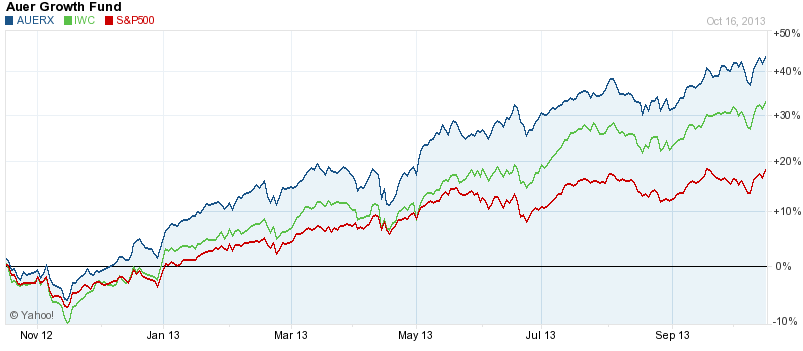](/content/images/wordpress/2013/10/Screen-shot-2013-10-17-at-5.18.16-PM.png)
**\===> Interact and learn with 250+ of the best microcap investors on the planet.** [\[Join Us\]](https://microcapclub.com/join-now/)
MicroCapClub is an exclusive forum for experienced microcap investors focused on microcap companies (sub $500m market cap) trading on United States, Canadian, European, and Australian markets. MicroCapClub was created to be a platform for experienced microcap investors to share and discuss stock ideas. Since 2011, our members have profiled 1000+ microcap companies. Investors can join our community by applying to become a member or subscribing to gain instant view only access. MicroCapClub’s mission is to foster the highest quality microcap investor Community, produce Educational content for investors, and promote better Leadership in the microcap arena. For more information, visit [http://microcapclub.com](http://microcapclub.com/) and
### Pattern Matching in MicroCap Stock Selection
URL: https://microcapclub.com/using-pattern-matching-microcap-stock-selection/
Last updated: 2023-10-15T11:13:59.000Z
A few weeks back I was sitting around the campfire with my wife and children and we were playing a pattern matching game. Later that evening I was watching and helping my three year old son with a puzzle which is another pattern matching activity. After the activities of that day I was pondering trading and investing and recalled that success is really a matter of good pattern matching. A pattern matching strategy boiled down to a well defined methodology is what separates successful traders and investors from the proverbial monkey throwing darts. Typically, the pattern matching revolves around things like financial information/trends, management comments, industry trends, and investor sentiment.
There are many patterns that can be matched to trade and invest successfully. Classically, there have been two types of investing called [value investing](http://en.wikipedia.org/wiki/Value%5Finvesting?ref=microcapclub.com) and [growth investing](http://www.yourdictionary.com/growth-investing?ref=microcapclub.com). Many value investors read the writings of [Ben Graham](http://en.wikipedia.org/wiki/Benjamin%5FGraham?ref=microcapclub.com), the father of value investing, to learn the techniques he described. There is even a blended version of value investing and growth investing called “Growth at a Reasonable Price” or [GARP](http://www.investopedia.com/terms/g/garp.asp?ref=microcapclub.com). Peter Lynch shared his investment [checklist](http://www.stockwatch.com.au/articles/fundamental-analysis/peter-lynch.aspx?ref=microcapclub.com) which is really a part of his pattern matching methodology.
While I’m not Ben Graham or Peter Lynch, I have found a successful pattern matching methodology that I have used for many years. I detailed this in two articles that I wrote for selecting microcap stocks including [My Secret Recipe: The Index Card](http://microcapclub.com/2012/10/my-secret-recipe-the-index-card/) and [My Secret Recipe: Shopping and a Taste Test](http://microcapclub.com/2012/10/my-secret-recipe-shopping-and-a-taste-test/). In fact, in the second article I detailed BioSyent ([RX.V](http://finance.yahoo.com/q?s=rx.v&ql=1&ref=microcapclub.com) / [BIOYF](http://finance.yahoo.com/q?s=BIOYF&ql=0&ref=microcapclub.com)) as a company that matched my pattern. Since that article was written a little more than a year ago, BioSyent has risen 155%. I’m pointing out the success of that pick not because I want to brag, but rather to demonstrate that a well defined pattern matching methodology is the key to success.
I’m not the only contributor at MicroCapClub that has detailed a pattern matching scheme that has helped them to be successful. Mark Vonderwell has detailed his strategy of finding disposition situations in his multiple articles such as [MicroCap Getting Smaller? Get Excited!](http://microcapclub.com/2012/05/microcap-getting-smaller-get-excited/), [Disposition Case Study: Broadway and Seymour](http://microcapclub.com/2012/06/disposition-case-study-broadway-and-seymour/), and [Disposition Case Study: Clearfield Inc.](http://microcapclub.com/2012/07/disposition-case-study-clearfield-inc/). Ian Cassel discussed his very easy (easy to comprehend, not to execute) investing strategy in the article entitled [Global Market Trends and the Microcap Benefactors](http://microcapclub.com/2012/05/global-market-trends-and-the-microcap-benefactors/).
While there are many successful methodologies, I think the key to success is to find a proven methodology which is comfortable for you and really learn the techniques. In order to do this successfully, you are going to need some minimal ability to read financial statements plus a dose of discipline to spend the time to learn the methodology and follow it closely. While multiple methodologies can be deployed by a single person, I think it is best to master one methodology before exploring another. Like many fields, trading and investing requires continual learning in order to keep up with the evolution of markets and to enhance your skills. I think it is equally important to both learn what works and to learn what doesn’t work. I find that I learn much by following what other investors and traders do and seeing what works and what doesn’t.
If you are an experienced microcap investor, I invite you to join MicroCapClub where we use a variety of different pattern matching techniques to find the best microcap stocks.
Disclosure: Mike Schellinger (aka MikeDDKing) is long shares of BioSyent.
**\===> Interact and learn with 250+ of the best microcap investors on the planet.** [\[Join Us\]](https://microcapclub.com/join-now/)
MicroCapClub is an exclusive forum for experienced microcap investors focused on microcap companies (sub $500m market cap) trading on United States, Canadian, European, and Australian markets. MicroCapClub was created to be a platform for experienced microcap investors to share and discuss stock ideas. Since 2011, our members have profiled 1000+ microcap companies. Investors can join our community by applying to become a member or subscribing to gain instant view only access. MicroCapClub’s mission is to foster the highest quality microcap investor Community, produce Educational content for investors, and promote better Leadership in the microcap arena. For more information, visit [http://microcapclub.com](http://microcapclub.com/) and
### The Power of Due Diligence (Part 4)
URL: https://microcapclub.com/power-due-diligence-part-4/
Last updated: 2023-10-15T11:13:01.000Z
Due diligence that goes above and beyond can often give you an edge that can yield large returns in the microcap space. Most astute investors read quarterly and annual financial statements, but I find very few go beneath this first layer of due diligence. In a four part series Sean, Neil, Jason, and I will give you a few recent examples of in-depth due diligence, and how it ultimately helped in making an investment decision. The company examples in each part are meant to help illustrate the DD and not meant to be stock recommendations. Here is the final part in The Power of Due Diligence Series:
#### **Part 4: Alteva ([ALTV](http://finance.yahoo.com/q?s=altv&ql=1&ref=microcapclub.com))**
by Jason Revland
[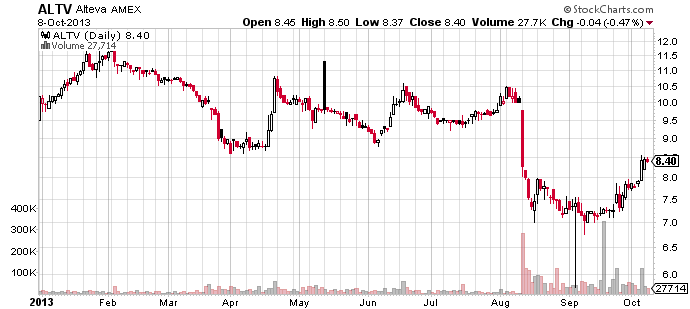](/content/images/wordpress/2013/10/Screen-shot-2013-10-09-at-7.47.13-AM.png)
We were initially attracted to Alteva Communications ([ALTV](http://finance.yahoo.com/q?s=altv&ql=1&ref=microcapclub.com)) due to its position within the Unified Communications (UC) industry, which we believe is in the early stages of a multi-year bull market, as businesses of all sizes switch from using older technology to newer, much more powerful technology. Billions will be spent switching, and there are many flavors of UC that can be provided, from out of the box to fully customizable solutions. There will be many winners. UC will enable businesses to be much more productive, fully leverage the internet and cloud, and pay for mission-critical telecom services using a recurring leasing model, rather than a fixed, capital-intensive model. There is a dearth publicly traded pure plays in this space. Alteva has a compelling business model, and is already successfully exploiting the UC opportunity.
Our due diligence involved several phases, took about one month, and we purchased an initial starter position at $9.
**Meeting Management**
Speaking with management is a non-negotiable requirement for investing. We walk away from companies that do not open their doors to us. Alteva has been outstanding in this regard. We first sat down with the CEO, CFO and Chief Technology Officer at their Philadelphia headquarters. We spent 2 hours speaking with them, and asked dozens of questions that we had prepared in advance. We also visited their hands-on technology center, where customers can experience their products and solutions. We left feeling more confident about the management team, their strategic vision, and their solutions and positioning in the marketplace.
**Industry Research**
We were fairly confident Alteva was in an industry with a very strong outlook for double-digit growth. This was supported by studies published by Gartner and IDC, which gave us additional confidence. A good friend worked for Siemens Business Solutions and Verizon Business Communications and provided a very good independent check on this industry growth. He provided industry affirmation, and was able to help outline the dominant technology providers, and how businesses were thinking about their various choices.
**Competitor Research**
ShoreTel ([SHOR](http://finance.yahoo.com/q?s=shor&ql=1&ref=microcapclub.com)), 8×8 ([EGHT](http://finance.yahoo.com/q?s=eght&ql=1&ref=microcapclub.com)) and newly public RingCentral ([RNG](http://finance.yahoo.com/q?s=rng&ql=1&ref=microcapclub.com)) are publicly traded comparables, leveraged to the UC opportunity, which compete with Alteva to varying degrees. We spoke to sell-side analysts who cover these companies to gain a better understanding of the competitive landscape, and we read published research on these companies from a variety of sources. UC is a large market, and can be delivered in many flavors, including out of the box and customized solutions. Alteva plays more in the customized, fully integrated space.
**Unique Balance Sheet Asset**
Dating from its days as a telecom company, Alteva owned a small interest in a wireless limited partnership, majority owned by Verizon ([VZ](http://finance.yahoo.com/q?s=vz&ql=1&ref=microcapclub.com)). Alteva recently restructured this partnership agreement with Verizon, which effectively gave Alteva an ability to re-sell its interest to Verizon in April 2014, for $50M gross proceeds. This essentially created a very valuable put option that could be exercised European style, at the discretion of Alteva, based on different financial scenarios of how the partnership performed. We spent a considerable amount of time understanding the dynamics of this asset, and believed it would provide substantial downside protection to the investment.
**Key Business Catalyst**
Alteva has been in a well-telegraphed business transition, going from an old-school telecom company to a growth-focused UC company. The company has been paying a sizable dividend for years, and its shareholder base was primarily value oriented and yield sensitive. As new growth investors, however, we were highly confident that the company would, at some unknown point, reduce or eliminate the dividend, which would align the dividend policy with their new growth initiatives. In August, the company eliminated their dividend, causing a significant disruption in the shareholder base, and a significant price sell-off. We did not anticipate such a violent negative reaction, but were well prepared to act on it. Our conviction level to add shares in the $7 range was bolstered by the diligence we had performed around the put option. Our view was that the price would normalize once management began telling the story to a new subset of growth investors who would see the “value plus growth” opportunity, and take out the old value shareholders. We believe much of this shareholder transition is now complete.
**Additional Research and Ongoing Diligence**
We had an opportunity to attend their annual shareholder meeting around the time we were conducting diligence. This enabled us to meet additional board members, and some other shareholders, as well as deepen our relationship with management by showing our commitment to being actively involved shareholders.
We spoke to one of Alteva’s larger re-sellers to understand how they distribute Alteva’s offerings, and their general opinions of Alteva vs competitors.
Since due diligence is obviously an ongoing effort, we endeavor to speak with management at least quarterly. As such, we have had several follow up conversations with management.
Finally, we set up Google Alerts on all of our investments, which include key words relating to the company name, key products and the names of top management. This helps us stay in the information flow, and monitor the vast amount of information that is being published on virtually any topic.
Disclosure: Jason Revland is LONG ALTV
Further due diligence on Alteva and more than 170 other microcaps can be found in our MicroCapClub members forum. Here are the first three parts of The Power of Due Diligence Series.
[Part 1: XPEL Technologies (XPLT) by Sean Marconi](http://microcapclub.com/2013/09/power-due-diligence/)
[Part 2: Parametric Sound (PAMT) by Neil Cataldi](http://microcapclub.com/2013/10/power-due-diligence-part-2/)
[Part 3: Innovative Food Holdings (IVFH) by Ian Cassel](http://microcapclub.com/2013/10/power-due-diligence-part-3/)
**\===> Interact and learn with 250+ of the best microcap investors on the planet.** [\[Join Us\]](https://microcapclub.com/join-now/)
MicroCapClub is an exclusive forum for experienced microcap investors focused on microcap companies (sub $500m market cap) trading on United States, Canadian, European, and Australian markets. MicroCapClub was created to be a platform for experienced microcap investors to share and discuss stock ideas. Since 2011, our members have profiled 1000+ microcap companies. Investors can join our community by applying to become a member or subscribing to gain instant view only access. MicroCapClub’s mission is to foster the highest quality microcap investor Community, produce Educational content for investors, and promote better Leadership in the microcap arena. For more information, visit [http://microcapclub.com](http://microcapclub.com/) and
### The Power of Due Diligence (Part 3)
URL: https://microcapclub.com/power-due-diligence-part-3/
Last updated: 2023-10-15T11:12:29.000Z
Due diligence that goes above and beyond can often give you an edge that can yield large returns in the microcap space. Most astute investors read quarterly and annual financial statements, but I find very few go beneath this first layer of due diligence. In a four part series Sean, Neil, Jason, and I will give you a few recent examples of in-depth due diligence, and how it ultimately helped in making an investment decision. The company examples in each part are meant to help illustrate the DD and not meant to be stock recommendations. In **[Part 1](http://microcapclub.com/2013/09/power-due-diligence/)**, Sean Marconi talked about his due diligence into XPEL Technologies ([XPLT](http://finance.yahoo.com/q?s=xplt&ql=1&ref=microcapclub.com)). In **[Part 2](http://microcapclub.com/2013/10/power-due-diligence-part-2/)**, Neil Cataldi talked about his due diligence into Parametric Sound ([PAMT](http://finance.yahoo.com/q?s=pamt&ql=1&ref=microcapclub.com)), now I bring you Part 3….
#### **Part 3: Innovative Food Holdings ([IVFH](http://finance.yahoo.com/q?s=ivfh&ql=1&ref=microcapclub.com))**
by Ian Cassel
[](/content/images/wordpress/2013/10/ivfhchart.png)
Innovative Food Holdings ([IVFH](http://finance.yahoo.com/q?s=ivfh&ql=1&ref=microcapclub.com)) is a profitable and fast growing provider of direct from the source specialty foods. IVFH has had 48 consecutive months of year/year growth. The company has many irons in the fire, now more than ever, and has visibility on multiple growth drivers on top of healthy core business trends. The company is also one of the only valid e-grocer microcaps, playing off of the Amazon.com’s ([AMZN](http://finance.yahoo.com/q?s=amzn&ql=1&ref=microcapclub.com)) [amazonfresh](http://fresh.amazon.com/welcome;jsessionid=E1E12DDBCC24298B84DEE90480133F58?ref=microcapclub.com) buzz that is just now starting.
I first found out about IVFH when Sam Klepfish CEO reached out to me over a year ago. I had quickly looked at the company and really liked the business but was hesitant due to weaknesses I saw in the capital structure. Sam understood this, and said they were working to address my concerns. He told me to just be aware of the company and follow their progress. I continued to talk to Sam over the next several months and found him to be very honest and non-promotional.
A few months later I decided to do a deeper dive into IVFH with the help of Neil Cataldi and Jason Revland. We spoke with Sam several times to find out as much as we could about the history of the company and the business itself. We also spoke with President, Justin Weirnasz, to further drill down on the business fundamentals and strategy. We also spoke to the founder of a company that IVFH acquired last year to get a feel for his mindset for the company. It’s important to talk to several C-Level executives inside a company to make sure everyone’s thought process-strategy are aligned. It’s amazing how many times I’ve spoken to multiple people inside other companies where you could sense the tension around strategy, which is a bad sign.
[](https://microcapclub.com/2013/10/power-due-diligence-part-3/ivfhwarehousepic3/)
IVFH Warehouse
[](https://microcapclub.com/2013/10/power-due-diligence-part-3/feastpic2/)
The Feast
[](https://microcapclub.com/2013/10/power-due-diligence-part-3/ivfhhqpic2/)
IVFH HQ
[](https://microcapclub.com/2013/10/power-due-diligence-part-3/ivfhchefadvisorpic4/)
Chef Advisors
Next, we wanted to try the product(s) and experience the sales process and customer service. Innovative Food’s uses a Chef Advisor customer service-sales force so everyone is a certified chef. We ordered steak, crab, and several other direct from the source products, and also spoke to a Chef Advisor on what accompaniments to order and how to prepare the food. We were very impressed and very full after this due diligence 🙂
The final piece of due diligence was visiting the company in Bonita Springs, FL. I can’t over emphasize how important company visits have been for me. Seeing a company’s HQ and having face-to-face meetings with the management is crucial. The ability to see how a company spends money, reading body language, and actually seeing how everyone communicates with one another is very important.
In the end, this exhaustive due diligence process which spanned a few months was crucial in gaining a comfort level with the management team and the value proposition in the company’s shares. I came away very impressed with the company, so much so [I bought 5%](http://www.sec.gov/Archives/edgar/data/312257/000107878213001810/f13g090913%5Fsc13g.htm?ref=microcapclub.com) of the company in the open market.
Further due diligence on Innovative Food Holdings and more than 170 other microcaps can be found in our MicroCapClub members forum. Stay tuned for the final part of The Power of Due Diligence Series.
Disclosure: Ian Cassel is LONG IVFH
**\===> Interact and learn with 250+ of the best microcap investors on the planet.** [\[Join Us\]](https://microcapclub.com/join-now/)
MicroCapClub is an exclusive forum for experienced microcap investors focused on microcap companies (sub $500m market cap) trading on United States, Canadian, European, and Australian markets. MicroCapClub was created to be a platform for experienced microcap investors to share and discuss stock ideas. Since 2011, our members have profiled 1000+ microcap companies. Investors can join our community by applying to become a member or subscribing to gain instant view only access. MicroCapClub’s mission is to foster the highest quality microcap investor Community, produce Educational content for investors, and promote better Leadership in the microcap arena. For more information, visit [http://microcapclub.com](http://microcapclub.com/) and
### The Power of Due Diligence (Part 2)
URL: https://microcapclub.com/power-due-diligence-part-2/
Last updated: 2023-10-15T11:11:54.000Z
Due diligence that goes above and beyond can often give you an edge that can yield large returns in the microcap space. Most astute investors read quarterly and annual financial statements, but I find very few go beneath this first layer of due diligence. In a four part series Sean, Neil, Jason, and I will give you a few recent examples of in-depth due diligence, and how it ultimately helped in making an investment decision. The company examples in each part are meant to help illustrate the DD and not meant to be stock recommendations. In **[Part 1](http://microcapclub.com/2013/09/power-due-diligence/)**, Sean Marconi talked about his due diligence into XPEL Technologies, and now we bring you Part 2….
#### **Part 2: Parametric Sound Corp ([PAMT](http://finance.yahoo.com/q?s=pamt&ql=1&ref=microcapclub.com))**
by Neil Cataldi
[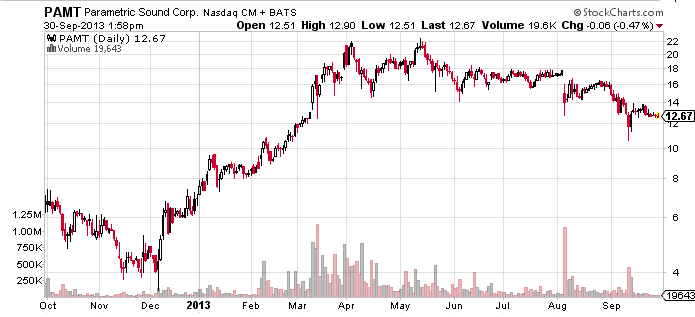](/content/images/wordpress/2013/09/Screen-shot-2013-09-30-at-1.59.05-PM.png)
The process of due diligence comes in many different forms and for me, changes based on the type of company I’m looking at. Between my partner and I, we have over 125 management interactions per year. To us, that number is a healthy amount and allows for us to digest the information properly before deciding which companies warrant further consideration.
I was at a conference in New York City during September of 2012 when a colleague suggested I demo a new audio technology developed by a company called Parametric Sound ([PAMT](http://finance.yahoo.com/q?s=pamt&ql=1&ref=microcapclub.com)). I had pre screened the companies presenting at this conference and had not found anything interesting about Parametric Sound before hearing the demonstration. However, as is the case sometimes, trying new technology and being able to see it or hear it can allow for one to further grasp its capability and potential adoption. That was the case with Parametric. I was completely blown away by the three dimensional all encompassing sound and immediately thought to myself, I want to own a set of these speakers. If I responded this way, I felt many others would as well.
It was at this point that my process began, a process than can sometimes take weeks or even months. With Parametric, I was interested quickly and thought the valuation at \~$11/share was worth my time. My interest was further peaked when the valuation was cut in half the following month without any news, later bottoming below $5 in early December. The company was, for the most part, still pre-revenue and in the licensing stage of commercializing its technology. Without true fundamentals, Parametric was difficult to value, not to mention volatile, but that in itself created an opportunity. They were ramping sales through digital signage applications on a smaller level but the lion share of future growth would come from consumer electronics and in licensing to household names such as Samsung, Sony, etc. My diligence process involved a number of components. One, I needed to determine whether the technology was truly unique and also whether there were other similar offerings in the marketplace (or soon to be). Two, I needed to speak with management which is always a necessary component of the research process. Questions are prepared far in advance and address all pertinent matters regarding the company. And three, I wanted to experience the technology further hopefully in different applications.
The result of my initial inquiry into the competitive environment yielded inconclusive results because while peer companies couldn’t offer the same solution, I found other audio companies profiling new and advanced forms of surround sound. Even further, the directional component that made the offering especially unique was developed and available on a low grade level on the internet via less reputable sources. The technology as a whole had been around for years having been first developed and owned by a company called LRAD Corp ([LRAD](http://finance.yahoo.com/q?s=lrad&ql=1&ref=microcapclub.com)) before being spun out into Parametric Sound. I soon realized that many people did not look at this technology favorably due to its past history. As an investor always seeking the next great idea, I try not to be turned off by what may appear as a consensus opinion and in this case, I was rewarded for my contrarian approach.
As the diligence process continued, I was further intrigued when we learned that the audio clarity and volume had progressed to a new level where commercialization on a mass scale was now possible and soon to be a reality. This differentiated the company in some ways from its peers as well as the less reputable sources mentioned before. In order to justify what I viewed as the opportunity set, I wanted to 1) hear of the technology embraced by a large company in some capacity and 2) wanted to see it again myself. To an extent I had a level of comfort with the first part as the company communicated material increases in licensing negotiations, whether it was NDA’s they had signed or simply a defined timeline for licensing news, which they stated would come by the end of March, 2013 (only a few months away). At this point, the diligence progress took an additional step forward that in many cases I feel is necessary when researching companies that offer products to the consumer.
[](http://microcapclub.com/wp-content/uploads/2013/09/PAMT-1.mov)
Rite-Aid DD Video (Click to Download)
Parametric Sound was in a trial with Rite Aid ([RAD](http://finance.yahoo.com/q?s=RAD&ql=0&ref=microcapclub.com)) stores offering the sound technology in a retail kiosk that customers could use to view promotions, print coupons, etc via an in store experience. They were also in a trial at select Build A Bear stores at the time which presented a similar but different application. I traveled to Los Angeles in December of 2012 to see the technology first hand at a Rite Aid. The experience yielded both greater conviction in its potential adoption, as well as a very practical example of how it could be used in a public retail setting. During early 2013, I also learned that a McDonalds ([MCD](http://finance.yahoo.com/q?s=mcd&ql=1&ref=microcapclub.com)) store location in California had installed the speakers in their dining section as a way to create multiple zones that would offer different visual and audio content to their customers. Though the location was at first difficult to find, I was able to locate it and subsequently sent a friend who lived nearby to both videotape the installations, as well as diagram the layout of the store. This stage of the diligence process could be called an inflection point as I now had multiple hands on experiences to point at regarding adoption. With the stock trading far below its peak valuation and with multiple near term catalysts approaching, I viewed the risk reward profile as extremely attractive. The process was rewarded as in the months to come shares would rise from the low $4’s in December to $21 by April.
Interaction with management is by far the most valuable tenet of my process. However, if you overlay those discussions with other practical experiences (examples include site visits, demonstration of a product or technology, channel checks via reseller relationships, etc), you may find both information positive and negative that can influence the decision set one faces on valuation and ultimately giving an investment the green light. The power of due diligence takes on different forms with all investors but one should never stop short of seeking new information every day because with every day comes new opportunity for data that can influence your investment.
Further due diligence on Parametric Sound and more than 170 other microcaps can be found in our MicroCapClub members forum. Stay tuned for part three of The Power of Due Diligence Series.
Disclosure: Neil Cataldi holds no position in any company mentioned.
**\===> Interact and learn with 250+ of the best microcap investors on the planet.** [\[Join Us\]](https://microcapclub.com/join-now/)
MicroCapClub is an exclusive forum for experienced microcap investors focused on microcap companies (sub $500m market cap) trading on United States, Canadian, European, and Australian markets. MicroCapClub was created to be a platform for experienced microcap investors to share and discuss stock ideas. Since 2011, our members have profiled 1000+ microcap companies. Investors can join our community by applying to become a member or subscribing to gain instant view only access. MicroCapClub’s mission is to foster the highest quality microcap investor Community, produce Educational content for investors, and promote better Leadership in the microcap arena. For more information, visit [http://microcapclub.com](http://microcapclub.com/) and
### The Power of Due Diligence
URL: https://microcapclub.com/power-due-diligence/
Last updated: 2023-10-15T11:11:13.000Z
Due diligence that goes above and beyond can often give you an edge that can yield large returns in the microcap space. Most astute investors read quarterly and annual financial statements, but I find very few go beneath this first layer of due diligence. In a four part series Sean, Neil, Jason, and I will give you a few recent examples of in-depth due diligence, and how it ultimately helped in making an investment decision. The company examples in each part are meant to help illustrate the DD and not meant to be stock recommendations.
#### **Part 1: XPEL Technologies ([DAP-U.V](http://finance.yahoo.com/q?s=DAP-U.V&ql=0&ref=microcapclub.com) or [XPLT](http://finance.yahoo.com/q?s=xplt&ql=1&ref=microcapclub.com))**
By Sean Marconi
[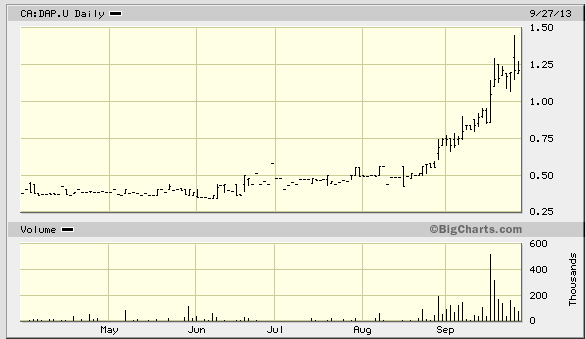](/content/images/wordpress/2013/09/Screen-shot-2013-09-30-at-7.35.34-AM.png)
I was introduced to Xpel from a MCC member [Paul Andreola](http://microcapclub.com/2013/07/investing-in-non-resource-canadian-microcaps/) around $0.35 about 3-4 months ago. It brought back several memories of ZAGG Inc ([ZAGG](http://finance.yahoo.com/q?s=zagg&ql=1&ref=microcapclub.com)) back in 2007-2008 when ZAGG was under a buck. If you were to compare Xpel today vs. ZAGG in early 2008 they have many similarities including: selling a protective film, branding, share structure, profitable, high growth rate, cash in the bank to execute, and international upside.
My extensive DD seems to come into play with consumer based product companies. Digging into Xpel has been a great time. It has been a combination of travel, phone calls to dealers, purchasing the company’s product to put on my own car, phone calls to account managers at the company, and a phone call with the CEO.
**Independent Dealer DD:** The first bit of on the ground DD was when I was in Michigan over the 4th of July weekend. I visited an independent dealer called Sun Shade window tint in Troy, MI. He is one of the premier window tint shops in metro Detroit. At the time he carried 2 brands of film. Suntek and Xpel. Definitely recommended Xpel, the higher priced option but said it was well worth it. His eyes would light up talking about the Ultimate film. I recently followed up with him last week and they mentioned that they ONLY work with Xpel films. The installer literally told me that he refuses to work with anything else.
[](/content/images/wordpress/2013/09/xpelpic.jpg)
**Product DD:** My 1st purchase from them was on August 12 ,2013 for $284 dollars. I purchased the bikini bra, headlight protection kit, and a few other accessories. Purchasing the product online you could get a feel for the sophistication of their shopping cart and was able to learn how they communicate with their customers. Literally a day after I received an email and a phone call from Xpel. The email was from a customer service rep. (See Below)
*“Good Morning Sean,*
*Thank you for your recent order. We will need a physical address to ship the order because the cleaner can’t be shipped by USPS.* *Your prompt reply is greatly appreciated so we can process your order in a timely manner*.”**
The phone call was from a territory account manager that wanted to let me know that unfortunately there weren’t any installation facilities in North Dakota yet. He then proceeded to tell me that he wanted to make sure I knew how to install the product. On top of that he upgraded my Xtreme film for my car to the Ultimate at no charge. He said that he wanted to make sure that I received a great experience. That was one of the best customer service experiences that I’ve received over the past years. I received the product a few days later. I installed the product and very impressed with it thus far.
**Website DD:** Consumer based product websites it’s very important that they have a website that is easy to navigate through and purchase product. The website functions well, but you can tell it needs a little work. When you go through the selection process with your vehicle it auto selects the Xtreme film for your car. There is no option to select between the different kinds of film offerings. This is why I believe their sales reps are calling all of their customers to make sure they are pleased. You can check out the Dealer Locator [http://locator.xpel.com/](http://locator.xpel.com/?ref=microcapclub.com) to see the different dealers across the world. If you look closely it seems as though it’s built on a newer looking website. The header is a different style than the current website [www.xpel.com](http://www.xpel.com/?ref=microcapclub.com). I’m hoping for a newer version website in the near future.
**Social Media DD:** I would highly recommend watching this video of Ryan Pape (CEO) of a dealer conference last year. He talks about strategy and how well his company is doing with the ULTIMATE film. He seems like a good guy. [http://vimeo.com/channels/xpel/49604671](http://vimeo.com/channels/xpel/49604671?ref=microcapclub.com)
Self Healing Video (38,227 views)
Xpel Ultimate Paint Protection Film Stain Resistant test (10,602 views)
This is only a brief overview of the DD I’ve done into XPEL Technologies. Further due diligence on XPEL Technologies and more than 170 other microcaps can be found in our MicroCapClub members forum. Stay tuned for the next three parts in The Power of Due Diligence Series.
Disclosure: Sean Marconi is LONG shares of XPLT
**\===> Interact and learn with 250+ of the best microcap investors on the planet.** [\[Join Us\]](https://microcapclub.com/join-now/)
MicroCapClub is an exclusive forum for experienced microcap investors focused on microcap companies (sub $500m market cap) trading on United States, Canadian, European, and Australian markets. MicroCapClub was created to be a platform for experienced microcap investors to share and discuss stock ideas. Since 2011, our members have profiled 1000+ microcap companies. Investors can join our community by applying to become a member or subscribing to gain instant view only access. MicroCapClub’s mission is to foster the highest quality microcap investor Community, produce Educational content for investors, and promote better Leadership in the microcap arena. For more information, visit [http://microcapclub.com](http://microcapclub.com/) and
### Tales From The MicroCap Crypt
URL: https://microcapclub.com/tales-microcap-crypt/
Last updated: 2013-09-22T12:46:13.000Z
The microcap space is filled with bad management teams, and over the years as an active investor I’ve witnessed and experienced interesting behaviors from company officers. As part of my due diligence, I visit quite a few companies and meet with their management teams 1×1\. I used to make it a point to stay an extra night to get the CEO-CFO to go out to dinner with me. The purpose of this dinner was to let them come out of their corporate shells a bit which would give me greater insight into the company. With some dinners, I’ve purposefully tried to grease the wheels a bit with alcohol to get them to open up to see their true character traits. Some management teams would completely restrain from alcohol and others would get ragingly drunk. I will not mention any companies or officers because some of them still exist, but here are just a few of the entertaining things I’ve witnessed at these dinners:
- “Service! Service! Service!” was screamed by a CEO along with his hand in the air to draw attention from the waiter at a Ruth Chris Steakhouse. The CEO was ready to order and wanted to immediately order. The whole restaurant stopped. It was one of the most horrifying yet hilarious experiences I’ve had.
- “Two of everything!” was screamed out when I was at dinner with a CEO when he could not decide on an appetizer. There were just two of us. They did in fact bring two of everything.
- “Guess how I bought this Porsche?” a CEO asked me, and after he told me, I realized I really didn’t want to know the answer.
- “The auditors are really good friends of mine” was told to me quite a few times which I never quite understood why they would think I wanted to hear that.
- “How would investors react if I sold some shares?”, not exactly awe inspiring when meeting the management team for the first time.
- “Goldman Sachs wants to do a deal with us”, on quite a few occasions this exact phrase was used which I quickly reminded them. “No they don’t”.
- “I think we can double revenues every year”, the CEO says, and I say, “Oh you mean like the next couple years”, and the CEO says, “No I mean forever”, and I just say, “well that would be something”.
- “Well the board just believes a forward split is in the best interests of shareholders”, says a CEO of a 75c stock. That is all I needed to hear.
These are just a few stories of a books worth of experiences I’ve had meeting with microcap management teams. I’m sure you all have your own, so feel free to share them in the comments section.
Here is a post I wrote a year ago, [8 Habits Of Highly Effective MicroCap CEOs](http://microcapclub.com/2012/11/8-habits-of-highly-effective-microcap-ceos/), that goes into detail on what I believe is important in microcap leaders.
**MicroCapClub** is an exclusive forum for experienced microcap investors focused on microcap companies (sub $300m market cap). MicroCapClub was created to be a platform for experienced microcap investors to share and discuss stock ideas. Our goal at [MicroCapClub.com](http://microcapclub.com/) is quality membership, quality stocks, and quality content. If you are an experienced microcap investor, feel free to [**Apply today**](http://microcapclub.com/forums/index.php?/forum/2-applicant-ideas/).
### The Case For MicroCap Stocks
URL: https://microcapclub.com/case-microcap-stocks/
Last updated: 2023-10-15T11:10:06.000Z
[**DGHM**](http://www.dghm.com/?ref=microcapclub.com) recently published a white paper on microcaps that studies microcap performance vs private equity and also analyzes microcap performance coming out of a recession. It’s important to note that for this paper DGHM defines microcap stocks as deciles 2-3 (mkt cap $275m-$894m), as decile 1 (sub $275m) contains companies that are “too illiquid” and below their breakpoint of their investable universe. Ahhh, that is a shame. Nonetheless I found the paper very well written and found value in reading it.
Microcap stocks are a unique group. They are under‐followed, illiquid and more volatile than their larger‐capitalized peers. That’s the bad news. The good news is that microcap stocks are under‐followed, illiquid and more volatile than larger companies. Generally these microcap companies are run by managers with higher inside ownership than their larger peers, and the companies’ operational success is leveraged more to the domestic economy. When compared to private equity, microcap stocks offer better liquidity and employ lower leverage. They also report returns that more appropriately represent the investments’ economic return than the Internal Rate of Return (IRR) calculations used by private equity funds, according to a recent academic paper
[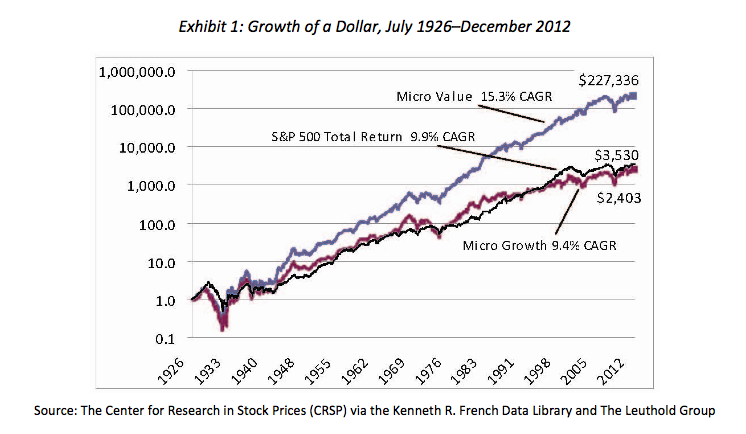](/content/images/wordpress/2013/09/Screen-shot-2013-09-13-at-7.01.57-AM.png)
### [\[READ FULL WHITE PAPER HERE\]](http://www.dghm.com/Published/News/DGHM%5FThe%5FCase%5Ffor%5FMicrocaps1.pdf?ref=microcapclub.com)
**DGHM** is a fundamental, value-driven equity investment manager utilizing a disciplined approach to purchase high-quality companies at compelling valuations. We believe this tradeoff results in superior performance over the long run. DGHM was founded in 1982 and currently manages $1.5 Billion\* for institutional and high net worth clients across the capitalization spectrum.
**\===> Interact and learn with 250+ of the best microcap investors on the planet.** [\[Join Us\]](https://microcapclub.com/join-now/)
MicroCapClub is an exclusive forum for experienced microcap investors focused on microcap companies (sub $500m market cap) trading on United States, Canadian, European, and Australian markets. MicroCapClub was created to be a platform for experienced microcap investors to share and discuss stock ideas. Since 2011, our members have profiled 1000+ microcap companies. Investors can join our community by applying to become a member or subscribing to gain instant view only access. MicroCapClub’s mission is to foster the highest quality microcap investor Community, produce Educational content for investors, and promote better Leadership in the microcap arena. For more information, visit [http://microcapclub.com](http://microcapclub.com/) and
### Hard Mailer Pump and Dump Performance Part 6
URL: https://microcapclub.com/hard-mailer-pump-dump-performance-part-6/
Last updated: 2013-09-08T08:42:38.000Z
A hard mailer is nothing more then a pump and dump. The company themselves, affiliates, or large shareholders pay millions of dollars to mail out glossy 20 page reports trying to dupe investors to buy the underlying stock so they can sell their positions. Just like Gravity, when a hard mailer pushes a stock up, they always crash back down to Earth.
A year ago I started keeping track of the stock performance on all the hard mailers I receive here at my home. Every couple of months I give an update, which you can find here: [\[Part 1\]](http://microcapclub.com/2012/08/performance-of-hard-mailer-pump-and-dumps/) [\[Part 2\]](http://microcapclub.com/2012/11/hard-mailer-pump-and-dump-performance-part-2/) [\[Part 3\]](http://microcapclub.com/2013/02/hard-mailer-pump-and-dump-performance-part-3/) [\[Part 4\]](http://microcapclub.com/2013/04/hard-mailer-pump-and-dump-performance-part-4/) [\[Part 5\]](http://microcapclub.com/2013/06/tribute-to-tobin-smith-hard-mailer-performance/).
Here is an example of a hard mailer I received at my home on Montalvo Spirits ([TQLA](http://finance.yahoo.com/q?s=tqla&ql=1&ref=microcapclub.com)) on June 22nd:
[](https://microcapclub.com/2013/09/hard-mailer-pump-dump-performance-part-6/tqlacover/)
TQLA Cover
[](https://microcapclub.com/2013/09/hard-mailer-pump-dump-performance-part-6/tqladisclaimer/)
TQLA Compensation Disclaimer
Here is the updated Hard Mailer Performance Matrix:
[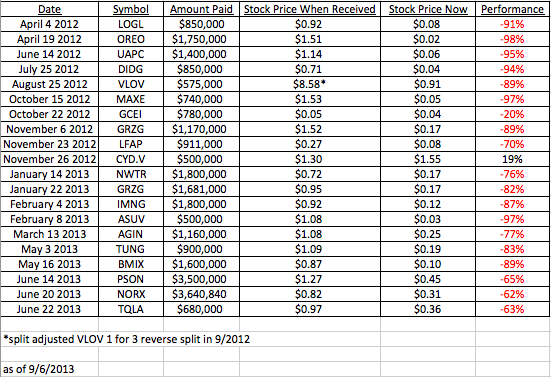](/content/images/wordpress/2013/09/Screen-shot-2013-09-08-at-8.18.45-AM.png)
Unfortunately a lot of times a new investors first entre to microcaps is a bad one, usually landing on a pump and dump website or hard mailer they receive in the mail. It’s important for investors to know that only a small percentage of microcaps indulge in such unscrupulous initiatives. Many microcaps have great businesses, management teams, share structures, and conduct themselves with integrity.
At MicroCapClub, most of our members make a living exclusively investing in microcap stocks. If you want to find out how we do what we do, check out some of our educational articles [\[HERE\]](http://microcapclub.com/educational/).
**MicroCapClub** is an exclusive forum for experienced microcap investors focused on microcap companies (sub $300m market cap). MicroCapClub was created to be a platform for experienced microcap investors to share and discuss stock ideas. Our goal at [MicroCapClub.com](http://microcapclub.com/) is quality membership, quality stocks, and quality content. If you are an experienced microcap investor, feel free to [**Apply today**](http://microcapclub.com/forums/index.php?/forum/2-applicant-ideas/).
### Opportunities For Alpha: Exploring MicroCap Equity
URL: https://microcapclub.com/opportunities-alpha-exploring-microcap-equity/
Last updated: 2013-09-06T08:57:47.000Z
I stumbled upon this RBC white paper on microcaps this morning. The paper hits on a few topics on why microcaps are so unique and why they are such an opportunity. The U.S. microcap equity market is comprised of the smallest publicly traded and investable companies in the United States. These companies, often young businesses with small and motivated management teams, simple business models and concentrated product lines, are inherently biased toward aggressive growth and the advantages of active investment management. In this paper, we provide an overview of microcap equity, discuss the benefits of the asset class, and explore this compelling opportunity for institutional investors seeking an active investment solution to meet their alpha and diversification objectives.
#### [](https://us.rbcgam.com/resources/docs/pdf/whitepapers/fundamental-series-alpha-opportunities-microcap%5F032013.pdf?ref=microcapclub.com)
#### [\[READ FULL REPORT\]](https://us.rbcgam.com/resources/docs/pdf/whitepapers/fundamental-series-alpha-opportunities-microcap%5F032013.pdf?ref=microcapclub.com)
**The MicroCapClub (mc2)** is an exclusive forum for experienced microcap investors focused on microcap companies (sub $300m market cap). The MicroCapClub was created to be a platform for experienced microcap investors to share and discuss stock ideas. Our goal at [MicroCapClub.com](http://microcapclub.com/) is quality membership, quality stocks, and quality content. If you are an experienced microcap investor, feel free to [**Apply today**](http://microcapclub.com/forums/index.php?/forum/2-applicant-ideas/).
### Selling Restricted Canadian Stock In The US
URL: https://microcapclub.com/selling-restricted-canadian-stock-us/
Last updated: 2013-09-03T08:53:33.000Z
Accredited investors may from time to time participate in private placements in US and Canadian listed microcap companies. A company needs funding, you write a check, and the company issues you restricted stock. The length of the restriction is different for US vs Canadian listed companies. An investor participating in a private placement with a Canadian listed company must hold the stock for 4 months before being able to sell. The process to sell restricted Canadian stock can be daunting if you don’t know the process. I’ve republished a report below from [Pennaluna & Co](http://www.pennaluna.com/?ref=microcapclub.com) which gives valuable insight on how to sell restricted Canadian stocks here in the US.
#### “So how do I sell my restricted Canadian shares here in the States?”
Here’s a brief overview of the process that should take you about four minutes to read.
Please note that this isn’t legal or investment advice… we’ll paint with a broad brush… and we’ll describe only the run of the mill retail transaction.
**Restricted stock needs exemption**
First of all, recall that U.S. securities law requires stock to be registered with the SEC before it can be publicly traded in this country.
Stock that isn’t registered is “restricted” from public trading. It may be lawfully sold only under an exemption from registration. The share certificate itself usually bears a prominent legend that warns of this requirement.
Restricted shares raise special concerns for brokerage firms, since participating in an unlawful distribution of unregistered securities is a large no-no. Thus, brokers tend to handle such sales carefully to help keep everybody out of legal hot water.
For guidance concerning offshore securities transactions, including Canadian, U.S. brokers look to Regulation S under the Securities Act of 1933\. Reg S confirms– in the charmingly impenetrable language of lawyers – that this nation’s registration requirements do not apply to strictly foreign activity. At the same time, it throws up barriers to end runs around U.S. securities laws when they do come into play.
**Reg S safe harbors**
The complexity of securities regulation is notorious. One nice thing about Reg S is that it cuts through a bit of the fog and offers some relatively straightforward “safe harbor” provisions for investors.
A safe harbor provision gives you virtually guaranteed protection from a law’s penalties when carefully followed in good faith. While it may not be the only possible way to comply, the certainty such a provision supplies gives you the opportunity to sail behind a minesweeper instead of charting your own course through the minefield. Your odds are better.
Rule 904 under Reg S offers a safe harbor for sales by the ordinary investor — persons who aren’t issuers, distributors or affiliates. (Another rule offers some protection to these others, but that’s outside this overview.)
**How the process works**
Here’s how the Rule 904 process generally works for an average investor in the States who wants to sell restricted shares issued by a Canadian company (often referred to as “the issuer”).
Initially your broker will need to know when you bought the shares. This is to be sure the required holding period has expired. Usually that’s the time mandated by law, but occasionally the issuer itself imposes a longer delay.
Also the broker will want to know how you paid for the stock. That’s because shares that weren’t bought for cash – say, for example, shares received in return for consulting services – may raise other concerns to be addressed.
The broker will provide you with a Stock Power form to facilitate transfer and a Rule 904 Seller’s Representation Letter, sometimes called a Declaration For Removal of Legend. He’ll ask you to sign both and send them to him along with the stock certificate.
**Seller’s Letter**
The Seller’s Letter is important. In it you’re asked to make representations to help verify that your sale falls within the safe harbor. Among other things, you’ll typically confirm that:
▪ You aren’t an affiliate of the issuer (Affiliates generally include 10% shareholders, officers and directors).
▪ The buyer of your stock is not in the U.S. and/or the stock will be sold on a designated offshore securities market — Canadian markets qualify — and you have no knowledge that the buyer is in the States.
▪ Neither you nor anyone acting for you is making “directed selling efforts” into this country. These could include advertising or other promotion aimed at boosting public demand for the shares in the States.
▪ You truly intend to sell the shares now… meaning you aren’t trying to wash the legend off the cert so you can use it in some other, perhaps unsanctioned, transaction (This is one reason cleaned up stock generally can’t be transferred out of an account unless the restricted legend is first replaced).
▪ Your sale isn’t part of a scheme to evade registration.
The issuer or its transfer agent may also require a Rule 904 Broker’s Letter. In that case, the broker must make several of the same representations.
**Sent on its way**
Once the paperwork is complete, the compliance cops give the documentation a once over. Then together with the certificate it’s sent off to the transfer agent used by the issuer.
These days virtually no public company handles its own stock transfers. So most transfer agents maintain securities records for a number of issuers. As a result, many have grown large and in certain cases a little slow when it comes to restricted shares.
After the transfer agent receives the package, staff in due course examines the documents and checks the relevant stock records. If all is in order, the issuer is asked for approval to remove the restricted legend.
Some issuers want a legal opinion before they’ll sign off on this. If so, counsel gets into the act at this point, conducting a review and giving the thumbs-up if everything passes muster.
**Home again**
Once the issuer says OK, the transfer agent removes the restricted status notation on the company’s stock records and issues a new, clean certificate that it sends back to the broker for deposit to the customer’s account.
Thereupon your broker will call with the happy news that you are now at liberty to sell your free trading Canadian shares.
(Check your watch. Four minutes or less?)
**The authors – Timothy Major**, an Idaho native, holds a degree in commerce from the University of the Witwatersrand in Johannesburg, South Africa. For 14 years he has been a broker with Pennaluna & Company, a FINRA broker-dealer and market maker with its main office in Coeur d’Alene, Idaho. Tom Wobker holds degrees in journalism and law and is a principal with the firm. Founded in 1926, Pennaluna trades stocks on all U.S. and Canadian exchanges, Nasdaq, OTCBB and Pink Sheets. Phone 800-535-5329 or visit [www.pennaluna.com](http://www.pennaluna.com/?ref=microcapclub.com) or [www.penntrade.com](http://www.penntrade.com/?ref=microcapclub.com).
**The MicroCapClub (mc2)** is an exclusive forum for experienced microcap investors focused on microcap companies (sub $300m market cap). The MicroCapClub was created to be a platform for experienced microcap investors to share and discuss stock ideas. Our goal at [MicroCapClub.com](http://microcapclub.com/) is quality membership, quality stocks, and quality content. If you are an experienced microcap investor, feel free to [**Apply today**](http://microcapclub.com/forums/index.php?/forum/2-applicant-ideas/).
### The Value of Net Operating Losses
URL: https://microcapclub.com/value-net-operating-losses/
Last updated: 2023-10-15T11:09:14.000Z
How do you create a publicly traded microcap? IPO a small cap and lose a lot of money. Quite a number of microcaps came to be in just this manner. A recent personal acquisition of just such a historical money-loser inspired this article. Some math was required to evaluate what the tax net operating loss (NOL’s) carry forwards might be worth going forward. Factoring such tax advantages into the valuations of companies is rather common, but much more so for microcaps than for larger companies. Large companies, after all, usually didn’t get to be large by losing a lot of money. In the case of my recent acquisition the company has been especially adept at losing money. In fact, the company has tax NOL’s that are roughly 16 times the company’s current market valuation. I figure they won’t be paying income taxes for the next twenty years. What’s that worth? I’ll bet the answer will surprise you.
The statutory Federal corporate income tax rate in the United States varies from 15% for lower incomes to a top bracket of 35%. States lay some income tax on top of that and you’ll sometimes see companies report income tax expense as high as 38% to 40% of pre-tax income. The 35% top rate is the highest among industrialized countries but in 2011 the average rate paid by U.S. corporations was a record low of just 12.1%. There were tax benefits from the large losses many companies experienced in the 2008 recession but also R&D credits and special breaks for special industries. The U.S. imposes confiscatory rates and then hands out tax breaks to constituencies favored by the politicians; a recipe for corruption. But this is an investing blog and let me just note that a small successful company without the benefit of NOL’s or political bribes pays significant income taxes. I’m going to use an effective rate of 30% for the calculations in this article.
Suppose your company is a no growth company with a pre-tax return on equity of 10% that pays all their earnings to shareholders in the form of dividends. After paying 30% corporate income tax the company earns 7% on their equity and pays all the earnings to shareholders. That’s probably the right thing to do if you’re just earning 7% on your capital. If they have NOL as their friend, they earn 10% return on equity and shareholders earn a much nicer dividend that is 42.8% higher. If those NOL’s could last forever the untaxed company would be worth 42.8% more than the one paying 30% to the government every year. Tax NOL’s generally can be carried forward to offset future income for a maximum of 20 years. That’s a long time, but not forever, so our no growth companies value is enhanced somewhat less than 42.8% by NOL.
But what if your company is a growth stock? That is, they earn a high pre-tax return on equity and can reinvest earnings back into the company at the same high return on equity? Are the tax NOL’s worth more? You bet. Let’s compare two companies with a pre-tax ROE of 20% that are absolutely identical except one pays taxes for the next 20 years and the other does not. The book value of the company with the NOL’s in twenty years would increase by the factor (1 + 0.20)20 = 38.33 . The same company paying taxes at 30% each year would have a return on equity after taxes of just 14%. After 20 years the fully taxed company would have increased book value by a factor of (1 + 0.14)20 = 13.74\. After 20 years the two companies are again equal in the eyes of Uncle Sam as the NOL’s have expired. However, the company that used their friend NOL is worth 38.33/13.74 = 2.79 times more than their tax-paying counterpart.
So you should mark up the value of any company with large NOL’s with 20-year expirations by a factor of almost three? Not so fast. First the valuation markup depends a lot on the return on equity. Highly profitable businesses with an opportunity to reinvest earnings at the same high rate benefit much more from NOL’s than their lower earning brethren. The chart below shows the markup factor as a function of after tax return on equity and the number of years before the NOL’s run out or expire.
[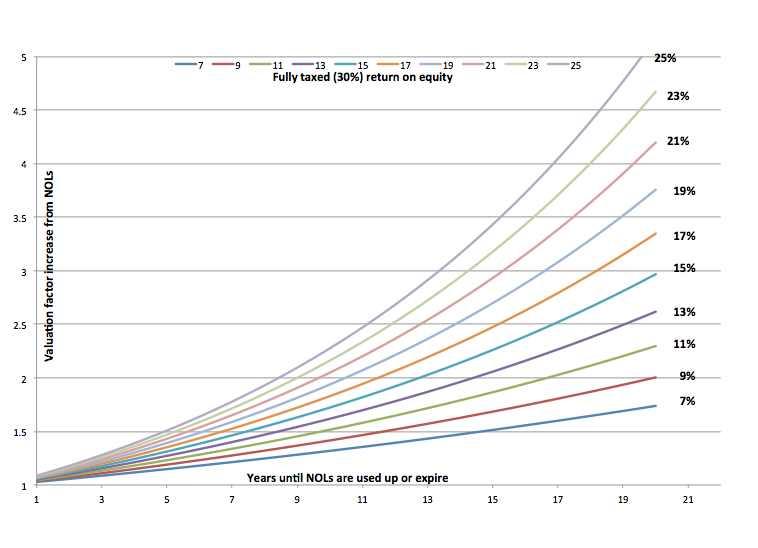](/content/images/wordpress/2013/08/Screen-shot-2013-08-24-at-8.10.35-AM.png)
Avoiding taxes for 20 years rather dramatically increases the value of high return businesses. The 25% return on equity business, for example, becomes a 35.7% return on equity business and is worth more than 5 times as much as the identical but taxpaying counterpart. This is the miracle of compounding at work.
I generally wouldn’t pay the premium prices for companies with NOL’s suggested by this chart, however. Using NOL’s comes with restrictions. The IRS will disallow NOL’s in the event of a change of control, so you can’t sell your microcap to someone bigger. The IRS will also find that a change of control has occurred if more than 50% of the shares change ownership in a three year period. Only 5% holders who must report holdings changes to the SEC count. The IRS doesn’t even know when we little guys buy and sell. You’ll often see poison pills that prevent acquisition of more than 5% of the shares without the permission of the board of directors. Asure Software ([ASUR](http://finance.yahoo.com/q?s=asur&ql=1&ref=microcapclub.com)), Broadwind Energy ([BWEN](http://finance.yahoo.com/q?s=bwen&ql=1&ref=microcapclub.com)), Horizon Lines ([HRZL](http://finance.yahoo.com/q?s=hrzl&ql=1&ref=microcapclub.com)), and Kingsway Financial ([KFS](http://finance.yahoo.com/q?s=kfs&ql=1&ref=microcapclub.com)) are a few microcap examples among many that have NOL preservation rights plans. I would also note that the value of NOL’s diminish or disappear if the company doesn’t hit the ROE’s you expect. NOL’s are an intangible tax asset. If the companies forecasts future profitability a “deferred tax asset” will appear on the balance sheet to reflect the value of the NOL’s. But it’s very high risk to pay the high valuation multiples from NOL’s suggested by the plots above. If future earnings aren’t what you expect the deferred tax assets must be reduced by the accountants but worse the tax benefit you counted on is reduced too. In the worst case, NOL’s become totally worthless if you stop making money. Of course it can work the other way too. If the company is more profitable than you projected the NOL’s may be worth more too.
Of course, managers of companies with NOL’s are well aware of arithmetic and will try to take advantage. Asure Software, for example, has large NOL’s. They’ve made four acquisitions in the last three years financed mostly by debt (to boost ROE) and the stock has tripled. Kingsway Financial has also made three acquisitions in just the last year and intends to issue preferred stock to continue to acquire and grow. This is frequently the strategy; grow quickly using debt to maximize the value of your NOL’s. Acquisition strategies are notorious for destroying shareholder value but the strategy can actually make sense for a company with NOLs. Every time a company with NOL’s buys a profitable company everyone is happy. The target company shareholders probably get a premium price, the acquirer gets a company worth more to them than to the seller, and the IRS gets screwed!
So companies with tax NOL’s have a serious competitive advantage. A rather ordinary 10% ROE business becomes a valuable 14% ROE business. Should you just go buy up all the companies that have lost a lot of money? I’m not keen on owning loser companies but if something has happened to change the fortunes of the company going forward then I’m interested. I own Asure software, for example, which lost money in the videoconferencing and patent troll business but now is a cloud software company aimed at the growing mobile workforce market. The new management is first rate and might get onto the 19% ROE curve that gets boosted to 27% with their NOL’s. Those NOL’s should last 10 years. Consulting the chart, the company’s money-losing history roughly doubles the value of the company.
Most microcap investors were well aware before reading this article that NOL’s are an asset. My hope is that some readers may now realize what a tremendous asset they can be especially for a highly profitable growth company that can reinvest earnings at a high rate. Highly profitable companies with a long history of big losses are rare. Hedge fund managers are attracted to them. Often times activists are trying to create them. When you come across one, you should consider the advantages of the NOL’s. And finally, if you find one you like, tell your friends at MicroCapClub about them!
**\===> Interact and learn with 250+ of the best microcap investors on the planet.** [\[Join Us\]](https://microcapclub.com/join-now/)
MicroCapClub is an exclusive forum for experienced microcap investors focused on microcap companies (sub $500m market cap) trading on United States, Canadian, European, and Australian markets. MicroCapClub was created to be a platform for experienced microcap investors to share and discuss stock ideas. Since 2011, our members have profiled 1000+ microcap companies. Investors can join our community by applying to become a member or subscribing to gain instant view only access. MicroCapClub’s mission is to foster the highest quality microcap investor Community, produce Educational content for investors, and promote better Leadership in the microcap arena. For more information, visit [http://microcapclub.com](http://microcapclub.com/) and
### Lessons Learned After One Year of Managing a MicroCap Fund
URL: https://microcapclub.com/lessons-learned-after-one-year-of-managing-a-microcap-fund/
Last updated: 2023-10-15T11:08:05.000Z
I became a full time microcap investor in October 2012, after working on Wall Street for 16 years across research, trading, institutional investment management and client service jobs. Early on in my career, I worked as the sole analyst for a microcap investor who ran his own firm. It was entirely his own money, and he had a lot of it. He accumulated his wealth by taking concentrated positions in companies I had never heard of. His approach involved taking huge positions, getting to know management on a personal level, and then watching his investments like a hawk. At the time, I didn’t appreciate the nuances of his strategy, and eventually moved on to other jobs.
I have always gravitated toward investing in smaller companies. They just seemed more interesting to figure out, and offered more upside per unit of time spent. My evolution brought me to a place where investing full time became a possibility and my wife was fortunately a key supporter of the idea. I left a good paying job where I could have kept on clipping the coupon, but what nagged at me was the desire for more freedom and to control my own destiny. I’ve been at it for almost a year now, running a portion of our personal wealth, alongside additional client money. My partner in the business, who I have known for more than 10 years, has the same skin in the game, and we share responsibilities equally. Doing this alone would be impossible, and we have been fortunate in our first year of operation.
To the extent anyone is out there thinking about taking a similar leap, this blog post is for you. Go for it. Failure IS an option, because whatever you learn and whoever you meet along the way will provide unforeseen options down the road. I probably waited too long to make the leap.
[](/content/images/wordpress/2013/08/thinking-man.jpg)
*Lessons learned:*
**Liquidity** is the best friend and the worst enemy of microcap investors. Never underestimate the risk of when you will need liquidity, and conversely don’t overestimate the opportunity to be a liquidity provider, especially when others will not. Position sizing and always having some cash on hand are two ways to mitigate this risk overall, as well as having a medium term investment horizon. There are days when your favorite stock might move down 10% on little volume, which is a good day to be a liquidity provider. We maintain at least 10% cash at all times to take advantage of such opportunities.
**Patience** is required to let themes play out. There are days when absolutely nothing happens. If you are a trader or like the action of trading, know this ahead of time. Sometimes there is no wind for the sails, or the sniper just lies in wait. After a six month holding period, we sold one of our positions after growing frustrated with management execution. We then watched it double in the next 4 months. We still don’t know why it doubled. Execution delays are common, and sometimes you need to let out longer rope. Management teams that mis-mange expectations are often bad management teams.
**Information** is king in microcaps. Figuring out a story first is difficult, but even if you are the second person to come upon actionable information, don’t discount its value, though it does have a sliding scale. You should know where you sit in the information chain. Information can be currency with your peers, and we use it to our advantage all the time, in driving returns for our investors, but also in building relationships with peers and industry contacts.
**Conviction** is the driver of high returns or financial ruin. Test your conviction via scientific method. i.e., actively try and poke holes in your own thesis. Ask others to evaluate your thinking. Do original research and talk to people who know and use the product or service your company offers. Conviction is maximized when the holes are not found. We have mistaken conviction for idea intoxication in the early stages of information discovery.
**Peer networks** help drive information, camaraderie, fellowship and hopefully returns. Do your own work, and validate ideas and information that is shared with you. Going it alone sounds noble, but you won’t have any fun in the process. There are great characters in this business, like any other, but especially in microcaps. Better decisions can be made by tapping into people with diverse backgrounds.
**Tolerance for pain** is required when things go against you. We don’t use stop-losses, which some people do. We accept a wide threshold for being wrong, because we have seen some of our best ideas go down 30% before they double or triple. We believe our home runs will pay for our strike-outs. Thus far that has proven successful. Your entry price is more random than you think, despite your confidence level. Having a position immediately move against you is disheartening and screws with your confidence. This is where conviction comes into play.
**Management** **access** is the linchpin of our information advantage, and is virtually impossible to obtain when you travel up the market cap ladder. We will not invest in companies that do not provide access to top-level executives. We try to meet management in person, incurring travel expenses to do so, by attending conferences or going directly to their offices. Travel expenses generally pay for themselves, sometimes in multiples. Nothing can replace looking a human being in the eye and evaluating body language, and meeting people directly goes a long way in building a fruitful relationship. The combination of how they tell you, and what they tell you is a powerful one. We try and speak with management quarterly.
**Partnership** is the only reason I jumped when I did. It gave me more confidence and I believe it is the key ingredient to our success. We bring different skills and backgrounds to the table. All decisions must be hashed out and debated, sometimes at a stalemate. Decisions that get made are high quality. Sometimes it slows things down, but we both know when to press the other person, and trust factors into this in a big way. There is no room for ego in a partnership model. If you are a lone wolf, it will be harder for sure – you can never leave the screen, your work-life balance and relationships might suffer. Your biases and viewpoints will not be questioned, and you will make faster decisions, to be sure.
**Red flags** include the need to raise capital and the need to raise capital. Just to hammer home the obvious on shareholder dilution. We recently saw a company get more than cut in half on an equity offering. It went from $5 to $2, in just two days because of the offering. Low insider ownership tells me that management isn’t going to wake up early and stay late, and someone will either eat their lunch or take their lunch money. I have my own money alongside my investors. It really, really hurts when I lose. I take it very personal. I would be embarrassed to offer my services to someone if I didn’t also have my own money at stake. A very high share count is almost a non-starter, which indicates to me that bullets have already been wasted and lots of investor churn will be required to move a stock higher. When someone pitches me an idea, looking at regular and fully diluted shares outstanding is often the very first thing I do. Lastly, we look for management teams that we trust, that we like as human beings and who do what they say they are going to do.
**Green flags** include high insider ownership, low institutional ownership as we want to lead the pack rather than follow it, clean capital structure (i.e., no warrants or convertible securities), cash on hand that can last in excess of your desired holding period, and/or being cash flow positive, a stable core business combined with a positive catalyst, a management team with a previous record of success.
**\===> Interact and learn with 250+ of the best microcap investors on the planet.** [\[Join Us\]](https://microcapclub.com/join-now/)
MicroCapClub is an exclusive forum for experienced microcap investors focused on microcap companies (sub $500m market cap) trading on United States, Canadian, European, and Australian markets. MicroCapClub was created to be a platform for experienced microcap investors to share and discuss stock ideas. Since 2011, our members have profiled 1000+ microcap companies. Investors can join our community by applying to become a member or subscribing to gain instant view only access. MicroCapClub’s mission is to foster the highest quality microcap investor Community, produce Educational content for investors, and promote better Leadership in the microcap arena. For more information, visit [http://microcapclub.com](http://microcapclub.com/) and
### My Thoughts On MicroCap Executive Compensation
URL: https://microcapclub.com/my-thoughts-on-microcap-executive-compensation/
Last updated: 2023-10-15T11:06:52.000Z
MicroCap executive compensation is a topic that has been brushed under the rug for quite a while. I’m not an executive compensation expert, but I have invested in over a hundred microcap companies over the years. As a full time microcap investor, there have been plenty of instances where I have completely passed on making an investment primarily due to executive compensation amounts and/or structures. In its truest form investors want to know: Is this management team in it for the salary or in it for shareholders? In this article I will give my subjective viewpoint on this topic, and I hope it will spur conversation amongst investors and corporate officers.
Executive compensation is made up of Cash Salary + Stock Option/Restricted Stock awards + other perks. Lets focus on the cash salary first. The main reason cash salary levels are so important to microcap investors is that over 90% of microcap companies are unprofitable. Salaries can greatly influence the health, longevity, and eventual success or failure of a microcap company. For example is a small microcap company is losing money, and the CEO is raking in $500,000 …what message does that send me? Not the right one, and I will pass on making an investment or buying the stock.
[](/content/images/wordpress/2013/08/greedyceo.jpg)
So what metrics do I use to determine if a cash salary is too high? To be honest I never really put down a formula before for this article. It’s always been common sense + my gut. There are many variables that come into play, but I believe the most important is the size and financial performance of the underlying business. Here is my subjective opinion on what **peak cash salaries** are acceptable given the financial performance of the underlying business. My annoyance meter or red flagdar goes off when salaries go much above these figures:
- Company is unprofitable – $1 million EBITDA per year: $200,000
- Company produces $1 million -$5 million EBITDA per year: $250,000
- Company produced $5-10 million EBITDA per year: $300,000
I stopped at $10 million in EBITDA because quite frankly I don’t take initial positions in companies that are larger than that. Also, the figures above are for microcap companies only as there are obviously plenty of billion dollar market cap companies that are unprofitable.
In some rare instances I’m willing to accept a higher cash salary such as when the CEO is a serial success story. One of our members on MicroCapClub calls these CEO’s “repeat offenders” in a good way, an executive that has built up and sold several companies to the benefit of shareholders. Examples of this would be Shimon Alon of Attunity ([ATTU](http://finance.yahoo.com/q?s=attu&ql=1&ref=microcapclub.com)), Mark Libratore of Liberator Medical Holdings ([LBMH](http://finance.yahoo.com/q?s=lbmh&ql=1&ref=microcapclub.com)), Manuel Villafa of Kips Bay Medical ([KIPS](http://finance.yahoo.com/q?s=kips&ql=1&ref=microcapclub.com)) but these individuals are few and far between in the microcap space. Even in these circumstances I’m ok with the CEO getting a little bit more but not a lot more. A successful CEO like this should be smart enough to take most of his compensation weighted in stock in the first place. I’ve also given leniency to corporate officers with higher than acceptable salaries that are consistent buyers of stock in the open market. But even in this situation, why not have a lower salary, let the company keep the cash and do a buy back and decrease the outstanding shares.
Outside of these outlier circumstances I find management teams that draw large cash salaries above and beyond the norm aren’t aligned with shareholder interests. Smart investors know this too, and they will completely pass on buying a stock if the salaries are too high. I could give you a bunch of real examples of companies that trade today that I passed on because of bloated management salaries, but the point of this article isn’t to be a bash session. Bloated cash salaries are a disease that affects many microcaps. The great thing is over 2/3 of publicly traded companies are microcaps, so you can cross them off the list and move onto the next one.
I will give you an example of a company that I invested in in spite of high management salaries. I’m an investor in Noble Roman’s ([NROM](http://finance.yahoo.com/q?s=nrom&ql=1&ref=microcapclub.com)), a company I wrote about a while ago [\[HERE\]](http://microcapclub.com/2012/09/noble-romans-inc-who-knew-pizza-could-be-so-profitable/). Over a year ago I was conducting my due diligence, and the biggest red flag I could find was the aggressive salaries of the CEO (father) and COO (son) pulling in a combined $700,000+ on a company that did 2.5 million in EBITDA in FY 2011\. After some digging I found that a few years earlier they actually reduced their salaries. YES they actually reduced their salaries from even higher ones, but at least it was a step in the right direction. I flew out to visit the company and met with the management team, and I got a comfort level with them and their motivations. I ended up investing in the company in spite of the high salaries mainly because the CEO owned 15% of the company, and he made it known they weren’t planning on increasing salaries anytime soon. I tell you this real life example to better illustrate the complexity of situations, but I would like to make note that even though I made an investment the high salaries did impact my position size.
[](/content/images/wordpress/2013/08/charles-barsotti-i-don-t-want-stock-options-i-want-you-to-pay-your-tab-new-yorker-cartoon.jpg)
Corporate officers are incentivized with stock options and sometimes restricted stock grants. The use of stock options and restricted stock can be very productive for microcap companies in recruiting top talent where they cannot afford to pay the normal going rate in all cash. Certain industries like Biotech and Pharma use these means of compensation more so than others. In 2011, the average microcap biotech/pharma executive compensation consisted of 50% cash and 50% stock options *([source](http://www.onpartners.com/News/resources/LifeSciExecCompTrends.pdf?ref=microcapclub.com))*. Companies will often say that the stock options better align the corporate officers with the shareholders, but they can be very dilutive to microcaps. If a company has a $10 million market cap and total salaries are $2 million per year, and half of that compensation is issued in stock options, it illustrates my point.
These options and stock grants can be quite destructive to a company’s capitalization table. Just like a large cash salary, a huge stock incentive plan can also turn away professional investors if it’s not structured correctly. I’ve seen companies that issue options that dilute 10%+ of the company per year, which is ridiculous. Restrictive stock grants are even worse because the company is just giving stock away. I believe that most corporate officers need to reward employees and management but not to the detriment of shareholders. As an investor be careful and really dive into the executive compensation structures of microcap companies.
Stock options should be granted in reasonable amounts and should be based on performance metrics that enable stock appreciation. In a perfect world, I believe every microcap executive officer would have a modest base salary and be highly incentivized with bonus awards for hitting predetermined business milestones, financial milestones, and stock milestones.
- Business Milestones: Predetermined events the board and management feel are important for the year ahead. Ex: Product XYZ rolled out by August, Two licensing deals accomplished by year-end, etc.
- Financial Milestones: Auxilio ([AUXO](http://finance.yahoo.com/q?s=auxo&ql=1&ref=microcapclub.com)) is a good example of a management team incentivized by financial milestones. In their case they receive option bonuses if the company achieves $2 million in EBITDA in 2013, $6.3 million in 2014, and $9.2 million in 2015.
- Stock Milestones: This one might be a bit controversial, but I believe it is a public company management team’s fiduciary duty to “be public” and let investors know they exist. I would love to see bonus awards granted for stock price and volume milestones. I certainly don’t want management teams doing unscrupulous things like \[[THIS](http://microcapclub.com/2013/06/tribute-to-tobin-smith-hard-mailer-performance/)\], but I believe it does make sense to tie some level of management compensation directly to stock performance. The goal would be to encourage microcap CEO’s in particular to get out and tell their stories.
Executive compensation is one of the first things I look at as a full time microcap investor because it quickly tells me how the management team is motivated. I hope this article has given a general overview on how evaluating executive compensation is important to microcap investing. I believe this topic has been brushed under the rug for years. I’ve tried to give a general outline about how one full time microcap investor, myself, looks at executive compensation. My hope is that at the very least this will start a dialogue amongst investors and amongst corporate officers. **I welcome any comments.**
**\===> Interact and learn with 250+ of the best microcap investors on the planet.** [\[Join Us\]](https://microcapclub.com/join-now/)
MicroCapClub is an exclusive forum for experienced microcap investors focused on microcap companies (sub $500m market cap) trading on United States, Canadian, European, and Australian markets. MicroCapClub was created to be a platform for experienced microcap investors to share and discuss stock ideas. Since 2011, our members have profiled 1000+ microcap companies. Investors can join our community by applying to become a member or subscribing to gain instant view only access. MicroCapClub’s mission is to foster the highest quality microcap investor Community, produce Educational content for investors, and promote better Leadership in the microcap arena. For more information, visit [http://microcapclub.com](http://microcapclub.com/) and
### Book Review: Insider Buy SuperStocks By Jesse Stine
URL: https://microcapclub.com/book-review-insider-buy-superstocks-by-jesse-stine/
Last updated: 2023-10-15T11:05:59.000Z
As a full time microcap investor, I haven’t found too many books that correlate with my own investment processes in finding the next microcap that can turn into a small-midcap. However, Jesse Stine’s book is about the closest one I’ve come across. I normally completely tune out books with titles like this one because it’s usually some self-described guru trying to sell their “trade like me” DVD series or subscription service. A recommendation from another MicroCapClub member prompted me to buy the book, and I’m glad I did. Jesse doesn’t invest exclusively in microcaps, but many of his big winners started out as microcaps.
In the book, Jesse goes into great detail about his trading-investing strategy that turned $46,000 into $6.8 million in 28 months from 2003 – 2006\. The more I read the book the more I realized that someone finally put 90% of my own investing philosophy down on paper. I was immediately jealous and annoyed that Jesse beat me to it 🙂
A big part of Jesse’s philosophy is completely tuning out the media and financial publications as they are a distraction. He rightly points out that when you start to hear a trend or stock on CNBC it’s normally time to sell, not buy. It’s also important to not put too much emphasis on general market performance. The great stocks will move up in any macro market condition. I agree completely with these two points, as ZAGG has always been my example of a stock that went up 250% during the crash of 2008-09.
Jesse’s investment philosophy is very similar to my own so it was a very easy and enjoyable read. Jesse is very picky, and holds only a few companies that fit a strict set of criteria. Jesse isn’t a day trader as his normal position is for a few weeks to a year. His approach combines a strict set of technical and fundamental analysis. He uses technical analysis for his buy-sell points, but he mostly uses fundamental analysis to find his next “superstock”. I was very impressed with his list of “Fundamental Super Laws” for picking winners. He goes into detail about share structure, earnings growth, operating leverage, comps, backlog, insider buying, super trends, etc.
If you are a passionate investor like I am, you will be able to read this book in a night or two. I highly recommend reading this book. I found it very useful and you will too.
##### [\[BUY IT HERE\]](http://www.amazon.com/Insider-Buy-Superstocks-Turned-Million/dp/0615818455/ref=sr%5F1%5F1?s=books&ie=UTF8&qid=1375838005&sr=1-1&keywords=insider+buy+superstocks&ref=microcapclub.com)
**\===> Interact and learn with 250+ of the best microcap investors on the planet.** [\[Join Us\]](https://microcapclub.com/join-now/)
MicroCapClub is an exclusive forum for experienced microcap investors focused on microcap companies (sub $500m market cap) trading on United States, Canadian, European, and Australian markets. MicroCapClub was created to be a platform for experienced microcap investors to share and discuss stock ideas. Since 2011, our members have profiled 1000+ microcap companies. Investors can join our community by applying to become a member or subscribing to gain instant view only access. MicroCapClub’s mission is to foster the highest quality microcap investor Community, produce Educational content for investors, and promote better Leadership in the microcap arena. For more information, visit [http://microcapclub.com](http://microcapclub.com/) and
### Take Away The Punch Bowl, Small-Cap Stocks May Keep Drinking
URL: https://microcapclub.com/interest-rate-hikes-and-small-cap-stock-returns/
Last updated: 2013-07-30T06:07:29.000Z
**By Perritt Funds**
Investor attention has focused on the Federal Reserve’s actions following a relatively chaotic few months in the bond market. Chairman Bernanke recently suggested that the Fed would perhaps begin tapering its purchases of bonds, and that bond buying could be completely over by the middle of 2014\. The Fed talking seriously about tapering has many investors considering the logical next phase – albeit far down the road – of an eventual new era of Fed tightening.
While exact dates and periods of past tapering actions or interpretations of “Fed speak” can’t be measured precisely, we can take a look at past periods of interest rates hikes and their effect on small cap equities. From this data, investors may gain some historical context to enhance their perspective regarding future Fed actions and market returns.
**The previous six times the Fed embarked on a tightening cycle and the associated small-cap returns are below:**
[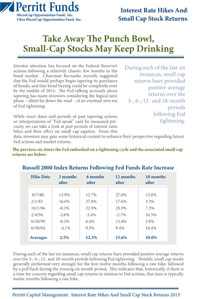](http://perrittmutualfunds.com/media/Punch%5FBowl.pdf?ref=microcapclub.com)
CLICK HERE
**The MicroCapClub (mc2)** is an exclusive forum for experienced microcap investors focused on microcap companies (sub $300m market cap). The MicroCapClub was created to be a platform for experienced microcap investors to share and discuss stock ideas. Our goal at [MicroCapClub.com](http://microcapclub.com/) is quality membership, quality stocks, and quality content. If you are an experienced microcap investor, feel free to [**Apply today**](http://microcapclub.com/forums/index.php?/forum/2-applicant-ideas/).
### The Rise of MicroCaps
URL: https://microcapclub.com/the-rise-of-microcaps/
Last updated: 2023-10-15T11:04:58.000Z
Microcap stocks, public companies with market caps less than $300 million, dominate the public market ecosystem. 68% of all public companies are microcaps, but these companies only represent 2% of total public company market value. In fact the total market capitalization of the entire microcap space is around $300 billion, about the size of Google ([GOOG](http://finance.yahoo.com/q?s=goog&ql=1&ref=microcapclub.com)).
Over the last couple weeks, [Barron’s](http://online.barrons.com/article/SB50001424052748704093404578611751428574108.html?mod=BOL%5Fhpp%5Fdc&ref=microcapclub.com) and several other financial publications have written about the recent outperformance by microcaps. I’ve been following the microcap space for a decade, and I too am intrigued with the latest move in microcaps. Of course the question: Is this the start or the end of the run in MicroCaps?
[](/content/images/wordpress/2013/07/Screen-shot-2013-07-19-at-1.18.09-PM.png)
As you can see the in the chart above, the Russell MicroCap Index ([IWC](http://finance.yahoo.com/q?s=iwc&ql=1&ref=microcapclub.com)) has significantly outperformed the S&P since mid May. Historically, the IWC has followed the pattern (see chart above pre-May) of overshooting to the upside and to the downside when compared to the S&P. In May, when the S&P moved lower, microcaps held their ground. This break from the pattern is rather noticeable. This could be just some random aberration, but I believe it could be the start of a longer-term sustainable rise in microcaps.
As I wrote in the opening paragraph, the whole microcap space is $300 billion. Of this, approximately $100 billion is in the hands of company founders. This leaves $200 billion for the investing public *([source](http://microcapclub.com/wp-content/uploads/2012/06/The-MicroCap-Advantage.pdf))*. Compare this with the individual market caps of Exxon Mobil ([XOM](http://finance.yahoo.com/q?s=xom&ql=1&ref=microcapclub.com)) $423 billion, Apple ([AAPL](http://finance.yahoo.com/q?s=aapl&ql=1&ref=microcapclub.com)) $398 billion, Google ([GOOG](http://finance.yahoo.com/q?s=goog&ql=1&ref=microcapclub.com)) $297 billion, Berkshire Hathaway ([BRK-A](http://finance.yahoo.com/q?s=BRK-A&ql=0&ref=microcapclub.com)) $293 billion, Microsoft ([MSFT](http://finance.yahoo.com/q?s=msft&ql=1&ref=microcapclub.com)) $262 Billion, Johnson & Johnson ([JNJ](http://finance.yahoo.com/q?s=jnj&ql=1&ref=microcapclub.com)) $259 billion, and Wal-Mart ([WMT](http://finance.yahoo.com/q?s=wmt&ql=1&ref=microcapclub.com)) $255 billion. Each one of these megacaps trades over $1 billion in volume per day. The cash and investments that Apple is sitting on is enough to buy more than half of the public float of every microcap that exists. Point being, it won’t take much in regards of capital inflows to move the entire microcap market.
Currently, there are four primary microcap indexes: First Trust Dow Jones Select MicroCap ([FDM](http://finance.yahoo.com/q?s=fdm&ql=1&ref=microcapclub.com)), Guggenheim Wilshire MicroCap ([WMCR](http://finance.yahoo.com/q?s=wmcr&ql=1&ref=microcapclub.com)), Powershares Zacks MicroCap Portfolio Fund ([PZI](http://finance.yahoo.com/q?s=pzi&ql=1&ref=microcapclub.com)), and the iShares Russell MicroCap Index ([IWC](http://finance.yahoo.com/q?s=iwc&ql=1&ref=microcapclub.com)). Since the end of June, the Russell MicroCap Index has had approximately $100 million of capital inflows, which is a very material inflow for the historic $500 million index.
MicroCaps are small businesses, and small businesses are the chief job creators, idea makers, and producers of the US economy. The government realizes this too with the successful passage of the [Jumpstart Our Business Startups Act](http://www.gpo.gov/fdsys/pkg/BILLS-112hr3606enr/pdf/BILLS-112hr3606enr.pdf?ref=microcapclub.com) or JOBS Act, which looks to ease restrictions for companies raising capital through means such as crowd funding. Two weeks ago, the Securities and Exchange Commission voted to allow start-ups to [start advertising](http://www.businessweek.com/news/2013-07-09/sec-set-to-lift-80-year-old-ban-on-advertising-by-hedge-funds?ref=microcapclub.com) their securities offerings directly to potential investors, a major step forward in the implementation of last year’s JOBS Act. Allowing accredited investors to pool resources and fund emerging growth companies could be the match that ignites the microcap space. This will most certainly bring in a significant new wave of capital into microcap market.
Microcaps make up the majority of public companies that exist and yet very few investors even look at the space. The mainstream financial press broad brushes the space as not investable. The microcap arena is risky and filled with bad management teams, business models, and even fraudulent companies. I’ve [written several pieces](http://microcapclub.com/2013/06/tribute-to-tobin-smith-hard-mailer-performance/) on several pump and dumps over the last couple of years. but this is the minority of companies. The fact that no one really looks at microcaps is exactly why the microcap market is so inefficient. You can get an edge simply by knowing a company exists. There are plenty of legitimate microcaps with great businesses.
One of the best qualities of microcaps is that they can really buck the trend of the macro economy and stock market. During the greatest financial disaster since the great depression (July 2008 – April 2009), the DOW and S&P were down 50%, and yet a microcap like ZAGG ([ZAGG](http://finance.yahoo.com/q?s=zagg&ql=1&ref=microcapclub.com)) was up over 250% during this timeframe.
[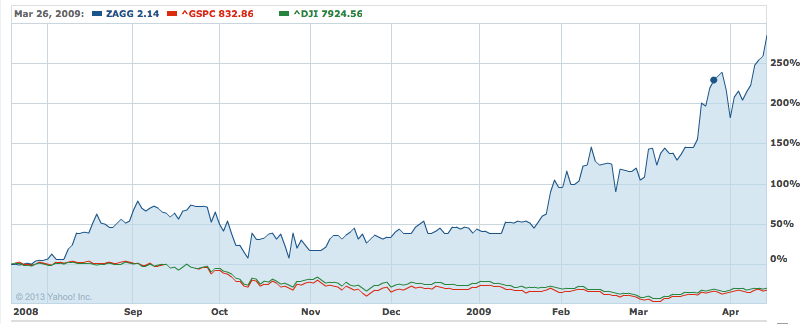](/content/images/wordpress/2013/07/Screen-shot-2013-07-20-at-7.15.21-AM.png)
Microcaps are the ultimate stock pickers playground. They march to the beat of their own drum because in most cases their businesses are so small that the larger macro forces don’t affect them. In many cases China could fall into the ocean and cease to exist, and many microcaps would continue on business as usual like nothing happened. Obviously I’m half joking, but in most cases the macro economy plays very little into microcap stock selection.
As the founder of MicroCapClub, I get to see the activity level in the microcap space from an interesting vantage point. Our membership is an eclectic one just like the companies we invest in. We have peanut farmers and construction workers as well as $10 billion funds as members. Only in the last six months I have seen very large private equity funds looking down the food chain towards the microcap arena. I believe the larger investment community is waking up to the fact that more value can be found in these tiny public companies than almost anywhere else.
In conclusion, microcaps have had a great run since May, breaking away from the normal correlations with the S&P. Microcaps make up a majority of the public companies that exist, and yet they are undiscovered and represent one of the last inefficient investment asset classes. We are starting to see significant capital inflows into microcaps, and with only $200 billion of public float, it won’t take much to raise the tide of the whole space. By the beginning of next year, we should start to see a flood of new capital via JOBS act approval of crowd funding entering microcaps, which could spark a historic run. Microcaps are risky, so it’s important to do your due diligence. If you would like to learn more about microcaps, **[\[HERE\]](http://microcapclub.com/educational/)** is a list of educational articles covering a variety of topics.
**\===> Interact and learn with 250+ of the best microcap investors on the planet.** [\[Join Us\]](https://microcapclub.com/join-now/)
MicroCapClub is an exclusive forum for experienced microcap investors focused on microcap companies (sub $500m market cap) trading on United States, Canadian, European, and Australian markets. MicroCapClub was created to be a platform for experienced microcap investors to share and discuss stock ideas. Since 2011, our members have profiled 1000+ microcap companies. Investors can join our community by applying to become a member or subscribing to gain instant view only access. MicroCapClub’s mission is to foster the highest quality microcap investor Community, produce Educational content for investors, and promote better Leadership in the microcap arena. For more information, visit [http://microcapclub.com](http://microcapclub.com/) and
### Spinoffs Are Hot: Are They For You?
URL: https://microcapclub.com/spinoffs-are-hot-are-they-for-you/
Last updated: 2023-10-15T11:03:58.000Z
A spin off consists of a distribution of shares of a subsidiary of an existing publicly traded corporation to the current shareholders resulting in two separate publicly traded securities. Larger spun off companies often result from breaking up conglomerates formed over the years to allow Wall Street to value the businesses individually. Recent prominent spin-offs with these motivations include the breakup of 21st Century Fox into Fox ([FOX](http://finance.yahoo.com/q?s=fox&ql=1&ref=microcapclub.com)) and News Corporation ([NWSA](http://finance.yahoo.com/q?s=nwsa&ql=1&ref=microcapclub.com)), Dean Foods spinoff of White Wave Foods ([WWAV](http://finance.yahoo.com/q?s=wwav&ql=1&ref=microcapclub.com)), and Sears spinoffs of Sears Canada ([SCC.TO](http://finance.yahoo.com/q?s=scc.to&ql=1&ref=microcapclub.com)) , Sears Home and Outlet Stores ([SHOS](http://finance.yahoo.com/q?s=shos&ql=1&ref=microcapclub.com)), and Orchard Supply Hardware ([OSH](http://finance.yahoo.com/q?s=OSHWQ&ref=microcapclub.com)).
[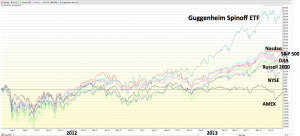](/content/images/wordpress/2013/07/Spinoff-Chart1.png)
Click to Enlarge
Spinoffs are popular with corporate managements again after nearly halting during the financial crisis. There’s been 13 spinoffs in the U.S. to date in 2013 with 16 more scheduled for the 2nd half of the year. Year 2012 had 23 spins, 2011 had 22, and 2010 just 10\. Spinoffs are popular with investors again too. The chart above shows the Guggenheim Spinoff ETF ([CSD](http://finance.yahoo.com/q?s=csd&ql=1&ref=microcapclub.com)) plotted against the major indexes for the last two years. The spinoff ETF tracks an index consisting of major spinoff companies that occurred within the last 30 months. Below are the returns of the Guggenheim Spinoff ETF for the past two years. The Guggenheim Spinoff ETF has crushed all the major indexes sporting a return of 57.71% nearly doubling the return of the next highest index (Nasdaq +29.41%).
[](/content/images/wordpress/2013/07/Spinoff-Chart-2.png)
Guggenheim Spinoff ETF performance vs. indexes for trailing two years (July 12, 2011 to July 12, 2013)
The trailing five-year period that includes the financial crisis meltdown also shows significant out performance with the spinoff ETF returning 104.69% after fees (0.60% a year) . The best-performing index (Nasdaq) returned 62.69% in the same period.
[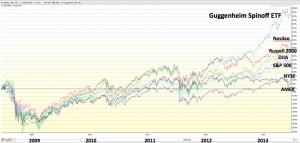](/content/images/wordpress/2013/07/SpinoffChart3.png)
Guggenheim Spinoff ETF vs indexes for trailing five years (July 11 2008 to July 12 2013)
None of this is surprising. A number of academic studies have documented the outperformance of spinoffs over different 10 year spans. Value investors are quite aware too. Seth Klarman points to spinoffs as an often mispriced security in his famous book [“Margin of Safety” published in the early 90’s](http://www.amazon.com/Margin-Safety-Risk-Averse-Strategies-Thoughtful/dp/0887305105/ref=sr%5F1%5F1?ie=UTF8&qid=1373935689&sr=8-1&keywords=margin+of+safety+by+seth+klarman&ref=microcapclub.com). At least that is what I understand as I can’t get my hands on one of the just 5000 printed copies that sell used for $1200\. Joel Greenblatt’s 1997 “[You Can Be a Stock Market Genius](http://microcapclub.com/2012/07/book-review-you-can-be-a-stock-market-genius-by-joel-greenblatt/)” also spends nearly half its pages extolling the virtues of spinoffs. He suggests you just buy them all if you don’t know much about security analysis, but also gives specific advice for picking the winners from the spinoff class if you do know something or care to learn. And this book sold well more than 5000 copies and was and is widely available in libraries. The Guggenheim ETF buys all the major ones so Mr. Greenblatt’s advice to just buy them all seems like it was worth the $10 for the book. So the academics have written papers and the best value investors have written books. What continues to amaze is that the outperformance has gone on for decades now and investors still apparently don’t seem to catch on.
So should you just buy the Guggenheim ETF and go to the beach? No for three reasons. First why pay 0.6% annual fees to own 40 stocks that you could just buy yourself for $10 a trade. Why do mutual funds even exist anymore? So should you just buy all the major spinoffs in your brokerage account and go to the beach? No for the 2nd reason. Momentum investors are real good at finding ETF’s that are going up. Note on the Guggenheim chart above that the spinoffs have run like crazy since last Fall. I wonder if the momentum investors aren’t chasing the spinoff stocks up already. If not now, someday they will chase them up to silly valuations where they’re liable to stay until they underperform for 10 years and they all lose interest. And the third reason not to buy the ETF and go to the beach? Because you can probably do a lot better in the spinoffs that the ETF doesn’t buy; that is the microcap spinoffs that are too illiquid for the ETF to include.
So why are spinoffs often attractive investments? There’s a number of reasons many of which are cited by Mr. Greenblatt and I’ll add some of my own.
1\. **Indiscriminate selling**: Parent shareholders don’t buy these spinoffs they just show up in their account. Some of these shareholders were index funds that must sell. Others are large cap funds that aren’t allowed to own a small-cap so they sell. Others are individuals or managers that bought the parent for a specific reason and have no reason to own the spinoff.
2\. **Limited analyst coverage and management communication:** Analysts may be slow to pick up coverage and management doesn’t want to communicate until their stock options are priced. No information coupled with indiscriminate selling makes for a low initial stock price.
3\. **Incentivized management**: As part of a larger organization, subsidiary performance may not have affected the stock price of the parent much. As a separate organization, managers now have options on their own stock price so they have incentives to deliver.
4\. **Entrepreneurial spirit**: As a smaller organization freed from large company bureaucracy and a future that depends only on the new company’s performance employees are motivated to improve financial performance.
5\. **Opportunities that are not understood by investors:** Spinning a subsidiary off is an expensive undertaking requiring investment banking fees that are significant. The company was spun off for a reason especially if it’s a microcap. There’s some opportunity in many cases that investors won’t initially fully understand resulting in a depressed stock price until the advantages of the spinoff become evident.
6\. **Buyouts:** Many spinoffs are acquired a few years later at a premium. Perhaps a sale was desired all along but a spinoff was elected rather than a subsidiary sale to avoid double taxation (corporate tax on subsidiary sale followed by tax on a dividend). Most spin-offs are tax free distributions but the distribution becomes taxable if the spinoff is bought within two years of the spin.
I won’t pretend that I have a lot to add to the fine work of Joel Greenblatt. Read that Stock Market Genius book if you want advice on investing in spinoffs. I do hope to add just a little content that you may find of value in a coming article. My 15 years of experience investing in these things is a little different than Mr. Greenblatt’s. For many of those years I was managing only my own meager assets. That means I could and did buy the tiniest ones. Spinning off tiny little microcaps is done for different reasons than breaking apart multi-billion dollar conglomerates. No sane manager would break apart a collection of businesses into micro-cap sized chunks to get a better valuation. There’s other reasons to spin off microcaps and it’s important for investors to understand why these transactions are happening. The internet didn’t really exist in 1997 either, so Mr. Greenblatt’s recommended research methods to find spinoffs was to read a lot and occasionally you’ll come across an article about one. Obviously there’s better sources today, although reading a lot is still important for investors. I’ll also reiterate some of Joel’s admonitions based on his experience with some experiences of my own.
**\===> Interact and learn with 250+ of the best microcap investors on the planet.** [\[Join Us\]](https://microcapclub.com/join-now/)
MicroCapClub is an exclusive forum for experienced microcap investors focused on microcap companies (sub $500m market cap) trading on United States, Canadian, European, and Australian markets. MicroCapClub was created to be a platform for experienced microcap investors to share and discuss stock ideas. Since 2011, our members have profiled 1000+ microcap companies. Investors can join our community by applying to become a member or subscribing to gain instant view only access. MicroCapClub’s mission is to foster the highest quality microcap investor Community, produce Educational content for investors, and promote better Leadership in the microcap arena. For more information, visit [http://microcapclub.com](http://microcapclub.com/) and
### The First MicroCap CEO I Ever Met
URL: https://microcapclub.com/the-first-microcap-ceo-i-ever-met/
Last updated: 2023-10-15T11:01:22.000Z
The first microcap CEO I ever met face to face was Hugh Panero, the co-founder of SIRIUS XM Radio ([SIRI](http://finance.yahoo.com/q?s=siri&ql=1&ref=microcapclub.com)) in 2002\. Yes, I know it’s hard to imagine but over ten years ago, XM Radio (pre merger with Sirius) was a microcap (\~$175m market cap).
I had just got done licking my wounds from the tech bubble, and was starting to look further and further down the market cap spectrum. I was completely burnt out on the efficiencies of the smallcap-midcap arena.
After listening to my broker in 1999 and losing my ass betting on smallcap tech companies, I was going to do my own DD and focus on microcaps. I felt this was the last bastion of inefficiency where someone could get an edge.
I stumbled upon XM Satellite Radio.
XM Satellite was also licking its wounds from the tech bubble. In less than a year the stock was down 90%, and hovering around $2.00\. I understood the premise of the technology: no commercials, consistent station listings, and digital quality. But the company had a lot of debt, and just spent a couple billion dollars to launch satellites up into space and had very few subscribers. The shorts were feasting.
Due to my unsuccessful passive approach to investing, one of my new rules was to do everything possible to meet the CEO of my next investment. I didn’t have that much money left, and I needed the next one to work.
I saw that Hugh Panero was presenting at an investor conference in NYC, so I registered for the event under some fictitious name, “Cassel Capital” I think. Needless to say the conference organizers didn’t know my “assets under management” was less than $10,000\. I skipped a day of college and took a bus from Lancaster, PA and made the trek to NYC.
I printed out XM’s 10k filing, which gave me ample reading material for the 3-hour bus trip. XM was in an awful position, huge debt service, bleeding cash, no OEM agreements with car manufacturers.
When I checked into the conference, to my amazement I was able to schedule a 1×1 with Hugh for later in the day. Evidently my fake business card had impressed someone somewhere. I listened to a few presentations including XM’s and took in the surroundings for a few hours.
I was so nervous for the 1×1, and my palms wouldn’t stop sweating. When I shook Hugh’s hand I immediately said, “Good afternoon Hugh, I was just in the bathroom and washed my hands”. I don’t think I even said who I was.
I remember thinking, “Whew, that wasn’t too embarrassing” as Hugh nodded in affirmation of my good hygiene.
To my amazement I didn’t embarrass myself during the meeting, and Hugh seemed to enjoy it as well. In retrospect, Hugh’s humble demeanor probably had more to do with his company’s market valuation dropping from $2 billion – $200 million market cap in less than a year. I’m sure he was getting beat up everyday by shareholders, creditors, and analysts.
When the 1×1 was over, I stood up, shook Hugh’s hand with my sweaty palm, and told him I liked the story and I was going to buy some stock. I remember him looking at me like I was the first person to tell him that in a long time.
I took the bus home that evening. The very next day, I bought 5,000 shares at $1.78\. 18 months later the stock hit $34.00, and my love affair with microcaps began.
The decision and timing to buy the stock was obviously more luck than skill, but the value add of sitting down with management stayed with me. Practice makes perfect and I would continue to talk to management teams. One year later in 2003 I flew across the country to make my first company visit and to meet with management.
Talking to management is a must. It is an edge because so few investors do it. So few investors do it because it is uncomfortable. There is a great quote “Courage is uncomfortable, and that’s why it is so rare.”
More Blog Posts on this subject:
[Talking To Management](http://microcapclub.com/2014/11/talking-to-management/)
[The Art of Interviewing Management](http://microcapclub.com/2014/11/the-art-of-interviewing-management/)
**\===> Interact and learn with 250+ of the best microcap investors on the planet.** [\[Join Us\]](https://microcapclub.com/join-now/)
MicroCapClub is an exclusive forum for experienced microcap investors focused on microcap companies (sub $500m market cap) trading on United States, Canadian, European, and Australian markets. MicroCapClub was created to be a platform for experienced microcap investors to share and discuss stock ideas. Since 2011, our members have profiled 1000+ microcap companies. Investors can join our community by applying to become a member or subscribing to gain instant view only access. MicroCapClub’s mission is to foster the highest quality microcap investor Community, produce Educational content for investors, and promote better Leadership in the microcap arena. For more information, visit [http://microcapclub.com](http://microcapclub.com/) and
### A MicroCap Investors Worst Enemy is Dilution
URL: https://microcapclub.com/a-microcap-investors-worst-enemy-is-dilution/
Last updated: 2023-10-15T11:00:41.000Z
I believe the biggest risk to microcap investors is share dilution. One of the keys to successfully investing in microcaps is finding companies that don’t need to constantly raise capital to survive.
So right off the bat, be very careful of capital-intensive industries like mining, energy, and biotech. In many cases these companies need to spend $50m-$100m- even $1 billion on R&D, FDA trials, permitting, exploration etc before they produce one dollar of revenue. Obviously, even in these industries there are those rare situations where great microcaps can be found, but for the most part it’s a crapshoot.
To illustrate this point further, all you have to do is look at this two-year chart of the TSX Venture Comp Vs S&P 500\. The TSX Venture Comp is 85% junior energy and mining companies who have to constantly raise capital to survive.
[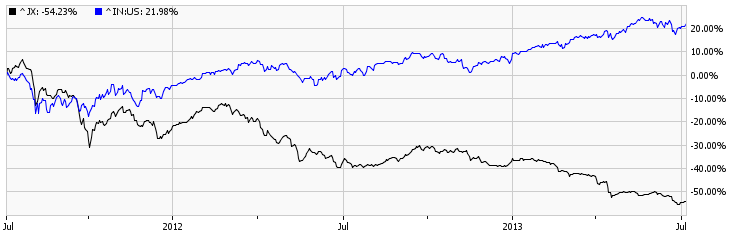](/content/images/wordpress/2013/07/Screen-shot-2013-07-06-at-7.26.50-AM.png)
These capital intensive industries are especially hard for retail investors because institutions know these companies are going to have to raise money, so the stocks normally can’t ever get out of their own way. Institutions just wait for the next capital raise, which will be done at a discount, and short the common stock while they wait. Soon enough you have a company with a bloated share structure spiraling lower and lower. The only way I invest in these particular industries anymore is if I’m investing at the founders level (aka the lowest valuation possible).
Obviously, serial money raising companies can be found in every industry, so you just need to be careful. If a company isn’t profitable, make sure they have enough cash in the bank to get them to profitability. When management says they have enough cash, don’t believe them. It always takes more time and more money.
Now, story time…
Talking about winners is a great ego boost but offers little value. “I picked the right stock, it went up, let me pat myself on the back”. I’ll leave that to the gurus trying to sell you something.
I really like to talk about my losers. Why? Because I hope that someone somewhere can learn from all the mistakes I’ve made through the years. It also lets me reflect back on these experiences and learn to be a better investor.
From 2008 – 2011, I was fortunate enough to have large positions in two companies that went up 600%, and 1200% respectively. [\[Please read, “After a big win, take time off”\]](http://microcapclub.com/2013/05/reminiscences-of-a-full-time-microcap-investor/). I felt very smart, which is normally the first sign that I’m about to do something very dumb. I let my guard down and invested in a biotech company near an all time high that was a serial money raiser.
[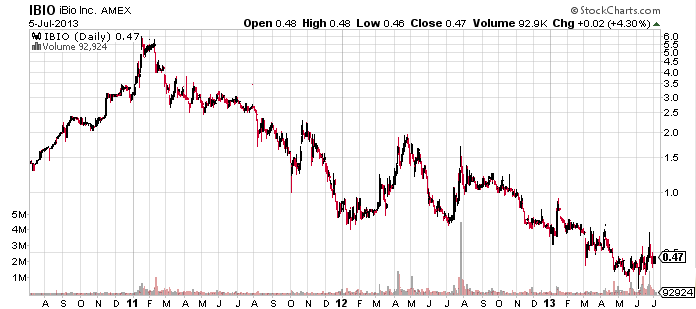](/content/images/wordpress/2013/07/Screen-shot-2013-07-06-at-7.29.01-AM.png)
In 2010, I was pitched the iBio ([IBIO](http://finance.yahoo.com/q?s=ibio&ql=1&ref=microcapclub.com)) story from some fellow investors and was completely mesmerized by the technology. The company could produce vaccines and biosimilars in 10% of the time and at 10% of the cost of traditional methods. The company also had a big brother comp in Protalix BioTherapeutics ([PLX](http://finance.yahoo.com/q?s=plx&ql=1&ref=microcapclub.com)) that pointed to a high valuation after proof of concept.
I met with management and visited their pilot plant in Delaware. I got to see all these green plants producing vaccines and other things. It was all very impressive.
The company was burning $5-6 million per year, which wasn’t a lot of money in biotech standards. My deranged thought process was that there was no way the company wasn’t going to get several licensing deals over the next 12 months with major pharma. These deals would likely include upfront payments which would be more than enough to fund the company on an ongoing basis.
Again, I just came off two major winners, so I obviously knew what I was talking about in an industry where I had no experience (sarcasm)….and I didn’t stay at a Holiday Inn Express the previous night
I bought stock, a lot of stock around $2.75-3.50 per share. The stock quickly raced to $5.50, but that was short lived. Licensing deals didn’t come, and the stock dropped from $5.50 to below $1 in 10 months. The company ended up raising capital at $0.65\. Luckily the stock had a dead cat bounce, and I sold my position at $1.25(ish). I lost several hundred thousand dollars.
Fast-forward to today, they recently raised more money at $0.42 per share. The fully diluted share count was 35m in 2010, and now it it has ballooned to 95m today. Again, this isn’t a bash of iBio, this is common place in biotech. I still think the technology is amazing, but the constant dilution has destroyed shareholder value. iBio could still go on to be a real winner, but I’m not in the hoping game.
Here is another example…
I’ve followed Oncolytics Biotech ([ONCY](http://finance.yahoo.com/q?s=oncy&ql=1&ref=microcapclub.com)) for almost ten years. Oncolytics is another great technology whose management team has been successfully developing its lead product REOLYSIN. The company is now enrolling patients in six Phase 2 trials, and a Phase 3 trial. Even though I believe the management team has been successful in advancing the technology, very little shareholder value has been created. In ten years the market cap has gone up 300% but that is because the outstanding shares has gone up 300%, not because the stock price has gone up.
[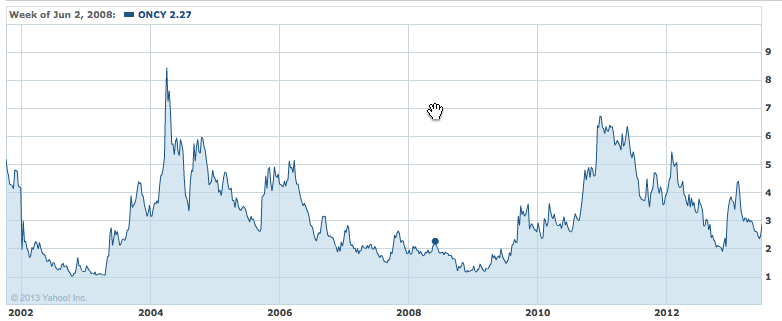](/content/images/wordpress/2013/06/Screen-shot-2013-06-30-at-10.25.18-AM.png)
In conclusion, be careful.
Investing in microcaps can be very fruitful if you stick with a proven strategy and have discipline. Certain sectors like biotech and basic materials are very capital intensive and shareholder dilution is commonplace. When companies have to constantly raise capital, it is like an anvil tied to a runners foot. It makes it extremely hard for a stock to appreciate. Invest in companies with good share structures that don’t need to raise capital.
**\===> Interact and learn with 250+ of the best microcap investors on the planet.** [\[Join Us\]](https://microcapclub.com/join-now/)
MicroCapClub is an exclusive forum for experienced microcap investors focused on microcap companies (sub $500m market cap) trading on United States, Canadian, European, and Australian markets. MicroCapClub was created to be a platform for experienced microcap investors to share and discuss stock ideas. Since 2011, our members have profiled 1000+ microcap companies. Investors can join our community by applying to become a member or subscribing to gain instant view only access. MicroCapClub’s mission is to foster the highest quality microcap investor Community, produce Educational content for investors, and promote better Leadership in the microcap arena. For more information, visit [http://microcapclub.com](http://microcapclub.com/) and
### Investing In Non-Resource Canadian MicroCaps
URL: https://microcapclub.com/investing-in-non-resource-canadian-microcaps/
Last updated: 2023-10-15T10:59:39.000Z
By Paul Andreola
When Ian asked to me write a blog about Canadian Microcaps I quickly said yes. After all, I’ve had a love affair with this tiny little slice of the investment world for over 20 years. It’s been one that has brought me both great joy and bitter heart break. I can’t count how many little gems that I have owned that have gone on to become “multi baggers”, some of them, unfortunately, after I sold them. It’s the treasure hunter in me that keeps me looking for the next potential 20 bagger.
As most good treasure hunters know there is little point in searching where others have looked, the best finds are likely to have been discovered and chances are what’s left is of little value. A treasure hunter today has to search where few others have looked and away from the crowds. It’s a simple analogy but it’s just common sense. Those old pirates didn’t hide their loot in places where it would be easy to find, right?
My investing experience has proven to me that the Canadian microcap sector is a treasure hunter’s dream. Many of these non-resource microcap companies, in my opinion, appear to be extremely under-followed and unrecognized by the North American investment community. Maybe it’s because these microcaps are poorly understood. Maybe few investors know how to find them or how to research them. Or are investors just too lazy and prefer to keep taking advice from an industry that has little to gain by recommending companies with higher perceived risk and little in the way of reward for the brokers and analysts that live off of financing fees? Quite likely it’s a mixture of all these things. The typical retail investor and broker just don’t seem to want to do the necessary work to uncover these little buckets of gold. I spoke to a Canadian broker recently and told him how I was having some great success with a couple of microcaps showing impressive earnings growth and his response was “I didn’t know there were any profitable Canadian microcaps”. Ah yes, I’m treasure hunting away from the crowds.
The Canadian public venture market, the TSX Venture exchange, exists to finance start-ups. Its predecessor, the Vancouver Stock Exchange originally came into existence to finance the various gold rushes and the dreams of prospectors and miners who promised to make investors wealthy beyond their wildest imaginations. Not surprisingly the majority of companies on TSX venture exchange today are mineral exploration start-ups. Just like in the days of the old Yukon gold rush prospectors and miners continue to offer the promise of great riches. The odds however are not very good; roughly one exploration project in one thousand ever becomes an economic deposit. The majority will only deliver failure and heart ache. Many international investors associate the TSX Venture exchange with mining and to a lesser degree oil and gas.
[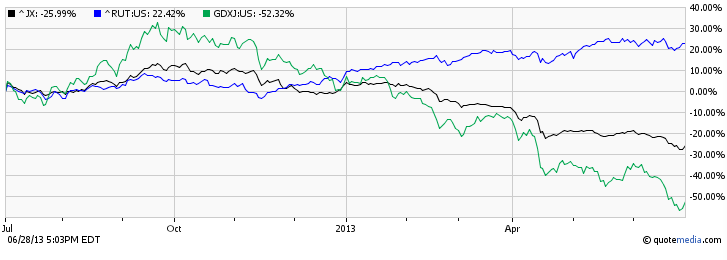](/content/images/wordpress/2013/07/Screen-shot-2013-07-01-at-7.55.22-AM.png)
Chart of the TSX Venture, Junior Gold Miners ETF, Russell 2000
Canada has a very diverse and thriving economy that is not solely dependent on the resource extraction industries. Granted we do have some of the best mining companies and mining professionals in the world. In Canada there is however an amazing amount of emphasis on the financing of resource exploration projects. The TSX Venture exchange finances more junior mineral exploration than any other exchange in the world. Most small brokerage firms in Canada have at least one full time mining analyst on staff and a good portion of financing revenues generated at these firms will come from IPO’s and secondary financings of mining and oil & gas exploration. Many larger firms will have several analysts covering different segments of the mining industry. The investment newsletter industry in Canada is dominated by dozens of mining investment experts. Investment journals and websites that cater to the mining sector outnumber all other sectors by a very wide margin. There are literally hundreds of small organizations that do investor relations consulting for mining companies. Add it all together and the promotion and financing of the mining sector is an industry onto itself and grabs an amazing amount of investor attention especially in the microcap space. Herein lays the opportunity for a microcap investor, one who is willing to look at the ignored sectors and companies that are building and growing their businesses far away from all the noise generated by the mining finance “industry”.
There are a number of great Canadian non-resource companies and most of them like everywhere else in the world began as small companies. From telecom to software to biotech and more, it’s all here. Many of these companies accessed the public markets for early stage funding just like the US, but the private venture capital market in Canada is no where near as mature. Many of Canada’s future industry titans will get their start on the TSX-V. There have been many companies originally listed on the Canadian venture exchange that have gone on to senior exchange listings, to Nasdaq, Amex or NYSE. There is no reason this will not continue.
Companies such as Valeant Pharmaceuticals ([VRX](http://finance.yahoo.com/q?s=vrx&ql=1&ref=microcapclub.com)), Catamaran Corp. ([CRTX](http://finance.yahoo.com/q?s=crtx&ql=1&ref=microcapclub.com)), Lions Gate Entertainment ([LGF](http://finance.yahoo.com/q?s=lgf&ql=1&ref=microcapclub.com)) and IMAX ([IMAX](http://finance.yahoo.com/q?s=imax&ql=1&ref=microcapclub.com)) got their start as Canadian listed microcaps. I fondly remember a little microcap company called Bowflex trading on the Vancouver Stock Exchange at little more then $0.10\. Bowflex’s revenues and earnings exploded and with that the company eventually moved to Nasdaq and then on to the NYSE. Accounting for share splits Bowflex, now called Nautilus Inc. ([NLS](http://finance.yahoo.com/q?s=NLS&ql=0&ref=microcapclub.com)), went well north of $150 per share.
Microcap investors who seek out great little Canadian listed companies with healthy fundamentals and growing earnings have little competition from most of the retail investment community in Canada. The “competition” is too focused on mining ventures. Very few brokerage firms have analysts dedicated to microcaps or even small cap companies. There are a small handful of publications in Canada dedicated to non-resource microcap companies and a number of those are “hired” to help generate investor attention. I have found that there are not many investors that have taken the time and effort to understand, look for and research these undiscovered little treasures. Therefore many of these companies can trade at significant valuation discounts to larger companies or to their peers in the US.
Biosyent Inc. ([RX.V](http://finance.yahoo.com/q?s=rx.v&ql=1&ref=microcapclub.com) or [BIOYF](http://finance.yahoo.com/q?s=bioyf&ql=1&ref=microcapclub.com)), Xpel Technologies ([DAP-U.V](http://finance.yahoo.com/q;%5Fylt=AiALpNj5SuwxFg8hjuqpLK7xVax%5F;%5Fylu=X3oDMTFjN3JndTZvBHBvcwMxMgRzZWMDeWZpU3ltYm9sTG9va3VwUmVzdWx0cwRzbGsDZGFwLXV2?s=DAP-U.V&ref=microcapclub.com) or [XPLT](http://finance.yahoo.com/q?s=xplt&ql=1&ref=microcapclub.com)) and Cipher Pharmaceuticals ([DND.T](http://finance.yahoo.com/q?s=dnd.to&ql=1&ref=microcapclub.com) or [CPHMF](http://finance.yahoo.com/q?s=cphmf&ql=1&ref=microcapclub.com)) are three great little Canadian listed companies that I think qualify as undiscovered Canadian “treasures”. While the TSX Venture Exchange is down 28% year to date and the mining sector measured by the Market Vectors Junior Gold Miners ETF ([GDXJ](http://finance.yahoo.com/q?s=gdxj&ql=1&ref=microcapclub.com)) is down 56%, these three little gems are up an average of 107% year to date and yet only one of these companies has any analyst coverage, interesting eh?. These three companies are not alone, Macro Enterprises, ([MCR.V](http://finance.yahoo.com/q?s=mcr.v&ql=1&ref=microcapclub.com) or [MCESF](http://finance.yahoo.com/q?s=mcesf&ql=1&ref=microcapclub.com)) up 199%, Iplayco ([IPC.V](http://finance.yahoo.com/q?s=ipc.v&ql=1&ref=microcapclub.com)) up 316% and Solium Capital Inc. ([SUM.T](http://finance.yahoo.com/q?s=sum.to&ql=1&ref=microcapclub.com) or [SIUMF](http://finance.yahoo.com/q?s=siumf&ql=1&ref=microcapclub.com)) up 101% are just a few more examples. Two of these companies are just now starting to get some analyst coverage.
[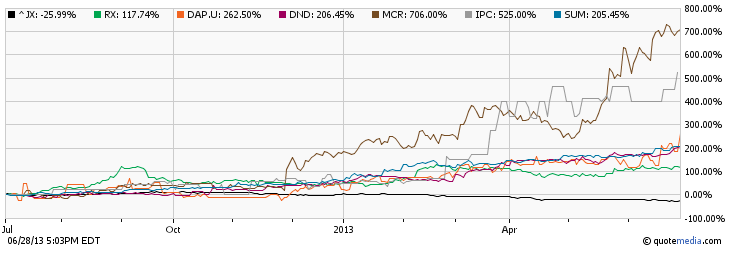](/content/images/wordpress/2013/07/Screen-shot-2013-07-01-at-8.01.37-AM.png)
There are dozens and dozens of great little, profitable and growing micraps listed in Canada that deserve greater investor attention from international investors and especially those south of the border.
Ok, so let’s now assume you’re interested in taking a better look at what Canada may have to offer. Where does one start? How about research? Apart from a company’s website there are several other online resources that will help in your pursuit of information on a Canadian listed company. Just like in the US with SEC filings for public companies Canada has SEDAR ( [www.sedar.com](http://www.sedar.com/?ref=microcapclub.com) ). All Canadian listed companies must file on SEDAR. Here you will find a company’s prospectus filings, news releases, annual and quarterly financial reports, AGM documents and various other publicly disclosed documents. Insider share holdings and trading information can be found at System for Electronic Disclosure by Insiders or SEDI for short ([www.sedi.ca](http://www.sedi.ca/?ref=microcapclub.com) ) and Canadian Insider ( [www.canadianinsider.com](http://www.canadianinsider.com/?ref=microcapclub.com) ). For Canadian listed companies’ price quotes and press releases I use TMX ([www.tmx.com](http://www.tmx.com/?ref=microcapclub.com) ), Stockwatch ( [www.stockwatch.com](http://www.stockwatch.com/?ref=microcapclub.com) ), or Yahoo Finance ([www.finance.yahoo.com](http://www.finance.yahoo.com/?ref=microcapclub.com) ). Some of the US sites will require a .TO or .V suffix when requesting a quote.
As a Canadian I have bought and sold US listed companies with ease for years and have no concerns or difficulties purchasing shares across the border yet many of my US friends are leery doing the same up north. It may require a change in the type of brokerage account a US investor has and of course it will require some understanding of the nuances in the Canadian markets but as a friend of mine in California attests once you have a few things in place trading in Canadian stocks should be just as easy as trading US listed companies. My friend uses Fidelity Investments but many firms now allow international trading. You’ll have to ask your current brokerage firm if they allow international trading and if so what their specific requirements are to allow you to trade shares directly on the Canadian exchanges. Many Canadian listed companies have their Canadian symbol and a US OTC or pink sheet symbol. It may turn out that trading Canadian listed company with a US symbol is as simple as tracking down the corresponding OTC or pink sheet symbol to execute the transaction.
I hope I’ve encouraged you to take a better look at what the Canadian markets have to offer to a microcap investor. There is plenty of treasure to be discovered up here. You just have to know where to look.
Oh and by the way, July 1 is our equivalent of Independence Day in the US. Happy Canada Day everyone!
**\===> Interact and learn with 250+ of the best microcap investors on the planet.** [\[Join Us\]](https://microcapclub.com/join-now/)
MicroCapClub is an exclusive forum for experienced microcap investors focused on microcap companies (sub $500m market cap) trading on United States, Canadian, European, and Australian markets. MicroCapClub was created to be a platform for experienced microcap investors to share and discuss stock ideas. Since 2011, our members have profiled 1000+ microcap companies. Investors can join our community by applying to become a member or subscribing to gain instant view only access. MicroCapClub’s mission is to foster the highest quality microcap investor Community, produce Educational content for investors, and promote better Leadership in the microcap arena. For more information, visit [http://microcapclub.com](http://microcapclub.com/) and
_Includes the latest 500 public posts. Use `/sitemap.xml` for the complete archive of public content._