Master and Apprentice
The perils of imitation and the discipline of making your own path
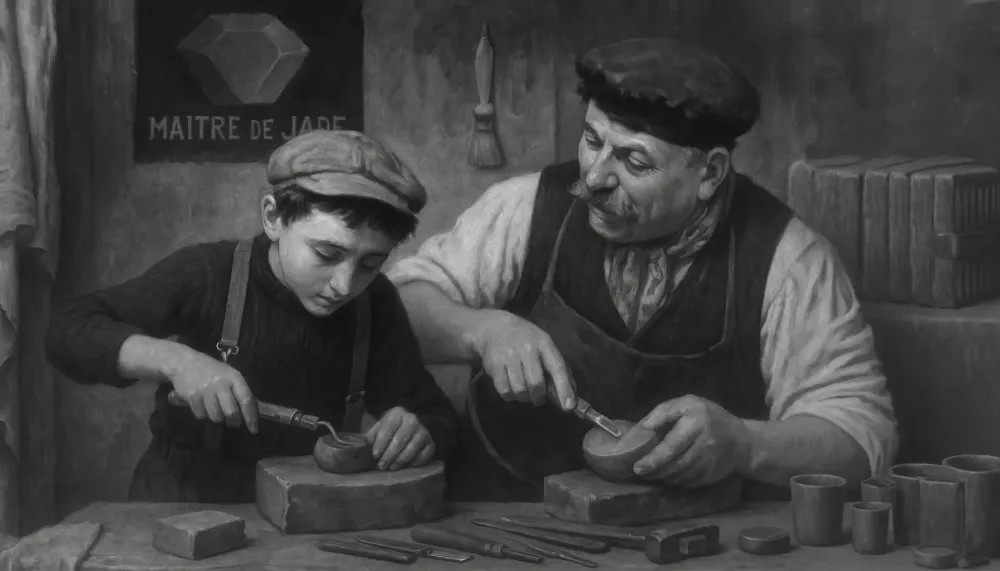
In 1989, Jack Schwager profiled Ed Seykota in the original “Market Wizards”. Seykota is widely regarded as one of the best traders ever. He quietly built one of the first computerized trading systems, then let math and discipline do the work. The results were astonishing: one account grew more than 250,000% in sixteen years.
But what struck Schwager most wasn’t the money, it was Seykota’s mind. He treated markets like a mirror, reflecting human behavior back at us. His real edge wasn’t prediction. It was understanding people, including himself.
Ed Seykota wrote a book that was never published called, “The Traders Window”. He would let visitors read it and even printed a few copies for some close friends.
In the book there is a short story called The Jade Master, and Seykota allowed Jack Schwager to reprint it for the prologue of his next book, “The New Market Wizards” (1992). Here is the story:
One cold winter morning a young man walks five miles through the snow. He knocks on the Jade master's door. The Jade master answers with a broom in his hand.
"Yes?"
"I want to learn about Jade."
"Very well then, come in out of the cold."
They sit by the fire sipping hot green tea. The Jade master presses a green stone deeply into the young man's hand and begins to talk about tree frogs. After a few minutes, the young man interrupts.
"Excuse me, I am here to learn about Jade, not tree frogs."
The Jade master takes the stone and tells the young man to go home and return in a week.
The following week the young man returns. The Jade master presses another green stone into the young man's hand and continues the story.
Again, the young man interrupts. Again, the Jade master sends him home.
Weeks pass. The young man interrupts less and less. The young man also learns to brew the hot green tea, clean up the kitchen and sweep the floors. Spring comes.
One day, the young man observes, "The stone I hold is not genuine Jade."
* * *
I lean back in my chair, savoring the story. My student interrupts.
"OK. OK. That's a great story. I don't see what it has to do with making money. I come to you to find out about the markets. I want to learn about the bulls and the bears, commodities, stocks, bonds, calls and options. I want to make big money. You tell me a fable about Jade. What is this? You ..."
"That's all for now. Leave those price charts on the table. Come back next week."
Months pass. My student interrupts less and less as I continue the story of The Trader's Window.

In 1991, Dr. David Druz became Ed Seykota’s first apprentice, but Druz was already an accomplished trader.
Dr. David Druz’s journey into the futures markets began with one electrifying moment: as a medical student, he watched a peer turn a $2,000 wager into $500,000 in the “great bean move” of 1970.
Rather than follow the usual path, Druz chose a dual-career route. For two decades he split his time between rigorous studies in medicine and working summers in the research department of a brokerage firm at the Chicago Board of Trade, testing trading systems and sharpening his quantitative edge.
In 1981, while still practicing emergency medicine in Fairbanks, Alaska, he launched his first futures fund under his own banner, Tactical Investment Management Corporation (TIM).
Fast-forward to 1991: having retired from medicine, Druz relocated to Hawaii, devoting his life fully to his twin passions, windsurfing by day and trading systematic futures by night.
It was at this time that Druz first read about Ed Seykota in Jack Schwager’s book.
Druz deduced from the book that Seykota lived in Lake Tahoe. He traveled to the area and went to a pay phone and searched the phone book for “Ed Seykota”. Sure enough, he finds and calls the number. Seykota picks up the phone and after some dialogue Sykota asks for Druz last 12-months worth of trades. It eventually leads to an apprenticeship.
In a rare interview, Druz talks about his experience learning under the master Ed Seykota. But he didn’t just learn from Seykota, he lived with him for six months.
..Right off the bat, when I'm starting out to be his apprentice, he gives me this little teeny book that he wrote, The Trader's Window. And this book has nothing to do with trading.
It's one of these Zen kinds of teaching things. In the Jade Master story, the guy that's been coming and sitting with the jade master, he eventually knows everything about jade. And the master has basically told him nothing. They just sat together.
Little did I realize this is Ed's teaching style. You know, you just hang out with the guy and you see what he does and see if you can do it. So anyway…
Most of the time it was just whatever Ed was doing that day. It was like, “Hey, Dave, let's go down the hill to Reno and go to the grocery store.” Okay, so, we'd go down to the grocery store. And we’d come back, and then Ed would play banjo. You know, he's a great banjo player. And then, at the end of the day, when markets closed, we’d look at charts. It would take about, maybe, 10 minutes. That was my favorite part.
And then I said, “Well, Ed, what do you think about this?”
“Well, I think I might buy that.” And I said, “Well, where are you going to buy that?”
“Well, you know, somewhere around here.” And he'd draw a little. He’d never tell me exactly.
“Well, but where are you going to put your stop?”
“Somewhere around here.”
And that's it. That's what we’d do.
And I’d just watch him do this. And he is very big on psychology. And his idea was everybody gets what they want from the markets. And markets are a vehicle for people to work out their psychology. And if they have any hidden psychological kinks, they're all going to come out in the markets. This is his idea. And if you've got anything that's screwing you up, inside, you’re going to bring it out of the markets and you're going to screw yourself up.
Well, after I apprenticed with him for that time, I thought, well, all right, I'll try it with my own money from my own account. And he always said, you have to trade with money that's meaningful in order for you to learn and understand yourself. Like, if you're a millionaire, you don't put $10,000 in an account and trade, or you're never going to learn anything because it doesn't mean anything to you. So, you have to put something meaningful into the account.
This is very scary because if you're wrong, you're going to lose a meaningful amount of your equity, of your assets. But this is his idea. This is what you have to do.
So, after I apprenticed with him, I said, okay, I'm going to try this for myself. And so, I took, for me, what was a significant amount of money and set up my own account. And I let my investors know that I do have a proprietary account, and it has nothing to do with what we're trading, and I'm not trading ahead, and blah, blah, blah, just to disclose.
So, what I did is I continued to run my systems for my investors, but I traded this account for a little over a year. And every day I would say, pretend you're Ed. Okay, all right, you're Ed. You're sitting with Ed. Okay, look at the charts. Okay, what would I do? Well, I'd probably buy it around here. I'd probably put a stop about here.
Okay, so, I did this for about 15 months, made 300% return, and absolutely went crazy because it was not my trading style. At the same time, my systems made 20% for my investors.
I closed the account, and I saw a psychiatrist for a year because I was so messed up by pretending I'm somebody I'm not. I pretended I was Ed, every day. You know, I did it for like 15 months. But it was just so not me. I can't tell you. It's like, I don't want to do that ever again.
Ed has this idea that we limit ourselves in our success in the markets because we don't believe that we are deserving of great success or we feel that we're not worthy or that we're not adequate or not good enough. We hold ourselves back. That's one of his psychological ideas.
So, you're always trying to clear our psychology and help us feel that we do have the ability to succeed. And if we have that mindset, we will attract the success. Without that mindset, it works very much against us. So, I got this. I understood this.
Interact and learn with 250+ of the best microcap investors on the planet:
MicroCapClub is an exclusive forum for experienced microcap investors focused on microcap companies (sub $500m market cap) trading on United States, Canadian, European, and Australian markets. MicroCapClub was created to be a platform for experienced microcap investors to share and discuss stock ideas. Since 2011, our members have profiled 1300+ microcap companies. Investors can join our community by applying to become a member or subscribing to gain instant view only access. MicroCapClub’s mission is to foster the highest quality microcap investor Community, produce Educational content for investors, and promote better Leadership in the microcap arena. For more information, visit https://microcapclub.com/ and https://microcapclub.com/summit/



![Lindbergh (LDB.MI): Rolling up Italian HVAC with vendor loans [Update]](/content/images/size/w600/2026/10/LDB-BLOG-4.png)

Comments
Loading comments…