Strengths as Weaknesses
“One marker that I’m seeing someone clearly is when I understand how their strengths are also their weaknesses, how their genius lives right next to their dysfunction.”
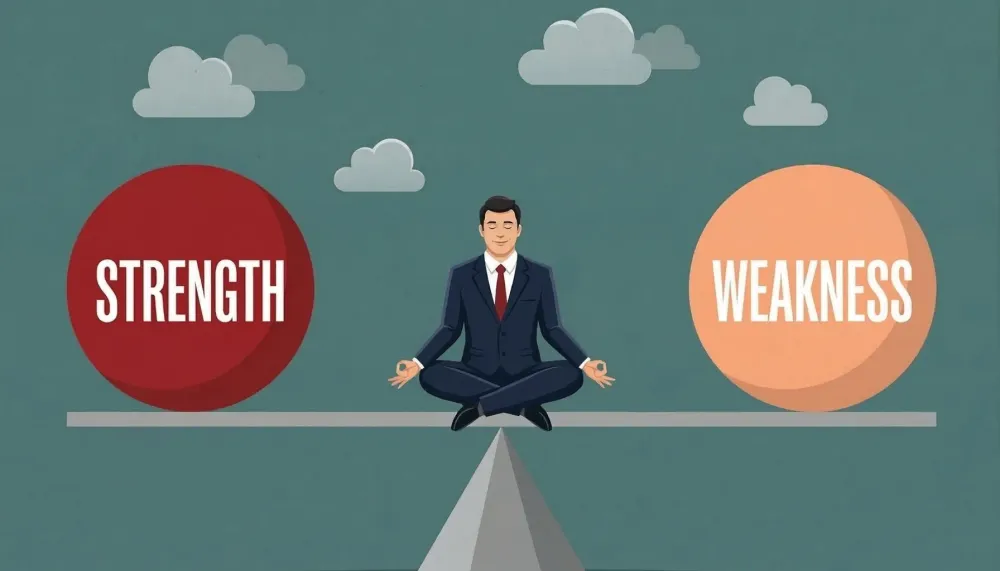
Every form of strength covers one weakness and creates another, and therefore every form of strength is also a form of weakness, and every weakness is a strength. - Michael Lewis
Sometimes an investors’ strengths can also be their greatest weaknesses. In fact, often times, your greatest strength is right next to your greatest weakness.
In Morgan Housel’s excellent book, Same as Ever, he talks about Cope’s Rule, an evolutionary hypothesis stating that animal lineages tend to evolve toward larger body sizes over geological time. The tendency of evolution to create larger species is counterbalanced by the tendency of extinction to kill off larger species. In other words, body size accentuates the gains but amplifies the losses. Big animals require lots of land per capita. They need more food per unit of body mass than small animals. They can’t hide easily. They move slowly. They reproduce slowly. They don’t need to adapt since they are at the top of the food chain. Therefore, they become more susceptible to death.
There are so many parallels to investing here, whether it’s thinking about leverage (which amplifies gains and magnifies losses), lack of adaptation, or competitive advantages (harder to gain, even harder not to lose). But I’m most interested in weaknesses sitting right next to strengths.
I attempted an exercise recently that involved writing down the most closely held beliefs I’ve developed as an investor, and then immediately examine how they could actually be some of my biggest weaknesses. The results were shocking. In just a short period of time, I realized that I’m guilty of being inflexible, stubborn, biased, and condescending toward other investment styles or ways of making money.
A few examples include my determination to find and own ‘cheap’ stocks, something I labeled as a strength. Well, the best businesses are rarely, if ever, optically cheap, and cheap stocks are cheap for a reason. Both of those truths, following my belief, have led to mistakes throughout my career.
I’ll never stop searching for and investing in quality microcaps, an area of the market that can be rife with inefficiencies. However, there is data behind the fact that large company stock prices move around significantly during any given year. There can be massive inefficiencies among even large cap companies (thinking of you, Constellation Software), while small companies often have difficulty achieving the appropriate cost of capital. There have been many times when I should have owned a larger business that I dismissed as ‘too big’, while instead owning a lower quality small company operating in the same industry.
The final example includes using long-termism as a crutch. Thinking that I will be bailed out from a weakening thesis or competitive position by being ‘long-term’ or more patient has at times detracted from returns. I’ve learned that the short term actually matters a lot. Investment returns are in fact a longer series of short term returns, and good companies that are executing do not stay cheap for years. It doesn’t make you short term by selling a losing position, or taking profits once a company has reached your estimate of intrinsic value.
These are just a few examples where strengths I’ve long valued sit uncomfortably close to potential weaknesses.
In his essay What’s Going On Here, With this Human, allocator Graham Duncan writes: “One marker that I’m seeing someone clearly is when I understand how their strengths are also their weaknesses, how their genius lives right next to their dysfunction.”
That idea has stuck with me because it applies just as much to investors as it does to anyone else. I’m not encouraging less conviction or less discipline. The goal is to understand the hidden costs of these qualities when taken too far, as a rigid framework or process can turn develop into shackles.
I’d recommend every investor try this exercise. Write down the traits and beliefs you are most proud of, then force yourself to ask how each one could be hurting you. Not in theory, but in practice. Where has your temperament improved your results? Where has it blinded you? What do you think is your edge, and how could it be a liability?
A person’s greatest strength often carries the blueprint for their greatest weakness. Pay attention to the traits that give you an advantage, then recognize the distortions and blind spots that can come with it. In investing, as in life, strengths don’t exist in a vacuum. They arrive attached to their own failure modes. The investor who can see both clearly is usually the one who keeps improving.
Interact and learn with 250+ of the best microcap investors on the planet:
MicroCapClub is an exclusive forum for experienced microcap investors to share and discuss microcap companies (sub $1 billion market cap) trading on global markets. Since 2011, our members have profiled 1400+ microcap companies, 300+ have turned into multi-baggers. Investors can join our community by applying to become a member or subscribing to gain instant access. For more information, visit https://microcapclub.com/



![Lindbergh (LDB.MI): Rolling up Italian HVAC with vendor loans [Update]](/content/images/size/w600/2026/10/LDB-BLOG-4.png)

Comments
Loading comments…