The Myth and Math of 10-Baggers: What Investors Overlook
10X stocks are wonderful - if you can find them, position them, hold thru deep drawdowns, and avoid round-trippers

Finding a 10-bagger, or a stock that has returned 10X, is the goal of many investors. These types of stocks are rare indeed, but finding one can certainly boost your net worth, not to mention providing a lot of “street cred”.
In my recent article, 10X Microcaps and Multibaggers – What Really Drives High Returns?, I shared some of the factors that have historically driven 10X returns in stocks.
But there are many other important aspects of 10X stocks that get overshadowed by the headlining high returns. We’ll look at some of them:
- 10X Stocks are rare
- Position sizing
- Time and opportunity cost
- Drawdowns and Round trippers
- 10X stocks vs. the 10X portfolio
10-Baggers – A Rare Breed
What are the chances of finding 10X stocks?
Let’s look at the 5 year returns of stocks today and see how many have made multi-bagger status.
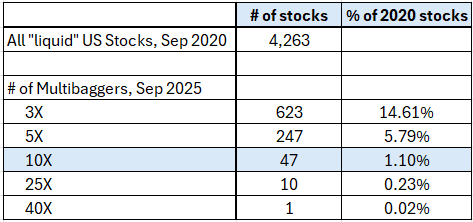
So about 1% of stocks have 10X’d in 5 years.
While there are particular factors that really drive 10X stocks (we saw the importance of earnings growth in the last piece), 1% is still a tiny, difficult to find fraction.
I often advocate finding “smaller-baggers” – while still difficult to find, the chances are often much higher than the elusive 10X+ stocks, and returns of multiple multi-baggers can compound quickly.
On the flipside, 25X and 40X stocks become increasingly rare – there was a 1 in 4,263 chance in finding a 40-bagger, or 0.02%.
10X Position Sizing
Needless to say, finding a stock that has returned 10X its initial value is outstanding, not only because of how rare they are, but the monetary gain. Turning $1 into $10 can certainly help to increase one’s overall wealth by a wide margin.
But the actual monetary gain of a 10X stock can vary widely, as it depends on two factors
a) return, and
b) position sizing
For illustration, if an investor went all in on a stock that eventually returned 10X, then his/her portfolio would also 10X. But I think we can all agree that the chances of this happening are extremely rare, and a concentration like this is extremely risky (based on how many stocks actually 10X) – regardless of how much fundamental analysis has been done, there are so many factors out of our control.
Now assume an investor who has 10 positions in his/her portfolio (equal weight initially), and manages to find a 10X stock. To keep it simple, assume that the other 9 positions are more or less even in terms of performance and have a net return of 0 (more on this below). In this case, the 10X stock would have only moved the portfolio 1.9X, significantly less than the 10X of the individual stock. Don’t get me wrong, nearly doubling a portfolio is fantastic, but the point is that a single 10X rarely translates into a 10X of the portfolio.
The higher the number of positions, the smaller the impact a 10X stock will have on the overall portfolio. This scenario, and others, are shown in the table below.
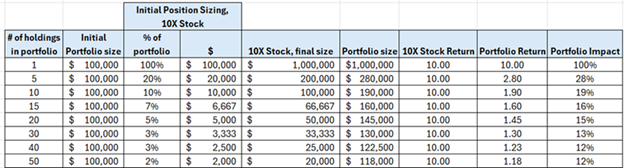
These are hypothetical scenarios of course, and the returns of the non-10X stocks can vary widely. If the investor “got lucky” in finding the 10X stock, then the assumption that the balance of the portfolio returned 0 may be realistic. If the investor is more systematic and has a strategy with a sustainable edge, then more stocks in the portfolio may have outperformed.
And position sizing can vary as well – investors may add more capital to the 10X stocks as they see it rising in price, or on the flipside may even sell some if the position size becomes too large, or in a panic during a drawdown to reduce exposure.
Either way – while the % return of a 10X stock is impressive, the actual monetary gain of an investor’s portfolio depends on position sizing, and is often some fraction of 10X.
Time & Opportunity Cost
A stock returning 10X is wonderful, but over what time frame?
Stock A returns 8% per year, and becomes a 10-bagger in roughly 30 years.
Stock B returns 50% per year, and becomes a 10-bagger in less than 6 years.
These are both 10X stocks, but the time to get there is vastly different.
Which is the better stock?
This answer may vary between investors, but I’d hazard a guess that most would pick Stock B.
These are annualized returns, and quite likely Stock B experienced some swings along the way, which would test most investors’ “conviction” (more on this below).
On the other hand, Stock A has been much more stable, but waiting 30 years for a 10-bagger isn’t really that impressive. For perspective, the 25 year CAGR of the S&P500 is 8%.
Waiting that long introduces opportunity costs, especially if better opportunities like Stock B exist. Investors who found Stock B could either choose to keep holding, or sell and try and find other multi-baggers, to further compound their overall portfolio.
Drawdowns
Conventional wisdom often states that high performing stocks can experience deep drawdowns during their ascent. How true is this?
Of all the 10X stocks from the last 5 years, the median max drawdown has been a whopping 56%. In fact, 6 of these stocks had drawdowns of 80% or higher.
See table below of all US 10X stocks from the last 5 years and their drawdowns.
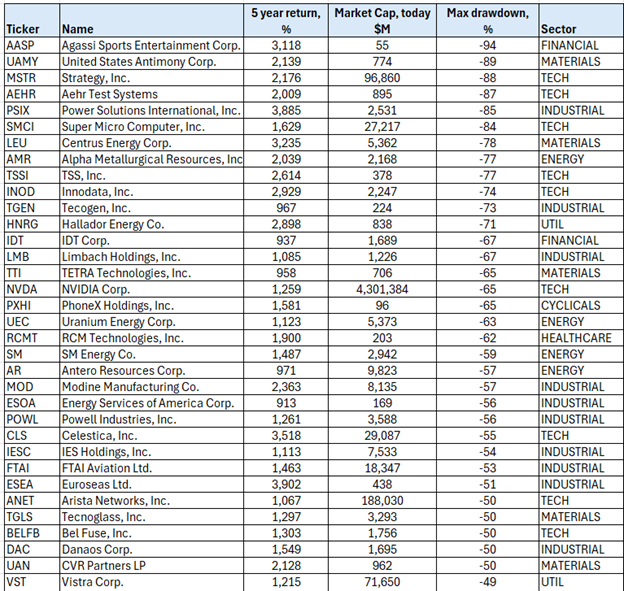
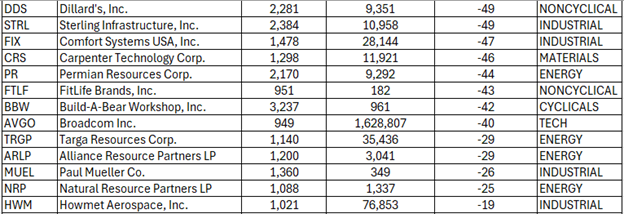
Drawdowns are a real risk in 10X stocks. Being able to hold thru these drawdowns is a key requirement in being able to reap the rewards later. But of course, easier said than done - whether there is a recovery after a drawdown is very difficult to know in the moment.
Reaching 10X is one thing, Keeping 10X is another
The 10X stocks we’ve been looking at from the last 5 years are those that are still 10X.
There are many stocks that may have reached 10X over this time, but have receded from those highs (and not surprising with the drawdown stats above).
Only 23% of all stocks reaching 10X+ in the last 5 years are still 10X. At the extreme, we have the dreaded "round-trippers" – former 10X stocks that have given back all of their returns, resulting in a negative 5 year return.
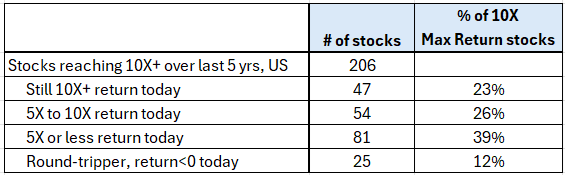
Drawdowns are common and deep in 10X stocks as we’ve seen – but the most challenging part is knowing what drawdowns will be followed by a recovery, and which drawdowns are permanent.
The 10X Portfolio vs. 10X Stocks
10X stocks are wonderful - if you can find them and hold them thru volatility. And depending on your portfolio allocation, a 10X stock is usually only a fraction of a 10X gain in one’s portfolio.
While we have focused on individual 10X stocks, another approach is to strive for the 10X Portfolio.
This is essentially targeting multi-baggers, but not necessarily at the extreme of 10X stocks. Over time, the portfolio may reach the equivalent return of a single 10X stock, but with the added feature (and safety) of diversification. A diversified portfolio can reduce the overall impact of the deep drawdowns experienced by individual 10X stocks, and position sizing in single positions is less of a concern.
There are many paths to 10X. The table below shows different variations of achieving 10X, based on annual return and the number of years.
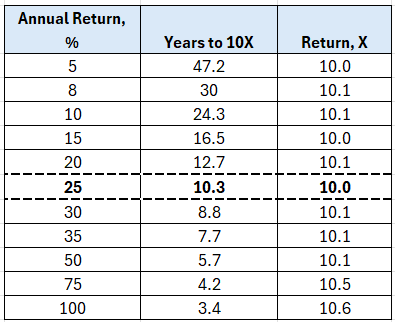
Even at a 5% annual return, you could reach 10X – the only caveat is that it would take half a lifetime (47 years) – not to mention the reduction in value thru inflation over such a long period.
At the opposite end of the spectrum, if you are a superinvestor and can achieve 100% per year, it would take you about 3.5 years to 10X.
In the middle, we have the “25% for 10 years” rule. While 25% is certainly a high return over time (the historical return for the S&P500 is 8%), it can be possible when finding the right stocks continuously over time.
Take the MC-GUTS Microcap Index for Canada. The index includes US, Canada and Europe, with the Canadian component of the strategy holding 40 stocks.
It just so happens that this strategy has compounded at 25% since May of 2015 (just over 10 years), in simulation.
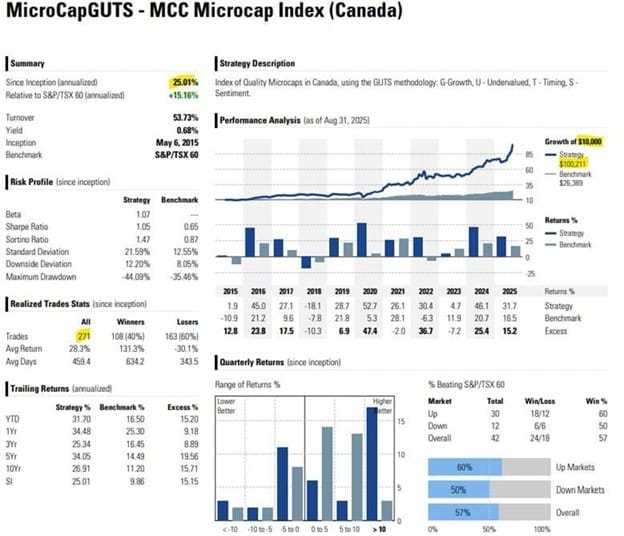
The Canadian component of the MC-GUTS Index has managed to 10X in 10 years at 25% CAGR, with 271 trades over that time. Overall win rate is only 40% - however the average return of winners is significantly higher than the average return of the 60% of losers.
And how many 10X stocks were in this portfolio? Only 2, or 0.7% of all trades.
The table below outlines the distribution of multi-baggers in the MC-GUTS Canada strategy.
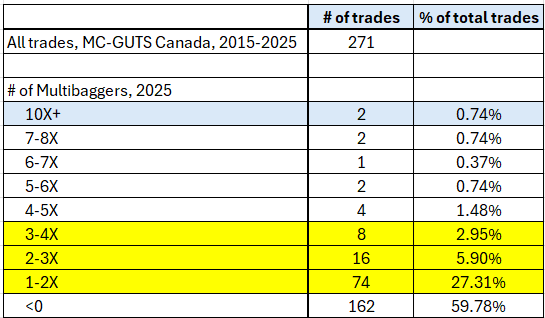
Of the winners, more than 1/3 were 4-baggers or lower. But when collected over time, returns compound towards overall strategy performance.
Also note the drawdown – single 10X stocks have historically drawn down on a median basis in the high 50%’s (and higher) – where this strategy max drawdown was at 44%. Still significant, but not as deep as single 10X stocks historically.
The Reality of 10X Stocks
No doubt, being able to find 10X stocks is great, but there are many other practical aspects and risks to consider: opportunity cost in just how rare they are, position sizing, drawdowns and volatility to name a few.
An alternative: the 10X portfolio – a diversified approach to target smaller multi-baggers, with less risk, and the potential to compound the portfolio to a 10X equivalent over time.
Portfolio123 – All data and quantitative tools used for this piece, and all pieces in the Evidence Based Forum, provided by Portfolio123. If you’d like to try Portfolio123 with an extended free trial (35 days vs. the typical 20 days), check out this link, or use Invitation Code “RYANT” (full disclosure, affiliate link). I’m available for any questions you may have.
Note: Past performance is not an indicator of future results. Please visit our Terms of Use for a more complete disclaimer and discussion of the risks of investing.
Interact and learn with 250+ of the best microcap investors on the planet:
MicroCapClub is an exclusive forum for experienced microcap investors focused on microcap companies (sub $500m market cap) trading on United States, Canadian, European, and Australian markets. MicroCapClub was created to be a platform for experienced microcap investors to share and discuss stock ideas. Since 2011, our members have profiled 1300+ microcap companies. Investors can join our community by applying to become a member or subscribing to gain instant view only access. MicroCapClub’s mission is to foster the highest quality microcap investor Community, produce Educational content for investors, and promote better Leadership in the microcap arena. For more information, visit https://microcapclub.com/ and https://microcapclub.com/summit/





Comments
Loading comments…