Find Your Swing
With every successful stock picker, you can find someone on the exact opposite side of the spectrum doing it at a GOAT level of competence and performance.
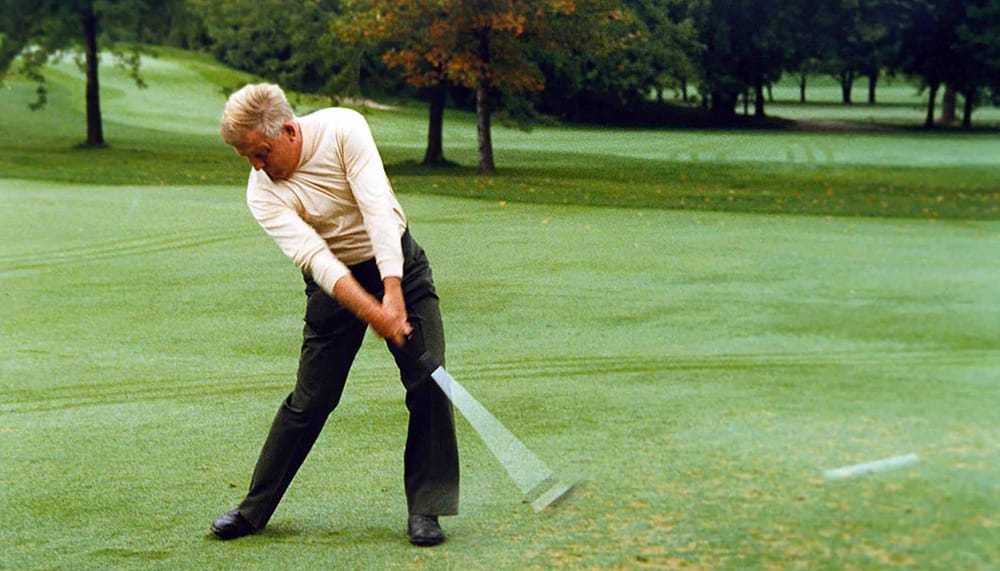
In January 2005, in the prime of his career prior to DUI charges, Tiger Woods said, "There are only two golfers who have truly owned their swings: Ben Hogan and Moe Norman." Ben Hogan made sense. But Moe Norman? A man who rarely played on the world’s biggest stages and lived most of his life in relative obscurity. Such a statement sent many to find out who this man was.
Known as "Pipeline Moe" for his ability to hit the ball perfectly straight, Norman was a golfing savant whose life was as complex as his swing was simple.
Born in 1929 in Kitchener, Ontario, Moe Norman’s journey began with childhood trauma. A sledding accident where he struck his head on a car bumper. Many believe this event, combined with what was likely undiagnosed autism, shaped his unique personality. He was socially awkward, had repetitive speech, but had intense focus. He could also remember any number. He had over 400 courses memorized. All holes and all yardages. He was the “Rain Man” of golf.
Moe was entirely self-taught. He never took a lesson. Instead, he developed his unique swing through sheer repetition. He would spend eight to ten hours a day on the range, hitting hundreds of balls. He didn't just practice. He relentlessly experimented. He learned how the clubface interacted with the ball by feel, eventually reaching a level of mastery where the club became an extension of his own anatomy.
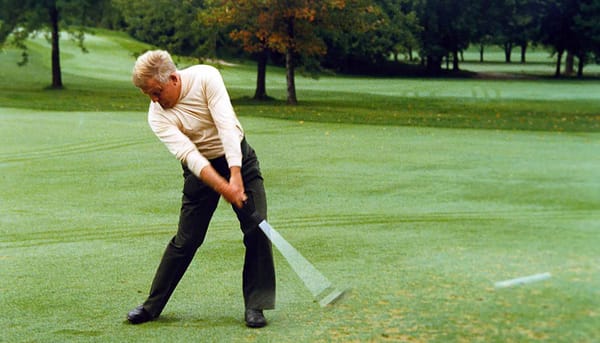
Moe’s swing was a radical departure from convention. Instructors today call it the "Single Plane Swing." While most golfers lift the club on one plane and return it on another, Moe’s swing stayed on a single path from address through impact.
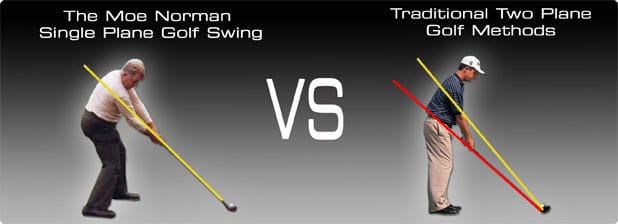
- The Address: Moe stood with his feet exceptionally wide apart for stability. He held the club several inches behind the ball, aligning the club shaft directly with his lead arm.
- The Grip: He used a palm grip rather than the traditional finger grip, which minimized hand action and wrist hinge.
- The "Move": Moe’s swing had the fewest moving parts of any in history. He didn't believe in the "shallowing" or "dropping" moves taught in modern golf. Instead, his body remained remarkably still, his legs braced, and his lead knee flexed.
- The Finish: He finished with his arms extended skyward, pointing the club toward the target.
The result of this was a ball flight that was unnervingly straight. During one exhibition, Moe hit 1,540 drives in seven hours. Every single one landed within a 30-yard wide landing zone.
Here is a Moe Norman interview and demonstration for the 1994 PGA coaching and teaching summit.
In the late 1950s, Moe attempted to take his talent to the PGA Tour. On paper, he was unstoppable. He won back-to-back Canadian Amateurs (1955-56) and dominated the Canadian Tour. However, the culture of the American PGA was a poor fit for a man who marched to the beat of his own drum.
Moe was different. He talked to himself. He played at a lightning-fast pace without taking practice swings. He would often crack jokes with the gallery while his playing partners were trying to focus. He would even take bets from the gallery, claiming he could bounce a ball off his driver face 100 times or hit a ball into a spectator's shirt pocket and then proceed to do it. Once, during a round with Sam Snead, Moe was told he couldn't carry a creek with his driver. Moe deliberately hit his ball across the bridge that spanned the creek, just to prove he could.
In a 1959 tournament in New Orleans, PGA officials gave him a "dressing down" for his antics. Afterword Moe retreated to Canada. He spent much of his career playing in Ontario, setting 33 course records and winning 55 professional tournaments.
Despite his brilliance, Moe lived in near poverty for much of his life. He didn't care for money. All he cared for was the feeling of greatness that came from a perfectly struck ball. He lived out of his car, carrying his clubs, a stash of Coca-Cola, and McDonald’s bags, choosing to play for the home crowd in Canada over the riches of the tour.
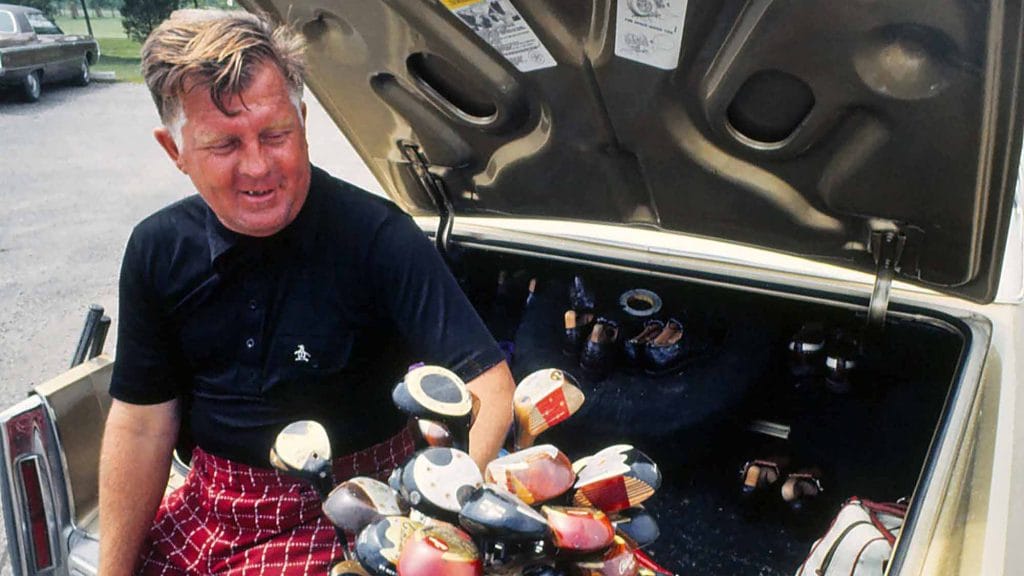
In 1995, Moe mentioned to a reporter that despite playing Titleist balls his entire career, "Titleist never did nothing for me."
Wally Uihlein, the CEO of Titleist heard the comment. Rather than being offended, Uihlein recognized that Moe was a living treasure who had been overlooked. He flew to meet Moe and signed him to a "lifetime contract" of $5,000 per month with no strings attached. It was a humanitarian gesture that provided Moe with financial security for the first time in his 60s. Uihlein later served as a pallbearer at Moe’s funeral, a testament to the respect the industry eventually found for the man they once shunned.

Today, Moe’s "Single Plane" philosophy is the foundation for thousands of golfers through organizations like Graves Golf. Players like Bryson DeChambeau have brought elements of Moe’s "scientific" approach, single-length clubs and palm-heavy grips back to the forefront of the professional game.
Moe Norman, Bobby Jones, Arnold Palmer, Tiger Woods, Jack Nicklaus, Lee Trevino all took great pride in how their golf swings were not conventional. You could tell it was Lee Trevino or Moe Norman 100 yards away from how they swung the golf club. Their swings were a highly personal expression of their art. They had the confidence to learn from the greats but to swing in their own unique way.
Jim Furyk is from my hometown. He holds the record for the lowest score in PGA Tour history, shooting a 58 in the final round of the 2016 Travelers Championship. He is a 17-time PGA Tour winner, including the 2003 US Open. Furyk's swing is unconventional. He brings the club straight up and drops it back down at impact. His swing is the opposite of Moe Norman’s single plane swing. He swung the club his own way.

Warren Buffett invests his way while Walter Schloss did it another way. Carl Ichan does it his way while Peter Lynch did it another way. David Tepper does it his way while Marc Andreessen does it another. Some are long term. Some are short term. Some are value investors. Some are growth investors. Some are concentrated. Some are diversified. Some are activists. Some are passivists. Some bet on change. Some bet on things that won’t change. The greatest investors ever have opposing strategies. Even within the world of “value investing” alone, there are hundreds of successful iterations.
With every successful stock picker, you can find someone on the exact opposite side of the spectrum doing it at a GOAT level of competence and performance. Successful stock picking isn’t about cloning other investors; it’s about finding where your temperament meets execution. Where YOU can hit the center of the club face consistently over the long-term. Your swing will be different from every other investor. Go practice. Go find your swing.
Interact and learn with 250+ of the best microcap investors on the planet:
MicroCapClub is an exclusive forum for experienced microcap investors to share and discuss microcap companies (sub $1 billion market cap) trading on global markets. Since 2011, our members have profiled 1400+ microcap companies, 300+ have turned into multi-baggers. Investors can join our community by applying to become a member or subscribing to gain instant access. For more information, visit https://microcapclub.com/






Comments
Loading comments…