Investing Against the Tide by Anthony Bolton
Bolton highlights the emotional and behavioral tendencies that most negatively impact our investing.
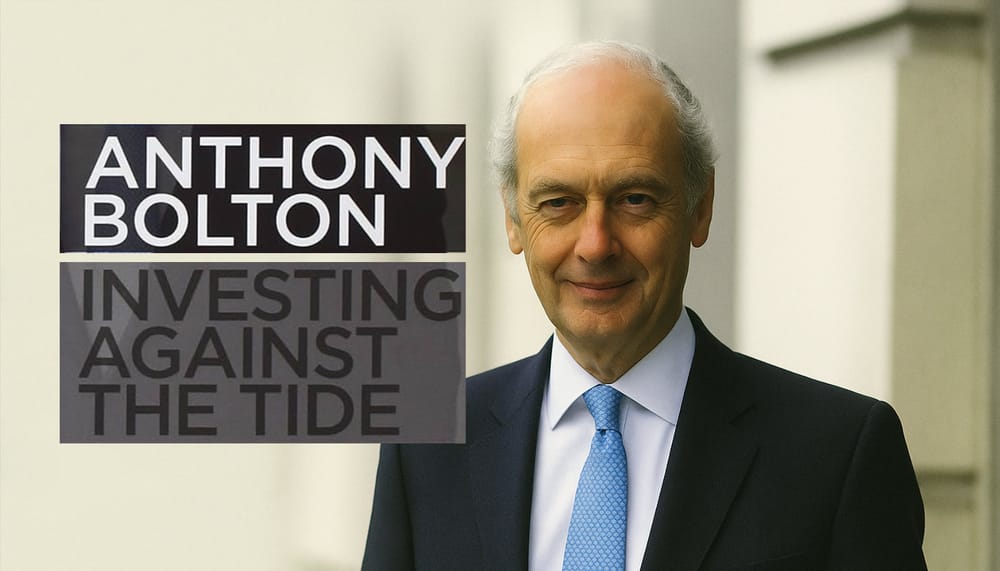
Anthony Bolton was called “Britain’s Warren Buffett” while managing the Fidelity Special Situations Fund from 1979 to 2007. His 28-year track record of 19.5% annualized returns remains one of the most impressive in modern fund management history.
In 2009, Anthony Bolton wrote, Investing Against the Tide: Lessons Learned from a Life Running Money. In the book he distills his investment philosophy, and lessons learned from managing one of the most successful and largest funds in Europe.
"When you have a fish on the line you have to know when to pull them in and when to give them more line. In the same way, knowing when to be aggressive in buying or selling and when to stand back and let the market come to you is part of the skill."
“Always remember that bull markets paper over the “cracks” while bear markets expose them – however the point is that the “cracks” are always there.”
“The stock market is an excellent discounter of the future – never underestimate this. It moves on what investors in aggregate expect to happen in the real world in six to twelve months’ time.”
I enjoyed Bolton’s writing on the emotional and behavioral patterns he’s observed, and thought this concise list was worth sharing. This is word for word from his book, not an AI summarized compilation.
- We need to keep an open mind. Once we buy shares, we become less open to the idea that our decision to buy was wrong. We close our mind to evidence that doesn’t confirm our initial thesis.
- We need to think independently of others. You are neither right nor wrong because the crowd disagrees with you.
- Many supposed experts are not. Many experts never change their view. They remain with a permanently positive or negative view of the world or companies knowing they will be right part of the time. A number of stock market newsletters, surprisingly, get a high number of readers despite taking this approach.
- We all think we are better at investment than we are. We are overconfident and, in particular, you mustn’t let a good run go to your head.
- We are often most influenced by the recent past and by recent prices. Often the first plausible answer is the one that influences us.
- We are too conservative when we take gains and too relaxed in running losses.
- We should ask ourselves if we own it, would we buy it again at this price?
- Investors underestimate the likelihood of rare events happening when they haven’t happened recently, while they overestimate them when they have. A classic example of this is the effect hurricanes have on the insurance business. After a bad season investors often think the next season will be bad again. This point about investors being particularly influenced by their recent experiences is a very important one.
I couldn’t help but nod my head in affirmation at many of these. I think many of these behavioral and emotional tendencies from investing dissipate when we become self-aware of them. It’s only after we become self-aware and decide to control these behaviors, that we may then take advantage of them in others.
You can also hear some recent interviews with Anthony Bolton here and here.
This interview with Anthony Bolton was good.
— Ian Cassel (@iancassel) June 21, 2025
Bolton did 19.5% net CAGR for 28 years. https://t.co/Clomk01Ol6 pic.twitter.com/OXlbYYZDTx
Interact and learn with 250+ of the best microcap investors on the planet:
MicroCapClub is an exclusive forum for experienced microcap investors focused on microcap companies (sub $500m market cap) trading on United States, Canadian, European, and Australian markets. MicroCapClub was created to be a platform for experienced microcap investors to share and discuss stock ideas. Since 2011, our members have profiled 1300+ microcap companies. Investors can join our community by applying to become a member or subscribing to gain instant view only access. MicroCapClub’s mission is to foster the highest quality microcap investor Community, produce Educational content for investors, and promote better Leadership in the microcap arena. For more information, visit https://microcapclub.com/ and https://microcapclub.com/summit/


![Lindbergh (LDB.MI): Rolling up Italian HVAC with vendor loans [Update]](/content/images/size/w600/2026/10/LDB-BLOG-4.png)


Comments
Loading comments…