The Last Moat
The ultimate edge is still simply being present with management in varying ways that most other investors aren’t doing.

You can also listen to this article as a podcast on Spotify, Apple, and YouTube.
I'm about to travel on three company visits over the next three weeks. I don't like to conduct management meetings with notes in front of me, so I've been writing down talking points. I do this to pound them into my thick skull so I can bring the topics up effortlessly during conversations with management. The goal is to have a conversation, not an interrogation. People tell you more when it feels natural and not like they're a defendant on trial.
As I’m preparing for these trips, I find myself thinking about the art of talking to management, and how there is a strange thing happening in investing right now.
Every serious investor today has access to AI and fintech tools that would have seemed like science fiction fifteen years ago. The information advantage that once separated great analysts from mediocre ones is being erased, and it happened faster than most people expected.
The speed at which you can find and diligence an idea has shortened. It benefits early adopters first, and I’m sure the speed advantage will slowly and then quickly get commoditized away.
But think about this for a minute - the groups building the most sophisticated AI tools for analyzing stocks are, in a weird way, making the least sophisticated investment activities more valuable.
It's funny how the simple things are still incredibly useful. Listening live on earnings calls versus reading the transcript later. Even waiting to listen to the recording later can mean you lost first mover advantage. Talking to management one-on-one. Visiting them in person. The ultimate edge is still simply being present with management in varying ways that most other investors aren’t doing.
These are not sophisticated activities. There is no algorithm involved. And yet they consistently produce insights that no machine can replicate, because the insight comes from interpersonal skills. Often it isn’t even the words. It is in everything surrounding the words.
When you are live on an earnings call and the CEO or CFO pauses for five seconds before answering a question about accounts receivables, you feel something. You cannot explain it cleanly. You just know that pause meant something. Read the transcript two hours later and that pause is gone entirely. The transcript says he answered the question. It does not say he needed five seconds to decide how.
When you visit management in person and the receptionist has been there for twenty-two years, that tells you something. When the parking lot is full at 4pm on a Friday, that tells you something. When the CEO walks you through the factory floor and he has unscripted personal dialogue with the line workers with what looks like genuine respect rather than performed deference, that tells you something significant about how this place operates.
None of that is in the 10-K.
One of the closest parallels to this dynamic is not in finance at all. It is in wine.
The Court of Master Sommeliers administers what many consider the most difficult professional examination in any field. The blind tasting component requires candidates to identify a wine's grape, region, vintage, and producer from a single glass, with no labels, no notes, and no assistance of any kind. Sophisticated spectroscopic tools can analyze a wine's chemical composition with extraordinary precision. AI platforms trained on thousands of tasting profiles can make educated guesses. And yet none of them can pass this exam, because the exam is not really about identification. It is about presence. It is about what happens when a human being with thousands of hours of embodied experience sits with a glass of wine and listens to it.
The Master Sommelier has built something that cannot be downloaded. It lives in their nervous system, their memory, their accumulated feel for the difference between confidence and overripeness, between elegance and dilution. They know things they cannot fully articulate. That inarticulate knowledge is the credential.
The microcap investor who has sat across from a few hundred CEOs in ten different industries over a decade has built the same thing. They have a calibrated internal model of what a great operator looks like under pressure, what a promotional story sounds like versus a real one, what genuine passion for a business feels like in a room versus rehearsed enthusiasm for an investor audience. That model is theirs alone. It cannot be replicated by someone who read the same transcripts and ran the same screens.
Here is the paradox that should make every serious microcap/small-cap investor pay attention.
As AI tools become more widespread and more capable, the informational playing field for for this data flattens. When every fund has access to the same sentiment analysis, the same alternative data, the same automated flags that data stops being an edge. It becomes table stakes. The alpha must go somewhere, and it migrates to wherever commoditization has not arrived yet.
Right now, commoditization has not arrived in the room. It has not arrived in the one-on-one phone call. It has not arrived in the scuttlebutt conversation with a former employee over coffee, or the trade show hallway exchange with a regional competitor who knows exactly why the company your evaluating keeps winning business.
The result is almost ironic. The investor willing to pick up the phone on a Saturday morning, fly coach to a small city in the middle of nowhere to spend two hours with a management team, or spend an afternoon calling every large shareholder they can find. This investor is doing something that looks old-fashioned. It is not old-fashioned. It is increasingly rare, which means it is increasingly valuable.
Phil Fisher understood this sixty years ago when he wrote about scuttlebutt. Charlie Munger understood it when he talked about the importance of reading people. The best microcap investors alive today understand it intuitively because they have lived it. You cannot build a variant perception on a company that every other investor has access to the same information about. But information is not the only input. The human being across the table is an input. The energy in the room is an input. The thing the CEO says at the very end of the call when he thinks the important part is over, that is an input.
These things are not sophisticated. They require no technology. They require only your presence, patience, and the judgment to know what you are seeing when you see it.
This is the last moat in microcap investing. And the more the machines learn, the wider it gets.
25 years ago, when I was 20 years old, I traveled to meet my first CEO. At the time I couldn't believe an idiot like me could sit across the table from a public CEO and gain an edge no one else had. It started my love affair with microcap investing. That motivation and drive to do what average investors aren't willing to do is still the moat.
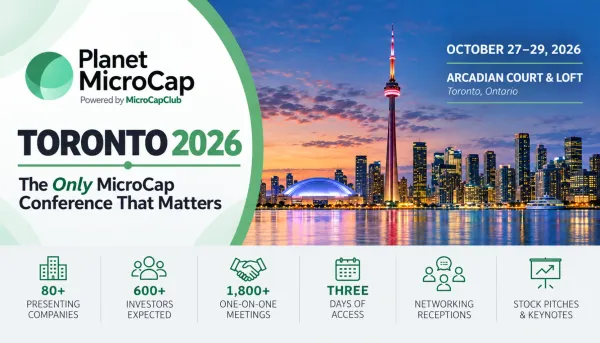
We'll have 500+ microcap investors at Planet MicroCap Las Vegas on June 16-18th. They will likely conduct over 2,000 1x1 management meetings. No AI listening in and commoditizing the knowledge. It's just those select investors willing to travel to form differential insights into companies.
The last moat was always the real moat in microcap.
Interact and learn with 250+ of the best microcap investors on the planet:
MicroCapClub is an exclusive forum for experienced microcap investors to share and discuss microcap companies (sub $1 billion market cap) trading on global markets. Since 2011, our members have profiled 1400+ microcap companies, 300+ have turned into multi-baggers. Investors can join our community by applying to become a member or subscribing to gain instant access. For more information, visit https://microcapclub.com/



Comments
Loading comments…